
Cincinnati City Zoning Code
CHAPTER 1425
PARKING AND LOADING REGULATIONS
§ 1425-01.- Purposes.
The purposes of the parking and loading regulations are to:
(a)
Require adequate off-street parking and loading, thereby reducing traffic congestion.
(b)
Allow for more efficient use of on-street parking.
(c)
Promote more efficient loading operations, reducing the use of public streets for loading purposes.
(Ordained by Ord. No. 15-2004, eff. Feb. 13, 2004)
§ 1425-03. - Requirements for Off-Street Parking and Loading.
Off-street parking and loading spaces must be provided for uses that are established, enlarged, extended or moved onto any lot in accordance with the standards in Section 1425-19 except within an Urban Parking Overlay District established according to Section 1425-04. Additional parking must be provided based on the standards of this chapter when the expansion of an existing use results in an increase of more than ten percent in the number of currently required parking spaces. Off-street parking and loading requirements for uses in the DD Districts are subject to the provisions of Chapter 1411, Downtown Development Districts.
(Ordained by Ord. No. 15-2004, eff. Feb. 13, 2004; a. Ord. No. 121-2008, § 1, eff. May 23, 2008; Ord. No. 259-2013, § 3, eff. Sept. 7, 2013; a. Emer. Ord. No. 199-2024, § 2, eff. 7-1-2024)
§ 1425-04. - Urban Parking Overlay Districts.
City Council may establish Urban Parking Overlay Districts within which the provisions of Sections 1410-09(a), 1411-23, 1425-03, 1425-05, 1425-07, 1425-09, 1425-11, 1425-13, 1425-17, 1425-19, 1425-21, and 1425-23 of the Zoning Code do not apply.
(Ord. No. 259-2013, § 4, eff. Sept. 7, 2013; a. Emer. Ord. No. 199-2024, § 2, eff. 7-1-2024)
§ 1425-05. - Noncomplying Parking or Loading Facilities.
An existing use of land or structure is not considered nonconforming solely because of the lack of off-street parking or loading facilities required by this chapter. The existing number of off-street parking and loading spaces as of the effective date of these zoning regulations may not be reduced in number.
(Ordained by Ord. No. 15-2004, eff. Feb. 13, 2004)
§ 1425-07. - Spaces Required for Multiple Uses.
If more than one use is located on a site, the number of off-street parking and loading spaces to be provided must be equal to the sum of the requirements prescribed for each use. If the gross floor area of individual uses on the same site is less than that for which a loading space would be required in Schedule 1425-21-B, but the aggregate gross floor area of all uses is greater than the minimum for which loading spaces would be required, then the aggregate gross floor area must be used in determining the required number of loading spaces according to the loading user group. If individual uses are in different loading user groups, the standards for the user group with the lowest number applies. See also provisions of § 1425-21 and § 1425-25.
(Ordained by Ord. No. 15-2004, eff. Feb. 13, 2004; a. Ord. No. 0346-2007, § 12, eff. Oct. 13, 2007)
§ 1425-09. - Existing Parking and Loading to be Maintained.
Existing parking or loading serving any facility may not be reduced in amount or changed in size to less than required by this Chapter.
(Ordained by Ord. No. 15-2004, eff. Feb. 13, 2004)
§ 1425-11. - Calculation Rules.
When the units of measurement determining the number of required parking spaces result in requirement of a fractional space, any fraction up to and including one-half is rounded down to the next whole number and fractions of over one-half are rounded up to the next whole number.
(Ordained by Ord. No. 15-2004, eff. Feb. 13, 2004)
§ 1425-13. - Dual Usage Prohibited.
An area may not be used and counted both as a required parking space and a required loading space.
(Ordained by Ord. No. 15-2004, eff. Feb. 13, 2004)
§ 1425-15. - Location of Parking.
Parking spaces must be on the same lot as the principal buildings except as noted in (c) below, and must be located in compliance with the following:
(a)
Front-Yard Parking Prohibited. In the SF and RMX Districts, parking for all uses may not be located in any front yard. Parking may be permitted on access drives where such drives lead to the parking lots or spaces either within the principal building or in any accessory structure or at locations behind the front line of a building. In the RM-2.0, RM-1.2, RM-0.7, O, ML and RF Districts, no parking lots or spaces are permitted in the required front yard setback of the district.
(b)
Corner Lots. On a corner lot in the SF and RM Districts, parking spaces must be located in interior side or rear yards and be at least ten feet from the street lot line.
(c)
Off-Site Parking on Nearby Lots. Off-site parking to serve a nearby principal structure or principal use is permitted on a lot upon the satisfaction of all of the following conditions:
(1)
the off-site parking lot shall be located within a 600-foot radius of the lot containing the principal structure or principal use;
(2)
the off-site parking lot shall not be located in a SF Single-Family District; and
(3)
(i)
A written instrument shall be recorded in title to both the lot containing the principal structure or principal use and the off-site parking lot as follows:
(aa)
If the lot containing the principal structure or principal use and the off-site parking lot are owned by the same owner, then a covenant shall be recorded; or
(bb)
If the lot containing the principal structure or principal use and the off-site parking lot are owned by different owners, then a reciprocal easement shall be recorded.
(ii)
In order to satisfy Condition (3)(i) above, any such written instrument shall:
(aa)
Be acceptable to the City Solicitor in substance and form;
(bb)
State clearly on its face that it is irrevocable without the prior written consent of the City Manager;
(cc)
State that the off-site parking lot shall be used and maintained exclusively for parking to serve the principal structure or principal use so long as the principal structure or principal use requiring such parking remains in existence and has not been abandoned, under the definition contained in Section 1447-07; and
(dd)
State that the off-site parking lot shall in no way be deemed to be a nonconforming use or be permitted to continue to be used for parking if the parking is no longer needed to serve the principal structure or principal use.
(Ordained by Ord. No. 15-2004, eff. Feb. 13, 2004; a. Ord. No. 012-2011, § 1, eff. Feb. 26, 2011; Emer. Ord. No. 008-2013, § 1, eff. Jan. 16, 2013; Ord. No. 259-2013, § 5, eff. Sept. 7, 2013; Emer. Ord. No. 141-2015, § 28, eff. July 1, 2015)
§ 1425-17. - Units of Measurement.
The following rules apply to the determination of required parking:
(a)
Gross Floor Area. In the case of uses where gross floor area is the unit for determining the required number of parking spaces, the gross floor area includes all areas employed by the use including outdoor eating and drinking areas, except that such gross floor area need not include any area used for parking within the principal building and need not include any area used for incidental service storage, installations of mechanical equipment, penthouses housing ventilators and heating systems and similar uses.
(b)
Hospital Bassinets. In hospitals, bassinets are not counted as beds.
(c)
Places of Public Assembly. In places of public assembly that provide benches, fixed or movable seating and assembly areas the requirements are as follows:
(1)
In stadiums, sports arenas and other places of assembly in which those in attendance occupy benches or other similar seating facilities, each 18 inches of such seating facilities will be counted as one seat for the purpose of determining the parking requirements of the Cincinnati Zoning Code.
(2)
In cases where a place of assembly has both fixed seats and open assembly area, parking requirements will be computed separately for each type of seating area and added together.
(Ordained by Ord. No. 15-2004, eff. Feb. 13, 2004; a. Ord. No. 93-2006, § 1, eff. May 18, 2006; a. Ord. No. 0346-2007, § 12, eff. Oct. 13, 2007)
§ 1425-19. - Off-Street Parking and Loading Requirements.
(a)
When required, off-street parking and loading spaces must be provided in accordance with Schedules 1425-19-A and 1425-19-B and made available to the use giving rise to the requirement. Unless a use is specifically noted under the appropriate use classification heading, the parking and loading requirements apply uniformly to all uses within a use classification. Off-street parking and loading requirements for uses in the DD Districts are subject to the provisions of Chapter 1411, Downtown Development Districts.
(b)
Off-street parking and loading facilities must be made permanently available to the use served. Where the use is undetermined or the parking requirement is not established in Schedule 1425-19-A, the Zoning Administrator may determine the probable use and number of spaces required.
(c)
An existing structure must maintain existing parking to the extent necessary to meet all or part of the current parking requirements for an existing or proposed use, but no additional parking shall be required in the event of a change in use of the structure.
(d)
Commercial uses located in certain Commercial, Office, and Manufacturing zoning districts are entitled to an exemption from the parking requirements as follows:
(1)
Commercial Uses in the CN-P and CC-P Zoning Districts. The first 2,000 square feet of gross floor area of existing and new commercial uses are exempted from the off-street parking requirements.
(2)
Commercial Uses in the CN-M, CC-M, OL, OG, IR, RF-C and ML Zoning Districts. The first 2,000 square feet of gross floor area of commercial uses in existing buildings are exempted from the off-street parking requirements. Commercial uses in new buildings are not exempted from the parking requirements.
Schedule 1425-19-A: Off-Street Parking and Loading Requirements
Schedule 1425-19-B: Loading User Group Classification
(Ordained by Ord. No. 15-2004, eff. Feb. 13, 2004; a. Ord. No. 96-2006, § 1, eff. May 18, 2006; a. Ord. No. 0022-2007, § 1, eff. Feb. 18, 2007; a. Ord. No. 0346-2007, § 12, eff. Oct. 13, 2007; a. Ord. No. 121-2008, §§ 2, 3, eff. May 23, 2008; a. Ord. No. 174-2008, § 1, eff. June 29, 2008; Emer. Ord. No. 141-2015, § 29, eff. July 1, 2015; a. Ord. No. 131-2018, § 1, eff. July 6, 2018; a. Emer. Ord. No. 418-2021, §§ 8, 39, eff. Nov. 10, 2021; a. Emer. Ord. No. 199-2024, § 2, eff. 7-1-2024)
§ 1425-21. - Shopping Center Requirements.
In lieu of calculating the number of parking spaces for individual uses in a shopping center, an overall requirement of four spaces for every 1,000 square feet of gross leasable floor area may be used. The same gross floor area may be used to calculate the loading spaces using the provisions of Loading User Group 1.
(Ordained by Ord. No. 15-2004, eff. Feb. 13, 2004; a. Ord. No. 0346-2007, § 12, eff. Oct. 13, 2007)
§ 1425-23. - Reduced Parking.
A reduction in the number of spaces to less than that specified in Schedule 1425-19-A is permitted under the following conditions:
(a)
Proximity to Public Parking Facilities. In the O, C, UM, and M Districts, where a use is located within 1,300 feet of a public parking facility, either publicly or privately owned and operated, as measured along paved sidewalks or walkways that provide access to both sites, and the facility could provide fifty percent or more of the parking spaces required for the use, the parking requirements for the use shall be reduced by fifty percent. If the reduced requirement results in fewer than five spaces being required, no spaces need be provided.
(b)
Multiple Uses on a Single Development Site. The maximum allowable reduction in the number of spaces to be provided may not exceed 15 percent of the sum of the number required for each individual use served and not less than the largest amount required for any of the uses computed separately. A covenant in a form satisfactory to the City Solicitor must be filed with the Zoning Administrator in which the owner or owners of property comprising the site agree to participate in the shared parking program. The covenant must include the following:
(1)
An agreement that there will be no substantial alteration in the uses that will create a greater demand for parking.
(2)
An agreement among the landowners for access to and use of the shared parking spaces.
(c)
Housing for the Elderly and Persons with Disabilities. The parking requirements for Type A dwelling units is one parking space for every two units, provided that the owner files with the Zoning Administrator, a covenant that reserves those units for the exclusive use of the elderly and persons with disabilities. "Type A dwelling unit" means an accessible dwelling unit complying with Section 1002 of the American National Standard ICC/ANSI A117.1-1998. "Exclusive use of the elderly and persons with disabilities" means that at least one member of the household occupying the dwelling unit is 60 years of age or older or has a physical or mental impairment that substantially limits one or more major life activities, including the functions of caring for one's self, performing manual tasks, walking, seeing, hearing, speaking, breathing, learning and working; a record of a physical or mental impairment; or being regarded as having a physical or mental impairment.
(d)
Proximity to Streetcar. The parking requirements for residential uses in SF, RM, RF-R, and UM Districts are reduced by fifty percent if located within 600 feet of a streetcar stop. If the effect of the fifty percent reduction means that fewer than three spaces are required, then no spaces need be provided.
(e)
On-Street Parking. Required off-street parking spaces shall be reduced in an amount equal to the number of on-street parking spaces located adjacent to the property line on the same side of the street. An on-street parking space used to comply with the requirement of this Section must be 20 feet in length, as measured perpendicularly to parallel straight lines.
(Ordained by Ord. No. 15-2004, eff. Feb. 13, 2004; a. Ord. No. 370-2006, § 1, eff. Jan. 20, 2007; a. Ord. No. 0221-2007, § 7, eff. July 6, 2007; a. Ord. No. 416-2010, § 5, eff. Dec. 24, 2010; Emer. Ord. No. 141-2015, § 30, eff. July 1, 2015; a. Emer. Ord. No. 199-2024, § 2, eff. 7-1-2024)
§ 1425-25. - Off-Street Parking and Loading Dimensions.
The following standards apply to off-street parking and loading facilities:
(a)
Size. A parking space used to comply with the parking requirements of this chapter may not be less than 8.5 feet in width, as measured perpendicularly to parallel straight lines and contain 160 square feet in area. The parking spaces, access drives and aisles of the parking facility design must be as approved by the Zoning Administrator.
(b)
Loading Space. Each loading space may not be less than ten feet in width and 25 feet in length.
(Ordained by Ord. No. 15-2004, eff. Feb. 13, 2004; Emer. Ord. No. 141-2015, § 31, eff. July 1, 2015)
§ 1425-27. - Parking Lot Screening.
In Residential Districts, a screen fence or solid wall is required for parking areas for four or more vehicles which adjoin or face any other premises, either abutting or directly opposite across-the-street, situated in any Residential or Parks and Recreation District. The fence or wall must be at least four feet and a maximum of six feet in height and must be maintained in good condition. A combination of a four-foot high berm with three-foot high continuous evergreen hedgerow or four-foot high continuous evergreen hedgerow may be substituted for screen fencing and walls. The fence is not required along that side of the property where one of the following conditions exist:
(a)
Abutting Parking Lot. The abutting property is developed with a parking lot within 25 feet of the common property line for four or more vehicles.
(b)
Grade Differential. The abutting property has an average elevation of four feet or more above the parking area surface, within an average horizontal distance of eight feet from the parking area.
(c)
Buffer Yard. The requirements of § 1423-13, Required Buffer Yards are satisfied.
(Ordained by Ord. No. 15-2004, eff. Feb. 13, 2004; a. Ord. No. 257-2007, § 4, eff. Aug. 27, 2007)
§ 1425-29. - Surface Parking Lot Landscaping.
Surface parking lots shall comply with the minimum landscaping and design requirements set forth below.
(a)
General Landscaping Requirements.
1.
Perimeter Landscaping. Surface parking lots shall provide a landscape buffer area separating the parking facility from adjoining streets. The buffer area shall be located within a six-inch-high, poured-in-place concrete curb, landscaped with plant material, and measure at least eight feet in width in CC-A and CG-A zoning districts and five feet in width in all other zoning districts. The buffer area shall not be paved except for approved walkways, bikeways, driveways, and other approved amenities or site elements. A perimeter landscape area of at least three feet in width is required for perimeter areas not adjoining streets.
2.
Trees. Surface parking lots shall provide at least one tree per ten parking spaces, including one canopy tree per 25 linear feet dispersed throughout the entirety of the perimeter landscape buffer area.
All trees shall have a minimum size at the time of planting as follows:
(a)
Two-inch caliper for a deciduous tree;
(b)
Four-foot height for a conifer or evergreen tree.
3.
Ground Cover. Ground cover shall be installed appropriate to the surface conditions of the area. Grass is the default landscaping material.
4.
Lighting and Walkways. Lighting fixtures and walkways are permitted within all islands and perimeter areas.
5.
Maintenance. All required plantings must be permanently maintained in good growing condition and replaced with new plant materials when necessary to ensure continued compliance with applicable landscaping requirements.
(b)
Facilities Larger than One-Quarter Acre. Surface parking lots larger than one-quarter acre (i.e., 10,890 square feet) shall conform to the following additional standards:
(1)
No parking area within a surface parking lot shall exceed one-quarter acre (i.e., 10,890 square feet) in size. To conform to this requirement, larger parking areas shall be divided into smaller parking areas by one or more landscape islands or peninsulas contained within and dispersed throughout the interior of the parking lot.
(2)
Interior landscaped islands and peninsulas shall contain plant material and plant-based ground cover within six-inch-high, poured-in-place concrete curbs, and at least one of every four trees required by subsection (a)(2) shall be located within the interior landscaped islands and peninsulas.
(3)
Landscaped islands and peninsulas need not be uniformly spaced but shall provide a minimum separation of fifteen feet between smaller parking areas.
(c)
Existing Surface Parking Lots. Surface parking lots established prior to the effective date of this zoning amendment must comply with the requirements of this section upon demolition of a principal structure for which the lot served as an accessory use or the redevelopment or expansion of existing site ground coverage (including buildings, accessory uses or structures, parking and outdoor storage areas) of thirty percent or more.
(Ordained by Ord. No. 15-2004, eff. Feb. 13, 2004; a. Emer. Ord. No. 199-2024, § 2, eff. 7-1-2024)
§ 1425-31. - Parking Lot Markings.
Driveways and parking areas must include markings consistent with the following standards:
(a)
Markings. Each parking space and parking facility must be identified by surface markings at all times. The markings must be arranged to provide for orderly and safe loading, unloading, parking and storage of vehicles. Markings required to be maintained in a highly visible condition include striping, directional arrows and signs for areas designated for persons with disabilities.
(b)
Directional Arrows. One-way and two-way access ways into required parking facilities must be identified by directional arrows. Any two-way access located at any angle other than 90 degrees to a street must be marked with a traffic separation stripe throughout the length of the access; this requirement does not extend to aisles.
(c)
Exit Signs. Where the exit may not be clearly recognizable, directional signage must be provided.
(Ordained by Ord. No. 15-2004, eff. Feb. 13, 2004; a. Ord. No. 287-23, § 1, eff. August 2, 2023)
§ 1425-33. - Additional Parking Lot Standards.
Driveways and parking areas must comply with the following standards:
(a)
Vertical Clearance. The minimum vertical clearance for parking spaces is 6 feet 8 inches.
(b)
Wheel Stops. All spaces must have wheel stops 2.5 feet from a fence, wall, or walkway unless this requirement is waived by the Zoning Administrator.
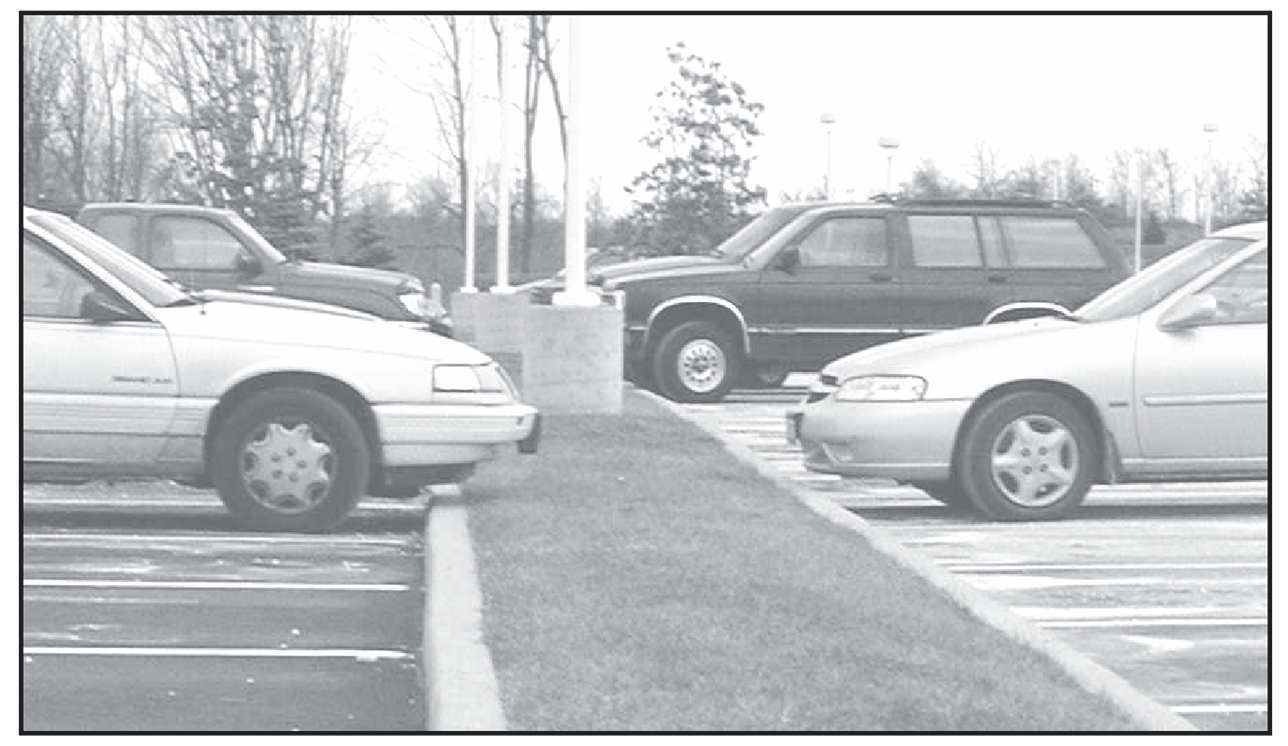
Figure 1425-33 Landscape Island WITHOUT Wheel Stops (Bumpers)
(Ordained by Ord. No. 15-2004, eff. Feb. 13, 2004; a. Ord. No. 249-2005, eff. July 21, 2005; Emer. Ord. No. 141-2015, § 32, eff. July 1, 2015)
§ 1425-35. - Access Drive and Maneuvering Aisles.
Access drives for parking purposes are permitted only in connection with permitted uses, except for access drives to restricted parking lots allowed by the Zoning Administrator in connection with uses in more restricted districts.
(a)
Parking Access. An access drive connecting the required parking spaces to a street must be provided either on the same lot as the principal use, or if located on a separate lot as the principal use by either of the following recorded instruments: (i) a recorded covenant if the lot containing the access drive is owned by the same owner as the lot containing the principal use; or (ii) a recorded reciprocal easement if the lot containing the access drive has a different owner than the lot containing the principal use. In any event, any such recorded instrument shall state clearly on its face that it is irrevocable without the prior written consent of the City Manager and shall be acceptable to the City Solicitor. Where provided on the same lot as the principal use, the access drives must have a minimum width of eight feet and a maximum aggregate width of 20 feet. Where provided for by a recorded instrument, the access drive must have a minimum width of eight feet, except where the access drive serves more than two properties in which case the access drive must be 16 feet.
(b)
Maneuvering Aisles. Maneuvering aisles and driveways may serve both required parking spaces and loading spaces if they meet the requirements specified in §1425-19 and § 1425-25 for both parking and loading facilities.
(c)
Requirement for Wider Driveway. The City Engineer may require a wider driveway and driveway opening for a development.
(d)
Driveway Visibility. Visibility from a driveway may not be blocked between a height of three feet and seven feet for a depth of five feet from the street property line and five feet from the edge of the driveway or at the nearest property line intersecting the street property line, whichever is less. Refer to Figure 1425-35.
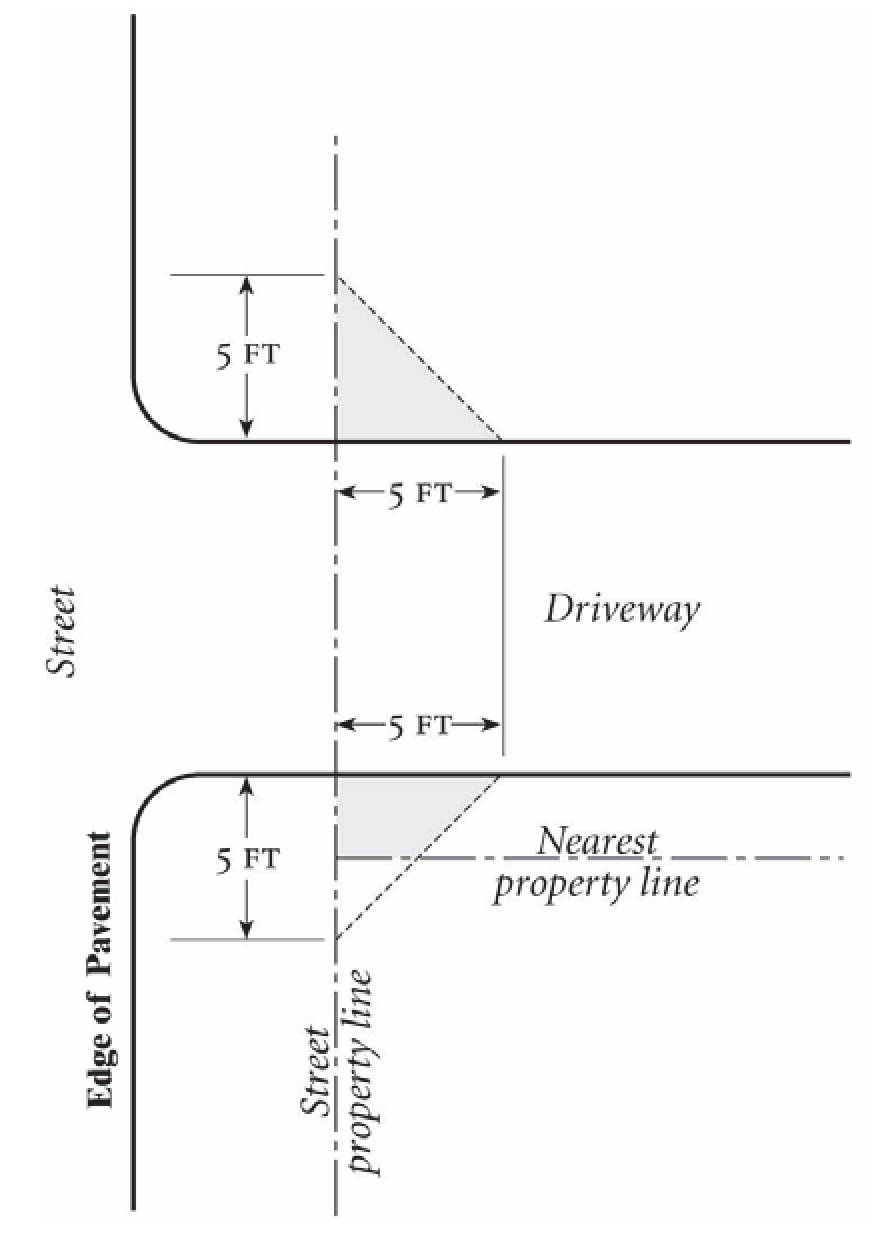
Figure 1425-35 Driveway Visibility
(e)
Garage Doors Facing an Alley. Any garage door facing an alley shall provide an adequate turning radius.
(Ordained by Ord. No. 15-2004, eff. Feb. 13, 2004; a. Ord. No. 0057-2008, § 1, eff. March 13, 2008; a. Ord. No. 363-2010, § 1, eff. Nov. 13, 2010; Emer. Ord. No. 141-2015, § 33, eff. July 1, 2015)
§ 1425-37. - Surfacing, Drainage and Grade of Parking and Loading Facilities.
Parking and loading facilities must comply with the following standards:
(a)
Maximum Slope. The maximum slope of any required maneuvering aisle, parking space or loading space is ten percent and the maximum slope of any required driveway is 15 percent.
(b)
Surfacing. Parking areas, maneuvering aisles and loading spaces must be paved with asphalt, concrete, interlocking masonry pavers or surfaced with open honeycomb paving blocks which allow grass or ground cover to grow, except as otherwise authorized by the Zoning Administrator.
(c)
Drainage. All paved parking areas, access drives and loading spaces must have satisfactory disposal of surface waters by grading and drainage subject to approval by the Metropolitan Sewer District.
(d)
Maintenance. Parking areas, maneuvering aisles and loading spaces must be maintained in good condition, free from broken asphalt, concrete, potholes and weeds and in a state of equivalent quality to that which was approved or required by the City.
(Ordained by Ord. No. 15-2004, eff. Feb. 13, 2004; a. Ord. No. 250-2005, eff. July 21, 2005; Emer. Ord. No. 141-2015, § 34, eff. July 1, 2015)
§ 1425-38. - Bicycle Parking.
The requirements for bicycle parking are established for the purpose of ensuring secure, weather-protected facilities to accommodate short- and long-term bicycle parking and to encourage the use of bicycles for travel as an alternative to the use of motorized vehicles.
(a)
Applicability. Bicycle parking facilities shall be provided in every new parking garage, and for every expansion of an existing parking garage when the expansion includes the provision of 60 or more additional motor vehicle parking spaces.
(b)
Maintenance. The property owner of the garage is responsible for all maintenance requirements imposed by this section.
(c)
Bicycle Parking Requirements. Bicycle parking spaces shall be provided at a rate of 1 bicycle parking space for every 20 motor vehicle parking spaces provided. In the case of a garage providing bicycle parking spaces based on an expansion, the number of bicycle parking spaces required shall be calculated based on the number of additional motor vehicle spaces created by the expansion.
(1)
Maximum. No parking garage shall be required to provide more than 24 bicycle parking spaces.
(2)
Fractional Spaces. When the units of measurement determining the number of required parking spaces result in requirement of a fractional space, any fraction up to and including one-half is rounded down to the nearest whole number and fractions of over one-half are rounded up to the next whole number.
(d)
Bicycle Parking Space Dimensions. An area no less than 2 feet in width by 6 feet in length shall be provided for each bicycle space. However, the area for each bicycle space may be reduced upon application to the Superintendent of Parking to certify that the proposed layout adequately accommodates the specified number of bicycles.
(e)
Location of Bicycle Parking Spaces.
(1)
Bicycle parking shall be located no lower than the first complete, contiguous parking level below grade, and no higher than the first complete, contiguous parking level above grade. There shall be no stairs on the access route to bicycle parking area(s).
(2)
Bicycle parking spaces shall be located inside the garage in an area that is protected from inclement weather.
(3)
Bicycle parking spaces shall be equipped with one of the following: a bicycle locker; a securely anchored floor, wall, or ceiling rack; or a similar system for securing the bicycle.
(4)
Bicycle parking shall be located in a highly visible area to minimize theft and vandalism.
(5)
Bicycle parking shall be separated from motor vehicle parking spaces and lanes of traffic by a physical barrier (such as a curb or bollard).
(6)
An aisle or other space at least 5 feet wide shall be provided behind all required bicycle parking to allow room for bicycle maneuvering.
(7)
The Department of Transportation and Engineering maintains a handbook of racks and siting guidelines that meet the standards of this section.
(f)
Standards for Bicycle Racks. Where required bicycle parking is provided by racks, the racks shall meet the following standards:
(1)
The bicycle frame and one wheel can be locked to the rack with a high security, U-shaped shackle lock and cable lock if both wheels are left on the bicycle. Bicycle racks that support the wheel but not the frame of the bike may not be used to fulfill a bicycle parking requirement.
(2)
A bicycle 6 feet long can be securely held with its frame supported so that the bicycle cannot be pushed or fall in a manner that will damage the wheels or components.
(3)
The rack shall be securely anchored.
(g)
Notice of Bicycle Parking. A sign shall be provided at each point of bicycle entry to the parking garage, mounted with its center between four and six feet above the ground, directly visible and unobstructed from the street. The entry sign shall match exactly the designated sign on file with the Department of Transportation & Engineering. Bicycle parking signs shall not be used in the calculation of maximum total sign area.
(Ordained by Ord. No. 156-2010, § 1, eff. June 12, 2010)
§ 1425-39. - Electric Vehicle Charging Equipment.
Electric vehicle charging equipment is permitted at any location where off-street parking spaces are permitted.
(Ordained by Emer. Ord. No. 199-2024, § 1, eff. 7-1-2024)

