
Cupertino City Zoning Code
CHAPTER 19
48: FENCES
19.48.010 Purpose.
The purpose of this chapter is to regulate the location and height of fences in yards of all zoning districts in order to protect the safety, privacy, and property values of residents and owners of properties within any zoning district of the City, including but not limited to residential, commercial, offices, institutional, industrial and/or agricultural properties. (Ord. 2085, § 2 (part), 2011; Ord. 1979, (part), 2006; Ord. 1788, § 1 (part), 1998)
19.48.020 Fence Location and Height in All Zones Except R1, RHS, R2, and R3 (up to Four Units).
- Design Review shall be required for projects in all zoning districts except R1, RHS, R2, and R3 (with up to four units).
- The Approval Body for a proposed project shall have the authority to require, approve, or disapprove fencing plans including location, height, and materials. Where an Approval Body is not identified, the Director of Community Development, or his or her designee, shall have the authority to require, approve, or disapprove fencing plans and design.
- The basic Design Review guidelines for the review of fences and walls are as follows:
- Fences separating commercial, industrial, offices, and institutional zones from residential zones shall be constructed at a height and with materials designed to:
- Acoustically isolate part of or all noise emitted by future uses within the commercial, industrial, offices, or institutional zones. The degree of acoustical isolation shall comply with the standards of Chapter 10.48.
- Ensure visual privacy for adjoining residential dwelling units.
- Fences shall be designed in a manner to provide for sight visibility at private and public street intersections (i.e. corner triangles or any sidewalk sight triangle).
- Fence design shall be consistent with the standards outlined in this Title for the applicable zone.
- Fences shall meet the regulations of any applicable Special Area Plan, Design Guidelines, or conceptual development plan.
- At no point shall fence height exceed 10 feet without a Fence Exception*
- Fences separating commercial, industrial, offices, and institutional zones from residential zones shall be constructed at a height and with materials designed to:
*For statutory provisions regarding fences taller than ten feet in height, see Civil Code § 841.4.
(Ord. 2085, § 2 (part), 2011; Ord. 1979, (part), 2006; Ord. 1844, § 1 (part), 2000; Ord. 1788, § 1 (part), 1998; Ord. 24-2260, Att. A, (§ 1) 2024.)
19.48.030 Fence Location and Height for Properties Not Requiring Design Review.
Table 19.48.030 sets forth the rules and regulations pertaining to fences on properties where design review is not required. Appendix A is a visual representation of the provisions of Section 19.48.030(A)–(C). The Director of Community Development is authorized to administratively make changes to Appendix A to clarify the intent of these provisions.
19.48.040 - Fence Design Requirements.
- Prohibited Materials:
The following materials shall be considered “Prohibited Materials” for purposes of this Chapter:- Unless required by law or regulation of the City, State or Federal Government, barbed wire, razor wire, chicken wire and similar small-gauge wire or mesh product, and/or electrified fencing are prohibited.
- Fences made of non-engineered plastic, fabric membranes, cloth, canvas, plywood, uncoated cyclone/chain link, and reed or bamboo with sticks and slats smaller than four inches in width are prohibited, unless located in areas not visible from public areas or adjacent properties.
- Allowed Materials: Allowed materials include, but are not limited to wood, engineered plastic, vinyl coated cyclone/chain link, metal (e.g. wrought iron), brick, block, stone, and other comparable (safe and commercially acceptable) materials intended for fence use.
- Material colors shall be natural earth tone and/or vegetation colors including natural hues of brown, green and shades of gray and shall have a reflectivity value of 60 or less.
- Other materials, except Prohibited Materials, may be allowed if deemed appropriate through Design Review approval.
- The area between the back of curb and any fencing shall be landscaped, with a suitable permanent irrigation system where necessary, or have pervious flatwork, and be continuously maintained by the property owner.
- General Maintenance: All fences adjacent to a street, sidewalk, or public right-of-way shall be continuously maintained free of visible and structural defects.
(Ord. 24-2260, Att. A, (§ 1) 2024)
19.48.050 - Proximity of Plants and Fences to Public Streets.
The proximity of plants and fences to public streets shall be controlled by the provisions of Chapter 14.08 of the Municipal Code.
(Ord. 24-2260, Att. A, (§ 1) 2024)
19.48.060 Roadway and Driveway Gates.
Roadway and Driveway gates are allowed if they comply with the Fire Department Standard Details and Specifications for Security Gates for access roadways and driveways and the criteria in Sections 19.48.969(A)-(C). Roadway and driveway gates in existence prior to September 20, 1999, with necessary permits to install them, are permitted to be replaced. All unpermitted roadway and driveway gates must comply with the regulations outlined below, when replaced.
19.48.070 Exceptions–Findings.
Where practical difficulties, unnecessary hardships, or results inconsistent with the purpose and intent of this chapter result from the strict application of the provisions hereof, exceptions may be granted as provided in Chapter 19.12, and this section for all zoning districts except the RHS Zoning District, in which case a Hillside Exception must be obtained in accord with the requirements of Section 19.40.040 and Section 19.40.070. The Approval Body may grant a request for a Fence Exception only if all the following findings can be made:
- The literal enforcement of the provisions of this chapter will result in restrictions inconsistent with the spirit and intent of this chapter and the proposed development is otherwise consistent with the City's General Plan and with the purpose of this chapter as described in Section 19.48.010.
- The granting of the exception will not result in a condition which is materially detrimental to the public health, safety or welfare or result in a hazardous condition for pedestrian and vehicular traffic.
- The exception to be granted is one that will require the least modification of the prescribed regulation and the minimum variance that will accomplish the purpose.
- When driveway, roadway, and structured parking gates not meeting allowed standards are proposed: The proposed development meets the requirements of the Santa Clara Fire Department and Sheriff's Department, and if security gates are proposed, that attempts are made to standardize access.
- When fences and gates that exceed allowable height limitations are proposed: The fence height for the proposed residential fence is needed to ensure adequate screening and/or privacy.
(Ord. 2085, § 2 (part), 2011; Ord. 24-2260, Att. A, (§ 1) 2024)
19.48.080 Temporary Fences for Construction.
- The Building Official may require persons constructing structures in the city to erect and maintain temporary fences around all or a portion of the construction site in order to secure the site from entry by the general public. Any such fencing may only be erected during the time a valid building permit is issued for construction.
- Temporary fences are not required to comply with the location requirements of Section 19.48.030 but shall not be located in any corner or sidewalk sight triangle.
- Temporary fence materials are restricted to non-combustible materials and must screen construction activities. Temporary fence materials shall be consistent with the prohibited and allowed materials outlined in Section 19.48.040 (A) and (B), except that uncoated cyclone/chain link fences may be allowed.
- All fences adjacent to a street, sidewalk, or public right-of-way shall be continuously maintained free of visible and structural defects.
(Ord. 2085, § 2 (part), 2011; Ord. 1979, (part), 2006; Ord. 1777, (part), 1998; Ord. 24-2260, Att. A, (§ 1) 2024)
19.48.090 Violation–Penalty.
Any person who violates the provisions of this chapter shall be guilty of an infraction and upon conviction thereof shall be punished as provided in Chapter 1.12.
(Ord. 2085, § 2 (part), 2011; Ord. 1979, (part), 2006; Ord. 1788, § 1 (part), 1998; Ord. 24-2260, Att. A, (§ 1) 2024)
Table 19.48.030: Fence Location and Regulations
| 7 foot high fence | 3 foot high fence | ||
|---|---|---|---|
| A. Front Yard | Not within required setback area, corner triangle, or sidewalk sight triangle. | Along any property line, in any required setback area, corner triangle, or sidewalk sight triangle. | |
| B. Rear Yard | Along property line or in required setback area, except not allowed in any corner triangle or sidewalk sight triangle. | ||
| C. Side Yard |
| ||
| D. Additional Regulations for Residential Hillside, Open Space Zoning Districts, and R1 Properties with an Average Slope Over 20% |
| ||
| E. In areas where a seven (7) foot fence is allowed, an up to eight (8) foot high fence can be constructed, subject to building permit approval and upon receipt of written approval from abutting property owners. | |||
F. Hedges exceeding the height requirements for fences outlined in Section 19.48.030(A)-(C) are allowed:
| |||
| G. Minor ornamental entry features (e.g. arbor, trellis, entry gates, light fixtures meeting the requirements of Chapter 19.102). |
| ||
| H. Notwithstanding any other provision of this chapter, fences shall not be located in any future right of way dedication area, and setbacks shall be measured from any planned future street line, as determined by the Public Works Department. | |||
| I. If the Director of Community Development determines that a proposed fence is widely visible to public view and has the potential to create impacts on the visual character of an area (for example, blocks public views from the valley floor to the hills or an open space reserve), then the proposed fence shall comply with the requirements in Sections 19.48.030D(1)(b) & 19.48.030D(2) regardless of lot size. | |||
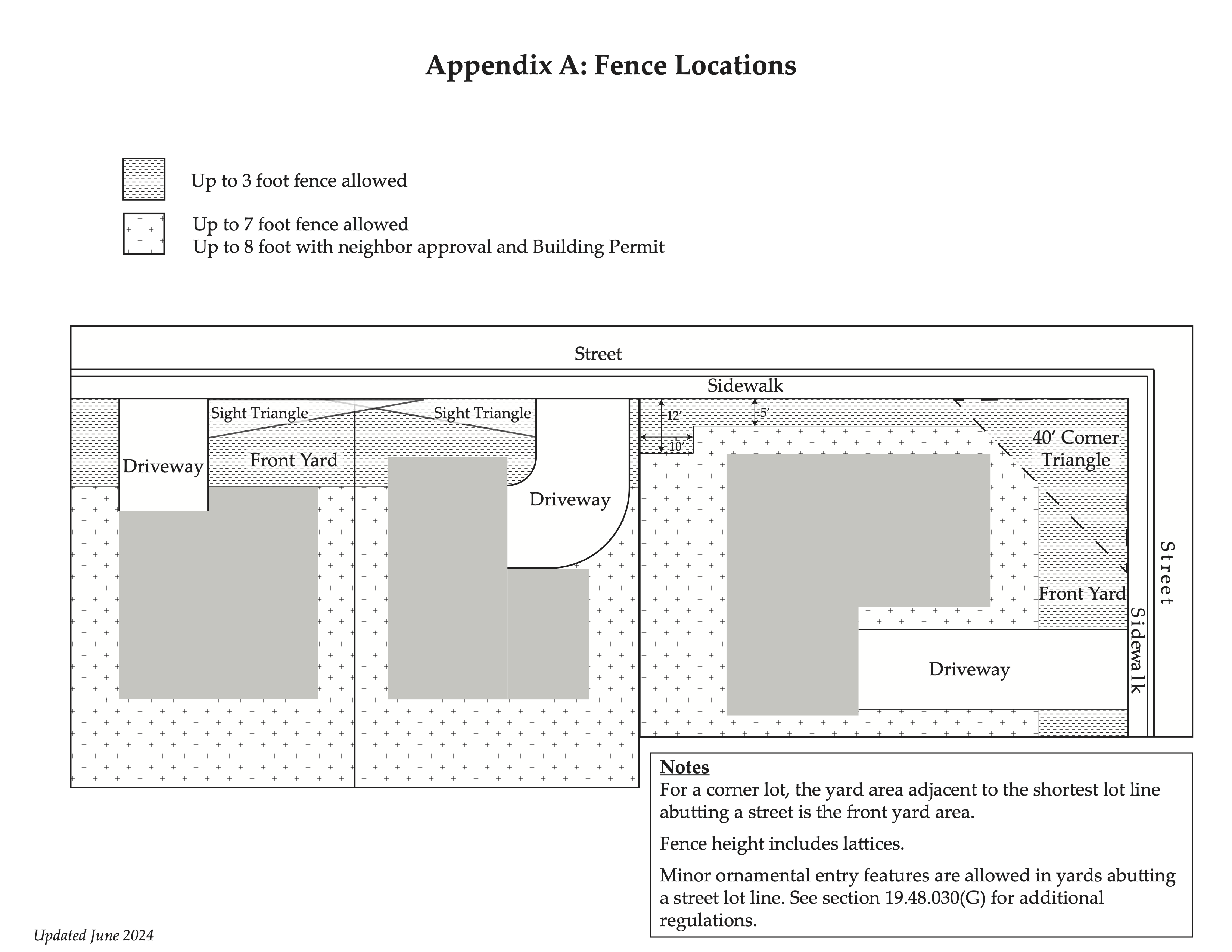
(Ord. 2085, § 2 (part), 2011; Ord. 24-2260, Att. A, (§ 1) 2024)
Table 19.48.060: Roadway and Driveway Gate Regulations
| A. All Residential Districts, Except RHS: |
|
| B. RHS Zoning District: |
|
| C. Other Development: |
|
(Ord. 2085, § 2 (part), 2011; Ord. 24-2260, Att. A, (§ 1) 2024)

