
Cupertino City Zoning Code
Appendix A
City of Cupertino Two Story Design Principles
Introduction
Cupertino’s neighborhoods have developed over a period of decades with varying architectural styles. Two story homes with a second story to first floor ratio greater than 66% and homes with second story side setbacks less than 15 feet must offset the building massing with designs that encompass higher quality architectural features and materials.
Design Principles
These design principles help integrate new homes and additions to existing homes with existing neighborhoods by providing a framework for the review and approval process. Where possible, additional details and examples have been provided. Conditions not covered by these examples will be evaluated on a case-by-cases basis.
- Provide an identifiable architectural style. Attractive homes are designed by using elements from one consistent theme. It is best to work with your designer to identify and carry out one style around the entire house.
- Design features. Proportions and details to be consistent with architectural style.
- Provide facade articulation. The following techniques offer ways to mitigate the bulk of larger homes in smaller scale neighborhoods and the impact of two- story tall walls on adjacent neighbors and the streetscape.
Second floor setbacks
Horizontal and vertical wall plane changes
Pop outs
Bay windows
Chimneys
Wide overhangs with projecting brackets
Juliet balconies
Belly bands
Window boxes and pot shelves
Landscaped trellises and lattices
Projecting window trim
Materials and color changes
Inset balconies
Applied decorative features
Recessed garage doors
Window trim
Tall trees to break up view of long walls - Use high quality materials.
- Ensure massing and scale appropriate to the architectural style.
- Design with architectural integrity of forms, materials and details on all sides of the structure.
- Provide symmetry, proportions and balance consistent with the architectural style.
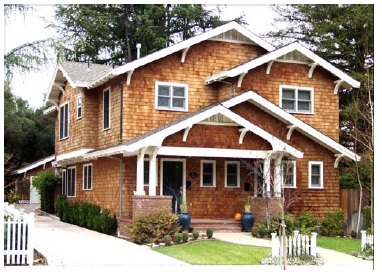
Distinguishing Architectural Features
There are a wide range of architectural styles in Cupertino. However, there are a few that have been most preferred in recent years. Annotated illustrations outlining some of the distinguishing features for five of the most common styles are included on the following pages:
Arts and Crafts
Mediterranean
Spanish Eclectic
Italian Villa
French Country
Resourses
The following resources may be useful to homeowners, buildings, and design professionals in understanding the special qualities of specific house styles.
A Field Guide to American Homes
Viginia & Lee McAlester
Alfred A. Knopf 2000
The Abrams Guide to American House Styles
Wilkin Morgan
Harry N. Abrams, Inc. 2004
House Styles in America
James C. Massey
Penquin Studio 1996
Celebrating the American Home
Joanne Kellar Bouknight
The Taunton Press 2005
The Distinctive Home, A Vision of Timeless Design
Jeremiah Eck
The Taunton Press 2005
Arts and Crafts Style
DISTINGUISHING FEATURES
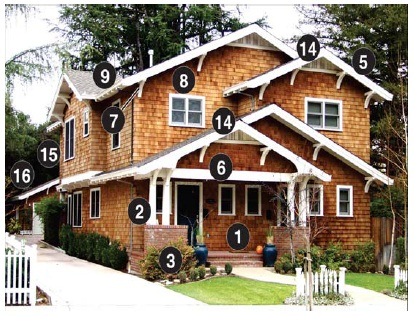
Arts and Crafts Style homes are characterized by gently pitched broad roof gables with wide eave overhangs. The visual impact of second floor spaces is often minimized by incorporating the living space into the roof form, and utilizing gable or shed dormers for light and interior volume. Generously sized entry porches with distinctive columns and column bases are common, as is the abundance of wood details.
- Generous and slightly elevated entry porch
- Large tapered or square wood columns
- Stone, brick, shingle, or wood paneled column base
- Wood porch railing
- Gabled roof ends
- Expressed wood beam
- Decorative wood brackets
- Wide wood window frames with divided light panes
- Exposed rafter tails
- Decorative Arts and Crafts carriage light
- Gable and shed dormers
- Shingles and/or wood siding occasionally with a small amount of stucco
- Composition or simulated wood shake roof shingles
- Interesting gable end window, attic vent, and/or wood details
- Bay windows with base trim and brackets
- Ancillary structures with matching forms, materials, and details
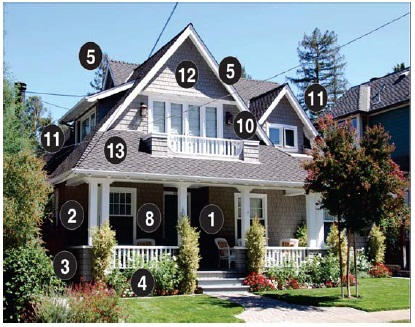
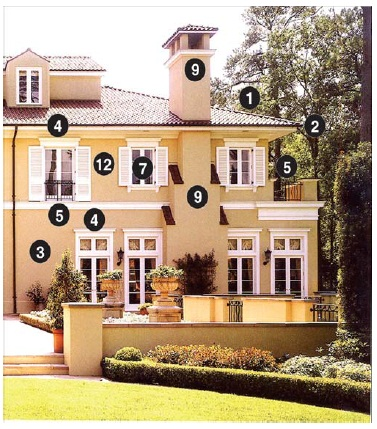
Mediterranean Style
DISTINGUISHING FEATURES
Mediterranean Style homes are characterized by low-pitched hip roofs, typically covered in tile. Roof overhangs are generally wide, and often are accentuated by decorative brackets. Windows are typically deep set from the exterior wall surface, and upper story windows are smaller and less elaborate than ground floor windows. Selected windows and doors often have arched head shapes, and entries are accentuated by deep recessed and flanking columns attached to the wall, but are generally subdued. Facades are often symmetrical.
- Low pitched roof with heavy textured tiles
- Wide roof overhangs for sun shading, often with decorative brackets
- Stucco or stone walls
- Deep set windows and entries, sometimes with arched heads and/or windows accentuated with surrounding trim
- Decorative metal carriage lights and railings
- Often symmetrical massing and window layout
- Upper floor windows smaller and less elaborate
- Supplemental sun shading at selected windows
- Distinctive chimney shapes and caps
- Small balconies with decorative railings and brackets
- Decorative columns and details
- Decorative shutters
Spanish Eclectic Style
DISTINGUISHING FEATURES
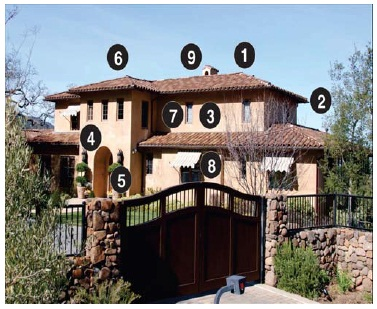
Spanish Eclectic Style homes are characterized by low-pitched gable and hip roofs, typically covered in red tiles. Roof overhangs may be wide with decorative brackets or minimal with curved molding at the wall/roof juncture. Windows are typically deep set from the exterior wall surface, and usually have projecting molding at their heads and sills. Selected windows and doors often have arched head shapes, and entries are accentuated by deep recesses and heavy wood doors. Facades are generally informal and asymmetrical in their massing.
- Low pitched roofs with heavy textured red tiles - overhangs may be large with decorative brackets or very small with curved molding at the wall/roof juncture
- Stucco walls
- Recessed entry door - often with arched head
- Deep set windows, sometimes with arched heads
- Informal and asymmetrical building forms
- Distinctive upper level balconies with metal or wood details
- Wood window shutters
- Projecting window head and sill trim
- Decorative tile and metal details
- Distinctive chimney shapes and caps
- Second floor overhangs with wood beam and bracket supports
- Casement windows with divided lights


Italian Villa Style
DISTINGUISHING FEATURES
Italian Villa Style homes are characterized in the Bay Area a wide variety of forms and details drawn from a variety of common Italian styles. They are frequently formal in their facade design, and often symmetrical with accentuated windows and entries.
- Low pitched hip roof
- Wide roof eaves, often with formal supporting brackets
- Symmetrical or asymmetrical front facade window patterns well-organized around a projecting formal entry with Italianate columns
- Tall first floor windows
- Deep set windows in grouped patterns
- Arched window heads and/or accentuated trim above the windows
- Projecting or recessed entries with Italianate columns and/or trim
- Projecting window heads, jambs and sills
- Articulated belt and trim courses


French Country Style
DISTINGUISHING FEATURES
French Country Style homes are characterized by steeply pitched roofs with eaves commonly flared upward at roof-wall junctions. They may be symmetrical in form and facade organization, but are more typically asymmetrical. Some variations include a round tower with a high, conical roof. Individual homes exhibit a wide variety in form detailing, but are united by the strong roof form. Roof are commonly covered with slate, tile or other rough-textured materials. Roof dormers are common. Entries are often deep-set from the home’s front wall.
- Gable and hip roof forms with medium to steep pitch
- Closed eaves
- Stucco, stone, or brick walls
- Recessed entry vestibule with decorative molding or projecting gable
- Articulated entry details
- Casement windows with divided lights - often recessed
- Second floor overhangs with wood beam and decorative supports
- Planter boxes, shutters, and other decorative details
- Distinctive chimney shapes and caps
- Gabled dormers
- Bay windows with metal roofs



