
Cupertino City Zoning Code
CHAPTER 19
08: DEFINITIONS
19.08.010 Purpose and Applicability.
The purpose of this chapter is to promote consistency and precision in the interpretation of zoning regulations. The meaning and construction of words and phrases defined in this chapter shall apply throughout the zoning regulations, except where the context of such word or phrases clearly indicates a different meaning or construction.
(Ord. 14-2125, § 3 (part), 2014; Ord. 2085, § 2 (part), 2011; Ord. 1601, Exh. A (part), 1992)
19.08.020 General Rules for Construction of Language.
The following general rules of construction shall apply to the text of the zoning regulations:
- The particular shall control the general.
- In case of any difference of meaning or implication between the text of any provision and any caption or illustration, the text shall control.
- The word "shall" is always mandatory and not discretionary. The word "may" is discretionary.
- References in the masculine and feminine genders are interchangeable.
- Words used in the singular include the plural, and the plural includes the singular, unless the context clearly indicates the contrary.
- The words "activities" and "facilities" include any part thereof.
- Unless the context clearly indicates to the contrary, the following conjunctions shall be interpreted as follows:
- "And" indicates that all connected items or provisions shall apply;
- "Or" indicates that the connected items or provisions may apply singly or in any combination;
- "Either. . . or" indicates that the connected items or provisions shall apply singly but not in combination.
- The words "lot" and "parcel" are interchangeable.
- The word "building" includes the word "structure."
- All public officials, bodies, and agencies to which reference is made are those of the City unless otherwise indicated.
- "City" means the City of Cupertino.
(Ord. 14-2125, § 3 (part), 2014; Ord. 2085, § 2 (part), 2011; Ord. 1601, Exh. A (part), 1992)
19.08.030 Definitions.
Throughout this title the following words and phrases shall have the meanings ascribed in this section.
A. "A" Definitions:
"Abandon" means to cease or discontinue a use or activity without intent to resume, but excluding temporary or short-term interruptions to a use or activity during periods of remodeling, maintaining, or otherwise improving or rearranging a facility, or during normal periods of vacation or seasonal closure.
"Abutting" means having property or district lines in common.
"Accessory building" means a building which is incidental to and customarily associated with a specific principal use or facility and which meets the applicable conditions set forth in Chapter 19.100, Accessory Buildings/Structures.
“Accessory dwelling unit” or "ADU" means an attached or a detached residential dwelling unit which provides complete independent living facilities for one or more persons. It shall include permanent provisions for living, sleeping, eating, cooking and sanitation on the same parcel as the primary dwelling unit is situated. An accessory dwelling unit also includes the following:
- An efficiency unit, as defined in Section 17958.1 of Health and Safety Code.
- A manufactured home, as defined in Section 18007 of the Health and Safety Code.
- “Junior accessory dwelling unit” or "JADU" means a unit that is no more than 500 square feet in size and contained entirely within an existing single-family structure. Junior accessory dwelling units must include an efficiency kitchen, which must include both a cooking facility with appliances and a food preparation counter and storage cabinets that are of a reasonable size in relation to the size of the unit. A junior accessory dwelling unit may include separate sanitation facilities, or may share sanitation facilities with the existing structure, as defined in California Government Code Section 66333.
“Accessory structure” means a subordinate structure, the use of which is purely incidental to that of the main building and which shall not contain living or sleeping quarters. Examples include a deck, tennis courts, freestanding trellis, light post, or car shelter. Fences eight feet or less or minor ornamental entry features structurally integrated as part of a fence are excluded.
"Addition" means any construction which increases the size of a building or facility in terms of site coverage, height, length, width, or gross floor area ratio.
"Adjacent property" means property that abuts the subject property, including property whose only contiguity to the subject site is a single point and property directly opposite the subject property and located across a street.
"Adult bookstore" means a building or portion thereof used by an establishment having as a substantial or significant portion of its stock in trade for sale to the public or certain members thereof, books, magazines, and other publications which are distinguished or characterized by their emphasis on matter depicting, describing or relating to "specified sexual activities" or "specified anatomical areas," as hereinafter defined.
"Adult cabaret" means a building or portion thereof used for dancing purposes thereof or area used for presentation or exhibition or featuring of topless or bottomless dancers, strippers, male or female impersonators or similar entertainers, for observations by patrons or customers.
"Adult motion picture theater" means a building or portion thereof or area, open or enclosed, used for the presentation of motion pictures distinguished or characterized by an emphasis on matter depicting, describing or relating to "specified sexual activities" or "specified anatomical areas," as hereinafter defined, for observation by patrons or customers.
"Advertising statuary" means a structure or device of any kind or character for outdoor advertising purposes which displays or promotes a particular product or service, but without name identification.
"Aerial" means a stationary transmitting and/or receiving wireless communication device consisting of one or any combination of the elements listed below:
- "Antenna" means a horizontal or vertical element or array, panel or dish that may be attached to a mast or a tower for the purpose of transmitting or receiving radio or microwave frequency signals.
- "Mast" means a vertical element consisting of a tube or rod which supports an antenna.
- "Tower" means a vertical framework of cross elements which supports either an antenna, mast or both.
- "Guy wires" means wires necessary to insure the safety and stability of an antenna, mast or both.
"Affordable housing cost" means the amount set forth in the Health and Safety Code Section 50052.5, as may be amended.
"Affordable rent" means the amount set forth in the Health and Safety Code Section 50053, as may be amended.
"Affordable units" means housing units available at affordable rent or affordable housing cost to lower or moderate income households.
"Agriculture" means the tilling of the soil, the raising of crops, horticulture, agriculture, livestock farming, dairying, or animal husbandry, including slaughterhouses, fertilizer yards, bone yard, or plants for the reduction of animal matter or any other similar use.
"Alley" means a public or private vehicular way less than thirty feet in width affording a secondary means of vehicular access to abutting property.
"Alteration", for purposes of the Sign Ordinance, means any permanent change to a sign.
"Alteration" means any construction or physical change in the arrangement of rooms or the supporting members of a building or structure, or change in the relative position of buildings or structures on a site, or substantial change in appearances of any building or structure.
- "Incidental alteration" means any alteration to interior partitions or interior supporting members of a structure which does not increase the structural strength of the structure; any alteration to electrical, plumbing, heating, air conditioning, ventilating, or other utility services, fixtures, or appliances; any addition, closing, or change in size of doors or windows in the exterior walls; or any replacement of a building facade which does not increase the structural strength of the structure.
- "Structural alteration" means any alteration not deemed an incidental alteration.
"Amusement park" means a commercial facility which supplies various forms of indoor and outdoor entertainment and refreshments.
Animal:
- Animal, Adult. "Adult animal" means any animal four months of age or older.
- Animal, Large. "Large animal" means any equine, bovine, sheep, goat or swine or similar domestic or wild animal, as determined by the Planning Commission.
- Animal, Small. "Small animal" means animals which are commonly found in single-family residential areas such as chickens, ducks, geese, rabbits, dogs, cats, etc.
"Animal care" means a use providing grooming, housing, medical care, or other services to animals, including veterinary services, animal hospitals, overnight or short-term boarding ancillary to veterinary care, indoor or outdoor kennels, and similar services.
"Apartment" means a room or a suite of two or more rooms which is designed for, intended for, and occupied by one family doing its cooking there.
"Apartment house" means a building designed and used to house three or more families, living independently of each other.
"Apartment project" means a rental housing development consisting of two or more dwelling units.
"Approval Body" means the Director of Community Development and his/her designee, the Planning Commission or City Council depending upon context.
"Architectural feature" means any part or appurtenance of a building or structure which is not a portion of the living area of the building or structure. Examples include: cornices, canopies, eaves, awnings, fireplaces, or projecting window elements. Patio covers or any projection of the floor area shall not constitute an architectural projection.
"Architectural projection," for purposes of the Sign Ordinance, means any permanent extension from the structure of a building, including the likes of canopies, awnings and fascia.
"Atrium" means a courtyard completely enclosed by walls and/or fences.
"Attic" means an area between the ceiling and roof of a structure, which is unconditioned (not heated or cooled) and uninhabitable.
"Automotive service station" means a use providing gasoline, oil, tires, small parts and accessories, and services incidental thereto, for automobiles, light trucks, and similar motor vehicles. Automotive maintenance and repair (minor) may be conducted on the site. The sale of food or grocery items on the same site is prohibited except for soft drinks and snack foods, either from automatic vending machines or from shelves. The sale of alcoholic beverages on the site is governed by Chapter 19.132, Concurrent Sale of Alcoholic Beverages and Gasoline.
"Automotive repair and maintenance (minor)" means the supplying of routine automotive services such as lubrication, engine tune-ups, smog certificates, servicing of tires, brakes, batteries and similar accessories, and minor repairs involving engine accessories. Any repair which requires the engine, drive train, transmission assembly, exhaust system, or drive train parts to be removed from a motor vehicle or requires the removal of internal parts shall not be considered minor. Body and paint shop operations are not minor repairs or maintenance.
"Average slope" means the ratio between vertical and horizontal distance expressed in percent; the mathematical expression is based upon the formula described below:
S = Average slope of ground in percent;
L = Combined length in feet of all contours on parcel;
I = Contour interval in feet;
A = Area of parcel in square feet.
B. "B" Definitions:
"Banks" means financial institutions including federally-chartered banks, savings and loan associations, industrial loan companies, and credit unions providing retail banking services to individuals and businesses. This classification does not include payday lending businesses or check cashing businesses. The term "payday lending business" as used herein means retail businesses owned or operated by a "licensee" as that term is defined in California Financial Code Section 23001(d), as amended from time to time. The term "check cashing business" as used herein means a retail business owned or operated by a "check casher" as that term is defined in California Civil Code Section 1789.31 as amended from time to time.
“Bar Facility” means part of an establishment used primarily for the sale of alcoholic beverages to be consumed on the premises, provided that the restaurant and bar/lounge area operate as a single entity. The physical layout, entry location(s), spatial connection between the areas, and operational characteristics, among other factors, shall be used to determine compliance. Any bar/lounge area cannot remain open when the dining area is closed. However, the dining area may be open while the bar/lounge area is closed. This is in contrast to a "Drinking establishment” which is a business that is primarily devoted to the selling of alcoholic beverages for consumption on the premises.
"Basement" means any floor below the first story in a building that is fully submerged below grade except for lightwells required for light, ventilation and emergency egress. A basement may have a maximum exterior wall height of two feet between natural grade and ceiling.
"Bay window" means a projecting window element that is not an extension of the floor area and does not incorporate any usable space for seating or other purposes.
Additionally, a bay or projecting window shall:
- Be a projection of windows, not walls;
- Be cantilevered no more than twenty-four inches, horizontally, from an exterior wall;
- Be a minimum of twenty-four inches from the finished floor;
- Not create a projection of the floor;
- Not occupy more than 50% of an interior wall face.
These limitations do not apply to bay windows which have been counted towards floor area and meet required setbacks.
“Bird-safe design” means when building design, site planning, design features, materials, exterior and interior lighting, are designed and developed to reduce hazardous conditions for birds.
“Bird-safe development” means development that incorporates bird-safe design and bird-safe treatment.
“Bird-safe treatment” means treatment to glass that provides visual cues to birds and reduce the likelihood of bird collisions.
“Bird-sensitive area”, for purposes of Chapter 19.102, Glass and Lighting Standards, means parcels that are in or within 300 feet of the Wildland Urban Interface; within 300 feet of watercourses; in Residential Hillside areas; and within 300 feet of public and private, open spaces and parks that are dominated by vegetation, including vegetated landscaping, forest, meadows, grassland, or wetlands.
"Block" means any lot or group of contiguous lots bounded on all sides by streets, railroad rights-of-way, or waterways, and not traversed by any street, railroad right-of-way or waterway.
"Boarding house" means any building used for the renting of rooms or providing of table board for from three to five persons, inclusive, over the age of sixteen years, who are not members of the same family.
"Buildable Area" means the lot area in which structures may be located, not including required yard or access areas.
"Building" means any structure used or intended for supporting or sheltering any use or occupancy when any portion of a building is completely separated from every other portion by a "Fire Barrier" as defined by the California Building Code, then each portion shall be deemed to be a separate building.
- "Attached building" means buildings which are structurally connected by any structural members or wall, excluding decks, patios or fences.
"Building coverage" means that portion of the net lot area encompassed within the outermost wall line which defines a building enclosure.
"Building frontage" means the length or the surface of the building wall which faces, and is visible to the general public from, a private or public right-of-way or driveway.
"Business" or "commerce" means the purchase, sale or other transaction involving the handling or disposition of any article, substance or commodity for profit or livelihood, including, in addition, office buildings, offices, shops for the sale of personal services, garages, outdoor advertising signs and structures, hotels and motels, and recreational and amusement enterprises conducted for profit.
"Business or trade school" means a use, except a college or university, providing education or training in business, commerce, language, or similar activity or pursuit, and not otherwise defined as a home occupation.
C. "C" Definitions:
"Canopy" means any roof-like structure, either attached to another structure or freestanding, or any extension of a roof line, constructed for the purpose of protection from the elements or aesthetic purposes in connection with outdoor living.
"Car shelter" means a roofed structure or a part of a building not enclosed by walls, intended and designed to accommodate one or more vehicles.
"Caretaker" means a person or persons employed for the purpose of protecting the principal use of the property or structure.
"Centerline" means the centerline as established by the County Surveyor of Santa Clara County, the City Engineer, or by the State Division of Highways of the State of California.
"Changeable copy sign" means any sign, or portion, which provides for each manual changes to the visible message without changing structural surfaces, including the likes of theater marquees and gasoline service station price signs, but excluding electronic reader board signs and signs which display the current time or temperature.
"Change of face" means any changes to the letter style, size, color, background, or message.
"Change of use" means the replacement of an existing use by a new use, or a change in the nature of an existing use, but not including a change in ownership, tenancy or management where the previous nature of the use, line of business, or other function is substantially unchanged.
"Child" means a person who is under eighteen years of age.
"Child day care facility" means a facility, licensed by the State or County, which provides non-medical care to children in need of personal services, supervision, or assistance essential for sustaining the activities of daily living or for the protection of the individual on less than a twenty-four-hour basis. Child day care facility includes day care centers, employer sponsored child-care centers and family day care homes.
"Church" means a use providing facilities for organized religious worship and religious education incidental thereto, but excluding a private educational facility. A property tax exemption obtained pursuant to Section 3(f) of Article XIII of the Constitution of the State of California and Section 206 of the Revenue and Taxation Code of the State of California, or successor legislation, constitutes prima facie evidence that such use is a church as defined in this section.
"College" or "university" means an educational institution of higher learning which offers a course of studies designed to culminate in the issuance of a degree or defined by Section 94110 of the Education Code of the State of California, or successor legislation.
"Collocation" means the placement of aerials and other facilities belonging to two or more communication service providers on a single mast or building.
"Commercial recreation" means a use providing recreation, amusement, or entertainment services, including theaters, bowling lanes, billiard parlors, skating arenas, and similar services, operated on a private or for-profit basis, but excluding uses defined as outdoor recreation services.
"Community center" means a place, structure, area, or other facility used for and providing religious, fraternal, social and/or recreational programs generally open to the public and designated to accommodate and serve a significant segment of the community.
"Commercial district," for purposes of the Sign Ordinance, means an area of land designated for commercial use in the current Cupertino General Plan.
"Common interest development" means the following, all definitions of which are based upon Civil Code Section 4100 or subsequent amendments:
- A condominium project,
- A community apartment project,
- A stock cooperative, or
- A planned development.
"Community organization" means a nonprofit organization based in the City and whose activities benefit the City, its residents, employees, or businesses.
"Concession" means a benefit offered by the City to facilitate construction of eligible projects as defined by the provisions of Chapter 19.56, Density Bonus. Benefits may include, but are not limited to, priority processing, fee deferments and waivers, granting of variances, and relaxation of otherwise applicable permit conditions or other concessions required by law.
"Condominium conversion" or "Conversion" means a change in the type of ownership of a parcel (or parcels) of land, together with the existing attached structures, to that defined as a common interest development, regardless of the present or prior use of such land and structures and whether substantial improvements have been made or are to be made to such structure.
"Condominium project" or "project" includes the real property and any structures thereon, or any structures to be constructed thereon, which are to be divided into condominium ownership.
"Condominium units" or "units" means the individual spaces within a condominium project owned as individual estates.
"Congregate residence" means any building or portion which contains facilities for living, sleeping and sanitation, as required by the California Building Code and may include facilities for eating and cooking for occupancies other than a family. A congregate residence may be a shelter, convent or monastery but does not include jails, hospitals, nursing homes, homes for disabled persons, residential care facilities, supportive or transitional housing, hotels or lodging houses.
"Convalescent facility" means a use other than a residential care home providing inpatient services for persons requiring medical attention, but not providing surgical or emergency medical services.
"Corner triangle" means a triangular-shaped area bounded by the following, unless deemed otherwise by the City Engineer:
- The intersection of the tangential extension of front and street side property lines as formed by the intersection of two public rights-of-way abutting the said property lines; and
- The third boundary of the triangular-shaped area shall be a line connecting the front and side property lines at a distance of forty feet from the intersection of the tangential extension of front and side property lines.
"Corner triangle," for purposes of the Sign Ordinance, means a triangular-shaped area of land adjacent to an intersection of public rights-of-way, as further defined in Cupertino Standard Details Drawings Nos. 7-2 and 7-4. (See Appendix A, Cupertino Standard Detail 7-2; Corner Triangle–Controlled Intersections, and B, Cupertino Standard Detail 7-4; Corner Triangle–Uncontrolled Intersections for details.)
"Court" means an open, unoccupied space, other than a yard, on the same lot with a building or buildings and which is bounded on two or more sides by such building or buildings, including the open space in a house court or court apartment providing access.
"Covered parking" means a carport or garage that provides full overhead protection from the elements with ordinary roof coverings. Canvas, lath, fiberglass and vegetation are not ordinarily roof coverings and cannot be used in providing a covered parking space.
D. "D" Definitions:
"Day care center" means any child day care facility, licensed by the State or County, other than a family day care home, and includes infant centers, preschools, and extended day care facilities.
Day Care Home, Family. “Family day care home” means a home, licensed by the State or County, which regularly provides care, protection and supervision for fourteen or fewer children, in the child care provider’s primary residence, for periods of less than twenty-four hours per day, while the parents or guardians are away, and includes the following:
- "Large-family day care home," which means a home which provides family day care for seven to fourteen children, inclusive, including children under the age of ten years who reside at the home, as set forth in the California Health and Safety Code Section 1597.465;
- "Small-family day care home," which means a home which provides family day care to eight or fewer children, including children under the age of ten years who resides at the home, as set forth in the California Health and Safety Code Section 1597.44.
"Decorative statuary," for purposes of the Sign Ordinance, means any structure or device of any kind or character placed solely for aesthetic purposes and not to promote any product or service.
"Demonstrated safety" means a condition requiring protection from the threat of danger, harm, or loss, including but not limited to the steepness of a roadway or driveway that may create a hazardous parking situation in front of a gate.
"Demonstrated security" means a condition requiring protection from the potential threat of danger, harm or loss, including but not limited to a location that is isolated and invisible from public view or that has experienced documented burglary, theft, vandalism or trespassing incidences.
"Density bonus" means a density increase over the otherwise maximum allowable residential density in accordance with the provisions of Chapter 19.56 as of the date of the project application.
"Developer" means the owner or subdivider with a controlling proprietary interest in the proposed common interest development, or the person or organization making application, or a qualified applicant who has entered into a development agreement pursuant to the procedures specified in Chapter 19.144.
"Development agreement" means a development agreement enacted by legislation between the City and a qualified applicant pursuant to Government Code Sections 65864 through 65869.5.
"Development standard" means a site or construction regulation, including, but not limited to, a setback requirement, a floor area ratio, and onsite open-space requirement, or a parking ratio that applies to a development pursuant to any ordinance, general plan element, specific plan, charter, or other local condition, law, policy, resolution, or regulation.
"District" means a portion of the property within the City within which certain uses of land, premises and buildings are permitted and certain other uses of land, premises and buildings are prohibited, and within which certain yards and other open spaces are required and certain building site areas are established for buildings, all as set forth and specified in this title.
"Drive-through establishment" means an activity where a portion of retailing or the provision of service can be conducted without requiring the customer to leave his or her car.
"Driveway" means any driveway that provides direct access to a public or private street.
Driveway, Curved. "Curved driveway" means a driveway with access to the front property line which enters the garage from the side at an angle of sixty degrees or greater to the front curbline and which contains a functional twenty-foot-deep parking area that does not overhang the front property line.
“Duplex” means a residential development, on a lot under one ownership, containing not more than two kitchens, designed and used as two attached or detached primary dwelling units, of comparable size independent of each other, and having no internal connection.
"Dwelling unit" means a room or group of rooms including living, sleeping, eating, cooking and sanitation facilities, constituting a separate and independent housekeeping unit, occupied or intended for occupancy on a non-transient basis and having not more than one kitchen.
“Dwelling unit, accessory” means an attached or a detached residential dwelling unit, which provides complete independent living facilities for one or more persons, on the same parcel as a principal dwelling unit. It must include permanent provisions for living, sleeping, eating, cooking and sanitation. An accessory dwelling unit also includes the following:
- An efficiency unit, as defined in Section 17958.1 of Health and Safety Code.
- A manufactured home, as defined in Section 18007 of the Health and Safety Code.
“Dwelling unit, principal” means the principal facility on a parcel zoned or used for detached single- family residential use.
E. "E" Definitions:
"Economically feasible" means when a housing development can be built with a reasonable rate of return. The housing developer's financial ability to build the project shall not be a factor.
Emergency Shelter:
"Emergency shelter, rotating" means a facility or program, including Rotating Safe Car Park, that provides temporary housing with minimal supportive services for people experiencing homelessness and meets criteria in Chapter 19.50.
"Emergency shelter, permanent" means a permanently operated facility that provides housing with minimal supportive services for people experiencing homelessness pursuant to California Health and Safety Code Section 50801(e) and meets criteria in Chapter 19.50. Permanent emergency shelters include other interim interventions, including but not limited to, bridge housing and respite or recuperative care
"Employee Housing" means accommodations for employees as defined by Health and Safety Code 17008, as may be amended.
"Enclosed" means a covered space fully surrounded by walls, including windows, doors and similar openings or architectural features, or an open space of less than one hundred square feet fully surrounded by a building or walls exceeding eight feet in height.
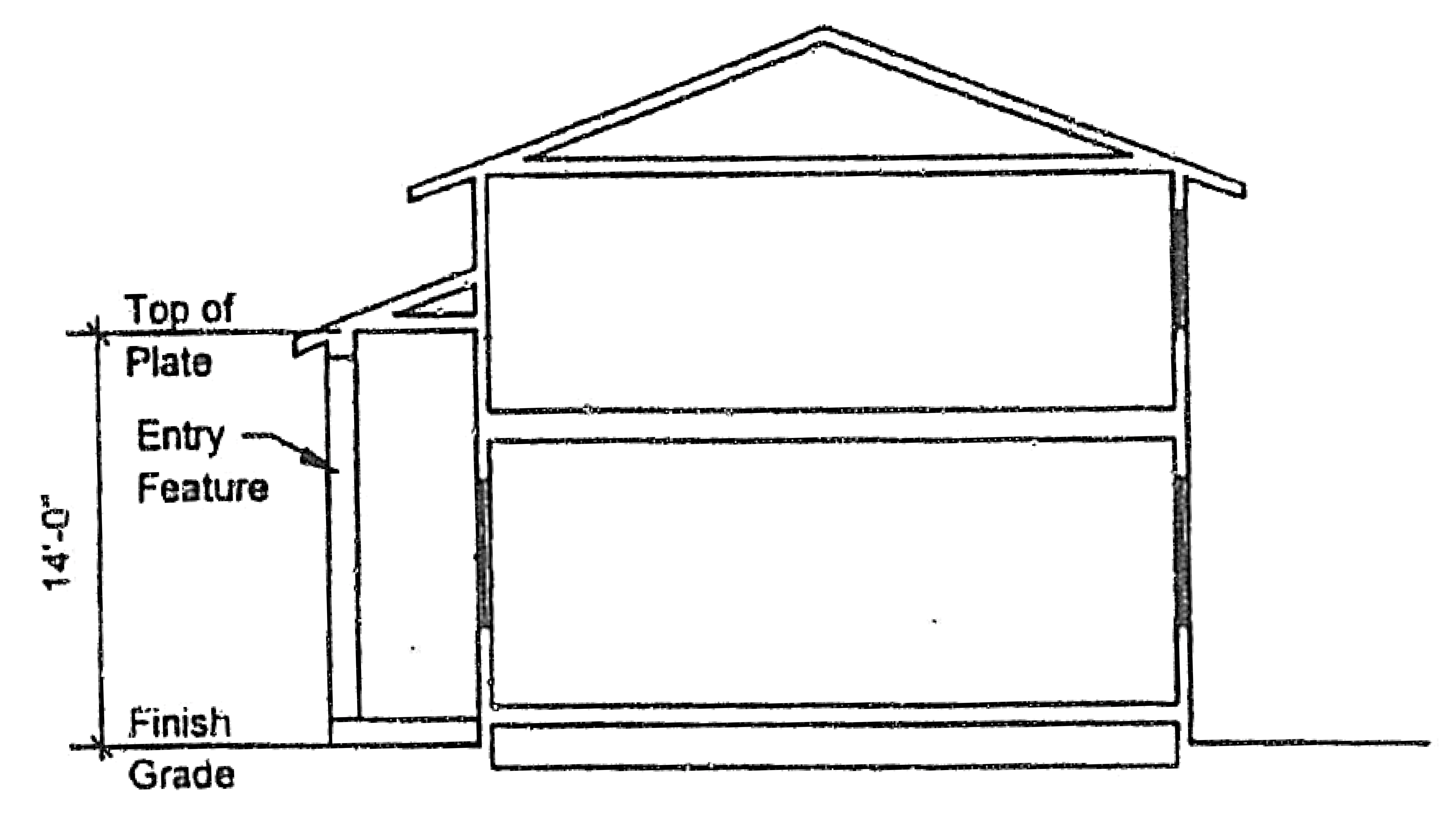
"Entry feature" means a structural element (e.g., porch, stoop), projecting from the front wall of a building that connects a building entrance, usually for a dwelling unit, to a walkway or sidewalk and is generally sheltered by a canopy or roof and accompanied by a landing, stairs, or ramp
"Equestrian center" means a facility for the shelter, display, exhibition, keeping, exercise or riding of horses, ponies or mules, or vehicles drawn by such animals, with related pasture lands, corrals and trails.
"Equipment yard" means a use providing for maintenance, servicing or storage of motor vehicles, equipment or supplies; or for the dispatching of service vehicles; or distribution of supplies or construction materials required in connection with a business activity, public utility service, transportation service, or similar activity, including but not limited to, a construction material yard, corporation yard, vehicular service center or similar use.
F. "F" Definitions:
"Facility" means a structure, building or other physical contrivance or object.
- "Accessory facility" means a facility which is incidental to, and customarily associated with a specified principal facility and which meets the applicable conditions set forth in Chapter 19.100.
- "Noncomplying facility" means a facility which is in violation of any of the site development regulations or other regulations established by this title, but was lawfully existing on October 10, 1955, or any amendment to this title, or the application of any district to the property involved by reason of which the adoption or application the facility becomes noncomplying.
- "Principal facilities" means a main building or other facility which is designed and constructed for or occupied by a principal use.
"Family" means an individual or group of persons living together who constitute a bona fide single housekeeping unit in a dwelling unit. "Family" shall not be construed to include a fraternity, sorority, club, or other group of persons occupying a hotel, lodging house, or institution of any kind.
“Farmers’ market” means a market certified by the state or county agricultural commission under Title 3, Chapter 3, Article 6.5 of the California Administrative Code which allows direct retail sale by farms to the public of such items as fruits, vegetables, nuts, eggs, honey, nursery stock, cut flowers, live animals and inspected meats and seafood.
"Fence" means a man-made structure, including a wall, which is designed, intended or used to protect, defend or obscure the interior property of the owner from the view, trespass or passage of others upon that property.
"Fence height" means the vertical distance from the highest point of the fence ( including post caps) to the lowest adjoining natural grade or finished grade as permitted through an approved permit. In a case where the finish grade is different for each face of the fence, the natural or approved final grade with the highest elevation shall be utilized in determining the fence height.
"Financial institutions" means a company engaged in the business of dealing with monetary transactions, such as deposits, loans, investments and currency exchange. This classification does not include payday lending businesses or check cashing businesses. The term "payday lending business" as used herein means retail businesses owned or operated by a "licensee" as that term is defined in California Financial Code Section 23001(d), as amended from time to time. The term "check cashing business" as used herein means a retail business owned or operated by a "check casher" as that term is defined in California Civil Code Section 1789.31 as amended from time to time.
"First floor" means that portion of a structure less than or equal to twenty feet in height, through which a vertical line extending from the highest point of exterior construction to the appropriate adjoining grade, passes through one story.
"Flag" means any fabric, banner, or bunting containing distinctive colors, patterns, or symbols, used as a symbol of a government, political subdivision, or other entity.
"Flat Yard Area" means a yard area graded to a slope of 5% or less, used for active or passive private recreation, not including a driveway.
"Floor area" means the total area of all floors of a building measured to the outside surfaces of exterior walls, and including the following:
- Halls;
- Base of stairwells;
- Base of elevator shafts;
- Services and mechanical equipment rooms;
- Interior building area above fifteen feet in height between any floor level and the ceiling above;
- Residential basements in the A, A1, R1 and RHS zoning districts with lightwells that do not conform to Section 19.28.070(I);
- Residential basements in the R1 and RHS zoning districts on projects pursuant to Government Code section 65852.21
- Residential garages;
- Roofed arcades, plazas, walkways, porches, breezeways, porticos, courts, and similar features substantially enclosed by exterior walls;
- Sheds and accessory structures.
“Floor area” shall not include the following:
- Residential basements in the R1 and RHS zoning districts with lightwells that conform to Section 19.28.070(I);
- Required lightwells;
- Attic areas;
- Parking facilities, other than residential garages, accessory to a permitted conditional use and located on the same site;
- Roofed arcades, plazas, walkways, porches, breezeways, porticos, courts and similar features not substantially enclosed by exterior walls.
“Floor area ratio” means the ratio of gross floor area on a lot to the lot area.
“Food Store” may include, but not be limited to, the following retail establishments:
- “Grocery store”. A Retail Sales and Services Use that:
- Offers a variety of unrelated, non-complementary food and non-food commodities, such as beverages, dairy, dry goods, fresh produce and other perishable items, frozen foods, household products, and paper goods; and
- May prepare food on site for immediate consumption.
- "Convenience market" means a use or activity that includes the retail sale of food, beverages, and small personal convenience items, including sale of food in disposable containers primarily for off-premises consumption, excluding delicatessens and other specialty food shops and establishments which have a sizable assortment of fresh fruits, vegetables, and fresh-cut meats.
- "Specialty food stores" means a retail establishment under 3,000 square feet that specializes in selling a specific type of food product with a limited scope of inventory. This food product may be prepared and sold on-site or purchased wholesale, and consumption of the goods occurs primarily off premises. Examples include butcher shops, delicatessens, bakeries, fish mongers, coffee shops, donut shops, ice cream stores, and produce markets. Specialty Food Stores are not considered fast food restaurants.
Food Stores may provide beer, wine, and/or liquor sales for consumption off the premises with a California Alcoholic Beverage Control Board License type 20 (off-sale beer and wine) or type 21 (off-sale general) that occupy less than 15% of the Occupied Floor Area of the establishment (including all areas devoted to the display and sale of alcoholic beverages).
“Foot-lambert” means a unit measurement of the brightness of light transmitted through or reflected from an object or surface.
“Freeway” means any public roadway so designated by the State of California.
“Front Entry Porch” means outdoor steps, stairs, and/or a raised platform less than 50 square feet in area, located immediately adjacent to the primary entry of a building for the purpose of providing pedestrian access from the outdoor ground elevation to a building interior. If the platform portion of a front entry porch (not including steps) is more than 50 square feet or has a proportionately greater width than its height, the structure is considered a porch.
“Front wall” means the wall of a building or other structure nearest the street upon which the building faces, but excluding certain architectural features as defined in this chapter.
G. “G” Definitions:
"Gable end" means the exterior wall that supports pitched roofs and is generally triangular in shape.
"Garage" means an accessory building (completely enclosed) or an attached building used primarily for the storage of motor vehicles.
"Gasoline service station" means any place of business which offers for sale any motor vehicle fuel to the public.
“Glare” means the effect produced by a light source within the visual field that is sufficiently brighter than the level to which the eyes are adapted, which causes annoyance, discomfort, or loss of visual performance and ability.
“Glass features”, for purposes of Chapter 19.102, Glass and Lighting Standards, means such features as free-standing glass walls, wind barriers, skywalks, balconies, greenhouses, and rooftop appurtenances.
"Grade" or "finished grade" means the lowest point of adjacent ground elevation of the finished surface of the ground paving, or sidewalk, excluding areas where grade has been raised by means of a berm, planter box, or similar landscaping feature, unless required for drainage, within the area between the building and the property line, or when the property line is more than five feet from the building, between the building and a line five feet from the building.
"Gross lot area" means the horizontal area included within the property lines of a site plus the street area bounded by the street centerline up to thirty feet distant from the property line, the street right-of-way line and the extended side yard to the street centerline.
"Guest room" means a room which is intended, arranged or designed to be occupied by occasional visitors or nonpaying guests of the occupants of the dwelling unit in which the room is located, and which contains no kitchen facilities.
H. "H" Definitions:
"Habitable floor" means the horizontal space between a floor area of at least seventy square feet and the ceiling height measuring at least seven feet six inches above it, except for a kitchen which shall have a ceiling height not less than seven feet above the floor.
"Habitable space" means space in a structure for living, sleeping, eating or cooking. Bathrooms, toilet compartment, closets, halls, storage or utility space and similar areas are not considered habitable space.
"Heavy equipment" means any mechanical or motorized device that is not a vehicle or a commercial vehicle as defined in Section 19.08.030(V), including, but not limited to, a backhoe, cement mixer, crane, ditch witch, dozer, earth mover, generator, grader, tractor or any similar device.
“Hedge” means a dense grouping of shrubs or trees that form a substantially continuous screen or boundary, intended or used to protect, defend or obscure the interior property of the owner from the view, trespass or passage of others upon that property.
"Height" means a vertical distance measured parallel to the natural grade to the highest point of exterior construction, exclusive of chimneys, antennas or other appurtenances, except that entry features are measured to the top of the wall plate.
Height restriction shall be established by establishing a line parallel to the natural grade.
"Height", for purposes of the Accessory Buildings/Structures, encompasses the entire wall plane nearest the property line, including roof, eaves, and any portion of the foundation visible above the adjoining finished grade.
HEIGHT LIMIT FOR ENTRY FEATURES
"Home occupation" means a business, profession, occupation or trade activity which is performed by the resident(s) of a dwelling unit within that dwelling unit, or a yard area, accessory structure or garage associated with that dwelling unit, or a yard area, accessory structure or garage associated with that dwelling unit, for purposes of generating income, by means of the manufacture, and/or sale of goods and/or services and/or by short-term rental activity in compliance with Chapter 5.08, but which activity is clearly incidental to the principal use of the dwelling for non-transient residential purposes.
“Hospital” means a facility for providing medical, psychiatric or surgical services for sick or injured persons, primarily on an inpatient basis, and including ancillary facilities for outpatient and emergency treatment, diagnostic services, training, research, administration, and service to patients, employees or visitors.
“Hotel” means a facility containing rooms or suites, solely occupied, intended or designed for use by guests on a transient occupancy basis, including any guest amenities such as swimming pools, gyms, restaurants, bars, meeting rooms, etc. A short-term rental is not a hotel.
"Household pets" means small animals commonly found in residential areas such as chickens, ducks, geese, rabbits, dogs, and cats, but excluding animals such as any bovine or equine animal, or any goat, sheep or swine. This title does not regulate the keeping of small household pets, such as fish, birds or hamsters, which is incidental to any permitted use. However, no animal including household pets may be kept, maintained and/or raised for commercial purposes except where permitted with required permits.
"Household type" means whether the occupants of the housing units are very low income, lower income, moderate income, or senior citizens.
"Housing development" means for the purposes of Chapter 19.56, Density Bonus, a development project for five or more residential units. For the purposes of that chapter, "housing development" also includes a subdivision or common interest development, approved by the City that consists of residential units or unimproved residential lots and either a project to substantially rehabilitate and convert an existing commercial building to residential use or the substantial rehabilitation of an existing multifamily dwelling, as defined in Government Code Section 65863.4(d), where the result of the rehabilitation would be a net increase in available residential units.
I. "I" Definitions:
"Industrial district," for purposes of the Sign Ordinance, means all ML districts and any other zoning classifications which are consistent with the industrial designation of the Cupertino general plan.
"Institutional district," for purposes of the Sign Ordinance, means all BQ, PR, FP, and BA districts and other zoning classifications and uses which are considered institutional in nature and are consistent with the institutional or quasi-public designation of the general plan.
J. "J" Definitions:
"Junkyard" means the use of more than two hundred square feet of the area of any lot for the storage or keeping of junk, including scrap metals or other scrap material, and/or for the dismantling or wrecking of automobiles or other vehicles or machinery.
K. "K" Definitions:
"Kitchen" means an area in habitable space used for the preparation of food and including at least three of the following:
- Cooking appliance(s) or provision for a cooking appliance such as 220V outlets, gas connections and space for appliances between counters;
- Counter;
- Refrigerator;
- Sink.
L. "L" Definitions:
"Landscaping" means an area devoted to or developed and maintained with native or exotic planting, lawn, ground cover, gardens, trees, shrubs, and other plant materials, decorative outdoor landscape elements, pools, fountains, water features, paved or decorated surfaces of rock, stone, brick, block or similar material (excluding driveways, parking, loading or storage areas), and sculptural elements.
"Late evening activities" means an activity which maintains any hours of operation during the period of eleven p.m. to seven a.m.
"Legal substandard lot" means any parcel of land or lot recorded and legally created by the County or City prior to March 17, 1980, which lot or parcel is of less area than required in the zone; or lots or parcels of record which are reduced to a substandard lot size as a result of required street dedication unless otherwise provided in the City of Cupertino General Plan. The owner of a legally created, substandard property which is less than six thousand square feet but equal to or greater than five thousand square feet may utilize such parcel for residential purposes. The owner of a legally created parcel of less than five thousand square feet may also develop the site as a single-family residential building site if it can be demonstrated that the property was not under the same ownership as any contiguous property on the same street frontage as of or after July 1, 1984.
“Light Fixture” means a complete lighting unit consisting of one or more lamps, and ballast(s), where applicable, together with the parts designed to distribute the light, position and protect the lamp(s) and ballast(s), and connect the lamp(s) to the power supply.
“Light trespass” means light emitted by a light fixture that shines beyond the property on which it is installed.
"Lightwell" means an excavated area required by the Uniform Building Code to provide emergency egress, light and ventilation for below grade rooms.
"Liquor store" means a use requiring a State of California "off-sale general license" (sale for off-site consumption of wine, beer and/or hard liquor) and having fifty percent or more of the total dollar sales accounted for by beverage covered under the off-sale general license.
“Live/work unit” means a free-standing residential unit or a unit within a multiple-family residential development used for commercial or office and residential purposes where the residential use of the space is accessory to the primary use as a place of work. A live/work unit shall meet the following: (a) combines a commercial or office activity allowed in the underlying zoning district with a residential living space for the owner of the business, or the owner’s employee, and that person’s household; (b) the resident owner or employee of the business is responsible for the commercial or office activity performed; (c) the business activity conducted takes place subject to a valid business license associated with the premises; and (d) active commercial, or office uses, shall be oriented along the street frontage with the residential component of the unit located behind or above the commercial or office space.
“Living space” means, for the purposes of Chapter 19.112, Section 19.40.090, and Section 19.28.150, the same as that set forth for “living area” in California Government Code Section 65852.2(j)(4). All attic and basement square footage proposed as part of an Accessory Dwelling Unit shall be limited by the maximum size allowed per Chapter 19.112.
"Loading space" means an area used for loading or unloading of goods from a vehicle in connection with the use of the site on which such space is located.
"Lot" means a parcel or portion of land separated from other parcels or portions by description, as on a subdivision or record of survey map, or by metes and bounds, for purpose of sale, lease or separate use.
- "Corner lot" means a lot situated at the intersection of two or more streets, or bounded on two or more adjacent sides by street lines.
- “Flag lot” means a lot with a long, narrow portion of the lot, or parcel of land not otherwise meeting the requirement of this title for lot width that consists entirely of and provides the sole means of vehicular connection between the buildable area of the lot and an abutting street.
- “Interior lot” means a lot other than a corner lot or a flag lot.
- “Key lot” means the first lot to the rear of a corner lot, the front line of which is a continuation of the side lot line of the corner lot, and fronting on the street which intersects or intercepts the street on which the corner lot fronts.
- "Pie-shaped lot" means an interior lot, that is not a flag lot, where the front lot line abuts a cul-de-sac, and a) is at least 20% shorter than the rear lot line or b) has five or more lot lines.
"Lot area" means the area of a lot measured horizontally between boundary lot lines, but excluding a portion of a flag lot providing access to a street and lying between a front lot line and the street, and excluding any portion of a lot within the lines of any natural watercourse, river, stream, creek, waterway, channel or flood control or drainage easement and excluding any portion of a lot acquired, for access and street right-of-way purposes, in fee, easement or otherwise.
"Lot coverage" means the following:
- "Single-family residential use" means the total land area within a site that is covered by buildings, including all projections, but excluding ground-level paving, landscape features, lightwells, and open recreational facilities. Sheds are included in lot coverage.
- "All other uses except single-family residential" means the total land area within a site that is covered by buildings, but excluding all projections, ground-level paving, landscape features, and open recreational facilities.
“Lot depth” means the horizontal distance measured, removing all existing and future dedications, from the midpoint of the front lot line to the midpoint of the rear lot line, or to the most distant point on any other lot line where there is no clear rear lot line.
"Lot line" means any boundary of a lot.
- "Front lot line" means on an interior lot, the lot line abutting a street, or on a corner lot, the shorter lot line abutting a street, or on a flag lot, the interior lot line most parallel to and nearest the street from which access is obtained. Lot line length does not include arc as identified on corner parcels.
- "Interior lot line" means any lot line not abutting a street.
- "Rear lot line" means the lot line not intersecting a front lot line which is most distant from and the most closely parallel to the front lot line. A lot bounded by only three lot lines will not have a rear lot line.
- "Side lot line" means any lot line which is not a front or rear lot line.
- "Street lot line" means any lot line abutting a street.
"Lot of record" means a lot which is part of a subdivision recorded in the office of the County Recorder, or a lot or parcel described by metes and bounds which has been recorded.
"Lot width" means the horizontal distance between side lot lines, measured at the required front setback line.
"Low-Barrier Navigation Center” means a facility that meets all of the requirements of Government Code Sections 65660 et seq.
"Lower-income household" means a household whose gross income does not exceed that established by Health and Safety Code Section 50079.5, as may be amended.
M. "M" Definitions:
"Major renovation," for purposes of Chapter 19.116, Conversions of Apartment Projects to Common Interest Development, means any renovation for which an expenditure of more than one thousand dollars was made.
"Major repair," for purposes of Chapter 19.116, Conversions of Apartment Projects to Common Interest Development, means any repair for which an expenditure of more than one thousand dollars was made.
"Major Transit Stop," for purposes of Chapter 19.56, Density Bonus, means an existing site, or a site included in the regional transportation plan, that contains a rail transit station, a ferry terminal served by either a bus or rail transit service, or the intersection of two or more major bus routes with a frequency of service interval of 15 minutes or less during the morning and afternoon peak commute periods. A housing development is considered to be within one-half mile of a major transit stop if all parcels within the housing development have no more than 25 percent of their area farther than one-half mile from the stop and if not more than 10 percent of the units or 100 units, whichever is less, in the housing development are farther than one-half mile from the stop as set forth in Government Code Section 65915(p)(3)(A), as may be amended.
"Manufacturing" means a use engaged in the manufacture, predominantly from previously prepared materials, of finished products or parts, including processing fabrication, assembly, treatment, packaging of products, but excluding basic industrial processing of extracted or raw materials, processes utilizing inflammable or explosive material (i.e., materials which ignite easily under normal manufacturing conditions), and processes which create hazardous or commonly recognized offensive conditions.
"Massage" means any method of pressure on or friction against or stroking, kneading, rubbing, tapping, pounding, vibrating or stimulating the external parts of the human body with the hands or with any mechanical or electrical apparatus or other appliances or devices with or without such supplementary aides as rubbing alcohol, liniment, antiseptic, oil, powder, cream, lotion, ointment or other similar preparations.
"Massage parlor" means a building or portion thereof, or a place where massage is administered for compensation or from which a massage business or service for compensation is operated which is not exempted or regulated by the Massage Establishment Ordinance as contained in Title 9, Health and Sanitation of the Cupertino Municipal Code, Chapter 9.06.
"Maximum allowable residential density," for purposes of Chapter 19.56, Density Bonus, means the maximum density allowed under the zoning ordinance and land use element of the general plan. For purposes of that Chapter, if the maximum density allowed under the zoning ordinance is inconsistent with the density allowed under the land use element of the general plan, the general plan density shall prevail.
"Minor change" means an alteration or modification of an existing plan, development or project which is substantially inferior in bulk, degree or importance to the overall dimension and design of the plan, development or project with no change proposed for the use of the land in question, no change proposed in the character of the structure or structures involved, and no variance required.
"Mobilehome" means a vehicle, other than a motor vehicle, designed or used as semi-permanent housing, designed for human habitation, for carrying persons and property on its own structure, and for being drawn by a motor vehicle, and shall include a trailer coach.
"Mobilehome park" means any area or tract of land where lots are sold, rented, or held out for rent to one or more owners or users of mobilehomes, excluding travel-trailers, for the purpose of permanent or semi-permanent housing.
"Moderate income household" means a household whose gross income does not exceed that established by Section 50093 of the Health and Safety Code, as may be amended.
"Multiple-family use" means the use of a parcel for three or more dwelling units which may be in the same building or in separate buildings on the same parcel.
“Muntins” means strips of wood, metal, or other materials that physically separate and support individual panes of glass in a window or visually separate a single pane of glass in a window into different sections.
N. "N" Definitions:
"Natural grade" means the contour of the land prior to improvements or development, unless otherwise established by a City approved grading plan that is part of a subdivision map approval.
"Nightclub" means an establishment providing alcoholic beverage service and late evening (past eleven p.m.) entertainment, with or without food service.
O. "O" Definitions:
"Office" means:
- "Administrative or executive offices" including those pertaining to the management of office operations or the direction of enterprise but not including merchandising or sales services.
- "Medical office" means a use providing consultation, diagnosis, therapeutic, preventative or corrective personal treatment services by doctors, dentists, medical and dental laboratories, and similar practitioners of medical and healing arts for humans, licensed for such practice by the State of California and including services related to medical research, testing and analysis.
- "Professional offices" such as those pertaining to the practice of the professions and arts including, but not limited to, accounting, architecture, dentistry, design, engineering, including associated testing and prototype development, but excluding product manufacturing and/or assembly, law and medicine, but not including sale of drugs or prescriptions except as incidental to the principal uses and where there is external evidence of such incidental use.
- "Office district," for purposes of the Sign Ordinance, means those buildings or groups of buildings for which the permitted uses are professional offices, is within an OA or OP zone or which are designated for offices on the general plan.
"Offset" means the indentation or projection of a wall plane.
"Open" means a space on the ground or on the roof of a structure, uncovered and unenclosed.
"Organizational documents" means the declaration of restrictions, articles of incorporation, bylaws and any contracts for the maintenance, management or operation of all or any part of a common interest development.
"Outdoor recreation use" means a privately owned or operated use providing facilities for outdoor recreation activities, including golf, tennis, swimming, riding or other outdoor sport or recreation, operated predominantly in the open, except for accessory or incidental enclosed services or facilities.
P. "P" Definitions:
"Park" means any open space, reservation, playground, swimming pool, golf course, recreation center, or any other area in the City owned or used by the City or County and devoted to active or passive recreations.
"Parking area" means an unroofed, paved area, delineated by painted or similar markings, intended and designed to accommodate one or more vehicles.
"Parking facility" means an area on a lot or within a building, or both, including one or more parking spaces, together with driveways, aisles, turning and maneuvering areas, clearances and similar features, and meeting the requirements established by this title. Parking facility includes parking lots, garages and parking structures.
- "Temporary parking facility" means parking lots which are not required under this title and which are intended as interim improvements of property subject to removal at a later date.
"Parking space" means an area on a lot or within a building, used or intended for use for parking a motor vehicle, having permanent means of access to and from a public street or alley independently of any other parking space, and located in a parking facility meeting the requirements established by this title. Parking space is equivalent to the term "parking stall" and does not include driveways, aisles or other features comprising a parking facility as previously defined in this chapter.
"Pennant" means any lightweight plastic, fabric, or other material, whether or not containing a message of any kind, suspended from a rope, wire, or string, usually in a series, designed to move in the wind.
"Permit" means a permit issued by the City Council, Planning Commission, Director of Community Development, or any other decision body as empowered by the Cupertino Municipal Code, approving architecture, site improvements, buildings, structures, land and/or uses. Permits may include but shall not be limited to Administrative Approvals, Two-story Permits, Minor Residential Permits, Architectural and Site Approvals, Development Permits, Conditional Use Permits, Exceptions, Variances or Subdivision Maps.
"Person" means an individual, group, partnership, firm, association, corporation, trust, governmental agency, governmental official, administrative body, or tribunal or any other form of business or legal entity.
"Personal fitness training center" means a facility providing space and equipment, with or without supervision, for group or individual athletic development, increased skill development in sports activity, or rehabilitative therapy for athletic injury.
"Perspective drawing" means a rendering of a three-dimensional view depicting the height, width, depth, and position of a proposed structure in relation to surrounding properties and structures when viewed from street level.
"Pet Day Care" means any premises where animals are trained, exercised and socialized, but not kept or boarded overnight, bred, sold, or let for hire. The hours of operation shall be limited daily from 7.a.m. to 9 p.m.
"Picnic area" means a facility providing tables and cooking devices for preparation and consumption of meals out of doors or within an unenclosed shelter structure.
“Porch” means outdoor steps, stairs, and/or a raised platform, located immediately adjacent to an entrance to a residential structure for the purposes of providing pedestrian access from the outdoor ground elevation to a building interior and/or private, recreational open space. A porch differs from a front entry porch or a front entry feature, which has a proportionately greater height than its width and is less than 50 square feet in area.
"Practice range" means a facility providing controlled access to fixed or movable objects which are used to test and measure accuracy of discharge from a weapon.
"Priority Housing Sites” means sites designated in the Housing Element that are assumed to meet the City’s Regional Housing Needs Allocation. Priority Housing Sites shall be shown on the City’s General Plan Land Use Map.
"Private educational facility" means a privately owned school, including schools owned and operated by religious organizations, offering instruction in the several branches of learning and study required to be taught in the public schools by the Education Code of the State of California.
"Private Open Space," for the purposes of Section 19.28.150 and 19.40.090, means an area, excluding the required front setback, between the structure and the street property line occupied by active or passive recreation facilities (e.g., deck, patio, playground equipment, porch, swimming pool, etc.) provided it is open on at least two sides and not covered by a roof, patio cover, or canopy.
“Primary residence” means residential real property at which a person resides a majority of the time, carries on basic living activities, and the place he or she usually returns to, in the event of travel. Evidence, such as motor vehicle registration, voter registration, a homeowner’s exemption on the property tax bill or other similar documentation, may be required by the city to determine whether the property is the primary residence.
"Project improvements" means all public road improvements, undergrounding utility improvements, and improvements to the on-site utility networks as required by the City of Cupertino for a common interest development.
"Projection" means architectural elements, not part of the main building support, that cantilevers from a single building wall or roof, involving no supports to the ground other than the one building wall from which the element projects.
"Promotional device" means any sign, display, fixture, placard, vehicle or structure that uses color, form, graphic, symbol, illumination or writing to advertise a special event or the opening of a new business.
"Property" means real property which includes land, that which is affixed to the land, and that which is incidental or appurtenant to the land as defined in Civil Code Sections 658 through 662.
- Property, Adjoining. "Adjoining property" means any unit of real property, excluding lands used as public streets, sharing one or more common points with another property.
“Property owner” means any person, legal entity, or association of individuals, that is the owner(s) of record of real property, as documented by a deed or other such evidence of ownership.
“Provider” means a person who operates a family day care home or a residential care facility and is licensed by the State of California.
"Public dancehall" is a building or portion used for dancing purposes to and in which the general public is admitted and permitted to dance, upon payment of any fee other than compensation, or upon payment of a charge for admission, or for which tickets or other devices are sold, or in which a charge is made for the privilege of dancing with any other person employed for such purpose by the operator of the establishment, including but not limited to taxi dances, but excluding restaurants, hotel rooms and nightclubs in which the dancing is incidental only to other entertainment.
Q. "Q" Definitions:
"Qualified applicant" is a person who has a legal or equitable interest in real property which is the subject of a development agreement, determined pursuant to Section 19.116.070. Qualified applicant includes an authorized agent.
"Qualifying resident" for purposes of Chapter 19.56, Density Bonus, of this Code, means a senior citizen or other persons eligible to reside in a senior citizen housing development.
R. "R" Definitions:
"Recreational open space" means open space within a common interest development (exclusive of required front setback areas) which shall be used exclusively for leisure and recreational purposes, for the use and enjoyment of occupants (and their visitors) of units on the project and to which such occupants (and their visitors) have the right of use and enjoyment. Accessory structures such as swimming pools, recreational buildings and landscaped areas may be included as open space.
"Recyclable materials" means discards or waste materials that may be separated or mixed, collected and processed, and used as raw materials for new products. For purposes of Chapter 19.108, Beverage Container Redemption and Recycling Centers, recyclable materials do not include hazardous materials.
"Recycling center" means a facility for the collection and/or processing of recyclable materials. Recycling center does not include storage containers or processing activity located on the premises of a commercial or manufacturing use and use solely for the recycling of material generated by that business or manufacturer.
- "Recycling center, Certified" or "Certified Processor" means a recycling facility certified by the California Department of Conservation as meeting the requirements of the California Beverage Container Recycling and Litter Reduction Act of 1986.
- "Recycling center, Mobile" means an automobile, truck, trailer or van licensed by the Department of Motor Vehicles, which is used for the collection of recyclable material. A mobile recycling center also means the bins, boxes or containers transported by trucks, vans, or trailers and used for the collection of recyclable materials. A mobile recycling center may consist of an enclosed vehicle such as box cab or enclosed semi-trailer or an open vehicle such as a flatbed trailer with bins or boxes to contain recyclable materials.
"Recycling facilities" may include the following:
- "Collection facility" means a facility for the acceptance (donation, redemption or sale) of recyclable materials from the public. Such a facility does not use power-driven processing equipment except as indicated in Chapter 19.108, Beverage Container Redemption and Recycling Centers. Collection facilities may include the following:
- Reverse vending machine(s);
- Small collection facilities which occupy an area of not more than five hundred square feet, and may include:
- A mobile recycling unit,
- Bulk reverse vending machine or a grouping of reverse vending machines occupying more than fifty square feet,
- Kiosk type units and bulk vending machines,
- Unattended containers placed for the donation of recyclable materials;
- Large collection facilities which may occupy an area of more than five hundred square feet, or is on a separate property not appurtenant to a host use, and may include permanent structures.
- "Processing facility" means a building or enclosed space use for the collection and processing of recyclable materials. Processing means the preparation of material for efficient shipment or to an end-user's specifications, by such means as baling, briquetting, compacting, flattening, grinding, crushing, mechanical sorting, shredding, cleaning, and remanufacturing. Processing facility includes the following:
- A light processing facility occupies an area of under forty-five thousand square feet of gross collection, processing and storage area and has up to two outbound truck shipments per day. Light processing facilities are limited to baling, briquetting, crushing, compacting, grinding, shredding and sorting of source-separated recyclable materials and repairing of reusable materials sufficient to qualify as a certified processing facility. A light processing facility shall not shred, compact, or bale ferrous metals other than food and beverage containers.
- A heavy processing facility is any processing facility other than a light processing facility.
"Religious institution" means a seminary, retreat, monastery, conference center, or similar use for the conduct of religious activities including accessory housing incidental thereto, but excluding a private educational facility. Any use for which a property tax exemption has been obtained pursuant to Section 3(f) of Article XIII of the Constitution of the State of California and Section 206 of the Revenue and Taxation Code of the State of California, or successor legislation, or which is used in connection with any church which has received such an exemption, shall be prima facie presumed to be a religious institution.
"Research and development" means a use engaged in study, design, analysis and experimental development of products, processes or services, including incidental manufacturing of products or provisions of services to others.
"Residential Care Facility" means a residential building or portion designed or used for the purpose of providing twenty-four-hour-a-day nonmedical care of persons in need of personal services, supervision, or assistance essential for sustaining the activities of daily life or for the protection of the individual. Residential care facility includes, but is not limited to, health facilities as defined in California Health and Safety Code (H&SC Section 1250 et seq.), community care facilities (H&SC Section 1500 et seq.), residential care facilities for the elderly (H&SC Section 1569 et seq.), alcoholism or drug abuse recovery or treatment facilities (H&SC Section 11384.11), and other similar care facilities.
"Residential Care Facility, Licensed" means any residential care facility licensed by the state.
- Large Licensed Residential Care Facility means a licensed residential care facility which serves seven (7) or more clients, not including provider, provider family or staff.
- Small Licensed Residential Care Facility means a licensed residential care facility which serves six (6) or fewer clients, not including provider, provider family or staff.
“Residential Care Facility, Unlicensed” means any residential care facility not required to be licensed by the state and operated as a single housekeeping unit.
"Residential district," for purposes of the Sign Ordinance, means the R-1, RHS, R-2, R-3, R-4, R1C, A, and A1 zoning classifications or TH combining district, which are consistent with the residential designation of the Cupertino General Plan.
"Restaurant":
- Restaurant, Fast-Food/Self-Service. "Fast-food/Self-Service restaurant" means a retail food service establishment in which prepared foods or beverages are served or sold on or in disposable containers, including those establishments where a substantial portion of the patrons may serve themselves and may consume the food and beverages off-site. A bar facility for serving alcoholic beverages is not permitted. Specialty food stores, such as ice cream stores, bakeries or shops, shall not be considered fast-food/self-service restaurants.
- Restaurant, Full Service. "Full-service restaurant" means any restaurant which is not a fast-food or self-service restaurant. Alcoholic beverages may be served with meals at a customer's dining table; however, a bar facility for serving alcoholic beverages is not permitted without a use permit.
"Reverse vending machine(s)" means an automated mechanical device which accepts one or more types of empty beverage containers, including, but not limited to aluminum cans, glass and plastic bottles, and issues a cash refund or a redeemable credit slip with a value not less than the containers redemption value, as determined by the State. A reverse vending machine may sort and process containers mechanically provided that the entire process is enclosed within the machine. In order to accept and temporarily store all three container types in a proportion commensurate with their relative redemption rates, and to meet the requirements of certification as a recycling center, multiple grouping of reverse vending machines may be necessary.
- A bulk reverse vending machine is a reverse vending machine that is larger than fifty square feet; is designed to accept more than one container at a time; and will pay by weight instead of by container.
S. "S" Definitions:
"Screened" means shielded, concealed, and effectively hidden from view at an elevation of up to eight feet above ground level on adjoining parcels, or from adjoining parcels, within ten feet of a lot line, by a fence, wall, hedge, berm, or similar structure, architectural or landscape feature, or combination thereof.
"Senior citizens" means:
- Persons at least sixty-two years of age; or
- Persons at least fifty-five years of age or otherwise qualified to reside in a senior citizen housing development, in accordance with State and federal law.
"Senior citizen housing development" means a housing development with at least thirty-five dwelling units as defined in the Civil Code Section 51.3, or a mobilehome park that limits residency based on age requirements for housing for older persons pursuant to Section 798.76 or 799.5 of the Civil Code, as may be amended.
"Setback line" means a line within a lot parallel to a corresponding lot line, which is the boundary of any specified front, side or rear yard, or the boundary of any public right-of-way or private road, whether acquired in fee, easement, or otherwise, or a line otherwise established to govern the location of buildings, structures or uses. Where no minimum front, side or rear yards are specified, the setback line shall be coterminous with the corresponding lot line.
Setback Area, Required. "Required setback area" means open space, unoccupied and unobstructed from the ground upward, except as provided in this title, between the lot line and the setback line on the same parcel.
- Setback Area, Required Front Yard. "Required front-yard setback area" means the setback area extending across the front of a lot between the front lot line and the setback line. Front yards shall be measured either by a line at right angles to the front lot line, or by a radial line in the case of a curved front lot line, except flag lots which is the area extending across the full extent of the buildable portion of the flag lot measured from the property line which is parallel to and nearest the street line and at which point the lot width equals a minimum of sixty feet. The Director of Community Development shall have the discretion to modify the provisions of this definition when it improves the design relationship of the proposed buildings to adjacent buildings or parcels.
- Setback Area, Required Rear Yard. "Required rear-yard setback area" means the area extending across the full width of the lot between the rear lot line and the nearest line or point of the main building.
- Setback Area, Required Side Yard. "Required side-yard setback area" means the area between the side lot line and the nearest line of a building, and extending from the front setback line to the rear setback line.
“Shielded fixture” means a light fixture that is shielded or constructed so that light rays emitted by the lamp(s) are projected below the horizontal plane passing through the lowest point on the light fixture.
"Shopping center" means a group of commercial establishments, planned, developed, owned or managed as a unit, with off-street parking provided on the parcel.
"Shopping center," for purposes of the Sign Ordinance, means a retail entity encompassing three or more tenants within a single building or group of buildings, but within which individual business located in defined tenant spaces are owned and managed separately from the shopping center management.
“Short-term rental” means any legally permitted dwelling unit, or portion thereof, made available for rent on a transient occupancy basis. Short-term rental use shall not be considered a hotel or single room occupancy use.
"Sidewalk sight triangle" is a triangular shaped area described in Cupertino Standard Detail 7-6. (See Appendix C, Cupertino Standard Detail; Sidewalk Sight Triangle (Sidewalk Clearance at Driveway)
"Sign" means any device, fixture, placard, or structure that uses any color, form, graphic, illumination, symbol, or writing to advertise, announce the purpose of, or identify the purpose of a person or entity, to communicate information of any kind to the public.
- "Animated sign" means any sign which projects action, motion or the illusion thereof, changes intensity of illumination or changes colors, including the likes of balloons, banners and flags, and blowing or air-powered attractions, but excluding electronic readerboard signs and signs that display the current time or temperature.
- "Blade sign" means a pedestrian oriented sign, adjacent to a pedestrian walkway or sidewalk, attached to a building wall, marquee, awning or arcade with the exposed face of the sign in a plane perpendicular to the plane of the building wall.
- "Development Identification Sign" means a ground sign at the major entry to a residential development with twenty units or more meant to identify the name and address of the development.
- "Directional sign" means any sign which primarily displays directions to a particular area, location or site.
- "Directory sign" means any outdoor listing of occupants of a building or group of buildings.
- "Electronic readerboard sign" means an electronic sign intended for a periodically-changing advertising message.
- "Freeway oriented sign" means any sign which is located within six hundred sixty feet and visible from a freeway right-of-way as defined by Section 5200 of the California Business and Professions Code.
- "Garage sale signs" means any sign used for advertising a garage or patio sale as defined in Chapter 5.16 of the Cupertino Municipal Code.
- "Ground sign" means any sign permanently affixed to the ground and not supported by a building structure. The height of the sign shall be measured from the grade of the adjoining closest sidewalk to the top of the sign including trim.
- "Identification sign" means any sign whose sole purpose is to display the name of the site and the names of the occupants, their products or their services.
- "Illegal sign" means any sign or advertising statuary which was not lawfully erected, maintained, or was not in conformance with the provisions of this title in effect at the time of the erection of the sign or advertising statuary or which was not installed with a valid permit from the City.
- "Illuminated sign" means any sign utilizing an artificial source of light to enhance its visibility.
- "Informational sign" means any sign which promotes no products or services, but displays service or general information to the public, including the likes of hours of operation, rest room identifications and hazardous warnings.
- "Landmark sign" means an existing, legal non-conforming ground sign that has a distinctive architectural style.
- "Nonconforming sign" means any sign or advertising statuary that was legally erected and had obtained a valid permit in conformance with the ordinance in effect at the time of the erection of the sign but which became nonconforming due to the adoption of the ordinance codified in this title.
- "Obsolete sign" means any sign that displays incorrect or misleading information, promotes products or services no longer available at that site or identifies departed occupants.
- "Off-site sign" means any sign not located on the premises of the business or entity indicated or advertised by the sign. This definition shall include billboards, poster panels, painted bulletins and other similar advertising displays.
- "On-site sign" means a sign directing attention to a business, commodity, service or entertainment conducted, sold or offered upon the same premises as those upon which the sign is maintained.
- "Political sign" means a temporary sign that encourages a particular vote in a scheduled election and is posted prior to the scheduled election.
- "Portable Sign or Display" means any outdoor sign or display not permanently attached to the ground or a structure on the premises it is intended to occupy and displayed only during business hours. Portable sign or display includes A-frames, flower carts, statues, and other similar devices used for advertising as determined by the Director.
- "Project announcement sign" means any temporary sign that displays information pertinent to a current or future site of construction, including the likes of the project name, developers, owners and operators, completion dates, availability and occupants.
- "Projecting sign" means any sign other than a wall sign that is attached to and projects from a structure or building face or wall.
- "Real estate sign" means a temporary sign indicating that a particular premises is for sale, lease or rent.
- "Roof sign" means a sign erected between the lowest and highest points of a roof.
- "Street address sign" means any sign that displays only the street address number(s) of the site and, at the option of the property owner, the street name.
- "Temporary Sign" means any sign, display, banner or promotional device which is designed or intended to be displayed only during the allowable business hours or for short periods of time as specified by the Director of Community Development.
- "V-shaped signs" means any sign consisting of two vertical faces, or essentially vertical faces, with one common edge and which appears as the letter V when viewed directly from above.
- "Vehicle sign" means a sign painted on or attached to an operable or movable vehicle; in the case of motor vehicles, "operable" shall be defined as having a valid license plate.
- "Wall sign" means any sign that is attached, erected or painted on a structure attached to a building, a canopy structure, or the exterior wall of a building with the exposed face of the sign parallel to the wall.
- "Window sign" means any sign that is intended to be read from outside of the structure or painted on a window facing a public street, parking lot, pedestrian plaza or walkway accessible to the public.
"Sign Area" for an individually lettered sign without a background, is measured by enclosing the sign copy with a continuous perimeter in simple rectilinear forms. (See Appendix D for examples of sign area calculation)
The sign area for a sign with borders and/or background is measured by enclosing the exterior limits of the border or background with a single continuous perimeter. The necessary supports, uprights, and/ or the base on which such sign is placed, shall be excluded from the sign area.
When a sign is separated by thirty-six inches or more, the area of each part may be computed separately.
“Single family residence,” for purposes of Chapter 19.112, shall mean one dwelling unit located on a separately owned lot, including custom-built on site, factory-built, manufactured, or modular housing. Single family residence does not include air parcels, condominiums, or townhomes.
“Single Housekeeping Unit” means one or more individuals occupying a dwelling unit with common access to, and common use of, living and eating areas and facilities for the preparation and storage of food, within the dwelling unit.
"Single room occupancy (SRO) living unit" means an individually secure residential unit between 150 and 400 square feet in size. SROs are not required to, but may, contain partial or full bathroom and kitchen facilities. SROs include extended stay hotels intended for long-term occupancy (more than 30 days) but do not include other hotels or residential care facilities.
"Site," for purposes of the Sign Ordinance, means a piece of land as shown on a subdivision map, record of survey map or assessor's parcel map, which constitutes one development site and which may be composed of a single unit of land or contiguous units under common ownership, control, or development agreement.
"Special event," for purposes of the Sign Ordinance means a temporary promotional event including, but not limited to, a special sale on merchandise or services, or grand openings.
"Special Event Banner" means any temporary sign constructed of pliable materials such as canvas, fabric, vinyl plastic or similar materials which will withstand exposure to wind and rain without significant deterioration, and which does not require a building permit for its construction, or installation outside of a building.
"Special needs housing," for purposes of Chapter 19.56, Density Bonus, means any housing, including supportive housing, intended to benefit, in whole or in part, persons identified as having special needs relating to mental health; physical disabilities; developmental disabilities, including without limitation intellectual disability, cerebral palsy, epilepsy, and autism; and risk of homelessness, and housing intended to meet the housing needs of persons eligible for mental health services funded in whole or in part by the Mental Health Services Fund, as set forth in Government Code Section 65915(p)(3)(C), as may be amended.
“Specialized School” means a private academic educational institution, providing specialized education/training. Examples include the following:
|
|
|
|
|
|
|
|
|
|
|
|
Also includes facilities, institutions and conference centers that offer specialized programs in personal growth and development, such as fitness, environmental awareness, arts, communications, and management. Specialized School does not include pre-schools, after school care and child day care facilities.
"Specified anatomical areas" means:
- Less than completely and opaquely covered human genitals, pubic region, buttocks and female breast below a point immediately above the top of the areola; and
- Human male genitals in a discernibly turgid state, even if completely and opaquely covered.
"Specified sexual activities" means:
- Human genitals in a state of sexual stimulation or arousal;
- Acts of human masturbation, sexual intercourse or sodomy;
- Fondling or other erotic touching of human genitals, pubic region, buttocks or female breast.
"Stepback” means a change in the vertical plane of a building where upper-story areas of the building wall are setback from the building wall of the story directly below.
"Story" means that portion of a building, excluding a basement, between the surface of any floor and the surface of the next floor above it, or if there is no floor above it, then the space between the floor and the ceiling next above it.
"Street" means a public or private thoroughfare the design of which has been approved by the City which affords the principal means of access to abutting property, including avenue, place, way, drive, lane, boulevard, highway, road, and any other thoroughfare except an alley as defined in this chapter.
- Street, Public. "Public street" means all streets, highways, lanes, places, avenues and portions and including extensions in the length and width, which have been dedicated by the owners to public use, acquired for public use, or in which a public easement for roadway purposes exists.
"Street Frontage," for purposes of Chapter 19.28, means the length of the curb (or if a curb is absent, the length of the portion of the street paved with asphalt or similar material designed for automobile traffic) parallel and closest to a property's front lot line.
"Structure" means that which is built or constructed, an edifice or building of any kind, or any piece of work artificially built up or composed of parts joined together in some definite manner.
- Structure, Recreational. "Recreational structure" means any affixed accessory structure or portion, which functions for play, recreation or exercise (e.g., pool slides, playhouses, tree houses, swings, climbing apparatus, gazebos, decks, patios, hot tubs and pools) but does not include portable play structures, such as swings or climbing apparatus.
"Structurally attached" means any structure or accessory structure or portion thereof, which is substantially attached or connected by a roof structure or similar physical attachment.
"Substantially enclosed" means an area that is covered by a roof or ceiling that is not more than 50% open to the sky/elements and is surrounded by solid barriers that are at least six inches tall on three or more sides. Solid barriers do not include open railings that are no taller than 42 inches, decorative arches, or trellises. Railings and trellises shall have a visual transparency of more than 50%.
"Supportive housing" means housing with no limit on length of stay, that is occupied by the target population, and that is linked to onsite or offsite services that assist the supportive housing resident in retaining housing, improving his or her health status, and maximizing his or her ability to live and, when possible, work in the community, or as otherwise defined in Government Code Section 65582(g). The “target population” is as defined in Government Code Section 65582(i).
“Supportive housing, permanent” means housing as defined in Government Code Section 65650(a) with a maximum of 50 units serving the target population as defined in Government Code Section 65650(c) and meeting all of the requirements of Government Code Sections 65650 et seq.
T. "T" Definitions:
“Tenant” means any person, legal entity, or association of individuals that is a lessee of real property, as documented by a rental agreement, whether in writing or otherwise.
"Transient" means any individual who exercises occupancy or is entitled to occupancy by reason of concession, permit, right of access, license or other agreement for a period of thirty consecutive calendar days or less, counting portions of calendar days as full days, and including any individual who actually physically occupies the premises, by permission of any other person entitled to occupancy.
"Transitional housing" (per CA Government Code 65582(h), as may be amended) means buildings configured as rental housing developments, but operated under program requirements that call for the termination of assistance and recirculation of the assisted unit to another eligible program recipient at some predetermined future point in time, which shall be no less than six months from beginning of assistance.
"Trim" means the molding, battens, cappings, nailing strips, lattice and platforms which are attached to a sign.
“Townhome” or “rowhouse” means a group of two or more attached dwelling units where units are separated from others by a common or party wall, no unit is located over another unit, each unit has its own front and rear ground floor access to the outside, and owners have fee simple title to the air space of the unit. Townhomes do not include duplexes legally built on properties where such uses are permitted.
U. "U" Definitions:
"Unobstructed Access," for purposes of Chapter 19.56, Density Bonus, means access to a location if a resident is able to access the location without encountering natural or constructed impediments, as set forth in Government Code Section 65915(p)(2), as may be amended.
“Uplighting” means the placement and orientation of light fixtures such that light rays are directed upward.
"Use" means the conduct of an activity, or the performance of a function or operation, on a parcel or in a building or facility.
- "Accessory use" means a use which is incidental to and customarily associated with a specified principal use.
- "Conditional use" means a use listed by the regulations of any particular district as a conditional use within that district, and allowable solely on a discretionary or conditional basis, subject to issuance of a conditional use permit, and to all other regulations established by this title.
- "Nonconforming use" means a use which is not a permitted use or conditional use authorized within the district in which it is located, but which was lawfully existing on October 10, 1955; or the date of any amendments thereto, or the application of any district to the property involved, by reason of which adoption or application the use became nonconforming.
- "Permitted use" means a use listed by the regulations of any particular district as a permitted use within that district, and permitted therein as a matter of right when conducted in accord with the regulations established by this title.
- "Principal use" means a use which fulfills a primary function of a household, establishment, institution, or other entity.
"Usable rear yard" means that area bounded by the rear lot line(s) and the rear building line extended to the side lot lines. The side yard adjacent to a proposed minor addition (e.g., addition equaling ten percent or less of the principal structure) may be included in calculation of usable rear yard area.
V. "V" Definitions:
"Variance application" means an application for which an exception process is not identified in the Municipal Code.
"Vehicle" means any boat, bus, trailer, motor home, van, camper (whether or not attached to a pickup truck or other vehicle), mobilehome, motorcycle, automobile, truck, pickup, airplane, boat trailer, truck tractor, truck trailer, utility trailer or recreational vehicle, or parts, or any device by which any person or property may be propelled, moved or drawn upon a public street, excepting a device moved exclusively by human power.
- Vehicle, Commercial. "Commercial vehicle" means a vehicle of a type required to be registered under the California Vehicle Code used or maintained for the transportation of persons for hire, compensation, or profit or designed, used, or maintained primarily for the transportation of goods.
- Vehicle, Recreation. "Recreation vehicle" means a vehicle towed or self-propelled on its own chassis or attached to the chassis of another vehicle and designed or used for temporary dwelling, recreational or sporting purposes. The term recreation vehicle includes, but is not limited to, trailers, motor coach homes, converted trucks and buses, and boats and boat trailers.
"Very low income household" means a household whose gross income does not exceed that established by Health and Safety Code Section 50105, as may be amended.
"Visual privacy intrusion" means uninterrupted visual access from a residential dwelling or structure into the interior or exterior areas of adjacent residential structures, which area is either completely or partially private, designed for the sole use of the occupant, and/or which serves to fulfill the interior and/or exterior privacy needs of the impacted residence or residences.
W. "W" Definitions:
“Watercourse”, for purposes of Chapter 19.102, Glass and Lighting Standards, means any natural or artificial arroyo, canal, channel, natural conduit, creek, culvert, ditch, gully, lake, ravine river, stream, waterway, or wash or other topographic feature on or over which waters flow at least periodically and adjacent areas in which substantial flood damage may occur from overflow or inundation.
X. "X" Definitions:
None.
Y. "Y" Definitions:
"Yard" means an area within a lot, adjoining a lot line, and measured horizontally, and perpendicular to the lot line for a specified distance, open and unobstructed except for activities and facilities allowed therein by this title.
- "Front yard" means a yard measured into a lot from the front lot line, extending the full width of the lot between the side lot lines intersecting the front lot line.
- "Rear yard" means a yard measured into a lot from the rear lot line, extending between the side yards; provided that for lots having no defined rear lot line, the rear yard shall be measured into the lot from the rearmost point of the lot depth to a line parallel to the front lot line.
- "Side yard" means a yard measured into a lot from a side lot line, extending between the front yard and rear lot line.
Z. "Z" Definitions:
None.
(Ord. 23-2247, § 1 (part), 2023; Ord. 22-2246, § III (part), 2022; Ord. 22-2238, § 3.2, 2022; Ord. 21-2235, § 3.2, 2021; Ord. 21-2225, Att. A (§ 2), 2021; Ord. 20-2200, § 5, 2020; Ord. 20-2199, §§ 1 - 3, 2020; Ord. 17-2170, § 1, 2017; Ord. 17-2169, § 2, 2017; Ord. 17-2165, § 2, 2017; Ord. 16-2157, §§ 1, 2, 2016; Ord. 16-2159, §§ 1-4, 2016; Ord. 16-2149, § 3, 2016; Ord. 16-2140, §§ 1-5, 2016; Ord. 14-2125, § 3 (part), 2014; Ord. 2085, § 2 (part), 2011; Ord. 11-2074, (part), 2011; Ord. 2056, (part), 2010; Ord. 1894, § 1, 2002; Ord. 1891, (part), 2002; Ord. 1863, (part), 2000; Ord. 1809, 2000; Ord. 1784, (part), 1998; Ord. 1725, (part), 1996; Ord. 1688, § 3 (part), 1995; Ord. 1657, (part), 1994; Ord. 1654, 1994; Ord. 1637, (part), 1993; Ord. 1635, (part), 1993; Ord. 1618, (part), 1993; Ord. 1607, § 1, 1992; Ord. 1601, Exh. A (part), 1992; Ord. 24-2260, Att. A, (§ 2) 2024; Ord. 24-2261, § 1 (part), 2024; Ord. 24-2266, Att. A, 2024; Ord. 25-2274, Att. A (§ 1), 2025; Ord. 25-2277, Exh. A (part), 2025)
Appendix A: Cupertino Standard Detail 7-2 Corner Triangle - Controlled Intersections.
Note: To view this Appendix in PDF, click HERE
Appendix B: Cupertino Standard Detail 7-4 Corner Triangle - Uncontrolled Intersections.
Note: To view this Appendix in PDF, click HERE
Appendix C: Cupertino Standard Detail 7-6 Sidewalk Sight Triangle (Sidewalk Clearance at Driveways).
Note: To view this Appendix in PDF, click HERE
Appendix D: Examples of How to Measure Sign Area.
Note: To view this Appendix in PDF, click HERE

