


Darrington City Zoning Code
CHAPTER 17
210 - REGULATION OF SMALL CELL FACILITIES AND FRANCHISE REQUIREMENTS
17.210.010 - Overview and purpose.
In order to manage its right-of-way in a thoughtful manner which balances the need to accommodate new and evolving technologies with the preservation of the natural and aesthetic environment of the Town while complying with the requirements of state and federal law, the Town has adopted this process for the deployment of small cell and microcell technology. Service providers who seek to utilize the public right-of-way for small cell deployment in order to provide wireless communication, data transmission or other related services to the citizens of the Town must have a valid franchise to provide the specific service seeking to utilize the right-of-way and a small cell permit to deploy the technology. Entities with franchises who wish to utilize a small cell deployment to upgrade or expand their existing services shall utilize the processes set forth in this chapter and through implementing small cell permits to deploy their technology and obtain design approval of specific installations. The small cell permit process administers deployment under the franchise. An entity without a franchise shall apply for a franchise and adjunct small cell permit which shall be processed concurrently as one master permit within the meaning of RCW 35.99.010(3) and 35.99.030.
A.
Nothing in this chapter revises or diminishes the rights and obligations of an existing franchise.
B.
The term "small cell deployment" shall include the deployment of small cell facilities, microcells and small cell networks as those terms are defined by RCW 80.36.375 or as otherwise defined by law. Small cell deployment elements which require SEPA review may utilize these processes only in conjunction with SEPA review.
(Ord. No. 761, § 3(Att. C), 12-9-2020)
17.210.020 - Definitions.
Definitions related to this chapter are as set forth in chapter 17.200.
(Ord. No. 761, § 3(Att. C), 12-9-2020)
17.210.030 - Franchise application.
Applicants shall apply using the Town's franchise application form and submit a fee according to the Town's fee schedule deposit commensurate with the estimated administrative costs of processing an application for a franchise. The fee deposit level shall be set by Town council resolution. The director is charged with administration of small cell deployments and other wireless communication review processes established in the Town Code. Subsequent to the approval of a franchise, a new pole or expansion beyond the dimensions or volume of small cell facility which exceeds the cumulative total provided by the definition of a small cell or microcell facility in RCW 80.36.375 shall require an amendment to the franchise agreement.
(Ord. No. 761, § 3(Att. C), 12-9-2020)
17.210.040 - Designation of facilities.
A.
The application shall provide:
1.
Specific locational information including GIS coordinates of all facilities;
2.
Specify whether and where small cell facilities are to be located on existing utility poles including Town-owned light standards (included in the definition of utility pole); or
3.
Whether and where small cell facilities are to utilize replacement utility poles, new poles, towers, and/or other structures.
B.
Conduit and/or ground-mounted equipment necessary for and intended for use in the deployment shall also be specified regardless of whether the additional facilities are to be constructed by the applicant or leased from an infrastructure provider.
C.
Detailed schematics and visual renderings of the facilities shall be provided by the applicant.
D.
Failure to provide sufficient detail may result in a later finding of a significant change in the facility if significant elements of the facility were not shown on the originally approved franchise exhibit. Failure to include significant elements may also result in the requirement that new or undocumented elements complete the approval processes detailed in this chapter and in other applicable provisions of the Town Code.
(Ord. No. 761, § 3(Att. C), 12-9-2020)
17.210.050 - Implementation—Small cell permits.
The rights granted under the franchise are implemented through the issuance of small cell permits. The franchise application may be accompanied by one or more applications for a small cell permit to deploy small cells. An initial franchise and all related small cell permit applications shall be processed concurrently as one master permit.
A.
Up to thirty sites may be specified in one small cell permit application for processing. The director may approve up to five additional sites in order to consider small cell sites within one logical service area in one application.
B.
Issuance of a small cell permit to install a small cell deployment shall be contingent upon approval of a franchise or the possession of a valid franchise.
C.
If more than one application for a small cell permit is submitted by an applicant, they shall be considered in the order received. If multiple applications are submitted on the same date, the applicant shall indicate which application should be considered first. All small cell permits which are submitted in conjunction with a franchise application shall be considered as one master permit. Any element of a deployment which qualifies as either an eligible facilities request or a collocation shall be specifically designated by the applicant and may be addressed separately by the director in order to comply with the shot clocks established by federal law and other applicable regulations.
D.
The director may approve, deny or conditionally approve all or any portion of the sites proposed in the small cell permit application.
E.
Any application for a franchise or small cell permit which contains an element which is not exempt from SEPA review shall simultaneously apply under RCW Chapter 43.21C and other applicable regulations.
F.
Radio Frequency (RF) Certification. The applicant shall submit a sworn affidavit signed by an RF engineer with knowledge of the proposed project affirming that the small cell deployment will be compliant with all FCC and other governmental regulations in connection with human exposure to radio frequency emissions for every frequency at which the small cell facility and associated wireless backhaul will operate. An existing franchisee applying for a small cell permit for small cell deployment shall provide an RF certification for all facilities included in the deployment which are to be installed by the franchisee. If facilities necessary to the small cell deployment are to be provided by another franchisee, then the small cell deployment in the initial franchise or in a subsequent small cell permit shall be conditioned on an RF certification showing the cumulative impact of the RF emissions on the entire installation. If facilities necessary to the small cell deployment are to be provided by another franchisee or in a subsequent, the use permit to deploy such facilities shall be contingent on submittal of an RF certification by the other franchisee for such facilities, if such facilities will emit RF emissions, this RF certification shall address the cumulative impact of the RF emissions and certify compliance with federal requirements.
G.
Regulatory Authorization. Issuance of the use permit for the facilities shall also be contingent upon the applicant's provision of proof of FCC and other regulatory approvals required to provide the service(s) or utilize the technologies sought to be installed.
H.
Completeness; Franchise and Small Cell Applications. The director or his/her designee shall review an application for completeness and notify the applicant within thirty days of submission whether the application is complete, provided, however, that an applicant may consent to a different completeness review period. A service provider may resubmit an incomplete application within sixty days of notice by the director. Failure to resubmit an application in a timely manner shall be deemed a withdrawal of that application. An applicant shall be notified in writing of the approval or denial of the application. No application shall be deemed complete without the fee deposit set by the director.
(Ord. No. 761, § 3(Att. C), 12-9-2020)
17.210.060 - Review process.
The following provisions relate to applications for a franchise or small cell permit for small cell deployments.
A.
Review of Facilities. Review of the site locations proposed by the applicant shall be governed by the provisions of 47 USC 253 and 47 USC 332 and applicable case law. Applicants for franchises and the small cell permits which implement the franchise shall be treated in a competitively neutral and non-discriminatory manner with other service providers utilizing supporting infrastructure which is functionally equivalent, that is, service providers whose facilities are similarly situated in terms of structure, placement or cumulative impacts. Franchise and small cell permit review under this chapter shall neither prohibit nor have the effect of prohibiting the ability of an applicant to provide telecommunications services.
B.
Concealment for Small Cell. In any zone not designated for design review, upon application for a small cell permit or for facilities designated within a franchise, the Town will permit small cell deployment on existing utility poles conforming to the Town's generally applicable pole design standard adopted pursuant to Town Code or street and utility standards. Accordingly, small cell facilities installed pursuant to this concealment authorization may not be expanded pursuant to an eligible facilities request unless the director determines that such expansion does not defeat the concealment elements of the facilities as outlined in this chapter. The applicable design standards are as follows:
1.
Design Standards.
a.
No Colocation. Each wooden utility pole may not contain more than one small cell facility.
b.
Height Restrictions. All small cell facilities shall be in compliance with height restrictions applicable to poles and other structures as stated in chapter 17.220. The director may approve deviations as described in this chapter.
c.
New and Replacement Poles. The new or replacement poles shall match height, color and material of the original or adjacent poles and shall be subject to approval by the director. The director may approve deviations as described in this chapter.
d.
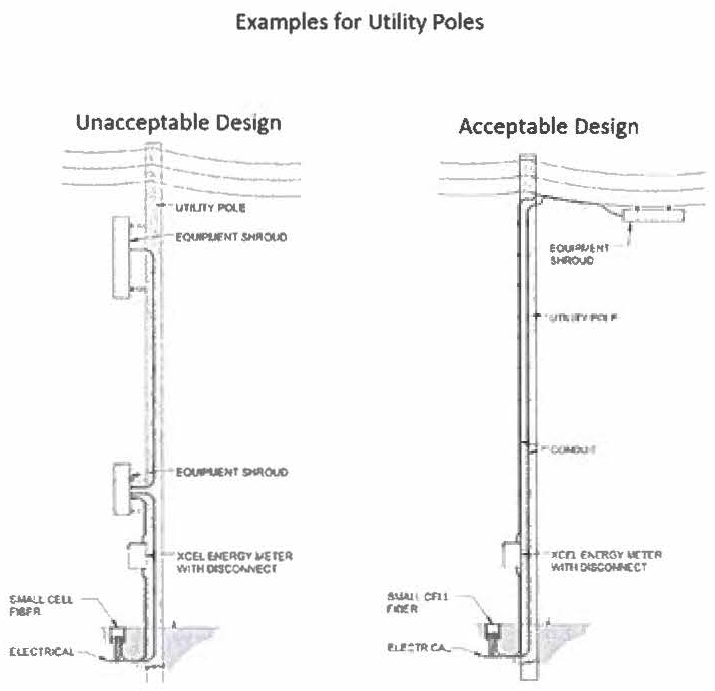
Interior Concealment. Whenever technologically feasible, antennas and equipment shall be fully concealed within the utility or light pole. When interior concealment is not possible, such as when attached to a wooden utility pole or due to American with Disabilities Act (ADA) requirements, antennas and equipment shall be camouflaged to appear to be an integrated part of the utility or light pole.
e.
Flush-Mounted Standoff Brackets or Pole-Top Antennas. In situations when interior concealment pursuant to subsection B.1.d. of this section is not possible, installation of an antenna on a pole shall be flush mounted, if feasible or located at the top of the pole. Flush mounting includes using brackets that offset the inside edge of such equipment from the utility pole by twelve inches or less, except as otherwise required by the pole owner or a controlling electrical code such as the National Electrical Safety Code, National Electric Code or State Electrical Code and when approved by the Town. Standoff brackets are permitted so long as the antennas are mounted as close to the pole as technically feasible, but no more than twelve inches off the pole.
f.
Antenna Design. Antennas shall be located in an enclosure of no more than three cubic feet in volume, or in case of an antenna that has exposed elements, the antenna and all of its exposed elements could fit within an imaginary enclosure of no more than three cubic feet. No more than four antennas are permitted on a single utility pole and with a total volume not to exceed nine cubic feet.
g.
Primary Equipment Enclosure Location and Dimensions. The applicant shall minimize the primary equipment enclosure space and use the smallest amount of enclosure possible to fit the necessary equipment. The primary equipment enclosure shall be located using one of the following methods:
(1)
Concealed completely within the pole or pole base. If within the pole base, the base shall meet the ADA requirements and not impact the pedestrian access route.
(2)
Located on a pole. If located on a pole, the equipment enclosure shall be seventeen cubic feet or less in size.
(3)
Underground in a utility vault. If located underground, the access lid to the primary equipment enclosure shall be located outside the footprint of any pedestrian curb ramp and shall have a nonskid surface meeting ADA requirements if located within an existing pedestrian access route.
(4)
On private property. If located on private property, the applicant shall submit a copy of an executed easement or lease agreement with the private property owner prior to the right-of-way permit issuance. In addition, if the private property is zoned residential, the applicant shall comply with the requirements of applicable zoning code chapter.
h.
Material and Color. Small cell facility antennas, conduit, mounting hardware and cabinets shall be painted to match the color of the pole and shall be nonreflective.
i.
No Illumination. Small cell facilities shall not be illuminated.
j.
Generators and Backup Battery. Applicant shall not install any generators or backup battery power.
k.
Underground Areas and Design Zone Aesthetics. The design plans for all small cell facilities in design zones shall be compatible with the character and aesthetics of the neighborhoods, plazas, boulevards, parks, public spaces, and commercial districts located in whole or in part within the design zone. Applicant shall propose design concepts and the use of camouflage or stealth materials, as necessary to blend its installations with the overall character of the design zone. Applicants are encouraged to meet with the Town prior to submitting a concealment element plan subject to this section and other applicable Town Code.
Examples of Unacceptable and Acceptable Small Cell Facilities
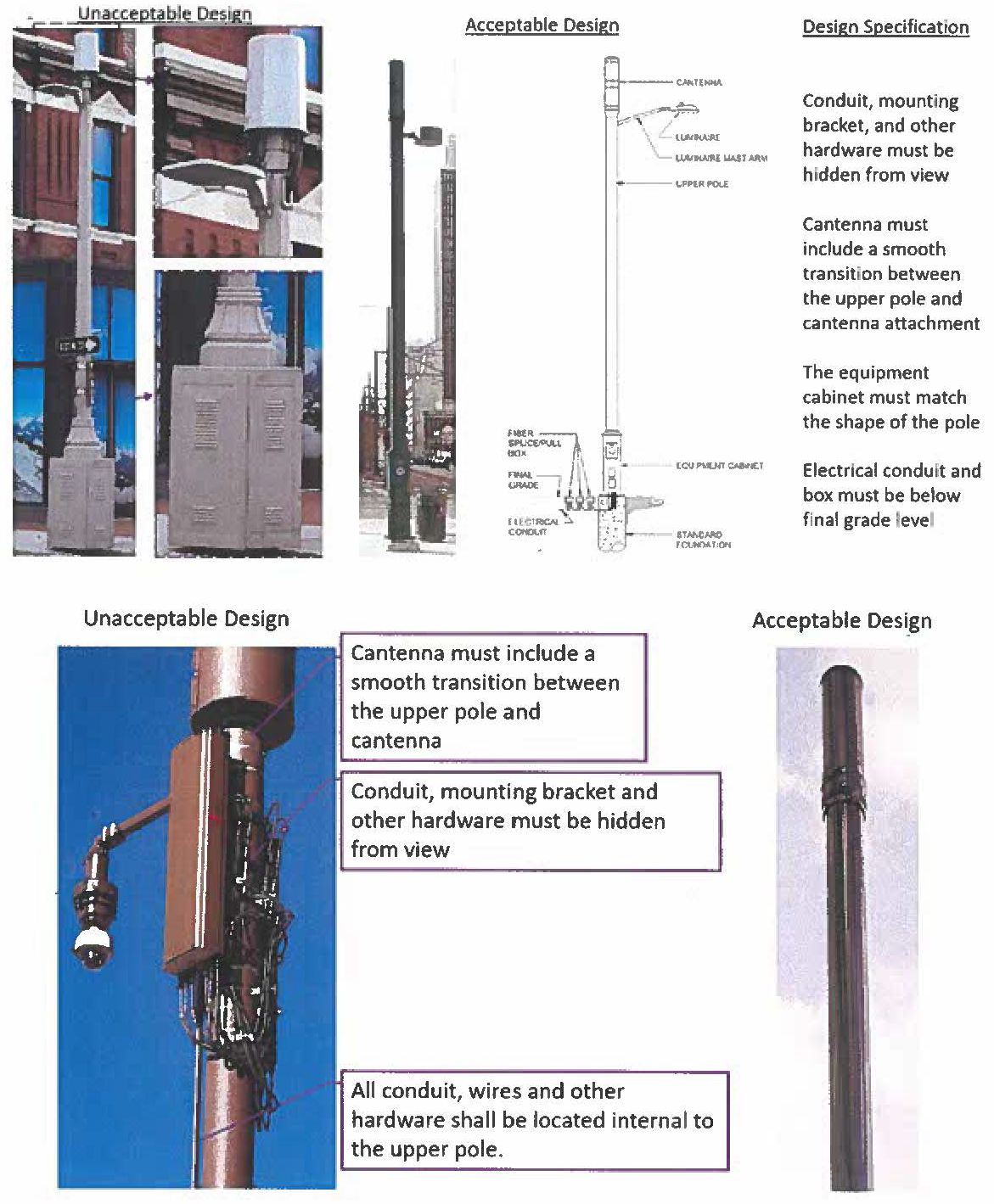
Examples of a Poorly Designed Small Cell Facility
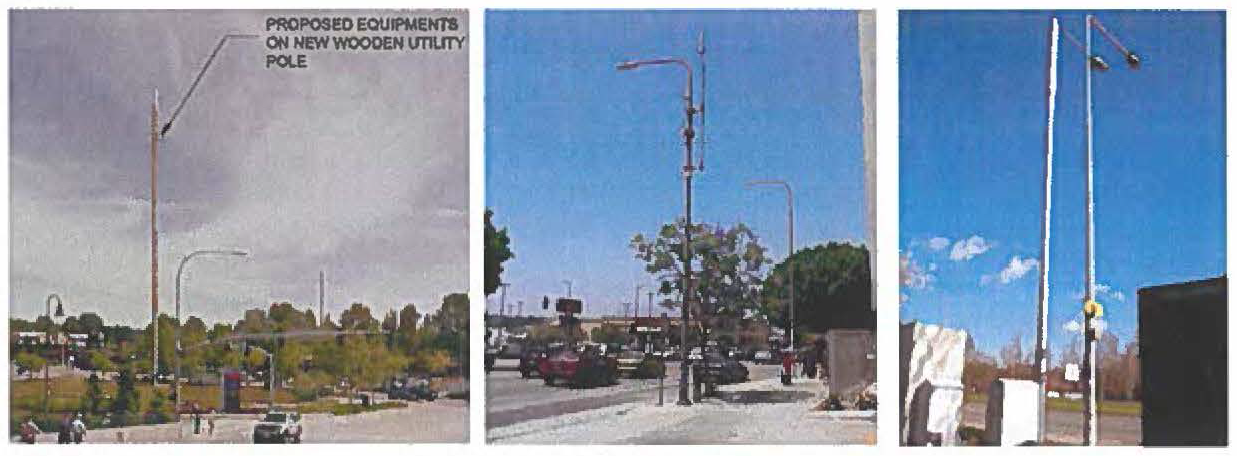
Examples of Utility Pole Design (Subject to Approval of the Utility)
l.
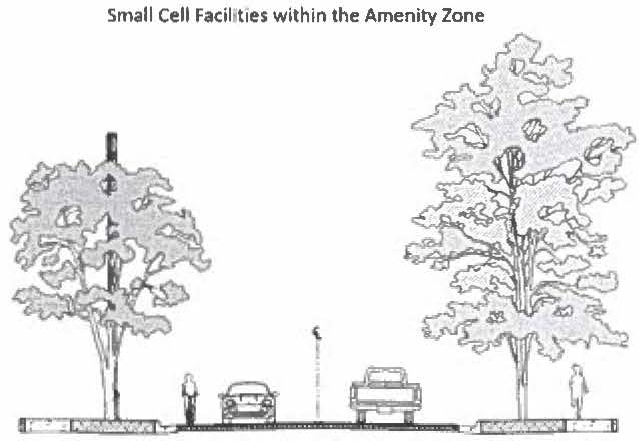
Placement Requirements. Small cell facilities and street light poles shall only be located where an existing pole can be removed and replaced or at a new location where is have been identified that a streetlight is necessary. Poles shall be placed as follows:
(1)
In a manner that does not impeded, obstruct, or hinder pedestrian or vehicle travel.
(2)
In alignment with existing trees, utility poles, and streetlights. Placement should be within the street amenity zone.
(3)
Equal distance between tress when possible, with a minimum of fifteen-foot separation such that no proposed disturbance shall occur within the critical root zone of any tree.
(4)
With appropriate clearance from existing utilities.
(5)
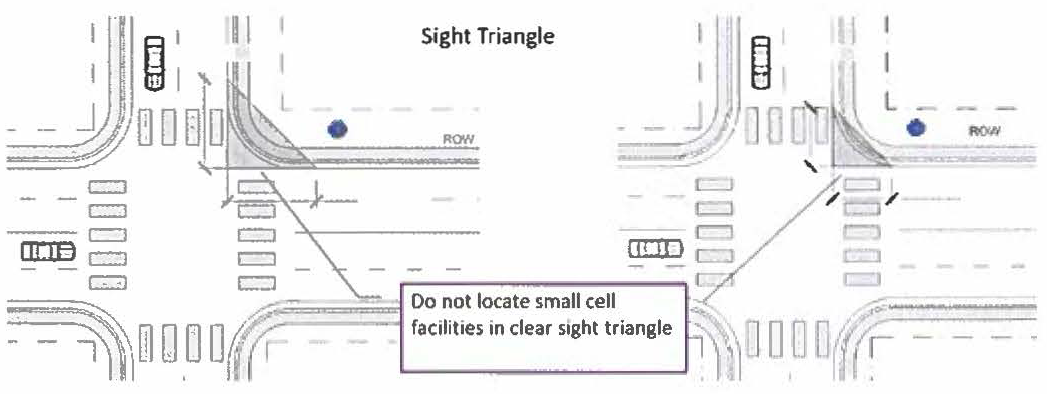
Outside the sight distance triangle at intersections; including alleys.
(6)
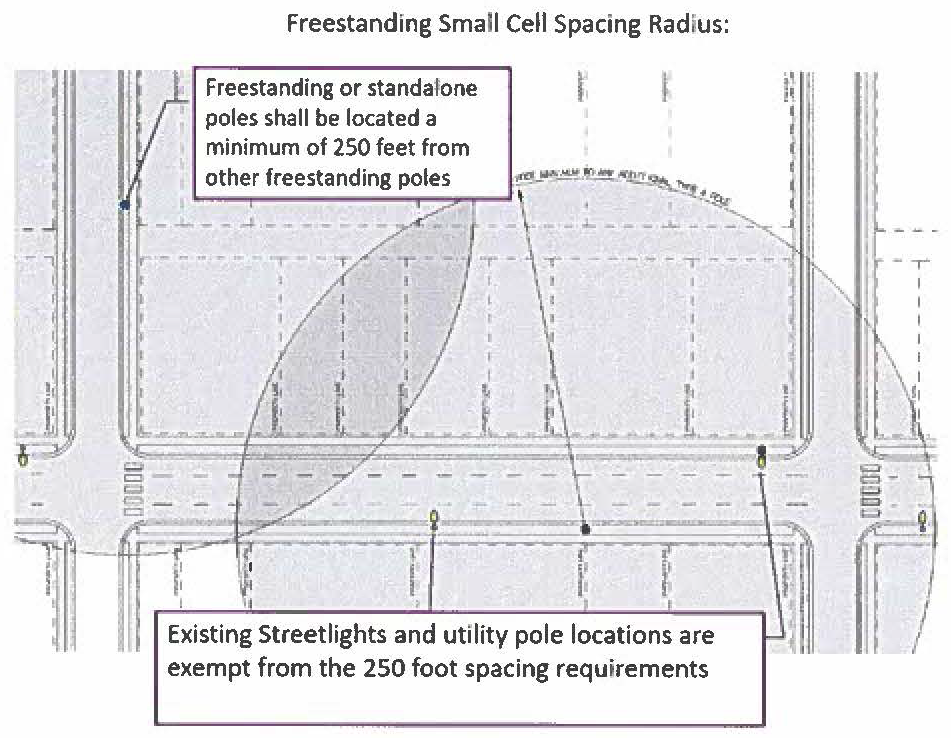
New standalone poles shall be separated by at least two hundred fifty feet in circumference.
(7)
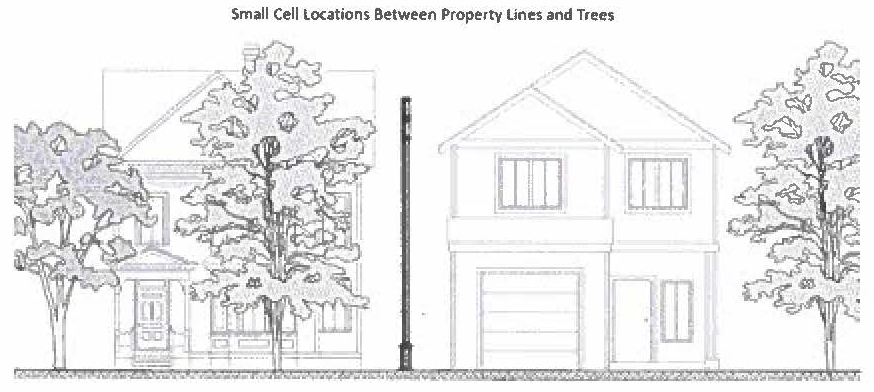
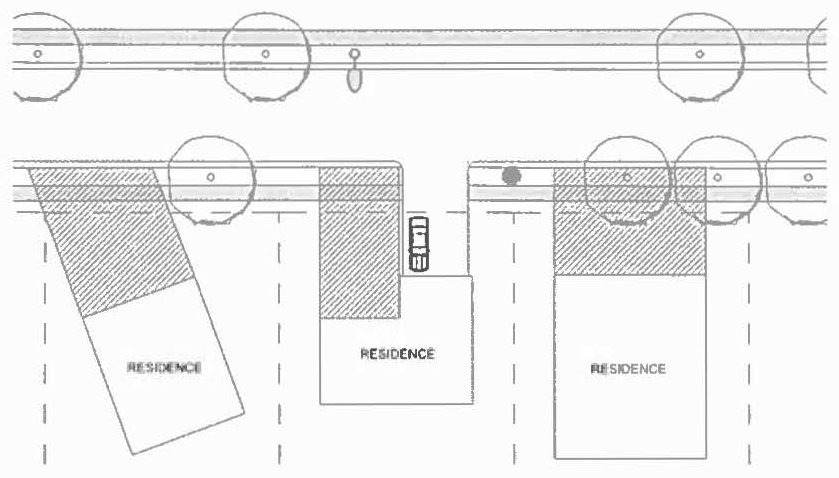
Small cells shall not be installed between the perpendicular extension of the primary street facing wall plane of any single-family residence.
(8)
When located adjacent to a commercial establishment, small cells shall be located away from store front windows, primary walkways, entrances or exits.
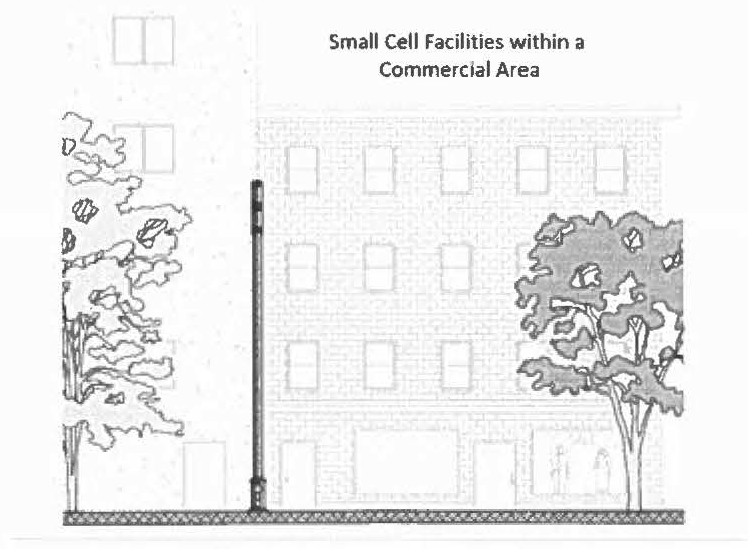
_____
2.
Third Party Requirements.
a.
All installations of small cell facilities must have permission from the pole/structure owner to install facilities on such structure.
b.
Governing Construction or Electrical Code. All installations of small cell facilities shall comply with any governing construction or electrical code such as the National Electrical Safety Code, the National Electric Code or state electrical code, as applicable. All installations of ground-mounted or replacement structures shall comply with the Town's adopted standards for construction in the right-of-way.
c.
Electrical Connection. The Town is not responsible for providing electricity to small cell facilities. Any third party utility providing such electricity must obtain a franchise from the Town prior to operating in the rights-of-way.
d.
Transport/Telecommunications Connection. The Town is not responsible for providing transport connectivity (i.e., fiber) to small cell facilities. Any third party utility providing such transport connectivity must obtain a franchise from the Town prior to operating in the rights-of-way.
C.
Ground-mounted equipment—ADA compliance required. In areas of the Town where overhead utility lines have been undergrounded (undergrounded areas), in designated design zones and in other areas where necessary to permit full use of the public right-of-way by pedestrians, bicycles and other users, all ground-mounted equipment shall be undergrounded in a vault meeting the Town's construction standards. The location of ground-mounted equipment (to the extent undergrounding such equipment is not technologically feasible), a replacement pole or street light shall comply with the Americans with Disabilities Act (ADA), Town development standards, and state and federal regulations in order to provide a clear and safe passage within the public right-of-way. Ground-mounted equipment is also permitted on private property adjacent to the public right-of-way with a recorded easement or lease agreement.
D.
Design Review. Small cell deployment, as well as certain new or replacement facilities, are subject to applicable design review and other zoning code requirements as set forth in the Darrington municipal code.
E.
Public Comment. The Town shall provide notice of a complete application for a franchise on the Town's website with a link to the franchise application. This notice requirement shall also apply to existing franchisees applying for a Small Cell Permit for small cell deployment. The notice shall include an email contact and telephone number for the applicant to answer citizen inquiries. The applicant is encouraged to host informational meetings for the public regarding the deployment. The Town shall post meeting notices, if any, for informational meetings on its website. These meetings are for the public's information and are neither hearings nor part of any land use appeal process.
(Ord. No. 761, § 3(Att. C), 12-9-2020)
17.210.070 - Right-of way permit for small cells and deviations.
A.
The director shall review applications for a right-of-way permit for a small cell deployment approved by a franchise or described in a concurrent franchise application. Deviations of the plans submitted may be approved by the director if the dimensions or volume of small cell facilities do not exceed the cumulative total provided by the definition of a small cell or microcell facility in RCW 80.36.375 and concealment technologies referenced in the exhibits to the franchise or design standards. A deviation may be approved by the director in the following circumstances:
1.
An increase in height of up to ten feet above the top of the existing pole.
2.
An increase in height exceeding ten feet above the top of the existing pole if required by the utility company for safety and/or operational purposes. The replacement pole shall be installed by the utility company.
3.
Replacement components of an existing, approved small cell facility, and the addition of antennas on a pole that exceed a cumulative total of nine cubic feet shall be considered a deviation. Provided, however, that in each instance the replacement components are consistent with the intent of the concealment features set by Town's generally applicable pole design standard adopted pursuant to the franchise, or applicable Town code.
B.
Right-of-way permits to install small cell facilities including approval of deviations shall be processed within ninety days of receipt of a complete application and final approval of a franchise, whichever occurs last. A right-of-way use permit for small cell deployment is a police power regulation adopted pursuant to RCW 35.99.040(2) and accordingly is not subject to the thirty-day use permit issuance requirement contained in RCW 35.99.030(2).
C.
The decision of the director to approve or deny a right-of-way permit for a small cell facility with a deviation, if any, shall be final and is not subject to appeal under Town Code or further legislative review.
D.
Wireless communication facilities other than small cell deployment in the public right-of-way shall be reviewed pursuant to chapter 17.220.
(Ord. No. 761, § 3(Att. C), 12-9-2020)
17.210.075 - Facilities designated in the franchise and/or small cell permit application.
Small cell deployments may be approved by reference to exhibits in an approved franchise. Approval of the franchise shall be deemed to approve the site and the design of small cell facilities set forth in the franchise. This approval is limited to the specific location, facility and design elements shown on the exhibits to the franchise. Any element not shown on an exhibit must be approved by the director governing review processes listed in the applicable provisions of the Town Code. All facilities shall comply with the concealment standards adopted by the Town. An existing franchisee may, at its option:
A.
Apply to amend the existing franchise to designate sites for small cell deployment, as well as approve the small cell facilities to be installed and the concealment measures to be utilized; and/or
B.
Apply for a small cell permit which shall include:
1.
Small cell facilities to be installed on existing utility poles, or replacement poles which do not exceed ten feet in additional height; utilize the concealment option provided this chapter; and/or
2.
Small cell facilities which comply with generally applicable objective design standards adopted by the Town; and/or
3.
Small cell facilities which require new utility poles or for replacement poles which exceed ten feet in additional, height, new utility poles or installations in a specially designated zone or overlay, utilize the applicable design approval procedures set adopted by the Town.
(Ord. No. 761, § 3(Att. C), 12-9-2020)
Editor's note— Ord. No. 761, § 3(Att. C), adopted December 9, 2020, enacted provisions intended for use as section 17.210.070. Inasmuch as there are already provisions so designated, and at the discretion of the editor, said provisions have been redesignated as section 17.210.075.
17.210.080 - Small cell permit and minor deviations.
A.
The director shall review applications for small cell permits for small cell deployments approved by a franchise or described in a concurrent franchise application. The director may authorize minor deviations in the small cell permit from the dimensional design and concealment technologies referenced in the exhibits to the franchise or design standards.
B.
A deviation in height of the pole of up to ten feet above the height of the existing pole when required for separation established for the zoning district, by the franchise or from a design approved for a specially designated design zone may be permitted.
C.
Deviations in the dimensions or volume of small cell facilities which do not exceed the cumulative total provided by the definition of a small cell or microcell facility in RCW 80.36.375 may be considered a minor deviation when an applicant replaces components of an existing, approved small cell facility. Similarly, the addition of antennae on a pole, not to exceed a cumulative total of six cubic feet shall be considered a minor deviation. Provided, however, that in each instance the new or revised facilities do not defeat the concealment features set by Town's generally applicable pole design standard adopted pursuant to the franchise, or Town Code.
D.
Small cell permits to install facilities including approval of minor deviations shall be processed within ninety days of receipt of a complete application and final approval of a franchise, whichever occurs last.
E.
The decision of the director to approve a small cell permit with a minor deviation, if any, shall be final and is not subject to appeal under Town Code or further legislative review.
(Ord. No. 761, § 3(Att. C), 12-9-2020)
17.210.090 - Significant deviations.
Any request for significant deviations from the approved small cell facilities design designated in the franchise, small cell permit or Town's design standards shall be considered a Type III permit under the provisions of chapter 17.104. An applicant seeking approval of a new pole or a replacement pole in a specially designated design zone shall be subject to the same review process as identified in chapter 17.220.
(Ord. No. 761, § 3(Att. C), 12-9-2020)
17.210.100 - Wireless communication franchise and small cell deployment facility approvals and processes.
Approval of a franchise, small cell permit and/or other approval referenced in this chapter are conditioned on the following requirements:
A.
Satisfy applicable bulk requirements such as noise and light regulations.
B.
Comply with adopted design and concealment standards, applicable to replacement utility poles and new utility poles in a design zone or undergrounded areas district.
C.
Obtain the written approval of the owner of any utility pole for the installation of its facilities on such utility pole. Approval of a franchise does not authorize attachment to Town-owned utility poles or other structures.
D.
Unless specifically provided for in a franchise, obtain a lease from the Town to utilize the Town's ground space for the installation of any new pole, a replacement utility pole over sixty feet or to locate any new ground based structure, base station or other attendant equipment on Town right-of-way or Town property;
E.
Comply with all Town construction standards and state and federal codes when operating in the right-of-way and obtain a required permit to enter the right-of-way.
F.
A franchise which includes a facility which is not exempt from SEPA review shall be processed in the provisions of chapter 17.210.
G.
Small cell facilities approved pursuant to this chapter shall be considered as an outright permitted use when located within the right-of-way.
(Ord. No. 761, § 3(Att. C), 12-9-2020)
17.210.110 - Small cell facilities in undergrounded areas or design zones.
A.
Replacement poles over forty-five feet in height and new street lights for small cell facilities to be constructed in any undergrounded area or design zone are permitted only when the applicant establishes that:
1.
The small cell facility cannot be located on an electrical transmission tower or on a site outside of the public right-of-way such as a public park, public property, or in or on a nonresidential use in a residential zone whether by roof or panel-mount or separate structure; and
2.
The proposed facility complies with an approved stealth installation plan as described in this section for an undergrounded area or design zone; and
3.
The facilities shall comply with critical areas requirements and SEPA, if applicable; and
4.
The applicant shall enter into an agreement with the owner of any new or replacement utility pole and/or street light within the public right-of-way and provide an executed copy of the agreement to the Town prior to right-of-way permit issuance.
B.
Stealth Installation Plan Required. Applications for proposed installations in underground areas and design zones which deviate for existing Town design standards (or if the Town has not created a design standard for that particular area) shall be required to submit a stealth installation plan. Such plan shall include the design of the screening, fencing or other concealment technology for a base station, tower, utility pole, or equipment structure, and all related transmission equipment or facilities associated with the proposed wireless facility, including but not limited to fiber and power connections.
1.
Purpose of Stealth Installation Plan, Generally. Stealth installation plans should seek to minimize the visual obtrusiveness of installations using methods including, but not limited to, integrating the installation with architectural features or building design components, utilization of coverings or concealment devices of similar material, color and texture—or the appearance thereof—as the surface against which the installation will be seen or on which it will be installed.
2.
Other stealth approaches may include, but not be limited to, use of architectural concealment products, fencing or screening materials, and where appropriate, landscape design, or any other camouflage strategies appropriate for the type of installation. Additionally, the use of a stealth support or concealment device, such as a clock tower, steeple, flagpole, tree, street sign, or other applicable concealment structure may be approved.
3.
The director shall apply this section, as well as all design requirements applicable in the underground area or design zone in which an installation is proposed.
4.
Review of Stealth Installation Plan for Non-substantial Change Colocations. Where a proposed collocation does not constitute a substantial change, a stealth installation plan shall be subject to ministerial review to ensure the proposed collocation does not defeat the concealment features approved as part of the initial installation at that location.
5.
Review of Stealth Installation Plan for Initial Installations and Substantial Change Colocations. For initial installations and substantial change colocations in underground areas and design zones, the director shall conduct an administrative review of stealth installation plans for compliance with this section and all applicable Town design guidelines.
C.
Replacement Utility Pole—Street Lighting. With the director's approval, a replacement utility pole or a request for a new utility pole may be permitted in the form of a new street light. The design of the street light shall be consistent with the existing street lights, subject to the director's approval. All equipment and cabling shall be internal to the replacement street lighting standard.
D.
Undergrounded Areas. It is the stated policy of the Town that all utilities shall be underground in areas that are currently undergrounded. No new utility poles shall be erected in undergrounded areas. The applicant may request to install a new street light as provided in the applicable Town code.
E.
Franchise and Small Cell Deployment Facility Approvals and Processes. Approval of a franchise, right-of-way permit and/or other approval referenced in this chapter are conditioned on the following requirements:
1.
Satisfy applicable design requirements, including, but not limited to, noise and light regulations.
2.
Comply with adopted design and concealment standards, applicable to replacement utility poles and new utility poles in a design zone or undergrounded areas.
3.
Obtain the written approval of the owner of any utility pole for the installation of its facilities on such utility pole. Unless specifically provided for in a franchise agreement, approval of a franchise does not authorize attachment to Town-owned utility poles or other structures.
4.
Comply with all Town construction standards and state and federal codes and standards when operating in the right-of-way and obtain a required permit to enter the right-of-way.
5.
A right-of-way permit for small cell deployment which includes a facility not exempt from SEPA review shall be processed in the provisions of the applicable Town code.
(Ord. No. 761, § 3(Att. C), 12-9-2020)
17.210.120 - Compliance with state processing limitations.
Review of franchise and small cell permits shall comply with the provisions of RCW 35.99.030. Applications shall be reviewed, completeness determined and the timeframe tolled as provided in chapter 17.205 of the Town Code. A right-of-way use permit for small cell deployment is a police power regulation adopted pursuant to RCW 35.99.040(2) and accordingly is not subject to the thirty-day use permit issuance requirement contained in RCW 35.99.030(2).
(Ord. No. 761, § 3(Att. C), 12-9-2020)
17.210.130 - Additional review procedures.
Wireless communication facilities, including small cell facilities permitted pursuant to this chapter, are required to comply with all other applicable review procedures and regulations duly adopted by the Town Code.
(Ord. No. 761, § 3(Att. C), 12-9-2020)