
Decatur City Zoning Code
ARTICLE 10
- Buildings and Fire
10.1.1. - In General
A.
Penalty for Violation of Article
Any person guilty of a violation of this Article shall be punished as provided in Section 1-12 of the Code of Ordinances.
B.
Permits
1.
When required, any owner, authorized agent, or contractor who desires to construct, enlarge, alter, repair, move, demolish, or change the occupancy of a building or structure, or to erect, install, enlarge, alter, repair, remove, convert, or replace any electrical, gas, mechanical, or plumbing system, the installation of which is regulated by the construction codes, or to cause any such work to be done, shall first make application to the building official and obtain the required permit for the work.
2.
Ordinary minor repairs and maintenance scopes of work (less than $1000.00 in value) may be made with the approval of the building official without a permit, provided that such repairs shall not violate any of the provisions of the construction codes, and excepting work proposed in a Historic District for which permits are otherwise required.
3.
Fees as set forth in the schedule of fees and charges are required at the time of permit.
4.
A reinspection fee may be required for the inspection of construction due to the following:
a.
Upon initial reinspection it is found that a previously reported building code violation has not been corrected "prior to reinspection or as otherwise approved by the Building Official".
b.
The work is not ready for inspection when an inspection is requested and performed.
c.
Work has been made inaccessible for proper inspection.
d.
A permit is obtained only after the work is posted with a notice of code violations.
e.
Payment of the reinspection fee shall be made prior to the reinspection.
f.
Any required fees shall be paid to the City clerk before any building permits shall be issued, and shall be deposited in the general fund of the City.
g.
Construction shall begin within 8 months from the issuance of such permit and failure to do so will terminate the permit, and all fees for such permit shall be forfeited to the City. Construction shall not begin after such expiration date until a new permit has been obtained and the fees paid.
h.
The building permit number shall be conspicuously posted on a sign in front of the property prior to undertaking any construction.
i.
No permit shall be granted for structural change, alteration or extension of any building located in the first fire district for the purpose of extending or enlarging an existing nonconforming use or to accommodate the change of an existing nonconforming use to a more extensive or different nonconforming use.
5.
Expiration of building permits. Construction, alteration, additions to or repair of residential buildings of no more than 4 dwelling units and/or associated accessory buildings:
a.
A building permit under which the work is not completed within 12 months after issuance shall expire by limitation and a new permit shall be secured before the work is continued. An additional fee equal to the amount of the fee for the expired permit shall be required prior to issuance of the new permit; however, for second and subsequent renewals, an additional fee equal to twice the amount of the fee for the expired permit shall be required prior to issuance of the new permit.
b.
Construction, alteration, additions to or repair of residential buildings of more than 4 dwelling units and all commercial, industrial, institutional and other types of construction:
i.
A building permit under which the work is not completed within 24 months after issuance shall expire by limitation and a new permit shall be secured before the work is continued. An additional fee equal to twice the amount of the fee for the expired permit shall be required prior to issuance of the new permit.
C.
Plans and Specifications to be Followed in Construction
1.
Construction shall be completed according to plans and specifications submitted for a permit. The premises shall not be occupied or used for the purposes presented in the plans until the permitted work has been completed and a Certificate of Occupancy has been issued by the Building Official.
2.
Any person who violates a provision of the construction codes or fails to comply with permitted plans, including all structural, electrical, gas, mechanical or plumbing systems submitted for permit, shall be punished as provided by City Code Chapter 1-12.
D.
Steel in Reinforced Concrete Construction
The steel used in all reinforced concrete construction shall not be covered until it has been inspected by the City building inspector.
E.
House Numbers
1.
All persons owning or occupying houses in the City fronting on the various streets shall be required to obtain from the UDO Administrator a number for their respective houses, and anyone erecting a new house shall obtain from the UDO Administrator the number for such house erected. For each business house or place of business occupying 20 feet, a number shall be obtained, and each residence lot which is improved will require a number for every 50 feet, but if more than 1 house is on the 50 feet, separate numbers for each house will be required.
2.
The UDO Administrator shall furnish numbers, as required by this section, in the following manner beginning at the Courthouse Square and going out all streets leading therefrom, with all even numbers on the left side of the street and all odd numbers on the right side of the street. On all streets which do not start from the courthouse, numbering shall be started at the nearest end to the courthouse, and the streets shall be numbered in like manner as those starting from the courthouse with the exception of Candler Street which shall be numbered starting at the Georgia Railroad going both ways viz: going north, North Candler; going south, South Candler.
3.
All persons owning or occupying houses in the City fronting on the various streets and alleys shall be required to display in a conspicuous place the number assigned to such owner or occupant of the property by the UDO Administrator in accordance with the centenary system. The number shall be erected by the owner or occupant within 10 days after being served with notice of the proper number assigned to the property. Anyone erecting a new house shall obtain from the UDO Administrator the number for such house at the time the building permit is issued. The street number shall be conspicuously posted on a sign in the front of the property prior to undertaking any new construction.
F.
Disposal of Construction Waste
1.
Waste materials, including but not limited to building materials, rubbish, litter, refuse, paper and similar materials, shall not be allowed to accumulate within a building or construction site, nor in the immediate vicinity of a building or construction site, nor in any public street or right-of-way, but shall be removed from the premises as rapidly as practical.
2.
Such waste materials may be stored temporarily in a construction-type commercial container which shall be maintained so that the area surrounding such container is clean and free of accumulations of refuse. Such container shall be removed and/or emptied when full.
G.
Demolition of Structures
Demolition of any structure shall not begin until all of the following conditions are satisfied:
1.
A permit for demolition scope of work, including any required Erosion and Sedimentation Control or Tree Conservation Plan, has been obtained from the City.
2.
A State-licensed Pest Control Agency has certified, and the Building Official has received verification, that the premises do not show or contain evidence of vermin and/or rodent infestation that would be disturbed or migrate from the premises during demolition and that abatement of any evident infestation condition has been accomplished prior to demolition.
3.
A State-licensed hazardous material abatement contractor has provided copies of all required lead-based paint and asbestos program forms submitted to the Georgia Environmental Protection Division, with approved landfill invoices receipting any asbestos materials from the site, to the Office of the Building Official.
4.
All utilities are terminated and capped at the right-of-way.
10.1.2. - Building and Construction Codes
A.
Generally
1.
It is hereby declared to be the intention of the City Commission to enforce and adopt the state minimum standards codes as defined by O.C.G.A. § 8-2-20(9). The adoption also includes the latest edition of the following state minimum standard codes, as adopted and amended by the state department of community affairs, for all permits approved after the adoption of this ordinance:
2.
Pursuant to O.C.G.A. § 8-2-25(a), the latest edition of the state minimum standard codes, enumerated in said Section, as adopted and amended by the Georgia Department of Community Affairs, shall be enforced in the City by inspection and fees.
3.
Generally. Where, in any specific case, different sections of these construction codes specify different materials, methods of construction, or other requirements, the most restrictive shall govern. Where there is a conflict between a general requirement and a specific requirement, the specific requirement shall be applicable.
B.
Permissive Codes
1.
Pursuant to O.C.G.A. § 8-2-25(b) and O.C.G.A. § 8-2-20(9)(B)(i)(X), the International Property Maintenance Code, as adopted and as amended from time to time by the Georgia Department of Community Affairs (DCA), is hereby adopted as part of the city's Code of Ordinances and is enforceable by the design environment and construction division within the department of public works.
2.
Pursuant to O.C.G.A § 8-2-25B and § 8-2-20(9)(B)(i)(X) the National Green Building Standard (ICC 700), as adopted and amended from time to time by the Georgia Department of Community affairs (DCA) is hereby adopted as part of the city's Code of Ordinances and is enforceable by the design environment and construction division within the department of public works.
3.
Pursuant to O.C.G.A. § 8-2-25B and § 8-2-20(9)(B)(i)(X) the International Existing Building Code, as adopted and amended from time to time by the Georgia Department of Community affairs (DCA) is hereby adopted as part of the city's Code of Ordinances and is enforceable by the design environment and construction division within the department of public works.
C.
Required Codes
1.
Building
The provisions of the International Building Code, as adopted and amended by the state department of community affairs, shall apply to the construction, alteration, repair, equipment, use and occupancy, location, maintenance, removal, and demolition, of every building or structure or any appurtenances connected or attached to such buildings or structures, except in one-and two-family dwellings.
2.
One- and Two-Family Dwellings
The provisions of the International Residential Code, as adopted and amended by the state department of community affairs, shall apply to the construction, alteration, repair, equipment, use and occupancy, location, maintenance, removal, and demolition, of every building or structure or any appurtenances connected or attached to such buildings or structures of detached one- and two-family dwellings and townhouses not more than three stories in height with a separate means of egress and their accessory structures.
3.
Electrical
The provisions of the National Electrical Code, as adopted and amended by the state department of community affairs, shall apply to the installation of electrical systems, including alterations, repairs, replacement, equipment, appliances, fixtures, fittings, and appurtenances thereto.
4.
Gas
The provisions of the International Fuel Gas Code, as adopted and amended by the state department of community affairs, shall apply to the installation of consumer's gas piping, gas appliances, and related accessories as covered in this Code. These requirements apply to gas piping systems extending from the point of delivery to the inlet connections of appliances and the installation and operation of residential and commercial gas appliances and related accessories, except in one- and two-family dwellings.
5.
Mechanical
The provisions of the International Mechanical Code, as adopted and amended by the state department of community affairs, shall apply to the installation of mechanical systems, including alterations, repairs, replacement, equipment, appliances, fixtures, fittings and/or appurtenances, including ventilating, heating, cooling, air conditioning and refrigeration systems, incinerators, and other energy related systems, except in one- and two-family dwellings.
6.
Plumbing
The provisions of the International Plumbing Code, as adopted and amended by the state department of community affairs, shall apply to every plumbing installation, including alterations, repairs, replacement, equipment, appliances, fixtures, fittings, and appurtenances, and when connected to a water or sewerage system.
7.
Energy
The provisions of the International Energy Conservation Code, as adopted and amended by the state department of community affairs, shall regulate the design of building envelopes for adequate thermal resistance and low air leakage and the design and selection of mechanical, electrical, service water heating, and illumination systems and equipment that will enable the effective use of energy in new building construction.
D.
International Building Code
1.
Exceptions to Restrictions in Fire District
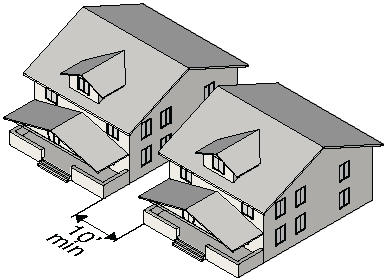
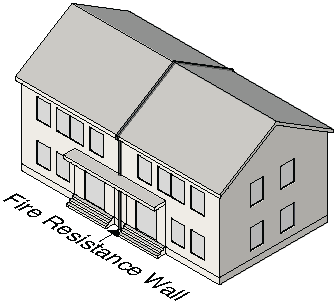
One and two-family dwellings, and townhouses may be of any type construction permitted by this Code provided that structures are:
a.
Separated by a minimum of 10 feet and greater than 5 feet from the property line or;
b.
Separated by a masonry wall having a 2-hour fire resistance rating.
2.
Separation
a.
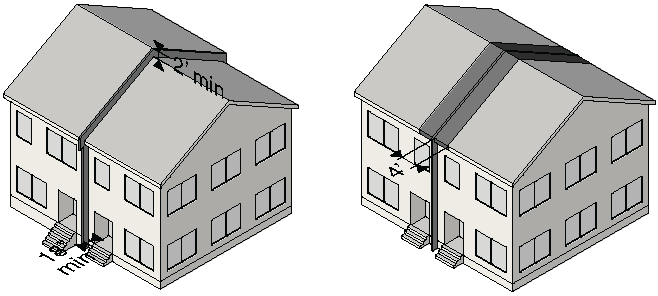
Each townhouse shall be considered a separate building and shall be completely separated from any adjoining dwelling by use of a masonry wall that provides a fire resistant rating of not less than 2 Hours; or a wall that provides a fire resistance rating of not less than 2 Hours tested in accordance with ASTM E 119 or UL 263 with exposure from both sides and an approved automatic sprinkler system in accordance with NFPA 13.
b.
Such wall shall be continuous from the foundation through the roof and shall extend not less than 2 feet above the roof, except that such wall need not extend above the roof where said roof is constructed of a material having a fire resistance rating of 2 Hours for an area within 4 feet of each side of the wall.
c.
Such wall shall extend 18 inches beyond the adjoining front and rear walls.
d.
Such wall shall not be penetrated by plumbing, piping, ducts, electrical or other building services.
e.
Each dwelling unit sharing such wall shall be designed and constructed to maintain its structural integrity independent of the unit on the opposite side of the wall.
f.
Each garage that adjoins a dwelling unit shall be separated from it by a minimum of 1 layer of five-eighths-inch fire resistive gypsum board, and doors located in the separation shall have a minimum fire resistive rating of 20 minutes.
3.
Automatic Fire Extinguishing System
a.
New Residential Properties
The following types of new residential properties shall be provided with an approved automatic sprinkler system in accordance with NFPA 13, Standard for the Installation of Sprinkler Systems, 1985 edition:
i.
Hotels/motels
ii.
Multiple-family dwellings of 3 or more stories
iii.
Lodginghouses or roominghouses
iv.
Dormitories
b.
New Business Occupancy Properties
The following types of new business occupancy properties shall be provided with an approved automatic sprinkler system in accordance with NFPA 13, Standard for the Installation of Sprinkler Systems, 1985 edition:
i.
All new business occupancy buildings 4 or more stories in height.
c.
Existing Highrise Residential Occupancies
i.
All existing highrise residential occupancy buildings shall be provided with an approved sprinkler system in accordance with NFPA 13, Standard for the Installation of Sprinkler Systems, 1985 edition.
ii.
It is hereby ordered that a 4-year period, beginning with the approval date of this UDO, shall be granted before an existing building is required to be provided with an approved sprinkler system in accordance with NFPA 13, Standard for the Installation of Sprinkler Systems, 1985 edition.
d.
Existing Highrise Business Occupancies
i.
Existing Highrise
All existing highrise business occupancy buildings shall be provided with an approved automatic sprinkler system in accordance with NFPA 13, Standard for the Installation of Sprinkler Systems, 1985 edition, or other approved automatic fire extinguishing system.
ii.
Undue Hardship
Whenever, in the opinion of the City Manager, the full implementation of this requirement would cause an undue hardship in a specific case, the City Manager may waive the requirements in question to provide that an equivalent means of achieving substantially the same degree of safety is ensured. Such waiver shall be in writing and shall state the equivalent methods by which the safety shall be ensured and shall be made a part of the plans or permits in question.
e.
Appeals
The owner of a building or structure, or the owner's authorized agent, may appeal a decision of the City Manager to the City Commission whenever one of the following conditions are claimed to exist:
i.
The provisions of this Section do not apply to the specific case in question.
ii.
An equally good or more desirable form of automatic fire extinguishing system can be employed to meet the requirements of this Section.
iii.
The intent and meaning of this Section has been misconstrued or incorrectly applied.
f.
Variance
The City Commissioners, when so appealed to and after a public hearing, may vary from the decision of the City Manager regarding the requirements of this Section when it finds that the enforcement thereof would be unjust and contrary to the purpose of this section and the public interest, and also finds all of the following:
i.
Special conditions and circumstances exist which are peculiar to the building or structure and which are not applicable to other buildings and structures.
ii.
The special conditions and circumstances do not result from the action or inaction of the appellant.
iii.
Granting the variance will not confer on the appellant any special privilege that is denied by this section to other buildings or structures.
4.
More Restrictive Requirements to Apply
Where the provisions of Sec. 10.1.2.D.3. are in conflict with other sprinkler requirements in this Code, the more restrictive requirements shall apply.
E.
Standard Mechanical Code
1.
Adoption
The International Mechanical Code, as amended and approved by the state department of community affairs for use as the state minimum standard mechanical code, is hereby adopted as the heating, ventilating and air conditioning code of the City. Such code shall have the same force and effect as if it were fully set forth or described in this section. A copy of the code shall be properly attested and kept on file with the City clerk.
2.
Schedule of Permit Fees
a.
Reinspection
A reinspection fee may be required for the inspection of a heating, ventilation, air conditioning or refrigeration system, boiler, chimney or vent due to the following reasons:
i.
Upon initial reinspection it is found that a previously reported code violation has not been corrected.
ii.
The work is not ready for inspection when an inspection is requested and performed.
iii.
Work has been covered or made inaccessible for proper inspection.
iv.
A permit is obtained only after the work is posted with a notice of code violation.
v.
The reinspection fee shall be paid in full prior to the reinspection.
3.
Plans; Specifications; Documents
a.
Plans Required
In order to safeguard life, health and property and to promote public welfare, plans and specifications shall be submitted for any heating systems, appliances or equipment having a total required input in excess of 500,000 Btu per hour, and plans shall be submitted for any air conditioning or refrigeration system in excess of 25 tons. Such plans and specifications shall have been prepared by a professional mechanical engineer legally registered under the laws of the state regulating the practice of engineering and shall have the engineer's official seal affixed to the drawings, specifications and accompanying data.
b.
Plan Review
When plans are required by this Code, the Building Official shall examine or cause to be examined contract documents, consisting of drawings, specifications, computations, and additional data, and shall ascertain by such examinations whether the construction indicated and described is in accordance with the requirements of this Code and all other pertinent laws or ordinances.
c.
Affidavits
The Building Official may accept a sworn affidavit from a professional mechanical engineer legally registered under the laws of the state regulating the practice of engineering stating that the plans submitted conform to this Code, and the Building Official may, without any examination or inspection, accept such affidavit, provided that the engineer who made such affidavit, agrees to submit to the Building Official copies of inspection reports as inspections are performed and, upon completion of the mechanical system, a certification that the system has been installed in accordance with the requirements of this Code. Where the Building Official relies upon such affidavit, the engineer shall assume full responsibility for the compliance with all provisions of this Code.
4.
Conditions of Permit
a.
Permit Intent
A permit shall be construed to be a license to proceed with the work and shall not be construed as authority to violate, cancel, alter, or set aside any of the provisions of the code, nor shall such issuance of a permit prevent the Building Official from thereafter requiring a correction of errors in plans or in construction, or of violations of this Code. Every permit issued shall become invalid unless the work authorized by such permit is commenced within 6 months after its issuance or if the work authorized by such permit is suspended or abandoned for a period of 6 months after the time the work is commenced. One or more extensions of time, for periods of not more than 90 days each, may be allowed for the permit, provided the extension is requested in writing and justifiable cause is demonstrated. Such extensions shall be in writing by the Building Official.
b.
Permit Issued on Basis of an Affidavit
Whenever a permit is issued in reliance upon an affidavit or whenever the work to be covered by a permit involves installation under conditions which, in the opinion of the Building Official, are hazardous or complex, the Building Official shall require the engineer who signed the affidavit or made the drawings or computations to supervise such work. This person shall be responsible for the conformity of the work with the permit, provide copies of inspection reports, as inspections are performed, and, upon completion, make and file with the Building Official a written affidavit that the work has been done in conformity with the approved plans and with the structural provisions of this Code. If such engineer is not available, the owner shall employ in said engineer's stead a competent person or agency whose qualifications are approved by the Building Official.
F.
Property Maintenance Code
1.
Adoption
The International Property Maintenance Code, as amended and approved by the state department of community affairs for use as the state minimum standard building code, is hereby adopted as the housing code of the City, save and except such portions as are hereinafter deleted, modified or amended by this section. Such code shall have the same force and effect as if it were fully set forth or described in this section. A copy of the code shall be properly attested and kept on file with the City clerk. Deletions, modifications and amendments to the code are as follows:
2.
Amendments
The particulars in which the Standard Housing Code is modified and amended are as follows:
3.
Scope
The scope of the code shall prohibit mobile homes and house trailers for residential occupancy.
4.
Unsafe Structures
Allow 60 days time for the performance of any act it requires.
5.
Appointment
In addition to its other duties, as specified in the Decatur City Code, the Zoning Board of Appeals is also designated to carry out the duties of the housing board of adjustments and appeals specified in the International Property Maintenance Code.
6.
Violations and Penalties
Modify the last sentence by deleting the last 2 words thereof: "state laws," and substituting therefor the words "the provisions of section 1-12 of the Code of the City of Decatur, Georgia."
7.
Maintenance of Exterior Areas of
Exterior areas of multiple dwellings and roominghouses shall be properly maintained and kept in good repair. Parking lots, walkways, drives and other paved surfaces shall be maintained in sound paved condition and free of potholes, paving failures or other conditions that constitute a dangerous or hazardous condition to vehicles or pedestrians. Yards, open areas and play areas shall be maintained with grass, ground covers or other landscape materials to prevent erosion and sedimentation.
8.
Required Space in Dwelling Unit
Every dwelling unit shall contain at least 300 square feet of habitable floor area for the first occupant thereof, at least 100 square feet of additional habitable floor area for each of the next 3 occupants, and at least 75 square feet of additional habitable floor area for each additional occupant.
9.
Required Space in Sleeping Rooms
In every dwelling unit and in every rooming unit, every room occupied for sleeping purposes by 1 occupant shall contain at least 75 square feet of floor area, and every room occupied for sleeping purposes by more than 1 occupant shall contain at least 50 square feet of floor area for each occupant 12 years of age and over and at least 35 square feet of floor area for each occupant under 12 years of age. No room shall be occupied by more than 4 persons.
10.
Care of Premises
It shall be unlawful for the owner or occupant of a residential building, structure or property to utilize the premises of such residential property for the open storage of any motor vehicle which has been abandoned, ice box, refrigerator, stove, glass, building material, building rubbish, commercial equipment, industrial equipment or similar items. It shall be the duty and responsibility of every such owner or occupant to keep the premises of such residential property clean and to remove from the premises all such items as listed above including, but not limited to, weeds, dead trees, garbage, etc., upon notice from the building official.
11.
Effect of Division Upon Pending Suits or Proceedings
Nothing in this division nor in the code hereby adopted shall be construed to affect any suit or proceeding now pending in any court, or any rights acquired or liability incurred, nor any cause or causes of action accrued or existing, under any act or ordinance repealed hereby. Nor shall any right or remedy of any character be lost, impaired or affected by this division.
12.
Compliance with Property Maintenance Code
No person shall occupy as owner-occupant, or let to another for occupancy, any dwelling, dwelling unit, apartment or any space designed or intended to be used for the purpose of living, sleeping, cooking, or eating therein which does not comply with the requirements of the International Property Maintenance Code then in effect, as adopted by the City, and without first obtaining a valid certificate of occupancy from the building official of the City.
G.
Plumbing Code
1.
Adoption
The International Plumbing Code, as amended and approved by the state department of community affairs for use as the state minimum standard plumbing code, is hereby adopted as the plumbing code of the City. Such code shall have the same force and effect as if it were fully set forth or described in this section. A copy of the code shall be properly attested and kept on file with the City clerk.
2.
Schedule of Permit Fees
a.
Reinspection; Cause
A reinspection fee may be required for the inspection of plumbing installations due to the following:
i.
Upon initial reinspection it is found that a previously reported code violation has not been corrected.
ii.
The work is not ready for inspection when an inspection is requested and performed.
iii.
Work has been covered or made inaccessible for proper inspection.
iv.
A permit is obtained only after the work is posted with a notice of code violation.
v.
The reinspection fee shall be paid in full prior to the reinspection.
3.
Exemption
Subsection (d) of O.C.G.A. § 8-2-26, relating to self-inspection of water and sewer projects by master plumbers or utility contractors, shall not be applicable within the City.
4.
Family or Assisted Use Toilet Room Requirements
a.
Definitions
The following words, terms and phrases, when used in this section, shall have the meanings ascribed to them in this section, except where the context clearly indicates a different meaning:
Baby changing station is a flat and level surface that is constructed or installed within a toilet or changing room for the purposes of changing a small child under 50 pounds. Baby changing stations shall be a minimum of 18 inches by 32 inches and shall have a working height between 34 and 38 inches.
Family or assisted-use bathing room is an ADA accessible room containing one water closet or toilet, one shower, and one lavatory shall be provided to anyone who requires dedicated bathing facilities.
Family or assisted-use toilet room is an ADA accessible room containing one water closet or toilet and one lavatory and shall be provided to anyone who requires dedicated restroom facilities.
Lavatory is a vessel (such as a basin) for washing, especially a fixed bowl or basin with running water and drainpipe for washing.
Shower is a room or vessel for washing especially: a fixed pan or basin suitable for walking with running water and a drain pipe for washing.
Water closet is a fixture with a water-containing receptor that receives liquid and solid body waste and on actuation conveys the waste through an exposed integral trap into a drainage system and which is also referred to as a toilet.
b.
Applicability
i.
Any newly constructed building greater than 3,000 square feet in floor area that contains a commercial use or a public use; and
ii.
Any substantial improvement to an existing building that contains a commercial use or a public use and is greater than 3,000 square feet in floor area or where the building is larger than 3,000 square feet and the gross floor area of the renovation project exceeds 10% of the total building gross floor area.
c.
General Requirements
The following apply to all buildings subject to this Section 10.1.2.G.4:
i.
An accessible family or assisted-use toilet room shall be provided where an aggregate of six or more male and female water closets is required. Plumbing fixtures located within family or assisted-use toilet rooms and family and assisted-use bathing rooms shall be included in determining the number of plumbing fixtures provided in an occupancy.
ii.
This Section 10.1.2.G.4 shall not apply to multiple-family dwelling unit residential properties, hotels and motels.
iii.
Family or assisted-use toilet rooms shall include only one water closet, only one lavatory, and a baby changing station. However, a urinal is permitted to be provided in addition to the water closet in a family or assisted use toilet room.
iv.
Family or assisted-use bathing rooms shall include only one shower or bathtub fixture. Family or assisted-use bathing rooms shall also include one water closet, one lavatory and one baby changing station.
v.
Family or assisted-use toilet and bathing rooms shall be located on an accessible route. Family or assisted-use toilet rooms shall be located not more than one story above or below separate-sex toilet rooms. The accessible route from any bathroom to a family or assisted-use toilet room shall not exceed 500 feet (152 m).
vi.
Where doors swing into a family or assisted-use toilet room or a family or assisted-use bathing room, a clear floor space not less than 30 inches by 48 inches (762 mm by 1219 mm) shall be provided within the room, beyond the area of the door swing.
vii.
Doors to family or assisted-use toilet rooms and family or assisted-use bathing rooms shall be securable from within the room.
viii.
Family or Assisted-use toilet rooms and family or assisted-use bathing rooms shall be constructed of walls from floor to ceiling and may not be constructed using partial height walls or other partitions within an existing restroom facility.
5.
Baby Changing Station Requirements
a.
At least one baby changing station shall be provided in all bathrooms in all commercial buildings. Baby changing stations in ADA accessible toilet or bathing rooms shall not impede the accessibility requirements for that space.
b.
This Section 10.1.2.G.5 shall not apply to multiple-family dwelling units, residential properties, hotels and motels.
H.
Swimming Pool Code
1.
Adoption
The International Swimming Pool and Spa Code, as amended and approved by the state department of community affairs for use as the state minimum swimming pool code, is hereby adopted as the swimming pool code of the City, save and except such portions as are deleted, modified or amended by this section. Such code shall have the same force and effect as if it were fully set forth or described in this section. A copy of such code shall be properly attested and kept on file with the City clerk. Deletions, modifications and amendments to the code are as follows:
2.
County Health Department Regulations Enforced
All of the rules and regulations of the county health department governing swimming pools shall be complied with by any person operating a swimming pool in the City.
3.
Location of Swimming Pools
Private swimming pools and public swimming pools not owned or operated by the City shall not encroach on any front or side yard required by this Code or the City zoning ordinance, nor shall such pools be located between the front property line and the setback line established by the buildings closest to the front property line in any zoning district. For the purposes of this division, property lines along both street sides of a corner lot shall be considered front property lines.
(Ord. No. O-15-15, 10-19-15; Ord. No. O-19-14, § 1, 8-19-19; Ord. No. O-19-Z-13, § 1, 12-16-19; Ord. No. O-22-11, § 3(Exh. B), 10-17-22)
10.1.3. - Flow-Rate Restrictions
A.
Purpose of Article
It is the purpose of this article to require the use of ultra-low flow plumbing fixtures in all new construction or when replacing plumbing fixtures during renovation or remodeling of existing buildings; to require the certification of plumbing fixtures regarding flow rates and serviceability standards; to promote compliance with state laws for the purpose of conserving water; to maintain the integrity of drinking water supplies; and to reduce wastewater flows.
B.
Standards for Fixtures
No plumbing fixture shall be installed which does not meet the standards listed in this section or the state plumbing code, whichever is stricter. This includes all plumbing fixtures installed in newly constructed buildings or when replacing plumbing fixtures during remodeling or renovation of existing buildings, except as noted in Sec. 10.1.3.D. below. The effective date of this requirement shall be February 1, 2016.
1.
All plumbing fixtures installed as referred to in this section shall not exceed the following maximum water use rates:
2.
The flow restriction device in a showerhead must be a permanent and integral part of the showerhead and must not be removable to allow flow rates in excess of that stated in Sec. 10.1.3.B.1. above.
3.
Lavatory faucets located in restrooms intended for use by the general public shall be of the metering or self-closing type, in addition to the flow requirement listed in Sec. 10.1.3.B.1. above.
4.
The flow rates for all showerheads, kitchen, bathroom and lavatory faucets shall be determined in accordance with ANSI/ASME A112.18.1M-1989 Plumbing Fixture Fittings, as amended; except that maximum flow rates may not exceed those given in Sec. 10.1.3.B.1. above.
5.
All toilets and urinals shall be certified to meet the hydraulic performance standards for low consumption water closets specified in ANSI/ASME A112.19.2-1990 Vitreous China Plumbing Fixtures, as amended, and ANSI/ASME A112.19.6-1990 Hydraulic Requirements for Water Closets and Urinals, as amended.
C.
Product Certification
The manufacturer shall certify compliance with the standards in Sec. 10.1.3.B. above by labeling the fixture and packaging as described in this section and providing, upon request, appropriate certification by an independent national testing organization acceptable to the City building official. Effective April 1, 1992, all toilets, urinals, showerheads or faucets shall be clearly labeled to indicate the maximum flow rate or water usage of the fixture at the specified test pressure. Toilets and urinals shall additionally be labeled ASME A112.19.2M, as prescribed in Section 8 of such standard. The label shall be affixed to the fixture and remain there until the proper building and/or plumbing inspections have been conducted. Also, the packaging must be clearly marked to identify water use rates when offered for retail.
D.
Exceptions
Permission for the exceptions listed in this section must be obtained from the building official. New construction and the repair or renovation of an existing building may be exempt from the standards of Sec. 10.1.3.B. above for the following:
1.
Showers and faucets installed for safety purposes, such as emergency eye wash stations, etc.
2.
Plumbing fixtures specifically designed for the physically handicapped.
3.
Fixtures specifically designed to withstand unusual abuse or for installation in a correctional institution which may require more water for proper operation.
4.
Instances of building renovation where significant plumbing modifications would be required to accommodate the lower flows or for specialized purposes which cannot be accommodated by existing technology.
E.
Enforcement
This Article shall be enforced by the City. Citations for violations may be issued by the building official or the building official's authorized representative. Any person, corporation, partnership or other entity violating this article shall be tried before the municipal court of the City. Upon conviction, such person, corporation, partnership or other entity found guilty of a violation of this article shall be punished as provided in Section 1-12 of the Code of Ordinances.
(Ord. No. O-22-11, § 3(Exh. B), 10-17-22)
10.1.4. - Inefficient Plumbing Replacement
A.
Applicability
Any building constructed prior to January 1, 1993, and offered for sale or sold must meet the standard, except for:
1.
Any building containing multiple-family dwellings that are rented;
2.
Any building that is being advertised for foreclosure;
3.
Any building that will be demolished after sale, except the purchaser may not obtain water service for the building unless such service is solely for demolition or construction-related purposes;
4.
Any building that is sold or conveyed between spouses, or between parents and their children, including conveyances during the administration of the estate of such spouse, parent or child; or
5.
The building is a historic structure or eligible for listing on the National Register of Historic Places.
B.
Administration
1.
The UDO Administrator will coordinate with DeKalb County to administer and enforce this Section.
2.
The UDO Administrator must prepare a certificate in which a home inspector, the UDO Administrator, or a licensed plumber pursuant to the laws of the state asserts, under penalty of perjury, that all buildings on the property only contain water-conserving plumbing fixtures and that all other kinds of plumbing fixtures have been removed from all structures on the property.
C.
Disclosure Requirements
Any person selling a building must disclose the requirements of this Section to potential purchasers prior to the execution of any contract to purchase and sell such building.
D.
Purchaser's Responsibility
No person who purchases a building may obtain water service from DeKalb County until such time as that person has demonstrated that all toilets, urinals, showerheads, lavatory faucets, and kitchen faucets are water conserving plumbing fixtures.
E.
Water conserving plumbing fixtures
Water conserving plumbing fixtures mean ultra-low-flow toilets that use a maximum of 1.6 gallons per flush; urinals that use a maximum of 1.0 gallon per flush; showerheads that emit a maximum of 2.5 gallons per minute; lavatory faucets that emit a maximum of 2.0 gallons per minute; kitchen faucets that emit a maximum of 2.2 gallons per minute.
F.
Duty
Nothing in this Section is intended to or shall be construed to create any duty upon the agent of any transferee of any building; unless otherwise mutually agreed to in writing.
10.1.5. - Substandard Buildings
A.
Findings of the Existence of Nuisances
1.
The City Commissioners of the City find and declare that within the City limits of the City there is the existence or occupancy of dwellings or other buildings or structures which are unfit for human habitation or for commercial, industrial, or business occupancy or use and not in compliance with applicable state minimum standard codes as adopted by ordinance or operation of law or any optional building, fire, life safety, or other codes relative to the safe use of real property and real property improvements adopted by ordinance in the City; or general nuisance law and which constitute a hazard to the health, safety, and welfare of the people of the City; and that a public necessity exists for the repair, closing or demolition of such dwellings, buildings, or structures.
2.
The City Commissioners of the City further find and declare that within the limits of the City where there is in existence a condition or use of real estate which renders adjacent real estate unsafe or inimical to safe human habitation, such use is dangerous and injurious to the health, safety and welfare of the people of the City and a public necessity exists for the repair of such condition or the cessation of such use which renders the adjacent real estate unsafe or inimical to safe human habitation.
3.
The City Commissioners of the City further find and declare that there exist within the limits of the City dwellings, buildings, or structures which are unfit for human habitation or for commercial, industrial, or business uses due to dilapidation and which are not in compliance with applicable codes; which have defects increasing the hazards of fire, accidents, or other calamities; which lack adequate ventilation, light, or sanitary facilities; or other conditions exist rendering such dwellings, buildings or structure unsafe or unsanitary, or dangerous or detrimental to the health, safety or welfare, or otherwise inimical to the welfare of the residents of the City, and
4.
The City Commissioners of the City further find and declare that there exist within the limits of the City vacant, dilapidated dwellings, buildings, or structures in which drug crimes are being committed, constituting an endangerment to the public health or safety as a result of unsanitary or unsafe conditions to those persons residing or working in the vicinity of such dwellings, buildings and structures.
B.
Continued Use of Other Laws and Ordinances
It is the intent of the City Commissioners of the City that nothing in this article shall be construed to abrogate or impair the powers of the courts or of any department of the City to enforce any provisions of any local enabling Act, charter, or ordinance or regulation, nor to prevent or punish violations thereof; and the powers conferred by this article shall be in addition to and supplemental to the powers conferred by any other law or ordinance, legislation, or regulation.
C.
Duties of Owners
1.
It is the duty of the owner of every dwelling, building or structure, or property within the City limits of the City to construct and maintain such dwelling, building, structure, or property in conformance with applicable codes in force within the City, or such ordinances that regulate and prohibit activities on property and that declare it to be a public nuisance to construct or maintain any dwelling, building, structure or property in violation of such codes or ordinances;
2.
The City Manager, the deputy City Manager, and the building official, are designated as public officer(s) to exercise the powers prescribed by this article;
3.
Whenever a request is filed with the public officer by a public authority or by at least 5 residents of the City charging that any dwelling, building, or structure is unfit for human habitation or for commercial, industrial, or business use and not in compliance with applicable codes, is vacant and being used in connection with the commission of drug crimes, or constitutes an endangerment to the public health or safety as a result of unsanitary or unsafe conditions, the public officer shall make an investigation or inspection of the specific dwelling, building or structure, or property. If the public officer's investigation or inspection identifies that any dwelling, building, structure or property is unfit for human habitation or for commercial, industrial, or business use and not in compliance with applicable codes; is vacant and being used in connection with the commission of drug crimes; or constitutes an endangerment to the public health or safety as a result of unsanitary or unsafe conditions, the public officer may issue a complaint in rem against the lot, tract or parcel of real property on which such dwelling, building, or structure is situated or where such public health hazard or general nuisance exists, and shall cause summons and a copy of the complaint to be served on the interested parties for such dwelling, building or structure. The complaint shall identify the subject real property by appropriate street address and official tax map reference; identify the interested parties; state with particularity the factual basis for the action; and contain a statement of the action sought by the public officer to abate the alleged nuisance. The summons shall notify the interested parties that a hearing will be held before the Municipal Court of the City, Georgia, at a date and time certain and at a place within the City where the property is located. Such hearing shall be held not less than 15 days nor more than 45 days after the filing of said complaint in court. The interested parties shall have the right to file an answer to the complaint and to appear in person or by attorney and offer testimony at the time and place fixed for hearing;
4.
If after such notice and hearing, the court determines that the dwelling, building, or structure in question is unfit for human habitation or is unfit for its current commercial, industrial, or business use and not in compliance with applicable codes; is vacant and being used in connection with the commission of drug crimes; or constitutes an endangerment to the public health or safety as a result of unsanitary or unsafe conditions, the court shall state in writing findings of fact in support of such determination and shall issue and cause to be served upon the interested parties that have answered the complaint or appeared at the hearing an order:
a.
If the repair, alteration, or improvement of the said dwelling, building or structure can be made at a reasonable cost in relation to the present value of the dwelling, building or structure, requiring the owner, within the time specified in the order, to repair, alter, or improve such dwelling, building or structure so as to bring it into full compliance with the applicable codes relevant to the cited violation and, if applicable, to secure the structure so that it cannot be used in connection with the commission of drug crimes; or
b.
If the repair, alteration, or improvement of the said dwelling, building or structure in order to bring it into full compliance with applicable codes relevant to the cited violations cannot be made at reasonable cost in relation to the present value of the dwelling, building or structure, requiring the owner within the time specified in the order, to demolish and remove such dwelling, building or structure and all debris from the property.
c.
For purpose of this article, the court shall make its determination of reasonable cost in relation to the present value of the dwelling, building or structure without consideration of the value of the land on which the structure is situated; provided, however, that costs of the preparation necessary to repair, alter, or improve a structure may be considered. Income and financial status of the owner shall not be a factor in the court's determination. The present value of the structure and the costs of repair, alteration, or improvement may be established by affidavits of real estate appraisers with a Georgia Appraiser Classification as provided in Chapter 39A of Title 41 of O.C.G.A., qualified building contractors, or qualified building inspectors without actual testimony presented. Costs of repair, alteration, or improvement of the structure shall be the cost necessary to bring the structure into compliance with the applicable codes relevant to the cited violations in force in the City.
5.
If the owner fails to comply with an order to repair or demolish the dwelling, building or structure, the public officer may cause such dwelling, building or structure to be repaired, altered, or improved, or to be vacated and closed or demolished. Such abatement action shall commence within 270 days after the expiration of time specified in the order for abatement by the owner. Any time during which such abatement action is prohibited by a court order issued pursuant to O.C.G.A. § 41-2-13 or by any other equitable relief granted by a court of competent jurisdiction shall not be counted toward the 270 days in which such abatement action must commence.
6.
The public officer shall cause to be posted on the main entrance of the building, dwelling, or structure a placard with the following words: "This building is unfit for human habitation or commercial, industrial, or business use and does not comply with the applicable codes or has been ordered secured to prevent its use in connection with drug crimes or constitutes an endangerment to the public health or safety as a result of unsanitary or unsafe conditions. The use or occupation of this building is prohibited and unlawful."
7.
If the public officer has the structure demolished, reasonable effort shall be made to salvage materials for credit against the cost of demolition. The proceeds of any moneys received from the sale of salvaged materials shall be used or applied against the cost of the demolition and removal of the structure, and proper records shall be kept showing application of sales proceeds. Any such sale of salvaged materials may be made without the necessity of public advertisement and bid. The public officer, the City Commissioners of the City, and the City are relieved of any and all liability resulting from or occasioned by the sale of any such salvaged materials, including, without limitation, defects in such salvaged materials.
8.
The amount of the cost of demolition, including all court costs, appraisal fees, administrative costs incurred by the City Manager and all other costs necessarily associated with the abatement action, including restoration to grade of the real property after demolition, shall be a lien against the real property upon which such cost was incurred.
9.
If the public officer's investigation or inspection of the specific dwelling, building or structure finds that it is in such condition as to make it imminently dangerous to the health, morals, safety, or general welfare of its occupants, the public officer shall order that such dwelling, building or structure be vacated.
D.
Collection of Lien
1.
The lien provided for in Sec. 10.1.5.C.8. above attach to the real property upon the filing of a certified copy of the order requiring repair, closure or demolition in the office of the Clerk of Superior Court of DeKalb County and shall relate back to the date of the filing of the lis pendens notice required by Sec. 10.1.5.K. below. The Clerk of Superior Court shall record and index such certified copy of the order in the deed records of DeKalb County and enter the lien on the general execution docket. The lien shall be superior to all other liens on the property, except liens for taxes to which the lien shall be inferior, and shall continue in force until paid.
2.
Upon final determination of costs, fees, and expenses incurred in accordance with this section, the public officer responsible for enforcement actions in accordance with this section shall transmit to the City Manager a statement of the total amount due and secured by said lien, together with copies of all notices provided to interested parties. The statement of the public officer shall be transmitted within 90 days of completion of the repairs, demolition or closure. It shall be the duty of the City Manager to collect the amount of the lien, using all methods available for collecting real property ad valorem taxes, including specifically Chapter 4 of Title 48 of O.C.G.A.; provided, however, that the limitation of O.C.G.A. § 48-4-78, which requires 12 months of delinquency before commencing a tax foreclosure, shall not apply. The City Manager shall remit the amount collected to the City Commissioners of the City.
3.
Enforcement of liens pursuant to this section may be initiated at any time following receipt by the City Manager of the final determination of costs in accordance with this section. The unpaid lien amount shall bear interest and penalties from and after the date of final determination of costs in the same amount as applicable to interest and penalties on unpaid real property ad valorem taxes. An enforcement proceeding pursuant to O.C.G.A. § 48-4-78 for delinquent ad valorem taxes may include all amounts due under this section.
4.
The redemption amount in any enforcement proceeding pursuant to this section shall be the full amount of the costs as finally determined in accordance with this section, together with interest, penalties, and costs incurred by the City Manager in the enforcement of such lien. Redemption of property from the lien may be made in accordance with the provisions of O.C.G.A. §§ 48-4-80 and 48-4-81.
5.
The City Commissioners of the City may waive and release any such lien imposed on property upon the owner of such property entering into a contract with the City, agreeing to a timetable for rehabilitation of the real property of the dwelling, building, or structure on the property and demonstrating the financial means to accomplish such rehabilitation.
E.
Appeal
Review of a court order requiring the repair, alteration, improvement or demolition of a dwelling, building or structure shall be by direct appeal to the superior court under O.C.G.A. § 5-3-29.
F.
Other Citations
The public officers designated in Sec. 10.1.4.B. and any designated agent of such officers, may issue citations to the owner, occupants, and/or persons in possession of the property and premises for violations of state minimum standard codes, optional building, fire, life safety, and other codes adopted by ordinance, and conditions creating a public health hazard or general nuisance, and may seek to enforce such citation in court of competent jurisdiction prior to issuing a complaint in rem as provided in this article. Any owner who fails to comply with any order issued pursuant to Sec. 10.1.5.C.4. shall be guilty of a misdemeanor and, upon conviction, thereof shall be punished as provided in Section 1-12 of the Code of Ordinances. Any person removing the notice provided for in Sec. 10.1.5.C.6. shall be guilty of a misdemeanor and, upon conviction, shall be punished as provided in Section 1-12 of the Code of Ordinances.
G.
Nuisance Abatement Powers
Nothing in this article shall be construed to impair or limit in any way the power of the City Commissioners of the City to define and declare nuisances and to cause their removal or abatement by summary proceedings or otherwise.
H.
Conditions of Nuisances
The public officer may determine, under existing ordinances, that a dwelling, building, or structure is unfit for human habitation or is unfit for its current commercial, industrial, or business use if the public officer finds that conditions exist in such building, dwelling, or structure that are dangerous or injurious to the health, safety, or morals of the occupants of such dwelling, building, or structure; of the occupants of neighborhood dwellings, buildings, or structures; or of other residents of the City. Such conditions include the following (without limiting the generality of the foregoing):
1.
Defects therein increasing the hazards of fire, accidents or other calamities;
2.
Lack of adequate ventilation, light or sanitary facilities;
3.
Dilapidation;
4.
Disrepair;
5.
Structural defects; and
6.
Uncleanliness.
7.
The public officer may determine, under existing ordinances, that a dwelling, building or structure is vacant, dilapidated, and being used in connection with the commission of drug crimes based upon personal observation or report of a law enforcement agency and evidence of drug crimes being committed.
I.
Powers of Public Officers
The public officer(s) designated in this article shall have such powers as may be necessary or convenient to carry out and effectuate the purposes and provisions of this article and O.C.G.A. §§ 41-2-7 through 41-2-17, including the following powers in addition to others granted in O.C.G.A. §§ 41-2-7 through 41-2-10 and §§ 41-2-12 through 41-2-17:
1.
To investigate the dwelling conditions in the City in order to determine which dwellings, buildings or structures therein are unfit for human habitation or are unfit for current commercial, industrial or business use or are vacant, dilapidated, and being used in connection with the commission of drug crimes;
2.
To enter upon premises for the purpose of making examinations; provided, however, that such entries shall be made in such a manner as to cause the least possible inconvenience to the persons in possession;
3.
To appoint and fix the duties of such officers, agents, and employees as the public officer(s) deem(s) necessary to carry out the purpose of the article; and
4.
To delegate any of the public officer(s)'s functions and powers under the article to such officers and agents as the public officer(s) may designate.
J.
Service of Complaints
1.
Complaints issued by a public officer pursuant to this article shall be served in the following manner. At least 14 days prior to the date of the hearing, the public officer shall mail copies of the complaint by certified mail or statutory overnight delivery, return receipt requested, to all interested parties whose identities and addresses are reasonably ascertainable. Copies of the complaint shall also be mailed by first-class mail to the property address to the attention of the occupants of the property, if any, and shall be posted on the property within 3 business days of filing the complaint and at least 14 days prior to the date of the hearing.
2.
For interested parties whose mailing address is unknown, a notice stating the date, time and place of the hearing shall be published in the newspaper in which the sheriff's advertisements appear in DeKalb County once a week for 2 consecutive weeks prior to the hearing.
3.
Orders and other filings made subsequent to service of the initial complaint shall be served in the manner provided in this section on any interested party who answers the complaint or appears at the hearing. Any interested party who fails to answer or appear at the hearing shall be deemed to have waived all further notice in the proceedings.
K.
Filing of Lis Pendens
A notice of lis pendens shall be filed in the office of the Clerk of the Superior Court of DeKalb County at the time of filing the complaint. Such notice shall have the same force and effect as other lis pendens notices provided by law.
(Ord. No. O-22-11, § 3(Exh. B), 10-17-22)
10.1.6. - High Performance Building Standards
A.
Single-Family and Two-Family Residential Standards
1.
Applicability.
The following standards apply to:
a.
Any newly constructed building containing attached or detached single-family dwelling units, two-family dwelling units, live-work, or an accessory dwelling units; and
b.
Any substantial improvement to an existing building containing attached or detached single-family dwelling units, two-family dwelling units, live-work or an accessory dwelling units that increases the total floor area by more than 20% or modifies more than 85% of the building's thermal envelope.
An effective date for this category is established as March 1, 2017.
2.
High Performance Building Certification
All buildings subject to this paragraph must comply with one of the following:
a.
Any level of Certification using the current version of the National Green Building Standard-ICC 700 for new homes or renovations; or
b.
Any level of certification using the current version of LEED for Homes; or
c.
Any level of certification using the current version of the EarthCraft House, Earthcraft Renovation or the EarthCraft Sustainable Preservation program
3.
General Requirements
The following apply to all buildings subject to this paragraph a.:
a.
All dwelling units must receive envelope and duct tightness verification in accordance with the current Georgia Residential Energy Code. Visual inspection may not be used in lieu of testing. The building thermal envelope for newly constructed buildings must test at less than 5 Air Changes per Hour when tested at 50 Pascals (< 5 ACH50) or, as an alternative, must demonstrate an Envelope Leakage Ratio of less than 0.33 CFM50/Square Foot of Building Envelope (< 0.33 ELR50) for dwelling units 1,500 square feet or less in floor area. Substantial improvement projects are exempt from this requirement and must comply with thresholds as outlined in the Georgia Residential Energy Code (7 ACH50 as of 2014).
b.
No alterations will be mandated to systems that are not being modified as part of the planned construction process, unless otherwise required by state or local rules and regulations.
c.
All dwelling units must be provided with a whole house ventilation system that complies with ASHRAE 62.2-2010 table 4.1a, or equation 4.1a, and may not rely on exhaust as the sole whole house ventilation strategy. The system must be designed and verified in accordance with ASHRAE 62.2-2010.
ASHRAE 62.2-2010 Equation 4.1a
CFM = 0.01 × Floor Area + 7.5 × (bedrooms + 1)
d.
The ventilation system airflow must be verified via airflow testing to be capable of providing quantities of outside air (in cubic feet per minute, CFM) that satisfy ASHRAE 62.2-2010, but may operate by default at a lower ventilation rate. The method of verification must be a volumetric air flow measuring device or measurement of the velocity of the air in the duct and calculating the CFM. Ventilation controls must be labeled and easily accessible for occupants, and are encouraged to offer occupant variability such as a temporary override switch that resets itself. The occupant must not be able to reduce the outside air to below 10% of the required outside air. All kitchen and bath exhaust devices must satisfy ASHRAE 62.2-2010 CFM efficiency and sone requirements and must terminate to the exterior.
e.
Outside air must be ducted from a manufactured outside air intake device that is protected from animals and large debris and is at least 10 feet from pollutant sources. Unless a filter is otherwise installed in the outside air duct, the outside air must be connected to the return air plenum upstream of the main system filter.
4.
Exemptions
a.
The UDO Administrator may issue an exemption from any of these requirements when circumstances particular to the building under review render full compliance with such requirements infeasible. The burden shall be on the applicant to demonstrate that one of the following criteria has been met rendering full compliance with the requirements infeasible:
i.
The least expensive allowed project certification and verification fees exceed 10% of the construction costs (not including construction costs incurred to comply with the high performance building requirements); or
ii.
The building is a designated historic building or a contributing building within a designated historic district and the Historic Preservation Commission has denied a certificate of appropriateness necessary for compliance with these requirements due to the negative impact such compliance would have on the historic qualities of the building.
iii.
The building is a historic structure or eligible for listing on the National Register of Historic Places, and when compliance with these requirements would cause the building to cease to be a historic structure or make the structure ineligible for inclusion on the National Register of Historic Places.
b.
All decisions granting or denying such infeasibility exemptions shall be made by the UDO Administrator in writing within 20 days of the filing of a request by the applicant that contains all information demonstrating compliance with the required criteria for exemption. The applicant shall be notified when a final decision is made and shall be provided a copy of the written decision. Appeals by any party aggrieved by the decision shall be made in accordance with Sec. 11.2.9.
B.
Multiple-Family Residential Standards
1.
Applicability
The following standards apply to:
a.
Any newly constructed building containing multiple-family dwelling units; and
b.
Any substantial improvement to an existing building containing multiple-family dwelling units.
2.
Low-Rise High Performance Building Certification
All buildings subject to this paragraph B. that are up to 3 stories in height must comply with one of the following:
a.
Silver Certification using the current version of the National Green Building Standard-ICC 700-2012; or
b.
Any level of certification using the current version of LEED for Homes; or
c.
Any level of certification using the current version of any applicable EarthCraft program, including, but not limited to, the EarthCraft House or the EarthCraft Sustainable Preservation program.
3.
Mid-Rise and High-Rise High Performance Building Certification
All buildings subject to this paragraph B. that are 4 or more stories in height must comply with one of the following:
a.
Silver Certification using the current version of the National Green Building Standard-ICC 700-2012; or
b.
Any level of certification using the active version of LEED for Homes or LEED Building Design and Construction; or
c.
Any level of certification using the current version of any applicable EarthCraft program, including, but not limited to, Earthcraft Multifamily, Earthcraft Light Commercial, or the EarthCraft Sustainable Preservation program.
d.
Three globes certification using the current version of the Green Globes program.
4.
General Requirements
The following requirements apply to all buildings subject to this paragraph B.:
a.
Dwelling units must test at less than 5 Air Changes per Hour when tested at 50 Pascals (< 5 ACH50) or, as an alternative, must demonstrate an Envelope Leakage Ratio of less than 0.33 CFM50/Square Foot of Building Envelope (< 0.33 ELR50) for dwelling units 1,500 square feet or less in floor area.
b.
Low, mid, and high rise multiple family dwelling buildings must be tested in accordance with the Georgia State Supplements and Amendments to the 2009 International Energy Conservation Code, Chapter 4, Section 402.4.2.2. Applicants using Protocol 1 may sample of one every four adjacent units (per floor) for blower door testing. If the sampled unit in each set of four passes the other three units in the same floor sample are deemed to comply. If the sampled unit fails, it must be further air sealed and retested until it passes and all remaining units in the four-unit sample must also be tested and pass. Protocol 2 (RESNET sampling protocol) may be employed in lieu of 1 in 4 sampling option, provided a certified Home Energy Ratings professional is conducting the test. Blower door testing may be performed as unguarded (single fan) or guarded (via pressurizing/depressurizing adjacent units) as allowed by the certifying program.
c.
Duct systems must be leak tested in compliance with the 2011 Georgia Energy Code for residential homes. Compliance testing is not required for any duct system if 100% of the duct system and air handler is located within the building's thermal envelope.
d.
All dwelling units must comply with ASHRAE 62.2-2010 with or without Amendment J.
e.
No alterations will be mandated to systems that are not being modified as part of the planned construction process, unless otherwise required by state or local rules and regulations.
C.
Commercial Use and Public Use Standards
1.
Applicability
The following standards apply to:
a.
Any newly constructed building greater than 3,000 square feet in floor area that contains a commercial use or a public use; and
b.
Any substantial improvement to an existing building that contains a commercial use or a public use and is greater than 3,000 square feet in floor area, or where the building is larger than 3,000 square feet and the gross floor area of the renovation project exceeds 10% of the total building gross floor area. The area that is substantially-improved must comply with these high performance building standards.
2.
High Performance Building Certification
All buildings subject to paragraph C. must comply with one of the following:
a.
Any level of certification using the current version of LEED Building Design and Construction; or
b.
Any level of certification using the current version of the applicable EarthCraft Light Commercial or the EarthCraft Sustainable Preservation program; or
c.
Three globes certification using the current version of the Green Globes program.
3.
General Requirements
No alterations to any building subject to this paragraph C. will be mandated to systems that are not being modified as part of the planned construction process, unless otherwise required by state or local rules and regulations.
(Ord. No. O-16-02, § 1, 2-16-16; Ord. No. O-17-02, § I, 3-20-17; Ord. No. O-18-01, 3-5-18)
10.2.1. - In General
A.
Fire District Established; Boundaries
The fire district of the City is hereby established. The boundaries of the fire district are shown upon the map designated as the "fire district map," an official copy of which is on file in the office of the City clerk. Such map is incorporated in this section and made a part of this section by this reference. The fire district map and all the notations, references and other information shown thereon are a part of this section and have the same force and effect as if the fire district map and all the notations, references and other information shown thereon were all fully set forth or described in this section.
B.
Open Burning
No person shall cause, suffer, allow, or permit open burning of leaves, rubbish or trash of any kind, or any other open burning in any area of the City except as follows:
1.
For cooking food for immediate human consumption.
2.
Operation of devices using open flames such as kettles, blow torches, welding torches, portable heaters and other flame-making equipment.
3.
Setting and maintenance by contractors and tradespersons of miscellaneous small fires necessary in such activities as street paving work, installation or repair of utilities, provided that such fires are kept small in size.
4.
Open burning in other than predominantly residential areas for the purpose of land clearing or construction or right-of-way maintenance, provided the following conditions are met:
5.
Prevailing winds at the time of burning are away from the area's population.
6.
The location of the burning is at least 1,000 feet from any structure or dwelling located in a predominantly residential area.
7.
No heavy smoke producing materials are burned such as heavy oils, asphaltic materials, natural or synthetic rubber.
8.
A certified burning apparatus is used in accordance with the instructions for the proper use of the apparatus and the apparatus is attended to by qualified personnel at time apparatus is in use.
9.
Burning for training fire department personnel under the supervision of the fire chief or such officer designated by the fire chief.
10.
Recreational fires in commercially available chimineas or outdoor fireplaces.
a.
Chimineas or outdoor fireplaces shall be used according to their intended use, and the manufacturer's recommendations.
b.
Chimineas or outdoor fireplaces shall have a chimney, screen, or other approved method to arrest sparks. Untreated wood, lumber, manufactured fire logs, or charcoal shall be the only substances permitted to be burned in Chimineas or outdoor fireplaces.
c.
Chimineas or outdoor fireplaces shall not be operated inside structures, on combustible surfaces or balconies, or within 25 feet of combustible construction.
d.
Chimineas or outdoor fireplaces shall have a non-combustible surface underneath to catch sparks.
11.
Aerial luminaries are prohibited. Unattended free-floating devices capable of producing an open flame, such as, but not limited to, devices commonly known as sky lanterns, flying luminaries, floating lanterns and fire balloons.
C.
Gasoline in Glass Containers
It shall be unlawful for any person in the City to sell, give, supply or furnish gasoline in glass containers.
1.
It shall be unlawful for any person to purchase, possess or store gasoline in glass containers.
2.
It shall be unlawful for any person to transport gasoline in glass containers in or through the City.
D.
Penalty for Violation of Section
Any person guilty of a violation of this Section shall, upon conviction, be punished as provided in Section 1-12 of the Code of Ordinances.
(Ord. No. O-22-11, § 3(Exh. B), 10-17-22)
10.2.2. - Fire Prevention Code
A.
Adoption
120-3-3 "State Minimum Fire Safety Standards", as amended and approved by the state department of community affairs for use as the state fire prevention code, is hereby adopted as the fire prevention code of the City, save and except such portions as are deleted, modified or amended in Sec. 10.2.2.B. below. Such code shall have the same force and effect as if it were fully set forth or described in this section. A copy of such code shall be properly attested and kept on file with the City clerk.
B.
Amendments
1.
123-3-3 "State Minimum Fire Safety Standards" adopted in section 46-31 is amended by revising Chapter 5, "Fire Service Features," which shall read as follows:
Section 503.2.7 Grade. The grade of the fire apparatus access road shall not exceed 10%.120-3-3 "State Minimum Fire Safety Standards" adopted in Sec. 10.2.2.A. above is amended by adding the following new section to Chapter 9 Fire Protection Systems, which shall read as follows:
Automatic sprinkler systems—Required
C.
New Residential Properties
The following types of new residential properties shall be provided with an approved automatic sprinkler system in accordance with NFPA 13, Standard for the Installation of Sprinkler Systems, currently adopted edition:
1.
Hotels/motels.
2.
Multiple-family dwellings of 3 or more stories.
3.
Lodginghouses or roominghouses.
4.
Dormitories.
5.
Exceptions:
a.
Sprinkler systems are not required in one- and two-family dwellings, personal care homes with no more than 6 occupants, and townhouses separated by a 2-hour rated masonry wall or a 10-foot horizontal separation.
b.
New residential occupancies not exceeding 4 stories in height may be provided with an approved automatic sprinkler system in accordance with NFPA 13R, Standard for the Installation of Sprinkler Systems in Residential Occupancies up to Four Stories in Height, 2013 edition.
D.
New Business Occupancy Properties
The following types of new business occupancy properties shall be provided with an approved automatic sprinkler system in accordance with NFPA 13, Standard for the Installation of Sprinkler Systems, 2013 edition:
1.
All new business occupancy buildings 4 or more stories in height.
10.2.3. - Fire Safety Standards
A.
Application of Article
Pursuant to the provisions of O.C.G.A. § 25-2-12(b), the City does hereby adopt the State Minimum Fire Safety Standards adopted in the rules and regulations promulgated pursuant to O.C.G.A. § 25-2-1 et seq. to apply to those buildings and structures listed in O.C.G.A. § 25-2-13 of such chapter. As used in this section, the term "state rules and regulations" shall mean the State Minimum Fire Safety Standards adopted in the rules and regulations promulgated by the state safety fire commissioner pursuant to such chapter from time to time, including all subsequent revisions thereof as fully as if same were set out in this section in their entirety. The provisions of this article and the state rules and regulations shall apply only to those buildings and structures listed in O.C.G.A. § 25-2-13. Without limiting the foregoing, the provisions of O.C.G.A. § 25-2-13(b) are hereby specifically adopted for application to buildings and structures located within the City.
B.
Penalty for Violation of Article
Any person violating the provisions of this article, upon conviction, shall be punished according to the provisions of Section 1-12 of the Code of Ordinances.
C.
Plans and Specifications
1.
Plans and specifications for all proposed buildings and structures which come under the classification of Sec. 10.2.3.A. shall be submitted to and receive approval by the fire marshal of the City before any building permit may be issued or construction started thereon. All such plans and specifications submitted as required in this section shall be accompanied by a fee as set forth in the schedule of fees and charges, payable to the City, and shall bear the seal and state registration number of the drafting architect or engineer, or otherwise have the approval of the fire marshal. A complete set of the approved plans and specifications shall be maintained on the construction site, and construction shall proceed in compliance with the minimum fire safety standards under which such plans and specifications were approved. The owner of any such building or structure, or the owner's authorized representative, shall notify the fire marshal upon completion of approximately 80% of the construction thereof and shall apply for a certificate of occupancy when construction of such building or structure is completed.
2.
Every building or structure which comes under the classification in Sec. 10.2.3.A. shall have a certificate of occupancy issued by the fire marshal or building official before such building or structure may be occupied. Such certificates of occupancy shall be issued for each business establishment within a building or structure, shall carry a flat rate charge as set forth in the schedule of fees and charges per business establishment, shall state the occupant load for such business establishment or building, shall be posted in a prominent location within such business establishment or building, and shall run the life of the building, except as provided in Sec. 10.2.3.C.3. below.
3.
For purposes of this article, any existing building or structure coming under the classification of Sec. 10.2.3.A. as of the effective date of adoption of the ordinance from which this section derives, shall be deemed to be a proposed building if such building or structure is subject to substantial renovation, a fire or other hazard of serious consequence, or a change in the classification of occupancy. For purposes of this article, the term "substantial renovation" shall mean any construction project involving exits or internal features of such building or structure costing more than the building's or structure's assessed value according to City tax records at the time of renovation.
4.
Plans for all buildings shall indicate how required structural and fire resistance integrity will be maintained where a penetration of a required fire resistance wall, floor or partition will be made for electrical, gas, mechanical, plumbing, signal and communication conduits, pipes and systems. Also, plans should indicate in sufficient detail how the fire integrity will be maintained where required fire resistance floors intersect the exterior walls.
D.
Temporary Occupancy Permits
In existing buildings or structures under the classification of Sec. 10.2.3.A., when substandard conditions are found, a temporary occupancy permit may be issued, such permit carrying a time limit for a time adjusted to meet the amount of time being necessary to make the proper corrections in order to bring the building up to standard. All certificates of occupancy shall be issued against the building and shall not require renewal because of change of ownership unless there is a change of use. The same set of fees for certificates of occupancy as applicable to proposed buildings covered under Sec. 10.2.3.C. shall apply. The fire marshal shall determine the time limit in complying with any of the provisions of this article.
E.
Compliance with State Rules and Regulations
1.
Every existing building and structure which comes under the classification of Sec. 10.2.3.A. shall comply with the minimum fire safety standards specified in the state rules and regulations which were in effect at the time such building or structure was constructed, except for those standards pertaining to electrical requirements which shall be the current standards adopted and specified in the state rules and regulations. A less restrictive provision contained in any subsequently adopted minimum fire standard may be applied to any existing building or structure.
2.
Every proposed building and structure which comes under the classification of Sec. 10.2.3.A. shall comply with the adopted minimum fire safety standards under the state rules and regulations that were in effect on the date that the plans and specifications therefore were received by the fire marshal for review and approval in accordance with the provisions of Sec. 10.2.3.C.
F.
Right of Entry to Inspect Premises
The fire marshal shall have the authority at all times of day or night to enter in or upon and examine all buildings or premises where a fire is in progress or has occurred and other buildings or premises adjacent or near the same. Likewise, the fire marshal shall have the right to enter in and upon all buildings and premises subject to this article at all reasonable times for the purpose of examination or inspection.
G.
Notice to Correct Conditions
Whenever the fire marshal shall find any building or other structure which, for want of repair or by reason of age or dilapidated condition or from any other cause, is especially liable to fire hazard or which is so situated as to endanger other property or the safety of the public; or whenever such officer shall find, in or around any building, combustible or explosive matter, inflammables, or other conditions dangerous to the safety of such building, notice may be given to the owner or agent and occupant of any building coming under the provisions of this section to correct such unsafe condition as may be found.
H.
Court Order to Correct Conditions
If any owner, agent, or occupant fails to comply with the notice prescribed in the preceding section, within the time specified in the notice, the fire marshal, upon approval of the City Commission, may petition the court for a rule nisi to show cause why an order should not be issued by the court that the same be removed or remedied. Such court order shall forthwith be complied with by the owner or occupant of the premises or building within such time as may be fixed in the court order. Nothing contained in this section, however, shall be deemed to be a waiver of the City's right to cause citation to be issued to the owner or occupant of any building or structure for violation of any applicable ordinance of the City.
I.
Failure to Comply with Court Order
If any person fails to comply with the order of the court within the time fixed, then the City shall cause such building or premises to be forthwith repaired, torn down or demolished, the hazardous materials removed, and all dangerous conditions remedied, as the case may be, at the expense of the City. If the owner thereof, within 30 days after notice in writing of the amount of such expense, fails, neglects or refuses to repay the City the expense thereby incurred, the City shall issue a writ of fieri facias (fi. fa.) against the owner of the property for the expense actually incurred.
J.
Final Authority for Ordering Enforcement
Sec. 10.2.3.F. through Sec. 10.2.3.F. shall be construed so that the final authority for carrying out and enforcement of such sections shall be by order of the court and not by the fire marshal or City Commission.
K.
Sovereign Immunity of City
Nothing contained in this article shall be construed to constitute a waiver of the sovereign immunity of the City or any officer or employee thereof in carrying out the provisions of this article. No action shall be maintained against the City or any officer, elected officer, or employee thereof for damages sustained as a result of any fire or related hazard covered by this article by reason of any inspection or other action taken or not taken pursuant to this article. Nothing in this article shall be construed to relieve any property owner or lessee thereof from any legal duty, obligation or liability incidental to the ownership, maintenance and use of such property.
L.
Maintenance and Reporting
Records of all system inspections, tests and maintenance required by the governing NFPA standard for the systems listed below shall be maintained on the premises for a minimum of three years and shall be provided to the City through an inspection reporting system of the City's choosing.
1.
Automatic fire sprinkler system.
2.
Fire alarm system.
3.
Commercial hood cleaning.
4.
Commercial hood suppression system.
5.
Standpipe.
6.
Active smoke control system.
7.
Private hydrant system.
8.
Fire pump.
9.
Spray paint booth.
10.
Emergency generator
M.
Fire Lane Enforcement
1.
No person shall park any motor vehicle, including a motorcycle, in a fire lane or within 3 feet of a fire hydrant to impede access; provided, however, this Section shall not apply to the parking of an authorized emergency vehicle on official business.
2.
Enforcement of this Section shall be through fire and police officials by the issuance of a ticket which shall be either left with the vehicle or delivered to the person in possession thereof. For purposes of such civil action, it shall be presumed that the registered owner of said vehicle is in control or possession thereof.
(Ord. No. O-22-11, § 3(Exh. B), 10-17-22)
10.2.4. - Fire Alarm Code
A.
Title and Purpose of Article
This article shall be known as the Fire Alarm Code. The purpose of this Code is to provide for a safe, efficient and dependable method of providing uniform fire alarm systems within the City.
B.
Scope of Article
The provisions of this Code apply to the selection, installation, alteration, equipment and maintenance of all public and private fire alarm systems installed within the City after the date of adoption of the ordinance from which this section derives. The provisions of this Code based on occupancy also apply to changes of existing buildings and structures or portions thereof from one occupancy classification to another.
C.
Validity of Other Laws
Nothing in this article shall be construed to prevent the enforcement of other laws which prescribe more restrictive limitations.
D.
Penalty for Violation of Article
Any person failing to comply with this article shall, upon conviction, be punished as provided. If any building or structure fails to comply with the standards of this article, so as to present a hazard to life and property, all persons shall be prohibited from occupying the structure by orders signed by the fire chief and posted on the premises.
E.
National Fire Protection Association Standards Adopted
The following NFPA standards will apply within the City:
1.
NFPA 72, National Fire Alarm and Signaling Code.
F.
Wiring
The installation of wiring and equipment shall be in accordance with Article 760, "Fire P Alarm Systems" of the National Electrical Code, NFPA, as approved for use in the county.
G.
Occupancy Requirements
1.
Every structure built, substantially renovated or having its occupancy classification changed shall have smoke detectors, heat detectors, rate of rise heat detectors or a combination thereof installed in the locations identifies below. Such detectors shall be installed in accordance with the NFPA standards described in Sec. 10.2.4.E.
a.
Workrooms
b.
Break rooms
c.
Corridors and hallways
d.
Waiting rooms
e.
Conference rooms
f.
Copy/printing rooms
2.
Every structure, with the exception of single-family residences, shall have an audible alarm which will alert all occupants of the structure, even though such occupants are not in the same living or working area. Such signals shall consist of horns, bells or sirens. Such signals shall not be used for any other purpose than to signal a fire alarm.
3.
Every structure with a life hazard exposure of 100 or more persons shall have an approved alarm system which shall also terminate in an Underwriters' Laboratories, Inc. (UL) approved monitoring station, which shall immediately contact the City public safety department when notified by the alarm.
4.
Every new structure containing the following occupancy types shall have a combination fire alarm/voice communication system installed in accordance with NFPA 101 and NFPA 72.
a.
High rise buildings
b.
Assembly occupancies
c.
Mall buildings
d.
Hotels and dormitories
H.
Alarm System Monitoring
1.
All systems required to be monitored in this article shall be monitored by an Underwriters' Laboratories, Inc. (UL) approved central monitoring station.
2.
It shall be unlawful for any person to place the emergency fire, police or public safety telephone number into any automatic device so designed to transmit a recorded message to the City fire, police or public safety departments.
3.
The City fire department shall be hereby permitted to issue a written warning after the first false alarm transmitted by an automatic signaling device.
4.
The City fire department, at the discretion of the fire chief, shall be permitted to impose a user fee, as set forth in the schedule of fees and charges, for every false alarm transmitted from any private alarm system after a written warning has been issued to the owner and/or subscriber of the system. All fees shall become a part of the general funds of the City.
I.
Special Alarm Systems
1.
All structures equipped with sprinkler systems which are built, substantially renovated, or upon having their occupancy classification changed shall have an automatic waterflow alarm and tamper detection device installed which shall transmit an immediate alarm to an Underwriters' Laboratories, Inc. (UL) approved monitoring station, which shall immediately contact the City public safety department when notified by the alarm.
2.
All structures equipped with automatic fire suppression systems shall have an activation alarm installed which shall transmit an immediate alarm to an Underwriters' Laboratories, Inc. (UL) approved monitoring station, which shall immediately contact the City public safety department when notified by the alarm.
3.
Exception: This requirement shall not apply to a structure with a life hazard exposure of fewer than 100 persons and in which the only automatic fire suppression system is a grease hood for the protection of a kitchen hood system.
J.
Maintaining Existing Fire Sprinkler Systems or Shutting Off Fire Sprinkler Systems
1.
Any existing fire sprinkler system in any structure shall be maintained to the extent recognized by the NFPA (National Fire Protection Association).
2.
No person shall shut off, disable, or disarm any automatic fire sprinkler system except for the following purposes:
a.
In order to perform required or necessary service or maintenance to such system. Any such maintenance may be conducted after notice has been given to the fire department.
b.
In the event of accidental damage to the system that causes undo water flow.
3.
In the event that a fire sprinkler system must stay off for an extended time due to repair or maintenance a fire watch may be required during that period. If required the fire watch is to remain in effect until such time that the system is returned to its full capacity.
K.
False alarm definitions and procedures.
1.
A false alarm shall mean the receipt by the fire department or 911 dispatch center via a private alarm monitoring service, (i.e. Tyco, Wells Fargo, Simplex, etc.), or by responsible individuals on site, any audio and or visual alarm or signal from an automatic fire alarm device set off by causes other than the occurrence of smoke or fire, or
2.
The activation of an alarm system through mechanical or electronic failure, malfunction, improper installation, or the negligence of the alarm user by way of failure to properly maintain such system by a qualified technician or company specializing in routine installation and maintenance of an automatic fire alarm system in accordance with NFPA Standard 72, National Fire Alarm Code.
3.
Once the fire department responds to any fire alarm, it shall be unlawful for the alarm panel to be reset by the owner of the premises or the owner's designee until authorized by a fire department official (fire chief, fire marshal, or incident commander).
4.
It shall be the responsibility of the owner or other responsible party to have the owner's alarm system inspected, maintained, and repaired in accordance with the manufacturer's recommendations and NFPA Standard 72, National Fire Alarm Code. It shall also be the responsibility of the owner or other responsible party to provide satisfactory alternate fire watch for any malfunctioning fire alarm system when that system is required for operation of the facility.
5.
The City and the City fire department assume no responsibility for alarm system problems or malfunctions between the individuals or businesses and their respective alarm company.
L.
Solicitation of Voluntary Compliance
All commercial and residential burglar and fire alarms must register in the designated Decatur Fire and Security Alarm Registry.
M.
False alarm penalties and fines.
1.
For any preventable false alarm that occurs at the same location and the same panel three times within a 24-hour period the owner or responsible person(s) of the premises may be assessed according to the fee schedule. No fines shall be assessed to a business or residence for the first three false alarms, at the same alarm panel location responded to by the fire department during period of 12 consecutive calendar months. If the responsible person(s) for the property at which an alarm occurs fail to provide one or more current key holders or key holders refuse to respond when requested by the fire department, the responsible person(s) for the property are liable for any damages and costs, of incidents or emergencies that may occur within or to their property, and/or to any other impacted property. Additionally, if responding firefighters are unable to access the building and have reason to believe that a fire or other emergency is occurring within the premises, they are authorized to use forcible entry at their discretion. The owner or responsible person(s) for the property and/or their insurance companies are also responsible for costs of repair or replacement of property that may be damaged by or due to forcible entry. A key holder is an authorized person designated by the owner or responsible person(s) of the property who has authorization, keys, and/or codes required to access the property and reset the alarm. The fire chief, fire marshal, and senior fire officer on duty are authorized to issue or authorize issuance of appropriate citations.
2.
The false alarm violations set forth herein shall not apply if the false fire alarms were caused by severe weather, lightning strikes, power surges, or any other potential sources for which the responsible party has no control. The fire officer in charge shall have the responsibility to determine if a false fire alarm was due to foreseeable and preventable conditions or if it was due to extraordinary reasons beyond the control of the responsible party. Additionally, if the property or fire alarm monitoring company from which an alarm is received provides appropriate information to verify that the alarm is false prior to the arrival of the first responding fire unit, the on scene fire officer will confirm the accuracy of the information and the cause of the incident. Absent other infractions, the first two such alarms will be documented but not counted in the incidents that activate citations in accordance with Sec. 10.2.4.M.1.
(Ord. No. O-22-11, § 3(Exh. B), 10-17-22)
10.2.5. - Fireworks
A.
Purpose of Article
The purpose of this article is to regulate the use, manufacture, sale and storage of fireworks within the City, in concert with and in a manner that augments state regulation of fireworks, so as to prevent adverse effects on the public health, safety and welfare of the City and to protect its citizens from the danger of fire.
B.
Fireworks Regulated
1.
Sale, Manufacture and Storage
a.
It shall be unlawful for any person to offer for sale at retail or wholesale, or to use or explode or cause to be exploded, or to possess, manufacture, or store any fireworks within Decatur City limits, except as is permitted by Chapter 10 of Title 25 of the Official Code of Georgia and this article.
b.
It shall be unlawful for any person to offer for sale at retail or wholesale, or to manufacture any consumer fireworks except within the C-3 heavy commercial zoning district as described and defined by this UDO.
c.
It shall be unlawful for any person to sell consumer fireworks from a temporary consumer fireworks retail sales stand except pursuant to a license issued by the City and only if such temporary consumer fireworks retail sales stand meets the requirements of O.C.G.A. § 25-10-2(b)(6)(B).
d.
A person desiring to sell consumer fireworks from a temporary consumer fireworks retail sales stand may apply for a license by filing an application with the City Manager or the City Manager's designee on forms provided by the City.
i.
Upon a finding that the applicant meets all the requirements set forth in O.C.G.A. § 25-10-5.1(c)(1) and the receipt of a $500.00 license fee per location, the City Manager or the City Manager's designee shall issue the requested license.
ii.
The City Manager or the City Manager's designee shall determine whether to issue the requested permit within 30 days of the date the application is filed.
iii.
Pursuant to the requirement of O.C.G.A. § 25-10-5.1(c)(4), all fees for licenses to sell consumer fireworks from a temporary consumer fireworks retail sales stand shall be expended for public safety purposes.
2.
Use of Fireworks on City Property
a.
Except pursuant to a special use permit as provided for in this article, it shall be unlawful for any person to use or ignite or cause to be ignited any fireworks within or on any park, historic site, recreational area, or other property which is owned by or operated by, for or under the custody and control of the City, including, but not limited to, all City parks, all City owned greenspaces, the MARTA Plaza, the Decatur Cemetery, the Old Courthouse lawn and the United Methodist Children's Home property.
b.
A person desiring to use or ignite fireworks on City property may apply for a special use permit by filing an application with the City Manager or the City Manager's designee on forms provided by the City.
i.
Such application shall be filed not less than 30 days before the date of the proposed use.
ii.
Upon filing of such application, the City Manager or the City Manager's designee shall consider the application and investigate the effect and suitability of the requested activity.
iii.
The City Manager or the City Manager's designee shall issue the requested permit within 21 days of the date the application is filed unless it is determined that the requested activity may reasonably be expected to:
a.
Cause injury to persons or property;
b.
Interfere with the City's use of the property;
c.
Conflict with the public purposes for which the property is used;
d.
Increase the likelihood of disorderly conduct; or
e.
Otherwise endanger the health, safety, security, good order and welfare of the City and its inhabitants.
iv.
A special use permit issued pursuant to this section shall not become valid until and unless the applicant tenders the required fee amount of $100.00 to the City.
3.
Times During Which Fireworks May Be Used
It shall be unlawful for any person to use or ignite or cause to be ignited any consumer fireworks except during the following time periods:
a.
On any day beginning at the time of 10:00 a.m. and up to and including the time of 9:00 p.m.;
b.
On January 1, July 3, July 4, and December 31 of each year after the time of 9:00 p.m. and up to and including the time of 11:59 p.m.; and
c.
On January 1 of each year beginning at the time of 12:00 midnight and up to and including the time of 1:00 a.m.
C.
Public Exhibitions or Displays of Fireworks
Public exhibitions or displays of fireworks, and sale and transportation of fireworks for such use, shall be allowed if properly permitted according to provisions of Article 10 of Chapter 25 of O.C.G.A.
D.
Penalty for Violation of Article
Any person violating the provisions of this article shall be subject to punishment, upon conviction, as provided for in Section 1-12 of the Code of Ordinances.
(Ord. No. O-17-13, § 1, 12-18-17; Ord. No. O-22-11, § 3(Exh. B), 10-17-22)

