
Decatur City Zoning Code
ARTICLE 7
- Site Development
Sec. 7.5. - Manufactured Homes, Preengineered Buildings
No manufactured (mobile) home shall be permitted as any dwelling, accessory dwelling, principal building or structure in any residential zoning district. No preengineered metal building shall be permitted in any zoning district except the C-3 heavy commercial zoning district, except when modified by application of masonry, brick, ceramic tile, stucco or similar facade to the walls of the building.
Sec. 7.6. - Performance Standards
All uses shall be so designed, constructed and operated as not to be injurious or offensive to the occupants of adjacent premises by reason of emission of smoke, odors, dust, or other particulate matter, or by creation of noise, vibration, electrical disturbance, toxic or noxious waste materials, glare, fire or explosive hazard, or by generation of traffic of type or volume likely to cause congestion in the streets. To assist in carrying out these objectives the following conditions shall apply
7.1.1. - Application
No building shall be erected, converted, enlarged, reconstructed, moved or structurally altered except in conformity with the off-street parking and loading regulations.
Dimensions
A.
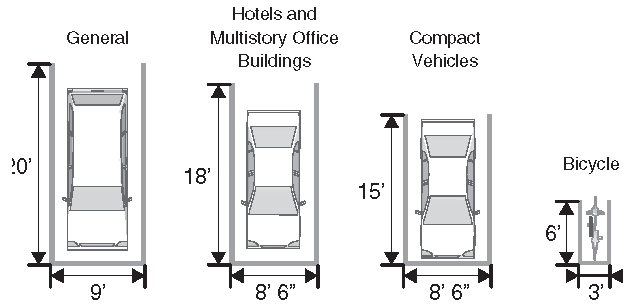
As a minimum, an off-street parking space shall consist of 180 square feet (9 feet by 20 feet) of storage space for one automobile, plus adequate space for maneuvering and parking one automobile.
B.
For hotels and associated conference and meeting facilities, and for multistory office buildings, an offstreet parking space shall consist of 153 square feet (8 feet, 6 inches by 18 feet) of storage space for one automobile, plus adequate space for maneuvering and parking one automobile.
C.
For compact vehicles only, as a minimum, an "offstreet parking space" shall consist of 127.5 square feet (8 feet, 6 inches by 15 feet) of storage space for 1 automobile, plus adequate space for maneuvering and parking 1 automobile.
D.
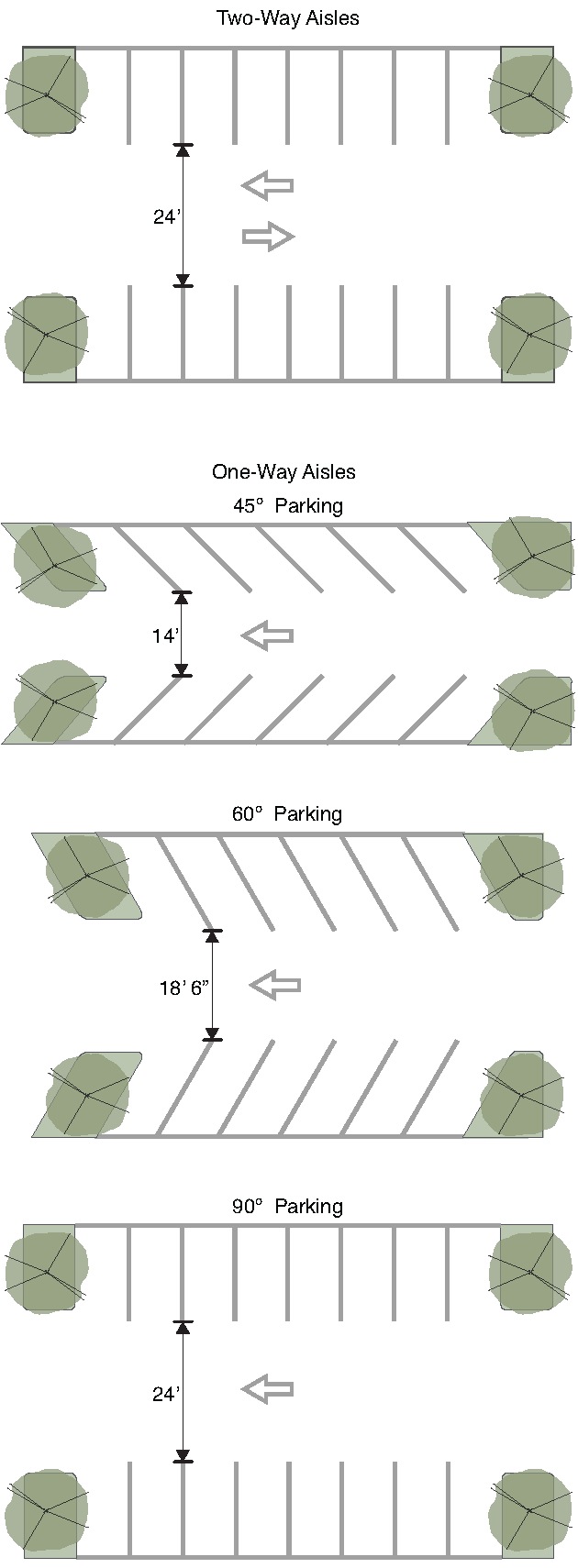
Adequate space for maneuvering and parking 1 automobile shall mean the following:
1.
Two-way aisles between parking spaces shall be at least 24 feet in width.
2.
One-way aisles between parking spaces shall be at least 14 feet in width for 45-degree angle parking, at least 18 feet, 6 inches in width for 60-degree parking, and at least 24 feet in width for 90-degree angle parking.
7.1.2. - Development Standards
A.
One-, Two-Family Dwellings and Townhouses
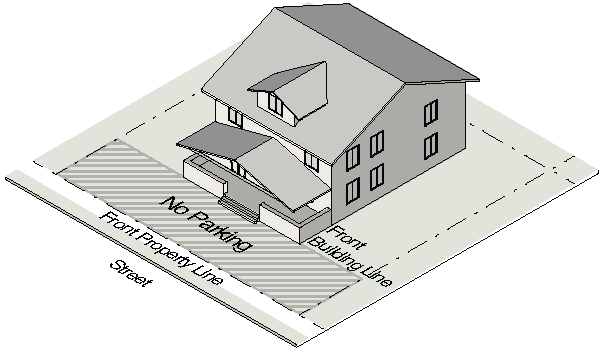
Parking spaces for one-family dwellings, two-family dwellings and townhouse dwellings shall be on the same lot as the building to be served except as otherwise provided in this Section. No parking space shall be permitted between the front building line and the front property line except on a bona fide paved or graveled driveway leading to a garage, carport or other permanent parking space located to the rear of the front building line. Circular driveways are prohibited. Paved parking areas will not be permitted between the front building line and the front property line except where a variance permitting such parking has been approved by the Zoning Board of Appeals according to the requirements of the UDO.
B.
Multiple-Family Parking
Parking spaces for multiple-family dwelling shall be located on the same lot as the building to be served. No required yard for multiple-family dwellings in RM-18, RM-43, PO, C-1, C-2 and C-3 districts shall be used for the purpose of parking or loading.
C.
Nonresidential Parking
Parking spaces for nonresidential buildings shall be located on the same lot as the building to be served except where additional spaces are required by enlargement of use or, where facilities are provided and maintained collectively, the required spaces may be located no more than 300 feet from each building served. No more than 50% of the parking requirements for uses in commercial and industrial zoning districts may be provided in off-site public or private parking facilities located not more than 300 feet from principal entrances to buildings where uses are located.
D.
Joint Parking
No more than 50% of the parking requirements for theaters, auditoriums, nightclubs, restaurants or similar uses may be provided and used jointly by office and retail uses not normally open for business during the same hours. Up to 100% of the parking requirements for places of worship may be provided and used jointly by office and retail uses not normally open for business during the hours of church and similar services.
E.
Common Parking
Parking requirements for uses in institutional districts may be provided in common parking areas which shall be approved as part of the institution's comprehensive site development plan.
F.
Multi-Use Parking
Parking requirements for developments with more than 1 use shall be determined by adding the parking requirements for the different uses within the development.
G.
Compact Vehicle Parking
No more than 25% of the parking spaces required for multiple-family residential, institutional, commercial, and industrial uses may be designed for the use of compact vehicles. Parking spaces for compact vehicles shall be clearly designated by signs or other special markings for the exclusive use of such vehicles.
H.
Enclosed Parking Requirements
In a RS-17 townhouse development, one of the required parking spaces per unit must be enclosed within a structure attached to, adjacent to or enclosed within the structure of each dwelling unit. The other required spaces may be provided in driveways, carports or turning courts, but may not be provided on streets or common drives unless there is adequate space for maneuvering and parking.
I.
Accessible Parking
Parking spaces for use by handicapped persons shall be provided as required by the state. Accessible required parking for personal storage facilities, "mini-warehouse" and similar temporary storage facilities shall not be permitted in aisles and driveways between storage buildings and facilities, but shall be located in a separate parking area on the same property as the facility to be served. Use of aisles and driveways shall be limited to driving, standing, loading and unloading.
J.
Commercial Vehicle Restriction
The parking of any bus, truck or other commercial or freight-carrying vehicle in excess of 1-ton capacity (10,000 pounds gross vehicle weight maximum) on a property located in any residential zoning district is prohibited. This regulation shall not prohibit commercial vehicles from loading or unloading in such districts, or from parking while servicing uses therein.
K.
Bicycle Parking
Bicycle parking shall be provided in all commercial zoning districts and installed according to the City Bicycle Parking Guidelines (2008), which are incorporated by reference herein. The UDO Administrator may grant a reduction or waiver from the required bicycle parking after considering the following factors: availability of public bicycle parking in the immediate area of the site, existing or potential shared parking arrangements, lack of on-site vehicle parking, and characteristics of the use of the site and/or building.
L.
Change of Use
No additional parking shall be required for a change in use, as allowed within the zoning district, for an existing building or the use of previously unused space within an existing building in the NMU, C-1, C-2, C-3, and MU zoning districts.
M.
Additions
No additional parking shall be required for structural additions that are 10% or less of the original gross floor area of the building in the NMU, C-1, C-2, C-3, and MU zoning districts. Additional parking shall be provided in accordance with Sec. 7.1.3. for any structure addition that exceeds 10% of the original gross floor area.
N.
On Street Parking
For Duplex and Walk Up Flat dwelling units in R-50, R-60, R-85, and RS-17 zoning districts, qualifying on-street parking may count for up to 50% of the off-street parking requirement, provided:
1.
For every 20 feet of street frontage of lot width, one qualifying on-street space may be counted towards off-street parking requirements.
2.
Legally restricted parking and curb cuts shall be excluded from length of lot width.
(Ord. No. O-21-Z-02, § 8.1, 10-18-21; Ord. No. O-23-Z-01, § 17, 2-6-23)
7.1.3. - Off-Street Parking Requirements
(Ord. No. O-17-09, § 3, 6-19-17; Ord. No. O-23-Z-01, § 18, 2-6-23; Ord. No. O-24-Z-05, § 3.1, 5-20-2024)
7.1.4. - Loading Requirements
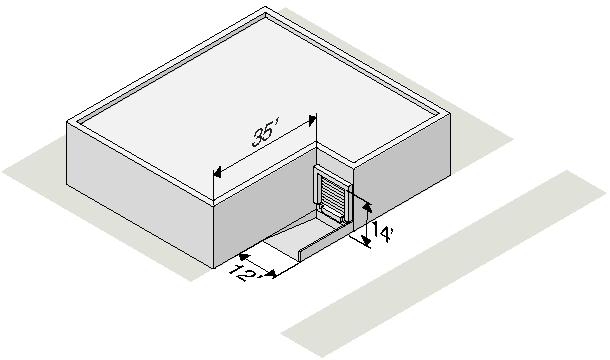
Where required, one or more off-street loading berths or spaces shall be provided on the same or adjoining lot with the facility it serves, either inside or outside a building. A loading berth shall have minimum dimensions of 12 feet by 35 feet by 14 feet overhead clearance. A loading space need not be a full berth but shall be sufficient to allow normal loading operations appropriate to the property served. The UDO Administrator shall determine the sufficiency of the space, but in no case shall this space or its use hinder the free movement of vehicles and pedestrians over a street or sidewalk.
A.
Retail Operations, Including Restaurants Within Hotels and Office Buildings, With a Total Gross Floor Area of 20,000 Square Feet Devoted to These Purposes
One loading space for every 20,000 square feet of gross floor area or fraction thereof; one loading berth for every 40,000 square feet of gross floor area or fraction thereof.
B.
Retail Operations and All First Floor Nonresidential Uses With a Gross Floor Area of Less Than 20,000 Square Feet; All Wholesale and Light Industrial Operations With a Gross Floor Area Less Than 10,000 Square Feet
One loading space.
C.
Office Buildings and Hotels
One loading berth for every 100,000 square feet of floor area or fraction thereof.
D.
Industrial and Wholesale Operations With a Gross Floor Area of 10,000 Square Feet or More
7.1.5. - Downtown Decatur Parking District
A.
Purpose
The purpose of these regulations is to improve the downtown Decatur environment in the following ways:
1.
Encourage, protect and enhance the pedestrian environment.
2.
Improve the aesthetics of the downtown area.
3.
Provide for parking in a way that does not diminish the pedestrian environment.
4.
Encourage additional street level activity.
5.
Better utilize existing, underused parking facilities.
6.
Promote opportunities for environmentally sustainable residential and commercial development.
7.
Promote opportunities for affordable residential development.
B.
Application
The provisions of Sec. 7.1., except as they conflict with this Section, apply to development in the Downtown Decatur Parking District (DDPD).
C.
Boundaries
The boundaries of the DDPD are shown upon the map designated as the "Downtown Decatur Parking District." The Downtown Decatur Parking District map and all the notations, references and other information shown thereon, which shall be kept on file with the City clerk, are incorporated by reference as a part of this UDO and have the same force and effect as if it were fully set forth or described herein.
D.
Additional Provisions
1.
Change of Use
No additional parking shall be required for a change in use, as allowed within the zoning district, for an existing building or the use of previously unused space within an existing building within the DDPD.
2.
Additions
No additional parking shall be required for structural additions that are 10% or less of the original gross floor area of the building within the DDPD. Additional parking shall be provided in accordance with Sec. 7.1.3. for any structure addition that exceeds 10% of the original gross floor area.
3.
Parking Management
a.
The DDPD allows shared and unbundled parking, and it includes both parking minimums and parking maximums.
b.
Nothing in this Section shall mean that the minimum required parking spaces must be assigned to individual users or tenants on a site.
E.
Parking Location
Buildable density on a parcel within the DDPD shall be determined by the sum of the parking provided in the following locations:
1.
Within the parcel
2.
Off-site through Shared Parking pursuant to Sec. 7.1.5.G. below.
a.
Residential uses may provide up to 50% of their required parking off-site.
b.
Nonresidential uses may provide up to 80% of their required parking off-site.
F.
Parking Ratios
1.
All new buildings or additions in the DDPD shall provide parking at a flat rate of not less than one parking space for every 500 sq. ft. of gross floor area of building and not more than one parking space for every 200 sq. ft. of gross floor area of building. If it is a mixed use building or residential building, the portions of the building used exclusively for residential uses shall provide one parking space per dwelling unit and shall not exceed 2 spaces per dwelling unit.
2.
All existing and new uses, as allowed within the zoning applicable to DDPD, in existing buildings within the DDPD are considered to comply with the parking requirements set forth in this Section.
G.
Shared Parking
1.
General Provisions
a.
Shared parking is allowed within the DDPD.
b.
Shared parking may be allowed between 2 or more uses to satisfy a portion of the minimum parking requirement.
c.
Sites with shared parking must contain non-residential uses and may also contain a mix of nonresidential and residential uses. Sites containing only residential uses may not use shared parking. A use for which an application is being made for shared parking shall be located within 300 feet of the parking facility for residential uses or within 1,320 feet of the parking facility for nonresidential uses. Such distances shall be measured by the most direct route of pedestrian travel on the ground.
2.
Shared Parking Privileges
Shared parking privileges are conditioned upon and shall continue in effect only as long as the use for which shared parking is utilized has legally enforceable access to the required amount of shared parking.
3.
Calculations
a.
Where a shared parking arrangement is proposed, the UDO Administrator shall determine the number of parking spaces that may be shared based on a shared parking application prepared by the applicant. The UDO Administrator shall provide the Decatur parking occupancy rates spreadsheet to the applicant.
b.
The shared parking application shall:
i.
Identify the properties and uses for the application;
ii.
Determine the number of parking spaces that would be required by applying the standard for the uses for all of the properties; and
iii.
Determine the peak parking demand for the combined demand of all of the uses for all of the properties in the application using the Decatur parking occupancy rates spreadsheet.
c.
Shared parking is only available for complementary uses with disparate parking demands.
d.
The UDO Administrator may use the lesser of the 2 parking demands calculated in Sec. 7.1.5.G.3.b. above as the minimum number of parking spaces to be provided for all the properties and uses addressed in the application.
e.
The Decatur parking occupancy rate spread-sheet is not an exhaustive list of land uses. If shared parking ratios in the Decatur parking occupancy rate spreadsheet are not available for the type of use the applicant is applying for the applicant may provide data collected at similar sites to establish local parking demand rates.
4.
Shared Parking Agreement
a.
Where a shared parking application includes 2 or more separately owned properties, a copy of a written, legally binding agreement providing for the shared use of parking (guaranteeing access to, use of, and management of shared parking spaces), shall be filed with the UDO Administrator. A copy of any amended, renewed, replacement or successor agreement shall be filed with the UDO Administrator within a reasonable amount of time following execution. Where a shared parking application includes 2 or more properties owned by the same person or entity, a sworn, notarized statement shall be submitted to the UDO Administrator, representing that, in the event of any change in ownership of any of the participating properties, a written, legally binding agreement providing for the continued shared use of parking (guaranteeing access to, use of, and management of designated parking spaces), will be entered into with subsequent owners and a copy provided to the UDO Administrator, with copies of all amended, renewed, replacement or successor agreements filed with the UDO Administrator within a reasonable amount of time following execution.
b.
On a periodic basis, not less than biennially, the UDO Administrator shall review all allowed shared parking arrangements to ensure compliance with the guaranteed access to shared parking requirements set forth above.
5.
Shared Parking Plan
a.
The UDO Administrator may require an applicant for shared parking to submit a shared parking plan. A shared parking plan includes one or more of the following:
i.
A site plan showing parking spaces intended for shared parking and their proximity to the uses they will serve.
b.
The shared parking plan shall satisfy the following standards, as applicable:
i.
Shared spaces for residential units must be located within 300 feet of dwelling unit entrances they serve.
ii.
Shared spaces for nonresidential uses must be located within 1,320 feet of the principal building entrances of all sharing uses.
H.
Parking District Maps
The Downtown Decatur Parking District map, is adopted and incorporated in this Section.
7.1.6. - Manufactured Homes and Trailers
A.
Parking and Storage
1.
Generally
It shall be unlawful for any person to park or store any trailer or mobile home, travel trailer, pickup coach, motorized home, boat, boat trailer (with boat on or off) or utility trailer on any street, alley, highway, or other public place, or on any tract of land owned by any person, occupied or unoccupied, within the City, except as provided in this article.
2.
On Private Residential Property
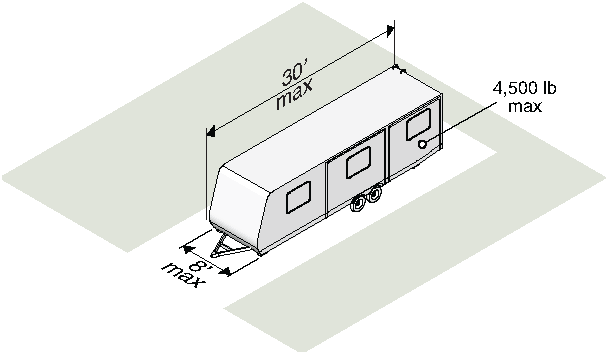
Any trailer or mobile home, travel trailer, pickup coach, motorized home, boat, boat trailer (with boat on or off) or utility trailer having a body width not exceeding 8 feet, provided its gross weight does not exceed 4,500 pounds or its body length exceed 30 feet, may be parked or stored on private residential property, subject to the conditions which are set out in this Section. At no time shall any trailer or mobile home, travel trailer, pickup coach, motorized home, boat, boat trailer (with boat on or off) or utility trailer exceeding the dimensions described in this Section be permitted to park or stand in any area within the corporate limits of the City except as provided in Sec. 7.1.6.A.3. below:
a.
At no time shall such parked or stored trailer or mobile home, travel trailer, pickup coach, motorized home, boat, boat trailer (with boat on or off) or utility trailer be occupied or used for living, sleeping, or house-keeping purposes.
b.
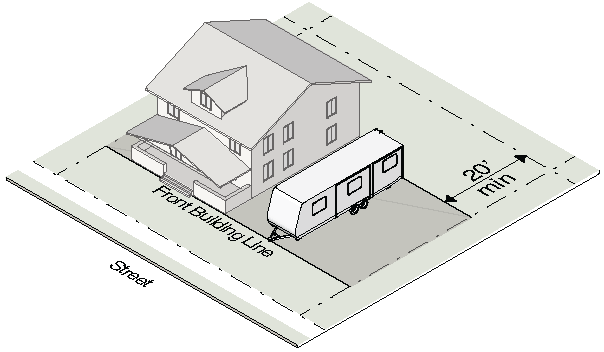
If the trailer or mobile home, travel trailer, pickup coach, motorized home, boat, boat trailer (with boat on or off) or utility trailer is parked or stored outside of a completely enclosed garage, it shall be parked or stored to the rear of the front line of the main building and not less than 20 feet from any rear lot line. Where a lot abuts 2 streets, it must be parked or stored within the building restriction lines of both streets.
c.
Notwithstanding the provisions of Sec. 7.1.6.A.2.b. above, a trailer or mobile home, travel trailer, pickup coach, motorized home, boat, boat trailer (with boat on or off) or utility trailer may be parked anywhere on the premises for loading or unloading purposes, provided the loading or unloading is completed within 8 hours.
d.
Emergency or temporary stopping or parking is permitted on any street, alley or highway for not longer than one hour, except when actually loading or unloading, subject to any other and further prohibitions, regulations or limitations imposed by the traffic and parking regulations or ordinances for that street, alley or highway.
e.
Pickup coaches may be parked on any street, alley or highway for a maximum of 6 hours, provided such parking is not in conflict with any other prohibitions, regulations or limitations imposed by the traffic and parking regulations or ordinances for that street or alley or highway.
3.
In Commercial Districts; Office-Type Trailers
a.
Any trailer or mobile home, travel trailer, pickup coach, motorized home, boat, boat trailer (with boat on or off) or utility trailer may be parked in districts zoned commercial subject to the restrictions and regulations of the City UDO. Such trailer or mobile home, travel trailer, pickup coach, motorized home, boat, boat trailer (with boat on or off), or utility trailer may be used only as accessory structure on the property on which it is located, and must be parked or stored in compliance with Sec. 7.1.6.A.2.
b.
Office-type trailers used by any person actually engaged in the construction or reconstruction of any structure are permitted, provided that they are parked on the site of the construction or reconstruction, and a permit for such parking of office-type trailers is granted by the City Manager and for such period of time as the City Manager shall approve.
(Ord. No. O-22-Z-08, § 2, 10-17-22)
7.2.1. - Walls, Fences and Planting
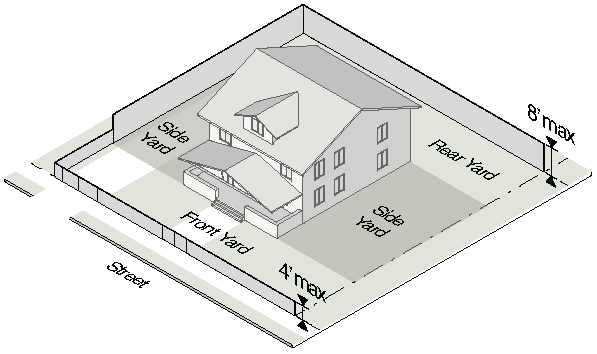
Walls and fences and ornamental trees and shrubs may be located within the yards except as provided herein:
A.
No wall or fence in a front yard shall exceed height of 4 feet.
B.
No wall or fence in a rear or side yard shall exceed a height of 8 feet. Where 8' fencing is allowed, it must be reduced in height to 4' on any lot line abutting a required front yard.
C.
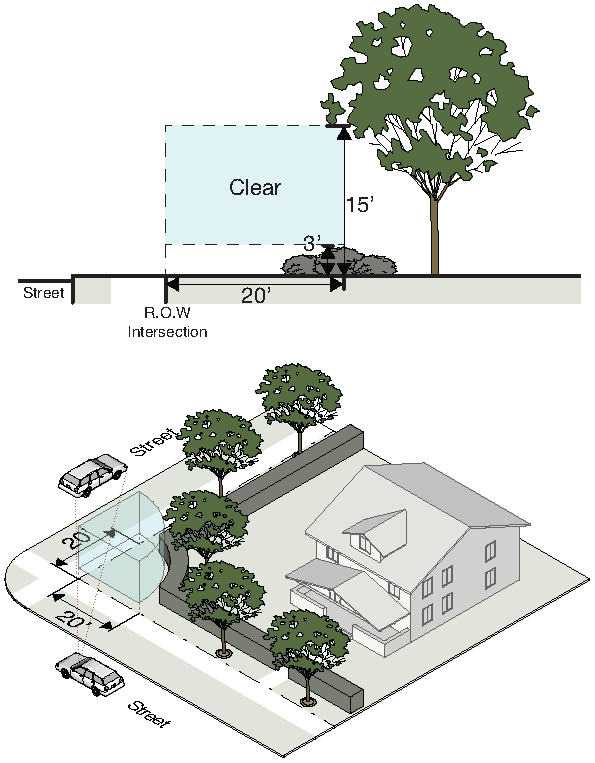
In all use districts, except the general business district, no fence, wall, shrubbery, sign, marquee, or other obstruction to vision between the heights of 3 feet and 15 feet shall be permitted within 20 feet of the intersection of the right-of-way lines of 2 streets or of a street intersection with a railroad right-of-way line.
7.2.2. - Required Buffer Areas
Buffer areas shall be established and maintained by the property owner under the following provisions:
A.
A buffer area which provides visual screening and a screening fence or wall shall be established and maintained by the owner as provided below in any required side or rear yard when a development in a RM-18, RM-22, RM-43, PO, C-1, C-2 or C-3 district adjoins a R-85, R-60, R-50 or RS-17 zoning district, or when a development in a C-1, C-2, or C-3 district adjoins a RM-18, RM-22 or RM-43 district.
B.
Minimum fence or wall height shall be 8 feet for developments in C-1, C-2 and C-3 districts. Minimum fence or wall height shall be 6 feet for developments in RM-18, RM-22, RM-43 and PO districts.
C.
The requirements for a fence or wall may be waived by the UDO Administrator upon presentation of field survey data by the property owner or developer which shows that construction of the fence or wall would destroy existing vegetation which, in itself, provides visual screening between the development and the adjoining residential district.
D.
Required buffer areas shall be maintained as a planted area, using existing vegetation or, when required, additional plantings as provided in this Section.
E.
Required buffer areas shall be appropriately landscaped with trees, shrubs, flowers, grass, stone, rocks and other landscaping materials.
F.
Required buffer areas shall not be used for parking or a structure other than a fence or drainage improvements required by the City. However, a buffer area may be used for vehicular access and utility easements if these uses are provided approximately perpendicular to the greater distance of the buffer area and for drainage improvements required by the City based upon competent engineering studies which show these improvements to be necessary, upon approval of the UDO Administrator.
G.
Except as otherwise provided, the natural topography of the land shall be preserved and natural growth shall not be disturbed beyond that which is necessary to prevent a nuisance, to thin natural growth where too dense for normal growth, or to remove diseased, misshapen or dangerous and decayed timbers. However, a slope easement may be cleared and graded where required to prevent soil erosion upon approval of the UDO Administrator; this easement may cover no more than 20% of the required buffer area, and shall be immediately replanted upon completion of easement improvements.
H.
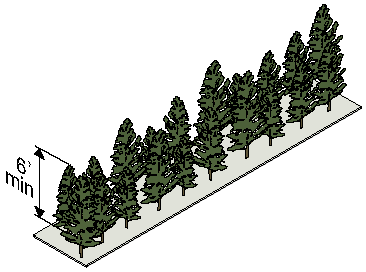
Where the conditions described in Sec. 7.2.2.G. above cannot be met by reason of the topography of the land or of the prior removal of or lack of vegetation and foliage, the owner of the buffer area may install a permanent screen of evergreen plantings, so designed and developed to provide visual screening between the property described herein. These plantings shall consist of evergreen trees or shrubs not less than 6 feet in height, or trees or shrubs which will, in normal growth, attain a height of 6 feet within 3 years. The following plants shall be approved for this purpose but shall not be exclusive of other plants which may be suitable, provided that they can form a hardy screen, dense enough and high enough both to interrupt vision and to diffuse the transmission of sound:
1.
Viburnum awabuki 'Chindo' (Chindo Viburnum)
2.
Cryptomeria japonica (Japanese Cryptomeria)
3.
Cupressus × leylandii (Leyland Cypress)
4.
Ilex burfordi (Burford Holly).
5.
Ilex 'Nellie R. Stevens' (Nellie Stevens Holly)
6.
Ilex opaca (American Holly).
7.
Ilex × attenuata 'Fosteri' (Foster Holly)
8.
Ilex × 'Emily Bruner' ('Emily Bruner Holly)
9.
Juniperus virginiana (Eastern Red Cedar)
10.
Magnolia grandiflora (Southern Magnolia).
11.
Magnolia grandiflora 'Little Gem' (Little Gem Magnolia)
12.
Magnolia grandiflora 'DD Blanchard' (DD Blanchard Magnolia)
13.
Osmanthus fragrans (Tea Olive)
14.
Pinus strobus (White Pine)
15.
Pinus virginiana (Virginia Pine)
16.
Thuja 'Emerald Green' (Emerald Green Arborvitae)
17.
Thuja 'Green Giant' (Green Giant Arborvitae)
I.
Any grading, improvements or construction adjacent thereto shall be conducted far enough from the buffer area so as not to disturb or encroach upon the buffer area.
J.
Required buffer areas shall be designated on each plat and recorded as a permanent easement.
7.2.3. - Outdoor Landscape Watering
A.
Outdoor watering for purposes of planting, growing, managing, or maintaining ground cover, trees, shrubs, or other plants may occur only between the hours of 4:00 p.m. and 10:00 a.m.; provided, however, that this limitation shall not create any limitation upon the following outdoor water uses:
1.
Commercial raising, harvesting, or storing of crops; feeding, breeding, or managing livestock or poultry; the commercial production or storing of feed for use in the production of livestock, including, but not limited to, cattle, calves, swine, hogs, goats, sheep, and rabbits, or for use in the production of poultry, including, but not limited to, chickens, hens, ratites, and turkeys; producing plants, trees, fowl, or animals; or the commercial production of aquacultural, horticultural, dairy, livestock, poultry, eggs, and apiarian products or as otherwise defined in O.C.G.A. § 1-3-3;
2.
Capture and reuse of cooling system condensate or stormwater in compliance with applicable local ordinances and state guidelines;
3.
Reuse of gray water in compliance with O.C.G.A. § 31-3-5.2 and applicable local board of health regulations;
4.
Use of reclaimed wastewater by a designated user from a system permitted by the Environmental Protection Division of the Georgia Department of Natural Resources to provide reclaimed wastewater;
5.
Watering personal food gardens;
6.
Watering new and replanted plant, seed, or turf in landscapes, golf courses, or sports turf fields during installation and for a period of 30 days immediately following the date of installation;
7.
Drip irrigation or irrigation using soaker hoses;
8.
Hand-watering with a hose with automatic cutoff or handheld container;
9.
Use of water withdrawn from private water wells or surface water by an owner or operator of property if such well or surface water is on said property;
10.
Watering horticultural crops held for sale, resale, or installation;
11.
Watering athletic fields, golf courses, or public turf grass recreational areas;
12.
Installation, maintenance, or calibration of irrigation systems; or
13.
Hydroseeding.
B.
No person shall use or allow the use of water in violation of the restrictions on outdoor water use contained in this Section.
C.
Sworn officers of the public safety department, the building official or codes enforcement officer or a designated representative of the above shall have authority to enforce the requirements of this Section.
7.2.4. - Applicability; Barrier Curb and Landscaping Requirements
All surface parking lots in any commercial or mixed use zoning districts, with a total of 30 or more parking spaces, whether primary or accessory in use and whether commercial or noncommercial, shall have minimum barrier curb and landscaping requirements as follows:
A.
Curbing or barrier blocks must be installed around the perimeter of parking lots and required landscaped areas to prevent vehicle encroachment onto adjacent property, rights-of-way and landscaped areas, except abutting a building or structure and at points of ingress and egress into the facility. Curbing may have openings to allow drainage to enter and percolate through landscaped areas.
B.
Curbing or barrier blocks must be a minimum of 6 inches in height and a minimum of 8 inches in width. Curbing must be concrete or stone, securely installed, and maintained in good condition.
C.
Where the end of a parking space abuts a landscaped area, curbing or barrier blocks may be placed in the parking space at a maximum of 2 feet from the end of the parking space. This 2-foot-wide area may have the pavement removed and be developed as part of the required landscaped area.
D.
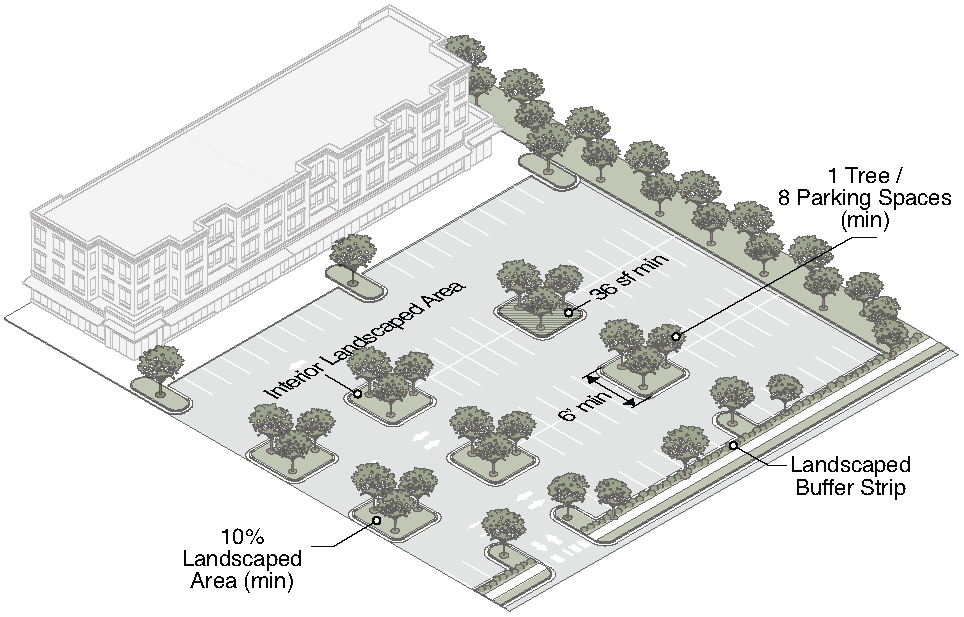
Surface parking lots shall have a minimum landscaped area equal to at least 10% of the paved area within such lot. In no case shall a parking lot owner be required to provide landscaped areas that exceed 10% of the paved area.
E.
A minimum of one tree per 8 parking spaces shall be included in the required landscaped areas. For the purpose of satisfying this requirement, existing trees that are 2½ inches or more in caliper as measured at a height of 36 inches above ground level shall be considered to be equivalent to one or more newly planted trees on the basis of one tree for each 2½ inches of caliper.
F.
In addition to trees, ground cover must be provided to protect tree roots, prevent erosion, and reduce water evaporation. Ground cover may consist of shrubs, liriope muscari, pine bark mulch, and similar landscaping materials.
G.
Shrubs shall be maintained at a maximum height of 2½ feet, except where such shrubs are screening the parking surface from an adjacent residential use.
H.
In the event that landscaped areas are in the interior of a parking lot, they shall be a minimum of 6 feet in length with a minimum area of 36 square feet.
I.
Continuous landscaped buffer strips shall be constructed along sidewalks and public rights-of-way where surface parking lots are adjacent to such sidewalks or public rights-of-way except at points of ingress and egress into the facility. Such landscaped buffer strips shall be a minimum of 5 feet in width and shall contain, in addition to ground cover, trees planted a maximum of 42½ feet on center along the entire length.
J.
Newly planted trees shall be a minimum of 2½ inches in caliper as measured at a height of 6 inches above ground level, shall be a minimum of 10 feet in height, shall have a 40-foot minimum mature height, and shall be drought tolerant. Trees shall be planted at a minimum of 30 inches from any barrier curb, so as to prevent injury to trees from vehicle bumpers.
K.
Where landscaped areas are located adjacent to vehicle overhangs, the trees shall be planted in line with the side stripes between parking spaces in order to avoid injury to trees by vehicle bumpers.
L.
All landscaped areas, including trees located in the public right-of-way that are counted in the fulfillment of this requirement, shall be properly maintained in accordance with approved landscape plans. In the event that a tree or any plant material dies, it shall be replaced within 6 months so as to meet all requirements of this Section and to allow for planting in the appropriate planting season.
M.
If it is determined by the City arborist that implementation of these regulations will result in the loss of parking spaces in existing lots, the UDO Administrator may increase the allowable percentage compact car spaces from 25% up to 35% so as to minimize the loss of parking spaces.
N.
Notwithstanding Sec. 7.2.4.M. above, existing parking lots shall not be required to reduce the number of parking spaces by more than 3% as a result of implementing these landscaping regulations.
O.
Upon written application by any person subject to the provisions of this Section, the Zoning Administrator is hereby authorized to grant administrative variances to the requirements of this Section only upon making all of the following findings:
1.
There are extraordinary and exceptional conditions pertaining to the particular piece of property in question because of its size, shape, topography, subsurface conditions, overhead structures, or the existence of sufficient trees in the public right-of-way within 10 feet of the property line;
2.
Such conditions are peculiar to the particular piece of property involved; and
3.
Relief, if granted, would not cause substantial detriment to the public good or impair the purposes and intent of this article.
7.3.1. - Preamble and Purpose
A.
In order to protect the public safety, to protect the tranquil environment, to protect community aesthetics, to protect the public investment in streets and highways, to promote commerce and to provide for the orderly and reasonable display of advertising for the benefit of the citizens of the City, it is hereby determined that the public health, safety and welfare require the adoption of this Section.
B.
The purpose of this Section is to recognize that although signs and advertising are necessary, they should be reasonably regulated in the interest of protecting the public health, safety, welfare, environment and community aesthetics by the establishment of standards for location, size, illumination, number, construction and maintenance of all signs and advertising structures and for the prohibition of certain signs and advertising structures in the City.
C.
The City further finds that the rights of persons to convey messages through signs and protection of First Amendment and other constitutional rights must be balanced with other important public interests such as traffic safety hazards, protecting property values, and restricting visual clutter that results in safety dangers as well as degradation of the City's important interests in protecting and enhancing its aesthetic environment. The City finds that regulation of the location, size, placement and design of signs through the following regulations is necessary to protect these public interests, particularly with regard to traffic and pedestrian safety as well as aesthetics, in an appropriate and balanced manner.
7.3.2. - General Provisions
A.
Defacing of Official Signs and Notices
No person shall injure, deface, obliterate, remove, take down, disturb or in any other manner interfere with any signboard containing the name of any street or public place, or any bulletin board, or sign or notice erected, posted or placed, bearing the name of the City commission or any officer thereof.
B.
Business License Required
No person shall engage in or carry on the business or occupation of billposting, advertising, sign painting, outdoor advertising, installing or maintaining signs unless said business or occupation is in compliance with the City's Business Occupation Tax Ordinance.
C.
Fastening Signs, Notices and Posters to Property—On Public Property
1.
Generally
It shall be unlawful for any person, except a public officer or employee in the performance of a public duty, to paste, print, nail, stake, tack or otherwise fasten any card, banner, handbill, sign, poster, advertisement or notice of any kind, or cause the same to be done, on any curbstone, lamppost, pole, hydrant, bridge, tree or area upon any public or publicly maintained street, sidewalk, right-of-way or property within the City, except as may be required by the provisions of this UDO, other ordinances of the City or the laws of the state or the United States or as may be otherwise authorized by this Section.
2.
Consent of City Manager Required for City Property
It shall be unlawful for any person, except a public officer or employee in the performance of a public duty, to paste, post, paint, print, nail, tack or otherwise fasten any card, banner, handbill, sign, poster, advertisement or notice of any kind, or cause the same to be done, on any City property. Any advertisement prohibited by this Section or Sec. 7.3.2.C.1. may be taken down, moved or destroyed by the City authorities.
3.
Consent of Owner, Holder, Lessee or Agent Required for Private Property
It shall be unlawful for any person, except a public officer or employee in the performance of a public duty or a private person giving legal notice, to paste, post, paint, print, nail, tack or otherwise fasten any card, banner, handbill, sign, poster, advertisement or notice of any kind, or cause the same to be done, upon any property without the written consent of the owner, holder, lessee, agent or trustee thereof. Any advertisement prohibited by this Section may be taken down, moved or destroyed by the City authorities.
D.
Scattering Paste, Glue, Waste Matter, Paint or Other Materials on Public or Private Property
No person shall scatter, daub or leave any paint, paste, glue or other substance used for painting or affixing advertising matter upon any public street or sidewalk, or scatter or throw or permit to be scattered or thrown any waste matter, paper, cloth or materials of whatsoever kind removed from signs or other advertising matter on any public street or private property.
E.
Noncommercial Messages
Any sign allowed herein may contain, in lieu of any other message or copy, any lawful noncommercial message that does not direct attention to a business operated for profit, or to a product, commodity or service for sale or lease, or to any other commercial interest or activity, so long as said sign complies with the size, height, area and other requirements of this Section.
7.3.3. - Sign Standards
A.
Awning, Marquee, Canopy and Projecting Signs
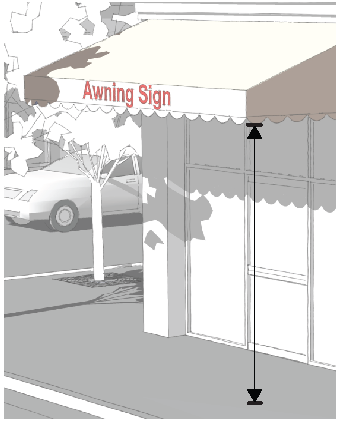
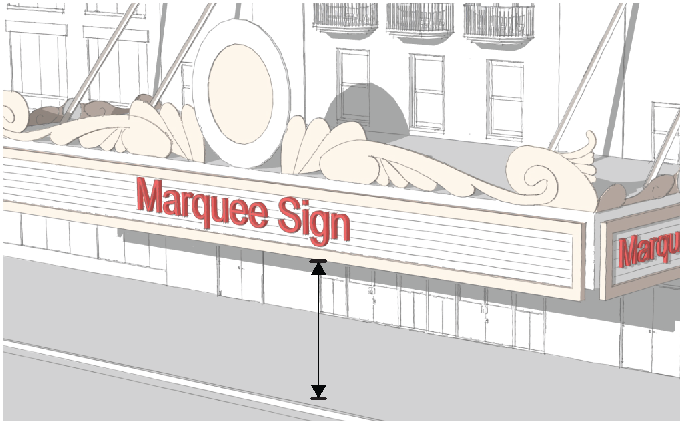
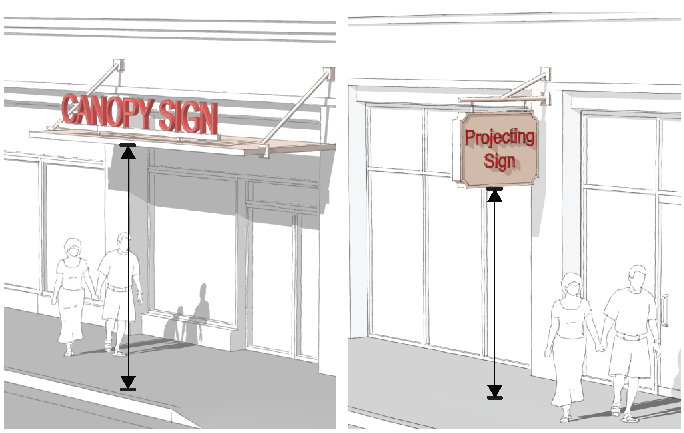
Awning, marquee, canopy and projecting signs shall be securely fastened to the building surface, shall be no less than 8 feet above the ground when erected over pedestrian walkways and no less than 14 feet above areas of vehicle access at the lowest extremity of the sign.
B.
Freestanding, Ground and Pole Signs
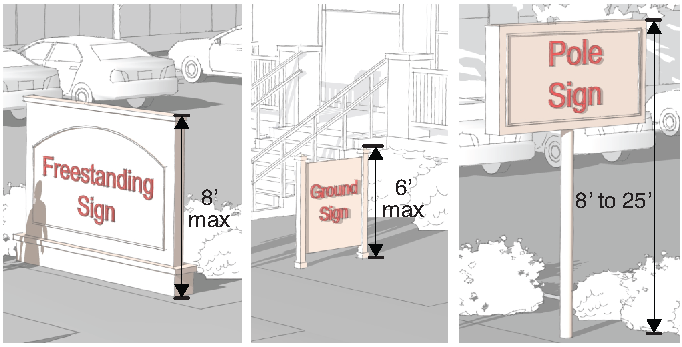
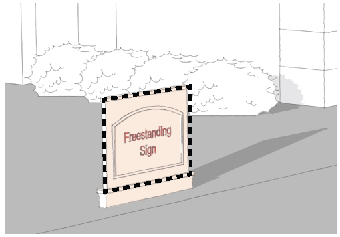
Freestanding, ground and pole signs shall be securely affixed to a substantial support structure which is permanently and securely attached to the ground and wholly independent of any building for support.
C.
Lighting Requirements
No sign shall give off light which glares, blinds, or has any other such adverse effect on vehicular traffic. The light from an illuminated sign shall be established in such a way that adjacent properties and roadways are not adversely affected and that no direct light is cast upon adjacent properties and roadways. No illuminated signs shall be constructed or maintained within 75 feet of any single-family dwelling. Signs with flashing, intermittent or animated illumination or effect are prohibited. Signs which simulate official traffic control, warning or public service signs are prohibited. Digital changeable copy signs and signs which include series, lines or rows of electric, neon or other lights are prohibited.
D.
Construction and Maintenance;
All signs for which a permit is required shall be constructed and maintained in conformance with City building and electrical codes. Such signs, together with their supports, braces, guys, anchors and similar parts, shall be maintained and protected as necessary to maintain a clean and safe appearance and condition. The UDO Administrator may cause to be removed after due notice any sign which shows gross neglect, becomes dilapidated or is not well maintained.
E.
Fire Safety
No sign shall obstruct any fire escape, any means of egress or ventilation or shall prevent free passage from one part of a roof to another part thereof, nor shall any sign be attached in any manner to a fire escape.
F.
Vehicular Traffic
No sign shall interfere with any roadway visibility or obstruct or otherwise interfere with the safe and orderly movement of vehicular traffic.
G.
Natural Features
No sign shall be erected, painted or drawn on any tree, rock or similar natural feature.
H.
Ownership
No sign shall be located on any building, fence, or other property belonging to another person without the consent of the owner.
I.
Prohibited Activities
No sign shall advertise an activity, service, product or other item prohibited by the laws and regulations of the United States or the state or by the ordinances and regulations of the City.
J.
Sound
No sign shall emit or utilize in any manner any sound capable of being detected on any public roadway, public right-of-way or public sidewalk by a person of normal hearing.
K.
Public Roads, Rights-of-Way and Utility Poles
No sign, sign structure or advertising shall be located on or within any public roadway or public right-of-way, or shall any sign, sign structure or advertising device be located on any utility pole, except signs for public governmental purposes specifically authorized by local, state or federal law.
L.
Street Intersections
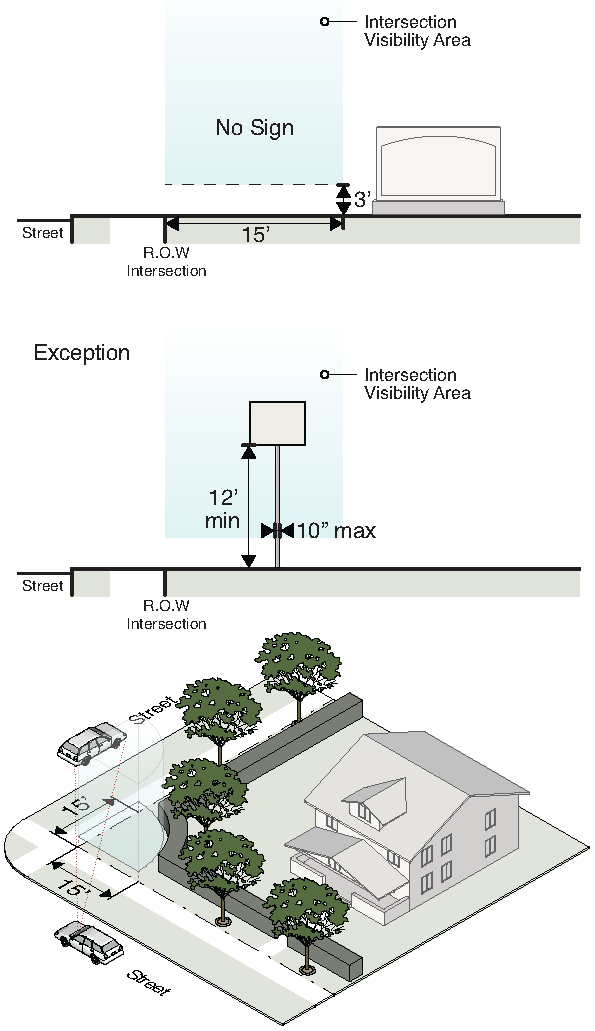
No sign or sign structure above a height of 3 feet shall be located within 15 feet of the intersection of the right-of-way lines extended of 2 streets, or of street intersection with a railroad right-of-way. However, a sign support structure of not more than 10 inches in diameter may be located within such intersection visibility area if all other requirements of this Section are met, and the lowest elevation of the sign surface is at least 12 feet above ground level.
7.3.4. - Permit Required
A permit shall be required for all permanent and temporary signs other than those specifically exempted from obtaining a permit by this Section.
7.3.5. - Application
A.
Application for sign permit shall be made through the office of the sign official. The applicant must submit sign plans indicating size, type of lettering, configurations, coloring, lighting and any electrical and structural specifications as per the requirements of this Section and the building codes. Standardized sign plans may be submitted in fulfillment of this requirement. Site plans showing specific location of signs shall be submitted with each application.
B.
Each application shall contain an agreement to indemnify and hold the City harmless of all damages, demands, or expenses of every character which may in any manner be caused by the sign, sign structure or advertising matter.
C.
The UDO Administrator shall process and approve or deny all sign applications within 20 calendar days of the City's receipt of a completed application including all required sign permit fees. This 20 day period may be extended if agreed to by the UDO Administrator and the applicant. Applications that do not comply with the provisions of these sign regulations, are incomplete, or contain false material statements shall be denied by the UDO Administrator. Complete applications that are in compliance with these sign regulations shall be approved. The UDO Administrator shall provide written notice to the applicant of the decision made on the application within the required time period. Should the application be denied, the reasons for the denial shall be stated in the written notice. If the UDO Administrator fails to act within the required time period, including any extension, the sign application shall be deemed to have been granted. Any resubmitted application shall be deemed to have been applied for on the date of resubmittal. Appeals from the issuance or denial of any sign permit shall be as provided in Sec. 11.2.9.
7.3.6. - Fees
A.
Schedule
Permit fees shall be payable with the application for the sign permit. Sign permit fees shall be paid according to the schedule as set forth in the schedule of fees and charges.
B.
Double Fee Penalty
If a sign is erected or painted before the issuance of permits, a penalty equal to the sign permit fee for the sign shall be charged.
7.3.7. - Inspection
The UDO Administrator may inspect, or cause to be inspected by the UDO Administrator's authorized representative, every sign installed under the provisions of this Section to determine that each sign meets the requirements set forth in this Section.
(Ord. No. O-22-Z-08, § 2, 10-17-22)
7.3.8. - Signs Exempt From Permits
The following signs are exempt from the permit requirements of this Section:
A.
Official traffic or warning signs;
B.
Changing of copy of bulletin board, poster board, display casement, marquee or changeable copy sign and the moving or relocating of embellishments that does not increase the area of embellishments;
C.
Decorative flags or buntings;
D.
Symbolic flag and award flag of institution or business, one for each business or one for each 50 feet of street frontage;
E.
Construction signs not exceeding 32 square feet in area;
F.
Residential real estate signs not exceeding 24 square feet in area;
G.
Political signs (see Sec. 7.3.12.N.);
H.
Directional signs not exceeding 6 square feet in area;
I.
Residential Signs (see Sec. 7.3.12.B. and C.);
J.
Signs of a governmental body, governmental agency or public authority, including traffic signs, traffic signals, traffic regulatory devices and warnings, official flags, emblems, official instruments, official public notices, and similar governmental signs or devices;
K.
Temporary window signs and banners; and
L.
Weekend directional signs (see Sec. 7.3.12.R.).
7.3.9. - Prohibited Signs and Sign Devices
The following signs and sign devices are prohibited under the provisions of this Section:
A.
Signs that display intermittent lights resembling flashing lights associated with danger.
B.
Signs using the word "stop" or "danger," or imitation of an official traffic control, warning or public service sign.
C.
Signs which provide background of colored lights blending with traffic signals which might confuse a motorist when viewed from normal approach distance of 25 feet to 300 feet.
D.
Any sign attached or applied to benches, trash receptacles or any other unapproved supporting structure.
E.
Pennants, streamers, ribbons, whirligigs, spinning devices and similar-type devices.
F.
Signs, other than temporary signs, which are not securely affixed to the ground or securely anchored so as to be immobile or otherwise affixed in a permanent manner to an approved supporting structure.
G.
Signs attached to or placed on a vehicle that is parked on private property, except service vehicles parked temporarily parked there.
H.
Roof signs.
I.
Animated, flashing and digital changeable copy signs.
J.
Billboards.
K.
Flashing signs.
L.
Marquee signs except for bona fide theaters.
M.
Rotating signs.
N.
Portable signs.
O.
Commercial product signs on residentially zoned property.
P.
Off-premises signs.
Q.
Signs advertising alcoholic beverages.
R.
Temporary signs unless permitted by this Section.
7.3.10. - Nonconforming Signs
A.
Signs which on the effective date of the ordinance from which this Section derives were legally erected and maintained under previous ordinances and regulations, or which become nonconforming with respect to the requirements of this Section, may be continued so long as the size of the sign is not increased beyond that existing as of the effective date of the ordinance from which this Section derives or any change thereto is made in conformance with this Section. However, the display face of a nonconforming roof sign located on an owner-occupied building may be replaced or repainted with a new display face so long as the total area of the sign is not increased.
B.
A nonconforming sign shall not be replaced by another sign except one which complies with the requirements of this Section.
C.
Minor repair and maintenance of nonconforming signs such as repainting, electrical repairs and neon tubing shall be permitted. However, no structural repairs or changes in the size or shape of a nonconforming sign shall be permitted except to make the sign comply with the requirements of this Section.
D.
Illegally installed or non-permitted nonconforming signs, nonconforming signs for which no permit was issued, and all nonconforming temporary signs shall be removed or made to conform with the requirements of this Section within 90 days of the effective date of the ordinance from which this Section derives.
7.3.11. - Vacant Buildings, Premises or Property
A.
Any business identification signs advertising a service or commodity associated with a vacated building premises or closed business shall be removed or resurfaced by the owner or tenant not later than 60 days from time the premises are vacated or the business closes.
B.
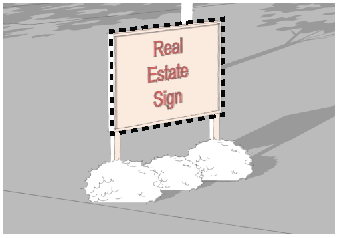
Real estate signs on a vacant or undeveloped property in a residential or professional office zoning district shall be limited to 1 residential real estate sign not exceeding 6 square feet in area. Real estate signs on a vacant or undeveloped property in a commercial zoning district shall be limited to 1 sign not exceeding 32 square feet in area.
7.3.12. - Permitted Signs
A.
Generally
1.
In addition to general regulations and restrictions applying to all signs, no signs shall be permitted except in compliance with the following specific regulations and restrictions. Unless defined in this Section, the meaning of such terms as "single-family dwelling," "high density, single-family dwelling," "street frontage," and so forth shall be as defined in this UDO.
2.
In addition to any other signs authorized in residential districts, one noncommercial sign not exceeding 2 square feet in sign area for each dwelling unit ("residential sign") is authorized. Such residential signs may be ground signs located within the yard areas of such residential lots or window signs. No commercial message may be placed on said residential signs.
B.
Single-Family Dwellings, Two-Family Dwellings, and Townhouse
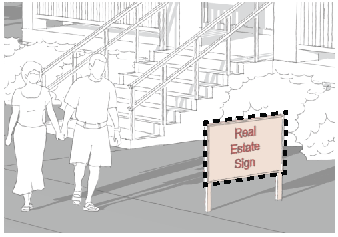
Signs for single-family dwellings, two-family dwellings, or townhouse shall be limited to 1 residential real estate sign not exceeding 6 square feet for each single-family, two-family, or townhouse dwelling or lot. Such signs shall be placed no closer than 10 feet to the street right-of-way except that when a residential structure is located within 10 feet of the street right-of-way, the sign shall be located as close as possible to the residential structure. Residential real estate signs shall be removed within 5 days of the signing of an agreement for the sale, rental or lease of the dwelling or lot. The sale of 4 or more dwellings in a development under construction may also be advertised by 1 residential real estate sign not exceeding 24 square feet in area.
C.
Multiple-Family Dwellings and Developments and RS-17 Residential Developments
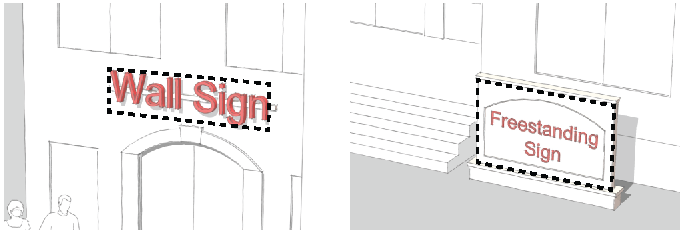
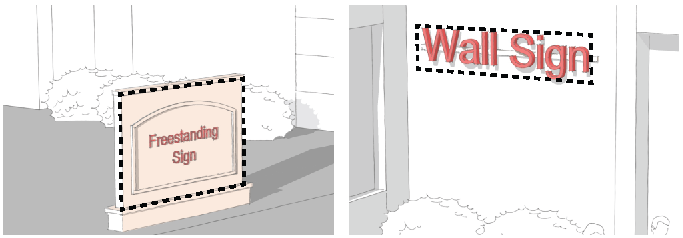
Signs for multiple-family dwellings and developments of any size and RS-17 residential developments of 6 or more units shall be limited to 1 permanent freestanding sign or 1 permanent wall sign mounted on and parallel to the surface of the building, not exceeding 24 square feet in area, for the purpose of identifying the development. Multiple-family dwellings and developments of less than 12 units may have 1 residential real estate sign not exceeding 6 square feet. Multiple-family dwellings of 12 or more dwelling units may have 1 residential real estate sign not exceeding 12 square feet in area.
D.
Roominghouses and Boardinghouses
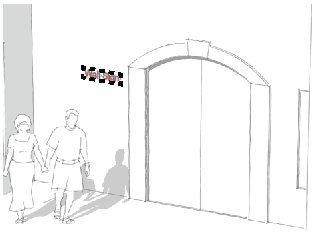
Signs for roominghouses and boardinghouses shall be limited to 1 permanent, nonilluminated sign not exceeding 72 square inches mounted flat against the wall of the building.
E.
Permitted Home Occupations
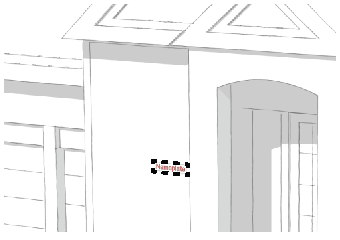
Signs for permitted home occupations in residential zoning districts shall be limited to 1 nonilluminated nameplate not exceeding 24 square inches in area mounted flat against a wall of the dwelling where the home occupation is located.
F.
Signs for Churches and Other Places of Worship Located in Institutional Zoning Districts
In lieu of signs permitted in Sec. 7.3.12.E. churches and other places of worship located in institutional zoning districts may have signs described as follows:
1.
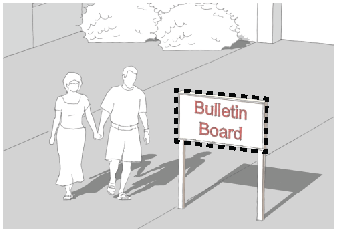
One permanent bulletin board not exceeding 6 square feet in area.
2.
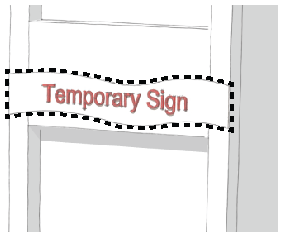
One temporary sign not exceeding 24 square feet in area announcing a special event.
3.
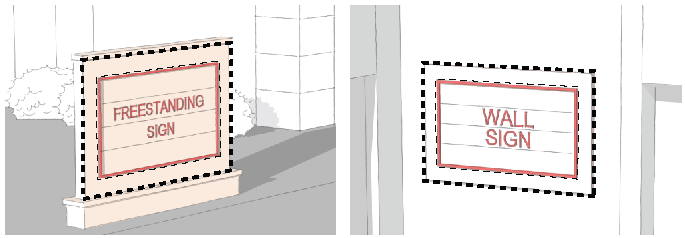
A maximum of 2 permanent freestanding signs, or a maximum of 2 permanent wall signs mounted on and parallel to the surface of the building, or a maximum of 1 permanent freestanding sign and 1 permanent wall sign mounted on and parallel to the surface of the building. Each permanent freestanding or wall sign shall not exceed 45 square feet in area of which no more than 32 square feet may be a changeable copy panel. Permanent freestanding or wall signs shall be subject to approval of the City Commission, which shall determine the compliance of such signs, including location, size, design in accordance with the following criteria and color and appearance. However, the total number of such signs shall not exceed 2, and the size of each sign shall not exceed 45 square feet in area of which no more than 32 square feet may be a changeable copy panel. The following standards shall be considered in determining whether such signs are approved:
a.
Suitability of the proposed signs in view of the character of the existing and proposed buildings of the church or other place of worship.
b.
Suitability of the proposed signs in view of the character and development of the adjacent and nearby properties.
c.
Suitability of the proposed signs in view of the area of the property on which the church or other place of worship is located.
d.
Suitability of the proposed sign in view of the number and size of the streets on which the church or other place of worship is located.
e.
Suitability of the proposed signs in view of the amount of public street frontage which the church or other place of worship has.
G.
Public Buildings, Parks, Schools, Cemeteries, and Other Public Uses, Private and Parochial Elementary and Secondary Schools, Hospitals, Churches and Other Places of Worship
Signs for public buildings, parks, schools, cemeteries, and other public uses, private and parochial elementary and secondary schools, hospitals, churches and other places of worship shall be limited to the following:
1.
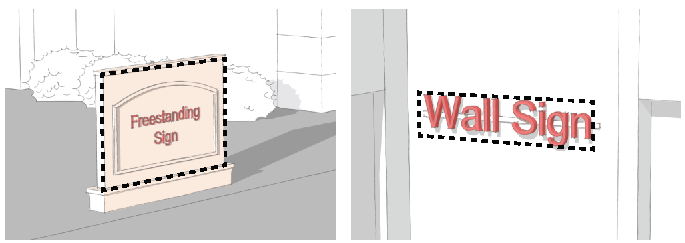
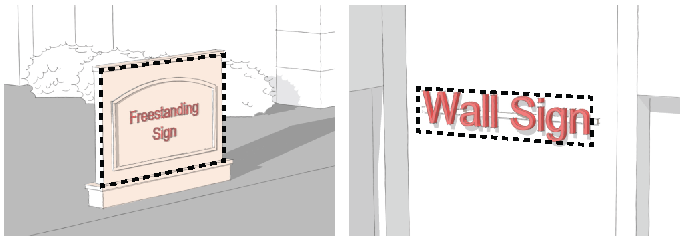
One permanent freestanding sign or 1 permanent wall sign mounted on and parallel to the surface of the building, not exceeding 24 square feet in area;
2.
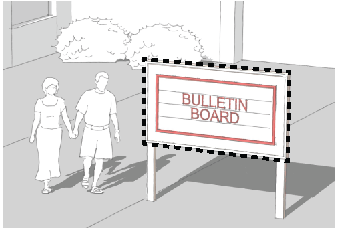
One permanent bulletin board, including changeable copy panel, not exceeding 24 square feet in area; and
3.
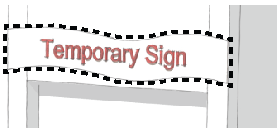
One temporary sign not exceeding 24 square feet in area announcing a special event.
H.
Colleges, Seminaries, and Other Institutions of Higher Learning
Signs for colleges, seminaries, and other institutions of higher learning shall be limited to the following:
1.
One permanent freestanding sign or 1 permanent wall sign mounted on and parallel to the surface of the building, not exceeding 24 square feet in area, for each street on which the institution has at least 500 linear feet of street frontage;
2.
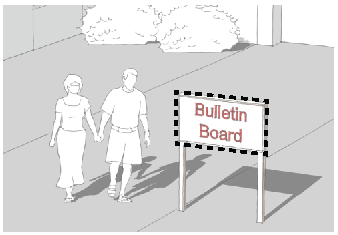
One permanent sign or bulletin board not exceeding 6 square feet in area; and
3.
One temporary sign of any size announcing a special event provided such sign is not placed or suspended closer than 10 feet to any property line or street right-of-way line.
I.
Nursery Schools, Day Care Centers, Nursing Homes, Sanitariums, Homes for the Elderly
Signs for nursery schools, day care centers, nursing homes, sanitariums, homes for the elderly shall be limited to 1 permanent freestanding sign not exceeding 12 square feet in area located not closer than 10 feet to any property line.
J.
Multiple-Tenant Office Buildings
In addition to signs permitted in Sec. 7.3.12.K. for storefront or street-facing businesses, signs for multiple tenant office buildings shall be limited to a lobby directory except that a multistory office building in excess of 50,000 square feet may have 1 permanent business identification freestanding sign or 1 permanent business identification wall sign not exceeding 2 square feet of sign area per 5,000 square feet of building space to identify an office-type business or businesses which are located in the building.
K.
Storefront or Street-Facing Business
Signs for a storefront or street-facing business shall be limited to the following:
1.
One Permanent Primary Sign
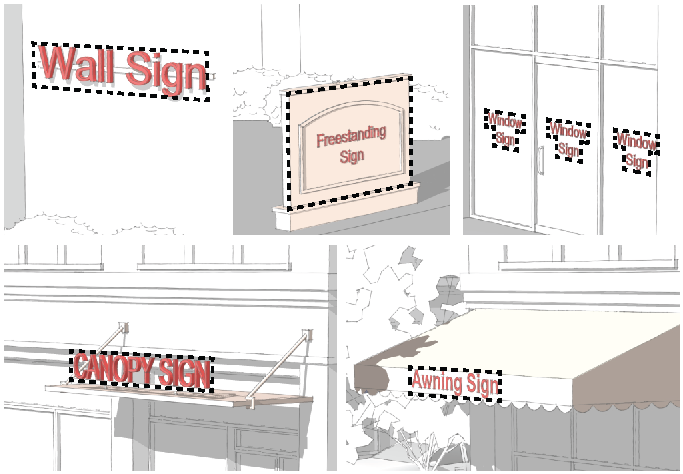
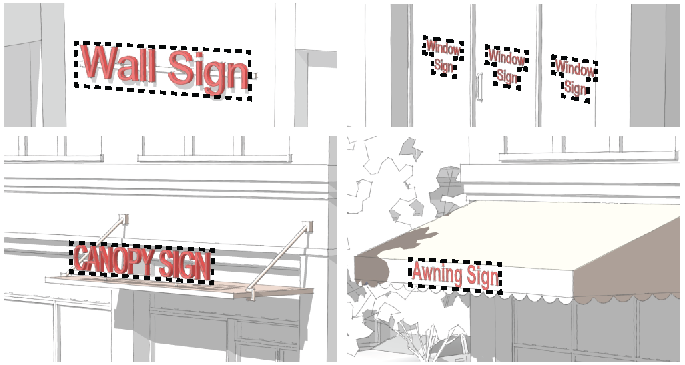
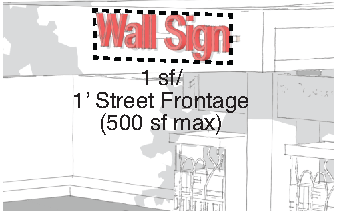
The primary business identification sign may be a wall sign, a freestanding sign, a window sign, or awning or canopy sign. Such signs are not required to face the street, but shall be on a building side which is visible from the street. If a wall, a freestanding or awning or canopy sign, such sign shall not exceed 1 square foot of sign area for each linear foot of street frontage of the business, the total sign area not to exceed 500 square feet. If a window sign, such sign shall not exceed one-tenth of the total window surface of the window in which it is located.
2.
One Permanent Secondary Sign
The secondary business identification sign may be a wall sign, a window sign or an awning or canopy sign. If a wall, an awning or canopy sign, such sign shall not exceed 1 square foot of sign area for each linear foot of street frontage of the business for the street to which it is oriented, with a total sign area not to exceed 250 square feet. If a window sign, the area of such sign shall not exceed one-tenth of the total window surface area of the window in which it is located.
3.
Temporary Signs Limited To:
a.
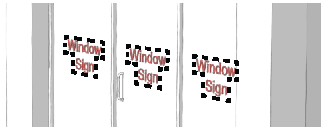
Window signs, provided the area covered by such signs does not exceed one-sixth of window surface area of the window in which it is located and there are no more than 3 temporary signs per 160 square feet of window surface area; or
b.
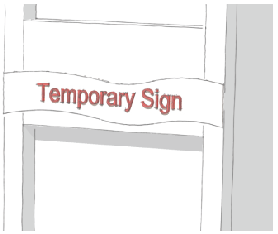
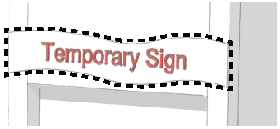
Banners not exceeding 150 square feet in area. Banners may be used for a period not to exceed 30 days in each calendar year.
L.
Vehicular Businesses
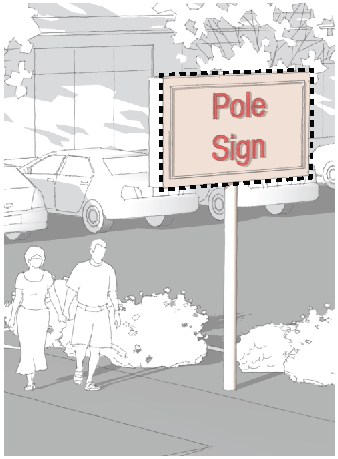
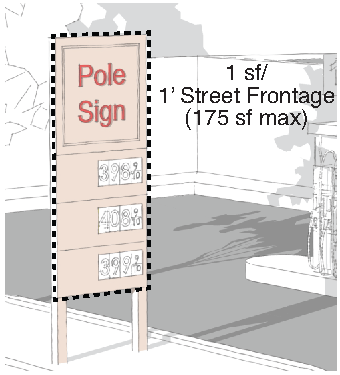
Signs for vehicular businesses shall be limited to signs permitted for storefront or street-facing businesses, as regulated by Sec. 7.3.12.K. above, and 1 business identification pole sign, the area of which shall not exceed 1 square foot of sign area for each linear foot of street frontage of the business, the total sign area not to exceed 175 square feet.
M.
Shopping Centers
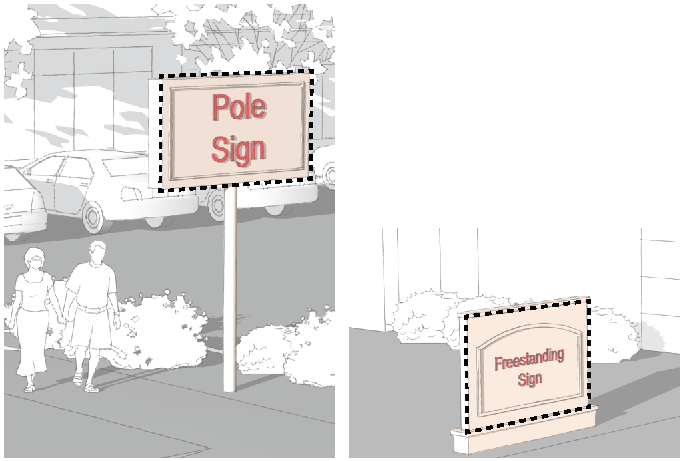
In addition to signs permitted for individual businesses located in a shopping center, as may be regulated by Sec. 7.3.12.K. and Sec. 7.3.12.L., a shopping center may have 1 permanent pole sign or 1 permanent freestanding sign of not more than 3 square feet of sign area per each 1,000 square feet of building space, the total sign area not to exceed 500 square feet, to identify the shopping center and businesses which are located in the center.
N.
Political Signs
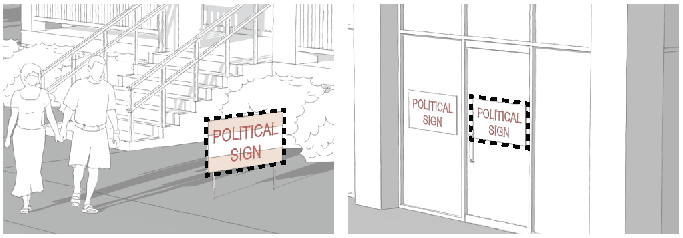
Political signs are permitted in all zoning districts, but they shall be limited only to developed properties. These signs are permitted for a period of not more than 6 weeks before a duly authorized election date. Political signs shall be removed within 1 week following the authorized general election date or within 1 week of the candidate's or issue's election or defeat, whichever comes first. Primary and general election dates shall be established by applicable federal, state or local law. Political signs shall not exceed 8 square feet in area and shall not exceed 2 signs per lot. Political signs shall not be located closer than 17 feet to the edge of a public road surface. However, no political sign shall be permitted in a public right-of-way. Political signs displayed in nonresidential or multiple-family zoning districts may only be placed in the window area of the primary structure.
Political signs may be displayed on private property in connection with political campaigns or noncommercial civic health, safety or welfare campaigns. Political signs shall not exceed 8 square feet in sign area and shall not exceed a height of 6 feet. Political signs displayed in nonresidential or multifamily zoning districts may only be placed in the window areas of the primary structure. All such signs shall be removed within 10 days of the date of conclusion of the campaign. Candidates are obligated and required to remove campaign signs placed on their behalf that are unlawfully located or that extend beyond the conclusion of the campaign and shall be liable to the City for the costs incurred in removing such unlawful signs. Campaign signs are specifically prohibited in or upon any public right-of-way or other public property and shall not be located closer than 17 feet from the curb of a public road surface.
O.
Service Stations
Signs for service stations shall be limited to the following:
1.
One permanent business identification pole sign with price panel, the maximum area of which shall be determined by the regulations for vehicular businesses in Sec. 7.3.12.L.
2.
One permanent principal business identification wall sign mounted flat on the building for each street facing, the maximum area of which shall be determined by the regulations for storefront or street-facing businesses in Sec. 7.3.12.K.
3.
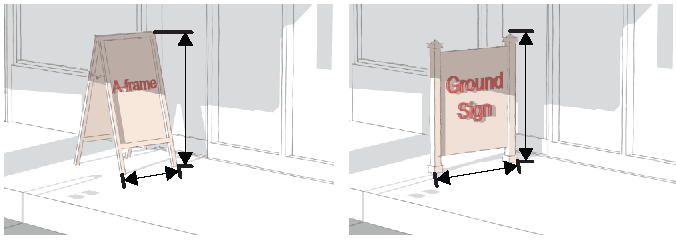
One temporary A-frame or ground sign for display purposes not exceeding 6 feet in height and 4 feet in width.
4.
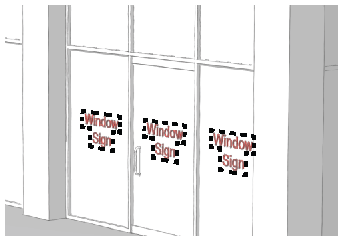
Temporary signs shall be permitted, provided that they are limited to window signs, and the total window surface area covered by such signs does not exceed one-fourth of the window surface area of the window in which they are located.
5.
Pennants, banners and other similar devices shall be permitted only for grand openings. The display time shall not exceed 10 days total time.
6.
Prohibited signs and sign devices at service stations. The following signs and sign devices are prohibited: temporary promotional signs other than window signs, tire and oil displays placed away from the building, signs of wood or other combustible materials, signs attached to pumps and light poles other than directional signs, roof signs, vehicles used as signs, light bulb lines and searchlights.
P.
Professional Offices
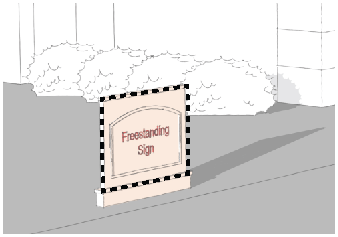
Signs for a professional office shall be limited to a nonilluminated permanent freestanding business identification sign not exceeding 12 feet in area. Such sign may only announce the firm name and the service or product represented.
Q.
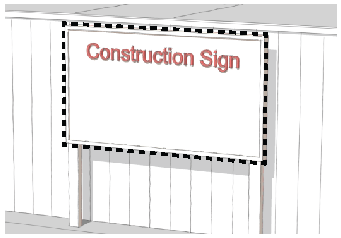
Construction Signs
During construction on or development of property, construction signs shall be permitted as follows:
1.
Residential and professional office zoning districts. One construction sign not exceeding 24 square feet in area.
2.
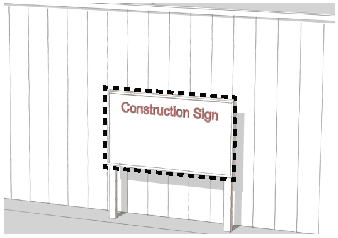
Commercial zoning districts. One construction sign not exceeding 100 square feet in area.
R.
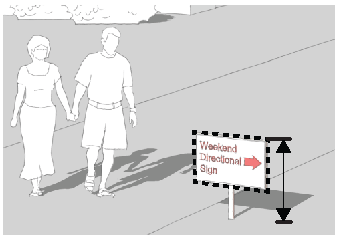
Weekend Directional Signs
Weekend directional signs are permitted in all zoning districts and shall be limited to the following:
1.
Weekend directional signs shall convey directions to a specific place or event.
2.
Weekend directional signs shall be allowed on weekends from 5:00 p.m. on Fridays to 11:59 p.m. on Sundays.
3.
Each weekend directional sign shall be legibly marked with the name of the owner who shall be responsible for removing signs by 11:59 p.m. on Sunday. If a party other than the owner is to be responsible for the removal of the sign, then the responsible party's name may be substituted. This information must be written in weatherproof ink or paint upon at least 1 face of the weekend directional sign and in letters of at least ½ inch in height. Each owner or responsible party shall give notice in the form of a letter to the City providing the name, address and telephone number of the sign owner or responsible party.
4.
Weekend directional signs shall not exceed 4 square feet of sign area and 3 feet in height and shall be allowed to have 1 face on each side of the sign. Weekend directional signs shall be mounted on an independent post or pole and shall not be affixed in any manner to any tree, utility pole, bridge, curb, bench, or any other public facility or fixture, nor to any other sign or sign structure. Weekend directional signs shall be made of metal, plastic, laminated cardboard or some other durable and waterproof material. No such sign shall be made of paper.
5.
There shall be no more than 2 weekend directional signs per intersection for any given place, activity or event, and all such signs must be located within 30 feet of a point defined by the intersections of the curbs of intersecting streets.
6.
Weekend directional signs may be located in a public right-of-way but shall be located no closer than 1 foot to any curb.
7.
Weekend directional signs may not be located in any part of the street frontage of schools, institutions of higher education or places of worship.
8.
Failure to comply with any of the provisions of this Section shall subject the violator, in addition to other penalties that may be applied by the municipal court, to a suspension of the privilege of placing weekend directional signs for a period of up to 1 year, after notice and hearing before the City commission.
7.3.13. - Severability
Should any section or subsection of this Sec. 7.3. (Signs) including Sec. 7.3.1. through Sec. 7.3.12. be declared by a court of competent jurisdiction to be invalid, such action shall not affect the validity of the sign ordinance as a whole or any part thereof other than the part so declared to be invalid, it being the intent of the City Commission that each section and subsection of the sign ordinance be severable.
7.4.1. - Purpose and Intent
The purpose and intent of this Section is to provide a regulatory strategy for outdoor lighting that will permit reasonable uses of outdoor lighting for nighttime safety, utility, security, productivity, enjoyment and commerce; curtail and reverse the degradation of the nighttime visual environment and the night sky; preserve the dark night sky for astronomy; minimize glare, obtrusive light and artificial sky glow by limiting outdoor lighting that is misdirected, excessive or unnecessary; conserve energy and resources to the greatest extent possible; and help to protect the natural environment from the damaging effects of night lighting from human-made sources.
(Ord. No. O-22-Z-08, § 2, 10-17-22)
7.4.2. - Conformance With Applicable Codes
All outdoor illuminating devices must be installed in conformance with the provisions of this UDO, the Building Code and the Electrical Code as applicable and under appropriate permit and inspection.
7.4.3. - Applicability
For all land uses, developments and buildings that require a permit, all outdoor lighting fixtures shall meet the requirements of this UDO. All building additions of 50% or more in terms of additional dwelling units, gross floor area, or parking spaces, either with a single addition or with cumulative additions subsequent to the effective date of this Section, will invoke the requirements of this Section for the entire property, including previously installed and any new outdoor lighting. Cumulative modification or replacement of outdoor lighting constituting 60% or more of the permitted lumens for the parcel, no matter the actual amount of lighting already on a nonconforming site, will constitute a major addition for purposes of this Section.
A.
Minor Additions
Additions of less than 50% of additional dwelling units, gross floor area, or parking spaces that require a permit, and that include changes to existing lighting require the submission of a complete inventory and site plan detailing all existing and any proposed new outdoor lighting. Any new lighting on the site must meet the requirements of this Section with regard to shielding and lamp type.
B.
Exempt Lighting
The following luminaires and lighting systems are exempt from these requirements:
1.
Interior lighting;
2.
Lighting for pools used at night;
3.
Underwater lighting used for the illumination of swimming pools and fountains;
4.
Temporary holiday lighting;
5.
Lighting required and regulated by the Federal Aviation Administration, or other federal, state or local agency;
6.
Emergency lighting used by police, fire, or medical personnel, or at their direction;
7.
All outdoor light fixtures producing light directly from the combustion of fossil fuels, such as kerosene and gasoline; and
8.
Security lighting controlled and activated by a motion sensor device for a duration of 10 minutes or less.
C.
Prohibited Lighting
The following lighting systems are prohibited:
1.
Aerial lasers;
2.
Searchlight style lights, temporary searchlights may be turned on for 8 hours within a 24-hour period and for no more than 3 consecutive days, once each calendar year.
3.
Other very intense lighting, defined as having a light source exceeding 200,000 lumens or intensity in any direction of 2 million candelas or more; and
4.
Mercury vapor lamps.
7.4.4. - Outdoor Lighting Standards
All nonexempt outdoor lighting fixtures shall meet the following criteria:
A.
Flood or spot lamps must be positioned no higher than 45 degrees above straight down (half-way between the vertical and the horizontal) when the source is visible from any off-site residential property or public roadway.
B.
All light fixtures that are required to be shielded shall be installed and maintained in such a manner that the shielding is effective as described herein for fully shielded fixtures.
7.4.5. - Specific Uses
All lighting not directly associated with the special use areas designated below must conform to the lighting standards described in this Section.
A.
Outdoor Sports, Recreation Fields, or Performance Areas
Lighting of outdoor recreational facilities (public or private), such as, but not limited to, outdoor athletic fields, courts, tracks, special event or show areas shall meet the following requirements:
1.
Luminaires
Facilities designed for municipal leagues, elementary to high school levels of play and training fields for recreational or social levels of play, college play, semi-professional, professional or national levels of play shall utilize luminaires with minimal uplight consistent with the illumination constraints of the design. Where fully shielded fixtures are not used, acceptable luminaires shall include those which:
a.
Are provided with internal or external glare control louvers or lenses, and are installed so as to minimize uplight and offsite light trespass and glare; and
b.
Are installed and maintained so as to avoid aiming more than 2.5 times the mounting height.
2.
Illuminance
All lighting installations shall be designed to achieve the illuminance levels for the activity as recommended by the Illuminating Engineering Society of North America (IESNA RP-6).
3.
Off-Site Spill
The installation must also limit off-site spill (off the parcel containing the sports facility) to the maximum extent possible consistent with the illumination constraints of the design. For all recreational or social levels of play and training fields, as well as, performance areas, illumination levels must not exceed 1.5 foot-candles at any location along any non-residential property line, and 0.5 foot-candles at any location along any residential property line.
4.
Curfew
Field lighting for these outdoor athletic facilities shall be turned off within 30 minutes after the last event of the night.
5.
Setback
All light poles shall be set back the greater of 50 feet or one foot for every foot in height from any residential property line or right-of-way.
B.
Service Station Canopies and Parking Structures
1.
All luminaires mounted on or recessed into the lower surface of service station canopies and parking structures must be fully shielded and use flat lenses.
2.
The total light output of luminaires mounted on the lower surface, or recessed into the lower surface of the canopy, and any lighting within signage or illuminated panels over the pumps, must not exceed 50 foot-candles.
3.
The total light output of illuminated areas of a service station other than as detailed in Sec. 7.4.5.B.2. above shall not exceed 15 foot-candles.
4.
Illuminance levels for the interior of parking structures, where interior lighting is visible from outside the structure, must conform to the IESNA recommendation (RP-20).
5.
Lights must not be mounted on the top or sides of a canopy and the sides of a canopy must not be illuminated.
C.
Security Lighting
1.
Security lighting is lighting that provides a level of illumination to clearly identify persons or objects and creates a psychological deterrent to unwanted or unsafe activity in the area being protected.
2.
Security lighting must be directed toward the targeted area, and not adjacent properties.
3.
Sensor activated lighting must be located in such a manner as to prevent direct glare and lighting into properties of others or into a public right-of-way, and the light must not be triggered by activity off the property.
D.
Pedestrian Path Lighting
Lighting posts must not exceed 16 feet from the finished grade.
E.
Architectural Accent Lighting
1.
Fixtures used to accent architectural features, materials, colors, style of buildings, landscaping, or art must be located, aimed and shielded so that light is directed only on those features. Such fixtures must be aimed or shielded to minimize light spill into the dark night sky in conformance with the luminaire standards.
2.
Lighting fixtures must not generate glare, or direct light beyond the facade onto a neighboring property, streets or into the night sky.
F.
Commercial Parking Areas
1.
All lighting fixtures servicing parking lots, except floodlights, must be cutoff fixtures, directed downward and not toward buildings or other areas.
2.
The minimum illumination level for a parking lot is 0.4 foot-candles at grade level and the ratio of the average illumination to the minimum illumination must not exceed 4:1.
3.
Floodlights must be aimed or shielded to minimize uplight.
4.
Light poles used in parking lots must not exceed 35 feet in height.
7.4.6. - Variances
A.
Any person may submit an application to the Zoning Board of Appeals for a variance from the provisions of this Section. The application should include, but not be limited to, evidence about the following:
1.
How the proposed design and appearance of the luminaire are superior;
2.
How light trespass and glare will be limited;
3.
How the proposed solution will provide a benefit without negative impact on the health, safety, or welfare of the community.
B.
The application may include the recommended practices of the Illuminating Engineering Society of North America, a professional engineer, or other authority on outdoor lighting.
7.4.7. - Plans and Evidence of Compliance
A.
Applicant
The applicant for any permit required by any provision of the laws of the Decatur in connection with proposed work involving outdoor lighting fixtures must submit, as part of the application for permit, evidence that the proposed work will comply with this Section. Even should no other permit be required, the installation or modification, except for routine servicing and same-type lamp replacement of any exterior lighting, will require submission of the information described below. The submission must contain but is not necessarily limited to the following, all or part of which may be part or in addition to the information required elsewhere in the laws of the City upon application for the required permit:
1.
Plans indicating the location on the premises of each illuminating device, both proposed and any already existing on the site.
2.
Description of all illuminating devices, fixtures, lamps, supports, reflectors, both proposed and existing. The description may include, but is not limited to catalog cuts and illustrations by manufacturers.
3.
Photometric data, such as that furnished by manufacturers or similar, showing the angle of cut off of light emissions.
B.
Additional Submission
The above required plans, descriptions and data must be sufficiently complete to enable the Department to readily determine whether compliance with the requirements of this Section will be secured. If such plans, descriptions and data cannot enable this ready determination, the applicant must submit additional evidence of compliance to enable such determination, such as certified reports of tests, provided that the tests have been performed and certified by a recognized testing laboratory.
C.
Subdivision Plats
All new subdivided properties must submit information as described above for installed street lights and other common or public area outdoor lighting.
D.
Certification
For all projects, certification that the lighting as installed conforms to the approved plans shall be provided by an illumination engineer/professional before the Certificate of Occupancy is issued. Until this certification is submitted, approval for use by the issuance of the Certificate of Occupancy will not be issued.
7.6.1. - Enclosure
All processing and storage (except vehicle storage) shall be within a completely enclosed building except where "open use" is noted.
7.6.2. - Heat and glare
Any source of heat or glare shall not be visible from any lot line of the premises on which the use is located.
7.6.3. - Odors
Every use shall be so operated as to prevent emission of objectionable odors in such concentration as to be perceptible to any point at or beyond the lot line of the property on which the use is located.
7.6.4. - Vibration
Every use shall be so operated that the ground vibration inherently and recurrently generated is not perceptible without instruments at any point on any boundary line of the lot on which the use is located.
7.6.5. - Dust, Dirt and Fly Ash
Every use shall be so operated as to prevent the emission into the air of dirt or any other solid matter which may cause damage to property or discomfort to persons or animals at or beyond the lot line of the property on which the use is located.
7.6.6. - Noxious Gases and Fumes
No noxious, toxic or corrosive fumes or gases shall be emitted into the atmosphere.
7.6.7. - Industrial Sewage Waste
Every use shall be so operated as to prevent the discharge into any stream, lake or the ground of any waste which will be dangerous or discomforting to persons or animals or which will damage plants or crops or the public water supply at or beyond the lot line of the property on which the use is located.
7.6.8. - Smoke
For the purpose of grading the density of smoke the Ringelmann chart, as published and used by the U.S. Bureau of Mines, is hereby made, by reference, a part of this UDO. Every use shall be so operated as to prevent the emission of smoke, from any source whatever, to a density greater than described as number 1 on the Ringelmann chart, except that in C-3 smoke equal to, but not in excess of, that shade of appearance described as number 2 on the Ringelmann chart may be emitted for a period or periods totaling not more than 4 minutes in any 30 minutes. All measurements shall be made at the point of emission.
7.6.9. - Noise
Sound level shall be measured with a sound meter and associated octave band filter manufactured according to standards prescribed by the American Standards Association. Every use shall be so operated as to comply with the maximum performance standards governing noise described below. Objectionable noises due to intermittence, beat frequency or shrillness shall be muffled or eliminated so as not to become a nuisance to adjacent uses.
7.6.10. - Electrical Disturbance and Radioactivity
Each use shall be so operated as to prevent the emission of quantities of radioactive materials in excess of limits established as safe by the U.S. Bureau of Standards or the emission of electrical disturbance sufficient to adversely affect the operation at any point of any equipment other than the creator of such disturbance.
7.6.11. - Traffic
Every use shall be so designed to prevent decreased multimodal level of service (LoS) below the existing LoS measurement. All measurements shall use the methodologies outlined in the most recent edition of the Highway Capacity Manual, published by the Transportation Research Board. The Decatur Multimodal Transportation Impact Study Guidelines shall be used to identify the effect of each applicable use on the City of Decatur's transportation system, and to implement mitigation measures where LoS impacts are identified.
(Ord. No. O-17-09, § 4, 6-19-17)

