
Decatur City Zoning Code
ARTICLE 6
- Use Provisions
Sec. 6.2. - Allowed Use Table
(Ord. No. O-16-Z-09, §§ 1.1, 1.2, 6-20-16; Ord. No. O-20-Z-01, § 1, 7-20-20; Ord. No. O-21-Z-2, § 6.1, 10-18-21; Ord. No. O-23-Z-01, § 14, 2-6-23; Ord. No. O-24-Z-05, § 1.1, 5-20-2024; Ord. No. O-24-Z-06, § 1.1, 5-20-2024)
6.1.1. - Classification of Uses
No building shall be erected, converted, enlarged, reconstructed, moved, structurally altered or used, except for a use permitted in the district in which the building is located.
A.
Principal Uses
1.
In order to regulate a variety of similar uses, use categories have been established for principal uses. Use categories provide a systematic basis for assigning uses to appropriate categories with other, similar uses. Use categories classify principal uses and activities based on common functional, product or physical characteristics.
2.
Where a use category contains a list of included uses, the list is to be considered example uses, and not all-inclusive. The Zoning Administrator is responsible for categorizing uses as set out in Sec. 6.1.2.
3.
The allowed use table in Sec. 6.2. establishes permitted uses by district. No land shall be used except for a purpose permitted in the district in which it is located.
4.
Use category definitions are provided in Sec. 6.3. through Sec. 6.7.
B.
Accessory Uses
1.
An accessory use is any use that is subordinate in both purpose and size, incidental to and customarily associated with a permitted principal use located on the same lot.
2.
No accessory use or structure shall be located, constructed or moved upon a lot until the construction of the main building has commenced. No accessory structure shall be used unless the main building is in use.
3.
Standards for accessory uses are specified in Sec. 6.8.
C.
Temporary Uses
1.
A temporary use is a use that is in place for a limited period of time only.
2.
Requirements for temporary uses are specified in Sec. 6.9.
6.1.2. - Principal Uses Not Listed
A principal use not specifically listed is not allowed unless the Zoning Administrator determines the use to be part of a use category as described below.
A.
The Zoning Administrator is responsible for categorizing all principal uses. If a proposed use is not listed in a use category, but is similar to a listed use, the Zoning Administrator may consider the proposed use part of that use category. When determining whether a proposed use is similar to a listed use, the Zoning Administrator must consider the following criteria:
1.
The actual or projected characteristics of the proposed use;
2.
The relative amount of site area or floor area and equipment devoted to the proposed use;
3.
Relative amounts of sales;
4.
The customer type;
5.
The relative number of employees;
6.
Hours of operation;
7.
Building and site arrangement;
8.
Types of vehicles used and their parking requirements;
9.
The number of vehicle trips generated;
10.
How the proposed use is advertised;
11.
The likely impact on surrounding properties; and
12.
Whether the activity is likely to be found independent of the other activities on the site.
B.
Where a use not listed is found by the Zoning Administrator not to be similar to any other permitted use, the use is only permitted following a text amendment.
6.1.3. - Use Table Key
A.
Permitted Use (P)
Indicates a use is permitted in the respective district. The use is also subject to all other applicable requirements of the UDO.
B.
Limited Use (L)
Indicates a use is permitted in the respective district, subject to a use standard found in the right-hand column of the use table. The use is also subject to all other applicable requirements of the UDO.
C.
Conditional Use (C)
Indicates a use may be permitted in the respective district only after a public hearing by the Planning Commission and approval by the City Commission. Conditional uses are subject to all other applicable requirements of this UDO, including any applicable use standards, except where the use standards are expressly modified by the City Commission as part of the approval.
D.
Use Not Permitted (—)
Indicates that a use is not permitted in the respective district.
6.3.1. - Household Living
A.
Defined
Residential occupancy of a dwelling unit by a house-hold. Household living includes the following:
1.
Single-family detached dwelling.
2.
Accessory dwelling unit (ADU).
3.
Single-family attached dwelling.
4.
Two-family dwelling.
5.
Multiple-family dwelling.
6.
Home occupation.
7.
Live-work.
8.
Lifecycle dwelling.
9.
Inclusionary dwelling.
B.
Single-Family Attached, Multiple-Family Dwelling
1.
NMU
Where a multiple-family dwelling is allowed as a limited use, it is allowed only in the upper stories of a mixed use building. A lobby or other entrance is allowed on the ground floor.
2.
C-1
Where a single-family attached or multiple-family dwelling is allowed as a limited or conditional use in C-1, ground floor residential cannot be visible from a public street and must be located behind space constructed for nonresidential occupancy. There are no restrictions on upper floors.
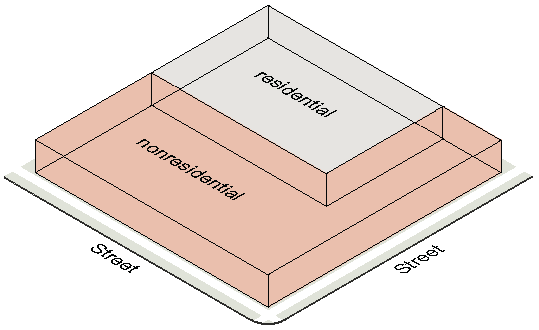
3.
C-2
Where a single-family attached or multiple-family dwelling is allowed as a limited or conditional use in C-2, ground floor residential cannot be visible along the following streets and must be located behind space constructed for nonresidential occupancy.
a.
Ponce de Leon Avenue (entire portion);
b.
Church Street (from Trinity Place to Commerce Drive);
c.
East Courthouse Square (entire portion); and
d.
Sycamore Street (from McDonough Street to Church Street).
C.
Downtown Multiple Dwelling
1.
Development Standards
a.
Minimum lot area: One acre—Exceptions to the minimum lot area may be approved after public hearing by the Planning Commission and approval of the City Commission.
b.
Minimum lot area per family: 1,000 square feet for buildings of three or less stories; 620 square feet for buildings of four or more stories.
2.
Supplemental Standards for Approval
a.
Open space. The proposed development shall provide a minimum of 5% outdoor amenity space for residents and other tenants.
b.
Parking. Parked vehicles shall be screened from view from the public right-of-way. Vehicular parking for the proposed development shall be:
i.
Underground;
ii.
Effectively screened by retail or residential space;
iii.
Effectively screened by a combination of architectural and landscape features (a minimum of 60% of the parking facility wall area must be screened); or
iv.
Effectively screened by landscape treatment (a minimum of 60% of the parking facility wall area must be screened).
c.
Ingress and egress. The proposed points of vehicular ingress and egress must maintain or improve existing traffic patterns and provide safe and convenient access for bicyclists and pedestrians.
d.
Site utilities. All utilities for the proposed development shall be underground.
D.
Live-Work
1.
Defined
Nonresidential activity conducted wholly within a residential dwelling that allows employees, customers, clients or patrons to visit.
2.
Standards
Where a live-work is allowed as a limited use, it is subject to the following:
a.
Live-work is only permitted in units with street level access.
b.
A minimum of one person must occupy the live-work unit as their primary place of residence.
c.
The live-work unit may employ no more than two persons not living on the premises at any one time.
d.
No business storage or warehousing of material, supplies or equipment is permitted outside of the live-work unit.
e.
The nonresidential use of the unit is limited to the use allowed in the zoning district.
f.
No equipment or process may be used in connection with the live-work unit that creates noise, vibration, glare, fumes, odors, or electrical interference detectable to the normal senses, off the premises.
g.
No more than 5 customers are permitted on the premises at any one time.
E.
Residential Conditional Use Permit
When a residential use is allowed as a conditional use, the following items shall be considered in determining whether the residential use shall be approved:
1.
The suitability of the proposed residential use in view of the use and development of adjacent and nearby properties.
2.
The impact that the proposed residential use will have on the public safety, traffic on the public streets, transportation facilities, utilities, and other public services.
3.
The impact that the proposed residential use will have on established property values and on the health, safety, comfort and general welfare of the residents of the City.
4.
The use standards of Sec. 6.3.1.C. apply.
F.
Inclusionary Dwelling
Where single-family detached dwelling, single-family attached dwelling, duplex, walk up flat, townhouse, multiple-family dwelling, or downtown multiple dwelling is permitted, or allowed as a limited use or as a conditional use, it is subject to the following:
1.
Applicability and Minimum Project Size.
a.
Any new development that includes at least five single-family dwelling units, attached or detached;
b.
Any new development that includes at least five single-family lots;
c.
Any new development that creates at least five multiple-family dwelling units;
d.
Any renovation or reconstruction of existing multiple-family dwelling units that increases the number of dwelling units by at least five dwelling units; or
e.
Any change in use of all or part of an existing development of one or more buildings from a nonresidential use to a residential use that has at least five dwelling units.
2.
Standards.
a.
A development that is subject to this Section shall designate a minimum of ten percent of the total number of dwelling units or lots to be developed as inclusionary dwelling units. To calculate the number of inclusionary dwelling units or lots, the total number of proposed units shall be multiplied by ten percent. If the product contains a fraction, a fraction of 0.5 or more shall be rounded up to the next higher integer, and fraction of less than 0.5 shall be rounded down to the next lower integer.
b.
The inclusionary dwelling units in the proposed development shall be:
i.
Designed to have a number of bedrooms in the same proportion as the market rate dwelling units;
ii.
Interspersed and among the market rate dwelling units within the development;
iii.
Built concurrently with the market rate dwelling units; and
iv.
Designed to be functionally equivalent in style and quality with the market rate dwelling units in the development.
c.
A development that is subject to this Section may incorporate a density bonus to accompany and support the inclusionary dwelling requirements.
i.
To calculate the density bonus for multiple-family developments, the maximum number of dwelling units approved in the applicable zoning district shall be multiplied by 20 percent. If the product contains a fraction, a fraction of 0.5 or more shall be rounded up to the next higher integer, and fraction of less than 0.5 shall be rounded down to the next lower integer.
ii.
For single-family detached dwellings, the minimum lot size and minimum lot width required by the applicable zoning district may be reduced by up to 25 percent to accommodate the additional lots.
d.
A multiple-family development that provides on-site inclusionary dwelling units may reduce the total number of off-street parking required per Section 7.1.3. by ten percent without a special exception.
e.
The inclusionary dwelling units and lots, as applicable, shall be located within the development, except in accordance with the following alternatives to on-site development, which shall be included in the Inclusionary Housing Plan:
i.
Inclusionary dwelling units are built on a separate site within the City of Decatur appropriately zoned for the residential use.
ii.
Payment in lieu is made to the City of Decatur Housing Trust Fund for development of inclusionary dwelling units or improvement of existing affordable housing in the City of Decatur prior to issuance of building permit of the development. The Decatur City Commission shall annually establish the per dwelling unit payment amount in its schedule of fees.
f.
Inclusionary dwelling units or lots that will be owner-occupied shall be:
i.
Restricted to households having an income that does not exceed 120 percent of the area median income for the family size having the same number of persons as the subject household for the Atlanta-Sandy Springs-Marietta, Georgia, Metropolitan Statistical Area, as published by the U.S. Department of Housing and Urban Development as of the date of the household's application, and whose housing and utility costs do not exceed 30 percent of the household's annual gross income; and
ii.
Maintained as inclusionary dwelling units through a land use restriction agreement with the City of Decatur and by a ground lease agreement with the Decatur Land Trust for a period no less than permissible by Georgia state law.
g.
Inclusionary dwelling units that will be leased or rented shall be:
i.
Restricted to households having an income that does not exceed 80 percent of the area median income for the family size having the same number of persons as the subject household for the Atlanta-Sandy Springs-Marietta, Georgia, Metropolitan Statistical Area, as published by the U.S. Department of Housing and Urban Development as of the date of the household's application, and whose housing and utility costs do not exceed 30 percent of the household's annual gross income; and
ii.
Maintained as inclusionary dwelling units through a land use restriction agreement with the City of Decatur for a period no less than permissible by Georgia state law.
h.
Subleasing of any leased inclusionary dwelling unit is not permitted. Leasing of any owner-occupied inclusionary dwelling unit is not permitted.
i.
The owner must provide a notice of availability to the City's Zoning Administrator of its intent to rent or sell an inclusionary dwelling unit.
j.
An affidavit must be provided to the City's Zoning Administrator confirming that household eligibility requirements have been met. Any agreement must be in writing and provided to the City upon request.
k.
A non-eligible household may occupy an inclusionary dwelling unit if an eligible household is not available to purchase or rent the dwelling unit. If an inclusionary dwelling unit is being offered for lease, a non-eligible household may occupy it on the date 90 days after the City's receipt of a notice of availability. If an inclusionary dwelling unit is being sold, a non-eligible household may occupy it on the date 120 days after the City's receipt of a notice of availability.
3.
Supplemental Standards for Approval.
a.
Prior to issuance of any development approvals, the developer shall submit an Inclusionary Housing Plan in accordance with the adopted Inclusionary Housing Plan Guidelines.
b.
The Zoning Administrator shall certify in writing that the development for which approval is sought is consistent with all applicable requirements of this Section and the Inclusionary Housing Plan Guidelines.
c.
Prior to the submittal of any development application, a pre-application conference between the developer and the Zoning Administrator is required to discuss the application and relevant requirements of the Inclusionary Housing Plan.
d.
A land use restriction agreement shall be executed between the City Manager and the developer, in a form promulgated by the City and approved by the City Attorney, based on the Inclusionary Housing Plan, which land use restriction agreement sets forth the land use restrictions required by this Section, as further provided for in the Inclusionary Housing Plan Guidelines.
e.
Prior to issuance of the certificate of occupancy for a development subject to this Section, the developer shall provide the UDO Administrator with a fully executed copy of the land use restriction agreement providing sufficient indicia that it has been recorded in the real property records maintained by the Clerk of the Superior Court of DeKalb County.
G.
Accessory Dwelling Unit (ADU)
Where an accessory dwelling unit is allowed as a limited use, it is subject to the following:
1.
An ADU is only allowed as an accessory use to a single-family detached house, duplex, or walk up flat and shall be subject to the Standards for Specific Accessory Uses in Section 6.8.3.
2.
An ADU as an accessory use to a four-unit walk up flat shall be subject to the Standards for Inclusionary Dwelling in Section 6.3.1.F. and shall not incorporate a density bonus or parking reduction.
(Ord. No. O-21-Z-02, § 7.1, 10-18-21; Ord. No. O-23-Z-01, § 15, 2-6-23)
6.3.2. - Group Living
A.
Defined
Residential occupancy of a structure by a group of people that does not meet the definition of house-hold living. Generally, group living facilities have a common eating area for residents, and residents may receive care or training. Group living includes the following:
1.
Assisted living facility, nursing home.
2.
Personal care home.
3.
Roominghouse, boardinghouse.
B.
Personal Care Home, Assisted Living Facility, Nursing Homes
1.
All Facilities
Where a personal care home, assisted living facility or nursing home is allowed as a limited use or requires a conditional use permit, it is subject to the following:
a.
Persons seeking to operate such a facility must file a permit application with the City along with any fees established by the City Commission.
b.
Each permit application shall include an affidavit that the applicant either has applied for or will immediately apply for the corresponding permit or authorization for the operation of the facility from the State of Georgia Department of Community Health in accordance with its rules and regulations and the affidavit shall also certify that the proposed facility will meet and be operated in conformance with all applicable state and federal laws and regulations and with all codes and regulations of the City.
c.
All application forms and information submitted to the State of Georgia Department of Community Health shall be submitted with the City permit application.
d.
The Zoning Administrator may require clarification or additional information from the applicant that is deemed necessary to determine whether operation of the proposed home will meet applicable laws, regulations and development standards.
e.
If the Zoning Administrator determines that an application to operate the facility is in compliance with the applicable requirements, the Zoning Administrator shall approve the application for a permit, but the permit for operation shall not be issued until the applicant has obtained the corresponding permit or authorization for operation of the facility from the State of Georgia Department of Community Health.
f.
No permit for the operation of the facility shall be transferable.
g.
No facility shall be operated without both a valid permit from the City and a valid license from the State of Georgia Department of Community Health.
h.
No such facility shall be located within 1,000 feet of any other such facility, said distance to be measured in a straight line from the closest property lines upon which each facility is located.
i.
All such facilities must provide at least 80 square feet of personal living space per resident or that amount required by the State of Georgia for the licensing of such facilities, whichever is greater.
j.
No signs shall be permitted other than those permitted by the regulations of the zoning district within which such facility is located.
2.
Personal Care Home, Assisted Living, Nursing Home Requiring a Public Hearing
When a personal care home, assisted living facility or nursing home requires a conditional use permit, the following items shall be considered in determining whether the facility shall be approved:
a.
The suitability of the facility in view of the use and development of adjacent and nearby properties.
b.
The impact that the proposed facility will have on the public safety, traffic on the public streets, transportation facilities, utilities, and other public services.
c.
The impact that the proposed facility will have on established property values and on the health, safety, comfort and general welfare of the residents of the City.
C.
Roominghouse, Boardinghouse
Where a roominghouse or boardinghouse is allowed as a limited use, the minimum floor area of each bedroom must be 80 square feet of usable floor area per occupant. Usable floor area is defined as floor area under a ceiling at least eight 8 feet in height.
6.3.3. - Social Services
A.
Defined
A facility that provides treatment for persons who present a direct threat to the persons or property of others. Includes persons convicted for illegal manufacture or distribution of a controlled substance, sex offenders, and juvenile offenders. Also includes facilities that provide transient housing related to post-incarceration and social service programs.
(Ord. No. O-20-Z-01, §§ 1, 2, 7-20-20)
6.4.1. - Civic
A.
Defined
Places of public assembly that provide ongoing governmental, life safety, educational and cultural services to the general public, as well as meeting areas for religious practice. Civic includes the following:
1.
Art gallery, public.
2.
College, university, seminary.
3.
Library, museum, public.
4.
Office, governmental, civic or charitable organization.
5.
Place of worship, including church, mosque, synagogue, temple.
6.
Police, fire or EMS station.
7.
Post office.
8.
School, private (K-12).
9.
School, public (K-12).
B.
Place of Worship
Where a place of worship is allowed as a limited use, it is subject to the following:
1.
Shall comply with the minimum front and rear yard requirements for the zoning district in which they are located and shall have a 25-foot side yard.
2.
No required front yard shall be used for the purpose of parking or loading.
3.
Coverage of property shall be limited to 50%. In addition to coverage by buildings, coverage by parking areas, drives, walkways and other paved or graveled surfaces shall be included in determining the percentage of coverage.
C.
School, Private (K-12)
Where a private school (K-12) requires a conditional use permit, it is subject to the following:
1.
Development Standards
a.
Minimum Lot Area
i.
Elementary schools: 4 acres.
ii.
Middle or junior high schools: 8 acres.
iii.
High schools: 15 acres.
b.
Minimum Frontage
100 feet.
c.
Minimum Building Setbacks
i.
From property lines from adjoining residential uses: 50 feet.
ii.
From property lines for parking areas and driveways: 25 feet.
d.
Special Exceptions
A special exception to any of these development standards may be approved as part of the school's comprehensive site development plan after consideration of the standards for approval described in Sec. 11.2.8.
2.
Supplemental Standards for Approval
In addition to the standards described in Sec. 11.2.8., the following standards shall be considered in determining whether the proposed development shall be approved:
a.
Adequacy of Site
Is the site adequate for the proposed development and use?
b.
Buildings
Are the scale and size of the proposed buildings appropriate in relation to the site and the adjacent and nearby properties?
c.
Vehicular Access, Circulation and Off-Street Parking and Loading
i.
Is the public street on which the proposed development is to be located adequate to allow estimated traffic?
ii.
Is ingress and egress to the proposed development adequate so as to minimize traffic congestion?
iii.
Is parking located to the rear of the proposed development and effectively screened?
iv.
Is there adequate access for fire and other emergency vehicles?
d.
Buffers
Are buffers and other screening measures adequate to protect adjacent residential uses from noise, lighting and other impacts?
e.
Garbage Disposal
i.
Are garbage disposal and refuse collection areas adequate?
ii.
Are they located and screened to minimize impacts on adjacent residential properties?
3.
Standards for Approval; Conditional Zoning
The standards described in Sec. 11.2.8. shall be considered in determining whether the proposed use shall be approved. Such use may be approved subject to such conditions as may be imposed in order to mitigate impacts which may be expected without the imposition of conditions and may be regulated in the same manner as provided in Sec. 11.2.8.
4.
Supplemental Application Requirements
Each application shall be accompanied by plans which shall include the following:
a.
Written Description of the Proposed Development
At a minimum, such description shall provide a summary of the scope and main features of the proposed development, including hours and manner of operation, and shall address standards for approval described in Sec. 6.4.1.C.2. and Sec. 6.4.1.C.3. above.
b.
Comprehensive Site Development Plan
At a minimum, such plan shall include all existing and proposed buildings and structures and their location on the property, heights of proposed buildings, proposed use of each building, all driveways, parking areas and loading areas, location of garbage disposal facilities and proposed buffers.
6.4.2. - Parks and Recreation
A.
Defined
Uses focusing on natural areas consisting mostly of vegetation, passive or active outdoor recreation areas, and having few structures. Parks and recreation includes the following:
1.
Cemetery.
2.
Open space.
3.
Park, playground, recreation field.
4.
Public land.
6.4.3. - Public Utilities
A.
Defined
Public or private infrastructure, including but not limited to water, sewer, gas, electric, telephone, Internet, cable and other similar services serving the community. Public utilities includes the following:
1.
Antennas.
2.
Communications tower. Neighborhood-serving cable, telephone, gas, or electric facility.
3.
On-site stormwater retention or detention facility.
4.
Water or wastewater pump or lift station.
B.
Antennas and Telecommunication Towers
Telecommunication towers and antennas may be erected and operated as permitted in the district regulations and in accordance with the policies and procedures described in this Section. Except in RM-43, and unless otherwise exempt, no communication tower or antenna shall be erected in a residential zoning district.
1.
Development Standards
a.
All Districts (Where Allowed)
i.
Co-Located Antennas
Antennas that are attached or affixed to lawful existing telecommunications support structures in a manner that negates the need to construct a new freestanding wireless support structure and that comply with the requirements of O.C.G.A. § 36-66B-4 as amended shall be authorized as: a limited use in those districts within which such towers are authorized if such co-location application is subject to the streamlined process of said state statute, subject to compliance with the provisions of this Section, or; a conditional use if so required in the district within which such towers is requested, subject to compliance with the provisions of this Section. Fees for co-location applications shall not exceed $500.00. Decisions on co-located antennas shall be made according to the applicable procedure within 90 calendar days of the date a completed application was filed and shall be in writing. The Zoning Administrator shall have 30 days from the date of application to determine if an application is complete and shall notify the applicant in writing of any additional materials required. If so notified, the time within which such information is being provided by the applicant shall not count against the 90 day decision period herein. Where authorized, building-mounted antennas must be visually screened from view from all abutting properties.
ii.
Federal and State Law
The regulations of this Section must be applied within the procedural and regulatory constraints of applicable federal and state telecommunications statutes.
iii.
Application Materials
Applications shall be made on forms prepared by the Zoning Administrator and shall contain all required documents and information required to analyze the application in accordance with the required criteria.
iv.
Decisions on New Towers
Final decisions on applications for new telecommunication support structures shall be in writing and be supported by a written record documenting the reasons for the denial and the evidence in support of the decision. Such decisions shall be made within 150 calendar days of the date of complete application, unless another date is agreed to by the applicant and the Administrator in writing. The Zoning Administrator shall have 30 days from the date of application to determine if an application is complete and shall notify the applicant in writing of any additional materials required. If so notified, the time within which such information is being provided by the applicant shall not count against the 150-day decision period herein.
b.
Antennas in RM-43, C-1, C-2, C-3, MU and I
Antennas may be located on existing structures, including but not limited to buildings, light poles, water towers, communications towers or other freestanding structures, provided that the existing structure is at least 50 feet in height and the antenna is no more than 10 feet higher than the highest point of the existing structure and is screened as provided in this Section.
c.
Telecommunication Towers
i.
Telecommunication towers must be set back at least 200 feet or the height of the tower, whichever is greater, from any property line, unless a greater setback is expressly required as part of conditional use permit approval.
ii.
Telecommunication towers must be painted a neutral color, so as to reduce visual obtrusiveness. These color and design requirements do not apply to alternative tower structures.
iii.
At a tower site, the design of the buildings and related structures must, to the maximum extent possible, use materials, colors, textures, screening and landscaping that will blend the tower facilities to the natural setting and built environment.
iv.
Towers may not be artificially lighted, unless required by the Federal Aviation Administration, Federal Communications Commission or other applicable authority. If lighting is required, it must be done in a way that minimizes the disturbance to surrounding views.
v.
Telecommunications towers must be entirely enclosed by a security fence of at least six feet in height. Towers must be equipped with an anti-climbing device. This requirement does not apply to alternative tower structures, provided equivalent alternative security measures are installed.
vi.
In addition to any other landscaping or buffer requirements that may apply, telecommunications towers must be landscaped with plant material that effectively screens the tower site from adjacent uses. Existing tree growth and natural land forms on-site must be preserved to the maximum extent possible. At a minimum, a landscaped strip ten feet in width must be provided around the perimeter of the tower site.
vii.
Telecommunication towers must be constructed to the minimum height necessary to accomplish their required telecommunications purpose.
viii.
The environmental effects of radio frequency emissions may not serve as a basis to approve, deny or otherwise regulate a telecommunications tower to the extent that emissions comply with Federal Communications Commission regulations.
ix.
Each applicant requesting approval of a telecommunications tower must provide to the zoning administrator as a part of the application an inventory of its existing towers that are either within the city or within one-quarter mile of the city boundaries, including information regarding the location, height and design of each tower.
x.
No new telecommunication tower may be permitted unless the applicant demonstrates that no existing tower or structure can accommodate the applicant's proposed antenna. Evidence must be submitted at the time of application demonstrating that no existing tower or structure can accommodate the applicant's proposed antenna and may consist of one or more of the following:
(a)
No existing towers or structures are located within the geographic area required to meet applicant's engineering requirements;
(b)
Existing towers or structures are not of sufficient height to meet applicant's engineering requirements;
(c)
Existing towers or structures do not have sufficient structural strength to support applicant's proposed antenna and related equipment;
(d)
The applicant's proposed antenna would cause electromagnetic interference with the antenna on the existing towers or structures, or the antenna on the existing towers or structures would cause interference with the applicant's proposed antenna;
(e)
The fees, costs, or contractual provisions required by the owner in order to share an existing tower or structure or to adapt an existing tower or structure for sharing are unreasonable; or
(f)
There are other limiting factors that render existing towers and structures unsuitable.
xi.
The placement of additional buildings or other supporting equipment necessarily required in connection with an otherwise authorized telecommunication tower or antenna is authorized.
xii.
Any telecommunications antenna or tower that is not operated for a continuous period of six months will be considered abandoned, and the owner of such antenna or tower must remove the antenna or tower within 90 days of receipt of notice from the city.
2.
Conditional Land Use Permit Approval Criteria
In reviewing and acting on conditional land use permit applications for telecommunication towers, the Planning Commission and City Commission must consider the following factors in addition to the generally applicable conditional land use permit approval criteria:
a.
Height of the proposed tower;
b.
Proximity of the tower to residential structures;
c.
Nature of uses on adjacent and nearby properties;
d.
Surrounding topography;
e.
Surrounding tree cover and foliage;
f.
Design of the tower, with particular reference to design characteristics that have the effect of reducing or eliminating visual obtrusiveness; and
g.
Compliance with telecommunication tower regulations of this Section.
h.
Exemptions
These regulations shall not apply to the following:
i.
Towers and/or antennas less than 70 feet in height and owned and operated by a federally licensed amateur radio operator.
ii.
Receive-only antennas.
iii.
Satellite dish antennas.
iv.
Towers and antennas operated by local, state or federal government for a necessary governmental function.
6.5.1. - Alcohol Sales
A.
Defined
The sales of any kind of alcoholic beverage regulated by the state of Georgia. This definition includes all alcohol, distilled spirits, beer, malt beverage, wine or fortified wine.
B.
Standards
Standards for Alcohol Sales are found in Chapter 6 of the Code of Ordinances.
6.5.2. - Day Care
A.
Defined
A facility providing care, protection and supervision of children or adults on a regular basis away from their primary residence. Care is provided to a given individual for less than 24 hours a day. Day care includes the following:
1.
Adult day care center.
2.
Day care center.
3.
Family day care home.
4.
Nursery school.
5.
After-school program.
B.
Use Standards
1.
In General
a.
Where a day care is allowed as a limited use or requires a conditional use permit, an outdoor play area must be provided and must meet the size, location, and fence requirements for playgrounds set forth in the Rules for Child Care Learning Centers as adopted and amended by the Georgia Department of Early Care and Learning pursuant to O.C.G.A. § 20-1A-1.
b.
Where a day care requires a conditional use permit, the following items shall be considered in determining whether the day care shall be approved
i.
The suitability of the proposed facility in view of the use and development of adjacent and nearby properties.
ii.
The impact that the proposed facility will have on the public safety, traffic on the public streets, transportation facilities, utilities, and other public services.
iii.
The impact that the proposed facility will have on established property values and on the health, safety, comfort and general welfare of the residents of the City.
2.
Family Day Care Home
Family Day Care Homes may be established and operated in the City in accordance with the following policies and procedures:
a.
Family day care homes shall be operated only in zoning districts in which such homes are allowed as permitted use.
b.
Persons seeking to operate a family day care home in the City must file an application with the City along with any fees established by the City Commission. Each family day care home application shall include a description of the program, an affidavit that the applicant has applied for the required approval from the Georgia Department of Early Care and Learning and the affidavit shall also certify that the proposed family day care home will meet and be operated in conformance with all state, federal and local laws and regulations. The Zoning Administrator may require clarification or additional information from the applicant that is deemed necessary to determine whether operation of the proposed day care will meet applicable laws, regulations and development standards.
c.
After the Zoning Administrator determines that the application is complete, the subject property shall be posted by placard for 15 days in a conspicuous location notifying the public that an application to establish a family home day care center has been filed with the city. The placard shall include information on where and when the pending application can be viewed. The Zoning Administrator shall keep a record of any comments submitted about the application during the 15 day advertisement period. No application shall be approved without the 15 day advertisement period.
d.
If the Zoning Administrator determines an application to operate a family day care home is in compliance with the applicable requirements, the Zoning Administrator shall approve the application for permit, but the Certificate of Occupancy or approval for operation shall not be issued until the applicant has submitted proof of registration or authorization from the Georgia Department of Early Care and Learning to operate the day care.
e.
Family day care homes must have a business license with the City.
f.
No permit for the operation of a family day care home shall be transferable.
(Ord. No. O-16-Z-13, § 1.1, 8-15-16)
6.5.3. - Indoor Recreation
A.
Defined
A commercial facility, varying in size, providing daily or regularly scheduled recreation-oriented activities in an indoor setting. Indoor recreation includes the following:
1.
Adult entertainment.
2.
Amusement center, game/video arcade.
3.
Art, music, dance, and photographic studio.
4.
Assembly hall, auditorium, meeting hall.
5.
Billiard parlor.
6.
Bowling alley, Club, lodge.
7.
Gym, health spa, yoga studio.
8.
Ice, roller skating rink.
9.
Indoor sports facility.
10.
Inflatable playground, trampoline park.
11.
Miniature golf facility.
12.
Movie theater, playhouse, live performance venue.
B.
Standards
1.
Adult Entertainment
No adult entertainment establishment shall be located within 200 yards of the property line of any place of worship, public park, public library, public housing development, hospital, public or private school, college or seminary, recreation center or private residence, unless such private residence is located in the C-3 zoning district. This distance requirement shall be measured in a straight line from the closest portion of the property line upon which the adult entertainment establishment is located to the closest portion of the property line of said listed uses.
2.
NMU Use Standards
Where indoor recreation is allowed as a limited use, it is subject to the following:
a.
No building can exceed a total floor area of 10,000 square feet.
b.
No use or establishment can exceed a floor area of 2,000 square feet.
c.
All allowed indoor recreation uses must be located on the ground floor.
d.
Hours of operation can begin no earlier than 6 AM and end no later than 11 PM, including all deliveries.
6.5.4. - Medical
A.
Defined
A facility providing medical or surgical care to patients. Some facilities may offer overnight care. Medical includes the following:
1.
Ambulatory surgical center, outpatient surgery center.
2.
Hospital, infirmary, sanitarium.
3.
Medical, dental, chiropractic clinic.
4.
Medical, dental laboratory.
5.
Urgent care, emergency medical office.
B.
Standards
1.
Hospital, Infirmary, Sanitarium
a.
Where a hospital, infirmary or sanitarium requires a conditional use permit, the following items shall be considered in determining whether the use shall be approved:
i.
Shall not include facilities for long-term custodial care of the mentally ill.
ii.
Shall have prior approval of the county health department.
iii.
Shall provide a visually solid fence or dense planted buffer on any side abutting residential use.
b.
The following conditions apply to hospitals, infirmaries or sanitariums in all districts permitting such uses:
i.
Shall not include facilities for long-term custodial care of the mentally ill.
ii.
Shall have prior approval of the county health department.
iii.
Shall provide a visually solid fence or dense planted buffer on any side abutting residential use.
2.
NMU Use Standards
Where medical is allowed as a limited use, it is subject to the following:
a.
No building can exceed a total floor area of 10,000 square feet.
b.
No use or establishment can exceed a floor area of 2,000 square feet.
c.
All allowed medical uses must be located on the ground floor.
d.
Hours of operation can begin no earlier than 6 AM and end no later than 11 PM, including all deliveries.
6.5.5. - Office
A.
Defined
A facility used for activities conducted in an office setting and generally focusing on business, professional or financial services. Office includes the following:
1.
Business or professional office including, but not limited to, lawyer, accountant, auditor, bookkeeper, engineer, architect, sales office, travel agency, interior decorator or security system services.
2.
Call center.
3.
Counseling in an office setting.
4.
Financial services including but not limited to, lender, investment or brokerage house, bank, credit union, bail bonds, insurance adjuster, real estate or insurance agent, mortgage agent, or collection agency.
5.
Radio, television studio.
6.
Trade, vocation, business school.
B.
NMU Use Standards
Where office is allowed as a limited use, it is subject to the following:
1.
No building can exceed a total floor area of 10,000 square feet.
2.
No use or establishment can exceed a floor area of 2,000 square feet.
3.
All allowed office uses must be located on the ground floor.
4.
Hours of operation can begin no earlier than 6 AM and end no later than 11 PM, including all deliveries.
5.
Drive-through or drive up service is not permitted.
6.5.6. - Outdoor Recreation
A.
Defined
A commercial facility, varying in size, providing daily or regularly scheduled recreation-oriented activities. Activities take place predominately outdoors or within outdoor structures. Outdoor recreation includes the following.
1.
Drive-in theater.
2.
Golf driving range,
3.
Miniature golf facility.
4.
Outdoor sports field/court.
5.
Outdoor theater.
6.5.7. - Overnight Lodging
A.
Defined
Accommodations arranged for short term stays. Overnight lodging includes the following:
1.
Bed and breakfast.
2.
Hotel, motel, lodginghouse.
3.
Short term rental.
B.
Standards
1.
In General
Where overnight lodging, is allowed as a limited use, it is subject to the following:
a.
Persons seeking to operate overnight lodging must file an application with the city along with any fees established by the City Commission. Each overnight lodging application shall include a description of the establishment, an affidavit that the applicant has applied for the required approval from the appropriate state departments and the affidavit shall also certify that the proposed overnight lodging will meet and be operated in conformance with all state, federal and local laws and regulations. The Zoning Administrator may require clarification or additional information from the applicant that is deemed necessary to determine whether operation of the overnight lodging will meet applicable laws, regulations and development standards. Information could include the number of guest rooms, a guest parking plan, operating hours and other information pertaining to the impact of the operation on adjoining properties.
b.
After the Zoning Administrator determines that the application is complete, the subject property shall be posted by placard for 15 days in a conspicuous location notifying the public that an application to establish overnight lodging has been filed with the city. The placard shall include information on where and when the pending application can be viewed. The Zoning Administrator shall keep a record of any comments submitted about the application during the 15 day advertisement period. No application shall be approved without the 15 day advertisement period.
2.
Lodginghouse
Where lodginghouse is allowed as a limited use or requires a conditional use permit, it is subject to the following:
a.
The minimum floor area of a lodginghouse shall not be less than 3,500 square feet.
b.
Legally established, but non-conforming lots are eligible for a lodginghouse use.
c.
The lodginghouse shall be managed by a full-time resident of the property who shall be present and residing in the home when guests are present. Present and residing in the home means the full-time resident shall not be staying overnight outside of the home for reasons such as vacation, visiting with friends or family, or travelling out of town for business or personal reasons. Temporary absences related to normal residential activity such as shopping, working, attending class, etc., are permitted. A minimum of two documents establishing proof of residency shall be supplied from an approved list of documents.
d.
Activities and functions at the lodginghouse shall be provided for overnight guests only. Meal service shall be limited to breakfast and an afternoon and/or evening refreshment. No commercial activities other than providing lodging for registered guests shall be permitted.
e.
No displays of goods, products, services, or other advertising shall be visible from outside of the building.
f.
The maximum number of guest rooms provided by the lodginghouse in a residential district shall be eight.
g.
The length of stay of guests shall not exceed 30 days.
h.
Accessory structures and outdoor activities. Accessory structures may be utilized for guest accommodation purposes as part of a lodginghouse use. The number of guest bedrooms in the accessory structure(s) cannot exceed the number of guest bedrooms in the principal structure. Accessory structures used to accommodate the guests of lodginghouse uses are subject to the floor area limitations for accessory structures and shall comply with the setback requirements for accessory structures.
3.
Short term Rental
a.
Short term rentals, whether there is a primary owner in residence or not, shall not be permitted in accessory structures, non-habitable structures, nor temporary structures, such as recreational vehicles, tents, canopies, yurts, or similar structures. Short term rentals are permitted within accessory dwellings, in accordance with [Section] 6.8.3, Standards for Specific Accessory Uses.
b.
All guest rooms and sleeping rooms must meet all building and fire code regulations.
c.
Maximum overnight occupancy for short term rentals shall be two persons per guest room or sleeping room, plus two additional persons per property or a maximum occupancy as determined by the fire marshal, but under no circumstances shall the maximum occupancy exceed ten persons. The short term rental owner shall ensure that all contracts and online listings and advertisements clearly set forth the maximum number of overnight guests permitted at the short term rental.
d.
The maximum number of day time guests and visitors allowed at any time in a single short term rental shall not exceed the maximum overnight occupancy plus four additional visitors, or 14 persons, whichever is less.
e.
Only single dwelling units in compliance with City Code shall be used as short term rentals. In duplexes, walk up flats, and stacked flats, no more than one dwelling unit per building may be rented or used at a time as a short term [rental].
f.
Parking for the short term rental shall meet the requirement of Section 7.1.3, Off Street Parking Requirements.
g.
All activities associated with the short term rental shall meet the general noise standards located in Chapter 42, Article III, Noise. The short term rental owner shall ensure that all rental agreements and online listings and advertisements clearly set forth rules prohibiting excessive noise and disturbing sounds and alerting renters to the noise ordinance.
h.
Outdoor amplified sound, other than household speakers, shall not be allowed at any short term rental.
i.
Recycling and refuse storage bins shall be stored within screened storage areas.
j.
All short term rentals operating within the city must have a local designated property manager who is available 24 hours per day, seven days per week, during all times that the short term rental is rented or used as a short term rental. Local designated property managers may be professional property managers, realtors, property owners, or another designated person who is a minimum of 21 years of age. The local designated property manager must be able to travel to the short term rental within one hour of being contacted.
k.
Prior to use as a short term rental, the owner must obtain a short term rental permit. A copy of the short term rental permit listing all applicable standards and limits shall be posted within the short term rental property. The owner shall post these standards and limits in a prominent place within six feet of the front door of the short term rental and include them as part of all rental agreements.
l.
All online advertisements and/or listings for the short term rental shall include the following:
i.
Maximum occupancy;
ii.
Maximum number of vehicles;
iii.
Notification regarding the noise ordinance;
iv.
Notification that no outdoor amplified sound other than household speakers is allowed; and,
v.
The name, address, and phone number of the local designated property manager.
m.
The owner shall provide to the Zoning Administrator written authorization from any homeowner's association, property-owner's association, community association, or other similar organization that makes and enforces rules and guidelines for a subdivision, planned community, condominium, townhome, or rental community to which the short term rental is subject.
n.
The owner shall obtain a short term rental permit, register the local designated property manager, and update any contact changes with the Zoning Administrator.
o.
The short term rental shall be subject to annual inspection to ensure compliance with the International Residential Code for One- and Two-Family Dwellings and/or the International Building Code.
p.
The short term rental shall be subject to annual inspection to ensure compliance with the International Fire Code.
q.
The owner of a short term rental shall obtain a business license for the short term rental and comply with all applicable provisions of Chapter 22, Article II, Occupation Taxes.
r.
The owner of a short term rental shall pay a hotel/ motel occupancy tax for the short term rental and comply with all applicable provisions of Chapter 94, Article III, Hotel Motel Excise Tax.
s.
Where a short term rental exists at the time of the effective date of Section 6.3.7.B.3, Short term Rental, the short term rental owner shall become compliant with this ordinance within 120 calendar days.
t.
Complaints regarding short term rentals shall be directed to the local designated property manager registered with the Zoning Administrator, as applicable. The local designated property manager shall be available by phone 24 hours a day during all times when the short term rental is rented. Should a complaint arise and be reported to the local designated property manager, the local designated property manager shall be responsible for contacting the renter to correct the problem within 60 minutes, including visiting the site if necessary, to ensure that the complaint has been corrected. Failure to respond to complaints shall be considered a violation of this section and shall be cause for revocation of the short term rental permit. If the issue reoccurs, the complaint will be addressed by the Zoning Administrator who may conduct an investigation to determine whether there was a violation of a zoning, licensing, or short term rental permit.
u.
A short term rental permit may be revoked or suspended by the City Commission for good cause after a hearing upon at least ten days' written notice to the holder of the permit of the time, place, and purpose of the hearing and a general statement of the charges to be considered. Good cause for the suspension or revocation of any such short term rental permit shall consist of multiple violations of federal, state, or city laws or ordinances by the short term rental owner and/or users and/or guests of the short term rental; violation of this section or other regulations made pursuant to authority granted for the regulation of short term rentals; repeated failure to respond to and/or address complaints, as described in the foregoing subsection; or for irregularities, omissions, or false information in the application for the short term rental permit.
v.
Notice of revocation or suspension hearing pursuant to the foregoing section shall be as follows:
i.
By personal delivery to the short term rental owner or local designated property manager;
ii.
By registered or certified mail with postage prepaid deposited in the United States mail addressed to the short term rental owner's or local designated property managers' last known address.
(Ord. No. O-16-Z-09, §§ 1.3—1.5, 6-20-16; Ord. No. O-24-Z-05, §§ 2.1, 2.2, 5-20-2024)
6.5.8. - Parking
A.
Defined
A facility that provides parking as a principal use. Parking includes the following:
1.
Commercial parking.
2.
Remote parking.
6.5.9. - Personal Services
A.
Defined
A facility involved in providing personal or repair services to the general public. Personal service includes the following:
1.
Animal care including veterinary hospital, clinic, kennel, animal boarding, animal grooming and doggy day care.
2.
Beauty, hair, or nail salon.
3.
Catering establishment.
4.
Cleaning establishment, carpet cleaning service, dry-cleaning or laundry drop-off facility, laundromat, washeteria.
5.
Copy center, printing, binding, photocopying, blueprinting, mailing service.
6.
Fortunetelling and related practices.
7.
Locksmith.
8.
Optometrist.
9.
Repair of appliances, bicycles, canvas product clocks, computers, jewelry, musical instruments, office equipment, radios, shoes, televisions, watch, or similar items.
10.
Tailor, milliner, or upholsterer.
11.
Tattoo parlor or body piercing.
12.
Taxidermist.
13.
Tutoring.
14.
Undertaking establishment, funeral home, mortuary.
15.
Wedding chapel.
B.
Standards
1.
Animal Care
Where a animal care is allowed as a limited use, it is subject to the following:
a.
The uses shall be operated so as to prevent objectionable odors.
b.
Any boarding or kennel space shall be contained within the building and is limited to no more than 25% of the total building area of the facility. In no case shall the boarding portion of an animal care facility exceed 500 square feet.
c.
No pens, cages or other animal confinement devices shall be permitted outside.
d.
Any areas used for boarding shall be adequately soundproofed and located at least 50 feet from any off-site residence.
2.
Cleaning, Carpet Cleaning, Dry-Cleaning
a.
NMU
Where cleaning, carpet cleaning, dry-cleaning is allowed as a limited use, it is subject to the following:
i.
No building can exceed a total floor area of 10,000 square feet.
ii.
No use or establishment can exceed a floor area of 2,000 square feet.
iii.
The use must be located on the ground floor.
iv.
Hours of operation can begin no earlier than 6 AM and end no later than 11 PM, including all deliveries.
v.
Drive-through or drive up service is not permitted.
b.
C-1, C-2, MU
Where a cleaning, carpet cleaning, dry-cleaning is allowed as a limited use, the establishment must be less that 2,000 total square feet per individual use.
3.
NMU Use Standards
Where personal service is allowed as a limited use, it is subject to the following:
a.
No building can exceed a total floor area of 10,000 square feet.
b.
No use or establishment can exceed a floor area of 2,000 square feet.
c.
All allowed personal service uses must be located on the ground floor.
d.
Hours of operation can begin no earlier than 6 AM and end no later than 11 PM, including all deliveries.
6.5.10. - Eating and Drinking
A.
Defined
A facility that prepares and sells food and drink for on- or off-premise consumption (see also Sec. 6.5.1., Alcohol Sales). Eating and drinking includes the following:
1.
Restaurant including brewpub, grille, coffee shop, yogurt or ice cream shop (without drive-through or drive up facilities).
2.
Restaurant including grille, coffee shop, yogurt or ice cream shop (with drive-through or drive up facilities).
Restaurant without Drive-Through
Where a restaurant without drive-through is allowed as a limited use, it is subject to the following:
3.
No building can exceed a total floor area of 10,000 square feet.
4.
No use or establishment can exceed a floor area of 2,000 square feet.
5.
The use must be located on the ground floor.
6.
Hours of operation can begin no earlier than 6 AM and end no later than 11 PM, including all deliveries.
7.
Drive-through or drive up service is not permitted.
8.
Any outdoor dining area is limited to 500 square feet in size.
6.5.11. - Retail Sales
A.
Defined
A facility involved in the sale, lease or rental of new or used products. Retail sales includes the sale, lease or rental of the following:
1.
Antiques, appliances, art supplies, baked goods, bicycles, books, building supplies, cameras, carpet and floor coverings, crafts, clothing, computers, convenience goods, dry goods, electronics, fabric, flowers, furniture, garden supplies, groceries, hardware, home improvement, household products, jewelry, medical supplies, music, musical instruments, office supplies, pets, pet supplies, pharmaceuticals, phones, photo finishing, picture frames, plants, pottery, produce, scooters, seafood, shoes, souvenirs, sporting goods, stationery, tobacco, toys, vehicle parts and accessories and related products.
2.
Pawnshop.
3.
Payday/title loans or check cashing.
B.
NMU Use Standards
Where retail sales is allowed as a limited use, it is subject to the following:
1.
No building can exceed a total floor area of 10,000 square feet.
2.
No use or establishment can exceed a floor area of 2,000 square feet.
3.
All allowed retail sales uses must be located on the ground floor.
4.
Hours of operation can begin no earlier than 6 AM and end no later than 11 PM, including all deliveries.
5.
Drive-through or drive up service is not permitted.
C.
Smoke/Vape/Tobacco Store
1.
Defined
A retail establishment having 50 percent or more of its total display and/or shelf area dedicated to the retail sale of tobacco, tobacco products, or tobacco paraphernalia.
2.
Distance Standards
Where smoke/vape/tobacco store is allowed as a limited use, it is subject to the following distance requirements:
a.
Smoke/vape/tobacco stores shall not be located within 1,000 feet of another smoke/vape/tobacco store.
b.
Smoke/vape/tobacco stores shall be located a minimum of 300 feet from the following uses.
i.
Day care center.
ii.
City or county recreation center, park, nature preserve, garden, or privately-owned public open space.
iii.
Hospital.
iv.
Public library.
v.
Metropolitan Atlanta Rapid Transit Authority (MARTA) Station.
vi.
Public or private K-12 school.
3.
Measurement of Distances
Unless otherwise provided by law, all measurements to determine distances required by this Section shall be measured by the most direct route of travel on the ground and shall be measured in the following manner:
a.
From the front door of the smoke/vape/tobacco store.
b.
In a straight line to the nearest public sidewalk, walkway, street, road or highway.
c.
Along such public sidewalk, walkway, street, road or highway by the nearest route.
d.
To the front door or primary entrance of the building or use.
4.
Additional Standards
Where smoke/vape/tobacco store is allowed as a limited use, it is subject to the following:
a.
No use or establishment can exceed a floor area of 2,000 square feet.
b.
All allowed retail sales uses must be located on the ground floor.
c.
Hours of operation can begin no earlier than 6:00 a.m. and end no later than 11:00 p.m., including all deliveries.
d.
Drive-through or drive-up service is not permitted.
(Ord. No. O-24-Z-06, § 2.1, 5-20-2024)
6.5.12. - Vehicle Service, Repair
A.
Defined
Repair and service to passenger vehicles, light and medium trucks, and other consumer motor vehicles such as motorcycles, boats and recreational vehicles, includes a car wash.
B.
Use Standards
Where vehicle service, repair is allowed as a limited use, it is subject to the following:
1.
Enclosed Building
a.
It shall be unlawful for a business engaged in the repair of automobiles, trucks, buses, trailers, boats, engines, motors, recreational vehicles, farm tractors and machines, and all other motorized and towed vehicles and parts to park, store, or repair such vehicles and parts anywhere within the Corporate limits of the City except in an enclosed building whose doors shall be kept tightly shut during painting and storage of vehicles and parts, or in an area which is screened by an opaque fence, wall or landscaped buffer at least 6 feet in height. Such fence, wall or buffer shall be maintained in good condition at all times.
b.
Building shall have no opening other than a stationary window along a side adjoining a residential district line.
c.
No parts or waste materials shall be stored outside the building.
2.
Towing and Storage
It shall be unlawful for a business engaged in the towing and storage of automobiles, trucks, buses, trailers, boats, engines, motors, recreational vehicles, farm tractors and machines, and all other motorized and towed vehicles and parts thereof to park or store such vehicles and parts anywhere within the corporate limits of the City except in an enclosed building whose doors shall be kept tightly shut during storage of vehicles and parts, or in an area which is screened by an opaque fence, wall or landscaped buffer at least eight 8 feet in height. Such fence, wall or buffer shall be maintained in good condition at all times.
3.
Areas Adjacent to Residential
It shall be unlawful for a business engaged in the minor repair of automobiles, trucks, buses, trailers, boats, motors, recreational vehicles, farm tractors and machines, and all other motorized and towed vehicles and parts thereof to repair such vehicles and parts in an area adjacent to or within 150 feet of a residential zoning district unless such area is screened from the residential zoning district by an opaque fence, wall or landscaped buffer at least six 6 feet in height. Such fence, wall or buffer shall be maintained in good condition at all times.
6.5.13. - Vehicle Sales/Rental
A.
Defined
A facility that sells, rents or leases passenger vehicles, light and medium trucks, and other consumer motor vehicles such as motorcycles, boats and recreational vehicles. Vehicle sales/rental includes the following.
1.
Vehicle rental.
2.
Vehicle sales or leasing.
6.6.1. - Light Industrial
A.
Defined
A facility that involves a heavy or intensive use that may cause excessive smoke, odor, noise, glare, fumes or vibration, and may include uses that are unsightly, noisy, noxious or offensive. Light industrial includes the following.
1.
Bottling plant.
2.
Building materials sales, contractor's storage yard, contractor's office and shop.
3.
Commercial, industrial storage (not including vehicle wrecker service storage yard, vehicle junkyard or similar use).
4.
Dairy product processing.
5.
Electrical motor and armature winding shop, machine shop.
6.
Heating fuel, ice storage sales yard, ice plant.
7.
Laundry, dry-cleaning, and carpet cleaning plant.
8.
Sale or rental of machinery, heavy equipment or special trade tool.
9.
Sheet metal, welding, machine shop, tool repair.
10.
Stone, clay, glass or concrete products.
11.
Taxi cab, limousine service.
B.
Use Standards
Where light industrial is allowed as a limited use, it is subject to the following:
1.
Limitations
a.
Building footprints shall not exceed 50,000 square feet.
b.
Lot widths shall not exceed 250 feet in width.
c.
No loading space, loading zone or loading dock shall be located in the front yard.
2.
Performance Standards
a.
Control of Air Pollution from Emission and Particulate Matter
Every use shall be so operated as to prevent any outdoor burning, incineration, or other emissions of particulate matter from any source to exceed allowable rates specified in the Georgia Air Quality Act, O.C.G.A. 12-9-1, et seq., incorporated herein by reference.
b.
Decomposition of Materials
The manufacture or storage of compounds or products which decompose by detonation shall not be permitted, except that chlorates, nitrates, perchlorates, phosphorus and similar substances and compounds in small quantities for use by industry, school laboratories, druggists or wholesalers may be permitted when approved by the fire marshal as not presenting a fire or explosion hazard.
c.
Storage of Flammable Materials
The storage and use of all flammable liquids and materials such as pyroxylin plastics, nitrocellulose film, solvents and petroleum products shall be permitted only when such storage or use conforms to the fire prevention and fire safety standards and regulations of the City.
d.
Volatile Organic Compounds
Volatile organic compound loading facilities and fuel dispensers must be in compliance with applicable state regulations, incorporated herein by reference.
e.
Open Storage
No open storage of materials or commodities shall be permitted as an accessory use to a main use of light manufacturing that is located in a building. No open storage operation shall be located in the front yard. No open storage of wrecked, junked or salvaged vehicles shall be permitted.
6.6.2. - Light Manufacturing
A.
Defined
A facility conducting light manufacturing operations within a fully-enclosed building. Light manufacturing includes the following.
1.
Clothing, textile or apparel manufacturing.
2.
Facilities engaged in the assembly or manufacturing of scientific measuring instruments; semiconductor and related devices, including but not limited to clocks, integrated circuits, jewelry, medical, musical instruments, photographic or optical instruments or timing instruments.
3.
Pharmaceutical or medical supply manufacturing.
4.
Brewery, microbrewery, distillery, craft distillery.
5.
Cabinet, woodworking, metal working, upholstery shop, furniture manufacturing.
B.
Use Standards
Where light manufacturing, is allowed as a limited use, it is subject to the following: Limitations
a.
Building footprints shall not exceed 50,000 square feet.
b.
Lot widths shall not exceed 250 feet in width.
c.
No loading space, loading zone or loading dock shall be located in the front yard.
1.
Performance Standards
a.
Control of Air Pollution from Emission and Particulate Matter
Every use shall be so operated as to prevent any outdoor burning, incineration, or other emissions of particulate matter from any source to exceed allowable rates specified in the Georgia Air Quality Act, O.C.G.A. 12-9-1, et seq., incorporated herein by reference.
b.
Decomposition of Materials
The manufacture or storage of compounds or products which decompose by detonation shall not be permitted, except that chlorates, nitrates, perchlorates, phosphorus and similar substances and compounds in small quantities for use by industry, school laboratories, druggists or wholesalers may be permitted when approved by the fire marshal as not presenting a fire or explosion hazard.
c.
Storage of Flammable Materials
The storage and use of all flammable liquids and materials such as pyroxylin plastics, nitrocellulose film, solvents and petroleum products shall be permitted only when such storage or use conforms to the fire prevention and fire safety standards and regulations of the City.
d.
Volatile Organic Compounds
Volatile organic compound loading facilities and fuel dispensers must be in compliance with applicable state regulations, incorporated herein by reference.
e.
Open Storage
No open storage of materials or commodities shall be permitted as an accessory use to a main use of light manufacturing that is located in a building. No open storage operation shall be located in the front yard. No open storage of wrecked, junked or salvaged vehicles shall be permitted.
6.6.3. - Research and Development
A.
Defined
A facility focused primarily on the research and development of new products. Research and development includes the following.
1.
Laboratories, offices and other facilities used for research and development by or for any individual, organization or concern, whether public or private.
2.
Prototype production facilities that manufacture a limited amount of a product in order to fully investigate the merits of such a product.
3.
Pilot plants used to test manufacturing processes planned for use in production elsewhere.
6.6.4. - Self-Service Storage
A.
Defined
A facility providing separate storage areas for personal or business use designed to allow private access by the tenant for storing or removing personal property. Self-service storage includes the following.
1.
Indoor multi-story storage.
2.
Mini-store, warehouse.
3.
Warehouse, self-service.
6.6.5. - Warehouse and Distribution
A.
Defined
A facility involved in the storage or movement of goods for themselves or other firms. Goods are generally delivered to other firms or the final consumer with little on-site sales activity to customers. Warehouse and distribution includes the following.
1.
Bulk storage, including nonflammable liquids, cold storage plants, frozen food lockers, household moving and general freight storage.
2.
Distribution of products and merchandise.
3.
Parcel services.
4.
Transfer and storage business where there are no individual storage areas or where employees are the primary movers of the goods to be stored or transferred.
6.7.1. - Agricultural
A.
Defined
The production of crops, livestock or poultry. Agriculture includes the following:
1.
Community garden.
2.
Market garden, small ( less than 5,000 square feet).
3.
Market garden, medium (5,000 square feet to 2 acres).
4.
Market garden, large (more than 2 acres).
6.8.1. - In General
A.
Accessory buildings and uses are permitted in conjunction with an allowed principal use. Allowed accessory uses include those listed in this Section and additional accessory uses as interpreted by the Zoning Administrator.
B.
Accessory buildings that are not identified as an accessory dwelling unit must share utility services and meters with the main building.
C.
Accessory buildings may have a ½ bath or a kitchen, but cannot contain both a full bathroom and a kitchen. Habitation is not permitted in an accessory building unless it is identified as an accessory dwelling unit (see Section 6.8.3.A.).
D.
Dimensional standards for accessory buildings are included with the principal structure standards for each district (Article 3, Residential Districts and Article 4, Mixed Use and Commercial Districts). No more than two accessory buildings are allowed per lot, excluding structures less than 100 square feet.
E.
Accessory buildings shall not exceed 1,000 square feet of total floor area, inclusive of an accessory dwelling unit, garages and other enclosed storage areas. Such buildings shall not exceed 25 feet in height and two stories.
F.
Allowed accessory uses and buildings include the following:
1.
Accessory dwellings units (ADU).
2.
Accessory uses administered by a place of worship that are related directly to the place of worship.
3.
Accessory uses administered by an institution that are related directly to the campus or institution, including parks, athletic fields, stadiums, playgrounds, bookstores, soda shops, art galleries, restaurants, cafeterias, card and souvenir shops, clinics, medical and dental offices, boarding and rooming houses, clubs, sororities, fraternities, and temporary lodging facilities.
4.
Garden sheds.
5.
Greenhouses.
6.
Home occupations.
7.
Home offices and studios.
8.
Multilevel parking facilities.
9.
Parking facilities, structured or hard-surfaced as accessory to a building.
10.
Private garages.
11.
Swimming pools and tennis courts.
(Ord. No. O-24-Z-04, § 1.1, 5-20-2024)
6.8.2. - Accessory Uses Not Listed
An accessory use not specifically listed is not allowed unless the Zoning Administrator determines the accessory use:
A.
Is clearly incidental to and customarily found in connection with an allowed principal use;
B.
Is subordinate to and serving an allowed principal use;
C.
Is subordinate in area, extent and purpose to the principal use served;
D.
Contributes to the comfort, convenience or needs of occupants, business or industry in the principal use served; and
E.
Is located on the same lot as the principal use served.
6.8.3. - Standards for Specific Accessory Uses
A.
Accessory Dwelling Unit (ADU)
1.
The design and size of the ADU shall conform to all codes which are required for any new construction.
2.
Only one ADU may be created per lot of record.
3.
The property owner must occupy either the principal dwelling unit or the ADU as their permanent residence for at least eight months out of each year, and at no time receive rent for the owner-occupied unit.
4.
An ADU may be developed in or adjacent to either an existing or new principal dwelling.
5.
An accessory dwelling unit may or may not share utility services and meters with the main building.
6.
In no case can an ADU be more than 800 square feet of floor area, or less than 300 square feet of floor area, excluding any related garage area or other ancillary storage, or shall it exceed 40 percent of the floor area of the principal dwelling; nor have more than two bedrooms.
7.
ADUs are subject to the parking requirements of Section 7.1.
8.
Application for a building permit for an ADU must be made to the Zoning Administrator and must include a sworn, notarized statement from the property owner stating that the owner will occupy one of the dwelling units on the premises, except for bona fide temporary absences, for eight months out of each year and shall receive no rent on such unit.
9.
The equipment of an accessory building or equipment of part of a principal building with one or more of the following or similar items, systems or equipment shall be considered prima facie evidence that such accessory building or such part of the principal building is a separate and distinct dwelling unit and is subject to the regulations of the zoning district in which it is located: utility services; utility meters; mailboxes; kitchen equipment such as sink, stove, oven, and/or cabinets.
B.
Home Occupation
1.
No stock in trade can be kept or commodities sold on the premises;
2.
No mechanical equipment can be used, except equipment that is normally used for family, domestic, or household purposes;
3.
Other than a nameplate not more than 24 square inches in area, no exterior indication that the building or property is being used for any purpose other than the dwelling can be attached to the dwelling unit. No other signs, free standing or attached, related to the home occupation are permitted on the property;
4.
Each person carrying on a home occupation must obtain a business license;
5.
Except members of the family residing on the premises, no more than one employee can be employed and that employee cannot work more than 20 hours per week at the premises;
6.
No sales displays can be visible from outside the dwelling;
7.
Contact with the public is limited to no more than 2 visitors in the dwelling at one time;
8.
Operations and client visits to the premises are prohibited between 12:00 midnight and 6:00 a.m.;
9.
Artists and other studio type operations may host "studio tour" type functions once per month where members of the general public may visit the dwelling for the purpose of learning about the artist's work;
10.
Commercial deliveries are limited to no more than 20 deliveries to the premises per week;
11.
No more than 25% of the total floor area of the main dwelling can be used for a home occupation;
12.
No outdoor open storage related to the home occupation is allowed on the premises;
13.
No vehicle exceeding a one ton capacity is allowed to park on the premises
14.
The term "home occupation" includes, but is not limited to the following:
a.
Art studio.
b.
Design services.
c.
Professional office of a learned profession, real estate agent, insurance agent, or other similar occupation.
d.
Teaching.
e.
Beauty parlor, barbershop.
f.
Web based services.
15.
The term "home occupation" does not include:
a.
Restaurants.
b.
Veterinarian offices.
c.
Medical, dental, or chiropractic offices, or offices of similar health-related professions.
(Ord. No. O-23-Z-01, § 16, 2-6-23; Ord. No. O-24-Z-04, § 2.1, 5-20-2024)
6.9.1. - Construction Buildings
Temporary buildings used in conjunction with construction work only are permitted in any district but must be removed immediately upon completion of the construction work.
6.9.2. - Open Air Seasonal Sales
A.
Defined
The outside sales of seasonal products such as Christmas trees and pumpkins.
B.
Standards
1.
All sales must be conducted on commercially-zoned land.
2.
It is unlawful for any person to place, use or employ open air sales on private property without first obtaining a special event permit.
3.
A set of operating rules addressing hours of operation, maintenance and security must be prepared and submitted with a permit application.
4.
A site plan must be provided that depicts the proposed location of the sales area including any tents, fencing, temporary buildings, generators and lights.
5.
The on-site presence of a manager during hours of operation is required.
6.
Activities cannot obstruct pedestrian or vehicular circulation, including vehicular sight distances.
7.
Any temporary structures used in association with the use must be removed within 48 hours after the final day of sales.
6.9.3. - Portable Storage Container
A.
Defined
A container designed and rented or leased for the temporary storage of commercial, industrial or residential household goods that does not contain a foundation or wheels for movement.
B.
Standards
The Zoning Administrator may allow the placement of a portable storage container for a period not to exceed 7 days.
6.9.4. - Mobile Food Facility
A.
Defined
A non-motorized, non-self-propelled vehicle that is readily movable or towable and that is commercially-designed to handle food preparation and service from which food or beverage is sold or offered for sale directly to a consumer.
B.
Standards
1.
Mobile food facilities may only be operated in mixed use and commercial districts.
2.
Mobile food facilities may not be operated within 100 feet of any residentially zoned land except pursuant to a special event permit.
3.
Mobile food facilities are subject to the requirements of Section 86-24.
(Ord. No. O-17-04, § 2, 5-15-17)

