
Decatur City Zoning Code
ARTICLE 8
- Public Improvements
8.1.1. - Bonds
A.
Performance Bonds
The applicant is required to file with the UDO Administrator a performance bond in an amount sufficient to ensure the completion of all street and public improvements required by the City.
B.
Maintenance and Maintenance Bond
1.
The applicant is responsible for maintenance of pavement and the drainage system for a period of one year and is required to post with the UDO Administrator a surety bond in the amount of 10% of the performance bond which was posted to ensure the completion of streets, roads and other public improvements which will be dedicated to public use.
2.
The bond shall be valid for a period of one year, beginning on the date of final acceptance of streets by the City Commission. If, upon being notified of the failure of the pavement or drainage system, the applicant does not correct the deficiency or commence work on same within 10 days of such notice, it shall be deemed to be a failure on the bond, and the City Commission shall have the right to make the necessary repairs, either by Public Works or by private contract, and the bond shall be liable for the full amount of the cost of such repairs.
8.1.2. - Streets and Sidewalks
A.
Requirements Generally
These street and sidewalk standards apply to existing and new public streets and existing private streets. Street improvements shall be provided as follows:
1.
All street improvements shall comply with City standards and specifications as determined by and administered by the UDO Administrator.
2.
Streets shall be graded to a width of not less than the right-of-way width.
3.
Concrete curb and gutter shall be constructed in accordance with City standards. Any curb damaged after being set and before pavement is completed shall be replaced.
4.
Pavement shall be installed in accordance with City standards and specifications. All streets and alleys shall be paved.
5.
A concrete sidewalk must be installed on both sides of street rights-of-way. Installation shall be in accordance with City standards and specifications.
6.
Driveway aprons shall be installed from edge of pavement to property line in accordance with City standards and specifications.
7.
Handicap ramps shall be constructed at all street intersections.
B.
Plans and Profiles
Four copies of the complete plans and profiles for street improvements shall be submitted for approval of the UDO Administrator prior to approval of the final plat by the Planning Commission.
C.
Underground Work
All underground work consisting of sewers, waterlines, gas mains, power lines and telephone conduits shall be installed and earth backfill shall be compacted before pavement is laid.
(Ord. No. O-17-09, § 5.1, 6-19-17)
8.1.3. - Sewers and Sewage Disposal
A.
Sanitary Sewers
1.
Generally
Except as otherwise provided, sanitary sewers shall be laid in all streets, service connections installed to each lot at the right-of-way line, and connections made to trunk line sewers.
2.
Prior Approvals
Two copies of the sewer plan, designed by a registered civil engineer, showing the proposed sewer in plan and profile, shall be submitted to and approved by the County Water and Sewer department prior to beginning installation of the sewer system.
3.
Installation; Generally
A qualified sewer contractor shall be employed to install the sewer. The installation shall be in conformance with County specifications and shall conform exactly to the approved plan with no exception unless approved by the County Sewer Department.
4.
Utility Covers
All utility cover castings shall be adjusted to the finished surface of paving.
5.
Drawings to be Furnished
Upon completion of the project, the UDO Administrator shall be given one copy of the plan and profile drawing showing the sewer as built with exact location and elevation of each service connection (stub-out) indicated.
B.
Septic Tanks
1.
Generally
Septic tanks may be permitted in a subdivision wherever service by sanitary sewerage is not available or technically feasible upon obtaining special permission of the county health department and the UDO Administrator. The installation shall be in accordance with county standards and specifications and shall conform exactly to the plan approved by the county health department.
2.
Lot Size
The lot size shall be not less than the minimum standard and shall be of satisfactory size for the proper installation of a septic tank sewage system, as determined by the county health department.
8.1.4. - Storm Drainage
Adequate storm drain pipes, detention ponds and catch-basins shall be installed in accordance with City standards and the provisions of Sec. 9.3., Sec. 9.4., and Sec. 9.5., as appropriate.
8.1.5. - Water
A.
Generally
Adequate water mains, acceptable to the City Engineer, Fire Chief and the County Water and Sewer Department shall be installed. Two copies of the water system plan, designed by a registered civil engineer, showing the proposed water system in plan and profile shall be submitted to and approved by the County Water and Sewer Department prior to beginning installation of the water system. Service stubs shall be extended from the main to each lot at the right-of-way line.
B.
Fire Service
Fire hydrants shall be installed in accordance with the specifications of the City Fire Department. Installation shall be approved by the City Fire Department. Hydrants shall be located so that all dwelling units are located within 500 feet of a hydrant.
8.1.6. - Monuments
Iron pins no less than 24 inches long nor less than ½ inch in diameter shall be set flush with the ground at every lot corner.
8.2.1. - Streets
A.
Generally
The arrangement, character, extent, width, grade and location of all streets shall conform to existing and planned streets, to topographical conditions, to public convenience and safety, and in their appropriate relation to the proposed uses of land to be served by such streets. These street design standards apply to both public and private streets.
B.
Minor Streets
Minor streets shall be so laid out that their use by through traffic will be discouraged.
C.
Special Treatment
Where a development abuts or contains any existing or proposed arterial street, the Planning Commission may require marginal access streets, reverse frontage with screen planting contained in a non-access reservation along the rear property line, deep lots with rear service alleys, or such other treatment as may be necessary for adequate protection of residential properties and to afford separation of through and local traffic.
D.
Railroad or Limited Access Highway Right-of-Way
Where a development borders on or contains a railroad right-of-way or limited access highway right-of-way, the Planning Commission may require a street approximately parallel to and on each side of such right-of-way, at a distance suitable for the appropriate use of the intervening land, as for park purposes in residential districts, or for commercial purposes in appropriate districts. Such distances shall also be determined with due regard for the requirements of approach grades and future grade separations.
E.
Reserve Strips
Reserve strips controlling access to streets shall be prohibited, except where their control is definitely placed in the City.
F.
Street Jogs
Street jogs with centerline offsets of less than 125 feet shall be avoided.
G.
Intersections
1.
Generally
Street intersections shall be as nearly at right angles as practicable.
2.
Property Line to be Curved
At each street intersection the property line at each block corner shall be rounded with a curve of radius R varying with the interior angle, as specified in the following table, unless sufficient data is presented to show that strict adherence to this section is impractical due to topographical or engineering considerations.
H.
Right-of-Way Width
Street right-of-way widths shall be as shown Sec. 8.2.2.
I.
Half Streets
Half streets shall be prohibited.
J.
Dead-End Streets
1.
Temporary dead-end streets may be platted where the City Commission deems desirable and where the land adjoins property not subdivided, in which case the streets shall be carried to the boundaries of the property. All temporary dead-end streets shall terminate with a cul-de-sac or other turnaround approved by the UDO Administrator.
2.
Permanent dead-end streets, shall not be longer than 600 feet and shall be provided at the closed end with a turnaround having an outside roadway diameter of at least 80 feet, and a street right-of-way diameter of at least 100 feet. Permanent dead-end streets shall not be required to be carried to the boundary of the property.
K.
Street Alignment
1.
Minimum Vertical
Arterial street profile grades, unless otherwise specified by the state department of transportation shall be connected by vertical curves of a minimum length equal in feet to 20 times the algebraic difference between the rates of grade, expressed in feet per 100; for all other streets, including minor streets and alleys, not less than 10 times the algebraic difference. In approaches to intersections, there shall be a suitable leveling of the street at a grade not exceeding 3% and for a distance of not less than 50 feet from the nearest line of the intersecting street.
2.
Minimum Horizontal
Radii of centerline horizontal curvature shall be as follows:
3.
Tangents
Between reverse curves there shall be not less than the following minimum tangents:
4.
Visibility Requirements
Visibility requirements shall be as follows:
a.
Minimum vertical visibility, measured between two points 4 feet above the pavement level, shall be:
b.
Minimum horizontal visibility measured on centerline shall be:
L.
Street Names
No street names shall be used which will duplicate or be confused with the names of existing streets. Street names shall be subject to the approval of the City Commission.
M.
Street Grades
Street grades, wherever feasible, shall not exceed the following with due allowance for reasonable vertical curves:
1.
Minimum Grade
No street shall have less than a 1% grade.
N.
Open Access
Major subdivisions must provide roadways that remain permanently open to the public and provide community-wide access as part of an overall connected street network.
O.
Connectivity Required
Proposed streets in major subdivisions must be interconnected and must connect with adjacent streets external to the subdivision in order to provide multiple routes for pedestrian and vehicle trips from, to and within the subdivision.
P.
Stub Streets
1.
Where a development adjoins un-subdivided land, stub streets within any new major subdivision shall be extended to the meet maximum block perimeter standards.
2.
The stub street must be extended to the boundary of the abutting property to the point where the connection to the anticipated street is expected.
3.
If a stub streets exists on an abutting property, the street system of any new subdivision must connect to the stub street to form a through street.
4.
Where a stub street is provided, a barricade using a design approved by the UDO Administrator must be constructed at the end of the stub street, pending the extension of the street into abutting property. A sign noting the future street extension shall be posted at the applicant's expense.
8.2.2. - Street Types
Unless modified by the UDO Administrator for the purpose of providing on- or off-street bicycle facilities, wider sidewalks or traffic calming, all new or extended streets must meet the following standards:
A.
Residential Narrow
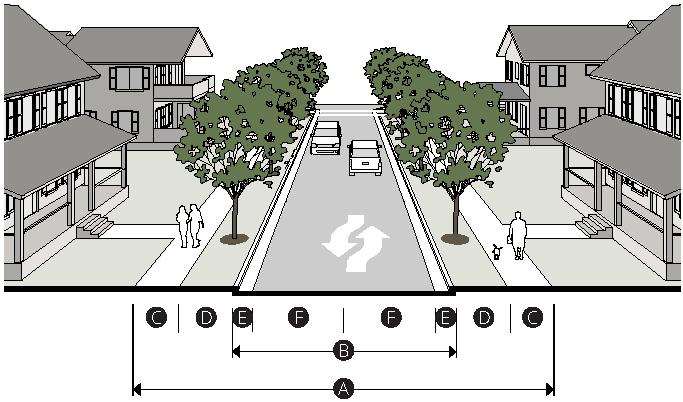
| Width | ||
 | Right-of-way width | 45' min |
 | Back-of-curb to back-of-curb | 21' min |
| Streetscape | ||
 | Sidewalk | 6' min |
 | Planting area | 6' min |
 | Curb and gutter | 2' |
| Travelway | ||
 | Travel lane | 10' |
| General | ||
| Walkway type | Sidewalk | |
| Planting type | Tree lawn | |
| Tree spacing | 40' o.c. avg. | |
| Parking type | Not allowed | |
B.
Residential Yield
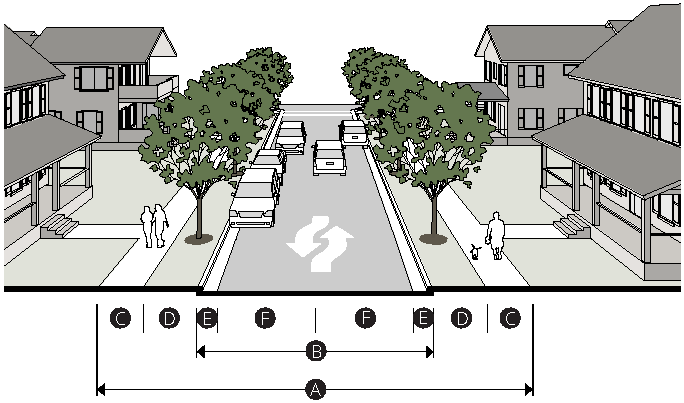
| Width | ||
| Right-of-way width | 50' min |
| Back-of-curb to back-of-curb | 28' min |
| Streetscape | ||
| Sidewalk | 5' min |
| Planting area | 5' min |
| Curb and gutter | 2' |
| Travelway | ||
| Parallel parking/travel lane | 12' |
| General | ||
| Walkway type | Sidewalk | |
| Planting type | Tree lawn | |
| Tree spacing | 40' o.c. avg. | |
| Parking type | Parallel | |
C.
Residential
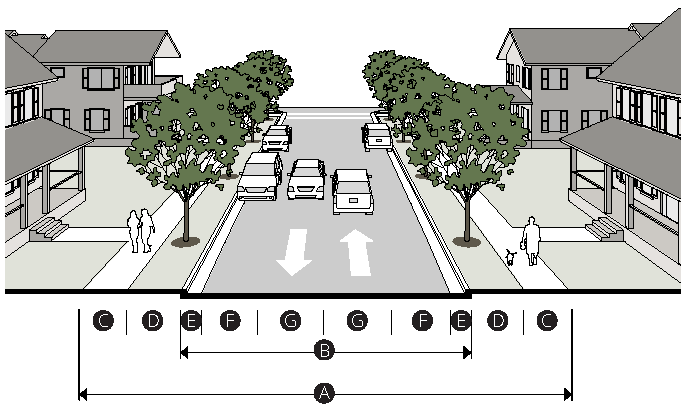
| Width | ||
| Right-of-way width (min) | 60' |
| Back-of-curb to back-of-curb (min) | 36' |
| Streetscape | ||
| Sidewalk (min) | 6' |
| Planting area (min) | 6' |
| Curb and gutter | 2' |
| Travelway | ||
| Parallel parking | 7' |
 | Travel lane | 9' |
| General | ||
| Walkway type | Sidewalk | |
| Planting type | Tree lawn | |
| Tree spacing | 40' o.c. avg. | |
| Parking type | Parallel | |
D.
Woonerf
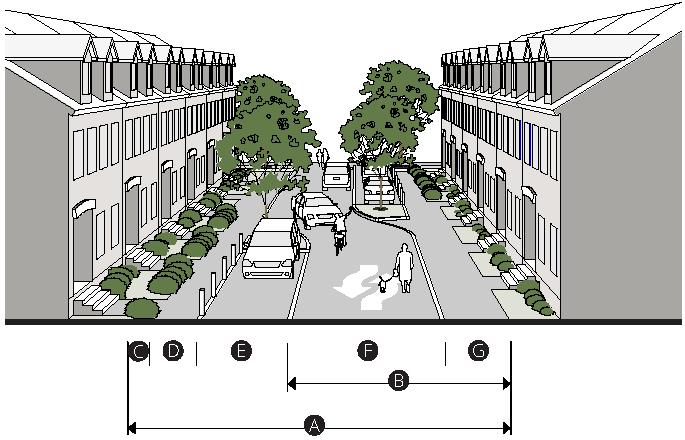
| Width | ||||
| Right-of-way width (min) |
two-way
one-way |
42'
38' | |
| Fire access—alternate (min) | 20' | ||
| Streetscape | ||||
| Optional planting area (min) | 3' | ||
| Sidewalk (min) | 6' | ||
| Parallel parking (min) | 8' | ||
| Pavement (min) | 8' | ||
| Travelway | ||||
| Travel lane |
two-way
one-way |
16'
12' | |
| General | ||||
| Walkway type | - | |||
| Planting type | - | |||
| Tree spacing | - | |||
| Notes | ||||
| Pedestrians and cyclists have legal priority over motorists | ||||
| Gateway signs indicate entrance to a woonerf | ||||
| Maximum length of a woonerf is between 1,200'—1,800' | ||||
E.
Urban Mixed Use/High Density Residential: Parallel Parking
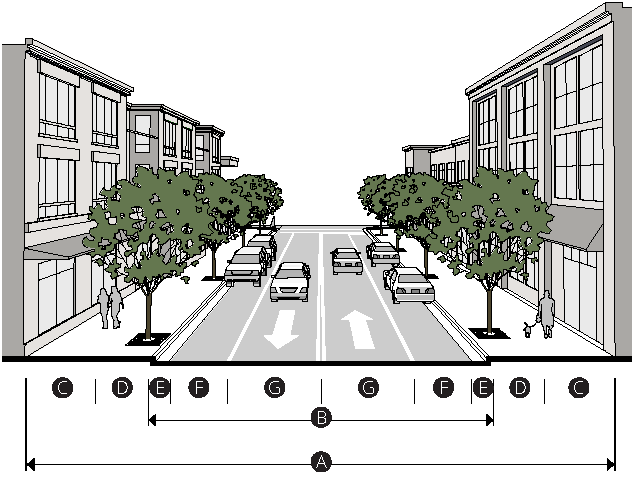
| Width | ||
| Right-of-way width (min) | 65' |
| Back-of-curb to back-of-curb (min) | 37' |
| Streetscape | ||
| Sidewalk (min) | 8' |
| Planting area (min) | 6' |
| Curb and gutter | 2' |
| Travelway | ||
| Parallel parking | 8' |
| Travel lane | 10' |
| General | ||
| Walkway type | Sidewalk | |
| Planting type | Tree grate | |
| Tree spacing | 40' o.c. avg. | |
| Parking type | Parallel | |
F.
Urban Mixed Use/High Density Residential: Angled Parking
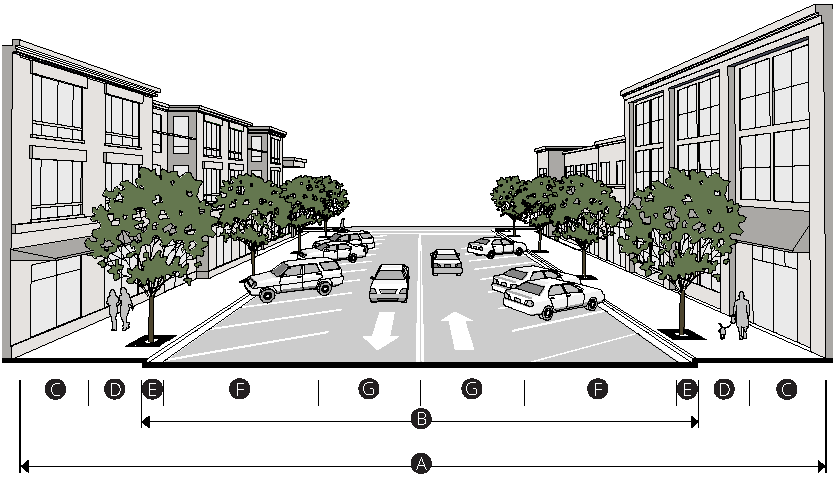
| Width | ||
| Right-of-way width (min) | 90' |
| Back-of-curb to back-of-curb (min) | 61' |
| Streetscape | ||
| Sidewalk (min) | 8.5' |
| Planting area (min) | 6' |
| Curb and gutter | 2' |
| Travelway | ||
| 60° angled parking | 18' |
| Travel lane | 12' |
| General | ||
| Walkway type | Sidewalk | |
| Planting type | Tree grate | |
| Tree spacing | 40' o.c. avg. | |
| Parking type | 60° angled | |
G.
Alley Residential
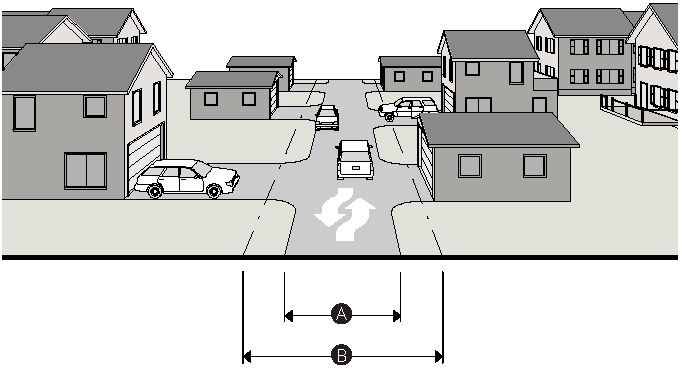
| Width | ||
| Easement width (min) | 20' |
| Travelway | ||
| Travel lane | 16' |
| Travel lane, fire service route (min) | 20' |
H.
Alley, Mixed Use
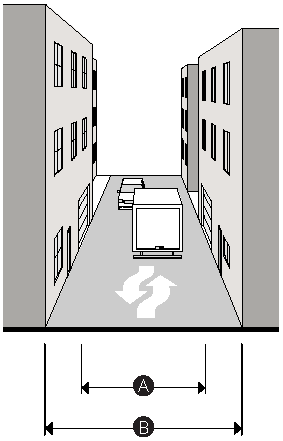
| Width | ||
| Easement width (min) | 24' |
| Travelway | ||
| Travel lane (min) | 20' |
(Ord. No. O-17-09, § 5.2, 6-19-17)
8.2.3. - Existing Streets, Streetscapes
A.
Applicability
1.
A building or site may be renovated or repaired without meeting the requirements of this Section, provided the renovation or repairs are not considered a substantial improvement (zoning). The requirements in this Section are applicable to all substantial improvements and new structures.
2.
Existing streets, landscape zones and sidewalk clear zones that do not meet the sidewalk and landscape standards of the Decatur Streetscape Table must be brought into compliance with the current standards prior to the issuance of Certificate of Occupancy.
3.
Where an existing street is subject to multiple requirements in the Streetscape Table, the wider streetscape requirements apply.
B.
Location
This Section applies:
1.
All zoning districts and street types; and
2.
In the Downtown Decatur Special Pedestrian Area.
C.
Streetscape Table
D.
Streetscapes Required
1.
On existing streets where there is insufficient right-of-way for the required streetscape improvements, the right-of-way needed for such improvements may be expanded by mutual agreement between the property owner and the entity holding the right-of-way, or a public access easement may be provided to the City to meet the required improvements.
2.
Where an easement is provided to the City, the back of the minimum required sidewalk clear zone (adjacent to the lot) may be considered the lot line for the purpose of establishing yards, may not be included in lot coverage calculations, and may not be counted in minimum lot size requirements for new lots.
3.
The Downtown Decatur Streetscape Design Guidelines shall be used as a guide in planning streetscape and site improvements. Standard materials, details and specifications, including street trees, street lights, litter containers, benches and similar items, as described in the Downtown Decatur Streetscape Design Guidelines, shall be used for required streetscape improvements.
a.
Sidewalks shall be built along all public streets. All sidewalks shall have a minimum width of 16 feet with a minimum clear zone of 10 feet and a minimum landscape zone of 6 feet.
b.
Where the existing building line does not presently provide a minimum sidewalk width of 16 feet, the minimum sidewalk width may be reduced to the actual width of the existing sidewalk.
c.
There shall be a continuous landscape zone adjacent to the curb which shall not be less than 6 feet in width. In addition to the planting of trees, this zone is also intended for the placement of street furniture including light poles, litter receptacles and similar items. Trees shall be planted a maximum of 40 feet on center. Newly planted trees shall be a minimum of 3½ inches in caliper, and shall be limbed up to a minimum of 6 feet.
d.
Accessory outdoor dining areas shall be permitted on a public or private sidewalk area where adjacent to and directly abutting a restaurant located in a building. However, the outdoor dining area shall not reduce the clear zone of a public sidewalk to a width of less than 5 feet. Tables, chairs, umbrellas and similar items shall be stored in the interior of the restaurant or in similar enclosed area so that a minimum clear zone of 10 feet is unobstructed when the outdoor dining area is not in use because of inclement weather or when the restaurant is closed.
4.
All sidewalk paving materials shall be continued across any intervening driveway at the same prevailing grade and cross slope as on the adjacent sidewalk clear zone.
5.
Administrative Adjustment. For a property presently within a R-50, R-60, R-85, RS-17, RM-18, RM-22, RM-43, PO, or I zoning district, which does not meet the present minimum landscape zone and sidewalk clear zone requirements, the UDO Administrator is authorized to allow a reduction in one or both of the minimum widths in accordance with Section 11.2.7 of this UDO.
E.
Payment in Lieu of Construction
If an Administrative Adjustment is granted, the applicant shall provide a payment in lieu of fee to the City as set forth in the annual adopted fee schedule. The fee shall be received in the sidewalk budget and used for construction of new sidewalk, sidewalk repair, or sidewalk maintenance within the City.
F.
Required Streetscape Improvements
The Downtown Decatur Streetscape Design Guidelines shall be used as a guide in planning streetscape and site improvements. Standard materials, details and specifications, including street trees, street lights, litter containers, benches and similar items, as described in the Downtown Decatur Streetscape Design Guidelines, shall be used for required streetscape improvements.
1.
Sidewalks
Sidewalks shall be built along all public streets. All sidewalks shall have a minimum width of 16 feet with a minimum clear zone of 10 feet and a minimum landscape zone of 6 feet.
2.
Exception
Where the existing building line does not presently provide a minimum sidewalk width of 15 feet, the minimum sidewalk width may be reduced to the actual width of the existing sidewalk.
3.
Landscape Zone
There shall be a continuous landscape zone adjacent to the curb which shall not be less than 5 feet in width. In addition to the planting of trees, this zone is also intended for the placement of street furniture including light poles, litter receptacles and similar items. Trees shall be planted a maximum of 40 feet on center. Newly planted trees shall be a minimum of 3½ inches in caliper, and shall be limbed up to a minimum of 6 feet.
4.
Outdoor Dining
Accessory outdoor dining areas shall be permitted on a public or private sidewalk area where adjacent to and directly abutting a restaurant located in a building. However, the outdoor dining area shall not reduce the clear zone of a public sidewalk to a width of less than 5 feet. Tables, chairs, umbrellas and similar items shall be stored in the interior of the restaurant or in similar enclosed area so that a minimum clear zone of 10 feet is unobstructed when the outdoor dining area is not in use because of inclement weather or when the restaurant is closed.
G.
Parking Areas and Driveways
1.
Parking areas or driveways, except for a driveway to reach a side or rear yard on-site parking facility, are not permitted between the sidewalk and the front of the building.
2.
Any permitted driveway shall be perpendicular to any adjacent street. Permitted driveways shall maintain the continuity and delineation of the sidewalk system.
3.
No property shall have more than one curb cut, unless otherwise authorized within this UDO.
4.
Surface parking areas shall not be located along or within 30 feet of any public street.
5.
Vehicular access to a drive-in or drive-through use shall not be permitted from a street or street segment.
6.
Driveway widths for a residential property shall be a minimum width of 8 feet and shall not exceed a width of 12 feet.
7.
Driveway widths for commercial properties shall be a minimum of 10 feet for a one-way driveway and 20 feet for a two-way driveway.
H.
Special Exceptions
Special exceptions to these requirements may be approved after consideration of the following standards:
1.
The suitability of the proposed exception in view of the use and development of adjacent and nearby property.
2.
The effect that the proposed exception will have on the existing use or usability of adjacent or nearby property.
3.
The impact that the proposed development will have on the public safety, traffic on the public streets, transportation facilities, utilities and other public services.
4.
The impact that the proposed development will have on established property values and on the health, safety, comfort and general welfare of the residents of the City.
5.
The economic or marketing impact that these guidelines may have on the property owner or developer. (Ord. No. O-18-Z-17, § 1, 5-21-18)
8.2.4. - Driveways
A.
Width
Unless approved by the UDO Administrator, the maximum width of curb cuts, not including flares or returns at the throat of the facility, for entrances, exits, service drives and similar facilities shall be 24 feet for two-way entrances and 12 feet for one-way entrances.
B.
Distance
1.
Except for an attached or detached single-family dwelling or two-family dwelling, entrances and exits shall be a minimum of 50 feet from the right-of-way line of any existing or proposed intersection, 40 feet from any existing or proposed curb cut, and 20 feet from any existing or proposed property line, unless approved by the UDO Administrator.
2.
The distance of proposed entrance or exit to an existing intersection is measured to any property line or to any existing or proposed entrance or exit to any existing or proposed public street or to any existing entrance or exit to any existing private street or drive.
(Ord. No. O-17-09, § 5.3, 6-19-17)
8.2.5. - Blocks
A.
Generally
The lengths, widths and shapes of blocks shall be determined with due regard to:
1.
Provision of adequate building sites suitable to the special needs of the type of use contemplated;
2.
Zoning district requirements as to lot sizes and dimensions;
3.
Needs for convenient access, circulation, control and safety of street traffic; and
4.
Limitations and opportunities of topography.
B.
Block Size
The maximum perimeter for a block shall be no more 2,400 linear feet in all commercial and mixed use districts, and 3,200 linear feet in all residential districts. Block perimeters are measured along the back of the required sidewalk of any existing or proposed public street or existing private street that was built to public standards.
C.
Pedestrian Easements
Easements for pedestrian walks, not less than 10 feet wide, may be required where deemed essential to provide circulation or access to schools, playgrounds, shopping centers, transportation and other community facilities.
(Ord. No. O-17-09, § 5.4, 6-19-17)
8.2.6. - Lots
A.
Generally
The lot size, width, depth, shape and orientation, and the minimum building setback lines shall be appropriate for the location of the subdivision and for the type of development and use contemplated.
B.
Dimensions
Lot dimensions shall conform to the requirements of this UDO.
C.
Corner Lots
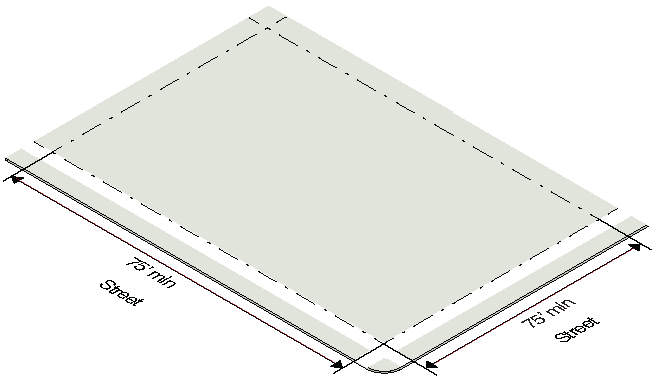
Corner lots for single family detached dwellings and two-family dwellings must have a minimum width of 75 feet along both lot frontages to permit appropriate building setback from and orientation to both streets.
D.
Street Frontage
1.
Each lot, except within a cottage court, shall front upon a public street.
2.
Cottage court dwellings may front on an open space or amenity space. Access required by the Fire Code continues to apply in these instances.
E.
Double Frontage and Reverse Frontage Lots
Double frontage and reverse frontage lots shall be avoided except where essential to provide separation of residential development from traffic arteries or to overcome disadvantages of topography and orientation. A planting screen reservation of at least 10 feet in width, with no right of access, shall be provided along the line of lots abutting such a traffic artery or other disadvantageous use.
F.
Side Lot Lines
Side lot lines shall be substantially at right angles or radial to street lines.
(Ord. No. O-17-09, §§ 5.5—5.7, 6-19-17)
8.2.7. - Easements
A.
Utilities
Utility easements shall be avoided except in unusual cases where it is impractical to install utilities within the street right-of-way. In general, utility easements shall be granted to each specific utility provider and not to the City.
B.
Drainage
Where the subdivision is traversed by a watercourse, drainageway, natural channel, or stream, the UDO Administrator shall determine if an easement shall be required to be dedicated and, if so, shall determine the dimensions required for such easement.
8.2.8. - General Suitability
A.
Uses Restricted for Certain Land
1.
Land subject to flooding and land deemed to be topographically unsuitable shall not be platted for residential occupancy, nor for such other uses as may increase danger to health, life or property unless the applicant provides satisfactory evidence to the UDO Administrator that:
a.
The proposed uses do not present dangers to the public safety or welfare; and
b.
All relevant previous provisions of Sec. 9.5. will be satisfied.
2.
In situations where the requirements of Sec. 8.2.8.A.1. cannot be met, such land shall be set aside for open space, recreational activities, or other such suitable uses which do not present dangers to the public safety or welfare.
8.2.9. - Public Sites and Open Spaces
A.
Park Sites; Generally
Where a site in a major subdivision is deemed suitable for a public park by the City Commission, such site shall be reserved for public usage. The subdivider shall allow a period of 45 days from the date of submittal of the preliminary plat during which time the City Commission is required to make known its intention of acquiring such site. If such notification shall be affirmative, the City Commission shall then set the period of time within which it shall acquire such site, upon consulting the subdivider and the proper authorities for such acquisition.
B.
Parks and Playgrounds
Parks and playgrounds may be dedicated to the City or reserved for public use under private ownership. If so dedicated, the land shall be used exclusively by the City for recreational purposes and the subdivider may stipulate a reasonable limit of time within which the proper authorities are required to make physical improvements to the site; otherwise the title to the site will revert to the subdivider.
C.
Size and Location
The UDO Administrator shall review and make a recommendation to the City Commission regarding the proposed size and location of parks and playgrounds in a major subdivision as part of the subdivision approval process.
D.
Failure to Meet Requirements
Where the proposed major subdivision is too small to provide space of suitable size for public open space use intended, the open space provided may be combined with that provided or to be provided in adjoining areas.
8.2.10. - Post Office Common Mailbox
Adequate provision for a location for delivery of US mail must be made on the site, subject to approval by the US Postal Service.

