
Decatur City Zoning Code
ARTICLE 2
- Rules of Interpretation
Sec. 2.2. - Building Types
The section provides standards for a variety of building types. Building types provide many key dimensional standards for each zoning district. Building types are applied to help reinforce the existing character and scale of the City. Note that these building types are for zoning purposes only, and not linked to the Building Code.
2.1.1. - Conformity to District Requirements
A.
Every building erected, converted, enlarged, reconstructed, moved or structurally altered shall be located on a lot except as approved by the City Commission under Sec. 5.4. In no case shall more than one principal building be located on a lot except as otherwise provided for in this UDO.
B.
The minimum yards, parking spaces and open spaces required by this UDO for each building existing at the time of passage of this UDO, or for any building erected or structurally altered after the passage of this UDO, shall not be encroached upon or considered as part of the yard or parking space or open space required for any other structure, nor shall any lot area be reduced below the minimum lot area for the district in which the lot is located.
C.
No building shall be erected, converted, enlarged, reconstructed, moved or structurally altered except in conformity with the lot area, floor area, and building height regulations of the district in which the building is located.
2.1.2. - Density
A.
Net Site Area
1.
Net site area is determined by subtracting publicly-dedicated land, from the gross site area.
2.
Land area set aside for common open space or recreational use is included in net site area for the purpose of determining the maximum number of dwelling units. Poor drainage areas or other areas of rough terrain as to constitute land which is economically unbuildable may be counted as common open space but may not be counted as space for active recreational areas.
B.
Dwelling Units Allowed
1.
The maximum number of dwelling units allowed on a site is calculated by multiplying the net site area by the maximum number of units per acre allowed in the district.
2.
Minimum lot sizes may appear to allow additional units to be developed on a site; however, the district's allowed density serves as the cap on the maximum number of units on a site.
2.1.3. - Amenity Space
A.
Amenity space is common area and may not be designated for the use of any specific tenant or group of tenants. The space may be restricted to use by residents, tenants and their visitors only, or made available to the general public, at the applicant's discretion.
B.
Where required, amenity space must be met in one contiguous open area or in multiple open areas on the site; however, to receive credit, the area must be at least 10 feet in width and length, and at least 50% of the required amenity space must be located in one contiguous open area.
C.
Amenity space must remain unenclosed on all sides, but up to 50% of the total provided amenity space may be covered.
D.
Amenity space may be located at or above grade.
E.
In calculating the required amenity space, the following listed facilities, and any similar facilities, may be included:
1.
Ground-level facilities such as a swimming pool, playground, sport court, dog park, garden, community, garden, park, green, pavilion, outdoor dining, seating area or plaza.
2.
Upper-level facilities such as a shared or common balcony, rooftop deck or rooftop garden.
2.1.4. - Lot Coverage
A.
Where a lot of record in R-50 or R-60 at the time of the effective date of this UDO had less than the required minimum lot area, the maximum lot coverage is as follows:
The lot coverage of properties developed with existing single-family dwellings where the existing lot coverage exceeds the maximum lot coverage permitted may be modified as long as the proposed lot coverage does not exceed the existing lot coverage.
2.1.5. - Yards
A.
General Yard Standards
1.
Every part of a required yard shall be open to the sky and unobstructed except for the ordinary projections of sills, belt courses, cornices, eaves, chimneys, buttresses and other ornamental and architectural features; provided, however, that such features do not project more than 1½ feet into any required yard.
2.
A deck or patio may project into a required side yard to a point not closer than 5 feet from any side lot line.
3.
Parking is allowed in the side yard or rear yard, except where further restricted by the district regulations of this UDO.
4.
More than one walk up flat, stacked flat, single-story shopfront, mixed use shopfront, general building or civic building may be located upon a lot or tract. In a residential district, no required yard except the rear yard shall be used for the location of a private swimming pool, and no mechanical appurtenance or pool shall be within 10 feet of any lot line.
5.
For a property with an existing single-family dwelling which does not meet the present minimum side yard requirement, the Zoning Administrator is authorized to allow the enlargement or extension of the dwelling under the following conditions:
a.
The enlargement or extension does not encroach in the side yard to any greater degree than the existing dwelling.
b.
The enlargement or extension does not encroach into any required front or rear yard.
c.
There is a minimum distance of 10 feet between the dwelling and the principal building on the adjacent property.
d.
The project is not determined to be a demolition or substantial improvement. Enlargements or extensions of dwellings that are defined as substantial improvements must be extended in conformity with the development standards in the applicable zoning district.
6.
Where a lot of record in an R-60 zoning district at the time of the effective date of this UDO had less than the required minimum lot width, one of the minimum required side yards may be reduced by ½ foot for each foot that the lot width is less than 60 feet, under the following conditions:
a.
There is a minimum distance of 10 feet between the dwelling and the principal building on the property adjacent to the reduced side yard.
b.
No side yard may be reduced below a minimum of 5 feet.
B.
Front Yard Standards
1.
Average Front Yard
a.
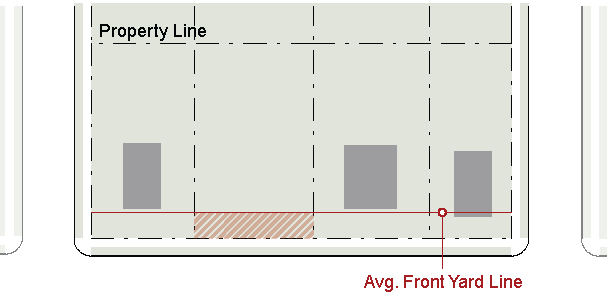
Where 40% or more of the frontage on the same side of a street between two intersecting streets is developed with buildings that have (with a variation of 5 feet or less) a front yard greater or lesser in depth than required, new buildings shall not be erected closer to the street than the average front yard established by the existing buildings.
b.
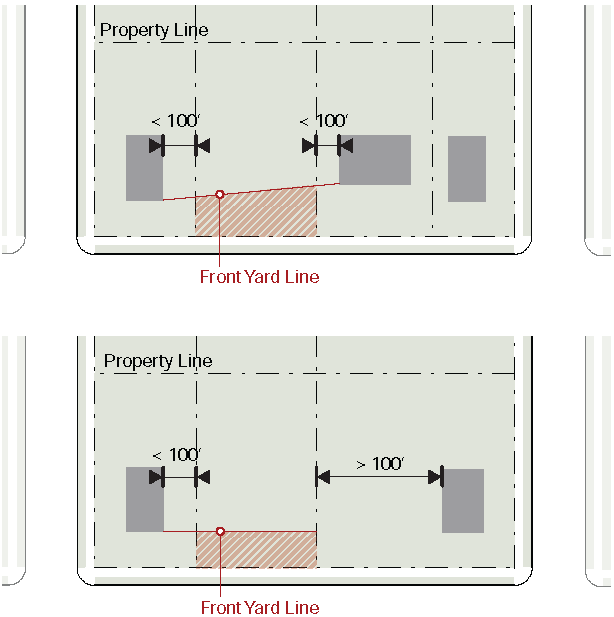
Where 40% or more of the frontage on one side of a street between two intersecting streets is developed that do not have a front yard as described above, then:
i.
Where a building is to be erected on a parcel of land that is within 100 feet of existing buildings on both sides, the minimum front yard shall be a line drawn between the two closest front corners of the adjacent buildings; or
ii.
Where a building is to be erected on a parcel of land that is within 100 feet of an existing building on one side only, the building may be erected as close to the street as the existing adjacent building.
2.
Double Frontage Lots
Double frontage lots shall provide the required front yard on both streets.
3.
Signs
Permitted signs may extend into a front yard or the required yard abutting a side street not to exceed 18 inches.
C.
Front Yard Reduction
The Zoning Administrator is authorized to allow a reduction in the minimum front yard requirement for the main dwelling under the following conditions:
1.
Where there is an existing dwelling with a covered entryway.
a.
The existing covered entryway does not meet the present minimum front yard requirement.
b.
The proposed renovation or repair will maintain the existing front yard setback or will result in a reduction of the front yard of 2 feet or less.
c.
The proposed renovation or repair will not result in a change to the elevation of the front door or the finished floor of the stoop, porch or first floor.
d.
The project is not determined to be a demolition or substantial improvement. Enlargements or extensions of dwellings that are defined as substantial improvements must be extended in conformity with the development standards in the applicable zoning district.
2.
Where there is an existing dwelling without a covered entryway.
a.
The existing dwelling may or may not meet the present minimum front yard requirement.
b.
The proposed renovation will include new covered entryway that will not extend beyond the existing stoop, deck or stairs.
c.
The proposed renovation or repair will not result in a change to the elevation of the front door or the finished floor of the stoop, porch or first floor.
d.
The project is not determined to be a demolition or substantial improvement. Enlargements or extensions of dwellings that are defined as substantial improvements must be extended in conformity with the development standards in the applicable zoning district.
D.
Rear Yard Standards
1.
Where a lot abuts upon an alley, ½ the alley width may be considered as part of the required rear yard.
2.
An unenclosed balcony, porch steps or fire escape may project into a rear yard for a distance not exceeding 10 feet.
3.
Accessory buildings and structures shall be located in a rear yard, and shall not occupy more than 30% of the required rear yard.
4.
Accessory buildings and structures shall not be nearer than 3 feet to any side or rear lot line, except that when a garage is entered from an alley, it shall not be located closer than 5 feet to the alley line.
5.
No 2-story accessory building shall be located closer than 10 feet to any side or rear lot line. No 2-story building shall be located closer than 10 feet to an alley.
6.
On corner lots, accessory buildings shall not be located closer to the side street right-of-way line than the principal building or closer to the rear lot line than the side setback requirements for the principal building located on adjoining lots with side yards contiguous to the rear lot line.
7.
When an accessory building is attached to the principal building by breezeway, passageway or similar means, it shall comply with the yard requirements of the principal building.
8.
Satellite dish antennas are permitted as accessory structures in residential districts, provided that they must be installed in a rear yard and not less than 10 feet from any property line, may be at a height no higher than the roof line and may be no greater than 12 feet in diameter.
2.1.6. - Height
A.
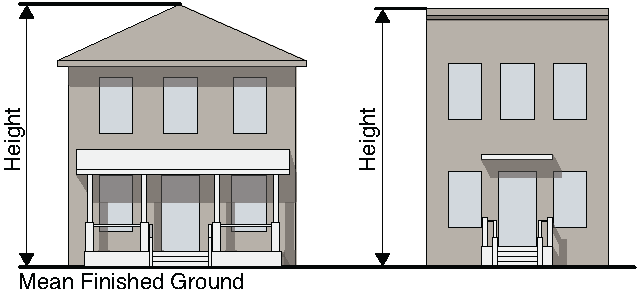
No building shall be erected, converted, enlarged, reconstructed, moved or structurally altered to exceed the height limit established for the district in which the building is located. Height is measured as the vertical distance from the mean finished ground level at the front of the building to the highest point of a roof.
B.
Special exceptions to height limits are provided below.
1.
The height limitations of this UDO do not apply to spires, belfries, cupolas and domes not intended for human occupancy, monuments, water towers, observation towers, transmission towers, chimneys, smokestacks, elevator or stair towers, parapets under 4 feet in height, flagpoles, radio towers, television towers, masts and aerials.
2.
The limitation on number of stories shall not apply to buildings used exclusively for storage purposes, provided such buildings do not exceed the height in feet permitted in the district in which located.
3.
Special exceptions to the height requirements may be approved after consideration of the following standards:
a.
The uses and heights of adjacent or nearby buildings.
b.
The impact that the proposed building will have on the light, air, and shading of adjacent and nearby properties.
c.
The impact that the proposed building will have on the public safety, traffic on the public streets, transportation facilities, utilities, and other public services.
d.
The impact that the proposed building will have on established property values and on the health, safety, comfort and general welfare of the residents of the City.
4.
Where a lot of record in an R-60 zoning district at the time of the effective date of this UDO had less than the required minimum lot width, the maximum building height shall be reduced by ½ foot for each foot that the lot width is less than 60 feet.
2.1.7. - First Floor Elevation
The finished floor elevation of the first floor of detached house, cottage court, duplex, walk up flat, and attached house shall be determined as follows:
A.
Where an existing dwelling is to be demolished and replaced with a new dwelling, the finished floor elevation of the first floor of the proposed dwelling may be no more than 2 feet above the finished floor elevation of the first floor of the dwelling to be demolished.
B.
The elevation of the mean ground level at the front of the proposed dwelling may be raised no more than 2 feet above the elevation of the existing mean ground level at the front of the building prior to construction.
C.
Where a new dwelling is to be built on a previously undeveloped lot that is within 100 feet of existing dwellings on both sides, the finished floor elevation of the first floor of the new dwelling shall be no higher than one of the following standards:
1.
Three feet above the existing elevation of the mean ground level at the front building setback line; or
2.
The average finished floor elevation of the first floors of the existing dwellings on either side of the undeveloped lot.
D.
Where a new dwelling is to be built on a previously undeveloped lot that is not within 100 feet of existing dwellings on both sides, the finished floor elevation of the first floor of the new dwelling may be no more than 3 feet above the existing elevation of the mean ground level at the front building setback line.
E.
Elevations required under this section shall be certified by a land surveyor or professional engineer licensed to practice in the State of Georgia. No regrading or filling of vacant lots shall be allowed without certification of required elevations.
(Ord. No. O-23-Z-01, § 1, 2-6-23)
2.1.8. - Transparency
A.
Transparency is the minimum percentage of windows and doors that must cover a ground or upper story facade.
B.
Transparency applies to primary and side streetfacing facades only.
C.
Glass is considered transparent where it has a transparency higher than 80% and external reflectance of less than 15%.
D.
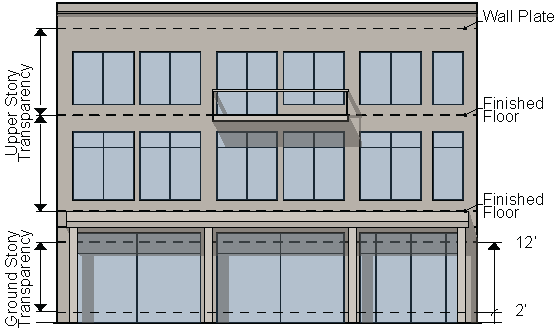
Ground story transparency is measured between 2 and 12 feet above the abutting sidewalk.
E.
Upper story transparency is measured from top of the finished floor to the top of the finished floor above. When there is no floor above, upper story transparency is measured from the top of the finished floor to the top of the wall plate.
2.1.9. - Blank Wall Area
Blank wall area means a portion of the exterior facade of the building that does not include: windows or doors; columns, pilasters or other articulation greater than 12 inches in depth; or a substantial material change (paint color is not considered a substantial change).
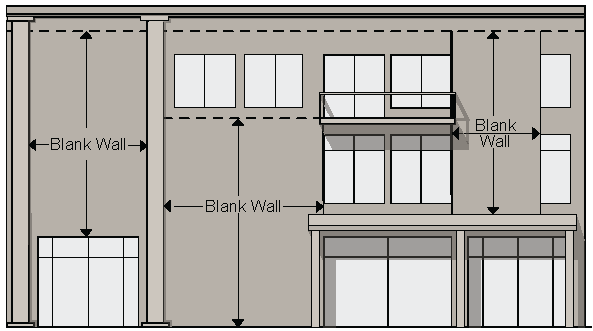
Blank wall area applies in both a vertical and horizontal direction. Blank wall area applies to ground and upper story primary and side street-facing facades only.
2.1.10. - Pedestrian Access
Where pedestrian access is required by this Article for multifamily, commercial and civic uses, it includes an ADA-compliant pedestrian walkway connection with a minimum width of 5 feet connecting the pedestrian access to the public sidewalks and other building entrances.
2.2.1. - Descriptions
Each building type is described below.
A.
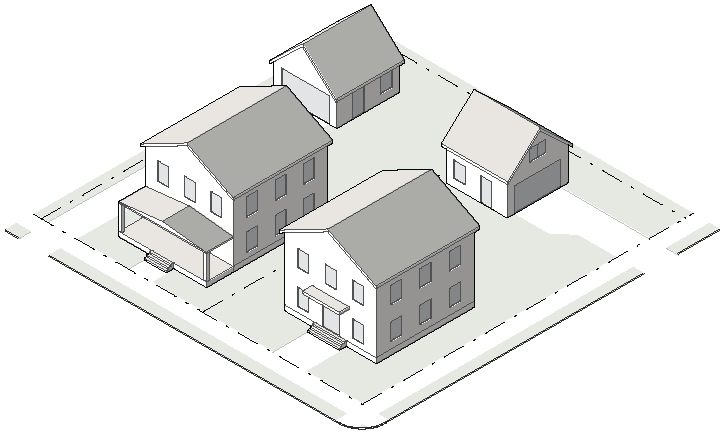
Detached House
A building type designed to accommodate one dwelling unit on an individual lot with yards on all sides.
B.
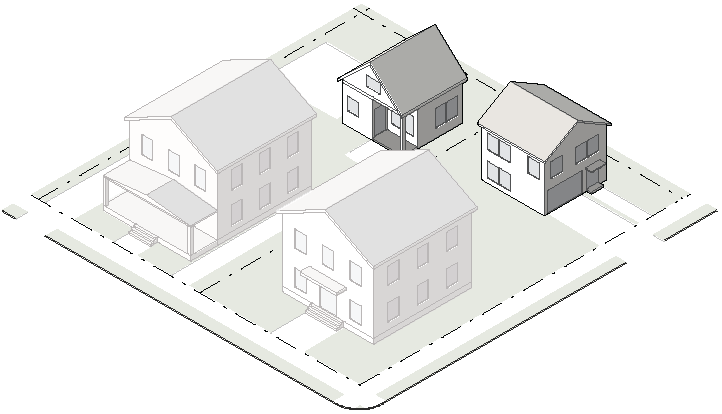
Carriage House
A building type designed to accommodate a small self-contained accessory dwelling unit located on the same lot as a principal structure, but physically separated.
C.
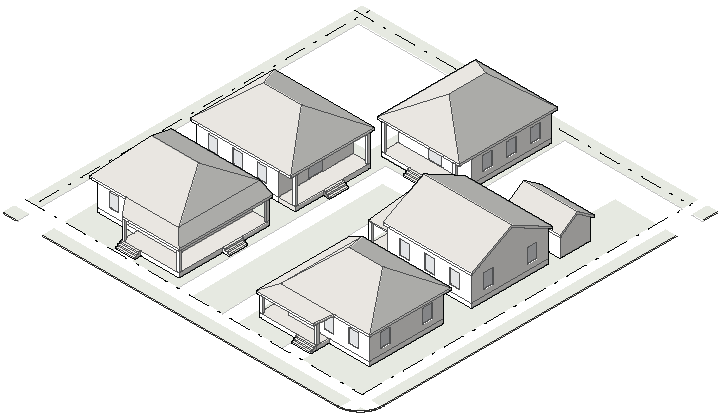
Cottage Court
A building type designed to accommodate detached dwelling units organized around a shared internal courtyard. Units cannot be vertically mixed.
D.
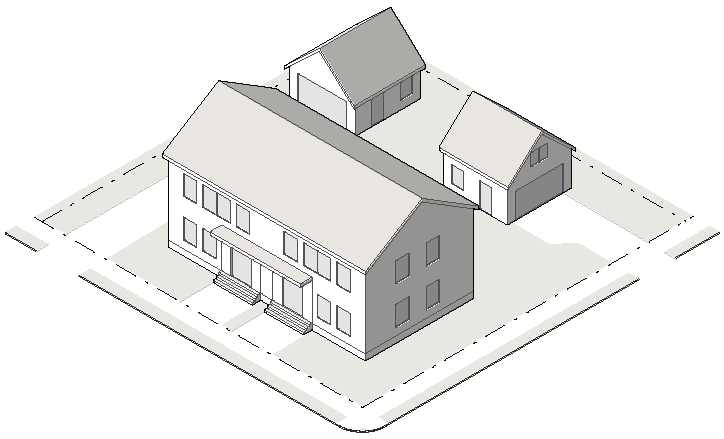
Duplex
A building type designed to accommodate two principal dwelling units, vertically or horizontally integrated, that share a common wall, floor or ceiling, or attached building element on a single individual lot.
E.
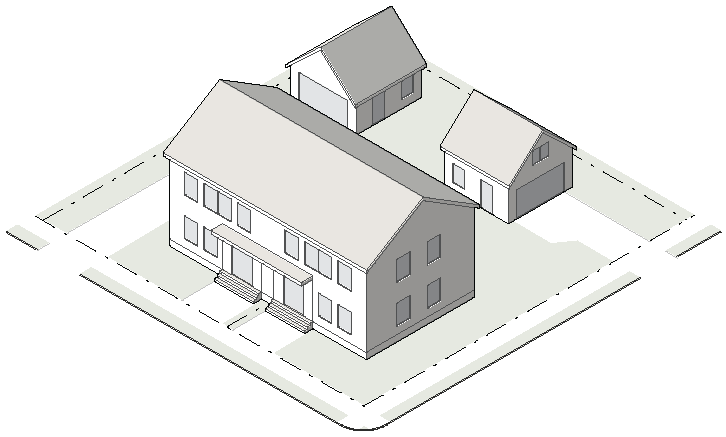
Attached House
A building type that accommodates two dwelling units that share a common wall along the lot line between two lots.
F.
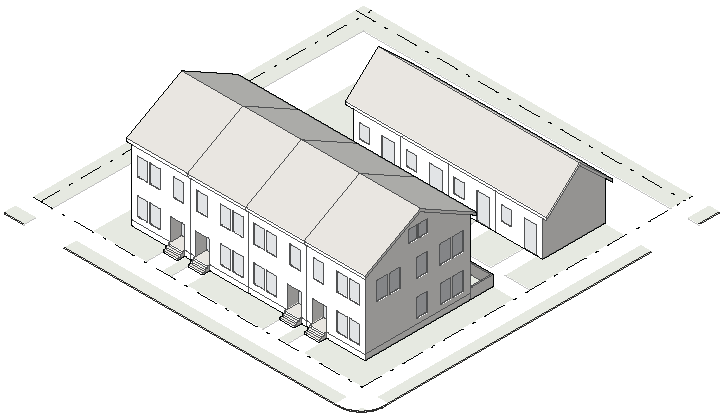
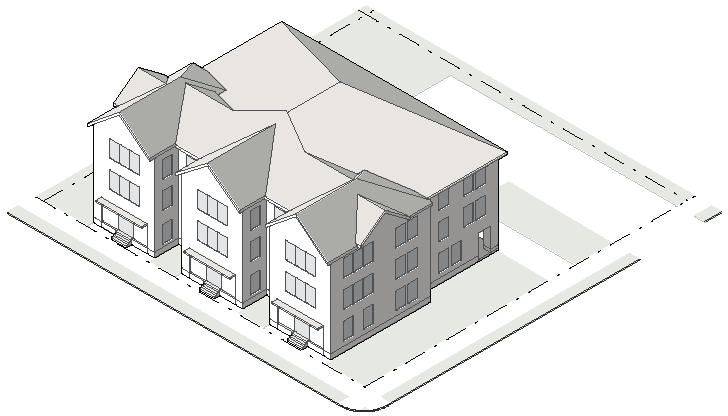
Townhouse
A building type designed to accommodate 3 to 6 dwelling units where each unit is separated by a common side wall. Units cannot be vertically mixed.
G.
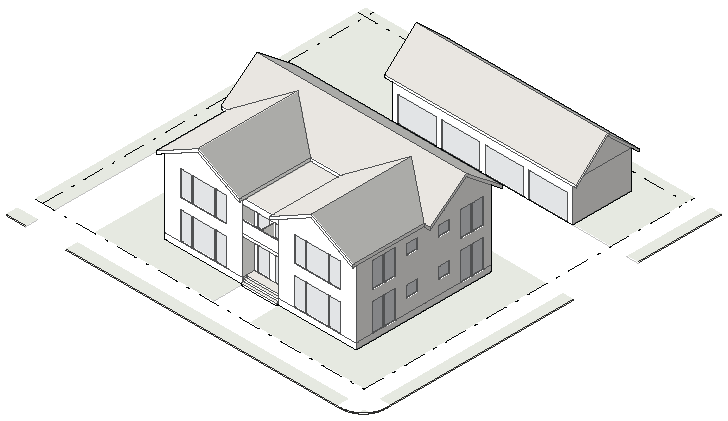
Walk Up Flat (3-4 units)
A building type designed to accommodate 3 to 4 principal dwelling units, vertically and horizontally integrated, that share a common wall, floor or ceiling, or attached building element on a single individual lot.
H.
Stacked Flat (5+ units)
A building type designed to accommodate 5 or more dwelling units vertically and horizontally integrated.
I.
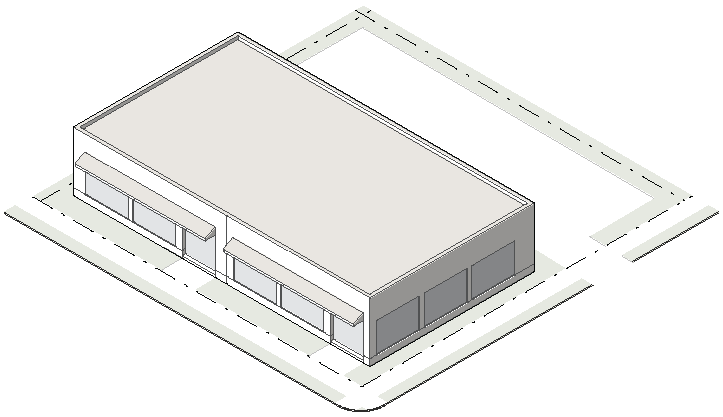
Single-Story Shopfront
A single-story building type designed to accommodate retail or commercial activity.
J.
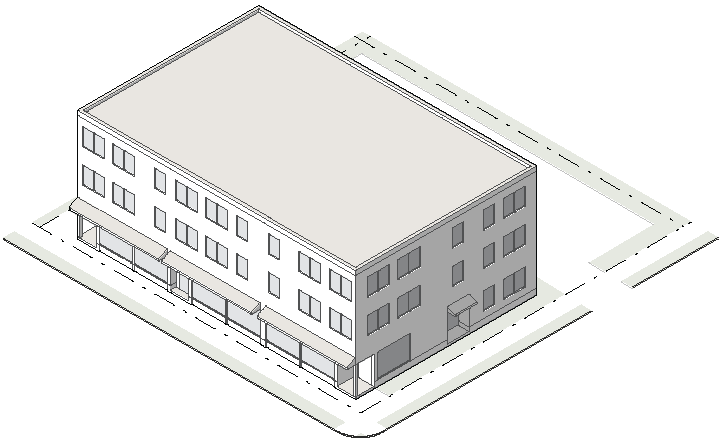
Mixed Use Shopfront
A multi-story building type designed to accommodate ground floor retail, office or commercial uses with upper-story residential or office uses.
K.
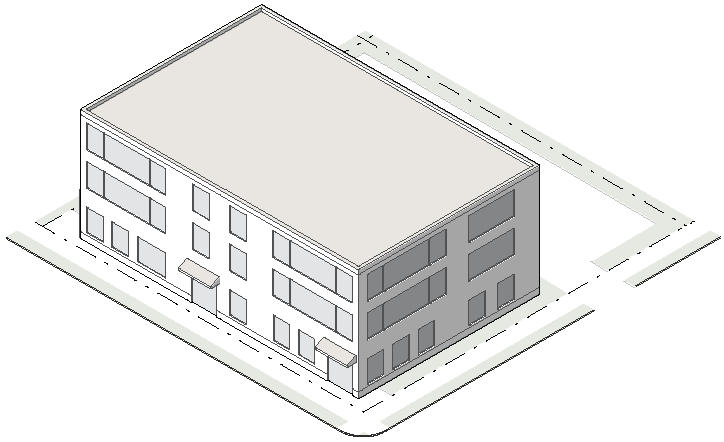
General Building
A building type designed to accommodate commercial, office or industrial activity. Not intended for retail sales or personal service uses.
L.
Civic Building
A building type designed to accommodate civic, institutional or public uses.
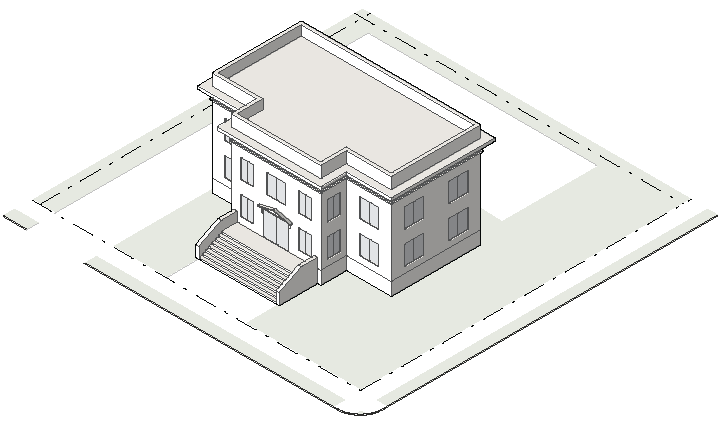
(Ord. No. O-21-Z-02, § 1.1, 10-18-21; Ord. No. O-23-Z-01, § 2, 2-6-23)
2.2.2. - Building Types Allowed by District
| R-85 | R-60 | R-50 | RS-17 | RM-18 | RM-22 | RM-43 | PO | NMU | C-1 | C-2 | C-3 | MU | I | |
|---|---|---|---|---|---|---|---|---|---|---|---|---|---|---|
| Residential Buildings | ||||||||||||||
|
Detached House
|  | | | | | | | | — | — | — | — | n/a | n/a |
|
Carriage House
| | | | | | | | | — | — | — | — | n/a | n/a |
|
Cottage Court
| — | — | — | | — | | — | — | — | — | — | — | n/a | n/a |
|
Duplex
| | | | | | | | | — | — | — | — | n/a | n/a |
|
Attached House
| — | — | — | | | | | | — | — | — | — | n/a | n/a |
|
Townhouse
| — | — | — | | | | | | — | | | — | n/a | n/a |
|
Walk Up Flat (3-4 units)
| | | | | | | | | — | | | | n/a | n/a |
|
Stacked Flat (5+ units)
| — | — | — | — | | — | | | — | | | | n/a | n/a |
| Commercial/Mixed Use Buildings | ||||||||||||||
|
Single-story Shopfront
| — | — | — | — | — | — | — | — | | | | | n/a | n/a |
|
Mixed Use Shopfront
| — | — | — | — | — | — | — | — | | | | | n/a | n/a |
|
General Building
| — | — | — | — | — | — | — | — | | | | | n/a | n/a |
| Public Buildings | ||||||||||||||
|
Civic Building
| | | | | | | | | | | | | n/a | n/a |
Key:
= Building type allowed -- = Building type not allowed
(Ord. No. O-21-Z-02, § 2.1, 10-18-21; Ord. No. O-23-Z-01, § 3, 2-6-23)
2.2.3. - Rules Specific to Building Types
A.
Detached House
A building type designed to accommodate one dwelling unit on an individual lot with yards on all sides.
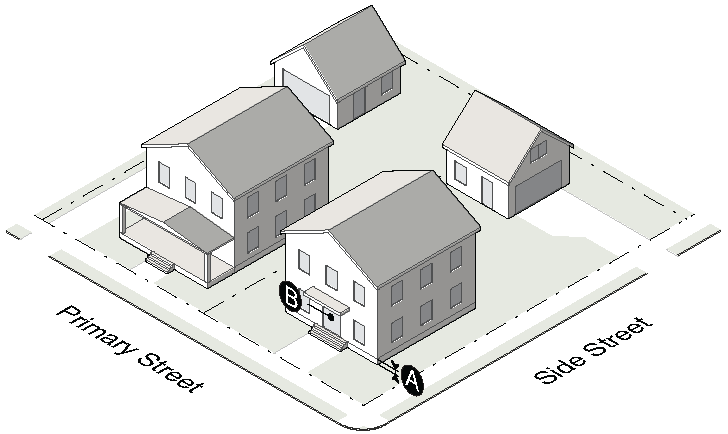
| Lot | ||
| Detached house units per lot | 1 max | |
| Height | ||
| Ground floor elevation | See Sec. 2.1.5. |  |
| Pedestrian Access | ||
| Entrance facing primary street | Required |  |
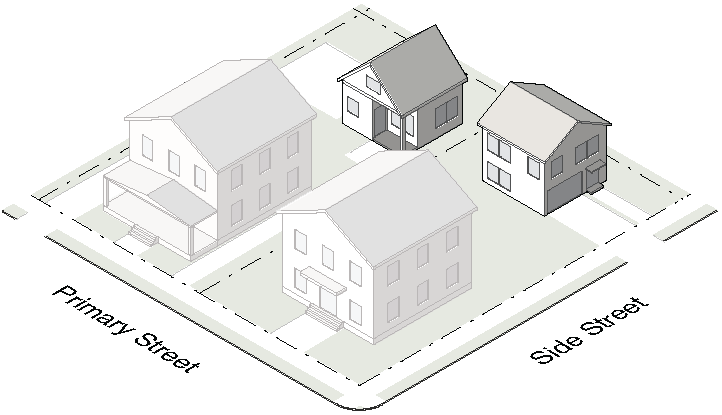
B.
Carriage House
A building type designed to accommodate a small self-contained accessory dwelling unit located on the same lot as a principal structure, but physically separated.
C.
Cottage Court
A building type designed to accommodate detached dwelling units organized around a shared internal courtyard. Units cannot be vertically mixed.
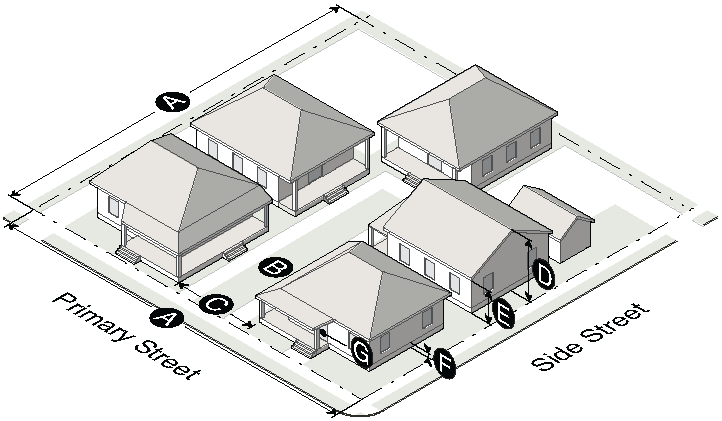
| Site | ||
| Site width/depth | 50' min | |
| Cottage Court units per site | 5 min | |
| Size | ||
| Floor area per unit | 1,500 SF max | |
| Courtyard | ||
| Area | 3,000 SF min | |
| Width | 40' min |  |
| Courtyard cannot be parked or driven upon, except for emergency access and permitted temporary events | ||
| Height | ||
| Principal building | 1.5 stories/24' max |  |
| Wall plate | 18' max |  |
| Ground floor elevation | See Sec. 2.1.5. |  |
| Pedestrian Access | ||
| Entrance facing primary street | Required for units facing street |  |
D.
Duplex
A building type designed to accommodate two principal dwelling units, vertically or horizontally integrated, that share a common wall, floor or ceiling, or attached building element on a single individual lot.
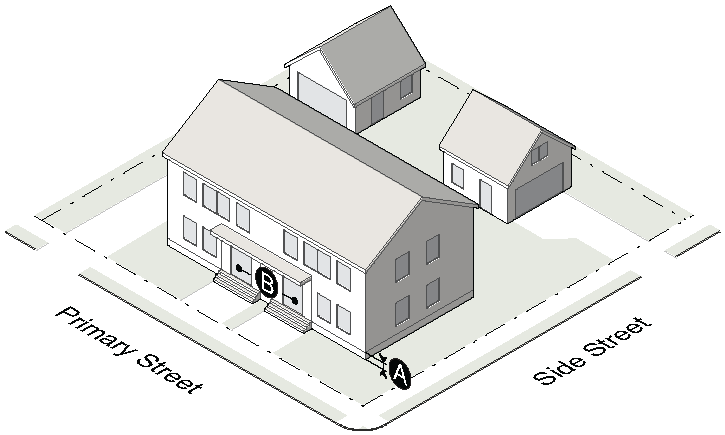
| Lot | ||
| Duplex units per lot | 2 max | |
| Height | ||
| Ground floor elevation | See Sec. 2.1.5. | |
| Pedestrian Access | ||
| Entrance facing primary street | Required, 1 min. | |
E.
Attached House
A building type that accommodates two dwelling units that share a common wall along the lot line between two lots.
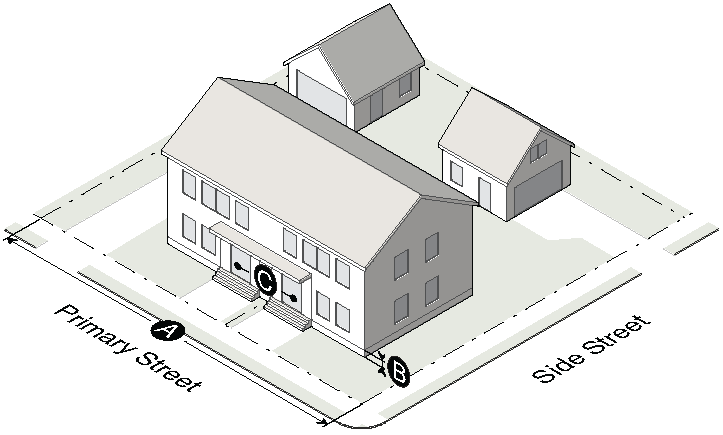
| Site/Lot | ||
| Site width | 50' min | |
| Dwelling units per site | 2 min | |
| Attached house units per lot | 1 max | |
| Height | ||
| Ground floor elevation | See Sec. 2.1.5. | |
| Pedestrian Access | ||
| Entrance facing primary street | Required for each street-facing unit | |
F.
Townhouse
A building type designed to accommodate 3 to 6 dwelling units where each unit is separated by a common side wall. Units cannot be vertically mixed.
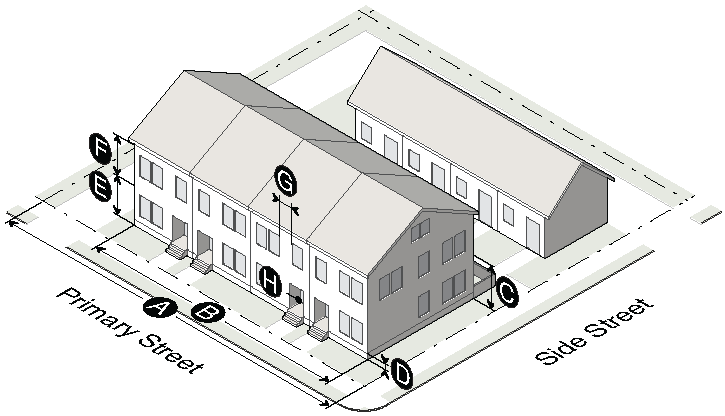
| Site/Lot | ||
| Site width | 50' min | |
| Townhouse units per site | 3 min | |
| Number of units in a row | 6 max | |
| Height | ||
| Ground story height | 10' min | |
| Ground floor elevation | 2' min/4' max | |
| Transparency | ||
| Ground story | 20% min | |
| Upper story | 20% min | |
| Blank wall area | 30' max | |
| Pedestrian Access | ||
| Entrance facing primary street | Required for each street-facing unit |  |
| Parking Location | ||
| No on-site parking is allowed between the building and the street | ||
G.
Walk Up Flat (3-4 units)
A building type designed to accommodate three to four principal dwelling units, vertically and horizontally integrated, that share a common wall, floor or ceiling, or attached building element on a single individual lot.
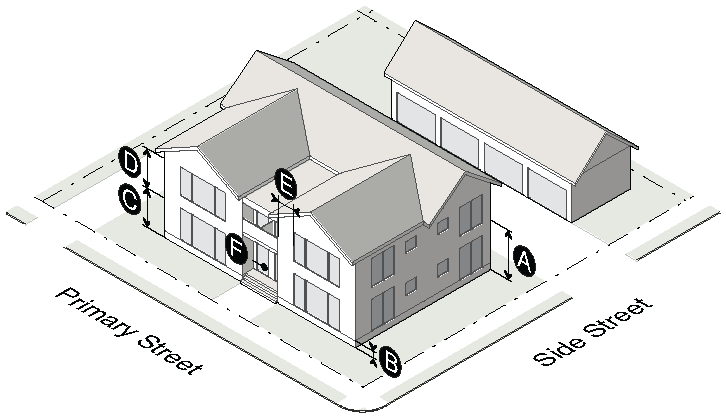
| Lot | ||
| Walk Up Flat units per building | 3 min/4 max | |
| Height | ||
| Ground story height | 10' min | |
| Ground floor elevation | 2' min/4' max | |
| Transparency | ||
| Ground story | 20% min | |
| Upper story | 20% min | |
| Blank wall area | 30' max | |
| Pedestrian Access | ||
| Entrance facing primary street | Required, 1 min. | |
| Parking Location | ||
| No on-site parking is allowed between the building and the street | ||
H.
Stacked Flat (5+ units)
A building type designed to accommodate 5 or more dwelling units vertically and horizontally integrated.
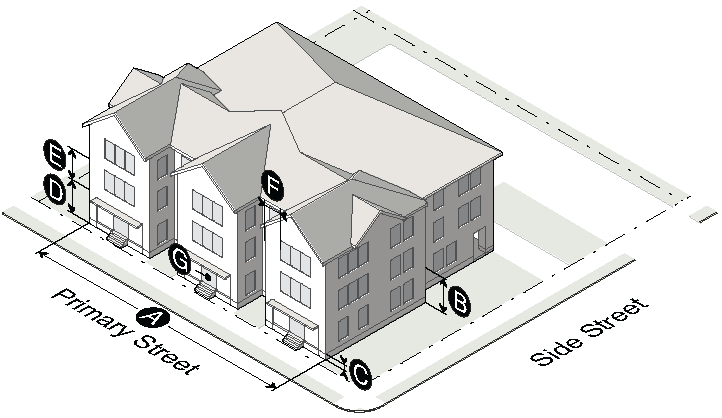
| Lot | ||
| Stacked Flat units per building | 5 min | |
| Street-facing facade length | 200' max | |
| Height | ||
| Ground story height (floor to ceiling) | 9' min | |
| Ground floor elevation | 2' min/4' max | |
| Transparency | ||
| Ground story | 20% min | |
| Upper story | 20% min | |
| Blank wall area | 30' max | |
| Pedestrian Access | ||
| Entrance facing primary street | Required for each ground floor street-facing unit | |
| Parking Location | ||
| No on-site parking is allowed between the building and the street | ||
I.
Single-Story Shopfront
A single-story building type designed to accommodate retail or commercial activity.
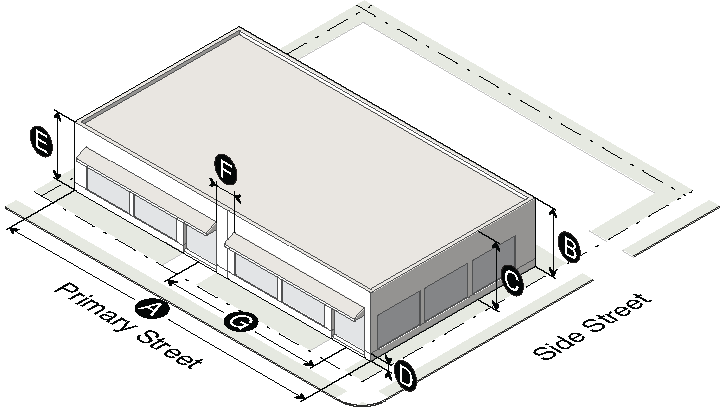
| Lot | ||
| Street-facing facade length | 200' max | |
| Height | ||
| Building height | 1 story max | |
| Ground story height (floor to ceiling) | 14' min | |
| Ground floor elevation | 0' min/2' max | |
| Transparency | ||
| Ground story: primary/side street | 60%/30% min | |
| Blank wall area: primary/side street | 30'/50' max | |
| Pedestrian Access | ||
| Entrance facing primary street | Required every 75' | |
| Parking Location | ||
| No on-site parking is allowed between the building and the street | ||
J.
Mixed Use Shopfront
A multi-story building type designed to accommodate ground floor retail, office or commercial uses with upper-story residential or office uses.
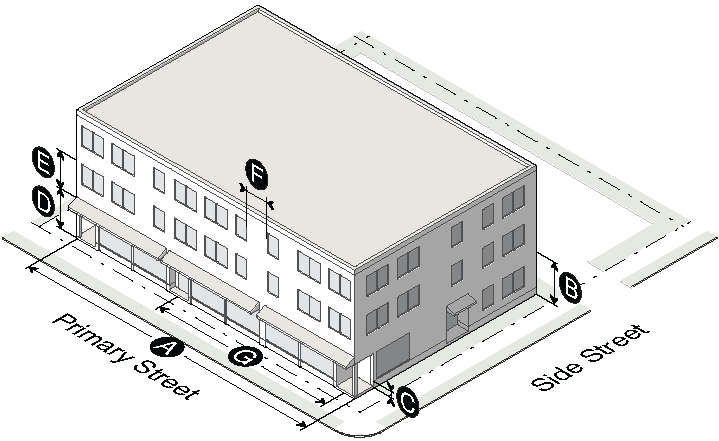
| Lot | ||
| Street-facing facade length | 200' max | |
| Size | ||
| Floor area per residential unit | 550 SF min | |
| Height | ||
| Ground story height (floor to ceiling) | 14' min | |
| Ground floor elevation | 0' min/2' max | |
| Transparency | ||
| Ground story: primary/side street | 60%/30% min | |
| Upper story | 20% min | |
| Blank wall area: primary/side street | 30'/50' max | |
| Pedestrian Access | ||
| Entrance facing primary street | Required every 75' | |
| Parking Location | ||
| No on-site parking is allowed between the building and the street | ||
K.
General Building
A building type designed to accommodate commercial, office or industrial activity. Not intended for retail sales or personal service uses.
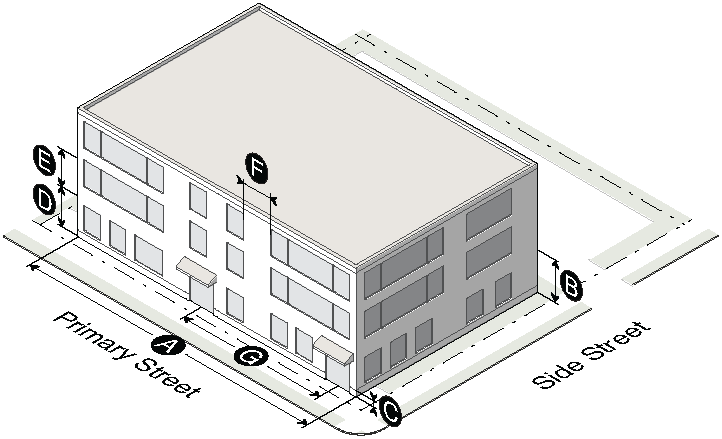
| Lot | ||
| Street-facing facade length | 200' max | |
| Height | ||
| Ground story height (floor to ceiling) | 11' min | |
| Ground floor elevation | 0' min/2' max | |
| Transparency | ||
| Ground story: primary/side street | 40%/20% min | |
| Upper story | 20% min | |
| Blank wall area: primary/side street | 40'/60' max | |
| Pedestrian Access | ||
| Entrance facing primary street | Required every 125' | |
| Parking Location | ||
| No on-site parking is allowed between the building and the street | ||
L.
Civic Building
A building type designed to accommodate civic, institutional or public uses.
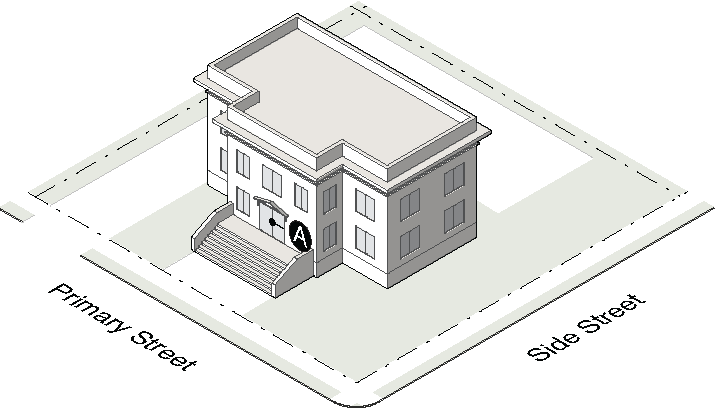
| Lot | ||
| Dwelling units per building | n/a | |
| Pedestrian Access | ||
| Entrance facing primary street | Required | |
| Use | ||
| Only the following uses are allowed in a civic building type (see Sec. 6.2.): | ||
| 1. College, university, seminary; | ||
| 2. Library, museum, public; | ||
| 3. Office, governmental, civic or charitable organization; | ||
| 4. Place of worship; | ||
| 5. Police, fire or EMS station; | ||
| 6. Post office; and | ||
| 7. School, private or private (K-12). | ||
(Ord. No. O-21-Z-02, § 3.4, 10-18-21; Ord. No. O-23-Z-01, § 4, 2-6-23)

