
Dolores City Zoning Code
ARTICLE 10
- Outdoor Lighting
Section 10.1.- Purposes.
These outdoor lighting standards are intended to allow the Town to preserve, protect, and enhance the use and enjoyment of public and private property through the use of appropriate outdoor lighting practices designed so as to:
A.
Set general and specific standards to encourage lighting that favorably contributes to visual performance, safety, and aesthetics from properly shielded light sources for lighting applications to include security, parking lots, recreational facilities, buildings and structures, landscaping, canopies, and signs;
B.
Preserve and enhance the natural nighttime visual environment of the Town by minimizing light trespass and controlling glare on and off property;
C.
Increasing nighttime utility, safety, security, and productivity; to foster the nighttime use of property; and to protect the privacy of residents;
D.
Reduce and prohibit light trespass, obtrusive light, and sky glow, and to reduce roadway glare and extreme variations of illumination, to which elderly drivers are particularly sensitive;
E.
To preserve the views of the starry sky, encouraging the enjoyment of their aesthetics, the education of the public in the sciences, and the astronomical study of celestial bodies;
F.
Encourage systematic practices in the use of outdoor electrically powered luminaires, consistent with conserving energy and maximizing the benefits to the citizens of Dolores; and
G.
Accomplishing these purposes by limiting illuminance levels; by directing the luminaire emissions away from roadways, other properties, and the sky; and by reducing illumination levels during later hours of the night.
Section 10.2. - Applicability.
A.
All new development and redevelopment shall comply with the standards in this article.
B.
All existing outdoor light fixtures installed prior to the effective date of this Code shall be brought into compliance with this article either as they are replaced or within two years, whichever is sooner.
Section 10.3. - Fixture type.
A.
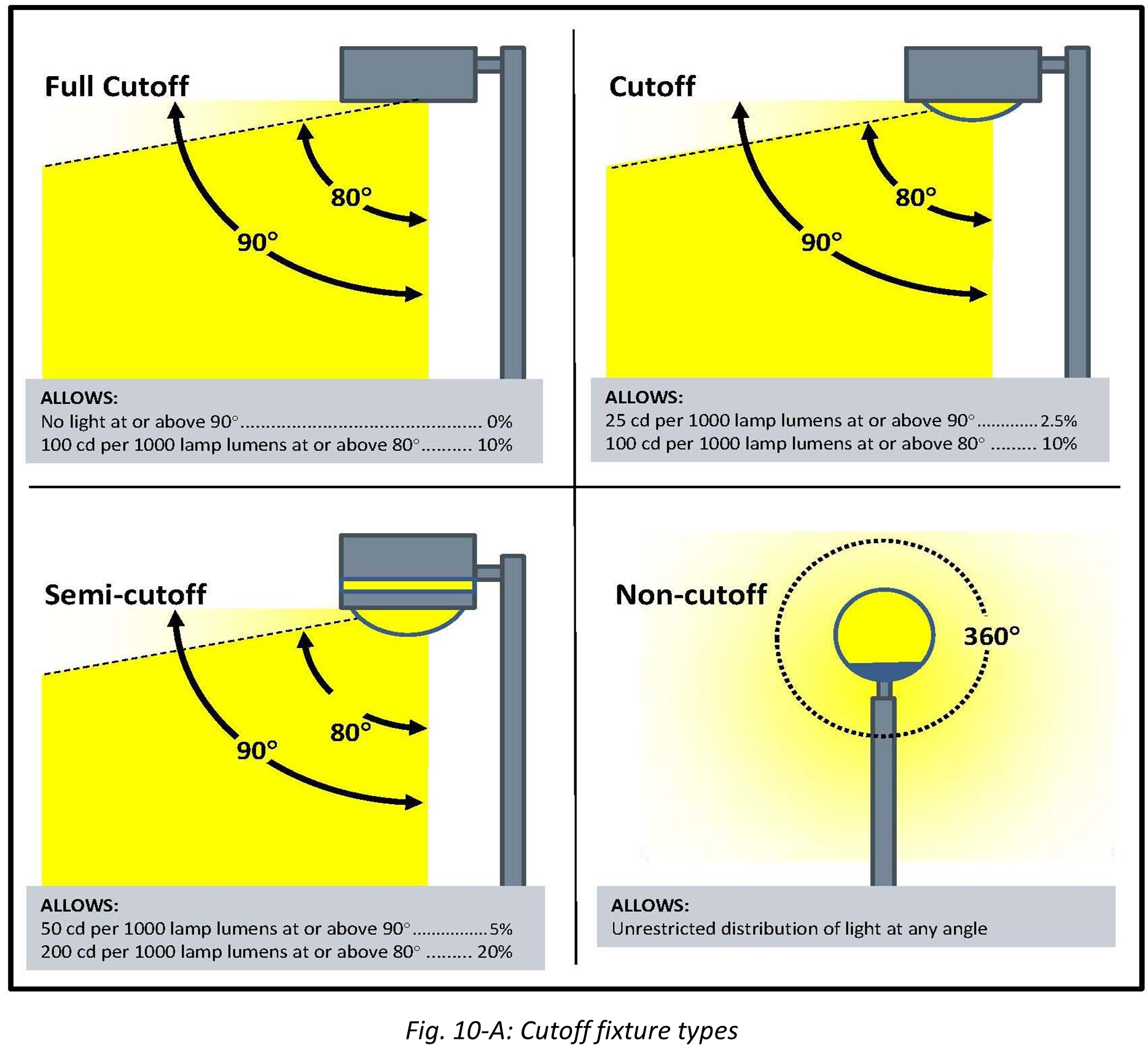
All freestanding outdoor light fixtures shall be shielded with full cutoff fixtures and directed downward to prevent off-site glare.
B.
Fixtures illuminating parking and pedestrian areas, both freestanding and building mounted, shall have full cutoff fixtures as identified in Figure 10-A, Cutoff Fixture Types.
C.
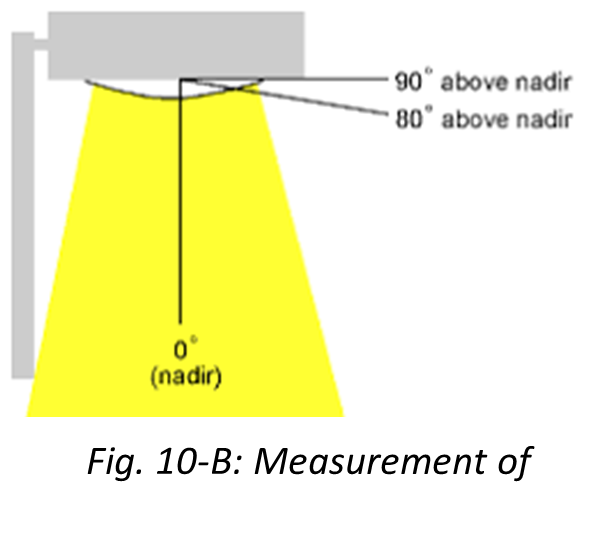
Building-mounted lighting shall be shielded and directed at a downward angle no higher than 45 degrees above the nadir (half-way between straight down and straight to the side) measured perpendicular from the pole or mounting wall. See Figure 10-B.
D.
Architectural, display, and decorative lighting visible off-site shall only be generated from a concealed or cutoff light source with low-level fixtures. Lamps used for this type of accent lighting shall be low intensity to produce a subtle lighting effect and shall utilize less than 100 watts and shall emit less than 1,600 lumens per fixture.
E.
Outdoor light fixtures under awnings, canopies, buildings, overhangs, or roof eaves shall be shielded to light pedestrian areas and walks and not illuminate the overhang, eave, or awning. Lighting fixtures shall not extend below the ceiling of freestanding canopies.
Section 10.4. - Measurement at property line.
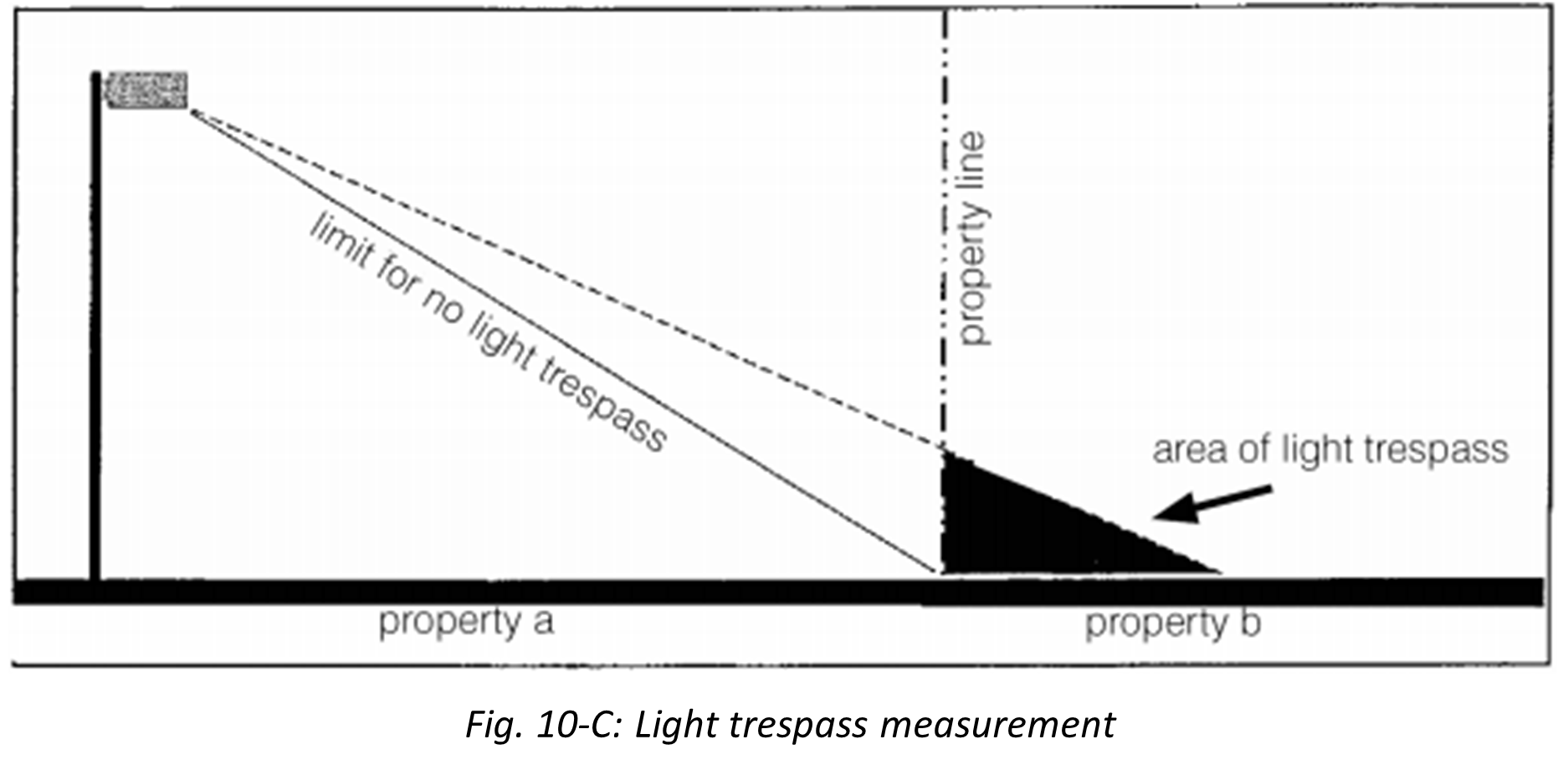
Outdoor lighting shall not cause light trespass exceeding the following amounts, measured with a light meter oriented vertically or horizontally at the property line of the property on which the light is trespassing:
A.
The maximum allowable trespass onto a residential use or property is 0.1 foot-candles.
B.
The maximum allowable trespass onto a non-residential use or property 0.25 foot-candles.
Section 10.5. - Generally applicable outdoor lighting design standards.
A.
All fixtures shall utilize one of the following bulb types: metal halide, induction lamp, compact fluorescent, incandescent (including tungsten-halogen), LED, solid state lighting, or high-pressure sodium, with a Color Rendering Index (CRI) above 70.
B.
All luminaires shall have a low Correlated Color Temperature (CCT) in the warm light spectrum (red, orange, and yellow range) of 2200-3000 Kelvin.
C.
No flickering or flashing lights shall be permitted, except for temporary decorative seasonal lighting.
D.
Lighting installations shall not have an adverse impact on ground or air traffic safety.
E.
The maximum height of any lighting pole shall not exceed the maximum height of a structure as allowed by the zoning district.
F.
All outdoor lighting shall be installed with an on/off switch.
Section 10.6. - Design standards for lighting outdoor uses.
A.
Active Recreation Uses.
Lighting for public and private outdoor recreational uses such as athletic playing areas (e.g., soccer fields, ball diamonds, playing fields, tennis courts) and similar uses, shall comply with the following standards.
1.
All lighting for athletic playing areas or fields shall utilize full cutoff luminaires that are installed in a fashion that maintains the full cutoff characteristics unless certified by a registered electrical engineer that such shielding is impractical and that substitute luminaires meet the following standards:
a.
The luminaires shall be provided with internal and/or external glare control louvers and installed so as to limit direct uplight to less than five percent of the total lumens exiting from the installed fixtures; and
b.
The luminaires shall be installed and maintained with minimum aiming angles of 25 degrees downward from the horizontal. The aiming angle shall be measured from the axis of the luminaire's maximum light intensity.
2.
The maximum height of any lighting pole shall be 80 feet at finished grade.
3.
Outdoor recreational lighting shall be extinguished between the hours of 11 p.m. and 7 a.m. or one hour after activities or games on the site are completed.
B.
Passive Recreation Uses.
Lighting for passive parks and trails shall comply with the following standards:
1.
Bollards or Step Lights: 0.5 footcandles average, 0.2 footcandles minimum, with a 4:1 average to minimum ratio. Spacing of 30 to 60-feet apart.
2.
Pedestrian Poles: 0.5 footcandles average, 0.2 footcandles minimum, with a 4:1 average to minimum ratio. Spacing of 12-foot poles shall be between 90 and 120-feet on center.
3.
Light may not be directed at or reflected into waterways.
Section 10.7. - Lighting curfew.
A.
All outdoor lighting except security lighting, as described in this section, shall be extinguished within 30 minutes of the close of business and shall stay off until 30 minutes before the commencement of business.
1.
Security lighting at stairways and loading areas that is activated by motion sensor which extinguishes 10 minutes after activation, and lighting at the building entrances and driveway egress points does not need to be extinguished.
2.
Lighting for ATMs and exterior accessways to hotel/motel rooms is not subject to the curfew.
B.
Automated control systems, such as motion sensors and timers, shall be used to meet the curfew requirements. Photocells or photocontrols shall be used to extinguish all outdoor lighting automatically when sufficient daylight is available. Automated controls should be fully programmable and supported by battery or similar backup.
Section 10.8. - Deviations.
Deviations from the lighting standards provided in this section may be approved by the Planning & Zoning Commission when the applicant can prove:
A.
There are unique circumstances affecting the subject property that make it infeasible or impractical to comply with strict application of the lighting standards detailed in this section.
B.
The proposed deviation will achieve the purpose and intent of this section.
C.
The levels of light pollution will not exceed the level anticipated to be produced by a project compliant with this section.
D.
The proposed project will not be contrary to or in conflict with the Comprehensive Plan.
Section 10.9. - Exemptions.
Lighting required by building codes or other regulations is exempt from this section, including: communication towers, exit signs, lighting for stairs/ramps, lighting for points of ingress/egress to buildings, and all other illumination required by air navigation safety provisions, building codes, OSHA standards, and other permitting requirements from state or federal agencies.

