
Dolores City Zoning Code
ARTICLE 2
- Measurements, Definitions, and Interpretations
Section 2.1.- Rules of construction.
A.
Text.
In case of any difference of meaning or implication between the text of this Land Use Code and any illustration or figure, the text shall control.
B.
Computation of Time.
The time within which an act is to be done shall be computed by excluding the first and including the last day; if the last day is a Saturday, Sunday or legal holiday declared by the Town, that day shall be excluded. In the computation of time for public hearing notice, both the first day (day of the advertisement) and the last day (day of the hearing) shall be excluded. The following time-related words shall have the meanings ascribed below.
1.
Day means a calendar day unless working day is specified.
2.
Week means seven calendar days.
3.
Month means a calendar month.
4.
Year means a calendar year, unless a fiscal year is indicated.
C.
Delegation of Authority.
Whenever a provision appears requiring the head of a department or some other officer or employee to do some act or perform some duty, it is to be construed to authorize the head of the department or other officer to designate, delegate and authorize appropriate subordinates to perform the required act or duty unless the terms of the provision or section specify otherwise.
D.
Public Officials, Bodies, and Agencies.
All public officials, bodies, and agencies to which reference is made are those of the Town of Dolores, Colorado, unless otherwise indicated.
E.
Lists and Examples.
Unless otherwise specifically indicated, lists of items or examples that use terms such as "for example," "including," and "such as," or similar language are intended to provide examples and shall not be interpreted as exhaustive lists of all possibilities.
F.
References to Other Regulations/Publications.
Whenever reference is made to a resolution, ordinance, statute, regulation, or document, it shall be construed as a reference to the most recent edition of such regulation, resolution, ordinance, statute, regulation, or document, unless otherwise specifically stated.
G.
Technical and Nontechnical Terms.
Words and phrases not otherwise defined in this Land Use Code shall be construed according to the common and approved usage of the language, but technical words and phrases not otherwise defined in this Land Use Code that may have acquired a particular and appropriate meaning in law shall be construed and understood according to such meaning.
Section 2.2. - Rules of interpretation.
A.
Mandatory and Discretionary Terms.
The words "shall," "must," or "will" are always mandatory, and the words "may" or "should" are always discretionary.
B.
Conjunctions.
Unless the context clearly suggests the contrary, conjunctions shall be interpreted as follows:
1.
"And" indicates that all connected items, conditions, provisions, or events shall apply; and
2.
"Or" indicates that one or more of the connected items, conditions, provisions, or events shall apply.
C.
Tenses and Plurals.
Words used in one tense (past, present, or future) include all other tenses, unless the context clearly indicates the contrary. The singular shall include the plural, and the plural shall include the singular.
D.
Undefined Terms.
The zoning administrator has the authority to provide the definition for a term where it is not defined in this Land Use Code. Appeal of a definition provided by the zoning administrator shall be to the Board of Adjustment.
Section 2.3. - Interpretations.
A.
Authority.
The Zoning Administrator shall have the authority to make all interpretations of the text of this Code, and the boundaries of the Official Zoning Map.
B.
Requests for Interpretation.
An interpretation may be requested pursuant to Section 13.14, Land Use Code Interpretations.
Section 2.4. - Measurements and associated terms.
A.
Floor Area Measurement.
Gross Floor Area: Total floor area designed for occupancy and use, including basements, mezzanines, and upper floors as measured from the centers of outside walls, excluding warehouse, storage, and utility rooms.
B.
Height Measurement.
1.
Height refers to the vertical distance between average finished grade along the front of the building and the highest point on the peak of the roof.
2.
Maximum heights are specified as maximum dimension.
a.
This requirement applies to the entire building.
b.
Maximum overall height in feet is measured from grade vertically to the highest point of the structure, excluding any permissible height exceptions per this zoning code.
C.
Lot Terms and Measurements.
1.
Lot: An undivided tract or parcel of land under one ownership having frontage on a public street and either occupied or to be occupied by a building or building group together with accessory buildings, which parcel of land is designated as a separate and distinct tract.
2.
Lot Area: The net area of the lot, excluding portions of streets and alleys.
3.
Lot Coverage: Lot coverage refers to the percentage of the lot area covered by the main and all accessory buildings. Roof eaves extending not more than three feet from the walls of a building shall be excluded from coverage computations.
4.
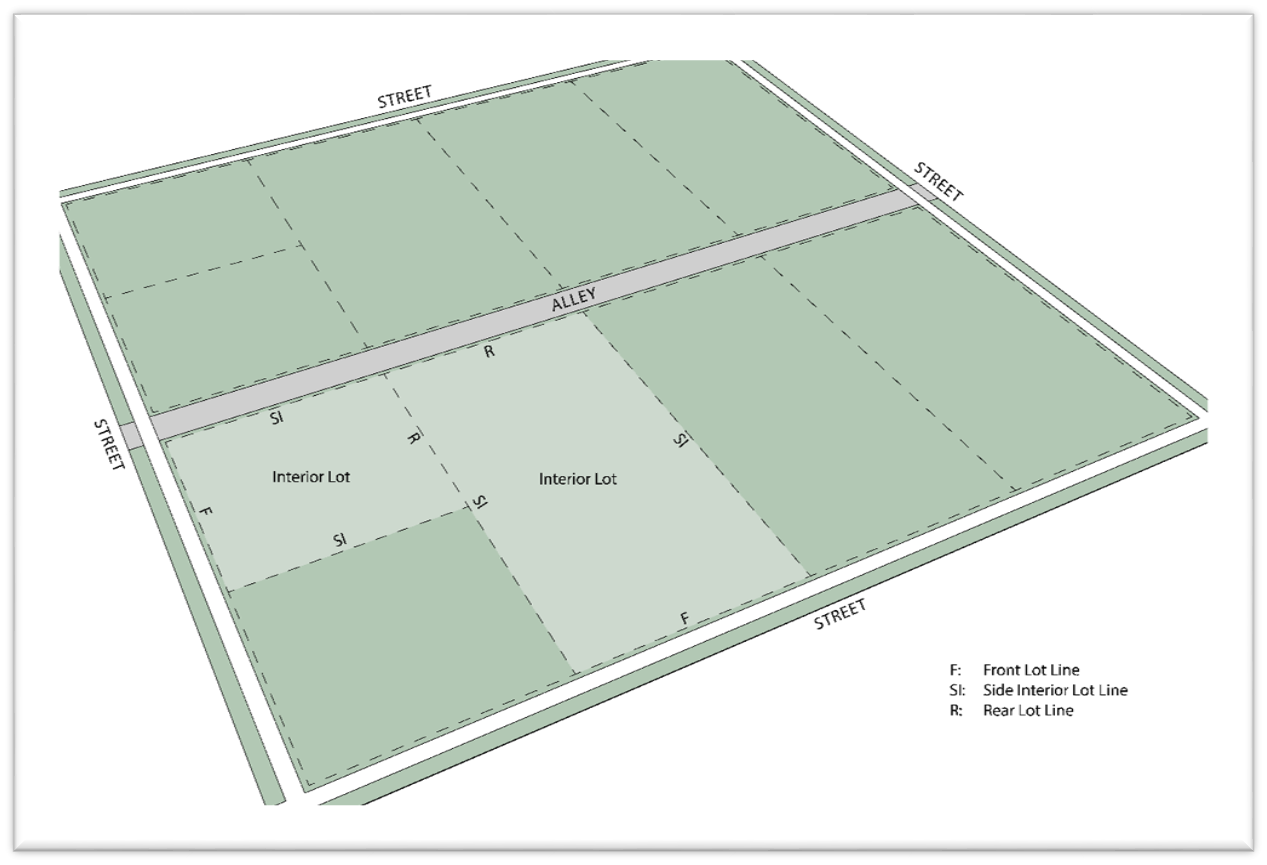
Lot Lines: A line of record bounding a lot which divides one lot from another lot or from a public or private street, alley or other public space.
a.
Front Lot Line: The lot line abutting a public or private front street.
b.
Rear Lot Line: The lot line not intersecting a front lot line that is most distant from and most clearly parallel to the front lot line.
c.
Side Lot Line: Any lot line that is not a front, street-side, or a rear lot line abutting an interior lot.
d.
Street-Side Lot Line: The lot line abutting a public or private side or non-front street.
5.
Lot Types:
a.
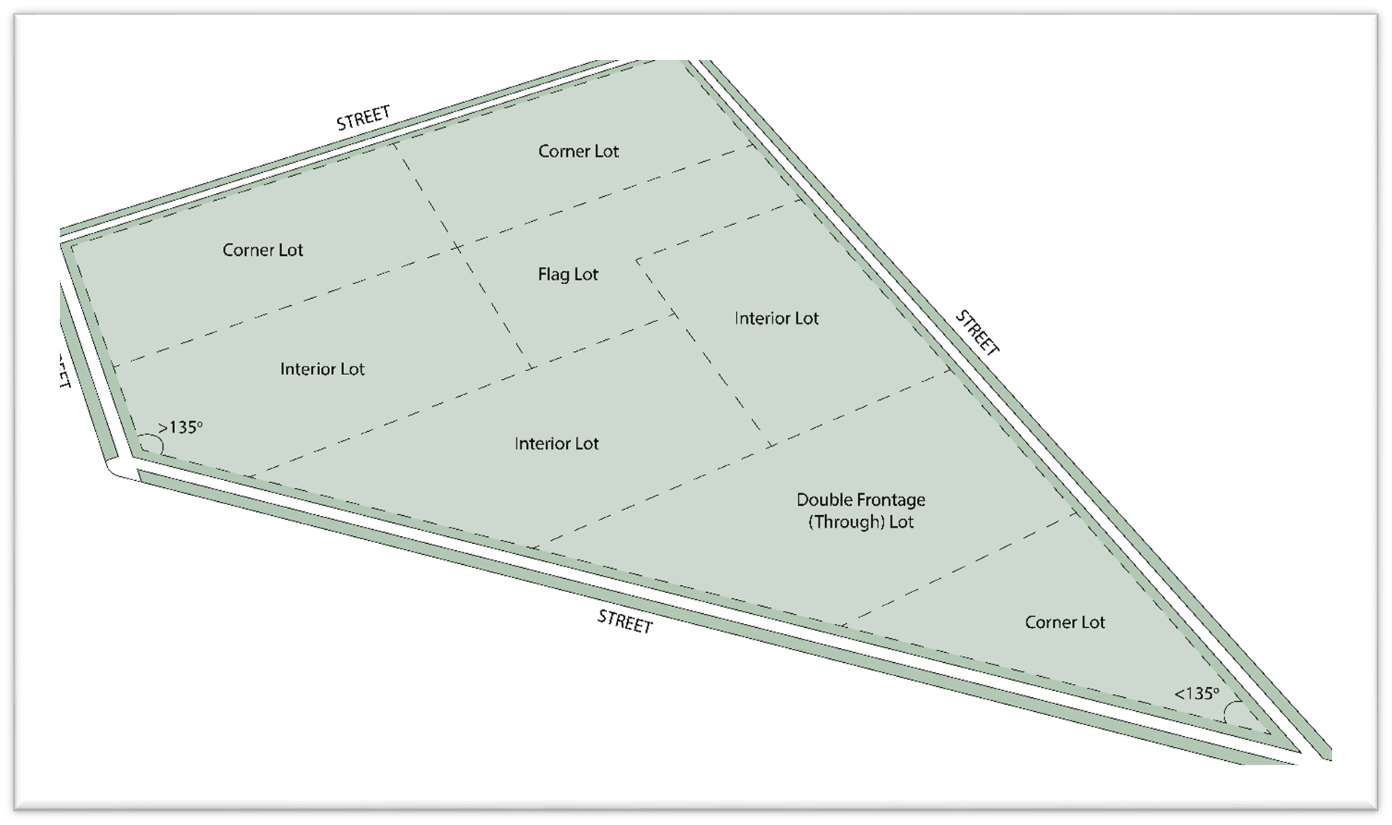
Corner Lot: A lot located at the intersection of two or more streets.
b.
Interior Lot: A lot other than a corner lot with only one frontage on a street other than an alley.
c.
Through Lot or Double Frontage Lot: A lot other than a corner lot with frontage on more than one street other than an alley.
d.
Flag Lot: A lot not meeting the minimum lot width or public street frontage requirements, and where access to a public street is limited to a narrow strip of land or private access way.
6.
Lot Width:
a.
Lot width shall be the length of the minimum required front yard setback line between the two side lot lines.
b.
If the front yard setback line is an arc or a curve, the lot width shall be the length of said arc or curve.
D.
Setback Terms and Measurements.
1.
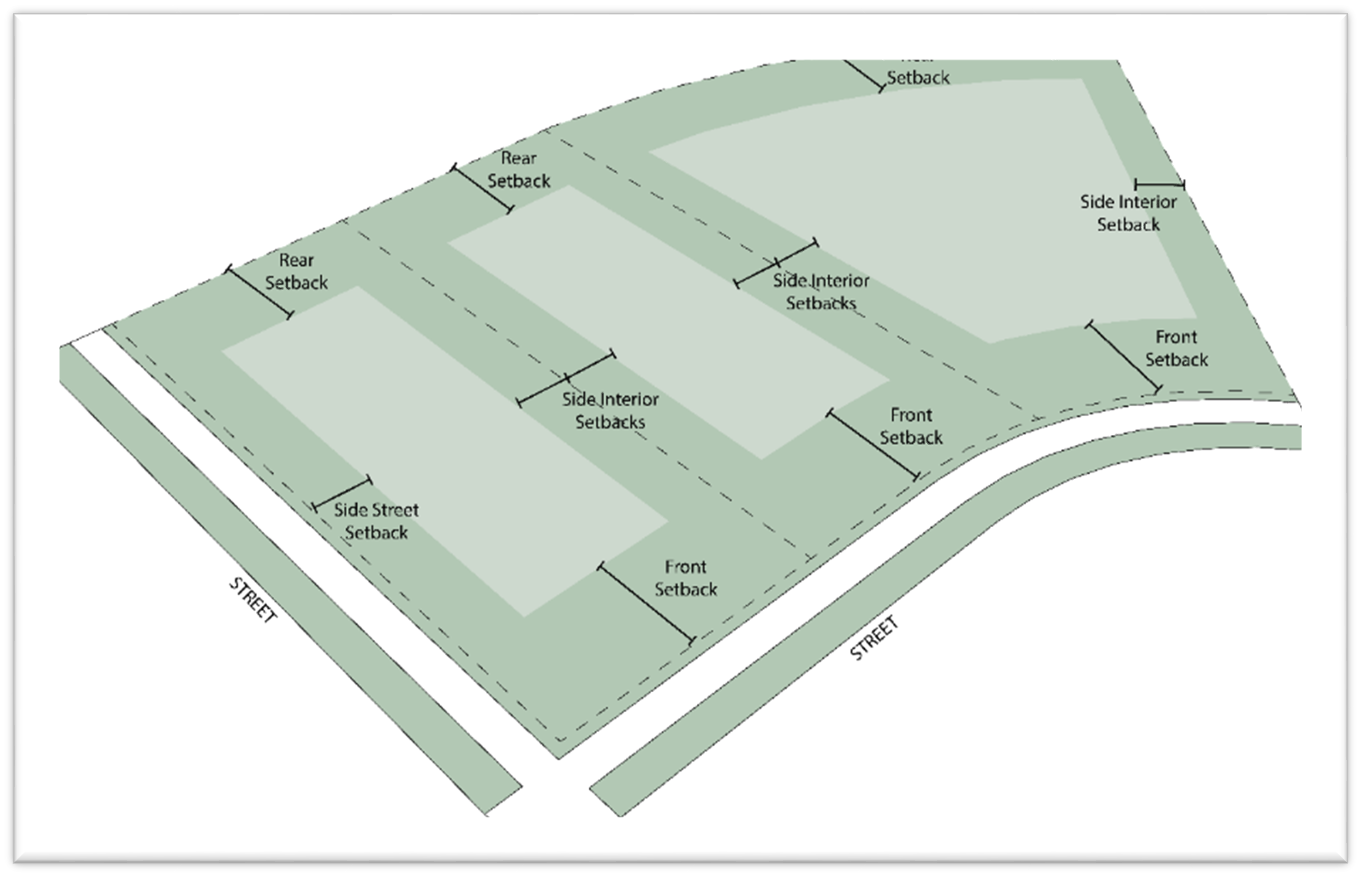
Setback. The open space at grade between a structure and the property line of the lot on which the structure is located measured by the horizontal distance between the lot line and the closest projection of the principal or accessory building.
2.
Setback Measurements for Nonstandard Lots.
a.
Corner Lots: For lots with frontage on two intersecting streets, such a lot shall be considered to have two front lot lines and shall comply with front yard setbacks from each front lot line.
b.
Double Frontage Lots: Where lots have double frontage, running through from one street to another, a required front yard shall be provided on both streets.
3.
Setback Encroachments.
a.
Setback encroachments are building and site elements that project into or are located on the "non-buildable" side of a setback line, typically in a required setback area.
b.
Measurement.
(1)
Each setback encroachment shall be measured from the minimum required setback line towards the lot line; setback encroachments are always measured from the same point and are not cumulative.
(2)
No permitted setback encroachment shall be closer than two feet to any lot line with the exception of fences and walls and gardens and landscaping.
E.
Separation or Distance Measurement.
Where a standard includes a separation or distance requirement, it shall be measured as follows:
1.
Between Buildings: The horizontal distance between the two closest portions of each building's exterior walls.
2.
Between Uses: The horizontal distance shall be measured from the nearest point of a structure or part of a multiple use structure occupied by the use requiring separation to the nearest point of a structure or part of a multiple use structure occupied by a use from which the separation is to be established.
3.
From an Adult Entertainment Establishment: The horizontal distance shall be measured from the midpoint of the closest customer entrance of the structure occupied by an adult entertainment establishment to the nearest point on a property line of the use or zone district from which the separation is to be established.
4.
Between a Use and a Zone District: The horizontal distance shall be measured from the nearest point of a structure or part of a multiple use structure occupied by the use requiring separation to the nearest point of a zone district boundary from which the separation is to be established.
Section 2.5. - Clear sight triangle.
A.
Described.
A clear sight triangle is an area free of all obstructions that could interfere with the visibility of approaching drivers as defined in this Code.
B.
Where Required.
1.
An intersection clear sight triangle is located at an intersection between two streets. The area is a triangular-shaped piece of land, measuring 40 feet in distance along the major street and 20 feet in distance along the minor street, both distances being measured from and along the back of the curb.
2.
A driveway clear sight triangle is located at an intersection between an entrance or drive and a street. The area is a triangular-shaped piece of land, measuring 15 feet in distance along the street and 15 feet in distance along the entrance or drive, both distances being measured from and along the back of the curb.
Section 2.6. - General definitions.
Words defined in this section shall be given the meanings set forth here. All other words shall be given their common, ordinary meanings. In case of dispute over the meaning of a term not defined here, the Zoning Administrator shall give a written interpretation.
A.
A Terms.
"Accessory:" A use, building or structure, part of a building or other structure, which is subordinate to, and the use of which is incidental to that of the main building, structure or use on the same lot, including a private garage.
"Accessory dwelling unit:" A residential unit that is located on the same lot as a primary residential dwelling unit, either internal to or attached to the primary residential dwelling unit or in a detached structure.
"Addition:" Any activity that expands the enclosed footprint or increases the square footage of an existing structure.
"Adult day care:" a facility that provides the staff assistance to clients that each requires for activities of daily living, including but not limited to eating, walking, and grooming.
"Affordable housing:" as further defined under Article 16, is either a rental unit(s) priced for households earning no more than 80 percent of the Area Median Income, or an ownership unit(s) priced for households earning no more than 120 percent of the Area Median Income. AMI information shall be determined by the U.S. Department of Housing and Urban Development (HUD), and affordable rental information shall be as determined by the Colorado Housing Finance Authority (CHFA). The affordability measurements in this definition may be adjusted pursuant to the Town of Dolores Affordable Housing Policy.
"Agriculture:" A use of land for production and/or marketing of crops, livestock or products produced on site.
"Agricultural production activity:" Production of forage, grains, livestock, trees, and fruits, vegetables, nursery, floral, and ornamental stock with reasonable expectation of profit; commercial feed lots shall not be considered agriculture for purposes of this definition.
"Alternative financial services:" The use of a site for the provision of alternative financial services such as vehicle title loans, check-cashing, payday advance/payday loan, or money transfer as defined below. An alternative financial services establishment does not include state or federally chartered banks, savings and loans, and credit unions. An alternative financial establishment does not include an establishment that provides financial services that are accessory to another main use.
Check cashing business. An establishment that provides one or more of the following:
1.
An amount of money that is equal to the face of the check or the amount specified in the written authorization for an electronic transfer of money, less any fee charged for the transaction;
2.
An agreement not to cash a check or execute an electronic transfer of money for a specified period of time; or
3.
The cashing of checks, warrants, drafts, money orders, or other commercial paper for compensation by any person or entity for a fee.
Payday advance/loan business. An establishment that makes small consumer loans, usually backed by a postdated check or authorization to make an electronic debit against an existing financial account, where the check or debit is held for an agreed-upon term, or until a customer's next payday, and then cashed unless the customer repays the loan to reclaim such person's check. Such establishments may charge a flat fee or other service charge and/or a fee or interest rate based on the size of the loan amount.
Money transfer business. An establishment that transfers funds for a fee.
Vehicle title loan business. An establishment that makes small consumer loans that leverage the equity value of a car or other vehicle as collateral where the title to such vehicle is owned free and clear by the loan applicant and any existing liens on the car or vehicle cancel the application. Failure to repay the loan or make interest payments to extend the loan allows the lender to take possession of the car or vehicle.
"Amusement, indoor:" Uses that provide commercial recreation or amusement indoors (except adult entertainment), including but not limited to: bowling alleys and pool rooms; indoor sports arenas, movie theaters and live theaters; indoor skating rinks (ice or roller); video arcades; and shooting arcades.
"Amusement, outdoor:" Uses that provide commercial recreation or amusement outdoors (except adult entertainment), including but not limited to: drive-in movie theater; amusement park or theme park; fairgrounds; miniature golf establishments; golf driving ranges; water slides; and batting cages.
"Apartment:" A building on a single lot with three or more residential dwellings that may be located side-by-side or over one another and are contained within a single building and under a single roof.
"Applicant:" A person who submits an application for development to the local government.
"Application for development:" An application for a preliminary or final plat for subdivisions, a planned unit development, or any other similar land use. Application for development includes applications for zoning, rezoning, general development plans, and special use permits where such applications are in anticipation of new surface development, but do not include building permit applications.
"Asphalt or concrete batching plant, temporary:" A temporary facility for producing asphalt or concrete products used in construction activities on the same or nearby sites.
"Assembly:" A room or place such as a ballroom, auditorium, party room, gaming room, or convention hall that is intended or used to accommodate people in a group and is further divided into the following types:
Civic: A building or structure, or group of buildings or structures, that by design and construction are primarily intended for the conducting of organized meetings, or other activities and accessory uses associated therewith, for non-commercial purposes.
Entertainment and trade: A building or portion thereof used for groups of people to gather for an event, or regularly scheduled program. General assembly uses include arenas, auditoriums, banquet facilities, conference and reception centers, concert halls and theaters.
Religious: A facility or area for people to gather together for public worship, religious training, or other religious activities including a church, temple, mosque, synagogue, convent, monastery, or other structure, together with its accessory structures, including a parsonage or rectory. This use does not include home meetings or other religious activities conducted in a privately occupied residence. Accessory uses may include meeting rooms and childcare provided for persons while they are attending assembly functions. Schools and other child care services are not accessory uses and shall require approval as separate principal uses.
"Assisted living facility:" As defined in Section 25-27-102, C.R.S., a residential facility that makes available to three or more adults not related to the owner of such facility, either directly or indirectly through an agreement with the resident, room and board and at least the following services: Personal services; protective oversight; social care due to impaired capacity to live independently; and regular supervision that shall be available on a twenty-four-hour basis, but not to the extent that regular twenty-four-hour medical or nursing care is required. The term "assisted living residence" does not include any facility licensed in this state as a residential care facility for individuals with developmental disabilities, or any individual residential support services that are excluded from licensure requirements pursuant to rules adopted by the department of public health and environment.
"Attached lighting:" A light fixture that is attached to a building or structure. Any light fixture that is directly or indirectly attached to a structure with a diameter and/or width of more than 12 inches is considered attached lighting.
"Auto repair garage:" A building or place arranged, designed, used or intended to be used for the primary purpose of providing general repair and servicing of motor vehicles. Such repair or servicing may include reconditioning of engines, air conditioning systems and transmissions; wrecker service; collision services including body, frame or fender straightening or repair; painting, undercoating and rust-proofing; replacement or repair of brakes, shock absorbers, tires, batteries, mufflers, or upholstery; and other similar services.
"Awning:" A roof-like cover that projects from the wall of a building for the purpose of shielding a doorway or window from the elements. An awning is either permanently attached to a building or can be raised or retracted to a position against the building when not in use.
B.
B Terms.
"Bars, taverns:" An establishment where alcoholic beverages are served on the premises and where the total sales of alcohol exceeds the total sales of food.
"Bed and breakfast:" Bed and Breakfast: An owner-occupied, single-family detached dwelling unit that includes guest rooms offered as short-term lodging for compensation to the travelling and vacationing public. Guest rooms or suites may include a private bath but shall not include cooking facilities. Breakfast and other meals, services, facilities, or amenities may be offered exclusively to guests.
"Block:" A group of lots within defined and fixed boundaries of a subdivision and usually being an area surrounded by streets or other features, such as parks, trails, pedestrian accessways, or municipal boundary lines, which together shall not be longer than 600 feet.
"Block face:" All lots on one side of a block.
"Boarding, animal:" The feeding, housing, and exercising of animals not owned by the owner of the property and for which the property owner may receive compensation.
"Boarding or rooming house:" A single detached dwelling unit in which the owner rents individual rooms and the individual rooms do not have individual cooking/restroom facilities. The unit is designed to serve as the residence of individuals subject to the following:
1.
Rooms may be rented on a monthly basis.
2.
The rooms are generally furnished by the owner.
3.
Communal cooking and restroom facilities are provided.
4.
Owner provides some housekeeping and linen services.
5.
The relationship between owner and resident is that of a landlord/tenant with references and deposits required of the resident.
6.
Rooms rented for a period of less than 30 days shall be deemed a short-term rental.
"Booking service:" Any person or entity that facilitates short-term rental reservations and collects payment for lodging in a short-term rental.
"Bufferyard:" A combination of physical space and vertical elements, such as plants, berms, fences, or walls, the purpose of which is to separate and screen uses from one another.
"Build-to zone:" An area in which the front or street side facade of a building shall be placed; it may or may not be located directly adjacent to a lot line.
"Buildable area:" For the purposes of subdivision development, buildable area shall mean that portion of a building lot or site not within the required front and rear yard areas. For the purposes of issuing building permits, buildable area shall also mean those areas on a building lot or site, as shown on the required site plan, necessary for the construction of such other improvements as driveways, parking areas, pools, tennis courts and accessory buildings, including sufficient adjacent area to allow the normal operation of construction equipment.
"Building:" Any structure built for the support, shelter, and enclosure of persons, animals, chattels or movable property of any kind. When subdivided in a manner sufficient to prevent the spread of fire, each portion so subdivided may be deemed a separate building. Building includes yurts, removable sheds, and similar uses, but does not include shipping containers or vehicles, even though immobilized, or signs or fences.
"Building coverage, maximum:" The maximum percentage of a yard or lot permitted to be covered by building and any other structures with a roof.
"Building line:" A line parallel or approximately parallel to the street line at a specified distance there from establishing the minimum distance from the street line that a building may be erected.
"Business service:" Services such as building repair and maintenance, the installation of plumbing, electrical, air conditioning and heating equipment, janitorial services, and exterminating services. The retail sale of supplies is permitted as an accessory use.
C.
C Terms.
"Caliper:" A standard for trunk measurement of plant nursery stock.
"Campground, public and private:" Any area or tract of land used or designed to accommodate two or more camping parties, including cabins, tents, travel trailers, recreational vehicles, and other camping outfits.
"Canopy:" An attached or detached structure, open on at least one side, that is designed to provide overhead shelter from the sun or weather. Canopies include, but are not limited to, service station canopies, carports, porte-cochères, arcades, and pergolas. A canopy is different from an awning in that a canopy is not covered with fabric or flexible material. Permanent, freestanding canopies such as service station canopies are referred to as structural canopies for the purposes of sign regulation.
"Carport:" A structure to house or to protect motor vehicles owned or operated by the occupants of the main building which is open on at least one side.
"Car wash:" A building or area that provides facilities for washing and cleaning motor vehicles, excluding semi-tractors and/or semi-trailers, which may use production line methods with a conveyor, blower, other mechanical devices, or hand labor in the cleaning of the vehicle.
"Cemetery/crematorium:" A facility or area used or intended to be used for the burial of the dead, including crematories, mausoleums, and mortuaries when operated in conjunction with, and within the boundaries of such cemetery.
"Church:" See Religious Assembly.
"Closely-held corporation:" Pursuant to Colorado Statutes, an entity with no more than three owners.
"Commercial development:" Commercial development includes, but is not limited to, the construction or expansion by the addition of square footage of office, retail, wholesale, warehouse, manufacture, commercial recreation, restaurant/bar and/or service commercial operations.
"Common interest community:" Real estate described in a declaration with respect to which a person by virtue of such person's ownership of a unit is obligated to pay for real estate taxes, insurance premiums, maintenance, or improvements of other real estate described in a declaration. "Ownership" does not include a leasehold interest of less than 40 years, including renewal options, as measured from the commencement date of the initial term.
1.
Condominium/townhouse: Common interest communities in which portions of the real estate is designated for separate ownership and the remainder of which is designated for common ownership solely by the owners of the separate ownership portions.
2.
Cooperative: A common interest community in which the real property is owned by an association, each member of which is entitled by virtue of such member's ownership interest in the association an exclusive possession of a unit.
3.
Planned community: A common interest community that is not a condominium or cooperative.
4.
Condominium map: A printed instrument depicting all or a portion of a common interest community in three dimensions. A condominium map or a condominium plat may be combined in one instrument.
5.
Condominium plat: A printed instrument that is a land survey depicting all or a portion of a common interest community in two dimensions. A condominium plat and condominium map may be combined in one instrument.
"Community garden:" An area managed and maintained by a group of individuals to grow and harvest food crops, or non-food crops, for personal or group consumption, for donation, or for sale that is incidental in nature.
"Community residential home or facility:" As defined in Section 25.5-10.202, C.R.S., a group living situation accommodating at least four but no more than eight persons, which is licensed by the state and in which services and supports are provided to: persons with intellectual and developmental disabilities; the aged (persons 60 years old or older); or persons with behavioral or mental health disorders.
"Consumer maintenance and repair:" A use category that includes uses that provide the repair and maintenance of a wide variety of consumer products.
"Convenience store:" A retail store that is designed and stocked to sell primarily food, beverages and other household supplies to customers who purchase only a relatively few items (in contrast to a "supermarket"). It is designed to attract, and depends upon, a large volume of stop-and-go traffic. Illustrative examples of convenience stores are those operated by the "7-11" and "Conoco" chains. These stores may also include pumps and/or storage tanks from which fuels are dispensed at retail. No servicing, maintenance or repair work shall be conducted on the business premises. This definition shall exclude truck stops.
"Craft alcohol:" The production of small batches of wine, hard cider, beer, or distilled alcoholic beverage as licensed by Colorado law.
D.
D Terms.
"Day care:" (or "child care") means care for children provided by an adult, other than a parent of the children or other person living with the children as a parent, on a regular or irregular basis, as applicable, for daily periods of less than 24 hours, whether that care is for daytime or nighttime hours. The term does not include a place where day care is provided if a parent of a child for whom day care is provided remains on the premises.
"Density:" The maximum number of dwelling units per gross acre of land permitted in a zone district.
"Developer:" Any public or private person, partnership, association or agency that prepares raw land for the construction of buildings or causes to be built physical building space for use primarily by others, during which preparation the land or the creation of the building space is in itself a business and is not incidental to another business or activity.
"Development permit:" See "Zoning Development Permit."
"Development:" The physical extension and/or construction of urban land uses. Development activities include: subdivision of land; change in the intensity of use of land; construction, reconstruction, demolition or partial demolition or alteration of buildings, roads, utilities, and other facilities; commencement of drilling (except for a well or to obtain soil samples), mining, or excavation; installation of septic systems; grading; deposit of refuse, debris, or fill materials; and clearing of natural vegetation cover.
"District:" District means a zoning district.
"Drive-through (thru):" The use of land, buildings, or structures, or parts thereof, to provide or dispense products or services, either wholly or in part, through an attendant, window or automated machine, to persons remaining in motorized vehicles that are in a designated stacking lane. This definition does not include a vehicle washing facility, a vacuum cleaning station accessory to a vehicle washing facility, or a service station.
"Dwelling:" A IBC standard constructed structure or portion of such a structure that is designed, occupied or intended to be occupied as living quarters and includes facilities for cooking, sleeping and sanitation; but not including mobile homes, recreational vehicles, hotels, motels, clubs, boarding houses.
"Dwelling unit:" One or more rooms designed for or occupied exclusively by one household.
"Accessory dwelling unit:" A dwelling unit attached to or within a single-family dwelling, or over a garage.
"Attached dwelling unit:" A dwelling unit with ground floor outside access, attached to two or more one-family dwellings by common vertical walls without openings. Attached DUs include duplex, triplex, and townhouse units.
"Detached dwelling unit:" Any dwelling unit that does not have a wall, roof and/or floor in common with any other dwelling unit except an accessory dwelling unit.
"Single-unit dwelling:" A building that has one dwelling unit.
"Three-unit dwelling (triplex):" Three attached dwelling units within a single building and under a single roof.
"Townhouse:" A series of three or more attached single unit dwellings.
"Two-unit dwelling (duplex):" A building that has two attached dwelling units. within a single building and under a single roof.
E.
E Terms.
"Eave:" the edge of a pitched or flat roof; it typically overhangs beyond the side of a building.
"Educational facility:" A use category for public, private, and parochial institutions at the primary, elementary, middle, high school, or post-secondary level, or trade or business schools that provide educational instruction to students.
"Electric vehicle charging station:" An electric vehicle charging station is a public or private parking space(s) that is (are) served by battery charging equipment with the purpose of transferring electric energy to a battery or other energy storage device in an electric vehicle, and is classified based on the following levels:
Level 1 is considered slow charging and operates on a fifteen to twenty amp breaker on a one hundred twenty volt AC circuit.
Level 2 is considered medium charging, and operated on a forty to one hundred amp breaker on a two hundred forty volt AC circuit.
Level 3 is considered fast or rapid charging, and operated on a sixty amp or higher breaker on a four hundred eighty volt or higher three phase circuit with special grounding equipment. Level 3 stations can also be referred to as rapid charging stations that are typically characterized by industrial grade electrical outlets that allow for faster recharging of electric vehicles.
"Eligible residential structure:" an "eligible residential structure" for purposes of this Code means a structure with an occupancy for single family use as permitted under the Town's adopted building codes.
F.
F Terms.
"Facade:" The exterior face of a building, including but not limited to the wall, windows, windowsills, doorways, and design elements. The front facade is any building face adjacent to the front lot line.
"Family:" Two or more persons related by blood, marriage, adoption, or other legal means, including any number of minor children in foster care. A "family" is distinguished from a group occupying a boarding house, lodging house, bed and breakfast inn, fraternity/sorority house, hotel or clubhouse. See also Household.
"Farm stand:" A temporary structure not permanently affixed to the ground and is readily removable in its entirety, which is used solely for the display or sale of agricultural products.
"Field office, temporary:" A structure or shelter used in connection with an approved development or building project for housing on the site of temporary administrative and supervisory functions and for sheltering employees and equipment.
"Financial institution:" Establishments that provide retail banking services, mortgage lending, and similar financial services to individuals and businesses. Accessory uses may include automatic teller machines, offices, and parking. The use may or may not be allowed to have a drive-through facility, depending on the zone district.
"Fixture:" A complete lighting unit including the lamp and parts designed to distribute the light, position and protect the lamp, and connect the lamp to a power source. Also referred to as a luminaire. The fixture may include an assembly housing, a mounting bracket or polo socket, lamp holder, ballast, a reflector or mirror, and a refractor or lens.
"Flag:" A flexible piece of fabric, that is attached along one edge to a straight, rigid flagpole (directly or with rope), and which is designed to move when the wind blows. Flags are typically (but not necessarily) rectangular in shape, and often (but not always) include printed or embroidered insignia that symbolizes a nation, state, or organization, or that display a graphic or message.
"Floodlight:" An outdoor lighting fixture intended to illuminate a large area. Often utilized to broadcast light over a substantial area for security and recreational purposes.
"Freestanding lighting:" A light fixture that is not attached to a building or structure. Any light fixture attached to a structure with a diameter and/or width of 12 inches or less (such as a pole) is considered freestanding lighting.
"Fuel sales:" A facility engaged in the storage, distribution, and retail sales of vehicle fuels for personal vehicles, fleet vehicles, and/or trucks.
"Fully shielded:" An outdoor lighting fixture that is shielded with a non-translucent barrier or constructed in such a manner that the light rays emitted by the fixture, either directly from the lamp or indirectly from the fixture, are projected below a horizontal plane passing through the lowest point of the fixture where light is emitted. Light rays emitted by a fully shielded fixture shall not cast direct light onto any adjacent property other than a common solid fence.
"Funeral home:" A building or part thereof used for human funeral services. Such building may contain space and facilities for: (a) embalming and the performance of other services used in the preparation of the deceased for burial; (b) the performance of autopsies and other surgical procedures; (c) the storage of caskets, funeral urns and other related funeral supplies; (d) the storage of funeral vehicles, and(e) facilities for cremation.
G.
G Terms.
"Garden center or nursery:" A business where retail and wholesale products and produce are sold to the customer. These centers, which may include a nursery and/or greenhouses, import many of the items sold, and may include plants, nursery products and stock, potting soil, hardware, power equipment and machinery, hoes, rakes, and other garden and farm variety tools. Marijuana shall not be grown or sold at a garden center.
"Grade:" The lowest point of elevation of the finished surface of the ground, or the lowest point of elevation of the finished surface of the ground between the exterior wall of the building and the property line, if there is less than five feet distance from the wall. In cases where walls are parallel to and within 20 feet of a public sidewalk, alley or other public way, the grade shall be the elevation of the sidewalk, alley, or public way.
"Government offices and buildings:" An office of a governmental agency that provides administrative and/or direct services to the public, such as, but not limited to: employment offices, public assistance offices, motor vehicle licensing, and registration services.
"Greenhouse:" A building or structure whose roof and sides are made largely of glass or other transparent or translucent material and in which the temperature and humidity can be regulated for the cultivation of fragile or out-of-season plants for subsequent sale or for personal enjoyment.
"Ground source heat pump definitions:"
Geothermal boreholes: A hole drilled or bored into the earth into which piping is inserted for use a closed vertical loop geothermal system.
Ground source heat pump system: A system that uses the relatively constant temperature of the earth or a body of water to provide heating in the winter and cooling in the summer. System components include open or closed loops of pipe, coils or plates; a fluid that absorbs and transfers heat; a heat pump unit that processes heat for use or disperses heat for cooling; and an air distribution system.
Ground source heat pump system, closed loop: A mechanism for heat exchange that circulates a heat transfer fluid, typically food-grade anti-freeze, through pipes or coils buried beneath the land surface or anchored to the bottom in a body of water.
Ground source heat pump system, horizontal: A closed loop ground source heat pump system where the loops or coils are installed horizontally in a trench or series of trenches.
Ground source heat pump system, open loop: A system that uses ground water as a heat transfer fluid by drawing groundwater from a well to a heat pump and then discharging the water over land, directly in a water body or into an injection well.
Ground source heat pump system, vertical: A closed loop ground system heat pump system where the loops or coils are installed vertically in one or more borings below the land surface.
Heat transfer fluid: A non-toxic, biodegradable, circulating fluid such as potable water, a food-grade aqueous solution of propylene glycol not to exceed 20 percent by weight, or a food-grade aqueous solution of potassium acetate not to exceed 20 percent by weight.
"Group home:" A structure in which housing is provided for a group of unrelated individuals or related and unrelated individuals pursuant to state statute.
"Guest:" A person who is visiting a household and is not paying any monetary or other consideration to occupy the unit.
H.
H Terms.
"Historic:" Having importance in the history, architecture, archaeology, or culture of Colorado, the Town of Dolores, Montezuma County, or the United States, as determined by the Historic Preservation Board.
"Historic district:" A district is a geographically definable area, urban or rural, possessing a significant concentration, linkage, or continuity of sites, buildings, structures, or objects united by past events or aesthetically by plan or physical development. A district may also comprise individual elements separated geographically but linked by association or history.
"Historic structure:" Any structure that is:
1.
Listed individually in the National Register of Historic Places (a listing maintained by the Department of Interior) or preliminarily determined by the Secretary of the Interior as meeting the requirements for individual listing on the National Register;
2.
Certified or preliminarily determined by the Secretary of the Interior as contributing to the historical significance of a registered historic district or a district preliminarily determined by the Secretary to qualify as a registered historic district;
3.
Individually listed on a state inventory of historic places in states with historic preservation programs which have been approved by the Secretary of the Interior; or
4.
Individually listed on a local inventory of historic places in communities with historic preservation programs that have been certified either:
a.
By an approved state program as determined by the Secretary of the Interior; or
b.
Directly by the Secretary of the Interior in states without approved programs.
"Historic properties:" The resources, including buildings, structures, objects, sites, districts, or areas that are of historical significance.
"Historic preservation:" The protection, enhancement, and maintenance of historic properties.
"Home occupation:" An accessory commercial service, financial service, office, or retail sales use that is permitted to be carried on in a residence for financial gain that does not change the residential character and is clearly secondary to the use of the dwelling. The provision of short-term rentals is considered a lodging use and is not a home occupation.
"Hospice:" A facility where palliative and supportive care are provided to meet the needs of a terminally ill patient and the patient's family.
"Hospital or clinic:" An establishment that provides diagnosis and treatment, both surgical and nonsurgical, for patients who have any of a variety of medical conditions through an organized medical staff and permanent facilities that include inpatient beds, medical services, and continuous licensed professional nursing services.
"Hotel/motel:" A building or group of buildings designed and occupied as temporary lodging for less than 30 days for compensation. To be classified as a hotel or motel, an establishment shall contain a minimum of six individual guestrooms or units and shall furnish customary hotel or motel services.
"Household:" (1) A family plus up to four unrelated individuals living together in a single, not-for-profit housekeeping unit sharing on common kitchen facility; or (2) one or more persons occupying a dwelling unit as a single housekeeping unit, subject to a limit of not more than two adults per bedroom; or (3) any group of individuals and caretakers recognized as a household by Colorado law.
I.
I Terms.
"Improvement:" The addition of street, curb and gutter, sidewalk, storm drainage or utilities facilities or street trees or any other required items on a vacant parcel of land.
"Individual business:" One business on one parcel provided that the parcel is not part of a multiple business complex; and also provided the parcel is not part of a group of multiple contiguous parcels under the same ownership. See also Tenant.
"Industrial sales and service:" A use category of firms that are engaged in the sale, repair, or servicing of agricultural, industrial, business, or consumer machinery, equipment, products, or by-products. Contractors and similar users perform services off-site. Few customers come to the site. Accessory activities may include sales, offices, parking, and storage.
"Inoperable vehicle:" Any vehicle incapable of immediate operation under its own power safely and in concurrence with governing and applicable traffic ordinances and statutes or any vehicle not having current license plates lawfully affixed thereto.
J.
J Terms.
"Junk:" Any worn out cast off or discarded article or material which is ready for destruction or has been collected or stored as salvage, for conversion to some other use or for reduction into components. Junk includes but is not limited to old or scrap brass, rope, rags, batteries, paper, tires, rubber debris or waste, iron, steel and other old or scrap ferrous or non-ferrous material.
"Junkyard:" An open area where wastes, or used or secondhand materials are bought, sold, exchanged, stored, processed or handled, which are not intended to be recycled. Materials shall include, but are not limited to, scrap iron and other metals, paper, rags, rubber tires and bottles.
K.
K Terms.
"Kennel, commercial:" Any lot, building, structure, or premises where more than two dogs or cats over the age of six months, other than those owned by the kennel owner are kept or maintained for boarding, training, breeding or selling, exclusive of medical care or for quarantine purposes in excess of 24 hours. Female dogs bred for the sole purpose of the sale of puppies for profit, and female dogs numbering more than three constitute a commercial Kennel.
"Kennel, noncommercial:" A kennel at, in, or adjoining a private residence where more than two dogs or cats are kept for the hobby of the householder in using them in shows or obedience trials, personal pleasure or for the guarding or protecting of the householder's property. The occasional raising of a litter of puppies or kittens at the kennel and the occasional sale of puppies or kittens by the keeper of a noncommercial kennel should in no way change the character of the residential property.
L.
L Terms.
"Landscaping:" May include trees, shrubs, grass, ground cover, vines, walkways, ponds, fountains, sculpture, and other organic and inorganic materials used for creating an attractive appearance. Smooth concrete or asphalt surfaces are not considered landscaping.
"Light pollution:" Any adverse effect of artificial light sources including, but not limited to, discomfort to the eye or diminished vision due to glare, uncontrolled uplighting, uncomfortable distraction to the eye, or any artificial light that substantially diminishes the view of the night sky.
"Limited liability company:" Pursuant to Colorado Statutes, a company in which the members and managers are not liable for a debt or obligation of the company.
"Livestock and fowl:" Livestock shall include all animals of the equine, bovine and swine class, including goats, sheep, mules, horses, hogs, cattle and other grazing animals. Fowl shall include chickens, geese, ducks, turkeys and other poultry.
"Long-term tenant:" A person who occupies land or property rented from a property owner for 30 days or longer.
"Lot of record:" A lot that is part of a subdivision or the original Town site, the plat of which has been recorded in the office of the County Clerk of Montezuma County or a parcel of land, the deed for which is recorded in the office of the County Clerk of Montezuma County prior to the adoption of the town's original Zoning Ordinance [Oct. 27, 1987].
M.
M Terms.
"Manufactured home:" A home built on a nonremovable steel chassis or frame. Each transportable unit of a manufactured home has a red certification label on the exterior section and is built according to the Manufactured Home Construction and Safety Standards (HUD Code). A manufactured home does not include a mobile home or house trailer constructed before the federal Manufactured Home Construction and Safety Standards went into effect on June 15, 1976. Manufactured homes are classified as Type 1, homes that were certified on or after January 1, 1990; and Type 2, homes that were certified prior to January 1, 1990.
"Manufacturing, hazardous or objectionable:" A use engaged in storage of, or manufacturing processes utilizing, flammable or explosive materials, or storage or manufacturing processes that potentially involve hazardous or commonly recognized offensive conditions. Typical uses include chemical manufacturing and warehousing, dry ice manufacturing, fat rendering plants, fertilizer manufacturing, fireworks and explosives manufacturing and warehousing, petroleum refineries, pulp processing and paper products manufacturing, radioactive materials manufacture or use, steel works, slaughterhouses and tanneries.
"Manufacturing, light:" An establishment or use engaged in the manufacture, predominantly from previously prepared materials, of finished products or parts, including processing, fabrication, assembly, treatment and packaging of such products, and incidental storage, wholesale sales and distribution of such products.
"Marijuana definitions:"
Marijuana: The usable form of marijuana as set forth in Article XVIII, Section 14(1)(i) of the Colorado Constitution, or as defined in any applicable state law or regulation.
Marijuana business, medical: Any business that is licensed by the State, such as: medical marijuana dispensary, medical marijuana center, medical marijuana cultivation facility, or medical marijuana-infused product manufacturer or production facility.
Marijuana dispensary: Any business licensed by the State that sells or otherwise distributes medical or non-medical marijuana or marijuana-infused products.
Marijuana dispensary, medical: A business that sells or otherwise distributes marijuana through one or more primary caregivers to patients for medical use.
Marijuana-infused product: A product infused with marijuana that is intended for use or consumption other than by smoking including edible products, ointments, and tinctures.
Marijuana-infused product, medical: A product infused with medical marijuana that is intended for use or consumption other than by smoking, including but not limited to edible products, ointments, and tinctures. These products, when manufactured or sold by a licensed medical marijuana center or a medical marijuana-infused product manufacturer, shall not be considered a food or drug for the purposes of the Colorado Food and Drug Act.
Marijuana, medical: Marijuana or marijuana-infused products regulated and intended for medical use as defined by the State of Colorado in Article XVIII, Section 14(1)(b) of the Colorado Constitution, or as may be more fully defined in any applicable state law or regulation.
Marijuana production facility: A facility that cultivates marijuana, produces marijuana-infused products, or tests marijuana products; whether medical or non-medical.
Medical use: Shall have the same meaning as is set forth in Article XVIII, Section 14(1)(b) of the Colorado Constitution, or as may be more fully defined in any applicable state law or regulation.
"Merchandise:" All items of movable personal property offered for sale to the public for which no title is required to be registered with or issued by the state.
"Mineral estate:" An interest in real property that is less than full fee title and that includes mineral rights as shown by the real estate records of the county in which the property is situated.
"Mineral estate owner:" The owner or lessee of a mineral estate underneath a surface estate that is subject to an application for development.
"Mixed-use:" A building that includes residential and some other use, typically commercial. In most cases, the commercial use is the primary use and is located on the ground floor. The secondary use shall be residential and shall be located above the commercial space or, in limited cases, to the rear of the primary use.
"Mobile home:" A dwelling unit built prior to June 15, 1976, to no state or nationally recognized building code. Mobile home does not include travel trailers, campers, camper buses, motor homes, or any closed vehicle designed to be towed by an automobile or truck.
"Mobile home park:" A tract of land designed or being used to accommodate two (2) or more mobile home dwelling sites for rental.
"Modular home:" A home built in a factory setting in units, transported to the home site, placed on a permanent foundation, and joined. Modular homes are required to meet the adopted building code and are permitted on any lot where residential development is permitted.
"Municipal facilities:" Town owned and operated institutions or facilities including but not limited to a library, museum, park, playground, trails, recreational center, jail or correctional facility, police, fire or utility facilities.
N.
N Terms.
"New construction:" Structures for which the start of construction commenced on or after the effective date of the initial ordinance codified herein and includes any subsequent improvements to such structures.
"Nursing home (nursing facility):" A facility provider that meets the state nursing home licensing standards established pursuant to section 25-1.5-103(1)(a), C.R.S., and is maintained primarily for the care and treatment of inpatients under the direction of a physician.
O.
O Terms.
"Occupied:" Includes the words intended, designated or arranged to be occupied.
"Occupiable space:" Interior building space occupied by the building users. It does not include storage areas, utility space, or parking.
"Office, business or professional:" A use where business, professional, or governmental services are made available to the public, including: (1) Business Office - an office for use by persons such as realtors, travel, advertising or insurance agents and property managers providing both products and services, or the home office of a company that sells retail or wholesale products or provides professional services; (2) Professional Office - an office for use by persons such as physicians, dentists, lawyers, architects, engineers, accountants and other professionals who primarily provide services rather than products.
"Open space:" Natural areas as described in the Town's Comprehensive Plan, and as follows: either owned privately under a single common ownership or by a public entity with little or no structural enhancements, the primary purpose of which is to protect or house wildlife habitat, migration and breeding areas, scenic views, cultural values, sensitive plants or environments, wetlands, and water quality. The calculation of open space does not include areas under specific individual ownership, such as private yards and driveways.
"Open storage:" The storage for a period of five consecutive days or more of junk, salvage, trash, inoperable vehicles and/or merchandise outside of an enclosed structure.
"Outdoor lighting fixture:" Any lighting fixture that is installed, located, or used in such a manner to provide illumination of objects or activities outside. Outdoor lighting fixtures include all fixtures mounted to the exterior of a structure, poles, or other freestanding structures, or placed so as to provide direct illumination on any exterior area or activity.
"Outdoor sales lot:" Use of land for retail product sales where the majority of the goods are stored or displayed outside during both business and non-business hours. Outdoor sales lots include automobile and truck sales and rental; boat and recreational vehicle sales and rental; and manufactured home dealerships.
"Owner:" Any part owner, joint owner, tenant in common, tenant in partnership, joint tenant or other person with sole or with concurrent legal and/or beneficial title to the whole or to part of a building or land.
P.
P Terms.
"Park:" Any dedicated and accepted public or private land available for recreational or scenic purposes.
"Partially shielded fixture:" A fixture employing a top shield to eliminate all direct upward light, but otherwise does not shield the lamp from view. May allow some light to pass through a semi-translucent barrier, and/or may allow visibility of the lamp/bulb from certain perspectives.
"Party house:" A residential dwelling unit, including all accessory structures, that is rented or used for the purpose of hosting a social, business, or commercial event that is open to more people, either as private invitees or members of the public, than the maximum unit rental capacity calculated at 2 adults per bedroom.
"Passive open space:" Open space that is owned, managed, and maintained in its natural state.
"Person:" An individual, proprietorship, trust, partnership, corporation, association, or other legal entity.
"Personal service:" A use category for establishments providing non-medical services to individuals as a primary use.
"Pervious surface:" Also referred to as pervious material. A material or surface that allows for the absorption of water into the ground or plant material, such as permeable pavers or a vegetated roof.
"Parking, commercial:" A use category including the commercial assembly or standing of vehicles, either in a garage structure or on a surface lot.
"Personal self-service storage:" Real property designed and used for the purpose of renting or leasing individual storage space to tenants with access to such spaces for the purpose of storing and removing personal property.
"Portable storage unit:" Enclosed storage containers that are left at a location for temporary storage on-site, or for filling and moving to another site (which may include an off-site storage facility).
"Porte-cochere:" A covered driveway entrance where vehicles stop to discharge passengers.
"Principal building:"
1.
A building accommodating the principal use to which the property is devoted.
2.
Lots with multiple principal uses may have multiple principal buildings, but storage buildings, garages, and other clearly accessory uses shall not be considered principal buildings.
"Principal building entrance:" A street-level primary point of public pedestrian access into a building. The phrase "principal building entrance" does not include doors used principally as emergency exits, or doors that provide restricted access (e.g., for employees or deliveries).
"Principal use:" The primary or predominant use to which the property is or may be devoted, and to which all other uses on the premises are accessory.
"Public land:" Land or interests in land owned by a governmental entity or held in trust for the benefit of the public by a not-for-profit organization.
"Public recreation facility:" Facilities or equipment that are used for public recreational or natural resource purposes that have a relatively low flood damage potential, and do not involve a structure. This includes, without limitation: bicycle, equestrian or pedestrian trails and paths, benches, ball fields, tennis and basketball courts, interpretive facilities, and golf courses.
Q.
Q Terms.
[Reserved]
R.
R Terms.
"Recreational vehicle:" Vehicle type unit primarily designed as temporary living quarters for recreational, camping, or travel use, which either has its own motive power or is mounted on or drawn by another vehicle. The basic types are:
1.
Travel trailer: A vehicular portable unit, mounted on wheels, of such a size or weight as not to require special highway movement permits when drawn by a motorized vehicle, and of a body width of no more than eight feet and six inches (8'6"), excluding awnings, and a body length of no more than 40 feet when factory equipped for the road.
2.
Tent camper: A portable unit mounted on wheels and constructed with collapsible partial side walls which fold for towing by another vehicle.
3.
Truck camper: A portable unit, designed to be loaded onto, or affixed to, the bed or chassis of a truck. Truck campers are of two basic types:
a.
Slide-in camper: A portable unit designed to be loaded onto and unloaded from the bed of a pickup truck.
b.
Chassis-mount camper: A portable unit designed to be affixed to a truck chassis.
4.
Motorhome: A vehicular unit built on a self-propelled motor vehicle chassis.
5.
Tiny house on wheels: a structured intended for temporary living quarters that is: a validly licensed vehicle, certified by the Dolores Building Official, a portable unit designed to be affixed to a truck chassis, and has not less than 115 square feet nor more than 400 square feet of habitable space excluding lofts.
"Recreational vehicle/travel trailer park:" A place where people with recreational vehicles can stay overnight, or longer, in allotted spaces known as sites. They can also provide for tent camping.
"Recycling processing facility:" A facility that is not a junkyard and in which recoverable resources, such as newspaper, glassware and metal cans are collected, stored, flattened, crushed or bundled. This term does not include automobile or vehicle salvage or wrecking yards.
"Religious assembly:" Religious assembly means a building which is used primarily for religious worship and related religious activities, including but not limited to churches, convents, monasteries, shrines, and temples.
"Repair services, consumer:" An establishment engaged in the repair of personal apparel and household appliances, furniture, and similar items, excluding repair of motor vehicles. Typical uses include apparel repair and alterations, small appliance repair, bicycle repair, lawn mower repair, clock and watch repair, and shoe repair shops.
"Research and testing laboratory:" A facility for conducting medical or scientific research, investigation, testing, or experimentation; however, this does not include facilities for the manufacture or sale of products, except as incidental to the main purpose of the laboratory. This definition includes electronic and telecommunications laboratories, including assembly.
"Residential structure or space:" to be eligible for use as a short-term rental, a structure or space within a structure shall have an established building code occupancy for residential use and shall be a permitted or legally nonconforming use within the applicable zone district.
"Restaurant, fast food:" An establishment where the principal business is the sale of food and beverages in a ready-to-consume state and where the design or method of operation includes any service to a customer in a motor vehicle.
"Restaurant:" An establishment where the principal business is the sale of food and beverages in a ready-to-consume state and where customers are normally provided with an individual menu, are generally served in non-disposable containers by a restaurant employee at the same table or counter at which said items are consumed. This use may include take-out service but excludes any service to a customer in a motor vehicle.
"Retail sales:" A use category for businesses involved in the sale, lease, or rental of new or used products to the general public. Accessory uses may include offices, parking, outdoor sales lot, storage of goods, and assembly, repackaging or repair of goods for on-site sale.
Agricultural retail: Retail outlets that sell farm, ranch, and agricultural supplies but may include other merchandise.
General retail: An establishment engaged in the sale of good to the public at retail and that have the potential to create impacts on surrounding residential areas due to the scale of the building, hours of operations, volumes of automobile or truck traffic, or other factors.
"Right-of-way:" A strip of land dedicated or acquired for use as a public way, or that is acquired through an easement.
"Runoff:" Water or liquid that is not absorbed by the soil or landscape to which it is applied and flows from the area.
S.
S Terms.
"Salvage yard:" A lot or portion of a lot where junk, waste, discarded or salvaged materials are bought, sold, exchanged, baled, stored, packed, disassembled, or handled, including auto wrecking activities, building wrecking activities, used lumber places and places for storage of salvaged building materials and equipment; but not including such places where such uses are conducted entirely within a completely enclosed building. This definition includes junkyard.
"School:" An institution of learning which offers instruction in the several branches of learning and study required to be taught in the schools by the Colorado State Board of Education; includes public, private and parochial schools.
"School, college, or university:" A public or private institution for higher learning (beyond grade 12) providing instruction as approved by the Colorado Department of Education or a national collegiate or university accreditation agency. This definition also includes higher learning facilities for religious institutions.
"School, trade, business, technology, or vocational:" A vocational/technical school, trade school, language school, business school, training center, beauty school, culinary school, and comparable advanced or continuing education facilities. The phrase does not include music schools, fitness centers, sports instruction, swimming instruction, or martial arts instruction.
"Screen:" A fence or wall which is designed and erected to obstruct and eliminate the public view of a storage or other area.
"Seasonal decorations:" Decorations and temporary signs that are clearly incidental, customary, and commonly associated with a holiday, birthday, anniversary, graduation, or similar occasion.
"Seasonal lighting:" Seasonal displays of 45 days or less within one calendar year.
"Service station:" A building or place arranged, designed, used or intended to be used for the primary purpose of dispensing gasoline, oil, diesel fuel, liquefied petroleum gases, greases, batteries, and other minor automobile accessories at retail direct to the motor vehicle trade and where other services to motor vehicles can be rendered. such as the following: sales and servicing of parts; tire repair and servicing, but no recapping; automotive services that are considered vehicle maintenance and replacement services and shall never be construed to include any major overhaul or the removal and/or rebuilding of an engine, cylinder head, transmission, differential, radiator, springs, or axles; steam cleaning; body or frame work; painting; upholstering; or replacement of glass. This use may include the incidental sale of meats, fruits, vegetables, bakery products, dairy products, personal care items, cleaning products and similar household items to a localized or neighborhood market, for off-premises consumption, provided that in no case shall the floor area devoted to such sales exceed 2,400 square feet.
"Setback:" The distance measured from the lot or property line to a supporting point(s) or wall(s) of a structure or building in which consists of unobstructed, unoccupied open space between a structure and the property line of the lot on which the structure is located.
"Severed:" Means that the surface owner does not own 100 percent of the mineral estate.
"Shared or co-living facility:" A multiunit residential structure combining the benefits of private housing with the advantages of communal living whereby each owner has a home while also sharing common spaces and facilities with fellow residents.
"Shelter, animal:" A facility that is used to house or contain animals and is owned, operated, or maintained by a nonprofit corporation for the purpose of providing temporary kenneling and care for the animals and finding permanent adoptive homes for them.
"Short-term rental (STR):" the renting, or offer to make available, (by way of a rental agreement, lease, license, or any other means, whether oral or written) for compensation or consideration, of residential property, a dwelling unit, or a portion thereof, for a period of 30 consecutive days or less to a transient guest.
"Short-term rental guest:" A person who occupies a room in a hotel, motel, or tourist court as well as a bed and breakfast or short-term rental for a period less than 30 days.
"Short-term rental unit:" A residential dwelling unit, or portion of such a unit, that is rented by a transient guest for compensation or consideration for less than 30 days at a time; does not include dwelling units owned by the federal government, the state, or the Town, or any of their agencies, or facilities licensed by the state as health care facilities.
"Sign:" Any letter, figure, character, mark, plane, point marquee sign, design poster, pictorial, picture, stroke, stripe, line, trademark, or reading matter of illuminated or non-illuminated surface that shall be so constructed, placed, attached, painted, erected, fastened, or manufactured in any manner whatsoever, so that the same shall be used for the attraction of the public to any place, subject, person, firm, corporation, public performance, article, machine, or merchandise whatsoever, that is displayed in any manner whatsoever out of doors.
"Solar energy facilities:" definitions:
Accessory use—An SEF designed primarily for serving on-site needs or a use that is related to the primary use of the property.
Concentrated solar power (CSP)—An SEF that uses mirrors to reflect and concentrate sunlight.
Photovoltaic (PV)—An SEF that converts sunlight into electricity through PV cells.
Practicable means it is available and capable of being done after taking into consideration cost, existing technology, and logistics in light of overall project purposes.
Primary use—An SEF that is devoted to solar electric power generation primarily for use off-site.
Secondary use—An SEF that is not the primary use of the property.
Solar energy facility (SEF) means a Solar Electric System that satisfies the parameters set out in Section 4.5.
Solar electric system (SES) means the components and subsystems that, in combination, convert solar energy into electric or thermal energy suitable for use, and may include other appurtenant structures and facilities. The term includes, but is not limited to, photovoltaic power systems, solar thermal systems, and solar hot water systems.
Solar thermal system—Also known as solar hot water systems; an SEF that absorbs solar energy as heat which is then used to heat structures and water.
"Stable, commercial:" A stable other than a private stable.
"Stable, private:" A detached accessory building in which horses or other beasts of burden owned by the occupant of the premises are kept, and in which no such animals are kept for hire, remuneration or sale, and are kept for the owner's private use only.
"Start of construction:" Includes substantial improvement and means the date the building permit was issued, provided that the actual start of construction, repair, reconstruction, placement, or other improvement was within 180 days of the permit date.
"Street:" A public way, other than an alley or driveway, which affords the principal means of access to abutting property.
"Street line:" A dividing line between a lot, tract or parcel of land and a contiguous street, the right of way line or easement line.
"Structural alterations:" Any change in the supporting member of a building, such as a bearing wall, column, beam or girder.
"Structure:" That which is built or constructed, an edifice or building or any kind or any piece of work artificially built up or composed of parts joined together in some definitive manner.
"Studio or instruction service:" A small-scale facility for the production of or education in a fine art, dance, fitness, or performance program. Examples of these facilities include: individual and group instruction and training in the arts and production rehearsal, photography and the processing of photographs produced only by users of the studio facilities, martial arts training studios, and gymnastics instruction and fitness centers. Also includes production studios for individual musicians, painters, sculptors, photographers, and other artists.
"Subdivision:" The division of any parcel of land into two or more parcels, separate interests or interests in common, except when such division: (1) Creates parcels of land each 35 or more acres, none of which is intended for use by multiple owners; (2) Creates parcels of land, such that the land area of each parcel, when divided by the number of interests therein, results in 35 or more acres per interest; (3) Is caused by order of any court in this state or by operation of law; (4) Is caused by a lien, mortgage, deed of trust or any other security instrument; (5) Is caused by a security or unit of interest in any investment trust regulated under the laws of this state, or any other interest in an investment entity; (6) Creates cemetery lots; (7) Creates an interest or interests in oil, gas, minerals, or water that is now and hereafter severed from the surface ownership of real property; or (8) Is caused by the acquisition of an interest in land in the name of a husband and wife or other persons in joint tenancy, or as tenants in common.
"Surface estate:" An interest in real property that is less than full fee title that does not include the mineral rights as shown by the real estate records of the county in which the property is situated.
"Surface owner:" The owner of the surface estate and any person with rights under a recorded contract to purchase all or part of the surface estate.
T.
T Terms.
"Temporary lighting:" means lighting that is intended to be used for a special event for 12 days or less per calendar year.
"Temporary sign:" A sign that is: (1) constructed of cloth, canvas, vinyl, paper, plywood, fabric or other lightweight material not well suited to provide a durable substrate; or (2) if made of some other material, is neither permanently installed in the ground, nor permanently affixed to a building or structure that is permanently installed.
"Temporary structure:" A structure established for a fixed period of time as established by this chapter.
"Temporary use:" A use established for a fixed period of time as established by this chapter.
"Tenant:" A single incorporated use of a premises for which a certificate of occupancy has been issued, which is separated from another business by demising walls and has a separate entrance.
"Theater:" A structure that is open to the public and is used for dramatic, operatic, musical, motion picture, or other performance or entertainment related activities, where admission is charged per performance or event, and where there is no audience participation other than as spectators.
"Towing service and storage yard:" Any lot, structure, or the use of any portion of such lot or structure for the temporary outdoor storage of towed vehicles that are to be claimed by the titleholders or their agents.
"Townhome (townhouse):" A single-family dwelling unit constructed in a group of three or more attached units in which each unit is on a separate lot and extends from the foundation to the roof and has a yard or public way on at least two sides.
"Trash:" Something worth little or nothing.
"Travel trailer:" See Recreational vehicle.
"Travel trailer park:" See Recreational vehicle park.
"Truck, RV, and heavy equipment repair:" An establishment engaged in the repair of trucks, buses, agricultural equipment, construction equipment or other heavy equipment.
U.
U Terms.
"Unlawful sign:" A sign which contravenes this article or which the administrator may declare as unlawful if it becomes dangerous to public safety by reason of dilapidation or abandonment or a nonconforming sign for which a permit required under a previous sign code was not obtained.
"Uplight:" Light emitted from a fixture into the hemisphere at or above the horizontal plane.
"Urban agriculture:" The practice of cultivating, processing, and distributing food in or around urban areas.
"Usable land:" Land that is free of the 100-year floodplain, wildlife habitat areas and geologic hazards, including slopes greater than 30 percent, landslide areas, potentially unstable slopes, and rock fall hazard areas.
"Usable open space:" That space on the same lot and contiguous to the principal building or buildings and which is either landscaped or developed and maintained for recreational purposes and excludes that portion of the lot which is utilized for off-street parking or loading space or for front yard setback requirements. Usable open spaces can be provided within a building or the roof top where facilities are provided for residents of the development.
"Use:" The purpose for which a building, lot, sign, or other structure is arranged, intended, designed, occupied or maintained.
"Used:" Includes the words intended, designated or arranged to be used.
"Utility:" A use category for the use of land for public or private lines and facilities related to the provision, distribution, collection, transmission, or disposal of water, storm and sanitary sewage, oil, gas, power, information, telecommunication and telephone cable, and facilities for the generation of electricity.
"Utilities, major facilities/service yard" means infrastructure services that have substantial land use impacts on surrounding areas. Typical uses include, but are not limited to, water and wastewater treatment facilities, major water storage facilities and electric generation plants. this definition also includes service yards for utility providers."
"Utilities, minor facilities/office" means infrastructure facilities and services that need to be located in the area where the service is to be provided such as water and sewer pump stations, electrical transforming substations, wind energy conversion systems, solar collector systems, water conveyance systems or gas regulating stations."
"Utility, public:" A private business organization performing some public service and subject to special governmental regulations or a governmental agency performing similar public services, the services by either of which are paid for directly by the recipients thereof. Such services shall include, but are not limited to, water supply, electric power, gas and transportation for persons and freight.
V.
V Terms.
"Vegetation:" Organic plants, including trees, shrubs, vines, and flowers.
"Vehicle sales and rental:" A facility used primarily for the sale or rental of consumer-oriented motor vehicles, such as automobiles, pick-up trucks, and motorcycles.
"Vehicle maintenance and repair:"
Major: Vehicle repair consisting of assembly or disassembly of engine parts, body parts, transmission, chassis, axles, etc. and/or the process of painting or upholstering.
Minor: Repairs consisting of a minor nature, such as: tune up, oil change, chassis lubrication, tire change or repair, wheel alignment, muffler repair or installation that meet the following:
1.
Repairs are made in fully enclosed bays;
2.
Repairs are of a type that is typically completed in less than two hours (e.g., oil changes, brake service, tire rotation and balancing, glass repair, tire replacement, fluid checks and replacement, muffler service, spark plug replacement, and comparable services); and
3.
Vehicles are generally not stored on-site, and on the occasion when overnight storage is necessary, vehicles are stored indoors.
"Vehicular use area:" The area of a site devoted to vehicular parking and driving aisles.
"Veterinary services:" A facility, including an animal hospital for the diagnosis and treatment of pets and other large or small animals including, but not limited to, dogs, cats, birds, and horses; incidental grooming, boarding, or breeding of animals may also be provided.
W.
W Terms.
"Warehousing:" The storing of goods, wares, and merchandise, whether for the owner or others.
"Weed:" A plant on the Colorado Department of Agriculture's Noxious Weed List.
"Wholesale:" An establishment primarily engaged in the sale of goods and merchandise for resale instead of for direct consumption.
"Window:" An opening in a wall, door, or roof of a building that allows the passage of light, sound, and sometimes air. An individual window is defined by an architecturally distinct opening. Individual windows may be further divided by muntins, mullions, or decorative elements such as grilles.
"Wireless communication facility:" A facility used to provide personal wireless services as defined at 47 U.S.C. Section 332 (c)(7)(C); or wireless information services provided to the public or to such classes of users as to be effectively available directly to the public via licensed or unlicensed frequencies; or wireless utility monitoring and control services. A WCF does not include a facility entirely enclosed within a permitted building where the installation does not require a modification of the exterior of the building; nor does it include a device attached to a building, used for serving that building only and that is otherwise permitted under other provisions of the code. A WCF includes an antenna or antennas, base stations, support equipment, alternative tower structures, and towers. The term does not include mobile transmitting devices used by wireless service subscribers, such as vehicle or hand-held radios/telephones and their associated transmitting Antennas, nor does it include other facilities specifically excluded from the coverage of Section 16-4-7.
"Wind energy conversion system:" terms.
Aggregated project—Aggregated projects are those which are developed and operated in a coordinated fashion, but which have multiple entities separately owning one or more of the individual WECS within the larger project. Associated infrastructure such as power lines and transformers that service the facility may be owned by a separate entity but are also included in the aggregated project.
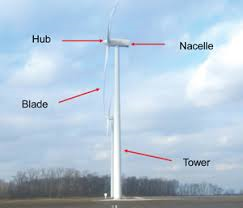
Blade arc—The arc created by the edge of the rotor blade that is farthest from the nacelle.
Fall zone—The area, defined as the furthest distance from the tower base, in which a tower will collapse in the event of a structural failure. This area is no greater than the total height of the structure.
Feeder line—Any power line that carries electrical power from one or more wind turbines or individual transformers associated with an individual wind turbine to the point of interconnection with the electric power grid, in the case of interconnection with the high voltage transmission systems the point of interconnection shall be the substation serving the WECS.
Meteorological tower—For the purposes of this LUC, meteorological towers are those towers that are erected primarily to measure wind speed and directions plus other data relevant to siting WECS. Meteorological towers do not include towers and equipment used by airports, the Colorado Department of Transportation, or other similar applications to monitor weather conditions.
Micro-WECS—Micro-WECS are WECS of five (5) kW nameplate generating capacity or less mounted on a tower.
Non-participating—Any landowner except those on whose property all or a portion of a Wind Energy Facility is located pursuant to an agreement with the Facility Owner or Operator.
Project site—The geographic area of an aggregated site or wind farm project that includes location of all turbines.
Property line—The boundary line of the area over which the entity applying for WECS permit has legal control for the purposes of installation of a WECS. This control may be attained through fee title ownership, easement, or other appropriate contractual relationship between the project developer and landowner.
Rated power output—the electric power output of a WECS at a constant hub height and wind speed of 25 mph.
Rotor diameter—The diameter of the circle described by the moving rotor blades.
Shadow flicker—Alternating changes in light intensity caused by the movement of Wind Turbine blades casting shadow on the ground or a nearby stationary object.
Significant shadow flicker—More than 30 hours per year of shadow flicker on adjacent property.
Substations—Any electrical facility designed to convert electricity produced by wind turbines to a voltage greater than (35,000 KV) for interconnection with high voltage transmission lines shall be located outside of the road right of way.
Total height—The highest point, above ground level, reached by a rotor tip or any other part of the WECS.
Transmission line—Those electrical power lines that carry voltages of at least 69,000 volts (69 KV) and are primarily used to carry electric energy over medium to long distances rather than directly interconnecting and supplying electric energy to retail customers.
Tower—Towers include vertical structures that support the electrical generator, rotor blades, or meteorological equipment.
Tower height—The total height of the WECS exclusive of the rotor blades.
Wind energy conversion system (WECS)—An electrical generating facility comprised of one or more wind turbines and accessory facilities, including but not limited to, power lines, transformers, and substations that operate by converting the kinetic energy of wind into electrical energy. The energy maybe used on-site or distributed into the electrical grid.
Wind turbine—A wind turbine is any piece of electrical generating equipment that converts the kinetic energy of blowing wind into electrical energy by airfoils or similar devices to capture the wind.
X.
X Terms.
"Xeriscape:" Landscape methods which conserve water through the use of drought-tolerant plants and planting techniques.
Y.
Y Terms.
"Yard, service or storage:" Any land or buildings used primarily for the storage of equipment, vehicles, machinery, or materials.
Z.
Z Terms.
"Zoning administrator:" An officer designated by the Mayor to enforce the provisions of this Code.
"Zoning development permit:" A permit issued by the Zoning Administrator that allows a developer to engage in development in compliance with all applicable sections of this Code and further enables the developer to seek a Building Permit that would allow the developer to commence actual development.
"Zoning map:" The certified Official Zoning Map upon which the boundaries of the various zoning districts are drawn.
(Ord. No. 565, § 1(Exh. A), 7-10-2023)
Section 2.7. - Flood hazard definitions.
The terms in this section are applicable to Section 9.5, Flood Hazard Regulations only. Unless specifically defined below, these words or phrases shall be interpreted to give them the meaning they have in common usage and to give Section 9.5 its most reasonable application.
"Alluvial fan flooding:" means flooding occurring on the surface of an alluvial fan or similar landform which originates at the apex and is characterized by high-velocity flows; active processes of erosion, sediment transport, and deposition; and unpredictable flow paths.
"Area of shallow flooding:" means a designated AO, AH or VO zone on a community's Flood Insurance Rate Map (FIRM) with a one percent chance or greater annual chance of flooding to an average depth of one to three feet where a clearly defined channel does not exist, where the path of flooding is unpredictable and where velocity flow may be evident. Such flooding is characterized by ponding or sheet flow.
"Area of special flood hazard:" is the land in the floodplain within a community subject to a one percent or greater chance of flooding in any given year. The area may be designed as Zone A on the Flood Hazard Boundary Map (FHBM). After a detailed ratemaking has been completed in preparation for publication of the FIRM, Zone A usually is refined into Zones A, AE, AH, AO, A1-99, VO, V1-30, VE or V.
"Base flood:" means the flood having a one percent chance of being equaled or exceeded in any given year.
"Basement:" means any area of the building having its floor sub-grade (below ground level) on all sides.
"Development:" means any man-made change in improved and unimproved real estate, including but not limited to buildings or other structures, mining, dredging, filling, grading, paving, excavation or drilling operations or storage of equipment or materials.
"Elevated building:" means for insurance purposes, a nonbasement building which has its lowest floor raised above ground level by foundation walls, shear walls, posts, piers, pilings or columns.
"Existing construction:" means for the purposes of determining rates, structures for which the "start of construction" commenced before the effective date of the FIRM or before January 1, 1975, for FIRMs effective before that date. "Existing construction" may also be referred to as "existing structures."
"Existing manufactured home park" or "subdivision:" means a manufactured home park or subdivision for which the construction of facilities for servicing the lots on which the manufactured homes are to be affixed (including, at a minimum, the installation of utilities, the construction of streets, and either final site grading or the pouring of concrete pads) is completed before the effective date of the floodplain management regulations adopted by a community.
"Expansion to an existing manufactured home park" or "subdivision:" means the preparation of additional sites by the construction of facilities for servicing the lots on which the manufactured homes are to be affixed (including the installation of utilities, the construction of streets, and either final site grading or the pouring of concrete pads).
"Flood" or "flooding:" means a general and temporary condition of partial or complete inundation of normally dry land areas from:
1.
The overflow of inland or tidal waters.
2.
The unusual and rapid accumulation or runoff of surface waters from any source.
"Flood insurance rate map (FIRM):" means an official map of a community, on which the Federal Emergency Management Agency has delineated both the areas of special flood hazards and the risk premium zones applicable to the community.
"Flood insurance study:" is the official report provided by the Federal Emergency Management Agency. The report contains flood profiles, water surface elevation of the base flood, as well as the Flood Boundary-Floodway Map.
"Floodplain" or "flood-prone area:" means any land area susceptible to being inundated by water from any source (see definition of flooding).
"Floodplain management:" means the operation of an overall program of corrective and preventive measures for reducing flood damage, including but not limited to emergency preparedness plans, flood control works and floodplain management regulations.
"Floodplain management regulations:" means zoning ordinances, subdivision regulations, building codes, health regulations, special purpose ordinances (such as a floodplain ordinance, grading ordinance and erosion control ordinance) and other applications of police power. The term describes such state or local regulations, in any combination thereof, which provide standards for the purpose of flood damage prevention and reduction.
"Flood protection system:" means those physical structural works for which funds have been authorized, appropriated, and expended and which have been constructed specifically to modify flooding in order to reduce the extent of the areas within a community subject to a "special flood hazard" and the extent of the depths of associated flooding. Such a system typically includes hurricane tidal barriers, dams, reservoirs, levees or dikes. These specialized flood modifying works are those constructed in conformance with sound engineering standards.
"Flood proofing:" means any combination of structural and non-structural additions, changes, or adjustments to structures which reduce or eliminate flood damage to real estate or improved real property, water and sanitary facilities, structures and their contents.
"Floodway (regulatory floodway):" means the channel of a river or other watercourse and the adjacent land areas that must be reserved in order to discharge the base flood without cumulatively increasing the water surface elevation more than a designated height.
"Highest adjacent grade:" means the highest natural elevation of the ground surface prior to construction next to the proposed walls of a structure.
"Historic structure:" means any structure that is:
1.
Listed individually in the National Register of Historic Places (a listing maintained by the Department of Interior) or preliminarily determined by the Secretary of the Interior as meeting the requirements for individual listing on the National Register;
2.
Certified or preliminarily determined by the Secretary of the Interior as contributing to the historical significance of a registered historic district or a district preliminarily determined by the Secretary to qualify as a registered historic district;
3.
Individually listed on a state inventory of historic places in states with historic preservation programs which have been approved by the Secretary of Interior; and
4.
Individually listed on a local inventory or historic places in communities with historic preservation programs that have been certified either:
a.
By an approved state program as determined by the Secretary of the Interior or;
b.
Directly by the Secretary of the Interior in states without approved programs.
"Levee:" means a man-made structure, usually an earthen embankment, designed and constructed in accordance with sound engineering practices to contain, control, or divert the flow of water so as to provide protection from temporary flooding.
"Levee system:" means a flood protection system which consists of a levee, or levees, and associated structures, such as closure and drainage devices, which are constructed and operated in accordance with sound engineering practices.
"Lowest floor:" means the lowest floor of the lowest enclosed area (including basement). An unfinished or flood resistant enclosure, usable solely for parking or vehicles, building access or storage in an area other than a basement area is not considered a building's lowest floor; provided that such enclosure is not built so as to render the structure in violation of the applicable non-elevation design requirement of Section 60.3 of the National Flood Insurance Program regulations.
"Manufactured home:" means a structure transportable in one or more sections, which is built on a permanent chassis and is designed for use with or without a permanent foundation when connected to the required utilities. The term "manufactured home" does not include a "recreational vehicle".
"Manufactured home park" or "subdivision:" means a parcel (or contiguous parcels) of land divided into two or more manufactured home lots for rent or sale.
"Mean sea level:" means, for purposes of the National Flood Insurance Program, the National Geodetic Vertical Datum (NGVD) of 1929 or other datum, to which base flood elevations shown on community's Flood Insurance Rate Map are referenced.
"New construction:" means, for the purpose of determining insurance rates, structures for which the "start of construction" commenced on or after the effective date of an initial FIRM or after December 31, 1974, whichever is later, and includes any subsequent improvements to such structures. For floodplain management purposes, "new construction" means structures for which the "start of construction" commenced on or after the effective date of a floodplain management regulation adopted by a community and includes any subsequent improvements to such structures.
"New manufactured home park" or "subdivision:" means a manufactured home park or subdivision for which the construction of facilities for servicing the lots on which the manufactured homes are to be affixed (including at a minimum, the installation of utilities, the construction of streets, and either final site grading or the pouring of concrete pads) is completed on or after the effective date of floodplain management regulations adopted by a community.
"Recreational vehicle:" means a vehicle which is:
1.
Built on a single chassis;
2.
400 square feet or less when measured at the largest horizontal projections;
3.
Designed to be self-propelled or permanently towable by a light duty truck; and
4.
Designed primarily not for use as a permanent dwelling but as temporary living quarters for recreational, camping, travel, or seasonal use.
"Start of construction:" (for other than new construction or substantial improvements under the Coastal Barrier Resources Act (Pub. L. 97-348)), includes substantial improvement and means the date the building permit was issued, provided the actual start of construction, repair, reconstruction, rehabilitation, addition, placement, or other improvement was within 180 days of the permit date. The actual start means either the first placement of permanent construction of a structure on a site, such as the pouring of slab or footings, the installation of piles, the construction of columns, or any work beyond the stage of excavation; or the placement of a manufactured home on a foundation. Permanent construction does not include land preparation, such as clearing, grading and filling; nor does it include the installation of streets and/or walkways; nor does it include excavation for basement, footings, piers or foundations or the erection of temporary forms; nor does it include the installation on the property of accessory buildings, such as garages or sheds not occupied as dwelling units or not part of the main structure. For a substantial improvement, the actual start of construction means the first alteration of any wall, ceiling, floor, or other structural part of a building, whether or not that alteration affects the external dimensions of the building.
"Structure:" means a walled and roofed building, including a gas or liquid storage tank, that is principally above ground, as well as a manufactured home.
"Substantial damage:" means damage of any origin sustained by a structure whereby the cost of restoring the structure to its before damaged condition would equal or exceed 50 percent of the market value of the structure before the damage occurred.
"Substantial improvement:" means any reconstruction, rehabilitation, addition, or other improvement of a structure, the cost of which equals or exceeds 50 percent of the market value of the structure before "start of construction" of the improvement. This includes structures which have incurred "substantial damage", regardless of actual repair work performed. The term does not, however, include either:
1.
Any project for improvement of a structure to correct existing violations of state or local health, sanitary, or safety code specifications which have been identified by the local code enforcement official and which are the minimum necessary conditions or
2.
Any alteration of a "historic structure", provided that the alteration will not preclude the structure's continued designation as a "historic structure."
"Variance:" is a grant of relief to a person from the requirement of this ordinance when specific enforcement would result in unnecessary hardship. A variance, therefore, permits construction or development in a manner otherwise prohibited by this ordinance. (For full requirements see Section 60.6 of the National Flood Insurance Program regulations.)
"Violation:" means the failure of a structure or other development to be fully compliant with the community's floodplain management regulations. A structure or other development without the elevation certificate, other certifications, or other evidence of compliance required by Section 9.5 is presumed to be in violation until such time as that documentation is provided.
"Water surface elevation:" means the height, in relation to the National Geodetic Vertical Datum (NGVD) of 1929 (or other datum, where specified), of floods of various magnitudes and frequencies in the floodplains of coastal or riverine areas.
Section 2.8. - Sign definitions and measurements.
A.
Applicability.
This section applies to all sign types and classifications.
B.
Building Frontage.
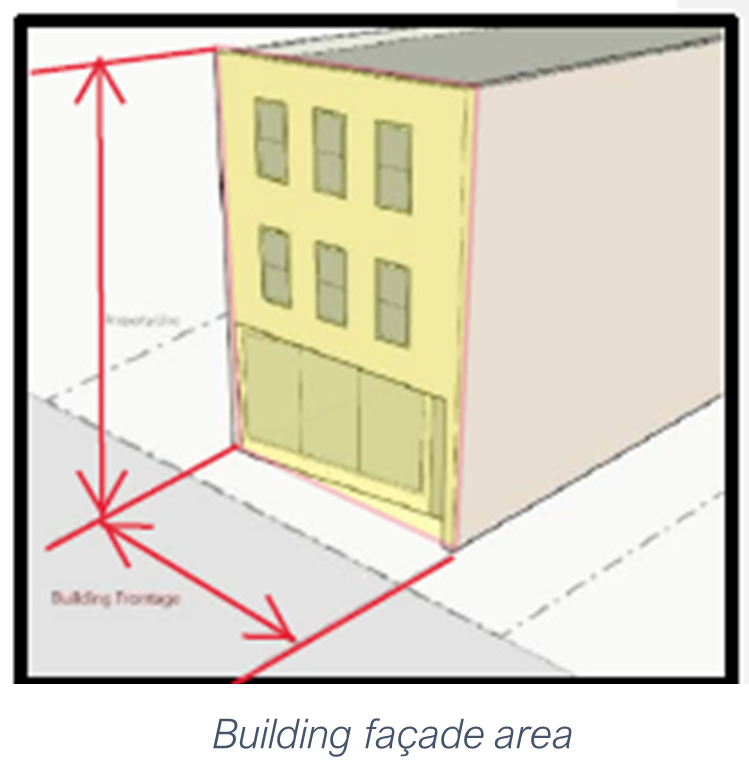
1.
Building frontage (or façade) is the wall of the primary building that faces the street abutting the property. Façade area is measured as width x height, as shown in Figure 1. If the primary building is located on a corner lot, the frontage may be any or all wall(s) of the primary building that face a street.
2.
Accessory structures shall not be included in the calculation of maximum signage. Wall signs may be affixed to accessory structures.
3.
The surface area of a wall shall be determined by measuring the building height and multiplying it by the length of the wall, without deduction for doors and windows. "False fronts" and mansard roofs shall not be included when calculating the total area of a wall.
C.
Clearance.
Clearance is the area under the sign that shall be free of obstructions to allow passage of pedestrians and vehicles. Clearance for pole and projecting signs shall be measured as the smallest vertical distance between the sign and the finished grade directly underneath the sign at the lowest point of the sign structure, including any framework or other structural elements.
D.
Height.
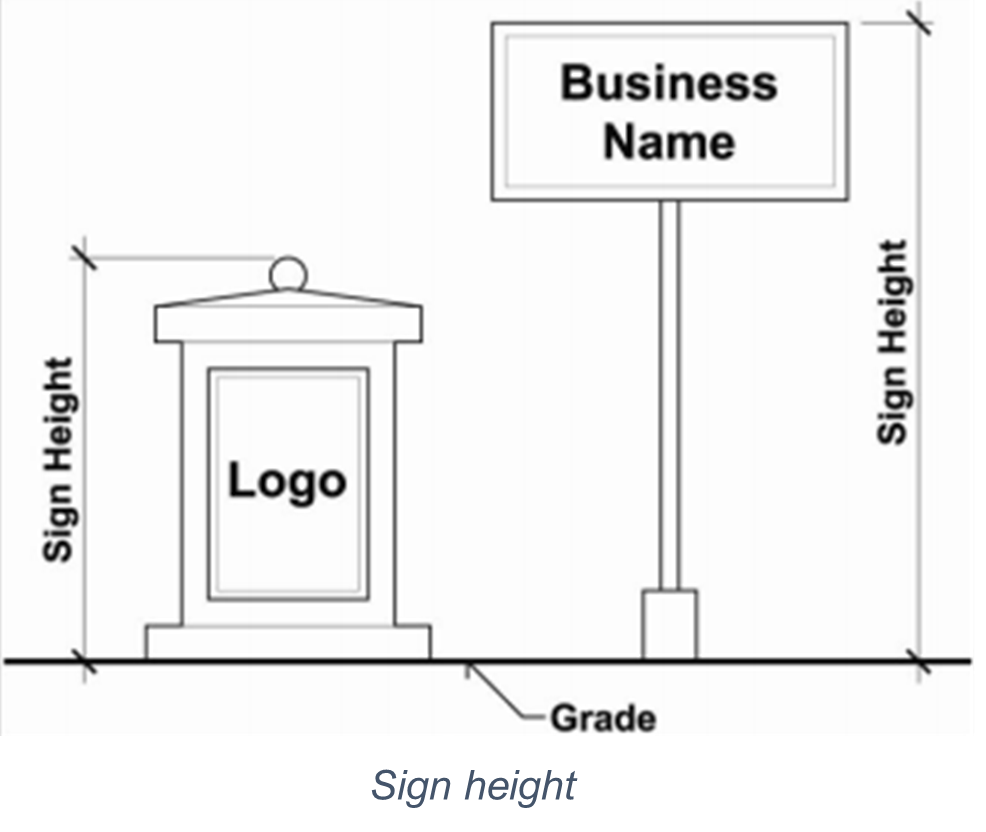
1.
Sign height is measured from the average finished grade at the sign foundation to the top of the highest attached component of the sign.
2.
When the existing finished grade at the point of measurement is lower than the average elevation of the adjacent street finished grade parallel to the location where the sign will be installed, that portion of the sign below the street shall not be included in determining the sign's overall height. If a sign is located on a mound, berm, or other raised area for the sole purpose of increasing the height of the sign, the height of the mound, berm, or other raised area shall be included in the height of the sign.
E.
Setback.
Setback is measured at that portion of any sign or sign structure that is closest to the property line.
F.
Sign Area.
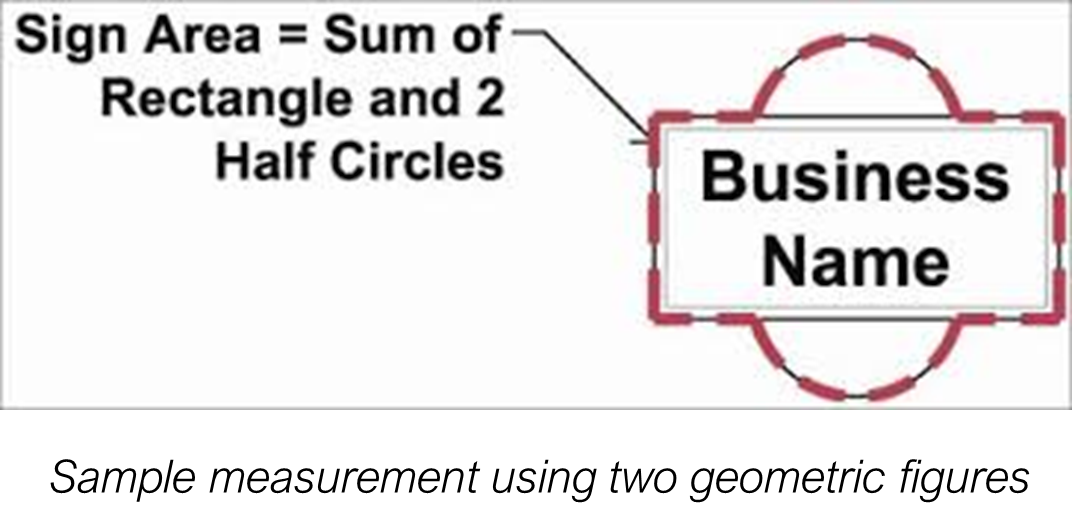
1.
The area of a sign shall be measured excluding the outside dimension of the frame, structure or bracing of the sign. Where a sign has two or more display faces, the area of one face shall be used in determining the area of the sign.
2.
The area of a signs with or without backing shall be computed by enclosing, with the smallest single continuous perimeter, all backing, background, materials, letters, numbers or emblems, which are part of the overall display.
a.
Individual letter signs using a wall as the background without added decoration or change in wall color shall be calculated by measuring the perimeter enclosing each letter. The combined total area of each individual letter shall be considered the total area of the sign.
b.
Sign copy mounted, affixed, or painted on a background panel or area distinctively painted, textured, or constructed as a background for the sign copy, is measured as that area contained within the sum of the smallest geometric figure that will enclose both the sign copy and the background.
c.
Module signs consisting of more than one sign cabinet shall be computed by adding together the total area of each module.
d.
Window signs printed on a transparent film and affixed to a window pane shall be measured as freestanding letters or logos, provided that the portion of the transparent film around the perimeter of the sign message maintains the transparent character of the window and does not contain any items in the sign message.
e.
If elements of a sign are movable or flexible, such as a flag or banner, or if the sign includes any permitted copy extensions, the measurement is taken when the elements or extensions are fully extended and parallel to the plane of view.
3.
Sign area includes only one side of a freestanding double-faced sign, so the area of a two-sided sign equals the area of one side.
a.
The second face may not exceed the area of the first face.
b.
If an angle of 30° for a "V" sign is exceeded, the area of both sign faces shall be included in the measurement of total sign area, except that the sign area for an A-frame sign is measured on one face of the sign regardless of the distance between the sign faces.
4.
Window sign area percentage is measured for each architecturally distinct window by dividing the sign area by the window area.
5.
Inflatables shall be measured by square feet of surface volume.
6.
The area of a spherical, cubical, or polyhedral sign equals 1/2 the total surface area.
G.
Spacing and Separation.
Spacing is a required linear distance between signs that is measured in feet. Sign separation shall be measured along the property lines from the center of the sign.
H.
Definitions.
"A-frame sign:" a temporary, portable sign consisting of two sign faces placed together at an angle of 90 degrees or less to form an "A" shaped structure that tapers from a wide base to a narrow top that is readily movable and has no permanent attachment to a building, structure, or the ground.
"Access point sign:" a sign located at a vehicular access point to a property.
"Alley:" a public street not designed for general travel and used primarily as a means of access to the rear of residences and business establishments.
"Attached sign:" a sign that is mounted on or attached to a structure, including a wall sign, window sign, roof sign, or projecting sign.
"Awning:" A roof-like cover that projects from the wall of a building for the purpose of shielding a doorway or window from the elements. An awning is either permanently attached to a building or can be raised or retracted to a position against the building when not in use.
"Awning sign:" a type of sign with one face affixed to an awning.
"Banner sign:" a type of temporary sign that is painted or printed on cloth, vinyl, or other flexible material, which is designed to be stretched between poles, fence posts or wire, mounted in a free-standing frame, or hung on walls with ties, clips, rails, brackets, hooks, or frames.
"Billboard:" a sign with at least one sign face that is greater than 70 square feet and is supported by one or more uprights and braces in the ground.
"Canopy:" An attached or detached structure, open on at least one side, that is designed to provide overhead shelter from the sun or weather. Canopies include, but are not limited to, service station canopies, carports, porte-cochères, arcades, and pergolas. A canopy is different from an awning in that a canopy is not covered with fabric or flexible material. Permanent, freestanding canopies such as service station canopies are referred to as structural canopies for the purposes of sign regulation.
"Canopy sign:" a type of sign with one face affixed to a canopy.
"Changeable copy sign:" a sign for which the informational content can be changed or altered by manual means. A changeable copy sign with copy that is changed electronically is referred to as an Electronic Message Center (EMC).
"Commercial speech:" expression by a speaker for the purposes of commerce, where the intended audience is actual or potential consumers, and where the content of the message is commercial in character. Commercial speech typically advertises a business or business activity or proposes a commercial transaction.
"Copy:" the wording on a sign surface either in permanent or removable form.
"Copy area:" the geometric area in square feet that encloses the copy of the sign.
"Copy extension:" that part of the sign area which extends beyond the edge or border of the sign.
"Curb line:" the line at the face of the curb nearest to the street or roadway. In the absence of a curb, the Town Engineer shall establish the curb line.
"Double-faced sign:" a sign with two faces that are parallel or within 30° of parallel.
"Durable:" a nonbiodegradable material with a proven serviceable lifespan of 25 years or more that withstands degradation from the elements.
"Electronic message center (EMC):" an electronic sign that utilizes lighted content, whether static or motion, to advertise products, services and businesses, and is digitally programmed and controlled, either directly or indirectly, by the use of a computer or software. The term electronic message center sign includes, but is not limited to, light-emitting diodes, liquid crystal displays and plasma screen displays.
"Erects:" to build, construct, attach, place, suspend, or affix, including the painting of a wall sign.
"Event sign:" an off-premises sign associated with a community event or facility.
"Facade:" the exterior face of a building, including but not limited to the wall, windows, windowsills, doorways, and design elements. the front facade is any building face adjacent to the front lot line.
"Flag:" A flexible piece of fabric, that is attached along one edge to a straight, rigid flagpole (directly or with rope), and which is designed to move when the wind blows. Flags are typically (but not necessarily) rectangular in shape, and often (but not always) include printed or embroidered insignia that symbolizes a nation, state, or organization, or that display a graphic or message.
"Flashing:" a change of light intensity in a sudden transitory burst or that switches on and off in a constant pattern with more than one-third of the light source that is not constant being off at any one time.
"Freestanding sign:" a ground-mounted sign erected on a permanently set pole or poles, mast, or framework that is not mounted on or attached to a structure; includes an access point sign, monument sign, or pole sign.
"Frontage:"
1.
Building means the wall of the primary building that faces the street abutting the property. If the building is located on a corner lot, the frontage may be any of the walls of the primary building that face a street.
2.
Lot means the length of the property line of any one property along a public right-of-way on which it borders.
3.
Street means the length of the property line of any one property along a public right-of-way on which it borders, measured along the property line.
"Front wall:" Is a building wall fronting the primary street or housing the primary entrance to the business.
"Garage" or "yard sale sign:" a temporary sign associated with a garage/yard sale event.
"Grade:" The lowest point of elevation of the finished surface of the ground, or the lowest point of elevation of the finished surface of the ground between the exterior wall of the building and the property line, if there is less than five feet distance from the wall. In cases where walls are parallel to and within 20 feet of a public sidewalk, alley or other public way, the grade shall be the elevation of the sidewalk, alley, or public way.
"Inflatable sign:" a large balloon or balloon-like object greater than 18 inches in any dimension that uses blown air or a gas to remain inflated.
"Interior sign:" any sign that is "interior" to a property or development that is not intended for view or readily legible from the public right-of-way.
"Interpretive sign:" a sign associated with historic buildings or sites where important events occurred or which serve educational, cultural, historical, or scientific purposes.
"Light projection sign:" any image, text, or other content that is projected onto an outdoor surface (e.g., a building wall, window, or sidewalk) by a laser projector, video projector, video mapping, or other comparable technology, in a location such that the image, text, or content is obviously visible from outside of the property.
"Mansard roof:" a sloped roof or roof-like facade architecturally able to be treated as a building wall.
"Marquee:" a permanent structure, other than a roof or canopy, attached to, supported by, and projecting from a façade of a building.
"Maximum allowable sign area:" the total area permitted for nonexempt signs on a site.
"Monument sign:" a sign supported by the ground upon a pedestal base or monument foundation.
"Mobile billboard:" a sign attached in any way to a vehicle operating in the public right-of-way, that is used for the primary purpose of advertising, and where the vehicle is either: (1) not used primarily for the transportation of passengers for hire or goods, or (2) is not designed for the transportation of passengers for hire or goods.
"Multiple-tenant building:" a single commercial structure that houses more than one retail business, office or commercial venture, and that may include residential apartment buildings on upper floors, sharing the same lot, access and/or parking facilities.
"Mural:" a mural or artwork painted on or otherwise affixed to the exterior wall of a building wall that does not contain a commercial message and that does not otherwise meet the definition of a sign. Exterior surface color alone is not considered a mural or artwork.
"Nonconforming sign:" any sign lawfully constructed prior to the enactment of the ordinance codified in this title, which fails to conform to the provisions of this title.
"Nonstructural trim:" the molding, batons, caps, nailing strips, latticing, cutouts or letters and walkways that are attached to the sign structure.
"Off-premises sign:" a sign that carries a message of any kind or directs attention to a business, commodity, service, or entertainment conducted, sold, or offered elsewhere than upon the premises where such sign is located, or to which it is affixed.
"On-premises sign:" a sign advertising any product, service, use, or enterprise sold or offered at the location where the sign is physically located.
"Open house sign:" a sign associated with an open house event.
"Parapet:" a false front or wall extension above the roof line.
"Parcel:" the real property on which a business is located or the portion of real property designated for use of a business. Parcel shall include all adjacent property used by a business including yards, parking lots, and storage yards. Where more than one business is located within a building, the property on which that building is located is considered one parcel.
"Pedestrian-oriented sign:" a sign designed at a scale that is appropriate to provide information for pedestrians and bicyclists.
"Pennant:" a piece of fabric, plastic or other flexible medium that may be in the shape of a triangle, rectangle or other shape, is typically mounted to a flexible cord or rope that is stretched across two points, is mounted in quantity and spaced along the cord or rope.
"Perimeter:" a square or rectangle required to enclose the sign area.
"Person:" persons, firms, partnerships, associations, corporations, and other business entities.
"Pole sign:" a self-supported sign permanently attached directly to the ground supported by upright poles or posts or braces placed on or in the ground. Pole signs may be mounted on more than one pole and pylon signs are included in the term pole sign.
"Political sign:" a temporary sign associated with an election event.
"Portable readerboard:" a sign supported by feet or wheels that is not permanently affixed to the ground, structure, or building but is mounted on an easel, trailer, or other movable equipment and that typically displays a changing message using manual changeable copy or EMC.
"Premises:" any one or more parcels directly abutting each other and all under the same ownership, upon which any building is located.
"Primary building:" the building in a multi-unit multifamily development located at the main access to the complex or where the office functions are provided for the complex.
"Projection:" the distance by which a sign extends over public property or beyond the property line.
"Public event:" an event on private property that is open to the public.
"Real estate sign:" a temporary sign associated with an active real estate listing.
"Repair, renewal, refurbishment and restoration are synonymous and may be used interchangeably to mean "to restore to a former, better state, and resembling the original design and construction as closely as possible" when describing a damaged sign" or "a sign in disrepair."
"Revolving sign:" any sign that rotates or turns in a circular motion by electrical or mechanical means and does not exceed eight revolutions per minute.
"Roof sign:" a business sign erected upon or above a roof or parapet of a building or structure. Mansard roof signs shall be considered wall signs.
"Roofline:" the top edge of a roof or parapet or the top line of a building silhouette.
"Seasonal decorations:" decorations and temporary signs that are clearly incidental, customary, and commonly associated with a holiday, birthday, anniversary, graduation or similar occasion.
"Sign:" Any letter, figure, character, mark, plane, point marquee sign, design poster, pictorial, picture, stroke, stripe, line, trademark, or reading matter of illuminated or non illuminated surface that shall be so constructed, placed, attached, painted, erected, fastened, or manufactured in any manner whatsoever, so that the same shall be used for the attraction of the public to any place, subject, person, firm, corporation, public performance, article, machine, or merchandise whatsoever, that is displayed in any manner whatsoever out of doors.
"Sign:" means any device, structure, fixture, painting, emblem, or visual that uses words, graphics, colors, illumination, symbols, numbers, or letters for the purpose of communicating a message. Sign includes the sign faces as well as any sign supporting structure. The term sign shall not include the following:
1.
Art that does not include commercial speech;
2.
Window displays of merchandise or products; or
3.
Products, merchandise, or other materials which are offered for sale or used in conducting a business, when such products, merchandise, or materials are kept or stored in a location which is designed and commonly used for the storage of such products, merchandise, or materials.
"Sign area:" the total area of a sign visible from any one viewpoint or direction, excluding the sign support structure, architectural embellishments, or framework that contains no written copy.
"Sign face:" the area made available by the sign structure for the purpose of displaying the sign copy.
"Sign height:" the vertical distance measured from the adjacent grade at the base of the sign support to the highest point of the sign or sign structure, whichever is higher.
"Sign structure:" any structure supporting or capable of supporting any sign defined in this chapter. A sign structure may be a single pole or may or may not be an integral part of the building or structure.
"Special event sign:" a sign associated with a permitted special event.
"Temporary sign:" A sign that is: (1) constructed of cloth, canvas, vinyl, paper, plywood, fabric, or other lightweight material not well suited to provide a durable substrate; or (2) if made of some other material, is neither permanently installed in the ground, nor permanently affixed to a building or structure that is permanently installed.
"Vehicle sign:" any magnetic sign(s), signs painted or wrapped on, adhesive vinyl film affixed to a window, or attached by other temporary or permanent means to a vehicle, where the vehicle is owned by the business, is operable and properly licensed, and the vehicle is regularly and consistently used in the normal daily conduct of the business, such as delivering or transporting goods or providing services related to the business. Vehicle signs do not include mobile billboards.
"Wall sign:" a sign attached or erected parallel to and extending from the facade or wall of any building to which it is attached. A wall sign is supported through its entire length with the exposed face of the sign parallel to the plane of said wall or facade. A sign painted on the wall of a building shall be considered a wall sign.
"Wind sign:" a display of pennants, streamers, balloons, whirligigs, wind blades, or similar devices, activated by wind.
"Window sign:" any sign which is painted or mounted onto an exterior window pane, or which is hung directly inside the window.
"Yard sign:" a type of temporary sign that is constructed of paper, vinyl, plastic, wood, metal, or other comparable material, which is mounted on a stake or a frame structure (often made from wire) that includes one or more stakes.
"Tenant:" a single incorporated use of a premise for which a certificate of occupancy has been issued, which is separated from another business by demising walls and has a separate entrance.

