
Dolores City Zoning Code
ARTICLE 13
- Administration and Procedures
Section 13.1.- Review and decision-making bodies.
A.
Planning and Zoning Commission (P&Z).
The Planning and Zoning Commission shall have the responsibilities provided by the Dolores Municipal Code Section 2.08 and as specified in this Land Use Code.
B.
Historic Preservation Board (HPB).
1.
Historic Preservation Board Established.
The Board of Trustees hereby creates the Historic Preservation Board ("HPB"), which shall have principal responsibility for matters of historic preservation.
a.
Membership. The HPB shall consist of the five regular members of the Planning and Zoning Commission, who shall be persons who have an interest and knowledge of local history.
b.
Quorum and Voting. A quorum for the Board shall consist of three members. A quorum is necessary for the Board to conduct business, including holding a public hearing. A roll call vote shall be taken upon the request of any member. A tie vote shall be deemed a denial of the motion or recommended action.
c.
Officers. Officers of the HPB shall be the same as the officers of the Planning and Zoning Commission.
d.
Meetings. The HPB shall hold meetings as necessary to the business of the Board. Minutes shall be kept of all HPB proceedings. The HPB shall conduct its business in accordance with the Public Meetings Acts, Public Records Act, and other laws applicable to local public bodies.
2.
Powers and Duties.
The HPB shall, after solicitation of public comment and at a properly noticed public meeting, do any of the following:
a.
Recommend eligibility criteria for the designation of historic resources and for review of proposals to alter designated resources.
b.
Review and determine qualifications of properties nominated for designation as either an historic structure, site or district and recommend to Board of Trustees approval or denial of a designation.
c.
Upon property owner's request, review and make recommendations to the owner(s) on proposed alternations to a designated historic structure, site, or district.
d.
Advise and assist owners of historic properties on physical and financial aspects of preservation, renovation, rehabilitation, and reuse, including nomination to the Town Register, the State Register and the National Register of Historic Places.
e.
Develop and assist in public education programs including, but not limited to, walking tours, brochures, a marker program for historic properties, lectures, exhibits and conferences.
f.
Conduct surveys of historic sites, properties, and areas for the purpose of defining those of historic significance and prioritizing the importance of identified historic areas.
g.
The HPB may create a list of structures of historical or archaeological merit which have not been designated.
h.
Advise the Board of Trustees on matters related to preserving the historic character and substance of the Town and recommend easements, covenants, licenses and other methods which would implement the completion of purposes of this ordinance.
i.
Actively pursue financial assistance for preservation-related programs.
j.
The HPB shall propose to the Board of Trustees bylaws as the HPB deems necessary.
k.
Recommend to Board of Trustees the establishment of construction and design standards for the renovation or alteration of historic structures and new construction within designated historic districts.
C.
Board of Adjustment.
1.
Creation and Organization.
There is hereby created a board known as the Board of Adjustment ("BOA"), which shall be organized as follows:
a.
The Board of Adjustment shall consist of the five regular members of the Planning and Zoning Commission.
b.
The Board of Trustees shall have the power to remove any member of the Board of Adjustment for cause after official public hearing.
2.
Officers and Procedures.
a.
Members of the Board of Adjustment shall elect from their members a chairperson to serve for a term of one year and may adopt such rules as may be necessary for the conduct of its business.
b.
The chairperson shall preside over meetings. In the event questions over procedures arise, Robert's Rules of Order shall apply.
c.
The recording of the minutes of the Board of Adjustment meetings shall be the responsibility of the staff.
d.
The Board of Adjustment may adopt rules to govern its proceedings and conduct of the business before the Board of Adjustment provided, however, that such rules are not inconsistent with this Code or Statutes of the State of Colorado.
e.
Meetings of the Board of Adjustment shall be held at the call of the chairperson, and at such other times as the Board may determine. The chairperson or, in the absence of the chairperson, the vice chairperson shall administer oaths and compel attendance of witnesses. All meetings of the Board of Adjustment shall be open to the public. Minutes of its proceedings shall be kept by the staff showing the vote of each member upon such question or, if absent or failing to vote, indicating such fact, and shall keep records of its examinations and other official actions, all of which shall be filed in the office of the Board of Adjustment and shall be a public record.
3.
Powers and Duties.
The Board of Adjustment shall have the following powers, and shall have the power to impose reasonable conditions to ensure compliance and protect adjacent property:
a.
To hear and decide appeals where it is alleged there is error in any order, requirement, decision, or determination made by an administrative official of the Town in the enforcement of this Code, pursuant to Section 13.8, Appeals of Administrative Decisions.
b.
To permit variance or modifications of the height of structures, yard, area, coverage, and parking regulations, pursuant to Section 13.27, Variances.
c.
To grant variances from flood hazard standards. The Board of Adjustment shall follow the guidelines set forth in Section 9.6, Flood Hazard Regulations, when considering such variances.
4.
Record on Appeal.
In the event any person appealing the Board of Adjustment is dissatisfied with the ultimate decision, the expense of reproducing the record before that Board for judicial appeal shall be at the expense of the appellant.
Section 13.2. - Administrative officials.
A.
Zoning Administrator.
There is hereby created an official administrative position known as the Zoning Administrator. The Zoning Administrator shall be appointed by, directed by, and serve at the pleasure of the Board of Trustees. The Zoning Administrator is entrusted with the jurisdiction, authority, and duty to administer, enforce, and interpret the LUC and to issue permits when approved as provided for in this Code. The Town Administrator may also serve as the Zoning Administrator.
B.
Building Official.
There is hereby created an official administrative position known as the Building Official. The Building Official shall be appointed by, directed by, and serve at the pleasure of the Board of Trustees. The Building Official has authority to enforce the Town's adopted building code, fire code, and any other adopted life safety codes; enforce the LUC; issue building and other life safety code-related permits; and to administer Section 9.6, Flood Hazard Regulations.
C.
Delegation of Authority.
The Town Administrator, Zoning Administrator, and Building Official may delegate associated responsibilities, duties, and tasks to other Town staff in accordance with Town policies. When this Code specifies that the Town Administrator, Zoning Administrator, or Building Official shall perform an act, it may be delegated by any of those officials without further instruction from this Code.
Section 13.3. - Summary table of review authority.
The responsibilities of officials and bodies for each LUC procedure are summarized in Table 13.1.
Section 13.4. - General procedures.
A.
Described.
1.
Generally Applicable Procedures.
The generally applicable procedures for review and decision-making for land use and development applications are established in this article. These are standard procedures that are applicable to all or most types of specific applications based on the following review steps:
a.
Pre-application meeting.
b.
Application submission and completeness review.
c.
Staff review.
d.
Public notice.
e.
Action by review and decision-making bodies.
f.
Appeal.
2.
Specific Procedures.
Sections 13.5 through 13.30 establish additional provisions for specific procedure types. Where the generally applicable procedures conflict with specific procedure provisions, the specific procedures provisions shall prevail.
3.
Applicable Common Steps by Specific Procedure.
Table 13.2 summarizes the procedural steps that are applicable for each specific application or action, and in the case of recommendations and decision hearings, which body has authority.
4.
Administrative Manual for Additional Materials.
The Zoning Administrator may compile the requirements for application contents, forms, fees, submission materials, and review schedule in an administrative manual or user's guide, which may be divided into sections or topics and which shall be made available to the public in print or electronic format. The Zoning Administrator may amend and update the administrative manual from time-to-time.
B.
Step 1: Pre-Application Meeting.
1.
Purpose.
The purpose of the pre-application meeting is to provide an opportunity for the applicant and the Town to discuss the development concept prior to the application submission for a project in order to:
a.
Determine the required application(s) and, if necessary, the timing of multiple application submittals (i.e., whether they may be processed concurrently or must be processed sequentially);
b.
Provide the applicant with application materials and inform the applicant of submittal requirements;
c.
Provide the applicant with an estimated time frame for the review process;
d.
Discuss generally compliance with the Code's zoning, use, density, development, and design standards, and attempt to identify potentially significant issues regarding compliance;
e.
Discuss the need for any neighborhood meetings and public notice requirements; and
f.
Refer the applicant to other departments or agencies to discuss potential significant issues prior to application submittal.
2.
Applicability.
This step is mandatory for special use permits, most subdivision application, rezoning requests, and other applications as identified in Table 13.2. A pre-application meeting is optional for the remaining procedures and may be scheduled by the Zoning Administrator at the request of an applicant.
3.
Evaluation Not Binding.
a.
The informal evaluation conducted by the Zoning Administrator and provided at the pre-application conference are not binding upon the applicant or the Town. The Town is not responsible for making or keeping a summary of the topics discussed at the pre-application meeting.
b.
A pre-application conference precedes the actual application, so some key issues relating to a specific proposal may not be apparent at the pre-application conference and may require additional review, submissions, or studies later in the application process.
4.
Applicant Representative.
An attorney, land planner, engineer, or surveyor may represent or assist the applicant in the pre-application meeting. The applicant shall be present at a mandatory pre-application meeting.
C.
Step 2: Submit Application.
The applicant is required to submit a formal application for all procedures and permit requests.
1.
Form of Application.
a.
The Zoning Administrator is authorized to establish submittal requirements for all land use development and permit applications required by this section and to update and amend such requirements as necessary to ensure effective and efficient Town review.
b.
Applicants shall refer to the individual application forms for submittal requirements for each type of land use development application.
c.
The applicant shall provide any additional information, documents, or other material relevant to the application that the Zoning Administrator reasonably believes is necessary in order for the Town to evaluate, analyze, and understand the subject matter of the application.
d.
Application submittal requirements, contents, form (printed or electronic), and fees shall be established on the individual application forms provided by the Town. Application forms may be revised and updated from time-to-time as determined necessary by the Zoning Administrator.
2.
Applicant Responsibility.
a.
The applicant shall prepare and submit an application that meets all requirements, including forms and fees. It is the applicant's responsibility to ensure that the application is complete and accurate.
b.
All applications required by this section shall be submitted to the Town offices unless otherwise specified.
3.
Waiver of Application Submission Requirements.
The Zoning Administrator may waive or alter specific application submission requirements if they are determined to be inappropriate or unnecessary to determining if the application satisfies applicable standards. The Zoning Administrator may not provide a general waiver of submission requirements.
a.
Applicants shall request the waiver of a submission requirement in writing as part of a pre-application meeting. Requests for waiver may not be submitted without a pre-application meeting.
b.
The Zoning Administrator shall review the application for waiver as part of the completeness review and make a determination regarding whether to waive or require the information. The Zoning Administrator may refer the application to the P&Z for consideration.
c.
A waiver request shall be considered based on the following criteria:
(1)
The applicant shows good cause for the requested waiver;
(2)
The project size, complexity, anticipated impacts, or other factors support a waiver;
(3)
The waiver does not compromise a proper and complete review; and
(4)
The information is not material to describing the proposal or demonstrating compliance with approval criteria.
d.
The Zoning Administrator shall notify the applicant in writing of the determination whether to waive submission requirements and include a summary of the decision in the staff report within five business days of the pre-application meeting or five business days of the P&Z meeting at which the request was reviewed.
e.
A waiver shall apply only to the specific application for which it was requested and shall not establish a precedent for approval of other requests.
f.
Once an application has been submitted it is too late to request a pre-application meeting or submission waiver; any late submission waiver requests shall not be considered.
4.
Reports and Studies.
a.
Reports or studies may be necessary to adequately evaluate the consequences of a proposed development and may be required as part of a specific application. These may include, but are not limited to, studies of soils, geological hazards, fiscal impacts, market analysis, traffic impacts, and environmental impacts.
b.
The applicant shall furnish the reports or studies needed at the applicant's cost. The applicant shall hire qualified professionals who have prepared similar studies in the region or State of Colorado. If the Board determines that information submitted by an applicant is insufficient or incomplete it may instruct the Town Administrator to hire a qualified professional and charge the applicant for the cost of preparation of a new or additional study.
5.
Fees.
a.
Fees for the review of an application shall be established from time-to-time by the Board of Trustees.
b.
The Town may also assess and collect such additional fees as are required by referral departments or agencies or as the Town may deem appropriate to adequately review an application. The Town shall base such additional fees upon the actual cost, whether by Town employees or independent third parties, of performing related plan and document preparation and review, inspection of construction of public and related improvements, and all related services, including attorney and engineering fees. Additional fees may be charged on a per-unit basis, such as foot or mile, and the Town may also include in such additional fees a factor for overhead or other indirect expenses.
c.
When changes are made to a complete application for which fees have been paid, the Town shall take the following actions:
(1)
Withdrawn Application: All fees are forfeited; the fee shall be paid again in full if the application is resubmitted.
(2)
Continuance of Application: Payment of additional fees may be required to cover the cost of additional notice.
(3)
Reapplication, Resubmission: Payment of fees shall be required for a reapplication or resubmission where a previous application has been denied. The Zoning Administrator may waive the application submission fee but is required to charge the applicant for actual costs associated with the resubmission.
(4)
Modification or Revision of Approved Preliminary Plan: Payment of the application fee shall be required to cover costs of re-review, less the cost of notice.
6.
Official Submission.
An application shall be officially submitted when it is presented in full to the Zoning Administrator, either through: 1) hand submitted copy of the application, or 2) electronically submitted copy of the application filed pursuant to instructions for electronic filing identified on the Town of Dolores webpage or portal (at such time as the Town makes this technology available), filed on a business day during normal office hours.
7.
Determination of Completeness.
a.
The Zoning Administrator shall determine whether the application is complete within 10 working days of submittal. A complete application is deemed sufficient in form and content such that recommendations, as required, and a decision may be made on the application by the Town officer or body authorized to review the application. The Zoning Administrator shall determine application sufficiency.
b.
If the application is incomplete, the Zoning Administrator shall inform the applicant in writing of the determination of incompleteness and specify, generally, which materials are missing or insufficient.
(1)
If the applicant fails to correct the deficiencies within 60 days, the application shall be considered withdrawn and returned to the applicant. Incomplete applications shall not be processed by the Town. The Town may retain the application fee paid. Once an application has been withdrawn, the application shall be resubmitted in full, including payment of all required fees.
(2)
An e-mail to the applicant or comment in the Town's permit online tracking system, if one is established, shall be considered a determination in writing.
c.
If the application is complete, the Zoning Administrator shall establish the filing date, inform the applicant of a determination of completeness and the filing date, and continue to Step 3: Staff Review and Report.
8.
Filing Date and Scheduling.
The filing date is established when the Zoning Administrator verifies that the application is complete. Complete applications shall be scheduled for public hearing on the next available agenda date of the appropriate review body following any required public notice. Applications for review that do not require a public hearing shall be reviewed within 30 days of a determination of completeness.
9.
Concurrent Application.
The applicant is encouraged, and may be required by the Town, to submit all applications necessary for a development on the same filing date. The concurrent applications shall be processed under the procedures for the primary application. Unless the Town determines otherwise, the primary application is the procedure type that is decided by the highest decision body. Concurrent applications shall be reviewed and recommended by every recommendation body for every application type being concurrently processed.
10.
Withdrawal.
At any time at least one business day prior to a decision hearing, the applicant may choose to withdraw the application for any reason by providing verbal or written notice to the Zoning Administrator. Notification of withdrawal of the application stops all further processing of the application.
11.
Limitation on Resubmission.
Whenever the Board of Appeals or Board of Trustees decides an application or an appeal of an application, no person shall submit an application that is the same, or substantially the same, for at least one year from the date of the final action on the application.
12.
Inactive Applications.
a.
Criteria: The Zoning Administrator may notify the applicant in writing that an application will be considered inactive unless corrective action is taken within 45 days, if at any point in a development review process the following have occurred:
(1)
The applicant fails to attend any scheduled mandatory meeting, meeting with the Zoning Administrator, meeting or hearing before the P&Z, BOA, or Board; or
(2)
The applicant has not responded to a staff report, has not agreed to a date for a meeting or hearing, or has not taken some other affirmative step within a reasonable time frame that is within the applicant's control and is necessary to advance the application for a final determination. A "reasonable time frame" shall be determined by the Zoning Administrator taking into account average response times from similar applicants on similar applications; or
(3)
The applicant fails to submit an application for the next required permit for the approved application within 2 years.
b.
Application Terminated: No further processing of any inactive application shall occur until the deficiencies are corrected. If the applicant does not correct the deficiencies within the 45-day correction period, the application shall be considered automatically withdrawn and terminated. Any re-submittal of the application thereafter by the applicant will be treated as a new application for purposes of review, scheduling, and payment of application fees.
D.
Step 3: Staff Review and Report.
Staff reviews the complete application, makes a determination for applications that are administratively approved, and prepares a report of findings for applications that are submitted to the P&Z, BOA, or Board for review determination.
1.
Administrative Decisions.
The process for administrative decisions is provided in Section 13.6.
2.
Referral to Agencies and Departments.
a.
When indicated as required for a specific procedure, the Zoning Administrator shall forward one copy of the application to:
(1)
Each of the referral agencies and departments named in the specific procedure section; and
(2)
Any additional county or state agency concerned with urban development or other subject matter relevant to the application, per the request of the agency, applicant, decision-making body, or Zoning Administrator.
b.
The Zoning Administrator shall inform each referral agency of the date in which comments shall be received to be included in the staff report. Each referral agency shall submit any comments or recommendations related to the application in writing to the Zoning Administrator at least 10 days prior to the first public meeting or public hearing for the application.
c.
The failure of any agency to respond shall be considered "no comment" on the application by that agency. As applicable, referring agencies will provide the review and decision-making bodies with a summary of any capacity evaluation study that assesses the availability of Town-provided facilities or services to the proposed development. The summary will include an explanation of the agency's assumptions regarding available capacity.
d.
Where a referral agency has authority to grant an approval that is necessary to the Town's final approval and has not done so prior to the Town reviewing the application, approval of the application may be conditioned upon the referral agency's granting any additional approval that is necessary.
3.
Review and Staff Report.
a.
Based on staff's review of the application against all applicable standards and criteria of the LUC, adopted policies of the Town, and written comments of all referral agencies and departments, staff shall prepare a written recommendation whether to approve, approve with conditions, or deny the application. If decision criteria are specified for the procedure, the recommendation shall include a draft of specific findings that support the recommendation for the decision-maker's review. If the recommendation is to approve with conditions, draft language of the specific conditions shall be stated in the report.
b.
At least five days prior to the meeting or hearing, the Zoning Administrator shall distribute the staff report to the applicant, referral agencies, and to the recommendation or decision-making body.
E.
Step 4: Recommendation.
The Planning Commission reviews the application and makes a recommendation to the decision-making body whether to approve, approve with conditions, or deny the application.
1.
Public Notice of Meeting.
Notice shall be provided in published, posted, or mailed forms as indicated in Table 13.3, Section 13.4.H, Public Notice Requirements, and specific procedures in Sections 13.5 through 13.30. Where the provisions of this section conflict with the provisions for specific procedures, the specific procedures provisions prevail.
2.
Public Meeting or Hearing.
a.
The Planning Commission shall review the application and staff report and issue a recommendation. As required by a specific application, this may be done in a public hearing.
b.
Where applicable, the public hearing shall be completed within 30 days of the filing date.
3.
Generally Applicable Review Criteria.
Unless otherwise specified in this section or the specific procedure, Town review and decision-making bodies shall review all development applications submitted pursuant to this section for compliance with the general review criteria stated below. The application may also be subject to additional review criteria specific to the type of application. In case of conflict between the general review criteria set forth in this section and the specific review criteria, the specific review criteria shall apply.
a.
Consistent with Prior Approvals: Where a preliminary plan or plat was submitted and approved, a subsequent application for the same development shall be consistent with the terms and conditions of such prior the preliminary plan or plat approval for the project including, without limitation, an approved phasing plan for development and installation of public improvements and amenities.
b.
Consistent with Comprehensive Plan: The proposal is consistent with the Dolores comprehensive plan and any applicable sub-area, neighborhood, sector, or district plan. The decision-making authority shall weigh competing plan goals, policies, and strategies and may approve an application that provides a public benefit even if the development is contrary to some of the goals, policies, or strategies in the comprehensive plan or other applicable plans.
c.
Compliance with Use and Development Standards: The proposal complies with all applicable use standards, site development standards, design standards, subdivision standards, public improvement standards, floodplain management standards, and all other applicable substantive standards stated in this LUC or other applicable Town code. Such compliance shall be applied at the level of detail required for the subject submittal, and those standards which are not otherwise modified, varied, or waived as allowed by this LUC.
d.
Compliance with Other Applicable Regulations: As applicable, prior to final approval of the proposed development pursuant to this LUC, the proposed development complies with all other Town regulations and with all applicable regulations, standards, requirements, or plans of the federal or state governments and other relevant jurisdictions, including but not limited to wetlands, water quality, erosion control, and wastewater regulations.
e.
Minimizes Adverse Environmental Impacts: The proposed development meets or exceeds all environmental protection standards in this LUC, is designed to minimize negative impacts, and does not cause significant adverse impacts on the natural environment, including but not limited to water, air, noise, storm water management, scenic resources, wildlife habitat, soils, native vegetation, and the natural functioning of the environment.
f.
Minimizes Adverse Impacts on Surrounding Property: The proposed development meets or exceeds all neighborhood protection standards in this LUC and all other site development standards intended at least in part to protect the existing character of neighboring properties and uses and does not cause significant adverse impacts on surrounding properties.
g.
Minimizes Adverse Fiscal or Economic Impacts: The proposed use will not result in significant adverse fiscal or economic impacts on community or the Town.
h.
Compliance with Utility, Service, and Improvement Standards: As applicable, the proposed development complies with federal, state, county, and/or service or special district standards and design/construction specifications for roads, access, drainage, water, sewer, schools, and emergency/fire protection.
i.
Provides Adequate Public Services and Facilities: There will be capacity to provide adequate public services and facilities to accommodate uses permitted under the proposed development at the time such needs or demands arise, while maintaining adequate levels of service to existing development. Public services and facilities include, but are not limited to, roads, domestic water, sewer, schools, public safety, fire protection, libraries, and vehicle/pedestrian connections and access within the site and to adjacent properties.
j.
Rational Phasing Plan: As applicable, the proposed phasing plan for development of the project is rational in terms of available infrastructure capacity. In addition, each phase of the development shall contain all of the required streets, utilities, landscaping, open space, and other improvements that are necessary and desirable for the residents and users of that phase and shall not be dependent upon subsequent phases for those improvements.
4.
Written Recommendation.
The Planning Commission shall consider all applicable standards and criteria of the LUC when making a recommendation.
a.
Within 10 working days of the public meeting, the Planning Commission shall submit a written recommendation to the Zoning Administrator. The Zoning Administrator shall provide a copy of the recommendation to the applicant.
b.
If the application process has specific decision criteria, the recommendation shall state specific findings that support the recommendation and identify any recommended conditions.
c.
If a decision-making body has authority to make the decision, the Zoning Administrator may amend the staff report to reflect the written recommendation and any new information discovered in the recommendation meeting. The amended staff report shall be submitted to the decision-making body for consideration.
F.
Step 5: Decision Hearing.
A decision-making body holds one or more hearings at which it reviews and decides whether to approve, approve with conditions, or deny the application.
1.
Public Notice of Hearing.
Notice shall be provided in published, posted, or mailed forms as indicated in Section 13.4.H, Public Notice Requirements. Where the provisions of Section 13.4.H conflict with the provisions for specific procedures, the specific procedures provisions prevail.
2.
Public Hearing.
a.
The decision-making body reviews the application, the staff report and recommendations from the P&Z and referral agencies in a public hearing.
b.
The public hearing shall be held within 30 days of the date in which the Zoning Administrator files the staff report or the P&Z files its written recommendation, whichever is later.
3.
Decision.
At the public hearing, the decision-making body decides whether the application is approved, approved with conditions, or denied.
a.
Decision Criteria: The decision-making body shall consider the generally applicable review criteria in Section 13.4.E.3, along with the decision criteria established for the specific application.
b.
Conditions.
(1)
The decision-making body may impose conditions on an approval to safeguard the welfare and protection of the Town and adjacent property.
(2)
Conditions of approval shall be reasonably related to the anticipated impacts of the proposed use or development on the site and surrounding properties and shall be based upon the review criteria specified in each procedure's adopted standards.
(3)
The decision-making authority may place specific time limits on the satisfaction of any condition of approval. If a time limit is not specified in the approval or in the specific provisions of this Code then a one-year time limit shall apply.
(4)
The decision-making authority may require financial guarantees from the applicant where it finds such guarantees are necessary to ensure compliance with conditions of approval and protect the public health, safety, or welfare. The Town shall release such guarantees when the Zoning Administrator has determined that all conditions attached to the approval have been or will be satisfied.
(5)
Conditions of approval shall be met or financial guarantees provided prior to the issuance of a certificate of occupancy or the appropriate final permit required by the Town.
c.
Written Decision.
(1)
Within 10 working days of a public hearing, the decision-making body shall submit a written record of the decision to the Zoning Administrator. The written record shall state the specific findings made to support the decision. If the decision is to approve with conditions, the written decision record shall state the specific conditions of the approval.
(2)
As soon as practicable, and within 5 days of receiving the written decision record, the Zoning Administrator shall send a notice of decision to the applicant.
(3)
For decisions by the Planning Commission, the Zoning Administrator shall forward a copy of the notice of decision to the Board.
4.
Withdrawal of Application by Applicant.
An applicant shall have the right to withdraw an application, without prejudice, at any time prior to action on the application at a public hearing or meeting.
a.
The applicant shall submit in writing the withdrawal request to the Zoning Administrator, and after such withdrawal, the Town will not take further action on the application.
b.
The application shall be considered terminated and no rights shall vest based on the application.
c.
To re-initiate review, the applicant may resubmit the application; in all respects it shall be treated as a new application for purposes of review, scheduling, and payment of application fees.
d.
Withdrawal of an application from a public hearing or meeting agenda is at the review or decision-making authority's discretion.
G.
Step 6: Post-Decision Actions.
1.
Termination of Approval.
a.
Approvals granted under this LUC may terminate if unused by the applicant after a reasonable period of time.
b.
Except as otherwise specified in the specific procedure sections of this LUC, an approval granted under this LUC shall lapse and shall become void one year following the date of final approval unless, prior to the expiration date, the use is established or a building permit based upon such approval is issued and construction is commenced and diligently pursued toward completion.
2.
Extension of Approval.
a.
An approval may be extended by up to one year by the body that issued the original approval. Requests for extensions of more than one year must show good cause for the need for extension.
b.
All requests for extensions shall be submitted to the Zoning Administrator in writing at least 30 days prior to the expiration of approval. An extension request shall include payment of required fees and written description of the reasons for the applicant's inability to comply with the specified deadlines, listing any changes in the character of the neighborhood, any changes to the comprehensive plan or this Code that have occurred since approval of the permit/plan as these changes affect the permit/plan, and the anticipated time schedule for completing the review project and/or the specific project. Additional review of the permit/plan may result in additional conditions.
c.
If the extension is denied, the applicant may re-submit a new application, subject to the fees and regulations in effect at the time of re-submittal, for the same project.
3.
Limitations on Successive Applications.
a.
Limitations on Resubmittals: No application on the same request shall be permitted within one year of an application denial unless the decision-making body determines that extenuating circumstances exist. A notation of "denied without prejudice" on the minutes of the prior action on an application shall be evidence of the existence of extenuating circumstances and resubmission shall be permitted.
b.
Amendments.
(1)
All substantial changes, modifications, removal, or release of the provisions of an approved plan or plat that do not qualify for administrative adjustment per Section 13.5 shall be considered amendments. Amendments shall include, but are not limited to, changes in use, access, layout, any condition of approval, any change resulting in significant increased off-site impacts, and similar changes as determined by the Zoning Administrator.
(2)
For purposes of review and scheduling, proposed amendments are treated as new applications subject to the applicable procedures and review criteria set forth in this chapter unless otherwise noted in the specific review procedures.
(3)
All approved amendments to a recorded plan or plat shall be recorded within 90 days of the amendment's approval.
c.
Modification of Special Use Permits: A request to modify, expand, or otherwise change an approved special use permit that is not in substantial conformance with the approved permit shall be processed according to the provisions of this section as a new application.
4.
Development Agreement and Performance Guarantee.
In the interest of ensuring compliance with the LUC provisions and specific development approvals, protecting the Town's fiscal and natural resources, and considering the health, safety, and welfare of the residents of the Town and future users or inhabitants of an area for which a development has been approved, the Town may require the applicant to enter into a development agreement and deposit a performance guarantee as follows.
a.
The purpose of the performance guarantee is to ensure completion of improvements connected with the proposed use as required by this LUC, including but not limited to grading, roadways, lighting, utilities, sidewalks, drainage, fences, screens, walls, landscaping, erosion control, and widening strips.
b.
Performance guarantees shall be required in instances where an occupancy permit is requested prior to completion of all improvements on an approved site plan, and may also be required where the mitigation of incomplete site improvements would place a financial burden on the Town. Where a performance guarantee is required for a specific procedure, the requirements of that guarantee shall be followed instead of this section.
c.
Performance guarantee as used herein shall be made in any form acceptable to the Town, including a cash deposit, certified check, irrevocable bank letter of credit, corporate surety, or performance bond in the amount of the estimated cost of the improvements to be made as determined by the applicant and verified by the Zoning Administrator.
d.
When required, a performance guarantee shall be deposited with the Town Treasurer prior to the issuance of the requested permit. The Town shall deposit the performance guarantee, if in the form of a cash deposit, certified check, or performance bond in an interest-bearing account.
e.
The development agreement shall prescribe the period of time within which the improvements for which the performance guarantee has been required are to be completed and how the performance guarantee will be refunded based on applicant milestones. The period will begin from the date the development agreement is approved.
f.
Upon the satisfactory completion of the improvements for which the performance guarantee was required, as determined by the Zoning Administrator, the Treasurer shall return to the applicant the performance guarantee deposited and any interest earned thereon.
g.
Actions in the event of default:
(1)
In the event the applicant defaults in making the improvements for which the performance guarantee was required within the time period established by the Town, the Town shall have the right to use the performance guarantee deposited and any interest earned thereon to complete the improvements through contract or otherwise, including specifically the right to enter upon the subject property to make the improvements.
(2)
If the performance guarantee is not sufficient to allow the Town to complete the improvements for which it was posted, the applicant shall be required to pay the Town the amount by which the costs of completing the improvements exceeds the amount of the performance guarantee. Should the Town use the performance guarantee or a portion thereof, to complete the required improvements, any amount remaining after improvement completion shall be applied first to the Town's administrative costs in completing the improvement with any balance remaining being refunded to the applicant.
(3)
If the applicant has been required to post a performance guarantee or bond with another governmental agency other than the Town to ensure completion of an improvement associated with the proposed project prior to the Town's approval, the applicant shall not be required to deposit with the Town a performance guarantee for that specific improvement.
H.
Public Notice Requirements.
1.
Forms of Required Notice.
Table 13.3, Forms of Required Notice, indicates the forms of required public notice for meetings and hearings for each procedure. Not all application types require public notice.
2.
Published Notice.
The Town Clerk shall publish one notice of the public meeting or hearing in a newspaper of general circulation at least 15 days prior to the hearing, unless otherwise required by Colorado law, that shall state the time and place of such hearing and the nature of the subject to be considered.
3.
Posted Notice.
a.
The applicant shall post a notice sign provided by the Town Clerk in a prominent location on the subject property.
b.
The Town Clerk shall post a notice sign in a publicly visible location within the Town offices and on the Town website.
c.
The notice sign shall state the time and place of the hearing and the nature of the subject to be considered; state the name, address, and phone number of the applicant; and include a map showing the land area affected.
4.
Mailed Notice.
a.
The Town Clerk, at the expense of the applicant, shall send notice by first class mail to property owners within 2500 feet of the subject property at least 15 days in advance of the hearing unless otherwise required by Colorado law.
b.
The mailed notice shall state the time and place of the hearing and the nature of the subject to be considered; state the name, address, and phone number of the applicant and; include a map showing the land area affected. Where an applicant is required to provide mailed notice, the Zoning Administrator shall provide the applicant with a copy of the notice to be mailed.
5.
Voluntary Notice.
a.
At the direction of the Board, the Town Clerk may establish a Voluntary Notice Address List. Residents of Dolores and Montezuma County may ask the Town Clerk to be added to the voluntary notice list and they will be provided summary information via email or appropriate delivery format about notices that the Town has posted.
b.
Voluntary notice is a courtesy provided for informational purposes only.
(1)
Failure of the Town to provide voluntary notice shall have no procedural implications for any application.
(2)
Provision of voluntary notice shall not establish any rights, obligations, or standing on the part of the recipients or Town.
6.
Timing of Published, Posted, or Mailed Notice.
Unless otherwise identified in a specific procedure or required by Colorado law, the timing for published, posted, or mailed notice shall be a minimum of 15 days prior to the public meeting or public hearing being noticed.
7.
Notice for Development of Mineral Estate.
a.
In accordance with Colorado Revised Statutes Section 10-11-123 and Sections 24-65.5-101 through 24-65.5-106, the applicant shall provide mailed notice to any mineral estate owner that has a severed mineral interest within the proposed development.
b.
Such notice shall contain the name and address of the mineral estate owner. To identify the mineral estate owner, the applicant shall examine the records in the office of the county clerk and recorder in which the real property is located. Notice shall be sent if the records establish any of the following:
(1)
The identity of the owner of the mineral estate.
(2)
That an applicable request for notification is on record.
(3)
That the mineral estate owner has recorded an instrument satisfying any applicable dormant mineral interest act.
c.
If the records do not identify any mineral estate owner, the applicant shall be deemed to have acted in good faith and shall not be subject to further obligations or held responsible for errors or omissions in such records.
d.
The notice shall contain the time and place of the initial public hearing, the nature of the hearing, the location of the property that is the subject of the hearing, and the name of the applicant.
e.
The notice shall be sent by first-class mail a minimum of 30 days prior to the decision hearing.
f.
Certification of notification of mineral estate owners in compliance with Colorado statutes is required.
I.
Appeal.
1.
Applicability.
a.
Any person aggrieved by a decision made under this LUC by Town staff may file an appeal to the Board of Adjustment as provided for in this section, except that interpretations made by the Zoning Administrator shall be appealed to the Board of Trustees.
b.
A protest provision for a decision of the Board on a rezoning application (zoning map amendment) is established in Section 13.30, Zoning Map and Land Use Code Text Amendments.
2.
Appeals to Court.
A decision of the Board of Adjustment or Board may be appealed by any aggrieved person or by an officer, department, board, or bureau of the Town as provided by Rule 106(a)(4), Colorado Rules of Civil Procedure. A written notice of appeal stating specific reasons for the appeal shall also be filed with the Town Administrator within 30 days of the final written decision being appealed.
3.
Administrative Determination Appeal Procedure.
An administrative appeal may be made by any person aggrieved by a final administrative decision of the Zoning Administrator regarding or enforcing the provisions of this Code.
J.
Form of Submittal.
1.
Submittal Requirements.
The Zoning Administrator shall establish and update, from time to time, the required inclusions in every application. The current submittal requirements shall be appended to this LUC. The town clerk shall maintain copies for public review in the Town offices.
2.
Forms.
The Zoning Administrator shall establish and update, from time to time, forms for use in applications, which shall be appended to this LUC. The Town Clerk shall maintain and provide copies for applicant use in Town offices.
3.
Required Number of Printed Copies.
The applicant is responsible to bear the expense of and provide all printed copies of the application as are necessary for review by the applicable recommendation, referral, and decision officials and bodies.
a.
The number of copies required shall be a minimum of two copies for applications that are decided by staff, plus one additional copy for every required referral agency or department, and one additional copy for every member of every recommendation body, and hearing body. The typical submission requirements are included in a schedule in the Appendix to this LUC.
b.
The Zoning Administrator may reduce the number of required copies if a review body has fewer than the typical number of sitting members.
c.
The Zoning Administrator may increase the number of copies if additional referral departments or agencies are required.
d.
By mutual agreement, the Zoning Administrator may charge the applicant for the cost of copies above the minimum number of two. On payment, the Zoning Administrator shall make copies on behalf of the applicant.
e.
The Town Clerk shall maintain one of the submitted copies of the application available for public review.
4.
Application Filing Fees.
a.
In order to cover the cost to the Town of reviewing and deciding applications for procedures of this LUC, the Board establishes a schedule of required application filing fees. The Town Clerk shall keep a record of the current schedule of application filing fees on record and make it available to the public.
b.
The Zoning Administrator shall periodically study the cost of application review and advise the Board as to whether any changes are necessary to ensure that fees are aligned with the real cost of review to the Town.
c.
The applicant shall submit the required filing fee when an application is submitted. An application shall not be deemed complete until the required filing fee is paid.
d.
If the Town finds that review and decision of an application will incur expense significantly greater than the established fee, then the Board may require the applicant to reimburse additional costs incurred by the Town.
Section 13.5. - Administrative adjustment.
A.
Purpose.
The purpose of administrative adjustment is to allow the modification of an existing numeric dimensional standard (such as lot width, depth, coverage, or area); setbacks; and building height or massing to accommodate site-specific or minor construction issues.
B.
Applicability.
1.
Administrative adjustment is applicable to new development, redevelopment, and major façade changes.
2.
Administrative adjustment may be requested either as part of an original application or as a modification to an existing approval.
C.
Procedures.
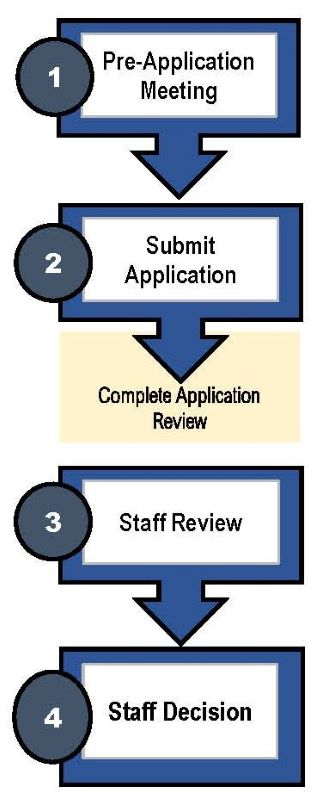
1.
Common Procedures.
The common procedures for review and decision of an administrative adjustment application are identified in Table 13.2. They are summarized here for applicant convenience.
2.
Specific Procedures.
All applications for administrative adjustment shall identify the specific issue that the administrative adjustment is intended to address and how the administrative adjustment will resolve that issue:
a.
A request for administrative adjustment prior to construction shall be submitted with the project site plan application and approved pursuant to Section 13.6, Administrative Decisions.
b.
Where the site plan is submitted in conjunction with a primary application, such as a conditional use request, that is decided by the P&Z or Board of Trustees, the request for administrative adjustment shall also be decided by that body. For example, if an administrative adjustment request is submitted with a rezoning application, the Board of Trustees will also decide on the administrative adjustment.
c.
A request for administrative adjustment to address a minor construction issue shall be submitted pursuant to Section 13.6, Administrative Decisions, with the approved project site plan, a written description of the minor construction issue, and an amended drawing of that part of the site for which the administrative adjustment is requested.
3.
Permitted Types of Administrative Adjustment.
The Zoning Administrator may grant administrative adjustments that conform to the following requirements:
a.
Setbacks. In any zone, modifications of the front, side, or rear yard setback requirement; provided that the total modification shall not reduce the applicable setbacks by more than ten percent of those otherwise required in the zone.
b.
Structure Heights. In any zone, modifications of the building or structure height requirement; provided, that the total modification shall not increase the applicable building or structure height by more than ten percent of the otherwise maximum height in the zone, nor add another habitable story or mezzanine.
c.
Fence Heights. In any zone, modifications of the maximum fence height requirement; provided, that the total modification shall not increase the applicable fence height by more than ten percent of the otherwise maximum height in the zone. Fences greater than or equal to eight feet in height will need a building permit.
d.
Parking. In any zone, a decrease in the number of required parking spaces of not more than ten percent when total required spaces are at least twenty spaces.
e.
Deviations from Final Planned Development Maps. In any planned development zone, deviations to final planned development maps which are consistent with the requirements of the preliminary planned development, final planned development conditions of approval, or development standards of the underlying zoning district.
4.
Limitations on Administrative Adjustment.
Administrative adjustment may not be used to:
a.
Create, intensify, or expand any nonconformity with maximum or minimum requirements of the zone district;
b.
Permit uses other than those permitted in the zone district;
c.
Reduce the effectiveness of approved transitional screening, buffering, landscaping, and/or open space; or
d.
Expand the area or type of signage approved.
D.
Decision Criteria.
To approve a request for administrative adjustment, the Zoning Administrator shall make and record findings that all of the following provisions are met:
1.
The proposed use, structure, or activity is permitted in the underlying zone district.
2.
There are special circumstances existing on the property for which the application is made related to size, shape, area, topography, surrounding conditions, and location that do not apply generally to other property in the same area and zone district;
3.
The special circumstances have not been created by the applicant; and
4.
The impact of the administrative adjustment is internal to the subject property.
E.
Review and Decision-Making.
Requests for administrative adjustment are processed as an administrative decision pursuant to Section 13.6 unless the application meets the requirements of Section 13.4.C.9 for applications submitted concurrently with another application type.
F.
Appeal.
An appeal to the BOA may be made by any applicant aggrieved by a denial of an administrative adjustment application.
G.
Post-Approval Actions.
Administrative adjustment approvals are valid for a period of 12 months from the date of approval and shall expire if an appropriate permit (e.g., building or certificate of occupancy) has not been issued for the project. Administrative adjustments may be extended for an additional 6 months with the approval of the Zoning Administrator. A request for extension shall be made prior to the permit expiration date.
Section 13.6. - Administrative decisions.
For procedures where the Zoning Administrator serves as the decision-making authority, the Zoning Administrator shall make a decision according to the following steps:
A.
Procedure.
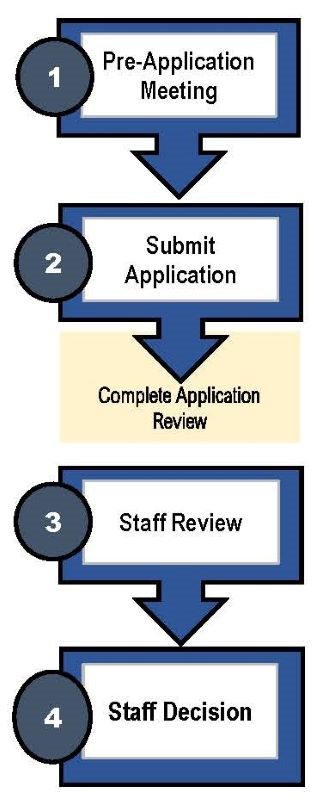
1.
Common Procedures.
The common procedures for administrative decisions are identified in Table 13.2. They are summarized here for applicant convenience.
2.
Specific Procedures.
Notice is not required for an administrative decision unless otherwise specified in an individual application type.
B.
Review Criteria.
1.
When the Zoning Administrator has the authority to decide an application, except in the case of an interpretation, the application shall be reviewed against the applicable provisions of this LUC.
2.
To be approved, an application shall be fully consistent with the standards of this Zoning Code unless administrative adjustment is concurrently approved to allow specified deviation from applicable standards. An administrative approval may include instructions and clarifications regarding full compliance with this LUC but shall not be approved with conditions that require action beyond the specific requirements of this LUC.
C.
Decision-Making.
1.
The Zoning Administrator shall review the application for conformance with all applicable provisions of the LUC.
2.
Within 15 days of the determination of a completeness, the Zoning Administrator shall decide to approve or deny the application and provides written notification of the decision to the applicant. If an application is denied, the written notification shall include the reasons for denial.
D.
Appeal.
An appeal to the BOA may be made by any applicant aggrieved by a denial of an administrative decision.
E.
Post-Approval Actions.
Unless otherwise provided in the specific application type or the individual approval, administrative approvals are valid for a period of 12 months from the date of approval and shall expire if an appropriate permit (e.g., building or certificate of occupancy) has not been issued for the project. Administrative adjustments may be extended for an additional 6 months with the approval of the Zoning Administrator. A request for an extension shall be made prior to the permit expiration date.
Section 13.7. - Annexations.
A.
Purpose.
Annexation is the legal process of bringing property from the unincorporated county into the Town limits. Annexation allows the Town to provide municipal services and exercise regulations that protect public health and safety.
B.
Authority.
In annexation proceedings, the Town may exercise all statutory powers it may lawfully assume, specifically the Colorado Municipal Annexation Act of 1965, as amended. This section shall be interpreted so as to extend such exercise of powers as is reasonable and necessary for the public welfare. The Town will impose terms and conditions of annexation to protect the public interest, and to that goal shall ensure that the following policies are accomplished:
1.
All annexations shall be consistent with the Dolores Comprehensive Plan.
2.
The Dolores Comprehensive Plan identifies areas surrounding the Town that are planned for the future residential, commercial, and industrial growth of the Town. Consent to annexation by benefiting landowners and conformance to the Dolores Comprehensive Plan and standards of this Code shall be a condition of extension or expansion of the municipal utility service.
C.
Procedures.
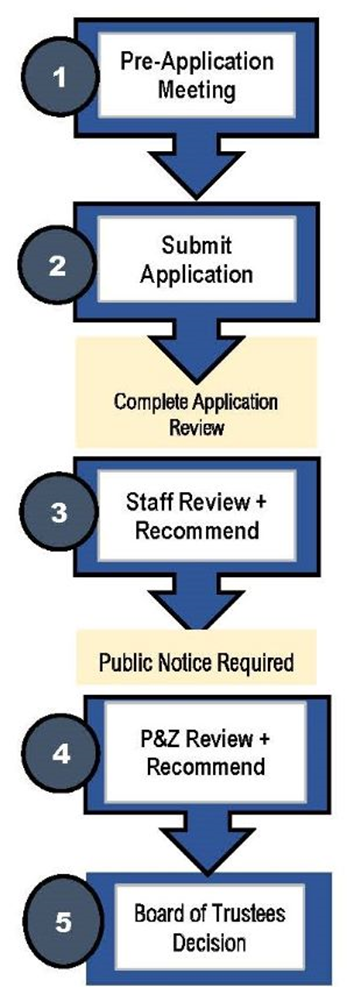
1.
Common Procedures.
a.
The common procedures for an annexation are identified in Table 13.2 and are summarized here for applicant convenience.
b.
The Applicant shall pay all costs incurred by the Town for reviewing annexation proposals, including fees charged by consultants and specialists needed to address technical issues.
2.
Specific Procedures.
a.
Staff shall review the complete application per Section 13.4.C.7. The Zoning Administrator shall refer the complete annexation application to the following:
(1)
Electric Power Association.
(2)
Dolores Fire Protection District.
(3)
Colorado Geological Survey.
(4)
Colorado Parks & Wildlife.
b.
Notice of the Planning and Zoning Commission and Board of Trustees public hearings shall be given as follows.
(1)
Published notice of the Planning and Zoning Commission public hearing shall be provided at least 10 days prior to the hearing.
(2)
Notice of the Board of Trustees Published notice of the Board public hearing shall be provided once a week for four successive weeks for a period of time that ends at least 10 days prior to the date of the hearing. Notice shall include a copy of the annexation petition without signatures.
(3)
The Town Clerk shall mail a copy of the notice and petition to the Montezuma County Board of County Commissioners and County Attorney at least 10 days prior to the hearing date.
(4)
Mailed notice shall be provided at least 15 days before the hearing date.
D.
Decision Criteria.
The Planning and Zoning Commission and the Board of Trustees shall find that the following criteria have been met before recommending approval or approving an annexation request:
1.
Use. The Comprehensive Plan for the use of the area to be annexed is consistent with the adopted Dolores Comprehensive Plan, in harmony with the intent of Town zoning and policies of the Town, and compatible with adjacent neighborhoods;
2.
Necessary. The proposed annexation is necessary or desirable and will contribute to the general well-being of the community;
3.
Health, safety, and general welfare. The proposed annexation will in no way be detrimental to the health, safety, or general welfare of persons residing within the corporate boundaries or injurious to property or improvements in the vicinity;
4.
Logical Road System. The area has incorporated in its design, if a design has been developed, a logical extension of roads;
5.
Utilities and roads. The extension of services is feasible and will be financed fully by the applicant, and that the applicant will post performance guarantees to assure the completion of public improvements;
6.
Water rights. All water rights associated with land areas proposed for annexation shall be dedicated to the Town;
7.
Revenues. The revenue and/or public benefit to be gained from the Town's portion of increased tax base is equal to or greater than the cost of services required;
8.
Open space. The proposed open spaces have a workable program established for maintenance and upkeep; and
9.
Applicants should identify revenues adequate to pay the long-term costs for maintenance of their developments, and the Town should agree that the revenues will be adequate prior to approval of a petition for annexation.
E.
Review and Decision-Making.
An application for annexation shall be reviewed and decided on as follows:
1.
Planning and Zoning Commission Review.
a.
The Planning and Zoning Commission shall hold a public hearing on the annexation application and consider the annexation application against the review standards in Section 13.7.D.
b.
Following review of the annexation application the Planning and Zoning Commission shall make a recommendation to the Board of Trustees to:
(1)
Approve the application as submitted.
(2)
Approve the application with conditions and state the conditions of approval, or
(3)
Deny the application and identify the reasons for denial.
c.
The action of the Planning and Zoning Commission and any conditions of approval or reasons for disapproval shall be noted in a resolution.
2.
Review by Board of Trustees.
a.
The Board of Trustees shall hold a public hearing on the annexation application and consider the annexation application against the review standards in Section 13.7.D.
b.
The final annexation hearing shall be initiated not less than 30 days or more than 60 days after review and recommendation by the Planning and Zoning Commission.
c.
Following review of the annexation application the Board of Trustees shall:
(1)
Approve the application as submitted,
(2)
Approve the application with conditions and state the conditions of the approval, or
(3)
Deny the application and identify the reasons for the denial.
d.
The action of the Board of Trustees and any conditions of approval attached to annexation ordinance or reasons for disapproval shall be noted in a resolution.
Section 13.8. - Appeal of administrative decisions.
A.
Applicability.
Any administrative decision made by a member of the Town staff (either permanent or contract) in the interpretation or application of this LUC may be appealed to the Board of Adjustment (BOA).
B.
Procedures.
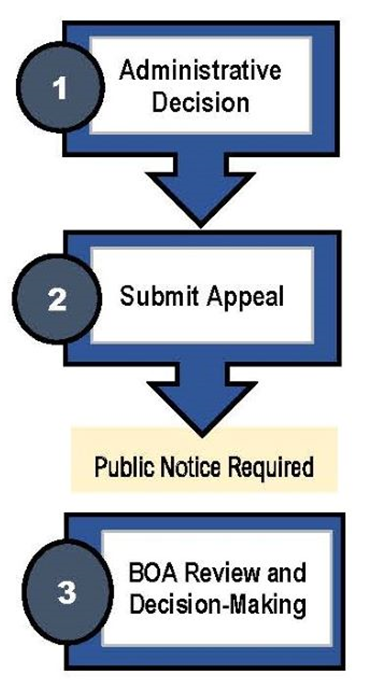
1.
Common Procedures.
The common procedures for appeal of an administrative decision are identified in Table 13.2 and are summarized here for applicant convenience.
2.
Specific Procedures.
a.
Appeals must be filed within 30 days after the decision has been rendered by the administrative officer.
(1)
The application for appeal shall be submitted at least 15 days prior to any desired agenda date.
(2)
Within three business days of receipt of a complete application, the officer from whom the appeal is taken shall transmit to the BOA all the papers constituting the record upon which the action appealed from was taken.
b.
The BOA shall fix a reasonable time for the hearing of an appeal. Published notice shall be given at least 15 days prior to the hearing.
C.
Stay of Proceedings.
1.
An appeal shall stay all proceedings of the action appealed except as provided below in Section 13.8.C.2. The Town will take no further action on the initial application or request while the administrative decision is being appealed.
2.
The Town may decide not to stay activities related to the application during administrative appeal where a stay would cause imminent peril to life or property, determined as follows:
a.
The appeal is filed, and
b.
The officer from whom the appeal is taken certifies that, by reason of facts stated in the certificate, a stay would, in the officer's opinion, cause imminent peril to life or property.
c.
In such case, proceedings shall not be stayed, otherwise than by a restraining order that may be granted by a court of record on application on notice to the officer from whom the appeal is taken and on due cause shown.
D.
Decision Criteria.
In reviewing an administrative decision, the BOA shall have all the powers of the officer from whom the appeal is taken. An appeal may be sustained only if the BOA finds that the administrative decision was made in error.
E.
Review and Decision-Making.
An application for appeal of an administrative decision shall be reviewed and decided on as follows:
1.
The BOA may amend; reverse; affirm, wholly or partly; or may modify the order, requirements, decision, or determination appealed from and make such order, requirement, decision, or determination as ought to be made. The concurring vote of four members of the Board of Adjustment shall be necessary to reverse any order, requirement, decision, or determination of the Town Staff or to decide in favor of the applicant.
2.
Pursuant to C.R.S. §31-23-307(1), every decision of the BOA shall be subject to review by certiorari, as provided by Rule 106(a)(4) Colorado Rules of Civil Procedure. Appeal may be taken by any person aggrieved or by an officer, department, board, or bureau of the municipality within such time as provided by the Colorado Rules of Civil Procedure. A notice of appeal, in writing, specifying the grounds for such an appeal, shall also be filed with the Board within 30 days of the final written decision of the Board.
F.
Reapplication.
If an application for an administrative review is denied by the BOA and not approved for reconsideration, another application shall not be filed within a period one year from the date of denial.
Section 13.9. - Certificates of occupancy.
The issuance of Certificates of Occupancy is administered pursuant to the Town's currently adopted Building Code.
Section 13.10. - Comprehensive plan amendments.
A.
Purpose.
The purpose of this section is to provide standards and requirements for amending the Dolores Comprehensive Plan and other adopted Town plans. The amendment process is established in order to provide flexibility in response to changing circumstances, to reflect changes in public policy, and to advance the general welfare of the Town.
B.
Authority.
1.
Adoption and amendment of the Dolores Comprehensive Plan is a duty of the Planning and Zoning Commission per C.R.S. §31-23-206(1), Master Plan (referred to as the Comprehensive Plan).
2.
Any person having a proprietary interest in any property within the corporate limits of the Town of Dolores, Colorado, may submit a comprehensive plan amendment application.
3.
The Planning and Zoning Commission or Board of Trustees may also, on its own motion, institute study and proposal for changes and amendments in the public interest.
C.
Procedures.
1.
Common Procedures.
The common procedures for comprehensive plan amendment are identified in Table 13.2 and are summarized here for applicant convenience.
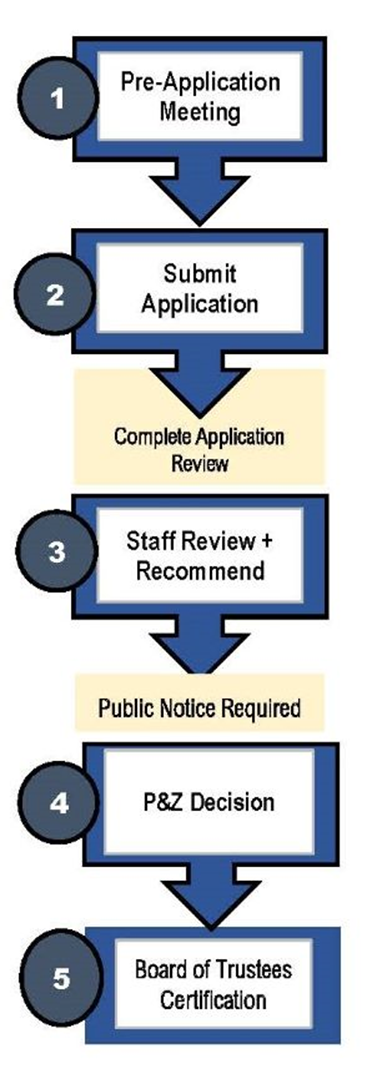
2.
Specific Procedures.
Published notice of the public hearings shall be provided at least 10 days prior to the hearing.
D.
Decision Criteria.
The Planning and Zoning Commission shall consider the following criteria when reviewing a comprehensive plan amendment application:
1.
The comprehensive plan amendment corrects a minor technical mistake; or
2.
The comprehensive plan amendment meets all of the following:
a.
It is consistent with the overall intent of the comprehensive plan;
b.
The existing comprehensive plan and/or any related element thereof is in need of the proposed amendment;
c.
It is necessary or desirable because of changing social values, new planning concepts, or other social or economic conditions and strict adherence to the comprehensive plan will result in a situation neither intended nor in keeping with other key elements and policies of the plan;
d.
The proposed amendment will not have a negative effect on the immediate areas or on transportation, services, and facilities;
e.
The proposed amendment will have minimal effect on service provision, including adequacy or availability of public facilities and services, and is compatible with existing and planned service provision and future development of the area;
f.
The proposed amendment, if for an area that is outside of the Town's current municipal boundaries, is consistent with the Town's ability to annex the property; and
g.
The proposed comprehensive plan amendment will promote the public health, safety, and general welfare of the people of Dolores.
E.
Review and Decision-Making.
1.
Planning and Zoning Commission.
Comprehensive plan amendment shall be reviewed and decided upon as follows:
a.
The Planning and Zoning Commission shall consider the comprehensive plan amendment application at a public hearing.
b.
The Planning and Zoning Commission shall review the application against the criteria in Section 13.10.D and determine whether to:
(1)
Approve the application;
(2)
Approve the application with conditions; or
(3)
Deny the application.
c.
Approval of Comprehensive Plan amendments shall require a favorable vote of two-thirds (2/3) of the entire voting membership of the Commission.
(1)
The adoption resolution shall refer expressly to the maps and descriptive matter intended by the Planning and Zoning Commission to form the whole or part of the plan, and the action taken shall be recorded on the map and plan and descriptive matter by the identifying signature of the Chairperson of the Commission.
(2)
An attesting copy of the plan or part thereof shall be certified to each governmental body of the territory affected and, after the approval by each body, shall be filed with the Town Clerk and with the Recorder of Montezuma County.
2.
Action by Board of Trustees.
a.
A public hearing shall be held by the Board of Trustees before certifying any proposed amendment, supplement, or change.
b.
Published notice shall be provided at least 10 days prior to the hearing date.
c.
In making its determination, Board of Trustees shall consider the recommendation of the Planning and Zoning Commission, staff reports, and the written and oral testimony presented.
Section 13.11. - Conditional use permits.
A.
Purpose.
A conditional use is a use that may or may not be appropriate in a given zone district depending upon the circumstances and the conditions imposed upon the approval of the use. The conditional use permit process allows the Town to consider and establish appropriate conditions to reasonably mitigate adverse impacts of the use upon the proposed site and surrounding properties.
B.
Applicability.
1.
Conditional use permits may be approved for the uses indicated as conditional uses in Table 4.1 for the applicable zoning district. Any change or expansion of an approved conditional use shall require application for a new conditional use permit.
2.
A conditional use permit may not be used to change the maximum density or intensity allowed in the underlying zone district.
C.
Procedures.
1.
Common Procedures.
The common procedures for conditional use permits are identified in Table 13.2 and are summarized here for applicant convenience.
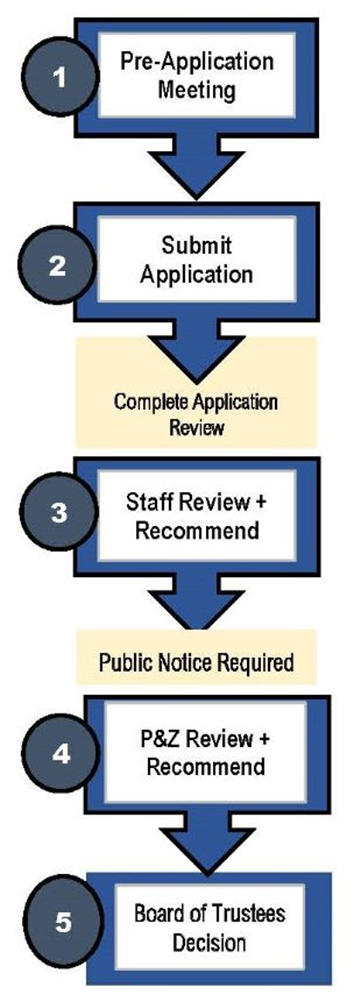
2.
Specific Procedures.
a.
The Zoning Administrator shall distribute the complete conditional use application to appropriate referral agencies, which may include the following:
(1)
Electric power association.
(2)
Dolores School District.
(3)
Dolores Fire Protection District.
(4)
If the property on which the proposed conditional use is located is within a potential hazard area, Colorado Geological Survey comment may be requested.
(5)
If the property on which the proposed conditional use is located is within a wildlife habitat area, Colorado Parks & Wildlife comment may be requested.
b.
Notice Requirements.
(1)
Published notice of the P&Z public hearing shall be provided at least 10 days prior to the hearing. date.
(2)
Mailed notice of P&Z public hearing shall be provided at least 15 days before the hearing date.
(3)
Published notice of the Board of Trustees public hearing shall be provided at least 15 days before the hearing date.
D.
Decision Criteria.
When considering an application for conditional use permit, the Planning and Zoning Commission and Board of Trustees shall consider whether the application complies with following criteria:
1.
The proposed use is consistent with the Dolores Comprehensive Plan;
2.
The proposed use complies with all applicable provisions of the LUC;
3.
The proposed use will not have a negative impact on the value of surrounding property or the general neighborhood;
4.
The location and size of the use, the nature and intensity of the operation involved or conducted in connection with is, and the location of the site with respect to streets giving access to it are such that the conditional use will not dominate the immediate neighborhood so as to prevent the development and use of neighborhood property in accordance with the applicable zoning district regulations. In determining whether the use will dominate the immediate neighborhood, consideration shall be given to:
a.
The location, nature, and height of buildings, structures, walls, and fences on the site; and
b.
The nature and extend of the proposed landscaping and buffering on the site.
c.
Whether adequate utility, drainage, and other necessary facilities have or will be provided; and
d.
Whether adequate access roads or entrance and exit drives will be provided and shall be designed to prevent traffic hazards and minimize traffic congestion.
E.
Review and Decision-Making.
Applications for conditional use permits shall be reviewed and decided upon as follows:
1.
Planning and Zoning Commission.
The Planning and Zoning Commission shall first review the application at a public hearing and make a recommendation and report to the Board of Trustees.
2.
Action by Board of Trustees.
a.
The Board of Trustees shall hold a public hearing before deciding on a Conditional Use Permit.
b.
The Board of Trustees may, in the interest of the public welfare and to assure compliance of this Code, establish conditions of operation, location, arrangement and construction of any use for which a permit is authorized. This may include conditions as necessary to mitigate impact on public facilities and services, including but not limited to water, sewer, streets, and street lighting. The Board may also impose development standards and safeguards as the conditions and location indicate important to the welfare and protection of adjacent property from noise, vibration, dust, dirt, smoke, fumes, gas, odor, explosion, glare, traffic circulation or other undesirable or hazardous conditions.
Section 13.12. - Grading and erosion control permit.
A.
Purpose.
Grading and erosion control permits are required to allow the Town to review proposed site disturbance to ensure that the applicant has designed the grading process to minimize and mitigate the disturbance of land, vegetation, drainage patterns; identify and mitigate any hazards arising from site disturbance; and establish necessary erosion control measures.
B.
Applicability.
1.
It shall be unlawful for any person to conduct any activity resulting in any of the following total disturbed areas without first obtaining a grading permit and erosion control permit. A grading permit shall be required for disturbed areas of:
a.
An excavation, fill, or combination in excess of 100 cubic yards;
b.
An excavation which, at its greatest depth, will be 3 or more feet below the ground surface, over an area of 500 square feet or more;
c.
A fill that, at its greatest depth, will be 3 or more feet above the ground surface, over an area of 500 square feet or more;
d.
An excavation or fill by a developer or contractor not working on behalf of the Town or a Public Utility that falls within a public sewer, water main, storm drainage, or power line easement, a public right-of-way, or any other public utility easement. This includes the preparation of roads, sidewalk, etc. (major grading);
e.
Vegetation removal over an area 500 square feet or more (major grading);
f.
Any site with existing trees subject to Section 7.7, Tree Preservation; or
g.
Mining, quarrying, or gravel operations.
2.
Grading not relating to a development application shall be prohibited, except as exempted below.
a.
Solid waste disposal sites operated by the public or under public regulations;
b.
An excavation by the Town for the purpose of maintenance or installation of public utilities, buildings, streets, or easements;
c.
An excavation by a private individual for the purpose of routine maintenance; and
d.
Tilling the ground for agricultural purposes or protection.
3.
The Town may also require a grading permit regardless of the size of the total disturbed area in conjunction with approval of a final subdivision plat, conditional use permit, or site development plan, or if the construction activities are adjacent to a floodplain boundary or wetlands.
C.
Procedures.
1.
Common Procedures.
The common procedures for grading and erosion control permits are identified in Table 13.2 and are summarized here for applicant convenience.
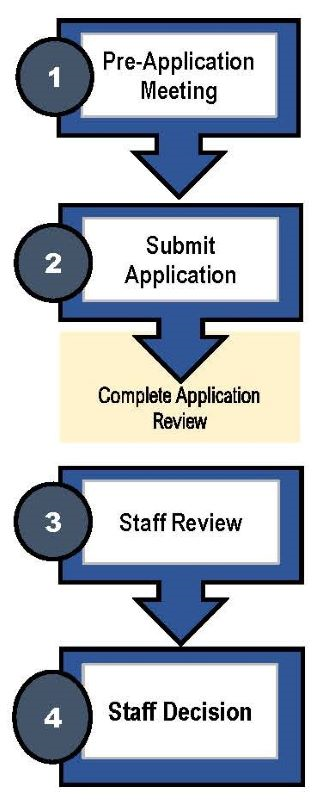
2.
Specific Procedures.
a.
Grading and erosion control permits shall be processed as Section 13.6, Administrative Decisions.
b.
The Zoning Administrator may distribute the complete grading and erosion control permit to appropriate referral agencies, which may include the following:
(1)
Dolores Fire Protection District.
(2)
If the property on which the proposed grading will be located is within a potential hazard area, Colorado Geological Survey comment may be requested.
D.
Review Criteria and Clarifications.
1.
Factors to be considered in reviewing the permit application shall include, but not be limited to the following:
a.
The grading proposed will have adequate on- and off-site sedimentation and erosion control measures;
b.
The grading proposed is the minimum amount necessary to carry out development plans;
c.
The grading proposed avoids any adverse impact on natural drainage patterns on- and off-site; and
d.
To the maximum extent practicable, the grading proposed avoids any disturbance of canyon side, hillsides, ridgelines, streams, or existing trees and vegetation.
2.
The Zoning Administrator shall deny the application where any of the following situations are present on the site or through the project design: possible saturation of fill and unsupported cut by water, both natural and domestic runoff surface waters that cause erosion and/or silting of drainageways; subsurface conditions such as the rock strata and faults, nature and type of soil or rock that when disturbed by the proposed grading may create earth movement and produce slopes that cannot be landscaped and excessive and unnecessary scaring of the natural landscaped through grading or removal of vegetation.
3.
The Zoning Administrator may request changes to the application to conform to any of the following criteria to comply with the requirements of this LUC:
a.
Limitation of the hours of operation or the period of year in which work may be performed;
b.
Restrictions as to the size and type of equipment;
c.
Designations of routes upon which materials may be transported;
d.
The place and manner of disposal of excavated materials;
e.
Requirements as to the laying of dust and tracking of dirt, the prevention of noises and other results offensive or injurious to the neighborhood, the general public, or any portion thereof;
f.
Designation of maximum or minimum slopes to be used;
g.
Regulations as to the use of public streets and places in the course of the work;
h.
Regulations as to the degree of compaction of fill material;
i.
Requirements as to paving private driveways and roads constructed under the permit;
j.
Requirements for safe and adequate drainage of the site;
k.
A requirement that approval of the Town Engineer be secured before any work which has been commenced may be discontinued;
l.
A requirement that personnel and equipment be provided at the site during storms to prevent incomplete work from endangering life or property;
m.
Requirements for fencing of excavation or fills that might be hazardous without such fencing.
E.
Appeal.
An appeal to the BOA may be made by any applicant aggrieved by a denial of a grading and erosion control permit application.
F.
Post-Approval Actions.
1.
Expiration and Extension.
Grading and erosion control permits are valid for a period of 12 months from the date of approval and may be extended for an additional 6 months with the approval of the Zoning Administrator. A request for extension shall be made prior to the permit expiration date.
2.
Modification.
An approved grading and erosion control permit may be modified through Section 13.5, Administrative Adjustment or, where the requested modifications exceed those allowed through Administrative Adjustment, the permit may be modified through the submission of a new grading and erosion control permit application.
3.
Performance Guarantee.
a.
If deemed necessary by the Zoning Administrator, the permit holder shall provide a surety bond and/or other security for the total amount required to stabilize, restore, or reclaim the disturbed ground to prevent erosion and/or release of sediment, excessive storm water and/or pumped water discharges to surface waters from the construction area.
b.
The security shall remain in effect for a period of 24 months after all completion of construction and establishment of erosional stability.
c.
The amount of the security shall be sufficient to stabilize a disturbed site to prevent releases of sediment and water from construction sites and protect the health, safety and welfare of the public. The amount shall be based on cost estimates of site restoration provided by the applicant and approved by the Zoning Administrator. The terms of the security and permit holder's responsibilities shall be reflected in an agreement entered into between the Town and the permit holder.
d.
Whether or not covered by surety, the permit holder shall reimburse the Town for any and all expenses incurred by the Town within the 24 months after completion of any work as a result of, or related to, failure by the permit holder to perform all installation, construction, maintenance, or other work pursuant to the grading and erosion control permit in a workmanlike manner.
4.
Release of Collateral.
a.
As public improvements are made, an applicant may apply to the Board for release of part or all of the collateral deposited with the Board.
b.
Upon inspection and approval, the Board shall release collateral, provided that in the event a combination of forms of collateral has been accepted, the Board shall release collateral on a priority basis it deems appropriate.
c.
If the Board determines that any of the required improvements are not constructed in substantial compliance with specifications, it shall furnish the applicant a list of specifications and shall be entitled to withhold collateral sufficient to ensure substantial compliance.
d.
If the Board determines that the applicant will not construct any or all of the improvements in accordance with all of the specifications, the Board may withdraw and employ from the deposit of collateral such funds as may be necessary to construct the improvements in accordance with the specifications.
Section 13.13. - Historic preservation.
This section was partially funded by the State Historical Fund grant award from the Colorado Historical Society.
A.
Purpose.
The purpose of this section is to enhance our community's local resources and to promote the public interest in historic preservation through:
1.
The protection and preservation of the Town's architectural, historic and cultural heritage, as embodied in designated historic structures, sites and districts, by appropriate regulations and incentives;
2.
The establishment of a Town Register listing designated structures, sites, and districts; and
3.
The provision of educational opportunities to increase public appreciation of Dolores' unique heritage.
B.
Town Register Established.
The Board of Trustees hereby establishes the Town Register of historic sites, structures or districts may be listed on said register only if said site, structure or district has been designated by the Board of Trustees following recommendation by the HPB. All properties listed on the National or State Register are eligible for the Town Register but are not designated until approval, pursuant to this section, is obtained.
C.
Designation of Historic Structures, Sites and Districts.
Pursuant of the procedures set forth in this section, the Board of Trustees may, by resolution:
1.
Designate as historic an individual structure, site or other feature or an integrated group of structures and features on a single lot or site having a special historical or architectural value; or
2.
Designate as an historic district an area containing a number of structures or sites having a special historical or architectural value.
3.
Each such designation shall include a description of the characteristics of the structure, site or historic district which justify its designation and a description of the particular features that should be preserved and shall include a legal description of the location and boundaries of the historic structure, site or district.
4.
No individual structure or site will be designated without the consent of all owners of record and the provisions of this section.
5.
The purpose and effect of designation is:
a.
To assist local groups interested in preservation of physical structures, sites or districts, and to recognize locally significant structures, sites or districts;
b.
To provide a mechanism to educate the public on local history, development of the community, architectural styles, and housing and business development;
c.
To enable the owners of the property in the Town to take advantage of historic preservation programs and opportunities; and
d.
To make all properties listed on the Town Register eligible for such incentive programs as may be developed.
D.
Procedures for Designating Historic Structures, Sites and Districts for Preservation.
A nomination for designation listing in the Town Register may be made by the Board or by any citizen by filing an application with the Zoning Administrator. The application shall be submitted at least 15 days prior to any desired agenda date. The applicant shall pay all public notice expenses, recording fees and any other fees established by resolution of the Board of Trustees.
1.
HPB Review.
a.
The HPB shall review the designation application in a public meeting no more than 30 days after the filing of the application, or as soon thereafter as practicable.
b.
The HPB shall review the application for conformance with the established criteria for designation and with the purposes of this section.
c.
Within 10 days after the conclusion of the public meeting, but in no event more than 30 days after the meeting, unless mutually agreed by the HPB, the applicant and the owner or owners other than the applicant, the HPB shall recommend either approval, modification and approval, or disapproval of the application. The HPB may recommend approval conditional upon the execution of certain easements, covenants, or licenses.
d.
The HPB shall forward to the Board of Trustees in writing any recommendations as to easements, covenants, or licenses that must be met by the property owner to receive and/or maintain the designation.
2.
Board of Trustees Review.
a.
The Board of Trustees shall hold a public hearing on the designation application no more than 30 days after receipt of the HPB's recommendation, or as soon thereafter as practicable.
b.
The Board of Trustees shall review the application for conformance with the established criteria for designation and with the purpose of this section.
3.
Owner Notification.
When a structure, site or historic district has been designated as provided herein, the Zoning Administrator shall promptly notify the record owners of the property, according to the County Assessor's records or other available information and record the designation with the County Clerk and Recorder.
4.
Limitation on Resubmission and Reconsideration of Proposed Designation.
Whenever the Board of Trustees disapproves a proposed designation, no person shall submit an application that is the same or substantially the same for at least one year from the effective date of the final action on the denied application.
E.
Criteria for Designation.
The HPB and Board of Trustees will consider the following criteria in reviewing nominations of properties for designation:
1.
Structures.
Structures must be at least 50 years old and meet one or more of the following criteria for architectural, cultural, or geographic/environmental significance. A structure can be exempted from the age standard if the Board of Trustees finds it to be exceptionally important in other criteria. Information contained in the "Historic Building/Structure Survey, Town of Dolores, Colorado," November 1997, provides one source of information to be considered in the evaluation of eligibility for historic designation.
2.
Architectural, Cultural, or Geographic/environmental Criteria.
Historic structures or sites shall meet one or more of the following criteria in order to be considered for designation.
a.
Architectural.
(1)
Exemplifies specific elements of an architectural style or period;
(2)
Is an example of the work of an architect or builder who is recognized for expertise nationally, state-wide, regionally or locally;
(3)
Demonstrates superior craftsmanship or high artistic value;
(4)
Represents an innovation in construction, materials or design;
(5)
Represents a built environment of a group of people in an era of history;
(6)
Exhibits a pattern or grouping of elements representing at least one (1) of the above criteria; or
(7)
Is a significant historic remodel.
b.
Cultural:
(1)
Is a site of an historic event that had an effect upon society;
(2)
Exemplifies cultural, political, economic or ethnic heritage of the Town; or
(3)
Is associated with a notable person or the work of a notable person.
c.
(3) Geographic/Environmental:
(1)
Enhances the sense of identity of the Town; or
(2)
Is an established and familiar natural setting or visual feature of the Town.
d.
Prehistoric and historic archaeological structures or sites. Prehistoric and historic archaeological structures or sites shall meet one (1) or more of the following:
(1)
Exhibits distinctive characteristics of a type, period or manner of construction; or
(2)
Is a unique example of structure;
(3)
Has the potential to make an important contribution to the knowledge of the area's history or prehistory;
(4)
Is associated with an important event in the area's development;
(5)
Is associated with a notable person(s) or the work of a notable person(s);
(6)
Is a typical example or is associated with a particular ethnic or other community group;
(7)
Is a unique example of an event in local history; or
(8)
Is geographically or regionally important.
3.
General Criteria.
Each property will also be evaluated based on physical integrity using the following criteria (a property need not meet all the following criteria):
a.
Shows character, interest or value as part of the development, heritage or cultural characteristics of the community, region, state or nation;
b.
Retains original design features, materials and/or character;
c.
Is in the original location or same historic context, if it has been moved;
d.
Has been accurately reconstructed or restored.
F.
Historic Districts.
1.
For the purposes of this section, a district is a geographically definable area including a concentration, linkage or continuity of sites, buildings, structures and/or objects. A district is related by a pattern of either physical elements or social activities.
2.
Significance is determined by applying criteria to the pattern(s) and unifying element(s).
3.
Nominations will not be approved unless the application contains written approval from owners of at least 70 percent of the properties within the district boundaries.
4.
Properties that do not contribute to the significance of the historic district may be included within the boundaries as long as the noncontributing elements do not noticeably detract from the district's sense of time, place, and historical development. Noncontributing elements will be evaluated for their magnitude of impact by considering their size, scale, design, location, and/or information potential.
5.
District boundaries will be defined by visual changes, historical documentation of different associations or patterns of development, or evidence of changes in site type or site density as established through testing or survey.
6.
When districts are designated, applicable design guidelines and other appropriate restrictions may be included as part of the designation.
7.
In addition to meeting at least one of the criteria outlined below, the designated contributing sites and structures within the district must be at least 50 years old. The district could be exempt from the age standard if the resources are found to be exceptionally important in other significant criteria. Each historic district shall meet one or more of the following criteria:
a.
Architectural:
(1)
Exemplifies specific elements of an architectural style or period;
(2)
Is an example of the work of an architect or builder who Is recognized for expertise nationally, state-wide, regionally or locally;
(3)
Demonstrates superior craftsmanship or high artistic value;
(4)
Represents an innovation in construction, materials or design;
(5)
Represents a built environment of a group of people in an era of history;
(6)
Exhibits a pattern or grouping of elements representing at least one of the above criteria; or
(7)
Is a significant historic remodel.
b.
Cultural:
(1)
Is the site of an historic event that had an effect on society;
(2)
Exemplifies cultural, political, economic or social heritage of the community; or
(3)
Is associated with a notable person(s) or the work of a notable person(s).
c.
Geographic/environmental.
(1)
Enhances the sense of identity of the community; or
(2)
Is an established and familiar natural setting or visual feature of the community.
d.
Archaeology/subsurface.
(1)
Has the potential to make an important contribution to the area's history or prehistory;
(2)
Is associated with an important event in the area's development;
(3)
Is associated with a notable person(s) or the work of a notable person(s);
(4)
Has distinctive characteristics of a type, period or manner of construction; and
(5)
Is of geographical importance.
G.
Review of Alterations.
The owner is requested to consult with the HPB before making any alteration. The Board shall determine if the alteration is compatible with the designation. Property owners making alterations or constructing new buildings adjacent to registered building, landmarks, or districts are requested to consult with the HPB prior to beginning construction. For the purposes of this section, the term "alteration" shall mean any proposed modification to a designated historic site, structure or district that could have an affect on the character of the historic resources relative to the criteria by which it was designated. Examples of alterations for structures may include additions, any exterior modifications, including signage to be affixed to the facade, and any interior modifications that may affect the characteristics for which the structure was designated. The HPB shall make its review in a timely manner.
1.
Criteria to Review Alterations.
In reviewing a proposed alteration, the HPB shall consider the project in terms such as design, finish, material, scale, mass, and height. When the subject site is in an historic district, the HPB must also find that the proposed development is visually compatible with the development on adjacent properties, as well as any guidelines adopted as part of the given Historic District designation. For the purposes of this section, the term "compatible" shall mean consistent with, harmonious with, and/or enhances the mixture of complementary architectural styles, either of the architecture of an individual structure(s) or the character, of the surrounding structures. The HPB will use the following criteria to determine compatibility of a proposed alteration:
a.
The effect upon the general historical and architectural character of the structure and property;
b.
The architectural style, arrangement, texture and material used on the existing and proposed structures and their relation and compatibility with other structures;
c.
The size of the structure, its setbacks, its site, location and the appropriateness thereof, when compared to existing structure and the site;
d.
The compatibility of accessory structures and fences with the main structure on the site, and with other structures;
e.
The effects of the proposed work in creating, changing, destroying, or otherwise impacting the exterior architectural features of the structure upon which such work is done;
f.
The condition of existing improvements and whether they are a hazard to public health and safety; and
g.
The effects of the proposed work upon the protection enhancement, perpetuation and use of the property.
H.
Revocation of Designation.
If a building or special feature on a designated site has been altered in such a way so as to negate the features necessary to retain designation, the owner may apply to the HPB for a revocation of the designation or the HPB shall recommend revocation of the designation to the Board of Trustees in the absence of the owner's application to do so.
Section 13.14. - Land use code interpretation.
A.
Purpose.
The purpose of a LUC interpretation request is to allow a code user to ask the Town to clarify how a specific provision of this LUC is or will be interpreted.
B.
Applicability.
1.
The Zoning Administrator is authorized to provide a written interpretation of the contents and requirements of this LUC.
2.
Interpretations may be requested for a provision of this LUC subject to a proposed or current application, hearing, or appeal.
3.
The Zoning Administrator may also provide a property-specific code interpretation in the form of a LUC clarification that identifies whether specific regulations in this LUC are applicable to the subject property.
C.
Authority.
An interpretation may be requested by any:
1.
Applicant,
2.
Person affected by an action proposed pursuant to this LUC, or
3.
Any Town departments or other governmental agencies that may be subject to the provisions of this LUC.
D.
Procedures.
1.
Common Procedures.
Common procedures for a LUC interpretation are established in Table 13.2. They are summarized here for applicant convenience.
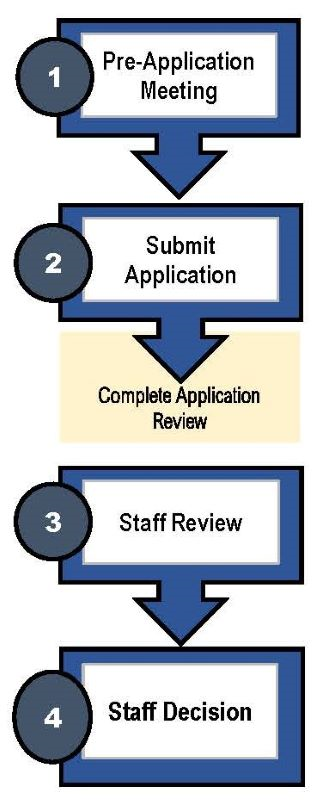
2.
Specific Procedures.
After the application for request for interpretation has been determined complete, the Zoning Administrator shall render an interpretation pursuant to Section 13.6, Administrative Determinations.
E.
Appeal.
An appeal to the BOA may be made by any applicant aggrieved by an interpretation of the LUC.
F.
Official Record.
The Zoning Administrator shall maintain an official record of all interpretations, which shall be available for public inspection during normal business hours.
Section 13.15. - Location and extent review.
A.
Purpose.
This process implements §31-23-209, C.R.S., and is intended to provide an opportunity for review of the location and extent of specified public facilities and uses sought to be constructed or authorized within Dolores, especially as to whether such public use is consistent with this LUC and the Dolores Comprehensive Plan.
B.
Applicability.
1.
Applicable to Specified Public Uses.
a.
Location and extent review shall apply to the construction or authorization of the following, unless otherwise regulated pursuant to Article 15, Areas and Activities of State Interest Regulations:
(1)
Public street or road;
(2)
Public park, open space, or trail;
(3)
Public building or structure; or
(4)
Publicly or privately owned utility, except for the routine extension of public utility lines.
(5)
Routine maintenance and minor modifications to existing facilities is exempt from this review.
b.
Location and extent review shall also apply to the acceptance, widening, removal, extension, relocation, narrowing, vacation, abandonment, change of use, or sale, lease, or acquisition of any land for any public use.
2.
Exemption for Town Public Uses Located Within Town Limits.
Location and extent review shall not apply to any public facility or use that is to be constructed, financed, or owned by the Town of Dolores on property located within the jurisdictional limits of the Town.
C.
Procedures.
1.
Common Procedures.
Common procedures for location and extent review are established in Table 13.2 and are summarized here for applicant convenience.
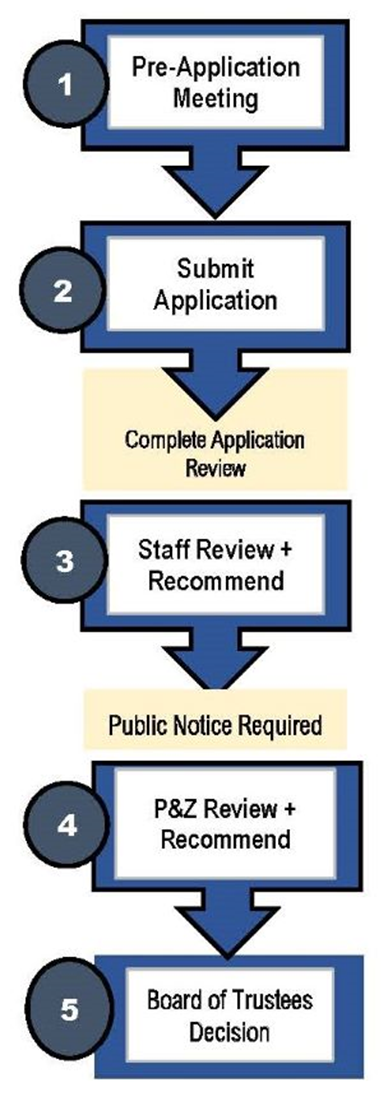
2.
Specific Procedures.
a.
Notice shall be published, posted, and mailed to property owners within 300 feet of the project site at least 15 days prior to the P&Z hearing regarding the project.
D.
Decision Criteria.
The P&Z and Board of Trustees shall review the extent and location of the proposed public use for its consistency with the goals, policies ,and objectives stated in the Dolores Comprehensive Plan and for its compliance with this Land Use Code.
E.
Recommendation and Decision-Making.
1.
Planning and Zoning Commission.
a.
The Planning and Zoning Commission shall review the application at a public hearing and make a recommendation to the Board of Trustees within 60 days after the date the application is determined to be complete, unless a longer period is granted by the submitting board, body, or official.
b.
If the Planning and Zoning Commission disapproves the site plan, it shall communicate its reasons to the Board of Trustees.
2.
Board of Trustees.
a.
The Board is authorized to act on the application. The Board may overrule P&Z disapproval by a majority vote of the Board's entire membership. Upon overruling, the Board may proceed with construction or authorization of the project, as applicable.
b.
If the project is not required to be authorized or financed by Board of Trustees or other Town official or board, the Planning and Zoning Commission's disapproval may be overruled by the body or official having jurisdiction over the authorization and financing of the project. A vote to overrule by such body shall be by a majority vote of its entire membership. In the case of a utility owned by an entity other than a political subdivision, the P&Z's disapproval may be overruled by the Public Utilities Commission by not less than a majority of its entire membership.
Section 13.16. - Minor subdivision plats.
A.
Purpose.
The purpose of the minor subdivision process is to allow shortened review and approval of a subdivision where no significant public infrastructure is required. The minor subdivision process is also applicable to condominium conversions and amendments to approved final plats.
B.
Applicability.
1.
Minor Plats.
A minor subdivision is the division of one or more lots, tracts, or parcels into a total of not more than four lots. A minor subdivision plat may be approved by the Board of Trustees without notice or hearing where all of the following conditions are met:
a.
All lots front onto an existing street;
b.
No streets, roads, extensions, or access easements need to be widened, dedicated, or developed;
c.
No utilities, other than individual service lines, need to be extended to serve the parcel and the necessary utilities are in place immediately adjacent to the parcel;
d.
The resulting lots shall be in compliance with the requirements of this LUC; and
e.
No part of any lots are located within Article 15, Areas or Activities of State Interest, a geological hazard area, a floodplain, or other problems of public concern.
2.
Plat Amendments.
An amendment of a previously approved final plat, or "replat," is reviewed and decided as a minor subdivision when it conforms to the following criteria:
a.
The replat does not remove any covenants or restrictions or increase the number of lots.
b.
The purpose of the amendment is to correct an error in any course or distance shown on the prior plat.
c.
The purpose of the amendment is to add any course or distance that was omitted on the prior plat.
d.
The purpose of the amendment is to correct an error in the description of the real property shown on the prior plat.
e.
The purpose of the amendment is to indicate monuments set after death, disability, or retirement from practice of the engineer or surveyor responsible for setting the monuments.
f.
The purpose of the amendment is to show the proper location or character of any monument that has been changed in location or character or that originally was shown at the wrong location or incorrectly as to its character on the prior plat.
g.
The purpose of the amendment is to correct any other type of clerical error or omission in the previously approved plat.
h.
The purpose of the amendment is to correct an error in courses and distances of lot lines between two adjacent lots where both lot owners join in the application for plat amendment and neither lot is abolished, provided that such amendment does not have a material adverse effect on the property rights of the owners in the plat.
i.
The purpose of the amendment is to relocate a lot line to cure an inadvertent encroachment of a building or improvement on a lot line or on an easement.
j.
The purpose of the amendment is to relocate or vacate one or more lot lines between one or more adjacent lots where the owners of all such lots join in the application for the plat amendment.
3.
Condominium Conversions.
Condominium conversion is reviewed and decided as a minor subdivision, regardless of the number of units proposed for conversion, provided that it conforms to the off-street parking requirements for the underlying zone district in Article 8, Parking, Loading, and Access Drives. Each residential condominium unit shall be considered a separate dwelling unit for purposes of determining parking compliance.
C.
Procedures.
1.
Common Procedures.
Common procedures for a minor subdivision plat are established in Table 13.2 and are summarized here for applicant convenience.
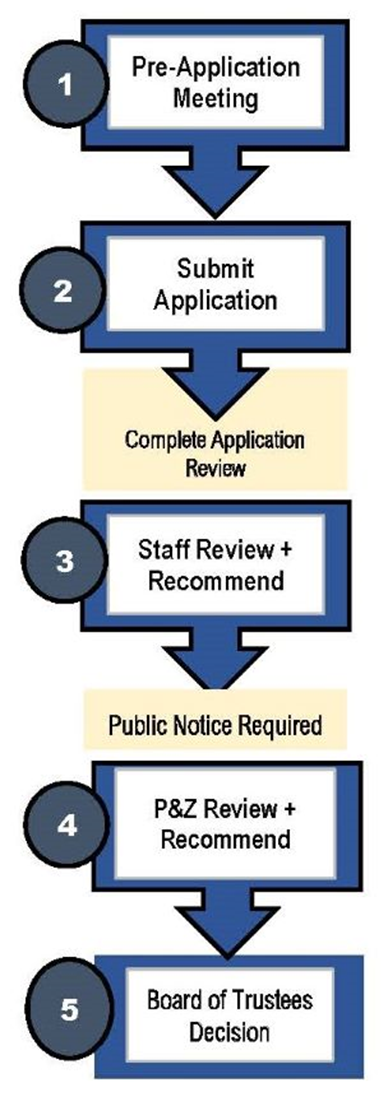
2.
Specific Procedures.
a.
Notice is not required for a minor plat application, except that that owners of properties proposed for condominium conversion shall notify all residential tenants in writing of the conversion at least 90 days prior to termination of any residential tenancy in accordance with Section 38-33-112, C.R.S. Copies of such notification shall be filed with the Town Clerk as proof of notification.
b.
The Zoning Administrator shall distribute the minor subdivision plats immediately upon receipt to the following:
(1)
Dolores Public Works.
(2)
Electric power association.
(3)
Dolores School District.
(4)
Dolores Fire Protection District.
D.
Decision Criteria.
1.
In reviewing a minor plat application, the Board of Trustees shall consider whether the application conforms to all applicable requirements of this LUC.
2.
Additional Standards for Review of Condominium/Townhouse Conversions: In addition to complying with the review standards applied to other subdivisions and condominium subdivisions/townhouse subdivision by this Code, condominium conversions shall comply with the following standards:
a.
The structure subject to the proposed condominium/townhouse conversion shall meet current off-street parking requirements for the underlying zone district found in Article 8, Parking, Loading, and Access. Each residential condominium unit shall be considered a separate dwelling unit for purposes of determining parking compliance.
b.
A minimum one-hour fire wall may be required between units as a condition of Town approval of any condominium/townhouse plat involving a condominium conversion.
E.
Review and Decision-Making.
1.
Minor plats are reviewed and decided upon in the following steps:
2.
Review pursuant to Preliminary and Final Plat procedures. If the minor subdivision plat is not approved within 30 days of its submission, or is disapproved by the Town, it shall automatically be processed pursuant to preliminary plat subdivision requirements unless withdrawn by the applicant.
F.
Recording and Filing.
1.
The Board of Trustee's approval of the minor subdivision plat shall be evidenced by the execution of the Board of Trustees certificate of approval on the plat. No additions, corrections, or modifications of any kind shall be made to the minor subdivision plat other than signatures required after the Board of Trustees has approved the Minor subdivision plat.
2.
The Board of Trustees shall take any necessary actions with reference to improvements, dedications, and utilities. The applicant shall pay all fees, including recording, review fees and cash-in-lieu of public land dedication.
3.
The applicant shall file the minor subdivision plat in the plat records of Montezuma County.
4.
If for any reason the minor subdivision plat has not been recorded within 90 days of Board of Trustees approval, the approval shall be deemed void.
Section 13.17. - Major subdivision.
A.
Purpose.
The purpose of the major subdivision review process is to ensure that proposed subdivisions are compliant with the standards and requirements of this LUC and to encourage quality development consistent with Town goals, policies, and objectives as included in the comprehensive plan.
B.
Applicability.
A subdivision plat establishes parcels, lot lines, rights-of-way, utilities, and dedications of land Every subdivision, including a condominium subdivision, shall be considered and decided under the procedures of this section, unless it conforms to the applicability provisions for a minor plat procedure of Section 13.16, Minor Subdivision Plat.
C.
Preliminary Plats.
1.
Common Procedures.
Common procedures for a major subdivision preliminary plat are established in Table 13.2 and are summarized here for applicant convenience.
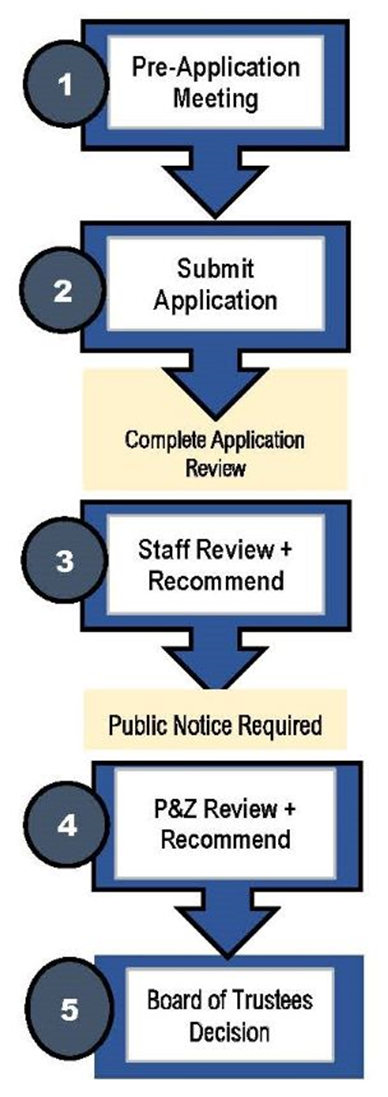
2.
Specific Procedures.
a.
The following notice shall be stamped on the face of each preliminary plat: "Preliminary Plat application for review purposes only." The Zoning Administrator shall distribute complete applications for preliminary plat approval to the following:
(1)
Electric power association.
(2)
Dolores School District.
(3)
Dolores Fire Protection District.
(4)
Colorado Geological Survey.
(5)
If the property is located within a wildlife habitat area, Colorado Parks & Wildlife.
3.
Notification Requirements for Preliminary Plat.
a.
Published notice of the public hearing shall be provided at least 10 days prior to the hearing.
b.
Mailed notice shall be provided at least 15 days before the hearing date.
c.
Posted notice shall be provided at least 15 days prior to the hearing.
4.
Decision Criteria.
The Planning and Zoning Commission and Board of Trustees shall consider the whether the proposed subdivision complies with the requirements of this LUC, including, but not limited to:
a.
The physical arrangement of the subdivision;
b.
The adequacy of street rights of way and alignment, the street standards of the Town of Dolores, the existing street pattern in the area and with all applicable provisions of the Comprehensive Plan.
c.
The adequacy of easements for proposed or future utility service;
d.
Provisions for surface drainage; and
e.
Whether lot sizes and areas are adequate to comply with the minimum requirements for the applicable zone district and for the type of sanitary sewage disposal proposed.
5.
Review and Decision-Making.
Preliminary plats shall be reviewed and decided upon as follows:
a.
Planning and Zoning Commission.
(1)
P&Z shall hold a public hearing to review the preliminary plat application. The P&Z shall act on the preliminary plat within 30 days after the official filing date or within a reasonable time thereafter.
(2)
If the information shown on a preliminary subdivision plat is of land located outside the corporate limits of the Town of Dolores and within the Urban Growth Boundary, the procedure for approval, modification, or disapproval, shall be the same as required for preliminary plats within the Town.
(3)
The action of P&Z shall be noted on two copies of the preliminary plat, referenced and attached to any conditions determined. One copy shall be returned to the applicant and the other retained by P&Z.
b.
Board of Trustees.
(1)
The Board of Trustees shall consider the P&Z recommendation at the next regularly scheduled meeting following Planning and Zoning Commission review.
(2)
The Board of Trustees shall approve or disapprove the preliminary plat as to street dedication and utility services, either with or without special provisions.
6.
Effect of Preliminary Plat Approval.
a.
Not Approval of Final Plat. Conditional approval of a preliminary plat shall not constitute approval of the final plat. Rather, it shall be deemed an expression of approval to the layout submitted on the preliminary plat as a guide to the preparation of the final plat.
b.
Lapse of Approval. Preliminary approval of the subdivision shall be valid for a period of 12 months from the date of approval and the general terms and conditions under which the preliminary approval was granted will not be changed. The Planning and Zoning Commission's preliminary approval of the subdivision shall be deemed voided unless the final plat is submitted within the 12-month period or unless the 12-month period is extended by the Planning and Zoning Commission at the request of the applicant.
D.
Final Plats.
1.
Procedure.
a.
The applicant shall submit a final plat for all or some of the property within 12 months of the approval date unless extended by action of the Planning and Zoning Commission.
b.
The final plat shall conform substantially to the preliminary plat as approved and, if desired by the applicant, it may constitute only that portion of the approved preliminary plat that he or she proposes to record and develop at the time, provided however, that such portion conforms to all requirements of these regulations.
c.
After the presentation of the construction plans for a subdivision to the Zoning Administrator, the Zoning Administrator may submit the construction plans to the Town Engineer for review. The Engineer shall, if deemed necessary, review the plans and submit a report to the Planning and Zoning Commission at the final plat presentation. The developer shall pay the reasonable cost of review of the construction plans before the final plat is presented to the Board of Trustees.
2.
Decision Criteria.
When deciding a final plat, the Board shall consider the following:
a.
Dedication of rights-of-way for public use;
b.
Construction of utilities, streets, drainage and other improvements;
c.
Status of conditions established by the preliminary plat approval;
d.
Status of all fees paid to the Town; and
e.
Proof of any required land dedication or payment of a cash-in-lieu fee.
3.
Review and Decision-Making: Board of Trustees.
a.
The Board of Trustees shall hold a public hearing on the final plat prior to taking action.
b.
An applicant may obtain approval of a portion or a section ("phase") of a subdivision provided that each phase shall meet all the requirements of this Code in the same manner required for a complete subdivision, including proportionate provision of all required infrastructure and open space.
(1)
When final plats are approved in phases, the final plat for each phase needs to carry the name of the entire subdivision, but is to bear a distinguishing letter, number, or subtitle.
(2)
Block numbers shall run consecutively throughout the entire subdivision, even though such subdivision may be finally approved in phases.
(3)
The Board of Trustees shall consider all proposals with respect to the criteria in Section 13.17.D.2, and when satisfied with the proposals, shall authorize the establishment of agreements for same.
c.
After the Board of Trustees has determined that the plat is in proper form, that the arrangement of the development proposed for the property being subdivided is consistent with zoning regulations, and that the subdivision complies with the provisions of this Code, it shall act to approve the plat.
d.
Final plats that are disapproved by the Board of Trustees shall be returned to the applicant with an attached statement of the reasons for such action.
E.
Post-Approval Action.
1.
Certification of Approval.
The Board of Trustee's approval and execution of the Board of Trustees certificate of approval on the final plat shall authorize the P&Z chairperson to execute the Planning and Zoning Commission certificate of approval on the plat. In no case shall additions, corrections, or modifications of any kind be made to the Final Plat other than signatures required after the Board of Trustees have approved the Final Plat.
2.
Recordation of Plats.
The final plat for any subdivision located within the corporate limits of the Town of Dolores shall then be caused to be filed of record by the applicant in the plat records of Montezuma County, but only after the Board of Trustees has officially acted upon the final plat with reference to improvements, dedications and utilities and all fees (including recording and review fees) shall be paid by the developer. The final plat shall have signatures from the Board of Trustees and the P&Z chairperson.
3.
Expiration and Extension.
An approved final plat has not been recorded within 90 days of Board of Trustees approval shall be considered expired. An applicant may request the Board for a 90-day extension prior to the expiration of the original approval.
F.
Improvements Agreements and Performance Guarantees.
1.
Improvements Agreements.
a.
Prior to the recording of a final plat or issuance of any building permit(s) the applicant shall submit an improvements agreement addressing construction of any required public improvements designated on the final plat to the Board for review and decision.
b.
Form of Agreement: All Improvement Agreements shall utilize the standard Town template (guide) for the format and content of such agreements.
2.
Performance Guarantee.
a.
The Board of Trustees shall require an applicant to file a financial guarantee in order to ensure compliance with any or all requirements of the Board stipulated in the improvements agreement and the final plat.
b.
The financial guarantee, in the judgment of the Board of Trustees, shall be sufficient to make reasonable provision for completion of the improvements in accordance with design and time specifications.
c.
Ordinarily, an irrevocable letter of credit to the Board of Trustees from a commercial bank, savings and loan institution, insurance company or other qualified lending institution(s) licensed or authorized to do business in the State of Colorado in a form satisfactory to the Mayor shall be required. Nothing in this section shall preclude the Board of Trustees from approving other forms of financial security.
3.
Release of Collateral.
a.
As public improvements are made, an applicant may apply to the Board for release of part or all of the collateral deposited with the Board.
b.
Upon inspection and approval, the Board shall release collateral, provided that in the event a combination of forms of collateral has been accepted, the Board shall release collateral on a priority basis it deems appropriate.
c.
If the Board determines that any of the required improvements are not constructed in substantial compliance with specifications, it shall furnish the applicant a list of specifications and shall be entitled to withhold collateral sufficient to ensure substantial compliance.
d.
If the Board determines that the applicant will not construct any or all of the improvements in accordance with all of the specifications, the Board may withdraw and employ from the deposit of collateral such funds as may be necessary to construct the improvements in accordance with the specifications.
G.
Acceptance of Subdivision Improvements.
1.
Timeframe for Completion.
a.
If public improvement construction has not commenced within one year after approval of the plans as reflected in the Improvement Agreement, re-submittal of plans may be required by the Town Engineer to ensure that the design meeting current standards and engineering requirements.
b.
These plans will be reviewed and comments noted in 15 working days. A fee as provided for in the fee schedule adopted by resolution of the Board of Trustees is required upon the re-submittal of plans for review.
c.
"Construction" shall mean the start or commencement of construction of Town maintained facilities.
2.
Expiration and Extension of Approval.
a.
The construction and acceptance of public improvements by the Town, and the corresponding final plat for said subdivision filed in the plat records of the Montezuma County shall be completed within 36 months from the date of final plat approval. Where construction is not completed, the final plat shall be null and void and shall conclusively be deemed to be withdrawn, without further action by the Town; provided however, this provision shall not apply to final plats approved by the Town prior to the adoption of this Land Use Code of June, 2008. If the public improvements for a subdivision that was approved prior to June, 2008 have not been constructed and accepted by the Town, and the corresponding final plat for said subdivision filed in the map and plat records of the Montezuma County by within 36 months of the adoption of the Land Use Code June, 2008, said final plat shall be null and void and shall conclusively be deemed to be withdrawn, without further action by the Town.
b.
An approved, unexpired final subdivision plat may be extended once for a period not to exceed 36 months, pursuant to the following provisions:
(1)
The Board of Trustees may extend the approval of the final plat, for good cause shown by the applicant, if there has been no significant change in development conditions affecting the subdivision plan and the plat continues to comply with all applicable standards and ordinances.
(2)
A request for an extension of time to complete final public improvements for a subdivision pursuant to these provisions shall be submitted to the Zoning Administrator no later than the date the final subdivision plat expires. The request shall be in writing, and the application shall state the reason and justification for the requested extension.
H.
Plat Amendments and Corrections.
Plat amendments shall be subject to all of the requirements of this Code regarding preliminary plats and final plats, provided, however, that the Board of Trustees shall be authorized to approve an amending plat without notice or hearing where the plat amendment is solely to correct the plat for one or more of the following purposes and does not remove any covenants or restrictions or increase the number of lots.
1.
The purpose of the amendment is to correct an error in any course or distance shown on the prior plat.
2.
The purpose of the amendment is to add any course or distance that was omitted on the prior plat.
3.
The purpose of the amendment is to correct an error in the description of the real property shown on the prior plat.
4.
The purpose of the amendment is to indicate monuments set after death, disability, or retirement from practice of the engineer responsible for setting the monuments.
5.
The purpose of the amendment is to show the proper location or character of any monument that has been changed in location or character or that originally was shown at the wrong location or incorrectly as to its character on the prior plat.
6.
The purpose of the amendment is to correct any other type of clerical error or omission in the previously approved plat.
7.
The purpose of the amendment is to correct an error in courses and distances of lot lines between two adjacent lots where both lot owners join in the application for plat amendment and neither lot is abolished, provided that such amendment does not have a material adverse effect on the property rights of the owners in the plat.
8.
The purpose of the amendment is to relocate a lot line in order to cure an inadvertent encroachment of a building or improvement on a lot line or on an easement.
9.
The purpose of the amendment is to relocate or vacate one or more lot lines between one or more adjacent lots where the owner or owners of all such lots join in the application for the plat amendment.
Section 13.18. - Condominium subdivision/townhouse subdivision.
A.
Purpose.
This section provides review procedures, submittal requirements and standards for review to ensure that the creation or conversion of condominium subdivisions will comply with the Uniform Building Code as amended by the Town of Dolores and other provisions of this Code.
B.
Procedures.
1.
Common Procedures.
Common procedures for a condo/townhouse subdivision plat are established in Table 13.2.
2.
Specific Procedures.
a.
A preapplication meeting is required.
b.
A new condominium subdivision shall be processed as a Section 13.17, Major Subdivision.
c.
Condominium/Townhouse conversion shall be reviewed as a Section 13.16, Minor Subdivision, regardless of the number of units proposed for conversion.
d.
Any subsequent change in the approved use(s) for a condominium subdivision/townhouse subdivision shall be subject to the same review procedures as would be applied to a new condominium subdivision.
e.
Notwithstanding anything in this Code to the contrary, no requirement for public improvements, dedication of land to public use or cash-in-lieu, or other subdivision requirement shall be imposed as a condition of approval for a condominium subdivision or common interest community which would not be imposed upon a physically identical development under a different form of ownership. This provision shall not be construed to prevent the Town from imposing the review requirements of this Code upon any change of use, expansion of use, increase in intensity of use, or other change in a condominium or common interest community unrelated to its form of ownership.
C.
Application Review Procedures for As-Built Condominium Subdivision Plats.
1.
The Zoning Administrator shall review as-built plats within 15 days of the submittal of the plat.
2.
If the Zoning Administrator is satisfied that the proper dedications have been made and that the plat accurately depicts the completion of the improvements in a manner that is substantially consistent with the approved final plat, the Zoning Administrator shall present the as-built plat to the Mayor for signature and shall cause the as-built plat and other appropriate documents to be filed of record by the developer in the plat records of Montezuma County.
Section 13.19. - Conservation subdivision.
A.
Purpose.
The purpose of a conservation subdivision is to encourage the conservation of environmentally sensitive or hazardous areas from development while allowing the permitted zoning density of the site to be clustered in smaller lots in less sensitive locations.
B.
Procedures.
1.
Major Subdivision.
A conservation subdivision application is processed as a Section 13.17, Major Subdivision, subject to the design requirements of this section.
2.
Site Analysis Map.
After the pre-application meeting, but prior to submittal of the conservation development subdivision application, the applicant shall prepare and submit a preliminary site analysis map that provides information about existing site conditions and context, and that comprehensively analyzes existing conditions both on the proposed subdivision property and on all lands within 1,500 feet of the subject property's boundaries. The site analysis map scale shall be in accordance with standards for a preliminary plat and the map shall contain the information listed in the subsections below.
a.
Public roads and trails;
b.
Utility easements and rights-of-way, as filed with the county;
c.
Constructed features, including but not limited to driveways, farm roads, buildings, foundations, walls and fences, wells, drainage fields, ditches, dumps, and utilities;
d.
Topography (from United States Geological Survey (USGS) maps) as required for preliminary plats, including steep slopes (30 percent or greater);
e.
Streams, rivers, waterbodies, and wetlands, and required setbacks as defined in this chapter;
f.
Base flood areas;
g.
Wildlife habitat protection areas identified by Colorado Parks and Wildlife (CPW);
h.
Soils as mapped by the United States Department of Agriculture (USDA) Natural Resources Conservation Service;
i.
Public lands, both state and federal;
j.
Lands protected under conservation easements; and
k.
Historically and culturally significant sites or structures.
3.
Proposed Conservation Area Design.
a.
The site analysis map shall depict the proposed or potential conservation area(s) (including total calculated conservation area and its percentage of the total subdivision) based on the natural features to be protected and to achieve the minimum amount of land to be conserved as identified in this section. The preliminary site analysis shall also identify the applicant's approach to conservation area(s) long-term maintenance.
b.
The site analysis map shall also delineate the potential buildable areas (including total calculated conservation area and its percentage of the total subdivision) as a last step, following delineation of the natural and constructed features and potential conservation area(s).
4.
Site Visit.
After the applicant creates a preliminary site analysis map, and prior to submission of the concept plan and complete application, the applicant shall schedule a site visit to the property with the zoning administrator. The zoning administrator may invite other relevant local, state, or federal agencies (e.g., Town engineer, Montezuma Land Conservancy, CPW) to attend the site visit. The purpose of the site visit is to:
a.
Familiarize staff with the property's existing conditions and special features,
b.
Identify potential site development issues, and
c.
Provide an opportunity to discuss design concepts, including the general location and layout of the conservation area(s), the potential locations for proposed buildable areas, parcels, and building envelopes within parcels (as applicable), and the potential locations for utilities, roads, and other development features.
d.
Comments made by staff during the site visit are not binding in any way and shall be interpreted as suggestions only. No official decisions shall be made during the site visit.
5.
Concept Plan.
After the pre-application meeting and site visit, the applicant shall submit the site analysis map, and a concept plan, and proposed conservation area(s) maintenance plan to the zoning administrator for review and comment.
6.
Complete Application.
Following receipt of the written comments on the concept plan from the zoning administrator, the applicant shall submit a complete subdivision application for a conservation development subdivision follow the requirements of Section 13.17, Major Subdivision.
Section 13.20. - Planned unit development.
A.
Purpose.
The PUD, Planned Unit Development District is designed to provide flexibility in the siting of structures to avoid or mitigate any hazardous areas, historic and prehistoric site's; to take advantage of the sites unique, natural, resource or scenic features; and to preserve open spaces. It is intended for application in all residential districts.
B.
Types of Planned Unit Developments.
1.
General PUD.
The Town Board, after public hearing and due notice and after recommendation from the Planning and Zoning Commission, may authorize the creation of the Planned Unit Development Districts on parcels of land containing at least five times the minimum lot area in the underlying zone district. A Planned Unit Development designation may be applied to land intended for residential development purposes.
2.
Community Benefit PUD.
In order to be deemed as an acceptable alternative to the Town's established zone districts, a Community Benefit PUD shall include at least one of the following community benefits:
a.
Affordable Housing PUD providing at least 20 percent of the proposed residential units in either rental or for-sale deed-restricted affordable housing.
b.
Historic Preservation PUD including an existing structure or site that is currently designated or is documented as eligible for designation on the Town Register, state list of historic structures, or the National Register of Historic Places within a contiguous area included in the PUD application, and must either:
(1)
In the case of an existing designated historic structure or site, the PUD application must include a written commitment to preserve the structure or site in compliance with all applicable historic preservation standards for a period of at least 20 years; or
(2)
In the case of an undesignated historic structure or site, the PUD application must include a written commitment to complete the Town designation of the structure or site prior to development of any portion of the PUD, and to preserve the designated structure or site in compliance with all applicable historic preservation standards for a period of at least 20 years.
3.
The PUD application may include additional lands contiguous with the lot or parcel containing the historic structure.
c.
Sustainable/Resilient Design PUD with proposed project, site, or building design features intended to achieve one or more of the following reductions in resource consumption or trip generation when compared to those levels anticipated for developments of a similar type under the reference base district:
(1)
A reduction in water consumption of at least 25 percent; or
(2)
A reduction in non-renewable energy use of at least 25 percent; or
(3)
A reduction in average daily motor vehicle trip generation of at least 25 percent;
(4)
A combination of reductions in water consumption, non-renewable energy use, and/or average daily motor vehicle trip generation providing at least an equivalent sustainable/resilient development benefit to the Town.
C.
Procedures.
1.
Common Procedures.
Common procedures for a PUD approval are established in Table 13.2.
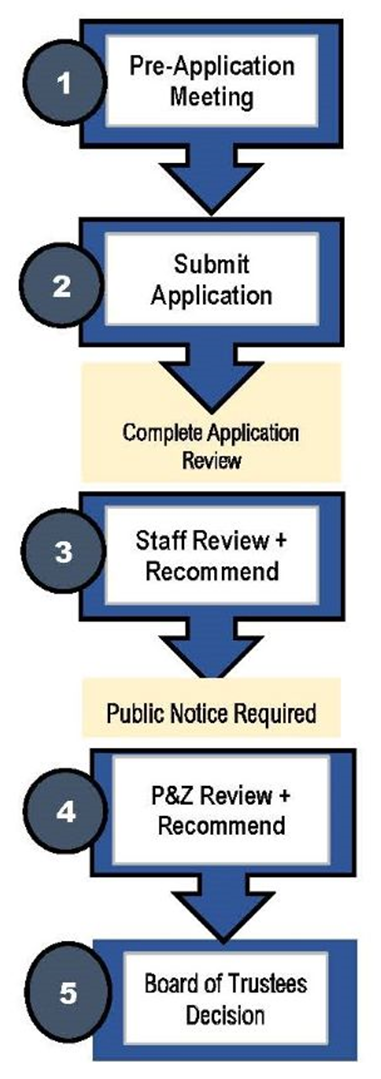
2.
Specific Procedures.
Every PUD District approved under the provisions of this LUC shall follow the rezoning procedure of Sec. 13.30, Zoning Map Amendment, and be considered an amendment to the zoning map.
D.
Site Plan Requirement.
1.
The establishment of a Planned Unit Development District shall require a comprehensive site plan of the development per Sec. 13.23. The site plan shall be approved as part of the ordinance approving a Planned Unit Development prior to the issuance of any further approvals or permits.
2.
The site plan and ordinance shall set forth the requirements for ingress and egress to the property with adequate right of way, special setbacks, sidewalks, trails, utilities, drainage, parking space, building height, maximum lot coverage, common open space, screening or fencing, landscaping and other development and protective requirements including a plan for the maintenance of common open space.
E.
Permitted Variation from Zoning Dimensional Standards.
In order to achieve the purpose and intent of the PUD District, variation may be permitted with respect to the minimum lot area, setbacks, lot width, lot coverage, and height.
F.
Maximum Density.
1.
The maximum density in a General PUD shall be no greater than that permitted in the underlying zone district prior to PUD approval.
2.
The Zoning Administrator may recommend and the Board of Trustees approve a maximum density increase in a Community Benefit PUD by up to 20 percent based on the applicant's ability to demonstrate that the increased density is appropriate for the location, will not detrimentally impact surrounding neighborhoods, and that the site does not meet any of the density reduction criteria in Section F.3.
3.
Densities in any type of PUD may be reduced if:
(a)
There is not sufficient water pressure and other utilities to service the proposed development;
(b)
There are not adequate roads to ensure fire protection to the proposed development;
(c)
The land is not suitable for the proposed development because of soil or geologic conditions, flood hazards or the presence of historic or prehistoric sites; or
(d)
The design and location of any proposed structure, road, or driveway in the proposed development is not compatible with surrounding land uses, would adversely affect the neighborhood character or adversely affect critical natural features of the site.
G.
Minimum Common Open Space.
The minimum common open space shall be 30 percent of the land area in the PUD; provided that, all areas in a PUD that are impacted by geologic hazards, flood hazards, or the presence of historic or prehistoric sites shall be set aside as common open space for the benefit of the residents and occupants of the PUD.
H.
Uses.
The permitted, accessory, conditional, and temporary uses allowed shall be those of the underlying zone district.
(Ord. No. 566, § 1(Exh. A), 8-14-2023)
Section 13.21. - Short-term rental permit.
A.
Application Contents.
In addition to any other information prescribed by the Zoning Administrator, an application for a short-term rental permit shall include the following information:
1.
Contact information for the owner of the property.
2.
Local contact and guest information: Each vacation rental shall have a designated local contact person(s). The local contact may be a property management/real estate company, rental agent or other person engaged or employed by the owner to rent, manage or supervise the vacation rental. A property owner may designate themselves as the local contact person if the owner meets the criteria of this section. The local contact must reside within a 30-minute drive of the rental property and be available 24 hours a day 365 days a year during tenancies for timely response to guest and neighborhood questions and concerns. An alternate local contact shall be designated, available and meet the criteria of this section when the primary is not available. All local contacts shall list their name and telephone/cell number and it shall be posted in a prominent location within the vacation rental and the contact information shall also be provided to the Town of Dolores on the application for a short-term rental. Any change to the contact(s) name or telephone/cell number shall be submitted to the Town within 24 hours of the change.
3.
Attestation and agreement to comply with the requirements of Section 4.5.B.4.
4.
Identification of all dwelling units that will be rented on a short-term basis.
5.
A zoning development permit with confirmation of a passed building, fire, and life safety inspection.
6.
The URL (i.e., the website address) and names of any booking services for any and all advertisements of the short-term rental of the property.
7.
Attestation that short-term rental of the property is not prohibited by Covenants, Conditions and Restrictions (CC&Rs), or rules or restrictions of a homeowners' association or similar association, and that applicant has notified such association that the property owner is applying for a short-term rental permit. Proof of notification must be retained for the duration that the applicant maintains a short-term rental permit for the property.
8.
If seeking a short-term rental permit in a multifamily structure, contact information, including a phone number, for all tenants. Copies of the leases for all tenants, and proof of ownership of entire building must be provided within 10 days of a request for such information.
9.
Payment of a permit fee the amount of which shall be established from time to time by the Board of Trustees of the Town of Dolores by resolution.
B.
Review.
The Zoning Administrator shall review an application for a short-term rental permit for compliance with these regulations. The Zoning Administrator shall not approve an application for a short-term rental permit (or renewal of such permit), or may revoke such permit, if any of the following findings are made:
1.
The applicant has not paid all applicable sales and lodging taxes due for the short-term rental or property on which it is located.
2.
The property has any outstanding code enforcement violations.
3.
The property does not comply with all applicable codes regarding fire, building and safety, and other relevant laws and ordinances.
4.
The applicant has knowingly made any false, misleading, or fraudulent statement of material fact in the application, or in any report or statement required to be filed that is related to the application.
5.
The property that is the subject of the application is not in a condition where it may be immediately rented on a short-term basis consistent with the requirements of these regulations.
6.
The property has received more than two citations for violation of the Land Use Code, parking, noise ordinance, or outdoor lighting regulations within a period of 12 consecutive months.
C.
Notice of Approval.
When a short-term rental permit is approved, the Zoning Administrator shall provide, at the owner's expense, the contact information for the owner's agent to all dwelling units adjacent to or across the street from the parcel boundary.
D.
Duration and Renewal.
1.
Short-term rental permits shall be issued for one year and must be renewed annually.
2.
An application to renew a short-term rental permit must be received by the Zoning Administrator not less than sixty days prior to the expiration of the short-term rental permit.
3.
Applications for renewal shall be in a form required by the Town and shall include updates of all information required or submitted for the permit.
4.
No permit shall be renewed unless all Town fees and taxes owed by the applicant are paid in full, including the renewal fee.
5.
Applications for renewal shall include a passing annual fire/life safety inspection conducted by the town Building Official.
E.
Effect of Denial or Revocation.
1.
If an application for a short-term rental permit (or an application for renewal of such permit) is denied, the Zoning Administrator shall not approve a new application for that applicant and location for a 12-month period after the denial unless the Zoning Administrator determines that the reason for the denial has been cured and no longer exists. An applicant who has requested review based on cured circumstances but who is then again denied must wait the full 12-month period following the cured circumstances request before submitting a new application.
2.
If a short-term rental permit is revoked, the short-term rental of the property must cease immediately and shall not be permitted for a period of 12 months from the date of revocation.
3.
The short-term rental of property (or advertisement or offer of such rental) after denial or revocation of a short-term rental permit shall result in the property and applicant being ineligible to conduct the short-term rental of property (or apply for a short-term rental permit) for an additional six-month period for each such rental; such period is in addition to the prohibitions listed in sections 1. and 2. above.
4.
No fee refunds shall be issued to any permittee whose short-term rental permit is revoked.
F.
Enforcement, Violation, and Penalties.
1.
In addition to the other penalties and remedies available to the Town, violations of this section shall be subject to a fine of $500.00 per day or violation.
2.
The short-term rental permit holder shall be held responsible for citations for violations of the municipal code committed by persons at the property during a period when the property is rented on Short-Term rental basis.
Section 13.22. - Sign permits.
A.
Purpose.
The purpose of a sign permit is to review a proposed sign for compliance with Article 11, Signs.
B.
Applicability.
1.
Permanent Sign Permit.
a.
It shall be unlawful to erect, construct, reconstruct, alter, paint, or repaint, or change the use of any sign as defined in this LUC without first obtaining a sign permit.
b.
A sign permit shall be required for each group of signs on a single supporting structure installed simultaneously. Thereafter, each additional sign erected on the structure must have a separate sign permit.
c.
These directives shall not be construed to require any permit for a change of copy on any sign, nor for the repainting, cleaning and other normal maintenance or repair of a sign or sign structure for which a permit has previously been issued, so long as the sign or sign structure is not modified in any way.
2.
Illegal Signs.
No permit for a sign issued hereunder shall be deemed to constitute permission or authorization to maintain an unlawful sign nor shall any permit issued hereunder constitute a defense in an action to abate an unlawful sign.
C.
Authority.
1.
A sign permit application may be submitted by a property owner, tenant, or an owner or tenant's agent.
2.
No person shall erect, construct, or maintain any sign upon any property or building without the consent of the owner or person entitled to possession of the property or building if any, or their authorized representatives.
D.
Procedures.
1.
Common Procedures.
Common procedures for a sign permit are established in Table 13.2 and are included here for applicant convenience.
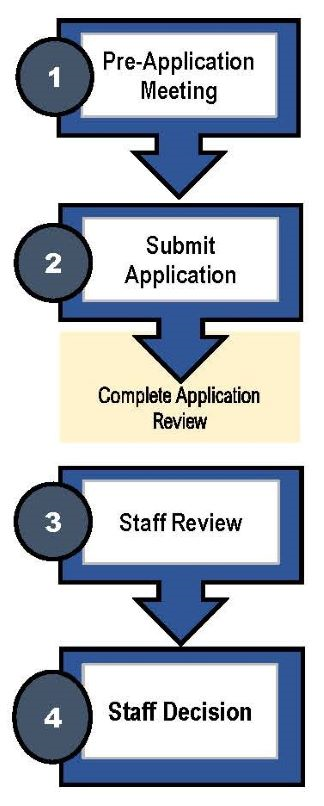
2.
Administrative Determination.
Sign permit applications are processed as a Section 13.6, Administrative Decision.
E.
Appeal.
An appeal to the BOA may be made by any applicant aggrieved by the Zoning Administrator's determination on a sign permit application.
F.
Post-Approval Action.
1.
Revocation.
The Zoning Administrator may, in writing, suspend or revoke a permit under provisions of this section whenever the permit was issued on the basis of a misstatement of fact or fraud.
2.
Permit Expiration.
A sign permit shall become null and void if installation is not commenced within 120 days from the date of permit issuance.
Section 13.23. - Site plan review.
A.
Purpose.
The purpose of a site plan is to provide the decision-making authorities with a legally binding visual representation of a proposed development to ensure compliance with the development and use-specific standards of these Regulations and to encourage quality development reflective of the goals, policies, and objectives of the Dolores Comprehensive Plan.
B.
Applicability.
1.
When site plan review is required, as identified below, structures and uses may be established, and building permits may be issued only after a site plan showing the proposed development has been approved in accordance with the procedures and requirements of this section.
2.
Preliminary Planned Unit Development review and approval serves as site plan review for the purposes of this section.
3.
The following applications and projects are subject to site plan approval:
a.
All new uses and structures that are not part of a preliminary PUD application or preliminary subdivision plat;
b.
All requests for temporary uses and structures;
c.
Any proposed redevelopment that meets or exceeds 10 percent increase in gross square footage, or 50 percent increase in assessed valuation, with either measurement calculated over a five-year period.
d.
Relocation of development pads, buildings, or dwelling units for some practical reasons such as topography, road alignment or easements provided that the modification does not significantly alter the site design in terms of parking layouts, vehicular circulation, landscape design, and other similar components of the development plans;
e.
An increase or decrease in a proposed setback, provided LUC requirements are still met;
f.
A modification to a recreation area or open space design, but not elimination or more than a 10 percent reduction;
g.
A change in the parking lot layout or vehicular circulation;
h.
Construction on any site with existing trees subject to Section 7.7, Tree Preservation;
i.
A change in the landscape design or a change of more than 20 percent of plant types for any mixed-use or non-residential development subject to a valid landscaping plan;
j.
Any change that may affect an adjoining residential neighborhood;
k.
Any request that would significantly alter the design of the site or building(s); or
l.
A request to change or delete a condition of approval established by the P&Z or the Board.
C.
Procedure.
1.
Common Procedures.
Common procedures for site plan review are established in Table 13.2 and are summarized here for applicant convenience.
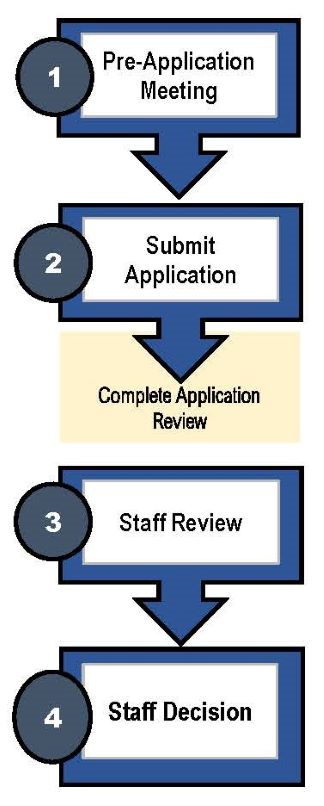
2.
Administrative Determination.
Site plan applications are processed as a Section 13.6, Administrative Decision.
3.
Referral to Planning Commission.
The Zoning Administrator may refer any site plan application to the P&Z that, in the Zoning Administrator's opinion, presents issues that require P&Z attention.
D.
Decision Criteria.
The Zoning Administrator may approve a site plan upon a finding that the application meets all of the following criteria, as applicable to the specific site and development design:
1.
The site plan is consistent with the Dolores Comprehensive Plan;
2.
The site plan is consistent with any previously approved subdivision plat, planned development, or any other precedent plan or land use approval as applicable;
3.
The site plan complies with all applicable development and design standards set forth in this LUC;
4.
Any significant adverse impacts reasonably anticipated to result from the use will be mitigated or offset to the maximum extent practicable;
5.
The development proposed in the plan and its general location is, or will be, compatible with the character of surrounding land uses and structures; and
6.
The development can be adequately served by Town services including, but not limited to: roads, water, and wastewater.
E.
Appeal.
An appeal to the BOA may be made by any applicant aggrieved by the Zoning Administrator's determination on a site plan application. Appeal of a P&Z site plan approval may be made to the Board of Trustees.
F.
Post-Approval.
1.
Site-Specific and Binding.
a.
Approved site plan documents shall be binding upon the applicants and their successors and assigns.
b.
No permit shall be issued for any building, structure, or use that is not in accord with the approved documents, or any approved modifications thereto.
c.
The construction, location, use or operation of all land and structures within the site shall conform to all conditions and limitations set forth in the documents.
d.
No structure, use, or other element of approved design review documents shall be eliminated, altered, or provided in another manner unless an amended site plan is approved.
2.
Expiration.
a.
Approved site plan documents shall expire one year after approval if a building permit has not been issued, or the approved use established.
b.
In the event that the documents expire due to the passage of this time period, new site plan review documents must be submitted for approval in the same manner as an original application for development review. An extension not to exceed one year may be granted by the zoning administrator.
3.
Modifications to Site Plans.
The holder of an approved site plan may request a modification to the document, or the conditions of approval, by submitting amended documents to the Zoning Administrator. The amended documents shall be filed and processed in accordance with the procedures for an initial site plan submittal.
Section 13.24. - Solar and wind energy facilities permitting.
A.
Application Types.
1.
Tier 1 wind and solar facilities require Section 13.23, Site Plan approval.
2.
Tier 2 wind and solar facilities are processed through Section 13.12, Conditional Use Permit Review.
B.
Additional Information.
Tier 2 applications shall include the following information:
1.
Approved net metering agreement(s) and copies of applications to or approved permit from applicable state and federal agencies.
2.
A landscape plan showing that all areas occupied by the facility that are not utilized for access to operate and maintain the installation shall be planted and maintained with a native shade tolerant grass or other vegetation for the purpose of soil stabilization or other methods approved by the zoning administrator.
3.
A storm water management plan showing existing and proposed grading and drainage demonstrating no net increase in runoff.
4.
A preliminary transportation plan describing ingress and egress to the proposed project site to deliver equipment and provide access during and after construction. Such plan shall describe any anticipated improvements to existing roads, bridges, or other infrastructure, as well as measures which will be taken to restore damaged or disturbed access routes following construction.
5.
An environmental assessment that analyzes the impact of the proposed project regarding on-site and site-adjacent floodways, riparian corridors, open water, wildlife migration routes, protected habitat, protected plant species, and other environmentally sensitive areas as identified by the County, City, State, or federal government, along with proposed mitigation recommendations.
6.
A decommissioning plan.
Section 13.25. - Special exceptions.
A.
Purpose.
Special exceptions are deviations from otherwise applicable operational performance standards; compatibility standards; setback standards; fence standards; design standards; sign standards, limited to historic replica signs only; and road design standards; where development is proposed that would be (1) compatible with surrounding land uses, (2) in keeping with the public interest and (3) consistent with the purposes of this Code.
B.
Authority.
A property owner or developer may request a special exception when the provisions of Section 13.5, Administrative Adjustment, are insufficient to provide the regulatory relief sought for the site or development.
C.
Procedure.
1.
Common Procedures.
Common procedures for a special exception application are established in Table 13.2 and are summarized here for applicant convenience.
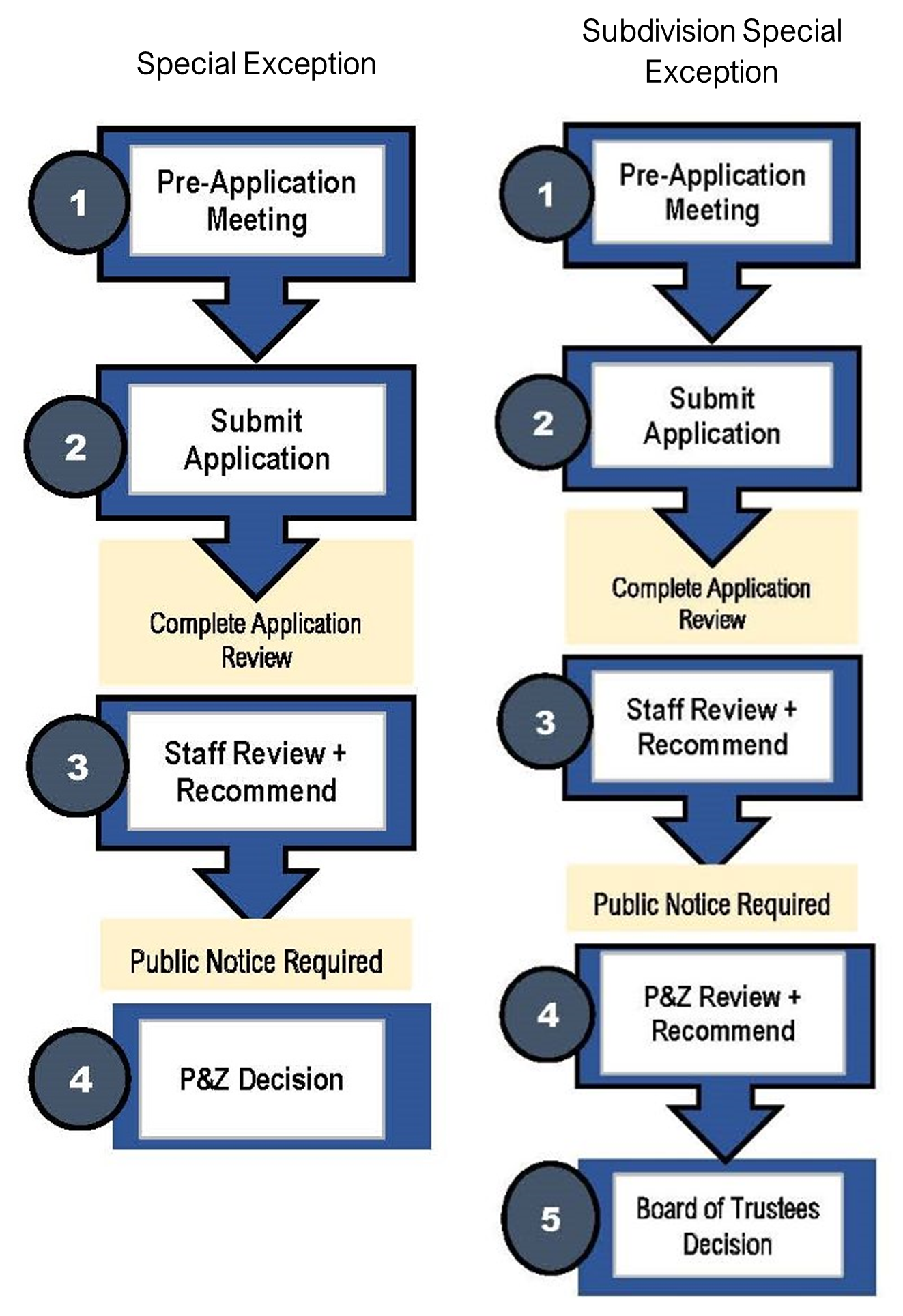
2.
Specific Procedures.
a.
Published notice of the P&Z public hearing shall be provided at least 15 days before the hearing date.
b.
Mailed notice of the Board of Trustees public hearing shall be given at least 15 days before the hearing date.
D.
Decision Criteria.
The Planning and Zoning Commission and Board of Trustees shall consider the following criteria when reviewing a special exception application:
1.
That granting the special exception will ensure the same general level of land use compatibility as the otherwise applicable standards;
2.
That granting the special exception will not materially and adversely affect adjacent land uses and the physical character of uses in the immediate vicinity of the proposed development because of inadequate buffering, screening, setbacks and other land use considerations;
a.
Special exceptions for setbacks shall be granted only where the standard separation between buildings in the district that normally results from the required setbacks is maintained and guaranteed by easement on the adjacent property;
b.
Special exceptions for historic replica signs shall be granted subject to the following:
(1)
A historic replica sign shall be located on a structure or in a district that has been historically designated pursuant to Section 13.14.
(2)
Applications for a historic replica sign will be supported by documentation evidencing the historic style, format and location of the sign to be replicated;
(3)
A historic replica sign shall replicate the style and format of a historic sign, but need not employ the same words, phrases, or symbols; and
(4)
The Planning and Zoning Commission or Board of Trustees must find that the proposed historic replica sign contributes positively to the historic redevelopment of the Town.
3.
That granting the special exception will not adversely affect property values in any material way; and
4.
That granting the special exception will be generally consistent with the purposes for this LUC described in Section 13.4.E.3.
E.
Decision-Making.
Decision-making for a Special Exception Permit shall be undertaken as follows:
1.
Planning and Zoning Commission.
a.
The Planning and Zoning Commission in accordance with the procedures, standards, and limitations of this section, shall approve, approve with conditions or disapprove an application for a Special Exception Permit after receiving a recommendation from the Zoning Administrator.
b.
The P&Z may impose such conditions on a Special Exception Permit as are necessary to accomplish the purposes of this LUC, to prevent or minimize adverse impacts upon the public and neighborhoods and to ensure compatibility. These conditions may include but are not limited to limitations on size, bulk, and location; standards for landscaping, buffering and screening, lighting and adequate ingress and egress; cash deposits, bonds and other guarantees of deposit; other on-site improvements; and limitations on the duration of the permit or hours of operation.
2.
Board of Trustees: Subdivision Special Exceptions.
In conjunction with the review of subdivision applications, the Board of Trustees shall be authorized to grant special exceptions subject to the requirements of Article 6, Subdivision Standards.
F.
Post-Approval Actions.
1.
General.
Issuance of a Special Exception Permit shall authorize only the particular variation, which is approved in the Special Exception Permit.
2.
Site-Specific.
A Special Exception Permit shall run with the land.
3.
Expiration and Extension.
a.
Unless otherwise specified in the Special Exception Permit, an application to commence construction of the improvements that were the subject of the Special Exception Permit request must be applied for and approved within 12 months of the date of the approval of the Special Exception Permit, otherwise the Special Exception Permit shall automatically become null and void.
b.
Permitted time frames do not change with successive owners.
c.
Upon written request, only one extension of the 12-month time frame may be granted by the Planning and Zoning Commission for a period not to exceed 12 months for good cause shown.
Section 13.26. - Temporary use permits.
A.
Purpose.
The purpose of a temporary use permit is to ensure that a proposed temporary use or structure is in compliance with the applicable regulations in this LUC.
B.
Applicability.
A temporary use permit may be approved only where the use or structure for which the permit is requested is authorized as a temporary use or structure in the district in which the use is to be located.
C.
Process.
1.
Common Procedures.
Common procedures for a temporary use permit are established in Table 13.2 and are summarized here for applicant convenience.
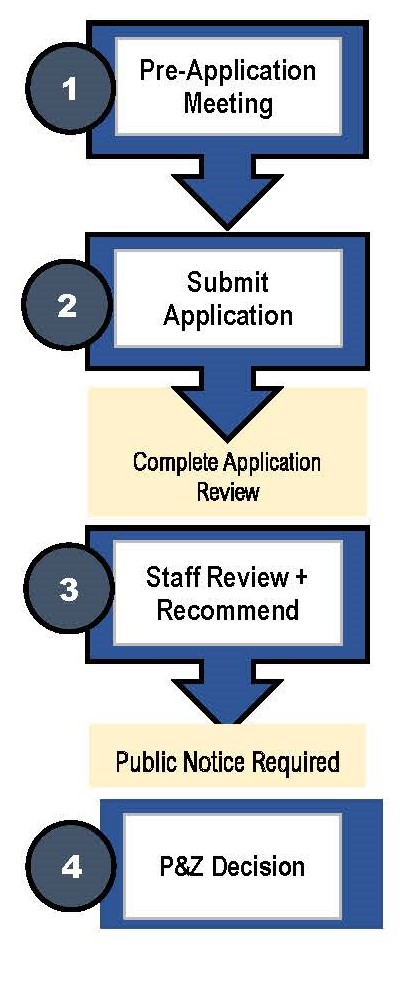
2.
Specific Procedures.
Temporary use permit applications shall be processed through the Section 13.23, Site Plan review process with a determination made by P&Z. Neither notice nor a public hearing are required for the issuance of a temporary use permit. The Planning and Zoning Commission may, in its discretion, hold a public hearing on any temporary use permit application of Town-wide significance.
D.
Decision Criteria.
In addition to the site plan review criteria, the Planning and Zoning Commission shall also review temporary use applications for the following:
1.
Requirements for vehicular ingress/egress and corresponding traffic safety provisions, parking requirements and facilities, and hours of operation;
2.
Regulation of public nuisance factors (e.g., light glare, noise, vibration, smoke, dust, dirt, odors, gases, and heat); and
3.
Regulation of maintenance and site restoration during, and after termination of the temporary use or expiration of the temporary use permit. A bond or other form of security acceptable to the P&Z may be required prior to the initiation of the use to ensure cleanup after the use is finished.
E.
Time Limit.
A time limit for the discontinuance of the Temporary Use shall be specified on the Temporary Use Permit. If no time limit is specified, then the time limit shall be 30 days from the day on which the temporary use is commenced.
Section 13.27. - Variances.
A.
Purpose.
Variances are deviations or modifications of height, yard, area, lot coverage and parking regulations of the applicable zone district where development is proposed that would not be contrary to the public interest and, due to special physical site conditions, a literal enforcement of the provisions of this Code would result in unnecessary hardship. Variance or modification of such area regulations may be permitted as may be necessary to secure appropriate development of a parcel of land that differs from other parcels in the district by being of such restricted area, shape, or slope that it cannot be appropriately developed without such modification.
B.
Authority.
1.
The Board of Adjustment may review and decide on an application for a variance.
2.
The Board of Trustees is authorized to review and decide on subdivision variances.
C.
Procedure.
1.
Common Procedures.
Common procedures for a variance are established in Table 13.2 and are summarized here for applicant convenience.
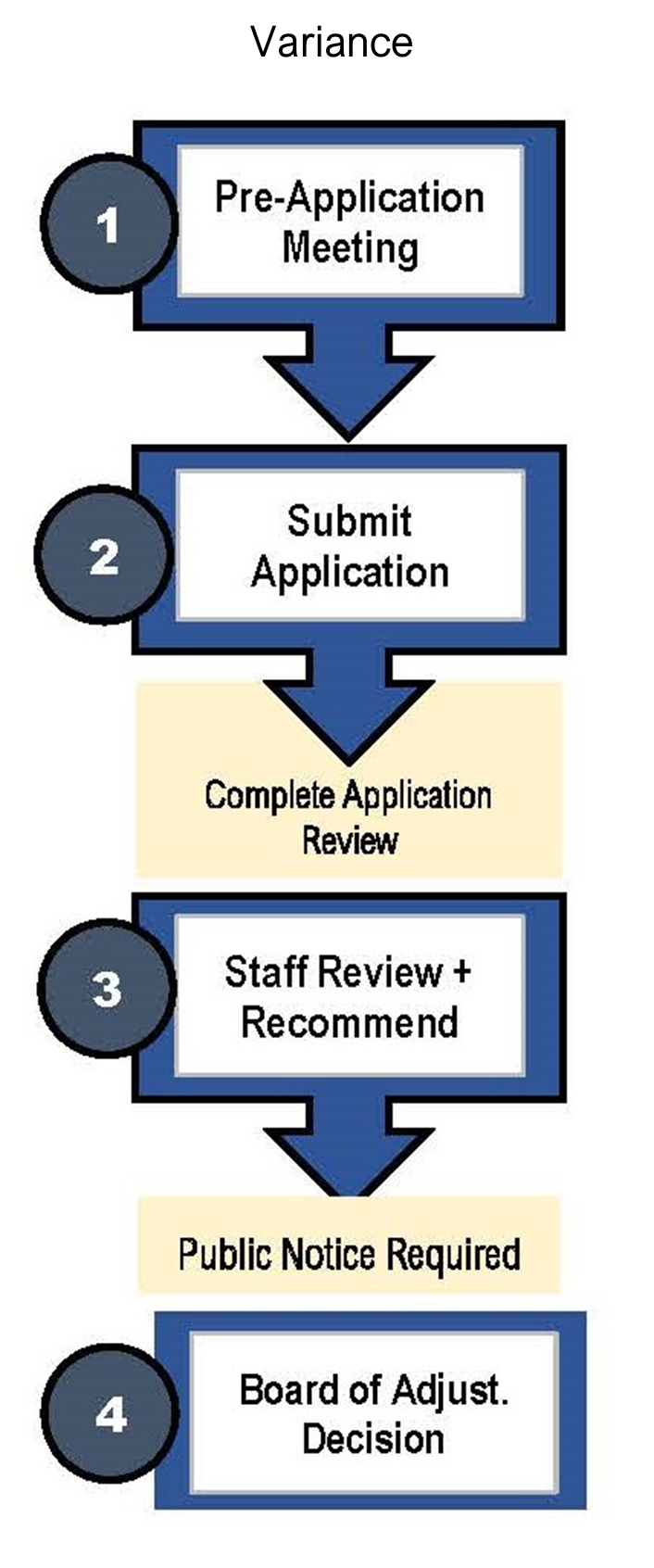
2.
Specific Procedures.
a.
Published notice of the public hearing shall be provided at least 15 days prior to the hearing date.
b.
Mailed notice shall be provided at least 15 days before the hearing date.
D.
Required Findings.
In exercising its power to grant a variance in accordance with this Code, the Board of Adjustment or Board of Trustees shall make the following findings:
1.
There are special circumstances existing on the property on which the application is made related to size, shape, area, topography, surrounding conditions and location that do not apply generally to other property in the same area and zone district;
2.
That a variance is necessary to permit the applicant the same rights in the use of this property that are presently enjoyed under this Code, by other properties in the vicinity and zone, but which rights are denied to the subject property;
3.
That the granting of the variance on the specific property will not adversely affect the land use pattern as outlined by the Future Land Use Plan and will not adversely affect any other feature of the Comprehensive Plan of the Town of Dolores;
4.
That the variance, if granted, will be no material detriment to the public welfare or injury to the use, enjoyment or value of property in the vicinity;
5.
That such unnecessary hardship has not been created by the applicant; and
6.
That the proposed use is a permitted use in the underlying zone district.
E.
Decision-Making.
Decision-making for a variance application shall be undertaken as follows:
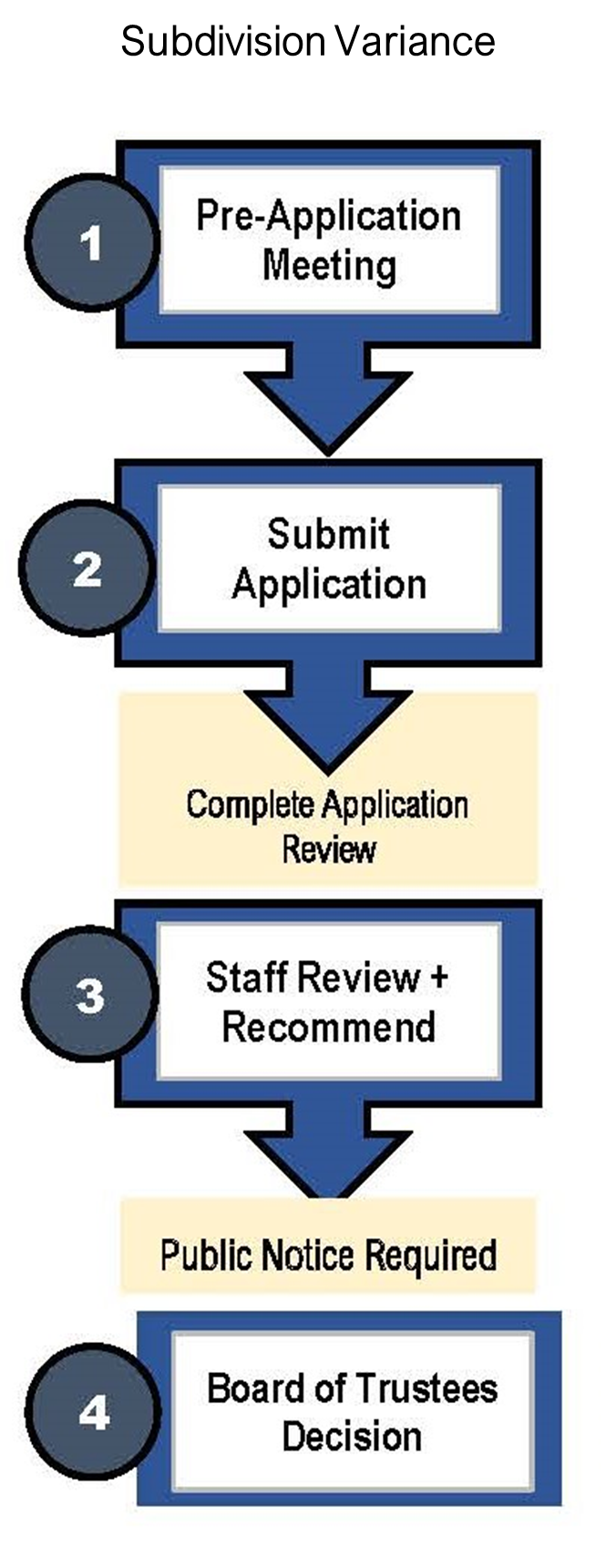
1.
Reviewing Board (Adjustment or Trustees).
The reviewing board shall hold a public hearing on an application for a Variance Permit.
a.
The concurring vote of four members of the Board of Adjustment shall be necessary grant any variance authorized by this Code.
b.
The Zoning Administrator may recommend, and the reviewing board may impose, such conditions on a variance as are necessary to accomplish the purposes of this LUC, to prevent or minimize adverse impacts upon the public and neighborhoods and to ensure compatibility. These conditions may include but are not limited to limitations on size, bulk and location; standards for landscaping, buffering and screening, lighting and adequate ingress and egress; cash deposits, bonds and other guarantees of deposit; other on-site improvements; and limitations on the duration of the permit or hours of operation.
F.
Post-Approval Actions.
1.
General.
Approval of a variance shall authorize only the particular variation, which is approved in the Variance Permit.
2.
Site-Specific Approval.
A Variance Permit shall run with the land.
3.
Expiration and Extension.
a.
Unless otherwise specified in the Variance Permit, an application to commence construction of the development that was the subject of the Variance Permit request must be applied for and approved within 12 months of the date of the approval of the Variance Permit, otherwise the Variance Permit shall automatically become null and void.
b.
Permitted time frames do not change with successive owners.
c.
Upon written request, only one extension of the 12-month time frame may be granted by the Commission for a period not to exceed 12 months for good cause shown.
Section 13.28. - Vested rights.
A.
General.
1.
Pursuant to the provisions of Article 68 of Title 24, Colorado Revised Statutes, a property right shall be deemed vested with respect to any property, following notice and public hearing, when required, upon the approval or conditional approval, of a final plat by the Board of Trustees.
2.
A vested property right shall attach to and run with the applicable property and shall confer upon the landowner the right to undertake and complete the development and use of said property under the terms and conditions of the approval.
3.
The Board of Trustees may approve a subdivision plat or grant other final approval upon such terms and conditions as may reasonably be necessary to protect the public health, safety and welfare. Such conditional approval shall result in a vested property right, although failure to abide by such terms and conditions will result in a forfeiture of vested property rights.
B.
Vested Property Right Term.
1.
A property right that has been vested shall remain vested for a period of three years. However, the Board of Trustees may enter into development agreements with landowners specifying that property rights shall be vested for a period exceeding three years when warranted in light of all relevant circumstances, including but not limited to the size and phasing of development, economic cycles and market conditions. Such development agreements shall be adopted as legislative acts subject to referendum.
2.
Issuance of a building permit or a development permit shall guarantee vested rights to use the property in compliance with the terms and conditions of the final plat, although failure to comply with such terms and conditions shall result in forfeiture of vested property rights.
3.
Should no building permit or development permit be issued within the applicable three years, the plan shall be terminated and the vested property right shall automatically expire.
C.
Extension of Vested Property Right Term.
1.
The affected land owner may request that the Board of Trustees grant an extension of the final plat for up to three years, provided that:
a.
A written request for an extension is submitted by the affected landowner no less than 60 days prior to the date of termination of the vested property right;
b.
There is no conflict with the Land Use Code or that any conflict may be corrected by an amendment to the final plat, which shall be presented with the request for extension;
c.
The Applicant has demonstrated that the final plat continues to be compatible with adjacent properties and the surrounding area, or that compatibility may be established by an amendment to the final plat, which shall be presented with the request for extension;
d.
The Applicant has demonstrated that the final plat is consistent with the Comprehensive Plan; and
2.
The extension request shall be considered by the Board in a public hearing, notice of which shall be published at least 30 days prior to the hearing. The extension, if granted, shall be valid only for the period approved by the Board of Trustees.
D.
Further Reviews.
Following approval or conditional approval of a subdivision plat or other final approval, nothing in this section shall exempt such a plan or plat from subsequent reviews and approvals, including, but not limited to, construction drawings, drainage plans, Building Permit and Certificate of Occupancy to ensure compliance with the terms and conditions of the original approval, provided that such reviews and approvals are not inconsistent with said original approval.
E.
New Regulations.
The establishment of a vested property right shall not preclude the application of land use regulations which are general in nature and are applicable to all property subject to land use regulations by the Town, including, but not limited to, building, fire, plumbing, electrical, mechanical codes, and other public health, safety and welfare codes.
F.
Natural or Man-made Hazards.
A vested property right shall automatically terminate upon the discovery on or in the immediate vicinity of the subject property of natural or man-made hazards which could not reasonably have been discovered at the time of site-specific development plan approval, and which, if uncorrected, would pose a serious threat to the public health, safety and welfare.
G.
Public Improvements.
The vested property rights provided herein shall in no way diminish or alter the requirement for public improvements, or other requirements, as provided in Town regulations.
H.
Effective Date of Final Plat Approval.
The effective date of the approval of a final plat shall be the date of approval or grant by the Board of Trustees. In the event amendments to a final plat are proposed and approved, the effective date of such amendments, for purposes of duration of a vested property right, shall be the date of approval or granting of the original final plat, unless the Board of Trustees finds to the contrary and incorporates such finding in its approval of the amendment.
I.
Vested Rights Language.
Each final plat shall contain the following language: "approval of this plan may create a vested property right pursuant to Article 68 of Title 24, C.R.S., as amended." Failure to contain this statement shall invalidate the creation of the vested property right. In addition, a notice describing generally the type and intensity of use approved and the specific parcel or parcels of property affected and stating that a vested property right has been created shall be published once, not more than 14 days after approval of the final plat, in a newspaper of general circulation within the County.
J.
Other Town Rules.
Approval of a final plat shall not constitute an exemption from or waiver of any other provisions of the Town's regulations pertaining to the development and use of property.
Section 13.29. - Zoning development permits.
A.
Applicability.
1.
No Building Permit may be issued and no person(s) may engage in any development (including grading) within the incorporated area of the Town of Dolores without obtaining a Zoning Development Permit. Every application for a zoning permit shall be accompanied by two copies of a plan or plat showing the building, structure, or sign in sufficient detail to enable the Zoning Administrator or the Building Official to ascertain whether the proposed construction, reconstruction, or conversion, moving and/or alteration is in conformance with the provisions of the applicable zone district and this Code.
2.
No Zoning Development Permit shall be issued for a building or structure on a lot which abuts a street and located on the side thereof from which all dedication has not been made according to the street plans and standards as adopted from time to time by the Town of Dolores.
B.
Revocation of Zoning Development Permits.
Failure to comply with any condition(s) of approval, as determined by the Board of Trustees, shall result in:
1.
Inability to obtain any rights granted conditionally there under, in accordance with Section 13.28, and
2.
Town revocation of the Zoning Development Permit upon 30-day notice to the Developer and opportunity for hearing and Town determination of non-compliance with conditions.
C.
Denial of Zoning Development Permit.
If an application for a Zoning Development Permit is not approved, the Zoning Development Permit shall be returned to the Applicant with a written statement detailing the reasons for such disapproval.
D.
Conflict.
Any zoning permit or Building Permit issued in conflict with the provisions of this Code shall be null and void and may not be construed as waiving any provision of this Land Use Code.
Section 13.30. - Zoning map and land use code text amendments.
A.
Purpose.
1.
Rezoning: The boundaries of any zone district may be changed, or the zone classification of any parcel of land may be changed pursuant to this section. The purpose of rezoning is to make adjustments to the official zoning map that are necessary in light of changed conditions, changes in public policy, to bring property into conformance with the Dolores Comprehensive Plan, or to advance the general welfare of the Town.
2.
LUC Text Amendment: The purpose of this section is to provide standards and requirements for amending the text of this LUC. The purpose of text amendments is to make adjustment to the text of this Code that are necessary in light of changed conditions, changes in public policy, or to advance the general welfare of the Town.
B.
Applicability.
1.
A zoning map amendment is required for a change in the boundary of a zoning district, or the assignment of a parcel to different zoning district. Rezoning should not be used as a way to legitimize nonconformities when a conditional use, variance, or administrative adjustment could achieve the same result.
2.
Corrections of drafting and clerical errors or omissions are not map amendments and may be made by the town clerk without a map amendment procedure.
3.
Text amendment are not intended to relieve particular hardships or to confer special privileges or rights on any person.
C.
Authority.
1.
Any person having a proprietary interest in any property may submit an application to the Board of Trustees for a change or amendment to the provisions of the zoning map or this Code,
2.
The Planning and Zoning Commission may, on its own motion or on request from the Board of Trustees, institute study and proposal for changes and amendments in the public interest.
D.
Procedures.
1.
Common Procedures.
Common procedures for a zoning map or LUC amendment are established in Table 13.2 and are summarized here for applicant convenience.
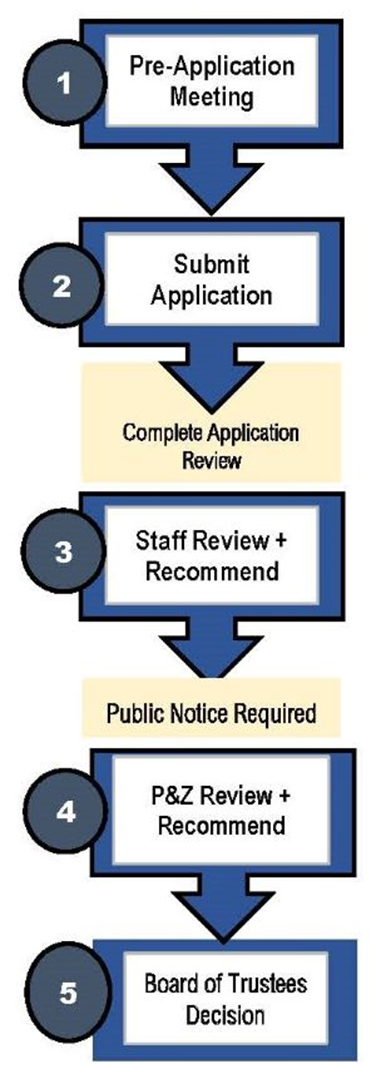
2.
Specific Procedures for Zoning Map Amendment.
When any such amendment or change relates to a change in the zoning classification of property or a change to the boundary of a zoning district, the following requirements shall be met:
a.
Published notice of the public hearing shall be provided at least 10 days prior to the hearing.
b.
Mailed notice shall be given at least 10 days before the hearing date.
c.
Mailed notice is not required when the zoning map in any way is to be changed or amended incidental to, or as a part of a general revision of this Code, whether such revision be made by repeal of the existing zoning and/or land use regulations and enactment of a new zoning and/or land use regulations, or otherwise.
d.
Posted notice shall be place in a prominent location on the subject property at least 10 days prior to the hearing date.
3.
Specific Procedures for LUC Text Amendment.
When any such amendment relates to a change of a regulation or to the text of this Code not affecting specific property, published notice of the public hearing shall be provided at least 15 days prior to the hearing date.
E.
Decision Criteria.
1.
Zoning Map Amendment.
When recommending and deciding on a zoning map amendment, the Planning and Zoning Commission and Board of Trustees shall consider the following criteria:
a.
Was the existing zone for the property adopted in error?
b.
Has there been a change of character in the area (e.g. installation of public facilities, other zone changes, new growth trends, deterioration, development transitions, etc.)?
c.
Is there a need for the proposed use(s) within the area or community?
d.
Are the proposed uses compatible with the surrounding area or uses; will there be adverse impacts; and/or can any adverse impacts be adequately mitigated?
e.
Will there be benefits derived by the community or area by granting the proposed rezoning?
f.
Are adequate public facilities and services available to serve development for the type and scope suggested by the proposed zone? If utilities are not available, could they be reasonably extended? Is the applicant willing to pay for the extension of public facilities and services necessary to serve the proposed development?
g.
Is the proposal in conformance with the policies, intents and requirements of the Dolores Comprehensive Plan and the Plan's Future Land Use Map?
h.
Does the proposed change constitute "spot zoning" based on guidance offered by the Town Attorney?
2.
LUC Text Amendment.
When recommending and deciding a code text amendment, the Planning and Zoning Commission and Board shall consider the following criteria:
a.
Whether the proposed amendment corrects an error or meets the challenge of some changing condition, trend, or fact since the time that the original text designations were established;
b.
Whether the proposed amendment is consistent with the Dolores comprehensive plan or other applicable Town plans and policy guides;
c.
Whether the proposed amendment is consistent with the purpose and intent of this LUC;
d.
Whether the proposed amendment will result in a logical and orderly development pattern; and
e.
Whether the proposed amendment is in the best interests of the Town as a whole.
F.
Review and Decision-Making.
Review and decision-making for a zoning map amendment or LUC text amendment shall be undertaken as follows:
1.
Planning and Zoning Commission.
a.
Before taking action on any proposed amendment, supplement, or change, the Board of Trustees shall submit the same to the Planning and Zoning Commission for its recommendation and report.
b.
The Planning and Zoning Commission shall hold a public hearing on any application for amendment or change prior to making its recommendation to the Board of Trustees.
2.
Board of Trustees.
a.
If the Board of Trustees adopts the zoning ordinance amendment on first reading, a public hearing and second reading shall be held by the Board of Trustees before adopting any proposed amendment, supplement or change. Such amendments shall become effective upon the favorable vote of a majority of the quorum of the Board of Trustees present and voting.
b.
As set forth in Section 31-23-305, C.R.S., a two-thirds vote of all members of the Board shall be required in favor of a zoning map amendment where there has been filed a protest with the town clerk at least 24 hours prior to the governing body's vote on the amendment where such protest is signed by owners of 20 percent or more of the area of land which is subject to the proposed change or 20 percent or more of the area of land extending a radius of 100 feet from the land which is subject to the proposed change, disregarding intervening public streets and alleys.

