
Dolores City Zoning Code
ARTICLE 4
- Use-Specific Standards
Section 4.1.- General provisions.
The following general standards apply to the uses identified in this article.
A.
No building or structure shall be erected, converted, enlarged, replaced, reconstructed, or altered for use, nor shall any building, structure or land be used or changed in such a way that it does not comply with all of the district regulations established by this Land Use Code for the district in which the building or structure or land is located.
B.
A lot may contain more than one use.
C.
Each of the uses may function as either a principal use or accessory use on a lot, unless otherwise specified.
D.
Uses are either permitted by-right in a district, permitted by-right with specific development or design regulations, or require a conditional use permit in order to be developed.
Section 4.2. - Use table organization.
A.
This section identified the uses that are permitted on a lot or in a development as follows:
1.
Table 4.1 identifies the primary uses permitted in each zone district.
2.
Table 4.3 identifies the accessory uses permitted in each zone district.
B.
Definitions for individual uses are provided in Article 2, Measurements and Definitions.
Section 4.3. - Primary use classification general descriptions.
A.
Organization.
1.
To organize the uses in the Table 4.1, Primary Uses, land uses and activities are classified into general "use categories" that are based on common functional, product, or physical characteristics, such as the type and amount of activity, the type of customers or residents, how goods or services are sold or delivered, and site conditions. The use categories in Table 4.1 are:
a.
Residential.
b.
Civic and Institutional.
c.
Commercial.
d.
Industrial, Wholesale, and Storage.
e.
Transportation, Utilities, and Communication.
2.
Where there are also groups of uses with a use type, the use type may also be organized into "use groups" and "use type subgroups" where there are a number of possible variations of a use type, such as residential dwellings or group living. This classification provides a systematic basis for assigning present and future land uses into appropriate zoning districts.
3.
The use categories and use groups are described below for the purpose of providing a general description of each use category and use group along with examples of primary and some accessory uses that might be permitted within the category or group. Not all of these uses are permitted in every zone district. Accessory uses described in this section may also be allowed as primary uses in some zone districts. To determine which uses are permitted in which district see Table 4.1.
B.
Residential Uses.
1.
Use Category Description: This is a category of uses offering habitation on a continuous basis that is established by property ownership or tenancy with a minimum term of at least 30 days. This use category also includes group residential facilities.
2.
Use Types.
a.
Household Living: This use type is characterized by residential occupancy of a dwelling unit by one or more persons. Uses where tenancy may be arranged for a shorter period are not considered residential; they are considered to be a form of transient lodging.
b.
Group Living: This use type is characterized by residential occupancy of a structure by a group of people who do not meet the definition of "Household Living". Generally, group living structures have a common eating area for residents. The residents may receive care, training, or treatment, and caregivers may also reside at the site.
C.
Public, Civic, and Institutional Uses.
1.
Use Category Description: This is a use category for public, quasi-public, and private uses that provide unique services that are of benefit to the public at-large.
2.
Use Types.
a.
Assembly, Civic: Civic assembly uses are permanent places where persons regularly assemble for religious worship or secular activities, and which are maintained and controlled by a body organized to sustain the religious or public assembly. Civic assembly uses include civic and social organizations such as private lodges, clubs, fraternities, and similar private membership organizations, as well as places of community assembly such as libraries and museums.
b.
Education: This use type includes institutions of learning that provide educational instruction to students. Accessory uses include play areas, cafeterias, recreational and sport facilities, auditoriums, and before- or after-school day care.
c.
Government and Public Safety: This use type includes structures and sites for services proved by governmental agencies.
d.
Health Care and Social Assistance: This use type is characterized by activities focusing on medical services, particularly licensed public or private institutions that provide primary health services and medical or surgical care to persons suffering from illness, disease, injury, or other physical or mental conditions. Accessory uses may include laboratories, outpatient, or training facilities, and parking, or other amenities primarily for the use of employees in the firm or building.
e.
Parks, Recreation, and Open Space: This use type includes uses that focus on natural areas, large areas consisting mostly of vegetative landscaping or outdoor recreation, community gardens, or public squares. These lands tend to have few structures. Accessory uses may include clubhouses, playgrounds, maintenance facilities, concessions, caretaker's quarters, and parking for cars and RVs as permitted by the Town.
D.
Commercial Uses.
1.
Use Category Description: This is a use category for any retail, consumer service, or office use.
2.
Use Types.
a.
Adult and Child Care: This use type includes a range of day care services.
b.
Amusement and Recreation: This use type includes a broad array of commercial establishments that operate indoor or outdoor facilities or provide services to meet varied artistic, cultural, entertainment, and recreational interests of their patrons. Uses within this category comprise: (1) establishments involved in producing, promoting, or participating in live performances, events, or exhibits intended for public viewing; (2) establishments that create, preserve and exhibit objects and sites of artistic, historical, cultural, sports or educational interest; and (3) establishments that operate facilities or provide services that enable patrons to participate in recreational activities or pursue amusement, hobby, or leisure time interests. Excluded are restaurants, bars, and night clubs that provide live entertainment in addition to the sale of food and beverages, which this code categorizes as "eating and drinking establishments."
c.
Animal Sales and Services: This use category groups uses related to animal care.
d.
Assembly, Entertainment and Trade: These commercial assembly uses include convention centers, theaters, stadiums, arenas, and wedding venues.
e.
Commercial Services: This use category includes uses that provide for consumer or business services and for the repair and maintenance of a wide variety of products. Personal services are also included, characterized by establishments that provide individual services related to personal needs such as barber shops or dry cleaners.
f.
Eating and Drinking Establishments: This is a use category for businesses that prepare or serve food or beverages for consumption on or off the premises, such as restaurants and bars, along with specialty food and beverage production such as coffee roasting, microbreweries, and microdistilleries. Accessory uses may include outdoor seating, offices, and parking.
g.
Financial Services: This use category includes establishments that have a primary purpose of: providing custody, loans, exchange, or issuance of money; extending credit; and transmitting funds, including via drive-in facilities and automatic teller machines.
h.
Lodging: Uses in this use type provide customers with temporary housing for an agreed upon term of less than 30 consecutive days; any use where temporary housing is offered to the public for compensation and is open to transient rather than permanent guests. This use type includes hotels, motels, and bed and breakfast inns.
i.
Office: This type includes uses where people are engaged primarily in on-site administrative, business, or professional activities. These uses are characterized by activities in an office setting that focus on the provision of off-site sale of goods or on-site information-based services, usually by professionals. This category may also include laboratory services that are conducted entirely within an office-type setting. Accessory uses may include cafeterias, health facilities, parking, or other amenities primarily for the use of employees in the firm or building.
j.
Personal Vehicle and Sales and Services: This use type includes a broad range of uses for the maintenance, sale, or rental of motor vehicles and related equipment. Accessory uses may include incidental repair and storage and offices.
k.
Retail Sales: This is a use type for businesses involved in the sale, lease, or rental of new or used products to the general public. Such uses may include, but are not limited to: convenience food store, drug store, grocery store, hardware store, general merchandise store, garden supplies, furniture, home furnishings, and equipment. Accessory uses may include offices, parking, storage of goods, and assembly, repackaging or repair of goods for in-site sales.
E.
Industrial, Wholesale, and Storage.
1.
Use Category Description: This is a use category including uses that produce goods from extracted and raw materials or from recyclable or previously prepared materials, including the design, storage and handling of these products and the materials from which they are produced.
2.
Use Types.
a.
Industrial and Construction Services: This use type is characterized by companies that are engaged in the repair or servicing of heavy machinery, equipment, products, or by-products, or the provision of heavy services including construction or contracting. Accessory activities and uses may include sales, offices, parking, and storage.
b.
Industrial Manufacturing, Assembly, or Processing: A use type including establishments involved in the manufacturing, processing, fabrication, packaging, or assembly of goods. Natural, constructed, raw, secondary, or partially completed materials may be used. Products may be finished or semi-finished, and are generally made for the wholesale market, for transfer to other plants, or to order for firms or consumers. Goods are generally not displayed or sold on site, but if so, such activity is a subordinate part of sales. Relatively few customers come to the manufacturing site. Accessory activities may include retail sales, offices, cafeterias, parking, employee recreational facilities, warehouses, storage yards, repair facilities, truck fleets, and caretaker's quarters.
c.
Warehousing, Wholesale, and Distribution: This use type includes facilities used for the sale, lease, or rent of products primarily intended for industrial, institutional, or commercial businesses. The uses emphasize on-site sales or order taking, and often include display areas. Businesses may or may not be open to the general public, but sales to the general public are limited as a result of the way in which the firm operates. Products may be picked up on site or delivered to the customer.
d.
Waste and Salvage: This is a use category for uses that collect, store, process, or sell waste or salvage materials, or collect and process recyclable material, for the purpose of marketing or reusing the material in the manufacturing of new, reused, or reconstituted products.
F.
Transportation, Utilities, and Communication.
1.
Transportation: this is a use category that includes uses involving public and private modes of vehicular transportation.
2.
Utilities and Public Facilities: This use type includes structures and locations for public or private lines and facilities related to the provision, distribution, collection, transmission, or disposal of water, storm and sanitary sewage, oil, gas, power, information, telecommunication and telephone cable, and facilities for the generation of electricity. Utility uses may or may not have regular employees at the site and the services may be public or privately provided.
3.
Wireless Communication Facilities: This use type includes structures, locations, and equipment for the transmission of voice, data, image, or video programming.
Section 4.4. - Uses by district.
Land and buildings in each zone district may be used for any of the principal land uses authorized in for that district in Table 4.1 and according to the type of approval specified in that table.
A.
Schedule of Use Regulations.
The Permitted Use Table shall be interpreted as follows:
1.
Permitted Uses.
Uses identified with a /P/ in a district column are permitted in the specific district, subject to compliance with any applicable use standards and all other provisions of this Code.
a.
Permitted uses must be in compliance with all applicable standards in this Land Use Code. Some uses have use-specific standards in Section 4.5. These standards are cross-referenced for convenience in Table 4.1. Applicants are responsible for compliance with all standards whether or not a cross-reference is provided.
b.
The location of a use in a structure is limited in some zone districts and identified with a "PL" in the district column.
2.
Conditional Uses.
Uses identified with a /C/ in a district column may be permitted in the specific district only upon approval of a Conditional Use Permit by the Board of Trustees in accordance with the procedures and standards of Section 13.11, Conditional Use Permits.
3.
Use Not Permitted.
Uses identified with a dash / — / in a district column are not allowed in the specific district.
B.
Interpretation.
1.
Classification of New or Unlisted Uses.
Every type of potential use cannot be addressed or foreseen in this Code. When a use is proposed that is not specifically listed in the applicable use table, the following procedures shall be applied.
2.
Uses Not Subject to Use Interpretation.
The following categories of uses typically impose substantial impacts on a site, adjacent sites and structures, pedestrians or cyclists, the road network, or public infrastructure. Where a new use is proposed that is not identified in the applicable use table and that can be categorized into one of these categories, the applicant shall file an application for Section 13.14, Land Use Code Interpretation, to determine if the use will be permitted. Through this process, the Town will have the opportunity to review and determine the impacts of the proposed use and establish any specific conditions that may be appropriate to allowing the use.
a.
Agricultural Uses.
b.
Industrial Services.
c.
Manufacturing, Processing, and Assembly.
d.
Waste and Salvage.
3.
Request for Use Interpretation.
Requests for a use not prohibited in the previous section and not specifically addressed in any zoning district shall be submitted to the Zoning Administrator for review, based on the following standards.
a.
The Zoning Administrator shall determine whether the proposed use is listed in the applicable use table as a use permitted by right, with prescribed conditions, or as a conditional use in any zoning district.
b.
If the use is not addressed in the appropriate use table, the Zoning Administrator shall select the use listed which most closely approximates the proposed use, using criteria such as:
(1)
Appropriate use category in Section 4.3;
(2)
Conformance with the currently adopted comprehensive plan and purpose of the zoning district in which the use is proposed;
(3)
Types of equipment and/or processes to be used;
(4)
Aesthetics, traffic characteristics, and potential nuisance effects (noise, vibration, dust, smoke, odor, glare, hours of operation) on adjacent and surrounding uses and structures;
(5)
Number of employees, visitors, or customers generated;
(6)
Parking demands associated with the use; and
(7)
Special public utility requirements for serving the proposed use type, including, but not limited to, electricity, water supply, wastewater output, pre-treatment of wastes and emissions required or recommended, and any significant power structures or infrastructure and communications towers or facilities.
c.
Once a similar use is determined, the Zoning Administrator shall issue a zoning determination letter and the proposed use shall comply with any conditions and review procedures that may apply to that use, including prescribed conditions, as applicable.
d.
If, based on the criteria identified above, and the Section 4.3, Use Categories, the Zoning Administrator determines that a use can reasonably be determined to be similar to more than one use or category of uses, the Zoning Administrator shall select the use or category of uses that provides the most exact, narrowest, and appropriate fit.
e.
The determination as to whether a proposed use is similar in nature and class to another use within a district shall be considered an expansion of the use regulations, not a variance applying to a particular situation. Any use determined by the Zoning Administrator to be similar shall thereafter be included in the enumeration of the uses via the appropriate code amendment process.
4.
Determination of Non-Similarity.
a.
The Zoning Administrator may determine that a proposed use is not substantially similar to any use identified in Table 4.1 because either:
(1)
The potential impacts of the use are significantly more impactful on the site, street, or neighborhood, than other permitted uses in the same use category and that the use would not otherwise be permitted without prescribed conditions or through a public review process; or
(2)
There are no similar uses permitted on the site or in the applicable zone district;
b.
When this is the case, the Zoning Administrator shall provide the applicant with a written determination of non-similarity within 14 business days of the request for interpretation.
5.
Post-Decision Actions.
a.
Following a determination of non-similarity, the applicant may submit an application for Section 13.30, Land Use Code Text Amendment.
b.
The Zoning Administrator's decision is appealable to the Board of Adjustment but the Board of Adjustment may not approve variances to Table 4.1.
(Ord. No. 566, § 1(Exh. A), 8-14-2023)
Section 4.5. - Use-specific standards.
In addition to applicable Article 5, Site Layout and Structure Design Standards, the following regulations apply to the listed uses when referenced in the use regulations of a particular zoning district.
A.
Residential Uses.
1.
Affordable Housing.
Affordable dwelling units shall comply with the following:
a.
The project shall meet the dimensional and density standards of the applicable zone district.
b.
All units shall meet the definition of Affordable Housing in Section 2.6.
c.
Density bonus is not applicable to affordable housing projects approved administratively.
2.
Household Living in Mixed-Use Districts.
PL: In the DMU district, residential dwelling units shall be located above the first floor or behind the front 30 percent of the structure.
3.
Group Home.
A group home may provide a living arrangement for not more than eight residents per home 60 years of age or older, or for the physically or developmentally disabled, and not more than two supervisory personnel, subject to the following conditions:
a.
Homes for the physically and/or developmentally disabled must be state-licensed.
(1)
All exterior aspects of a group home, including its scale and off-street parking configuration, shall not disrupt the residential character of the area.
(2)
A group home shall provide one off-street parking space for visitors and one for each employee (typical peak staff), in addition to off-street parking otherwise required pursuant to Article 8, Parking, Loading, and Access.
(3)
In no case shall the total number of persons residing on premises (including staff) be more than one per 400 square feet of usable floor area.
b.
An assisted living facility may provide living arrangements subject to the following conditions:
(1)
Such facility must be state licensed.
(2)
All exterior aspects of an assisted living facility, including its scale and off-street parking configuration shall not disrupt the residential character of the area.
(3)
An assisted living facility shall provide one off street parking space for visitors and one for each employee (typical peak staff), in addition of off-street parking otherwise required pursuant to Article 8, Parking, Loading, and Access.
(4)
In no case should the total number of persons residing on premises (including staff) be more than one per 400 square feet of usable floor area.
4.
Manufactured Homes.
Type 1 Manufactured Homes (Certified on or after January 1, 1990) are required for placement on new manufactured home lots or the replacement of existing manufactured or mobile homes.
B.
Commercial Uses.
1.
Bed and Breakfast, or Boarding or Rooming House.
A bed and breakfast or boarding or rooming establishment may provide lodging and breakfast for temporary overnight occupants in no more than three separate bedrooms for compensation. One off-street parking space per bedroom offered for use for temporary overnight accommodations, in addition to off-street parking otherwise required pursuant to Article 8, Parking, Loading, and Access.
2.
General Retail (Indoors).
The footprint of each general retail (indoor) structure shall be limited to 10,000 square feet.
3.
Recreational Vehicle/Travel Trailer Park.
Recreational vehicle/travel trailer park and incidental facilities shall comply with the standards in this section.
a.
Such areas may be occupied only by persons using travel trailers, truck campers and tents for overnight and short duration camping (4-month maximum);
b.
Each space shall be at least 1500 sq. ft. in area;
c.
Each space shall be at least 22 ft. in width;
d.
Each park shall be served by central town water and sewer facilities;
e.
No dependent recreational vehicle, travel trailer, truck camper or tent shall be located more than 200 ft. from a water and sewage service building; and
f.
Provisions shall be made for adequate all-weather walkways to each space.
4.
Short-Term Rentals.
a.
The purpose of the Town of Dolores Short-Term Rental regulations is to:
(1)
Maintain the character of residential neighborhoods in Dolores.
(2)
Preserve long-term rental residential properties for the residents of Dolores and surrounding local communities.
(3)
Facilitate the permitting of short-term rental units subject to appropriate restrictions and standards.
(4)
Allow for varied accommodations and experiences for visitors.
(5)
Establish a licensing and permitting system to ensure that all taxes including sales and lodging taxes, fees, and fines related to short-term rentals are both assessed and current.
(6)
Map the location of short-term rental properties within the community with the purpose of measuring their concentration and impact in order to reevaluate the effectiveness of these regulations on a regular basis.
(7)
Protect the health, safety and welfare of guests and occupants of short-term rentals and the residents of the Town of Dolores.
(8)
The Dolores Board of Trustees intends for these short-term rental regulations to be supportive of both neighborhood conservation and local businesses in the Town. The Board may adjust the total number of permits issued annually as necessary to meet the purposes of these regulations.
b.
Applicability.
(1)
It shall be unlawful for any person to operate any short-term rental unit without a valid short- term rental permit, as approved pursuant to the provisions of this short-term rental regulations and other applicable provision of the Dolores Land Use Code.
(2)
The short-term rental permit shall be issued to the specific owner of the property and does not run with the property. The permit shall not be transferred or assigned to another individual, person, entity, or address, but may be managed by a third party on behalf of the owner.
(3)
A short-term rental permit shall only be issued to:
i.
A natural person whose name appears on the deed of the property.
ii.
A trust, if the beneficiary of the trust is a natural person; or
iii.
A not-for-profit corporation licensed pursuant to Section 501(c) of the Internal Revenue Code.
iv.
Limited Liability Company or a closely held corporation with three or fewer members or shareholders who are natural persons.
(4)
Nothing in this section shall limit the ability of a property owner; property covenants, conditions, and restrictions (CC&Rs); homeowners' association or similar association from prohibiting or further limiting the short-term rental of property where the authority to do so exists.
(5)
Nothing in this section shall prohibit the operation of a hotel, motel, or bed and breakfast inn where such use is permitted.
c.
Where Permitted.
(1)
Short-Term Rentals are permitted in all zones except the MH—Mobile Home and P—Public zones where all short-term rentals are expressly prohibited.
(2)
Located in a Habitable Structure: Short-term rentals shall be located in a habitable structure that complies with the Dolores LUC and applicable Town building and life safety codes adopted under Title 15 of The Dolores Municipal Code as may be amended from time to time and shall not be located in:
i.
Non-residential areas within buildings or accessory structures (e.g., shed, garage),
ii.
Commercial (office/retail) or industrial (warehouse) spaces, or
iii.
Outdoors in a temporary structure (e.g., tent, yurt, treehouse, or other similar structure) or in a recreational vehicle, mobile home, travel trailer, commercial or passenger vehicle or trailer, or any portable storage unit.
d.
Maximum Number of Permits.
(1)
Short-term rentals are organized into the following categories:
i.
Category 1: Full-Time Use: A dwelling unit that is not owner-occupied and is primarily used or made available for short-term rentals.
ii.
Category 2: Part-Time Use: A dwelling unit that is owner-occupied for more than 180 days per calendar year and that is rented as an entire unit during the time when the owner is not in residence.
iii.
Category 3: Accessory Dwelling Unit Use: A dwelling unit with an ADU where either the primary home or the ADU are owner-occupied and the other unit is made available for short- term rentals on a periodic basis.
iv.
Category 4: Accessory Space Use: A bedroom or other habitable space offered for short-term rental within an owner-occupied dwelling unit.
v.
Category 5: Residential Unit in Mixed-Use or Commercial District: A residential structure or space located in a mixed-use or commercial district where lodging is a permitted use.
(2)
Short-term rentals are permitted in these categories as follows:
i.
Categories 1, 2, and 5: A maximum of number of short-term rental permits equal to four percent of the Town's eligible residential structures and spaces may be issued in Dolores for any one-year period. The number of eligible residential structures and spaces for any given year shall be determined by the Building Official within 30 days after adoption of this ordinance and by January 15 of each year thereafter. In any year where the maximum number of permits has been issued, whether new or renewal, no additional permits will be issued.
ii.
Categories 3 and 4: Short-term rental permits are required for ADUs and accessory spaces. There is no maximum limit on the number of permits the Town may issue in these categories.
(3)
No more than one permit shall be issued per structure.
(4)
A short-term rental permit may not be issued for a permanently affordable dwelling unit.
(5)
Short-Term Rentals in existence at the time of adoption of this Short-Term Rental Regulation shall are subject to all of the requirements of this Regulation, the Dolores Land Use Code, and the applicable provisions of Title 15 of the Dolores Municipal Code. The owners of existing Short-Term Rentals shall apply for and obtain a Short-Term Rental Permit not later than 60 days after the effective date of the ordinance adopting this Short-Term Rental Regulation or shall be deemed to be in violation hereof.
e.
Generally Applicable Requirements.
(1)
Use.
i.
Short-term rentals shall be used for lodging purposes only.
ii.
A short-term rental may not include simultaneous rental to more than one party under separate contracts.
iii.
Use of the short-term rental unit as a party house for any commercial or large social events or gatherings, such as weddings, is prohibited. These uses may be permitted through the Town's temporary use permit or special event process.
iv.
Overnight guest occupancy for Short-Term vacation rentals shall not exceed the maximum number of allowable overnight guests permitted by the applicable building codes adopted by the Town of Dolores under Title 15 of the Dolores Municipal Code as determined by the Building Official and stated in the permit.
v.
During the daytime, maximum number of total guests and visitors allowed at any time in a short- term vacation rental shall not exceed the maximum overnight occupancy plus six additional persons per property, or 14 persons, whichever is less.
(2)
Noise.
i.
Quiet hours shall be from 10:00 p.m. to 7:00 a.m. and no outside assembly of more than the maximum overnight occupancy shall be permitted during this period.
ii.
Outdoor amplified sound (microphone or speaker system) shall not be allowed at any time. This provision does not apply to casual music from personal music devices or similar situations that are typical of residential surroundings.
iii.
Pets if allowed by owner shall be secured on the property at all times. Continual nuisance barking by unattended pets is prohibited.
(3)
Outdoor Fire Areas: Outdoor fire areas, when not prohibited by state or local fire codes, may be allowed but shall be limited to three feet in diameter, shall be located on a non-combustible surface, shall be covered by a fire screen, and shall be extinguished as soon as it is unattended or by 10:00 p.m. whichever is earlier.
(4)
Taxes and Insurance.
i.
The owner shall obtain a business license from the Town of Dolores.
ii.
The owner shall be responsible for payment of all applicable sales and lodging taxes.
(5)
Advertising: All short-term rental advertising shall include the Dolores Short-Term Rental Permit number and the maximum unrelated occupancy permitted in the unit pursuant to the currently adopted International Building Code or International Residential Code, as applicable.
(6)
Health, Safety, and Code Compliance.
i.
Short-Term rental units must remain compliant with all zoning, parking, building, fire, noise, and other applicable Town codes.
ii.
The short-term rental unit shall be equipped with operational smoke detectors, carbon monoxide detectors, 2A:10B:C fire extinguisher, and other life safety equipment as may be required by the Town.
iii.
Parking in private driveways shall be utilized first with overflow parking on the street where permitted. Parking on-site in non-driveway areas (e.g., setbacks or yards) shall be prohibited. Where on- site parking is not available, the property owner shall instruct the renter where to find the closest legal parking, which may include on-street parking.
iv.
Short-Term Rental permit holders will encourage guest parking limited to the frontage of the permitted STR and shall otherwise comply with the parking requirements of the zone in which the Short- Term Rental is located.
v.
The owner shall maintain weekly trash collection services. Garbage/refuse containers shall not be left out at the collection point 24 hours after collection and property shall be free of trash and debris.
(7)
Local contact and guest information: Each vacation rental shall have a designated local contact person(s). The local contact may be a property management/real estate company, rental agent or other person engaged or employed by the owner to rent, manage or supervise the vacation rental. A property owner may designate themselves as the local contact person if the owner meets the criteria of this section. The local contact must reside within a thirty-minute (30) drive of the rental property and be available twenty-four (24) hours a day 365 days a year during tenancies for timely response to guest and neighborhood questions and concerns. An alternate local contact shall be designated, available and meet the criteria of this section when the primary is not available. All local contacts shall list their name and telephone/cell number and it shall be provided to the Town of Dolores on the application for a short-term rental which shall be made available to the Town Marshal. Any change to the contact(s) name or telephone/cell number shall be submitted to the Town within twenty-four (24) hours of the change. Each rental unit shall also display the following information in a prominent interior and easy to access location:
i.
The short-term rental permit number.
ii.
A copy of the Dolores Short-Term Rental Regulations.
iii.
Site-specific instructions about parking locations and trash pick-up.
5.
Vehicle Maintenance and Repair (Garage).
Motor vehicles without valid registration or a work order shall be classified as salvage and junk, and may not be kept, stored, or worked on in an auto repair shop.
C.
Industrial Uses.
[Reserved]
D.
Wireless Communication Facilities.
Telecommunication tower or facilities related to the provision of wireless telecommunication services may be permitted, subject to the following requirements:
1.
Co-Location Requirement.
a.
It is the express intent of this Code to minimize the number of towers built to accommodate antennas and other appurtenances to telecommunications facilities. Therefore, a proposal for a new Tower shall not be approved unless by resolution the Board of Trustees determines that the telecommunications Facilities for the proposed Town cannot be accommodated on an existing or approved tower or antenna support structure as follows:
(1)
Within a one-mile search radius for proposed towers over 60 feet;
(2)
Within a half-mile search radius for proposed towers under 60 feet; or
(3)
Within a quarter-mile search radius for proposed towers under 60 feet.
b.
In all cases, the applicant shall demonstrate that at least one of the following conditions is present:
(1)
The planned equipment and antenna would exceed the structural capacity of the existing or approved tower or antenna support structure as documented by a qualified and Colorado licensed engineer; or in the alternative, that the existing or approved tower or antenna support structure cannot be reinforced, modified or replaced to accommodate the planned or equivalent equipment at a reasonable cost;
(2)
Existing or approved towers and antenna support structures within the search area accommodate the planned telecommunications facilities at a height necessary to function reasonable as documented by a qualified and Colorado licensed engineer; or
(3)
Other unforeseen reasons make it unfeasible to locate the planned tele-communications equipment upon an existing or approved tower or building.
2.
Tower Height.
a.
The maximum height of all commercial wireless antennas and supporting towers shall not exceed the distance to the nearest lot or parcel boundary on the subject lot or parcel or 120 feet, whichever is less.
b.
No tower shall be in excess of a height equal to the distance from the base of the antenna and tower to the nearest overhead electrical power line, less five feet.
c.
Notwithstanding the above provision to the contrary, the maximum height of all commercial wireless antennas and supporting towers shall not exceed the minimum that is technically necessary to serve the design purpose.
3.
Design.
Proposed or modified towers, antennas, accessory structures, and buildings shall meet the following design requirements:
a.
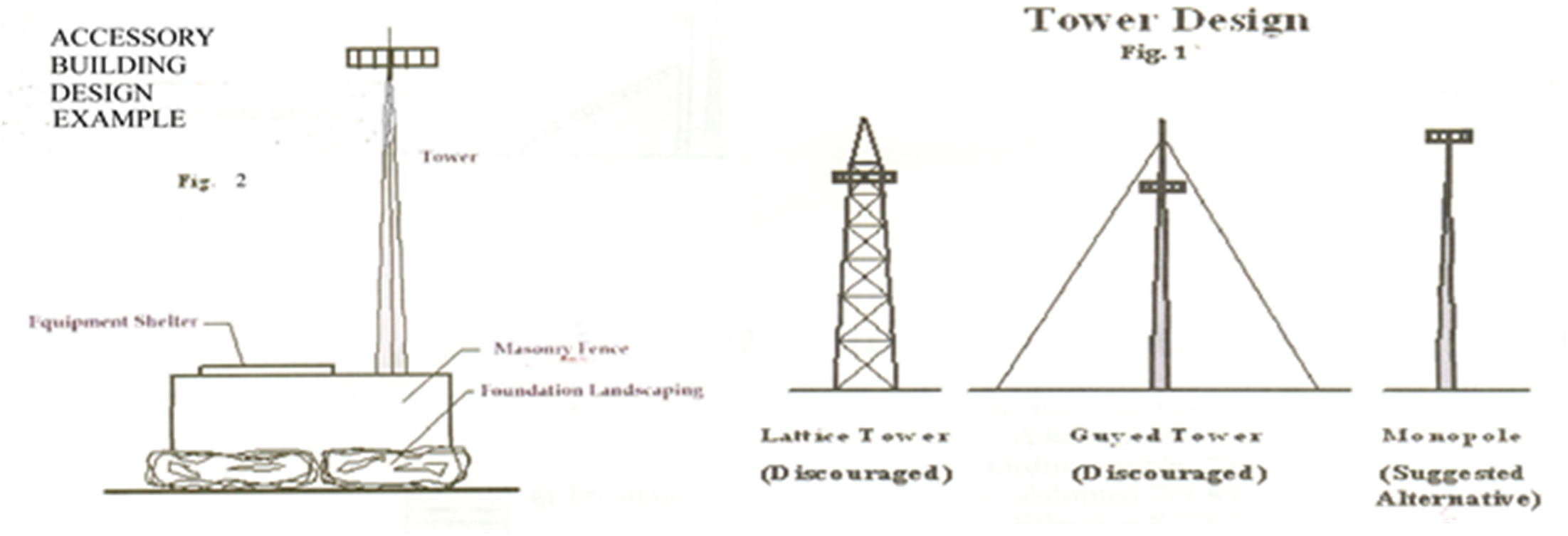
Towers and antennas shall utilize a stealth design in order to blend into the surrounding environment through the use of color and camouflaging architectural treatment.
b.
Towers shall be of monopole design unless the Town Board determines that an alternative design would be more appropriate to or better blend in with the surrounding land uses and environment.
c.
Accessory structure and building design. The design of accessory or related structures or control buildings shall be architecturally designed to blend in with the surrounding buildings and environment, and they shall meet the minimum underlying zoning district. (See Fig. 2)
d.
All proposed telecommunications facilities shall be engineered and designed structurally in all respects to accommodate both the applicant's antennas and equipment and comparable antennas and equipment for a minimum of two additional uses if the tower is over 60 feet tall and four additional users if the tower is over 100 feet tall.
4.
Landscaping and Screening.
Ground- and rooftop-mounted mechanical equipment shall be screened from view off-site in accordance with the requirements of Article 7, Landscaping, Screening, and Trees.
5.
Tower Siting.
Towers shall not be located between a principal or accessory structure and a public road or street.
6.
Tower Setbacks.
All towers shall conform to the minimum setback requirements of the underlying zoning district, or as modified below:
a.
The minimum setback for a tower not rigidly attached to a building shall be equal to the combined height of the tower plus the antenna attached to the tower.
b.
The minimum setback for a Tower that is rigidly attached to a building and with the Tower base on the ground may exceed this setback by an amount equal to the distance from the point of attachment to the ground.
c.
Notwithstanding other provisions to the contrary, a tower's setback may be reduced or its location in relation to a public street varied, as necessary to mitigate visual impacts or to allow the integration of a tower into an existing or proposed structure such as a church steeple, light standard power line support device or similar structure.
7.
Lights and Other Attachments.
a.
Towers shall not be artificially illuminated or display strobe lights unless the Federal Aviation Administration or other federal or state authority for a particular tower specifically requires such lighting when incorporated into the approved design of the tower, light fixtures used to illuminate ball fields, parking lots, or similar areas may be attached to the tower.
b.
No tower shall have constructed on, or attached to, any additional platform, catwalk, crow's nest, or like structure (other than those required by industry standards or Federal Regulations), except during periods of construction or repair.
8.
Signs and Advertising.
The use of any portion of a tower for signs other than warning or equipment information signs is prohibited.
9.
Interference with Public Safety Telecommunications.
No telecommunications service shall interfere with public safety telecommunications. All applications for new service shall be accompanied by an inter-modulation study, which provides a technical evaluation of existing and proposed transmissions and indicates all potential interference problems. Before the introduction of new service or changes in existing service, telecommunication providers shall notify the Town Board at least 10 calendar days in advance of such changes and allow the Town Board to monitor interference levels during the testing process. The Town Board may require a new conditional use permit for such new services or changes.
10.
Performance Standards.
All towers must conform to the applicable performance standards in Section 4.8.
11.
Tower Construction Requirements.
All towers erected, constructed or located within the Town, and all wiring therefore, shall comply with the requirements of all IBC and IFC codes.
12.
Additional Submittal Requirements.
In addition to the information required elsewhere in the Code, development applications for towers shall include a report from a qualified and licensed professional engineer that:
a.
Includes any and all technical information and design requirements, including co-location requirements, necessary to evaluate the request;
b.
Describes the tower height and design including a cross section and elevation;
c.
Documents the height above grade for all potential mounting positions for co-located antennas and the minimum separation distances between antennas;
d.
Describes the tower's capacity, including the number and type of antennas that it can accommodate;
e.
Documents what steps the applicant will take to avoid interference with established public safety telecommunication;
f.
Includes an engineer's stamp and registration number;
g.
A letter of intent committing the tower owner and his or her successors to allow the shared use of the tower if an additional user agrees in writing to meet reasonable terms and conditions of shared use; and
h.
Proof that the proposed tower complies with regulations administered by Federal Aviation Administration.
E.
Solar Energy Facilities (SEF).
1.
Applicability.
a.
These standards apply to the establishment of any new photovoltaic or solar thermal SEFs within the Town. Concentrated solar power systems are prohibited.
b.
An SEF established prior to the effective date of this LUC shall not be required to meet the requirements of this LUC, however:
(1)
Physical modification or alteration to an existing SEF that materially alters the size, type or components of the SEF shall be subject to this LUC. Only the modification or alteration is subject to this LUC;
(2)
Substantial conformance review determinations (described below) are not major amendments to a project's existing permits; and
(3)
Routine operation and maintenance or like-kind replacements do not require a zoning compliance permit.
2.
Tier Descriptions.
Solar energy facilities are divided into three tiers that describe the intensity and impact of the use on the property and adjacent properties.
a.
Tier 1: Accessory Solar Energy Facilities meet the following criteria:
(1)
Is an accessory use on the site that provides energy primarily for on-site use; and
(2)
Can be building-mounted or ground-mounted, which may include: rooftop systems, building-integrated solar (e.g., shingle, hanging solar, canopy, new technology), or covered permanent parking or other hardscape areas.
b.
Tier 2: Intermediate Solar Energy Facilities meet the following criteria:
(1)
Is the primary use on the site or a secondary use that exceeds the size criteria for a Tier 1 SEF.
(2)
Provides energy for on-site or off-site use, and
(3)
Can be building-mounted or ground-mounted and may include rooftop systems, building-integrated solar, and covered permanent parking or other hardscape areas.
c.
Tier 3: Large-Scale Solar Energy Facilities are large-scale, primary or secondary SEFs that provide energy for on-site or off-site use.
3.
Standards for Ground-Mounted SEFS.
a.
Size: The maximum footprint for a ground-mounted SEF shall be as follows:
(1)
Tier 1:
i.
Residential and mixed-use districts: 2,000 sf or 25 percent of the lot size, whichever is less.
ii.
Industrial and public districts: 4,000 sf or 25 percent of the lot size, whichever is less.
(2)
Tier 2:
i.
IND district: up to 10 acres.
ii.
P2 district: up to 20 acres.
(3)
Tier 3: Prohibited in Dolores.
b.
Height: The maximum height for a ground-mounted SEF shall be as follows:
(1)
Residential districts: 10 feet.
(2)
All other districts: 20 feet.
c.
Setbacks: Ground-mounted SEFs shall comply with the following setback standards:
(1)
All SEFs shall meet the setback requirements of the individual zone district where located.
(2)
Tier 2 SEFs in mixed-use and industrial districts shall provide 100-foot minimum setback between the edge of the SEF installation boundary and any residential district.
(3)
Tier 1 and Tier 2 SEFs may not be located between the front building line and the street.
4.
Standards for Building-Mounted SEFS.
a.
Height.
(1)
Tier 1 SEFs shall be subject to the maximum height for zone district or a maximum of five feet above the height of the roofline, whichever is less. Additional height may be requested through the conditional use review process.
(2)
Tier 2 SEFS shall be subject to the maximum height for the zone district or a maximum of 10 feet above the height of the building, whichever is greater. Additional height may be requested through the conditional use review process.
5.
Permit and Annual Compliance Plan Required.
a.
Complete permit submission requirements and processes are provided in Section 13.Y, Solar and Wind Energy Facilities Permitting.
b.
Following approval, all SEF permit holders are required to submit an annual compliance statement that confirms that the system is still active and compliant with the permit and that provides current owner and emergency contact information. This requirement shall not preclude the Town from undertaking a separate compliance report where confirmation of data provided by the facility's operator is desired.
6.
Generally Applicable Standards.
a.
Off-Site Facilities: When the SEF is located on more than one parcel, there shall be an easement agreement or other Town-approved documentation that includes methods for the notification of all impacted parties.
b.
Septic System Avoidance: The SEF shall not be located over a septic system, leach field area or identified reserve area;
c.
Conform to Development Standards for Underlying Zone: The SEF shall be ground mounted, or when located on a structure, the SEF shall conform to the development standards for a principal structure in the zone in which such facilities and structures are to be located, except as otherwise provided herein.
d.
If lighting is required, it shall be activated by motion sensors, fully shielded and downcast type where the light does not spill onto the adjacent parcel or the night sky.
e.
The site shall comply with Article 7, Landscaping, Screening, and Trees.
f.
The facility shall be enclosed by a six-foot tall fence (eight feet if razor or barbed wire will be used), barrier, or other appropriate means designed to prevent or restrict unauthorized persons or vehicles from entering the parcel(s). Fences or barriers shall incorporate wildlife friendly design. No barrier shall be required where projects employ full-time security guards or video surveillance.
g.
Signs: Signs on SEFs are prohibited. Permanent or temporary commercial signs (including flags, streamers, or decorative items) are prohibited from being displayed on any SEF equipment. For emergency and safety purposes, SEF equipment shall display identification of the manufacturer, facility owner and/or operator, and an emergency contact number.
7.
Abandonment.
a.
Applicability.
(1)
An SEF, other than a Tier 1 system, that ceases to produce electricity on a continuous basis for 12 months shall be considered abandoned unless the property owner or facility operator demonstrates by substantial evidence satisfactory to the Town that there is no intent to abandon the facility.
(2)
A property owner or facility operator with an abandoned system shall follow the decommissioning plan to remove the system. If the system was approved without a decommissioning plan, the property owner or facility operator shall remove all equipment and facilities and restore the site to original condition upon abandonment.
(3)
Facilities deemed by the Town to be unsafe and facilities erected in violation of this section shall also be subject to this section.
b.
Determination of Abandonment.
(1)
Based on the information provided in an annual compliance statement or verified zoning complaint, the zoning administrator shall have the right to request documentation and/or affidavits from the property owner regarding the system's usage and shall make a determination as to the date of abandonment or the date on which other violation(s) occurred. The zoning administrator shall submit the documentation and administrator's findings to the Town Board, property owner, and facility operator and schedule a public hearing for a determination of abandonment.
(2)
Upon a determination of abandonment or other violation(s), the Town shall send a notice to the property owner and facility operator, indicating that the responsible party shall remove the SEF and all associated facilities, and remediate the site to its approximate original condition within a reasonable timeframe established by the Town, unless the Town determines that the facilities must be removed in a shorter period to protect public safety. Alternatively, if the violation(s) can be addressed by means short of removing the SEF and restoration of the site, the Town may advise the property owner and facility operator of such alternative means of resolving the violation(s).
(3)
If the property owner or facility operator does not comply, the Town may remove the SEF and restore the site and may thereafter:
i.
Draw funds from the bond, security, or financial assurance that was established during permitting, and
ii.
Initiate judicial proceedings or take other steps authorized by law against the responsible parties to recover only those costs associated with the removal of structures deemed a public hazard.
8.
Decommissioning.
A decommissioning plan shall be prepared for Tier 2 applications and submitted with site plan review application. The plan shall address the following:
a.
Defined conditions upon which decommissioning will be initiated (e.g., end of land lease, no power production for 12 months, etc.)
b.
Removal of all non-utility owned equipment, conduit, structures, fencing, roads, and foundations, and restoration of property to condition prior to development of the SEF. This shall include a revegetation plan. The applicant may propose retaining some site improvements, such as roads and infrastructure, subject to landowner consent and Town approval.
c.
Timeframe for completion of decommissioning activities, not to exceed one year.
d.
Description and copy of any lease or any other agreement with landowner regarding decommissioning.
e.
Name and address of person or party responsible for decommissioning.
f.
Plans and schedule for updating the decommissioning plan.
g.
A professional engineer's estimated cost of decommissioning, the financial resources to be used to accomplish decommissioning, and the escrow agent with which the resources shall be deposited. The decommissioning plan shall also include an agreement between the applicant and the Town that:
(1)
The financial resources for decommissioning shall be in the form of a surety bond or letter of credit and shall be deposited in an escrow account with an escrow agent acceptable to the Town.
(2)
The Town shall have access to the escrow account funds for the express purpose of completing decommissioning if decommissioning is not completed by the applicant within one year of the end of project life or facility abandonment. Escrow funds may be used for administrative fees and costs associated with decommissioning.
(3)
The Town is granted the right of entry onto the site, pursuant to reasonable notice, to effect or complete decommissioning.
(4)
The Town is granted the right to seek injunctive relief to effect or complete decommissioning, as well as the Town's right to seek reimbursement from applicant, operator, or their successor(s) for decommissioning costs in excess of the amount deposited in escrow and to file a lien against any real estate owned by applicant, operator, or their successor(s), or in which they have an interest, for the amount of the excess, and to take all steps allowed by law to enforce the lien.
h.
Before final electrical inspection, provide evidence that the decommissioning plan was recorded with the Dolores Town Clerk.
F.
Wind Energy Conversion Systems (WECs).
1.
Applicability.
a.
These standards apply to the construction of any new WECS within the Town.
b.
A WECS legally established or permitted prior to the effective date of this LUC shall not be required to meet the requirements of this LUC, however:
(1)
Physical modification or alteration to an existing WECS that materially alters the size, type, or components of the WECS shall be subject to this LUC. Only the modification or alteration is subject to this LUC;
(2)
Substantial conformance review determinations (described below) are not major amendments to a project's existing permits; and
(3)
Routine operation and maintenance or like-kind replacements do not require a permit.
2.
Wind Energy Conversion System Tier Descriptions.
a.
Tier 1: Accessory Wind Energy Conversion Systems meet the following criteria:
(1)
Is designed to supplement other electricity sources as an accessory use to existing facilities, wherein the power generated is used primarily for on-site consumption, and
(2)
Consists of one or more wind turbines, which may be roof-mounted;
b.
Tier 2: Intermediate Wind Energy Conversion Systems meet the following criteria:
(1)
Is the primary use on the site or is a secondary use that exceeds the criteria for a Tier 1 WECS,
(2)
Consists of one or more wind turbines, all of which are ground-mounted, and
(3)
Is designed primarily to serve a local load.
c.
Tier 3: Large-Scale Wind Energy Conversion Systems for Commercial Generation meet the following criteria:
(1)
Consists of one or more wind turbines, and
(2)
Has a total facility rated capacity of greater than 1 MW.
3.
Standards for Ground-Mounted WECS.
a.
Size: The maximum footprint for a ground-mounted WECS shall be as follows:
(1)
Tier 1:
i.
Residential and mixed-use districts: 2,000 sf or 25 percent of the lot, whichever is less.
ii.
Industrial, and Public 2 districts: 4,000 sf or 25 percent of the lot, whichever is less.
(2)
Tier 2:
i.
IND district: up to 10 acres.
ii.
P2 district: up to 20 acres.
(3)
Tier 3: Prohibited in Dolores.
b.
Height.
The following height standards are applicable to WECS towers:
c.
Setbacks.
(1)
Tower locations shall comply with zone district setbacks and any of the additional setback standards identified in this section. Ground-mounted Tier 1 and Tier 2 WECS may not be located between the front building line and the street.
i.
Towers shall be setback a minimum of 0.5 x total height from any primary structure.
ii.
The owner of a primary structure on the same lot as a Tier 1 or Tier 2 tower may waive this setback as applied to that lot and apply a reduced setback of 0.25 x total height.
iii.
The setback may not be waived for primary structures on an adjacent lot.
iv.
All new primary structures shall be located at least 0.5 x total height from an existing tower.
v.
No further setback waivers are permitted, nor may this requirement be waived or varied by the zoning administrator or board of adjustment.
(2)
Towers shall be setback a minimum distance equal to 500 feet or 0.5 x the total height (tower plus extended blade), whichever is higher, from:
i.
All property lines,
ii.
Any overhead utility lines, and
iii.
Any public roadway right-of-way.
(3)
Guy cables and other support devices shall be setback at least 10 feet from all property lines and occupied buildings. Guy cables must be marked and clearly visible to a height of six feet above the guy cable anchors.
(4)
The setback shall be measured from the centerline of the turbine and applied in a diameter around the tower.
d.
Tower Separation: At a minimum, there shall be a separation between towers of not less than 3 times the rotor diameter.
e.
Clearance: The minimum height of the lowest position of the rotor blade shall be at least 30 feet above the ground and 30 feet above the highest existing structure or tree within a 250-foot radius.
4.
Standards for Building-Mounted WECS.
a.
A Tier 1 building mounted WECS shall be subject to the maximum building height specified for the district or a maximum of 30 feet above the height of the building to which it is attached, whichever is greater. Additional height may be requested through the conditional use review process.
b.
The maximum number of Tier 1 building mounted WECS permitted by district type is:
(1)
Residential and mixed-use: Two per primary structure, one per accessory structure.
(2)
Industrial and P2 districts: no limit, may be mounted on primary or accessory structures.
5.
Permit and Annual Compliance Report Required.
a.
Complete permit submission requirements and processes are provided in Section 13.Y, Solar and Wind Energy Facilities Permitting.
b.
Following approval, all permit holders are required to submit an annual compliance report that confirms that the system is still active and compliant with the permit and that provides current owner and emergency contact information. This requirement shall not preclude the Town from undertaking a separate compliance report where confirmation of data provided by the facility's operator is desired.
6.
Safety and Installation.
WECS facilities shall be developed in a manner that utilizes sound engineering practices and considers public safety in regard to the potential hazards that may be created to adjacent properties, public infrastructure, communities, aviation, etc. The following lists public safety matters that shall be addressed and implemented in the development of the WECS facility:
a.
WECS facilities shall conform to applicable industry standards, including those of the American National Standards Institute ("ANSI") and the Institute of Electrical and Electronics Engineers ("IEEE") and the National Electrical Code (NEC). Concurrently with permits for construction, the Applicant(s) shall submit certificates of design compliance that equipment manufacturers have obtained from Underwriters Laboratories ("UL"), Det Norske Veritas ("DNV"), Germanischer Lloyd Wind Energie ("GL"), or an equivalent third party.
b.
WECS facilities shall comply with applicable FAA regulations and comply with conditions regarding WECS facility installation established by affected airports. If approved by the FAA, all WECS facilities shall implement a FAA approved Aircraft Visual Warning System (AVWS) that allows for the use of aircraft warning lights to be minimized.
c.
Each WECS shall be equipped with both manual and automatic controls to limit the rotational speed of the blade within the design limits of the rotor. Manual electrical and/or overspeed shutdown disconnect switches shall be provided and clearly labeled on the wind turbine structure. No WECS shall be permitted which lacks an automatic braking, governing, or feathering system to prevent uncontrolled rotation, overspeeding, and excessive pressure on the tower structure, rotor blades, and turbine components.
d.
All WECS structures must be unclimbable by design or protected by anti-climbing devices. All climbing apparatus shall be removed from the lower 10 feet of the tower, or ladder access shall be restricted.
e.
Appropriate warning signage (e.g., "Danger, High Voltage") shall be placed where it is clearly visible by persons standing near the tower base or other ground-mounted electrical equipment.
f.
All electrical and control equipment shall be safely and appropriately enclosed from unintentional access by means such as lockable equipment cabinetry, enclosed tower with lockable access door, or similar.
g.
All access doors on towers shall be locked or fenced.
7.
Design.
a.
Color: When not conflicting with colors required by the Federal Aviation Administration or other federal agencies, the WECS facility shall remain painted or finished in the color that was originally applied by the manufacturer. Bright, luminescent, or neon colors are prohibited.
b.
Signal Interference.
(1)
No WECS facility shall be installed in any location where its proximity with existing fixed broadcast, retransmission, or reception antennas for radio, television, or wireless phone or other personal communication systems would produce electromagnetic interference with signal transmission or reception.
(2)
No WECS facility shall be installed in any location along the major axis of an existing microwave communications link where its operation is likely to produce electromagnetic interference in the link's operation.
c.
Location and Views: WECS Facility structures shall be located to make maximum use of existing terrain, vegetation, and structures for the purposes of maintaining the viewshed. The site shall comply with Article 7, Landscaping, Screening, and Trees.
d.
Lighting: WECS Facilities, including buildings and structures, shall not be artificially lighted except to the extent required by FAA regulations. Minimal ground level security lighting is permitted.
e.
Shadow Flicker: WECS facilities shall be designed so that there is no significant shadow flicker at an adjacent property, measured at the nearest wall of inhabited structures, unless waived in writing and recorded against the property by the landowner in the Montezuma County Clerk & Recorder's office.
f.
Sound:
(1)
Sound produced by the turbine under normal operating conditions, as measured at the property line of any adjacent property improved with a dwelling unit at the time of the issuance of the zoning certificate, shall not exceed 55 dBA for any period of time.
(2)
The 55 dBA sound level may be exceeded during short-term events out of the owner's control such as utility outages and/or severe windstorms.
(3)
The noise level generated by a WECS must also not increase ambient sound levels by more than 3 dBA at any sensitive noise receptors, including residences, hospitals, libraries, schools, and places of worship, within 2,500 feet of the site property line.
g.
Signs: WECS facilities shall not display commercial permanent or temporary signs (including flags, streamers, or decorative items) on any WECs equipment. For emergency and safety purposes, WECs equipment shall display identification of the turbine (or other equipment) manufacturer, facility owner and/or operator, and an emergency contact number.
h.
Outdoor Storage: Except during construction, re-construction or decommissioning, outdoor storage is not permitted within the project boundary.
i.
Underground Lines: Intra-project power lines having a voltage of 34,500 volts or less shall be buried unless the applicant can sufficiently demonstrate that burying the lines will violate other guidelines, standards, or applicable law. The actual installed burial depth of underground wiring shall be verified by the developer of the WECS facility. The developer shall provide certification from the installing contractor of the actual installed burial depth of all underground wiring. Such certification shall be under the penalty of perjury. The collection system may be placed overhead adjacent to public roadways, near substations or points of interconnection to the electric grid, or in other areas as necessary.
8.
Maintenance and Inspections.
a.
All WECS must be maintained in operational condition meeting all of the requirements of this section and other permit conditions at all times, subject to reasonable maintenance and repair outages.
b.
The Town may elect to have a WECS inspected for structural and operational integrity by a Colorado licensed professional engineer. The Town has the right to enter the premises of the wind energy facility at any reasonable time to inspect the WECS. The Town will give at least 24 hours' notice of its intent to inspect the WECS.
9.
Transfer and Replacement.
a.
If ownership or operation of a WECS changes, the new owner or facility operator must present full contact information and proof to the Town that all required bonds and insurance policies remain in full force a minimum of 30 days prior to the transfer of ownership.
b.
Any replacement of or modification or alteration to a WECS, excluding regular maintenance and repair, requires an amendment to the original approval, which amendment shall not be unreasonably withheld.
c.
Replacement of a WECS may occur without Town approval when there will be:
(1)
No increase in the total height of the WECS,
(2)
No change in the location of the WECS,
(3)
No additional lighting on the WECS, except to the extent required by the FAA, and
(4)
No increase in noise produced by the WECS.
10.
Abandonment.
a.
Applicability.
(1)
A WECS, other than a Tier 1 system, that ceases to produce electricity on a continuous basis for 12 months shall be considered abandoned unless the property owner or facility operator demonstrates by substantial evidence satisfactory to the Town that there is no intent to abandon the facility.
(2)
A property owner or facility operator with an abandoned system shall follow the decommissioning plan to remove the system. If the system was approved without a decommissioning plan, the property owner or facility operator shall remove all equipment and facilities and restore the site to original condition upon abandonment.
(3)
Facilities deemed by the Town to be unsafe and facilities erected in violation of this section shall also be subject to this section.
b.
Determination of Abandonment.
(1)
Based on the information provided in an annual compliance statement or verified zoning complaint, the zoning administrator shall have the right to request documentation and/or affidavits from the property owner or facility operator regarding the system's usage and shall make a determination as to the date of abandonment or the date on which other violation(s) occurred. The zoning administrator shall submit the documentation and administrator's findings to the property owner, facility operator, and county commission and schedule a public hearing for a determination of abandonment.
(2)
Upon a determination of abandonment or other violation(s), the Town shall send a notice hereof to the property owner and facility operator, indicating that the responsible party shall remove the WECS and all associated facilities, and remediate the site to its approximate original condition within a reasonable timeframe established by the Town, unless the Town determines that the facilities must be removed in a shorter period to protect public safety. Alternatively, if the violation(s) can be addressed by means short of removing the WECS and restoration of the site, the Town may advise the property owner and facility operator of such alternative means of resolving the violation(s).
c.
If the property owner or facility operator does not comply, the Town may remove the WECS and restore the site and may thereafter:
(1)
Draw funds from any bond, security or financial assurance established as part of the permitting process, or
(2)
Initiate judicial proceedings or take other steps authorized by law against the responsible parties to recover only those costs associated with the removal of structures deemed a public hazard.
11.
Decommissioning.
A decommissioning plan shall be prepared for Tier 2 application and submitted with the conditional use review application. The plan shall address the following:
a.
Defined conditions upon which decommissioning will be initiated (e.g., end of land lease, no power production for 12 months, etc.)
b.
Removal of all non-utility owned equipment, conduit, structures, fencing, roads, and foundations and restoration of property to condition prior to development of the WECS. This shall include a revegetation plan. The applicant may propose retaining some site improvements, such as roads and infrastructure, subject to landowner consent and Town approval.
c.
Timeframe for completion of decommissioning activities, not to exceed one year.
d.
Description and copy of any lease or any other agreement with landowner regarding decommissioning.
e.
Name and address of person or party responsible for decommissioning.
f.
Plans and schedule for updating this decommissioning plan.
g.
A professional engineer's estimated cost of decommissioning, the financial resources to be used to accomplish decommissioning, and the escrow agent with which the resources shall be deposited. The decommissioning plan shall also include an agreement between the applicant and the Town that:
(1)
The financial resources for decommissioning shall be in the form of a surety bond or letter of credit to be deposited in an escrow account with an escrow agent acceptable to the Town.
(2)
The Town shall have access to the escrow account funds for the expressed purpose of completing decommissioning if decommissioning is not completed by the applicant within one year of the end of project life, inoperability of individual WECS turbine, or facility abandonment. Escrow funds may be used for administrative fees and costs associated with decommissioning.
(3)
The Town is granted the right of entry onto the site, pursuant to reasonable notice, to effect or complete decommissioning.
(4)
The Town is granted the right to seek injunctive relief to effect or complete decommissioning, as well as the Town's right to seek reimbursement from applicant, operator, or their successor(s) for decommissioning costs in excess of the amount deposited in escrow and to file a lien against any real estate owned by applicant, operator, or their successor(s), or in which they have an interest, for the amount of the excess, and to take all steps allowed by law to enforce the lien.
h.
Before final electrical inspection, provide evidence that the decommissioning plan was recorded with the Dolores Town Clerk.
G.
Ground Source Heat Pump Systems.
1.
Ground Source Heat Pump Systems.
a.
Permitted Districts: Ground source heat pump systems in accordance with the standards in this section are allowed as an accessory use in all zoning districts.
b.
Installation of Vertical Systems.
(1)
Vertical systems may only be installed by a geothermal installer or vertical closed loop (VCL) driller accredited by the International Ground Source Heat Pump Association (IGSHPA) or installer with an equivalent accreditation or certification from a nationally recognized organization, as determined by the zoning administrator.
(2)
Detailed plans of a vertical system shall be reviewed and approved by the zoning administrator prior to installation.
c.
Generally Applicable Standards.
(1)
System Requirements.
i.
Only closed loop ground source heat pump systems utilizing heat transfer fluids are permitted. Open loop ground source heat systems are prohibited.
ii.
Ground source heat pumps and related boreholes shall conform to applicable industry standards, including those of the American National Standards Institute (ANSI), the International Ground Source Heat Pump Association (IGSHPA), the American Society for Testing and Materials (ASTM), the Air-Conditioning and Refrigeration Institute (ARI), or other similar certifying organization and shall apply with adopted building code standards. The manufacturer specifications shall be submitted as part of the application.
(2)
Depth: All horizontal closed loop systems shall be installed to no more than 20 feet in depth.
(3)
Setbacks.
i.
All components of ground source heat pump systems including pumps, borings, and loops shall be setback at least five feet from all property lines.
ii.
Above-ground equipment associated with ground source heat pumps shall not be installed in a front yard of any lot or in the side yard of a corner lot adjacent to a public right-of-way except in industrial districts.
iii.
All parts of the heat pump system shall be located a minimum distance of 25 feet from any on-lot or adjacent lot wells.
iv.
Ground source heat pumps systems shall not be located in or encroach upon any public drainage, utility roadway, or trail easement.
(4)
Screening: Ground source heat pump systems are considered mechanical equipment and are subject to mechanical screening requirements of the zoning district.
d.
Abandonment: If the ground source heat pump system remains nonfunctional or inoperative for a continuous period of one year, the system shall be deemed to be abandoned and shall constitute a public nuisance. The property owner shall shut down the system as follows:
(1)
The heat pump and any external mechanical equipment shall be removed.
(2)
Pipes or coils beneath the land surface shall be drained and filled with grout. The top of the pipe, coil, or boring shall be uncovered and grouted.
(Ord. No. 566, § 1(Exh. A), 8-14-2023; Ord. No. 567, § 1, 12-11-2023)
Section 4.6. - Accessory Uses.
A.
Accessory Dwelling Units.
1.
Applicability.
Accessory dwelling units (ADUs) in applicable zones are permitted on any parcel where a single-unit detached dwelling unit or duplex is permitted or currently exists. Where each duplex unit is on an individual lot, each lot may have an ADU.
2.
Ownership and Occupancy.
a.
The property owner shall live in either the primary or accessory dwelling unit.
b.
The accessory dwelling unit shall not be sold separately or subdivided from the primary dwelling unit or lot unless both lots created by the subdivision conform to the minimum lot size for the zone district where located.
3.
Dimensional Standards and Location.
a.
All new and existing ADUs must be located in a habitable structure that meets applicable Town building and life safety codes. ADUs shall not be located in:
(1)
Non-habitable areas within buildings or accessory structures (e.g., shed, garage),
(2)
Commercial (office/retail) or industrial (warehouse) spaces, or
(3)
Outdoors in a temporary structure (e.g., tent, yurt, treehouse, or other similar structure) or in a recreational vehicle, mobile home, travel trailer, commercial or passenger vehicle or trailer, or any portable storage unit.
b.
ADUs must have separate water and sewer taps.
c.
One accessory dwelling unit is permitted per residential lot. The ADU shall be located on the same lot as the primary unit and the primary unit must be constructed prior to the accessory dwelling unit.
d.
Accessory dwelling units may be internal or attached to the primary dwelling unit or separate, detached accessory dwelling unit that may or may not be attached to a detached garage.
e.
Unless specifically addressed in this section, accessory dwelling units are subject to the same zone district dimensional regulations for a principal building; e.g., setback requirements and lot coverage standards.
(1)
A detached accessory dwelling unit shall not cover more than 30 percent of the available rear yard between the primary structure building line and the rear yard setback line.
(2)
These standards do not apply to legally established detached garages that contain an accessory dwelling unit. Any expansion of a detached garage for conversion into an ADU shall comply with the appropriate setback and yard requirements for the detached garage.
(3)
Maximum height for a new, detached accessory dwelling unit shall not exceed the height of the principal dwelling unit unless the ADU still conforms to the height limit for the zone district.
(4)
The footprint of a detached accessory dwelling unit shall not exceed the footprint of the principal dwelling unit.
f.
An existing accessory structure whose height or setback(s) does not meet the requirements for a dwelling in the zone district may be converted into an accessory dwelling unit, but the structure may not be altered in any manner that would increase the degree of height or setback non-conformity and provided the ADU complies with all other applicable standards such as parking and storage.
4.
Size.
a.
The gross floor area of an attached or internal accessory dwelling unit shall not exceed the gross floor area of the primary dwelling unit.
b.
The gross floor area of a detached accessory dwelling unit shall be no more than 80 percent of the gross floor area of the principal dwelling unit. A detached ADU may be as small as permitted by the adopted Building Code.
5.
Construction.
a.
Accessory dwelling units must contain a kitchen or a food prep area, bathroom, sleeping area, and 100 square foot or larger storage area, all for the sole use of the unit.
b.
Water and sewer service shall be provided pursuant to the Dolores Municipal Code.
c.
Mobile homes, manufactured housing, recreational vehicles, travel trailers, and any other wheeled or transportable structure shall not be used as accessory dwelling units.
d.
A new street address for a new ADU is required to assist in emergency response.
6.
Design.
a.
An ADU, either detached or an extension of an existing structure, shall meet all design standards applicable to the primary structure.
b.
Accessory dwelling units shall have a separate entrance with a clearly labeled street address.
7.
Parking.
The accessory dwelling unit shall have at least one dedicated off-street parking spaces in addition to the parking required for the primary dwelling unit.
8.
Home Occupations.
Home occupations are permitted in an accessory dwelling unit.
B.
Accessory Use or Structure, General.
Accessory uses or structures may be permitted subject to the following conditions:
1.
Such uses shall be limited to those customarily associated with and appropriate, incidental, and subordinate to the principal use.
2.
Such uses shall be located on the same lot or tract as the associated principal use.
3.
Such uses shall be controlled in the same manner as the associated principal use, except as otherwise expressly provided in this Code.
4.
Accessory structures shall not exceed the total square footage of the principal structure.
5.
The maximum height cannot exceed height of principal structure.
6.
In no event shall an accessory use be construed to authorize a use not otherwise permitted in the zone district in which the principal use is located.
7.
No accessory use or structure shall be established prior to the principal use or structure to which it is accessory.
8.
Notwithstanding other provisions of this Code to the contrary, all accessory structures larger than 120 square feet shall be considered an accessory building. Any structure larger than 120 sq. ft. requires a building permit. All accessory structures regardless of size are subject to setbacks and spacing between buildings.
C.
Community Garden.
1.
Community gardening is permitted on rooftops that are structurally capable of supporting the garden.
2.
Use Standards.
a.
The site shall be designed and maintained so that water and fertilizer will not drain to adjacent property.
b.
A minimum three-foot wide, clearly marked entrance path shall be provided from a public right-of-way to the garden.
c.
The on-site sale of community garden products is prohibited except when permitted as an approved temporary use.
d.
The use of motorized equipment is restricted to hours beginning at 7:00 AM and ending at 9:00 PM.
e.
An on-site trash storage container must be provided and located as close as practicable to the rear lot line or, when located on a lot with other uses, the rear side of the community garden. Compost bins or piles must also be located in the same location. Trash must be removed from the site at least once a week.
f.
The keeping of animals is prohibited.
g.
Within a residential zoning district, operating hours for community garden activities are restricted to between 5:00 AM and 11:00 PM daily.
h.
Customary accessory uses are regulated in the accessory use section.
3.
Community gardens in residential zones shall be restricted to one, non-illuminated identification sign not exceeding eight square feet and eight feet in height and set back a minimum of five feet from the front and side property lines. In all other zoning districts, signs shall comply with the permanent sign standards for the applicable zoning district.
D.
Drive-Through (Thru) Facility.
The following standards shall apply to businesses that contain a drive-through establishment, regardless if the drive-through is part of another use (e.g., restaurant or financial institution) or if it is a stand-alone use (e.g., automatic teller machine).
1.
Audible electronic devices such as loudspeakers, automobile service order devices, and similar instruments located within 50 feet of any residential zone district shall not be audible beyond the subject property line.
2.
All drive-through areas, including but not limited to menu boards, stacking lanes, trash receptacles, loudspeakers, drive up windows, and other objects associated with the drive-through area shall be located in the side or rear yard of a property to the maximum extent feasible, and shall not cross, interfere with, or impede any public right-of-way.
E.
Home Occupation.
The following home occupation standards are intended to permit residents to engage in home occupations that are compatible with residential land uses and to ensure that home occupations do not adversely affect the integrity of residential areas. A home occupation shall be considered an accessory use, subject to the following standards.
1.
No persons shall be engaged in a home occupation other than persons occupying the subject property as their residence; provided, however that up to a maximum of one person who does not occupy the property as their residence may be employed as part of the home occupation where one additional off-street parking space is provided, in addition to off-street parking otherwise required pursuant to Article 8, Parking, Loading, and Access.
2.
There shall be no visible storage of equipment, materials or vehicles that have more than two axles.
3.
The home occupation shall be conducted entirely within the principal residential building or within a permitted accessory structure; and.
4.
No equipment shall be used that creates undue noise, vibration, electrical interference, smoke or particulate matter emission, excessive power demands or odors. Home occupations shall comply with the operational performance standards of Section 4.8.
Section 4.7. - Temporary uses.
A.
General Standards for Temporary Uses.
All temporary uses shall be subject to the issuance of a temporary use permit, and shall meet the following general requirements, unless otherwise specified in this Code:
1.
Impact on Subject Property and Surrounding Properties and Uses.
a.
The temporary use shall not be detrimental to property or improvements in the surrounding area, or to the public health, safety, or general welfare.
b.
Permanent alterations to the site are prohibited.
c.
If the property is undeveloped, it shall contain sufficient land area to allow the temporary use to occur, as well as any parking and traffic circulation as required that may be associated with the temporary use, without disturbing sensitive or protected resources including required buffers, 100-year floodplains, river protection setbacks, and required landscaping. At the conclusion of the temporary use, or at expiration of the permit, whichever occurs first, all disturbed areas of the site shall be restored or improved to the condition that existed prior to the use.
d.
If the property is developed, the temporary use shall be located in an area that is not actively used by an existing approved principal use, and that would support the proposed temporary use without encroaching or creating a negative impact on existing buffers, open space, landscaping, traffic movements, pedestrian circulation, or parking space availability.
e.
Off-street parking shall be adequate to accommodate the proposed temporary use.
f.
Trash containers shall be provided on site for debris, and all waste from the permitted use shall be properly disposed of.
g.
The size, nature, or location of the temporary use shall not be reasonably likely to cause a clear and present danger of injury to persons and property.
2.
Compliance with Applicable Regulations.
a.
The temporary use shall comply with all applicable general and specific regulations of this section, and this LUC, unless otherwise expressly stated.
b.
Temporary uses are only permitted on private property with the written permission of the property owner.
c.
All temporary signs associated with the temporary use shall be properly permitted and removed when the activity ends or the permit expires, whichever occurs first.
d.
The temporary use shall not violate any applicable conditions of approval that apply to a principal use on the site.
e.
The applicant or operator must obtain any other required permits, such as health or building permits, prior to the commencement of the temporary use.
f.
Tents and other temporary structures shall be located so as not to interfere with the normal operations of any permanent use located on the property, shall be anchored, and meet all requirements of the LUC.
B.
Asphalt or Concrete Batching Plant.
A temporary asphalt or concrete batching plant permit may be approved by the Planning and Zoning Commission subject to the following conditions.
1.
The batching plant site shall comply with all applicable provisions of Town, State and Federal laws.
2.
The batch plant shall not be located within 600 feet of a residence.
3.
Hours of operation shall be limited to Monday through Friday, 7:00 a.m. to 7:00 p.m.
4.
The batch plant permit shall be valid for up to six months. Extensions may be provided due to weather constraints.
5.
No portion of the batch plant or its operation shall be located on a public street.
6.
The batch plant shall only furnish concrete, asphalt, or both, to the specific project for which the temporary Zoning Development Permit is issued. The placement of a temporary batching plant for a private project is restricted to the site of the project.
7.
The temporary plant shall be operated in a manner that eliminates unnecessary dust, noise and odor (as illustrated by, but not limited to, covering trucks, hoppers, chutes, loading and unloading devices and mixing operations, and maintaining driveways and parking areas free of dust).
8.
The site must be clear of all equipment, material, and debris upon completion of the project.
9.
All public improvements that are damaged during the operation of the temporary batching plant must be repaired or replaced within 30 days of completion of the project.
10.
At termination and/or removal of plant permit, permittee shall have the person responsible walk the site with the Building Official or his/her designee to verify the site meets Town approval.
C.
Construction Field Office, Construction Storage Yard.
Temporary construction field offices and storage yards may be permitted between the issuance of a building permit and the issuance of a certificate of occupancy as follows:
1.
In the residential districts, and for residential construction in a mixed-use district.
a.
This use is limited to on-premise construction purposes associated with the properties within the same platted subdivision.
b.
The Zoning Administrator may order the use to be discontinued and in no event shall such temporary use continue after subdivision construction is 90 percent complete.
2.
In the mixed-use and industrial districts.
a.
This use is limited to on-premise construction purposes associated with the properties within the same platted subdivision.
b.
The Zoning Administrator may order the use to be discontinued and in no event shall such temporary use continue after construction is substantially complete.
c.
Sheds, warehouses, and open air storage used by contractors in connection with the building of a principal building or the development of an area may be erected and used provided they shall be removed from the premises within ten days after substantial completion of the project or unusual suspension of work.
d.
The authorization of extended use of construction trailers except to facilitate ongoing construction upon the premises may be granted by the Zoning Administrator subject to the following conditions:
(1)
Adequate utilities are connected to construction trailers.
(2)
No construction trailer shall be closer to any public road than 150 feet. However, if, for safety reasons, topography or size of the property prohibits the required 150 feet from any public road, a reduction of the distance may be approved by the Zoning Administrator, but in no case shall the construction trailer be closer than 25 feet from any public road.
(3)
Temporary use permits shall be issued for a period not to exceed six months. One extension of the temporary use permit may be approved by the Zoning Administrator upon written request from the applicant, not to exceed an additional six months.
(4)
Any extension of the construction trailer after the first year must be approved by the Planning and Zoning Commission. The Planning and Zoning Commission may extend the use of the construction trailer for one year. After the first year, the Planning and Zoning Commission may continue to allow for the continued use of the construction trailer at one-year intervals.
2.
Farmer's Market.
a.
Number of Vendors - limited to a maximum of 25 agricultural vendors, and up to five non-agricultural vendors; only one non-agricultural vendor is allowed for every five vendors of agricultural products.
b.
Operating Hours - shall only operate, including any setup or breakdown activities, a total of 12 hours per day between the hours of 7:00 AM and 10:00 PM.
c.
Maximum Area - shall not occupy an area larger than 20,000 square feet and shall meet the zone district required setbacks and off-street parking.
d.
Operating Rules - Each farmer's market shall have an established set of operating rules addressing the governance structure of the market, hours of operation, maintenance, insurance, security requirements and responsibilities, and appointment of a market manager who directs the operation of all vendors.
3.
Outdoor and Sidewalk Seating.
a.
Eating and drinking establishments may provide accessory outdoor seating areas, including rooftop seating, that meet the following generally applicable criteria:
(1)
Outdoor seating areas may not occupy required landscape area, required parking spaces, or required parking area access aisles.
(2)
An outdoor seating area exceeding 25 percent of the indoor building floor area is counted as floor area for purposes of determining off-street parking and loading requirements.
(3)
The use of mechanically produced sound, amplified sound, or live music shall only be permitted in conformity with the Town's noise standards.
(4)
All outdoor uses shall be maintained free of garbage and other debris.
(5)
The hours of operation for the outside seating shall be consistent with the hours of operation of the inside use.
(6)
The outdoor seating area shall not obstruct any fire exit, fire escape, or other required ingress or egress.
b.
Public sidewalk seating may be permitted in compliance with the following conditions:
(1)
The area of occupancy must be abutting and contiguous to the restaurant in which food preparation, sanitation and related services for the sidewalk cafe will be performed.
(2)
Sidewalk seating may not be enclosed by fixed walls, unless such walls are necessary to comply with requirements to serve alcohol, and shall be open to the air, except that it may have a canopy.
(3)
There shall be a minimum width of four feet of clear, unimpeded sidewalk remaining for pedestrians between the curb and the area of sidewalk seating.
(4)
The sidewalk seating shall be located a minimum of five feet from driveway and alleys, and ten feet from intersections.
(5)
All curbs, alleys, sidewalks, and public rights-of-way adjacent to the sidewalk seating shall be kept in a clean and orderly condition.
(6)
All outdoor seating shall be maintained free of garbage and other debris.
(7)
An encroachment permit may be required.
4.
Outdoor Sale/Promotional Event.
The temporary outdoor displaying of wares, including for temporary parking lot sales, shall be permitted by temporary use permit in the DMU and CMU districts within a parking area, sidewalk, or yard provided the following conditions are met:
a.
All sales/events shall meet the following criteria:
(1)
The sale/event may not be located so as to block any required sight triangle or the view of on-coming traffic;
(2)
This section shall not apply to the sale of motor vehicles, trailers or boats;
(3)
Hours of operation shall coincide with the hours of operation for the principal use;
(4)
All merchandise shall be secured during non-operational hours;
(5)
A sub-lessee may not occupy a parking lot for the purpose of conducting independent sales activity.
b.
Sales/events held on private property shall also meet the following criteria:
(1)
The event shall be located within the confines of the retailer's owned or leased property;
(2)
The event shall be located at least 10 feet from all property lines;
(3)
No merchandise shall block any public pedestrian way, and a minimum clearance width of three feet from any public sidewalk shall be provided;
(4)
No merchandise may be placed on landscaping, or within three feet of either side of a working doorway, or within 10 feet directly in front of a working doorway;
(5)
Minimum off-street parking requirements shall be maintained;
(6)
Merchandise shall not be hung resulting in a clearance less than eight feet above a pedestrian way. Additionally, any display with moving parts shall not come into contact with pedestrians if there is any potential to cause harm, including movement driven by the movement of air or by mechanical or electrical means.
c.
Use of Public Sidewalks and Rights-of-Way.
The Board of County Commissioners may permit temporary outdoor sales and promotional events to be located on a public sidewalk or in a public right-of-way subject to conditions established by the Board in approving the temporary use.
5.
Portable Storage Unit.
a.
A portable storage unit may be permitted on a residential premises subject to the following:
(1)
A portable storage unit is intended to be used only for temporary storage. It is not intended to be used for long-term, on-site storage, and any such use in any zoning district is expressly prohibited.
(2)
The outside dimensions shall not exceed 16 feet in length, eight feet in width and nine feet in height.
(3)
The unit must be placed on a paved surface. Portable storage units are prohibited on public streets or within any street right-of-way.
b.
A portable storage unit may be placed on a non-residential zoned premises provided:
(1)
The unit is located in a manner which does not hinder pedestrian or vehicular access to the premises, and does not obstruct intersection sight distance.
(2)
In emergency situations, the planning and development director may extend the length of time a portable storage unit can be located on a site.
6.
Public Event on Private Property.
a.
This categories of temporary use may not be applied when any other temporary use standards are applicable. Event uses that include the use of public property are regulated as special events.
b.
A temporary use permit is required when the public event on private property is anticipated to displace more than 10 percent of the required parking for an existing residential use, or 25 percent of the required parking for an existing non-residential use on the site.
7.
Recycling Drop-Off Center.
a.
The area used for recycling activities shall be limited to 500 square feet.
b.
Recyclables may be deposited in refuse-type containers, storage igloos, kiosks, or other containers.
c.
No processing of the recyclables shall take place except for the depositing of materials and the collection of materials for transport to a different recycling center or other location for sorting and processing.
d.
No household hazardous waste shall be accepted at a recycling center.
e.
The proposed recycling center cannot remove the required parking for the existing use.
8.
Seasonal Sales.
a.
The use may only be located on a vacant lot, or on a lot occupied by a non-residential use. The use shall not operate as an accessory to a principal residential use on a lot. In addition, the use shall not be located on a lot which adjoins a residential use unless the lot is located on a major thoroughfare.
b.
The use shall be located on an arterial street classification or higher.
c.
The use shall not involve or require the construction of a permanent building. A portable building may be permitted on site and shall be removed within 48 hours of the expiration of the temporary use permit. Where required for security purposes as identified by the city, a recreational vehicle may be parked on the site for the duration of the use; the recreational vehicle used for security purposes may not be used as a residence.
d.
Goods or merchandise displayed in conjunction with a seasonal sale shall not exceed nine feet in height.
e.
Any signage which identifies the use shall be in accordance with the temporary sign standards.
f.
Five off-street parking spaces shall be provided for the use.
g.
The use, including all sale items, parking and maneuvering shall observe a setback of 15 feet from all property lines, and sale items shall not be located in the sight distance triangle.
h.
The operator is responsible for the removal of any vestige upon cessation of the seasonal sale, including signage.
9.
Temporary Office or Classroom.
The authorization of a manufactured structure to be utilized in any district for educational or commercial activities is subject to the following conditions:
a.
When associated with commercial construction, a valid and active building permit shall be in place for the construction of a permanent mixed-use or commercial structure. Temporary office space may be approved by the Zoning Administrator for a period of one year or less and may be extended while a valid and active building permit remains in place.
b.
A temporary classroom may be approved for 12 months as a temporary use. Temporary classrooms that are anticipated to be used for longer than 12 months may be approved as accessory structures pursuant to Section 4.6.B.
Section 4.8. - Operational performance standards.
A.
Applicability.
All uses in any district of the Town of Dolores shall conform in operation, location and construction to the subjective performance standards herein specified so that the public health, safety and welfare will be protected.
B.
Exemption.
The following are exempt from the performance standards of this section:
1.
Temporary construction, excavation and grading associated with development for which applicable permits have been issued and with the installation of streets or utilities; and.
2.
Demolition activities that are necessary and incidental to permitted development on the same lot, on another of several lots being developed at the same time or in the public right-of-way or easement.
C.
General.
The location, size, design and operating characteristics of all uses shall minimize adverse effects, including visual impacts, on surrounding properties; and
D.
Noise.
At no point on the bounding property line of any use in any district shall the sound pressure level of any use, operation or plant produce noise of such intensity as to create a nuisance or detract from the use and enjoyment of adjacent property. For the purposes of this section, bounding property line shall be interpreted as being at the far side of any street alley, stream or other permanently dedicated open space from the noise source when such open space exists between the property line of the noise source and adjacent property. When no such open space exists, the common line between two parcels of property shall be interpreted as the bounding property line.
E.
Smoke and Particulate Matter.
No operation or use in any district shall at any time create smoke and particulate matter that, when considered at the bounding property line of the source of operation creates a nuisance or distracts from the use and enjoyment of adjacent property.
F.
Odorous Matter.
No use shall be located or operated in any district that involves the emission of odorous matter from a source of operation where the odorous matter exceeds the odor threshold at the bounding property line or any point beyond the tract on which such use or operation is located. The odor threshold shall be the concentration of odorous matter in the atmosphere necessary to be perceptible to the olfactory nerve of a normal person.
G.
Fire and Explosive Hazard Material.
1.
Explosives.
No use involving the manufacture or storage of compounds or products that decompose by detonation shall be permitted in any district, except that chlorates, nitrates, phosphorus and similar substances and compounds in small quantities for use by industry, school laboratories, druggists or wholesalers may be permitted when approved by the Fire Marshall as not presenting a fire or explosion hazard.
2.
Flammables.
The storage and use of all flammable liquids and materials such as pyroxylin plastics, nitrocellulose film, solvents and petroleum products shall be permitted only when such storage or use conforms to the standards and regulations of the Town of Dolores.
H.
Toxic and Noxious Matter.
No operation or use in any district shall emit a concentration across the bounding property line of the tract on which such operation or use is located of toxic or noxious matter that will exceed the threshold limits set forth by the Colorado Department of Health.
I.
Vibration.
No operation or use in any district shall at any time create earth-borne vibration that, when considered at the bounding property line of the source of operation creates a nuisance or distracts from the use and enjoyment of adjacent property.
J.
Glare.
No use or operation in any district shall be located or conducted so as to produce intense glare or direct illumination across the bounding property line from a visible source of illumination nor shall any such light be of such intensity as to create a nuisance or detract from the use and enjoyment of adjacent property.

