
Dolores City Zoning Code
ARTICLE 7
- Landscaping, Screening, and Trees
Section 7.1.- Purpose.
This section is designed to provide standards for the installation and maintenance of landscaping, walls, and screening devices to promote the general welfare of the community. This is accomplished by:
A.
Enhancing the appearance of all development by providing standards for the quality, quantity, and functional aspects of landscaping and buffering.
B.
Decreasing the use of water for landscaping purposes by encouraging the use of drought-resistant, low-water native and naturalized plant materials that thrive in the regional soil types and environmental conditions in planting zone 4 in southwestern Colorado;
C.
Preserving healthy environmental conditions by providing shade, air purification and oxygen generation, groundwater recharge, stormwater runoff retardation, water quality treatment, and noise, glare, and heat abatement through the preservation of established trees and installation of landscaping;
D.
Encouraging the replanting of trees and vegetation lost to land development activity to provide heat abatement, wind deflection, and support and increase property values;
E.
Improving the quality and diversity of plant and tree selection through the implementation of landscape standards and specifications;
F.
Encouraging the creation of an attractive appearance along streets and by screening from view those uses that may be unattractive to public view;
G.
Using landscaping materials, including ground covers, shrubs, and trees that facilitate the control of erosion and the reduction of glare and dust; and
H.
Requiring long-term maintenance including the removal of weeds and the timely replacement of landscape components lost after installation.
Section 7.2. - Applicability.
A.
New and Complying Development.
This article shall apply to all new development unless otherwise specified in an individual subsection.
B.
Redevelopment: Expansion, Enlargement, and Nonconformities.
1.
When landscaping would otherwise be required for new development, this article shall apply a proportionate requirement to redevelopment, defined for this article as whenever any building is enlarged in height or in ground coverage, as follows:
a.
Minimal Change. Square footage changes that increase the total gross floor area of a structure by less than 10 percent, as determined by the building permit application, shall not be required to provide additional landscaping.
b.
Proportionate Change. Square footage changes that increase the total gross floor area of a structure by more than 10 percent but less than 75 percent, as determined by the building permit application, shall require a corresponding percent increase in compliance with landscaping standards until the site reaches compliance.
c.
Full Compliance. Square footage changes that increase total gross floor area of a structure by 75 percent or greater, as determined by the building permit application, shall be required to fully comply with these standards.
d.
Measurement is based on changes to an individual structure that is subject to improvements, regardless of the total number of structures on the site.
2.
Any application by a property owner to expand or replace part of an existing structure shall remain on record for five years from the date of work completion. Any subsequent application by the same property owner(s) to expand or replace part of an existing structure shall be cumulative to any requests made within the previous five years. The cumulative total shall be used by the Town to determine the property owner's necessary level of compliance.
C.
Existing Development.
Existing development shall comply with the requirements of this article unless otherwise specified or exempted in an individual subsection.
Section 7.3. - Landscaping.
A.
Applicability.
1.
This section identifies three types of landscaping, located generally as identified in Figure 7.A and applicable to new development and redevelopment as identified in Table 7.1, below:
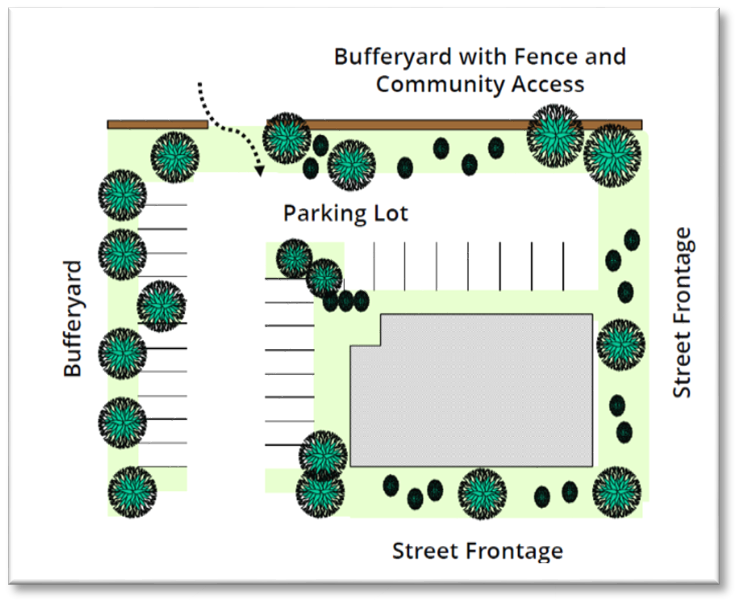
Figure 7.A: Illustrated location of different required landscape types
2.
A property or development site may have more than one type of required landscaping. Each type of landscaping is calculated separately. One type of required landscaping may not be calculated toward nor substituted for the provision of a different type of required landscaping. For example, street frontage landscaping may not be calculated toward off-street parking lot landscaping.
B.
Street Frontage Landscape Area Standards.
1.
Applicability.
Any front or side-street yard ("street frontage") of each lot or tract and any adjacent right-of-way on the private property-side of a sidewalk shall be landscaped according to this section.
2.
Dimensions.
a.
The minimum depth of the street frontage landscape area shall be 10 feet, measured inward from the property line.
(1)
Where a sidewalk is installed or required the depth shall be measured from the inside edge of the sidewalk.
(2)
A property owner may provide landscaping between the right-of-way and a sidewalk in addition to required street frontage landscaping. All property owners shall maintain the area between the right-of-way and a sidewalk pursuant to Dolores Municipal Code Section 8.08.21.
b.
Street frontage landscape areas may be located within required zone district yards and required setbacks.
3.
Plant Materials.
a.
The street frontage landscape area shall be planted in 75 percent organic materials. The remaining 25 percent may be covered in inorganic materials.
(1)
Turf grass or other material that requires regular mowing may not be planted in street frontage landscape areas in mixed-use or non-residential districts.
(2)
Smooth concrete or asphalt surfaces are not considered landscaping.
b.
One tree, with a minimum two-inch caliper, shall be planted per 35 linear feet (or fraction thereof) of required street frontage landscaped area.
(1)
Required trees shall be spaced at least 35 feet apart.
(2)
Access driveways shall not be subtracted from calculations of the amount of street yard landscaping required. If there are driveways along the frontage or property line, required landscaping shall be condensed into the remaining landscaping area.
c.
Generally applicable plant materials standards are located in Section 7.4.
d.
Street tree species shall be chosen from the list in Appendix A.
e.
The use of coniferous trees is not permitted in street frontage landscape areas.
C.
Bufferyards.
1.
Applicability.
a.
When made applicable by new development or development change as described in Section 7.2.B, the exterior boundary of a lot that adjoins or is located across an alley from a different zone district, structure, or use, and that does not adjoin a public street right-of-way, shall meet the bufferyard requirements shown in Table 7.2, below.
b.
A lot may require both street frontage landscaping and bufferyards depending upon the types of surrounding development.
c.
In the DMU district, the requirements of this section shall be accommodated to the maximum extent feasible. The bufferyard design may be adjusted by the Zoning Administrator to accommodate the space available on the lot.
d.
There are three types of landscaping bufferyards identified in Table 7.2 that are intended to accomplish the following:
(1)
B1: Visual Enhancement is intended to create a partial visual separation between uses or districts.
(2)
B2: Filtered Screen is intended to create a semi-opaque visual separation between uses or districts.
(3)
B3: Screened Separation is intended to provide both space and a partial visual separation between uses or districts. This bufferyard is intended for use where a new development is located adjacent to a district or use that is significantly different in intensity, such as a residential district next to an industrial district.
e.
The dimensions and planting requirements for each type of bufferyard is specified in Table 7.3, immediately following Table 7.2.
2.
Types of Bufferyards.
The bufferyards identified in Table 7.2 shall meet the following minimum dimensions and planting requirements:
3.
Location and Calculations.
a.
Bufferyard depth is measured from the property line inward. Where a buffer area overlaps another buffer area, the area of overlap of one bufferyard shall be subtracted from the total required landscape point calculation to avoid double counting.
b.
Bufferyards may be located within required yards and setbacks.
c.
Access driveways shall not be subtracted from the linear frontage in calculations of the amount of landscaping required. If there are driveways along the frontage or property line, required landscaping shall be condensed into the remaining site perimeter landscaping area.
4.
Additional Standards and Instruction.
a.
If a use or district does not conform with the categories identified in Table 7.2, the Zoning Administrator shall determine which category best matches the use.
b.
A six-foot high sight-obscuring fence or wall shall be provided on the property line where a commercial or industrial use or structure is adjacent to or across an alley from any residential uses, including residential as part of a mixed-use development.
(1)
A screening fence or wall is not required where the residential uses is separated from the commercial or industrial use by a public street.
(2)
A continuous hedge may be substituted for the required fence or wall, as long as it has a minimum height at installation of three feet and reaches six feet or more at maturity.
(3)
Vinyl or powder-coated, colored chain link fencing is allowed within a bufferyard where a sight obscuring fence is required so long as the chain link fence has sight-obscuring slats installed.
D.
Off-Street Parking Lot.
1.
Applicability.
The following requirements shall be applicable to all new off-street surface parking lots with 10 or more spaces.
2.
Required Landscape Area.
All surface parking lots shall incorporate the following interior landscaping:
a.
Landscape islands shall be installed for every 10 parking spaces contained in a parking row, either within the parking row or at the end of the parking row.

Figure 7.B Sample parking lot landscaping layout
b.
Parking lots with 50 or more spaces shall also be divided into subsections of no more than 25 spaces with landscape divider strips shall be placed between the sections.
3.
Landscape Area Design.
a.
Minimum standards for landscape islands:
(1)
Minimum dimensions:
i.
Width: six feet.
ii.
Area: 200 square feet.
(2)
Planting per 200 square feet: four, five-gallon deciduous shrubs and one deciduous tree with a minimum caliper of two and one-half inches.
b.
Minimum standards for landscape dividers:
(1)
10 feet in width and shall extend the length of the parking row.
(2)
Include a four-foot-wide sidewalk and a six-foot wide planting strip.
(3)
Meet planting requirements for landscape islands, as outlined above, with one tree planted every 40 feet.
c.
Landscaped areas within parking lots or the along perimeter of the property must be protected from vehicular traffic through the use of concrete curbs, extruded asphalt or other approved permanent barriers.
d.
No paving shall be permitted within four feet of the center of a tree.
e.
All of the required parking lot landscaped areas must contain a minimum of 75 percent organic landscaping material, with a maximum of 25 percent inorganic landscaping material. Approved sidewalks are not counted toward the percentage of inorganic material unless specifically provided for in this section.
f.
Clear vision areas where the parking lot access drive enters from a public right-of-way must be maintained as required in Section 2.3.F. Plant materials within these clear vision areas must be trimmed downed to no more than 30 inches above grade, or in the case of trees, the lowest branch height trimmed up to 8 feet above grade.
g.
Where appropriate, the use of porous pavement and/or specially designed brick or block should be considered to increase on-site water retention for plant material, replenishment of groundwater supplies and to reduce problems associated with runoff.
h.
Parking lots shall be designed so as not to drain into or across public sidewalks, adjacent property, or directly into natural watercourses. Curbs used to protect landscape islands should have 18 to 24-inch-wide curb cuts at frequent intervals to allow storm water infiltration. The surface of landscape islands and divider strips shall be concave to help channel surface water runoff. The following drainage structures are permitted within parking lot landscape areas:
(1)
Rain gardens,
(2)
Bio-swales,
(3)
Drainage easements, and
(4)
Drainage inlets.
Section 7.4. - Materials, installation, and maintenance.
A.
General Standards.
The following criteria and standards shall apply to landscape materials and installation:
1.
Plant Materials List.
The Town of Dolores suggested and prohibited plant list provided in Article 7 Appendix A shall be used as necessary to identify plant material requirements or prohibitions within Dolores. Where a species is chosen for a landscape plan that is not identified on a Town plant list, the applicant shall provide information about growth and spacing characteristics on the landscape plan. Plant information shall be taken from objective sources, including professional landscape organization websites or nursery cut sheets. Plant materials identified in any prohibited plant list may not be used in landscaping.
2.
Shrubs and Trees.
a.
Tree and plant materials shall be selected for: energy efficiency and water efficiency; adaptability and relationship to the native environment; color, form and pattern; ability to provide shade; soil retention; and resistance to fire. The overall landscape plan shall be integrated with all elements of the project, such as buildings, parking lots, and streets, and to achieve a desirable microclimate and minimize energy demand.
b.
Locally appropriate shrubs and grasses shall be utilized in order to minimize the consumption of water. Naturalized vegetation within sensitive land and resource areas shall be preserved unless the Town approves an alternative naturalized landscaping plan that preserves significant desirable naturalized vegetation.
c.
If turf areas are included in landscaping, it must be a sod or seed mix specifically cultivated to thrive in the conditions present at the particular site.
(1)
The use of non-naturalized, high water consumptive turf or other monoculture seeding such as Kentucky Blue Grass is discouraged.
(2)
The applicant must provide information regarding the composition of a sod or seed mix as part of the detailed plant list as required.
(3)
No person or organization shall impose private covenants, conditions, deed clauses, or other agreements that require the installation of turf or prevent the utilization of water efficient landscaping, provided such landscaping receives appropriate approval. No person shall prohibit landscaping materials and designs solely on the basis that they make use of water-efficient landscaping.
3.
Weed Control.
The Colorado Revised Statutes at Title 35, Article 5.5, Colorado Noxious Weed Act will be used for control of noxious weeds.
4.
Quality.
All plant and landscaping materials must be free of weeds, insects, diseases, mechanical injuries, and other objectionable features at the time of planting. Where appropriate, certified weed-free products, such as mulch, shall be used.
5.
Coverage.
a.
Grass, ground cover, shrubs, organic mulch, and other organic landscape materials shall be used to cover at least 75 percent of open ground. Shade provided by trees, shrubs, or structures, or anything not on the horizontal plane of the site does not qualify as ground cover.
(1)
Open ground includes all fill slopes and hillsides, regardless of the angle of the slope.
(2)
Open ground also includes all fill rock and shot rock slopes that must be covered with an appropriate depth of soil to allow for the healthy growth of the coverage.
(3)
Inorganic material can be incorporated into a landscape plan where appropriate and can be used to cover up to 25 percent of open ground.
b.
No area required to be landscaped shall include any artificial trees, plants, or turf; impervious surfacing other than sidewalks, decorative pathways, or other public amenities; or any carpeting designed as a visual substitute for lawn or other groundcover.
c.
Areas devoted to pasture, farm crops, or undeveloped areas of a parcel shall not be considered landscaped for the purpose of fulfilling any landscape requirements.
6.
Trees.
Trees used for landscaping shall be a species common to, or adapted to this area of the state, and not identified as prohibited on any Town plant list. Trees shall have the following characteristics:
a.
Canopy trees, with an outer layer of dense leaves that block light and provide share, shall be deciduous trees that have a minimum height of 30 feet at maturity. All canopy trees shall have a caliper width of at least two inches at time of planting.
b.
Understory trees shall be deciduous trees that have a maximum height of less than 30 feet at maturity. All understory trees shall have a caliper width of at least one and one half (1.5) inches at time of planting.
c.
Coniferous trees shall have a minimum height of 20 feet at maturity. All coniferous trees shall be at least four feet in height at time of planting.
d.
Street trees shall be canopy trees.
7.
Shrubs, Hedges, and Ornamental Grasses.
Shrubs shall have the following characteristics:
a.
Small or dwarf deciduous shrubs that typically do not grow to a mature height or spread exceeding three feet shall have a minimum height of twelve inches with a minimum of four canes.
b.
Intermediate deciduous shrubs with a mature height or spread of three to seven feet shall have a minimum height of 18 inches with a minimum of four canes.
c.
Large or tall deciduous shrubs with a mature height exceeding seven feet shall have a minimum height of 24 inches and a minimum of five canes. Where these shrubs have a narrow habit the minimum number of canes may be reduced to one.
d.
Ornamental grasses shall have a minimum two-gallon pot size at time of planting.
e.
Hedges, where installed as a bufferyard screen, shall be planted and maintained so as to form a continuous, unbroken, solid, visual screen which will be at least three feet in height at the time of planting and achieve a minimum height of six feet within five years.
8.
Ground Cover, Perennials, and Annual Planting Areas.
Ground covers, perennials, and annual planting areas used in lieu of grass in whole, and in part, shall be planted in such a manner as to present a finished appearance and reasonably complete coverage at maturity.
9.
Lawn Grass.
Grass areas may be sodded, plugged, sprigged, or seeded, except that sod or other erosion control products shall be used in swales, berms, or other areas subject to erosion.
10.
Naturalized Plants and Grasses.
Naturalized plants and grasses shall not be considered weeds that are subject to [Dolores Municipal Code]; however, the area planted in naturalized plants and grasses shall be kept weed-free to maintain this exemption.
11.
Fractions in the calculation of number of trees and shrubs.
In the calculation of trees and shrubs for any required landscaping, all fractions shall be rounded to the nearest whole number.
B.
Interference and Visibility.
1.
All landscaping shall be sized and located so that it does not interfere with utilities, easements, or fire hydrants.
2.
All landscaped areas must comply with the clear vision area standards for intersections as established in Section 2.3.F.
C.
Location of Utilities.
Proposed utilities shall be located, when possible, so that their installation will not adversely affect vegetation to be retained on a site.
D.
Installation.
Landscaping, watering devices, walls and screening structures shall be installed in accordance with the approved landscape or screening plan prior to issuance of a final Certificate of Occupancy for the building or use. The Building Official may grant a temporary Certificate of Occupancy during the winter months when installation is impracticable or not feasible.
E.
Maintenance Requirements.
1.
Landscaped areas shall be reasonably maintained by the owner or the lessee of the property, including pruning, trimming, watering, and other requirements necessary to create an attractive appearance for the development. Lack of maintenance of required landscaping material shall constitute a violation of this Code.
2.
Any plant materials not surviving shall be replaced within 30 days of their demise or in the next appropriate season.
F.
Irrigation Systems.
Irrigation systems shall be installed to current water regulations for safety purposes and reported to the Town Staff for inspection.
Section 7.5. - Screening.
A.
Screening Standards.
Where screening standards are required by this Code, the following screening standards shall apply:
1.
Height of Screening Devices.
The height of screening devices shall be measured from the highest finished adjacent grade of the element to be screened.
2.
Outdoor Storage Areas.
All outdoor storage areas for materials, trash, mechanical equipment (including ground-based satellite dishes) or other similar items shall be screened from street view by a minimum six-foot high screening device. The screening device shall consist either of plant material or a wall constructed of or finished with materials to match the main building of the site.
3.
Roof Mounted Equipment.
Roof mounted mechanical equipment shall be screened by parapet walls or other screening devices except solar equipment.
Section 7.6. - Fences and walls.
In any residential district or along the common boundary between any residential or nonresidential district where a wall, fence, or screening separation is erected or where a screening wall or fence is required by this Code, the following standards for height and design shall be observed.
A.
No fence or wall erected within a required front yard shall exceed four feet in height above the adjacent grade.
B.
No fence or wall erected within a required side or rear yard shall exceed six feet in height above the adjacent grade, provided, however, where houses on adjacent lots are constructed such that the front of one house faces the back of the adjacent house, then the maximum rear yard fence height shall be four feet.
C.
Fences and walls shall be erected in accordance with the requirements of Section 2.3.F, Clear Vision Area.
D.
Barbed wire fences are prohibited.
Section 7.7. - Tree preservation.
A.
Purpose.
The terms and provisions of this section are intended to accomplish the following:
1.
Encourage the protection of healthy trees and provide for the replacement and/or replanting of trees that are necessarily removed during construction, development, or redevelopment; in accordance with species included in State Noxious Weed list.
2.
Provide for the preservation and protection of larger established trees, which provide a valuable amenity to the urban environment and which, once destroyed, can only be replaced after generations, if at all.
3.
Provide for open space and more efficient drainage of land; thereby, reducing the effects of soil erosion and the need for additional drainage facilities.
4.
Prevent the clear cutting of land.
B.
Applicability.
1.
When a grading or building permit is requested for a property, all healthy trees of desirable species, as identified in Appendix A, that meet the following criteria shall be maintained on private property prior to issuance of the requested permit.
a.
A single trunk of six inches caliper or greater, measured at four feet above natural grade DBH (diameter breast height), and at least 12 feet high; or
b.
A multi trunk having a total caliper width of eight inches, measured by combining the caliper width of the largest stem or branch with one half the caliper width of each additional stem or branch, all measured at four feet above natural grade level, and at least twelve feet high.
2.
An inventory of all trees meeting these criteria ("established tree") must be shown on the site plan.
C.
Review.
The Town may hire a certified arborist or other qualified professional to assist with tree preservation and removal issues. Fees for this work may be charged to the applicant or property owner.
D.
Exemptions.
The following established trees are exempt from the provisions of this section:
1.
Trees located within necessary public rights of way, easements, and the designated buildable area of a building lot or site to be removed subject to site plan approval and prior to the issuance of a grading or building permit.
2.
Any established tree that is determined by the zoning administrator to be standing dead, severely damaged from an emergency (such as a storm, flood, or other act of God), or is otherwise in a hazardous or dangerous condition so as to endanger the public health, welfare, or safety, may be removed without delay. Authorization for removal without site plan approval may be given by the Town Administrator, and the tree may then be removed.
E.
Preservation of Established Trees.
1.
All existing, healthy established trees must be preserved or transplanted on the site unless their removal is approved by the Zoning Administrator.
2.
Where established trees are removed, they shall be replaced elsewhere on the site as follows:
3.
Tree replacement shall be made within 180 days of the removal. Any tree or tree areas identified to be retained on the site plan that do not remain alive for a period of at least two years after the development of the site, or stage ceases, shall be considered damaged in violation of this Code and shall be replaced.
4.
If the site layout cannot reasonably accommodate the number of trees required in compliance with the replacement ratios and/or tree spacing consistent with standard forestry practices, the zoning administrator shall either:
a.
Approve an increase in the size of the on-site replacement trees and reduce the number of trees required. The quantity and quality of the replacement trees shall be sufficient to produce a reasonable tree canopy for the size of the lot; or
b.
Require payment of an in-lieu fee in compliance with subsection (3) of this section for the required number of trees or any portion thereof.
c.
In-lieu fee. Payment of a fee shall be made to the Town for tree planting elsewhere in the community should on-site location of the replacement trees not be possible, subject to the following:
(1)
The in-lieu fee will be based on the fair market value of the number of trees required for the same or equivalent species, delivered and installed, as determined by the zoning administrator.
(2)
The fees will be used to purchase trees that will be planted within the public right-of-way or on other public property as directed by the Town Board.
(3)
Payment of the in-lieu fee shall be made prior to issuance of the project final permit.
F.
Penalties for Unauthorized Removal of Established Trees.
It shall be considered an unauthorized removal if an established tree is removed without first obtaining site plan approval, or if it is intentionally or unintentionally killed by means of grading, grubbing, placement of fill, or other unacceptable construction methods and the Town may enforce the provisions of Article 18, Violation, Enforcement, and Penalties.
G.
Tree Protection Measures.
The following protection measures shall be required for established trees as identified on the site plan:
1.
Prior to construction or land development, the developer shall clearly mark with three inch wide red ribbon or tape all established trees within 30 feet of a public right of way, public easement, or buildable lot area, as included on the applicable approved and filed final plat.
2.
No attachments or wires of any kind, other than those of a protective nature, shall be attached to any established tree.
3.
With major grade changes of six inches or greater, a retaining wall or tree well of rock, brick, landscape timbers or other approved materials shall be constructed around the established tree no closer than the drip line of the tree. The top of the retaining wall or tree well shall be constructed at the new grade.
4.
Unless otherwise approved by the Town, no construction or construction related activity shall occur under the canopy, drip line, or closer than five feet, whichever is more, of any established tree or group of established trees.
Section 7.8. - Removal of dead, diseased, or dangerous trees.
A.
The Zoning Administrator may enter upon any premises without a warrant to inspect all trees in the Town.
B.
If the Zoning Administrator finds that there exist dead trees or overhanging limbs that pose a danger to persons or property, the Zoning Administrator will notify the owner, lessee, agent, occupant, or other person in possession or control of the property upon which the condition exists of the duty to remedy the condition within 15 days from the date of the notice or such shorter time as the Zoning Administrator finds appropriate in view of the nature and extent of the condition.
C.
If the Zoning Administrator determines that any tree growing on private property within the Town is afflicted with any dangerous or infectious insect infestation or disease, the Administrator will notify the owner, lessee, agent, occupant, or other person in possession and control of the property of the condition and order such person to take specific prescribed measures that the Zoning Administrator determines are reasonably necessary to cure the infestation or disease and to prevent its spread, within 10 days from the date of the notice or such time as the Zoning Administrator finds appropriate in view of the nature and extent of the condition. If necessary to address a dangerous or infectious insect infestation or disease, the Zoning Administrator may require that work shall be completed under the supervision of a certified arborist.
D.
If the person notified pursuant to Subsection B or C of this section fails to correct the condition as required by the notice prescribed in such subsection, except in cases of extreme emergency, the Zoning Administrator may enter the property, pursuant to an administrative warrant issued by the municipal court, and correct the condition and charge the costs of such correction, plus reasonable administrative costs, to the owner and to the lessee, agent, occupant, or other person in possession and control of the property.
E.
Nothing in this section shall be deemed to prohibit the Zoning Administrator from taking such steps to correct an immediate threat to the public health, safety, or welfare that the Zoning Administrator determines is posed by such diseased, dead, or dangerous trees.
Appendix 7A: - Dolores suggested and prohibited plant list.
A.
Prohibited Plants.
Any plant included in the State of Colorado or Montezuma County Noxious Weed Guide (or successor list).
B.
Suggested Plants.
Native or naturalized trees, shrubs and grasses, appropriate to Southwestern Colorado that require minimum water use, as identified by any of the following guides or sources:
Colorado State University Extension Service.
City of Durango Tree & Shrub Guide.
Dolores and Mancos Conservation District.
Waterwise resources for the San Juan Basin or as identified by the Denver Botanic Gardens.
Applicants may provide additional documentation to the Town for consideration but the Town reserves the right to reject sources that are not in keeping with this list.

