
Dolores City Zoning Code
ARTICLE 5
- Site Layout and Structure Design Standards
Section 5.1.- Residential design standards.
A.
Design Standards: Single Unit, Two Unit, Three Unit, and Townhouse.
1.
Purpose.
The purpose of the residential design standards is to preserve and enhance the quality and character of the built environment in the Town. More specifically, the purposes of this section are to:
a.
Encourage high quality development as a strategy for investing in the Town's future;
b.
Emphasize the Town's unique and creative community character;
c.
Avoid repetitive and monotonous development and streetscapes;
d.
Protect and enhance property values;
e.
Provide property owners, developers, architects, builders, business owners, and others with a clear and equitable set of parameters for developing land; and
f.
Promote structural sustainability through the use of materials appropriate to the Town's climate and altitude.
2.
All Principal Residential Buildings.
All principal residential buildings shall be designed to comply with the following standards:
a.
New residential development shall incorporate the following architectural design elements:
(1)
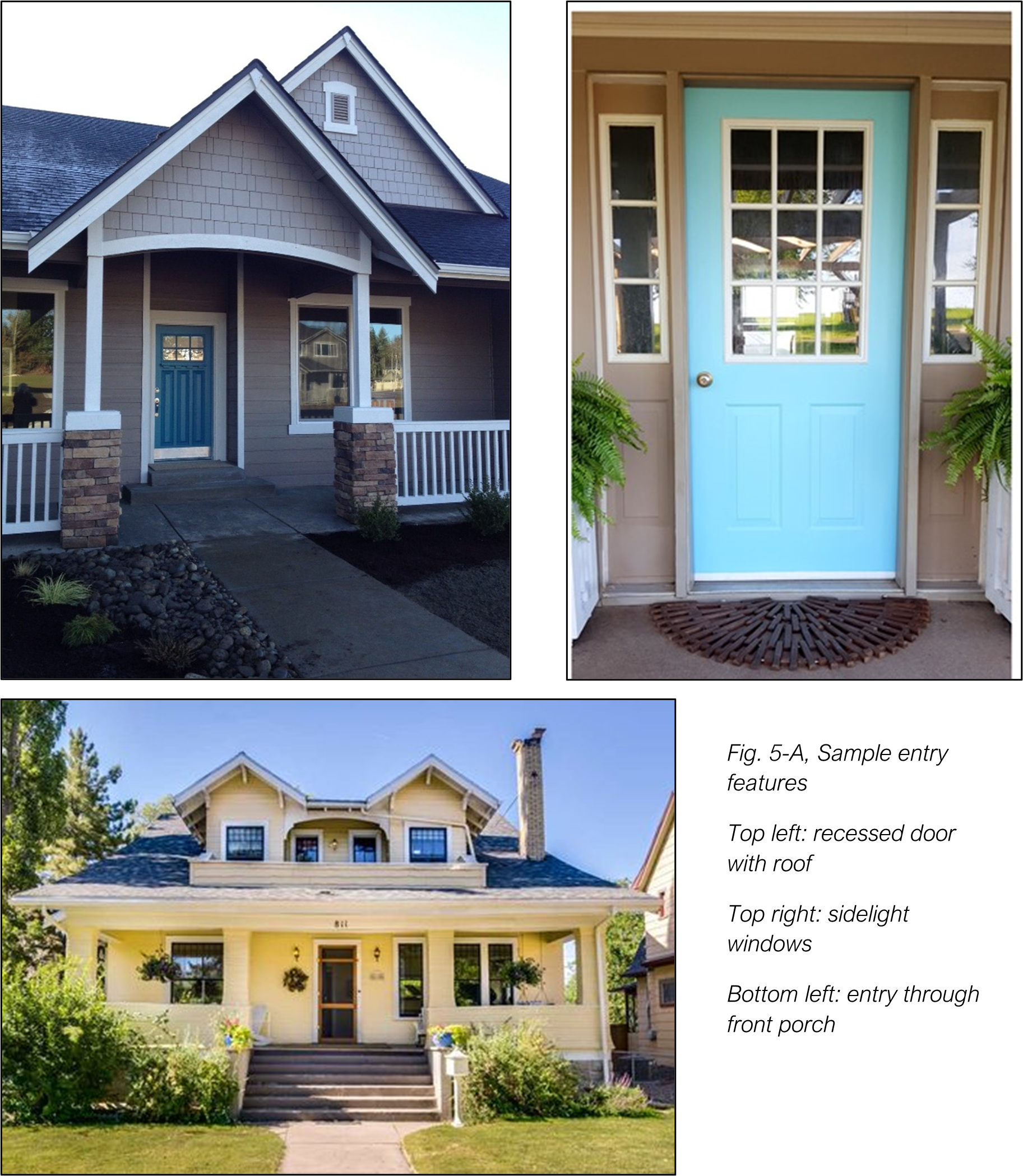
Front entrance emphasis using one of the following design features:
i.
Entrance through a front porch;
ii.
Locate the entrance in a recessed or projecting bay;
iii.
Sidelights, trim, and/or transom windows abutting the front door; or
iv.
Front entry covered by a roof or canopy differentiating it from the overall roof type.
(2)
The front façade of new residential buildings shall provide a minimum of 15 percent window and door coverage per story. The use of vertical-oriented double-hung windows is preferred over horizontal sliding windows.
(3)
Garage doors for attached garages on the front facade shall not exceed 40 percent of the total width of the front façade.
b.
No front facade shall be repeated more than once every three lots on the same side of the street. Each facade used to satisfy this requirement shall distinctly differ from other facades in a minimum of four of the following design elements.
(1)
Placement of windows and doors on the front façade;
(2)
Use of different materials on the front façade;
(3)
Substantial variation in the location and proportion of garages and garage doors;
(4)
Variation in the use, location, or proportion of front porches;
(5)
Substantial variations in rooflines, that may include roof pitch;
(6)
Use of dormers;
(7)
Variation of building type between ranch, two-story, or split level;
(8)
Other distinct and substantial facade design variations approved by the Planning & Zoning Commission.
3.
Two and Three Unit Dwellings.
Two- and three-unit dwellings shall also comply with the following standards:
a.
Front porches shall be incorporated for all front entrances.
b.
All units shall be provided with at least one entrance connected by sidewalk to a public sidewalk or street. A storage room of at least 10' by 10' shall be provided for each residential unit.
4.
Townhome Dwellings.
a.
The attached dwellings in any one townhouse structure shall be required to have distinctly different front facades. No attached single-unit structure front facade shall be repeated more than once every four structures on the same side of the street. Options for façade differentiation include:
(1)
Placement of windows and doors;
(2)
Use of different materials;
(3)
Substantial variation in the location and proportion of garages and garage doors;
(4)
Variation in the use, location, or proportion of front porches;
(5)
Substantial variations in rooflines, that may include roof pitch;
(6)
Use of dormers; or
(7)
Other distinct and substantial facade design variations approved by the Planning and Zoning Commission.
b.
Any building (excluding parking garages and other accessory buildings) viewed from a public right-of-way or public open space shall either face the right-of-way or open space or shall have a façade facing public view that is designed in keeping with the character of the front façade, including the utilization of similar fenestration and materials.
B.
Design Standards: Multiunit Dwellings.
Multiunit dwellings shall comply with the following standards:
1.
Each dwelling unit shall have a minimum floor area of 400 square feet,
2.
Each dwelling unit shall have a balcony or a patio of at least 64 square feet/unit;
3.
No more than four apartment units shall share a common entrance stairway;
4.
A storage room of at least 10' by 10' shall be provided for each residential unit;
5.
Walls with long, flat facades over 40 feet in length shall be designed to avoid presenting a "backside" to neighboring properties by incorporating recesses, off-sets, angular forms or recessed windows, display cases, porches, balconies, or other features.
C.
Parking.
1.
Generally Applicable to All Principal Structures.
Service and vehicular access shall be provided off the alley. Where there is no alley the Zoning Administrator shall determine the appropriate location for access based on traffic circulation, land use, and public safety.
2.
Two-Unit and Multiunit Dwellings.
a.
All required off-street parking shall be provided in the rear of the property. Strip parking along street frontages is not permitted.
b.
Off-street parking access shall be provided from an alley. Where alley access is unavailable, access shall be provided from a single common driveway.
D.
Density Bonus for Affordable Housing.
The Planning Commission may recommend and the Board of Trustees may approve and apply any combination of the following adjustments to accommodate the inclusion of one affordable housing unit per lot in addition to the maximum number of units allowed in the applicable zone district (for example, where a duplex unit is allowed, a triplex may be approved when one of the units meets the Town requirements for affordability):
1.
Minimum setbacks or lot widths may be adjusted by up to 20 percent;
2.
Maximum lot coverage may be increased by up to 20 percent;
3.
Minimum lot size may be reduced by 20 percent;
4.
Maximum height may be increased:
a.
Residential zoning district limit of 35 feet may be increased to 40 feet;
b.
Height in mixed-use or nonresidential districts may be increased by 1 story, not to exceed an additional 15 feet above the original maximum height;
5.
The required off-street parking spaces may be reduced to 1.5 spaces per dwelling unit, and
6.
If a public park or open space is located within 1,320 feet and safely accessible to the development site, any required open space dedication may be reduced by 50 percent.
(Ord. No. 566, § 1(Exh. A), 8-14-2023)
Section 5.2. - Mixed-use and commercial development.
A.
Purposes.
The mixed-use and commercial design standards are intended to promote high-quality design that works within the context of the surrounding development, neighborhood, or Town in general. The standards are further intended to:
1.
Provide visual interest and variety while still ensuring context-appropriate design that works with surrounding structures;
2.
Enhance the pedestrian scale of development and the streetscape;
3.
Mitigate negative visual, pedestrian, and neighborhood impacts from the scale, bulk, and mass of large buildings;
4.
Balance the community's economic and aesthetic goals; and
5.
Encourage building and site design that fosters community sustainability goals, including adaptive reuse where possible.
B.
Applicability.
The design standards in this subsection apply to all new commercial, mixed-use, and industrial structures except those located in the Downtown Mixed-Use (DMU) district.
C.
Building Design.
1.
Façades.
The majority of a building's architectural features and treatments shall not be restricted to a single façade. Building details, including roof forms, windows, doors, trim, and siding materials, shall reflect the architectural style of the building. All publicly-visible sides of a mixed-use or commercial building shall display a similar level of quality and architectural detailing.
2.
Building Orientation.
The front façade shall be oriented toward a public street and pedestrian walkways.
3.
Building Styles.
Franchise architecture is discouraged in favor of design that is architecturally compatible with the character of the neighborhood or district.
4.
Roofs.
Flat roofs shall include parapets concealing flat roofs and rooftop equipment such as HVAC units from public view. Parapet roofs should be of sufficient height to conceal HVAC units and other similar roof-mounted apparatus from public view from adjacent street levels. Parapet roofs shall have cornices or be stepped. The Planning & Zoning Commission may waive or reduce the parapet requirement for roof-mounted solar equipment or green roofs.
5.
Parking.
Parking shall be located to the side or rear of the primary structure.
Section 5.3. - Neighborhood manners—Residential adjacency.
A.
Applicability.
The following standards apply to all zone districts except Downtown Mixed-Use.
B.
Standards.
1.
Nonresidential structures taller or larger than adjacent residential uses shall be broken up into modules or wings with the smaller or shorter portions of the structure located adjacent to residential uses. The module or wing adjacent to a residential use shall be no more than one story taller than the residential structure.
2.
Facade Configuration.
a.
Service functions like refuse collection, incidental storage, and similar functions shall be integrated into the architecture of the building unless an alternate location places these functions farther from adjacent residential uses.
b.
Windows shall be arranged to avoid direct lines-of-sight into abutting residential uses.
c.
Multi-story structures with balconies, patios, or other public gathering spaces more than 24 feet above grade shall orient these features to avoid direct views into lots in low- and medium-density residential districts.
3.
The residential compatibility standards in this subsection apply when nonresidential or mixed-use development is proposed adjacent to lots used by or zoned for detached or attached single-family structures in a residential district.
4.
Where these adjacency standards apply, the following uses or features shall be prohibited as principal or accessory uses:
a.
Public address/loudspeaker systems;
b.
Outdoor storage; and
c.
Uses providing delivery services via large tractor trailers (not including package delivery services).
5.
Off-street parking for the nonresidential or mixed-use structure shall be established in one or more of the locations listed below. The locations are listed in priority order; the applicant shall select the highest feasible location from this list, and shall demonstrate why that application was selected over other alternative locations.
a.
Adjacent to off-street parking lots serving nonresidential uses on abutting lots;
b.
Adjacent to lot lines abutting nonresidential development;
c.
Adjacent to lot lines abutting mixed-use development;
d.
Behind the building;
e.
In front of the building; or
f.
Adjacent to lot lines abutting residential uses.
6.
In cases where an off-street parking lot serving a nonresidential use is located on an abutting lot, connection between the two parking areas via a cross-accessway with a minimum width of 12 feet and a maximum width of 24 feet is strongly encouraged. A cross-access easement shall be recorded.
7.
Landscaping/Screening.
a.
Screening shall not interfere with public sidewalks, vehicular cross-accessways, or improved pedestrian connections.
b.
Any parking designated for trucks, recreational vehicles and other large vehicles shall be placed in a location which is not adjacent to either any street or to any residentially zoned property.
8.
Operation.
a.
Nonresidential uses with outdoor components (e.g., outdoor dining, performance venues) located adjacent to lots in a residential district shall curtail outdoor activities by 10:00 pm.
b.
Loading or unloading activities shall take place only between the hours of 7:00 am and 11:00 pm.
c.
Alternate hours of activities may be approved through the conditional use permit process.
Section 5.4. - Generally applicable structure design standards.
A.
Materials.
1.
Purpose.
The choice of building materials is important to ensure that structures in Dolores are:
a.
Developed in a manner that responds to the climate of Southwestern Colorado, including periods of extensive solar radiation, high heat, and very low moisture or rainfall;
b.
As fire-resistant and ignition resistant as is feasibly possible;
c.
Uniquely designed while still grounded by some basic materials design standards; and
d.
Constructed with safe and efficient materials that are in keeping with both historic and modern Dolores.
2.
Applicability.
All multifamily, mixed-use, and commercial building walls that are clearly visible from a public street or right-of-way shall comply with the following standards:
3.
Generally Applicable Materials Standards.
a.
Stronger and heavier materials (masonry) should be located below lighter materials (wood).
b.
Material changes should occur at logical construction locations.
c.
Equivalent or Better: Materials, techniques, and product types prescribed here are permitted. Where indicated, equivalent or better practices and products in terms of quality, maintenance, and durability as shown by the manufacturer's specifications and industry studies, may be proposed to the Town for review according to the Alternative Compliance process established in Article 17.
4.
Primary Façade Materials.
Any of the following building materials shall be used on a minimum of 75 percent of the facade area. This measurement shall be calculated as a percentage of the wall portion of the facade, exclusive of windows, doors, or other openings.
a.
Brick, natural stone, block, or integrally-colored synthetic stone;
b.
Adobe;
c.
Fire-retardant treated wood or Town-approved fiber cement siding;
d.
Stucco (cement plaster), however, prefabricated stucco panels and sprayed on stucco finishes are prohibited;
e.
Cast iron, copper, stainless steel (18-8 or better), or titanium metal;
f.
Vinyl siding that meets ASTM Standard 3679 that has anti-weathering protection and a minimum warranty of 50 years; and
g.
Aluminum siding with a manufacturer's projected lifespan of 40 years or more.
5.
Secondary Materials.
Any of the following materials are permitted on a maximum of 25 percent of the façade area and on all side and rear elevations.
a.
All permitted primary facade materials,
b.
Metal,
c.
Ground- or split-faced block (integrally colored),
d.
Glass block,
e.
Decorative tile,
f.
Pre-cast masonry, and
g.
EIFS (Exterior Insulation and Finishing System) and other synthetic materials may be used above the second story,
6.
Prohibited Materials.
a.
Styrofoam and all other foam-based products, and
b.
Faux and/or thin-brick or stone panels.
7.
Additional Permitted Materials and Elements.
a.
Cornices and soffits may be comprised of wood, metal, vinyl, or synthetic materials.
b.
Gutters and downspouts may be vinyl and/or metal, in accordance with industry standards.
c.
Parapet wall materials, exclusive of copings, shall match the building wall.
Section 5.5. - Sidewalks and pathways.
A.
Sidewalks are required along both sides of all public streets in accordance with Town standards. The minimum width for sidewalks and pathways is five feet.
B.
Provisions shall be made on all development sites to encourage the use of bicycle and pedestrian travel through the integration of bicycle and pedestrian paths, trails and/or bicycle lanes that connect to parks, open spaces, schools, public transit, and shopping areas.
C.
Bicycle and pedestrian paths, trails, and/or bicycle lanes shall also connect to collector and collector streets. Easements and/or rights-of-way shall be provided for bicycle/pedestrian paths between and within developments as necessary to provide pedestrian and bicycle linkages between developments, unless the applicant can demonstrate that to do so would be infeasible.
D.
The following standards apply to multifamily, mixed-use, and non-residential development:
1.
A continuous internal pedestrian walkway shall be provided from the perimeter public sidewalk to the principal building entrance.
2.
For multi-structure developments, pedestrian walkways or sidewalks shall connect all primary building entrances and must be provided along any facade featuring an entrance that exits into a parking area or travel lane. Pedestrian walkways shall also connect all on-site common areas, parking areas, storage areas, open space, and recreational facilities.
Section 5.6. - Alley easements required.
A.
Alley easements shall be provided in all residential areas.
B.
Where there is an existing or planned alley system in a mixed-use or non-residential area, alleys shall be provided and lots shall be provided vehicle access from the alley.
C.
Where an existing or planned alley system does not exist, the Planning Commission may waive the alley easement requirement provided other definite and assured provision is made for safe service access, such as off-street parking, consistent with and adequate for the uses proposed.
Section 5.7. - Drainage.
A.
Purpose.
The purposes of understanding and addressing stormwater drainage issues in Dolores include:
1.
Protecting human life, health, and property;
2.
Minimizing the expenditure of public monies for costly flood control projects;
3.
Minimizing erosion and sedimentation problems and enhancing water quality;
4.
Minimizing future operational and maintenance expenses; and
5.
Providing for inspection and monitoring procedures necessary to ensure compliance with this article.
B.
Adequate Drainage Required.
All developments shall provide for new drainage facilities, the improvement of any existing drainage facilities, channel improvements, grading, driveway adjustments, culvert improvements or any other improvement, drainage facility or work which is necessary to provide for the stormwater drainage needs of a development, in accordance with the requirements and design standards of this section, shall be included but not limited to any drainage facilities, improvements or other work which is necessary to:
1.
Provide for the conveyance of all stormwater from the development when fully developed to an adequate discharge point;
2.
Fulfill any purpose for which the requirements of this section are imposed;
3.
Adequately protect the development from flooding, including the effects of the one-hundred-year flood;
4.
Properly control any increase in the upstream or downstream stage, concentration or water surface elevation caused by the development;
5.
Provide for the conveyance of off-site storm drainage based on ultimate developed watershed conditions through the development.
C.
Drainage Study Required.
The applicant shall be responsible for submitting a drainage plan for the site prepared and stamped by a registered professional engineer licensed in Colorado. The applicant shall further provide all easements and construct all drainage facilities called for in the approved plan.
D.
Contents of Drainage Study.
A drainage study shall include or identify the following:
1.
A contour map showing all existing and proposed water courses, including the seasonal course limits of tributaries, indicating the surface conditions and locations of points of departure from the development.
2.
Computations of ten-year flows and one-hundred-year flows, in addition to an indication of the limits of the one-hundred-year floodplain plotted on the contour map.
3.
Computations of the increase or decrease in flows anticipated as a result of the development, the capacity and velocity through all drainage structures, including open channels, and the revised floodplains shall be plotted on a contour map.
4.
In no case shall the area within the one-hundred-year floodplain be used for structural development without specific approval of the Town Board.
5.
Detention ponds and/or infiltration galleries shall be included in the drainage plan to reduce peak runoff rates and to minimize pollution release to receiving streams when such can be reasonably fit into the development and when they will not create unusual maintenance responsibilities for the Town.
E.
Minimum Standards.
All provisions for drainage and flood control shall be established at a minimum to handle the anticipated 100-year frequency storms for maximum period of intensity over the entire drainage basin which the subdivision serves, and they shall be made in accordance with the approved improvement plan. The 100-year floodplain referred to herein shall mean that floodplain calculated on the basis of a fully developed watershed, regardless of any regulated floodplain designations.
F.
Erosion.
Where free fall of water occurs, satisfactory means shall be provided to prevent erosion of soil. Culverts shall have concrete head walls and wing walls where conditions require.
G.
Catch Basins.
Standard drop inlet catch basins shall be constructed.
H.
Water and Sewer System Protection.
Water supply systems and sanitary sewage systems shall be designed to minimize or eliminate infiltration of floodwaters.
Section 5.8. - Traffic impact analysis.
A.
The transportation system for new development shall be capable of supporting the proposed development in addition to the existing and future uses in the area. Where new development meets any of the applicability criteria listed in 5.8.B below, the application shall submit an evaluation of system capacity in the form of a Traffic Impact Analysis (TIA), that considers the following factors: street capacity and level of service; vehicle access and loading; on-street parking impacts; impacts on adjacent neighborhoods; and traffic safety including pedestrian safety.
B.
A TIA shall be required with applications for development review when:
1.
Trip generation during any peak hour is expected to exceed 200 trips per day or more than 100 trips during any one-hour peak period, based on traffic generation estimates of the Institute of Transportation Engineers' Trip Generation Manual (or any successor publication); or
2.
A TIA is required by the Planning and Zoning Commission or Town Board as a condition of any land use application approved pursuant to the requirements of this Code; or
3.
The Town Administrator may require a TIA for:
a.
Any project that proposes access to a street with Level of Service "D" or below;
b.
Any application for a rezoning;
c.
Any case where the previous TIA for the property is more than two years old; or
d.
Any case in which the Town Administrator determines that a TIA should be required because of other traffic concerns that may be affected by the proposed development.

