
Excelsior City Zoning Code
ARTICLE 19
- OFF-STREET PARKING REQUIREMENTS
Sec. 19-1.- Purpose.
The regulation of off-street parking spaces in this Appendix E is to alleviate or prevent congestion of the public rights of way and to promote the safety and general welfare of the public, by establishing minimum requirements for off-street parking of motor vehicles in accordance with the intensity of utilization of various parcels of land or structures.
Sec. 19-2. - Application of off-street parking regulations.
The regulations and requirements set forth herein shall apply to all off-street parking facilities in all of the zoning districts of the city.
Sec. 19-3. - Site plan drawing necessary.
All applications for a building permit or a certificate of occupancy in all zoning districts shall be accompanied by a site plan, as specified in article 9 of this Appendix E, indicating the location of off-street parking and loading spaces in compliance with the requirements set forth in this article.
Sec. 19-4. - General provisions.
(a)
Floor area. The term "floor area" for the purpose of calculating the number of off-street parking spaces required shall be determined on the basis of the exterior building dimensions of the buildings, structure or use times the number of floors, minus ten percent, except as may hereinafter be provided or modified.
(b)
Change of use or occupancy of existing buildings. Any change of use or occupancy of any building or buildings including additions thereto requiring more parking area shall not be permitted until there is furnished such additional parking spaces as required by this Appendix E.
(Ord. No. 405, 11-20-2006)
(c)
Damage to structure. When a building, structure, or use is damaged or destroyed by fire or other cause, and is re-established in accordance with this Appendix E, the number of off-street parking or loading spaces which existed must be retained and should plans be proposed for enlarging the floor area, seating capacity or other facilities which would affect the parking or loading requirements, the parking or loading spaces shall be enlarged accordingly.
(d)
Disability accessible parking. Disability accessible parking spaces shall be provided as applicable pursuant to Minn. Stats. § 168.021, as may be amended. Current disability standards are on file with the zoning administrator.
(e)
Restrictions on parking.
(1)
Required off-street parking spaces in any district shall not be utilized for open storage, sale or rental of goods, storage of inoperable vehicles, and/or storage of snow. All site plans required by this Appendix E shall illustrate the size and location of snow storage space on the property in question.
(2)
Except as may be otherwise allowed by this Appendix E, on- and off-street exterior parking facilities accessory to a residential use shall be utilized solely for the parking of licensed and operable motor vehicles not to exceed 22 feet in length and eight feet in height; and recreational vehicles and equipment, as provided for in section 18-4.
(3)
Trucks, commercial, and delivery vehicles, parked on residential streets are regulated in chapter 32 of the Code. Exceptions, for cause and in compliance with the intent and purpose of this Appendix E, may be approved by the zoning administrator as an administrative permit.
(4)
Under no circumstances shall required parking facilities accessory to residential structures be used for the storage of commercial vehicles or equipment or for the parking of automobiles belonging to the employees, owners, tenants, or customers of business or manufacturing establishments. As an exception, one commercial vehicle may be approved by the zoning administrator as an administrative permit, provided that the vehicle is screened in accordance with section 21-4 of this Appendix E.
(5)
Except where specifically allowed, contracting, excavating equipment, or other commercial vehicles and equipment may not be parked or stored on any public property in the city unless it is being used in conjunction with a temporary service benefitting the premises.
(f)
Vehicle repair. No motor vehicle repair work of any kind shall be permitted in conjunction with exposed off-street parking facilities, except for temporary (not exceeding eight hours) minor repairs of vehicles owned by the occupant or resident of the principal use for which the parking space is intended. Repair work and exterior storage of vehicles or parts shall be in compliance with chapter 16 of the Code. No exterior storage of car parts is allowed at any time.
(g)
Calculating space.
(1)
When determining the number of off-street parking spaces results in a fraction, each fraction of one-half or more shall constitute another space.
(2)
In stadiums, sports arenas, churches and other places of public assembly in which patrons or spectators occupy benches, pews or other similar seating facilities, each 22 inches of such design capacity seating facilities shall be counted as one seat for the purpose of determining requirements.
(3)
Except as provided for under joint parking, should a structure contain two or more types of use, each use shall be calculated separately for determining the total off-street parking spaces required.
(h)
Stall, aisle and driveway design.
(1)
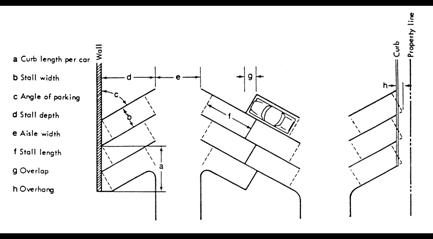
[Design standards.] Except for single-family and two-family residential uses or as otherwise provided for herein, all off-street parking facilities shall conform with the following design standards:
PARKING LOT DIMENSIONS TABLE*
*
This table pertains to a wall-to-wall situation. In calculating dimensions, two feet may be subtracted from each stall depth for each overhang and overlap. No subtraction for overlap is allowed for angles greater than 60 degrees.
**
Joint or combined parking facilities on separate lots as authorized and when constructed adjacent to a common lot line separating two or more parking areas are not required to observe the parking area setback from such common lot line. For commercial and public uses, side and rear yard setbacks shall be increased to front yard setback requirements when such side or rear yard abuts an R District.
(2)
Parking space size.
a.
Except as may be specifically provided herein, parking spaces in the areas outside of the Downtown Business District shall be not less than nine feet wide and 20 feet in length exclusive of snow storage and access aisles, and each space shall be served by access aisles as required by this article.
b.
Within the Downtown Business District, the minimum parking spaces shall be not less than eight feet, six inches wide and 19 feet in length exclusive of snow storage and access aisles.
c.
Two feet of parking stall depth may be subtracted for overhang of vehicle if totally on the subject property. No subtraction for overhang of vehicle is allowed for angles greater than 60 degrees.
(Ord. No. 458, § 1, 5-3-2010)
(3)
Within structures.
a.
The off-street parking requirements may be satisfied by providing a space or spaces within the principal building or detached accessory structure.
b.
Unless otherwise in compliance with this article and Title, no building permit shall be issued to convert a parking structure within a commercial district to a dwelling unit, living area, or other activity.
(4)
Circulation.
a.
Except in the case of single-family, two-family, and townhouse dwellings, access and parking areas shall be designed so that circulation between parking bays or aisles occurs within the designated parking lot and does not depend upon a public street or alley.
b.
Except in the case of single-family, two-family, and townhouse dwellings, access and parking area design which requires backing into the public street is prohibited.
(5)
Parking arrangement. In no case shall parking project into a sidewalk, or public or private street or driveway.
(6)
Compliance. Except in the case of single-family, two-family, and townhouse dwellings, parking areas and their aisles shall be developed in compliance with the construction standards outlined in this article. Drive aisles and parking stalls shall be constructed in accordance with the following minimum tonnage standards as specified by the zoning administrator.
(7)
Curb cut width. No driveway curb cut access shall exceed 22 feet in width unless approved by the zoning administrator.
(8)
Property lines. Except as allowed by the zoning administrator, curb cut openings shall be a minimum of three feet from the side yard property line in all districts.
(9)
Grade elevation.
a.
Parking spaces and areas. The grade elevation of any parking area shall not exceed five percent, except as approved by the zoning administrator.
b.
Driveways. Unless approved by the zoning administrator, the grade elevation of any driveway shall not exceed:
1.
Ten percent for single-family and two-family dwellings.
2.
Five percent for all other uses.
(10)
Number allowed.
a.
Single-family uses shall be limited to one curb cut access per property unless an administrative permit is approved by the zoning administrator.
b.
Properties on Water Street between Lake Street and Oak Street shall not be entitled to curb cuts on Water Street unless:
1.
The property in question has no alternative access to off-street parking located on the property; and
2.
The property owner can demonstrate that providing a curb cut on Water Street will not adversely affect traffic and public safety.
c.
All other properties shall be allowed one curb cut or driveway access for each 100 feet of street frontage unless an administrative permit is approved by the zoning administrator. Administrative permits for additional curb cuts shall be subject to the following criteria:
1.
The additional access is necessary to provide adequate on-site circulation.
2.
The additional access shall create a minimum of conflict with through traffic movement and shall comply with the requirements of this article.
3.
The additional access would not adversely impact the context of the neighborhood or commercial area.
(Ord. No. 579, § 1, 4-16-2018)
(11)
Surfacing. All areas intended to be utilized for parking space and driveways shall be surfaced with materials suitable to control dust and drainage. Driveways and parking stalls shall be surfaced with asphalt, concrete, cobblestone, paving brick or pervious pavement. Plans for surfacing and drainage of driveways and stalls for three or more vehicles shall be submitted to the zoning administrator for review and the final plans shall be subject to the zoning administrator's written approval.
(Ord. No. 495, § 2, 4-1-2013)
(12)
Striping. Except for single-, two-family, and townhouse, all parking areas of three spaces or more shall be marked with white or yellow painted lines not less than four inches wide.
(13)
Lighting. Any lighting used to illuminate an off-street parking area shall be hooded and so arranged as to reflect the light away from adjoining property, abutting residential uses and public rights of way and shall be in compliance with section 16-5 of this Appendix E.
(14)
Curbing and landscaping. Except for single-family, two-family, and townhouses, all open off-street parking shall have a perimeter continuous concrete B6-12 curb around the entire parking lot. Grass, plantings or screening shall be provided in all areas bordering the parking area as specified by this Appendix E and the design standards.
(15)
Pedestrian provision. All off-street parking areas shall be designed with due regard to pedestrian circulation. Off-street parking areas shall be designed such that vehicle and pedestrian circulation is accommodated in a safe, complementary and orderly fashion. When curb separated sidewalks are provided at the head of parking stalls, the minimum width shall be five feet or as approved by the zoning administrator.
(16)
Required screening. All open, nonresidential off-street parking areas of three or more spaces shall be screened and buffered from abutting or surrounding residential districts in compliance with article 21 of this Appendix E.
(17)
Parking lot landscaping.
a.
All exposed parking areas of three or more required spaces shall be landscaped on all sides in compliance with article 21 of this Appendix E.
b.
Within off-street parking facilities for commercial uses of 25 or more stalls, irrigated landscaped islands shall be provided at a rate of one island per 25 surface stalls or fraction thereof. For the purposes of this section, all landscaped islands shall be required to consist of a minimum of 100 square feet of area landscape surface. Such islands shall be contained within raised, curbed beds consistent with other applicable parking lot construction requirements of this article. It is not the intent of this section to relieve a project of the installation of islands that are necessary to promote the safe and efficient flow of traffic, regardless of parking lot size.
c.
All parking areas shall be screened from view of the public right-of-way with suitable landscaping and/or fencing in conformance with Article 21.
d.
No landscaping or screening shall interfere with drive or pedestrian visibility for vehicle entering, circulating or exiting the premises.
(18)
Compact car spaces. Up to 20 percent of the parking spaces in a parking lot may be permanently marked for compact cars only, provided that:
a.
All compact car spaces are a minimum of eight feet in width and 16 feet in length.
b.
Signs and markings, as approved by the city, are placed and maintained in each compact car space.
c.
All required off-street parking aisle widths are maintained.
d.
The compact car stalls shall not displace preferred disability accessible parking stall locations.
e.
The design, layout, and location of designated compact car spaces shall not be located in immediate proximity to building entrances, shall not encourage utilization by oversized vehicles, and shall be subject to approval by the zoning administrator.
(Ord. No. 541, § 1, 7-18-2016; Ord. No. 657, § 1, 9-18-2023)
Sec. 19-5. - Maintenance.
It shall be the joint and several responsibility of the lessee and owner of the principal use, uses or building to maintain in a neat and adequate manner, the parking space, accessways, striping, landscaping, and required fences/screening. Adequate space for snow storage shall be provided on the site so as not to reduce the required minimum number of parking spaces. In those cases where excessive snow cannot be properly stored on site, it shall be immediately removed from the site.
Sec. 19-6. - Restrictions.
All accessory off-street parking facilities required by this article shall be located and restricted as follows:
(1)
Lot and ownership. Required off-street parking shall be on the same lot under the same ownership as the principal use being served, except under the provisions of sections 19-9 and 19-10 of this Appendix E.
(2)
Prohibited in yard. In the case of single-family, two-family, and townhouse dwellings parking shall be prohibited in any portion of the front, side, or rear yard except on designated driveways leading directly into a garage or one open, surfaced space located on the side of a driveway, away from the principal use. Said extra space shall be surfaced with paver bricks, concrete, bituminous material, or crushed rock and gravel, as approved by the zoning administrator.
Sec. 19-7. - Number of spaces required.
(a)
Parking credits. The number of off-street parking spaces provided for any uses in the DC, Downtown Commercial District on January 1, 2003, shall satisfy the requirements of this section for the size and type of use in existence on January 1, 2003. Any change in the sizes or type of use for such properties after January 1, 2003, that requires additional off-street parking may be complied with by providing the number of newly required spaces plus replacement of any spaces eliminated by the expansion or change in use. Notwithstanding the above provisions, no use in existence as of January 1, 2003, shall reduce its number of off-street parking spaces unless the number of spaces remaining after the reduction satisfies the requirements of this section.
(b)
Parking stall requirements. The following minimum number of off-street parking spaces shall be provided and maintained by ownership, easement and/or lease for and during the life of the respective uses hereinafter set forth:
(1)
Single-family dwelling. At least two parking spaces for each dwelling unit, plus one additional parking space for each three roomers accommodated. Garage spaces will fulfill this requirement. However, a building permit shall not be granted to convert a garage to living space unless other acceptable provisions are made to provide the required parking space.
(2)
Two-family dwelling. At least two parking spaces per dwelling unit, but not more than three per unit.
(3)
Boarding and rooming houses. At least two parking spaces for each three persons for which accommodations are provided for sleeping.
(4)
Multiple dwelling. At least two and one-half parking spaces per dwelling unit not more than one of which per dwelling unit shall be open and above ground; and one and one-half parking spaces per dwelling unit shall be underground.
(5)
Hotel and motel. At least one parking space for each rental unit plus one parking space for every ten rooms. Parking for ancillary uses to the hotel, limited to restaurants and banquet halls and conference rooms, shall be calculated at 75 percent of the requirements specified herein. The parking requirements for restaurants is found in subsection 19-7 (b)(18) and for banquet halls and conference rooms in subsection 19-7 (b)(31) of this Appendix E. For mixed use buildings that include a hotel or motel, the city may require a proof of parking plan that will indicate the difference between minimum parking requirements and anticipated future demand where future potential uses of the building will generate additional parking demand.
(6)
Extended stay hotel and apartment hotel. At least one and one-half parking spaces for each rental unit provided in the design of the building.
(7)
School, elementary and junior high. At least one parking space for each classroom plus one additional parking space per 400 student capacity.
(8)
School, high school through college. At least one parking space for each four students based on design capacity, plus one additional parking space for each two classrooms.
(9)
Educational services. At least one parking space per staff member plus one space per five students of legal driving age based on design capacity.
(10)
Church, institution. At least one parking space for each four seats based on the design capacity of the main assembly hall.
(11)
Theater. At least one parking space for each ten seats of design capacity.
(12)
Hospital. At least two parking spaces for each patient bed.
(13)
Sanitarium, convalescent home, rest home, nursing home or institution. At least one parking space for each six beds for which accommodations are offered, plus one parking space for each two employees on maximum shift.
(14)
Medical or dental clinic. At least four parking spaces for each staff doctor or dentist or one space for each 150 square feet of gross floor area, whichever is greater.
(15)
Clinics (non-veterinary). At least four parking spaces for each staff doctor or dentist or one space for each 150 square feet of gross floor area, whichever is greater.
(16)
Veterinary services. At least one parking space per veterinarian, or one space per 200 square feet of gross floor area.
(17)
Drive-in food establishment. At least one parking space for each 15 square feet of gross floor space in building allocated to drive-in operation.
(18)
Bowling alley. At least five parking spaces for each alley, plus additional spaces as may be required herein for related uses such as a restaurant.
(19)
Motor fuel station. At least one space for each employee on maximum shift, plus two spaces for each service stall. Retail activities associated with a motor fuel station shall be in addition to the requirements specified and shall comply with subsection 19-7(b)(17).
(20)
Car wash. At least one and a half spaces per bay, plus four stacking spaces per bay, plus one space per employee on the largest shift.
(21)
Retail store. At least two and one-half off-street parking spaces for each 1,000 square feet of gross floor area.
(22)
Restaurants, café, bars, taverns, night clubs.
a.
For facilities with liquor, one space for each three seats based on capacity design or where there is no design layout, one space for each 42 square feet of gross floor area.
b.
For facilities without liquor, one space for each eight seats based on capacity design or where there is no design layout, one space for each 84 square feet of gross floor area.
(23)
Personal services. One parking space per 300 square feet of gross floor area.
(24)
Offices, and/or public office buildings, banks, and financial institutions. At least three parking spaces for each 1,000 square feet of gross floor area.
(25)
Funeral homes. One parking space for each five seats or 35 feet of seating area where there are not fixed seats, plus one parking space for each 250 square feet of floor area not used for seating.
(26)
Furniture store, wholesale and industrial uses, auto sales, repair shops. At least three parking spaces for each 1,000 square feet of gross floor area. Open sales lots shall provide one and one-half parking spaces for each employee on maximum shift, but not less than three spaces.
(27)
Open sales and rental lots. At least one space per 250 square feet of indoor sales area plus one space per 2,000 square feet of outside sales or display area plus one space per 2,000 square feet of storage area.
(28)
Warehouse, storage handing of bulk goods. At least one space for each two employees on maximum shift or one for each 2,000 square feet of gross floor area, whichever is greater.
(29)
Transportation services. One parking space per 300 square feet of office or sales area.
(30)
Trade shop. One parking space per 300 square feet of office or sales area, plus one space per 3,000 square feet of storage area.
(31)
Bed and breakfast. Two parking spaces plus one for each bed and breakfast unit.
(32)
Marinas and boat clubs. One parking space for every two boat spaces.
(33)
Transient boat docks. Shall allow the owner/operator on parking space credit for each transient boat space.
(34)
Permanent boat spaces. One parking space for every two boat spaces.
(35)
Community office education center. At least three parking spaces for each 1,000 square feet of gross floor area.
(36)
Charter boat operations. One parking space for every four seats on the charter boat.
(37)
Daycare and pediatric rehabilitation centers. One parking space for each employee plus one space for each four children.
(38)
Health and fitness centers, physical culture studios. One parking space for each 250 square feet of gross floor area.
(39)
Banquet halls and conference rooms. At least one space per every three persons of seating capacity including outdoor areas if used for independent seating capacity.
(40)
Microbrewery, micro-distillery, and micro-winery. Parking space requirements shall be based upon the typed of uses on the premises. The retail portion of the business would fit under the retail requirement; (subsection 19-7(b)(17)); the restaurant or tasting portion under the restaurants, cafes, bars taverns and night club requirement (subsection 19-7(b)(18)); and the production portion under the warehouse, storage, and handling of bulk good requirement (subsection 19-7(b)(22)).
(41)
Community center/arts and culture center. Parking space requirements shall be based upon the types of uses on the premises (i.e., educational services, community office education center, office, etc.).
(Ord. No. 433 § 2, 12-1-2008, Ord No. 470 § 2, 8-1-2011; Ord. No. 625, § 6, 3-7-2022; Ord. No. 671, § 3, 9-16-2024)
Sec. 19-8. - Off-street bicycle parking.
Provisions shall be made for the off-street parking of bicycles in all multiple family and nonresidential developments and uses. Plans for such facilities shall be reviewed and evaluated on an individual project or use basis as part of site plan review provisions of article 9 of this Appendix E.
Sec. 19-9. - Annual parking impact fee.
(a)
Findings, purpose, and intent.
1.
Findings.
i.
Many properties within the city's downtown business district (as that term is defined in section 32-165(a) of the city code) are unable to satisfy the off-street parking requirements contained in this Appendix E.
ii.
Those properties in the downtown business district that do not satisfy the off-street parking requirements contained in this Appendix E utilize facilities owned by the city to meet their automobile parking requirements.
iii.
The cost of maintaining the city's automobile parking facilities is paid by the properties utilizing (and benefiting from) those facilities.
iv.
The inability of properties to satisfy the off-street parking requirements in this Appendix E is preventing some properties from changing uses or otherwise redeveloping in a manner that would have a positive impact on the city.
2.
Purpose and intent. The purpose and intent of this section is to utilize automobile parking facilities owned by the city to permit changes in use and redevelopment of properties in the city's downtown business district while ensuring that the costs of providing such facilities for this purpose are borne by the properties receiving the benefit of the facilities.
(b)
Eligible properties. Any new building, addition to a building, change of use, or change of occupancy of any building or buildings requiring more parking area shall not be permitted until there is furnished such additional off-street parking spaces as required by this Appendix E; provided that a proposed new building, additions to a building, change in use or change in occupancy (collectively referred to as "project") that requires additional off-street parking that cannot be provided on-site shall be permitted if: (1) an annual parking impact fee is paid; and (2) there is no reduction in the existing number of parking spaces on the property unless the spaces being eliminated are nonconforming with sections 50-9 or 54-9 of this Appendix E; and (3) a conditional use permit is approved based upon the criteria found in article 4 of this Appendix E and the following:
1.
The project is located within the "downtown business district" as that term is defined in section 32-165(a) of the City Code.
2.
The project is consistent with the comprehensive plan, is a permitted use, and complies with the City Code.
3.
If the project is located on a property that is a contributing historic site or within the downtown historic district, the project complies with chapter 20 of the City Code and article 62 of this Appendix E.
4.
The project includes a change of use, construction of a building or portion thereof that will close undeveloped gaps in the streetscape, or increases the usable floor area within the downtown business district.
5.
The project enhances the viability and vitality of the downtown business district.
6.
The parking impact of the project does not exceed the available capacity of the city's automobile parking facilities. For purposes of this section, "available capacity" shall be the number of parking spaces available for use by applicants for new parking impact fee conditional use permits. This number shall be determined each year by the city council based on a monthly census of the utilization of the city's automobile parking facilities and set for the following calendar year by resolution. The monthly census shall be conducted the third week of each month June through August on Tuesdays, Thursdays, and Fridays. The counts shall be taken at Noon, 4:00 p.m., and 6:00 p.m. on Tuesday and Thursday and at Noon, 4:00 p.m., 6:00 p.m. and 8:00 p.m. on Friday.
(Ord. No. 527, § 1, 5-18-2015)
(c)
The amount of the annual parking impact fee shall be established by the city council by resolution taking into account the anticipated costs of future acquisition and development of additional automobile parking facilities and the value to property owners of satisfying off-street parking requirements.
(d)
Any applicant receiving a conditional use permit pursuant to this section shall enter into a development agreement with the city that includes an agreement to pay the annual parking impact fee for as long as it is necessary to satisfy the off-street parking requirements for the use of the property. The amount of the annual parking impact fee paid each year by the conditional use permit holder shall be as determined in the resolution referred to in paragraph (b) above provided, however, that the annual parking impact fee for each conditional use permit holder shall not exceed the annual fee in place in the year when the permit is issued. The development agreement shall be executed no later than the date on which a building permit is issued (or if no building permit is required, the date on which a certificate of occupancy is issued) and also include an agreement by the owner of the property for which the conditional use permit is required to permit the city to assess any unpaid annual parking impact fee against the property as a special assessment and include a waiver of any right to object or appeal said assessment. The obligation to pay the annual parking impact fee shall run with the property and the development agreement shall be recorded against the property.
(e)
The payment of a parking impact fee pursuant to this section shall not cover the costs of maintaining the city's automobile parking facilities. Such costs shall be paid as provided in section 32-165 of the Code.
(f)
A conditional use permit issued pursuant to this section shall expire six months after being granted unless a development agreement described in subsection (c) above is executed by the permit holder.
(g)
In the event that two or more applications for conditional use permits under this section are pending at the same time and there is insufficient available capacity to issue both permits, preference (all other criteria being equal) shall be given to the complete application(s) submitted on the earliest date.
(Ord. No. 462, § 1, 12-6-2010; Ord. No. 483, § 1, 5-21-2012)
Sec. 19-10. - Reserved.
Editor's note— Ord. No. 497, adopted May 6, 2013, repealed § 19-10, which pertained to joint facilities and derived from Ord. No. 478, § 1, adopted November 7, 2011.

