
Excelsior City Zoning Code
ARTICLE 2
- RULES AND DEFINITIONS
Sec. 2-1.- Rules.
The language set forth in the text of this Appendix E shall be interpreted in accordance with the following rules of construction:
(1)
The singular number includes the plural, and the plural the singular.
(2)
The present tense includes the past and the future tenses, and the future the present.
(3)
The word "shall" is mandatory while the word "may" is permissive.
(4)
The masculine gender includes the feminine and neuter.
(5)
All measured distances expressed in feet shall be to the nearest tenth of a foot.
(6)
For terminology not defined in this Appendix E, the Code, the Minnesota State Building Code or the Webster's Dictionary shall be used to define such terms.
Sec. 2-2. - Definitions.
The following words and terms, wherever they occur in this Appendix E, shall be interpreted as herein defined:
Abutting. Making contact with or separated only by public thoroughfare, railroad, or public utility right-of-way.
Accessory structure or use. A use or structure on the same lot with, and of a nature customarily incidental and subordinate to, the principal use or structure.
(Ord. No. 556, § 2, 4-17-2017)
Addition. A physical enlargement of an existing structure.
Adjacent. In close proximity to or neighboring, not necessarily abutting.
Administrative permit, A permit issued by the zoning administrator in accordance with the procedures specified in this Appendix E as a device to allow limited flexibility after consideration of the proposed use, its adjacent uses, and the overall conformity with Appendix E regulations and standards.
Airport or heliport. Any land, water, or structure which is used or intended for use, for the landing and take-off of aircraft, and any appurtenant land or structure used or intended for use for port buildings or other port structures or rights-of-way.
Alley. A public or private right-of-way primarily designed to serve as secondary access to the side or rear of those properties whose principal frontage is on a street.
Animals.
Domestic (domesticated animals). Any of the various animals including, but not limited to, dogs and cats adapted so as to live with humans in a tame condition.
Farm animals. Cattle, hogs, bees, sheep, goats, chickens, turkeys, horses, and other animals commonly accepted as farm animals in the State of Minnesota.
Nondomestic (nondomesticated animals). Any animal, mammal, amphibian or reptile, which is of a species which is wild by nature or of a species which due to size, vicious nature or other characteristics is inherently dangerous to human beings.
Animal kennel. Any place where five or more domestic animals, or more than four of one type, over six months of age, are kept, sold, boarded, bred, or exhibited, except hospitals, clinics, and other premises operated by a licensed veterinarian exclusively for the care and treatment of animals.
Antenna related.
Accessory and/or secondary use. Those antenna including radio and television receiving antennas, satellite dishes, TVROs two meters or less in diameter, short-wave radio dispatching antennas, or those necessary for the operation of electronic equipment such as radio receivers, ham radio transmitters, and television receivers that are customary and incidental to allowed principal uses within the various zoning districts of the city.
Camouflaged structure. A monopole in which the pole is hidden from view.
Colocation. Locating more than one antenna or set of antennas on the same antenna mount.
Guyed tower. A communication tower that is supported, in whole or in part, by guy wires and ground anchors.
Height. The vertical distance measured from the base of the antenna mount at grade to the highest point of the antenna.
Lattice tower. A self-supporting communication tower consisting of an open work structure made of crossing bars or rods forming a network used for support.
Monopole. A self-supporting communication tower consisting of a single pole.
Mount. Any structure which supports an antenna including communication towers, alternative tower structures, and the roofs or walls of buildings.
Personal wireless service antennas. A device consisting of metal, carbon fiber, or other electromagnetically conductive rods or elements, usually arranged in a circular array on a single supporting pole or other structure, and used for the transmission and reception of wireless communication radio waves including cellular, personal communication service (PCS), enhanced specialized mobilized radio (ESMR), paging and similar services and including the support structure thereof.
Public utility microwave. A parabolic dish or cornucopia shaped electromagnetically reflective or conductive element used for the transmission and/or reception of point to point UHF or VHF radio waves in wireless telephone communications, and including the support structure thereof.
Radio and television, broadcast transmitting. A wire, set of wires, metal, or carbon fiber rod, or other electromagnetic element used to transmit public or commercial broadcast radio, or television programming, and including the support structure thereof.
Radio and television receiving. A wire, set of wires, metal or carbon fiber element(s), other than satellite dish antennas, used to receive radio, television, or electromagnetic waves, and including the support structure thereof.
Satellite dish. A device incorporating a reflective surface that is solid, open mesh, or bar configured and is in the shape of a shallow dish, cone, horn, or cornucopia. Such device is used to transmit and/or receive radio or electromagnetic waves between terrestrially and/or orbitally based uses. This definition shall include, but not be limited to, what are commonly referred to as satellite earth stations, TVROs (television, receive only), and satellite microwave antennas, and the support structure thereof.
Satellite dish height. The height of the antenna or dish measured vertically from the highest point of the antenna or dish when positioned for operation, to the top of the foundation which supports the antenna.
Short-wave radio transmitting and receiving. A wire, set of wires or a device, consisting of a metal, carbon fiber, or other electromagnetically conductive element used for the transmission and reception of radio waves used for short-wave radio communications, and including the support structure thereof.
Support structure. Any building or other structure other than a tower which can be used for location of antennas.
Tower. A self-supporting lattice, guyed, or monopole structure constructed from grade which supports personal wireless service antennas. The term tower shall not include amateur radio operators' equipment, as licensed by the FCC.
Temporary mobile. Any mobile tower, pole, or structure located on a trailer, vehicle, or temporary platform intended primarily for the purpose of mounting an antenna or similar apparatus for personal wireless services, also commonly referred to as cellular on wheels (COW).
Applicant. The owner, their agent, or person having legal control, ownership and/or interest in land for which the provisions of this Appendix E are being considered or reviewed.
Automobile repair—Major. General repair, rebuilding, or reconditioning of engines, motor vehicles or trailers; collision service, including body, frame, or fender straightening or repair; overall painting or paint job; vehicle steam cleaning.
Automobile repair—Minor. Installation, including cellular telephones, audio systems, and minor repairs, upholstering, replacement of parts (tires, glass, etc.), and minor motor services to passenger automobiles and trucks not exceeding 12,000 pounds gross weight, but not including any operation specified under "automobile repair-major."
Automobile sales. The use of any building or land area for the display and sale of new or used automobiles, trucks, vans, trailers, or recreational vehicles including any major or minor automobile repair or service uses conducted as an accessory use.
Automobile wrecking or junk yard. Any place where two or more vehicles not in running condition and/or not licensed, or parts thereof, are stored in the open and are not being restored to operation or any land, building, or structure used for wrecking or storing of such motor vehicles or parts thereof, and including any commercial salvaging and scavenging of any other goods, articles, or merchandise.
Awning. A temporary hood or cover which projects from the wall of a building, and of a type which is fixed or can be retracted, folded, or collapsed against the face of a supporting building.
Balcony. A platform projecting from the wall of a building and surrounded by a railing, balustrade or parapet.
Basement. That portion of a building between floor and ceiling, which is partly below and partly above grade, but so located that the vertical distance from grade to the floor below is more than the vertical distance from grade to ceiling. (See definition of Story.)
Bay. Cantilevered area of a room.
Bed and breakfast facility. A building other than a hotel, wherefor compensation, meals, and lodging are provided to transient guests, and where at least one meal and/or beverages are offered in connection with the provision of sleeping accommodations.
Belt course. A strip or band of differing building materials or patterns to provide a horizontal element on a building façade or wall.
Boarding house. A building other than a hotel where, for compensation and by prearrangement for definite periods, meals, or lodging and meals are provided to four or more persons, not of the principal family therein, pursuant to previous arrangements and not to anyone who may apply, but not including a building providing these services for more than eight persons.
Boarding room. A room rented as sleeping and living quarters, but without cooking facilities and with or without an individual bathroom. In a suite of rooms without cooking facilities, each room which provides sleeping accommodation shall be counted as one boarding room.
Boarding (house) home, foster children. A family dwelling where children out of their own homes are cared for.
Body piercing. Penetrating or making a hole in or through the human body to place jewelry or objects of metal, plastic, wood, bone, or other foreign material on any area for cosmetic purposes.
Boulevard. The portion of the street right-of-way between the curb and the property line.
Boundary lines. Any line indicating the bounds or limits of any tract or parcel of land; also a line separating the various use districts as shown on the city's zoning map.
Breezeway. A roofed, open sided or screened passageway connecting two structures, such as a house and a garage.
Buffer. The use of land, topography, difference in elevation, space, fences, or landscape plantings to screen or partially screen a use or property from another use or property or to shield or mitigate noise, lights, or other impacts.
Buffer yard. A strip of land utilized to screen or partially screen a use or property from another use or property or to shield or mitigate noise, lights, or other impacts.
Buildable area. The portion of a lot remaining after required yards have been provided.
Building. Any structure with a permanent roof, separated on all sides from adjacent open areas by walls, built for the shelter, or enclosure of persons, animals, or property of any kind.
(Ord. No. 556, § 2, 4-17-2017)
Building envelope. The entire above ground volume of a structure.
Building façade. That portion of any exterior elevation of a building extending from grade to the top of the parapet wall or eaves and including the entire width of the building elevation.
Building height. See section 14-1(b).
(Ord. No. 556, § 2, 4-17-2017)
Building line. A line parallel to a lot line or the ordinary high water level at the required setback beyond which a structure may not extend.
Building official. The person designated by the city council to be the building official for the city.
Building setback. The minimum horizontal distance between the building and the lot line.
Building volume. The volume of a building measured in cubic feet above grade level and from the outside to outside of exterior walls and roof.
(Ord. No. 424, 1-7-2008)
Business. Any establishment, occupation, employment, or enterprise where merchandise is manufactured, exhibited or sold, or where services are offered for compensation.
Business services. Establishments primarily engaged in rendering services to business establishments on a fee or contract basis, such as advertising and mailing, building maintenance, office equipment rental and leasing, photo finishing, business supply services, and computer programming/data processing services.
(Ord. No. 625, § 5, 3-7-2022)
Cafe. (See Restaurant.)
Canopy. An accessory roof-like structure, which is either attached to or detached from an allowable primary building; which is open on all sides, other than where attached; and, which is located over and designed to provide cover for entrances, exits, walkways, and approved off-street vehicle service areas.
Carport. A canopy wide enough to accommodate at least one automotive vehicle constructed of metal or other materials supported by posts either ornamental or solid and completely open on a least two sides.
Cellar. (See Basement.)
Cemetery. A parcel or tract of land used or intended to be used for the burial of the dead including columbariums, crematories, mausoleums, and mortuaries when operated within the boundaries of such cemetery.
Channel. A natural or artificial depression of perceptible extent, with definite bed and banks to confine and conduct water either continuously or periodically.
Chimney. A structural passage through which smoke or gasses escape from a fire or furnace.
City attorney. The person designated by the city council to be the city attorney for the city.
City building official. The person designated by the city council to be the city building official for the city.
City council. The governing body for the city.
City engineer. The person designated by the city council to be the city engineer for the city.
City forester. The person designated by the city council to be the city forester for the city.
City manager. The person designated by the city council to be the city manager for the city.
Clear-cutting. The removal of an entire stand of trees and/or vegetation.
Clinic. A building or a portion of a building in which a group of allied licensed professional people are associated for the purpose of providing out-patient health services to patrons. The clinic may include ancillary laboratories and diagnostic equipment necessary to provide the necessary treatment.
(Ord. No. 638, § 2, 8-1-2022)
Club or lodge. A nonprofit association of persons who are bona fide members paying annual dues, with the use of premises being restricted to members and their guests for receptions, social recreation, and other gatherings.
Commercial equipment. Any equipment, including trailers, used for the alteration, demolition, construction, maintenance, or excavation of a building, structure, or property.
Commercial recreation. Bowling alley, cart track, jump center, golf, pool hall, vehicle racing, amusement dance hall, skating, trampoline, tavern, theater, firearms range, boat rental, amusement rides, campgrounds, deer park, and similar uses.
Commercial use. The principal use of land or buildings for the sale, lease, rental, or trade of products, goods, and services.
Commercial vehicle. A vehicle used for commercial purposes either greater than eight feet in height or greater than 22 feet in length, including but not limited to: boom trucks, cargo trucks, dump trucks, farm implements, fire trucks, ambulances, limousines, hearses, semitractor trailers, tank trucks, and tow trucks.
Communication services. Establishments primarily engaged in the provision of broadcasting and other information relay services accomplished through the use of electronic and telephone mechanisms. Excluded from this use type are facilities classified as essential services or broadcasting and communications towers. Typical uses include television studios, telecommunications service centers, telegraph service offices or film and sound recording facilities.
(Ord. No. 625, § 5, 3-7-2022)
Community center/arts and culture center. A building or group of buildings that provides space for use by nonprofit private or public entities that provide community space and promote the arts through education, performance, or other means.
(Ord. No. 671, § 1, 9-16-2024)
Comprehensive plan. A compilation of policy statements, goals, standards, and maps for guiding the physical, social and economic development, both private and public, of the municipality and its environs, including air space and subsurface areas necessary for mined underground space development as pursuant to Minnesota Statutes, and may include, but is not limited to, the following: statements of policies, goals, standards, a land use plan, a community facilities plan, park/trail/recreation plan, a transportation plan, stormwater management plan, sanitary sewer and water system plan, and recommendations for plan execution.
Concept plan. A report in map and text form submitted as the first phase of a planned unit development (PUD) proposal, depicting the location, general purpose, general type of land use and circulation patterns, primary relationships between site elements and between the proposed development and surrounding development, proposed general schedule of development, and information on the applicant.
Conditional use. A use, which because of special problems of control the use presents, requires reasonable, but special, unusual, and extraordinary limitations peculiar to the use for the protection of the public welfare and the integrity of the city comprehensive plan.
Conditional use permit. A permit issued by the city council in accordance with procedures specified in this Appendix E, as a flexibility device to enable the city council to assign dimensions to a proposed use or conditions surrounding it after consideration of adjacent uses and their functions and the special problems which the proposed use present.
Condominium. A multiple family dwelling or development containing individually owned dwelling units and jointly owned and shared areas and facilities, which dwelling or development is subject to the provisions of the Minnesota Condominium Law, Minn. Stats. §§ 515.01 through 515.29.
Control measure. A practice or combination of practices to control erosion and attendant pollution.
Convenience (fast) food establishment. An establishment which serves food in or on disposal or edible containers in individual serving for consumption on or off the premises.
Cooperative (housing): A multiple-family dwelling owned and maintained by the residents. The entire structure and real property is under common ownership as contrasted to a condominium dwelling where individual units are under separate individual occupant ownership.
Cornice. A horizontal projection that crowns or completes a building.
Court. An unoccupied open space other than a yard which is bounded on two or more sides by the walls of the buildings.
Cupola. A small ornamental structure at the top of a roof that may be used to admit light or air to the building on which it is located. The size of a cupola shall be proportionate to the size of the building. In no case shall the cupola exceed ten percent of the length of the ridge line of the roof, up to a maximum of six feet in width, or four feet above the maximum permitted building height. The interior of the cupola shall not be accessible from the interior of the building.
(Ord. No. 619, § 1, 12-21-2020)
Curb level. The elevation of the established curb in front of a building measured at the center of such front. Where no curb level has been established, the city engineer shall determine a curb level or its equivalent for the purpose of this Appendix E.
Day care facility. Any state licensed facility, public or private, which for gain or otherwise regularly provides one or more persons with care, training, supervision, habilitation, rehabilitation, or developmental guidance on a regular basis, for periods of less than 24 hours per day, in a place other than the person's own home. Day care facilities include, but are not limited to: family day care homes, group family day care homes, day care centers, day nurseries, nursery schools, daytime activity center, day treatment programs, and other "nonresidential programs" as defined by Minn. Stats. § 245A.02, subd. 10.
Deck. Horizontal, unenclosed platform with or without attached railings, seats, trellises, or other features, attached or functionally related to a principal use or site, and at any point extending above grade.
Deck line. (See Roof line.)
Decorative walkways. A pathway consisting of impervious and pervious material allowing a free flow of water to pass through the walking surface and consisting of materials to include, but not limited to, stone, crushed rock, gravel, wood, and concrete.
(Ord. No. 441, § 1, 7-20-2009)
Department of Natural Resources (DNR). The Department of Natural Resources, as established by the State of Minnesota.
Deposit. Any rock, soil, gravel, sand, or other material deposited naturally or by man into a water body, watercourse, floodplains, or wetlands.
Detention facility. A permanent natural or man-made structure, including wetlands, for the temporary storage of runoff which contains a permanent pool of water.
Distribution lines. All those wires, poles, and appurtenant equipment used to carry electricity, generally rated below 115 kilovolts, located between a customer and a transmission line.
District. A section or sections of the city for which the regulations and provisions governing the use of buildings and lands are uniform for each class of use permitted therein.
Diversion: A channel that intercepts surface water runoff and that changes the accustomed course of all or part of a stream.
Docks. Any wharf or pier or other structure constructed or maintained in the lake whether floating or anchored, included all "els", "Ts" or posts which may be a part thereof, whether affixed or adjacent to the shoreland or principal structure.
Draining. The removal of surface water or groundwater from land.
Dredging. To enlarge or clean out a water body, watercourse, or wetland.
Drive-through facility. An establishment (principal or accessory use) at which patrons may purchase products or receive service without having to leave the motor vehicle.
Dry stacking. The out-of-water storage of boats and other watercraft during the boating season with the intention of moving the boats in and out of storage for use on a regular basis but not including boat slides or storage out of sight in an accessory or principal structure. Dry stacking also shall not include out-of-water storage of boats or watercraft on parcels in the R-1, R-1A, R-2, or R-2A zoning districts.
(Ord. No. 457, § 2, 4-19-2010)
Dry storage. The out-of-water storage of boats and other watercraft, on a long-term basis any time during the year but not including boat slides or storage within a structure that blocks the view of the watercraft.
(Ord. No. 457, § 2, 4-19-2010)
Duplex, triplex, and quad. A dwelling structure on a single lot, having two, three, and four units, respectively, being attached by common walls and each unit equipped with separate sleeping, cooking, eating, living, and sanitation facilities.
Dwelling. A building or portion thereof, designated exclusively for residential occupancy, including one-family, two-family, and multiple-family dwellings, but not including hotels, motels, boarding houses, bed and breakfast, mobile homes, or trailers.
Dwelling, efficiency/studio apartment. A dwelling unit consisting of one principal room exclusive of bathroom, hallway, closets, or dining alcove.
Dwelling, elderly (senior citizen) housing. A public agency owned or controlled multiple dwelling building with open occupancy limited to persons over 55 years of age.
Dwelling, manor homes. A residential structure with five to eight units with each unit having a separate entrance/exit. There may be more than one floor and an attached garage space.
Dwelling, multiple-family (apartment). A building designed with three or more dwelling units exclusively for occupancy by three or more families living independently of each other, but sharing hallways and main entrances and exits.
Dwelling, nursing home. A state-licensed facility or that part of a facility which provides nursing care pursuant to Minn. Stats. ch. 144A.01.
Dwelling, quadraminium. A single structure which contains four separately owned dwelling units, all of which have individually separate entrances from the exterior of the structure.
Dwelling, single-family. A dwelling unit designed exclusively for and occupied exclusively by one family.
Dwelling site. A designated location for residential use by one or more persons using temporary or movable shelter, including camping and recreational vehicle sites.
Dwelling, townhouses. Structures housing three or more dwelling units contiguous to each other only by the sharing of one or more common walls with each unit having a separate entrance/exit, such structures to be of the townhouse or row house type as contrasted to multiple family dwelling apartment structures.
Dwelling, townhouses, detached. A structure having the characteristics of a multiple unit townhouse structure that has been separated into single dwelling units at the common side wall, typically with structure dimensions that have a narrow front and deep side walls and are typically without windows or features on at least one of the side walls.
Dwelling, two-family. A structure designed exclusively for occupancy by two families living independently of each other.
Duplex. A two-family dwelling with one unit above the other.
Twinhome. A two-family dwelling with two units side-by-side.
Dwelling unit. A residential building or portion thereof intended for occupancy by one or more persons with facilities for living, sleeping, cooking and eating, but not including hotels, motels, nursing homes, tents, seasonal cabins, boarding or rooming houses, motor homes, or travel trailers.
Dwelling unit occupancy. Occupancy of a dwelling unit for the purpose of enforcing provisions of this Appendix E shall be limited by restrictions as included in the definition of family in this section.
Dwelling unit, temporary. A residence allowed for a specific time which is intended for occupancy by one or more persons with facilities for living, sleeping, cooking and eating. Temporary dwelling units shall not include garages, tents, or accessory buildings.
Earth berm (house construction). An earth covering on the above grade portions of the building walls.
Earth sheltered building. A building so constructed that 50 percent or more of the completed structure is covered with earth. Earth covering is measured from the lowest level of the livable space in residential units and of usable space in nonresidential buildings. An earth sheltered building is a complete structure that does not serve just as a foundation or substructure for above grade construction. A partially covered building shall not be considered earth sheltered.
Eave. The projecting overhang at the lower border of a roof.
Easement. A grant by a property owner for the use of a strip of land and for the purpose of constructing and maintaining streets, trails, sidewalks, drives, and/or utilities, including, but not limited to, wetlands, ponding areas, sanitary sewers, water mains, electric lines, telephone lines, storm sewer or storm drainage ways, and gas lines.
Educational services. Establishments engaged in furnishing specialized academic or technical courses, normally on a fee basis, such as vocational or correspondence schools, barber college, data processing schools, or secretarial schools along with non-degree granting schools such as post-secondary colleges and universities, martial arts, music, art, ceramic and dramatic, schools, and dance instruction.
(Ord. No. 625, § 5, 3-7-2022)
Electronic and amusement devices or games. A mechanical or electrical amusement device or machine which, upon the insertion of a coin, token or slug, operates or may be operated or used for a game, contest, or amusement of any description and which contains no payoff in money, coins, checks, or merchandise other than a free game(s) at the same machine. Said item includes pinball machines; miniature pool tables; bowling machines; shuffleboards; electric rifle or gun games; miniature mechanical or electrical games patterned after baseball, football, basketball, hockey, soccer or similar games; electric word and test games; and aptitude used solely for amusement and not as gambling devices. This term does not include juke boxes, food vending machines, or children amusement devices.
Engineer. An electrical, mechanical, civil, or other professional engineer licensed by the State of Minnesota.
Erosion. The wearing away of land surface by the action of natural elements.
Essential services. The erection, construction, alteration, or maintenance by private or public utilities, or municipal departments of underground or overhead telephone, gas, electrical, steam, hot water, communication, waste, or water transmission, distribution, collection, supply or disposal systems, including water towers, wells, poles, wires, radio receivers and transmitters, mains, drains, sewers, pipes, conduits, cables, fire alarm boxes, police call boxes, traffic signals, hydrants and other similar equipment, accessories and related structures in connection therewith for the furnishing of adequate service by such private or public utilities or municipal departments. Essential services shall not include waste facilities or personal wireless service antennas or support structures.
Essential service structures. Structures and buildings necessary for the operation of essential services, including but not limited to, telephone buildings, telephone booths, gas regulator stations, substations, electrical stations, water tanks, lift stations.
Extended stay hotel/apartment hotel. A serviced apartment complex that uses a hotel-style booking system.
(Ord. No. 433, § 1, 12-1-2008)
Exterior storage. The storage of goods, materials, equipment, manufactured products, and similar items not fully enclosed by a building.
Extractive use. The use of the land for surface or subsurface removal of sand, gravel, rock, industrial minerals, other nonmetallic minerals, and peat not regulated under Minn. Stats. §§ 93.44 through 93.51.
FAA. The Federal Aviation Administration.
Family. An individual or two or more persons each related to the other by blood, marriage, adoption, domestic partnership, or foster care, or a group of not more than three persons not so related maintaining a common household and using common cooking and kitchen facilities.
FCC. The Federal Communications Commission.
Fence. A fence is defined for the purpose of this Appendix E as any partition, structure, wall, or gate erected as a dividing marker, barrier, or enclosure and located along the boundary within the required yard.
Fence, boundary line. All fences located within the five feet of a property line.
Fence, interior yard. All fences located five feet or more from a property line.
Fence, height. The distance from the adjacent finished grade to the highest projection of a fence structure, not including support posts, provided that the support posts are no more than four inches above the fence structure.
(Ord. No. 441, § 1, 7-20-2009)
Filling. The act of depositing any rock, soil, gravel, sand, or other material so as to fill natural topography, a water body, watercourse, or wetland.
Financial institution. Provision of financial and banking services to consumers or clients. Walk-in and drive-in services are generally provided on the site. Typical uses include banks, savings and loan associations, savings banks, credit unions, lending establishments, and drive-up automatic teller machines (ATMs).
(Ord. No. 625, § 5, 3-7-2022)
Flood related:
Basement. means any area of a structure, including crawl spaces, having its floor or base subgrade (below ground level) on all four sides, regardless of the depth of excavation below ground level.
Equal degree of encroachment. Method of determining the location of encroachment lines so that the hydraulic capacity of floodplain lands on each side of a stream are reduced by an equal amount when calculating the increases in flood stages due to floodplain encroachments.
FEMA. Federal Emergency Management Agency.
Flood. A temporary rise in stream flow or stage that results in inundation of the areas adjacent to the channel.
Flood frequency. The average frequency, statistically determined, for which it is expected that a specific flood stage or discharge may be equaled or exceeded.
Flood fringe. That portion of the floodplain outside of the floodway. Flood fringe is synonymous with the term "floodway fringe" used in the flood insurance study for the city.
Flood hazard areas. The areas included in the floodway and flood fringe as indicated on the official zoning map and the flood insurance study and flood insurance rate map which have been officially adopted by the city.
Flood insurance rate map. The flood insurance rate map prepared by the Federal Emergency Management Agency for the city.
Flood insurance study. The flood insurance study prepared for the city by the Federal Emergency Management Agency.
Floodplain. The channel or beds proper and the areas adjoining a wetland, lake or watercourse that have been or hereafter may be covered by the regional flood. Floodplain areas within the city shall encompass all areas designated as Zone A, Zone AE, Zone AO, or Zone AH on the flood insurance rate map adopted in section 61-2(a) of this Appendix E.
Floodproofing. A combination of structural provisions, changes, or adjustments to properties and structures subject to flooding primarily for the reduction or elimination of flood damages to properties, water and sanitary facilities, structures and contents of buildings in a flood hazard area in accordance with the Minnesota State Building Code.
Floodway. The bed of a wetland or lake and the channel of a watercourse and those portions of the adjoining floodplains which are reasonably required to carry or store and discharge the regional flood discharge determined by the use of the 100-year flood profile and other supporting technical data in the flood insurance study.
Lowest floor. The lowest floor of the lowest enclosed area (including basement).
Manufactured home. A structure, transportable in one or more sections, which is built on a permanent chassis and is designed for use with or without a permanent foundation when attached to the required utilities. The term "manufactured home" does not include the term "recreational vehicle".
Obstruction. Any dam, wall, wharf, embankment, levee, dike, pile, abutment, projection, excavation, channel rectification, culvert, building, wire, fence, stockpile, refuse, fill, structure, or matter in, along, across or projecting into any channel, watercourse, or regulatory flood hazard area which may impede, retard or change the direction of the flow of water, either in itself or by catching or collecting debris carried by such water, or that is placed where the flow of water, either in itself or by catching or collecting debris carried by such water, or that is placed where the flow of water might carry the same downstream to the damage of life or property.
100-year flood. A flood which is representative of large regional floods known to have occurred generally in Minnesota and reasonably characteristic of what can be expected to occur on an average frequency in the magnitude of the 100-year recurrence interval as determined by the use of the 100-year flood profile and other supporting technical data in the flood insurance study.
Reach. A hydraulic engineering term to describe a longitudinal segment of a stream or river influenced by the natural or man-made obstruction. In an urban area, the segment of a stream or river between two consecutive bridge crossings would most typically constitute a reach.
Recreational vehicle. A vehicle that is built on a single chassis, is 400 square feet or less when measured at the largest projection, is designed to be self-propelled or permanently towable by a light duty truck, and is designed primarily not for use as a permanent dwelling but as temporary living quarters for recreational, camping, travel, or seasonal use. For the purposes of this Appendix E, the term recreational vehicle shall be synonymous with the term travel trailer/travel vehicle.
Regional flood. A flood which is representative of large floods known to have occurred generally in Minnesota and reasonably characteristics of what can be expected to occur on an average frequency in magnitude of the 100-year recurrence interval. Regional flood is synonymous with the term "base flood" used on the flood insurance rate map.
Regulatory flood protection elevation. An elevation not less than one foot above the water surface profile associated with the 100-year flood as determined by the use of the 100-year flood profile and supporting technical data in the flood insurance study plus any increase in flood heights attributable to encroachments on the floodplain. It is the elevation to which uses regulated by this section are required to be elevated or flood-proofed.
Structure. Anything constructed or erected on the ground or attached to the ground or on-site utilities, including, but not limited to, buildings, factories, sheds, detached garages, cabins, manufactured homes, travel trailers/vehicles not meeting the exemption criteria specified in [sub]section 61-13(1) of this Appendix E and other similar items.
Substantial damage. means damage of any origin sustained by a structure where the cost of restoring the structure to its before damaged condition would equal or exceed 50 percent of the market value of the structure before the damage occurred.
Substantial improvement. Within any consecutive 365-day period, any reconstruction, rehabilitation (including normal maintenance and repair), repair after damage, addition, or other improvement of a structure, the cost of which equals or exceeds 50 percent of the market value of the structure before the "start of construction" of the improvement. This term includes structures that have incurred "substantial damage," regardless of the actual repair work performed. The term does not, however, include either:
a.
Any project for improvement of a structure to correct existing violations of state or local health, sanitary, or safety code specifications which have been identified by the local code enforcement official and which are the minimum necessary to assure safe living conditions.
b.
Any alteration of an "historic structure," provided that the alteration will not preclude the structure's continued designation as an "historic structure." For the purpose of this Appendix E, "historic structure" shall be as defined in 44 Code of Federal Regulations, Part 59.1.
(Ord. No. 380, 8-16-2004)
Floor area. The sum of the gross horizontal areas of the several floors of the building or portion thereof devoted to a particular use, including accessory storage areas located within selling or working space such as counters, racks or closets, and any basement floor area devoted to retailing activities, to the production of processing of goods, or to business or professional offices. However, the floor area shall not include: basement or cellar floor area other than area devoted to retailing activities, the production or processing of goods, or to business or professional offices. The floor area of a residence shall not include the cellar area or noninhabitable storage areas.
Floor area ratio. The floor area of a building divided by the lot area.
Flue. A pipe or chimney through which hot air, gas, steam or smoke may pass.
Footprint. As related to a building or structure, the outline of the foundation on the ground surface.
Four-sided architecture. Four-sided architecture means the building's style, design and detail is consistent on all sides, not just the front façade. It recognizes that all sides of a house are visible and affect the neighborhood, especially those sites adjacent. Four-sided architecture, regardless of style, is also more authentic, bringing a character that is more consistent with the character of existing four-sided design in the neighborhood. Roof forms, location and style of window openings, siding materials and texture, trim and detailing all play a role in creating consistent, four-sided design.
(Ord. No. 619, § 1, 12-21-2020)
Frontage. That boundary of a lot which abuts an existing or dedicated public street, watercourse or similar barrier.
Funeral home. Establishments engaged in undertaking services such as preparing the dead for burial and arranging and managing funerals. Typical uses include funeral homes or mortuaries.
(Ord. No. 625, § 5, 3-7-2022)
Garage, attached. A garage that is connected to the principal structure on the site.
(Ord. No. 592, § 1, 6-17-2019)
Garage, detached. An accessory building on the same lot as the principal structure which is used solely for vehicle parking or storage and is without a bathroom.
(Ord. No. 592, § 1, 6-17-2019)
Garage, private (residential). An accessory building or accessory portion of the principal building which is primarily intended for and used to store the private passenger vehicles and trucks not exceeding 12,000 pounds gross weight, of the family resident upon the premises.
Garage, public. A building or portion of a building, except any herein defined as a private garage or as a repair garage, used for the storage of motor vehicles, or where any such vehicles are kept for remuneration or hire.
Garage, tuck-under. An attached garage that is located on the same level as the basement of the principal structure.
(Ord. No. 592, § 1, 6-17-2019)
Garden supply store. A place of business where retail and wholesale products and produce are sold to the retail customer. These centers import the majority of the items sold. These items may include soils, wood chips, decorative rock, brick, retaining wall block, plants, nursery products and stock, fertilizers, potting soil, hardware, power equipment and machinery, hoses, rakes, shovels, and other garden and farm tools and utensils.
Gazebo. A freestanding, roofed and usually open sided structure.
Grade. The elevation of the ground.
Grade, existing. The grade prior to the commencement of any new work on the site, including grading.
Grade, finished. The final grade at the completion of all work on the project in conformance with approved plans.
Grading. Changing the natural or existing topography (elevation) of land.
Greenhouse. An enclosed building, permanent or portable, which is used for the growing of small plants. Retail or accessory sales are prohibited.
Ground. (See Grade.)
Guest cottage. A structure used as a dwelling unit that may contain sleeping spaces and kitchen and bathroom facilities in addition to those provided in the primary dwelling unit on a lot.
Guest quarters. Living quarters within an accessory structure for the use only of persons whose principal employment is on the premises or guest of the occupants. Such quarters shall not be rented.
Guest room. A room occupied by one or more guests for compensation and in which no provision is made for cooking, but not including rooms in a dormitory for sleeping purposes primarily.
Gutter. A pipe or trough for draining off water under the eaves of a roof.
Historic buildings or sites. Those buildings or sites within the Excelsior Downtown Historic District, both contributing and noncontributing, and those individually designated sites outside the district. This term shall also include buildings or sites on the National Register of Historic Places or the State Register of Historic Sites.
Home occupation. Any occupation or profession engaged in by the occupant of a residential dwelling unit, which is clearly incidental and secondary to the residential use of the premises and does not change the character of said premises.
Home occupation—Permitted. Any home occupation in which no person other than those who customarily reside on the premises shall be employed, and are limited to art studios, tailoring, secretarial services, consulting services, professional offices, and teaching with musical, dancing, and other instructions which consist of no more than one pupil at a time and similar uses.
Home occupation—Special, Any home occupation that does not meet the specific requirements for a permitted home occupation as defined in this Appendix E.
Home office. A home occupation consisting of a room or group of rooms used for conducting affairs of a recognized business, profession or service solely by the occupant of the dwelling and which does not involve the on-site sale of products or client/patron site visitations.
Hotel/inn. Any building or portion thereof occupied as the more or less temporary abiding place of individuals and containing six or more guest rooms, used, designated, or intended to be used, let or hired out to be occupied, or which are occupied by six or more individuals for compensation, whether the compensation be paid directly or indirectly.
Hotel or motel. A building designed for occupancy as the more or less temporary abiding place of individuals who are lodged with or without meals, in which there are six or more guest rooms.
(Ord. No. 625, § 5, 3-7-2022)
House pet enclosure. Any accessory building or portion thereof, accessory structure or area of any kind, including, without limitation, pens, runs, kennels, and pet houses, that is principally used or designed for use as a place for keeping house pets. An electronic pet containment system is not considered a house pet enclosure.
Impervious surface coverage. See section 14-1(f).
(Ord. No. 556, § 2, 4-17-2017)
Indoor recreation. Establishment primarily engaged in activities intended to provide personal amusement with the largest number of patrons typically during the evening hours on weekends, and where food and refreshments may be provided as an incidental service, including such uses as bowling alleys, billiard, pool, or bingo parlors, racquet clubs, indoor skating rinks, swimming pools, or gymnasiums and amusement arcades.
(Ord. No. 625, § 5, 3-7-2022)
Industrial use. The use of land or buildings for the production, manufacture, warehousing, storage or transfer of goods, products, commodities, or other wholesale items.
Inn. (See Hotel.)
Interim use. A temporary use of property until a particular date, until the occurrence of a particular event, or until zoning regulations no longer allow it.
Interim use permit. A permit issued in accordance with procedures specified in this Appendix E, as a flexible device to enable the city council to assign time limits and conditions to a proposed use after consideration of current or future adjacent uses and their functions.
Junk yard. An open area where waste, used, or second hand materials are bought, sold, exchanged, stored, baled, packed, disassembled or handled; including but not limited to, scrap iron and other materials, paper rags, rubber, tires, lumber, and bottles. A junk yard includes an auto wrecking yard, but does not include uses established entirely within closed buildings nor sanitary landfills.
Lakeshore. The shoreline of any meandered body of water.
Land disturbing or development activities. Any change of the land surface including removing vegetative cover, excavating, filling, grading, and the construction of any structure.
Land reclamation. The process of the reestablishment of acceptable topography (i.e., slopes), vegetative cover, soil stability and the establishment of safe conditions appropriate to the subsequent use of the land.
Land/sea containers. Fully enclosed metal or other prefabricated material structures, containers, holders, or receptacles greater than five feet in length with an opening for access, which may or may not have a door attached, which are used for purposes of, but not limited to, storage, transportation of freight, or holding for sale or lease, and which are not used as a dwelling or for human habitation.
Land surveyor. Such persons licensed by the State of Minnesota as a land surveyor.
Landscape. Site amenities, including trees, shrubs, ground covers, flowers, mulches and edges, fencing, berms, retaining walls, irrigation paving, foundations, decks, decorative boulders, and other outdoor furnishings.
(Ord. No. 553, § 1, 1-17-2017)
Landscaping. Plantings such as trees, flowers, grass, shrubs, and improvements directly related thereto.
Light industrial. Commercial establishments that include minor assembly, packaging or manufacturing within the buildings including, but not limited to, cabinet making, electrical heating/air conditioning, and plumbing service, upholstery, and telephone service centers.
(Ord. No. 625, § 5, 3-7-2022)
Lighting related:
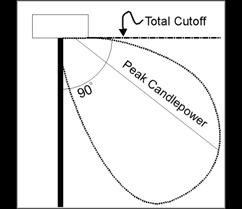
Figure 1. Cut Off Angle
Cutoff. The point at which all light rays emitted by a lamp, light source or luminaire are completely eliminated at a specific angle above the ground.
Cutoff angle. The angle formed by a line drawn from the direction of light rays at the light source and a line perpendicular to the ground from the light source above which no light is emitted. (See Figure 1.)
Cutoff type luminaire. A luminaire with elements such as shields, reflectors, or refractor panels which direct and cut off the light at a cutoff angle that is less than 90 degrees.
Flashing light. A light source which is not constant in intensity or color at all times while in use.
Foot candle. A unit of illumination produced on a surface, all points of which are one foot from a uniform point source of one candle.
Light source. A single artificial point source of luminescence that emits measurable radiant energy in or near the visible spectrum.
Luminaire. A complete lighting unit consisting of a light source and all necessary mechanical, electrical and decorative parts.
Outdoor lighting. Any light source or collection of light sources, located outside a building, including but not limited to, light sources attached to any part of a structure, located on the surface of the ground or located on freestanding poles.
Outdoor light fixture. Outdoor electrically powered illuminating devices, outdoor lighting or reflective surfaces, lamps and similar devices, permanently installed or portable, used for illumination or advertisement. The fixture includes the hardware that houses the illumination source and to which the illumination source is attached including, but not limited to, the hardware casing. Such devices shall include, but are not limited to, search, spot, and flood lights for:
a.
Buildings and structures.
b.
Recreational areas.
c.
Parking lot lighting.
d.
Landscaping lighting.
e.
Signs.
f.
Street lighting.
g.
Product display area lighting.
h.
Building overhangs and open canopies.
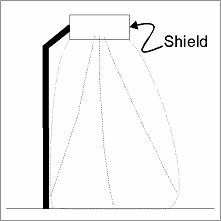
Figure 2. Shielding
Security lighting. Outdoor lighting fixtures installed exclusively as a measure to reduce the possible occurrence of a crime on the property.
Shielding. A technique or method of construction permanently covering the top and sides of a light source by a material which restricts the light emitted to be projected below an imaginary horizontal plane passing through the light fixture. (See Figure 2.)
Spillage. Any reflection, glare or other artificial light that emits onto any adjoining property or right-of-way and is above a defined maximum illumination.
Lintel. The horizontal beam forming the upper member of a door or window frame and supporting part of the structure above it.
Living quarters. That portion of a structure used for lodging or as a residence.
Lot. Land occupied or to be occupied by a building and its accessory buildings, together with such open spaces as are required under the provisions of this Appendix E, having not less than the minimum area required by this Appendix E for a building site in the district in which such lot is situated and having its principal frontage on a public street.
Lot area. The area of a horizontal plane within the lot lines.
Lot, base. Lots meeting all the specifications in the zoning district prior to being subdivided into a two-family dwelling or quadraminium subdivision.
Lot, corner. A lot located at the intersection of two streets or bounded on two sides by a curving street chords of which form an angle of 120 degrees or less measured on the lot side.
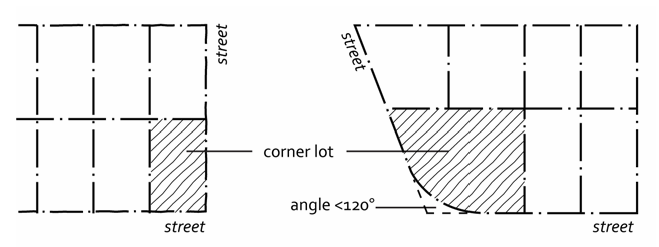
(Ord. No. 556, § 2, 4-17-2017)
Lot Coverage. See section 14-1(f).
(Ord. No. 556, § 2, 4-17-2017)
Lot, double frontage. A lot having frontage on two parallel or nonintersecting streets, as distinguished from a corner lot.
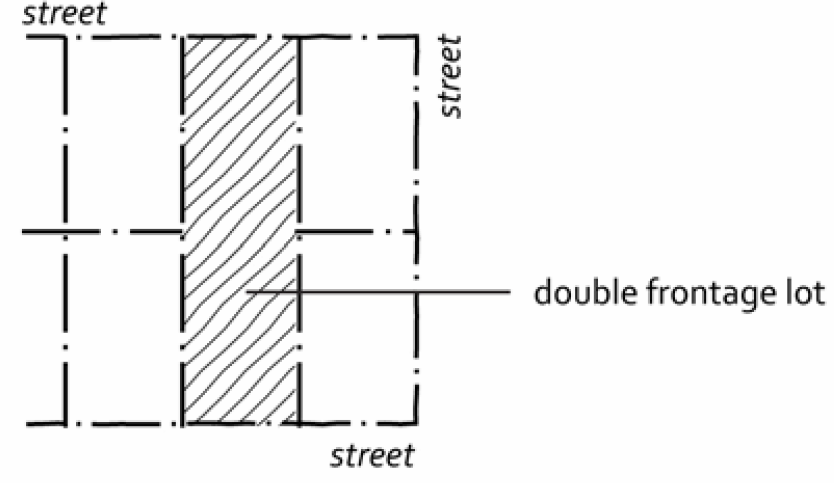
(Ord. No. 556, § 2, 4-17-2017)
Lot, flag. An "L" shaped lot utilizing a minimum frontage on a public street in order to accommodate back lot or rear property division and development
Lot improvement. Any building, structure, place, work of art, or other object, or improvement of the land on which they are situated constituting a physical betterment of real property, or any part of such betterment.
Lot, interior. A lot, other than a corner lot, including through or double frontage lots.
Lot line, front. A lot line abutting a street; on those lots which abut lakeshore the front lot line shall be the lakeshore. On a corner lot, it shall be the shortest dimension on a public street; if the dimensions are equal, the front lot line shall be designated by the city. On a double frontage lot, the front lot line shall be the street from which the address is assigned.
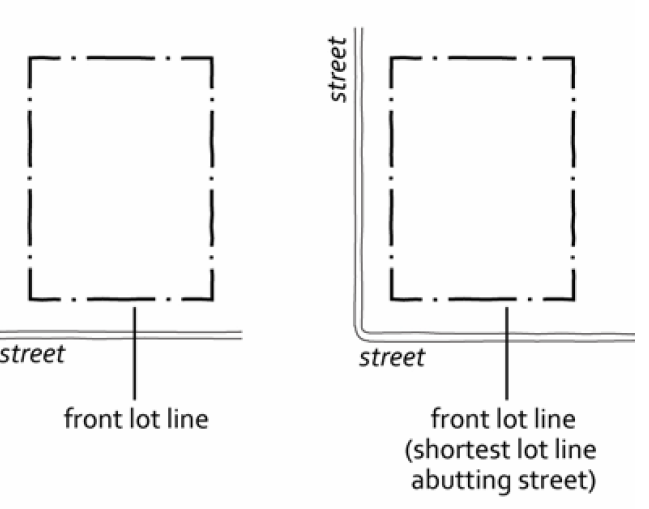
(Ord. No. 556, § 2, 4-17-2017)
Lot line, rear. That boundary of a lot which is opposite the front line. If the rear lot line is less than ten feet in length, or if the lot forms a point at the rear, the rear lot line shall be a line ten feet in length within the lot, parallel to, and at the maximum distance from the front lot line.
Lot line, side. Any boundary of a lot which is not a front lot line or a rear lot line.
Lot of record. A lot which is a part of a subdivision, the amp of which has been recorded in the office of the registrar of deeds, or a lot described by metes and bounds, the deed to which has been recorded in the office of the registrar of deeds at the time the ordinance from which this appendix derives is passed.
(Ord. No. 556, § 2, 4-17-2017)
Lot, substandard. A lot or parcel of land which does not meet the minimum lot area, structure setbacks or other dimensional standards of this Appendix E.
Lot, unit. Lots created from the subdivisions of a two-family dwelling or quadraminium having different minimum lot size requirements than the conventional base lots within the zoning district.
Lot, width. The minimum horizontal distance between the side lot lines at the front yard setback line for the district in which the lot is located.
Lot, zoning. (See Zoning lot.)
Manufactured home. A structure, transportable in one or more sections, which in the traveling mode is eight body feet or more in width or 40 body feet or more in length, or when erected on site, is 320 or more square feet, and which is built on a permanent chassis and designed to be used as a dwelling with or without a permanent foundation when connected to the required utilities, and includes the plumbing, heating, air conditioning, and electrical systems contained therein; except that the term includes any structure which meets all the requirements and with respect to which the manufacturer voluntarily files a certification required by the secretary of state and complies with the standards established under Minn. Stats. ch. 327.
Manufactured home park. Any site, lot, field, or tract of land upon which two or more occupied manufactured homes are located, either free of charge or for compensation, and includes any building, structure, tent, vehicle, or enclosure used or intended for use as part of the equipment of the manufactured home park.
Massage therapy (therapeutic). The process by which a practitioner applies massage therapy techniques, and may apply adjunctive therapies, with the intention of positively affecting the health and well being of the client. The rubbing, stroking, kneading, tapping, positioning, causing movement, and applying touch and pressure to the body. Adjunctive therapies may include:
(1)
Application of heat, cold, water, mild abrasives, heliotherapy, topical preparations not classified as prescription drugs,
(2)
The use of mechanical devices and tools which mimic or enhance manual actions, and
(3)
Instructed self-care and stress management.
Massage therapy shall not include techniques traditionally practiced by chiropractors.
Medical and dental clinics. A structure intended for providing medical and dental examinations and service available to the public. This service is provided without overnight care available.
Medical facilities. Establishments engaged in providing diagnostic services, extensive medical treatment (including surgical services), and other hospital services, as well as continuous nursing service, including general medical and surgical hospitals, specialty hospitals, medical laboratories, bio-medical appliance sales, and similar uses, but not including animal hospitals.
(Ord. No. 625, § 5, 3-7-2022)
Membership organization. Organizations operating on a membership basis for the promotion of the interest of the members included such as trade associations, business associations, professional membership organizations, labor unions, civic or fraternal organizations, but not including churches, hospitals, golf and country clubs, or credit unions.
(Ord. No. 625, § 5, 3-7-2022)
Metes and bounds description. A description of real property which is not described by referenced to a lot or block shown on a map, but is described by starting at a known point and describing the bearings and distances of the lines forming the boundaries of the property or delineating a fractional portion of a section, lot or area by described lines or portions thereof.
Microbrewery, micro-distillery, and micro-winery. A small scaled business located in a building where the primary use is for restaurant, retail or tasting room, and which specializes in producing limited quantities of wine, beer or other alcoholic beverages.
(Ord. No. 470, § 1, 8-1-2011)
Minerals. Soil, clay, stone, sand, gravel, and other similar solid material or substance to be mined from natural deposits.
Mining. All or any part of the process involved in the extraction of minerals by removing the overburden and extracting directly from the mineral deposits thereby exposed.
Minnehaha Creek Watershed District. The Minnehaha Creek Watershed District, as established under the laws of the State of Minnesota.
Mixed use. Multiple principal and accessory uses on one lot, adjacent lots, or in the same building or group of buildings.
Motel/motor hotel. A building or group of detached, semidetached buildings containing guest rooms or units, each of which has a separate entrance directly from the outside of the building, or corridor, with garage or parking space conveniently located to each unit, and which is designed, used or intended to be used primarily for the accommodation of transient guests traveling by automobile.
Motor fuel station. A place where gasoline is stored only in underground tanks, kerosene or motor oil and lubricants or grease, for operation of automobiles, are retailed directly to the public on premises, and including minor accessories and services for automobiles, but not including automobile major repairs and rebuilding.
Natural drainage system. All land surface areas which by nature of their contour configuration, collect, store and channel surface water runoff.
Natural obstruction. Any rock, tree, gravel, or analogous natural matter that is an obstruction and has been located within a water body, watercourse, or wetland by a nonhuman cause.
Nonconforming structure or use, illegal. A structure or use that has been established in a manner that does not conform to the applicable conditions required by the regulations in place at the time the structure or use was established.
Nonconforming structure or use, legal. Any lawfully established structure or use which on February 9, 2003, does not conform to the applicable conditions if the structure or use was to be erected under the guidance of this Appendix E.
Noxious matter. Any solid, liquid, or gaseous material including but not limited to gases, vapors, odor, dusts, mists, or combinations thereof, the emission of which is detrimental to or endangers the public health, safety, comfort, or general welfare or causes damage to property.
Nursery, landscape. A business growing and selling trees, flowering and decorative plants, and shrubs.
Nursing home. A private building with facilities for the care of children, the aged, or the infirm, or a place of rest for those suffering bodily disorders, but not containing equipment for surgical care or for treatment of disease or injury. The nursing home shall be licensed by the State Board of Health as provided for in Minnesota State Statutes.
Occupancy. The purpose for which a building is used or intended to be used. The term shall also include the building or room housing such use. Change of occupancy is not intended to include change of tenants or proprietors.
Off-street loading space. A space accessible from the street, alley or way, in a building or on a lot, for the use of trucks while loading or unloading merchandise or materials. Such space shall be of such size as to accommodate one truck of the type typically used in the particular business.
Off-street parking space. An area of such shape and dimensions as provided by this Appendix E, enclosed in the principal building, in an accessory building, or unenclosed, sufficient in size to store one motor vehicle, which has adequate access to a public street or alley, and permitting satisfactory ingress and egress of an automobile.
Office business (general). An establishment located within a building or portion of a building for the conduct of business activities involving predominantly professional, administrative or clerical service operations including attorneys, financial advisors, consultants, insurance, travel, and other uses of similar character.
Open sales, lot. Any open land used or occupied for the purpose of buying, selling and/or renting merchandise, and for the storing of same prior to sale.
Open space. Any open area not covered by structures, but not limited to the following uses: required or established yard areas, parking areas, sidewalks, school walks, trails, recreation areas, water bodies, shorelands, watercourses, wetlands, groundwater recharge areas, floodplain, floodway, flood fringe, erodible slopes, woodland, and soils with severe limitation for development.
Open storage. Storage of material outside of a building.
Out patient care. Medical examination or service available to the public. This service is provided without overnight care and shall be considered a separate, independent, principal use when combined or operated in conjunction with a hospital.
Outdoor recreation. An outdoor facility developed for entertainment, amusement, or tourist purposes which typically involve large areas of land and concentrated traffic peaks oriented towards events at the facility, including drive-in theaters, amphitheaters, outdoor concert halls, theme parks, skating rinks, golf driving ranges, or miniature golf facilities.
(Ord. No. 625, § 5, 3-7-2022)
Outdoor sidewalk cafe. An area of additional outdoor seating for a dining establishment on or adjacent to the public right-of-way or public property.
(Ord. No. 436, § 1, 3-17-2009)
Outlot. A lot remnant or parcel of land left over after platting, which is intended as open space or other future use, for which no building permit shall be issued.
Overburden. The earth, rock, and other materials that lie above a natural deposit of mineral.
Owner. An individual, association, syndicate, partnership, corporation, trust, or any other legal entity holding an equitable or legal ownership interest in land, buildings, structures, dwelling unit(s), or other property.
Parapet. A low wall which is located on a roof of a building will be known as a parapet for this Appendix E.
Parcel. An individual lot or tract of land.
Parking ramp. A structure designed and used for the storage of motor vehicles at, below and/or above grade.
Parking space. An area enclosed in the principal building, in an accessory building, or unenclosed, sufficient in size to store one motor vehicle, which has adequate access to a public or private street, alley or driveway permitting satisfactory ingress and egress of an automobile.
Party wall. A wall on the boundary line of adjoining properties that are shared by the owners or tenants.
Pavers. An interlocking pavement system. The city shall maintain a list of allowable paving systems and installation specifications as periodically reviewed and approved by the city council.
(Ord. No. 393, 11-7-2005)
Pergola. An arbor or passageway with a roof or trellis work on which clinging plants are grown.
Permitted home occupation. (See Home occupation, permitted.)
Permitted use. A use which may be lawfully established in a particular district or districts, provided it conforms with all requirements, regulations, and performance standards (if any) of such districts.
Person. An individual, firm, partnership, association, corporation, or organization of any kind. Person also means an adult who is handicapped by reason of mental retardation, mental illness, chemical dependency, or physical handicap, and a child, whether handicapped or not, as defined by Minn. Stats. § 245A.02, subd. 4.
Personal services. Establishments primarily engaged in providing services involving the care of a person or his or her apparel, such as barber shops, clothing rental, salons, and health clubs, photographic studios, cleaning, and garment services (but not including power laundries or dry-cleaning plant(s) or coin operated laundries.
(Ord. No. 625, § 5, 3-7-2022)
Personal wireless service. A device consisting of metal, carbon fiber, or other electromagnetically conducive rods or elements, usually arranged in a circular array on a single supporting pole or other structure, and used for the transmission and reception of wireless communication radio waves including cellular, personal communication service (PCS), enhanced specialized mobilized radio (ESMR), paging, and similar services and including the support structure thereof.
Pet shop. A place kept or maintained for the exhibition, for sale, or sale or purchase of live dogs, cats, rabbits, or other small animals, or any birds, reptiles or fish. Pet shops may include incidental animal grooming and adoption activities, but not animal hospitals, veterinary clinics, or places selling live bait for fishing.
Pilasters. A supporting column or pillar with a capital and base, usually set partially into a wall as an ornamental feature.
Planned unit development. A zoning designation which allows a mixing of buildings and uses which cannot be otherwise addressed under this Appendix E, and/or whereby internal site design standard deviations from this section may be allowed to improve site design and operation.
Planning commission. The Excelsior Planning Commission.
Pole building. Any structure possessing the following characteristics: structural wood poles or timbers buried in ground on individual footings, and metal wall coverings hung vertically. Such definition shall not include or apply to decks, sign supports, earth retention structures, playground equipment, electric utilities, or any similar structure not covering or enclosing a specific area.
Porch. An entryway attached to a building and/or projecting from its main mass.
(Ord. No. 438, § 1, 3-17-2009)
Principal use/building. The main use of land or buildings as distinguished from accessory uses. A "principal use" may be either permitted, interim, conditional, or allowed by administrative permit.
Protective covenants. Contracts entered into between all owners and holders of mortgage constituting a restriction on the use of property within a subdivision for the benefit of the property owners, and providing mutual protection against undesirable aspects of property value and economic integrity of any given area.
Public uses. Uses owned or operated by municipal, school districts, county, state, or other governmental units.
Public utility. Any person, firm, corporation, municipal department, or board fully authorized and furnishing under municipal regulation to the public electricity, gas, steam, communication services, telegraph services, transportation, water, or the like.
Publication. Notice placed in the official city newspaper stating time, location and date of meeting and description of the topic.
Quonset structure. A prefabricated shelter or structure set on a foundation of bolted steel trusses and built of a semicircular arching roof of corrugated metal insulated with wood fiber.
Recreational business. Health club, bowling alley, cart track, golf course, billiard (pool) hall, dance hall, skating rinks, swimming pools, firearms range, boat rental, amusement rides, campgrounds, private parks, and uses of similar character, which may be further distinguished as indoor or outdoor uses.
Recreation, field or building. An area of land, water, or any building in which amusement, recreation or athletic sports are provided for public or semipublic use, whether temporary or permanent, except a theater, whether provision is made for the accommodation of an assembly or not. A golf course, arena, baseball park, stadium, or gymnasium is a recreation field or building for the purpose of this Appendix E.
Recreational vehicle and equipment. Includes, but is not limited to operable and licensed, as required by the State, travel trailers, chassis mounted campers, motor homes, tent trailers, slide-in campers, airplanes, and converted buses; snowmobiles and trailers, boats/water craft and trailers, all terrain vehicles, motorcycles, and utility trailers. A fish house, boat, snowmobile, or other recreational vehicle when stored or kept on a trailer shall be considered as one recreational vehicle. A recreational vehicle does not include a motor vehicle designed or used for off-road racing, off-road use, or demolition derby.
Recyclable material. Materials that can be readily separated from mixed municipal solid waste for the purpose of recycling, including but not limited to paper, glass, plastics, metals, automobile oil and batteries. Recyclable materials that have been separated from the waste stream, processed, and sold or given away for reuse are no longer considered waste.
Religious institution. A building, together with its accessory buildings and use, where persons regularly assemble for religious purposes and related social events and which building is maintained and controlled by a religious body organized to sustain religious ceremonies and purposes.
Repair and maintenance shop. Establishments engaged in miscellaneous repair services, primarily of household-orientated products such as radios, televisions, washers and dryers, furniture (including re-upholstery), bicycles, or locksmiths.
(Ord. No. 625, § 5, 3-7-2022)
Research laboratory. A building or portion of buildings in which are located facilities for scientific research, investigation, testing or experimentation, but not facilities for the manufacture or sale of products, except as incidental to the main purpose of the laboratory.
Residential facility, state licensed. Any program, defined by Minn. Stats. § 245A.10, subd. 14, that provides 24-hour-a-day care, supervision, food, lodging, rehabilitation, training, education, habilitation, or treatment outside a person's own home, including a nursing home or hospital that receives public funds, administered by the commissioner of the department of human services to provide services for five or more persons whose primary diagnosis is mental retardation or a related condition or mental illness and who do not have a significant physical or medical problem that necessitates nursing home care; a program in an intermediate care facility for four or more persons with mental retardation or a related condition; a nursing home or hospital that was licensed by the commissioner of the department of human services on July 1, 1987, to provide a program for persons with a physical handicap that is not the result of the normal aging process and considered to be a chronic condition; and chemical dependency or chemical abuse programs that are located in a hospital or nursing home and receive public funds for providing chemical abuse or chemical dependency treatment services under Minn. Stats. § 254B. Residential programs include home and community-based services for persons with mental retardation or a related condition that are provided in or outside of a person's own home.
Residential shelter. A facility providing short-term housing, food, and protection for individuals, not including State licensed residential care facilities, community correctional facilities, day care facilities, hotels, motels, or nursing homes.
Restaurant. An establishment which serves food in or on nondisposal [nondisposable] dishes to be consumed primarily while seated at tables or booths within the building or on adjacent outdoor areas.
Retail. The sale of items in small quantities directly to the consumer.
Retaining wall. A wall or terraced combination of walls more than 12 inches in height, measured from where it emerges from the ground at its lowest elevation to the top of the highest part of the wall, and constructed for the purpose of stabilizing soil, retaining erosion, or terracing a parcel or site.
(Ord. No. 424, 1-7-2008)
Roof, flat. A roof that has a 3/12 slope or less.
(Ord. No. 619, § 1, 12-21-2020)
Roof line. That line at which an exterior wall surface of a building departs from the vertical plane and, typically, where the horizontal plane of the roof commences.
School. A building used for the purpose of elementary or secondary education, which meets all the requirements of compulsory education laws of the State of Minnesota, and not providing residential accommodations.
School, private. Any building or group of buildings, not operated by a public agency or unit of government, the use of which meets compulsory education laws of the State of Minnesota, for elementary school, middle school (junior high school), secondary (senior high school), or higher education, and which use does not secure the major part of its funding directly from any governmental source.
Screening. A barrier which restricts views from public roads and differing land uses to off-street parking areas, loading areas, service and utility areas, and mechanical equipment.
(Ord. No. 553, § 1, 1-17-2017)
School, public. Any building or group of buildings, the use of which meets compulsory education laws of the State of Minnesota, for elementary school, middle school (junior high school), secondary (senior high school), or higher education, and which secures all or the major part of its funding from governmental sources and is operated by a public agency or governmental unit.
Secondary use. A use of land or of a building or a portion thereof which is subordinate to and does not constitute the primary use of the land or building.
Sediment. Solid matter carried by water, sewage or other liquids.
Semipublic use. The use of land by a private, nonprofit organization to provide a public service that is ordinarily open to some persons outside the regular constituency of the organization.
Sensitive resource management. The preservation and management of areas unsuitable for development in their natural state due to constraints such as shallow soils over groundwater or bedrock, highly erosive or expansive soils, steep slopes, susceptibility to flooding, or occurrence of flora or fauna in need of special protection.
(Ord. No. 441, § 1, 7-20-2009)
Setback. The minimum horizontal distance between a structure and lot line or ordinary high water mark. Location points of measurement on buildings or structures are subject to the exceptions in Article 14 (Measurements).
(Ord. No. 556, § 2, 4-17-2017)
Sewer system. Pipelines or conduits, pumping stations, and force main, and all other construction, devices, appliances, or appurtenances used for conducting sewage or industrial waste or other wastes to a point of ultimate disposal.
Shopping center. An integrated grouping of commercial stores, under single ownership or control.
Shoreland related:
Bluff. A topographic features such as a hill, cliff, or embankment having the following characteristics (an area with an average slope of less than 18 percent over a distance for 50 feet or more shall not be considered part of the bluff):
a.
Part or all of the features is located in a shoreland area.
b.
The slope rises at least 25 feet above the ordinary high water level of the waterbody.
c.
The grade of the slope from the toe of the bluff to a point 25 feet or more above the ordinary high water level averages 30 percent or greater.
d.
The slope must drain toward the waterbody.
Reserved.
Bluff, toe of the. The lower point of a 50 foot segment with an average slope exceeding 18 percent.
Bluff, top of the. The higher point of a 50 foot segment with an average slope exceeding 18 percent.
Bluff impact zone. A bluff and land located within 20 feet from the top of the bluff.
Boathouse. A structure designed and used primarily for the storage of boats or boating equipment.
Commissioner. The Commissioner of the Department of Natural Resources.
Development. The division of a parcel of land into two or more parcels; the construction, reconstruction, conversion, structural alteration, relocation or enlargement of any structure; any land disturbance, and any use or extension of the use of land.
Green rooftops. Veneers of living vegetation installed atop of buildings which act to manage stormwater by mimicking a variety of hydrologic processes normally associated with open space.
(Ord. No. 441, § 1, 7-20-2009)
Lake Minnetonka Conservation District (LMCD). The Lake Minnetonka Conservation District, as established by the state for the purposes of water planning and project implementation.
(Ord. No. 441, § 1, 7-20-2009)
Ordinary high water level. The boundary of public waters and wetlands, and shall be an elevation delineating the highest water level which has been maintained for a sufficient period of time to have evidence upon the landscape, commonly that point where the natural vegetation changes from predominantly aquatic to predominantly terrestrial. For watercourses, the ordinary high water level is the elevation of the top of the bank of the channel. For reservoirs and flowage, the ordinary high water level is the operating elevation of the normal summer pool. At the time of adoption of this article, the ordinary high water level of Lake Minnetonka was 929.4 feet.
(Ord. No. 441, § 1, 7-20-2009)
Public waters. Any waters as defined in Minn. Stats., § 103G.005, subdivision 15.
(Ord. No. 441, § 1, 7-20-2009)
Public waters—General development (GD). Large, deep lakes or lakes of varying sizes and depths with high levels and mixes of existing development. These lakes often are extensively used for recreation and, except for the very large lakes, are heavily developed around the shore. Second and third tiers of development are fairly common. The larger examples in this class can accommodate additional development and use.
Sensitive resource management. The preservation and management of areas unsuitable for development in their natural state due to constraints such as shallow soils over groundwater or bedrock, highly erosive or expansive soils, steep slopes, susceptibility to flooding, or occurrence of flora or fauna in need of special protection.
Sewer system. Pipelines or conduits, pumping stations, and force main, and all other constructions, devices, appliances, or appurtenances used for conducting sewage or industrial waste or other wastes to a point of ultimate disposal.
Shore impact zone. Land located between the ordinary high water level of a public water and a line parallel to it at a setback of 50 percent of the structure setback.
Shoreland. Land located within the following distances from public waters: 1,000 feet from the ordinary high water level of a lake, pond, or flowage; and 300 feet from a river or stream, or the landward extent of a floodplain designated by Appendix E on a river or stream, whichever is greater. The limits of shorelands may be reduced whenever the waters involved are bounded by topographic divides which extend landward from the waters for lesser distances and when approved by the Commissioner.
Steep slope. Land where agricultural activity or development is either not recommended or described as poorly suited due to slope steepness and the site's soil characteristics, as mapped and described in available County soil surveys or other technical reports, unless appropriate design and construction techniques and farming practices are used in accordance with the provisions of this Appendix E. Where specific information is not available, steep slopes are lands having slopes over 12 percent, as measured over horizontal distances of 50 feet or more, that are not bluffs.
Surfacewater-oriented commercial use. The use of land for commercial purposes, where access to and use of a surfacewater feature is an integral part of the normal conductance of business. Marinas, resorts, and restaurants with transient docking facilities are examples of such use.
(Ord. No. 441, § 1, 7-20-2009)
Water-oriented accessory structure or facility. A small, above-ground building or other improvement, except stairways, fences, docks, and retaining walls, which because of the relationship of its use to a surfacewater feature, reasonably needs to be located closer to public waters than the normal structure setback. Examples of such structures and facilities include boathouses, gazebos, screen houses, fish houses, pump houses, and detached docks.
(Ord. No. 441, § 1, 7-20-2009)
Wetland. A surfacewater feature classified as a wetland in the United States Fish and Wildlife Service Circular No. 39 (1971 edition).
(Ord. No. 441, § 1, 7-20-2009)
Sign related.
Abandoned sign. Any sign and/or its supporting sign structure which remains without a message or whose display surface remains blank for a period of one year or more, or any sign which pertains to a time, event or purpose which no longer applies, shall be deemed to have been abandoned. Signs applicable to a business temporarily suspended because of a change in ownership or management of such business shall be deemed to be abandoned. Signs which are present because of being legally established nonconforming signs or signs which have required a conditional use permit or variance shall also be subject to the definition of an abandoned sign.
Alteration. Any change to a sign excluding routine maintenance, repair, painting or change of copy of any existing sign.
Artificial light. Illumination resulting from internal or external artificial light sources, including glare and reflected light byproducts of artificial light sources.
Awning, canopy or marquee sign. A written or graphic message, as part of or permanently or semipermanently affixed to an awning, canopy, marquee, or other similar device. Where lighting is incorporated with the awning, canopy or marquee, the apparatus shall not be construed as a sign exclusive of the area physically designed to form the message, identification, or advertisement thereto.
Banners. Attention getting devices which resemble flags and are of a paper, cloth, or plastic-like consistency.
Bench signs. A sign which is affixed to a bench such as at a bus stop.
Billboard. (See Off-premises sign.)
Canopy sign. (See Awning.)
Changeable copy sign. A sign or portion thereof that has a readerboard for the display of text information in which each alphanumeric character, graphic or symbol is defined by objects not consisting of an illumination device and may be changed or rearranged manually or mechanically with characters, illustrations, letters or numbers that can be changed or rearranged without altering the face or surface of the sign structure.
Changeable copy sign, electronic. A sign or portion thereof that displays electronic, nonpictorial text information in which each alphanumeric character, graphic, or symbol is defined by a small number of matrix elements using different combinations or light emitting diodes (LEDs), fiber optics, light bulbs or other illumination devices within the display area. Electronic changeable copy signs include computer programmable, microprocessor controlled electronic displays. Electronic changeable copy signs include projected images or messages with these characteristics onto buildings or objects. Electronic changeable copy signs do not include official signs.
Commercial speech. Speech advertising a business, profession, commodity, service or entertainment.
Copy. The wording on a sign surface either permanent or removable letter form.
Double-sided sign. A sign with two faces back to back, or a V-type sign with an angle not exceeding 20 degrees. Only one side of a double-sided sign shall be used in computing total surface area.
Dynamic display. Any characteristics of a sign that appear to have movement or that appear to change, caused by any method other than physically removing and replacing the sign or its components, whether the apparent movement or change is in the display, the sign structure or any other component of the sign. This includes the displays that incorporate technology or methods allowing the sign face to change the image without having to physically or mechanically replace the sign face or its components as well as any rotating, revolving, moving, flashing, blinking or animated display and any display that incorporates rotating panels, LED lights manipulated through digital input, digital ink or any other method or technology that allows the sign face to present a series or images or displays.
Electronic graphic display sign. A sign or portion thereof that displays electronic, static images, static graphics or static pictures, with or without text information, defined by a small number of matrix elements using different combinations of light emitting diodes (LEDs), fiber optics, light bulbs or other illumination devices within the display area where the message change sequence is accomplished immediately or by means of fade, repixalization or dissolve modes. Electronic graphic signs include computer programmable, microprocessor controlled electronic or digital displays. Electronic graphic display signs include projected images or messages with these characteristics onto buildings or other objects.
Flag. Any fabric or similar lightweight material attached at one end of the material, usually to a staff or pole, so as to allow movement of the material by atmospheric changes and which contains distinctive colors, patterns, symbols, emblems, insignia or other symbolic devices.
Flashing sign. A directly or indirectly illuminated sign or portion thereof that exhibits changing light or color effect by any means, so as to provide intermittent illumination that changes light intensity in sudden transitory bursts and creates the illusion of intermittent flashing light by streaming, graphic bursts showing movement, or any mode of lighting which resembles zooming, twinkling or sparkling.
Freestanding sign. A self-supported sign not affixed to another structure.
Ground or low profile sign. A sign that is intended to be incorporated into some form of landscaping design scheme or planter box, is not elevated from the ground by means of a pole or freestanding support structure, but is placed directly on the ground or on an interior planter base which is incorporated into such a design arrangement.
Illuminated sign. A sign illuminated by an artificial light source either directed upon it or illuminated from an interior source.
Marquee. (See Canopy.)
Maximum height of sign. The vertical distance from the base of the sign, or the grade of the road centerline, whichever is higher, to the top of the sign.
Message sign. A sign which allows for the graphic and/or verbal content to be changed, when desired, through electronic or manual methods.
Monument sign. A block type sign structure not supported by poles or braces, but rather placed directly on the ground.
Motion sign. Any sign which revolves, rotates, has moving parts, or gives illusion of motion.
Multivision sign. Any sign composed in whole or part of a series of vertical or horizontal slats or cylinders that are capable of being rotated at intervals so that partial rotation of the group of slats or cylinders produces a different image and when properly functioning allows on a single sign structure the display at any given time one or two or more images.
Multiple tenant site. Any site which has more than one tenant, and each tenant has a separate ground level exterior public entrance.
Noncommercial speech. Dissemination of messages not classified as commercial speech which include, but are not limited to, messages concerning political, religious, social, ideological, public service and informational topics.
Nonconforming signs.
a.
Legal. A sign which lawfully existed at the time of the passage of this Appendix E or amendment thereto, but which does not conform with the regulations of this Appendix E, is legal.
b.
Illegal. A sign which was constructed after the passage of this Appendix E or amendments thereto and does not conform with the regulations of this Appendix E is illegal.
Off-premises sign. A commercial speech sign which directs the attention of the public to a business, activity conducted, or product sold or offered at a location not on the same lot where the sign is located. For purposes of this Appendix E, easements and other appurtenances shall be considered to be outside such lot and any sign located or proposed to be located in an easement or other appurtenance shall be considered an off-premises sign.
Official sign. Signs of a public, noncommercial nature including public notification signs, safety signs, traffic signs, direction to public facilities when erected by or on behalf of a public official or employee in the performance of official duty.
Opaque. Impervious to the passage of light.
Outdoor signage. Any object which indicates a name, identification, description, display or illustration which is affixed to or represented directly or indirectly upon a building, structure, or piece of land in which directs attention to an object, product, place, activity, person, institution, organization or business. However, a "sign" for application of this Appendix E shall not include any display of official court or public notices or traffic control signs.
Permitted signs. Signs allowed with or without a permit.
Portable sign. A sign so designed as to be movable from one location to another and which is not permanently attached to the ground, sales display device, or structure. A temporary sign.
Principal frontage. The wall of the principal building on a lot which fronts toward the principal public streets.
Prohibited signs. Signs not allowed in the city.
Projecting sign. A sign, other than a wall sign, which is affixed to a building and which extends perpendicular from the building wall.
Public entrance. Any passage or opening which affords entry and access to the general public or customer.
Public entrance, common. A public entrance providing access for the utilization and benefit of two or more tenants or building occupants.
Pylon sign. A freestanding sign mounted on top of a single post which is greater than ten feet in height.
Reader board. A message sign with an electronic changing message.
Roof line. The top of the coping or, when the building has a pitched roof, the intersection of the outside wall with the roof.
Roof sign. A sign erected, constructed, or attached wholly or in part upon or over the roof of a building.
Rotating sign. A sign which revolves or rotates on its axis by mechanical means.
Sandwich board. Two boards with messages, hinged at the top and used on sidewalks or yards for advertising.
Sign. Any letter, word or symbol, poster, picture, statuary, reading matter or representation in the nature of advertisement, announcement, message or visual communication, whether painted, posted, printed, affixed or constructed, including all associated brackets, braces, supports, wires and structures, which is displayed for informational or communicative purposes.
Sign area. The area within the marginal lines of the surface of a sign which bear the advertisement or, in the case of messages, figures or symbols attached directly to a building or sign structure, that area which is included in the smallest rectangle or series of geometric figures used to circumscribe the message, figure or symbol displayed thereon.
Sign structure. The supports, uprights, bracing, and framework for a sign including the sign area.
Street frontage. The proximity of a parcel of land to one or more streets. An interior lot has one street frontage and a corner lot has two or more frontages.
Temporary sign. A sign erected or displayed for a specified period of time.
Time and/or temperature sign. A sign that displays the current time and/or temperature.
Total allowable sign area. The maximum allowable gross surface area in square feet of a sign or signs. The maximum number of signs cannot be arranged and integrated so as to create a surface area in excess of this requirement.
Video display sign. A sign that changes its message or background in a manner or method of display characterized by motion or pictorial imagery, which may or may not include text and depicts action or a special effect to imitate movement, the presentation of pictorials or graphics displayed in a progression of frames that gives the illusion of motion, including, but not limited to the illusion of moving objects, moving patterns or bands of light, or expanding or contracting shapes, not including electronic changeable copy signs. Video display signs include projected images or messages with these characteristics onto buildings or other objects.
UL approved. A device which has been approved by the "Underwriters' Laboratories (48)", a U.S. nonprofit organization which establishes standards for electrical equipment.
Wall sign. A sign affixed to the exterior wall of a building and which is parallel to the building wall. A wall sign does not project more than 12 inches from the surface to which it is attached, nor extend beyond the top of the parapet wall.
Wall graphics. A sign painted directly on an exterior wall.
Window sign. A sign affixed to or inside of a window in view of the general public. This does not include merchandise on display.
(Ord. No. 429, 7-21-2008)
Sill. The horizontal member that bears the upright portion of a frame, such as on a window or door.
Site plan. A map drawn to scale depicting the development of a tract of land, including, but not limited to, the location and relationship of structures, streets, driveways, recreation areas, parking areas, utilities, landscaping, and walkways, as related to a proposed development.
Sketch plan. A drawing showing the proposed project. This plan shall be a reasonable depiction of the site, drawn to scale and dimensioned.
Slope. The degree of deviation of a surface from the horizontal, usually expressed in percent of degrees.
Solar energy system. Any solar collector or other solar device or any structural design of a building whose primary purpose is to collect, convert, and store solar energy for useful purposes including heating and cooling of buildings, domestic water heating, electric power generation, and other energy using processes.
Special home occupation. (See Home occupation, special.)
Stacking area (magazine space): That area which allows for a line of automobiles in such instances as drive-up tellers and other vehicle service areas.
Storage, outdoor. Storage of any property not fully enclosed in a building or completely screened so as not to be visible from adjoining properties or street rights of way.
Story. That portion of a building included between the surface of any floor and the surface of the floor next above, or if there is not a floor above, the space between the floor and the ceiling above. A basement with more than 50 percent of its exterior wall area located entirely below the proposed ground elevation adjoining the basement shall not be counted as a story.
Story, half. The uppermost floor of a building of which: 1) the intersection of at least two opposite walls and the roof is not more than three feet above the floor elevation, excluding dormers; and 2) not more than 65 percent of the floor's area exceeds five feet in height, as measured from the floor to the rafters.
Street. A public right-of-way for vehicular traffic, whether designated as a highway, thoroughfare, arterial, parkway, collector, through-way, road, avenue, boulevard, lane, place, drive, court or otherwise designated, which has been dedicated or deeded to the public for public use and which affords principal means of access to abutting property.
Street, collector. Collector roadways connect neighborhood within and between subregions and distribute traffic between arterials and local streets. Parking is restricted as necessary and posted speed limits typically range between 30 and 45 mph. Collector streets typically should have two driving lanes, two parking lanes, and a bicycle/pedestrian surface if necessary. Collector streets are typically spaced one-quarter to one mile apart. Traffic control typically involves local street stops, four-way stops, and some traffic signals. Collectors typically carry 1,000 to 15,000 vehicles per day.
Street, connector. A local street serving as a hybrid of local street access and collector function. Connections carry modest levels of local traffic from neighborhoods to arterials and major destinations.
Street, frontage. The proximity of a parcel of land to one or more streets. An interior lot has one street frontage and corner lots and through lots have two frontages.
Street, local. Local streets provide direct land access within neighborhoods and other homogeneous land use areas and provide connections to collector streets. Parking is usually unrestricted, the posted speed limit is 30 mph or less, and streets are two lanes wide plus space for parking. Traffic control is most likely to involve strategies such as stop signs, cul-de-sacs, and diverters. Local streets typically carry about 1,000 vehicles or less per day. Residential streets typically carry about ten trips per household per day.
Street, minor arterial. Minor arterials connect adjacent subregions and activity centers within subregions. Land access is usually restricted and trips are somewhat longer than on collector streets.
Parking is often restricted and the posted speed limit is 35 to 45 mph. Width is dependent on the volume carried. Minor arterials are typically spaced one-half to two miles apart. Traffic control typically includes traffic signal timing and land access spacing. Typical traffic volumes range from 5,000 to 30,000 ADT.
Structural alteration. Any change, other than incidental repairs, which would prolong the life of the supporting members of a building, such as bearing walls, columns, beams, girders, or foundations.
Structure. Anything constructed or erected on the ground or attached to the ground or on-site utilities, including, but not limited to, buildings, factories, sheds, detached garages, gazebos, but not including fences or walls.
(Ord. No. 556, § 2, 4-17-2017)
Swimming pool. Structure designed to be used for swimming which has capacity of 1,000 gallons or more or which has a depth of over 24 inches.
Tattoo, tattooing. Any method of placing designs, letters, scrolls, figures, symbols or any other mark upon, under or in the skin with ink or any other substance resulting in the coloration of the skin by the aid of needles or any other instruments which puncture any portion of the skin to any degree.
Temporary commercial structure. A structure used on a temporary basis for an occupation, employment, or enterprise that is carried on by the owner, lessee, or licensee.
Temporary structure. A structure not permanently erected on a site with a foundation that is used for emergency purposes or used on a construction site for offices and equipment storage during construction of a permanent structure.
Terrace. A raised embankment or a vertical series of raised embankments with the top or tops relatively level and restrained by placed or constructed materials for the purpose of landscaping or erosion control.
Trade shop. Any lot, land, building or structure that serves at the headquarters for contractors involved in specialized activities such as plumbing, painting, plastering, masonry, carpentry, roofing, well-drilling, landscaping, and the like, where tools, equipment and materials used in the business are stored. The category also includes establishments involved in specialized trades such as sheet metal, sign painting, drapers, and exterminators.
(Ord. No. 625, § 5, 3-7-2022)
Trailer, semitractor. A trailer with a set or sets of wheels at the rear only, which may be supported in front by a truck, tractor or towing vehicle, and which is used for the purpose of, but not limited to, storage, transportation of freight, or holding freight for sale or lease.
Transit station. A building or area which serves as a regular stopping place for buses and/or other forms of urban public transportation.
Transmission line. Those high capacity conductors generally rated 115 kilovolts and above and associated structures which are used to carry electricity from points of generation to distribution points such as substations and distribution lines.
Transportation services. Establishments furnishing services related to the arrangement of persons and goods movements, such as freight forwarding, parking services, or the rental/leasing of automobiles or two-axle trucks.
(Ord. No. 625, § 5, 3-7-2022)
Tree related.
Coniferous/evergreen tree. A woody plant which, at maturity, is at least 30 feet or more in height, with a single trunk, fully branch to the ground, having foliage on the outermost portion of the branches year-round.
(Ord. No. 553, § 1, 1-17-2017)
Deciduous overstory shade tree. A woody plant which, at maturity, is 30 feet or more in height, with a single trunk, unbranched for several feet above the ground, having a defined crown, and which loses leaves annually.
(Ord. No. 553, § 1, 1-17-2017)
Deciduous understory ornamental tree. A woody plant which, at maturity, is eight feet or more in height, with a single trunk un branched two feet or more above the ground, having a defined crown which loses leaves annually.
(Ord. No. 553, § 1, 1-17-2017)
Drip line. The outermost extension of any branches of any tree.
Forester. That person appointed as city forester by the Excelsior City Manager.
Usable open space. A required ground area or terrace area on a lot which is graded, developed, landscaped and/or equipped, and which is intended and maintained for either active or passive recreation or both, available and accessible to and usable by all persons occupying a dwelling on the lot or a development project and their guests. Such areas shall be grassed and landscaped or covered only for recreational purposes. Roofs, driveways, and parking areas shall not constitute usable open space. Required front and side yards shall be excluded from the usable open space area calculation.
Use. The purpose or activity for which the land or building thereon is designated, arranged, or intended or for which it is occupied, utilized or maintained, and shall include the performance of such activity as defined by the performance standards of this Appendix E.
Variance. A modification of or variation from the provisions of this Appendix E consistent with the state enabling statute for municipalities, as applied to a specific property and granted pursuant to the standards and procedures of this Appendix E, except that a variance shall not be used for modification of the allowable uses within a district and shall not allow uses that are prohibited.
Vegetation. The sum total of plant life in some area; or a plant community with distinguishable characteristics.
Vertex. The corner point of a triangle, rectangle, or other geometric figure bounded by lines.
Veterinary clinic. A clinic operated by a licensed veterinarian exclusively for the diagnosis, treatment, correction, relief, or prevention of animal disease, deformity, defect, injury, or other physical or mental conditions; the performance of obstetrical procedures for animals, including determination of pregnancy and correction of sterility or infertility; and the rendering of advice or recommendations with regard to any of the above.
Waste. Infectious waste, nuclear waste, pathological waste, sewage sludge, solid waste, and hazardous waste.
Waste facility. Property used for the accumulation, storage, processing, or disposal of waste.
Waste, hazardous. Any refuse, sludge, or other waste material or combination of refuse, sludge, or other waste materials in solid, semisolid, liquid, or contained gaseous form which because of its quantity, concentration, or chemical, physical, or infectious characteristics may:
(1)
Cause or significantly contribute to an increase in mortality or an increase in serious or irreversible, or incapacitating reversible illness; or
(2)
Pose a substantial present or potential hazard to human health or the environment when not properly treated, stored, or transported, or disposed of, or otherwise managed. Categories of hazardous waste materials include, but are not limited to: explosives, flammable, oxidizers, poisons, irritants, and corrosives. Hazardous waste does not include source, special nuclear, or byproduct material as defined by the Atomic Energy Act of 1954, as amended.
Waste, infectious. Laboratory waste, blood, regulated body fluids, sharps, and research animal waste that have not been decontaminated.
Waste, pathological. Human tissue and body parts removed accidentally or during surgery or autopsy intended for disposal. Pathological waste does not include teeth.
Water body. A body of water (lake, pond) or a depression of land or expanded part of a river, or an enclosed basin that holds water and is surrounded by land.
Watercourse. A channel or depression through which water flows year-round or intermittently, such as rivers, streams, or creeks.
Wetland related.
Hydric soils. Soils that are saturated, flooded, or ponded long enough during the growing season to develop anaerobic conditions in the upper part.
Hydrophytic vegetation. Macrophytic plant life growing in water, soil or on a substrate that is at least periodically deficient in oxygen as a result of excessive water content.
Wetlands. Lands transitional between terrestrial and aquatic systems where the water table is usually at or near the surface or the land is covered by shallow water. For purposes of this Appendix E, wetlands must have the following three attributes:
a.
Have a predominance of hydric soils.
b.
Are inundated or saturated by surface or groundwater at a frequency and duration sufficient to support a prevalence of hydrophytic vegetation typically adapted for life in saturated soil conditions.
c.
Under normal circumstances, support a prevalence of such vegetation.
Wholesaling. The selling of goods, equipment, and materials by bulk to another business that in turn sells it to the final customer.
Wind energy conversion system (WECS). Any device that is designed to convert wind power to another form of energy such as electricity or heat (also referred to by such common names as wind charger, wind turbine, and windmill).
Wireless communication site. A tract, parcel of land or location that contains wireless communication facilities consisting of the antennas, support structure, and related equipment like storage buildings or equipment cabinets.
Yard. An open space on a lot which is unobstructed from the lowest level to the sky, except as hereinafter permitted. A yard extends along a lot line and at right angles to such lot lines to a depth or width specified in the yard regulations for the district in which such lot is located.
(Ord. No. 556, § 2, 4-17-2017)
Yard, front. The portion of the yard on the same lot with the building between the front line of the building and the front line of the lot for the lot's full width.
Yard, rear. A yard extending across the full width of the lot lying between the rear lot line of the lot and the nearest line of the principal building.
Yard, side. A yard extending along a side lot line between the front and rear yards.
(Ord. No. 556, § 2, 4-17-2017)
Yard, waste compost facility. A site used to compost yard waste materials, including all structures or processing equipment used to control drainage; collect and treat leachate; and storage areas for the incoming waste, the final product, and residuals resulting from the composing process.
Yard waste materials. Garden wastes, leaves, lawn cuttings, weeds, and pruning generated by residential or commercial properties.
Zero lot line. The reduction of side yard setback requirements to zero, permitting the placement of a structure near or adjacent to the side yard lot line. With zero lot line, no portion of the structure or accessory appurtenance shall project over the lot line.
Zoning administrator. The person designated by the city manager to be the zoning administrator for the city.
Zoning amendment. A change, authorized by the city, either text of this Appendix E or in the mapped boundaries of the district.
Zoning district. An area or areas of the city (as delineated on the zoning map) set aside for specific uses with specific regulations and provisions for use and development as defined by this Appendix E.
Zoning district overlay. A zoning district containing regulations superimposed upon other zoning district regulations and superseding the underlying zoning district use regulations.
Zoning district underlying (base). All zoning districts except overlay zoning districts.
Zoning lot. A single tract of land which consists of one or more lots of record and which, at the time of filing for a building permit, is designated by its owner or developer as a tract to be used, developed or built upon as a separate unit under single ownership or control.
Zoning map. The map or maps incorporated into this Appendix E as part thereof, designating the zoning districts.
(Ord. No. 556, § 1, 4-17-2017; Ord. No. 638, § 2, 8-1-2022; Ord. No. 664, § 1, 2-20-2024)

