
Fayetteville City Zoning Code
CHAPTER 164
- SUPPLEMENTAL ZONING REGULATIONS AND SPECIALIZED DEVELOPMENT REGULATIONS2
Editor's note— Ord. No. 5921, §4, adopted Nov. 1, 2016, changed the title of Chapter 164 from "Supplementary Zoning Regulations" to "Supplemental Zoning Regulations and Specialized Development Regulations."
164.00 - Purpose
(A)
The purpose of this chapter is to protect and further the health, safety and general welfare of the citizens of Fayetteville by providing appropriate zoning and development regulations to provide opportunities for innovative development while protecting neighboring properties and neighborhoods from incompatible development.
(B)
Regulations within this chapter that regulate traditional zoning requirements such as density, setbacks, bulk and area, maximum buildable area, height of structures, lot width, etc., shall be administered as all other zoning regulations. Regulations within this chapter that regulate traditional development requirements such as type of foundation, minimum building width, building design requirements, open space requirements, parking requirements, internal separation requirements, orientation requirements, etc., shall be administered as all other development regulations.
(Ord. No. 5921, §4, 11-1-16)
164.01 - Accessory Commercial Uses
Permitted accessory uses in RMF and R-O Districts shall include accessory commercial uses of the types included in Unit 25 provided that:
(A)
Permitted accessory uses in districts that allow single-family dwellings.
(1)
Model Home. In single-family detached subdivisions undergoing the preliminary and final plat process, building permits for model homes may be issued prior to final plat and subject to the following provisions.
(a)
A subdivision of ten (10) single-family lots or fewer may have one (1) model home; subdivisions of eleven (11) to twenty (20) single-family lots may have two (2) model homes. A subdivision of twenty-one (21) or more single-family lots may have three (3) model homes.
(b)
The preliminary plat of the subdivision has been approved. The model home lots may be indicated on the preliminary plat for planning purposes.
(c)
Proposed lot property corners of all lots proposed for a model home have been set by a licensed, professional land surveyor in accordance with the approved preliminary plat lot configuration.
(d)
An applicant shall provide a building permit application and all required submittal documents for each model home.
(e)
Setbacks for the model home(s) shall be measured from the proposed lot lines and setbacks per preliminary plat approval.
(f)
The lots to be developed with a model home must meet one (1) of the following access options:
(i)
Frontage upon an existing public street; or
(ii)
The Fire Department must grant approval of temporary access road proposed to the model home.
(g)
A traffic control plan shall be presented to the satisfaction of the Fire Department and City Engineer to minimize conflicts between construction and model home traffic.
(h)
Parking in yards or other unpaved surfaces is not permitted for the model home. Parking may be provided in the driveway, garage, or on street if the street allows parking. Unless otherwise approved as a conditional use permit, parking lots for model homes are not permitted.
(i)
Stormwater and drainage facilities necessary for the areas of the subdivision serving the model home(s) are in place and functional to the satisfaction of the City Engineer.
(j)
There must be an approved and available water source for connection with the model home sites. Additionally, a fire hydrant must be within 250 feet of a model home's property line. A fire hydrant shall be in good working order and shall be capable of delivering the required fire flow.
(k)
Use of the model homes for a sales office shall require inspection and approval for compliance with applicable building and fire codes.
(l)
Occupation as or conversion into a residential use shall require inspection and approval of all required improvements that directly or indirectly affect the model home and shall not be permitted until after recordation of the final plat.
(m)
If a model home is constructed in a preliminary plat that expires and no extension has been granted, the model home and all associated improvements, including but not limited to any temporary sales office, shall be removed within one hundred twenty (120) days of the expiration of preliminary plat.
(n)
A model home shall be converted into a residential use within one hundred twenty (120) days of approval of the issuance of a building permit for the final undeveloped lot of the final phase of the subdivision.
(B)
Convenience. Such uses are located entirely within a multi-family dwelling or office building as an accessory use for the convenience of the occupants of said building.
(C)
Gross Floor Area. Do not occupy more than 10% of the gross floor area of the building in which located.
(D)
Signs. Have no signs or other advertising visible from outside the zoning lot on which located.
(E)
Location. Are located in or contiguous to the lobby of the principal building.
(F)
Lobby Entrance. Have at least one (1) lobby entrance.
(Code 1965, App. A., Art. 7 (2); Ord. No. 1747, 6-29-70; Code 1991, §160.077; Ord. No. 4100, §2 (Ex. A), 6-16-98; Ord. No. 5312, 4-20-10; Ord. No. 6087, §2, 9-4-18)
164.02 - Accessory Structures And Uses
Accessory Structures and Uses. Accessory structures and uses shall be subject to the applicable use conditions set forth in Zoning, Chapters 160 through 165, and to the following general conditions:
(A)
Accessory Structures.
(1)
When Erected. No accessory structure shall be erected on any property prior to the construction of the principal structure, unless such accessory structure shall have been approved by the Planning Commission as a conditional use. An approved accessory structure erected prior to the principal structure shall not be inhabited.
(2)
Integral Part of Principal Structure. An accessory structure erected as an integral part of the principal structure shall be made structurally a part thereof, shall have a common wall therewith, and shall comply in all respects with the requirements of the building code applicable to the principal structure.
(3)
Height and Setback Restrictions. Accessory structures 10 feet or less in height shall maintain a minimum side setback of 3 feet and a minimum rear setback of 5 feet from the property lines. Accessory structures greater than 10 feet in height shall meet the setback requirements of the zoning district in which it is located. All accessory structures shall conform to the front setbacks of the zoning district in which is it located.
(4)
Build-to Zones. Accessory structures shall be exempt from meeting the requirements of the build-to zone in any zoning district.
(5)
Size of Accessory Structure(s). Any accessory structure(s) shall be 50% or less of the size of the principal structure, except for accessory roof mounted solar energy systems and accessory ground mounted solar energy systems. Any accessory structure(s) requested that is greater than 50% the size of the principal structure shall be allowed only as a conditional use and shall be granted in accordance with §163, governing applications of conditional use procedures; and upon the finding that the requested structure is designed to be compatible with the principal structure on the property and those on surrounding properties. Accessory structures that exceed 50% of the size of the principal structure shall meet the setback requirements of the zoning district in which it is located.
(6)
Shared Accessory Structures. Shared accessory structures may be constructed across common property lines, subject to all building and fire codes. Building setbacks for shared accessory structures may be administratively varied to permit zero lot line development. Easements for driveway access and maintenance of the structure and driveway shall be provided prior to the issuance of a building permit. For purposes of calculating size of shared accessory structures, only that portion of the shared accessory structure on the lot with the principal structure shall count toward the maximum allowable size.
(7)
Accessory Ground Mounted Solar Energy Systems. An accessory ground mounted solar energy system shall be considered an accessory structure and shall be subject to applicable accessory structure requirements.
(8)
Electric Vehicle Charging Stations. Electric vehicle charging stations that are publicly accessible shall be considered an accessory use in all commercial, mixed-use, industrial, and institutional zoning districts. Publicly accessible electric vehicle charging stations shall be reserved for the parking and charging of electric vehicles only and information shall be posted indicating that the space is reserved for electric vehicle charging purposes only. Electric vehicle charging equipment must be designed and located to not impede pedestrian, bicycle or wheelchair movement. Property owners may collect a service fee for the use of an electric vehicle charging station. Information shall be posted identifying voltage and amperage levels and any type of use, fee, or safety information related the electric vehicle charging station. Electric vehicle charging stations must be maintained in all respects, including the functioning of the equipment. A phone number, email address, or some other contact information must be provided on the charging equipment for reporting when it is not functioning, or for when other problems are encountered.
(B)
Swimming Pools. Swimming pools shall not be located in any required front setback.
(Code 1965, App. A., Art. 7 (1); Ord. No. 1747, 6-29-70; Ord. No. 2177, 12-16-75; Ord. No. 3131, 10-1-85; Code 1991, §160.076; Ord. No. 4100, §2 (Ex. A), 6-16-98; Ord. No. 4817, 1-3-06; Ord. No. 5239, 5-5-09; Ord. No. 5592, 06-18-13; Ord. No. 5950, §1, 2-7-17; Ord. No. 6245, §§4, 5, 10-15-19; Ord. No. 6407 §2, 1-19-21)
164.03 - Accessory Residential Uses In Nonresidential Districts
(A)
Attached Residential Use. Attached residential uses shall be permitted in the C-1, C-2, I-1 and I-2 zoning districts as a use by right. Density limitations for attached residential uses in such zoning districts shall be governed by a density of twenty-four (24) dwelling units per acre.
(B)
Detached Residential Dwelling. A detached residential dwelling unit may be permitted in the C-1, C-2, I-1 and I-2 zoning districts as a conditional use. Density limitations shall be governed by a density of twenty-four (24) dwelling units per acre. The building site and setback area must be separate and distinct from off-street parking spaces and setback areas required for the principal structure and shall include a minimum of 4,200 square feet of land area. The residential structure shall be located to meet required setbacks from exterior boundaries of the total tract. The property owner shall execute and record covenant provided that the residential structure shall not be sold separately from the principal structure; the covenant shall run with the land.
(Code 1965, App. A., Art. 7(24); Ord. No. 1747, 6-29-70; Ord. No. 3132, 10-1-85; Code 1991, §160.094; Ord. No. 4100, §2 (Ex. A), 6-16-98; Ord. No. 5271, 9-1-09)
164.04 - Urban Agriculture (Fowl, Bees & Goats)
(A)
General Provisions.
(1)
It shall be unlawful for any person to permit or allow any domesticated animal or fowl to run at large within the corporate limits of the city.
(2)
Animals traditionally associated with the practice of livestock raising or farm animals, such as horses, goats, swine, chickens, cows, bees and other such animals are not considered pets and are not permitted within any zoning district in the city limits, with the exception of R-A, Residential Agricultural or other zoning districts in which Use Unit #6, Agriculture and Use Unit #7, Animal Husbandry are permitted uses by right, unless otherwise stated herein.
(3)
Separation of Use. Unless otherwise stated herein, the following uses, where permitted, shall be conducted no nearer than the following stated number of feet to the boundary of an R District, or to a dwelling on the same premises.
(4)
This section shall not supersede or invalidate any sections within Fayetteville City Code, Chapter 92 - Animals. Chapter 92 shall take precedence over any conflicting provisions of this section.
(B)
Fowl. It shall be lawful to keep fowl within the corporate limits of the city under the following terms and conditions:
(1)
Allowed fowl shall include ducks and/or female chickens only. No roosters shall be allowed. All fowl shall be a breed that cannot fly or must be wing-clipped to prevent flight.
(2)
The principal use of the property shall be educational or single-family residential.
(3)
A maximum of four (4) fowl shall be allowed on lots 5,000 square feet and smaller. For lots larger than 5,000 square feet, one (1) additional fowl shall be allowed for every additional 1,250 square feet, up to a maximum number of twenty (20) fowl.
(4)
There shall be no outside slaughtering of fowl.
(5)
Fowl shall be provided with sufficient good and wholesome food and water.
(6)
All fowl shall have a coop/roost that is constructed with a minimum area of 3 square feet per fowl and during daylight hours fowl shall have access to a secure enclosure/yard that is adequately fenced to protect them from predators. The coop/roost shall be kept in the side or rear yard, and is not permitted in the front yard area.
(7)
The coop/roost structure shall not be located closer than 25 feet to any residential structure on an adjacent lot, and shall meet the building setbacks of the underlying zoning district.
(8)
The coop/roost structure shall be well ventilated and provide protection from the weather and predators. The coop/roost area must be kept in a neat and sanitary condition at all times, and must be cleaned on a regular basis so as to prevent offensive odors, attraction of flies or vermin, the creation of an environment otherwise injurious to the public health and safety, or that would obstruct the free use of property so as to interfere with the comfortable enjoyment of life or property by members of the neighborhood, city, or other persons. The owner shall provide for the storage and removal of manure. Stored manure to be used for composting shall be fully covered or placed in an enclosure. All manure not used for composting or fertilizing shall be removed and properly disposed.
(9)
Illegal fowl currently existing in the city shall not be "grandfathered" or permitted to remain after the effective date of this ordinance.
(10)
The city may further restrict or prohibit the keeping of fowl within residential districts, within a neighborhood or on a particular property if the City Council determines that fowl have created a public nuisance or public health issue.
(11)
Nothing in this section shall be deemed or construed to prohibit the keeping of fowl within a school property or community garden for the purposes of study or education.
(C)
Bees. It shall be lawful to establish or maintain any hive where bee colonies are kept, or keep any bees in or upon any premises within the corporate limits of the city under the following terms and conditions:
(1)
The principal use of the property shall be educational or single-family residential.
(2)
A maximum of two (2) hives shall be allowed on lots 5,000 square feet and smaller. For lots larger than 5,000 square feet, one (1) additional hive shall be allowed for every additional 2,500 square feet up to a maximum of four (4) hives.
(3)
All hives shall be located at least 20 feet from a securely fenced property line. Hives shall be located a minimum of 100 feet from an unfenced property line. Hives shall be kept in the side or rear yard, and are not permitted in the front yard area.
(4)
Fresh clean watering facilities for the bees shall be provided within 20 feet of the hive(s) at all times.
(5)
All hives shall be registered through the Arkansas State Plant Board and all hives and equipment kept in accordance with the Arkansas Apiary Law and Regulations.
(6)
Each beehive shall be identified by displaying the name, telephone number, address and state registry number of the beekeeper on the structure of the hive or on a sign within 10 feet of the hive. Identification shall be placed in a manner to make it conspicuous to anyone approaching the hive(s). This information shall also be made available to any city official upon request.
(7)
Nothing in this section shall be deemed or construed to prohibit the keeping of bees at a school property or community garden for the purposes of study or education.
(8)
Africanized honey bees are prohibited.
(9)
In instances where bees create a public hazard with unprovoked aggressive behavior, it shall be the responsibility of the beekeeper to re-queen or remove the colony. The Northwest Arkansas Beekeepers Association should be contacted to handle the removal or re-queening of beehives.
(10)
The city may further restrict or prohibit the keeping of bees within residential districts, within a neighborhood or on a particular property if the City Council determines that bees have created a public nuisance or public health issue.
(D)
Goats. It shall be lawful to keep goats within the corporate limits of the city under the following terms and conditions:
(1)
Allowed goats shall be female dwarf or pygmy goats not weighing more than 85 pounds and no taller than 22.5 inches at the withers (ridge between the shoulder blades). Bucks are not allowed.
(2)
All goats shall have RFID microchips and be registered with the Fayetteville Animal Services Program.
(3)
The principal use of the property shall be educational or single-family residential.
(4)
Goats shall not be permitted on lots smaller than 10,000 square feet. The minimum number of goats kept on a lot that is 10,000 square feet and larger shall be two (2). Lots 15,000 square feet and larger shall be allowed up to a maximum number of three (3) goats. Nursing off-spring may be kept on the property until the age of twelve (12) weeks and shall not be included in the number of goats allowed.
(5)
There shall be no onsite slaughter of goats.
(6)
Goats shall be provided with sufficient good and wholesome food and water.
(7)
All goats shall have a secure, fenced yard constructed with a minimum area of 200 square feet per goat and a shelter that is minimum 5 square foot per goat. Shelters shall be well ventilated and provide protection from the weather including four (4) sides with opening, roof and floor.
(8)
The shelter shall not be located closer than 50 feet to any residential structure on an adjacent lot, and shall meet the building setbacks of the underlying zoning district. The shelter and fenced yard shall be in the side or rear yard, and are not permitted in the front yard area.
(9)
The yard must be kept in a neat and sanitary condition at all times, and must be cleaned on a regular basis so as to prevent offensive odors, attraction of flies or vermin, the creation of an environment otherwise injurious to the public health and safety, or that would obstruct the free use of property so as to interfere with the comfortable enjoyment of life or property by members of the neighborhood, city, or other persons. The owner shall provide for the storage and removal of manure. Stored manure to be used for composting shall be fully covered or placed in an enclosure. All manure not used for composting or fertilizing shall be removed and properly disposed.
(10)
Nothing in this section shall be deemed or construed to prohibit the keeping of goats within a school property or community garden for the purposes of study or education. Additionally, land owners are permitted to keep goats in one location for a maximum of two (2) weeks for the purpose of land clearing and the removal of vegetation.
(11)
The city may further restrict or prohibit the keeping of goats within residential districts, within a neighborhood or on a particular property if the City Council determines that goat(s) have created a public nuisance or public health issue.
(E)
Exemptions. The above sections are not intended to apply to indoor birds kept as pets, such as, but not limited to, parrots or parakeets, nor to the lawful transportation of fowl through the corporate limits of the city. Neither shall it apply to fowl, bees or goats kept in areas of the city which are zoned R-A, Residential Agricultural, or other zoning districts in which Use Unit #6, Agriculture and Use Unit #7, Animal Husbandry are permitted uses by right.
(Code 1965, App. A., Art. 7 (3); Ord. No. 1747, 6-29-70; Code 1991, §160.078; Ord. No. 4100, §2 (Ex. A.), 6-16-98; Ord. No. 5198, 12-2-08; Ord. No. 5668, 3-18-14)
164.05 - Motor Vehicle Repair
In any district where permitted, gasoline service stations and motor vehicle repair and body shops shall be subject to the following regulations:
(A)
All appurtenances used for repair or servicing of vehicles which are not enclosed shall be located at least 12 feet from a street lot line and 25 feet from any lot line of agricultural or residential district.
(B)
Although temporarily inoperable, motor vehicles shall have substantially all of its main component parts attached, and where subject to a license, shall be currently and validly licensed for operation upon public streets and highways.
(C)
Vehicles or trailers that are wrecked, or that have missing or damaged parts such that it cannot be maintained for driving, may not be stored outside longer than forty-five (45) days. If more time is needed for repairs, the vehicle or trailer shall be stored inside a building or removed from the property.
(D)
Abandoned vehicles shall not be stored on the premises.
(Code 1991, §160.079; Code 1965, App. A, Art. 7(4); Ord. No. 1747, 6-29-70; Ord. No. 5271, 9-1-09; Ord. No. 5348, 9-7-10)
164.06 - Minimum Buildable Street Frontage
(A)
Purpose. The purpose of minimum buildable street frontage regulations is to ensure traditional town form by locating buildings and structures in the build-to zone adjacent to the street.
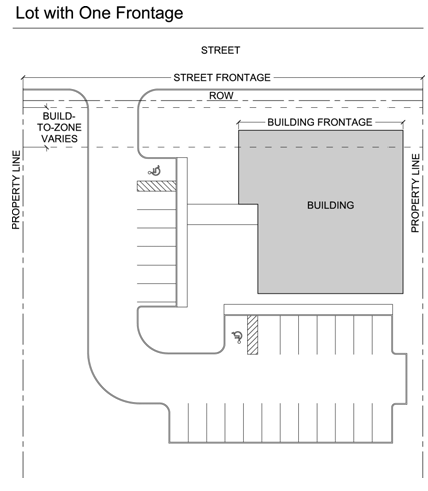
(B)
Lot with one street frontage.
(1)
Calculated by measuring the linear distance of the street adjacent to the lot and applying the minimum buildable street frontage requirement of the underlying zoning district.
(2)
The minimum buildable street frontage requirement shall be met by locating the principal façade of the primary structure in the build-to zone.
(3)
If the minimum buildable street frontage requirement cannot be met by locating the principal façade of the primary structure in the build-to zone, supplemental elements shall be required and shall not exceed 10% of the minimum buildable street frontage requirement.
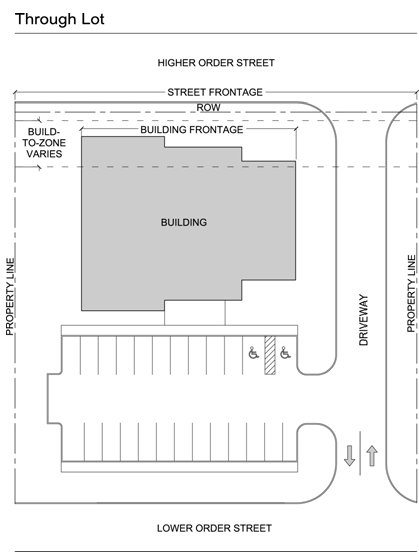
(C)
Through Lot.
(1)
Calculated by measuring the linear distance of the higher functional classification street adjacent to the lot and applying the minimum buildable street frontage requirement of the underlying zoning district. When the two (2) adjacent rights-of-way of a through lot are of an equal functional street classification, the applicable street frontage to be measured shall be established by the property owner.
(2)
The minimum buildable street frontage requirement shall be met by locating the principal façade of the primary structure in the build-to zone measured for the purposes of a through lot.
(3)
If the minimum buildable street frontage requirement cannot be met, supplemental elements shall be required and shall not exceed 10% of the minimum buildable street frontage requirement.
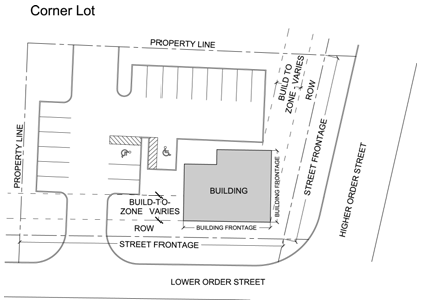
(D)
Corner Lot.
(1)
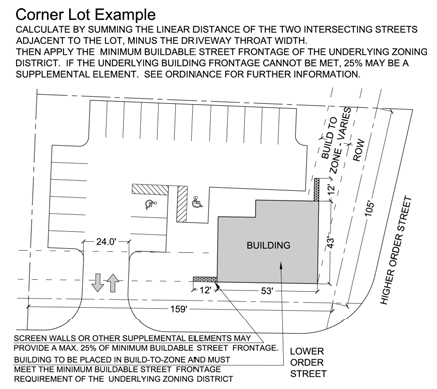
Calculated by summing the linear distance of two (2) intersecting streets adjacent to the lot and applying the minimum buildable street frontage requirement of the underlying zoning district to the total.
(2)
The minimum buildable street frontage requirement shall be met by locating the principal façades of the primary structure in the build-to zone at the intersection of the two streets measured for the purposes of a corner lot.
(3)
If the minimum buildable street frontage requirement cannot be met supplemental elements shall be required and shall not exceed 25% of the minimum buildable street frontage requirement.
(E)
Standards for Auto-Oriented Facilities. The intent of this section is to provide design standards for auto-oriented facilities in urban zoning districts. Auto-oriented developments such as fueling stations with convenience stores and drive-thru restaurants and banks utilize site development patterns that allocate a large percentage of the site area for vehicular movement and a necessarily smaller portion for the business structure. Urban zoning districts are designed to require traditional town form and the following standards are provided in an effort to achieve an improved development form for auto-oriented facilities.
(1)
Drive-Thru Facilities.
(a)
Auto-oriented developments that generate the majority of their business from a drive-in/drive-thru format shall make every effort but shall not be required to meet the minimum buildable street frontage requirement of the underlying zoning district.
(b)
These facilities shall locate the building's principal façade within the build-to zone. Supplemental elements shall be utilized to make up the remaining minimum buildable street frontage requirement for the development site.
(2)
Fueling Stations with Convenience Stores.
(a)
These facilities shall locate the convenience store's principal façade within the build-to zone, but shall not have to meet the minimum buildable street frontage requirement of the underlying zoning district with the building. Supplemental elements shall be utilized to make up the remaining minimum buildable street frontage requirement for the development site.
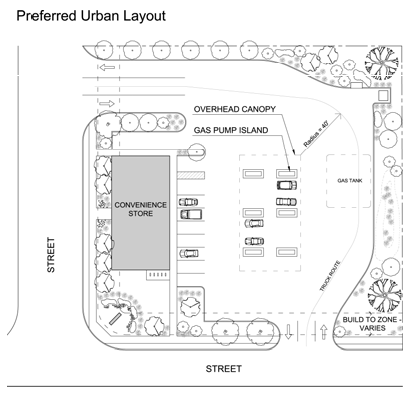
(b)
The preferred layout of a fueling station places the pumps near the rear of the lot while having the convenience store out in front near the street. This helps to highlight the building, shield the utilitarian pumps and canopy and pulls the curb cuts away from the intersection, creating safer and easier access.
(c)
Fueling Station Canopy.
(i)
Fueling station canopies should be designed as an cohesive part of the station architecture whenever possible, and are encouraged to be integrated with the overall roof structure of the convenience store.
(ii)
The canopy structure shall be setback a minimum of 20 feet from the master street plan right-of-way; pump islands, compressed air connections and similar equipment shall be setback a minimum of 25 feet from the master street plan right-of-way line.
(iii)
The canopy structure and supports shall be consistent with the design of the primary structure with respect to materials and design. Metal support columns must be clad (with brick, stone, wood etc.) to aesthetically complement the primary structure and provide greater variety in materials, unless they are architecturally designed for aesthetic interest.
(iv)
Canopy supports shall have a minimum width to height ratio of 1:10.
(v)
Canopy height, as measured from the finished grade to the lowest point on the canopy fascia, shall not exceed 13 feet 9 inches.
(vi)
Canopy downspouts and related hardware shall be integrated into the structure to reduce visibility.
(vii)
Canopy ceiling shall be textured or have a flat finish; glossy or highly reflective materials are not permitted.
(viii)
Light fixtures mounted under canopies shall be completely recessed into the canopy with flat lenses that are translucent and completely flush with the bottom surface (ceiling) of the canopy. The sides (fascias) of the canopy shall extend at least 12 inches below the lens of the fixture to block the direct view of the light sources and lenses from adjacent property line. Lights shall not be mounted on the top or sides of the canopy.
(ix)
When visible from the street, fueling station bays/pump islands shall be screened on the street side with articulated masonry walls 32 inches—42 inches in height, as least as wide as the pump island or bay; or
(x)
A masonry screen wall 32 inches—42 inches in height shall be constructed between the drive aisle serving the fueling station pumps and the public sidewalk, within the build-to zone; or
(xi)
A hedge row 32 inches—42 inches in height shall be installed between the drive aisle serving the fueling pumps and the public sidewalk, within the build-to zone, so long as a maintenance guarantee is provided that covers the installation and care of the hedge until it is grown to sufficient height and density to screen as intended.
(F)
Supplemental Elements. A supplemental element that is utilized for meeting the minimum buildable street frontage requirement shall consist of at least one of the following, in addition to other required open spaces or pedestrian-oriented elements:
(1)
A masonry screen wall between 32 inches and 42 inches in height constructed with materials similar to the principal structure and a 50% minimum opacity;
(2)
Functional outdoor space with an overhead structure and a minimum depth of six feet, such as a porch, outdoor dining area or courtyard;
(3)
A colonnade with a minimum depth of 8 feet and a minimum height of 10 feet.
(4)
Other similar features meeting the intent of this subsection, subject to the approval of the Zoning and Development Administrator.
(G)
Exceptions.
(1)
Single-family dwellings in all zoning districts shall be exempt from the minimum buildable street frontage requirement.
(2)
Portions of a lot's build-to zone determined by the Zoning and Development Administrator to be un-buildable due to the minimum requirements of another ordinance or special regulation may be excepted from the linear street length used to calculate the minimum buildable street frontage requirement, including but not limited to: required setbacks, easements, significant topography, tree preservation, floodway and required driveway access dimensions.
(3)
Street frontage onto an interstate highway shall be exempt from the minimum buildable street frontage percentage requirement.
(4)
For developments on lots that only disturb a portion of the original lot, thereby leaving buildable area for future development, the Zoning Development Administrator may allow consideration of only the portion adjacent to the proposed development when calculating the minimum buildable street frontage. The remaining area may be excluded from the calculation.
(Code 1991, §160.080; Code 1965, App. A, Art. 7(5); Ord. No. 1747, 6-29-70; Ord. No. 2380, 9-20-77; Ord. No. 5348, 9-7-10; Ord. No. 5592, 06-18-13)
164.07 - Erection Of More Than One Principal Structure On A Lot Of Record
In any district, more than one (1) structure housing a permitted principal use may be erected on a single lot, provided that setback and other requirements of this chapter shall be met for each structure as though it were on an individual lot.
(Code 1965, App. A., Art. 8(4); Ord. No. 1747, 6-29-70; Code 1991, §160.112; Ord. No. 4100, §2 (Ex. A), 6-16-98)
164.08 - Extraction
(A)
Rezoning. Extractive uses are generally incompatible with other land uses and cannot be permitted as a use by right in any district. Such uses are to be considered by rezoning request. In an extraction district no building or premises shall be used and no building shall be erected or altered except for one (1) or more of the following uses:
(1)
Extractive uses as described in Use Unit 30;
(2)
City-wide uses by right as described in Use Unit 1;
(3)
Park, playground, or preserve operated on a noncommercial basis;
(4)
Accessory uses and buildings.
(B)
Exception. Extractions which occur in association with development activities and not for the primary purpose of exporting earth products (any material of commercial value found in the earth) shall be subject to Chapter 169, Physical Alteration of Land without requirement for extraction district rezoning.
(C)
Operational Requirements. Operations at the site shall not create unusual traffic hazards or the need for special public improvements, nor the need for special protection, repair, or maintenance of adjacent property. Blasting operations shall be limited to Mondays through Fridays, between 8:00 a.m. and 5:00 p.m. Creation of undrained pockets and stagnant pools shall be avoided to the maximum extent. The operation of machinery (other than extraction equipment) such as sorters, crushers, or other processing devices shall not be permitted within 500 feet of any lot lines. While excavation is in progress, effective steps shall be taken to control erosion of disturbed areas. Such measures may include seeding, mulching, screening, stabilizing, or other cover as appropriate.
(D)
Fencing and Screening. Where deemed necessary by the Planning Commission, approved safety fences shall be provided. In addition, where deemed necessary to protect abutting property from diminution of land value or use, the Planning Commission may require approved fencing and/or screening of at least 75% opaqueness.
(E)
Rezoning Application. The application shall include the following:
(1)
Arkansas Open Cut Land Reclamation Act. A letter from the State Department of Pollution Control and Ecology stating whether the proposed operation is subject to or not subject to the Arkansas Open Cut Land Reclamation Act.
(2)
Development Plan. The plan for development shall show the proposed development as planned and staged in relation to surrounding property and shall include topographic surveys indicating present conditions (including drainage) and the conditions (including topography), drainage and soils to be left at the end of the extraction phase. Contour intervals shall be 5 feet. The plan for development shall demonstrate the feasibility of the operation proposed without hazard or damage to other properties because of increased flooding or runoff, undesirable rise or reduction in ground water levels, erosion, or undermining or settlement in adjoining areas. This plan shall also show important locational aspects of the stages of exploitation, where and how traffic will be handled, where equipment will be operating, the location and dimension of structures, safety safeguards, depth of excavation and hydrogeology in the area.
(3)
Plan for Reuse. A site plan of the restored property showing its proposed future use shall be submitted. Such proposed reuse shall be compatible with surrounding property. Where conditions are suitable, permanent lakes may be permitted, but intermittent lakes and marshes shall not be allowed. Excavation shall be phased so that no more than 10 acres shall be in use or unrestored at any time. Restoration standards shall conform to §161.23 of this Code and shall result in conditions appropriate for the planned reuse of the site.
(Code 1991, §160.135; Code 1965, App. A, Art 4(1); Ord. No. 1747, 6-29-70; Ord. No. 1918, 5-15-83; Ord. No. 2126, 7-14-75)
164.09 - Fences, Walls, And Vegetation
(A)
Subject to the provisions of §166.12, fences, walls, and vegetation may be permitted in any required building setback or any required setback area, or along the edge of any setback, provided the fence, wall, or vegetation does not materially impede vision, as determined by the Zoning and Development Administrator, between vehicular or pedestrian traffic. In any required setback or any required setback area, nothing permanent over 2½ feet (30 inches) high may be installed which materially impedes vision between vehicular or pedestrian traffic.
(B)
Fences. Fences may be permitted for screening, security or for aesthetic purposes. The following types, height, and location of fences shall be prohibited for developments that are subject to the regulations within this chapter:
(a)
Razor and/or Barbed Wire. Razor and/or barbed wire fences are prohibited if visible from the street right-of-way or a residence, unless and except barbed wire fences that are used for agricultural purposes.
(b)
Chain Link. Chain link fence is prohibited if closer to the street than the front of the building. Single-family residential uses outside the Downtown Design Overlay District are exempt from this requirement.
(c)
Height of Fences in Front of Buildings. Fences located in front of the principal façade of a building may be solid up to 30 inches in height. Any part of a fence which exceeds 30 inches in height shall not obstruct the view of the principal façade from the right-of-way.
(Code 1965, App. A., Art. 8(2); Ord. No. 1747, 6-29-70; Ord. No. 2380, 9-20-77; Code 1991, §160.111; Ord. No. 4100, §2 (Ex. A), 6-16-98; Ord. No. 5271, 9-1-09; Ord. No. 5526, 9-18-12)
164.10 - Garage and/or Agricultural & Produce Sales
Garage and/or agricultural & produce sales are permitted in any zoning district subject to the following conditions:
(A)
Frequency. Garage and/or agricultural & produce sales shall not locate in one (1) location more than four (4) times per year.
(B)
Term. Garage and/or agricultural & produce sales may be held for a duration not to exceed three (3) consecutive days.
(C)
Signs. One (1) on-site and three (3) off-site temporary signs are allowed to be posted, however, posting may not occur more than two (2) days before the sale begins. Signs are not to be located on public rights-of-way. Each sign shall not exceed 4.5 square feet in area. The off-site signs shall include address and date(s) of sale. All signs shall be removed by 8:00 a.m. on the day following the sale. Any such signs not so removed the following day, or located in public rights-of-way may be removed by city staff and for any such sign removed a collection fee shall be imposed.
(Code 1991, §160.103; Ord. No. 3970, §3, 5-7-96; Ord. No. 4100, §2 (Ex. A), 6-16-98; Ord. No. 5668, 3-18-14)
164.11 - Height Or Setback Regulations; Exceptions And Home Protection Requirements
(A)
Side Setbacks-Detached Single-family Units. In RI and all multi-family zoning districts that permit detached single-family units, side setbacks may be varied to permit zero lot line development patterns, subject to all applicable building and fire codes and the following standards.
(1)
The zero lot line allowance only applies to detached single-family homes.
(2)
The side setback opposite of the zero lot line shall be at least 10 feet.
(3)
At least 5 feet of maintenance area shall be provided along a structure that is within 5 feet of a property line. This may be provided through a perpetual maintenance easement on the adjacent property, or through a combination of maintenance easement and private property. Walls, fences and customary yard accessories are permitted in the maintenance area.
(B)
Side Setbacks-Attached Townhouse Units. In zoning districts that permit two, three or other multi-family residential uses, side setbacks may be varied to permit common walls between single-family attached/townhouse dwellings, subject to all applicable building and fire codes and the following standards:
(1)
The total number of dwelling units on the lot, prior to being subdivided into single-family attached/townhouse lots, shall conform to the minimum bulk and area requirements of the underlying zoning district.
(2)
The townhouse development shall conform to the zoning district density, exterior setback requirements, height regulations and all other applicable city ordinances.
(3)
There shall be a minimum lot width of 18 feet for each dwelling unit.
(4)
There shall be no minimum lot area requirement unless otherwise specified by the underlying zoning district.
(C)
Home Protection Requirements. Regardless of any other setback or build-to zone regulations, new multi-family, private dormitory, commercial, office, parking deck, or mixed-use construction exceeding 24 feet in height which adjoins or abuts a single-family home being used primarily as a single-family residence within the Downtown General or Main Street Center Zoning Districts must at a minimum be setback from the side or rear adjoining property line at least 15 feet. The maximum height of the new building from the 15-foot setback shall be 36 feet for an additional 15-foot stepback from the residence's property line. These setback and stepback requirements are minimums so that, if larger setbacks or stepbacks are required by other zoning laws, the larger setback/stepbacks are controlling.
(D)
The height limitations contained in the Zoning Regulation, Chapter 161, do not apply to spires, belfries, cupolas, antennas, water tanks, ventilators, chimneys, or other appurtenances usually required to be placed above the roof level and not intended for human occupancy.
(Code 1965, App. A., Art. 8(6); Ord. No 1747, 6-29-70; Ord. No. 2555, 8-21-79; Code 1991, §160.113; Ord. No. 4100, §2 (Ex. A), 6-16-98; Ord. No. 5225, 3-3-09; Ord. No. 5327, 6-1-10; Ord. No. 5636, 12-03-13; Ord. No. 5800, §1(Exh. A), 10-6-15; Ord. No. 5945, §15, 1-17-17; Ord. No. 6879, §5, 5-20-25)
164.12 - Nonconforming Structures, Uses And Lots
It is the intent of this section to regulate nonconforming structures, uses or lots that are created when zoning designations or regulations are created or changed such than an existing lawfully established structure, use, or lot no longer conforms to the regulations of the Unified Development Code. It is also the intent of this section to permit nonconformities to continue as they exist presently and to guide future uses and development to be consistent with the city's planning policy and regulations.
(A)
Nonconforming Structures.
(1)
Nonconforming structures are permitted to exist for continued and creative reuse to contribute to the surrounding character, diversity, and services in the neighborhood until such structures are removed.
(2)
Repairs to nonconforming structures or portions thereof are permitted, so long as the nonconforming portion of the structure is not enlarged in volume, area or footprint.
(3)
Reconstruction of nonconforming structures or portions thereof amounting to less than 50% of the existing square feet are permitted so long as the nonconforming portion of the structure is not enlarged in volume, area or footprint.
(4)
Voluntary removal, damage or destruction of a nonconforming structure or portion thereof amounting to 50% or more of the existing square feet shall require either complete removal of the structure or its reconstruction in conformance with existing regulations.
(5)
Involuntary damage to or destruction of a nonconforming structure (from fire, winds or other calamity) shall permit the owner to rebuild, reconstruct or restore the structure on the same footprint of the original structure plus any addition or expansion that is allowed by the underlying zoning district. Such reconstruction is permitted as long as it begins within eighteen (18) months of the loss and complies with all other applicable zoning, development and building codes.
(6)
For nonconforming structures located in a zoning district utilizing conventional building setbacks, building additions/expansions are permitted so long as the addition is in compliance with all current setbacks, building area and building height requirements of the underlying zoning district, along with all other applicable zoning and development ordinances.
(7)
For nonconforming structures located in zoning districts utilizing build-to zones and requirements for a minimum buildable street frontage, all new construction that increases the existing building(s) footprint or volume of habitable space by 50% or more shall comply with the standards of the underlying zoning district. Building additions/expansions that increase the existing building(s) footprint or volume of habitable space on a property by less than 50% may be located outside of the build-to zone, so long as they are compliant with all other applicable zoning and development ordinances.
(8)
Should a nonconforming structure be moved for any reason for any distance whatever, it shall thereafter conform to the regulations for the district in which it is located after it is moved.
(9)
A structure or portion thereof within any zoning district may be altered to decrease its nonconformity.
(10)
Owners of nonconforming structures are encouraged to keep such structures in good condition by regular maintenance and prompt repairs when necessary. If the city's Building Official notifies the owner of any unsafe or unlawful condition of the building, the owner must repair such unsafe or unlawful condition promptly. The Building Official may impose a reasonable time limit for the repairs to be complete. Failure of the owner to promptly and satisfactorily complete the necessary repairs may result in the City Council ordering a raze and removal of the structure.
(11)
A nonconforming structure may be brought into conformity by way of an approved variance from the Board of Adjustment, a rezoning action, or by altering the structure to comply with the standards of the underlying zoning district. A structure constructed unlawfully shall not be considered a nonconforming structure for the purposes of this chapter and is a prohibited structure unless it is brought into compliance as provided herein.
(B)
Nonconforming Uses. Nonconforming uses are declared by the underlying zoning district to be incompatible and are regulated to further restrict actions that would make the uses more permanent in their location or expand their nonconformity.
(1)
Nonconforming uses of Land, Structures or of Structures and Land in Combination. Where a permitted or otherwise lawful use of land or of structure and land in combination exists which would not be permitted by subsequent regulations imposed by the Unified Development Code, the use may be continued as long as it remains otherwise lawful, subject to the following provisions.
(a)
Enlargement. No use of land or an existing structure devoted to a use not permitted in the district in which it is located shall be enlarged, extended, constructed, reconstructed, moved or structurally altered except in changing the use of the land or structure to a use permitted in the district in which it is located or as required by other ordinances.
(b)
Extending Use. Any nonconforming use may be extended throughout any parts of the building which were manifestly arranged or designed for such use, but no such use shall be extended to occupy any land outside such buildings.
(c)
Change of Use. Any nonconforming use of land, structure, or structure and land in combination may as a conditional use be changed to another nonconforming use provided that the Planning Commission, either by general rule or by making finding in the specific case, finds that the proposed use is equally appropriate or more appropriate to the district than the existing nonconforming use. In permitting such change the Planning Commission may require appropriate conditions and safeguards in accord with the provisions of the Unified Development Code.
(d)
Conditional Use Provisions Not Nonconforming Uses. Any use which is permitted as a conditional use in a district under the terms of this chapter and has been approved by the Planning Commission (other than a change through Planning Commission action from a nonconforming use to another use not generally permitted in the district) shall not be deemed a nonconforming use in such district, but shall be without further action considered a conforming use.
(e)
Superseded by Permitted Use. Any land, structure, or structure and land in combination, in or on which a nonconforming use is superseded by a permitted use, shall thereafter conform to the regulations for the district, and the nonconforming use may not thereafter be resumed.
(f)
Abandonment of Use. When a nonconforming use of land, a structure, or structure and land in combination is discontinued or abandoned for six (6) consecutive months, (except where government action impedes access to the premises), the land, structure, or structure and land in combination, shall not thereafter be used except in conformity with the regulations of the district in which it is located.
(g)
Destruction. Removal or destruction of a structure with a nonconforming use shall eliminate the nonconforming status of the land. Destruction for the purpose of this subsection is defined as damage to an extent of more than 50% of the existing gross square feet of the structure.
(2)
A nonconforming use may be brought into conformity through a rezoning action by the City Council or by Conditional Use Permit by the Planning Commission, as applicable. A use established unlawfully shall not be considered a nonconforming use for the purposes of this chapter and is a prohibited use unless it is brought into compliance as provided herein.
(C)
Nonconforming Lots. Lots that do not fully meet the requirements of the Unified Development Code to be considered a conforming lot for development, and thus are considered nonconforming lots, may be utilized for development in accordance with the following provisions:
(1)
A proposed structure must meet all applicable building setbacks, height and lot coverage requirements and other applicable zoning and development codes, with the specific exception of the reason for which the lot is nonconforming.
(2)
Such lot shall have frontage onto a public street, and water and sewer shall be provided to the lot at the time of development.
(3)
Such lot shall have at least 50% of the required lot width and area of the underlying zoning district.
(4)
A nonconforming lot that does not meet the provisions above may be brought into conformity by way of an approved variance from the Board of Adjustment, a rezoning action, or by combining a lot(s) in order to meet the standards of the underlying zoning district. A lot that was established unlawfully shall not be considered a legal lot of record for the purposes of this chapter and no building or development permit may be granted until the lot is legally established as provided herein.
(Code 1965, App. A., Art. 4(1), (2), (4)—(7); 5(8); Ord. No. 1747, 6-29-70; Ord. No. 1806, 7-16-71; Ord. No. 1891, 12-5-72; Ord. No. 2126, 7-14-75; Ord. No. 2505, 2-20-79; Ord. No. 1918, 5-15-83; Ord. No. 3114, 9-3-85; Ord. No. 3124, 9-17-85; Ord. No. 3130, 10-1-84; Code 1991, §§160.135—160.142; Ord. No. 4100, §2 (Ex. A), 6-16-98; Ord. No. 4930, 10-03-06; Ord. No. 5312, 4-20-10; Ord. No. 5453, 10-18-11)
164.13 - Non Residential Uses In RSF Districts
The following requirements apply to specific nonresidential facilities where permitted in or abutting an RSF District. The Planning Commission may reduce these requirements after receiving and reviewing a development plan under the provisions of §166. For the uses listed, the minimum separation shall be measured from the actual nonresidential use or structure to the closest single-family residential structure.
(Code 1965, App. A., Art. 7 (14); Ord. No. 1747, 6-29-70; Code 1991, §160.088; Ord. No. 4100, §2 (Ex. A), 6-16-98; Ord. No. 5296, 12-15-09; Ord. No. 5453; 10-18-11)
164.14 - Parking And Storage Of Certain Vehicles
(A)
Motor vehicles or trailers of any kind, which are required to be licensed, must have current license plates properly attached (unless completely enclosed within a building) except within the lot of the following legally operating businesses: vehicle sales, trailer sales, junkyards, and auto salvage yards.
(B)
Disabled motor vehicles or trailers, including antique/hobbyist vehicles, must be stored inside buildings unless stored within auto salvage yards, junk yards, auto body shop lots, or towing impound yards.
(C)
Parking or storing wrecked or abandoned vehicles within residential districts is prohibited.
(D)
Vehicles in any zoning district shall be parked in such a way so they do not encroach upon a public sidewalk, or block pedestrian or vehicular use and visibility.
(Code 1965, App. A., Art. 8(7); Ord. No. 1747, 6-29-70; Code 1991, §160.115; Ord. No. 4100, §2 (Ex. A), 6-16-98; Ord. No. 5348, 9-7-10)
164.15 - Modular Construction
(A)
Residential Unit. Modular residential units may be considered as single-family, two-family, three-family, four-family, or multi-family residential units.
(B)
Additional Requirements. All units shall meet the following requirements:
(1)
The codes adopted by the State of Arkansas and the ordinances of the city;
(2)
Be secured to a permanent masonry or concrete foundation; and
(3)
Have permanent water and sewer connections.
(C)
Location of Modular Construction. Modular construction is permitted in all zoning districts where the residential unit type is permitted.
(Ord. No. 6874, §3, 5-20-25)
Editor's note— Ord. No. 6874, §3, adopted May 20, 2025, repealed the former §164.15, and enacted a new §164.15 as set out herein. The former §164.15 pertained to prefabricated construction and derived from Code 1965, App. A., Art. 7 (13), adopted 1965; Ord. No. 1747, adopted June 29, 1970; Code 1991, §160.087, adopted 1991; Ord. No. 4100, §2 (Ex. A), adopted June 16, 1998.
164.16 - Reserved
Editor's note— Ord. No. 6869, §5, adopted May 6, 2025, repealed §164.16, which pertained to structures to have access and derived from Code 1965, App. A., Art. 8(6), adopted 1965; Ord. No. 1747, adopted June 29, 1970; Ord. No. 2555, adopted August 21, 1979; Code 1991, §160.114, adopted 1991; Ord. No. 4100, §2 (Ex. A), adopted June 16, 1998.
164.17 - Visibility At Intersections In Residential/Nonresidential Districts
(A)
Residential. On a corner lot in any residential district, nothing shall be erected, placed, planted, or allowed to grow in such a manner as materially to impede vision between a height of 2½ feet above the centerline grades of the intersecting streets in the area bounded by the street lines of such corner lots and a line adjoining points along said street lines 25 feet from the point of the intersection.
(B)
Nonresidential. On a corner lot in any nonresidential district, nothing shall be erected, placed, planted, or allowed to grow, and no motor vehicle or mobile home shall be parked in a manner as to materially impede vision between a height of 2½ feet above the centerline grades of the intersecting streets in the area bounded by the street lines of such corner lots and a line adjoining points along said street lines 10 feet from the point of the intersection; provided, this restriction shall not be applicable to a corner lot located in a DC, MSC or DG zoning district.
(Code 1965, App. A., Art. 8(1, 1.1); Ord. No. 1747, 6-29-70; Ord. No. 2193, 2-3-76; Code 1991, §160.110; Ord. No. 4100, §2 (Ex. A), 6-16-98; Ord. No. 5028, 6-19-07)
164.18 - Supplementary Use Regulations
(A)
Gasoline Service Stations. A gasoline service station shall be subject to the following requirements:
(1)
Bulk and Area. Gasoline service stations shall be regulated by the bulk and area requirements of the district in which it is located and the following:
(2)
Signs. Any permitted sign shall be stationary and shall conform in all respects to the applicable regulations pertaining to signs.
(3)
Auto Washing. Washing of autos shall be entirely within an enclosed structure.
(B)
Retail Liquor Stores. Retail liquor stores may be located in those zoning districts where such use is permitted, subject to the following conditions:
(1)
Church/School. No retail liquor store shall be located within the distance established by Ark. Code Ann. § 3-4-206, and any future amendments thereto, from any church or schoolhouse.
(2)
Residential Zone. No retail liquor store shall be located on any property two or more sides of which abut or are across the street from and perpendicular to property zoned residential. For the purpose of this section the term "street" shall not include any federal highway.
(C)
Riding Stables. In any district where permitted, riding stables shall be subject to the following conditions.
(1)
Minimum Area. Riding stables shall not be located on any property which does not contain a minimum of 40 acres of undeveloped land.
(2)
Setback from Residential Property Lines. No riding stable shall be located within 250 feet of the property line of any abutting property zoned residential and no riding path shall be located within 100 feet of the property line of any abutting property zoned residential.
(3)
Extent of Operations. The operation of a riding stable shall be limited to the boarding of horses, the providing of riding lessons, and the renting of riding horses, saddles, bridles, and other accessories for use on the premises. No horse racing or horse shows shall be permitted on the premises; provided, horse shows displaying only those horses used in the daily operation of a riding stable may be permitted. The operation of a riding stable shall be limited to the hours of 6:00 a.m. to 10:00 p.m.
(4)
Number of Horses Permitted. The number of horses permitted on premises used for a riding stable shall be limited to one horse for every ¾ acre of undeveloped land.
(D)
Towing Impound Yards. An impound yard shall be subject to the following:
(1)
Motor vehicles shall not be stored on the premises longer than forty-five (45) days.
(2)
Impound yards shall be surrounding on all sides by a minimum 6 foot tall wood board privacy fence.
(Code 1965, App. A., Art. 7(9) (22)(23); Ord. No. 1747, 6-29-70; Ord. No. 1870; 6-19-72; Ord. No. 2122, 7-15-75; Ord. No. 2123, 7-25-75; Ord. No. 2126, Ord. No. 2380, 9-21-77; 7-15-75; Code 1991, §160.092; §160.084; Ord, No. 4100, §2 (Ex. A), 6-16-98; Ord. No. 5271, 9-1-09); Ord. No. 5339, 8-3-10; Ord. No. 5348, 9-7-10; Ord. No. 6374, §3, 11-5-20)
164.19 - Accessory Dwelling Units (ADU)
(A)
Purpose. Accessory dwelling units are allowed in certain situations to:
•
Create new housing units while respecting the character and pattern of small scale traditional town form;
•
Increase the housing stock of existing neighborhoods in a manner that is compatible with established massing, scale, and development patterns;
•
Allow more efficient use of existing housing stock and infrastructure;
•
Provide a means for residents, particularly seniors, single parents, and families with grown children, to remain in their homes and neighborhoods, and obtain extra income, security, companionship and services; and
•
Provide a broader range of accessible and more attainable housing.
(B)
Intent. Planning staff shall evaluate the following criteria for the review and approval of an accessory dwelling unit application:
(1)
The property shall have infrastructure (water, sewer, gas, electric, etc.) that meets city standards to serve the accessory dwelling unit.
(2)
A two (2) story accessory dwelling unit shall limit the major access stairs, decks, entry doors, and major windows to the walls facing the principal dwelling, or to the alley if applicable. Windows that impact the privacy of the neighboring side or rear yard shall be minimized.
(3)
The orientation and location of buildings, structures, open spaces and other features of the site should protect and maintain natural resources including significant trees and shrubs to the extent feasible and minimize alteration of natural land forms. Building profiles, location and orientation should relate to natural land forms.
(C)
Administrative Design Review and Approval. All accessory dwelling units shall meet the following standards for administrative approval by the Zoning and Development Administrator. Prior to approval of an accessory dwelling unit, the Zoning and Development Administrator shall find that:
(1)
Maximum Square Feet. The accessory dwelling unit(s) shall not be greater than 1,200 square feet of habitable space per lot.
(2)
Zoning. The accessory dwelling unit shall comply with all underlying zoning requirements including but not limited to building height, building area, bulk and area, and setbacks with the exception of density limits.
(3)
Parking. Additional parking is not required to accommodate an accessory dwelling unit.
(4)
Maximum Number of Accessory Dwelling Units per Lot. A maximum of two (2) accessory dwelling units are permitted provided the combined square footage does not exceed 1,200 square feet. Accessory dwellings may be interior, attached, or detached from the primary dwelling, or attached to each other.
(5)
Other Code Requirements. The accessory dwelling unit shall comply with the requirements of the Arkansas Fire Prevention Code as adopted in §173.02 of the Unified Development Code.
(6)
Maximum Occupancy of the Accessory Dwelling Unit. A maximum of one (1) family shall be permitted to reside in an accessory dwelling unit.
(D)
Planning Commission Approval. An applicant may request approval from the Planning Commission of a variance to the requirements for size (square feet) and height, where unique circumstances exist and the effect will not adversely affect adjoining or neighboring property owners. The applicant shall provide notification to adjacent property owners prior to the date of the meeting.
(Ord. No. 6076, §1, 8-7-18; Ord. No. 6520, §§3, 4, 1-18-22; Ord. No. 6870, §1(Exh. A), 5-6-25)
Editor's note— Ord. No. 6076, §1, adopted Aug. 7, 2018, repealed the former §164.19, and enacted a new §164.19 as set out herein. The former §164.19 pertained to similar subject matter and derived from Ord. No. 5128, adopted April 15, 2008; Ord. No. 5866, §2, adopted April 5, 2016.
164.20 - Approval Of Vital Municipal Facilities
Regardless of any other provision within the Unified Development Code, the City Council after a public hearing and by a two-thirds majority vote may approve a lot split, lot line adjustment or other appropriate development action and authorize the construction of a vital municipal facility including, but not limited to: a water storage tank, water or sewer pump station, water or sewer pipelines, fire station, police station, public communications facility and all accessory structures needed for such facilities.
(Ord. No. 5245, 6-16-09)
164.21 - Limited Business
(A)
Purpose. These regulations are intended to mitigate the potential adverse impacts associated with commercial uses adjacent to or within residential areas by allowing limited neighborhood commercial uses that are compatible in size, scale, massing and residential appearance with adjoining and surrounding residential uses. The following standards shall apply:
(1)
Enhance and regulate the appearance of neighborhood commercial uses.
(2)
Protect adjoining properties from the potential adverse impacts associated with commercial uses adjacent to residences such as traffic, noise, appearance, lighting, drainage, and effect on property values.
(3)
Provide areas for off-street parking that will be appropriate in size, location and scale within residential areas.
(4)
Provide commercial uses that are accessible for the convenience of individuals living in residential districts.
(5)
Reduce the length and number of vehicle trips generated by residential development.
(B)
Applicability. These standards shall apply to all conditional use requests for Use Unit 12, Limited Business, in any zoning district.
(C)
Similar Uses Allowed. When a use is not specifically listed as a permitted use in Use Unit 12 (Limited Business), the use may be permitted if it is determined by the Zoning and Development Administrator that the use is similar to other uses listed. In determining "similarity," the Zoning and Development Administrator shall make all of the following findings:
(1)
The proposed use meets the purpose of this section and the goals and policies of the Comprehensive Land Use Plan.
(2)
The proposed use shall not adversely impact the public health, safety and general welfare of the neighboring residents;
(3)
The proposed use shall be similar to the uses listed above considering use intensity and characteristics.
(D)
Conditions for Approval. The uses listed may be allowed as a permitted use and shall meet the following conditions:
(1)
The proposed use shall not adversely affect local traffic conditions on the adjoining streets.
(2)
New structures located within a residential zoning district shall incorporate design elements similar to and compatible with those found within the neighborhood, including materials, roof pitch, scale, etc.
(3)
New parking areas or lots, utility equipment and trash enclosures shall be designed to have minimal visual impact to adjacent property owners and to the street. Screening of these elements shall be accomplished with plantings, walls, architectural elements, and/or fencing.
(4)
Hours of operation shall be limited to Sunday through Thursday, 6:00 a.m. to 9:00 p.m., and Friday and Saturday, 6:00 a.m. to 11:00 p.m., unless otherwise further determined by the Planning Commission.
(5)
All new or enlarged structures shall comply with the zoning requirements of the underlying district.
(E)
Design Review. The applicant shall submit the following information to the Planning Division for review, where applicable:
(1)
A site plan drawn to scale showing location of parking, building footprint, and all other improvements.
(2)
Color elevation drawings of all sides of the structure, indicating the type of materials to be used on the exterior of the building, and proposed sign.
(3)
Landscape plan showing the location of all proposed landscaping, size and species of plant material.
(4)
Abbreviated tree preservation plan.
(Ord. No. 5312, 4-20-10; Ord. No. 5375, 12-21-10)
164.22 - Cluster Housing Development
(A)
Purpose. The purpose of the cluster housing development ordinance is to encourage innovation and variety in housing while ensuring compatibility with established neighborhoods, and to provide housing opportunities for a population diverse in age, income and household size.
(B)
Applicability. The provisions of this section shall apply to proposed cluster housing development proposals, as defined in Chapter 162, Use Units, and authorized by Chapter 161, Zoning Regulations of the Unified Development Code, however zoning and development regulations such as density, bulk and area, building area, street frontage requirements, lot splits and other standards for cluster housing development are enforced subject to the criteria adopted in this chapter.
(C)
Development Review Process. For the purpose of development review, cluster housing developments less than one (1) acre shall be processed as a site improvement plan. Cluster housing development on lots one (1) acre or larger shall be processed as a large scale development. If individual cluster housing unit lots are proposed and the proposal meets all of the requirements in this section, the subdivision shall be processed through the subdivision platting process as a lot split regardless of the number of lots created.
(D)
Dwellings Permitted.
(1)
Number of Cluster Housing Units Permitted. A cluster housing development shall contain a maximum of twelve (12) dwelling units. In multi-family zones where the proposed cluster housing development exceeds the minimum open space requirements of 164.22(G)(3)(a) by at least 20%, and in which at least 75% of the planned units are attached dwellings, there shall be no maximum number of dwelling units, except to conform to the density limitations herein.
(2)
Existing Nonconforming Structures. On a lot to be used for a cluster housing development, existing detached single-family residential structures, which may be nonconforming with respect to the standards of this section, shall be permitted to remain, but the extent of the nonconformity may not be increased. Such nonconforming dwelling units shall be included in the maximum permitted cluster density.
(E)
Zoning Regulations. The parent tract prior to development shall conform to the zoning criteria of the underlying zoning district.
(1)
Permitted and Conditional Use. Cluster housing development is permitted as identified in Chapter 161, Zoning Regulations, as a permitted or conditional use.
(2)
Density. Cluster housing development permitted as a use by right shall be allowed a density in conformance with the underlying zoning district. Zoning districts that allow cluster housing developments as a conditional use shall be allowed a density not to exceed two (2) times the maximum density allowed in the underlying zoning district.
(3)
Bulk and Area Regulations.
(a)
Lot Width Minimum. There is no lot width requirement for individual cluster housing lots.
(b)
Lot Area Minimum. The lot area minimum for cluster housing lots is 750 square feet.
(c)
Land Area per Dwelling Unit. The land area per dwelling unit requirement is 750 square feet.
(4)
Setback Requirements. All structures shall meet setback and separation requirements of the International Building Code, as applicable. For zoning purposes:
(a)
In single-family districts, all cluster housing units shall have a minimum separation from one another of ten feet measured from exterior wall to exterior wall, not counting eaves or other architectural projections.
(b)
In multi-family districts, there are no separation requirements from one cluster housing structure to another.
(c)
The setbacks from the exterior property lines of the original parent tract shall be set by the underlying zoning district.
(5)
Building Height Regulations. The height for all structures in a cluster housing development shall not exceed the permitted height requirement of the underlying zoning district.
(6)
Building Area. None.
(7)
Accessory Dwelling Units. Accessory dwelling units are permitted in cluster housing developments by conditional use. Where a cluster housing development is permitted as a conditional use, accessory dwelling units may be requested within the same application.
(F)
Common Property Maintenance. Community buildings, parking areas and common open space shall be owned and maintained commonly by the cluster housing development residents, through a condominium association, a homeowners' association or a similar mechanism, and shall not be dedicated to the city unless accepted by the City Council.
(G)
Development Standards. All cluster housing developments are subject to the following standards:
(1)
Floor Area. The total conditioned floor area of any individual cluster housing unit shall not exceed 2,500 square feet.
(2)
Building Orientation. A minimum of 75% of dwelling units in a cluster housing development shall be oriented around and face the common open space, a public trail or towards the street, having pedestrian access to the common open space and the street. Where a cluster housing unit fronts onto a public trail, the façade facing the public trail shall be considered a principal façade for the purposes of meeting design standards.
(3)
Open Space.
(a)
For units up to 1,500 square feet, a minimum of 250 square feet of common open space shall be provided per unit. For units exceeding 1,500 square feet and up to 2,000 square feet, 500 square feet of common open space shall be required per unit. For units exceeding 2,000 square feet, 750 square feet of common open space shall be required per unit. Common open space is subject to the following performance criteria:
(i)
No dimension of a common open space area used to satisfy the minimum square footage requirement shall be less than ten feet.
(ii)
Required common open space shall be divided into no more than two (2) separate areas per cluster of dwelling units.
(iii)
Common open space shall be improved for passive or active recreational use, garden/food production, social gathering spaces or landscaped areas. Examples may include but are not limited to courtyards, orchards, landscaped picnic areas, plazas or gardens. A detailed site plan of the common open space depicting the design and amenities of the space shall be reviewed with the site plan for approval.
(iv)
Amenities such as permanent or movable seating, landscaping, trails and paths, barbeque or eating facilities, covered shelters or water features shall be included within the common open space. Low Impact Development stormwater management facilities may be placed within the common open space when they are integrated with the amenities listed above.
(b)
Each cluster housing unit shall be provided with a private open space of 250 square feet with no dimension of less than ten feet. Private open space should be contiguous to each dwelling unit, for the exclusive use of each respective resident. In multi-family zones in which at least 75% of the planned units are attached dwellings, private open space shall not be required where the development exceeds the minimum open space requirements of (G)(3)(a) by at least 20% and it can be demonstrated that each unit has easily available access to open space amenities.
(c)
Parking areas and driveways shall not be counted as open space.
(4)
Fences. Fencing located between a cluster housing unit and a public street or trail or the common open space shall not exceed 48 inches in height.
(5)
Parking Requirements and Standards. Parking areas should be located within the cluster housing development in such a way as to maintain the character along the public street and to minimize the noise and light impacts on private residences and public spaces. Reductions in parking space allowances are permitted in cluster housing developments as described in Chapter 172, Parking and Loading. Permitted on-street parking spaces adjacent to a project's frontage may count towards the parking requirements of the development. Parking standards for cluster housing developments shall be as follows:
(a)
The owner/developer may choose to supply one (1) parking space per bedroom for his or her entire cluster housing development. Otherwise, the required number of parking spaces shall be determined according to the square footage of the cluster housing unit as described below:
(i)
Dwelling units less than 1,000 square feet shall have one and one-half (1.5) parking spaces provided.
(ii)
Dwelling units over 1,000 square feet shall have two (2) parking spaces provided.
(b)
Shared covered parking shall be designed to be similar and compatible to the design, materials and roof pitches used for the cluster housing units.
(6)
Cluster housing developments shall provide at least one (1) bicycle parking rack per cluster housing unit.
(7)
Fire Department Access. Fire Department access shall be determined at the time of development review.
(8)
Pedestrian Connectivity. All buildings and common spaces shall be served by a pedestrian circulation system that connects to an existing or planned sidewalk or trail system.
(9)
Utilities. Individual cluster housing lots shall have a unique connection to the main water and sewer lines. Main water and sewer lines on private property servicing cluster housing unit developments shall be located in a dedicated easement.
(10)
Community Buildings. Indoor or covered common areas less than 2,000 square feet are permitted by right in cluster housing development. These structures shall be architecturally integrated with the architectural style of the cluster housing development.
(11)
Recycling and Trash Collection Service. For the purposes of recycling and trash collection cluster housing developments are considered a residential use and should receive residential recycling and trash collection service (individual carts and recycling bins) where possible. In certain instances, it may be necessary to service cluster housing developments with commercial trash collection equipment (dumpsters). This may occur when a project is located in a predominately commercial area serviced by commercial trash pickup. It is incumbent on the developer to design recycling and trash collection facilities into the cluster housing development plan early in the process. The final determination of recycling and trash collection service and pick-up areas will be made at the time of development review by the city. Specific requirements for residential and commercial trash and recycling pick-up shall be as follows:
(a)
Residential trash and recycling collection service requires a designated location near the street curb for trash carts and recycling bins. This location shall be kept clear of obstructions on the designated pick-up day. If this location is also used for on-street parking it shall be clearly marked and a sign posted restricting use for the designated pick-up day. An appropriate linear distance is required to accommodate each cluster housing unit's trash cart and recycling bin, subject to city approval.
(b)
Commercial trash collection service requires a dumpster location that is freely accessible for front end loading and screened from public view.
(c)
Recycling and trash facilities shall be located behind the front building setback line and shall be screened from the right-of-way and adjacent property owners by either architectural treatments or vegetative screening.
(H)
Building Design Standards.
(1)
Variety in Detached Cluster Housing Units Floor Plans and Architectural Treatments. These standards are intended to avoid the overly repetitive use of the same building design, structural features, detailing or finishes among detached units within the cluster housing development. In cluster housing developments no two (2) structures shall be identical in terms of exterior finishes. All cluster housing units shall differ from each other by utilizing at least two (2) of the following options:
(a)
Variations in building material finishes such as clapboard, shake shingles, stone, brick, etc., and building color;
(b)
Variations in adjacent cluster housing unit floor plans that alter the location of exterior windows and doors;
(c)
Variations in the size of main floor area and/or building height of adjacent structures; or
(d)
A front porch with a minimum width no less than 50% of the front building façade. Front porches shall have a minimum depth of six feet. No structurally identical front porches shall be located on adjacent cluster housing units.
(e)
Variations in roof shapes or gables between adjacent structures.
(f)
Other variations as approved by the Zoning and Development Administrator.
(2)
All attached cluster housing units shall comply with §166.23, Urban Residential Design Standards. Where a cluster housing unit fronts onto a public trail or open space, the façade facing the public trail or open space shall be considered a principal façade, for the purposes of meeting this section.
(I)
Variances From the Minimum Cluster Housing Development Requirements. Variances of this section, Cluster Housing Development, shall be administered as normal development regulations for variances of General Design Standards, except that (E) Zoning Regulations shall be administered as zoning regulations for variance purposes.
(Ord. No. 5921, §5(Exh. A), 11-1-16; Ord. No. 6067, §1, 5-1-18; Ord. No. 6520, §5, 1-18-22)
Editor's note— Ord. No. 5921, §5(Exh. A), adopted Nov. 1, 2016, repealed §164.22 and added a new section as set out herein. The former §164.22 pertained to cottage housing development and derived from Ord. No. 5462, adopted Dec. 6, 2011.
164.23 - Small Lot Design Standards
(A)
Purpose. The purpose of these standards is to better maintain visibility, security, safety and aesthetics for pedestrians, drivers and the residents of homes built on relatively narrow lots.
(B)
Applicability. These standards apply to new detached single-family homes with street frontage of 50 feet or less.
(1)
Each home shall have a clearly defined front door and windows on the façade facing the street. This is only required on one (1) side of a home where there is more than one (1) street frontage.
(2)
Garage openings that are on the same side of the home as the front door shall not protrude forward past the edge of the principal façade.
(3)
The garage opening shall be less than 50% of the principal façade length unless the house has a second story with windows facing the street or has a balcony, deck, or similar feature which projects at least flush with the garage opening toward the street.
(Ord. No. 5800, §4(Exh. D), 10-6-15; Ord. No. 5895, §1, 8-16-16)
164.24 - Registered Child Care Family Homes
Registered Child Care Family Homes shall be allowed by right in any zoning district in which residential uses are permitted. Operators of registered child care family homes shall ensure a current copy of his or her license issued by the State of Arkansas is on file with the City of Fayetteville.
(Ord. No. 6440, §2, 5-18-21; Ord. No. 6689, §3, 10-3-23)
164.25 - Tandem Lot Development
(A)
Where Allowed. Tandem lot development shall be permitted for a single-family dwelling and customary accessory structure and/or dwelling unit only and shall be permitted in all districts where single-family dwellings are permitted. The development of one (1) tandem lot behind another tandem lot shall be prohibited.
(B)
Requirements. Development of a tandem lot shall be subject to the following requirements:
(1)
The tandem lot shall have access to a public street by way of a private drive with a minimum width and specification, such as a vehicular turnaround, as determined by emergency response providers in accordance with applicable local, state, and federal codes. The tandem lot owner shall be responsible for maintaining said private drive so that emergency vehicles have safe access to the dwelling located on the lot. Parking of vehicles in the designated private drive for emergency vehicle access shall not be permitted. The tandem lot owner shall have title to, or a perpetual private easement in, the private drive. If the private drive intersects a paved street, the private drive shall be paved for a minimum distance of 18 feet from said right-of-way in accordance with the driveway design standards in Fayetteville Unified Development Code Chapter 172.
(2)
The distance between the private drive of a tandem lot and any adjacent driveway shall not be less than the minimum distance between curb cuts in Fayetteville Unified Development Code Chapter 166 Street Design and Access Management Standards.
(3)
Solid waste service for the tandem lot shall be provided by customers placing standard residential garbage carts, recycling bins, and yard waste at a designated collection point on trash day in accordance with City of Fayetteville Code of Ordinances Chapter 50.20(B). The designated collection point shall be identified at the time the tandem lot is created, in coordination with the City Solid Waste Division. Garbage carts and recycling bins shall not be placed at the collection point more than twelve (12) hours before or after regular trash pickup in accordance with Chapter 50.20(B).
(4)
Lot Width and Area. The tandem lot, excluding the private drive, shall conform to the minimum lot width and lot area requirements of the zoning district in which it is located, unless a variance is otherwise granted by the Board of Adjustment.
(5)
Setback. Each tandem lot shall have a minimum building setback requirement as follows:
(a)
Tandem lots shall have a minimum building setback requirement of 35 feet from all property lines in the R-A, RSF-5, RSF-1, and CCR zoning districts.
(b)
Tandem lots shall have a minimum building setback requirement of 30 feet from all property lines in the RSF-2 zoning district.
(c)
Tandem lots shall have a minimum building setback requirement of 15 feet from all property lines in the RSF-4 and RSF-7 zoning districts.
(d)
Tandem lots shall have a minimum building setback requirement of 10 feet from all property lines in the R-O zoning district.
(e)
Tandem lots shall have a minimum building setback requirement of 5 feet from all property lines in the RSF-8, RSF-18, RI-12, RI-U, RMF-6, RMF-12, RMF-18, RMF-24, RMF-40, NS-L, NS-G, CS, UT, DC, MSC, DG, NC, UC, and UN zoning districts.
(f)
Any variance to the minimum building setback requirement may only be granted by the Board of Adjustment.
(C)
Variances. Variances to the requirements in (B)(1)—(B)(3) of this section shall be administered as development regulations to be considered by the Planning Commission. All other variances to zoning regulations, including those in (8)(4) and (B)(5), shall be administered as zoning regulations for variance purposes.
(Ord. No. 6565, §2(Exh. A), 5-3-22; Ord. No. 6793, § 4, 9-17-24; Ord. No. 6830, §3, 1-7-25; Ord. No. 6884, §3, 6-17-25)
164.26 - Type 1 Short-Term Rentals Citywide And Type 2 Short-Term Rentals In Non-Residential And Mixed-use Zoning Districts
(A)
Commercial and Mixed-use Zoning Districts. Type 2 short-term rentals may be permitted in all zoning districts where hotel/motel uses are permitted by right and shall not count towards the Type 2 short-term rental density cap in these districts except in multi-family buildings as specified in Chapter 118 of the Fayetteville City Code. Type 2 short-term rentals in all other non-residential and mixed-use zoning districts may be permitted but shall count towards the Type 2 short-term rental density cap.
Short-term rentals may be permitted by right or by conditional use in planned zoning districts subject to the zoning regulations enacted by the City Council for each district.
(B)
Occupancy. Maximum of two (2) people per bedroom, when operated as a short-term rental.
(C)
Parking. Parking is limited to the maximum number of vehicles as allowed by the underlying zoning district for the residential building on the property.
(D)
Special events are not permitted in a short-term rental. Example of special events include, but are not limited to, weddings, receptions, anniversaries, private parties, fundraisers and business seminars.
(E)
Short-term rental units are allowed in any structure established as a permanent dwelling including an accessory dwelling unit. No recreational vehicle, trailer, other vehicle or structure not classified as a permanent dwelling may be used as a short-term rental.
(F)
Exceptions. Exceptions to the short-term rental standards, except proposals that would exceed the city-wide density maximum, may be granted by the Planning Commission as a conditional use permit.
(G)
Short-term rentals must comply with all applicable codes under City Code §118.01 and successfully obtain a business license prior to operation.
(Ord. No. 6945, §8(Exh. G), 12-16-25)
Editor's note— Ord. No. 6945, §8(Exh. G), adopted Dec. 16, 2025, repealed the former §164.26, and enacted a new §164.26 as set out herein. The former §164.26 pertained to Type 2 Short-Term Rentals in Non-Residential and Mixed-use Zoning Districts and derived from Ord. No. 6630, §6(Exh. C), adopted Dec. 20, 2022.
164.27 - Data Centers
(A)
Purpose and Applicability. All data centers constructed within the City of Fayetteville shall be designed and built to incorporate sufficient external noise attenuation measures in order to minimize the impact of noise disturbance on residents.
(B)
Definitions. For the purpose of this section, the following definitions shall apply unless the context clearly indicates or requires a different meaning:
Ambient noise: The all-encompassing noise level associated with a given environment, being a composite of sounds from all sources, excusing the alleged offensive noise, at the locations and approximate time at which comparison with the alleged offensive noise is to be made.
Data center shall have the same meaning as set forth in §151.01 Definitions of the Unified Development Code.
Decibel (dB) shall have the same meaning as set forth in §96.01 Definitions of Chapter 96, Noise Control.
Mechanical equipment: The networked computer systems along with supporting equipment such as batteries, backup generators, and cooling systems housed on the data center's property.
Noise attenuation: The reduction of noise levels through the use of sound-absorbing material, architectural design techniques, and/or any other suitable means.
Noise disturbance shall have the same meaning as set forth in §96.01 Definitions of Chapter 96, Noise Control.
Person: An individual, association, partnership, or corporation, including any officer, employee, department, or agency.
Sound: An oscillation in pressure, particle displacement, particle velocity or other physical parameter, in a medium with internal forces that causes compression and rarefaction of that medium. The description of sound may include any characteristic of such sound, including duration, intensity and frequency.
Sound level: shall have the same meaning as set forth in §96.01 Definitions of Chapter 96, Noise Control.
Sound level meter: shall have the same meaning as set forth in §96.01 Definitions of Chapter 96, Noise Control.
(C)
Noise Attenuation Requirements. Before a data center has commenced construction or operating within this jurisdiction, the property owner and operator proposing to build a data center shall comply with the following:
(1)
Notice Requirements. The property owner and operator must notify all residents within a half-mile radius of the parcel, including any affiliated homeowners' association operating within the half-mile radius. that the property owner and operator intends to build and operate a data center on the property. The notice required in this section must be mailed to all property owners, residents, and homeowners' association addresses contained within a half-mile radius extending from the boundary of the site where the proposed data center will be built. Proof of notification shall be filed with the Planning Division within thirty (30) days of providing notice. The property owner and operator must notify the Mayor that the property owner and operator intend to build and operate a data center. The notice must include the location for the proposed data center. This public notification shall occur at the same time as any other notification required by Chapter 157. If no public hearing is required, then this notification shall occur no less than thirty (30) days prior to the submission of the applicant's development or business license application. whichever occurs first.
(2)
Noise Study Requirements. The property owner of the lands upon which the data center is to be located shall conduct a sound study performed by a third-party acoustic engineer to document baseline sound levels in the area of the proposed data center, including noise levels measured at the boundary of the site in eight (8) locations (north, south, east, west, northeast, northwest, southeast, southwest.) The report of the study must include sound mitigation recommendations based on the results of the sound study. The property owner must provide a copy of the report of the study to the Planning Division within thirty (30) days of completion of the report.
(3)
Noise Attenuation Plan Requirements.
(a)
The property owner must consult with a third-party architectural or design firm to develop a building plan that includes necessary noise attenuation measures in order to prevent the external sound level emanating from the data center from exceeding the sound level limitations contained in in Chapter 96, Noise Control, which would be considered a noise disturbance. The building plan is not required to adopt any or all of the noise attenuation recommendations so long as the plan includes noise attenuation measures that the city deems adequate to be in compliance with this section. Noise attenuation measures may include but not limited to:
(i)
Soundproofing walls, screens, panels, fences, or enclosures.
(ii)
Buffer yards.
(iii)
Other noise attenuation measures recommended by the third-party acoustic engineer or the city.
(b)
Mechanical equipment must be shown on any proposed plan and must be fully screened on all sides. Mechanical equipment not screened by a facade of the building must be screened by a visually solid fence, screen wall or panel, or parapet wall and constructed with a design, materials, details, and treatment compatible with those used on the nearest facade of the building.
(c)
The property owner must provide a copy of the building plan to the city within thirty (30) days of completion of the plan prior to construction.
(d)
Any additions, changes, or expansions of the data center must comply with the noise attenuation requirements of this section and must be designed and submitted to the city within thirty (30) days of completion of the report.
(4)
Post Completion Noise Study Requirements.
(a)
Upon the data center's completion, the data center operator must conduct a post-construction noise study performed by a third-party acoustic engineer to document noise levels emanating from the data center when mechanical equipment is running at full capacity, including all HVAC units and generators necessary for peak operation. Noise levels are to be measured at the boundary of the site in the original eight (8) locations used during the baseline study. The data center operator must provide a copy of the report to the city within ten (10) days of completion of the study.
(b)
The data center shall not begin operations until the completion of the post-construction noise study and submission to the city as required above. In order for the data center to be in compliance, the noise study results must show that its operation is in compliance with this section and will not adversely impact residential neighbors. If the results show that the data center is not in compliance with this section or will adversely impact residential neighbors, the data center will be unable to commence operation until the required noise attenuation measures and noise limitations are met.
(c)
Furthermore, the data center operator must conduct annual noise studies under the baseline and post-construction studies specifications in accordance with subsections (a) and (b) above. The data center operator must provide the results to the city within ten (10) days after the anniversary date of the first sound study report.
(D)
Procedure for Measurement. All tests shall be conducted according to the procedures set forth in Chapter 96, Noise Control.
(E)
Noise Limitations. It shall be unlawful for any data center to make, or continue to cause or permit to be made or continued, noise levels constituting a noise disturbance. For the purposes of this section, the external noise level emanating from data centers shall be deemed disturbing to a person, reasonably calculated to disturb the peace and unreasonably offensive and injurious to the public, or their property. if the sound level does not comply with the limits set forth in Chapter 96, Noise Control.
(F)
Violations and Penalties. Violations of the noise limitations shall be subject to the enforcement and penalty provisions of Chapter 96, Noise Control, as well as any remedies available to the city pursuant to the Unified Development Code, state or federal law. Violations of other provisions of this section shall be subject to the enforcement and penalty provisions of the Unified Development Code.
(1)
Any or all of the following persons may be held responsible for noise violations:
(a)
The person operating the equipment or creating the noise;
(b)
The person who employs the person operating the equipment or creating the noise at the time of the violation;
(c)
The person who owns or rents the property where the violation occurs.
(2)
The following acts, and the causing thereof, are declared to be in violation of this section:
(a)
The sound level emanating from the data center exceeds that allowed by Chapter 96, Noise Control.
(b)
The noise attenuation measures provided in the design plan to the city are not incorporated in the construction of the data center.
(c)
Any of the required sound study results are not filed with the city within thirty (30) days of completion of the report.
(d)
The building plan is not filed with the city within thirty (30) days of completion of the plan prior to construction.
(e)
Failure to act in accordance with any other provision of this section.
(3)
All data centers shall be in compliance with the requirements of this section before the city will issue a certificate of occupancy; failure to do so will be deemed a violation of this section and may result in an injunction, a stay in commencing operation, denial of allowed occupancy, or denial or withdrawal of city utilities or services.
(Ord. No. 6678, §4(Exh. A), 9-5-23)

