
Fayetteville City Zoning Code
CHAPTER 177
- LANDSCAPE REGULATIONS
177.01 - Purpose
(A)
It is the purpose of this chapter to preserve and protect the health, safety, and general welfare, preserve and enhance the natural beauty of Fayetteville, and create an attractive, environmentally sound and healthy urban landscape for the residents of the City of Fayetteville to enjoy by providing for regulations of the design, planting, establishment and maintenance of spaces impacted by developmental practices.
(B)
The standards found within this chapter accomplish these purposes with existing and new vegetation by:
(1)
Promoting the beautification of the City of Fayetteville and enhancing its aesthetic quality;
(2)
Promoting reasonable conservation and replenishment of valued tree canopy and vegetation;
(3)
Aiding in restoring ecological balance by contributing to air purification, oxygen regeneration, and ground water recharge;
(4)
Providing for vegetation to reduce storm water runoff and the potential damage it may create;
(5)
Achieving a meaningful urban landscape while permitting economically feasible urban development to occur.
(6)
Creating a healthy environment for Fayetteville residents, businesses, and industries;
(7)
Moderating the harmful effects of sun, wind, and temperature changes;
(8)
Buffering noise, air and visual pollution;
(9)
Screening incompatible land uses and enhancing the appearance of parking lots in all zoning districts;
(10)
Promoting energy conservation; and
(11)
Protecting and enhancing property values.
(12)
Discouraging the new installation of identified invasive plant species and encouraging the removal of existing invasive plant species.
(C)
Principles. This chapter shall be enforced according to the following principles:
(1)
Sufficient landscaping shall provide beautification, soil stability and suitable drainage.
(2)
Trees, shrubs, groundcover and grass shall be the primary source of landscaping and shall be retained and/or placed in such a manner as to reduce water runoff and provide for safe sight distances at intersections and points of access.
(3)
The current property owner shall properly maintain all landscaping and shall replace any landscaping that dies or is damaged. Landscaping that dies or is damaged shall be removed and replaced by the current owner of the property. The owner shall have sixty (60) days from the receipt of written notice issued by the City of Fayetteville to remove and replace any required landscaping that dies or is damaged.
(4)
Native vegetation is preferred. Vegetation requiring minimum watering is also preferred.
(5)
Preservation is primary; therefore landscaping shall make a concerted attempt to incorporate existing on-site trees and shrubbery.
(6)
Providing outdoor spaces and places for people to gather is strongly encouraged.
(7)
The City of Fayetteville's Landscape Manual shall be used in support of this chapter to explain specific objectives and principles and to provide a resource for guidance in implementing all landscape plans.
(8)
Plants identified as invasive in Section 177.09: Invasive Plant Species are prohibited from being installed in all development projects that require a landscape plan review.
(Ord. No. 4917, 9-05-06; Ord. No. 5820, §§1, 2, 11-3-15)
177.02 - City Of Fayetteville Tree Preservation, Protection And Landscape Manual
The Urban Forester, in cooperation with other members of city staff, shall promulgate and periodically revise forms, procedures and regulations to implement this chapter and publish this information in the City of Fayetteville Tree Preservation, Protection, and Landscape Manual.
(A)
Copies of the Tree Preservation, Protection, and Landscape Manual are to be made readily available to the public and shall include, but need not be limited to:
(1)
Specific criteria for gaining city approval of landscape plans;
(2)
The format and content of reports and plans the applicant must submit to the city pursuant to this chapter;
(3)
A glossary of important terms used in this chapter;
(4)
Size and species requirements for trees planted for parking lots, screening or to meet other necessary criteria; and
(5)
Maintenance of trees (including but not limited to pruning, irrigation, and protection from disease).
(B)
The Urban Forestry Advisory Board shall review and may recommend revisions to the Tree Preservation, Protection, and Landscape Manual at least every three (3) years to reflect changes in arboricultural and horticultural practices, lists of preferred tree species, city policies, or the content of this chapter.
(Ord. No. 4340, 10-2-01; Ord. No. 4917, 9-05-06; Ord. No. 5820, §3, 11-3-15)
177.03 - Landscape Plan Requirements
(A)
Applicability. The provisions of this section shall apply to proposed subdivisions, large scale developments and other development as indicated below required by the Unified Development Code to go through the city's permitting process.
(1)
Subdivisions and Large Scale Developments. Applicants seeking approval of proposed subdivisions and large scale developments shall submit a detailed landscape plan.
(2)
Building Permits. Landscape plan requirements shall apply to all permit applications for nonresidential construction, and the construction of multi-family residential buildings composed of three (3) or more dwelling units.
(3)
Parking Lots. Landscape plan requirements shall apply to all permit applications for the construction of parking lots with five (5) or more spaces.
(B)
General. The landscape plan required for subdivisions and large scale developments shall be prepared and sealed by a registered landscape architect. The landscape plan required for building permits and parking lots may be prepared by a landscape designer.
(C)
Submittal of Plans. The following information shall be included with a landscape plan submittal:
(1)
The date, scale, north arrow, project name, name of landscape architect/designer and name of the owner/developer.
(2)
The location of property lines and the dimensions of the tract.
(3)
Site Features:
(a)
Existing vegetation (See Tree Preservation & Protection Ordinance for specific criteria.)
(b)
The approximate center line of all existing water courses.
(c)
The location and size of existing and proposed drive aisles, streets and alleys, parking areas and other improvements to the site.
(d)
Existing and proposed utility easements and overhead utility lines on or adjacent to the lot.
(e)
Existing and proposed sidewalks on or adjacent to the lot.
(f)
Location of all existing and proposed points of access.
(g)
Existing and proposed structures on the property.
(h)
Existing topography and proposed grading.
(4)
Proposed Landscaping. The landscape plan shall indicate the number and species of all plants, the size of each species at the time of planting, the spacing requirements for each plant, and the type of edging and mulch to be used for the planting areas.
(5)
Combined Plan. The Planting Plan may be incorporated with the Site or Grading/Tree Preservation Plan.
(6)
Planting Details and/or Specifications. Planting and installation details are to insure compliance with all required landscaping standards.
(a)
All landscaping shall be planted within areas that minimize maintenance and jeopardy of plant damage: this includes such areas as tree lawns, tree islands, urban tree wells, foundation plantings and free-standing beds.
(b)
Planting beds shall have amended soil to insure the health of the plant materials.
(c)
All new plantings shall be mulched in accordance with the guidelines established for landscape installation in the Landscape Manual.
(d)
All sod shall be removed within the planting bed and mulch shall cover the bare soil to ease maintenance.
(e)
Sod or organic mulch will be allowed in tree lawns and tree islands if no other plant material is included within these areas.
(f)
A planting bed shall be contained by edging material other than vegetation.
(g)
Planting Details/Specifications shall be included on the landscape plan, in accordance with the Landscape Manual.
(7)
Size and Type of Plant Material.
(a)
All plant material shall meet the requirements established by the American Standard for Nursery Stock.
(b)
Deciduous trees shall have a minimum of 2-inch caliper and evergreen trees shall have a minimum height of 8 feet at the time of installation, unless otherwise approved by the Urban Forester.
(c)
Shrub size at the time of planting shall be a minimum of 3-gallon containers with an expected height of 3 feet or more within two (2) years of installation.
(d)
Plant species installed in vehicular use areas are to be approved by the Urban Forester.
(e)
Acceptable species of trees are listed within the City of Fayetteville's Landscape Manual.
(f)
Protective fencing shall be provided for preserved trees and other vegetation during construction, as required by §167 Tree Preservation and Protection.
(g)
A description of the type of irrigation system used for each required landscape area shall be included.
(i)
An automated irrigation system is encouraged to ensure adequate moisture to plant material.
(ii)
In landscaped areas without an automated irrigation system, hose bibs (water spigots) shall be installed at a ratio of one (1) for every 100 feet.
(h)
Plants listed in Section 177.09: Invasive Plant Species shall not be installed in developments requiring a landscape plan review.
(D)
Plan Review. Upon receipt of the landscape plans, the Urban Forester shall make a recommendation to the Planning Commission or an administrative determination, as permitted by the Unified Development Code, with the following results:
(1)
Approve/Recommend the landscape plan as complying with the requirements of this chapter; or
(2)
Approve/Recommend the landscape plan with conditions which bring it into compliance with the requirements of this chapter; or
(3)
Reject the landscape plan as failing to comply with the requirements of this chapter.
(Ord. No. 4917, 9-05-06; Ord. No. 5820, §4, 11-3-15)
177.04 - Site Development And Parking Lot Landscape Standards
(A)
Applicability. A detailed landscape plan is required to be submitted for all development when either new development or expansion of 25% of the existing building square footage occurs and for all new or expanded parking lots containing five (5) or more spaces. Landscape plans shall be submitted with the application for building permit or parking lot permit. Submittals shall conform to the standards established within this chapter.
(B)
General Requirements.
(1)
Separation of Landscaped Areas and Vehicles. All landscaped areas shall be protected from potential damage by vehicles by placing concrete curbs or wheel barriers adjacent to the landscaped area.
(2)
Vehicle Overhangs. A portion of a standard parking space may be landscaped instead of paved to meet part of the landscaping requirement. The landscaped area may be up to 2 feet of the front of the space as measured from a line parallel to the direction of the bumper of the vehicle using the space. Landscaping may only be groundcover plants in the overhang area.
(3)
Maintenance. The current owner of the property shall be responsible for the maintenance of all required landscaping.
(a)
Irrigation System. Some method of irrigation shall be required in landscaped areas. An automated irrigation system is encouraged to ensure adequate moisture to plant material. In landscaped areas without an automated irrigation system the installation of hose bibs (water spigots), installed one (1) for every 100-foot radius, will be required.
(b)
Planting Beds. All landscaping shall be planted within areas designated as planting beds. Planting beds shall have amended soil to insure the health of the plant materials. All sod shall be removed within the planting bed and mulch shall cover the bare soil to ease maintenance. Sod will be allowed in tree lawns and tree islands if no other plant material is included within these areas.
(c)
Replacement Landscaping. Landscaping that dies or is damaged shall be removed and replaced by the current owner of the property. The owner shall have sixty (60) days from the receipt of written notice issued by the city to remove and replace any required landscaping that dies or is damaged.
(C)
Interior Landscaping Requirements.
(1)
Amount of Landscaping. Parking lots containing ten (10) or more spaces shall be landscaped with one of the following options:
(a)
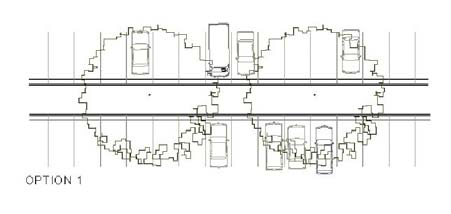
Option 1. Narrow Tree Lawn. A continuous landscape strip between rows of parking. The minimum width of a tree lawn shall be 8 feet ; the minimum area shall be 300 square feet. One (1) tree every twelve (12) parking spaces or one tree every 30 linear feet, whichever provides more canopy, shall be planted with this option. Trees may be grouped or spaced within the lawn area.
(b)
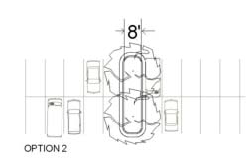
Option 2. Tree Island. The minimum width of a tree island shall be 8 feet; the minimum area shall be 150 square feet. One (1) tree shall be planted for every twelve (12) parking spaces with this option, with a maximum run of twelve (12) parking spaces permitted without a tree island.
(2)
Placement of Trees. Interior trees shall be placed on either side of points of access (entrance drives, exit drives) within tree islands, as indicated in the Landscape Manual.
(3)
Tree Planting. All trees planted to meet these requirements shall be deciduous shade trees. Species selection shall be chosen from the approved list of trees found in the appendices of the City of Fayetteville Landscape Manual. Alternate tree species selections may be approved by the Urban Forester.
(4)
Calculation of Area. Required perimeter landscaping may not be substituted for interior landscaping. However, it is recognized that interior landscaping may join perimeter landscaping. In such cases, landscaping which extends 4 feet or more into the parking area may be included in the calculation of interior landscaped area.
(5)
Exceptions. All parking lots used solely for the purpose of providing areas for the display and storage of motor vehicles for sale, lease, and rental shall be exempt from the interior landscaping requirements.
(D)
Perimeter Landscaping Requirement. Proposed development shall be landscaped meeting the following requirements:
(1)
Side and Rear Property Lines. All parking lots shall have 5 feet of landscaped area between the property line and parking lot. The 2-foot vehicle overhang option may be included to meet this requirement. Depending on the use and location, additional landscaped area and screening may be required along property lines. Where parking lots are located adjacent to a public alley, greenspace is not required between the parking lot and the alley. A shared driveway or parking lot drive aisle within a platted access easement may encroach fully within the required greenspace along the side or rear property lines.
(2)
Property Lines Adjoining Street Right-of-Way.
(a)
Landscape Area Required. A 15-foot wide landscaped area shall be provided along the front property line exclusive of and adjacent to the Master Street Plan right-of-way. Points of access (entrance drives, exit drives) and sidewalks are allowed to cross the 15-foot landscaped area provided the integrity of the landscaped area is maintained.
(b)
Urban Zoning Districts. Zoning districts that prescribe urban building form (e.g., a build-to zone) permitting front setbacks of less than 15 feet may be permitted to eliminate the greenspace between the principal façade of a building and the Master Street Plan right-of-way and instead provide pedestrian oriented elements as referenced in 166.24(E).
(c)
Residential Zones. Except for permitted entrance drives, every development shall be landscaped for an equal and uniform width of 15 feet parallel to the front property line(s) street right-of-way. Single and two-family residential uses shall be exempt from this requirement.
(d)
Nonresidential Zones. Except for permitted entrance drives, every development shall be landscaped for an equal and uniform width of 15 feet parallel to the front property line(s) street right-of-way.
(e)
Shade. All tree planting locations shall attempt to achieve shade for parking lots, cars, benches, pedestrian walkways, etc., by utilizing aspect and locating trees along the south and west boundary of these areas.
(f)
Screening. Parking lots containing five (5) or more spaces shall be screened from the public right-of-way and adjacent properties, where said parking areas are adjacent to residential zones, with shrubs and/or graded berms. If graded berms are used, shrubs are also required.
(g)
Perimeter Planting Location. Street trees shall be installed in the location identified under the street tree planting standards described herein, all other plantings noted herein shall be installed within the required landscape area. Subject to approval by the Urban Forester, required shrubs may be planted within the right-of-way or outside the required landscape area parallel to the street right-of-way only in extenuating circumstances.
(3)
Tree Planting.
(a)
Large species trees shall be planted in the location identified in the Street Tree Planting Standards containing one (1) tree per 30 linear feet along the front property line. Trees along the perimeter may be grouped to allow flexibility in design. The maximum allowed grouping may be up to 25% of the required number of street trees.
(b)
Species selection shall be chosen from the approved list of trees for landscaping found in the appendices of the City of Fayetteville Landscape Manual. Alternate tree species selections may be approved by the Urban Forester. No more than 25% of trees planted to meet perimeter landscaping requirements may be evergreen.
(c)
Planted trees shall have a 2-inch caliper (diameter) measured 6 inches above ground level at the time of planting.
(d)
At the request of the developer, the Urban Forester may exempt specific areas from required tree planting where the terrain, existing trees or other physical limitations make the planting of new trees impracticable. In cases of existing overhead power lines, small trees shall be planted that will not interfere with the existing power lines. Species selection shall be approved by the Urban Forester.
(4)
Shrub Screening. Parking lots that require screening shall have shrubs that are spaced so as to create a seamless row of hedging. A minimum of 50% of the shrubs shall be evergreen. Shrub size at the time of planting shall be in a minimum of 3-gallon containers with an expected height of three feet or more within two (2) years of planting.
(5)
Perennial Groundcover. All landscaped areas shall be vegetated or re-vegetated with appropriate perennial groundcover. Prior to the issuance of a certificate of occupancy, all bare soil shall be adequately covered.
(Ord. No. 4917, 9-05-06; Ord. No. 5312, 4-20-10; Ord. No. 5337, 8-3-10; Ord. No. 5859, §3(Exh. B), 3-15-16; Ord. No. 6090, §1, 9-18-18)
177.05 - Street Tree Planting Standards
(A)
Applicability. All new developments that create or develop along a public or private street shall be required to establish street trees in accordance with the standards and procedures provided for in this section and the adopted policies of the Landscape Manual and Fayetteville's Tree Ordinance.
(1)
All street tree planting plans shall follow the submittal criteria set forth in Ch. 177.03 Landscape Plan Requirements.
(2)
Street Tree Planting Requirements.
(a)
Street trees are intended to be planted in a greenspace strip between the curb and sidewalk or in urban tree wells in accordance with the Master Street Plan. The intent of the street tree planting location is to shade the sidewalk, provide a barrier between vehicles on the street and pedestrians, increase motorized traffic and pedestrian safety, and spatially frame the street. Existing trees within the build-to-zone shall be counted towards the required number of street trees. When there is not adequate greenspace between the curb and sidewalk and urban tree wells are not appropriate, or there are utilities or other structural conflicts in the greenspace strip between the curb and sidewalk, the Urban Forester may permit street trees in greenspace behind the sidewalk and on private property.
(b)
Plans shall indicate the spacing of trees along all newly created public and private streets within the development site. At the request of the developer, the Urban Forester may exempt specific areas from required tree planting where the terrain or existing trees make the planting of new trees impracticable. Examples include, but are not limited to:
(i)
Where the finish grade slope in the planting area between the top back of the street curb and the property line is in excess of 30%.
(ii)
Where bedrock is encountered within 30 inches of finish grade in the planting area between the top back of the curb and the property line.
(iii)
Where existing healthy trees that are shown to be preserved within the right-of-way are in such close proximity they would prevent a new tree from establishing a full canopy when mature.
(c)
Plans shall identify the species of trees to be planted, which must be selected from the Landscape Manual or otherwise approved by the Urban Forester. Street trees shall be large species canopy trees.
(d)
Plans shall identify the size and quality of trees which must meet or exceed the standards adopted in the Landscape Manual.
(e)
Indicate the location of all points of access (driveways, sidewalks and public & private utilities) within the proposed development. The developer shall ensure that driveways, sidewalks, utilities, etc. will not endanger the livelihood of the proposed trees, and shall plan accordingly.
(f)
A maintenance agreement and landscape establishment guarantee shall be established. All plans shall include a binding three (3) year maintenance and monitoring plan, which shall hold the developer responsible for the health of all planted trees.
(g)
Approval of a maintenance agreement and landscape establishment guarantee shall be contingent upon the developer depositing with the City of Fayetteville a surety or contract, as outlined in 177.10.
(h)
Upon completion of the three (3) year landscape establishment period, the Urban Forester shall inspect the site and determine whether 90% percent of the trees are healthy and have a reasonable chance of surviving to maturity. Upon such a finding, the City of Fayetteville shall release the currency, bond or letter of credit.
(i)
In the absence of such a finding, the developer shall be notified to replace any unhealthy or dead trees, or take other appropriate action as approved by the Urban Forester. If the developer does not take remedial steps to bring the property into compliance, the City of Fayetteville shall use the necessary monies from the landscape establishment guarantee to do so.
(j)
In the event trees are injured or destroyed by natural disasters, including but not limited to, tornadoes, straight-line winds, ice storms, fire, floods, hail or lightning strikes, or through the independent actions of their parties, the developer shall be relieved of the responsibility of replanting the tree or trees so affected.
(k)
Contain such other information as may be required to reflect how the plan addresses the remaining policies within the Landscape Manual.
(3)
Street tree plantings that are above and beyond the requirements as established herein may count as on-site tree mitigation, with approval of the Urban Forester.
(4)
Timing of Planting. The Urban Forester shall recommend to the Planning Commission the option that will potentially result in accomplishing the most objectives of this chapter.
(a)
Street Tree Planting with Infrastructure (Subdivisions Only). The developer may choose to provide a landscape plan that conforms to the regulations herein, with all landscaping along streets to be installed prior to final plat approval and acceptance of public improvements associated with the development. If planted prior to final plat approval, the developer shall provide proper measures to ensure the longevity of health of all planted trees during development of individual lots; or
(b)
Street Tree Planting with Development (Subdivisions Only). The developer may choose to provide a landscape plan that conforms to the regulations herein only to the extent that future development on lots created by the subdivision shall be responsible for individual landscape plans as each lot develops.
(c)
Street Tree Planting with Concurrent Development. Where development approval is requested (large scale, building permit, parking lot permit, etc.), the developer shall provide a detailed landscape plan that conforms to the regulation established by this chapter.
(d)
Street tree planting plans shall be submitted with the plans submitted for development or subdivision approval by the Planning Commission, in accordance with the options listed herein.
(e)
A written description of the method(s) and time frame the project will utilize to track development of each individual lot shall be submitted by the developer to ensure the required street trees are planted and their longevity of health assured.
(B)
Street Tree Planting Plan Requirements for Proposed Residential and Non-Residential Subdivisions.
(1)
Residential Subdivisions. Submittals for all proposed residential subdivisions shall include a street tree planting plan at the time of final plat submittal.
(a)
Street trees shall be planted one (1) tree per lot, and lots with multiple street frontages shall be planted at one (1) tree per street frontage.
(b)
Street trees shall be planted within or along the right-of-way; where possible, between the sidewalk and the curb. Location shall be approved by the Urban Forester. Refer to the Landscape Manual for spacing requirements.
(2)
Non-Residential Subdivisions. Submittals for all proposed non-residential subdivisions shall include a street tree planting plan at the time of final plat submittal, or in accordance with the option approved for Timing of Planting as required by this chapter.
(a)
A minimum of one (1) 2-inch caliper, large species tree per 30 linear feet of frontage shall be planted.
(b)
Street trees shall be planted within the required landscape area. Location shall be approved by the Urban Forester. Refer to the Landscape Manual for spacing requirements.
(3)
Optional Street Tree Planting Plan for Urban Streetscapes. The street planting plans for development in urban zoning districts may utilize an urban streetscape at least 8 feet wide from curb to building. At the time of developmental submittal, the proposed urban streetscape shall include a street tree planting plan in compliance with the following requirements:
(a)
A minimum of one (1) 2-inch caliper, large species tree per 30 linear feet of street frontage or every ten (10) parking spaces, whichever provides the most trees, shall be planted with this option.
(b)
Location of trees shall be approved by the Urban Forester to ensure that adequate spacing, access and visibility are maintained. The spacing of trees may be varied with approval of the Urban Forester.
(c)
Trees shall be planted within urban tree wells. The minimum width of an urban tree well shall be 3 feet; the minimum area shall be 15 square feet. This option is only permitted to allow trees planted within wide sidewalks, in a downtown/urban fashion. Size and shape of urban tree well shall be approved by the Urban Forester.
(d)
Tree wells shall be covered with either a tree grate or some form of permeable pavers, (block or stone), to be approved by the Urban Forester.
(e)
Structural soil or similar treatment shall be utilized with this option (see Landscape Manual for specifications)
(f)
Street tree planting plans utilizing this option shall follow the construction procedures and details as outlined in the Landscape Manual.
(g)
Development applications approved for the use of urban tree wells shall not be required to provide additional perimeter landscaped area between the Master Street Plan right-of-way and building, as described further under the perimeter landscaping requirements.
(Ord. No. 4917, 9-05-06; Ord. No. 5003, 4-17-07; Ord. No. 5057, 9-04-07; Ord. No. 5513, 7-17-12; Ord. No. 5818, 10-20-15; Ord. No. 5859, §4, 5, 3-15-16; Ord. No. 6579, §1, 6-21-22)
177.06 - Stormwater Facilities
(A)
Applicability. All development required to install dry surface stormwater facilities (detention ponds) shall conform to the requirements herein. A landscape plan shall be submitted and approved prior to issuance of a permit or at the time of final plat (whichever is applicable). All required plantings shall be installed prior to issuance of a certificate of occupancy or filing of a final plat (whichever is applicable). Development that utilizes retention, underground or parking lot detention, or alternative stormwater management measures as approved by the Urban Forester and City Engineer shall not be required to meet the requirements of this chapter.
(B)
General Requirements. It is critical that selected plant materials are appropriate for soil, hydrologic and other existing site conditions.
(1)
All plants within required stormwater facility areas shall be appropriate species selected from the Landscape Manual or approved by the Urban Forester.
(2)
The design for plantings shall minimize the need for herbicides, fertilizers, pesticides or soil amendments at any time before, during and after construction and for a long-term basis.
(3)
Plantings should be designed to minimize the need for mowing, pruning and irrigation. Grass or wildflower seed shall be applied at the rates specified by the suppliers. If plant establishment cannot be achieved with seeding by the time of substantial completion of the stormwater facility portion of the project, the contractor shall plant the area with wildflower sod, plus, container plants or some other means to complete the specified plantings and protect against erosion as approved by the Urban Forester.
(4)
Plantings shall not impede the primary function of the stormwater facility, as identified in the Unified Development Code. Should plantings be proposed that call into question the ability of the stormwater facility to operate to the satisfaction of the City Engineer, the developer shall provide sufficient information (calculations, etc.) for review, at the time of submittal.
(C)
Detention Ponds. These are stormwater facilities that do not have standing water for more than a few hours per storm event. Vegetation helps improve infiltration functions, protects from rain and wind erosion and enhances aesthetic conditions.
(1)
The stormwater facility area is defined to be equivalent to the area of the detention basin, including the bottom and the side slopes, plus a 10-foot buffer around the detention basin.
(2)
The developer shall install minimum plant material quantities per 3,000 square feet of the stormwater facility area as follows:
(a)
One (1) evergreen or deciduous tree:
(i)
Evergreen trees: Minimum height of 6 feet.
(ii)
Deciduous trees: Minimum caliper of 1½ inch at 6 inches above the base.
(b)
Four (4) large shrubs/small trees, 3-gallon containers or equivalent.
(c)
Six (6) shrubs/large grass-like plants, 1-gallon containers or equivalent.
(d)
Ground cover plants, one (1) per 12 inches on center with triangular spacing, unless seed or sod is specified and installed.
(e)
At least 50% percent of the facility shall be planted with grasses or grass-like plants, or as otherwise required by the Unified Development Code.
(f)
Wildflowers, native grasses and ground covers shall be designed to require mowing no more than twice annually.
(3)
Trees planted within stormwater facilities may be utilized to meet on-site tree mitigation requirements, subject to approval by the Urban Forester.
(Ord. No. 4917, 9-05-06)
177.07 - Landscaping For Erosion Control
(A)
Applicability. Those developments requiring a grading permit shall conform to the following requirements.
(B)
General Requirements. Erosion control measures shall be installed as soon as practical and prior to the final approval. Prior to vegetation controls, all other appropriate erosion control strategies should be in place.
(1)
The faces of cut and fill slopes which measure 5 feet or greater in vertical height shall be treated and maintained to control against erosion for the protection of the public health, safety and welfare.
(2)
Landscape materials on graded slopes shall be designed to be compatible with adjacent natural vegetation and shall be suitable for the climatic, soil and ecological characteristics of the area. Non-invasive, drought tolerant materials shall be selected as approved by the Landscape Administrator.
(C)
Temporary Seeding. Temporary seeding is required where exposed soils are not to be fine graded for periods of twenty (20) days or more. Such areas include denuded areas, soil stockpiles, dikes, sides of sediment basins, temporary roadbanks and parking areas, storage areas, etc.
(1)
Seeds shall be evenly applied.
(2)
Mulching shall be used to reduce water runoff, windblow and increase moisture conditions of seedlings.
(3)
Re-seeding is required in areas which fail to establish vegetation - after investigating and remediation of such failure.
(D)
Permanent Seeding. Permanent seeding is required where disturbed areas will be permanent and where long lived vegetative cover is needed to stabilize soils. Rough graded areas which will not be brought to final grade for one (1) year or more shall also require long lived vegetative cover.
(1)
In order to establish a good stand of vegetation, seedbeds shall consist of appropriate soil texture, structure, moisture, nutrient content, depth and internal drainage.
(2)
Seeds shall be evenly applied.
(3)
Mulching shall be used to reduce water runoff, windblow and increase moisture conditions of seedlings.
(4)
Re-seeding is required in areas which fail to establish vegetation - after investigating and remediation of such failure.
(E)
Sodding. Grass sod shall be installed where disturbed areas require immediate vegetative covers or where sod is preferred to other forms of grass establishment.
(F)
Vegetative Streambank Stabilization. Re-vegetation shall be required where banks in creeks, streams and rivers, subject to erosion from excess runoff, have been eroded from land disturbance due to the development.
(1)
Revegetation shall be consistent with all other required erosion control measures.
(2)
Landscape materials shall be designed to be compatible with adjacent natural vegetation and shall be suitable for the climatic, soil and ecological characteristics of the area.
(Ord. No. 4917, 9-05-06)
177.08 - Timing Of Installation
Required landscaping shall be installed prior to the issuance of a final certificate of occupancy or filing of the final plat, whichever development procedure is most applicable. A 90-day temporary certificate of occupancy may be issued or a final plat may be filed once the owner deposits, with the City, U.S. currency or an irrevocable letter of credit in an amount equal to 150% of the estimated cost of the uninstalled plant material. The letter of credit must be from a bank or banking institution doing business within the State of Arkansas which is a member of the Federal Deposit Insurance Corporation. Tree planting may be delayed for optimal planting times with approval from the Urban Forester. A deadline for delayed planting will be set and must be agreed upon with the Urban Forester.
(Ord. No. 6442, §4(Exh. D), 6-1-21)
177.09 - Invasive Plant Species
The following plants shall not be installed in development projects that require a landscape plan review.
*Cultivars that do not produce flowers or fruit are not considered invasive.
(Ord. No. 5820, §5(Exh. A), 11-3-15)
177.10 - Tree Maintenance Agreements
(A)
Maintenance Agreement and Landscape Establishment Guarantee. All plans requiring street trees per 177.05 shall include a binding three (3) year maintenance and monitoring plan, which shall hold the applicant responsible for the health of all planted trees.
(1)
Approval of a plan requiring street trees shall be contingent upon the applicant depositing with the city either currency, bond irrevocable letter of credit or other surety, in an amount equal to the estimated cost of materials and labor of trees at the time of planting. The bond, irrevocable letter of credit, or other surety must cover the entire three (3) year maintenance and monitoring period. The applicant shall submit cost estimates to the urban forester.
(2)
Upon completion of the three (3) year landscape establishment period, the urban forester shall inspect the site and determine whether 90% of the trees are healthy and have a reasonable chance of surviving to maturity. Upon such finding, the city shall release the currency, bond, or letter of credit.
(3)
In the absence of such a finding, the applicant shall be notified to replace any unhealthy or dead trees, or take other appropriate action as approved by the urban forester. If the applicant does not take remedial steps to bring the property into compliance, the city shall use the necessary monies from the landscape establishment guarantee to do so.
(4)
In the event trees are injured or destroyed by natural disasters, including but not limited to, tornadoes, straight-line winds, ice storms, fire, floods, hail, or lightning strikes, or through the independent actions of third parties, the applicant shall be relieved of the responsibility of replanting the tree or trees so affected.
(5)
However, in lieu of cash surety, letter of credit, or bond, the monitoring and maintenance requirement may also be met through proof of a three (3) year tree maintenance contract with a landscape contractor approved by the Urban Forester. The contract shall name the City of Fayetteville as a third party beneficiary. This fully executed contract shall contain:
(a)
Itemized proof of payment or charge for three (3) years of watering and maintenance for each required tree.
(b)
A clause that requires that if the approved contract is breached, the developer shall either immediately supply an acceptable replacement maintenance contract or shall deposit into the city's tree escrow account the normal original amount set forth in section 167.04(J)(4).
(c)
After inspection by the Urban Forester at the end of the three (3) year period, if the Urban Forester determines that less than 90% of the trees are found healthy and with a reasonable chance of surviving to maturity, the trees shall be replaced by the developer within sixty (60) days of notice from the Urban Forester. If the developer fails to comply, the city would recover losses as outlined in the contract.
(Ord. No. 5818, 10-20-15)
177.11—177.99 - Reserved
(Ord. No. 5818, 10-20-15)

