
Fayetteville City Zoning Code
CHAPTER 151
- DEFINITIONS
151.01 - Definitions
For the purpose of Title XV, Unified Development Code, the following definitions shall apply to the divider sections, chapters, sections or subsections, unless the context clearly indicates or requires a different meaning.
44 CFR, Emergency Management and Assistance — National Flood Insurance Program Regulations, Parts 59—75 (flood damage prevention) contain federal regulations upon which local floodplain managements are based.
44 CFR § 65.12 (flood damage prevention) contains the section of the federal regulations which involves revision of flood insurance rate maps to reflect base flood elevations caused by proposed encroachments.
A
A risk zones (flood damage prevention). Special flood hazard areas without detailed studies, where base flood elevations have not been determined.
Abbreviated tree preservation plan (tree preservation and protection.) A shorter, less formal tree preservation plan required of applicants seeking building, grading, or parking lot permits, but who are not subject to the requirements for large scale developments or subdivisions.
Accent lighting (outdoor lighting). Any directional lighting which emphasizes a particular object or draws attention to a particular area.
Accessory community structures (manufactured homes and parks) (manufactured homes and parks opened or expanded after 4-20-72). A structure or a portion of a structure for commercial use that is located in a manufactured home park and which is intended solely for the convenience of the residents or occupants of the manufactured home park.
Accessory ground mounted solar energy system: A solar energy system that is accessory to the principal use of the property and is structurally mounted to the ground. For the purposes of zoning, accessory ground mounted solar energy systems shall be considered accessory structures.
Accessory roof mounted solar energy system: A solar energy system that is accessory to the principal use of the property and is structurally mounted to the roof of a building or structure. For the purposes of zoning, accessory roof mounted solar energy systems shall be considered accessory structures.
Accessory structures (manufactured homes and parks) (manufactured homes and parks opened or expanded, 4-20-72). Any structural addition to the manufactured home such as awnings, cabanas, carports, Florida rooms, porches, patio covers, and similar additions.
Accessory use or structure. A use or structure on the same lot with, of a nature and size of 50% or less, and customarily incidental and subordinate to, the principal use or structure. An accessory dwelling is not subject to the 50% size limit in relation to a principal use or structure.
Act (wireless telecommunications facilities). The Communications Act of 1934, as it has been amended from time to time, including the Telecommunications Act of 1996, shall include any future amendments.
Active open space (development). An area intended for rigorous activity such as tennis, baseball, badminton, and other games requiring physical exertion.
Addition (flood damage prevention). Any improvement to an existing structure which increases the habitable space. This can include but is not limited to lateral additions, storage space conversions and garage/carport conversions.
ADEQ (physical alteration of land, stormwater management and drainage). The Arkansas Department of Environmental Quality which is the governing authority for the National Pollutant Discharge Elimination System program in the state of Arkansas.
Administrative determination (tree preservation and protection). Final action by the landscape administrator to either approve, conditionally approve or disapprove a tree preservation plan. Administrative determinations apply only to those projects which do not require Planning Commission approval.
Adult arcade (zoning). Any place to which the public is permitted or invited wherein coin-operated or slug-operated or electronically, electrically, or mechanically controlled image producing devices are maintained to show images to five (5) or fewer viewers at one time, and where the images so displayed are distinguished or characterized by the depicting or describing of "specified sexual activities" or "specified anatomical area."
Adult bookstore or adult video store (zoning). A commercial establishment whose principal business purpose is to offer for sale or rental for any form of consideration any one (1) or more of the following: books, magazines, periodicals or other printed matter, or photographs, films, motion pictures, video cassettes, or video reproductions, slides or other visual representations which depict or describe "specified sexual activities" or "specified anatomical areas."
Adult cabaret (zoning). A nightclub, bar, restaurant, or similar commercial establishment which regularly features:
(A)
Persons who appear in a state of nudity; or
(B)
Live performances which are characterized by the exposing of "specified sexual activities" or "specified anatomical areas;" or
(C)
Films, motion pictures, video cassettes, slides, or other photographic reproductions which are characterized by the depiction of "specified sexual activities" or "specified anatomical areas."
Adult motion picture theater (zoning). A commercial establishment where, for any form of consideration, films, motion pictures, video cassettes, slides, or similar photographic reproductions are regularly shown, excluding those which are characterized by the exposure of "specified sexual activities" or "specified anatomical areas."
Adult theaters (zoning). A theater, concert hall, auditorium, or similar commercial establishment, which regularly features persons who appear in a state of nudity or live performances which are characterized by the exposure of "specified sexual activities" or "specified anatomical areas."
Adverse impact (flood damage prevention). Any negative or harmful effect.
AE risk zones (flood damage prevention). Special flood hazard areas where detailed studies have determined base flood elevations.
Agent, owner-designated. A person designated by the owner of a property where designee has a physical address within the City of Fayetteville, is accessible 24-hours a day, and is otherwise in compliance with the UDC requirements for short-term rentals. The owner may serve as their own agent.
AH risk zones (flood damage prevention). Special flood hazard areas characterized by shallow flooding with ponding effects (where floodwaters accumulate in depressions and linger until absorbed or evaporated).
Airport (Airport Zone). Fayetteville Airport (Drake Field).
Airport elevation(Airport Zone). 1,251 feet above mean sea level.
Alley (development). A minor public way dedicated to public use for utility easements and vehicle access to the back or the side of properties abutting a street.
Alternative tower structure (wireless tele-communications facilities). Man-made trees, clock towers, bell steeples, light poles, and similar alternative design mounting structures that camouflage or conceal the presence of antennas or towers and are built for the express purpose of serving as a tower or for locating antennas.
Analysis report (tree preservation and protection). A report, which among other things, sets forth any alternative designs the applicant considered in arriving at the proposed design.
Animal daycare (zoning). A facility that provides day or nighttime supervision for three (3) or more animals. Animals are kept inside the facility, except animals are permitted to be walked on a leash outside. Facilities that contain outdoor dog runs, play areas, or kennels are not considered an animal daycare.
Antenna (wireless telecommunications facilities). Any structure or device used to collect or radiate electromagnetic waves, including both directional antennas, such as panels, microwave dishes and satellite dishes and omni-directional antennas, such as whips but not including satellite earth stations.
AO risk zones (flood damage prevention). Special flood hazard areas characterized by shallow flooding with sheet flow (where floodwaters flow in a broad, shallow sheet rather than through a narrow channel).
Apartment complex/multi-family complex. One (1) or more multi-family dwelling structures occupying a single lot, operating under a common name, and having a common owner or manager.
Appeal Board (flood damage prevention). A person or persons specifically designated to render decisions on variance applications and floodplain management complaints.
Applicant (enforcement, appeals, tree preservation and protection). Any person, party, partnership, corporation or other business entity seeking the city's approval of a proposed tree preservation plan.
Approach surface (Airport Zone). A surface longitudinally centered on the extended runway centerline, extending outward and upward from the end of the primary surface and at the same slope as the approach zone height limitation slope. In a plane the perimeter of the approach surface coincides with the perimeter of the approach.
Approach, transitional, horizontal and conical zones (Airport Zone). Those zones as set forth in §165.01.
Approval (physical alteration of land). A written authorization by the City Engineer.
Appurtenances (DDOD). Architectural features consisting of awnings, marquees, porches, stoops, balconies, turrets, cupolas, balconies, colonnades, and arcades.
Arcade (DDOD). A colonnade composed of counterthrusting arches.
Area sign (signs). A sign to identify a common area containing a group of structures, or a single structure on a minimum site of 5 acres, such as a residential subdivision, residential office, commercial or industrial subdivision, apartment complex, manufactured home park, or shopping center located at the entrance or entrances of the area, and consisting of fence or wall or archway with letters or symbols affixed thereto or other supporting structure as approved by the zoning and development administrator.
Articulation (development). The architectural composition of combined treatment of elements and parts of the edges, corners, and surface of a building.
Artist studio (zoning). Any building or place of business where Artists use the premises for the creation, sale and/or display of art or craft work.
As graded (physical alteration of land). The surface condition on completion of grading.
Aspect (landscape regulations). The angle of exposure from sunlight as it relates to the slope of the earth, primarily south and west in this region.
Auto Salvage (zoning). The dismantling or wrecking of motor vehicles or trailers, or the storage, keeping, selling, buying, or dumping of any wrecked, scrapped, ruined, dismantled, disabled, or inoperable motor vehicle or motor vehicle part.
Automatic entry and exit of floodwaters (flood damage prevention). Water must be able to enter and exit with no intervening action from a person.
Awning (DDOD). A flexible roof-like cover that extends out from an exterior wall and shields a window, doorway, sidewalk, or other space below from the elements.
B
Balcony (DDOD). An open habitable portion of an upper floor extending beyond a building's exterior wall that is not supported from below by vertical columns or piers but is instead supported by either a cantilever or brackets.
Baluster (DDOD). A short vertical member used to support a railing or coping.
Balustrade (DDOD). A railing together with its supporting balusters or posts, often used at the front of a parapet.
Banner (signs). Any sign printed or displayed upon cloth or other flexible material, with or without frames.
Barrel roof (DDOD). Like a covered wagon, or inverted ship; barrel vault is an arch of uniform cross-section.
Base density (tree preservation and protection). The number of trees an applicant must plant based upon the quality and number of the trees proposed to be removed per acre.
Base flood (stormwater management, drainage and erosion control, flood damage prevention). The flood having a 1% chance of being equaled or exceeded in any given year, also referred to as the one hundred (100) year storm event. The base flood is the national standard used by the National Flood Insurance Program (NFIP) and all Federal agencies for the purposes of requiring the purchase of flood insurance and regulating new development.
Base flood elevation (flood damage prevention). The expected height of floodwaters during the peak of the base flood event.
Basement (flood damage prevention). Any enclosed area that is below grade on all sides.
Beacon (signs.) A stationary or revolving light which flashes or projects illumination, single color or multi-colored, in any manner which is intended to attract or divert attention; except, however, this term is not intended to include any kind of lighting device which is required or necessary under the safety regulations described by the Federal Aviation Agency or similar agencies.
Bed and breakfast facility (zoning). A permanently owner-occupied private home with a maximum of five (5) guest rooms furnishing temporary lodging and meals to overnight and event guests.
Bedroom. As defined by the International Building Code and International Fire Code as adopted by the State of Arkansas and the City of Fayetteville and listed on the City of Fayetteville STR website.
BFE (flood damage prevention). The acronym for base flood elevation.
Block. A combination of building lots, the perimeter of which abuts streets.
BMP (physical alteration of land, stormwater management and drainage). The acronym for Best Management Practices which means schedules of activities, prohibitions of practices, maintenance procedures, and other management practices to prevent or reduce the discharge of pollutants to waters of the United States. BMPs also include green stormwater practices (GSPs), treatment requirements, operating procedures, and practices to control plant site runoff, spillage or leaks, sludge or waste disposal, or drainage from raw material storage.
Board of Adjustment (Airport Zone). The Board of Adjustment established by Chapter 33.
Bona fide agricultural purpose (tree preservation and protection). The aim or goal of facilitating the ongoing commercial pursuit of farming, dairying, pasturage, horticulture, viticulture, or the keeping or raising of livestock or poultry, not otherwise prohibited by city ordinance.
Booking transaction. Any contractual agreement between a guest and an owner relative to a short-term rental.
Build-to line. A build-to line identifies the precise horizontal distance from a street right-of-way that the building shall be built to, in order to create a uniform line of buildings along the street.
Build-to zone. A build-to zone is a range of allowable distances from a street right-of-way in which a building or structure shall be constructed in order to create a moderately uniform line of buildings along the street.
Buildable area (zoning). The portion of a lot remaining after required yards have been reserved.
Building frontage: The vertical side of a building which faces the primary space or street and is built to the build-to line.
Building official (building regulations). A city building inspector.
Building permit (development). Authorization issued by the Building Safety Division to commence building, electric, gas, mechanical, plumbing, and other work in conformance with adopted codes.
Building permit (manufactured homes and parks) (manufactured homes and parks opened or expanded after 4-20-72). A written permit issued by the enforcement officer permitting construction, erection, alteration, remodeling, or repair of a manufactured home park.
Buoyancy (flood damage prevention) is the upward force exerted by water. Buoyancy can cause underground tanks to float free and can lift structures off foundations.
C
Caliper (landscape regulations, parking and loading). A measurement of general tree size taken at a point located 6 inches above natural ground or root ball surface.
Campground. Private or city property used for camping purposes.
Camping. To reside or dwell temporarily in a place, with shelter, including one (1) or more of the specified activities:
(A)
Erecting any tent, tarpaulin, shelter, or other structure or temporary structure that would permit one (1) to sleep overnight;
(B)
Using a vehicle for the purpose of sleeping, including but not limited to all types of recreational vehicles.
Camping shall not include incidental napping, picnicking, or personal use by the owner or tenant of a permanent residential dwelling.
Canopied slopes (tree preservation and protection). Any land with a slope of 15% or greater containing trees, woody shrubs and herbaceous plants that serve the function of sustaining the structural integrity of the soil, thus reducing the likelihood of erosion, slide or slump.
Canopy (tree preservation and protection). The combined crowns of all trees on a tract of land.
Carport. An automobile shelter having one (1) or more sides open.
Center for collecting recyclable materials (zoning). A facility that is not a salvage yard and in which recoverable resources, such as paper products, glass, aluminum, metal cans, and other products are processed for recycling. Processing may include the preparation of materials for efficient shipment by such means as baling, compacting, flattening, grinding, crushing and mechanical sorting.
Certificates of Compliance (flood damage prevention). Formal documents issued by floodplain administrators certifying that completed projects comply with the requirements of the local Code.
CFR (flood damage prevention). The acronym for the Code of Federal Regulations. The Code of Federal Regulations is the codification of the general and permanent rules published in the Federal Register by the executive departments and agencies of the Federal Government. It is divided into fifty (50) titles that represent broad areas subject to federal regulation. The Federal regulations pertaining to the national Flood Insurance Program are found in Title 44, Emergency Management and Assistance.
Chief Administrator (building regulations). The Mayor of the City of Fayetteville.
Chief Appointing Authority (building regulations). The City Council.
Chief building official (building regulations). Building Safety Division Director.
City (stormwater management, drainage and erosion control). The City of Fayetteville, including staff and elected officials, or designee.
City Engineer (stormwater management and drainage, physical alteration of land). The City Engineer or his appointed representatives, including assigned staff engineers, technicians and inspectors.
City of Fayetteville Landscape Manual (tree preservation and protection). A document having detailed instructions for preparing tree preservation plans and standards and specifications for tree protection, planting, maintenance and design.
City official (streets and sidewalks). The Mayor (or other official designated by the Mayor, and authorized to issue the permits granted thereunder) of the city.
City Planning Commission (manufactured homes and parks) (manufactured homes and parks opened or expanded after 4-20-72). That commission created for the city by Chapter 33.
Civic building. Structure used primarily for public education, cultural performances, gatherings and displays administered by non-profit cultural, educational, governmental, and religious organizations.
Clearing (flood damage prevention). The act of cutting timber or shrubs from an area.
Club or lodge (zoning). A building or portion of a building used by an association for the promotion of some common objective excepting clubs the chief activity of which is a service customarily carried on as a business.
Coffee roasting facility. A facility in which unprocessed green coffee may be sorted, roasted and processed or packaged for use and consumption.
Collector street. Equivalent to a Neighborhood Link in the 2040 Master Street Plan.
Co-location (wireless telecommunications facilities). Locating wireless communications equipment for more than one (1) provider at a single communications facility, on a building, or on an alternative tower structure.
Colonnade (DDOD). A roofed structure, extending over the sidewalk, open to the street except for supporting columns or piers.
Column (DDOD). A supporting pillar usually consisting of a round shaft, a capital, and a base.
Commercial development (tree preservation and protection). Any development in an R-O, Commercial or Industrial Zone and any conditional use in any other zone which permits activities usually conducted within an R-O, Commercial or Industrial Zone.
Commercial driveway (streets and sidewalks). An entrance on public property or exit from any commercial, business, or public establishment adjacent to a public street or highway.
Commercial tree pruner/service (tree preservation or protection). A person who performs work on trees for profit.
Common open space (development). Land within or related to a development, not individually owned or dedicated for public use, which is reserved for the exclusive use or enjoyment of the residents or occupants of the development and their guests.
Community recycling drop-off facility (zoning). A facility designed to be a collection point where only pre-sorted recyclable materials are dropped off and temporarily stored prior to delivery to a center for collecting recyclable materials for processing. A community recycling drop-off facility is intended for household or consumer use. This facility can be temporary and/or mobile or a permanent installation that is the principal use.
Community sewage system (development). Any non-publicly owned system serving two (2) or more individual houses, housing units, apartments or other occupied structures for the collection and disposal of domestic, non-residential or industrial wastewater of a liquid nature, including various devices for the collection, conveyance and treatment of the treated wastewater effluent and the monitoring of the affected groundwater quality and the management of the associated solid waste by-products (septage and sludge). (Also known as decentralized sewer systems)
Community storage structure (manufactured homes and parks). A structure located in a manufactured home park for the convenience of the residents to provide storage space for often used outdoor equipment, furniture, tools and other items which cannot be conveniently stored in the typical manufactured home.
Compact automobile (parking and loading). Any vehicle less than 6 feet wide and 15 feet long.
Compaction (physical alteration of land). The densification of a fill by mechanical means.
Company flag (signs). A flag identifying a business or organization by use of the name of the business or organization where the flag is displayed. The flag must have the same proportional dimensions as the United States Flag, be installed upon standard flag pole allowing flags to be raised and lowered, and be flown only in conjunction with either the United States Flag or Arkansas State Flag or both. The company flag must be flown lower than the government flag, cannot exceed the size of the government flag and in no case can exceed 6 feet in length.
Concrete deadman anchors (flood damage prevention). Heavy steel rods embedded in buried sections of concrete, used to secure items in place under tension.
Conditional use (zoning). A use permitted in certain zoning districts subject to certain conditions imposed by the Planning Commission after review of development plat.
Condominium (zoning). Two (2) or more single-family dwelling units constructed in a series of attached units and submitted to a horizontal property regime under A.C.A. §8-13-102 et seq.
Conical surface (Airport Zone). A surface extending outward and upward from the periphery of the horizontal surface at a slope of twenty-to-one (20:1) for a horizontal distance of 4,000 feet.
Connection (water and wastewater impact fees). The physical tie-in of a private water or wastewater service system to the City of Fayetteville's public water or wastewater system. For the purposes of the impact fee ordinance, the physical tie-in shall occur upon the installation of a water meter.
Conservation easement (tree preservation and protection). A formal, legally binding agreement between parties, usually a landowner and a private or public entity, providing for the preservation of land in its natural state.
Construction permit (stormwater management, drainage and erosion control). Stormwater management, drainage and erosion control permit issued by the city to an entity with the legal ability to construct the stormwater management system in accordance with the approved system design and permit conditions.
Construction (stormwater management, drainage and erosion control). Any on-site activity that would result in the creation of a new stormwater management system, including the building, assembling, expansion modification, or alteration of the existing contours of the property; the erection of buildings or other structures, any part thereof; or land clearing.
Contiguous woodlands (tree preservation and protection). A portion of canopy existing on the site of proposed development, which is a part of a larger, unbroken forest, whether or not it extends onto adjacent lots.
Contour intervals (development). Topographic map lines connecting points of equal elevations.
Controlled access highway (signs). Any state or federal numbered highway designated by ordinance as a controlled access highway by the City Council.
Cornice (DDOD). A projecting horizontal decorative molding along the top of a wall or building.
Covenant (flood damage prevention). A clause in a contract that requires one (1) party to do, or refrain from doing, certain things. A covenant frequently appears as a restriction that a lender imposes on a borrower.
Crawlspace (flood damage prevention). A type of structural foundation where the space beneath the lowest floor is typically not deep enough to allow a person to stand and not all of its sides are below grade.
Cupola (DDOD). A domelike structure surmounting a roof or dome, often used as a lookout or to admit light and air.
Critical facilities (flood damage prevention). Governmental facilities that are considered essential for the delivery of critical services and crisis management (such as data and communication centers and key governmental complexes); facilities that are essential for the health and welfare of the whole population (such as hospitals, prisons, police and fire stations, emergency operations centers, evacuation shelters and schools); mass transportation facilities (such as airports, bus terminals, train terminals); lifeline utility systems (including potable water, wastewater, oil, natural gas, electric power and communications systems); high potential loss facilities (such as nuclear power plants or military installations); hazardous material facilities (such as industrial facilities housing or manufacturing or disposing of corrosives, explosives, flammable materials, radioactive materials and toxins.
Curb radius The curved edge of street paving at an intersection, measured at the inside travel edge of the travel lane.
Cut (physical alteration of land). See "excavation."
D
D Zone areas (flood damage prevention). Areas in which the flood hazard has not been determined but may be possible.
Dance hall (zoning). Any building, premises, pavilion, or place of business wherein dancing is permitted, conducted or engaged in by the public in general, including but not limited to private clubs as defined by ordinance and/or the laws of the State of Arkansas, either for profit or not.
Data center. A facility constructed and operated that is engaged in storage, management, processing, and transmission of digital data, including facilities used for cryptocurrency mining, which houses networked computer systems along with supporting equipment such as batteries, back-up power generators, HVAC and cooling systems. A data center does not include a dwelling unit used for home digital asset mining as defined by Ark. Code Ann. §14-1-501, et seq.
Daylighting (flood damage prevention). To restore a stream, creek or natural drainage way or other waterway from an underground pipe to open air and daylight.
Dead-end street (development). A street having one end open to traffic and being permanently terminated by a vehicular turnaround.
Deciduous trees (physical alteration of land). Trees that shed their leaves annually. Small deciduous trees are no more than 40 feet tall at maturity while large deciduous trees exceed 40 feet in height at maturity.
Dedication (development). Land and improvements offered to the city, county, or state and accepted by them for public use, control, and maintenance.
Deed restriction (flood damage prevention). A clause in a deed that limits the future uses of the property in some respect. Deed restrictions may impose a vast variety of limitations and conditions, for example, they may limit the density of buildings, dictate the types of structures that can be erected, prevent buildings from being used for specific purposes or even from being used at all.
Department of Law (building regulations). The City Attorney's offices.
Dependent manufactured home (manufactured homes and parks) (manufactured homes and parks opened or expanded, 4-20-72). A manufactured home which does not have a flush toilet and bath or shower.
Detention (stormwater management and drainage, physical alteration of land). The collection and temporary storage of stormwater per the specifications of the city's Drainage Criteria Manual with subsequent gradual release of the stormwater; see also Extended Detention Area.
Develop (physical alteration of land). Permanently altering land by subjecting it to grading, removal of vegetation, or construction such as but not limited to buildings, parking lots, streets, and sidewalks.
Developer (stormwater management, drainage and erosion control). Any person(s), parties, partnerships, or corporations, private or public, engaging in activities described as development.
Developer (development). A person, firm or corporation undertaking to develop a subdivision or large scale development as set forth in the development regulations.
Development (flood damage prevention). Any man-made change to improved or unimproved real estate, including but not limited to, buildings or other structures, mining, dredging, filling, grading, paving, excavation or drilling operations or storage of equipment or materials.
Development (stormwater management and drainage, physical alteration of land). To make a site or area available for use by physical alteration. Development includes, but is not limited to, providing access to a site, clearing vegetation; grading; earth moving; providing utilities and other services such as parking facilities; stormwater management and erosion control systems; and sewage disposal systems; altering landforms; or construction of a structure on the land. Development shall also mean any of the following:
(A)
Construction, installation, alteration, demolition, or removal of a structure, impervious surface, or stormwater management system; or
(B)
Clearing, scraping, grubbing, or otherwise removing or killing the vegetation of a site; or
(C)
Adding, removing, exposing, excavating, leveling, grading, digging, dumping, or otherwise disturbing the soil or rock of a site in a manner contrary to the requirements of the stormwater management, drainage and erosion control regulations.
Development (streets and sidewalks). Shall include, but shall not be limited to, the construction of a new improvement, the construction of an addition to an existing improvement, or a parceling which results in the need for access and utilities.
Development plan (development). A drawing showing all proposed improvements to a piece of property such as streets, parking lots, buildings, drives, signs, utilities, drainage, grading and planting by size and location.
Development site (physical alteration of land). That portion of any lot or parcel subjected to grading, removal of vegetation, or construction such as, but not limited to, buildings, parking lots, streets and sidewalks.
Diameter breast height (DBH) (tree preservation and protection). The diameter of a tree measured at a point 4½ feet above the ground. If a tree splits into multi-trunks, the trunk is measured at its narrowest point below the split.
Directional sign (signs). A sign of a noncommercial nature which directs the reader to the location of public or educational institutions, or to the location of historical structures or areas, or the location of public parks or buildings.
Discharge (physical alteration of land, stormwater management and drainage). When used without qualification, means the "discharge of a pollutant."
Discharge of Stormwater Associated with Construction Activity (physical alteration of land). Refers to a discharge of pollutants in stormwater runoff from areas where soil disturbing activities (e.g., clearing, grading, or excavation), construction materials or equipment storage or maintenance (e.g., fill piles, borrow area, concrete truck washout, fueling), or other industrial stormwater directly related to the construction process (e.g., concrete or asphalt batch plants) are located.
Discharge-related activities (physical alteration of land, stormwater management and drainage). Includes activities which cause, contribute to, or result in stormwater point source pollutant discharges; and measures to control stormwater discharges, including the siting, construction and operation of best management practices (BMPs) to control, reduce or prevent stormwater pollution.
Display surface area (signs). The net geometric area enclosed by the display surface of the sign including the outer extremities of all letters, characters and delineations; provided, however, "display surface area" shall not include the structural supports for free standing signs; provided further, that only one (1) face of a double-faced sign shall be considered in determining the display surface area.
District or zoning district (signs). A section or sections of the incorporated area of the city for which the then effective zoning ordinance governing the use of buildings and land are uniform for each class of use permitted therein. References to individual zoning districts contained herein shall refer to the zoning district established by the City Council in Chapter 160.
Disturb (physical alteration of land). To alter the natural state.
Domed roof (DDOD). A vaulted roof having a circular, polygonal, or elliptical base and a generally hemispherical or semispherical shape.
Dormitory, institutional (zoning). A building or group of buildings designed or altered for the purpose of accommodating students or members of religious orders with sleeping quarters, with or without communal kitchen facilities, and administered by educational or religious institutions.
Dormitory, private (zoning). A building or group of buildings not located on an academic or religious campus that provides housing for students of those institutions. Units generally consist of suites with shared living and cooking areas and three (3) or more private bedrooms, each with its own bathroom. Private dormitories shall be treated as multi-family for the purpose of zoning and development regulations where it is not separately identified.
Drainage area (stormwater management, drainage and erosion control). The watershed area contributing surface and stormwater runoff to a stormwater management system.
Drainage Criteria Manual (physical alteration of land, stormwater management and drainage). The supporting technical manual adopted by City Council as Ordinance No. 5702 and which may be amended by the City Engineer.
Dripline (tree preservation and protection). An imaginary vertical line that extends downward from the outermost tips of the tree branches to the ground.
Drive-in/drive-through restaurant (zoning). Any place or premises used for sale, dispensing, or serving of food, refreshments, or beverages in automobiles, including those establishments where customers may serve themselves and may eat or drink the food, refreshments or beverages on the premises.
Dwelling, accessory (zoning, supplemental zoning). A separate, complete housekeeping unit with a separate entrance, kitchen, sleeping area, and full bathroom facilities, which is an attached or detached extension to a single- or two-family structure.
Dwelling, live/work. A dwelling unit within which an at-home business is encouraged. Businesses are limited to a maximum of two (2) employees that do not dwell in the principal or accessory dwelling unit.
Dwelling, manufactured home (zoning). A detached residential dwelling unit designated for transportation on streets or highways on its own wheels or on flatbed or other trailers, and arriving at the site where it is to be occupied as a dwelling complete and ready for occupancy except for minor and incidental unpacking and assembly operations, location on jacks or other temporary or permanent foundation, connection to utilities, and the like. A travel trailer is not to be considered as a manufactured home.
Dwelling, multi-family (zoning). A residential building designed for or occupied by five (5) or more families, with the number of families in residence not exceeding the number of dwelling units provided.
Dwelling, single-family attached/townhouse (zoning). Two (2) or more dwelling units located on individual lots but joined along a single lot line. All such dwellings must be totally separated from other dwellings by a fire-resistant common wall.
Dwelling, single-family (zoning). A detached residential dwelling unit other than a manufactured home, designed for and occupied by one (1) family only.
Dwelling, three-family or four-family (zoning). A residential building designed for or occupied by three (3) or four (4) families, with the number of families in residence not exceeding the number of dwelling units provided.
Dwelling, two-family/duplex (zoning). A detached residential building containing two (2) dwelling units, designed for occupancy by not more than two (2) families and located on one (1) lot of record.
Dwelling unit (zoning). One (1) room or rooms connected together constituting a separate, independent housekeeping establishment for owner occupancy, or rental or lease on a monthly, or longer basis, and physically separated from any other rooms or dwelling units which may be in the same structure, and containing independent cooking and sleeping facilities.
E
Easement (development). A grant by the property owner to the public, a corporation or persons, for the use of a strip of land for specific purposes.
EIFS (exterior insulating and finish systems) (DDOD). A cement based synthetic material used as an alternative to natural stucco.
Electric vehicle charging station (supplementary district regulations). Publicly accessible electric vehicle charging stations shall have a minimum amperage of thirty (30) amps on a 240-volt circuit and shall be a "Level 2" electric vehicle charging station or higher. Publicly accessible electric vehicle charging stations shall be networked for remote access to online management tools through an online portal known as an electric vehicle supply equipment (EVSE) network.
Electronic graphic display screen (signs). A sign or portion of a sign that displays electronic images, graphics or pictures, defined by matrix elements using different combinations of light emitting diodes (LED), fiber optics, light bulbs, or other illumination devices. Electronic graphic displays include television screens, plasma screens, digital screens, flat screens, LED screens, LCD screens, video boards, holographic displays, or other technologies of a similar nature.
Electronic message board (signs). A changeable copy sign that displays electronic, non-pictorial, text information in which alphanumeric characters and punctuation marks are defined by illumination devices, such as, but not limited to, light emitting diodes (LED), fiber optics, light bulbs, and liquid crystal display (LCD).
Elevation Certificate (flood damage prevention). Refers to FEMA form 81-31, which for the purposes of this Code must be properly completed by a professional engineer, surveyor or architect licensed to practice in the State of Arkansas.
Enforcement officer (manufactured homes and parks) (manufactured homes and parks opened or expanded, 4-20-72). The Chief Building Inspector of the city, or his/her duly authorized representative.
Engineer (stormwater management, drainage and erosion control). A professional engineer registered in Arkansas, or other person exempted pursuant to the provisions of the Arkansas Code Annotated, who is competent in the fields of hydrology and stormwater management.
Erect (signs). To build, construct, attach, hang, place, suspend, or affix, and shall also include the painting of wall signs.
Erosion (stormwater management, drainage and erosion control). The removal of soil particles by the action of water, wind, ice or other geological agents.
Evergreen (physical alteration of land). A plant that retains leaves or needles year-round.
Excavation (physical alteration of land). The mechanical removal of earth material from water or land.
Existing structure (flood damage prevention). A structure which is in place before any reconstruction, rehabilitation, addition, or other improvement takes place for flood management purposes.
Existing manufactured home park or subdivision (flood damage prevention). A manufactured home park or subdivision for which the construction of facilities for servicing the lots on which the manufactured homes are to be affixed (including, at a minimum, the installation of utilities, the construction of streets, and either final site grading or the pouring of concrete pads) is completed before the effective date of the floodplain management regulations adopted by a community.
Expansion to an existing manufactured home park or subdivision (flood damage prevention). The preparation of additional sites by the construction of facilities for servicing the lots on which the manufactured homes are to be affixed (including the installation of utilities, the construction of streets, and either final site grading or the pouring of concrete pads).
Extended detention area (stormwater management and drainage). An area designed based on the proposed site and existing conditions upstream of proposed detention and can also be referred to as a stormwater pond. These constructed stormwater detention basins have a permanent pool (or micropool) of water that captures and treats runoff from each rain event per the Drainage Criteria Manual.
Extensive green roof. A green roof with 2 to 5 inches of soil medium that can sustain plant species with shallow root systems.
Extreme flood protection (stormwater management and drainage). Measures taken to prevent adverse impacts from large low-frequency storm events with a return frequency of one hundred (100) years or more.
F
FAA (Airport Zone). The Federal Aviation Administration.
Facilities emitting odors (zoning regulations). Any function that involves a process which emits or has the potential for emitting odor.
Facilities handling explosives (zoning). Any function that involves a process dealing with a product with explosive potential.
Fall zone (wireless communications facilities). The area within which a tower or antenna might cause damage to persons or property should the tower or antenna be knocked down, blown over or fall on its own.
Family (zoning). In R-A, Neighborhood Conservation and all single-family districts including single-family Planned Zoning Districts, a "family" is no more than three (3) persons unless all are related and occupy the dwelling as a single housekeeping unit. In all other zoning districts where residential uses are permitted, a "family" is no more than four (4) persons unless all are related and occupy the dwelling as a single housekeeping unit with the exception that the City Council may permit a definition of "family" as no more than five (5) persons unless all are related and occupy the dwelling as a single housekeeping unit in a specific Planned Zoning District with proper safeguards for the surrounding neighborhood such as applying the parking requirements of §172.11 (even though this is a multi-family PZD), requiring that each five (5) person unit must be placed within a freestanding structure of not more than two (2) stories and be buffered from other residential districts outside the Planned Zoning District. The City Council shall consider whether an applicant's PZD with one (1) or more five (5) unrelated person structures would cause unreasonable traffic into an adjoining residential neighborhood before approving any such PZD. Persons are "related" for purposes of this definition if they are related by blood, marriage, adoption, guardianship, or other duly-authorized custodial relationship. The definition of "family" does not include fraternities, sororities, clubs or institutional groups.
FCC (wireless telecommunications facilities). The Federal Communications Commission.
Felling. The process of safely cutting a tree down and bringing the tree to the ground.
FEMA (physical alteration of land). Federal Emergency Management Agency.
Fenestration (development) An exterior opening in the surface of a structure, such as a window, door, clerestory window, curtain wall, etc.
Fill (physical alteration of land). A deposit of earth material placed by artificial means.
First or ground floor (DDOD). The finished floor facing a street right-of-way.
Flashing sign (signs). An illuminated sign on which artificial or reflected lights is not maintained stationary and constant in intensity and color at all times when in use.
Flood or flooding events (flood damage prevention). General or temporary conditions of partial or complete inundation of normally dry land areas from the overflow of flood waters, or the unusual and rapid accumulation or run-off of surface water from any source.
(A)
100-year flood (flood damage prevention) is any flood with a 1% chance of occurring in any given year. The term is misleading, because of its statistical derivation. A one hundred (100) year flood may occur many times in any given one hundred (100) year period, or it may not occur at all in one hundred (100) years.
(B)
500-year flood (flood damage prevention) is any flood with a 0.2% chance of occurring in any given year. As with the one hundred (100) year flood, this term is also misleading, because of its statistical derivation. A five hundred (500) year flood may occur many times in any given five hundred (500) year period, or it may not occur at all in five hundred (500) years.
Flood Boundary and Floodway Map. (flood damage prevention). The official map on which the Federal Insurance Administration has delineated both the areas of flood hazards and the floodway.
Flood fringe (flood damage prevention). The portion of the one hundred (100) year floodplain which is outside the floodway.
Flood Insurance Rate Map (FIRM) (flood damage prevention). The official map on which the Federal Management Agency or Federal Insurance Administration has delineated both the areas of special flood hazards and the floodway. Unless otherwise stated, it shall be the latest regulatory FIRM including any effective letters of map revision that has been adopted by FEMA.
Flood Insurance Study (flood damage prevention). The official report provided by the Federal Insurance Administration that includes flood profiles, the FIRM, the Flood Boundary and Floodway Map, and the water surface elevation of the base flood. Unless otherwise stated, it shall be the latest regulatory Flood Insurance Study for Washington County that has been adopted by FEMA.
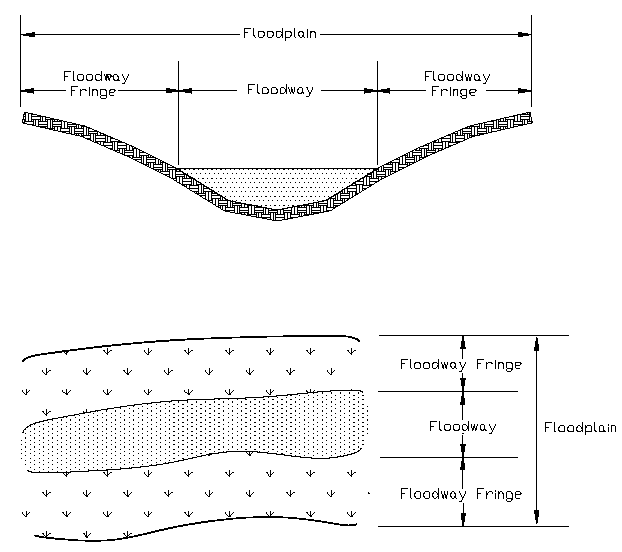
Floodplain or flood-prone area (flood damage prevention). Areas that are subject to, or are exposed to, flooding and flood damage.
Floodplain (stormwater management, drainage and erosion control). For a given flood event, that area of land that is temporarily covered by water and that adjoins a watercourse. In FEMA regulated, or established floodplains, the floodplains shall mean the area subject to inundation from any source during the regulatory event.
Floodplain Administrator (flood damage prevention). The community official designated in the local Flood Damage Prevention Code as responsible for the Code's administration.
Floodplain development permit (flood damage prevention). A permit issued by the local Floodplain Administrator and is required before beginning any development in an area designated as a special flood hazard area on the community's FIRM.
Floodplain management (flood damage prevention). The operation of an overall program of corrective and preventive measures for reducing flood damage, including but not limited to, emergency preparedness plans, flood control works and floodplain management regulations.
Floodplain management regulations (flood damage prevention). Development code, building codes, health regulations, special purpose ordinances (i.e., grading ordinance and erosion control ordinance) and other applications of police power. The term describes such state or local regulations in any combination thereof, which provide standards for the purpose of flood damage prevention and reduction.
Floodproofing (flood damage prevention). Any combination of structural and nonstructural additions, changes or adjustments to structures which reduce or eliminate flood damage to real estate or improved real property, water and sanitary facilities, structures and their contents.
Floodproofing Certificate (flood damage prevention). This term refers to FEMA form 086-0-34, which for the purposes of this Code must be properly completed by a professional engineer or architect licensed to practice in the State of Arkansas.
Floodway (flood damage prevention). The channel of a river, or other watercourse, and the adjacent land area that must be reserved in order to discharge the base flood without cumulatively increasing the water surface elevation more than 1 foot. Also referred to as "regulatory floodway."
Floodway (stormwater management, drainage and erosion control). The channel of a stream, plus any adjacent floodplain areas that must be kept free to encroachment so that the one hundred (100) year flood discharge can be conveyed without increases of more than specified amount in base elevations, either zero or 1 foot depending on specific location. This is an area of significant depths and velocities and therefore due consideration should be given to the effects of fill and loss of cross-sectional flow area is increased water surface elevations.
Floor (DDOD). A story within a building.
Flow-through openings (flood damage prevention). Openings specifically designed to allow floodwaters to flow into and out of enclosed spaces, minimizing the danger of foundation or wall collapse from lateral hydrostatic pressure.
Foot candle. A unit of measurement referring to illumination. One (1) foot candle is equal to one (1) lumen uniformly distributed over an area of 1 square foot.
Forestation (tree preservation and protection). The act of planting trees.
Fraternity or sorority house (zoning). A building owned or leased by a general or local chapter of some regularly organized college fraternity or sorority, or by or on its behalf by a building corporation or association composed of members or alumni thereof, and occupied by the local chapter of such fraternity or sorority as a place of residence.
Freestanding sign (signs). A sign which is attached to or a part of a completely self-supporting structure. The supporting structure shall be set firmly in or below the ground surface and shall not be attached to any building or any other structure whether portable or stationary.
Frontage line. The property line or lines of a lot which coincide with a right-of-way or other public open space, including alleys, multi-use trails, and public parks.
Front yard area. Front yard area shall mean the area between the plane of the front elevation of the principal façade(s) of the principal structure extending to the side property lines and the front property line abutting the street, including the driveway. A front shall be any plane of a building which abuts to a public street right-of-way.
Functionally dependent use (variances, flood damage prevention). A use which cannot perform its intended purpose unless it is located or carried out in close proximity to a feature, such as water.
G
Gable (DDOD). The vertical triangular end of a building from cornice or eaves to ridge.
Gabled roof (DDOD). A double sloping roof that forms a gable at each end.
Gambrel roof (DDOD). A roof where each side has two (2) slopes; a steeper lower slope and a flatter upper one; a "barn roof."
Garage sales (zoning). An occasional sales activity, not to include activities described elsewhere as home occupations, but including activities generally referred to as garage sales, yard sales, rummage sales, white elephant sales, cleaning sales, or moving sales, where used goods are displayed or offered for sale to the general public in a residential area on the resident's premises.
Gas outlet (building regulations). For the purpose of establishing gas permit fees for additions, alterations, repair, and new installations, a gas outlet shall be defined as any service line and/or pipe replacement or extension and a connection to any device and equipment that receives, stores, consumes, transfers, and/or discharges gas.
Gasoline service station (Zoning).
(A)
Buildings and premises where gasoline, oil, grease, batteries, tires, and automobile accessories may be supplied and dispensed at retail, and where in addition the following services may be rendered and sales made, no other:
(1)
Sale and servicing of spark plugs, batteries, and distributor parts;
(2)
Tire servicing and repair, but no recapping or regrooving;
(3)
Replacement of mufflers and tail pipes, water hose, fan belts, brake fluid, light bulbs, fuses, floor mats, seat covers, windshield wipers and wiper blades, grease retainers, wheel bearings, mirrors, and the like;
(4)
Radiator cleaning and flushing;
(5)
Washing and polishing, and sales of automotive washing and polishing materials;
(6)
Greasing and lubrications;
(7)
Providing and repairing fuel pumps, oil pumps, and lines;
(8)
Minor servicing and repair of carburetors;
(9)
Emergency wiring repairs;
(10)
Adjusting and repairing brakes;
(11)
Minor motor adjustments not involving removal of the head or crankcase or racing the motor;
(12)
Sales of cold drinks, package foods, tobacco, and similar convenience goods for filling station customers, as accessory and incidental to principal operations;
(13)
Provision of road maps and other information material to customer; provision of restroom facilities.
(B)
Uses permissible at a filling station do not include major mechanical and body work, straightening of body parts, painting, welding, storage or automobiles not in operating condition, or other work involving noise, glare, fumes, smoke, or other characteristics to an extent greater than normally found in filling stations. A filling station is not a repair garage or a body shop.
Glare (outdoor lighting) means the brightness of a light source that causes eye discomfort.
Glazing (development). A transparent or translucent material that is integrated into a building envelope, such as a window, display window, door, glass curtain wall, etc.
Grade (physical alteration of land). The percentage of rise or fall per 100 feet. Existing grade is the grade prior to grading. Rough grade is the stage at which the grade approximately conforms to the approved plan. Finish grade is the final grade of the site which conforms to the approved plan.
Grading (physical alteration of land). Any stripping, cutting, filling, or stockpiling of earth or land.
Grading and drainage permit (physical alteration of land, stormwater management). Permit issued by the City of Fayetteville to an entity with the legal ability to construct temporary erosion and sedimentation control practices and permanent stormwater practices in accordance and compliance with the provisions and permit conditions of Chapters 169 and 170.
Green façade. A green façade is created by growing climbing plants up and across the façade of a building, either from plants grown directly in the ground or a large container of at least 12 inches of soil medium. Plants can attach directly to the building or be supported with a 12-inch by 12-inch trellis system connected to the building.
Green roof (stormwater). A green stormwater practice, designed per the city's Drainage Criteria Manual, in which an elevated roof surface is entirely covered with a thin soil and vegetation layer.
Green Stormwater Practices (GSPs) and/or Mitigation Measures (development, stormwater management). A green stormwater practice or Water Quality, Flood, and Tree Mitigation Measure, as designed per the city's current Drainage Criteria Manual.
Ground cover (physical alteration of land). Plants with low, spreading habit that form a dense mat in time, preventing erosion.
Guest, short-term rental. Any person who occupies a short-term rental for a period of less than thirty (30) consecutive days pursuant to a short-term rental lease term and/or other like agreement for the purposes of temporary lodging.
Guyed towers (wireless telecommunications facilities). A communications tower that is supported, in whole or in part, by guy wires and ground anchors.
H
Habitable space. Building space whose use involves human presence. Habitable space excludes parking garages, self-service storage facilities, warehouses, and display windows separated from retail activity.
Hazard to air navigation (Airport Zone). An obstruction determined to have a substantial adverse effect on the safe and efficient utilization of the navigable airspace.
Hazardous materials (flood damage prevention). Any material, including any substance, waste, or combination thereof, which because of its quantity, concentration, or physical, chemical, or infectious characteristics may cause, or significantly contribute to, a substantial present or potential hazard to human health, safety, property, or the environment when improperly treated, stored, transported, disposed of, or otherwise managed.
Hazardous tree (tree preservation and protection). A tree or tree parts with high probability of falling or causing injury or property loss; also, a tree harboring insects or a disease that could be detrimental to surrounding trees.
Health officer (Manufactured homes and parks) (manufactured homes and parks opened or expanded, 4-20-72). The legally designated health authority of the city or his authorized representative.
Height. (Airport Zone). Sea level elevation, unless otherwise specified.
Height (Hillside/Hilltop Overlay District). Building height shall be measured from the lowest point of the structure at the historic grade, prior to development, to the highest point of the structure. If the structure is located on a graded pad then the height of the building is measured from the historic grade.
Height (wireless telecommunications facilities). The vertical distance measured from the mean elevation of the finished grade to the highest point on the tower or other structure, even if said highest point is an antenna or antenna array.
Highest adjacent grade (flood damage prevention). The highest natural elevation of the ground surface prior to construction next to the proposed walls of a structure.
Hillside/Hilltop Development Manual (zoning). The best management practices document that supplements the Hillside/Hilltop Overlay District and illustrates desirable Hillside/Hilltop development practices.
Hillside/Hilltop Overlay District (zoning). Lands located within the city that generally have slopes in excess of 15%. The Hillside/Hilltop Overlay District is shown on the city's official zoning map. The development regulations in the Hillside/Hilltop Overlay District supercede the underlying zoning district.
Hipped roof (DDOD). A roof with slopes on all four (4) sides. The "hips" are the lines formed when the slopes meet at the corners.
Historic discharge or volume (Stormwater management, drainage and erosion control). The peak rate or volume at which stormwater runoff leaves a parcel of land in an undisturbed/natural site condition either by gravity or by the legally allowable discharge at the time of permit approval.
Historic grade (Zoning). The natural grade of the land prior to any development.
Historic structure (flood damage prevention). Any structure that is:
(A)
Listed individually in the National Register of Historic Places (a listing maintained by the Department of Interior) or preliminarily determined by the Secretary of the Interior as meeting the requirements for individual listing on the National Register;
(B)
Certified or preliminarily determined by the Secretary of the Interior as contributing to the historical significance of a registered historic district or a district preliminarily determined by the Secretary to qualify as a registered historic district; or
(C)
Individually listed on a state inventory of historic places which has been approved by the Secretary of the Interior.
Home occupation (zoning). An occupation, profession or avocation conducted in a dwelling unit on a part-time or full-time basis for which financial compensation is received and which generates motor vehicle traffic to the dwelling unit by patrons or clients of the occupation, profession or avocation conducted therein. A nontraffic generating occupation, profession or avocation conducted in a dwelling unit by one (1) or more members of the family occupying the premises shall be considered a residential use and not a commercial use. The term home occupation shall include a child care facility handling not more than six (6) children at one (1) time.
Horizontal surface (Airport Zone). A horizontal plane 150 feet above the established airport elevation, the perimeter of which in plane coincides with the perimeter of the horizontal zone.
Horsepower (building regulations). The equivalent to 745 watts.
Host, short-term rental. The owner(s) of a short-term rental who has authority to offer the dwelling unit, portion thereof, or a room within the dwelling unit as a legal short-term rental.
Hosting platform. A person or entity that participates in the short-term rental business by providing and collecting or receiving a fee(s) for facilitating booking transactions through which a short-term rental host may offer a short-term rental to a short-term rental guest. Hosting platforms typically, though not always, facilitate booking transactions through an online platform that allows a short-term rental host to advertise the short-term rental through a website provided by the hosting platform and the hosting platform conducts a transaction by which potential short-term rental guest reserve a guestroom(s) and arrange payment, whether the short-term rental guest pays rent directly to the short-term rental host or to the hosting platform.
Housing Board (manufactured homes and parks) (manufactured homes and parks opened or expanded, 4-20-72). The Housing Board established by the city.
House, lodging or rooming (zoning). A dwelling or building where lodging is provided for two (2) or more persons for compensation, pursuant to previous arrangements, but which is not available to transients and with which no table board is furnished.
Hydrodynamic forces (flood damage prevention). The forces and stresses associated with moving water, including impacts from objects carried in the water.
Hydroseed (physical alteration of land). A machine blown mixture of mulch, seed and sometimes fertilizer.
Hydrostatic flood forces (flood damage prevention). The forces and stresses associated with standing floodwaters.
I
I-540 Overlay District. The Overlay District encompasses all lands lying within 660 feet of each side of the right-of-way of I-540 from the intersection of I-540 and State Highway 471 (a/k/a 71B) north to the city limits of Fayetteville, (a/k/a the 71 Bypass and/or John Paul Hammerschmidt Expressway), and also that portion known as State Highway 471S described more fully as that portion of State Highway 471 which connects I-540 to State Highway 471 (a/k/a North College) and all future extensions of I-540 within the City of Fayetteville. Said boundaries are set out on the official plat pages along with a legal description of such boundaries located in the Planning Division.
Illicit connection (stormwater management and drainage). Any man-made conveyance connecting an illicit discharge directly to the city's municipal separate storm sewer system. This can include either:
(A)
Any drain or conveyance, whether on the surface or subsurface that allows an illegal discharge to enter the storm drain system including but not limited to any conveyances that allow any non-storm water discharge including sewage, process wastewater, and wash water to enter the storm drain system and any connections to the storm drain system from indoor drains and sinks, regardless of whether said drain or connection had been previously allowed, permitted, or approved by an authorized enforcement agency or,
(B)
Any drain or conveyance connected from a commercial or industrial land use to the storm drain system that has not been documented in plans, maps, or equivalent records and approved by an authorized enforcement agency.
Illicit discharge (stormwater management and drainage). Any discharge to a municipal separate storm sewer that is not composed entirely of stormwater unless specifically allowed by §170.10 and discharges resulting from emergency firefighting activities.
Illuminance. The photometric quantity most closely associated with the perception of brightness and a measurement of the intensity of light falling on a surface at a given distance from the light source.
Illuminated sign (signs). Any sign which has characters, letters, figures, designs or outline illuminated by electric lights or luminous tubes as a part of the sign proper.
Impact Fee Administrator (water and wastewater impact fees). The Zoning and Development Administrator or his designee
Impervious area or surface (stormwater management and drainage, physical alteration of land). Land that has been compacted or covered so that it is highly resistant to infiltration by water. Examples include rooftops, sidewalks, driveways, parking lots, and streets unless specifically designed, constructed, and maintained to be pervious. Areas of compacted gravel are considered impervious.
Improvements (development). Physical changes made to property to prepare it for development such as street grading, drainage structures, street surface, sidewalks, curbs, gutters, utility lines, bridges and similar items.
Independent manufactured home (manufactured homes and parks) (manufactured homes and parks opened or expanded, 4-20-72). A manufactured home which has a flush toilet and a bath or shower.
Intensive green roof. A green roof with 6 inches or greater soil medium that can sustain plant species with deeper root systems.
Intermittent stream (tree preservation and protection). A stream that carries water part of the year is dry another part but receives flow from the groundwater table when it is high enough.
Invasive species (tree preservation and protection). Any species not indigenous to a region, which becomes established and displaces native species.
J
Joint identification sign (signs). A sign which serves as common or collective identification for a group of persons or businesses operating on the same subdivision or lot in a residential office, commercial or industrial district (e.g., shopping center, office complex, etc.) Such sign may name the person(s) or business included but carry no other advertising matter.
Junkyard (zoning). Any worn out or discarded materials including but not limited to scrap metal, inoperable motor vehicles and parts, construction material, discarded appliances, or other material in a condition such that it cannot be used for its original purposes.
K
Kennel (zoning). A structure or facility used for the purpose of breeding two (2) or more litters of puppies or kittens within any twelve (12) month period. A facility that keeps animals commercially and has open dog runs, outside play areas, or any areas where animals are kept or left outside.
L
Lacustrine flooding (flood damage prevention). Flooding associated with a lake.
Lamp or bulb (outdoor lighting) means the light producing source installed in the socket portion of a luminaire.
Land disturbance (tree preservation and protection, physical alteration of land, landscape regulations). Clearing, scraping, grubbing, or otherwise removing or destroying the vegetation of a site, or adding, removing, exposing, excavating, leveling grading, digging, tunneling, trenching, burrowing, dumping, piling, dredging or application of toxic substance, storage of materials, and operation of equipment, or otherwise significantly disturbing the soil, mud, sand, or rock of a site.
Landscape Administrator (tree preservation and protection). The person who is responsible for the administration of Tree Preservation and Protection, Chapter 167 and Landscape Regulations, Chapter 177. Also known as Urban Forester.
Landscape establishment guarantee (tree preservation and protection). A bond, irrevocable letter of credit, or other surety held by the city until the satisfactory conclusion of the three (3) year landscape establishment period.
Landscape fabric (physical alteration of land). A barrier against soil erosion, allowing water to pass through while keeping soil in place.
Landscaping (zoning). The area within the boundaries of a given lot which consists of planting materials, including but not limited to trees, shrubs, ground covers, grass, flowers, decorative rock, bark, mulch, and other similar materials.
Large scale development (development). Generally intended for development on a site of 1 acre or greater in size and proposes to create more than 10,000 square feet of impervious area and where a corresponding subdivision of land is not proposed.
Larger than utility runway (airport zone). A runway that is constructed for and intended to be used by propeller-driven aircraft of greater than 12,500 pounds maximum gross weight and jet powered aircraft.
Lateral forces (flood damage prevention). The horizontal hydrostatic forces associated with standing water. Water exerts an equal force in all directions, and as little as 3 feet of standing water can generate sufficient lateral force to collapse a foundation or wall.
Lattice tower (wireless telecommunications facilities). A guyed or self-supporting three (3) or four (4) sided, open, steel frame structure used to support telecommunications equipment.
Lease (signs). An agreement by which a property owner conveys, usually for a specified rent, to other persons, permission to erect and maintain an advertising sign upon his property.
Less desirable species (tree preservation and protection). Low-priority trees or other woody shrubs listed in the City of Fayetteville Tree Preservation, Protection, and Landscape Manual.

Levee (flood damage prevention). A man-made structure, usually an earthen embankment, designed and constructed in accordance with sound engineering practices to contain, control, or divert the flow of water so as to provide protection from temporary flooding.
Light pollution (outdoor lighting) means general sky glow caused by the scattering of artificial light in the atmosphere and resulting in decreased ability to see the natural night sky.
Liner building. A building built in front of a parking garage, cinema, supermarket etc., to conceal large expanses of blank wall area and to face the street space with a façade that has doors and windows.
Lintel (DDOD). A horizontal beam that supports the weight of the wall above a window or door.
Loading space, off-street (zoning). Space logically and conveniently located for bulk pickups and deliveries, scaled to delivery vehicles expected to be used, and accessible to such vehicles when required off-street parking spaces are filled.
Lot (signs). A parcel of land under one (1) ownership whether described by metes and bounds or as a platted lot.
Lot (zoning, flood damage prevention). A parcel of land of at least sufficient size to meet minimum zoning, and where applicable the flood damage prevention, requirements for use, coverage and area, and to provide such yards and other open spaces as are herein required. The term includes the words "plot" or "parcel." Such lot may consist of:
(A)
A single lot of record;
(B)
A portion of a lot of record;
(C)
A combination of complete lots of record, of complete lots of record and portions of lots of record, or of portions of lots of record;
(D)
A parcel of land described by metes and bounds; provided that in no case of division or combinations shall any residential lot or parcel be created which does not meet the requirements of the zoning regulations, Chapter 167.
Lot, corner (zoning). A lot located at the intersection of two or more streets. A lot abutting on a curved street or streets shall be considered a corner lot if straight lines drawn from the foremost points of the side lot lines to the foremost point of the lot meet at an interior angle of less than 135 degrees.
Lot, depth of (zoning). The distance between the midpoints of straight lines connecting the foremost points of the side lot lines in front and the rearmost points of the side lot lines in the rear.
Lot frontage (zoning). The front of a lot shall be construed to be the portion nearest the street, alley, multi-use trail, or public park. Where lots utilize only a public alley, multi-use trail or park to meet lot frontage requirements, development, landscaping, and other standards shall be required as if said alley, multi-use trail, or park were a public street.
Lot, interior (zoning). A lot other than a corner lot with only one (1) frontage on a street, alley, multi-use trail, or public or private park.
Lot, through (zoning). A lot, other than a corner lot, with frontage on more than one (1) street. Through lots abutting two (2) streets may be referred to as double frontage lots.
Lot, width of (zoning). The distance between straight lines connecting front and rear lot lines at each side of the lot, measured across the rear of the required front yard, provided, however, that width between side lot lines at their foremost points (where they intersect with the street line, alley, multi-use trail, or public park) shall not be less than 80% of the required lot width except in the case of lots on the turning circle of a cul-de-sac, where the 80% requirement shall not apply.
Lot of record (zoning.) A lot which is part of a subdivision recorded in the office of the county recorder or a lot or parcel described by metes bounds, the description of which has been so recorded.
Lowest floor (flood damage prevention). The lowest floor of the lowest enclosed area (including basement). An unfinished or flood resistant enclosure, usable solely for parking of vehicles, building access or storage in an area other than a basement area is not considered a building's lowest floor; provided, that such an enclosure is not built so as to render the structure in violation of the applicable nonelevation design requirements of this chapter.
Luminaire or fixture (outdoor lighting) means a complete lighting unit including the lamps or bulbs, together with the parts required to distribute the light, to position and protect the lamps, and to connect the lamps to the power supply.
M
Mall (signs). Any concentration of retail stores and/or service establishments which share customer parking areas and are located within an enclosure having public walkways whereby a customer in one (1) store or establishment may walk to another store or establishment without leaving the enclosure.
Mansard roof (DDOD). A roof type with two (2) slopes on each of the four (4) sides, the lower slope being steeper than the other; capped off with a cupola, typically Victorian.
Manual message board (signs). A changeable copy sign that is arranged manually in the field through the utilization of alphanumeric characters and punctuation marks.
Manufactured home (flood damage prevention). A factory-built, single-family structure that meets the National Manufactured Home Construction and Safety Standards Act (42 U.S.C. §5401), commonly known as the HUD (U.S. Housing and Urban Development) code. For floodplain management purposes the term also includes park trailers, travel trailers, and other similar vehicles placed on a site for greater than one hundred eighty (180) consecutive days. For insurance purposes the term "manufactured home" does not include park trailers, travel trailers, and other similar vehicles.
Manufactured home (manufactured homes and parks). A home built entirely in the factory under a federal building code, administered by the U.S. Department of Housing and Urban Development (HUD), which went into effect June 15, 1976.
Manufactured home (manufactured homes and parks opened or expanded after 4-20-72). A detached structure designed as a complete residential dwelling unit with a permanent chassis and capable of being transported on its own wheels, or on a trailer, and constructed to be ready for use upon being placed on a temporary or permanent foundation.
Manufactured home lot (manufactured homes and parks opened or expanded after 4-20-72). A plot of ground or a lot in a manufactured home park designed for the location for only one (1) manufactured home.
Manufactured home pad (manufactured homes and parks opened or expanded after 4-20-72). That part of an individual manufactured home lot which has been reserved for the placement of a manufactured home.
Manufactured home park (manufactured homes and parks). Any plot of ground of at least one (1) acre in size upon which two (2) or more manufactured homes, occupied for dwelling or sleeping purposes, are located.
Manufactured home park (Manufactured homes and parks opened or expanded after 4-20-72). Any park, court, site, parcel or tract of land designed, maintained intended or used for the purpose of supplying a location or accommodations for two (2) or more manufactured homes and shall include all buildings used or intended for use as part of the equipment thereof; whether or not a charge is made for the use of the court and its facilities.
Manufactured home park or subdivision (flood damage prevention). A parcel (or contiguous parcels) of land divided into two (2) or more manufactured home lots for sale or rent.
Manufactured home space (manufactured homes and parks). A plot of ground within a manufactured home park, designed for the accommodation of one manufactured home.
Manufactured homes and trailer sales lot (manufactured homes and parks opened or expanded after 4-20-72). A lot on which unoccupied trailers are parked for purposes of inspection and sale.
Manufactured home court (zoning). Any plot of ground on which there are located or intended to be located two (2) or more manufactured homes to be occupied for dwelling or sleeping purposes.
Mansard roof (signs). Any roof that has an angle greater than 45 degrees and which derives part of its support from the building wall and is attached to (but not necessarily a part of) a low slope roof and which extends along the full length of the front building wall or three-quarters of the length of a side building wall. For purposes of Signs, Chapter 174, a low slope roof shall mean any roof with a pitch less than 3 inches rise per 12 inches horizontal.
Marquee. A permanently roofed architectural projection the sides of which are vertical and are intended for the display of signs and which is supported entirely from an exterior wall of a building.
May. Is permissive.
Mean sea level (flood damage prevention). For purposes of the National Flood Insurance Program, the National Geodetic Vertical Datum (NGVD) of 1929 or other datum, to which base flood elevations shown on a community's Flood Insurance Rate Map are referenced.
Meter (building regulations). For the purpose of establishing electrical permit fees for additions, alterations, repair, and new installments and to include farm buildings and owner/occupied dwellings a meter shall be defined as an apparatus to measure electrical power and an outlet shall be defined as a point on the wiring system at which current/voltage is switched, connected to a lighting fixture or receptacle, connected to utilization equipment, and connected to any equipment that receives, controls, stores, consumes, and/or transfers electricity.
Microbrewery/microdistillery/microwinery. An establishment for the manufacture, blending, fermentation, processing and packaging of no more than fifteen thousand (15,000) barrels of alcoholic beverages per year. It may serve alcoholic beverages for sampling on the premises and may also have wholesale and resale for sales of alcoholic beverages produced on the premises.
Minimum buildable street frontage (zoning). The minimum required percentage of a lot's street frontage, established by the underlying zoning district and measured in linear feet, that is met by constructing a portion or portions of the vertical side of a building or structure within the build-to zone, subject to supplementary district regulations. Buildings may be constructed outside of the build-to-zone after the minimum required percentage has been met.
Ministorage units (zoning). A structure or structures containing separate, individual, and private storage spaces of varying sizes leased or rented on individual leases for varying periods of time.
Mitigation (tree and preservation and protection). The planting of trees on-site in an effort to lessen the environmental damage caused by the injury or removal of trees during development.
Mitigation alternatives. Mitigation alternatives are plantings that are not trees but still offer environmental benefits. Intensive green roofs, extensive green roofs, and green façades are mitigation alternatives.
Mixed-use structures (flood damage prevention). Structures with both a business and a residential component, but where the area used for business is less than 50% of the total floor area of the structure.
Mobile home (zoning). A manufactured home built prior to June 15, 1976.
Model home. A dwelling unit utilized for display purposes which typifies the type of units to be constructed and available for sale in a subdivision. A model home is constructed in an approved preliminary plat which has not yet received final plat and may be used to sell homes in that subdivision. The model home shall not be used as a branch real estate office for conducting business unrelated to the marketing of homes and lots within the subdivision.
Modular construction (zoning). Any building or structure constructed off-site under plant-controlled conditions, using the same materials, to the same codes and standards as conventionally-built facilities (excluding manufactured homes, as defined by federal standards).
Monopole tower (wireless telecommunications facilities). A communications tower constructed without the use of guy wires and ground anchors and consisting of only a single pole.
Monument sign (signs). A freestanding signs whose entire base is in contact with and supported by the ground.
Motor vehicle (Zoning). A self-propelled vehicle that would have to be licensed to be operated on the public streets and highways. (See Chapter 14 of Title 27 of the Arkansas Code.)
Motor vehicle accessory store (Zoning). Stores that sell new automobile parts, tires, and/or accessories.
Motor vehicle repair and body shop (Zoning). Any property, building or portion thereof used for the service and repair of motor vehicles including major mechanical repair and body work, straightening of body parts, painting, welding, or other work involving noise, glare, fumes, smoke, or other characteristics to an extent greater than normally found in gasoline service stations.
MS4 (stormwater management and drainage). The acronym for Municipal Separate Storm Sewer System and means a conveyance or system of conveyances (including roads with drainage systems, municipal streets, catch basins, curbs, gutters, ditches, manmade channels, and storm drains):
(A)
Which is owned or operated by a state, city, town, county, district, association, or other public body (created by or pursuant to state law) having jurisdiction over disposal of sewage, industrial wastes, stormwater, or other wastes, including special districts under state law such as a sewer district, flood control district or drainage district, or similar entity, or a designated and approved management agency under Section 208 of the Clean Water Act (33 U.S.C. 1288) that discharges to waters of the United States;
(B)
Designed or used for collecting or conveying stormwater;
(C)
That is not a combined sewer; and
(D)
That is not part of a publicly owned treatment works.
Mulch (physical alteration of land). A layer of leaves, straw, bark, or other organic material spread around plants to retain moisture, and to control weeds or erosion.
Mullions (DDOD). Strips of wood or metal that separate and hold in place the panes of a window.
Muntin (DDOD). A short vertical or horizontal bar used to separate panes of glass in a window or panels in a door. The muntin extends from a stile, rail, or bar to another bar. This term is often confused with mullion.
N
Native woodlands (tree preservation and protection). A biological community of trees and woody shrubs native to the Ozark Plateau, covering an area of 10,000 square feet or greater. A list of species to the Ozark Plateau may be found in the City of Fayetteville Tree Preservation, Protection, and Landscape Manual.
Natural drainage ways (flood damage prevention, physical alteration of land). Ephemeral, intermittent and perennial streams. Chapter 169 is not concerned with ephemeral streams.
Neighborhood Link. A street in which in addition to serving abutting properties, provides a bridge between minor streets and community facilities and the larger arterial/regional link street system. Equivalent to a collector street in previous Master Street Plans.
New construction (flood damage prevention). For floodplain management purposes, structures for which the "start of construction" commenced on or after the effective date of this development code.
New development (water and wastewater impact fees, development, physical alteration of land, tree preservation and protection). Construction of a new structure or other impervious area (IA) and the construction or expansion of any other building or structure. The change in use of a building or structure that results in increased demand from water and wastewater facilities shall also be considered new development.
New manufactured home park or subdivision (flood damage prevention). A manufactured home park or subdivision for which the construction of facilities for servicing the lots on which the manufactured homes are to be affixed (including at a minimum, the installation of utilities, the construction of streets, and either final site grading or the pouring of concrete pads) is completed on or after the effective date of the initial floodplain management regulations adopted by a community.
No adverse impact principle (flood damage prevention). A principle of restricting or prohibiting land development that does harm or "adversely affects" someone else's property or land.
Nonconforming sign (signs). A sign existing on 12-19-72 which could not be built under the terms of the UDC.
Nonconforming use (Airport Zone). Any pre-existing structure, object of natural growth, or use of land which does not conform to the provisions of Chapter 165 or an amendment thereto.
Nonconforming structures, uses, and lots. A structure or building, use or activity, or lot which was lawful prior to the adoption, revision, or amendment of the zoning ordinance but that fails by reason of such adoption, revision or amendment to conform to the present requirements of the zoning district.
Non-native woodlands (tree preservation and protection). A biological community of trees and woody shrubs, covering the area of 10,000 square feet or greater, descended from non-native species brought to the area during urban settlement. A list of typical non-native species may be found in the City of Fayetteville Tree Preservation, Protection, and Landscape Manual.
Nonresidential structures (flood damage prevention). Structures used only for commercial or public purposes, such as businesses, schools, churches, etc.
Non-Traditional MS4 (stormwater management and drainage). Systems similar to separate storm sewer systems in municipalities, such as systems at military bases, hospitals, public universities or prison complexes, and highways and other thoroughfares. The term does not include separate storm sewer systems in very discrete areas such as individual buildings.
No-Rise Certificates (flood damage prevention). Formal certifications signed and stamped by a professional engineer licensed to practice in the State of Arkansas, demonstrating through hydrologic and hydraulic analyses performed in accordance with standard engineering practice that a proposed development will not result in any increase (0.00 feet) in flood levels within the community during the occurrence of a base flood event.
NPDES (stormwater management and drainage, physical alteration of land). An acronym for the National Pollutant Discharge Elimination System Storm Water Discharge Permit means a permit issued by EPA (or by a State under authority delegated pursuant to 33 USC § 1342(b)) that authorizes the discharge of pollutants to waters of the United States, whether the permit is applicable on an individual, group, or general area-wide basis.
Nudity or state of nudity (zoning).
(A)
The appearance of the bare human buttocks, anus, male genitals, female genitals or female breast.
(B)
A state of dress which fails to opaquely cover a human buttock, anus, male genitals, female genitals, or areola of the female breast.
O
Obstruction (Airport Zone). Any structure, growth or other object, including a mobile object, which exceeds a limiting height set forth in Chapter 165.
Off-site sign (signs). A sign which directs attention to a business, commodity, service, entertainment or attraction sold, offered or existing elsewhere than upon the same lot where such sign is displayed. The term of-site sign shall include an outdoor advertising sign (billboard) on which space is leased or rented by the owner thereof to others for the purpose of conveying a commercial or noncommercial message.
On-site sign (signs). A sign which directs attention to a business, commodity, service, entertainment or attraction sold, offered or existing on the same lot where such sign is displayed; provided, an on-site sign may also display a noncommercial message.
Operator's permit (manufactured homes and parks) (manufactured homes and parks opened or expanded after 4-20-72). A written permit issued by the enforcement officer permitting the manufactured home park to operate under Chapter 175 and regulations promulgated thereunder.
Original tower height (wireless telecommunications facilities). Height of a tower, not including any antennas, on the date of the passage of this ordinance.
Outdoor advertising business (zoning). Provision of outdoor displays or display space on a lease or rental basis only.
Outdoor music establishment (zoning). Any business or establishment that has a garden, patio, rooftop or premises not wholly enclosed by solid walls and fully roofed in which amplified or loud music is played that could be audible at nearby residences or businesses.
Outfall (drainage criteria manual). A point source as defined by 40 CFR 122.2 at the point where a municipal separate storm sewer discharges to waters of the United States and does not include open conveyances connecting two (2) municipal separate storm sewers, or pipes, tunnels or other conveyances which connect segments of the same stream or other waters of the United States and that are used to convey waters of the United States.
Overbank flood protection (stormwater management and drainage). Measures taken to prevent an increase in the frequency and magnitude of out-of-bank flooding (i.e., flow events that exceed the capacity of the channel and enter the floodplain).
Owner. A person who owns at least a 50% interest in a dwelling unit used for short-term rentals.
P
Parapet. A low guarding wall at the edge of a roof, terrace, or balcony.
Parcel (development). An area under one (1) ownership.
Parking garage (DDOD). Layers of parking stacked vertically.
Parking informational sign (Signs). A wall sign or a freestanding sign indicating the location of a motor vehicle parking lot and designating the persons authorized to park in said lot. The size of a parking information sign shall not exceed 4 square feet. The number of parking informational signs on a parking lot shall not exceed the number of entrances for the parking lot.
Parking lot (zoning). An off-street, surfaced, ground level open area, for the temporary storage of five (5) or more motor vehicles.
Parking pad (Hillside/Hilltop Overlay District). Parking areas for multi-family residential, residential office, and commercial use in the Hillside/Hilltop Overlay District.
Parking space, off-street (parking and loading). A space adequate for parking an auto manufactured with room for opening doors on both sides, together with properly related access to a public street or alley and maneuvering room.
Passive open space (development). An area intended for tranquil activities such as walking, sitting, observing and the less active games like shuffleboard and croquet.
Pavement width (development). The distance from inside edge of curb to inside edge of curb (flow line to flow line).
Peak flow (stormwater management, drainage and erosion control). The maximum rate of flow of water at a given point and time resulting from a given storm event as defined by the city's current Design Criteria Manual.
Peak flow attenuation (stormwater management, drainage and erosion control). The reduction of the peak discharge of storm runoff by storage and gradual release of that stored flow as defined by the city's current Design Criteria Manual.
Pedestal (DDOD). The base or support of an upright structure.
Percent minimum canopy (tree preservation and protection). The amount of existing tree canopy an applicant must preserve based on the zoning designation of the land to be developed.
Perennial stream (physical alteration of land). A stream that carries water year round.
Permanent residential dwelling. A structure that has been legally permitted or is a legal, non-conforming structure allowed for permanent occupancy as a residential dwelling.
Permeable pavers (stormwater). A solid surface that allows natural drainage and migration of water into the earth by permitting water to drain through the surface itself or through spaces between the pavers.
Person An individual, firm, limited or general partnership, corporation, company, business, association, joint stock association, organization, group of individuals, other legal entity or government entity, including a trustee, a receiver or assignee or a similar representative of any of them.
Personal use (wireless telecommunications facilities). "Personal use" refers to a non-commercial use by a resident of the subject property. If any revenues are generated from the operation of the tower, it will not be for personal use as such term is used.
Pet shop (zoning). A commercial establishment or facility which regularly sells pets such as dogs, cats, birds, rodents, reptiles and/or fish to the general public.
Piers (flood damage prevention). Columns of concrete or other structural material, used to support other structural members.
Pilings (flood damage prevention). Steel tubes driven to rock or a suitable soil bearing layer and connected to the foundation of a structure.
Plan, General (development). The plan made and adopted by the Planning Commission and adopted by the City Council that includes studies and analysis of the population, housing and economics of the city and includes the future land use plan and the master street plan.
Plan, Future Land Use (development). A part of the Comprehensive Land Use Plan made and adopted by the Planning Commission and adopted by the City Council that establishes long-range planning policies and implementation strategies to manage and guide future growth and development, consisting of a map and text. It includes general recommendations for locations of land uses.
Plan, Master Street (development). A part of the Comprehensive Land Use Plan made and adopted by the Planning Commission and adopted by the City Council that classifying certain streets within the planning area jurisdiction as arterial or collector streets, consisting of a map and text.
Planned Zoning District (zoning, development). A zoning district that allows for comprehensively planned developments for either single-use or mixed-use and permits development and zoning review as a simultaneous process.
Plat, concept (development). A generalized sketch of an area intended to be subdivided and containing sufficient information to allow the Planning Commission to determine whether a subdivide can comply with the regulations.
Plat, final (development). A complete and exact subdivision plat, prepared for official recording as required by state law, to define property boundaries and proposed streets and other improvements.
Plat, preliminary (development). A preliminary plat for a subdivision shall be a formal plan, drawn to scale, indicating prominent existing features of a tract and its surroundings and the general layout of the proposed subdivision and shall meet the requirements outline in Chapter 166.
Platform sign (signs). A single or double-face sign attached to a supporting base place on the ground surface.
Plinth (Hillside/Hilltop Overlay District). A foundation or base, usually on the upslope side of the Hillside/Hilltop, on which a house is located. Most often a plinth is constructed by erecting a retaining wall at the street with backfill creating a level building pad for the home.
Plumbing fixture (building regulations). For the purposes of establishing plumbing permit fees for additions, alterations, repairs, and new installations, a plumbing fixture shall be defined as any service line and/or pipe replacement or extension and any device and equipment that receives, stores, consumes, transfers, and/or discharges liquid and/or waste.
Pole sign (signs). A freestanding sign that is affixed, attached, or erected on a pole or poles that is not itself an integral part of or attached to a building or structure.
Pollutant (stormwater management and drainage). Dredged spoil, solid waste, incinerator residue, filter backwash, sewage, garbage, sewage sludge, munitions, chemical wastes, biological materials, radioactive materials (except those regulated under the Atomic Energy Act of 1954, as amended (42 U.S.C. 2011 et seq.)), heat, wrecked or discarded equipment, rock, sand, cellar dirt and industrial, municipal, and agricultural waste discharged into water.
Porch (DDOD). An open, roofed structure attached to and structurally a part of the main building that is not more than 75% enclosed by walls and is not heated or cooled.
Portable swinger sign and A-frame or sandwich sign (signs). An advertising device which is ordinarily in the shape of an "A" or some variation thereof, located on the ground, easily movable, not permanently attached thereto and which is usually two (2) sided.
Portable temporary attraction sign board (signs). A single or double-surface painted or poster panel type sign or some variation thereof, which is temporary in nature, usually mounted on wheels, easily movable, and not permanently attached thereto.
Post construction stormwater management (stormwater management and drainage). Term involves stormwater best management practices that are used on a permanent basis to control and treat runoff once construction has been completed in accordance with a drainage permit issued per Chapter 170 and the city's current Drainage Criteria Manual.
Precision instrument runway (Airport Zone). A runway having an existing instrument approach procedure utilizing an instrument landing system (ILS) or a precision approach radar (PAR). It also means a runway for which a precision approach system is planned and is so indicated on an approved airport layout plan or any other planning document.
Prefabricated construction (zoning). Any structure built entirely off-site (excluding manufactured homes, as defined by federal standards).
Primary surface (airport zone). A surface longitudinally centered on a runway. When the runway has a specially prepared hard surface, the primary surface extends 200 feet beyond each end of that runway; for military runways or when the runway has no specially prepared hard surface, or planned hard surface, the primary surface ends at each end of that runway. The width of the primary surface is set forth in §165.01. The elevation of any point on the primary surface is the same as the elevation of the nearest point on the runway centerline.
Principal dwelling unit (zoning). A principal dwelling unit is the primary and larger of two dwelling units located on a single lot.
Principal façade. The front plane of a building that faces a public street including porches and balconies, but not including stoops, awnings or canopies (whether or not attached to the building).
Principal use ground mounted solar energy system: A solar energy system that is the principal use of the property and is structurally mounted to the ground.
Private open space (development). The outdoor living area directly adjoining a dwelling unit or building, intended for the private enjoyment of the residents or occupants of the dwelling unit or building and defined in such a manner that its boundaries are evident.
Projected bay (DDOD). A window or series of windows forming a bay in a room and projecting outward from the wall.
Projecting sign (signs). Any sign that shall be affixed at an angle or perpendicular to the wall of any building in such a manner to read perpendicular or at an angle to the wall on which it is mounted.
Protected Streams Map (flood damage prevention). The official map adopted by the Fayetteville City Council, and revised as required administratively for annexed areas, indicating the point where at least 100 acres drains into a waterway and the requirements of the streamside protection zone apply downstream.
Public grounds (tree preservation and protection). Areas including street rights-of-way, alleys, parks, medians, substations, treatment plants, plazas, squares, public buildings and any other area designated for public use.
Public open space (development). Open space, including but not limited to, any park, lake, stream, playground, or natural area commonly open to the public.
R
Rain garden (stormwater). An attractive landscaping feature planted with perennial native plants. It is a bowl-shaped garden, designed to absorb stormwater run-off from impervious surfaces such as roofs and parking lots.
Real estate sign (signs). Temporary sign placed upon property for the purpose of advertising to the public the sale or lease of said property.
Rear access lane A publicly or privately owned secondary way that affords access to the side or rear of abutting property.
Recreational structure (development). Anything constructed or erected with a fixed location on the ground, or attached to something having a fixed location on the ground that has a primary use that is recreational in nature. Among other things, recreation structures include tennis courts, basketball courts, swimming pools and jogging trails.
Recreational vehicles (flood damage prevention) means a vehicle which is:
(A)
Built on a single chassis;
(B)
400 square feet or less when measured at the largest horizontal projections;
(C)
Designed to be self-propelled or permanently towable by a light duty truck; and
(D)
Designed primarily not for use as a permanent dwelling but as temporary living quarters for recreational, camping, travel, or seasonal use.
Regional link. A street or road intended to carry local and regional multi-modal traffic, serving low-density residential areas and open spaces. Equivalent to a minor arterial street in previous Master Street Plans.
Regional link, high activity. A street or road intended to carry local and regional multi-modal traffic through a variety of densities and land uses. Equivalent to a major arterial street in previous Master Street Plans.
Registered child care family home (zoning). A childcare setting in which the caregiver provides child care in a family residence or a residence with a homelike environment and is registered or licensed by the State of Arkansas pursuant to Ark. Code Ann. §20-78-201, et seq.
Regulatory floodway (flood damage prevention). See: "Floodway."
Relic orchard (tree preservation and protection). Groups of fruit trees originally planted for agricultural purposes, but since taken out of production.
Remedy a violation (flood damage prevention). To bring the structure or other development into compliance with state or local floodplain management regulations, or, if it is possible, to reduce the impacts of its noncompliance. Ways that impacts may be reduced include protecting the structure or other affected development from flood damages, implementing the enforcement provisions of this development code, or otherwise deterring future similar violations, or reducing federal financial exposure with regard to the structure or other development.
Remove (signs). Remove shall mean:
(A)
The sign face, along with the posts, columns, or supports of freestanding signs, shall be taken down and removed from the property.
(B)
The sign face and supporting structures of "projecting," "roof" or "wall" signs shall be taken down and removed from the property.
(C)
The sign face of "painted wall signs" shall be removed by painting over the wall sign in such a manner as to completely cover up and hide from sight the sign in question.
Residential driveway (streets and sidewalks). A driveway on public property adjacent to a public street or highway to provide entrance to or exit from residential property for the exclusive use and benefit of those residing therein.
Residential link. Intended to be the standard in neighborhoods and low-volume streets outside of downtown. Equivalent to a local street in previous Master Street Plans.
Residential link, alternative. Intended to reduce the footprint of the residential streetscape in areas where historic precedent, environmental characteristics, traffic volumes, or land uses support reduced rights-of-way. Equivalent to residential or low-impact development streets in previous Master Street Plans.
Residential zone (streets and sidewalks). Any one (1) side of a block in which 50% or more of the frontage of that side is used for residential purposes.
Retail (DDOD). The sale of commodities or goods in small quantities to ultimate consumers.
Retail liquor store (zoning). Any business engaged primarily in the retail sale of spirituous, vinous or malt beverages or light wine or beer as said terms are defined by A.C.A. §3-1-102, §3-1-103 and §3-5-202 for off-premises consumption.
Retaining wall (physical alteration of land). A structure erected between lands of different elevation to protect structures and/or prevent erosion from the upper slope.
Retaining wall height (physical alteration of land). The height of a retaining wall, for setback purposes, shall be defined as the vertical distance from the top of the wall to the ground surface of the low side.
Retention (landscape regulations). The use of complete storage to prevent the discharge of a given volume of stormwater runoff into surface waters.
Right-of-way (development). The land opened, reserved or dedicated for street, walk, drainage or other public purposes.
Riparian (tree preservation and protection, low impact development). Of, relating to, or located on the bank of a river or stream.
Riparian buffer (tree preservation and protection, low impact development). A biological community consisting of trees, woody shrubs and groundcover that exists along the banks of rivers, creeks or intermittent and perennial streams.
Rip-rap (physical alteration of land). A loose assemblage of stones placed on ground to prevent erosion. Rip-rap shall be sized so that displacement does not occur due to velocity of water.
Risk zones categorize special flood hazard areas into groupings by the specific risk of flooding. Zones A, AE, AO, and AH are special flood hazard areas. See "X Risk Zones" in this section.
Riverine (flood damage prevention). Relating to, formed by, or resembling a river (including tributaries), stream, brook, etc.
Riverine flooding (flood damage prevention). Flooding associated with a river or stream channel.
Roof sign (signs). Any sign wholly erected, constructed or maintained on the roof structure or parapet wall of any building.
Runoff reduction method. Refers to the use of Green Stormwater Practices as described in the city's current Drainage Criteria Manual, to control stormwater runoff volume by attempting to mimic a site's natural hydrology through the use of design techniques that promote infiltration, filtration, storage, and evapotranspiration.
Runway (Airport Zone). A defined area on an airport prepared for landing and take-off of aircraft along its length.
Rural street (development). A street located, or to be located, outside the city limits of the city but within the planning area jurisdiction of the city.
RV (flood damage prevention). The acronym for recreational vehicle.
S
Safety zone (streets and sidewalks). All parts of the street or highway right-of-way between the curb or shoulder line and the right-of-way line along the property frontage, except those areas contained in the access driveways.
Screw augers (flood damage prevention). Any type of anchor that twists into the soil, typically to a depth of 4 feet or more. They are not suitable for securing manufactured homes against floodwaters because saturated grounds often soften and fail to hold the anchor in place.
Section 404 Wetlands Permit (flood damage prevention). A permit required under Section 404 of the Clean Water Act for the discharge of dredged and fill material into any surface water of the United States. The U.S. Army Corps of Engineers issues Section 404 permits.
Sediment basin (physical alteration of land). A temporary depression in a waterway designed to trap sedimentation before entry into the stormwater system or natural drainage ways.
Separate offense (tree preservation and protection). In relation to trees, each tree is a separate offense.
Service building (manufactured homes and parks) (manufactured homes and parks opened or expanded after 4-20-72). A building housing toilet and bathing facilities for men and women with laundry facilities and such other facilities as may be required by Chapter 175.
Setback (zoning). A required open space other than a court unoccupied and unobstructed by any structure or portion of a structure 30 inches above the general ground level of the graded lot upward, provided, however, that fences, walls, poles, posts and other customary yard accessories, ornaments, and furniture may be permitted in any yard subject to height limitations and requirements limiting obstruction of visibility. An architectural projection, such as an eave, utility chase, chimney or bay window shall not be considered to be in violation of a setback requirement as long as the projection does not intrude into a public right-of-way or extend more than 3 feet into a setback. A projection which encroaches into a setback shall not come closer than 3 feet to a property line.
Setback lines or building lines (development). A line on a plat generally parallel to the street right-of-way, indicating the limit beyond which buildings or structures may not be erected except as provided in ordinances.
Setback, front (zoning).
(A)
A setback extending between side lot lines across the front of a lot adjoining a public street. In the case of through lots, unless the prevailing front setback pattern on adjoining lots indicates otherwise, front setbacks shall be provided on all frontages.
(B)
Depth of required front setbacks shall be measured at right angles to a straight line joining the foremost point of the side lot line, in the case of rounded property corners at street intersections, shall be assumed to be the point at which the side and front lines would have met without such rounding.
Setback, rear (zoning).
(A)
A setback extending across the rear of the lot between inner side setback lines. In the case of through lots and corner lots, there will be no rear setbacks, but only front and side setbacks.
(B)
Width of a required rear setback shall be measured in such a manner that the setback established is a strip of the minimum width required by the district regulation with its inner edge parallel with the rear lot line.
Setback, side (zoning).
(A)
A setback extending from the rear line of the required front yard to the rear lot line, or in the absence of any clearly defined rear lot line, or in the absence of any clearly defined rear lot line to the point on the lot farthest from the intersection of the lot line involved with the public street. In the case of through lots, side setbacks shall extend from the rear lines of front setbacks required. In the case of corner lots, yards remaining after full front setbacks have been established shall be considered side setbacks.
(B)
Width of a required side setback shall be measured in such a manner that the setback established is a strip of the minimum width required by district regulations with its inner edge parallel with the side lot line.
Setback, special (zoning). A setback behind any required setback adjacent to a public street, required to perform the same functions as a side or rear setback, but adjacent to a lot line so placed or oriented that neither the term "side setback" nor the term "rear setback" clearly applies.
Sexually oriented business (zoning). An adult arcade, adult bookstore or adult video store, adult cabaret, adult motion picture theater, or adult theater.
Shall (zoning). Is mandatory.
SFHA (flood damage prevention). The acronym for special flood hazard area.
Shallow flooding (flood damage prevention). Flooding at a depth of less than 3 feet.
Shed roof (DDOD). A roof type with one high pitched plane covering the entire structure.
Shielding (outdoor lighting) means that no part of the lamp or bulb is visible below the horizontal plane of the fixture where light is emitted. The lamp or bulb shall be completely enclosed within the fixture. The top and sides of the fixture above the horizontal plane shall be 100% opaque.
Shopping center (signs). Two (2) or more retail stores and/or service establishments, or one (1) retail store and one (1) service establishment, sharing customer parking areas, regardless of whether said stores and/or establishments occupy separate structures or are under separate ownership.
Short-term rental. A commercial dwelling unit, portion of a dwelling unit, or bedroom within a residential dwelling unit, leased and/or rented to a guest(s), for a period of less than thirty (30) consecutive days.
Short-term rental, Type 1. A short-term rental is where the owner or long-term tenant occupies the principal dwelling or the accessory dwelling unit as their primary full-time residence for at least nine (9) months of each calendar year and rents the remaining portion of their residence or their accessory dwelling unit as a short-term rental. An applicant for a Type 1 short-term rental shall provide a copy of the property's Homestead Tax Credit, long-term lease agreement or other comparable evidence of long-term residency to the city to prove the long-term residency requirement. The long-term occupant of the property is responsible for the management and control of occupants in the short-term rental, Type 1 to ensure no adverse effects or problems are inflicted upon residential neighbors.
Short-term rental, Type 2. If a desired short-term rental does not qualify as a short-term rental, Type 1, a property owner may seek to be approved as a short-term rental, Type 2. A new short-term rental, Type 2 may be permitted in residential zoning districts pursuant to the requirements of §163.18 and in non-residential and mixed-use zoning districts pursuant to §164.26. All short-term rentals, Type 2 must also comply with requirements of §118.01(E).
Sign (signs). Only those commercial and non-commercial signs that are in view of the general public from a public right-of-way or public property shall be regulated pursuant to Chapter 174, Signs. Signs within buildings not generally visible outside the building are not regulated.
(1)
Non-commercial sign. A device or display including flags and attraction devices commonly referred to as a sign that does not advertise a product or service or relate to a business purpose, does not propose a commercial transaction nor relate to economic interests including offices and studios.
(2)
Commercial sign. A device or display including flags and attraction devices commonly referred to as a sign that does not meet the definition of a non-commercial sign nor a government sign.
(3)
Government sign. A device or display including flags commonly referred to as a sign that is installed, owned, required or controlled by the City of Fayetteville, County of Washington, State of Arkansas, the United States of America or any agencies or subdivisions of such governmental bodies.
(4)
Artistic murals. Artistic murals hand painted on a building's wall without advertising, commercial logos or depictions of commercial activities are not signs for the purposes of Chapter 174, Signs.
Significant tree (tree preservation and protection). A tree with a diameter at breast height (DBH) of 24 inches or more for fast growth species, 18 inches or more for slow and moderate growth species, and 8 inches or more for understory species, as set forth in the City of Fayetteville Tree Preservation, Protection, and Landscape Manual. A tree may also be considered significant because of advanced age for its species, or because it represents an uncommon or endangered species, or due to its location on a site designated as historic by local, state or federal authorities.
Single housekeeping unit (zoning). A dwelling unit with common access to and common use of all living and eating areas an all areas and facilities for the preparation, serving and storage of food within the dwelling unit.
Site (physical alteration of land). Any lot or parcel of land or contiguous combination thereof, under the same ownership, where grading is performed or permitted.
Slab anchors (flood damage prevention). Anchors where the hook of the anchor is wrapped around a horizontal rebar in the slab before the concrete is poured.
Slope (physical alteration of land). An inclined ground surface, the inclination of which is expressed as a ratio of horizontal distance to vertical distance.
Special flood hazard areas (flood damage prevention). Geographical areas identified on FEMA flood maps as being at-risk for flooding. The maps further categorize these areas into various flood risk zones A, AE, AH, and AO.
Specified anatomical areas (zoning).
(A)
Less than completely and opaquely covered human genitals, pubic region, buttock(s), and female breast below a point immediately above the top of the areola; and
(B)
Human male genitals in a discernible turgid state, even if completely and opaquely covered.
Specified sexual activities (zoning).
(A)
Human genitals in a state of sexual stimulation or arousal;
(B)
Acts of human masturbation, sexual intercourse, or sodomy;
(C)
Fondling or other erotic touching of human genitals, pubic region, buttock(s) or female breast.
Spotlight or floodlight (outdoor lighting) means any lamp that incorporates a reflector or a refractor to concentrate the light output into a directed beam in a particular direction.
Spot light illumination (signs). Illumination which comes from lamps, lenses or devices designed to focus or concentrate the light rays of the source.
Stabilization (physical alteration of land). That which is attained once the site is restored to its pre-development state in terms of soil stability and irritability.
Start of construction (flood damage prevention). The date the building permit is issued for either new construction or substantial improvement, provided the actual start of construction, repair, reconstruction, replacement, or other improvement was within one hundred eighty (180) days of the permit date. The actual start means either the first placement of permanent construction of a structure on a site, beyond excavation, or the placement of a manufactured home on a foundation. Permanent construction does not include land preparation or the installation of streets and/or walkways, nor does it include the installation on the property of accessory buildings, such as garages or sheds not occupied as dwelling units or not part of the main structure.
State coordinating agency (flood damage prevention). The agency that acts as a liaison between FEMA and a community for the purposes of floodplain management. The Arkansas Department of Agriculture Natural Resource Division is the State Coordinating Agency for Arkansas.
Stealth technology (wireless telecommunications facilities). Systems, components and materials used in the construction of wireless communications facilities to make it compatible with the surrounding property.
Stoop (DDOD). A small platform and / or entrance stairway at a door, commonly covered by a secondary roof or awning.
Storefront. The portion of a building at the first story of a retail frontage that is made available for retail use.
Stormwater (stormwater management, drainage and erosion control). The flow of water that results from and occurs immediately following a rainfall event.
Stormwater facility (landscape regulations, physical alteration of land, stormwater management, drainage and erosion control). A facility designed to meet the requirements for stormwater management. For the purposes of Chapters 169 and 170, stormwater facilities refer primarily to detention ponds.
Stormwater management plan (stormwater management, drainage and erosion control). A plan for receiving, handling, and transporting storm and surface waters within the city's stormwater management system.
Stormwater management system (stormwater management, drainage and erosion control). All natural and man-made elements used to convey stormwater from the first point of impact with the surface of the earth to a suitable outlet location internal or external to the boundaries of the City of Fayetteville. The stormwater management system includes all pipes, channels, streams, ditches, wetlands, sinkholes, detention/retention basins, ponds, lakes, and other stormwater conveyance and treatment facilities whether public or private.
Stormwater sizing criteria (stormwater management, drainage and erosion control). Development projects applying for a Grading and Drainage Permit shall meet the Minimum Standards related to stormwater runoff and protection of existing water bodies and properties. These stormwater sizing criteria must be used to design required structural stormwater controls and can be found in the city's current Drainage Criteria Manual.
Story (building height). Building height when measured in stories shall be as defined by the International Building Code.
Stream (flood damage prevention). Defined for the purposes of Chapter 168, Flood Damage Prevention, as single lines with no floodplain or floodway defined as illustrated on the city's current Flood Insurance Rate Map.
Stream corridor (stormwater management, drainage and erosion control). The landscape and physical features on both sides of a stream, including soils, slope, and vegetation, whose alteration can directly impact the stream's physical characteristics and biological properties.
Streamside protection zones (flood damage prevention). Areas generally, but not always, made up of trees and accompanied by shrubs and other vegetation along a stream, river or shoreline that is managed to maintain the integrity of the waterway and to reduce pollution.
Street (development). A strip of land, including the entire right-of-way, intended primarily as a means of vehicular and pedestrian travel which may also be used to provide space for sewers, public utilities, trees and sidewalks.
Street, frontage (development). A minor street which is generally parallel to and adjacent to a major highway or railroad right-of-way and which provides access to abutting properties and protection from through traffic.
Street line (zoning) (streets and sidewalks). The right-of-way line of street.
Street, minor (development). A street used primarily to provide access to abutting properties.
Street right-of-way (development). The area designated for city improvements on both sides of the street.
Streets (streets and sidewalks). Of higher use designation than collector street, including arterial streets and expressways as defined in Ordinance No. 1750 of the City of Fayetteville, Arkansas.
Structural development (flood damage prevention). A development that includes the placement or construction of a structure.
Structure (Airport Zone). An object, including a mobile object, constructed or installed by man, including but without limitation, buildings, towers, cranes, smokestacks, earth formation, and overhead transmission lines.
Structure (flood damage prevention). Refers to any building with two (2) or more rigid walls and a fully secured roof on a permanent site or to any gas or liquid storage tank that is principally above ground.
Structure orbuilding (zoning). Anything constructed or erected with a fixed location on the ground, or attached to something having a fixed location on the ground. Among other things, structures include buildings, manufactured homes, walls, fences, billboards and poster panels.
Subdivider (development). A person, firm or corporation undertaking a subdivision as defined in Chapter 166, Development.
Subdivision (development). The subdividing of land into lots and blocks, the parceling of land resulting in the need for access or utilities, or the dividing of an existing lot or parcel into two (2) or more lots or parcels.
Substantial damage (flood damage prevention). Damage of any origin sustained by a structure whereby the cost of restoring the structure to its before-damaged condition would equal or exceed 50% of the market value of the structure before the damage occurred.
Substantial improvement (flood damage prevention). Any repair, reconstruction, rehabilitation, addition or improvement of a structure or any combination thereof, the cost of which equals or exceeds 50% of the market value of the structure and cumulative substantial improvements over a five (5) year period, either:
(A)
Before the improvement or repair is started; or
(B)
In the case of cumulative substantial improvement before the initial improvement or repair is started within the past 5-year period.
(C)
If the structure has been damaged, and is being restored, before the damage occurred.
This phrase shall include structures which have incurred substantial damage. For the purpose of this definition, "substantial improvement" is considered to occur when the first alteration of any wall, ceiling, floor, or other structural part of the building commences, whether or not that alteration affects the external dimensions of the structure. The term does not, however, include either:
(a)
Any project for improvement or a structure to comply with existing state or local health, sanitary, or safety code specifications which are solely necessary to assure safe living conditions; or
(b)
Any alteration of a structure listed on the National Register of Historic Places, or a state inventory of historic places provided that the alteration will not preclude the structure's continued designation as an historic structure.
Suburban (development). Located outside the corporate city limits, but within the city's planning area.
T
Tandem lot. A lot which has less than 50% of the required frontage on a public street and which is located behind a conforming lot or a portion of a conforming lot.
Telecommunications (wireless telecommunications facilities). The transmission, between or among points as specified by the user of information of the user's choosing, without change in the form or content of the information as sent and received.
Terne (DDOD). An alloy of lead with about 15% tin. Used to coat sheet steel to inhibit corrosion.
Terrace (physical alteration of land). A relatively level step constructed in the face of a graded slope surface for drainage and maintenance purposes.
Top of bank (flood damage prevention). The point along a streambank where an abrupt change in slope is evident, and where the stream is generally able to overflow the banks and enter the adjacent floodplain during flows at or exceeding the average annual high water stage.
Topping (tree preservation and protection). Also referred to as stubbing, dehorning, pollarding and heading; it is the severe removal of the tree canopy back to large stubs.
Tower or communications tower (wireless telecommunications facilities). Any structure that is designed and constructed for the primary purpose of supporting one or more antennas, including lattice towers, guy towers, or monopole towers. The term includes radio and television transmission towers, microwave towers, common-carrier towers, cellular telephone towers, alternative tower structures, and the like. This term is not intended to describe buildings or other structures that have been constructed primarily for a purpose other than supporting one or more antennas, despite the fact that such structure may currently, or in the future, actually support one (1) or more antennas.
Towing impound yard (Zoning). A facility operated for the temporary storage of towed motor vehicles that are to be claimed by their title holders or agents, or transported to a repair shop.
Towing service (Zoning). An establishment that provides for the removal of a motor vehicle by towing, carrying, hauling or pushing from public or private property when such vehicle has been ordered to be impounded to a public or private impound yard. This shall not include a "motor vehicle repair and body shop" use that has a tow truck and services vehicles on-site.
Transitional surfaces (Airport Zone). A surface extending outward at 90 degree angles to the runway centerline and the runway centerline extended at a slope of 7 feet horizontally for each foot vertically from the sides of the primary and approach surfaces to where they intersect the horizontal and conical surfaces.
Travel trailer (zoning). A vehicular, portable structure built on a chassis, designed to be used as a temporary dwelling for travel and recreational purposes, having a body width not exceeding 8 feet.
Tree (Airport Zone). Any object of natural growth.
Tree (tree preservation and protection). Any self-supporting woody perennial plant, usually having a main stem or trunk and many branches, and at maturity normally attaining a trunk diameter greater than 3 inches at DBH and a height of over 10 feet.
Tree preservation area (tree preservation and protection). Those areas designated for the protection of both preserved and planted trees depicted on a tree preservation plan, abbreviated tree preservation plan, preliminary plat, large scale development, or site plan.
Tree preservation plan (tree preservation and protection). A site plan that delineates tree preservation areas and details measures to be taken to ensure protection and survivability of trees to be saved, prior to and during construction.
Tree registry (tree preservation and protection). A list of trees registered with the city due to documented historic association, rare tree species or extraordinary value because of their age, size or type.
Tree surgery (tree preservation and protection). Includes cavity filling/repair, bracing, cabling, and wound treatment.
Turret (DDOD). A small tower or tower-shaped projection on a building.
U
Unit (building regulations). A product or equipment used in heating and air conditioning, refrigeration, ventilation, or process cooling and heating system.
Urban (development). Located within the corporate city limits.
Urban Forester (tree preservation and protection, landscape regulations). The person who is responsible for the administration of Tree Preservation and Protection, Chapter 167 and Landscape Regulations, Chapter 177. Also known as Landscape Administrator.
Urban Forestry Advisory Board (tree preservation and protection). An advisory committee appointed by the City Council to assist the Urban Forester with city beautification and the management of its trees.
Urban street (development). A street located, or to be located, within the city limits.
Use buffer (tree preservation and protection). Trees or other woody shrubs that serve to screen incompatible land uses, unwanted light, or noise.
Used or occupied (zoning). Include the words "intended," "designed," or "arranged to be used or occupied."
Uses vulnerable to floods (flood damage prevention). Any land or structural uses that may be negatively affected by a flood.
V
Veterinary small animal out-patient clinic (zoning). An office where vaccination and treatment of small animals is performed; where no x-rays, surgery or treatments requiring hospitalization are performed; where no overnight boarding is permitted; and where no after-hours or weekend emergency services are performed.
View obscuring vegetation (zoning). A screen of live plant material that is opaque from the ground to a height of at least 6 feet intended to exclude visual contact between uses and to create a strong impression of special separation during all seasons of the year. At maturity, the screen shall be considered to be view obscuring if there are no openings of greater that one square foot.
Violation (flood damage prevention). The failure of a structure or other development to be fully compliant with the community's floodplain management regulations. A structure or other development without the elevation certificate, other certifications, or other evidence of compliance required in Chapter 168 is presumed to be in violation until such time as that documentation is provided.
Visual runway (Airport Zone). A runway intended solely for the operation of aircraft using visual approach procedures.
W
Wall sign (signs). Any sign that shall be affixed parallel to the wall or printed on the wall of any building in such a manner as to read parallel to the wall on which it is mounted; provided, however, said wall sign shall not project above the top of the wall or beyond the end of the building. For the purpose of Chapter 174, any sign display surface that is affixed flat against the sloping surface of a mansard roof shall be considered a wall sign. Any sign that is affixed to the face of the building marquee, building awning, or a building canopy shall be considered a wall sign.
Wastewater system improvements (water and wastewater impact fees). Capacity-enhancing improvements to the facilities for the transmission, treatment, reclamation and disposal of wastewater. Lift stations, force mains and gravity mains or excluded from the definition of wastewater system improvements.
Water surface elevation (flood damage prevention). The height, in relation to the North American Vertical Datum (NAVD) of 1988 (or other datum where specified) of floods of various magnitudes and frequencies in the floodplains of riverine areas.
Water system improvements (water and wastewater impact fees). Capacity-enhancing improvements to the facilities for the supply, storage, transmission and distribution of potable water, excluding water lines less than 8 inches in diameter and other lines that are the minimum size needed to serve an individual development project.
Watercourse alteration (flood damage prevention). Refers to any change that occurs within the banks of a watercourse.
Windblown sign (signs). Any flag, pennant, balloon, spinner, or blimp.
Wireless communications facility (WCF) (wireless telecommunications facilities). A land use facility that transmits and/or receives electromagnetic signals for the purpose of transmitting analog or digital voice or data communications. It includes antennas, microwave dishes, horns and other types of monopoles, or similar structures supporting said equipment, equipment buildings, shelters or cabinets, and other accessory development. Wireless communications facility includes personal wireless services as defined in the Federal Telecommunications Act of 1996, and as subsequently amended.
X risk zones (flood damage prevention). A special group of insurance risk zones. One (1) type, shown as non-shaded areas on FEMA issued flood maps, indicates a zone of minimal flood risk. The second type, shown as shaded areas of FEMA flood maps, indicates a flood hazard area that is expected to be affected by the five hundred (500) year flood, but not by the one hundred (100) year base flood.
(Code 1965, §§13A-1; 13B-1; 17B-7(a0, 19-24, 1713-2; App. A, Art. 17; App. B, §1; App. C, Art. 1, §D; Ord. No. 1509, 8-8-66; Ord. No. 1747, 6-20-70; Ord. No. 1790, 3-15-71; Ord. No. 1801, 6-21-71; Ord. No. 1859, 3-20-72; Ord. No. 1893, 12-19-72; Ord. No. 1998, 5-7-74; Ord. No. 2581, 12-4-79; Ord. No. 2697, 1-20-81; Ord. No. 2753, 8-18-81; Ord. No. 2789, 1-18-82; Ord. No. 2934, 8-2-83; Ord. No. 2948, 9-20-83; Ord. No. 3011, 6-5-84; Ord. No. 3024, 8-21-84; Ord. No. 3231, 12-2-86; Ord. No. 4024, §2, 3-28-87; Ord. No. 3298, 10-6-87; Code 1991, §§98.60, 118.01, 150.02, 156.001, 156.065, 158.03, 158.35, 159.04, 160.002, 160.096(A), 160.121, 161.06, 162.02, 163.02; Ord. No. 3551, 6-4-91; Ord. No. 3138, 11-5-85; Ord. No. 3165, 2-4-86; Ord. No. 3699, §2, 4-20-93; Ord. No. 3780, §1, 4-19-94; Ord. No. 3794, §1 5-17-94; Ord. No. 3870, §1, 4-1-94; Ord. No. 3895, 6-20-95; Ord. No. 3901, §1, 2, 7-5-95; Ord. No. 3908, §1, 7-18-95; Ord. No. 3970, §1, 7-18-95; Ord. No. 3913, §1, 8-1-95; Ord. No. 3963, §1, 4-16-96; Ord. No. 3970, §1, 5-7-96; Ord. No. 3971, §1, 5-21-96; Ord. No. 4100, §2 (Ex. A), 6-16-98; Ord. No. 4113, 8-18-98; Ord. No. 4127, 12-15-98; Ord. No. 4178, 8-31-99; Ord. No. 4226, 2-15-00; Ord. No. 4285, 1-2-01; Ord. No. 4321, 6-19-01; Ord. No. 4340, 10-2-01; Ord. 4714, 6-21-05; Ord. No. 4817, 1-03-06; Ord. No. 4847, 3-7-06; Ord. No. 4855, 4-18-06; Ord. No. 4919, 09-05-06; Ord. No. 4930, 10-03-06; Ord. No. 5028, 6-19-07; Ord. No. 5029, 6-19-07; Ord. No. 5056, 9-04-07; Ord. No. 5128, 4-15-08; Ord. No. 5206, 12-16-08; Ord. No. 5238, 5-5-09; Ord. No. 5296, 12-15-09; Ord. No. 5304; 1-19-10; Ord. No. 5312, 4-20-10; Ord. No. 5313, 4-20-10; Ord. No. 5327. 6-1-10; Ord. No. 5339, 8-3-10; Ord. No. 5352, 9-7-10; Ord. No. 5348, 9-7-10; Ord. No. 5375, 12-21-10; Ord. No. 5453, 10-18-11; Ord. No. 5490, 4-3-12; Ord. No. 5526 9-18-12; Ord. No. 5559, 01-03-13; Ord. No. 5592, 06-18-13; Ord. No. 5634, 11-05-13; Ord. No. 5653, 01-21-14; Ord. No. 5679, 4-15-14; Ord. No. 5735, 1-20-15; Ord. No. 5793, 8-18-15; Ord. No. 5866, §1, 4-5-16; Ord. No. 5888, §1, 6-21-16; Ord. No. 5901, §1, 9-6-16; Ord. No. 5951, §1, 2-7-17; Ord. No. 5986, §3, 7-6-17; Ord. No. 6015, §2, 11-21-17; Ord. No. 6087, §1, 9-4-18; Ord. No. 6245, §1, 10-15-19; Ord. No. 6350, §2(Exh. A), 8-18-20; Ord. No. 6407 §1, 1-19-21; Ord. No. 6427, §§1(Exh. B), 2, 4-20-21; Ord. No. 6440, §1, 5-18-21; Ord. No. 6442, §7(Exh. G), 6-1-21; Ord. No. 6446, §2(Exh. A), 6-15-21; Ord. No. 6520, §§1, 2, 1-18-22; Ord. No. 6521, §3, 1-18-22; Ord. No. 6630, §3, 12-20-22; Ord. No. 6658, §1, 5-2-23; Ord. No. 6659, §1, 5-2-23; Ord. No. 6678, §1, 9-5-23; Ord. No. 6689, §1, 10-3-23; Ord. No. 6869, §§1—4, 5-6-25; Ord. No. 6874, §§1, 2, 5-20-25; Ord. No. 6879, §1, 5-20-25; Ord. No. 6945, §4(Exh. C), 12-16-25)
Editor's note— Ord. No. 6888, §1, adopted June 17, 2025 determines that Ordinance 6427 (Sunset Clause), Ordinance 6625 (extending Sunset Clause), Ordinance 6710 (extending the Sunset Clause), and Ordinance 6820 (extending the Sunset Clause) be amended so that Ordinance 6427 and all amendments to Code Sections ordained or enacted by Ordinance 6427 shall automatically sunset, be repealed and become void on November 30, 2025 unless prior to that time and date the City Council amends this ordinance to repeal or further amend this sunset, repeal and termination section. Subsequently, Ord. No. 6945, adopted Dec. 16, 2025, repealed all Sunset Clause Ordinances pertaining to short-term rentals and enacted new provisions. See Code Comparative Table for full derivation.

