
Fayetteville City Zoning Code
CHAPTER 172
- PARKING AND LOADING
172.01 - Purpose
The regulations of this section are intended to reinforce community standards and to promote safe and attractive parking lots for new, redeveloped, and expanded development within the city. The size, number, design, landscaping, and location of parking lots are regulated in order to:
(A)
Provide for the safe and orderly circulation of motor vehicles within parking lots;
(B)
Provide safe ingress and egress to parking lots from public and private streets;
(C)
Protect adjoining properties from the adverse impacts associated with parking lots such as noise, lighting, appearance, drainage, and effect on property values;
(D)
Provide adequate areas for off-street parking and storage of motor vehicles, while at the same time preventing over-supply of parking in mixed-use circumstances; and,
(E)
Enhance the appearance of parking lots in all zoning districts.
172.02 - Parking Lot Construction Standards
(A)
Permits and Plan. For parking lots containing five (5) or more spaces, building, and grading permits and site and grading plans shall be required prior to any initiation of work.
(B)
Surfacing. Parking lots shall be asphalt, semi-permeable soil pavers, or concrete, graded and drained to dispose of surface water into appropriate structures.
(C)
Barriers. Parking lots shall be provided with wheel guards or curbs so located that no part of a parked vehicle will extend into or over the sidewalks, property lines, or street right-of-way.
(D)
Striping and Marking. Parking lots spaces shall be striped to indicate the location of the individual spaces, directional arrows shall be provided at the entrance of aisles and entry drives, and accessible spaces shall be marked meeting current Americans with Disabilities Act (ADA) requirements. Such striping and marking shall be in accordance with the Manual on Uniform Traffic Control Devices.
172.03 - Accessibility
(A)
ADA Reference. Accessibility for persons with disabilities in parking lots and building approaches shall be as required by the current ADA and as may from time to time be amended.
(B)
Location and Size. Location and minimum stall size of accessible parking spaces, passenger loading zones, or valet parking facilities, when provided for public or governmental buildings and facilities, shall meet the standards adopted in the ADA.
(C)
Buildings. Accessibility guidelines (ADAAG) for buildings and facilities, Appendix A to 28 C.F.R. Part 36, or the current federal standard.
(D)
Signage. Accessible parking spaces for persons with disabilities shall be identified with signs in accordance with the current federal statute of the Americans with Disabilities Act (ADA). Curb ramps shall be provided in accordance with the Americans with Disabilities Act (ADA) wherever an accessible route crosses a curb in the parking lot.
(E)
Minimum Number of Accessible Spaces. The following table shall be used to determine the minimum number of accessible parking spaces to be provided for persons with disabilities:
(F)
Facilities Providing Medical Care. Facilities providing medical care and other services for persons with mobility impairments shall provide accessible parking spaces as follows:
(1)
Outpatient Facilities. Outpatient units and facilities shall provide a minimum of 10% of the total number of parking spaces provided serving each such outpatient unit or facility, but in no event shall less than one such parking space be provided.
(2)
Specialized Facilities. Units and facilities that specialize in treatment or services for persons with mobility impairments shall provide 20% of the total number of parking spaces provided serving each such unit or facility, but in no event shall less than one such parking space be provided.
(G)
Multi-Family Dwellings. Multi-family dwellings containing four (4) or more dwelling units shall provide accessible parking spaces as follows:
(1)
Fair Housing Act Reference. Accessible parking shall be provided which meets the provision in the Final Housing Accessibility Guidelines, 24 C.F.R., Chapter 1, Subchapter A, Appendix II, of the Fair Housing Act of 1968, as amended, or the current federal standard.
(2)
Number of Required Accessible Space. Designated accessible parking shall be provided for at least 2% of the dwelling units and at facilities such as swimming pools and clubhouses that serve accessible buildings. Additional designated accessible parking shall be provided on request of residents with disabilities, on the same terms and with the full range of choices that are provided for other residents of the development.
(3)
Visitor Parking. Accessible visitor parking that provides sufficient access to grade level entrances of multi-family dwellings is also required.
(Ord. 5297, 12-15-09)
172.04 - Parking Lot Design Standards
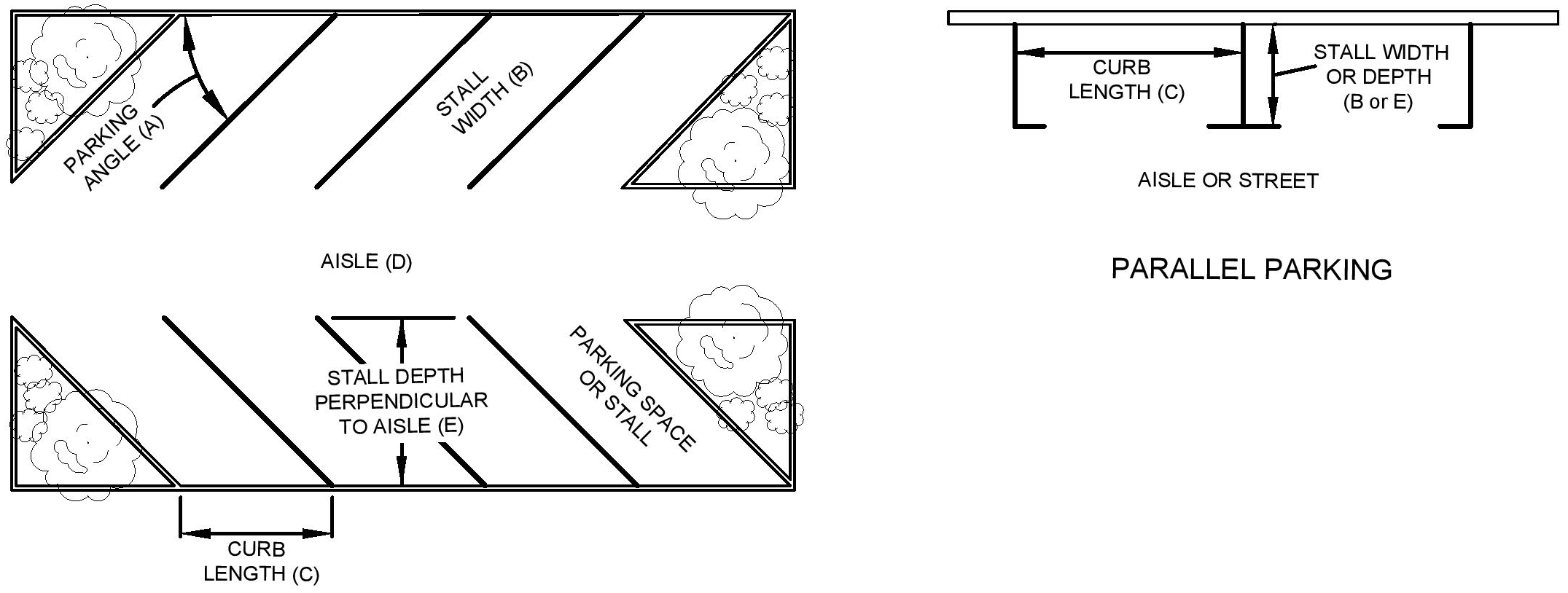
(See: Illustration: Parking Dimension Factors)
(A)
Maneuvering. Parking lots shall be designated, maintained, and regulated so that no parking or maneuvering incidental to parking will encroach into the areas designated for sidewalks, streets, or required landscaping. Parking lots shall be designed so that parking and un-parking can occur without moving other vehicles, unless a valet service has been approved as part of the development plans. Vehicles shall exit the parking lot in a forward motion.
(B)
Pedestrian Access.
(1)
Pedestrian access shall be provided from the street to the entrance of the structure by way of designated pathway or sidewalk.
(2)
Parking lots may be utilized by restaurants, cafes, and similar uses where pedestrian seating, access, or service does not interfere with safe and functional circulation. If a parking lot utilized for outdoor service is determined to represent a hazard to pedestrian or vehicular use, sites may be required to include an implied or physical barrier with landscaping elements, gated fencing, changes in ground surface texture, material or color, or similar treatments.
(C)
Build-to Zone. A portion of a required parking lot may be located within the build-to zone, subject to the following:
(1)
A parking lot located within the build-to zone shall be screened with a masonry screen wall between 32 inches and 42 inches in height and 50% opaque minimum.
(2)
Parking lots that are located within the build-to zone shall comply with Chapter 177: Landscape Regulations, related to landscape setbacks.
(3)
Off-site parking lots shall be prohibited from being located within the build-to zone.
(4)
In urban zoning districts that specify urban form (i.e., a build-to zone) the intent is for drive-thru lanes, parking lot drive aisles, and parking spaces to be located to the side or rear of buildings. In urban zoning districts, a drive-thru lane, parking lot drive aisle, or parking spaces are not permitted to be located in the front yard directly between a building and the Master Street Plan right-of-way.
(D)
Compact Spaces. A maximum of 35% of the total spaces are allowed to be compact spaces for nonresidential uses and a maximum of 20% are allowed to be compact spaces for residential parking. Compact spaces shall be marked either by marking on the pavement or by separate marker.
(E)
Dimensional Requirements. (See Table 1)
TABLE 1
DIMENSIONAL REQUIREMENTS
DIMENSIONAL FACTORS
(F)
Parking Lot Circulation.
(1)
Throat Length. The length of driveways or "throat length" shall be designed in accordance with the anticipated storage length for vehicles to prevent them from backing into the flow of traffic on the public street or causing unsafe conflicts with on-site circulation. General standards appear below, but these requirements may vary according to the project volume of the individual driveway. These measures generally are acceptable for the principal access to a property and are not intended for minor driveways. Variation from these standards may be permitted for good cause upon approval of the Zoning and Development Administrator and City Engineer.
TABLE 2
GENERALLY ADEQUATE DRIVEWAY THROAT LENGTHS
*GLA-Gross leaseable area
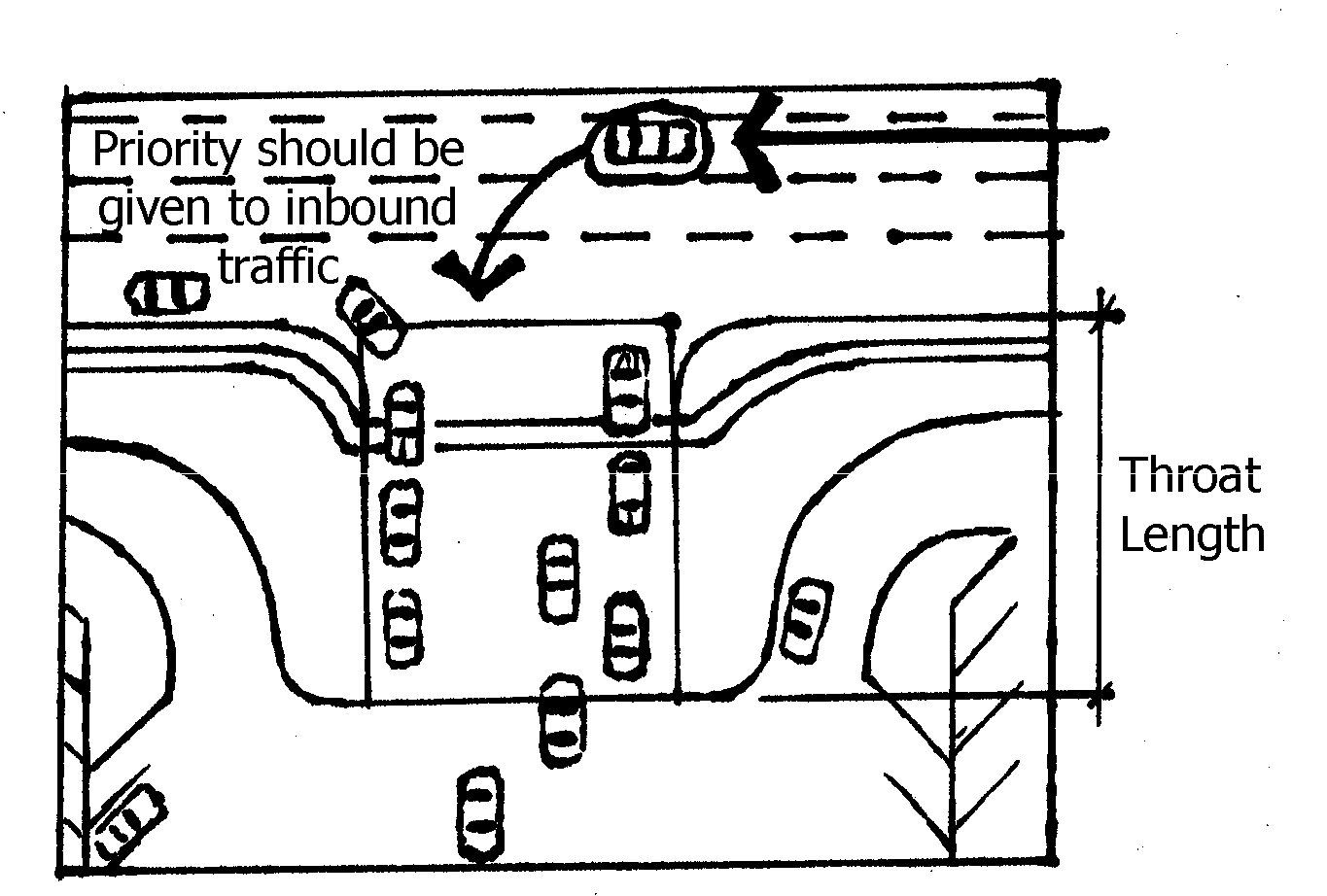
Commentary: The throat lengths in Table 2 are provided to assure adequate stacking space within parking lot driveways for general land use intensities. This helps prevent vehicles from stacking into the thoroughfare as they attempt to enter the parking lot. High traffic generators, such as large shopping plazas, need much greater throat length than smaller developments or those with unsignalized driveways. The guidelines here for larger developments refer to the primary access drive. Reduced throat lengths may be permitted for secondary access drives serving large developments.
(2)
Drive-Through Facilities. All uses that include a drive-up window or are characterized by patrons remaining in their vehicles to receive service shall meet the following on-site stacking requirements in order to alleviate traffic congestions:
(a)
Restaurant, fast food: a minimum of four (4) spaces as measured from the drive-thru window
(b)
Vehicular washes: a minimum of two (2) spaces per car wash bay as measured from the bay.
(c)
Pharmacies and financial institutions: a minimum of four (4) spaces for one (1) drive-thru window, plus three (3) spaces for each additional drive-thru lane or automated teller machine (ATM), as measured from each drive-thru window.
(d)
Dry cleaning and laundry services: a minimum of two (2) spaces as measured from the drive-thru window.
(3)
Entrances and Internal Aisle Design for Parking Lots Containing 8 Parking Spaces or Less. The driveway width into parking lots shall meet the following requirements:
(a)
Entrances.
(i)
One-Way Access to Parking Lots. If the driveway is a one-way in or one-way out, then the driveway width shall be a minimum of 12 feet and a maximum of 16 feet. Parking lots shall not be located more than 100 feet from the street right-of-way. Commercial solid waste service is required.
(ii)
Two-Way Access to Parking Lots. For two way access, the driveway width shall be a minimum of 12 feet and a maximum of 24 feet. Parking lots shall not be located more than 100 feet from the street right-of-way. This standard shall only apply when a 2-yard dumpster is allowed.
(iii)
Driveway Width Requirements for Parking Lots Located 100 Feet or More from the Street Right-of-Way. Two (2) drive lanes a minimum width of 10 feet each, up to a maximum combined width of 24 feet, shall be required for adequate parking lot access.
(iv)
Effective Curb Radius. All driveway entrances serving 8 or less parking spaces shall have a minimum effective curb radius of 10 feet and a maximum of 20 feet.
(b)
Internal aisle design.
(i)
Aisles shall be designed so that they intersect at 90 degrees with other aisles and driveways where practical.
(ii)
Aisles shall be designed to discourage cut-through traffic by use of landscape islands, and shall meet the requirements of Chapter 177: Landscape Regulations.
(iii)
Aisles shall conform to the dimensional requirements of §172.04(C).
(c)
Variances. Development proposals which do not meet these standards may apply for a variance from these requirements subject to Planning Commission approval.
(4)
Entrances and Internal Aisle Design for Parking Lots Containing Nine (9) or More Parking Spaces. The driveway width into parking lots shall meet the following requirements:
(a)
Entrances.
(i)
One-Way Access to Parking Lots. If the driveway is a one-way in or one-way out, then the driveway width shall be a minimum of 12 feet and a maximum of 16 feet.
(ii)
Two-Way Access to Parking Lots. For two (2) way access, the driveway width shall be a minimum 20 feet and a maximum width of 24 feet, unless otherwise required by the Fire Department.
(iii)
Neighborhood and Regional Links. Driveways that enter neighborhood and regional link streets may be required to have two (2) outbound lanes (one (1) for each turning direction) and one (1) inbound lane for a maximum total driveway width of 39 feet.
(iv)
Effective Curb Radius. All driveways serving nine (9) or more parking spaces shall have an effective curb radius of 15 feet for curb cuts on residential link streets and an effective curb cut radius of 20 feet for neighborhood and regional link streets.
(b)
Internal Aisle Design.
(i)
Aisles shall be designed so that they intersect at 90 degrees with other aisles and driveways where practical.
(ii)
Aisles shall be designed to discourage cut-through traffic by use of landscape islands, and shall meet the requirements of Chapter 177: Landscape Regulations.
(iii)
Aisles shall conform to the dimensional requirements of §172.04(C).
(G)
Hillside/Hilltop Overlay District.
(1)
Separation of Parking Pads in Multi-Family, and Non-Residential Development. Parking pads shall be separated by a minimum undisturbed area of 15 feet between parking pads. Streets and access drives are permitted to cross this undisturbed area.
(2)
Cut and Fill Slopes. Parking pads should be encouraged to utilize cut slopes with retaining walls to minimize disturbance.
(3)
Maximum Number of Spaces per Parking Lot for Multi-Family and Non-Residential Uses. Parking pads shall have a maximum of thirty (30) spaces per pad.
(4)
Parking Lot Location. Parking lots shall be setback with a minimum of 35 feet of undisturbed area required adjacent to the street right-of-way.
(5)
Multi-Family and Non-Residential Uses. Developers of multi-family and non-residential uses in the Hillside Overlay District are encouraged to refer to the Hillside Best Management Practices Manual for guidance and direction in the design of their project.
(Ord. No. 4725, 7-19-05; Ord. No. 4855, 4-18-06; Ord. No. 4917, 9-05-06; Ord. No. 5044, 8-07-07; Ord. No. 5079, 11-20-07; Ord. No. 5297, 12-15-09; Ord. No. 5592, 06-18-13; Ord. No. 5680, 4-15-14; Ord. No. 5841, §§1—3, 1-5-16; Ord. No. 5859, §2, 3-15-16; Ord. No. 6325, §1, 6-16-20; Ord. No. 6350, §9(Exh. G), 8-18-20; Ord. No. 6864, §1, 5-6-25)
172.05 - Standards For The Number Of Spaces By Use
(A)
Non-Residential Parking Requirements. There shall be no minimum number of spaces required for non-residential use. The maximum number of spaces provided shall be limited to the ratios in Table 3 and the allowable increases over the baseline ratio as described in §172.05(3). The applicant shall provide a statement or parking analysis indicating how they will provide adequate parking for the proposed non-residential use to succeed without negatively impacting adjacent properties or creating or compounding a dangerous traffic condition.
(B)
Residential Parking Requirements. The minimum and maximum number of spaces required for residential use shall conform to the parking ratios listed in Table 3. The minimum and maximum number of spaces required for a use not specifically included in this section shall be as required for the most similar use listed or as otherwise determined by the Planning Division utilizing reference standards.
(1)
Reductions for Residential Use. Residential uses may utilize the following reductions to the minimum number required off-street parking ratios listed in Table 3. If the applicant does not provide the number of parking spaces allowed by Table 3, the applicant shall provide for approval by the Zoning and Development Administrator relevant parking utilization data or a parking analysis demonstrating how they will provide adequate parking for the proposed residential use to succeed without negatively impacting adjacent properties or creating or compounding a dangerous traffic condition. The statement or analysis shall address factors such as abutting street widths, existing parking conditions, parking reductions already claimed by nearby residential and commercial developments, potential and compounding impacts on surrounding neighborhoods and commercial districts, existing use of on-street parking, capacity for additional on-street parking, density of existing buildings, emergency vehicle access, fire safety, and whether existing properties have off-street parking available.
(a)
Developments with 1—50 bedrooms may be allowed a maximum reduction of 35% of the total required spaces without being required to apply for consideration and approval by the Planning Commission.
(b)
Developments with 51—100 bedrooms may be allowed a maximum reduction of 20% of the total required spaces without being required to apply for consideration and approval by the Planning Commission.
(c)
Developments with 101—250 bedrooms may be allowed a maximum reduction of 15% of the total required spaces without being required to apply for consideration and approval by the Planning Commission.
(d)
Developments with two hundred fifty-one (251) or more bedrooms may be allowed a maximum reduction of 10% of the total required spaces without being required to apply for consideration and approval by the Planning Commission.
(e)
Multi-family and mixed-use developments that include multi-family along N. College Ave. and S. School Ave. within the Urban Corridor (UC) zoning district may be allowed an additional reduction of 10% of the total spaces required without being required to apply for consideration and approval by the Planning Commission.
(2)
Criteria for Consideration of Additional Reductions for Residential Use by the Planning Commission. Applicants may request parking space reductions for residential use in addition to those listed in §172.05(B)(1) subject to the requirements in §156.03(C)(5). In reviewing the requested parking variance, the Planning Commission shall utilize the criteria in §172.05(B)(1) to evaluate the request, and may consider factors such as proximity to transit stops, provision of covered and secured storage for bicycles, and other means of alternative transportation. The Planning Commission shall be limited to granting a maximum reduction of 35% total or four (4) spaces, whichever is greater, for developments described in §172.05(B)(1).
(C)
Review of Parking Plan. If an application for a residential use was approved for a reduction in required parking and the project is being considered by the Planning Commission, a Planning Commissioner may move that the Planning Commission review the decision by the Zoning and Development Administrator concerning the adequacy and correctness of the applicant's proposed parking plan pursuant to the factors in §172.05(B)(1). If this motion passes, the Planning Commission may review and amend the Zoning and Development Administrator's decision. However, the Planning Commission may not reduce the mandatory minimum parking reductions granted by the Zoning and Development Administrator for a development of fifty (50) or fewer bedrooms.
(D)
Shared Parking. Parking requirements may be shared where it can be determined that the peak parking demand of the existing or proposed occupancy occur at different times (either daily or seasonally). Such arrangements may be approved by the Zoning and Development Administrator if they meet the conditions below:
(1)
Shared Parking Between Developments. Formal arrangements that share parking between intermittent uses with non-conflicting parking demands (e.g., a church and a bank) are allowed as a means to reduce the amount of parking required.
(2)
Shared Parking Agreements. If a privately owned parking facility is to serve two (2) or more separate properties, then a "Shared Parking Agreement" is to be filed with the city for consideration by the Zoning and Development Administrator.
(3)
Shared Spaces. Individual spaces identified on a site plan for shared users shall not be shared by more than one (1) user at the same time.
(E)
Maximum Number of Parking Spaces Allowed for Residential and Non-Residential Uses. Residential and non-residential developments may utilize the following increases to the maximum number of allowed spaces listed in Table 3 when the following standards are met:
(1)
Developments may increase the number of off-street parking spaces by up to 15% above the parking ratios listed in Table 3.
(2)
Developments may increase the number of off-street parking spaces by up to an additional 10% when alternative stormwater treatment techniques are utilized, such as:
(a)
Bioswales;
(b)
Constructed wetlands;
(c)
Pervious pavement; and
(d)
Other such techniques that aid in improving water quality and quantity as approved by the City Engineer.
(3)
Developments may increase the number of off-street parking spaces by up to an additional 5% when one (1), 2-inch caliper tree for every ten (10) additional parking spaces is planted on-site in addition to all other landscaping requirements.
(F)
Parking Ratio Calculation. The number of spaces required for a use not specifically included in Table 3 shall be as required for the most similar use listed or as otherwise determined by the City Planning Division utilizing industry standards. For all parking space requirements resulting in a fraction, the fraction shall be:
(1)
Rounded to the next higher whole number when the fraction is 0.5 or higher.
(2)
Rounded to the next lower whole number when the fraction is less than 0.5.
(G)
On-Street Parking. Each on-street parking space adjacent to a project frontage that complies with adopted fire code may count toward the parking requirements for all development. The approval of on-street parking is subject to approval by the Zoning and Development Administrator.
(H)
Increases or reductions in excess of those identified herein shall be allowed only by the Planning Commission as a variance and shall be granted in accordance with Chapter 156.03.
TABLE 3 PARKING RATIOS
(Use and Required Minimum and Maximum Spaces)
Residential
(Ord. No. 4567, 05-04-04; Ord. No. 4930, 10-03-06; Ord. No. 5118, 3-18-08; Ord. No. 5297, 12-15-09; Ord. No. 5435, 8-16-11; Ord. No. 5801, §1(Exh. A), 10-6-15; Ord. No. 6864, §2(Exh. A), 5-6-25; Ord. No. 6879, §6, 5-20-25)
172.06 - Parking Lot Location Standards
The location of all required and nonrequired parking lots with five (5) or more spaces shall meet the location requirements below. All conditional uses hereunder shall be granted by the Planning Commission in accordance with Chapter 163, governing applications of conditional uses; procedures.
(A)
Permitted Locations by Right. Parking lots shall be located within the same zoning district and on the same site as the use they serve. Required parking lots for uses allowed by right within a zoning district are allowed as a use by right in the same zoning district.
(B)
Permitted Locations as a Conditional Use.
(1)
Parking lots located within residential zones which serve uses in nonresidential zones may be allowed as a conditional use by the Planning Commission.
(2)
Parking lots for uses allowed as conditional uses within residential zones must also be approved as a conditional use. A conditional use for a parking lot may be approved at the same time the use is approved or may be approved separately if additional parking lots are developed later.
The Planning Commission shall make a finding based upon the size, scale, and location of these activities that the proposed parking lot will not adversely affect adjacent residential uses or the residential character of the neighborhood.
(C)
Off-Site Locations. If off-street parking cannot be provided on the same site as the principal use due to existing buildings or the shape of the parcel, parking lots may be located on other property not more than 600 feet distant from the principal use, subject to conditional use approval by the Planning Commission.
(D)
Intermittent Parking. Uses which generate only intermittent demand for parking may count available on-street parking within 600 feet of the building as part of required parking, subject to the approval of the Planning Commission.
(Ord. No. 6864, §3(Exh. B), 5-6-25)
172.07 - Reserved
(Ord. No. 4917, 09-05-06)
172.08 - Nonconforming Parking Lots
All parking lots and/or parking areas which were in existence prior to the effective date of this ordinance may continue in a nonconforming state until such time as the following shall occur:
(A)
Rehabilitation. A building permit is granted to rehabilitate a structure on the property exceeding 50% of the current replacement cost of the structure. At such time, 50% of the existing parking lot use area shall be required to be brought into compliance with the provisions of this ordinance. This shall continue on a graduated scale in accordance with the percentage of rehabilitation cost; and/or
(B)
Enlargement or Reconstruction. A building permit is granted to enlarge or reconstruct a structure on the property exceeding 10% of its existing gross floor area. At such time 10% of the existing parking lot and/or parking lot area shall be brought into compliance with the provisions of this section. This shall be on a graduated scale until reaching 100% of the required landscaping; and/or
(C)
New Curb Cut. A new curb cut permit is granted for the nonconforming parking lot. At such time the parking lot and/or parking area shall be required to be brought into compliance with the provisions of this ordinance.
(Code 1965, App. A., Art. 8(9); Ord. No. 1747, 6-29-70; Ord. No. 2380, 9-20-77; Ord. No. 2549, 8-7-79; Code 1991, §160.117; Ord. No. 3870, §4, 2-21-95; Ord. No. 3962, §§1, 2, 4-16-96; Ord. No. 4100, §2 (Ex. A), 6-16-98; Ord. No. 4127, §1 (Ex. A), 12-15-98; Ord. No. 4319, 6-5-01; Ord. No. 4412, (Ex. A), 9-3-02)
172.09 - Off-Street Loading
In all districts, accessory off-street loading berths, open or enclosed, shall be so arranged so that parking and maneuvering will occur on private property.
(Code 1991, §160.116; Ord. No. 4100, §2 (Ex. A), 6-16-98; Ord. No. 5296, 12-15-09; Ord. No. 5297, 12-15-09)
172.10 - Bicycle Parking Rack Requirements
(A)
Applicability. All new construction or expansions requiring five (5) or more off-street automobile parking spaces shall provide bicycle parking as required by this chapter. Any property owner required to have bicycle parking may elect to establish a shared bicycle parking facility with any other property owner within the same block to meet the combined requirements.
(B)
Definition. A bicycle rack is a fixture designed to park bicycles that can be secured with a standard u-shaped bicycle lock. Each bicycle parking rack holds two (2) bicycles.
(C)
Number of Bicycle Racks Required. The minimum number of bicycle parking racks required is determined by the number of parking spaces required for the type of land use. Alternative rack designs may be approved by the Planning Division so long as they have the bicycle capacity storage equivalent to total number of standard bicycle racks required. The following standards shall determine the number of bicycle racks required based on the number of automobile parking spaces in the development:
(1)
Non-Residential Development. Non-residential development shall provide one (1) bicycle parking rack per twenty (20) automobile parking spaces. At a minimum the development shall provide one (1) bike rack.
(2)
Residential Development. Residential development shall provide one (1) bicycle rack per thirty (30) dwelling units. At a minimum the development shall provide one (1) bike rack.
(D)
Bicycle Rack Site Design. Careful consideration should be given to the layout and location of bicycle racks. For optimal functionality the following standards shall apply in determining the layout and position of bicycle racks:
(1)
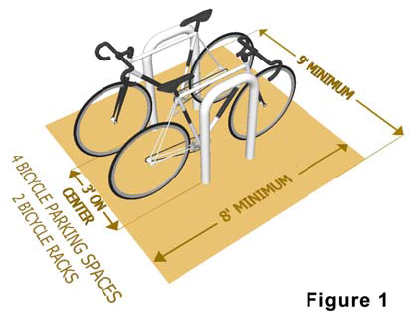
Spacing Between Bicycle Racks. Each bicycle parking space shall have 36 inches of clear space, paved or unpaved, beside the rack allowing each rack to support two (2) bicycles. The 36-inch dimension may overlap another bicycle parking space such that racks positioned in a parallel row may be 36 inches on center. The minimum length dimension required is 8 feet free and clear (See: Figure 1).
(2)
Location of Bicycle Parking Racks. Bicycle racks should be located in areas where they are useful to the bicyclist while not impeding access. The following standards shall apply when determining the location of bicycle racks:
(a)
Bicycle parking racks should be located within 50 feet of a public entry. In locations that have multiple entrances, such as shopping areas, bicycle parking racks should be distributed near all major points of public entry.
(b)
Bicycle parking facilities should have adequate lighting for the operation of combination and key locks at night and to minimize theft.
(c)
Bicycle parking racks should be positioned so that no pedestrian traffic is impeded.
(d)
Bicycle parking racks should not be located within bus stops, loading zones, or other curb space where on-street parking is permitted unless approved by the city engineer.
(e)
Bicycle parking racks shall have a 6-foot minimum clearance from the edge of fire hydrants.
(f)
Bicycle parking racks should have a 4 feet 0 inches clearance from existing street furniture, including mailboxes and light poles.
(g)
Bicycle parking rack location shall not interfere with ADA standards.
(E)
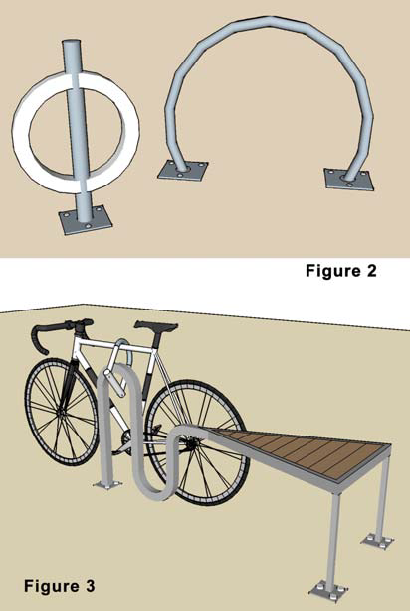
Bicycle Rack Specifications. The Planning Division has pre-approved the standard inverted u-shaped bicycle rack (see figure 1). Applicants may also request an alternative design with Planning Division approval (see examples in figure 2). All bicycle racks shall be designed so that they support a bicycle at two points on the bicycle frame and such that the bicycle may be securely locked with a u-shaped bicycle lock (See figure 3).
(F)
Materials. Racks are to be constructed of 1½ inch, Schedule 40 steel pipe (1.90" x 0.145" wall).
(G)
Finishes. Unless the pipe material is stainless steel, the pipe shall have PVC coating, powdercoat finish or hot-dipped galvanized finish applied after the flange has been welded in place (Surface Mount Method) or the anchoring cross bar/supports have been fitted (Embedment Method).
(H)
Anchoring. Bicycle racks shall be anchored with one of the following methods:
(1)
Embedded in Concrete. The rack legs shall extend a minimum of 9 inches into a concrete footing with an anchoring crossbar mounted 3 inches above the base.
(2)
Surface Flange Mount. A pre-drilled, steel flange, minimum 8 inch square, shall be welded to the bottom of each leg before final finish is applied. The flange shall have a minimum of three bolt holes. Each bolt hole shall accept a ½ inch diameter steel bolt.
(3)
Alternative Anchoring Methods. Alternative methods of anchoring bicycle racks may be permitted with approval of the City Engineer.
(Ord. No. 4293, 2-20-01; Ord. No. 5297, 12-15-09; Ord. No. 5482, 2-7-12; Ord. No. 5603, 8-6-13)
172.11 - Driveway And Parking Standards For Four (4) Or Less Parking Spaces
(A)
Purpose. The purpose of this ordinance section is to promote the public health, safety and general welfare, to prevent the adverse impacts associated with excess parking and over-occupancy of homes in single-family districts, and to ensure that compatibility of land uses within single-family districts remain intact.
(B)
Applicability. The following requirements shall apply to properties that require four (4) or less parking spaces. The regulations herein do not apply to motor vehicles located completely within or underneath garages or carports, nor to properties zoned Residential Agricultural.
(C)
Maximum number of parking spaces permitted. Unless otherwise permitted herein, a maximum of four (4) motor vehicles may be parked outdoors on a property containing a single-family home(s) at any time, including driveways and other designated off-street parking areas. Parking for all other permitted uses shall conform to the Parking Ratio Table contained within this chapter.
(D)
Use of Front Yard Area for a Driveway and Off-Street Parking. Motor vehicles shall be parked in a driveway or off-street parking area that is clearly defined by pavement, a change in materials, edging, or other means. Driveways and off-street parking areas shall be limited to a maximum of 40% of the front yard area and shall meet the maintenance requirements as identified by this chapter.
(E)
Parking of Non-Motorized Vehicles in Front Yard Area. If parked within the front yard area of a property (including driveways), non-motorized recreational vehicles, trailers, and boats shall be counted toward the maximum total of four (4) motor vehicles permitted on the property.
(F)
Off-Street Parking on City Street Right-of-Way. The off-street parking of any motor vehicle, non-motorized recreational vehicle, boat or trailer shall be prohibited within the street right-of-way, which includes any sidewalk, greenspace or other area from the edge of the paved street through the width of the dedicated street right-of-way. On-street parking within properly designated areas of the street right-of-way may be permitted, in accordance with current traffic regulations.
(G)
Driveway Standards.
(1)
Driveway approach to property line. The driveway approach shall extend to the property line and/or master street plan right-of-way from the paved street and shall be designed, permitted, and paved with concrete in accordance with §171.13 Sidewalk and Driveway Specifications.
(2)
Driveways Beyond the Property Line. Driveways shall be paved from the property line and/or master street plan right-of-way with asphalt, concrete, brick or stone pavers, or other solid surface and shall extend 18 feet (length) into the property. To prevent vehicles from parking over the public sidewalk, garages and carports shall be positioned to provide at least 18 feet between the sidewalk or Master Street Plan right-of-way line and the garage or carport.
(3)
Driveways Beyond 18 Feet into the Property. Driveways beyond 18 feet into the property may be paved or unpaved and shall be clearly defined by landscaping or edging.
(4)
Unpaved Streets. These requirements are waived where the street to which the driveway connects is not paved.
(H)
Driveway and Parking Area Maintenance Requirements.
(1)
Paved. Driveways and parking areas that are paved shall be maintained to prevent erosion onto adjacent properties and to prevent dirt, rock and other materials from entering the street.
(2)
Unpaved. Driveways and parking areas that are not paved shall be maintained to prevent erosion onto adjacent properties and to prevent dirt, rock and other materials from entering the street. Driveways and parking areas shall be constructed and maintained with adequate gravel, grasses, or other plants and/or landscaping materials to keep the area from becoming rutted, muddy and/or soil from being blown or washed away. If an unpaved driveway is not maintained and is identified as a violation of this provision, such driveway shall be immediately remedied by the property owner.
(I)
Driveway Grading and Drainage. The driveway shall be graded in such a way to dispose of surface water into appropriate structures.
(J)
Maximum Driveway Width. Driveway width shall be limited to:
(K)
Loop, Circle, and Multiple Driveways. Loop, circle and multiple driveways on a single property shall be allowed so long as a 30 foot separation between the drives is maintained, as measured from the interior edges of the curb cuts, subject to other restrictions for driveway separations in the UDC.
(L)
"Pay-to-Park" Operations. Pay-to-park operations are prohibited within single-family districts and properties within all zoning districts that are utilized for a single-family detached home. "Pay-to-park" operations are defined as those which advertise and/or sell or lease permits to park or otherwise allow parking for free or for payment on a property on which the owner and/or operator of the vehicle does not reside.
(M)
Exemptions. The following exemptions to this ordinance section shall be permitted:
(1)
University of Arkansas Events. An unlimited number of motor vehicles shall be allowed to park on private property for a period of twelve (12) hours before and twelve (12) hours after a University of Arkansas event for persons attending said event on days when events are occurring at Bud Walton Arena or Donald W. Reynolds Stadium on the University Arkansas Campus.
(2)
Construction Vehicles. Parking of motor vehicles for new construction and additions shall be allowed on private properties and within the greenspace between the street and sidewalk during the duration of the project, as long as the building permit remains active. Any damage from construction vehicles to city property such as broken curb, sidewalk cracks, ruts in the greenspace, and erosion of unpaved areas shall be repaired by the owner/developer prior to completion of construction.
(3)
Temporary Parking. Temporary driveways or parking lots approved by the Planning Commission.
(4)
Existing Driveways. All existing driveways constructed prior to August 07, 2007 shall be exempt from meeting §172.11(G), until a curb cut permit or a building permit for the new construction of 1,000 square feet or larger is granted.
(5)
Special Events. Infrequent parking for special events which exceeds the normal maximum number of motor vehicles permitted on a property is excepted from this ordinance. Excessive parking which occurs more frequently than an average of one day a month may be determined by the Zoning and Development Administrator upon complaint by a nearby neighbor to be "frequent" and thus not excepted as "infrequent." The Zoning and Development Administrator shall notify an owner/tenant by regular mail or similar notice that the excessive parking has been determined to be "frequent" and in violation of this section prior to taking other enforcement measures.
(6)
Special Parking Exception Permits. A property owner that can prove special exception to the limitation on number of motor vehicles permitted on a single-family property may present evidence to the Planning Division to apply for a Special Parking Exception Permit. Such cases may include hobbyist vehicles or motor vehicle collections, an all-related family in residence, or other special circumstances deemed suitable by the Planning Division, wherein the circumstance meets the purpose and intent of the ordinance. If the Planning Division approves the special exception permit, a permit will be issued for the address, indicating additional vehicles are permitted to be parked on the property
(Ord. No. 5044, 8-07-07; Ord. No. 5304, 1-19-10; Ord. No. 5800, §5, 10-6-15; Ord. No. 6864, §4, 5-6-25)

