
Flowery Branch City Zoning Code
ARTICLE 20
- ACCESS AND DRIVEWAYS10
Editor's note—Ord. No. 348-16, § 1 (Exh. A), adopted July 19, 2018, repealed former Art. 20, §§ 20.1—20.13, and enacted a new Art. 20 as set out herein. Former Art. 20 pertained to similar subject matter.
Sec. 20.1.- Reference to Other Regulations.
For street frontage requirements, see Sec. 5.12 of this Zoning Ordinance. For requirements and guidelines pertaining to parking lot paving and design, access management, interparcel access, on-site circulation, and traffic impacts, see Article 10 of this Zoning Ordinance.
(Ord. No. 348-16, § 1 (Exh. A), 7-19-2018)
Sec. 20.2. - Visibility at Intersections.
No fence, wall, sign, hedge or planting which obstructs the sight lines at elevations between thirty (30) inches and twelve (12) feet above any roadway shall be placed or permitted to remain on any corner lot within a sight visibility triangle as defined by this zoning ordinance. Unless otherwise specified by the Zoning Administrator, the area regulated shall be two triangular areas formed by the street right-of-way lines, or such lines extended, and lines connecting such right-of-way lines at points twenty-five (25) feet from the intersections of the right-of-way lines. In such cases as right-of-way lines do not exist or cannot be determined, said measurements shall be made from points fifteen (15) feet from the centerline of the existing road or ten (10) feet from the existing pavement or roadbed, whichever is greater.
(Ord. No. 348-16, § 1 (Exh. A), 7-19-2018)
Sec. 20.3. - General Access Provisions.
(a)
Parking and Loading Areas. All off-street parking shall be provided with vehicular access to a street, and loading areas shall be provided with access to a street or alley; such parking or loading area shall not thereafter be encroached upon or altered. Except for single-family and duplex dwellings, off-street parking and loading spaces shall have access so that their use will not require backing movements or other maneuvering within a street right-of-way. Access to off-street parking areas for single-family and duplex dwellings shall be subject to approval of the Zoning Administrator.
(b)
Land Use Compatibility. Service drives that serve commercial, office-professional, or industrial zoning districts shall not be allowed to pass through residential zoning districts, except when approved as part of a site plan for development in a mixed-use or planned unit development, except as may otherwise be approved by the Zoning Administrator.
(c)
Sidewalk Obstructions. There shall be no obstruction of a public sidewalk, including that portion of the sidewalk within a driveway apron, due to parking, loading, or other activity. The City Engineer may require that construction contractors make special provisions for maintaining safe passage along public sidewalks during construction.
(Ord. No. 348-16, § 1 (Exh. A), 7-19-2018)
Sec. 20.4. - Pedestrian Access Internal to Site Required.
(a)
Required. Internal to any development site other than single-family residential dwellings, developments shall provide safe routes of pedestrian access between points of departure and destinations.
(b)
Minimum Width. All walkways internal to the site shall be a minimum of four (4) feet wide, except as otherwise specified by the city. In the case of pedestrian-oriented development, wider sidewalks will be required.
(c)
Right-of-way. Pedestrians shall have the right-of-way over automobile travel.
(d)
Public System Connection. The internal sidewalk system shall connect to the public sidewalk system along streets and highways. Where a transit stop exists, the internal sidewalk system shall provide as direct a link as possible from the buildings on site to the transit stop.
(e)
Interparcel Connection. The internal sidewalk system shall also connect to any sidewalk systems on abutting private properties or provide for such connections in their absence through interparcel access easements specified in this Article.
(Ord. No. 348-16, § 1 (Exh. A), 7-19-2018)
Sec. 20.5. - Interparcel Access Easements Required.
(a)
Required. For any office or retail sales or services use, the property owner shall grant an access easement to each adjoining property that is zoned or used for an office or retail sales or services use. The purpose of the easement is to facilitate movement of customers and their vehicles from establishment to establishment (lot to lot) without generating additional turning movements on a public street.
(b)
Recording. When required by this Section, interparcel access easements shall be recorded in the office of the Clerk of Superior Court, Hall County, and reference to deed book and copy of such recorded easement provided to the Zoning Administrator and shown on plans and plats.
(Ord. No. 348-16, § 1 (Exh. A), 7-19-2018)
Sec. 20.6. - Access Easement Provisions.
(a)
The interparcel access easement shall permit automobile access from the adjoining property to driveways and parking areas intended for customer or tenant use; but parking spaces may be restricted to use by the owner's customers and tenants only.
(b)
The granting of such easement shall be effective upon the granting of a reciprocal easement by the adjoining property owner.
(c)
Upon the availability of access to driveways and parking areas of the adjoining lot, the pavement or other surfacing of the owner's driveways and parking areas shall be extended to the point of access on the property line.
(Ord. No. 348-16, § 1 (Exh. A), 7-19-2018)
Sec. 20.7. - Location of Interparcel Connections.
The location of vehicular connections across a property line should be mutually determined and constructed by both property owners. In the case of coordination problems or any factors preventing construction of an interparcel connection, the Zoning Administrator shall determine the location of connection to be constructed by property owners.
(Ord. No. 348-16, § 1 (Exh. A), 7-19-2018)
Sec. 20.8. - Relief.
Where the proposed land use is such that adverse impact of the required easement on the use of the property would outweigh the reduced impact on the public street provided by the reciprocal easements, or in cases where property owners cannot agree on interparcel access provisions approved by the Zoning Administrator, the Zoning Administrator may waive or modify the requirement for access easements, in whole or in part, administratively.
(Ord. No. 348-16, § 1 (Exh. A), 7-19-2018)
Sec. 20.9. - Driveway Approval Required.
No curbs or medians on public streets or rights-of-way shall be cut or altered for access, and no driveway connection to a public or private street shall be made or altered, without a permit issued by the City Engineer and/or other applicable jurisdictions (e.g., Georgia Department of Transportation, Hall County). For driveways accessing U.S. or State highways, the requirements of the Georgia Department of Transportation shall apply whenever more restrictive than the standards in this Article. However, the city may impose requirements on access to state and federal routes that are more restrictive than state or federal requirements.
(Ord. No. 348-16, § 1 (Exh. A), 7-19-2018)
Sec. 20.10. - Driveway Width Requirements.
Vehicular access from properties to streets shall comply with the following dimensional requirements, measured at the right-of-way line. Driveways shall be paved with asphalt or concrete unless the Zoning Administrator waives the requirement due to environmental impacts or because of inconsistency with the character area in which the improvement is located, as described in the comprehensive plan. _____
Table 20.1
Driveway Width Requirements
When a property containing a single-family residence is converted to a use that requires a wider driveway, the City Engineer may reduce the driveway width required by this Section if access via a narrower driveway will not be impeded.
(Ord. No. 348-16, § 1 (Exh. A), 7-19-2018)
Sec. 20.11. - Driveway Location, Maximum Width, length, and Spacing.
Curb cuts, driveways, and access points on public streets must meet the following requirements:
(a)
Location. In developments other than detached, single-family residences, they shall not be located within thirty (30) feet of any intersection or within forty (40) feet of another curb cut.
(b)
Maximum Width. A curb cut serving a nonresidential use shall be no greater than forty (40) feet in width. For single-family and duplex uses, the width of an individual driveway shall not exceed the width of the garage, unless otherwise approved by the Zoning Administrator.
(c)
Residential Driveway Length. All front loaded single-family homes are required to have a minimum driveway length of twenty-three (23) feet as measured from the back of sidewalk.
(d)
Spacing. Curb cuts, driveways and access points shall be no closer than twenty (20) feet to any property line, unless approved by the Zoning Administrator; provided, however that this provision shall not prevent shared driveways and common access easements located along common property lines.
(Ord. No. 348-16, § 1 (Exh. A), 7-19-2018)
Sec. 20.12. - Number of Driveways Limited.
(a)
Federal and State Routes. Along State and/or U.S. highways, no more than one (1) point of vehicular access from a property shall be permitted for each 300 feet of lot frontage, or fraction thereof. Further restrictions on the number of driveways may be considered and imposed during site plan or design review.
(b)
Other Major Streets. Along major (e.g., arterial and collector) streets other than State or U.S. highways, lots with less than 200 feet of frontage shall have no more than one point of access to any one public street. Two (2) points of vehicular access from a property to each abutting public street shall be permitted only if the lot has 400 feet or more of lot frontage. The City Engineer shall determine whether the points of access may be unrestricted or will have to be designed for right-in, right-out traffic flow.
(c)
Site Specific Considerations. More restrictive limitations on driveways may be imposed during the site plan review and design review and approval, if justified given the particular conditions of the site and the proposed access.
(d)
Single-Family Residential. Shall be allowed one curb cut per lot.
(Ord. No. 348-16, § 1 (Exh. A), 7-19-2018)
Sec. 20.13. - Minimum Driveway Construction Specifications.
Driveway connections shall be provided between the edge of pavement or back of curb to the right-of-way line. No property may be afforded access from a public street unless it meets the following specifications or as otherwise approved by the City Engineer:
(a)
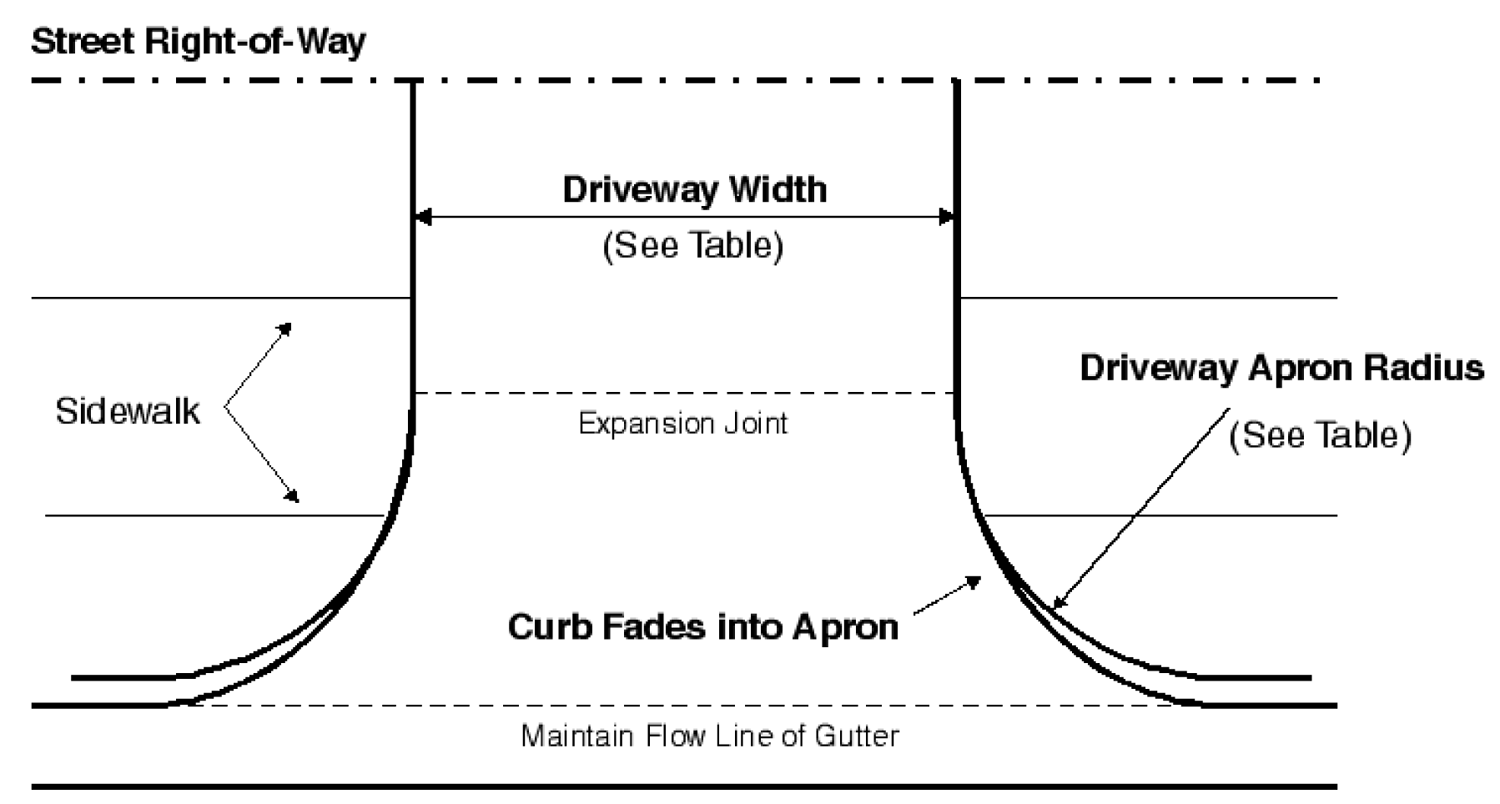
Curb and gutter streets shall be provided with a driveway apron constructed of 3000 psi concrete at least six (6) inches thick. Sidewalks, where provided, shall be warped to the driveway apron and are to be identified across the driveway apron by construction joints or control joints.
(b)
Swale ditch section streets shall be provided with a driveway apron constructed of 3000 psi concrete at least six (6) inches thick, or asphaltic concrete of the same thickness and type as the paving course(s) for the street.
(c)
For streets that have been overlaid, driveway aprons shall tie into the existing curb and gutter. Asphalt may be added to the apron for smoother access.
(d)
All driveway aprons shall have a radius connecting the driveway to the curb line or pavement edge as follows:
Table 20.2
Driveway Apron Radii
(Ord. No. 348-16, § 1 (Exh. A), 7-19-2018)

