Flowery Branch City Zoning Code
ARTICLE 9
- NONRESIDENTIAL ZONING DISTRICTS7
Editor's note—Ord. No. 348-16, § 1 (Exh. A), adopted July 19, 2018, repealed former Art. 9, §§ 9.1—9.7, and enacted a new Art. 9 as set out herein. Former Art. 9 pertained to similar subject matter and derived from Ord. No. 348-11, § 11, 11-18-2010; Ord. No. 348-13, §§ 4—7, 8-18-2011; Ord. No. 514, § 2, 6-24-2015; Ord. No. 523, §§ 4—7, 7-7-2016; Ord. No. 524, § 1, 7-7-2016; Ord. No. 545, § 1, 3-15-2018.
Sec. 9.1.- O-P, Office-Professional District.
(a)
Purpose and Description. This zoning district is intended to implement the "Institutional Campus" character area established in the comprehensive plan. The Office-Professional district is intended to encourage and provide suitable areas for professional, medical, research and scientific functions, general offices, and certain related activities. This district is intended to apply to single-function office buildings and to planned office parks and planned office complexes. In some cases, the OP district may be appropriate as a transition between a commercial zoning district and a single-family or multi-family residential zoning district.
(b)
Permitted and Conditional Uses. Permitted and conditional uses shall be as provided in Table 9.1, "Permitted and Conditional Uses in Nonresidential Zoning Districts."
(c)
Dimensional Requirements. Dimensional requirements shall be as provided in Table 9.2, "Dimensional Requirements in Nonresidential Zoning Districts."
(d)
Design Requirements. See Articles 10 and 40 of this Zoning Ordinance.
(Ord. No. 348-16, § 1 (Exh. A), 7-19-2018; Ord. No. 657, § 1(Exh. A), 12-16-2021)
Sec. 9.2. - INST, Institutional District.
(a)
Purpose and Description. This zoning district is intended to implement the "Institutional Campus" character area established in the comprehensive plan. The Institutional zoning district is intended to encourage and provide suitable areas for single-function institutional campuses including the Atlanta Falcons Training Facility, schools, and large churches.
(b)
Permitted and Conditional Uses. Permitted and conditional uses shall be as provided in Table 9.1, "Permitted and Conditional Uses in Nonresidential Zoning Districts."
(c)
Dimensional Requirements. Dimensional requirements shall be as provided in Table 9.2, "Dimensional Requirements in Nonresidential Zoning Districts."
(d)
Design Requirements. See Articles 10 and 40 of this Zoning Ordinance.
(Ord. No. 348-16, § 1 (Exh. A), 7-19-2018; Ord. No. 657, § 1(Exh. A), 12-16-2021)
Sec. 9.3. - NS, Neighborhood Shopping District.
(a)
Purpose and Description. This zoning district is intended to implement the "commercial" designation of the future land use plan contained within the comprehensive plan of the City of Flowery Branch. It is also intended to implement the "neighborhood commercial" character area established in the comprehensive plan.
(b)
Character. Neighborhood commercial districts are intended to provide areas for limited, small-scale commercial uses of a convenience nature serving nearby residential neighborhoods as opposed to a regional market. This district provides for attractive, non-auto related neighborhood businesses and services, with distinctive architectural features and a scale compatible with pedestrians and connected to adjacent residential neighborhoods. Uses within neighborhood commercial character areas generally occur within enclosed buildings with no outside storage and limited outdoor display of goods and merchandise. Pedestrian accessibility is promoted via sidewalks connected to nearby neighborhoods but uses are mostly reliant on the automobile for access. Nonetheless, buildings and developments are scaled to be compatible with and promote pedestrian activity. Entrances, frontages, and building facades are softened with landscaping and low-lying identification signs.
(c)
Permitted and Conditional Uses. Permitted and conditional uses shall be as provided in Table 9.1, "Permitted and Conditional Uses in Nonresidential Zoning Districts." Auto-related, highway-oriented commercial uses are not permitted. Neighborhood commercial districts are not intended to permit or accommodate automotive uses or other types of more intensive highway business activities, or those uses that generate excessive traffic, noise, odors, pollution, safety hazards, or other adverse impacts which would detract from the desirability of adjacent properties for residential use.
(d)
Dimensional Requirements. Dimensional requirements shall be as provided in Table 9.2, "Dimensional Requirements in Nonresidential Zoning Districts." Business establishments do not exceed 2,500 square feet in any one tenant space, to keep the bulk and intensity in scale with the needs of adjacent neighborhoods. Open space is limited to suburban plazas or small open spaces. A three-story height limit is imposed.
(Ord. No. 348-16, § 1 (Exh. A), 7-19-2018; Ord. No. 657, § 1(Exh. A), 12-16-2021; Ord. No. 694, § 1(Exh. A), 6-1-2023)
Sec. 9.4. - HB, Highway Business District.
(a)
Purpose and Description. This zoning district is intended to implement the "activity center" and "activity center-retail" character areas established in the comprehensive plan. This zoning district will be an accessible center of businesses, services, and complementary uses with attractive building and site features and contributing extensively to the economic base of the city. The widest possible range of commercial uses is contemplated in this zoning district, except for industry, mixed use developments, and single-family residences including manufactured homes.
(b)
Permitted and Conditional Uses. Permitted and conditional uses shall be as provided in Table 9.1, "Permitted and Conditional Uses in Nonresidential Zoning Districts."
(c)
Dimensional Requirements. Dimensional requirements shall be as provided in Table 9.2, "Dimensional Requirements in Nonresidential Zoning Districts."
(d)
Design Requirements. See Articles 10 and 40 of this Zoning Ordinance.
(Ord. No. 348-16, § 1 (Exh. A), 7-19-2018; Ord. No. 657, § 1(Exh. A), 12-16-2021)
Sec. 9.5. - CBD, Central Business District.
(a)
Purpose and Description. This zoning district is intended to primarily implement the "Old Town" character area established in the comprehensive plan, but may also be used to implement the "Mixed Use - Downtown" character area. Developments are built to a pedestrian-friendly scale (i.e., "Main Street Commercial") that complement the historic character of the City's downtown core and that include plazas and small urban pocket parks.
(b)
Permitted and Conditional Uses. Permitted and conditional uses shall be as provided in Table 9.1, "Permitted and Conditional Uses in Nonresidential Zoning Districts."
(c)
Dimensional Requirements. Dimensional requirements shall be as provided in Table 9.2, "Dimensional Requirements in Nonresidential Zoning Districts."
(d)
Construction Approval.
1.
Any proposed construction project must be approved by the City Council prior to issuance of any permit.
2.
For lots zoned CBD which are within the city's local historic district, compliance with the city's historic preservation ordinance is required prior to issuance of any building permit. See also Section 9.5.(f)7. below.
(e)
Construction Approval Requirements. All construction proposals shall submit at a minimum the following:
1.
Legal description of the property;
2.
Survey of the property;
3.
Existing conditions analysis of the site to be redeveloped, including any existing buildings, structures, and/or uses on the subject site, and the existing land uses and description of buildings, structures, and uses on all adjacent lots;
4.
Letter of intent describing the proposed use(s) of the property or other action requested (redevelopment project approval). The applicant must be comprehensive in terms of describing all principal uses that will be included - these will become limiting and binding on the developer - refer to the permitted uses listing in Table 9.1 of Article 9 of the Flowery Branch Zoning Ordinance. For complex projects, the applicant should describe the intended phasing of the project, if applicable. The letter of intent shall address the following:
a.
How the proposed action compares (and is consistent with) the goals, policies, and development requirements of the Old Town Redevelopment Plan;
b.
How the project will be consistent with any adopted design guidelines for the type of development and/or the proposed use; and
c.
How the general design, the character and appropriateness of design, scale of buildings, arrangement, texture, materials, and colors of buildings in the proposed redevelopment project will be appropriate in its surroundings;
5.
Two copies and one electronic copy of a site plan of the property, at an appropriate engineering scale, showing the proposed use and relevant information (buildings, parking, open spaces, etc.) regarding proposed improvements;
6.
Statistics regarding the proposed development (this may be incorporated into the letter of intent, or shown on the site plan, or both). At minimum, such statistics shall include the total square footage of the redevelopment project, including any existing buildings to be retained, the total gross square footages of building(s) devoted to each use, and proposed building heights for all buildings and structures proposed in the redevelopment project;
7.
Two copies and one electronic copy of all exterior elevation drawings of all building faces that will front on a public or private street, and rear and side elevations of same if requested by Zoning Administrator, drawn to an architectural scale and signed by an architect. If structured parking is proposed, elevations of the parking structure must also be submitted. Said exterior elevation drawings shall clearly show in sufficient detail the exterior appearance and architectural design of proposed principal buildings. Each application shall also indicate proposed materials, textures and colors and provide samples of materials and colors. In cases where an applicant has already made application for approval of a certificate of appropriateness (COA), the applicant can submit the complete application for certificate of appropriateness as submitted to the Historic Preservation Commission. Where an applicant has already received a certificate of appropriateness from the Historic Preservation Commission, resubmission of the approved application for certificate of appropriateness shall constitute compliance with this application requirement unless the Zoning Administrator notifies the applicant that additional information is needed for aspects not covered in the approved COA application;
8.
Facility impact analyses, including the following:
a.
Proof of water and sewer availability from the Public Works Director and Wastewater Treatment Plant Superintendent.
b.
Analysis of the adequacy of drainage for the site (description and assessment of adequacy of stormwater facilities on-site and off-site).
9.
A written development agreement, if the developer requests city participation in the provision of on-site or off-site facilities, such as the sharing of costs for facilities, shared parking, etc. which may or may not be available from the city. If accepted by the city, the development agreement may become a condition of project approval or it may be considered and approved separately from redevelopment project approval;
10.
If any variances or administrative variances are required, the applicant will file a separate application following submission requirements and processes for the type of variance sought.
(Ord. No. 348-16, § 1 (Exh. A), 7-19-2018; Ord. No. 657, § 1(Exh. A), 12-16-2021)
Sec. 9.6. - M-1, Light Manufacturing and Industrial District.
(a)
Purpose and Description. This zoning district is intended to accommodate light industrial uses and to implement the "industrial employment" character area established in the comprehensive plan. The M-1 district provides for various types of industrial, manufacturing or warehousing operations that generally require storage of materials or goods, but are of low noise or nuisance level. Land for the M-1 district should be located in relation to the local road network due to frequent truck traffic and designated so as to not disrupt normal traffic flow. This district provides a concentration of employment and job activity, contributing substantially to the economic base of the city.
(b)
Permitted and Conditional Uses. Permitted and conditional uses shall be as provided in Table 9.1, "Permitted and Conditional Uses in Nonresidential Zoning Districts." Light industries are the primary permitted uses.
(c)
Dimensional Requirements. Dimensional requirements shall be as provided in Table 9.2, "Dimensional Requirements in Nonresidential Zoning Districts."
(d)
Design Requirements. Please see Article 14 sec. 14.13 and Article 40 of this ordinance.
(Ord. No. 348-16, § 1 (Exh. A), 7-19-2018; Ord. No. 657, § 1(Exh. A), 12-16-2021)
Sec. 9.7. - M-2, Heavy Manufacturing and Industrial District.
(a)
Purpose and Description. This zoning district is intended to accommodate heavy industrial uses and to implement the "industrial employment" character area established in the comprehensive plan. The M-2 district provides for industrial, manufacturing and warehousing operations which require buildings and open areas for fabricating, processing, extracting or repairing equipment, raw materials, manufactured products or wastes and which require adequate separation and screening from residential and commercial uses. Land for the M-2 district should be located in relation to the local road network so as to not disrupt normal traffic flow. This district provides a concentration of employment and job activity, contributing substantially to the economic base of the city.
(b)
Permitted and Conditional Uses. Permitted and conditional uses shall be as provided in Table 9.1, "Permitted and Conditional Uses in Nonresidential Zoning Districts." Light and heavy industries are the primary permitted uses.
(c)
Dimensional Requirements. Dimensional requirements shall be as provided in Table 9.2, "Dimensional Requirements in Nonresidential Zoning Districts."
(d)
Design Requirements. Please see Article 14 sec. 14.13 and Article 40 of this ordinance.
(Ord. No. 348-16, § 1 (Exh. A), 7-19-2018; Ord. No. 657, § 1(Exh. A), 12-16-2021)
Sec. 9.10. - DOD, Downtown Overlay District.
(a)
Purpose and Description. The downtown overlay zoning district is intended to protect and promote the character of the City's core downtown, to provide additional uses unique to the downtown and to implement the "old town" and "mixed use downtown" character areas established in the comprehensive plan.
(b)
Permitted and Conditional Uses of Underlying Zoning to Remain. The underlying zoning of all property located within the downtown overlay district and any permitted, conditional, or prohibited uses shall remain unchanged except as provided in subsection (c). Any applicable dimensional, design, or other requirements and conditions of zoning on such property shall likewise remain unchanged by virtue of the downtown overlay district, except as provided in subsection (c).
(c)
Specific Additional Permitted and Conditional Uses. Where the downtown overlay district specifically allows a conditional or permitted use that differs from those in the underlying zoning of a property, the differing uses specifically provided for in the downtown overlay district shall prevail over those in the underlying zoning. The specific permitted uses of the downtown overlay district shall be noted in Table 9.1, "Permitted and Conditional Uses in Nonresidential Zoning Districts."
(d)
Boundaries of the Downtown Overlay District. The downtown overlay district consists of those properties within the area located between Atlanta Highway south of Lights Ferry Road, northwest of Mulberry Street, southeast of Gainesville Street, and the intersection of Atlanta Highway at the intersection with Vireo Drive as depicted as shaded solid in the following map:
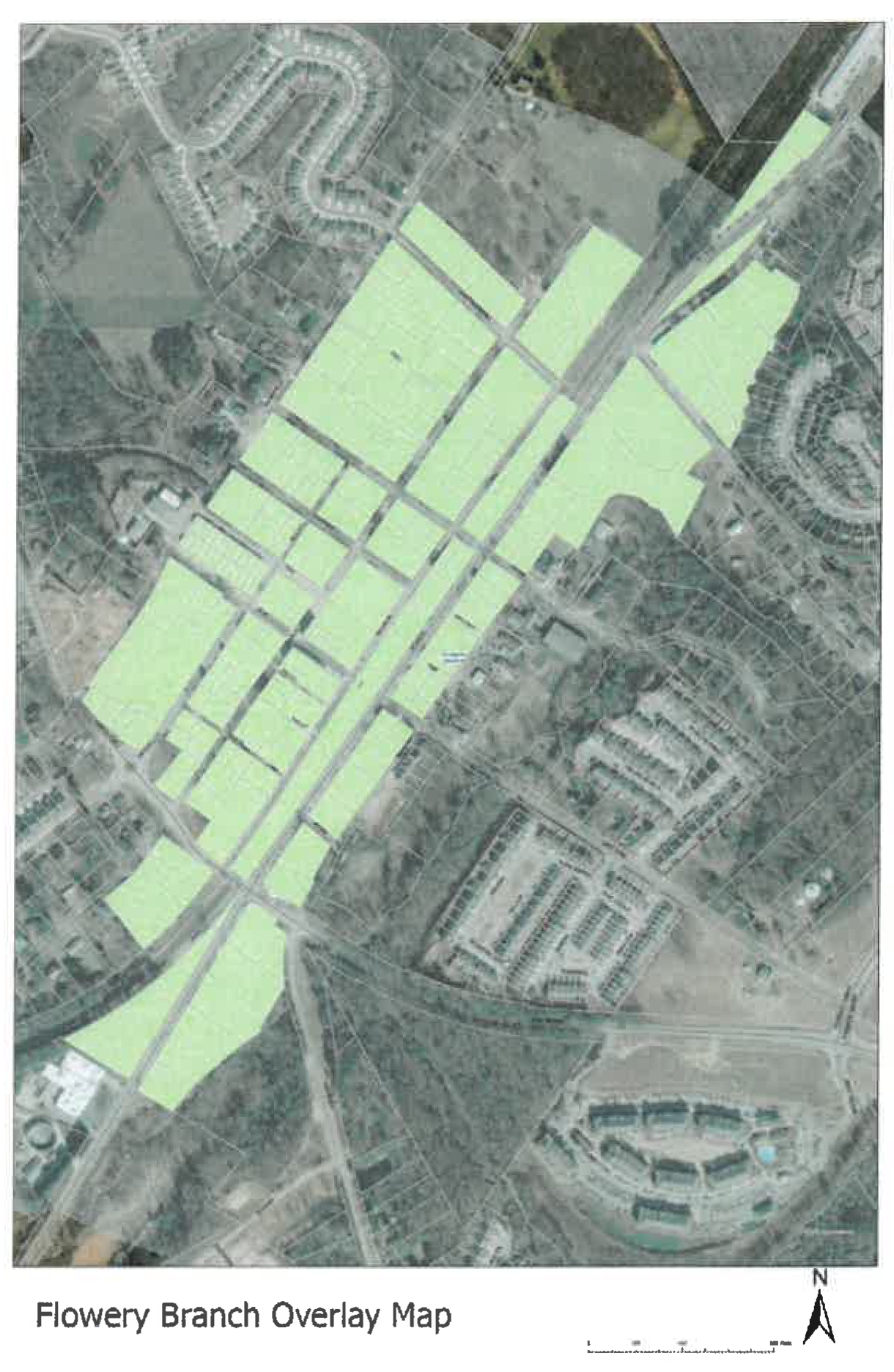
(Ord. No. 723, § 1, 11-21-2024)
_____
Table 9.1
Permitted and Conditional Uses in Nonresidential Zoning Districts
(P = Permitted Use C = Conditional Use X = Prohibited)
Note 1. Building Height and Number of Stories. The maximum height of any building, including those on lots subsequently zoned CBD after the effective date of this zoning ordinance amendment, shall be three stories and 45 feet, except as follows:
The maximum building height shall be four stories and 60 feet for the following city blocks: The city block bounded by Railroad Avenue, Pine Street Extension, Church Street, and Chestnut Street; the city block bounded by Railroad Avenue, Main Street, Church Street, and Pine Street Extension; and the city block bounded by Railroad Avenue, Bailey Drive, Church Street, and Main Street. The building height may project 6 feet above the maximum for purposes of screening roof mounted equipment, safety railings and/or other service equipment.
X(1): HB zoned properties located within the downtown overlay district may operate micro-breweries or micro-distilleries subject to the granting of a Conditional Use Permit.
(Ord. No. 348-16, § 1 (Exh. A), 7-19-2018; Ord. No. 657, § 1(Exh. A), 12-16-2021; Ord. No. 694, § 1(Exh. A), 6-1-2023; Ord. No. 717, § 2, 7-18-2024; Ord. No. 723, § 2, 11-21-2024; Ord. No. 734, § 1(Exh. A), 3-6-2025; Ord. No. 751, § 1(Exh. A), 8-21-2025; Ord. No. 786, § 1(Exh. A), 6-4-2026)
Table 9.2
Dimensional Requirements for Nonresidential Zoning Districts
Note 1. Building Height and Number of Stories. The maximum height of any building, including those on lots subsequently zoned CBD after the effective date of this zoning ordinance amendment, shall be three stories and 45 feet, except as follows:
The maximum building height shall be four stories and 60 feet for the following city blocks: The city block bounded by Railroad Avenue, Pine Street Extension, Church Street, and Chestnut Street; the city block bounded by Railroad Avenue, Main Street, Church Street, and Pine Street Extension; and the city block bounded by Railroad Avenue, Bailey Drive, Church Street, and Main Street. The building height may project 6 feet above the maximum for purposes of screening roof mounted equipment, safety railings and/or other service equipment.
Note 2. Townhouse and Multi-family Dwelling Dimensional Requirements.
In the Central Business District (CBD) zoning district, the following regulations shall apply:
•
Single-Family Attached Townhouses (Fee-Simple Ownership): For dwellings classified as single-family attached townhomes, the dimensional standards set forth in Table 6.2 for Single-Family Townhouses (SF-TH) shall govern. Additionally, such dwellings shall comply with the design standards articulated in Articles 10, 12, and 40 of the zoning ordinance.
•
Multi-family Dwellings (including Condominiums): For multi-family dwellings, whether comprising attached or detached condominiums, the dimensional standards specified in Table 6.2 for Residential Multi-Units (RMU) shall apply. Such dwellings shall further adhere to the design standards delineated in Articles 10, 12, and 40 of the zoning ordinance.
(Ord. No. 348-16, § 1 (Exh. A), 7-19-2018; Ord. No. 657, § 1(Exh. A), 12-16-2021; Ord. No. 714, § 1, 6-20-2024; Ord. No. 734, § 1(Exh. A), 3-6-2025; Ord. No. 751, § 1(Exh. A), 8-21-2025)