
Flowery Branch City Zoning Code
ARTICLE 21
- PARKING
Sec. 21.1.- Findings.
(a)
Generally. Poor design of parking lots can lead to damage to the environment and may require the community to subsidize the interests of a commercial enterprise at the expense of the community's environment. It is reasonable to require that development prevent environmental damage through good design of parking lots. Possible negative effects of parking and loading areas include creation of heat islands and changes to microclimate, isolation of pedestrians, increased stormwater runoff, and reduced stormwater infiltration into the ground.
(b)
Heat islands. Large parking lots can create heat islands where pavement absorbs solar radiation during the day and remains warm well into the night. When heat islands exist, cooling costs are higher than normal. Strategies can be used to reduce heat islands and their effects.
(c)
Lack of safe pedestrian mobility. Large areas of paving are necessary to accommodate automobiles, but they can be unfriendly to pedestrians without specific regulations requiring that designers accommodate pedestrians. Large, open parking areas are conducive to high speeds and random maneuvers which can endanger pedestrians. Wide driveway aisles and access roads also increase speeds and discourage pedestrian travel. Street and parking lot design is moving away from automobile-centered standards toward a more balanced approach that includes pedestrians.
(d)
Stormwater management. Parking lots can be seas of asphalt contributing to the degradation of local water quality. Parking lots can be more compatible environmentally if environmental protection measures are incorporated into design standards and regulations. Porous pavement and grass pavers reduce runoff by allowing it to pass through the paved surface and infiltrate back into the soil and groundwater. Utilizing porous pavements and grass pavers also reduces or eliminates land dedicated to surface storm water management facilities. Porous pavement designs and grass pavers are appropriate in some instances. Other types of stormwater management facilities are also more environmentally compatible, such as vegetative swales and bioretention.
(e)
Overbuilding of parking lots. Past off-street parking requirements have called for huge, expanses of parking around shopping centers and malls, some or much of which remains unused for most of the year. The risk of lost retail sales because of insufficient customer parking, as well as parking requirements for commercial loans, have led in part to the overbuilding of parking lots. This has worked to the benefit of retailers but has been shown to have undesirable environmental impacts, and those costs have been borne by communities. Certain parking areas are used only a few days of the year, yet the impacts of excess pavement continue every day, regardless of whether the parking is used or not. Studies have shown that at least one-half of the parking spaces in shopping centers are vacant at least 40 percent of the time (Urban Land Institute 1982, as cited in "An Opportunity to Reduce Minimum Parking Requirements," by Donald Shoup, Journal of the American Planning Association, Winter 1995, 14-28). Parking lot construction is a considerable factor in the cost of development. Reducing parking areas reduces development costs. Therefore, reductions in the size of paved parking and flexibility in the types of pavement and parking designs are beneficial to all concerned.
(Ord. No. 348-17, § 1(Exh. A), 8-2-2018)
Sec. 21.2. - Purposes.
The multiple purposes of this Article are summarized as follows:
(a)
Establish requirements for multi-modal access to development sites, including vehicular, truck service, and pedestrian, as appropriate;
(b)
Establish on-site circulation patterns conducive to safe pedestrian as well as vehicular and truck access;
(c)
Establish minimum off-street parking and loading areas in proportion to the need created by each use, but considering reductions for the provision of alternative modes of travel;
(d)
Reduce congestion in the streets and ensure that uses and functions of public rights-of-ways are not interrupted;
(e)
Establish certain maximum as well as minimum requirements for parking spaces to reduce development costs and ensure that excess impervious surfaces are not constructed, while providing for exceeding maximums when a demonstrated need exists. Parking requirements should be based on actual average parking demands, rather than to accommodate the highest hourly parking at a site as in conventional parking requirements.
(f)
Provide for alternative pavement materials, such as porous asphalt, turf block, gravel, wood mulch, and cobbles which have higher degrees of water quality effectiveness than conventional asphalt and pervious concrete;
(g)
Promote flexible approaches to the provision of off-street parking, including in some cases, as appropriate, use of on-street parking, shared parking arrangements, smaller spaces for compact cars, and unimproved or pervious pavement overflow or spillover parking areas; and
(h)
Establish design and improvement specifications for the development of parking lots.
(Ord. No. 348-17, § 1(Exh. A), 8-2-2018)
Sec. 21.3. - Applicability.
This Article shall apply to any new building constructed; for new uses or conversions of existing, conforming buildings; and for enlargements of existing structures. This Article shall not be construed so as to require additional parking spaces to be furnished for an existing building which is repaired, altered, maintained, or modernized, where the size of the building is not increased; provided, however, that when the occupancy of any building is changed to another use, parking shall be provided to meet the requirements of this Article for the new use.
(Ord. No. 348-17, § 1(Exh. A), 8-2-2018)
Sec. 21.4. - Parking Plan Required.
Before any building permit is issued, the parking lot layout and area must be found by the Zoning Administrator to be in compliance with all requirements of this Article. The Building Inspector shall not allow occupancy or use of a building until advised by the Zoning Administrator that parking facilities meet the requirements of this Article.
No permit shall be issued for any parking area, except those for detached, single-family residences, until the plans and specifications have been submitted for review by the Zoning Administrator. Such plans and specifications shall include the number of spaces provided and required, the location of entrances, exits, aisles, curbing where required, landscaping, screening, surface materials, and provisions for drainage.
(Ord. No. 348-17, § 1(Exh. A), 8-2-2018)
Sec. 21.5. - Parking Requirements in the CBD Zoning District.
It is the intent of this Section to give the Zoning Administrator maximum flexibility in administering the off-street parking requirements of this Article within the CBD zoning district, in order to promote redevelopment while ensuring that parking problems do not occur. Notwithstanding other provisions of this Article, off-street parking requirements of this Article may be administratively varied by the Zoning Administrator after considering the specific uses involved and the availability of on-street and other (nearby) off-street parking.
(Ord. No. 348-17, § 1(Exh. A), 8-2-2018)
Sec. 21.6. - Uses of Parking Lots.
(a)
Restriction to Parking Use. Areas provided to meet the minimum requirements of this Article for handicapped and other parking spaces, along with the aisles and driveways necessary to provide access to those spaces, shall not be used for any purpose other than the temporary parking of vehicles for the present on-site use or uses, except as specifically provided in this Section or authorized by the Zoning Administrator. Specifically, no such parking area may be used for the sale, repair, dismantling or servicing of any vehicles, equipment, materials or supplies.
(b)
Temporary Uses. Upon application, the Zoning Administrator may approve temporary structures and uses such as tent sales within required parking spaces that are not used on a continuous basis, provided that such uses are moveable from the site upon order by the Zoning Administrator.
(Ord. No. 348-17, § 1(Exh. A), 8-2-2018)
Sec. 21.7. - Interpretations.
(a)
Fractions. Where a fractional space results during the calculation of required parking, the required number of parking spaces shall be rounded upward to the next whole number.
(b)
Parking Space Requirement Not Specified. Where the parking requirement for a particular use is not described in this Article, and where no similar use is listed, the Zoning Administrator shall determine the number of spaces to be provided based on requirements for similar uses, location of the proposed use, the number of employees on the largest shift, total square footage, potential customer use, and other expected demand and traffic generated by the proposed use. At the discretion of a development applicant, a parking generation study prepared by a qualified professional may be submitted to aid the Zoning Administrator in making such a determination; if submitted, it shall be considered by the Zoning Administrator prior to making a determination.
(c)
Computations for Multiple Uses within a Building. In cases where a building contains some combination of office space, retail or wholesale sales area, and/or bulk storage area, the Zoning Administrator may authorize that combinations of the parking requirements established in this Article which are proportional to the use of floor areas (e.g., warehousing, retail, and/or office) be used in determining the minimum required off-street parking space requirements of this Article.
(d)
Reduction for Undesignated Parking Areas. The Zoning Administrator may authorize a reduction of a number of required parking spaces when it can be demonstrated to his satisfaction that the use provides other areas on the site that are not marked as parking spaces but which serve some of the demand for on-site parking. Such areas may include but are not limited to drive-through stacking lanes, drive-through bays, and gas pump canopy areas.
(Ord. No. 348-17, § 1(Exh. A), 8-2-2018)
Sec. 21.8. - Off-Street Parking Spaces on Same Site as Use They Serve.
All parking spaces required by this Article for all uses shall be located on the same lot as the use for which such parking is intended, except as specifically provided otherwise by this Article.
(Ord. No. 348-17, § 1(Exh. A), 8-2-2018)
Sec. 21.9. - Off-Site Parking Spaces Permitted.
In lieu of parking on the same lot as the use for which such parking is intended, parking spaces required by this Article for all uses may be provided off-site, provided the following requirements are met:
(a)
Proximity. The spaces are within a walking distance of four-hundred (400) feet of the main entrance to the building or use they are intended to serve, provided, however, that no required parking spaces may be located across any State or U.S. highway from the use they are intended to serve. In townhouse subdivision developments, each parking space shall be within one-hundred (100) feet of the entrance to the dwelling unit that it serves, as measured along the most direct pedestrian route.
(b)
Ownership or Lease Required. The property containing the parking spaces not serving a use onsite must be either under the same ownership as the property containing the use to which the parking will serve, or a valid lease agreement must exist between the two property owners for use of the parking area. Lease agreements, as applicable, must be of sufficient duration to serve the use or uses proposed to be partially served by the off-site leased parking, as approved by the Zoning Administrator.
(c)
Maximum Reductions. Off-site parking shall not exceed fifty (50) percent of the required parking for a building or buildings, except in the CBD zoning district, where 100 percent is permitted.
(d)
Pedestrian Access Required. Safe and convenient pedestrian access, such as a sidewalk or path, must exist or be provided at the expense of the property owner from the structure or use to the off-site parking lot.
(e)
Reduction for On-street Parking. The Zoning Administrator may in individual cases administratively authorize a reduction, not to exceed twenty percent (20%) of the minimum required number of parking spaces for projects that are directly served by on-street parking approved by the City Engineer.
(f)
Combinations of Uses. The number of parking spaces required by this Article for any number of separate uses may be combined and provided in one lot (i.e., off the site of one or more uses), provided that the spaces are within a walking distance of four-hundred (400) feet of the main entrance to the building or use they are intended to serve; provided further that the required spaces assigned to each use may not be assigned to another use, except as follows:
1.
One-half of the parking spaces required for a church, theater or assembly hall whose peak attendance will be on weekends and nights that services or activities are held may be assigned to a use that will be closed during those time periods.
2.
Parking spaces may be shared by more than one use if the Zoning Administrator that the total number of spaces will be adequate at the peak hours of the uses they serve.
(Ord. No. 348-17, § 1(Exh. A), 8-2-2018)
Sec. 21.10. - General Requirements for Design of Parking Lots.
(a)
Location of Spaces in Relation to Rights-of-ways. No parking space shall be provided along an access driveway within the first the first twenty-five (25) feet of the driveway from any local street.
(b)
Drainage. Parking and loading areas shall be properly graded if necessary but in all cases drained so as to prevent damage to abutting properties or public streets. Water quality effectiveness and character of the zoning district shall be considerations in determining curbing requirements.
(c)
Surfacing. Unless specifically provided otherwise in this Article, at the time of the establishment of any use, or erection of any building, or at the time any principal building is enlarged or increased in capacity by adding dwelling units, guest rooms, seats or floor area, there shall be provided permanent off-street parking spaces improved in accordance with this Article.
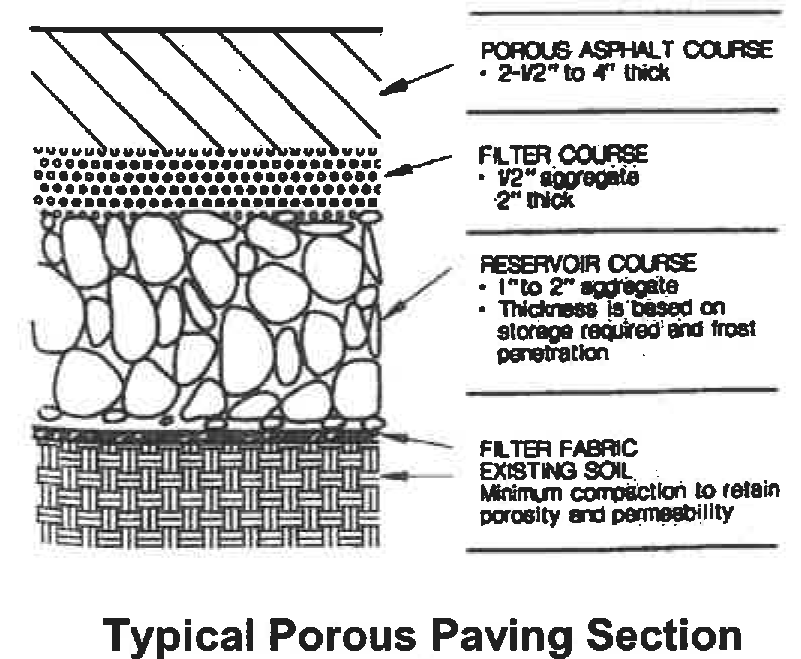
Source: Parker, Dave, et al. 2002. "Design of Stormwater Management Facilities." In The Dewberry Companies, Land Development Handbook (2 nd ed.). Figure 22.37, p. 525. New York: McGraw-Hill.
(d)
Variations of Surfacing. Parking shall be improved with an asphalt or concrete surface and curb and gutter; provided, however, that the Zoning Administrator may grant relief from the paving and/or curb and gutter requirements if negative impacts to the environment would occur, or, if alternative curbing or access control would be more compatible with the character or historic district regulations and/or guidelines. Specifically, within environmentally sensitive areas, alternative surfacing may be considered, including but not limited to, porous asphalt, turf block, and cobbles, all of which have higher degrees of water quality effectiveness than conventional asphalt and pervious concrete.
(e)
Curbs or stops. Curbing shall be installed as required by the City Engineer when considered necessary for drainage, although water quality effectiveness and character of the zoning district shall be considerations in determining curbing requirements.
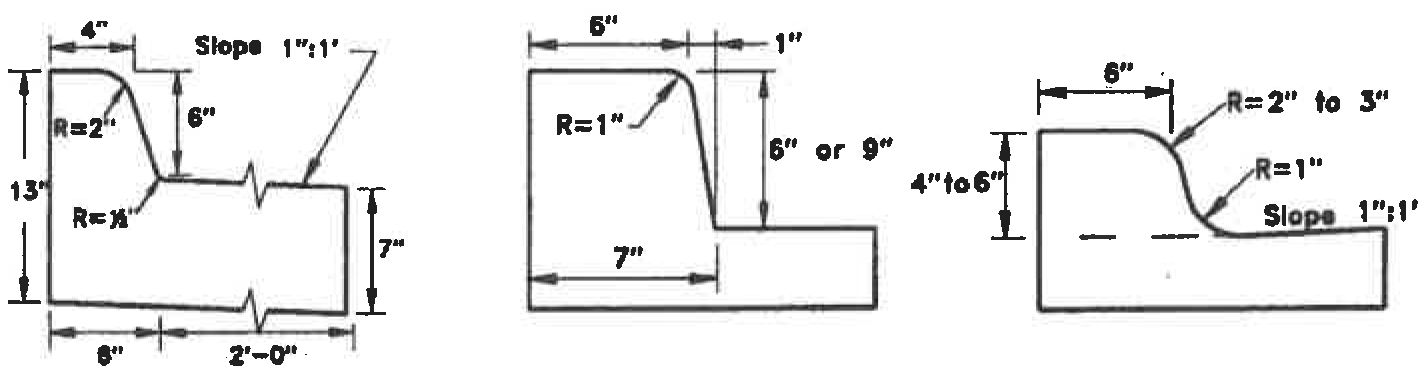
Vertical Curb Details
Source: Tanner, J. Thomas. 2002. "Suburban Street Design." In The Dewberry Companies, Land Development Handbook (2 nd ed.). Figure 20.10, p. 370. New York: McGraw-Hill.
(f)
Striping. All parking and loading spaces must be striped with paint lines, lined with curbstones, or otherwise permanently marked to designate the space, except in cases where the materials used are not conducive to striping or lining with permanently marked materials.
(g)
Lighting. Adequate lighting shall be provided if the facilities are to be used at night or if necessary for security purposes. All lighting facilities shall be so arranged to prevent the direct illumination of adjacent properties or public streets.
(h)
Signs. Signs essential to the proper functioning of the parking lot and loading areas shall be installed. Such signs shall not be illuminated and shall not exceed four feet in area, or nine feet in height.
(i)
Maintenance. All parking lots must be maintained in an acceptable condition with regards to pavement surface, signage, striping and landscaping.
(Ord. No. 348-17, § 1(Exh. A), 8-2-2018)
Sec. 21.11. - Stormwater Requirements for Large Parking Lots.
All off-street parking lots with ten or more spaces and/or establishments dispensing petroleum based products shall be required to have an oil/water separator device designed and constructed and shown in the stormwater management plan. Such device shall be approved by the City Engineer and shall be the responsibility of the property owner for maintenance and operation.
(Ord. No. 348-17, § 1(Exh. A), 8-2-2018)
Sec. 21.12. - Parking Space and Aisle Design Specifications.
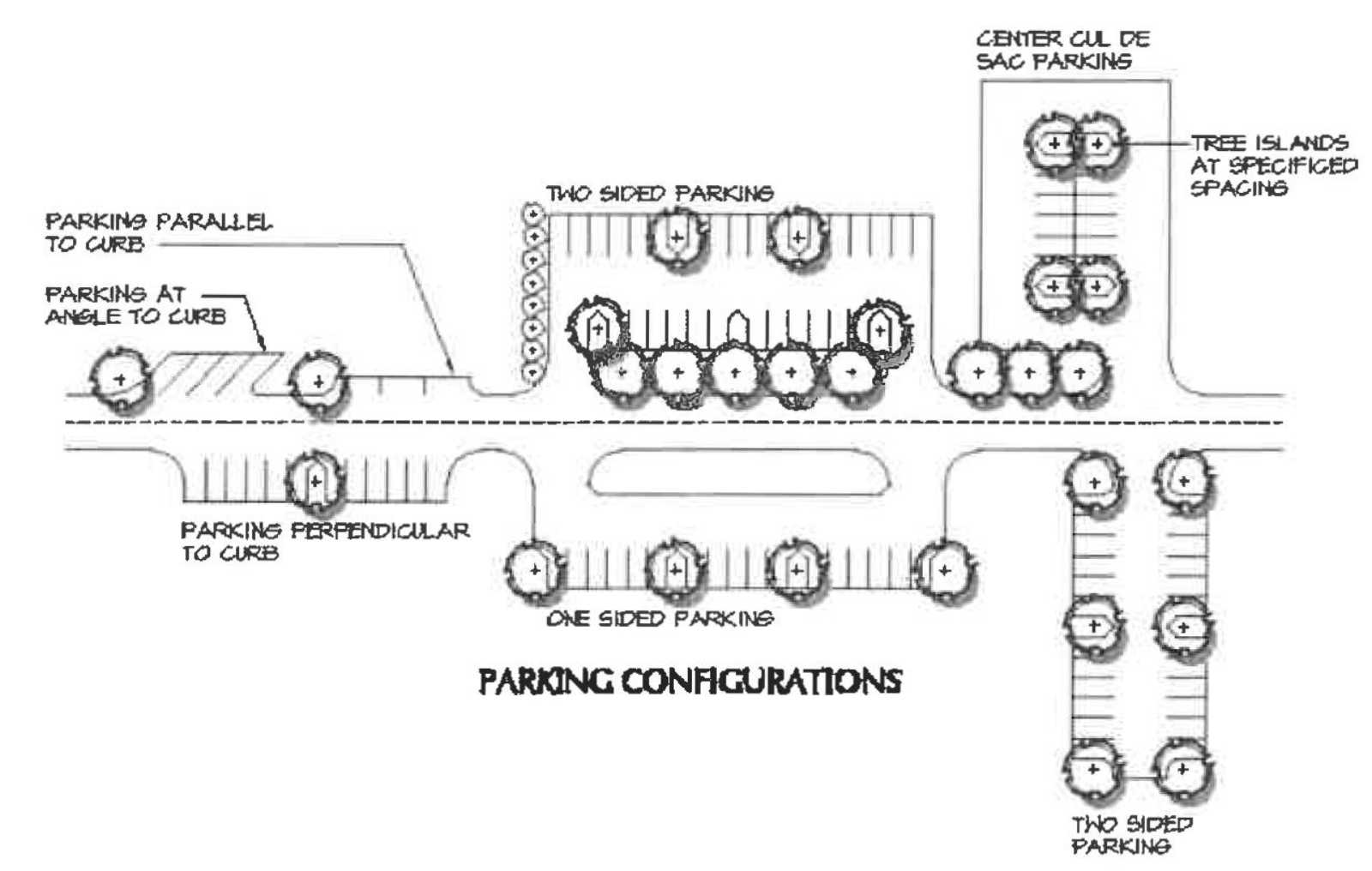
(a)
Angled Parking. Designers are permitted flexibility with regard to parking lot designs, subject to the requirements of this Article.
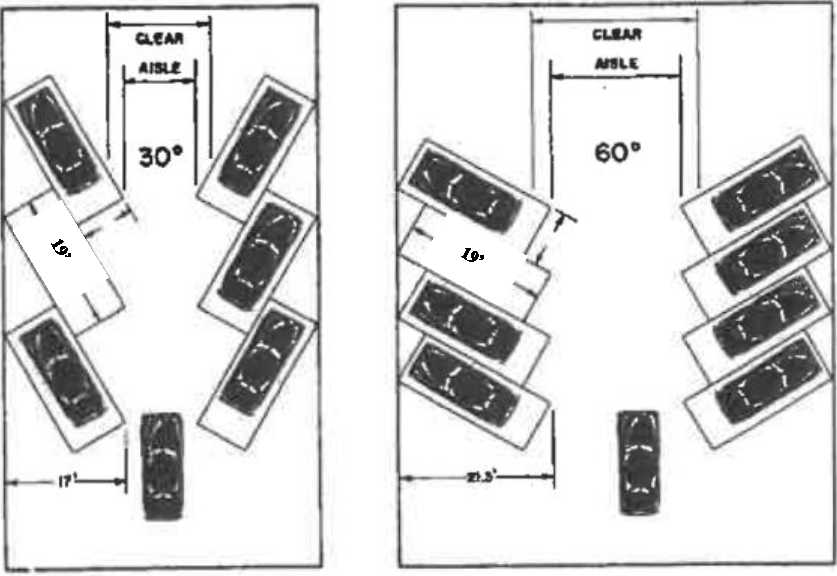
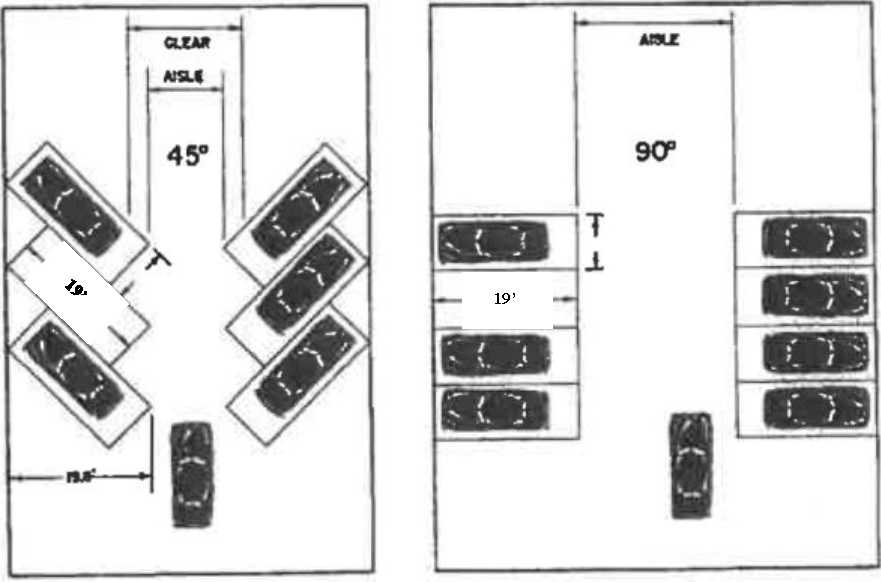
Source: De Chiara, Joseph, and Lee E. Koppelman. 1984. Time-Saver Standards for Site Planning. Figure 6.205, p. 663. New York: McGraw-Hill.
(b)
Parking Space Width and Length. Parking spaces shall be a minimum of nine (9) feet in width and nineteen (19) feet in length.
(c)
Interlocking design. An interlocking or "herringbone" parking design is not permitted, as it exposes the side of one vehicle to the front of another, which can result in substantial damage if the vehicle rolls forward (see figure).
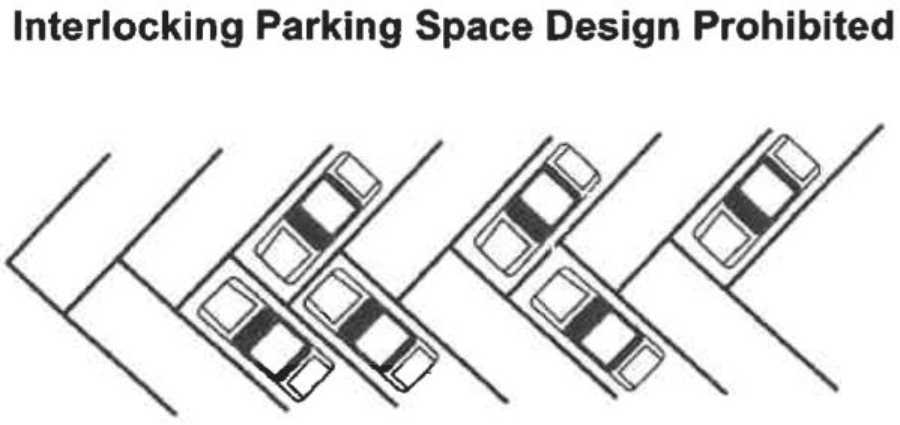
Source: Stover, Vergil G., and Frank J. Koepke. 2002. Transportation and Land Development (2 nd Ed.). Washington, DC: Institute of Transportation Engineers. Figure 9-6, p. 9-15.
(d)
Inter-parcel driveway connection or provision of a future inter-parcel driveway stub (with appropriate cross-access easements) shall be required between adjacent non-residential properties. This requirement may be waived by the Director only if it is demonstrated that an inter-parcel connection is not feasible due to traffic safety or topographic concerns.
(e)
Interior driveways, with or without parking, shall be 12 to 16 feet wide for one-way traffic, and 22 to 24 feet wide for two-way traffic. Driveways that are determined to be essential fire access shall be increased to a minimum of 20 feet in width.
(f)
Interior driveways providing primary access to loading/unloading zones or loading docks for truck traffic shall be increased to 14 feet in width per travel lane.
(g)
Interior driveways surrounding gasoline pumps shall be increased to 40 feet in total width (as measured from the base of the gasoline pump islands).
(h)
Bumper stops shall be installed to separate parking spaces from sidewalks, rights-of-way, adjacent properties and landscape strips to prevent overhangs or encroachments. Where required, bumper stops shall be a minimum of 6 inches in height and 6 inches in width. Bumper stops shall be constructed of concrete, stone, or equally suitable material approved in writing by the Zoning Administrator, and be permanently secured to the pavement surface.
(Ord. No. 348-17, § 1(Exh. A), 8-2-2018; Ord. No. 767, § 1, 11-20-2025)
Sec. 21.13. - Minimum Number of Handicapped Parking Spaces.
Handicapped spaces shall be provided in each parking lot according to the requirements of Table 21.2. Such spaces shall be counted in meeting the off-street parking requirements of this Article, as specified in Table 21.3 of this Article.
Table 21.2 Minimum Number of Handicapped Spaces Required
(Ord. No. 348-17, § 1(Exh. A), 8-2-2018)
Sec. 21.14. - Specifications for Handicapped Parking Spaces.
Handicapped parking spaces shall have an adjacent aisle five (5) feet wide, and one in every eight (8) handicapped spaces (but not less than one) shall be adjacent to an aisle eight (8) feet wide and the space shall be signed "van accessible." Handicapped parking space aisles shall be clearly demarcated.
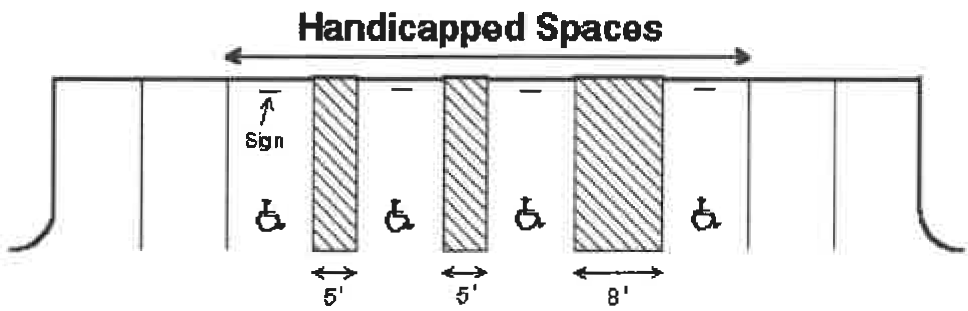
All handicapped parking shall comply with the requirements of the Georgia Accessibility Code. Accessible parking spaces shall be designated as reserved by a sign showing the symbol of accessibility, per applicable state law requirements. Such signs shall be located so that they cannot be obscured by a vehicle parked in that space.
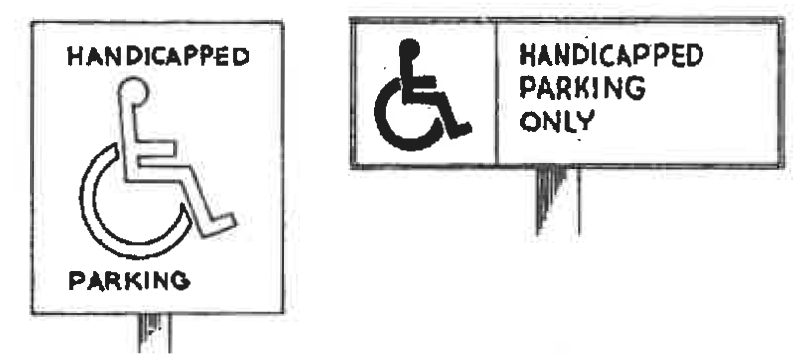
Source: De Chiara, Joseph, and Lee E. Koppelman. 1984. Time-Saver Standards for Site Planning. Figure 6.222, p. 679. New York: McGraw-Hill.
(Ord. No. 348-17, § 1(Exh. A), 8-2-2018)
Sec. 21.15. - Off-Street Parking Requirements by Use.
(a)
Required. Unless specifically provided otherwise in this Article, on each lot where a building, structure, or use exists, each site shall be designed to provide and shall provide for off-street parking in the minimum amounts and not to exceed the maximum amounts specified in Table 21.3 (including handicapped parking spaces). Requirements refer to one space per unit of measurement unless otherwise specifically provided. Square footages are measured on the basis of gross square footage unless otherwise specifically provided.
(b)
Reduction or Alteration Prohibited. No existing or future off-street parking area shall be reduced in capacity to less than the minimum required number of spaces or increased to more than the maximum permitted number of spaces or altered in design or function to less than the minimum standards, unless specifically provided for in this Article.
(c)
Applicability. This Section shall not be construed as requiring compliance of parking lots which lawfully existed on the effective date of this Article; provided, however, that the Zoning Administrator shall ensure parking lots that do not comply with this Article meet the requirements of this Article or substantially comply when a new development permit is required or a building permit is required to add additional building space on the site. If substantial redesign of the parking lot is required to comply with this Article in such cases of new development or building additions, the Zoning Administrator may accept substantial rather than complete compliance when the strict application of a requirement of this Article would pose substantial practical difficulty.
Table 21.3
Minimum and Maximum Number of Off-Street Parking Spaces Required
(Ord. No. 348-17, § 1(Exh. A), 8-2-2018)
Sec. 21.16. - Stacking Space Requirements for Drive-Through Facilities.
Stacking spaces shall be provided for any use having a drive-through facility or areas having drop-off and pick-up areas in accordance with this Section. Stacking spaces shall begin at the window or communication/mechanical device (e.g., order board) first encountered by the vehicle user.
(a)
Specific Commercial Facilities. Financial institutions with drive-through windows, car washes (automated or staffed facilities), drive-through photo finishing booths, drive-through coffee sales facilities, and any other uses with drive-through facilities except restaurants shall provide three (3) stacking spaces for each window or drive-through service facility.
(b)
Restaurants. Restaurants with drive-through facilities shall at least provide five (5) stacking spaces for each window or drive-through service facility, free and clear of access easements if any and drives required for on-site circulation.
(Ord. No. 348-17, § 1(Exh. A), 8-2-2018)
Sec. 21.17. - Stacking Lane Specifications.
The following general standards shall apply to all stacking spaces and drive-through facilities:
(a)
Stacking spaces and lanes for drive-through stations shall not impede on and off site traffic movements, shall not cross or pass through off-street parking areas, and shall not create a potentially unsafe condition where crossed by pedestrian access to a public entrance of a building.
(b)
Drive-through lanes shall be separated by striping or curbing from off-street parking areas. Individual lanes shall be striped, marked, or otherwise distinctly delineated.
(c)
All drive-through facilities shall be provided with a bypass lane with a minimum width of ten (10) feet.
(Ord. No. 348-17, § 1(Exh. A), 8-2-2018)
Sec. 21.18. - Administrative Variances.
The Zoning Administrator may allow parking above the maximum or twenty percent (20%) below the minimum required as specified in Table 21.3, on a case-by-case basis based upon the scale and impacts of the request, for good cause shown. The applicant shall make said request in writing which shall include documentation from an acceptable industry publication (e.g., Institute of Transportation Engineers, Urban Land Institute, American Planning Association, etc.) or by a study prepared by a qualified professional that documents parking requirements. In approving administrative variances that reduce the minimum parking requirements established in this Article, the Zoning Administrator may as a condition of approval, if applicable, require an area to be reserved or set-aside for additional parking area for future use if needed.
(Ord. No. 348-17, § 1(Exh. A), 8-2-2018)
Sec. 21.19. - Electric Vehicle Charging Stations
(a)
Electric vehicle charging stations may be counted toward satisfying minimum off street parking space requirements for non-single-family uses.
(b)
Electric vehicle charging stations must be reserved for charging electric vehicles. For purposes of this provision "charging" means that an electric vehicle is parked at an electric vehicle charging station and is connected to the battery charging station equipment.
(c)
Vehicle charging equipment must be designed and located so as not to impede pedestrian, bicycle or wheelchair movement or create safety hazards on sidewalks.
(d)
Information must be posted identifying voltage and amperage levels and any type of use, fees, or safety information related to the electric vehicle charging station. The information shall be posted on a sign not to exceed four square feet in total sign face area.
(e)
Electric vehicle charging stations must be maintained in all respects, including the functioning of the equipment. A valid phone number, e-mail address, or other contact information must be provided on the equipment for reporting when it is not functioning properly, or other problems are encountered.
(Ord. No. 348-15, § 1, 3-16-2017; Ord. No. 348-17, § 1(Exh. A), 8-2-2018)

