
Fridley City Zoning Code
CHAPTER 634
Fencing
634.01 Purpose
1. The City recognizes the health, safety, aesthetic and economic value of fences. The provisions of this Chapter are intended to:
(a) Allow for areas on site for privacy, while maintaining the City’s general open design along streets;
(b) Provide screening and mitigation of potential conflicts between active areas and more passive areas;
(c) Enhance the overall aesthetic conditions of the City;
(d) Limit sight line obstructions;
(e) Reduce the potential for criminal and illegal activities; and
(f) Prevent conflicts with utilities and drainage flow.
Adopted by Ord. 1431 on 6/18/2025
634.02 General Fencing Provisions
1. Fences are permitted in all yards and zoning districts subject to the provisions in this Chapter.
2. Property owners wishing to erect a fence must first apply for and obtain a zoning permit from the City, in accordance with the Procedures chapter.
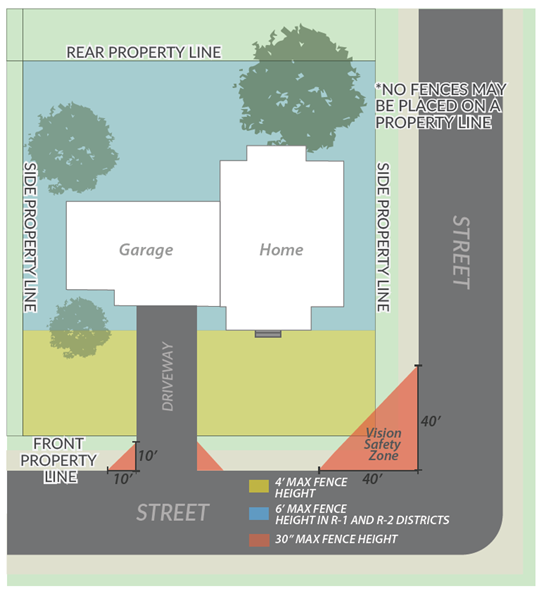
3. Fencing must be located entirely upon the private property of the owner constructing the fence. No fence is allowed to be located on a property line. The property owner is responsible for maintaining the area between the property line and the owner’s fence.
4. No fence is allowed to encroach into the Vision Safety Zone as described in the Definitions chapter.
5. Fences in Easements
(a) Fences placed within a drainage or utility easement is at the risk of the property owner. The City or any utility company that has the authority to use such easement will not be liable for any damages, repair or replacement of the fence in the event it is moved, damaged or destroyed in the installation, maintenance or repair of the facilities or utilities within the easement area.
(b) If located within a drainage or utility easement, the fence must not impede the flow of water runoff or interfere with planned or installed utilities. Fences which have been determined by the Community Development Director to impede water runoff or interfere with utilities are deemed a public nuisance and must be removed at the owners’ expense.
6. Specific district standards may apply to special fencing as applicable in Section 634.04.
7. Every fence must be constructed in a substantial and sturdy manner and of a substantial material. Fences must be constructed of wood, metal, bricks, masonry, plastic or other materials designed for permanent outdoor fencing. Wood fences must be constructed of cedar, redwood or other decay resistant wood. Fences must not be constructed from razor wire, snow fencing, plywood or materials originally intended for other purposes.
(a) Fence installation, posts and supporting members. All fence elements must be permanently installed and constructed in a durable manner to secure the fence in a vertically level position. Fences must be installed so that fasteners, posts and lateral supports are not on the side of the fence facing an adjacent property or public right-of-way, unless exposed on both sides.
8. All fencing must be maintained, kept safe and in a state of good repair by the property owner. The property owner is responsible for maintaining the area between the property line and the owner’s fence.
9. Every fence must be maintained in a condition of reasonable repair and may not be allowed to become and remain in a condition of disrepair or danger, or constitute a nuisance, public or private. Any such fence that has become a nuisance must be repaired or removed. Any violation of this Section is subject to the Abatement of Exterior Public Nuisances Chapter of the Code.
10. Any fence existing on the effective date of this Chapter and not in conformance with this section may be maintained, but no alteration, modification or improvement of said fence must occur, unless installed in conformance with this section.
Adopted by Ord. 1431 on 6/18/2025
634.03 Fence Height
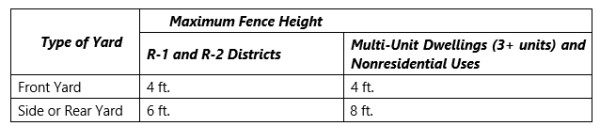
1. Except where otherwise required by this code or required by a condition of approval for a land use application, the following limitations apply to fence height:
2. No fence may exceed a height of 30 inches within 10 feet of a driveway for a distance of 10 feet in each direction from the intersection of the property line, as illustrated in Figure 1.
Figure 1
3. Building permits are required for fences over seven feet in height.
4. Exceptions and interpretation. The following exceptions and guidance on interpretation apply to fence height limitations:
(a) A residential fence abutting a nonresidential use may rise to the height of eight feet.
(b) For the purposes of determining fence height, the Community Development Director will determine the front yard.
Adopted by Ord. 1431 on 6/18/2025
634.04 Special Fence Provisions
1. Security Fencing
(a) Security and electrical fencing are permitted only in industrial zoning districts that:
(1) Abut a railroad;
(2) Have approved outdoor storage uses;
(3) Contain public utility or defense contractor facilities.
(b) Additional height is allowed for an electric security fence or a barbed wire security fence if:
(1) The fence is located in the side or rear yard of an industrial property that has been approved for outdoor storage use; and
(2) In any yard of a public utility or defense contractor facility, the following conditions are met:
((a)) Barbed wire security fence. In addition to an eight-foot fence, up to three strands of barbed wire, not to exceed 18 inches total in height, may be affixed to the top of the eight-foot fence and mounted on standard barbed wire arms designed specifically for that purpose.
((b)) Electric security fence.
((1)) In addition to an eight-foot-tall fence, commercially-available electric security fencing which meets the standards established in American Society for Testing and Materials (ASTM) “Standard Practice for Commercial Application of Electric Security Fences” and is installed and maintained to manufacturer specifications may extend up to 24 inches above the eight-foot-high fence.
((2)) Electric security fencing must be placed inside a solid surface or otherwise impenetrable, eight-foot tall, non-electric fence capable of preventing ground-level persons, animals or objects from contacting it from outside the fence.
((3)) The electric security fence must at all times be marked with clearly legible electric fence warning signage. Signage must be placed at least every 30 linear feet and on every gate.
((4)) The area three feet from the electric security fence in any direction must be kept free of vegetation which may contact the electric security fence.
(c) With City approval, during times of national emergency, properties may be authorized for additional usage of barbed wire or electric security fencing including temporary barriers made of barbed wire and barbed wire used on top of temporary security fences.
Adopted by Ord. 1431 on 6/18/2025
634.05 Prohibited Fences
1. The following fences are prohibited within the City:
(a) Any fence charged with or connected to an electrical current, able to be transmitted to persons, animals or objects which might come in contact with it, unless otherwise authorized by this Chapter.
(b) Any fence constructed within or upon any public right-of-way or pedestrian or vehicle access.
(c) Any fence constructed within, upon or through any stormwater drainage areas, ponds or wetlands.
(d) Any fence that encloses, hinders or restricts access to above ground utility boxes, fire hydrants or other above ground utility structures or components.
(e) Any fence over 30 inches tall located within a Vision Safety Zone as described in the Zoning Districts Chapter.
Adopted by Ord. 1431 on 6/18/2025

