
Gastonia City Zoning Code
CHAPTER 8
SUPPLEMENTAL USE REGULATIONS
8.1.1 - AGRICULTURAL USE, CLASS II
For riding stable uses only. All buildings, structures and facilities (including riding rinks/rings but excluding pasture lands) designed for use or occupancy of animals shall be located at least one hundred (100) feet from any lot line.
8.1.2 - ASSISTED LIVING CENTER; CONTINUING CARE FACILITY; INDEPENDENT LIVING CENTER; NURSING HOME
A.
Any facility which is licensed or constructed to have greater than fifty (50) residents shall maintain a side setback of at least twenty (20) feet and a rear setback of at least forty (40) feet when the side or rear yard abuts a residential district or a lot containing a principal residential use, unless a greater setback is otherwise required for the zoning district in which it is located.
B.
Any facility on a lot that abuts a residentially zoned district must install a Type B buffer along the adjoining property line.
8.1.3 - FAMILY CHILD CARE HOME, CHILD CARE CENTER (LOCATED IN A RESIDENCE)
A.
The facility must be located within the single-family residential dwelling unit and occupied by the operator.
B.
Outdoor play areas shall be located in the rear or side yards only. Outdoor play areas must also be in compliance with regulations set forth by the North Carolina Department of Health and Human Services.
C.
All outdoor play areas shall be surrounded by a fence or wall at least four (4) feet in height. Outdoor play areas shall not include driveways, parking areas, or other land unsuitable for play use. No outdoor play shall be permitted after sundown.
D.
The facility shall be located in a structure originally designed and constructed as a single-family dwelling. Said structure shall be the principal structure on the lot. The exterior of the structure (aside from the allowed day care signage) shall not be altered in a manner that diminishes its single-family dwelling characteristics.
E.
A copy of the license issued by the North Carolina Department of Health and Human Services must be submitted to the City of Gastonia prior to the permit being closed.
(Ord. No. 14-632, § 8, 8-19-14; Ord. No. 21-737, § 2, 5-18-21)
8.1.4 - URBAN MULTI-FAMILY & MIXED-USE DEVELOPMENT
The Urban Multi-family & Mixed-Use Development regulations are hereby established, and applicable to the following "urban core areas" and associated underlying zoning districts:
1.
The Central Business District (CBD);
2.
The Urban Mixed Use (UMU) Zoning District;
3.
The Gateway Corridor Overlay (GC-O) District;
4.
The Historic District Overlay (HD-O) Districts (York-Chester & Brookwood);
5.
The York-Chester National Historic District;
6.
The Municipal Service District;
7.
The Urban Redevelopment Area;
8.
The Loray Mill National Register Historic District;
9.
The Downtown Gastonia National Register District;
10.
The Uptown Redevelopment Area; and
11.
The West Gastonia Redevelopment Area.
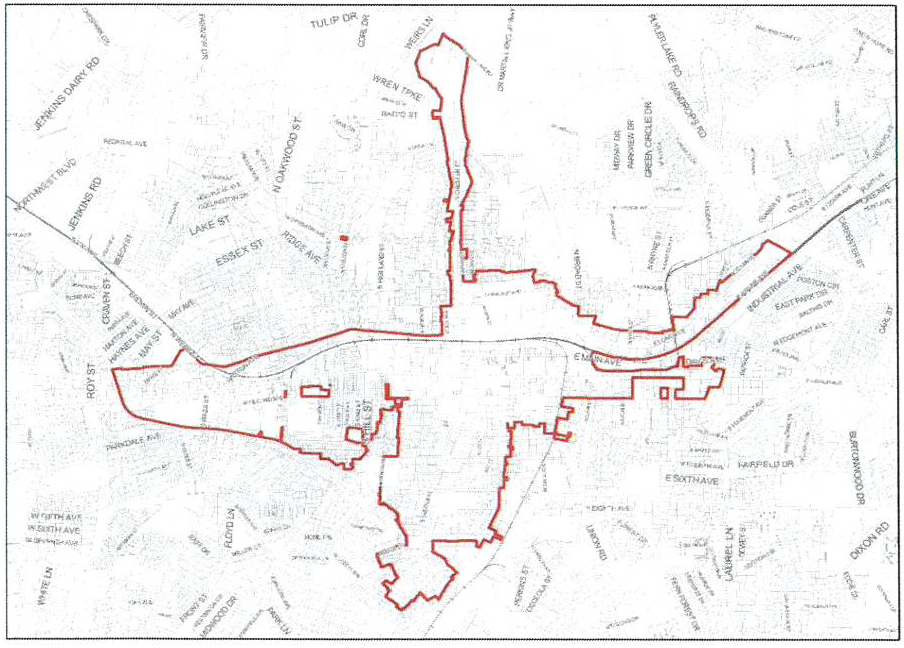
These areas which comprise of Gastonia's Urban Core include a variety of base zoning districts whereas the supplemental regulations are intended to allow urban multi-family and mixed use developments by right, or via conditional zoning process in existing residential districts.
These developments are intended within zones that are transitioning from an automobile-centric orientation toward a comfortable pedestrian environment that is easily accessible and well-connected to surrounding neighborhoods. Such developments may serve the daily needs of nearby residents within walking distance. The standards allow for greater flexibility in design and site needs, such as parking amount and location, while accommodating multiple modes of transportation including walking, bicycling, and automobile.
1.
General Provisions.
a)
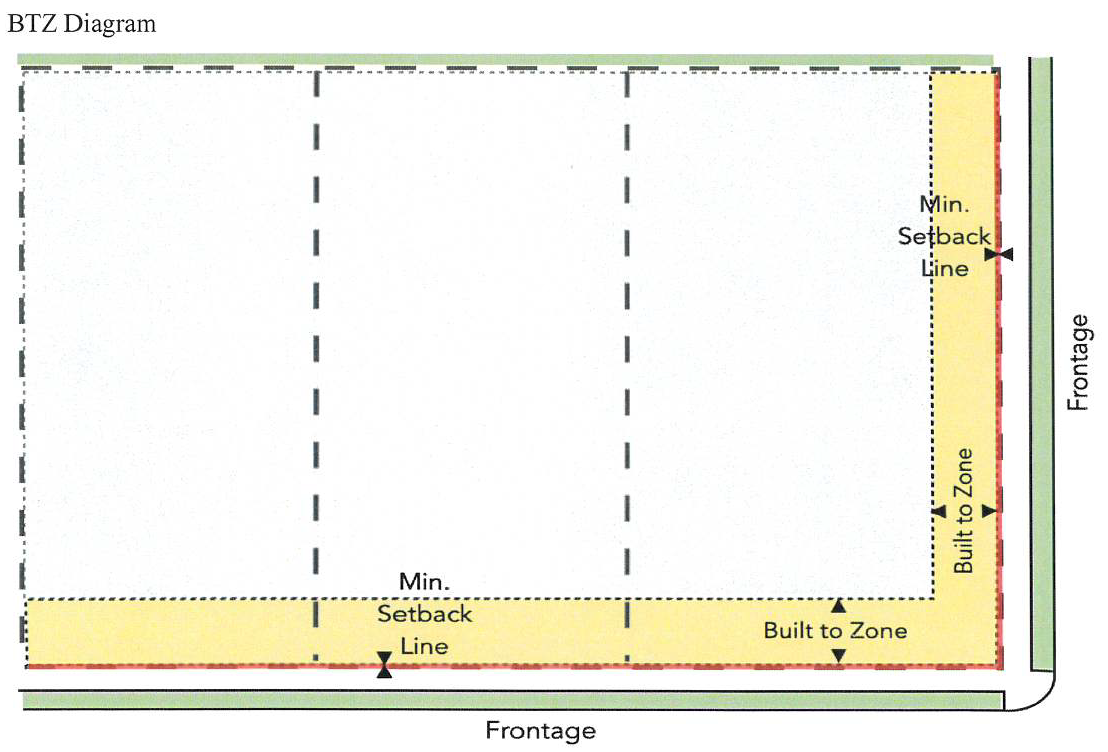
Build-to-zone - A build-to zone (BTZ) is the area on a lot, measured parallel from the required frontage setback line, where the minimum build-to percentage of a structure shall be located. A build-to-zone sets a minimum and maximum dimension within which the building facade line shall be located per the requirements of the minimum build-to percentage.
b)
Build-To Percentage - The percentage of the building facade that shall be located within the build-to zone (BTZ), calculated by building facade, not lot width. Build-to percentage is further defined as:
•
Facade articulation elements, such as window or wall recesses and projections, shall be considered to meet any required build-to percentage.
•
Public open spaces and outdoor dining areas that are bounded by a building facade and are no more than an average of twenty-four (24) inches above or below grade are counted as meeting the build-to percentage.
•
Common or private open spaces of residential development bounded on three sides by a building and no more than an average of twenty-four (24) inches above or below grade are counted as meeting the build-to percentage.
c)
Frontage on Public and Private Streets - The percentage of the building façade that shall be located within the build-to zone (BTZ), calculated by building facade, not lot width. Build-to percentage is further defined as:
•
Buildings within a multi-dwelling development may be placed on a lot that does not abut a street, provided that each building is within four-hundred (400) feet of a public street or network required private street that furnishes direct access to the property.
•
Lots within a mixed-use development site need not abut a street so long as the overall development site abuts a public or network required private street and is designed in such a manner that access is furnished to all interior lots or building sites. Access to interior lots or building sites shall only be across property zoned for nonresidential development.
d)
Building Length - measured as the length of the facade abutting a frontage. Passageways, breezeways, ground floor passages and similar building connections are included in the calculation of total building length.
e)
Prominent Entrance - A building entrance that is visually distinctive from the remaining portions of the facade where it is located and is parallel and directly connected to adjacent pedestrian facilities. A building frontage shall have a minimum of 1 prominent entrance. Individual tenant spaces on the ground floor must each provide a connection to adjacent pedestrian facilities. For mixed-use buildings, and multi-family stacked units, entrances that contain at least three of the following are considered a prominent entrance:
•
Decorative pedestrian lighting/sconces;
•
Architectural details carried through to upper stories;
•
Covered porches, canopies, awnings, or sunshades;
•
Archways;
•
Transom or sidelight windows
•
Terraced or raised planters;
•
Common outdoor seating enhanced with specialty details
•
Paving, landscaping, or water features;
•
Double doors;
•
Stoops or stairs.
f)
Maximum Blank Wall Area - measured vertically or horizontally on any facade facing a public ROW, public open space, and public trail shall not exceed 20 ft.
2.
Building Setbacks & Architectural Design Specifications.
The Diagram 2(a) and Table 2(a) regulate the built form and placement of multi-family and mixed-use developments buildings in the designated Zoning Districts in which they are applicable.
Diagram 2(a)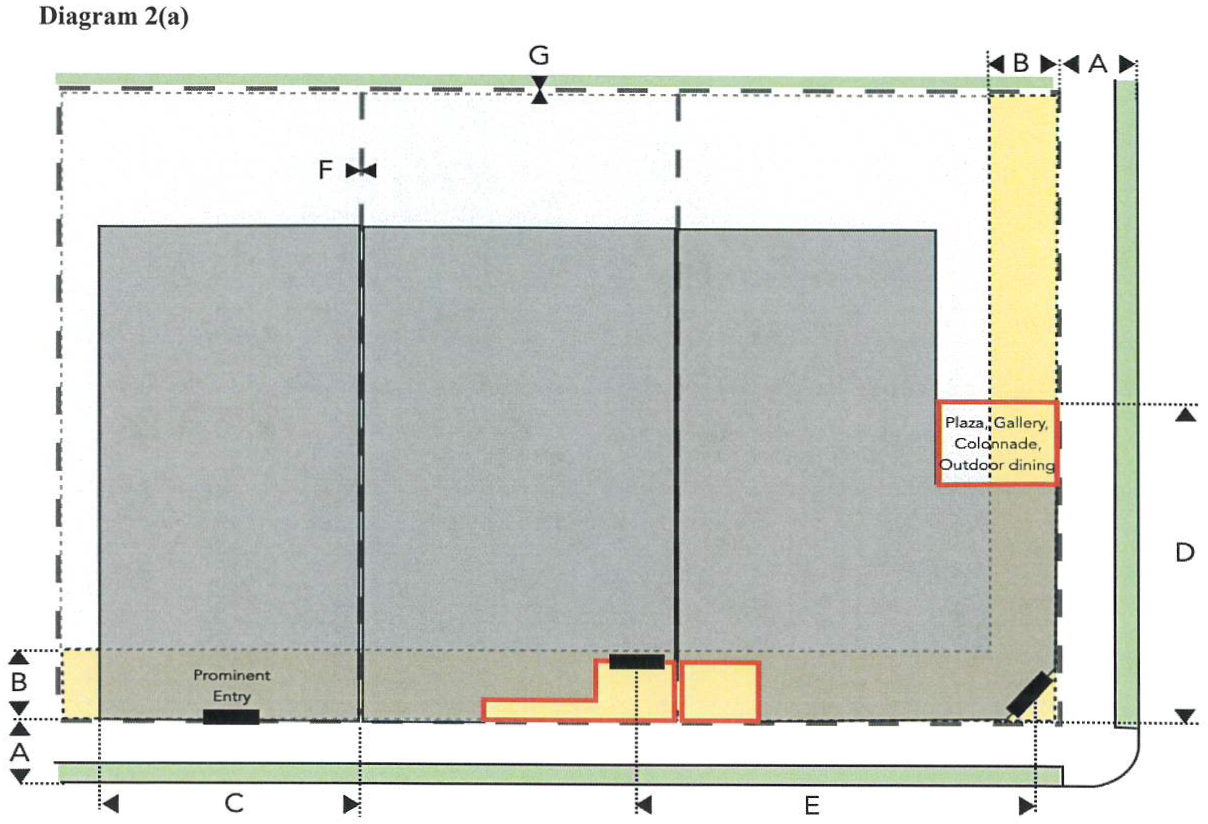
3.
Building Materials.
The following building materials are limited to 10% of each façade along a frontage. They may also be used as a component of construction when not a surface finish material without limitation.
a.
Corrugated metal siding; however, the reuse of prefabricated shipping containers is permitted.
b.
and is not subject to limitation, as long as all building codes and other applicable codes are met.
c.
Exterior insulation finishing systems (EIFS) is prohibited on the ground floor of a multi-family.
d.
Building.
e.
Plain concrete masonry units (CMU).
f.
Plastic.
g.
T-111 Composite plywood siding, fiber cement.
h.
Vinyl or PVC.
4.
Architectural Elements Encroachment Requirements.
Table 4(a) lists architectural design features and extensions permitted into required setbacks.
Table 4(a) lists architectural design features and extensions permitted into required setbacks.
5.
Architectural Elements Design Requirements.
a)
Arcade, Gallery, Colonnade.
•
An arcade, gallery, or colonnade is considered to meet a required build-to-zone.
•
The minimum vertical clearance of an arcade, gallery, or colonnade is ten (10) feet.
•
A horizontal clearance of at least 8' shall be maintained between columns or piers.
•
If enclosed, arcades, galleries, and colonnades shall meet min transparency requirements.
•
Arcades, galleries, and colonnades shall be located at or behind the required setback line.
•
Projecting and Shingle signs are permitted, and are subject to the supplemental sign regulations of Chapter 12 Signs.
Diagram 5(a) Arcade, Gallery, Colonnade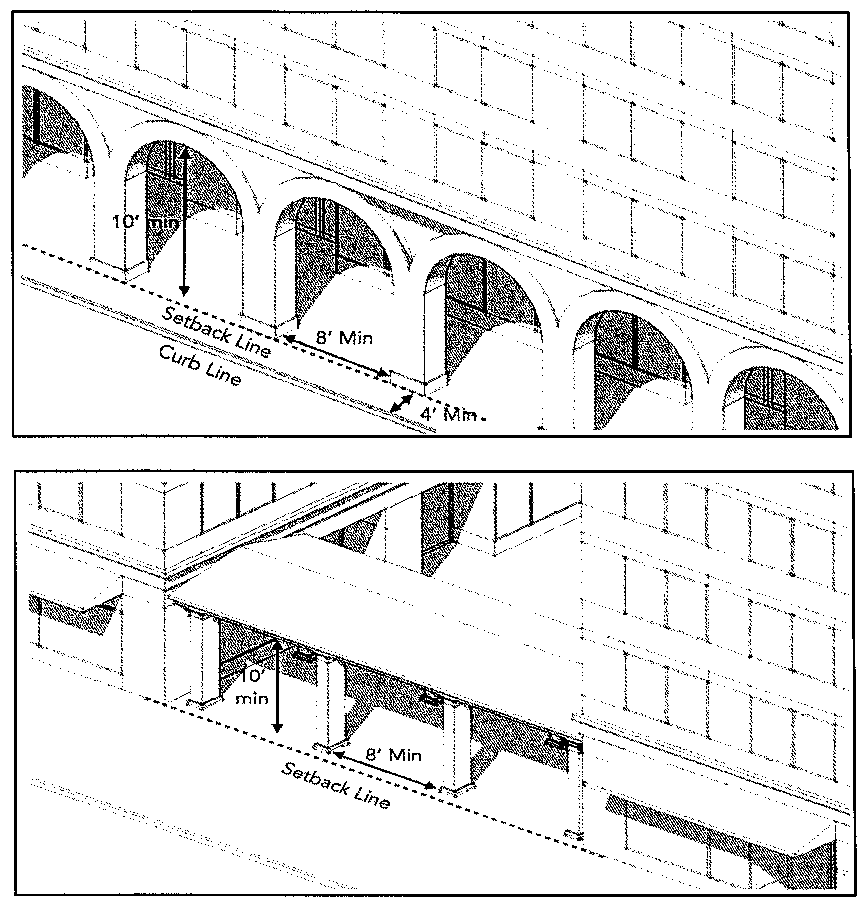
b)
Awning.
•
Awnings and sunshades may encroach over a public or private sidewalk, shared use path, amenity zone, or planting strip, but no more than 4' from the future back of curb.
•
Awnings and sunshades shall have a minimum vertical clearance of 10'.
•
These standards do not apply to awnings used as awning signs, which are subject to the supplemental sign regulations of Chapter 12 Signs.
Diagram 5 (b): Awning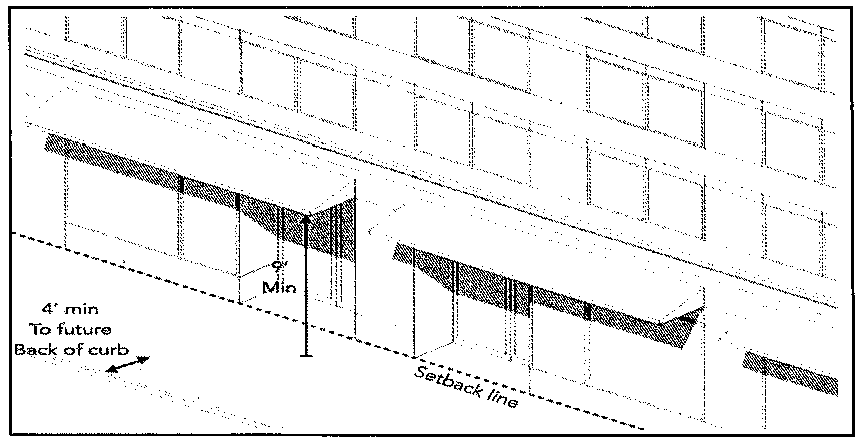
c)
Balcony.
•
balconies may project four (4) feet beyond the required setback line but cannot encroach into any public ROW.
•
balconies shall maintain a minimum vertical clearance of twelve (12) feet.
Diagram 5 (c): Balcony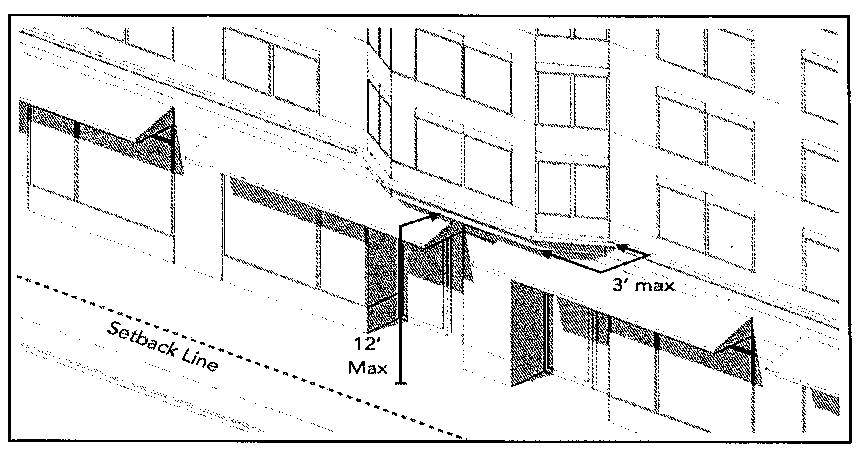
d)
Bay Window.
•
Bay windows may project up to a max of three (3) feet from the building facade line.
•
Bay windows may not encroach into any public right-of-way
•
Bay windows shall maintain a min. clearance of twelve (12) feet above ground.
Diagram 5 (d): Bay Window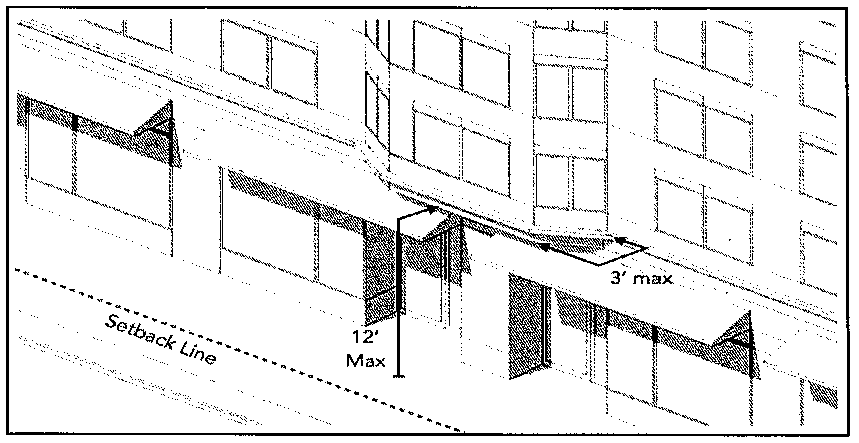
e)
Canopy.
•
Canopies may encroach over a public or private sidewalk, shared multi use path, amenity zone, or planting strip, but no more than 4' from the future back of curb.
•
Canopies shall have a minimum vertical clearance of nine (9) feet.
•
A horizontal clearance of at least eight (8) feet shall be maintained between canopy supports and between canopy supports and any building facade.
•
For existing buildings, canopy posts may be located within an amenity zone, a minimum of four (4) feet from the back of curb. All other buildings require canopies and all support posts to be located on the property.
•
These standards do not apply to canopies used as canopy signs, which are subject to the supplemental regulations of Chapter 12 Signs.
Diagram 5 (e): Canopy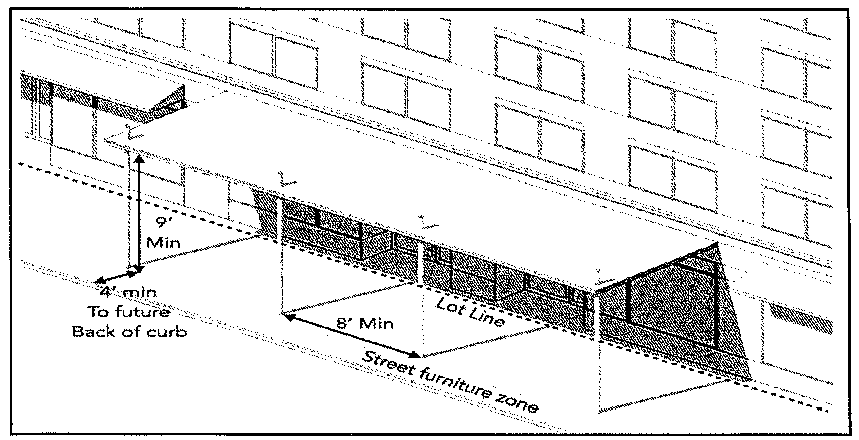
f)
Sills, Belt Courses, Eaves, Cornices, & Ornamental Features.
•
Sills, belt courses, eaves, cornices, and ornamental features may project from the building facade no more than 2' and may extend over a public or private sidewalk, shared multi use way, amenity zone, or planting strip.
•
Sills, belt courses, eaves, cornices, and similar ornamental features shall have a minimum vertical clearance of 10'.
6.
Open Space Requirements.
Development sites of one acre or less are exempt from on-site open space requirements. Development sites greater than one acre shall provide a minimum of 10% of the site area as open space. Of the 10% set aside for open space 50% shall be Public Open Space for Mixed Use development and 25% for Multi-Family development. The design of Open Spaces shall meet the requirements of Section 8.1.11.
7.
On Site Pedestrian Connectivity.
a)
Multi-Family Developments - A pedestrian connection, a minimum of five feet in width, is required to the adjacent public sidewalk, between buildings, and from buildings to all on-site facilities (parking areas, bicycle facilities, plazas, and open space, etc.). This includes a connection to a required public sidewalk not yet constructed.
b)
Mixed-Use Developments - Internal sidewalk connections are required between buildings and from buildings to all on-site facilities (parking areas, bicycle facilities, plazas, and open space, etc.). All internal sidewalks shall have a hard surface constructed of concrete, asphalt, or other similar material and shall be at least five feet in width. In the event that such connection would disturb or impair any significant environmental features of the site, this requirement may be modified by the Zoning Administrator.
8.
Off Street Parking, Requirements, Design & Location: Multi-family & Mixed-use.
Off Street surface lots and structured parking for Multi-family and Mixed-use buildings shall follow the requirements of Chapter 10, in addition to the requirements listed herein.
a)
All surface and structured parking lots are prohibited in an established setback along a primary frontage, with the following exemptions:
•
Where there is no principal building along a frontage, surface parking areas may be located a minimum of 25 feet from a right-of-way, back of sidewalk, or a shared use path, whichever is greater. On all other frontages parking shall be located behind the established setback. A knee-wall a minimum of three (3) feet in height shall screen all parking from a primary frontage.
•
no parking structure shall face onto a primary frontage, or be located along a primary frontage unless screened by an intervening liner building having a minimum of 30ft in width, and a height sufficient to cover 95% of the height of the parking structure.
•
For mixed-use buildings on streets four (4) lanes or greater, one double row of parking may be located between the building façade and the required setback. Surface parking should be separated from the street right-of-way and public sidewalk by curbing, wheel stops, planted shrubs a min of 3ft in height, or a knee-wall a min of 3ft in height.
•
Alternatively, on streets greater than 4 lanes parking may be located between the building façade and the required setback for up to 50% of the total building length. The remainder of the building length shall be located at, or closer to, the required setback line than the parking.
b)
No surface parking, driveways, circulation, or maneuvering areas shall be located in the established setback along a frontage except as prescribed herein. Driveways shall only be installed across the established setback along a frontage for access to parking areas and shall be as nearly perpendicular to the street frontage as possible. Driveway locations also require approval by the City Development Services Department and through the Technical Review Committee process. Shared parking and driveway connections between parking lots is encouraged. No vehicle travel aisle, including drive aisles for on-site circulation, shall be located in the established setback along a frontage.
c)
Driveway access to surface parking areas shall not be located in an established setback along a primary frontage. Exceptions may be granted by the Zoning Administrator for site conditions that preclude any other practical alternative.
9.
Off Street Loading.
a)
No more than 5 loading spaces are required for any single building. The minimum required number of off-street Loading spaces may be part of a loading dock or may be freestanding. In no instance shall loading be located within any required setback, or be utilized for placement or storage of any waste or recycling containers with capacity in excess of 2 cubic yards.
b)
Off street loading shall be calculated separately for the residential components and the non-residential components of a development as follows:
•
Residential - One (1) loading space min., is required for a development containing 50 or more dwelling units.
•
Non-residential - Less than 20,000 sf total gross area (GFA): none; 20,000 sf- 150,000 sf GFA: 1; One (1) additional for each 100,000 sf GFA above 150,000 sf.
c)
If a parcel has multiple frontages, then exterior loading spaces or driveway access to loading spaces shall not be located on a primary frontage. If this requirement creates a public safety issue or impacts operations, the Zoning Administrator may modify this requirement or provide an alternative standard. If all frontages are primary frontages, the Zoning Administrator will determine the frontage where it shall be located with minimal disruption to vehicles and pedestrians in the right-of-way.
d)
Loading spaces may be located on the exit portion of a driveway stem when the driveway has two points of ingress and egress. Loading spaces shall be located a minimum of 20 feet behind any required setback and any sidewalk or other pedestrian facilities. The requirement for two access points may be waived if the lading vehicle is able turn around on the site.
10.
Landscape & Screening.
See Chapter 11 of the Gastonia UDO.
11.
Signs.
See Chapter 12 of the Gastonia UDO.
(Ord. No. 23-785, § 3, 4-18-23)
8.1.5 - DWELLING, TWO-FAMILY (DUPLEX)
A.
Two-family dwellings are allowed as a use by right on corner lots only in the RS-12 zoning district. Driveway ingress and egress to each unit shall be from separate streets. The structure must meet the minimum front setbacks from both streets.
(Ord. No. 16-646, § 2, 5-17-16; Ord. No. 21-739, § 1, 6-15-21; Ord. No. 23-785, § 3, 4-18-23; Ord. No. 24-802, § 2, 1-16-24)
8.1.6 - FAMILY CARE HOME
A family care home shall be a use by right, except that no family care home shall be located within one-quarter (¼) mile of another family care home.
(Ord. No. 21-739, § 1, 6-15-21)
8.1.7 - GROUP HOME
A.
Each facility must have a minimum uncovered land area (equal to the lot area less the square footage of all principal and accessory building footprints) of five thousand (5,000) or more square feet for up to twelve (12) residents, and seven hundred (700) square feet for each additional resident;
B.
No group care facility may be located closer to another such facility than one-half (½) mile measured by a straight line, and not street distances, in order to prevent the creation of a de facto social service district and to avoid affecting the surround neighborhood. "Affecting" means the point at which the number of group care facilities or residents therein might become so large that it may alter the character of a neighborhood. This subsection is also intended to protect existing group care facilities from the possibility that an over-concentration of such facilities might inadvertently create an institutional setting and hinder or negate the purposes of such facilities.
8.1.8 - MANUFACTURED HOME, CLASS A; MANUFACTURED HOME PARK
Manufactured Home, Class A.
Manufactured homes are allowed on individual lots in manufactured home subdivisions only.
Manufactured Home Park.
A.
The number of manufactured homes within a nonconforming manufactured home park shall not be greater than the number in existence on February 25, 2005, or the date the property is annexed, whichever date is later. A manufactured home may be replaced by another manufactured home in a nonconforming manufactured home park so long as the total number of homes does not exceed the number of homes referenced above.
B.
Said replacement manufactured home shall be placed on the same manufactured home space provided that the replacement manufactured home shall not be placed any closer to the external property boundaries than the original home.
C.
Manufactured homes shall be in compliance with all other applicable local and state codes.
D.
In no instance shall a manufactured home park that existed on the effective date of this Ordinance be allowed to expand (i.e., increase in the number of manufactured home spaces) subsequent to the adoption of this Ordinance, unless meeting the requirements of Section 8.1.8 A above.
E.
In no instance shall any new manufactured home parks be created after the effective date of this Ordinance.
8.1.9 - MATERNITY HOME
A.
In the OLC, O-1 and C-1 zoning districts, the use is permitted by right for up to thirty (30) beds. For a use with greater than thirty (30) beds, a special use permit shall be required.
(Ord. No. 21-739, § 1, 6-15-21)
8.1.10 - DWELLING, MULTI-FAMILY & MIXED RESIDENTIAL
A.
Development Guidelines.
1.
Allowed Zoning Districts
All multi-family developments must be served by a public water and sewer system.
2.
Maximum Building Height
Same as underlying zoning district
3.
Minimum Gross Lot Size
10,000 ft 2
4.
Common Open Space
Within Multi-family and Mixed Residential developments, total acreage shall be based on number of units in Multi-Family-Apartment and Attached Single Family-Townhome building types using the ratios listed below, with a reduction based on proximity to existing municipal facilities, i.e: parks, greenways/trails, recreation/athletic/pool facilities.
For developments adjacent to such facilities the amount of open space shall be reduced by 75%. For developments within a 10-minute walk from the closest point of the property boundary to the municipal facility, open space shall be reduced by 50%. All other developments shall provide the open space according to the ratios below.
In all zoning districts except for CBD, TMU, I-U and UMU, the following amount of common open space shall be provided:
•
Less than ten (10) units: no open space required
•
Ten (10) to two hundred (200) units: Eight hundred (800) square feet per unit
•
Any additional units over two hundred (200): Four hundred (400) square feet per unit
At least seventy-five (75) percent of the open space shall be improved open space per Section 8.1.11 Open Space. The standards and type of open space shall be in accordance with Section 8.1.11 Open Space of this Ordinance.
5.
Approval Process
6.
Off-street Parking Requirements
Parking shall be provided in accordance with Chapter 10 herein.
7.
Buffer Requirements
Buffer shall be installed in accordance with Section 11.3.2 Buffer Yard Standards.
B.
Building Design Standards.
1.
All Multi-Family-Apartment buildings located within two hundred (200) linear feet of a public street shall be oriented parallel with the front yard. (NOTE: The above referenced orientation requirements shall be waived if screening in the form of a Type B or higher screen is provided in the front yard. This regulation does not apply in the CBD C-3, TMU, UMU and I-U Zones.)
The Administrator shall have the authority to waive or modify this requirement provided that specific circumstances unique to the subject property would make meeting the required width impractical or impossible.
2.
Front build-to lines shall be a minimum of five (5) feet behind internal streets and sidewalks. The 5ft setback shall be planted along the entire length of the building except at building entrances, with at least one (1) shrub per six (6) linear feet. For buildings that do not provide open porches and patios along an elevation fronting internal streets and sidewalks, the front build-to line may be a minimum of zero (0) feet.
3.
No off-street parking spaces may be placed in front yard unless a Type B or higher screen is provided in the front yard to shield the parking spaces from the adjoining street. Notwithstanding, in no case may greater than one-half (½) of the off-street parking be placed in the front yard.
4.
Multi-Family Apartment buildings shall provide a minimum of ten (10) feet between the sides of all one story buildings, plus an additional five (5) feet of separation for buildings two stories and above.
In C-3, TMU and UMU Zones the fronts of Multi-Family Apartment buildings fronts may face one another across an open space (as defined in Supplemental Regulations 8.1.11 Open Space) a minimum of 30' in width. For buildings taller than 2 floors the separation between two front facing buildings shall be the equal to the height of the tallest building plus 5'.
In C-3, and TMU Zones Attached Single Family Townhomes, Attached Single Family Duplex and Detached Single Family dwellings shall set back a min of 5' from a fronting sidewalk, provide a minimum of ten (10) between the sides of any two (2) buildings, and provide a minimum of 34' between the rear of any two (2) buildings. The rear setback shall be increased to seventy-five (75) feet if the units are parked on-site via a rear lane. The rear setback between any two (2) buildings may be decreased to sixteen (16) feet if the entirety of the rear yard and the side yard up to the rear facade of the building is enclosed by a privacy fence having a minimum height of six (6) feet. Furthermore, fence height shall a minimum height of eight (8) feet when the fence is adjacent to or visible from a street (whether public or private) or common open space. Privacy fences shall be completely opaque made of brick, split face block, wood, or stucco, or any material design approved by the Zoning Administrator.
Front setbacks for detached single-family buildings that have front-loaded parking shall set back all portions of a building used for parking, whether attached, detached, enclosed, or open air, a min of 25' from a fronting sidewalk. All Attached Single Family Townhomes, Attached Single Family Duplex and Detached Single Family dwellings that have a cumulative frontage total of 55' or less in width shall be accessed and parked from the rear. Cumulative frontage is defined as the total of the two building side separation measurements divided by two, plus the width of the unit's front facade.
Attached Single Family Townhomes, Attached Single Family Duplex and Detached Single Family dwellings that face onto one another across an open space (as defined in Supplemental Regulations 8.1.11 Open Space) a minimum of 20' in width measured from building foundation wall to foundation wall.
5.
Trash dumpsters shall be screened in accordance with Section 11.6 - Open-Air Storage and Solid Waste Dumpster Screening, No dumpsters shall be placed in the front yard setback.
6.
The primary pedestrian entrance into the building shall be from the front yard sidewalk.
7.
At least fifty (50) percent of the front elevation of the Multi-Family Apartment building shall be clad with brick, rock, decorative block, approved stucco and other permitted masonry materials as determined by the Zoning Administrator or approval body in instances where a special use permit or conditional zoning is involved. Buildings located in the CBD and UMU will follow the design standards for those districts. Buildings located in TMU Zones shall follow the design standards of the CBD and UMU Zones. In C-3 Zones, Attached Single Family-Townhome, Attached Two Family-Duplex, and Detached Single Family dwelling units shall use complimentary building materials to those of any Multi-Family Apartment building. If no Multi-family Apartment Buildings area present cladding materials shall be approved by the Zoning Administrator.
8.
All newly constructed Multi-Family Apartment buildings shall have a minimum of two (2) different roof elevations on any building with a length over seventy-five (75) feet. Buildings located in the CBD and UMU will follow the design standards for those districts. Buildings located in TMU Zones shall follow the design standards of the CBD and UMU Zones. Flat roofed buildings in a C-3 Zone shall follow the requirements of the CBD and UMU Zones.
9.
For Multi-family Apartment buildings greater than one hundred (100) feet long, there shall be no uninterrupted wall length exceeding seventy-five (75) feet. An interruption shall consist of a change in place by more than one foot or a change in texture/masonry patterns. Multi-family Apartment buildings located in the CBD and UMU will follow the design standards for those districts. Buildings located in TMU Zones shall follow the design standards of the CBD and UMU Zones.
10.
For Multi-family Apartment buildings that have a length less than one hundred (100) feet, one interruption shall be required within thirty (30) feet on either side of the center of the building. Multi-family Apartment Buildings located in the CBD and UMU will follow the design standards for those districts. Buildings located in TMU Zones shall follow the design standards of the CBD and UMU Zones.
11.
Each exterior front door that provides access to an individual unit or any shared door (i.e., a door that provides access to more than one unit from the exterior) shall have a porch that forms the predominant aspect of the building design. Porches shall constitute at least fifteen (15) percent of the front façade of each apartment unit. Buildings located in the CBD and UMU will follow the design standards for those districts. Buildings located in TMU Zones shall follow the design standards of the CBD and UMU Zones. Multi-family Apartment Buildings located in a C-3 and I-U Zones are exempt.
12.
At least one ground entrance to every dwelling shall be located within a walking distance of one hundred (100) feet to the parking area within the development designated to serve that dwelling.
13.
Sidewalk requirements—Refer to Section 9.18.1.
14.
Greenstrip requirements—Refer to Section 9.18.2.
(Ord. No. 11-586, § 5, 1-18-11; Ord. No. 14-632, § 9, 8-19-14; Ord. No. 21-735, § 4, 3-16-21; Ord. No. 21-739, § 1, 6-15-21; Ord. No. 21-742, § 4, 8-10-21; Ord. No. 22-756, § 2, 1-18-22; Ord. No. 22-763, § 3, 5-17-22)
8.1.11 - REVISED RESIDENTIAL DEVELOPMENT DISTRICT
A.
Purpose.
In order to provide for the orderly development of residential neighborhoods, encourage residential development patterns that contribute to the character and sense of place of the community, and to allow for creativity in the planning of future residential development, the City hereby establishes districts and their associated standards and specifications to amend the City's existing UDO.
B.
Districts Established.
Single Family Residential Districts (R-1, R-2, R-3, R-4 and R-5) provide for the completion of existing residential neighborhoods and the development of new residential neighborhoods. Allowed building/lot types in the Single-Family Districts are: Detached House and Attached House (Townhome & Duplex). Listed uses are restricted to single-family homes and their accessory uses, per Section 7.1-1 Table of Uses. Density calculations exclude accessory dwelling units. Maximum acreage refers to size of development before mixed use, in the form of retail and/or commercial use, is required. R-4 Townhome Development that is adjacent to existing commercially zoned property, in retail and/or office use, may exceed the maximum acreage listed below by up to 20% provided all the acreage dedicated to Townhomes is contiguous to the commercially zoned property.
C.
Lot Dimensions, Building Setbacks and Specifications by Type.
Permitted building types and associated standards by District are specified by Tables C(1), C(2), and C(3), as well as Section 8.1.17 Tables A(1) and C(2). Landscaping shall comply with the requirements set forth in Chapter 11, Screening and Landscaping.
1.
Detached House Lot Type and Building Type Standards.
The detached house is the most prevalent building type in Gastonia. The detached house building type is generally found in residential neighborhoods, although it may coexist with other, similarly scaled buildings in commercial or mixed-use areas. For detached homes on large lots, building placement and site planning shall be dictated by landscape features and landscape preservation. Within the limits described below, these regulations shall apply to all houses built utilizing these revised residential development standards.
2.
Side Yard (Zero Lot) Housing - a detached single-family house with one side built on, or directly adjacent, to a side property line, and the opposite side facing onto a yard.
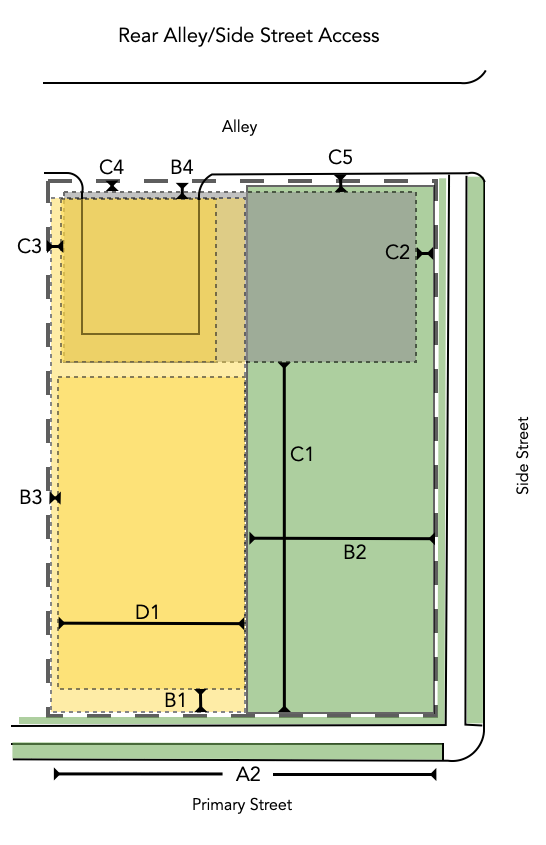
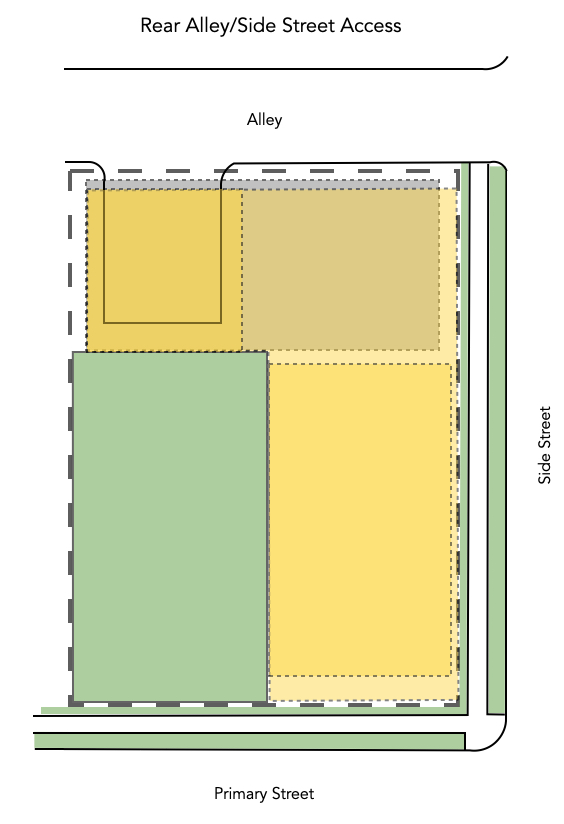
3.
Neighborhood Cottage Court allows Detached Homes (single unit living), Side Yard (Zero Lot Line) Homes, Duplex Homes, (two unit living), and Townhomes, (three (3) units max per building) centered on a common courtyard. Lot accessibility and lot frontage requirements shall comply with Section 9.5 of the UDO. A Cottage Court may be developed on individual lots or with a common form of ownership.
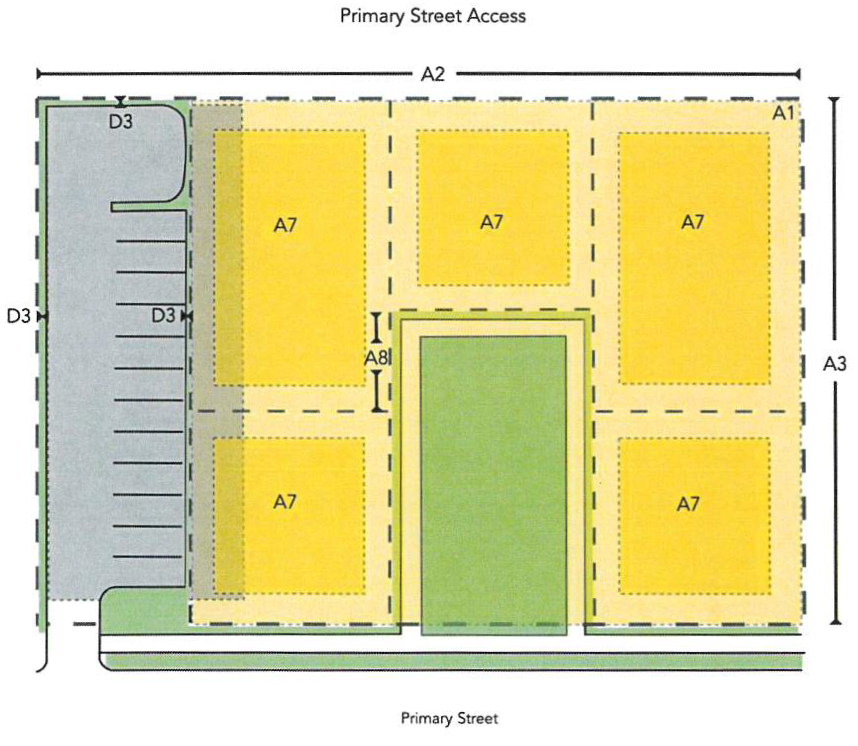
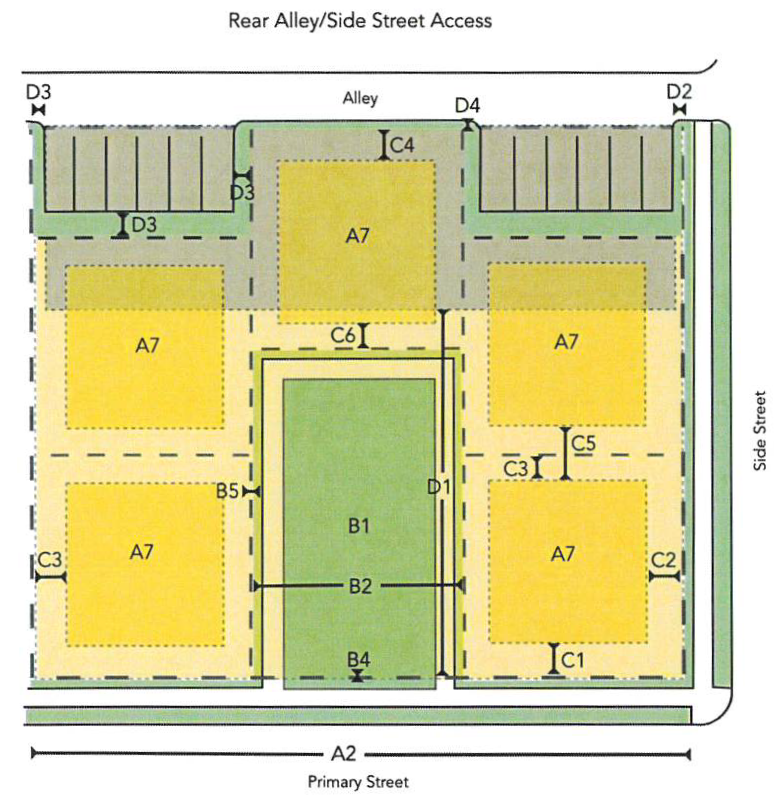
D.
Single Family Attached Lot Development Standards
Single Family Attached R-4 and R-5 District Standards within these Supplemental Regulations shall be adhere to the requirements of Section 8.1.17, Tables A(1) and C(1).
E.
Subdivision Design Standards
The following apply to R-1, R-2, R-3, R-4 and R-5 Districts. For additional requirements specific to Attached Single Family R-4 and R-5 Districts see Section 8.1.17.
1.
Site Grading, Streets, Alleys and Blocks Requirements:
a.
Grading shall provide for smooth grade transitions in accordance with the most recent version of the "Subdivision Grading Minimum Design Standards" to avoid abrupt "v" ditches, swales and other disruptions to the landscape, particularly between buildings where open space enhancements for use by persons actively utilizing the landscape and/or yard area. The use of crawl space, skim walls, and raised slab construction techniques in attached residential structures and professional landscape design are required to meet this characteristic of site development to establish a Finished Floor Elevation (FFE) as measured from the top of curb of fronting street to the minimums established for each building type, See Table 1, in Section 8.1.11 and Tables 1 and 2 in Section 8.1.17.
b.
Primary pedestrian access into the building shall be from a street frontage line, sidewalk, or parking area. Primary Pedestrian entry for buildings fronting an open space may be located from the open space. For Townhomes facing onto a common open space, entrances to other units either adjacent, or opposite, shall also face the common open space. See Section 8.1.17.B.l(d) for Townhomes facing onto designated open space.
c.
The average perimeter of all blocks shall not exceed one thousand three hundred fifty (1,350) feet. Road segments connecting across utility easements, designated flood zones, and undeveloped lands set aside as open space shall not be counted in permitter block calculations, (see Streets C.4). See Section 8.1.17 for Townhome development.
d.
Water and Sewer utilities are encouraged to run along fronting streets, and "dry" utilities along rear lanes/alleys provided that a permanent access and utility easement is recorded for the full length of alley being used for utilities or public services such as garbage collection.
e.
Streets shall be organized according to a hierarchy based on function, size, capacity, and design speed; streets and rights-of-way are therefore expected to differ in dimension. The proposed hierarchy of streets shall be indicated on the submitted site plan. Each street type shall be separately detailed.
f.
To prevent speeding, continuous street segments greater than one thousand (1,000) feet in length shall employ traffic calming measures as outlined in the Gastonia Public Works Traffic Calming Toolkit.
g.
Consistent build-to lines shall be established along all streets and public space frontages; build-to lines determine the width and ratio of enclosure for each public street or space. A minimum percentage build-out at the build-to line shall be established on the plan along all streets and public square frontages.
h.
Townhome developed property abutting Detached Single-Family development shall provide a landscaped buffer, per Chapter 11.3 of the UDO, along the length of the shared frontage, for units that are front loaded.
i.
Street plans shall take into account the adopted MPO Comprehensive Transportation Plan for guidance as to the allocation of any proposed Rights-of-Way that may impact layouts.
2.
On Street Parking Requirements
a.
Location of Parking
On street parking shall be allowed along all residential streets per City of Gastonia Engineering Specifications & Details Manual. Parking is not permitted along rear lanes, designated bike lanes, within eight (8) feet of a driveway apron, within fifteen (15) linear feet of a fire hydrant, and areas specifically signed for no parking. In no case shall minimum off-street parking space(s), whether enclosed or not, extend into the public right of way, or into an easement, or a public sidewalk on private property.
b.
Assignment of Parking
On street parking at the lot front may be counted toward all or part of the parking requirement of a dwelling unit provided the standards in the above paragraph are satisfied.
3.
Building Architecture Requirements (see section 8.1.17.B.3 for Townhome requirements):
a.
Garage doors for parking located in a front setback shall be setback a min of twenty-five (25) feet from back of sidewalk of fronting street.
b.
Garage doors shall be designed to have a second story element extend at least one foot beyond the ground floor wall plane for the length of the garage door.
c.
Garage door facades visible from a ROW shall harmonize with the architecture of the home as regards materials and colors and include at least two (2) of the following design elements: windows, glazed paneling, matching or complimentary hardware to home, decorative accents.
d.
Porches shall form a predominant motif of home designs and be located on the front or to the side of the dwelling. When attached to the front, they shall extend over at least forty (40) percent of the front facade. All porches shall be constructed of materials in keeping with those of the main building.
4.
Accessory Uses & Structures
a.
Accessory uses and structures are permitted in conjunction with allowed principal uses. Allowed accessory uses and structures include those listed in this Chapter, and additional accessory uses and structures that, as interpreted by the Zoning Administrator, meet the following:
i.
Are clearly incidental to and customarily found in connection with an allowed principal building or use,
ii.
Are subordinate to and serving an allowed principal building or use,
iii.
Are subordinate in area, extent and purpose to the principal building or use served,
iv.
Contribute to the comfort, convenience or needs of occupants, business or industry in the principal building or use served, and
v.
Are located on the same lot and to the rear of the principal building or use served.
b.
In addition, no accessory use or structure may be established on a lot prior to the establishment of a permitted principal use.
c.
Setback and height requirements for all accessory structures are established for each building type and are set forth in this Chapter.
d.
No accessory structure may be located closer than six (6) feet to any other building or structure on the same lot. Two (2) or more structures joined by a breezeway shall be considered attached and part of the same principal building except when the breezeway meets the following:
i.
Is no more than six (6) feet in width, including roof overhangs,
ii.
Is no more than sixteen (16) feet in height or the height of the principal structure, whichever is less,
iii.
Meets the accessory structure setbacks,
iv.
Is open on the sides except for structural support columns,
v.
Is located no closer to the primary or side street than the wall plane of the principal structure closest to the street, and
vi.
Has no walkway on the roof.
e.
In Residential Districts, accessory structures associated with Detached Home, Duplex Home, and Townhome types shall comply with the following:
i.
Accessory structures with gross floor area of one hundred fifty (150) square feet or less, and height of ten (10) feet or less shall have a minimum setback of five (5) feet from side and rear property lines,
ii.
The Accessory structure shall not be located any closer to the primary or side street than the wall plane of the principal structure closest to the street,
iii.
Accessory structures shall have a minimum setback of four (4) feet from an alley/rear lane,
iv.
The Vehicular opening of a garage on an alley shall have a setback of either four (4) feet, or twenty (20) feet or more from the alley/rear lane,
v.
Notwithstanding anything herein, accessory structures shall be lower in height than the principal building,
vi.
No deck or balcony shall be permitted above the finished floor elevation of the ground floor,
vii.
Vertical encroachments are not permitted, and
viii.
Encroachments into setbacks are not permitted.
f.
In Residential Districts, accessory structures associated with Detached Home, Duplex Home, or Townhomes shall conform to the following floor area and footprint standards:
i.
For lots less than ten thousand (10,000) square feet, the combined floor area of all accessory structures shall not exceed six hundred (600) square feet, or fifty (50) percent of the rear yard, or seventy-five (75) percent of the principal building footprint, whichever is less.
ii.
For lots between ten thousand (10,000) square feet and thirty thousand (30,000) square feet, the combined floor area of all accessory structures shall not exceed nine hundred (900) square feet, or fifty (50) percent of the rear yard, or seventy-five (75) percent of the principal building footprint, whichever is less.
iii.
For lots greater than thirty thousand (30,000) square feet, the combined floor area of all accessory structures shall not exceed one thousand two hundred (1,200) square feet, or fifty (50) percent of the rear yard, or seventy-five (75) percent of the principal building footprint, whichever is less.
g.
In Residential Districts, accessory structures associated with Detached Home, Duplex Home, or Townhome shall conform to the following height and setback standards. Breezeway connections permitted under Section D shall not count towards the floor area or footprint calculations of this Section.
i.
One story Accessory Structures shall be a maximum of sixteen (16) feet in height. Attics are not permitted. Side and rear setbacks shall be ten (10) feet.
ii.
One-and-one half story Accessory Structures shall be a maximum of twenty-one (21) feet in height. Attics are permitted. Side and rear setbacks shall be fifteen (15) feet.
iii.
Two story Accessory Structures shall be a maximum of twenty-five (25) feet in height. Attics are not permitted. Side and rear setbacks shall be twenty (20) feet.
h.
The Accessory Dwelling Unit shall not be considered a separate unit for the purpose of determining minimum lot size or maximum density.
i.
In Residential Districts, accessory structures associated with Detached Home, Duplex Home, or Townhome shall conform to the following parking and design standards:
i.
Vehicular access to the Accessory Dwelling Unit shall be via the same drive that provides access to the principal structure unless the Accessory Dwelling Unit is located on a rear lane/alley, corner, or through lot. If located on a corner or through lot, a secondary drive may provide access to the Accessory Dwelling Unit, but the secondary drive shall not be on the same street as the drive providing access to the principal dwelling. If the lot is serviced by a rear lane access shall be via the rear lane only.
ii.
One parking space may be provided for the Accessory Dwelling Unit. The parking space shall be located in the same area as the parking provided for the principal dwelling unit unless the lot is a corner or through lot and a separate drive provides access to the Accessory Dwelling Unit. If the lot is serviced by a rear lane/alley parking shall be provided off the rear lane/alley
iii.
The design of the accessory structure housing the Accessory Dwelling Unit shall be of the same architectural style as that of the principal dwelling unit.
iv.
The roof style and pitch of the accessory structure housing the Accessory Dwelling Unit shall be the same as that of the principal dwelling unit.
v.
The exterior building materials used for the accessory structure housing the Accessory Dwelling Unit shall be the same as those used for the principal dwelling unit. When the principal dwelling unit is predominantly brick or stone, the use of smooth wood or fibrous cement siding for the accessory structure housing the Accessory Dwelling Unit is appropriate to reinforce the ancillary and secondary nature of the Accessory Dwelling Unit.
vi.
Windows and doors used for the accessory structure housing the Accessory Dwelling Unit shall be the same style and design as those used of the principal dwelling unit. Window and Door placement (fenestration: on the accessory structure housing the Accessory Dwelling Unit shall mimic that of the principal dwelling unit.
vii.
Exterior paint colors for the accessory structure housing the Accessory Dwelling Unit shall be the same as (or complementary to) those for the principal dwelling unit.
j.
The use of manufactured dwellings, mobile homes, travel trailers, campers, or similar units as an Accessory Dwelling Unit is prohibited.
k.
The Accessory Dwelling Unit shall not be deeded and/or conveyed to separate and/or distinct ownership separately from the principal dwelling unit.
5.
Setback Encroachments
All buildings and structures must be located at or behind required setbacks, except as listed below. Underground structures covered by the ground may encroach into a required setback except as dictated by utility easements and requirements of Public Works department.
a.
Building Features
i.
Porches (raised structures attached to a building forming a covered entrance) may extend up to nine (9) feet, including the steps, into a required setback, provided that such extension is at least three (3) feet from the vertical plane of any lot line.
ii.
Stoops (small, raised platforms that serve as entrances to buildings) may extend up to six (6) feet into a required setback, provided that the landing is at least three (3) feet from the vertical plane of any lot line. Stoops may be covered but cannot be fully enclosed.
iii.
Balconies (platforms projecting from the wall of a building with a railing along its outer edge, often accessible from a door or window) may extend up to six (6) feet into a required setback, provided, that the landing is at least three (3) feet from the vertical plane of any lot line. Balconies can be covered but cannot be full enclosed.
iv.
Galleries (covered passages extending along the outside wall of a building supported by arches or columns that are open on 1 side), must have a clear depth from the support columns to the building's facade of at least eight (8) feet and a clear height above the sidewalk of at least ten (10) feet. A gallery may extend into a required street setback. A gallery may not extend into a required side setback.
v.
Chimneys or flues may extend up to four (4) feet, provided that such extension is at least three (3) feet from the vertical plane of any lot line.
vi.
Building eaves, roof overhangs, awnings and light shelves may extend up to five (5) feet, provided that such extension is at least three (3) feet from the vertical plane of any lot line.
vii.
Bay windows, oriels, vestibules and similar features that are less than ten (10) feet wide may extend up to four (4) feet, provided that such extension is at least three (3) feet from the vertical plane of any lot line.
viii.
Unenclosed fire escapes or stairways may extend up to four (4) feet into a required side or rear setback, provided that such extension is at least five (5) feet from the vertical plane of any lot line.
ix.
Unenclosed patios, decks, or terraces may extend up to four (4) feet into a required side setback, or up to eight (8) feet into a required rear setback, provided that such extension is at last five (5) feet from the vertical plane of any lot line.
x.
Cornices, belt courses, sills, buttresses, or other similar architectural features may project up to 1.5 feet into any setback.
xi.
Handicap ramps may project to the extent necessary to achieve required grade per ADA standards.
xii.
If a variance is not required, a building feature may encroach into the right-of-way, provided a license for the use of the right-of-way is obtained from the City, which is terminable at will by the City.
b.
Mechanical Equipment and Utility Lines
i.
Mechanical equipment associated with residential uses, such as HVAC units, and security lighting, may extend into a required rear or side setback, provided that such extension is at least three (3) feet from the vertical plane of any lot line. Permanently installed generators associated with residential uses must meet setbacks for the primary structure in the District. A zoning permit is required.
ii.
Solar panels or wind turbines may extend into a required rear or side setback, provided that such extension is at least three (3) feet from the vertical plane of any lot line.
iii.
Rainwater collection or harvesting systems may extend into a required rear or side setback, provided that such extension is at least three (3) feet from the vertical plane of any lot line.
iv.
Utility lines located underground and minor structures accessory to utility lines, such as hydrants, manholes, and transformers and other cabinet structures, may extend into a required rear or side setback only.
v.
Encroachments into the five (5) GDUE shall be by conditional permit only.
6.
Height
a.
Building Height
i.
Building height is measured from average grade in feet to the mid-point of a pitched roof, and highest point of a flat roof, not including a maximum parapet wall encroachment. The maximum height of a parapet wall encroachment is four (4) feet for a three-story building, with one additional foot of parapet wall allowed for each additional story thereafter. In no case shall a parapet encroachment exceed twelve (12) feet.
ii.
For infill single lot residential buildings, the maximum allowed wall height adjacent to the side property line is twenty-five (25) feet, or the average of the two (2) abutting neighboring wall planes, whichever is greater. The wall height may increase one foot for each foot of horizontal distance the wall is moved from the side setback line, not to exceed the maximum height allowed within the district.
iii.
For Single Family Home, Duplex Home, and Townhome buildings zoned for a maximum of three (3) floors, where a lot slopes downward from any primary street, one story that is additional to the specified maximum number of floors may be built on the lower portion of the lot. This provision shall not be applicable for any structure that includes a basement.
iv.
Where the property slope increases to the rear, building height is measured from the average point at grade of the front and rear wall plane.
v.
For a detached or attached building type only, an attic does not count as a story where fifty (50) percent or more of the attic floor area has a clear height of less than seven and one-half (7.5) feet, measured from the finished floor to the finished ceiling.
vi.
When fifty (50) percent or more of the perimeter wall area of a detached or attached building is located below grade, the building contains a basement. The floor of this level must be located entirely below finished grade. This provision can be utilized for other building types, however, the entirety of the floor area may only be used for storage, mechanical equipment, parking, laundry, or waste collection.
b.
Ground Floor Elevation
Ground floor elevation is measured from the average curb level of the adjoining street, or if no curb exists, the average level of the center crown of the street to the top of the finished ground floor.
c.
Floor Height
i.
Floor height is measured from the top of the finished floor to top of the finished floor above.
ii.
Minimum ground story height applies to the first thirty (30) feet of the building measured inward from the street facing facade. At least fifty (50) percent of the ground floor must meet the minimum ground floor height provisions.
iii.
Where applicable, at least eighty (80) percent of each upper story mut meet the required minimum upper story height provisions.
iv.
As a primary or accessory use, levels of a parking structure with both a ceiling and a floor shall be included when calculating the maximum number of floors.
d.
Height Encroachments
Any height encroachment not specifically listed is expressly prohibited except where the Zoning Administrator determines that the encroachment is similar to a permitted encroachment as listed below:
i.
The maximum height limits of the district do not apply to spires, belfries, cupolas, domes, bell towers, monument, water tanks/towers, or other similar structures not intended for human occupancy, which by design or function, must exceed the established height limits.
ii.
The following accessory structures may exceed the established height limits provided they do not exceed the maximum building height by more than twelve (12) feet:
-
Chimney, flue, or vent stack,
-
Unenclosed deck, patio, or shade structure,
-
Rooftop garden, landscaping
-
Flagpole
-
Parapet wall,
-
Rainwater collection or harvesting system, and
-
Solar panels, wind turbines.
iii.
The following accessory structures may exceed the established height limits, provided they do not exceed the maximum building height by more than twelve (12) feet, do not occupy more than twenty-five (25) percent of the roof area, and are set back at least ten (10) feet from the edge of the roof:
-
Cooling tower
-
Elevator penthouse or bulkhead,
-
Greenhouse,
-
Mechanical equipment,
-
Skylights
-
Elevator or stairway access to roof, and
-
Tank designed to hold liquids, as approved by City.
iv.
An accessory structure located on a roof may not be used for any purpose other than a use incidental to the principal use of the building except for telecommunications facilities.
F.
Detached Housing Conversions
When an existing detached house is converted to a Duplex (attached living) and an addition is added to the existing building, the following regulations apply:
1.
The addition must contain the same building materials as the existing building,
2.
The roof pitch and form of the addition shall be the same as the existing building,
3.
The height of the addition shall not exceed the height of the existing building,
4.
The building addition shall not cumulatively exceed fifty (50) percent of the floor area of the existing building, or increase its total lot coverage by ten (10) percent over the base District's requirements, whichever is greater. Lot coverage for each District is calculated by subtracting all required minimum setbacks from total lot area. Existing Buildings that have the minimum side and front setbacks permissible, shall construct additions into rear yard setbacks only. Maximum encroachment into a required rear yard setback shall not exceed seventy-five (75) percent.
G.
STREETS
Streets are integral components of municipal development. Streets impact levels of societal accessibility and equality, influence modes of transportation, and contribute to a community's environmental and economic adaptability. Street networks that encourage equitable growth, access, and support the environment have high levels of connectivity. All streets shall connect to help create a comprehensive network that enables the efficient movement of automobiles, bicycles, and pedestrians. The dispersion of trips through a connected network is dependent upon providing numerous opportunities for ingress, egress, and internal circulation within neighborhoods, districts, and corridors.
Streets are also integral components of municipal character. Taken collectively streets constitute the largest percentage of land area and public realm in most communities. Street networks that support urban character must have numerous street types within a hierarchy of context sensitive designs. Context sensitive designs must equally address a street's traffic capacity and urban character.
As an alternative to current N.C. Department of Transportation road standards, the following street standards are provided for non-state maintained streets within PP-RRDD and for streets proposed to be maintained by the City upon annexation. Streets built to the standards identified in this section are eligible for consideration by the City Council for acceptance into City maintenance.
A.
Street and Associated Infrastructure Standards
To encourage optimum traffic capacity and urban character the following standards are provided for the design and construction of Streets:
1.
Interconnected within a development and with adjoining development. The location of streets as may be shown in all applicable plans and adopted area plans shall govern street layouts. Street stubs shall be provided within developments adjacent to undeveloped land for future connections except where environmentally sensitive areas such as wetlands, 303d listed streams, slopes in excess of 12%, and conservation areas are vulnerable to harmful impacts by extension of the street. The number of street stubs shall be determined by the Administrator, taking into consideration development layout, size, environmental conditions and other reasonable factors as deemed by the Administrator.
2.
Be bordered by sidewalks as shown in the approved street sections per the City of Gastonia Engineering & Details Manual.
3.
Cul-de-sacs shall not exceed 500 feet in length in the PP-RRDD and must be:
a)
Accessed from a street providing internal or external connectivity,
b)
Permanently terminated by a vehicular turnaround, and
c)
Permitted cul-de-sacs shall have a minimum of 10-foot-wide pedestrian access easement connecting to the nearest public open space, street right-of-way, and have pedestrian connections where practicable.
4.
Streets 100' or less in length that do not intersect with another street do not require a turnaround cul-de-sac.
5.
Be lined with street trees per the City of Gastonia Engineering & Details Manual
6.
Streets and alleys/rear lanes shall be classified as public, or private according to the City of Gastonia street acceptance policy.
7.
Orientation of the principal building(s) shall front toward public streets as specified by the lot and building type standards herein.
8.
Be illuminated by street lighting per the City of Gastonia Engineering & Details Manual
9.
Other traffic calming measures such as neck downs, chicanes, intersection diverters, curb bulbs, serial hill crests, and related devices may be specified on a case-by-case basis, to improve traffic safety and functional appropriateness. See Gastonia Public Works Traffic Calming Toolket.
B.
Intersections
1.
Segments of straight streets shall be interrupted by intersections designed to:
a)
disperse traffic flow and reduce speeds, thereby eliminating the creation of de facto collector streets with high-speed, high-volume traffic,
b)
terminate vistas with landmarks such as a significant natural feature, a building, park, or other public space.
C.
Blocks
Blocks represent the aggregate of lots and tracts bounded by streets and roads. The three patterns of block shape are: rectilinear, elongated, and irregular.
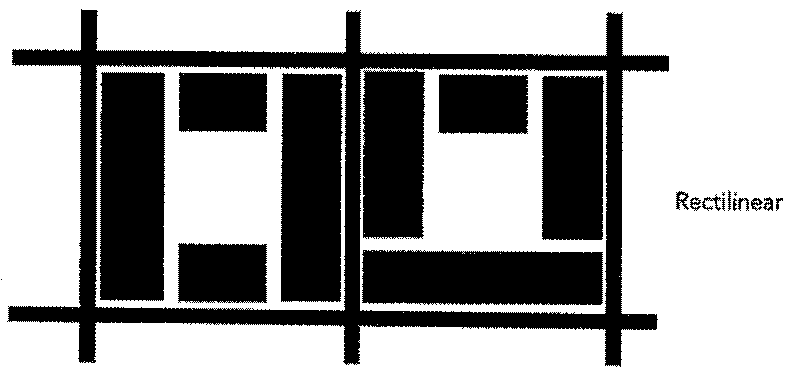
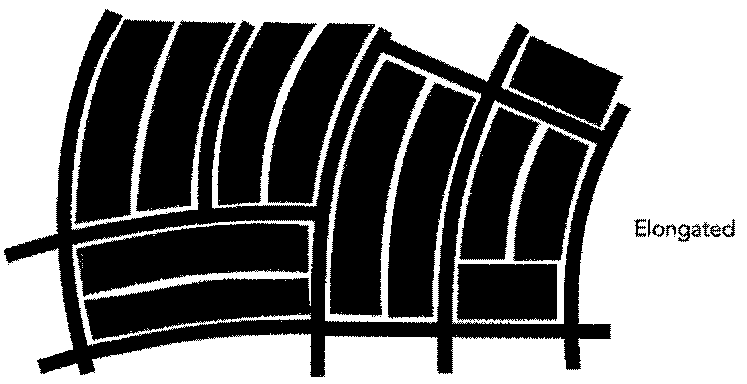

1.
All three may be used to plan a neighborhood, depending on the size of the property and its topography. The fundamental difference between site planning using blocks and site planning using streets is in the scale of each. The perimeter area of a block is larger than that of a single street and, therefore, requires relationships between adjoining blocks be planned comprehensively. As a result, block planning promotes street interconnectivity, pedestrian walkability, clear assignment of public and private lands, clear allocation of usable and prominent open spaces, and neighborhood identity. In comparison street planning focuses on the individual street as opposed to the relationships between streets, and thus reduces the priority of street interconnectivity, dilutes pedestrian walkability, and creates residual spaces poorly defined by weak public and private realm relationships that are often assigned as "open space". These "open spaces" are poorer in quality and usability as a result. The combination of these weakens neighborhood identity. Neighborhood plans shall use blocks to:
a.
establish the routing of the primary egress and ingress into the development so as to establish the general orientation and accessibility of the balance of the block plan.
b.
reinforce the discipline of block frontages to support a civic realm where public streets and roads provide access to the primary entrances of all plots and tracts to be development, or to be retained for open space;
c.
provide for block lengths per the provisions of this Ordinance. Where a longer block will reduce the number of railroad grade crossings, major stream crossings, or where longer blocks will result in an arrangement of street connections, lots and public space more consistent with this section, the Administrator may approve greater block lengths.
d.
establish a walking network that is convenient for the pedestrian, using streets and through block passages to connect to amenities and open spaces within the development, and where appropriate beyond the development.
e.
provide for increased densities through the provision of rear lanes/alleys mid-block.
D.
Street Plan
The layout of streets should provide structure to the neighborhoods. The formality of the street plan will vary depending upon site conditions and topography. Unique site conditions should be used to create special character and comply with the standards set forth herein. For high density development streets shall be paired with rear lanes and alleys, see Paragraph 5(c). Alleys and Rear Lanes may be used to enhance and preserve open space by reducing the need for direct access of units/buildings onto a fronting public Street. To qualify, such open space shall be fronted on all sides by a combination of public ROW and residential units. In such instances the minimum paved surface width of the rear lane/alley servicing the units shall be 16 ft, with a maximum length of 600 feet before intersecting with a Street, (See Paragraph 5(d)).
1.
Street Design Specifications
Street Designs shall permit comfortable use of the street by motorists, pedestrians, and bicyclists. Pavement widths, design speeds, on-street parking, and the number of motor travel lanes are to be considered comprehensively to enhance safety for motorists and non-motorists alike. The specific design of any given street must take into account the density of the surrounding development as dictated by the building types that have frontage along it, the traffic capacity of the street in relation to the overall street network, and the generation of on-street parking needs. The Administrator shall have final say on the application of street sections based on the overall development density of a project that consists of multiple building types. The following alleys and streets are approved for use within PP-RRDD District per City of Gastonia Engineering Specifications & Details Manual:
2.
To prevent speeding on continuous street segments greater than 1,000 ft in length, the Administrator may request review by the City's Public Works Department, which at its discretion may require the application of certain traffic calming measures as provided for in the Gastonia Public Works Traffic Calming Toolkit.
3.
Privately maintained alleys/rear lanes shall be provided in all new high-density residential developments where residential lots are 55 ft or less in width, so as to increase on-street parking capacity at the curb, reduce pedestrian conflicts due to sidewalk incursions, minimize impacts of utility easement requirements along fronting streets, and disperse service/delivery vehicle congestion. The provision of alleys/rear lanes may be waived by the Administrator if the following conditions are present:
a)
grading required to provide practical access to units from the front and rear cannot be achieved reasonably even with the incorporation of retaining walls and/or use of the unit itself to accommodate changes in elevation across a house lot.
b)
development boundary configurations preclude the application of complete block layouts that can accommodate rear lanes/alleys at the edges of a property.
4.
Rear Lane/Alley section FA-34-20 shall be applied only to residential plots with primary frontages that directly abut designated open space. (See City of Gastonia Engineering Specifications & Design Manual)
5.
Garages and accessory dwelling units accessed from an alley/rear lane shall display addresses that are clearly visible from the alley/lane.
6.
Street trees and sidewalks per the approved street sections in the City of Gastonia Engineering Specifications & Details Manual.
7.
Covenants and restrictions made a part of development shall not restrict vehicle types in conflict with adopted City policies.
8.
Traffic control plans showing signage and pavement markings shall be prepared in accordance with the guidance of the Manual on Uniform Traffic Control Devices Design Standards and specifications for City streets are set forth herein and in the City of Gastonia Technical Standards & Specifications Manual. The street specifications in this manual may only be varied in accordance with Chapter 13 Subdivisions.
H.
OPEN SPACE
Purpose.
The open space standards contained herein are established to provide for the reservation of various forms of open spaces, including parks and greenways in all forms of developments located in the City of Gastonia. Preservation of open space in developing areas serves a variety of purposes, including meeting the recreational needs of residents, improving the aesthetic character of the community, reducing stormwater runoff, improving stormwater runoff water quality, and enhancing air quality. The standards set forth below establish regulations for open space.
Open Space.
Although open space can be agricultural or natural in character, sub-urban open space is typically planned and developed as part of a development. The following standards are hereby established for open space.
a.
Detached Home and Attached Home Open Space Requirements.
i.
Subdivisions six (6) acres, or less are exempt from providing open space.
ii.
Subdivisions greater than six (6) acres and less than ten (10) acres located within one mile, an existing park, measured as a straight line from the nearest edge of the subdivision to the nearest edge of the park, having a minimum of four (4) acres, are exempt from providing open space.
iii.
For all other subdivisions a minimum of ten (10) percent of the total subdivision project site shall be set aside as open space designed as described by the Open Space Types.
iv.
Utility easements may be counted toward required open space if easement is part of larger open space area that is a minimum of 60 feet in width at its narrowest point and planted with lawn and available for passive, or active recreational activity.
Land designated as future open space. Regardless of the requirements and exemptions of this subsection, any portion of the site of the proposed development that is designated as future open space or greenway in the adopted Comprehensive Land Use Plan adopted by the City of Gastonia, as amended from time to time, shall be reserved for open space. This area may be counted toward the total amount of open space required for the development. If the total amount of land designated as future open space or greenway is less than the total amount of open space required for the development, then the developer shall provide additional open space to meet the requirement listed above. If the amount of land designated as future open space or greenway exceeds the total amount of open space required, then the developer must provide the open space designated in the official adopted plan. As compensation for any open space dedication associated with implementing any official adopted plan above the requirement listed herein, the developer is eligible for a density bonus of one (1) dwelling unit per each four thousand three hundred fifty-six (4,356) square feet of land area in excess of that required, up to a maximum of a fifteen (15) percent increase above the maximum density or intensity allowed in the applicable zoning district. The density bonus in the proposed development is limited to additional yield that can be configured with less than a ten (10) percent reduction in(s) in lot area and/or setback dimensions specified herein
Minimum open space area. Individual areas designated as open space areas shall not contain less than five hundred (500) square feet, although smaller areas may be approved by the Planning Director if the intent of this Ordinance is determined to be met.
Improvement of open space. With the exception of Natural and Agricultural Open Space, open space shall be planned and improved, accessible and usable by persons living nearby. Improved shall mean cleared of underbrush and debris and shall contain four (4) or more of the following improvements: landscaping, walls/fences, walks, statues, fountains, demarked ball fields, and/or playground equipment. Walls and fences shall be made of brick, stone, wrought iron, or wood and shall not exceed three and one-half (3.5) feet in height with the following exceptions: fences used in conjunction with ball fields, tennis courts, swimming pools, and/or playgrounds.
Design and location. In major subdivisions and multi-building developments, open space shall be integrated into the design of the site. In subdivisions where fifty (50) percent or more of the lots are less than 0.75 acre in size, open space shall be located within one-fourth (¼) mile of at least ninety (90) percent of the building lots, as measured along the rights-of-way of streets providing access between the two (2). In subdivisions where fifty (50) percent or more of the lots are 0.75 acre or more in size, open space shall be located within one-half (½) mile of at least 90% of the building lots, as measured along the rights-of-way of streets providing access between the two.
Focal point. Open space features should provide focal points for the neighborhood. A central square or green, for example, may comprise a majority of the open space. There should be a hierarchy of open space within new neighborhoods so that open space serves the needs of multiple age groups.
Types of open space. Open space types include Squares, Parks, Forecourts, Plazas, Greenways, and Natural and Agricultural. Standards for these open space types are set forth below:
A.
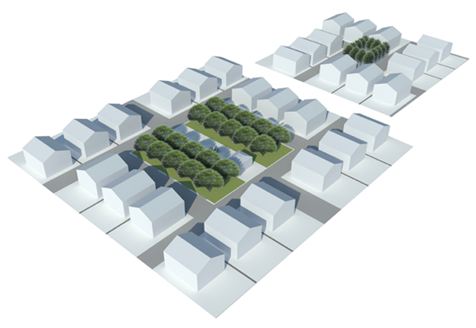
Squares.
Squares are areas for passive recreational use. Squares shall be bounded by streets on either a minimum of three (3) sides or fifty-six (56) percent of their perimeter.
Squares should be used in high density environments where residents have little yard space. Squares are used to bring a natural landscape into a high density environment. As such, not more than twenty-five (25) percent of a square shall be impervious surface coverage. Hardscaping shall be decorative (example brick pavers instead of asphalt for walkways).
Min size: 500 square feet
Max Size: 4 acres
B.
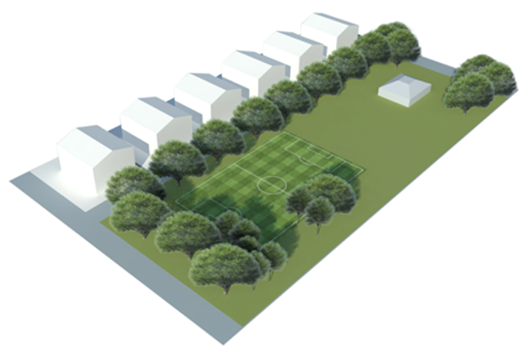
Parks.
Parks are areas for passive or active recreational use. Parks shall be bounded by streets on either a minimum of two (2) sides or thirty-two (32) of their perimeter.
Minimum Size: 6,500 square feet
Maximum Size: 8 Acres. Maximum size may exceed eight (8) acres if the park serves multiple neighborhoods or preserves environmental features.
Parks shall be areas where both passive and active recreation may occur simultaneously (example: park benches for elderly and a tot-lot for young children), encouraging intergenerational interactions among park users.
C.
Forecourt.
Forecourts are open spaces that act as buffers between residential buildings and streets or non-residential buildings. Forecourts are entirely bounded by buildings or streets. Forecourts shall be planted parallel to all primary street rights-of-way as shown in the illustration above.
Minimum Size: 500 square feet
Maximum Size: 1.5 acre
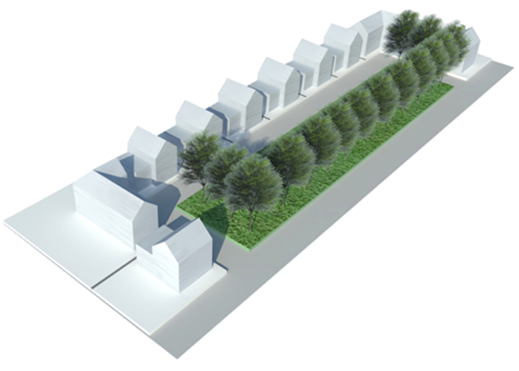
D.
Playground.
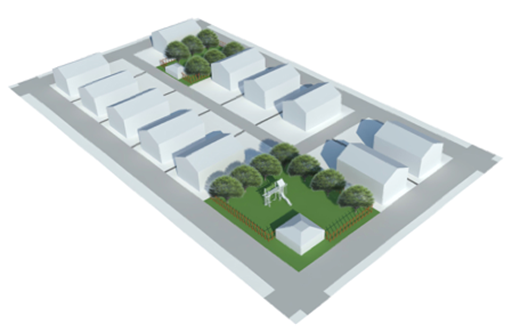
A Playground provides sunny and shaded play areas for children as well as open shelter with benches and for parents. Playgrounds may be built within squares and parks or may stand alone within a residential block.
Playgrounds shall be fenced, lockable and lit if not part of a Square or Park. Playing surfaces may be covered in sand, wood chips, or other equivalent material. Paths and walkways may be paved in concrete, crushed gravel, brick paver, or similar material, or partially paved.
Minimum Size: 10,000 square feet
Maximum Size: 20,000 square feet
E.
Greenways.
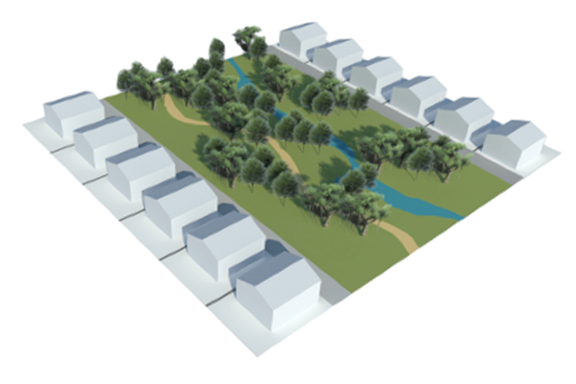
Greenways are spaces designed to incorporate natural settings such as creeks and significant stands of trees within a neighborhood. Greenways shall have streets or pedestrian ROWs parallel to or integrated into at least seventy-five (75) percent of their length. Greenways are used for walking, jogging, biking, and they are used as wildlife corridors. Greenways may have infrequent small-scale active recreational facilities such as playgrounds, although the majority of greenways shall be for passive, pedestrian and/or bicycle recreation.
F.
Natural and Agricultural Open Space.
Natural and Agricultural Open Space preserves agricultural lands, environmentally sensitive areas such as stream buffers and floodplains, scenic views, cultural features, and rural character that would likely be lost through conventional development approaches. To accomplish this goal, the City of Gastonia encourages creativity and allows for greater flexibility in the design of developments through use of the Overlay Districts in Chapter 7 of this Ordinance. Natural and Agricultural Open Space shall be placed in preserves, which adjoin housing areas.
Open Space Ownership and Conservation Easement. Open space may be owned or administered by one (1) or a combination of the following methods: fee simple ownership by a unit of government or private non-profit land conservancy; owned by a property association; or by individual private ownership such as a farmer, developer or other private entity that maintains the open space (i.e., farming, equestrian facility, etc.) All lands within areas required to be maintained as open space shall be protected by a permanent conservation easement, prohibiting further development, and setting other standards safeguarding the site's special resources from negative changes. Public use of the open space may be limited to residents of the development, except for land used for public sidewalks and multi-use trails, provided that such open space is held in private or property association ownership.
Maintenance. The owner or lessee of the property designated as the open space shall be responsible for the maintenance of the open space area. Landscaped areas shall be maintained in good condition and the entire area shall be kept clear of debris. Failure to maintain the area shall constitute a violation of this or other applicable ordinances. Alternatively, if acceptable to the City Council, as applicable, the land may be dedicated to the City for public use and thereafter maintained by the City.
Land Acceptable for Open Space Designation. The classes of land enumerated below may be utilized to meet the requirements of this section.
A.
Open water, wetlands, utility transmission rights-of-way, and undisturbed floodplains may account for up to eighty (80) percent of the area requirement.
B.
Land used for landscape buffers, public sidewalks in excess of standard sidewalk requirements, streetscape and hardscape areas accessible to the public, areas containing public art, and similar high density area open space amenities.
C.
Land on which locally or nationally designated historic structures are located and determined to be contributing to the designation.
D.
Land which exceeds a sixteen (16) percent slope may be used to provide up to eighty (80) percent of the required open space if existing slopes and vegetation so designated remain undisturbed.
E.
Land used for stormwater retention, provided such land is natural in appearance and is not separately fenced, may be used for up to thirty-two (32) percent of the required open space; green roofs are eligible to be counted as open space under this provision on a 2:1 ration (two (2) square feet of green roof = one (1) square foot of conventional open space). Additionally, land used for stormwater retention, provide such land is natural in appearance and is not separately fenced, that is developed using best management practices (e.g., constructed wetlands, rain gardens, green roofs or similar features), and either exceeds the required amount of retention or treats off-site stormwater may be used for up to eighty (80) percent of the required open space at the discretion of the Planning Director and Subdivision Administrator.
F.
Land available to residents or tenants for active or passive recreation, including parks, walking trails not used to meet sidewalk requirements, playgrounds, benches, picnic tables, and similar land uses or facilities. Playgrounds and athletic fields installed shall be counted at a 2:1 ratio (two (2) acres of unimproved land = one (1) acre playground and/or athletic field) for calculation compliance provide all improvements are installed.
G.
Land that is suitable for agriculture, land that has environmentally sensitive areas (ex. mature trees), or land that has cultural significance (ex. important view such as a rural entrance into City).
Land not Acceptable for Open Space Designation: The classes of land enumerated below shall not be utilized to meet the requirements of this section:
A.
Land that is contaminated with hazardous or toxic waste or materials as defined by state or Federal regulations, with the exception of land covered by an approved mitigation plan and deemed acceptable by the City Council or land that is designated in an officially adopted Open Space, Park or Greenway master plan.
B.
Land occupied by streets, drives, parking areas, or structures other than recreational structures.
C.
Land with a minimum width less than twenty (20) feet.
D.
Playgrounds and athletic fields that have not been maintained to adequate standards for safe and sanitary use.
Fee-in-Lieu.
For open space and/or park requirements of five hundred (500) square feet or less in area and not involving property designated as a greenway on any official plan adopted by the City of Gastonia, a property owner may elect to pay a fee-in-lieu of open space instead of providing the open space provided that the Planning Director deems that there is reasonable existing or future open space proximate to the subject parcel. For other required open space areas, a property owner may pay a fee-in-lieu of open space designation for all or a portion of the open space requirement if such fee-in-lieu is acceptable to the City Council. For developments and subdivisions containing more than thirty (30) residential units, the fee-in-lieu option may only be used for up to fifty (50) percent of the open space requirements in order to ensure that these larger projects provide on-site open space for their residents. This fee shall be calculated by using the pro rata value of the designated property relative to the value of the entire site to be developed using current property tax appraisal data; for properties covered by agricultural or other exemptions, the City may utilize a separate appraisal method in its sole discretion. Funds collected in this manner shall be maintained in a separate fund and shall be used to purchase or to enhance recreational use of property provided such features are reasonably proximate to the site(s) from which the funds are collected. Where practical, the collected fees for each project shall be designated for specific parks and recreation acquisitions and/or enhancements by the City.
(Ord. No. 19-690, § 3, 8-20-19; Text Amend. 9508, § 1, 6-16-20; Ord. No. 21-735, § 5, 3-16-21; Ord. No. 21-736, § 1, 4-20-21; Ord. No. 21-737, § 5, 5-18-21; Ord. No. 21-738, § 1, 6-15-21; Ord. No. 21-748, § 1, 10-19-21; Ord. No. 22-766, 7-19-22; Ord. No. 25-827, § 1, 3-4-25)
Editor's note— Ord. No. 19-690, § 3, adopted August 20, 2019, repealed § 8.1.11 in its entirety and set out a new § 8.1.11 to read as set out herein. Former § 8.1.11 pertained to Planned Residential Development (PRD), and derived from the Unified Development Ordinance adopted on October 20, 2009.
8.1.12 - IRREGULAR SINGLE-FAMILY PROPERTIES; APPLICABILITY
The supplemental regulations of this section shall apply to any property zoned for single family residential within the jurisdiction of this UDO where the owner of record seeks to renovate, or demolish and build a new single-family detached home. The provisions of this section are written to enable the owner of record (applicant) to develop on irregular lots that do not conform to the standard setback and lot size provisions of their base zoning.
8.1.12.1 Existing Property: Developed
Developed Property is defined as having above ground buildings including their basements and other below ground construction in support of the main building(s). Such property may adhere to the supplemental regulations if the following conditions are applicable:
(A)
Applicant's property has access to water and sewer, and abuts a publicly dedicated ROW for a length of a minimum of twenty-four (24') feet.
(B)
Applicant is not seeking to subdivide an existing property, or assemble existing properties into a new property unless doing so increases the build-ability of the property in question, and does not render the adjoining properties unbuild-able as regards minimum access, and the fire and safety code requirements of the Base Zoning and these Supplemental Regulations.
(C)
Applicant does not seek a change of use, or the addition of a new use prohibited by the Base Zone for the property.
(D)
Applicant does not seek an increase in building height more than five (5) percent of the Base Zoning provisions for Single Family development.
(E)
Applicant does not seek to increase existing total building footprint such that new construction encroaches within three (3') feet of a rear and side yard line, or five (5') feet of a front yard line as designated by the building site plan; or which requires grading and/or land disturbance of more than fifty (50) percent of the property area.
(F)
Applicant is not seeking to demolish, or alter a building designated as landmarked, historic, or significant by Federal, State, or City agencies.
8.1.12.2 Existing Properties: Undeveloped
Undeveloped Property is defined as having no above ground buildings, or that may have the foundations/basements of demolished buildings and structures; and/or having site improvements that have disturbed land through clearing, grading and other acts of engineering for vehicular access, stormwater control, septic/water and sewer. Such property may adhere to the supplemental regulations if the following conditions are applicable:
(A)
Applicant's property has access to water and sewer, and abuts a publicly dedicated ROW for a length of a minimum of twenty-four (24') feet.
(B)
Applicant is not seeking to subdivide an existing property, or assemble existing properties into a new property unless doing so increases the build-ability of the property in question, and does not render the adjoining properties unbuild-able as regards minimum access, and the fire and safety code requirements of the Base Zoning and these Supplemental Regulations.
(C)
Applicant does not seek a change of use, or the addition of a new use prohibited by the Base Zone for the property.
(D)
Applicant does not seek an increase in building height more than five (5) percent of the Base Zoning provisions for Single Family development; encroach within three (3') feet of a rear and side yard line; zero feet to five (5') feet of a front yard line as designated by the building site plan; or which requires grading and/or land disturbance of more than fifty (50) percent of the property area.
(E)
Applicant can demonstrate that the new home will meet all applicable fire and safety code requirements.
8.1.12.3 Irregular Single Family Properties: Property Requirements
The following property requirements apply to renovations and new construction of detached single-family homes:
(A)
A property with three (3) lot lines must have at least one lot line a minimum of fifty (50) feet in length and one eighty (80) degree min corner.
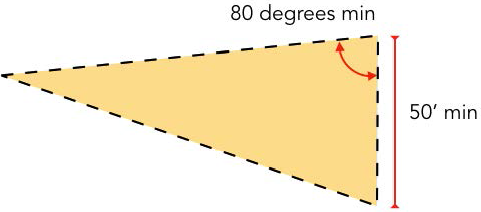
(B)
A property with four (4) lot lines must have at least one lot line between twenty-four (24') feet and forty-eight (48') feet in length. Such properties must have at least one additional lot line fifty (50') feet minimum in length, and no corner angles less than eighty (80) degrees.
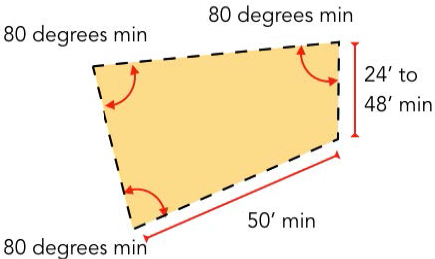
(C)
A Property with more than four (4) lot lines must have at least one lot line between twenty-four (24') feet and forty-eight (48') feet in length, one additional lot line fifty (50') feet in length, and no corner angle less than eighty (80) degrees. Total lot area shall be a minimum of one thousand one hundred seventy (1,170 ft 2 ) square feet to a maximum of three thousand five hundred ninety-nine (3,599 ft 2 ) square feet in area.
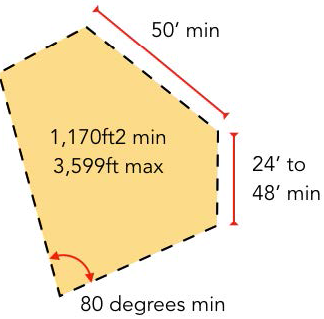
(D)
A property's slope shall not exceed forty-five (45) percent across any direction of measurement as taken from the point of access at the abutting ROW.
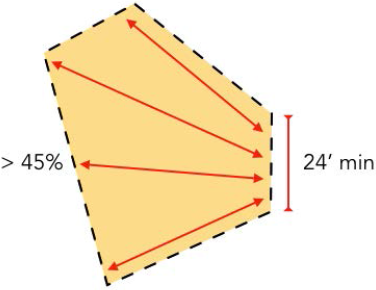
(E)
A property shall contain no delineated wetland(s).
(F)
A property shall not be within one hundred (100') feet of a designated floodplain.
8.1.12.4 Irregular Single Family Properties: Site Plan Requirements
The following site requirements apply to renovations and new construction of detached single-family homes:
(A)
Minimum eight (8) feet of building separation between new home and any adjacent home or accessory structure measured from building wall to building wall.
(B)
For new home construction a minimum first floor elevation of three (3') feet if front setback is less than fifteen (15') feet to protect privacy and promote personal safety.
(C)
No on-site parking is required for lots less than two thousand five hundred (2,500 ft 2 ) square feet. On-street parking, adjacent to the property shall count for permitting purposes. If no on street parking is possible, a dedicated space within seven hundred fifty (750') feet of the property shall be designated and assigned to the home. If a rear alley/lane is available, driveway access to parking shall occur only from the alley/lane.
(D)
In no instance shall a front facade be located behind the plane of the rear façade of an adjoining built property unless the distance between the front and rear corners of the two (2) homes is a minimum of two hundred fifty (250') feet and the side yards are screened by landscaping and/or fencing to provide privacy to the rear yard of the adjoining lot.
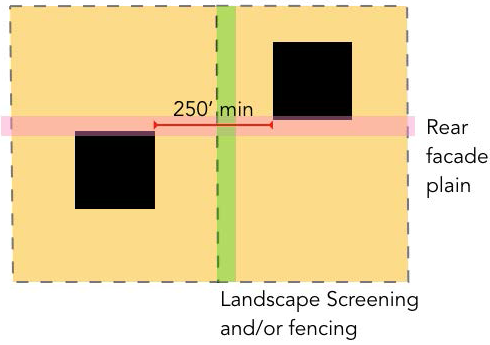
(Ord. No. 20-697, § 4, 3-17-20)
8.1.13 - TRADITIONAL NEIGHBORHOOD DEVELOPMENT (TND)
A traditional neighborhood development is a type of planned unit development (PUD); provided however, if it contains only residential land uses (and other nonresidential uses typically allowed by right in the applicable residential district) it may be deemed a type of planned residential development (PRD). A traditional neighborhood development that substantially meets the guiding principles of traditional neighborhood development design as set forth in this section.
In keeping with the stated purpose of this section, a Traditional Neighborhood Development shall only be allowed through conditional zoning as a TND district.
A.
Purpose and Intent.
The purpose of this section is to set forth guiding principles for traditional neighborhood development design and to provide relief from some of the standards found in this Ordinance, when such developments are found to substantially meet the guiding principles of this section.
B.
TND Guiding Principles.
For organizational purposes, the guiding principles have been divided into six (6) categories; however, most principles relate to multiple categories. A TND must substantially meet these principles. Where the development application does not meet a principle, the applicant shall submit justification therefore, unless the principle is described as optional. The guiding principles are as follows:
1.
The principles of the public realm:
a.
The central element of traditional neighborhood design is the emphasis and weight given to the public realm (the streets and plazas, and the public open spaces such as parks, playgrounds, greens, and natural areas, together with semi-public spaces which frame the public realm and provide transition between public and entirely private spaces).
b.
TNDs feature well-designed public spaces, special emphasis on public and cultural buildings, and special design treatment for vista terminations.
c.
A sense of enclosure is maintained along the public street through an appropriate ratio between the height of building fronts and the distance between buildings on opposite sides of the street. Where street frontage consists of single story buildings or open space, street trees can be a substitute for front building walls to maintain this sense of enclosure.
d.
Non-residential buildings are set at or very near the sidewalk. In most situations, the same is true for attached housing. Single homes have relatively shallow setbacks, typically one-fourth (¼) to one-third (⅓) the lot width. Encroachments are allowed for porches, steps, bay windows, and balconies.
e.
The public realm is appropriately landscaped. Unless good landscape design would otherwise dictate, each street is provided with an orderly regimen of street trees of substantial nursery stock, which will grow quickly to provide a street canopy. Planting strips wide enough to accommodate street trees typically separate sidewalks from street roadways (see Section 8.1.13B2f).
f.
Single-family home lots in TNDs are typically smaller and narrower than in conventional subdivisions. A substantial amount of land area savings from reduced lot sizes is dedicated toward common areas.
g.
Narrower lots necessitate alternative treatment of certain fixtures that can diminish the aesthetic quality of the public realm. A system of rear access lanes (alleys) can provide garage access at the rear of the lot. This is especially preferred for lots less than fifty (50) feet in width. When built to a 16-foot standard with a 24-foot right-of-way, the alley can also serve as an appropriate location for electric, gas, cable TV, and telephone equipment as well as access for garbage pick-up and mail delivery. On lots at least fifty (50) feet wide, alternate, less preferred methods of garage access include (in descending order of preference):
1.
Front driveway accessing a garage behind the house or near the back of the lot;
2.
Turning the garage so that it does not face the front (provided the garage is set behind the front building line);
3.
Setting the garage at least twenty (20) feet behind the front of the house; or
4.
Providing special architectural treatment to the house to visually de-emphasize a garage at the front.
Where alleys are not available, other measures are taken to hide unsightly utility equipment; however, fire hydrants are always located on the fronting street, ideally situated on planting strip bulb-outs at intersections.
h.
TNDs are designed so that there are linkages between the private realm and the public realm while protecting private spaces. Single homes have front porches large enough for sitting (six (6) to eight (8) feet minimum depth), and attached dwellings typically have sitting porches or front stoops. Guidelines to allow for low front picket fences are often provided. Always for single homes served by alleys, and where feasible and designed appropriately for town homes, private spaces are protected at the rear using privacy devices according to the development guidelines. The bottom floor of any dwelling whose sidewalk facing wall is within five (5) feet of such sidewalk should be elevated sufficiently above the sidewalk to provide additional privacy inside the dwelling.
i.
TNDs are designed to feature vista terminations at multiple locations. Vistas can terminate to important buildings, parks and greens, civic features in the town center, a carefully sited dwelling, a curve in the road, natural green edge, distant objects and scenery, and other features as appropriate. Entry into the community usually uses an important vista termination to provide a sense of place arrival.
j.
Utility wiring is underground and decorative street lighting fixtures are typically provided. Exceptions are provided for industrial areas.
2.
The principles of the transportation system:
a.
TNDs always have a connecting web of streets, typically provided by a grid or modified grid street pattern. The street system is organized in a comprehensible network hierarchy that forms an orderly discernable neighborhood or town structure.
b.
Culs-de-sac are avoided unless natural site or site boundary conditions require them. In such situations, special street design features such as eyebrows and cul-de-sac loops are encouraged instead of standard ball-end cul-de-sacs.
c.
Curved as well as straight streets are allowed; however, each must contribute to the connecting web. Where possible, curved streets maintain the same cardinal orientation. Long blocks are to be avoided with an average block being no more than six hundred (600) feet in length or one thousand eight hundred (1,800) feet in perimeter.
d.
While the "sense of enclosure" described in Section 8.1.13B1c., will help to reduce traffic speeds, additional design measures will be needed to slow traffic. Examples of such measures include such features as "bulbing out" the curb line at intersections, traffic circles, streets no wider than necessary to provide adequate access, design for and encouragement of on-street parking, and safe but unconventional street geometrics. The internal streets should be designed to feel safe driving at a speed no more than twenty-five (25) miles per hour.
e.
Typical street widths include: 34—38 feet for a main street with marked parking on both sides, 32—34 feet for lesser streets with marked parking on both sides); 27—29 feet for through streets with marked parking on one side, 24—26 feet for standard streets with unmarked parking allowed to stagger from side to side; 20—24 feet for low density local streets with unmarked parking on one side; twenty (20) feet for one-way streets with parking on one side; and sixteen (16) feet for public residential alleys (private alleys may be allowed as narrow as twelve (12) feet) with commercial alleys typically being twenty-four (24) feet. Where possible, streets are encouraged to narrow to 22—24 feet at intersections and at mid-block cross walks. Curve radii at intersections are ten (10) feet to twenty (20) feet, depending on street function. Standard vertical curb is preferred, and it is required on all residential streets without driveways (auto access is provided via a rear alley) and all commercial streets.
f.
TNDs are always walkable communities in the fullest sense. They typically contain sidewalks on both sides of the street and, in addition, may contain a network of off-road walking and bike trails. Pedestrian facilities always meet the three (3) standards of safety, comfort and interest. Sidewalks are well separated from the roadway with planting strips that are planted with indigenous, mostly deciduous shade trees (on commercial streets sidewalks may extend to the curb with street trees planted in grates or other sufficiently sized planting space). Planting strips should be six (6) feet to ten (10) feet wide (eight (8) feet is recommended), but may be reduced to four (6) feet in situations that are both unusual and difficult. Sidewalks are recommended five (5) feet in width on residential streets, wider on commercial streets.
g.
TNDs always have multiple points of ingress and egress from collector and major roads. The street system should also flow seamlessly to adjoining neighborhoods either existing or future.
h.
TNDs are never gated.
i.
Parking lots should not front along a street. On-street parking is provided throughout the development, and particularly so on streets with commercial buildings and attached housing. Where additional parking is needed, it is provided behind buildings in the interior of the block. The calculation of parking needs for nonresidential uses should always take into consideration available on-street parking and the expected walkable patronage. Parking lots shall include shade trees and no space in a parking lot shall be further than sixty (60) feet from the trunk of a shade tree. Each shade tree shall be planted in a planting area sized and shaped to enable healthy growth, a minimum of two hundred (200) square feet. Pedestrian access from interior block parking area is best provided via a mid-block passageway to the street front. This passageway can also be used for other activities such as front entrances for small shops, access to second floor apartments, outdoor dining, outdoor vendors and outdoor display of plants, flowers and other appropriate items for sale.
j.
When located on a public transit route a dry, inviting waiting place is provided at the neighborhood center. Where not located on a transit route, the TND should be given consideration for future route expansions when ridership can be expected.
3.
The principles of mixed use:
a.
TNDs almost always contain a mixture of uses and dwelling types. Exceptions may be made for TNDs of less than twenty-five (25) acres and/or one that is within safe, easy walking distance to retail and other neighborhood services.
b.
TNDs always feature a mixture of residential types. While a mix of single homes and at least one type of attached housing is required in the development, an appropriate and carefully designed blending of single and attached housing within the development is encouraged.
c.
TNDs offer housing at a variety of affordability levels. Allowing garage apartments and "granny flats" at the rear of single home lots, in accordance with the development's private guidelines (whether rented or not) is encouraged. These innovative (but historically traditional) housing forms help to accommodate family situations and promote income diversity within the TND.
d.
Live-work units (shop or office at the street level and residence at the second level), apartments over businesses, and covenant provisions for zero-impact customary home occupations are encouraged.
e.
In traditional communities the denser housing and live-work units are typically located closer to the town center with a transition outward to less dense housing such as single homes. This principle should not be construed to discourage the careful blending of housing types as this transition occurs.
f.
Schools and churches are encouraged within the TND as is the provision of pedestrian and bicycle routes to connect to such facilities inside or outside the TND. It is, however, recognized that school location will, in most cases, not be possible unless the public school system considers smaller site standards.
g.
Where buildings are on both sides of the street, similar building types should face each other when possible. Single house, townhouse, live-work unit, apartment building and store building are examples of building types.
h.
TNDs are designed so that there are linkages between the private realm and the public realm while protecting private spaces. Single homes have front porches large enough for sitting (six (6) to eight (8) feet minimum depth), and attached dwellings typically have sitting porches or front stoops. Guidelines to allow for low front picket fences are often provided. Always for single homes served by alleys, and where feasible and designed appropriately for town homes, private spaces are protected at the rear using privacy devices according to the development guidelines. The bottom floor of any dwelling whose sidewalk facing wall is within five (5) feet of such sidewalk should be elevated sufficiently above the sidewalk to provide additional privacy inside the dwelling.
i.
In general TNDs should be built in approximate proportions to the overall percentages of dwelling types shown on the overall site plan; provided however, lower density housing may be built at any faster rate than higher density housing. The initiation of commercial phases shall follow at any time after the initiation of construction of at least ten (10) percent of single homes.
4.
The architectural principles:
a.
The architecture should respond to the surrounding fabric of buildings and spaces and to local traditions. The principle that structures should be seamlessly linked to their surroundings (within the TND) transcends the issue of style.
b.
Each building always exhibits principles of human and pedestrian scale and contributes appropriately to the pedestrian life of the street.
c.
Architecture within the development should reflect styles that are complimentary of each other. Private development controls assure a variety styles or sub-styles which serve to compliment each other while providing for overall consistency and reflection of the principles of traditional neighborhood design.
d.
Affordability variations between housing types and choices do not translate into meaningful inferior architectural treatment of lower cost housing choices, as such housing relates to the public realm.
e.
Commercial buildings typically take on a "shop front" type appearance, joined by common walls, set with the front and entrance at the sidewalk along the street, and are typically two (2) or more stories high (other uses such as residential and offices may occupy upper floors). Commercial buildings should not face intersecting streets with blank walls.
f.
Residential buildings, other than bungalows and patio homes, should be at least two (2) stories tall.
g.
Except to more accurately portray pre-1940 architectural styles, buildings should employ relatively flat fronts and simple roofs. (Note: This principle shall not be construed to require pre-1940 architectural styles). Building articulations and setback encroachments for porches, stoops, steps, bay windows, balconies and other such features that form the transition between the public and private realms are encouraged.
h.
Corner-lot homes should face their front door to the larger street (unless said street is a thoroughfare), except for an end-unit townhouse or row house, which may turn the corner with its front (unless the side street is an alley). Fronting a townhouse on both the primary street and the intersecting street with two (2) doors and/or wrap-around porch is encouraged.
5.
The principles of the neighborhood center:
a.
TNDs have at least one defined center. Neighborhood centers typically feature uses such as shops and services, live-work units, attached dwellings, apartments over businesses, a formal open space such as a village square or green, and public/civic buildings (church, community building/center, and post office are examples).
b.
Automobile oriented uses are typically not found in a neighborhood center and drive-thru facilities are strongly discouraged; an exception may be made for a bank abutting a thoroughfare.
c.
A public gathering space such as a plaza, green or square is almost always present along with one or more focal features in or near this public space such as a clock tower, fountain, monument, bandstand and/or public art which serve to terminate vistas and define the community.
d.
The TND center is ideally located near the geographic center of the development; however, it may also identify itself jointly with a thoroughfare bordering the TND (and therefore, be located near this major road or be linked to this road with an entrance street) in order that businesses within the center may more easily attract patrons from outside the development. This can serve to improve chances for economic success of the TND center. Ideally, the neighborhood center is no farther than one-fourth (¼) mile radius of most dwellings; however, a neighborhood center that is within two thousand four hundred (2,400) feet of eighty (80) percent of the dwellings in the TND is acceptable in order to allow the center to identify itself jointly with an adjoining thoroughfare.
e.
Development form in the center typically reflects the traditional "main street" or "town square" vernacular of the region as described in Section 8.1.13(b)(4)e. and parking is provided in accordance with Section 8.1.13(b)(2)c.
f.
Other civic uses are encouraged, including schools and day care centers; however, such uses should take on design features and lot sizes sympathetic to traditional principles and a walkable community. Office employment may occur at the TND center or along major roads adjoining the TND. Light industrial employment, if present, is more appropriately located along a major road boundary in accordance with Section 8.1.13(b)(3)c.
g.
At least one site should be reserved at or near the neighborhood center, for an important community or civic building such as a community center, church, school, amenity center (club house and recreation facility) or community hall. The site should be prominent and special.
6.
The principles of open spaces and natural site characteristics:
a.
A substantial amount of land savings generated by a more compact development form is converted to common open spaces.
b.
TNDs always have formal public open spaces such as greens, village squares, parks and playgrounds. They may also have substantial amounts of natural or semi-natural open spaces that typically feature more informal amenities such as walking/bicycling trails and picnic areas.
c.
There is always a significant civic space such as a town square, green, commons, or plaza at the neighborhood center.
d.
Small parks are distributed throughout the development, usually within one thousand (1,000) feet of any dwelling.
e.
Pre-existing or natural water features should be retained and made a community asset.
f.
The site should be designed in a manner that preserves specimen trees and significant groups of mature deciduous trees. Major tree stands should be incorporated into public open spaces, where possible.
g.
The neighborhood design should adapt itself, as much as possible, to the existing topography to minimize the amount of grading necessary to achieve a viable street network.
h.
Parks, plazas, and commons should be equipped with proper furnishings and shade trees to encourage outdoor sitting, human interaction and people watching; while some common areas should be grassed and left open (except for street trees) to encourage the types of leisure/recreational activities that require open areas.
C.
Relief From (or Establishment of Greater Standards for) Certain PRD and PUD Requirements.
In order that TNDs may meet the principles set forth in this section the following provisions of Sections 8.1.11 and 8.2.26 are hereby modified for developments which are found to substantially meet the guiding principles of TND:
1.
Section 8.1.11A5B, for TNDs minimum project boundary setback shall be twenty (20) feet. Allowed encroachments into rear setbacks along the project boundary include accessory buildings (including accessory dwellings) up to ten (10) feet from the project boundary (twenty (20) feet for two-story structures); utility equipment; alleys up to eight (8) feet provided an evergreen tree planting strip is provided if the alley is not used by development outside the project boundary; fences and walls. Where commercial uses within the TND adjoin single-family areas outside the TND, the Planning Commission or City Council may require additional setbacks, not to exceeding a cumulative total of fifty (50) feet.
2.
Section 8.1.11A8C, for TNDs on street parking ma count towards a portion of the parking requirements. Parking spaces inside garages are counted.
3.
Section 8.1.11A9A, minimum screening requirements, do not apply to TNDs; provided, however, the Planning Commission may require screening in any situation along the boundary of a TND or inside a TND as a condition for approval wherever it deems appropriate for the protection of adjoining properties or to establish necessary transition. As a general rule, following of the best TND design principles should negate the need for screening, and screening should not be allowed to substitute for poor design or the lack of adequate design transition between less compatible buildings or uses.
4.
Section 8.2.26A is modified for TNDs to be the purpose and intent of Section 8.1.13.
5.
Section 8.2.26B1b does not apply to TNDs because a TND always contains dwellings.
6.
Section 8.2.26B3b does not apply to TNDs.
7.
Section 8.2.26B10b, c and d shall be modified for TNDs as set forth in Section 8.1.13C1 for residential buildings. Nonresidential buildings shall observe setbacks of thirty (30) feet minimum along any external project boundary that is not a street and ten (10) feet where a street right-of-way is the external boundary. Where commercial uses within the TND adjoin single-family areas outside the TND, the Planning Commission may require additional setbacks, not to exceed a cumulative total of fifty (50) feet.
8.
Section 8.2.26B8 is replaced for TNDs with the applicable provisions of Section 8.1.13B and the principles set forth in Section 8.1.13C3.
9.
Section 8.2.26B10e does not apply to TNDs.
10.
Sections 8.2.26B9 and 8.2.26B10 g, h, i, and j are replaced for TNDs with the applicable provisions of Section 8.1.13B.
D.
TND Parameters.
1.
Approval Process for a TND.
a.
The first step is to determine if a project meets the purpose, intent, and principles of a traditional neighborhood development as outlined in this section. The Developer shall be required to meet with the Administrator and review the TND to ensure substantial conformity to the Ordinance prior to the PIM being held.
b.
Traditional neighborhood developments shall follow the procedures for approval through the conditional rezoning process, however the following additional requirements will be required in the site plan submission:
i.
Representative building elevations representing the various building types proposed within the development shall be submitted for approval.
ii.
Cross-section drawings of typical street areas from building profile to opposing building profile. A typical profile for each building type is needed; for example: town center, single-family street, town home or row house street, and apartment street.
2.
Reserved.
3.
Uses Allowed Within the TND.
Uses within a TND are limited to those listed below. Unless otherwise specified in this section, residential portions of planned unit developments shall meet all requirements of Section 8.1.11.
(1) If a use located in the TND is subject to the issuance of a special use permit, and if such use were shown on the site plan originally approved for the TND through the conditional zoning process or through issuance of a special use permit, issuance of a special use permit for such use shall not be needed. In instances where such use was not indicated on and approved as part of the site plan for the conditional rezoning of the property for the TND, or if the TND were approved administratively, a special use permit would need to be issued for such use.
(2) Additional specifications for building design and layout specifications for buildings located in the TND are indicated elsewhere in this Section.
E.
TND Building and Lot Standards
All design standards of the Urban Standards Overlay District shall prevail. Refer to Section 9.18.1(D) for provisions relating to sidewalks. In addition, the following design standards shall apply:
1.
Non-Residential Buildings in the TND Center.
a.
Buildings facing each other on the same side of the same street shall maintain a common front build-to line of from zero (0) to fifteen (15) feet. The Administrator may allow for minor deviations from the build-to line to allow for exterior amenities such as outdoor dining areas, customer drop-off points, etc. Refer to Figure 8.1.13-2 for an illustration of this requirement.
b.
Building facades shall be parallel to the adjoining street.
c.
Off-street parking shall be to the rear of buildings.
d.
Off-street parking areas shall be inter-connected, wherever possible.
e.
Trash dumpsters are to be located to the rear of the building.
f.
Buildings are to be served with rear-loading alleys.
g.
Primary pedestrian entrance into the building shall be from the adjoining front yard sidewalk.
h.
Building elevations fronting and/or visible from public streets shall be clad with any of the following: brick, brick veneer, stone or stone veneer, stucco or artificial stucco; cement fiberboard; glass, wood, or wood materials, or materials similar in composition, texture, and appearance. The Administrator or approval body, in instances where a special use permit or conditional zoning is involved, shall have the authority to approve building materials not specifically listed but similar in composition, texture, and appearance and texture to those herein listed.
i.
Street level windows shall be provided and shall be transparent. Mirror or reflective glass shall not be allowed.
2.
Residential Buildings.
a.
For multi-family buildings, building standards shall apply per Section 8.1.10B.
b.
For all other residential development, building standards shall apply per Section 8.1.11B.
3.
Civic Buildings.
a.
A minimum 15-foot front yard setback shall be observed. Areas between the building and the adjacent sidewalk shall be landscaped per Section 11.4. Off-street parking in the front yard shall be prohibited.
b.
Building facades shall be generally parallel to front property line.
c.
Pedestrian access to the principal buildings shall be from the adjoining front yard sidewalk.
d.
Off-street parking areas shall be inter-connected, wherever possible.
e.
Trash dumpsters are to be located to the rear of the building.
f.
Building elevations fronting and/or visible from public streets shall be clad with any of the following: brick, brick veneer, decorative concrete block, pre-cast or field poured tilt concrete panels with texture; stone or stone veneer, flush architectural metal panels; stucco or artificial stucco; glass, wood, or wood materials, or materials similar in composition, texture, and appearance. The Administrator or approval body, in instances where a special use permit or conditional zoning is involved, shall have the authority to approve building materials not specifically listed but similar in composition, texture, and appearance and texture to those herein listed.
g.
Decorative metal roofs shall be allowed.
h.
Street level windows shall be provided and shall be transparent. Mirror or reflective glass shall not be allowed.
i.
Flat roofs may be permitted, provided a parapet is provided that screens all rooftop equipment from the view of pedestrians and motorists from the view below.
(Ord. No. 21-739, § 1, 6-15-21; Ord. No. 22-763, § 4, 5-17-22)
8.1.14 - AMATEUR WIRELESS FACILITY
A.
Non-commercial, amateur, ham radio or citizen's band antenna supporting structures, antennas or antenna arrays with an overall height of less that seventy (70) feet in Residential Districts or with an overall height of less that one hundred (100) feet in all other zoning districts may be developed in accordance with the following additional requirements.
1.
Towers and support structures shall meet all requirements for accessory structures for the zoning district in which the proposed facility shall be located, except that such structures shall meet the setback requirements for accessory structures, or fifty (50) percent of the tower or support structure height, whichever is greater.
2.
The applicant shall commit in writing that the facility will be erected in accordance with the manufacturer's recommendations.
B.
Non-commercial, amateur, ham radio or citizen's band antenna supporting structures, antennas or antenna arrays with a height greater than as provided above shall be regulated in accordance with Section 9.15, Communications Towers.
8.1.15 - PRODUCE STAND, ACCESSORY AND PRINCIPAL USE
Produce Stand (Accessory Use)
A.
Any produce stand structure shall not be placed in a road right-of-way. If a freestanding structure is used it shall not be located closer than ten (10) feet to any side lot line or twenty (20) feet to any side lot line which abuts a residential (R) district (except RLD), unless a greater setback is required for the zoning district in which it is located.
B.
Screening shall not be required for any freestanding produce structure.
C.
Signs for the produce stand shall not be illuminated.
D.
The produce stand structure may not be a permanent structure and shall be removed nightly.
E.
All produce sold on the lot shall be grown on a lot under the same ownership as the lot upon which the produce stand is located.
F.
Required parking for the underlying principal use and the produce stand shall be provided.
G.
The maximum display area of the produce stand shall be two hundred (200) square feet in a residential (R) district (except RLD) and four hundred (400) square feet in all other districts.
Produce Stand (Principal Use)
A.
Any produce stand structure shall not be placed in a road right-of-way. If a freestanding structure is used, it shall not be located closer than ten (10) feet to any side lot line or twenty (20) feet to any side lot line which abuts a residential (R) district (except RLD), unless a greater setback is required for the zoning district in which it is located.
B.
The produce stand may be a permanent or temporary structure.
8.1.16 - AUTO HOBBYIST
Allowed on any lot containing a principle single-family or two-family dwelling.
8.1.17 - SINGLE-FAMILY ATTACHED DEVELOPMENT DISTRICT
A.
Townhome
Traditional southern homes in Savannah and Charleston provide a model for the Townhome. Generally, building plans will have narrow frontages with the plan depth being greater than its width. Within the limits described below and unless the zoning district standards require greater measures, these regulations shall apply to all attached townhomes.
1.
Lot Dimensions, Building Setbacks and Specifications
Permitted building type and associated standards are specified by Table A(1) and Subdivision design standards are specified in Section 3. Landscaping shall comply with the requirements set forth in Chapter 11, Screening and Landscaping.
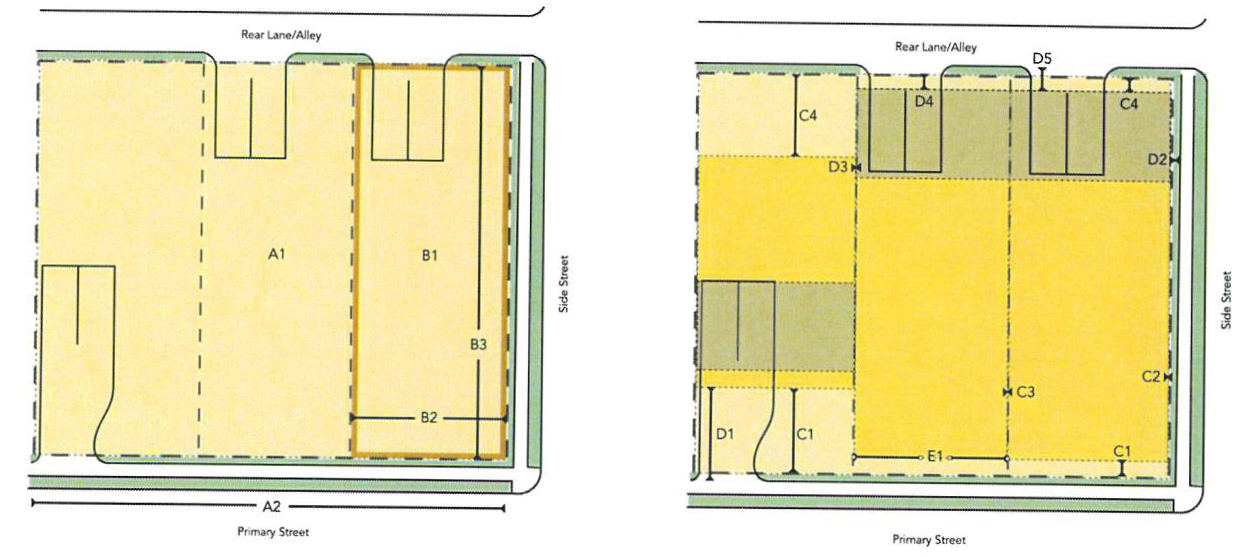
B.
Townhome Subdivision Design Standards
1.
Site Grading, Streets, Alleys and Blocks Requirements:
a.
Grading shall provide for smooth grade transitions in accordance with the most recent version of the "Subdivision Grading Minimum Design Standards" to avoid abrupt "v" ditches, swales and other disruptions to the landscape, particularly between buildings where open space enhancements for use by persons actively utilizing the landscape and/or yard area. The use of crawl space, skim walls, and raised slab construction techniques in attached residential structures and professional landscape design are required to meet this characteristic of site development to establish a Finished Floor Elevation (FFE) as measured from the top of curb of fronting street to the minimums established for each building type, See Table 1, in Section 8.1.11 and Tables 1 and 2 in Section 8.1.17.
b.
For townhome units requiring a raised ground floor, in instances where the grade differential between a unit's front facade is greater than the elevation of the fronting ROW line and/or back of sidewalk, the finished first floor elevation shall make up the difference between the two (2) levels until the required elevation per Table A(1) is achieved after which no additional first floor grade elevation is required.
c.
In no instance shall the front facade of a unit(s) be built on a finished grade elevation lower than the fronting ROW line and/or back of sidewalk.
d.
Townhomes may face onto designated open space as defined in Section 8.1.11.H only if rear loaded and serviced by a rear lane/alley section as approved by the City. At no time shall two townhome facades face across an open space that is less than 30 ft in width measured from foundation wall to foundation wall. Townhome facades that face onto a side elevation of another townhome shall adhere to the same minimum setback requirement. In no instance shall the front facade of a townhome face onto the rear elevation of a townhome across a defined and listed open space. Open spaces located between and abutting the frontages of attached and detached residential dwellings, configured linearly as replacements for streets are not permitted.
e.
Primary pedestrian access into the building shall be from a street frontage line, sidewalk, or parking area. Townhomes facing onto a common open space, entrances to other units either adjacent, or opposite, shall also face the common open space.
f.
Streets and alleys shall terminate with other streets and alleys within a development and shall connect, wherever practicable, to existing and projected streets outside the development.
g.
Cul-de-sacs are permitted only where topography makes a street connection impracticable.
h.
Pedestrian connections shall be provided as extensions of terminating streets where not precluded by topography or other physical constraints when connecting open spaces and/or greenways and trails.
i.
No block shall have a length greater than 600 feet without an intersecting street, dedicated alley, or pathway providing through access. Open spaces as defined in 8.1.11.H may be used to break up a block if such space is part of a linked network of open space within a development.
j.
Lots containing Townhomes with parking in the front setback shall not face across a street onto Townhomes serviced by a rear lane/alley, unless an intervening open space a minimum of 35 feet is provided on the rear lane/alley served block, along the entirety of the length that such frontage occurs. Such open space will count toward required open space per Section 8.1.17(C)4.
k.
Townhome developed property abutting Detached Single-Family uses shall provide a landscaped buffer, per Chapter 11.3 of the UDO, along the length of the shared frontage, unless the Townhome units orient their front facades toward the Detached Housing. Such housing shall be served via rear lane/alley to qualify.
2.
On Street Parking Requirements
a.
Parking on Residential Streets
Parking shall be allowed along all residential streets per City of Gastonia Engineering Specifications & Details Manual. Parking is not permitted along rear lanes, designated bike lanes, within eight (8) feet of a driveway apron, within fifteen (15) linear feet of a fire hydrant, and areas specifically signed for no parking. In no case shall minimum off-street parking space(s), whether enclosed or not, extend into the public right of way, or into an easement, or a public sidewalk on private property.
b.
On Street Parking Requirements
On street parking at the lot front may be counted toward all or part of the parking requirement of a dwelling unit provided the standards in the above are met.
3.
Building Architecture Requirements:
a.
Garage doors for parking located in a front setback shall be setback a min of twenty-five (25) feet from back of sidewalk of fronting street.
b.
Garage doors shall be designed to have a second story element extend at least one foot beyond the ground floor wall plane for the length of the garage door.
c.
Garage door facades visible from a ROW shall harmonize with the architecture of the home as regards materials and colors and include at least two (2) of the following design elements: windows, glazed paneling, matching or complimentary hardware to home, decorative accents.
d.
Townhomes located at street corners or, located abutting a common open space a minimum of forty (40) feet in width, shall return a minimum of two (2) of the following architectural features so that the entirety of the side elevation has no more than twenty (20) feet of blank wall space: a bay window, windows, wrap around porch, or a prominent entry with direct access to the street, or open space on the side elevation.
e.
Townhome units located on either end of a row of townhomes, whether, or not located as described in paragraph B.3.d may choose to designate the side of the unit as the primary entry. Such designation requires a front door that is sidewalk accessible and architectural features along the entirety of the side elevation in keeping with the appearance of a primary facade. If such units are front loaded they shall be exempt from the garage door and parking restrictions per Table A.1, Notes, #3 and #6. Minimum building setback with primary entry side units shall be 20'.
f.
In addition to individual unit step-backs Townhome unit variation may be accomplished using a combination of the following architectural elements:
i.
Change in roofline no more than once per grouping, except as dictated by topography so as to avoid ground floor elevations for units that would be below fronting street top of curb level.
ii.
Application of balconies, bay windows, porches a min of four (4) feet in width, or stoops.
g.
Maximum grouping of individual Townhome units in a single building shall be regulated by required block length and/or required pedestrian breaks, whichever is shortest. Minimum number shall be three (3).
4.
Open Space
a.
Subdivisions over three (3) acres in size shall meet the following minimum Open Space requirements. Subdivisions ten (10) acres or less, within a quarter mile from an existing Municipal Park, are exempt.
b.
Open space may be designed using any of the Types listed in Section 8.1.11(H), Open Space.
C.
Attached House Lot and Building Standards.
In appearance a Duplex resembles a detached home, except that each unit is accessed by its own door and is differentiated by separate roof pitches at shared party wall. Duplex Homes are common in established neighborhoods in older communities. Within the limits described below, these regulations sha apply to all duplexes (including Dwelling, Two Family (Duplex) and Dwelling, Single-family Attached, Two Unit).
1.
Lot Dimensions, Building Setbacks and Specifications by Type
Permitted building type and associated standards are specified by Table C(1). Landscaping shall comply with the requirements set forth in Chapter 11, Screening and Landscaping. Subdivision requirements are provided in Section 8.1.11 Revised Residential Development District.
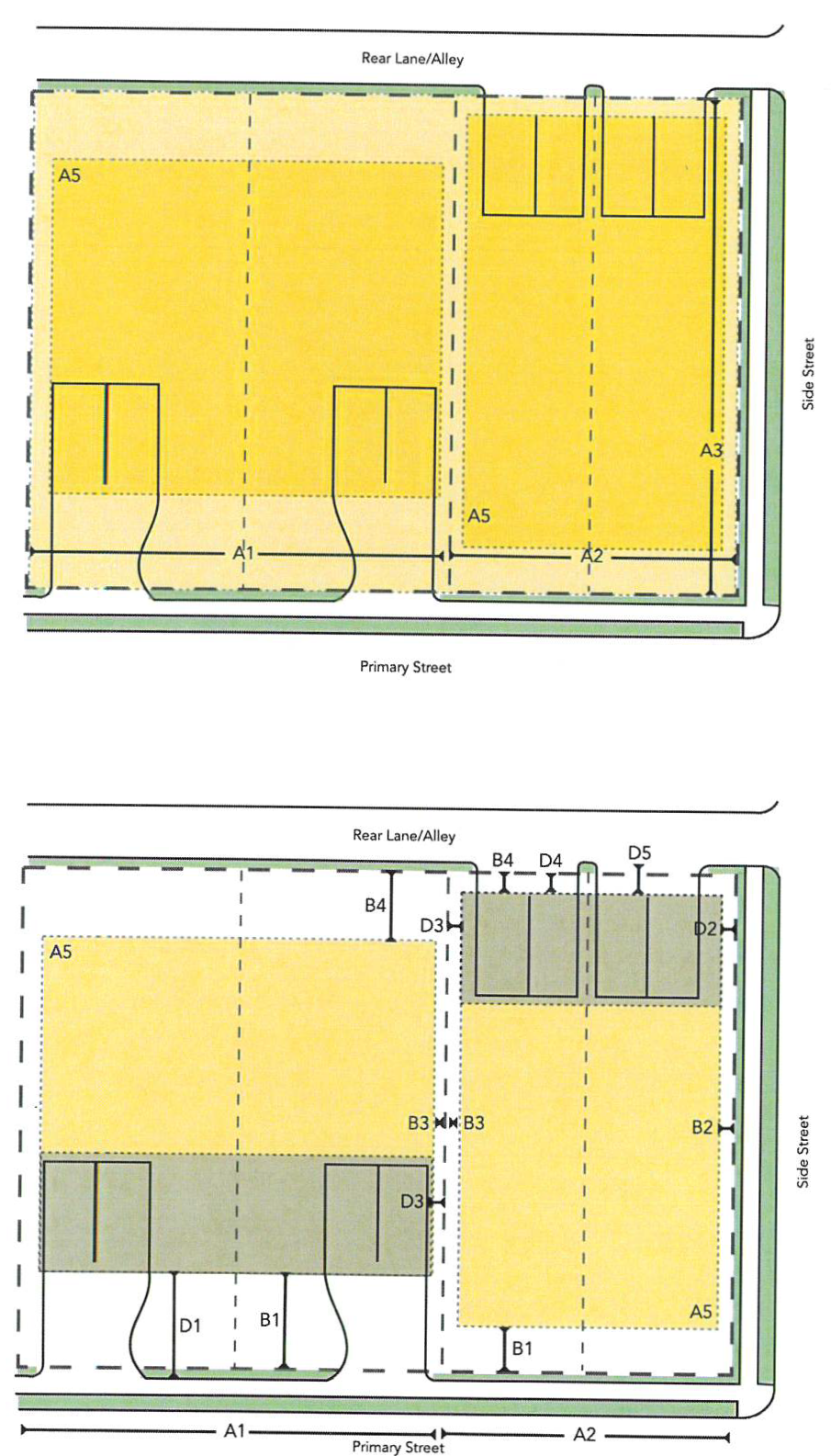
2.
Design Standards
a.
A dwelling unit attached by a common vertical wall to another dwelling unit. Each dwelling unit can be located on a separately deeded lot of record with individual HVAC, utility meter and ground floor access.
b.
For Dwelling, Two-Family: infill properties 1 acre or less, or developments totaling a maximum of 8 dwellings (4 Duplex buildings), the duplex lot area shall equal the minimum lot area and parking standards required for single-family detached dwellings within the underlying District.
c.
Total square footage (including accessory building(s) shall not to exceed five (5) percent of the c. floor area of a single-family dwelling and accessory building permissible by the underlying District.
d.
Each unit shall have its front or a side elevation facing onto a public ROW, or open space, if such unit is serviced by a rear alley/lane.
e.
Duplexes may face onto designated open space if rear loaded and serviced by a rear lane/alley section as approved by the City. Minimum width of open space shall be fifteen (15) feet.
f.
Each unit shall be served by public water and sewer.
g.
One accessory building may be built per dwelling unit over a dedicated off-street parking pad, with dimensions of 12' X 22', or 24' x 22'.
D.
Detached Home Conversions
When an existing detached house is converted to a Duplex (attached living) and an addition is added to the existing building, the following regulations apply:
1.
The addition must contain the same building materials as the existing building,
2.
The roof pitch and form of the addition shall be the same as the existing building,
3.
The height of the addition shall not exceed the height of the existing building,
4.
The building addition shall not cumulatively exceed fifty (50) percent of the floor area of the existing building, or increase its total lot coverage by ten (10) percent over the base District's requirements, whichever is greater. Lot coverage for each District is calculated by subtracting all required minimum setbacks from total lot area. Existing Buildings that have the minimum side and front setbacks permissible, shall construct additions into rear yard setbacks only. Maximum encroachment into a required rear yard setback shall not exceed seventy-five (75) percent.
(Ord. No. 19-685, § 3, 5-21-19; Ord. No. 20-697, § 5, 3-17-20; Text Amend. 9508, § 2, 6-16-20; Ord. No. 20-727, § 1, 9-15-20; Ord. No. 21-735, § 5, 3-16-21; Ord. No. 21-738, § 2, 6-15-21; Ord. No. 21-739, § 1, 6-15-21; Ord. No. 21-748, § 2, 10-19-21; Ord. No. 24-802, § 3, 1-16-24; Ord. No. 24-816, § 1, 10-15-24)
8.2.1 - ADULT ESTABLISHMENT
A.
Adult establishments, by their very nature, are recognized as having certain serious objectionable operational characteristics upon: adjacent neighborhoods (especially residential neighborhoods); churches; schools; child care facilities; public parks where juveniles congregate; or where adult establishments are concentrated. Special regulation of these establishments is necessary to ensure that their adverse effects will not contribute to the blighting or downgrading of the surrounding neighborhood. The following requirements as herein provided are therefore established.
B.
Massage businesses shall be permitted in all C zones and the I-1, I-2, and I-3 zones; however, this provision shall not pertain to massage therapists who are licensed or registered medical professionals or other persons certified by a state or nationally recognized organization; nor shall this apply to any private or public fitness center or nonprofit community recreational fitness and service organization, either of which provides massage therapy as a service incidental to the operation of a fitness center.
C.
No two (2) adult establishments may be located within one thousand (1,000) linear feet of each other; provided, however, that no lot upon which an adult hotel or motel is located shall be within two thousand (2,000) feet of another lot containing an adult establishment. No lot upon which an adult live entertainment business is located shall be within two thousand (2,000) feet of a lot containing a lounge.
D.
No adult establishment may be located within five hundred (500) linear feet of the property line of any church/house of worship or any public or private elementary, middle, or high school, library, public park or playground, child care facility, or residential (R) zoning district.
E.
The required distances shall be measured from the closest edge of the property occupied by an adult establishment to the closest edge of the property occupied by a protected use or another adult establishment. Provided, however, that when an adult establishment is located in a multitenant facility, the distance shall be measured from the closest edge of the portion of the facility occupied by such establishment.
F.
No more than one adult establishment shall be located within the same structure or portion thereof.
G.
Except for adult hotels and motels, no adult establishment shall provide sleeping quarters.
H.
No printed material, slide, video, photograph, written text, live show, or other visual presentation shall be visible, nor shall any live or recorded voices, music, or sounds be heard from outside the walls of the establishment.
I.
Irrespective of the sign area regulations contained in Chapter 12, no freestanding signs for adult establishments shall be permitted. Attached signage on all building faces shall not exceed eighty (80) square feet. In no case, however, shall signage cover more than ten (10) percent of the area of any building face.
J.
A minimum Type B buffer shall be provided along the interior property lines of any adult establishment; provided, however, that this does not apply when the adult establishment is located in a multitenant facility.
K.
Before granting a variance from the separation requirements set forth in this section, the Board of Adjustment shall find that a freeway or Interstate-type highway, traffic circulation patterns, structures, or other natural or man-made geographic or topographic features are likely to provide an adequate means of protection for the protected zoning or use from any secondary effects of the adult establishment. Furthermore, the Board of Adjustment may also grant a variance based upon this section regarding uses regulated under Section 8.2.16.
L.
After the effective date, the establishment of a residential (R) zone or protected use subsequent to the commencement of an adult establishment will not render the adult establishment nonconforming.
M.
No adult hotels, motels or adult live entertainment business shall be permitted in the C-1 district. Adult live entertainment businesses which are also private clubs shall also meet the requirements set forth in Section 8.2.16.
(Ord. No. 21-737, § 5, 5-18-21)
8.2.2 - AMUSEMENT AND SPORTING FACILITY, INDOOR
In any Office zoning district, only fitness gyms shall be allowed.
8.2.3 - AMUSEMENT AND SPORTING FACILITY, OUTDOOR
A.
All outdoor swimming facilities shall be located at least fifty (50) feet from any adjoining lot line, except one hundred (100) feet shall be required if adjacent to a residential zoning district.
B.
All outdoor accessory recreational uses (with the exception of swimming pools) located on any lot must be located at least twenty (20) feet from any side or rear lot line; fifty (50) feet shall be required if adjacent to a residential zoning district. These distances shall serve as minimum distances and shall be increased for particular uses as mandated elsewhere in this Ordinance.
C.
Lights shall be extinguished after regular hours of operation. Illumination of sporting events shall be permitted after this time only to conclude a scheduled event that was unable to conclude before this time due to unusual circumstances.
D.
The following requirements apply to fairgrounds only:
1.
All outdoor recreation facilities and vending stands shall be located at least five hundred (500) linear feet from a residential district. Otherwise, all buildings or structures, whether permanent or temporary, may not be located within one hundred (100) feet of any lot line.
2.
Access to the site shall be provided by major or minor thoroughfares only, as depicted on the most currently adopted version of the local thoroughfare plan or comprehensive transportation plan.
8.2.4 - ANIMAL HOSPITAL (INDOOR KENNEL); ANIMAL HOSPITAL (OUTDOOR KENNEL)
A.
If the use shares interior walls with any other use, the animal hospital structure shall be insulated and soundproofed, in order to minimize all loud and disturbing noises that might disturb those persons in adjoining structures or in the nearby vicinity.
B.
For indoor animal hospitals only, if the lot containing the use is located within one hundred (100) feet of a residential zoning district, a special use permit per Section 5.11 shall be required.
C.
If the use has an outdoor kennel, it shall meet the requirements of Section 8.2.5, with the exception of the minimum lot size requirements.
(Ord. No. 21-739, § 1, 6-15-21)
8.2.5 - ANIMAL KENNEL; ANIMAL SHELTER
A.
Any structure which houses animals which is not fully enclosed, and all animal runs shall each be located at least one hundred (100) linear feet from any lot line and three hundred (300) linear feet from any preexisting principal residential structure located on another lot.
B.
Outdoor run areas shall be located in the rear yard only and shall be enclosed by an opaque, decorative fence or masonry wall at least eight (8) feet in height.
C.
In the C-2 and C-3 zoning districts, a minimum lot area of one acre shall be required.
8.2.6 - AUTOMATIC TELLER MACHINE (ATM)
A.
Freestanding ATM structures shall be visible from a public street for security reasons.
B.
A freestanding ATM must be located outside all required setbacks.
8.2.7 - AUCTION HOUSE
In the CBD, UMU, C-1 and IU zoning districts and in all TNDs, if all principal and accessory structures for the use exceed twenty-five thousand (25,000) square feet GFA, a special use permit shall be required. In these same zoning districts the use shall be indoor only.
(Ord. No. 21-739, § 1, 6-15-21)
8.2.8 - AUTOMOBILE BODY SHOP; AUTOMOBILE DETAIL SHOP; AUTOMOBILE REPAIR SHOP; AUTOMOBILE RECONDITIONING
A.
All storage of equipment and materials shall be placed on the lot containing the use and shall not be on any adjacent street or lot.
B.
All painting and/or external repair of damaged, wrecked, dismantled or inoperative vehicles and all "auto body work," shall be done behind closed doors in a properly ventilated, indoor area.
C.
All outdoor storage of damaged, wrecked, dismantled or inoperative vehicles shall be screened in accordance with Section 11.6, C and D.
D.
Any use which also has an automobile towing and wrecking service as an accessory use must meet the requirements contained in Section 8.2.10.
E.
Any use with over seven (7) spaces designated for vehicles waiting for repair must screen such spaces from any public road in accordance with Section 11.6, C and D.
F.
Maximum allowed front and side yard parking shall be equivalent to three (3) parking spaces per garage bay. Additional parking spaces shall be located in the rear yard only and shall be substantially screened from any public street before issuance of a certificate of occupancy.
G.
In the IU zoning district, if the lot containing the use is located within one hundred (100) feet of a residential zoning district or the use has towing and wrecking as an accessory use, a special use permit shall be required.
H.
Automobile detail shops shall have no more than three (3) cars stored on-site overnight. Existing auto detail shops shall comply with this provision within one hundred eighty (180) days of Ordinance adoption.
I.
Automobile body, detail, and repair shops shall operate between the hours of 7:00 a.m. and 10:00 p.m. only when adjacent to an R zone (except RLD).
J.
Automobile body shops; automobile repair shops and automobile reconditioning shops existing as of the date of adoption of this ordinance in the Gateway Corridor Overlay and the Central Business District shall comply with the following provisions within one hundred eighty (180) days of Ordinance adoption.
1.
Storage areas for damaged, wrecked, dismantled or inoperative vehicles at locations in the Gateway Corridor Overlay shall be screened along any thoroughfare frontage (as designated on the most recently adopted version of the Gaston Urban Area Thoroughfare Plan) by a minimum 15-foot wide screening yard consisting of a wall or opaque fence meeting the requirements of Section 11.3.5(F) and plantings equivalent to a Level C buffer (fence with plantings option only). Plantings shall be located immediately outside the fenced storage area. The outside limit of said screening yard shall be located no closer than fifty (50) feet from the right-of-way of any thoroughfare.
2.
Storage areas for damaged, wrecked, dismantled or inoperative vehicles at locations in the Central Business District shall be screened along any public street frontage in conformity with the fence and/or wall provisions of the Central Business District standards. If an opaque masonry wall design is chosen it shall be a minimum six (6) feet in height, If a masonry column and metal picket design (in conformity with the C-B standards) is chosen, said fence (minimum six (6) feet in height) shall be supplemented by a one hundred (100) percent evergreen Level C equivalent screen at least fifteen (15) feet in width. As an additional option, under this specific section and applying only to these specific uses, for storage areas for damaged, wrecked, dismantled or inoperative vehicles at locations in the Central Business District, the Zoning Administrator may approve the installation of a fence meeting the requirements of subsection J., 1. of this section. Plantings shall be located immediately outside the fenced storage area. The outside limit of said screening yard shall be located no closer than fifty (50) feet from any public street frontage.
3.
No damaged, wrecked, dismantled or inoperative vehicles shall be stored outdoors for longer than ninety (90) days (regardless of screening used) in conjunction with any automobile body shops, automobile repair shops or automobile reconditioning shops in the Gateway Corridor Overlay and the Central Business District. Any location storing such damaged, wrecked, dismantled or inoperative vehicles for longer than ninety (90) days shall be deemed a junkyard as defined in this Ordinance.
4.
Buildings located between the storage area for damaged, wrecked, dismantled or inoperative vehicles and the street frontage requiring screening under this section may be deemed as sufficient to meet the standards set forth in this section if it is determined by the Zoning Administrator that the building(s) substantially screen the vehicle storage area from view from the applicable street frontage.
5.
Any business subject to this paragraph (8.2.8-J) that is lacking screening required by this paragraph for the storage of damaged, wrecked, dismantled or inoperative vehicles may store outdoors, without screening, no more than three (3) such vehicles on the business site, if such vehicles are stored or parked on a paved or gravel surface at least one hundred (100) feet from any street right-of-way of which screening is otherwise required by this paragraph; provided however, no such vehicle may be parked outdoors on said site for a period greater than ninety (90) days.
(Ord. No. 10-578, § 2, 2-16-10; Ord. No. 21-739, § 1, 6-15-21)
8.2.9 - AUTOMOBILE SERVICE STATION
A.
No above grade equipment for the vehicular service of gasoline, oil, or other petroleum product, shall be located closer than twenty-five (25) feet to any public right-of-way and ten (10) feet to any exterior property line or within any required setback, whichever is greater. Pump island canopies shall not be located closer than ten (10) feet to a public right-of-way in the front yard or extend within any required side or rear yard setback.
B.
No more than three (3) fuel pumps shall be allowed in the front yard by-right. Additional fuel pumps in the front yard may be approved with a special use permit. For corner lots, each road frontage shall be considered a separate front yard for this regulation.
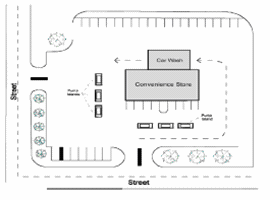
C.
If the lot containing the use has more than thirteen (13) fueling pumps and is located within one hundred (100) feet of a residential zoning district, a special use permit shall be required.
D.
Automobile service stations shall operate between the hours of 6:00 a.m. and midnight only when adjacent to an R zone (except RLD).
(Ord. No. 21-739, § 1, 6-15-21)
8.2.10 - AUTOMOBILE TOWING AND WRECKER SERVICE (PRINCIPAL AND ADJUNCT)
Principal Use:
A.
All principal and accessory towing and wrecker services uses must meet the requirements contained herein.
B.
Any outdoor vehicle storage area shall be located a minimum of one hundred (100) linear feet from any street right-of-way and two hundred (200) linear feet from any residential zoning district.
C.
All damaged and wrecked vehicles must be parked in delineated parking spaces.
D.
Vehicle storage facilities shall not be located at an elevation whereby the storage is visible from a public street after the required screening is in place.
E.
A type E buffer is required to fully screen vehicle storage, regardless of adjacent zoning. All screening requirements must be sufficiently opaque to materially screen the storage area at the time the certificate of occupancy is issued.
Adjunct Use:
A.
The towing and wrecker service may operate with not more than three (3) wreckers.
B.
The towing and wrecker service may store not more than twenty (20) customer vehicles at any one time.
C.
The towing and wrecker service must screen the storage yard from the general view of any public street with a combination of on-site buildings and a wooden screening fence not less than eight (8) feet in height.
D.
The towing and wrecker service may not store any customer vehicle longer than 90 consecutive days.
8.2.11 - AUTOMOBILE, TRUCK, BOAT, MOTORCYCLE, MANUFACTURED HOME AND RECREATIONAL VEHICLE SALES
A.
Off-street parking in the side and rear yards shall be screened with a minimum Type A buffer yard if the lot containing the use adjoins a residential zoning district, except RLD. Parking shall be placed on the lot in a manner designed to have the least physical impact on adjoining residential uses.
B.
All outdoor vehicle display areas shall be paved.
C.
No vehicles may be displayed or stored on or within required buffer yards, including required street yards.
D.
Paved areas reserved for the storage or display of vehicles for sale shall not be required to be striped for individual vehicle spaces. However, off-street parking for employees and patrons shall be required to conform to the design provisions of Chapter 10.
E.
Only two (2) rows of display vehicles shall be allowed in the front yard.
8.2.12 - BED AND BREAKFAST INN WITH RESTAURANT; BED AND BREAKFAST INN WITHOUT RESTAURANT
A.
In any residential district, breakfast shall be the only meal served and shall be served only to guests. In any office or commercial district, meals to non-guests may be served, including lunch and/or dinner.
B.
In any residential zoning district, no more than two (2) off-street parking spaces shall be provided in the front yard and overnight guest accommodations shall be in the principal structure only.
C.
Off-street parking, equal to that required for the bed and breakfast inn and for a restaurant shall be provided. Separate signage for both uses, however, shall not be permitted.
D.
Off-street parking in the side and rear yards shall be screened with a minimum Type A buffer yard (see Section 11.3) if the lot containing the use adjoins a residential zoning district, except the RLD zoning district. Parking shall be placed on the lot in a manner designed to have the least physical impact on adjoining residential uses.
8.2.13 - BUS OR TRAIN TERMINAL, PASSENGER
The site shall be located so as to have buses directly accessing thoroughfares as depicted on the most currently adopted version of the local thoroughfare plan or comprehensive transportation plan to avoid traveling through any abutting residential neighborhoods.
8.2.14 - CAMPING AND RECREATIONAL VEHICLE PARK
A.
All spaces for camping and recreational vehicles shall be located at least one hundred (100) linear feet from any adjoining lot line.
B.
Notwithstanding any other screening requirements, the campground shall be sufficiently wooded to provide an opaque natural buffer between the campground, all adjacent lots, and all adjacent public roads at the time a certificate of occupancy is issued for the use.
C.
Accessory uses, limited to usage by campground patrons, may include laundry facilities and the selling of convenience items (snacks, beverages, etc.).
D.
Access to the site shall be provided by major or minor thoroughfares only, as depicted on the most up-to-date version of the thoroughfare plan of the Gaston Urban Area.
E.
Maximum gross density of fifteen (15) campsites per acre is allowed.
F.
Each campsite shall be no greater than three hundred fifty (350) feet from any service buildings providing bathing and sanitary facilities.
8.2.15 - CAR WASH, AUTOMATIC; CAR WASH SELF SERVICE
A.
Vacuuming, drying and polishing facilities may not be located in the front yard. In addition, such facilities shall not be located in any required yard or buffer area adjacent to a residential zoning district.
B.
Wash bays shall not face any lot in a residential zoning district. This shall not apply in the case of lots containing such automobile washes that are separated from such residentially zoned lots by a major or minor thoroughfare.
C.
All vehicular accessible areas on the lot shall be at least fifty (50) feet from any adjoining residentially zoned lot, except in cases where such lot lies directly across a major or minor thoroughfare.
D.
If a self-service car wash is located adjacent to a residentially zoned district, a special use permit shall be required.
E.
A car wash shall operate between the hours of 7:00 a.m. and 10:00 p.m. only when adjacent to an R zone (except RLD).
(Ord. No. 21-739, § 1, 6-15-21)
8.2.16 - PRIVATE CLUB (WITHOUT ADULT ENTERTAINMENT)
A.
Any private club shall be located at least two hundred (200) linear feet from a residential (R) zoning district (except RLD); dwelling unit; elementary, middle, or high school facility; church or other house of worship facility. A private club within a multi-tenant development shall be four hundred (400) feet from the zones and uses noted above, as measured from the building footprint of the tenant space containing the private club. This provision shall not apply within the CBD and UMU zoning district.
B.
A private club shall abut and may only be provided direct access via major or minor thoroughfares as depicted on the most up-to-date version of the thoroughfare plan of the Gaston Urban Area. This provision shall not apply within the CBD zoning district.
C.
Private clubs located in the CBD and UMU shall preserve visibility into establishments from the sidewalk/street to include no tinting, painting or covering (curtains, blinds, paper, etc.) of windows. Further, no openings on any portion of a wall oriented toward a public street shall be covered or blocked with any material so as to render the opening functionally obsolete or to cause it to be opaque.
D.
Subsections A. and B. shall not be applicable to a "teen club" or to a fraternal organization facility which is licensed to dispense alcohol.
E.
Before granting a variance from the separation requirements set forth in this section, the Board of Adjustment shall find that a freeway or interstate-type highway, traffic circulation patterns, structures, or other natural or man-made geographic or topographic features are likely to provide an adequate means of protection for the protected zoning or use from any secondary effects of the private club.
(Ord. No. 10-585, § 4, 8-17-10; Ord. No. 12-617, § 2, 8-21-12; Ord. No. 13-623, § 1, 9-17-13; Ord. No. 20-695, § 3, 2-18-20)
8.2.17 - CONVENIENCE STORE—FUEL MART
A.
The following uses shall be considered accessory to Convenience Stores: Car Washes, Automatic (in the side or rear yard only) and rental of video tapes / DVDs. All such accessory uses will not require additional parking. In no case shall such accessory uses be allowed additional signage.
B.
In the UMU district, access to the site shall be provided by at least one major or minor thoroughfare, as depicted on the most currently adopted version of the local thoroughfare plan or comprehensive transportation plan.
C.
No above grade equipment for the vehicular service of gasoline, oil, or other petroleum product, shall be located closer than twenty-five (25) feet to any public right-of-way and ten (10) feet to any exterior property line or within any required setback, whichever is greater. Pump island canopies shall not be located closer than ten (10) feet to a public right-of-way in the front yard or extend within any side or rear required setbacks.
D.
Reserved.
E.
Vacuuming facilities may be located outside the building, but may not be located within any required yard or buffer area adjacent to a residential district.
F.
The sale of fuel at convenience store - fuel marts shall be prohibited in TNDs.
G.
If a convenience store - fuel mart lies within fifty (50) feet of a residential (R) zone (except RLD), a dense buffer at least fifty (50) feet in width shall be placed in the side or rear yard closest to the R district and hours of operations shall be between 6:00 a.m. and midnight only.
(Ord. No. 10-585, § 4, 8-17-10; Ord. No. 12-608, § 3, 4-17-12)
8.2.18 - COUNTRY CLUB; GOLF COURSE; GOLF DRIVING RANGE
A.
Accessory uses including restaurants, retail shops selling golf related items, and other accessory uses normally associated with a county club or golf course may be allowed.
B.
The following requirements apply to golf driving ranges only:
1.
Fencing, netting, trees, berms, or other control measures shall be provided around the perimeter of the driving or playing areas so as to prevent golf balls from going onto adjacent properties. Such devices, where applicable, may be counted towards any required screening provided.
2.
The minimum lot depth from the tees to the end of the driving area shall be one thousand (1,000) feet or the end shall be controlled with netting and/or berms to prevent golf balls from leaving the property.
8.2.19 - DAY CARE CENTER, CLASS B; DAY CARE CENTER, CLASS C; DAY CARE CENTER, ACCESSORY
A.
Outdoor play areas shall be located in the rear or side yards only. In no case shall such play areas be located in a required side yard setback.
B.
All outdoor play areas are to be surrounded by a fence or wall at least four (4) feet in height.
C.
See Section 10.6 for staging area requirements.
D.
Daycares that are accessory to a church are allowed as a use by right in residential zoning districts for up to fifty (50) pre-school children, after school care children, handicapped persons or senior citizens unrelated by blood or marriage, and not the legal wards or foster children of the attendant adult. In residential zoning districts, such day cares with over fifty (50) attendees will require the issuance of a special use permit; in all other zoning districts these day cares will be treated the same as a Class C day care center. The Planning Commission or City Council may issue a special use permit in accordance with Section 5.11.
E.
Accessory day care centers shall be located on property that is owned by the principal use (i.e., church, school, office, commercial, or industrial use) and which lies within five hundred (500) linear feet of the lot containing the principal use, or on another lot owned by the principal use where principal use activities are regularly conducted. The capacity of the daycare cannot exceed ½ the capacity of the largest assembly room in the church.
F.
Signage for an accessory day care center shall be included in that which is allowed for the principal use.
(Ord. No. 21-737, § 2, 5-18-21; Ord. No. 21-739, § 1, 6-15-21)
8.2.20 - FLEA MARKET, INDOOR AND OUTDOOR
A.
For outdoor flea markets only, the lot shall be at least three hundred (300) linear feet from any lot located in a residential district.
B.
Any flea market shall be on a lot of at least five (5) acres that fronts and has direct access from a minor thoroughfare road or higher classification as depicted on the most currently adopted version of the local thoroughfare plan or comprehensive transportation plan.
8.2.21 - NEIGHBORHOOD SERVICES CENTER
General Principles:
A.
NSCs shall be designed so that pedestrian traffic is encouraged and accommodated, through a combination of providing visual appeal, well-designed sidewalk systems, and enhancement of pedestrian comfort and safety. Furthermore, they should provide amenities that serve pedestrian and bicycle traffic, such as outdoor seating, bike racks, landscaping elements, awnings over sidewalks where appropriate, etc. These centers shall be designed to provide a reasonable level of accommodation for automobiles, but with less functional and visual emphasis than in typical suburban centers.
B.
NSCs shall avoid auto-oriented, "franchise" or prototypical architecture and site design typically used in suburban settings.
C.
NSCs shall typically be between one and three (3) acres. Sites larger than three (3) acres may be utilized, but all buildings and automobile parking and circulation facilities shall be contained within a sub-area not larger than three (3) acres.
D.
NSCs shall provide retail and service oriented businesses of a scale that serves a more local population, typically living within one-half (½) mile of the site. In order to promote the economic viability of such centers, there should generally be an existing or expected minimum net density of two thousand (2,000) dwelling units within a one-half-mile radius of the external boundaries of the site. The area within a one-half-mile radius should also have a reasonably well-developed system of sidewalks or other pedestrian or bicycle pathways, whether existing or planned for near-term construction.
E.
NSCs shall be located at an intersection of a thoroughfare and another public street of any size. An exception may be made that allows NSCs to be constructed on lots with frontage on only one road (a thoroughfare) if the site has a well-developed greenway, pedestrian or combination bicycle/pedestrian connection to substantial existing or planned residential neighborhoods behind or adjacent to the site. Such connections must be permanent and open for use by the general public. All NSCs should be within comfortable walking distance of a mixture of housing types (typically not more than one-fourth (¼) mile).
Building Design Principles:
A.
As a general design principle, buildings shall be designed and oriented on the site so as to front both intersecting streets on corner lots, or the single thoroughfare on non-corner lots. The primary goal is to mirror commercial design patterns in traditional downtown areas. To achieve this it will generally be necessary to design buildings whose long edges are oriented parallel to public streets and are longer than they are deep by a factor of at least two to one. It will further be necessary to establish a "build-to" line whereby the average building setback from a public street shall not exceed fifteen (15) feet. Articulation in the setback shall be incorporated to provide visual breaks in the facade and to permit sight triangles at intersections of two (2) roads. Where subject property under one ownership is divided by a public street, buildings shall be oriented to provide frontage on all streets. Typical suburban yards (setbacks) shall not be allowed. On sites where the primary goals stated herein are achieved and there remains unused square footage allowance, additional buildings may be constructed on the site at other suitable locations. Such additional buildings shall meet all required C-1 district setbacks.
B.
Square foot allowances and number of tenants for NSCs:
1.
For parcels between one and one and one-half (1.5) acres, the non-residential portion of NSCs shall not exceed twenty thousand (20,000) square feet in size and shall contain not fewer than three (3) non-residential uses. Second floor residential units shall be allowed, the total area of which shall not exceed twelve thousand (12,000) square feet. If second-floor residential uses are incorporated into the design, for every two (2) square feet of heated floor area devoted to such uses, one additional square foot of non-residential space shall be allowed (not to exceed a total bonus of six thousand (6,000) square feet of additional non-residential space). One parking space for each one thousand (1,000) square feet of residential space shall be required.
2.
For parcels between one and fifty-one hundredths (1.51) and two (2) acres, the non-residential portion of NSCs shall not exceed twenty-five thousand (25,000) square feet in size and shall contain not fewer than four (4) non-residential uses. Second floor residential units shall be allowed, the total area of which shall not exceed sixteen thousand (16,000) square feet. If second-floor residential uses are incorporated into the design, for every two (2) square feet of heated floor area devoted to such uses, one additional square foot of non-residential space shall be allowed (not to exceed a total bonus of eight thousand (8,000) square feet of additional non-residential space). One parking space for each one thousand (1,000) square feet of residential space shall be required.
3.
For parcels larger than two (2) acres, the non-residential portion of NSCs shall not exceed thirty thousand (30,000) square feet and shall contain not fewer than five (5) non-residential uses. Second floor residential units shall be allowed, the total area of which shall not exceed twenty thousand (20,000) square feet. If second-floor residential uses are incorporated into the design, for every two (2) square feet of heated floor area devoted to such uses, one additional square foot of non-residential space shall be allowed (not to exceed a total bonus of ten thousand (10,000) square feet of additional non-residential space). One parking space for each one thousand (1,000) square feet of residential space shall be required.
4.
Any single retail establishment shall be limited to 6,000 square feet, except those offering multiple lines of general merchandise, such as groceries, notions, drugs, household goods, etc. Such uses may have a floor area not exceeding 12,000 square feet. Examples of such uses include, but are not limited to, full-service drug stores, convenience stores without fuel sales, etc.
C.
Buildings may be one or two (2) stories. No portion of a single story structure may exceed 18 feet in height. Second stories must be structurally functional, and should incorporate fenestration on the exterior facades.
D.
The total floor area of any NSC shall be enclosed within one or two (2) freestanding buildings unless the site is divided by a public street; in which case up to four (4) buildings may be permitted. In general, separate buildings for each tenant, with independent and/or disconnected parking, circulation systems, and signage, shall be prohibited. If two (2) structures are built along the "build-to-line," the space separating them shall not be used for vehicular access.
E.
Buildings shall be designed so that each facade facing a public street contains significant fenestration at the street level, and should if practical, incorporate functional means of ingress/egress for pedestrians.
F.
Detailed building facade elevations and material specifications shall be required as part of the submission process.
G.
Buildings should incorporate common design elements while avoiding mass uniformity. Small variations in height, materials, and roof articulation are encouraged.
H.
Drive through service lanes and windows may be utilized only in association with pharmacies, dry cleaning shops, automated bank teller machines, and photographic film deposit stations.
I.
Awnings, arcades, or porte-cocheres should be provided near building entrances and sidewalks. Awning may extend beyond property lines if necessary to cover a public sidewalk provided there are no obvious or foreseeable public utility conflicts. However, such awnings shall not extend closer than six (6) feet to the pavement edge of any travel lane.
J.
Outdoor seating for restaurants shall be allowed and is encouraged.
Site and Land Use Principles:
A.
Signs for the development name should be ground signs. Other allowable signs include wall signs attached to architectural sign friezes, awning signs painted or otherwise lettered onto the awning skirt, or suspended signs not exceeding nine (9) square feet in size.
B.
Lighting should be low (between eight (8) and twelve (12) feet above grade), and of a type that is non-intrusive to adjoining residential areas. Metal halide and similar types of lighting typically used in suburban centers shall be disallowed.
C.
All parking shall be provided behind, or beside, buildings given sign considerations, and not generally visible (or at least not visually dominant) from a public street. Parking lots must be screened with a low (between three (3) and four (4) feet in height) wall constructed of brick or finished concrete block or dense shrubbery.
D.
Parking lots shall be designed to provide maximum safety, convenience and visual appeal to pedestrians and cyclists utilizing them.
E.
The number of parking stalls provided shall not be less than sixty (60) percent, nor more than eighty-five (85) percent of that required under normal zoning standards.
F.
Any single restaurant or similar food and beverage service establishment shall have a seating capacity not exceeding sixty (60) fixed seats.
G.
Any single office use shall be limited to five thousand (5,000) square feet or less.
H.
Uses allowed in a NSC are listed below. These uses may be more specific and define a use more narrowly than the use chart and may not be uniquely identified on said chart.
1.
Animal grooming establishment.
2.
Animal hospital with no outdoor runs.
3.
Animal obedience school.
4.
Antique store.
5.
Appliance sales and repair.
6.
Art gallery.
7.
Automobile parts and supply store.
8.
Bakery—coffee shop (retail).
9.
Bank teller machines, outdoor.
10.
Barber/beauty shop.
11.
Beauty supply and cosmetic store.
12.
Bicycle sales and service.
13.
Blueprinting and drafting service.
14.
Book store.
15.
Brew-pub.
16.
Camera and photography supply store.
17.
Candy and nut store.
18.
China and tableware shop.
19.
Clock and watch sales and repair.
20.
Clothing, footwear, and apparel store.
21.
Coin and stamp shop.
22.
Community center.
23.
Computer and data processing sales and service.
24.
Craft studio.
25.
Customary home occupation.
26.
Day care center, any class.
27.
Department store.
28.
Detective agency.
29.
Doctor's office.
30.
Drapery and linen shop.
31.
Dry cleaning services outlet.
32.
Dwelling, mixed use.
33.
Employment agency.
34.
Engineering, architect or surveying service.
35.
Essential services, classes 1 and 2.
36.
Finance company.
37.
Financial institution.
38.
Floor covering store.
39.
Floral and Christmas items store.
40.
Florist, retail.
41.
Food catering facility.
42.
Food store, not exceeding nine thousand nine hundred ninety-nine (9,999) sq. ft. GFA.
43.
Formal wear and costume rental store.
44.
Fraternal and service organization meeting facility (nonprofit and not-for-profit) not exceeding nine thousand nine hundred ninety-nine (9,999) sq. ft. GFA.
45.
Furniture store, retail.
46.
Gift, novelty and souvenir store.
47.
Glass and mirror shop.
48.
Hobby, toy and craft shop.
49.
Home decorating center.
50.
Home electronics sales and repair.
51.
Insurance agency (principal use).
52.
Interior decorator.
53.
Jewelry sales (principal use) and repair.
54.
Key shop and locksmith.
55.
Laundromat.
56.
Library, public.
57.
Live-in office or business.
58.
Luggage and leather goods shop.
59.
Martial arts school.
60.
Massage therapist.
61.
Message and errand service.
62.
Music store sales and service.
63.
Newsstand (principal use).
64.
Office (not exceeding five thousand (5,000) square feet gross floor area).
65.
Office equipment and computer store.
66.
Optician and optical supply store.
67.
Pet shop.
68.
Pharmacy.
69.
Photocopy service.
70.
Photo finish laboratory.
71.
Photographic studio.
72.
Picture frame shop.
73.
Post office (excluding contract stations).
74.
Produce stand (accessory or principal use).
75.
Public safety station.
76.
Real estate agency.
77.
Recreation center, indoor (public, private and nonprofit).
78.
Recreational use, accessory.
79.
Recycling deposit station.
80.
Restaurant (principal use, not exceeding sixty (60) fixed seats).
81.
Restaurants, within another facility (not exceeding sixty (60) fixed seats).
82.
Sandwich shop/deli with table or counter service and no drive through.
83.
Secondhand and consignment shop.
84.
Sewing, cloth and notions store.
85.
Shoe repair shop.
86.
Sign and banner shop.
87.
Sporting goods and apparel shop.
88.
Stationery shop.
89.
Tailor and alteration shop.
90.
Take out restaurant serving prepared food with no drive through.
91.
Tanning and nail salon.
92.
Tax preparation service.
93.
Taxi stand.
94.
Tobacco shop.
95.
Travel agency.
96.
Trophy and plaque shop.
97.
Variety store.
98.
Video rental shop.
(Ord. No. 11-593, § 3, 8-2-11)
8.2.22 - BUSINESS INCUBATION FACILITY
No more than ten thousand (10,000) square feet of space shall be devoted to any single tenant. All office uses are allowed along with the required supplemental regulations as applicable. Any manufacturing type use shall only be allowed if allowed in the underlying zone.
8.2.23 - HOTEL; HOTEL, FULL SERVICE; MOTEL
A.
Retail uses, lounges, and restaurants may be located as an accessory use within any motel or hotel.
B.
Off-street parking facilities shall be separately computed at a rate of three-fourths (.75) percent the normal minimum parking requirement for any retail use containing over one thousand (1,000) square feet of gross floor area or for any restaurant or private club which is open to the general public.
C.
The following requirements apply to hotels in the OM district only:
1.
Only full service hotels are allowed in the OM district.
2.
In the OM district only, each of the additional findings of fact must be found in the affirmative by the Planning Commission or City Council prior to the issuance of a special use permit for a hotel:
a.
The hotel will be supportive of the hospital and medical community. Examples of this include: (1) marketing of meeting rooms to the medical community, (2) marketing and promotion of lodging to the medical community and to friends and/or relatives of hospital patients, or (3) assignment of rooms designated to serve persons receiving out-patient care or other medical care not requiring hospitalization.
b.
The design and exterior finish shall be of a type and quality in keeping with the existing development found in the area.
c.
Access and traffic flow patterns for the site shall not create difficulties for emergency vehicles accessing the hospital and shall be compatible with the overall hospital complex.
(Ord. No. 21-739, § 1, 6-15-21)
8.2.24 - NURSERY (GARDEN)
A.
Structures associated with the use shall be at least fifty (50) feet from any interior lot line and a Type A landscaping buffer shall be installed along all interior lot lines.
B.
Mulch and gravel piles, etc., must be located out of the front, rear and side setbacks. If the mulch and gravel piles, etc. are stored in the front yard, they must be permanently screened from the adjoining public road with either an opaque landscaping screen or a wooden fence. Such screen must have a minimum height of six (6) feet.
8.2.25 - OFFICE USES WITH GREATER THAN 25,000 GFA
Office buildings over 25,000 GFA in the O-1 and OLC zoning district are allowed as a use by right for conversions only. Otherwise, such uses shall be a conditional use.
(Ord. No. 11-594, § 3, 9-6-11)
8.2.26 - PLANNED UNIT DEVELOPMENT
A.
Purpose and Intent.
All planned unit developments (PUDs) shall be developed in accordance with the standards of this Section; provided, however, any residential components of such developments shall also conform to all the requirements of Section 8.1.11 of this Ordinance (except as herein provided).
The purpose of this Section is to establish requirements and review procedures for mixed use projects which may include a full range of housing types and compatible commercial, office institutional, and industrial uses. In order to encourage high quality design and innovative arrangements of buildings and open space uses throughout the project site, these regulations provide for substantial flexibility from conventional use and dimensional requirements. The goal is to achieve a well-blended project where common architecture is integrated throughout.
In keeping with the stated purpose of this Section, a Planned Unit Development shall only be allowed through conditional district zoning as part of a PD planned district.
B.
PUD Project Requirements.
1.
Project Size
a.
PUDs which contain residential dwelling units—Thirty (30) acres.
b.
PUDs which do not contain residential dwelling units—Ten (10) acres.
2.
Maximum Building Height
The maximum building height shall be based on the distance the principal structure is from a principal residential structure within the PUD or the lot line separating the PUD district from a residential (R) zoning district, except RLD.
Notwithstanding, the maximum height may be as high as any other principal structure located within the PUD which lie within the linear distance separation area.
3.
Maximum Density/Intensity
a.
For residential portions of the project the maximum densities shall be those listed in Section 8.1.11A3 of this Ordinance. The density bonuses in accordance with Section 8.1.11 shall likewise be applicable.
b.
Except as may be provided elsewhere in this Ordinance, for nonresidential portions of the project the maximum floor area ratio (FAR) and maximum impervious surface ratio (ISR) shall be:
** Also see Section 9.26 Stormwater Detention.
In order to have a FAR in excess of 0.35, the project must have direct access onto a major or minor thoroughfare and the site must be located so that the majority of automobile and/or truck traffic associated with the development be funneled away from any existing adjoining residential neighborhoods.
4.
Uses Allowed in the PUD
Uses within a PUD are limited to those listed below. Unless otherwise specified in this section, residential portions of planned unit developments shall meet all requirements of Section 8.1.11.
(1) If a use located in the PUD is subject to the issuance of a special use permit, and if such use were shown on the site plan originally approved for the PUD through the conditional zoning process or through issuance of a special use permit, issuance of a special use permit for such use shall not be needed. In instances where such use was not indicated on and approved as part of the site plan for the conditional rezoning of the property for the PUD, or if the PUD were approved administratively, a special use permit would need to be for issued for such use.
5.
Common Open Space
At least ten (10) percent of the gross acreage of the PUD shall be preserved as common open space. This shall include all common areas (at least one-half (½) of which shall be grassed or landscaped) that are readily accessible by residents and users of the PUD. At least one-half (½) of the required common open space shall consist of improved common areas, such as plazas, courtyards and other improved pedestrian-accessible areas specifically designed to accommodate residents and visitors. Such areas can include benches, fountains, play equipment and venues for outdoor vending stands.
All common open space shall otherwise be in accordance with Section 8.1.11A6 and 11.7 of this Ordinance.
6.
Approval Process for a PUD
In keeping with the stated purpose of this section, a Planned Unit Development shall only be allowed through conditional district zoning as part of a PD planned district.
7.
Off-street Parking Requirements
The requirements of Chapter 10 shall prevail except location of off-street parking shall be as provided for herein based on the building type. Parking lot landscaping shall be in accordance with Section 11.5. Off-street parking areas shall be separated from interior streets within the project. Parking decks, if used, shall be of the Option "B" and "C" variety as contained in Sections 10.9.2 and 10.9.3 of this Ordinance. All off-street loading areas (for loading and unloading of goods) shall be located in the rear of buildings except that such areas may be located on the sides of buildings when screened from view from the front of such building(s). Streets within the PUD are strongly encouraged to be designed to accommodate on-street parking.
8.
Screening Requirements
Screening shall be provided at the periphery of the PUD, when such use, if not located in the PUD, would have been required to provide screening in accordance with Section 11.4. If the residential portion of the PUD abuts (i) an industrial use, (ii) a use only allowed in the RLD or an industrial district, or (iii) a RLD or industrial zone, screening in the form of a type D screen, as a minimum, shall be provided. All such required screening shall be located within the boundaries of the PUD.
Screening shall be provided within the PUD, between nonresidential uses and areas planned for residential use, when such use, if not located in the PUD, would have been required to provide screening in accordance with Section 11.4. Required screening shall be located on the nonresidential side of such boundary. If a multifamily or attached single-family development within a PUD lies adjacent to or directly across the street from a single-family housing area within the PUD, a type B screen, as a minimum, shall be provided between such uses. Such screening shall be located on the multifamily portion of the PUD.
Notwithstanding, the Planning Commission or City Council may require screening in any situation along the boundary of a PUD or internally as a condition for approval wherever it deems appropriate for the protection of adjoining properties or to establish necessary transition. Screening should not be allowed to substitute for poor design or the lack of adequate design transition between less compatible buildings or uses.
9.
Street Requirements
Streets within the development shall be designed and constructed to carry vehicular traffic from public streets to parking or service areas within the development. All streets (except those which access residential dwellings only) shall, at a minimum, meet the following requirements:
a.
Minimum pavement widths (back of curb to back of curb); local access street—twenty-eight (28) feet; collector street—thirty-three (33) feet.
b.
The edge of pavement of any private street shall be no closer than forty (40) feet to any building except that a street may be located within twenty (20) feet of an accessory building, provided that this requirement shall not apply to passenger and goods loading and unloading drives and facilities.
c.
All streets and parking areas shall be paved and bordered in accordance with the city's curb and gutter standards. Storm drainage shall be installed in accordance with all applicable local and state standards. Sidewalks shall be installed per Section 9.18.
d.
Alleys in the PUD shall have a minimum paved surface of sixteen (16) feet and a minimum right-of-way width of twenty (20) feet. Alleys shall meet all other applicable NCDOT design and construction, except that alleys shall not be required to have sidewalks or a gutter. Alleys must be designed to sufficiently accommodate drainage through modern engineering standards.
10.
Requirements for Non-Residential Portions of the PUD
a.
Public water and sewer must be provided to the site.
b.
Minimum front setback at project boundary—Fifty (50) feet. (The term "project boundary" shall mean any dedicated street which constitutes an external project boundary. The 50-foot setback requirement also shall apply to any thoroughfare which cuts through the development. Additional thoroughfare setback requirements may apply.
c.
Minimum side setback at project boundary—Thirty (30) feet (except on corner lots where fifty (50) feet shall be provided).
d.
Minimum rear setback at project boundary—Thirty (30) feet.
e.
Interior lot setbacks for nonresidential uses shall be as follows:
Front yard—Thirty-five (35) feet.
Side yard—Fifteen (15) feet (an additional ten (10) feet shall be required if the side yard abuts a street corner).
Rear yard—Thirty-five (35) feet.
f.
Minimum project lot width (as measured at required front yard setback)—One hundred (100) feet. In no case shall the front lot width at the street right-of-way line be less than fifty (50) feet.
g.
Except for pedestrian walkways and pedestrian courts and paved facilities specifically designed and designated for passenger or goods loading and unloading, no paved facilities (street, drives, or parking areas) shall be located closer than twenty (20) feet from the front or rear of any building and ten (10) feet from the side of any building.
h.
Off-street parking areas and all internal streets shall provide safe and convenient access for emergency service and refuse collection vehicles and service and delivery vehicles.
i.
The front entrance to any principal building shall not directly face the designated goods loading area of any other principal building, unless there is a separation of at least one hundred fifty (150) feet between said building and sufficient landscaping equal to a minimum type 3 screen between said loading area and the front entrance of the opposite building. This separation distance may be reduced to one hundred (100) feet if a type 4 3 screen is provided.
j.
No two (2) principal buildings shall be located closer to each other than the greater of (i) seventy (70) feet; or (ii) a distance equal to the height of the taller structure.
C.
Building and Lot Standards.
Except as provided herein, all design standards of the Urban Standards Overlay District shall prevail. Additional design standards are also shown below for the various types of buildings that may be found a PUD.
1.
Commercial Buildings
a.
Buildings facing each other on the same side of the same street shall maintain a common front build-to line. The Administrator may allow for minor deviations from the build-to line to allow for exterior amenities such as outdoor dining areas, customer drop-off points, etc.
b.
Building facades shall be parallel to the adjoining street.
c.
Off-street parking areas shall be inter-connected, wherever possible.
d.
Trash dumpsters are to be located to the rear of the building.
e.
Buildings may be served with rear-loading alleys.
f.
Building elevations fronting and/or visible from public streets shall be clad with any of the following: brick, brick veneer, stone or stone veneer; stucco or artificial stucco; cement fiberboard; glass, wood, or wood materials, or materials similar in composition, texture, and appearance. The Administrator or approval body, in instances where a special use permit or conditional zoning is involved, shall have the authority to approve building materials not specifically listed but similar in composition, texture, and appearance and texture to those herein listed. Decorative metal roofs shall be allowed.
g.
Street level windows shall be transparent. Mirror or reflective glass shall not be allowed.
h.
Roofs may either be flat or pitched. Flat roofs may be permitted, provided a parapet is provided that screens all rooftop equipment from the view of pedestrians and motorists from the view below.
2.
Residential Buildings
a.
For multi-family buildings, building standards shall apply per Section 8.1.10B.
b.
For all other residential development, building standards shall apply per Section 8.1.11B.
3.
Civic Buildings
a.
A minimum 15-foot front yard setback shall be observed. Areas between the building and the adjacent sidewalk shall be landscaped per Section 11.4. Off-street parking in the front yard shall be prohibited.
b.
Building facades shall be generally parallel to front property line.
c.
Off-street parking areas shall be inter-connected, wherever possible.
d.
Trash dumpsters are to be located to the rear of the building.
e.
Building elevations fronting and/or visible from public streets shall be clad with any of the following: brick, brick veneer, decorative concrete block, pre-cast or field poured tilt concrete panels with texture; stone or stone veneer, flush architectural metal panels; stucco or artificial stucco; glass, wood, or wood materials, or materials similar in composition, texture, and appearance. The Administrator or approval body, in instances where a special use permit or conditional zoning is involved, shall have the authority to approve building materials not specifically listed but similar in composition, texture, and appearance and texture to those herein listed.
f.
Street level windows shall be transparent. Mirror or reflective glass shall not be allowed.
g.
Flat roofs may be permitted, provided a parapet is provided that screens all rooftop equipment from the view of pedestrians and motorists from the view below.
(Ord. No. 21-739, § 1, 6-15-21)
8.2.27 - PAINTBALL FACILITY
Outdoor paintball facilities and activities shall be allowed in the RLD, I-1, and I-2 zones only. The following supplemental regulations shall apply to outdoor facilities and activities only.
A.
No portion of the operation activities shall be located closer than one hundred (100) linear feet from any exterior lot line, and one hundred fifty (150) feet to any residentially zoned lot line.
B.
A facility shall be placed on a parcel of land consisting of at least five (5) acres.
C.
The use shall not be permitted to locate adjacent or contiguous to any existing place of worship, child care facility or school.
D.
A public address system is permitted, provided that the speakers and other such audible equipment are pointed in a downward and inward direction, so as to be away from adjoining properties.
E.
A lighting system is permitted, provided that the light fixtures and other such equipment are pointed in a downward and inward direction, so as to be away from adjoining properties.
F.
Any paintball facility requiring fifty (50) or more parking spaces shall be located on a major or minor thoroughfare as depicted on the Gaston Urban Area Thoroughfare Plan.
G.
Hours of operation shall be between 7:00 a.m. to 11:30 p.m. only.
(Ord. No. 21-737, § 2, 5-18-21)
8.2.28 - PARKING LOT (PRINCIPAL USE)
A.
In all zoning districts except for the C-2, C-3 and Industrial zoning districts, lots shall be limited to one-half (½) acre or less in size.
B.
No portion of any such lot shall be located closer than five hundred (500) feet to any portion of another such lot.
8.2.29 - RACETRACK; FIRING RANGE, OUTDOOR
A.
For racetracks, no portion of the race course perimeter shall be located closer than three hundred (300) linear feet from any exterior lot line, except five hundred (500) linear feet from any lot line abutting a residential (R) zoning district.
B.
For outdoor firing ranges, shooting areas shall be located at least five hundred (500) linear feet from any abutting lot line; provided, however, that no existing principal residential structures shall be located closer than one thousand five hundred (1,500) linear feet down range of any target located on an outdoor firing range.
C.
A projectile-proof backstop, consisting of concrete, steel, earth, or any combination, at least fifteen (15) feet above the target line must be erected and maintained behind all target areas.
D.
Hours of operation may be between 10:00 a.m. to 11:00 p.m. only (racetracks); and 10:00 a.m. to one hour prior to sunset (outdoor firing ranges).
E.
All race courses for any motorized vehicle shall be paved.
8.2.30 - RESTAURANT WITH DRIVE THROUGH
If the lot containing the use is adjacent to a residential zoning district, a type D buffer shall be required.
8.2.31 - RESTAURANT WITHOUT DRIVE THROUGH
A.
Any restaurant within an office district shall have a maximum gross leasable area of one thousand five hundred (1,500) square feet. Restaurants in the O-M district may have a maximum gross leasable area of three thousand (3,000) square feet. The structure housing the restaurant shall have more than fifty (50) percent of its gross leasable area devoted to office uses. (Not applicable in the O-M district.)
B.
Restaurants having any outside amphitheater, stage, sports equipment, playing field or court, or any provision for live or recorded acoustic or amplified entertainment outside of the building, shall comply with the following standards:
1.
The use shall be located no closer than one hundred (100) feet from any residential zoning district.
2.
The Administrator may establish a closing time for any outside facility that is earlier than the closing time of the activities that occur entirely within the building if the lot containing the use is within one hundred (100) feet of a residentially zoned district.
8.2.32 - RETAIL
A.
In the TMU and OLC office districts any individual commercial use shall have a maximum gross leasable area of one thousand five hundred (1,500) square feet. Retail uses in the O-M district may have a maximum gross leasable area of three thousand (3,000) square feet. The structure housing the commercial use shall have more than fifty (50) percent of its gross leasable area devoted to office uses. (Not applicable in the O-M district.)
B.
In the O-M District, the only retail establishments allowed are medical supply, optician, pharmacy and florist.
C.
For retail uses of between fifty thousand but less than one hundred thousand (50,000—99,999) square feet GFA, access to the site shall be provided by one or more major or minor thoroughfares, as depicted on the most currently adopted version of the local thoroughfare plan or comprehensive transportation plan.
D.
For retail uses with greater than one hundred thousand (100,000) square feet GFA, access to the site shall be provided by either (1) two (2) major or (2) one major and one minor thoroughfare, as depicted on the most currently adopted version of the local thoroughfare plan or comprehensive transportation plan.
8.2.33 - RETAIL USES IN OFFICE DISTRICTS
A.
Except as otherwise noted, any individual commercial use shall have a maximum gross leasable area of one thousand five hundred (1,500) square feet. Retail uses in the O-M district may have a maximum gross leasable area of three thousand (3,000) square feet.
B.
The structure housing the commercial use shall have more than fifty (50) percent of its gross leasable area devoted to office uses. (Not applicable in the O-M district.)
8.2.34 - SHOPPING CENTER
A.
Direct access to shopping centers with more than one hundred thousand (100,000) square feet GFA shall be served by at least one major or minor thoroughfare as depicted on the most currently adopted version of the local thoroughfare plan or comprehensive transportation plan.
B.
For shopping center with greater than two hundred fifty thousand (250,000) square feet GFA, a traffic study based on ITE (Institute of Transportation Engineering) rates or other comparable source analyzing the proposed site's impact on the existing road network shall be provided. Proposed roadway improvements serving the site should also be detailed.
C.
Uses in a shopping center are limited to those that are allowed in the underlying zoning district. Any use shown as a "conditional use" shall require the issuance of a special use permit in a shopping center, irrespective of the size of that shopping center.
D.
In the TMU and OLC office districts any individual commercial use shall have a maximum gross leasable area of one thousand five hundred (1,500) square feet. The structure housing the commercial use shall have more than fifty (50) percent of its gross leasable area devoted to office uses.
E.
No shopping centers developed prior to the adoption of the Unified Development Ordinance shall be required to obtain a special use permit in order to be a conforming land use in a district that otherwise allows a shopping center.
(Ord. No. 13-628, § 15, 11-19-13; Ord. No. 21-739, § 1, 6-15-21)
8.2.35 - SWIMMING POOL, SALES, SERVICE AND SUPPLIES
A.
A pool dealer shall be permitted to erect up to three (3) functioning model pools outdoors on the same site as the store. Said pools may be above ground or in-ground types. A "functioning model pool" is one which is operational and maintained in a clean appearance as if fit for swimming and intended to be used as a sales display only and may also include a pool which is covered with a winterizing cover between September 15 and April 15 of any year. There are no restrictions on the number of model pools the pool store may erect indoors.
B.
Any such model pool erected outdoors shall meet the enclosure requirements for residential accessory pools found in Section 9.9(A)(11).
C.
The model pool area shall meet all setbacks for the zoning districts.
8.2.36 - TIRES SALES, NEW AND/OR USED
A.
All tires for outdoor display shall be placed on a display rack only. The maximum number of tires for outdoor display shall be limited to sixteen (16) at any one time. The storage of tires shall be indoors only. Existing businesses shall comply with this provision within one hundred eighty (180) days of modification to this Ordinance.
(Ord. No. 14-632, § 10, 8-19-14)
8.2.37 - AUTOMOBILE WHOLESALER
On-site storage shall be allowed in the C-3 district only.
8.2.38 - BARBER/BEAUTY SHOP/GROOMING SERVICES
The maximum square footage shall be one thousand five hundred (1,500).
8.2.39 - LIVE-IN OFFICE OR BUSINESS
A.
One residence and one nonresidential use within the same structure with employment limited to the proprietor residence and two (2) nonresidents.
B.
The nonresidential use shall not exceed seventy-five (75) percent of the total square footage of the structure or three thousand (3,000) square feet, whichever is less. This shall not apply in the CBD.
C.
The residential portion of the structure shall be occupied by the proprietor of the business who shall be employed either full-time or solely in said business.
D.
The site shall meet all buffer and landscaping, parking and signage requirements contained herein. This shall not apply in the CBD.
E.
In the CBD, the dwelling shall be at least seven hundred (700) square feet in area.
8.2.40 - PRIVATE DINING CLUB
In all districts, banquet facilities must be large enough to accommodate at least one hundred fifty (150) persons at one sitting.
8.2.41 - TRUCK AND UTILITY TRAILER RENTAL FACILITY
A.
Allowed as a principal use in the C-3, I-2, and I-P districts only.
B.
Allowed as an accessory use to an automobile service station, home center, mini-warehouse, or moving and storage facility in the C-2, C-3, I-2, and I-U districts only.
C.
The parking of any rental trucks or trailers shall be in designated areas not counted as satisfying any of the off-street parking requirements.
8.2.42 - TRANSITIONAL HOUSING FACILITY
A.
A transitional housing facility housing more than six (6) persons shall require a special use permit.
B.
No transitional housing facility shall be located within two thousand five hundred (2,500) feet of another transitional housing facility.
C.
Each transitional housing facility shall provide a minimum of four (4) off-street parking spaces for the first six (6) residents and one space for each seven-tenth (0.7) resident over six (6).
(Ord. No. 21-739, § 1, 6-15-21)
8.2.43 - TAXI STAND
Taxicab stands may be the principal or ancillary use on a lot. Such stands, if placed within the street right-of-way, first must be approved by the Subdivision Administrator and City Manager.
(Ord. No. 10-585, § 4, 8-17-10)
8.2.44 - GARDEN EVENTS FACILITY
A.
Any event at such facilities involving amplified sound shall require a noise permit in accordance with Chapter 5 of the Gastonia City Code.
B.
Facilities located immediately adjacent to residential uses or districts shall require the issuance of a special use permit.
C.
Facilities located immediately adjacent to residential uses or districts shall be limited to hours of operation between 10:00 a.m. and 10:00 p.m.
(Ord. No. 21-739, § 1, 6-15-21)
8.2.45 - RESERVED
Editor's note— Ord. No. 21-753, § 3, adopted Dec. 21, 2021, repealed § 8.2.45, which pertained to electronic gaming operations and derived from Ord. No. 12-610, § 3, adopted May 15, 2012; and Ord. No. 21-737, § 5, adopted May 18, 2021.
8.3.1 - INDUSTRIAL HEAVY EQUIPMENT BULK STORAGE YARD & COMMERCIAL VEHICLE AND TRUCK STORAGE
A.
All storage areas shall be screened from both a public street (including I-85) and any adjoining residentially zoned lot with a Type D buffer yard.
B.
All commercial vehicle and truck driving, parking and maneuvering areas shall be surfaced with asphalt or bituminous concrete.
C.
A lighting plan shall be provided showing all outdoor lighting fixtures, type and wattage. Glare shall be minimized through the use of directional fixtures and be in compliance with Section 9.13 Lighting and Reflectivity and Chapter 10 Lighting for Parking Lot and Vehicle Loading areas.
D.
One shade (canopy) tree for every four thousand (4,000) square feet of impervious area shall be installed throughout the site. Preservation of existing trees are eligible to count towards this requirement.
E.
Existing trees of a caliper greater than eight (8) inches may be used to satisfy the tree coverage requirement of section D listed above based on the location of the tree(s), the caliper, and the species.
(Ord. No. 21-739, § 1, 6-15-21; Ord. No. 22-761, § 3, 4-5-22; Ord. No. 23-787, § 4, 6-20-23)
8.3.2 - STORAGE BUILDING SALES AND DISPLAY
The front setback for this use shall be a minimum of thirty (30) feet and outdoor display associated with this use shall not encroach into the required yard setbacks. A single row of evergreen trees, planted every ten (10) feet and standing at least three (3) feet in height at planting, shall be installed within twenty (20) feet of any adjacent street right-of-way. This requirement is in addition to any landscaping (including street trees) required by other sections of this Ordinance.
8.3.3 - JUNKYARD AND SALVAGE YARD
A.
Outside storage of all junked material shall be at least one hundred (100) feet from all lot lines.
B.
All screening requirements must be sufficiently opaque to materially screen the storage area at the time the certificate of occupancy is issued.
C.
A minimum lot area of twenty (20) acres is required.
D.
A minimum Type E screen, plus an additional screen at least fifteen (15) feet in width containing one row of evergreen trees - not including pines) shall be required around all storage areas.
E.
Any lot containing such use shall be located at least three hundred (300) linear feet from any lot line in a residential district.
F.
Existing, nonconforming Junkyard and Salvage Yards over twenty thousand (20,000) square feet shall be screened from public streets and adjacent, developable lots. Screening shall include a Type C buffer. All landscaping shall be evergreen and if a fence is used, said fence shall be at least eight (8) feet in height. The Zoning Administrator shall have the authority to require the Type C buffer option that provides the best screen for a particular site, based on site topography, adjacent street right-of-way, and adjacent uses. Applicable Junkyard and Salvage Yards shall comply with this provision within eighteen (18) months of Ordinance adoption.
8.3.4 - LANDFILL, LAND CLEARING AND INERT DEBRIS (OFF-SITE)
A.
The actual fill area shall be located at least three hundred (300) linear feet from any preexisting principal residential structure and at least fifty (50) feet from any lot line. All other structures and facilities (except access driveways) associated with the landfill shall be located at least one hundred (100) linear feet from any lot line.
B.
Direct access to the site shall be provided by major or minor thoroughfares only, as depicted on the most up-to-date version of the thoroughfare plan of the Gaston Urban Area. Direct access from all other streets shall be prohibited.
C.
All access driveways which serve the site for ingress or egress shall be wide enough to accommodate two (2) lanes of traffic.
D.
Access to the site shall be controlled with gates, fences, or other suitable devices to prevent unregulated dumping.
E.
All applicable state permits for the facility shall be obtained.
8.3.5 - LANDFILL, LAND CLEARING AND INERT DEBRIS (ON-SITE—ACCESSORY)
A.
Any on-site demolition landfill site must obtain a permit from and comply with all standards of the city, county and the state.
B.
Any such site may not be operated for more than twenty-four (24) months, after which time it must be closed in an approved fashion. Any on-site demolition landfill site which is located in an industrial (I) zoning district is exempted from the 24-month requirement, provided that no portion of the fill area is located within one hundred (100) feet of any adjoining residential (R) zoned lot (except the R-A district) or any preexisting principal residential use.
C.
The location of any such site must be indicated on any required final subdivision plat. Further, any parcel or lot which contains any part of the site must have notification of the existence and extent of the site recorded as part of the deed for the lot or parcel, even if no subdivision plan is required for development of the property.
D.
No portion of the fill area may be located within twenty-five (25) feet of any exterior property lines. This includes structures, equipment storage, parking areas and fill areas, except that access drives may cross this area.
8.3.6 - MANUFACTURED GOODS, CLASS 1
A.
In the UMU district and in TNDs, only manufactured uses that are enclosed within a building, have no noxious odors or noxious noise shall be allowed.
B.
A use, classified with an SIC code 5093, which necessitates the outdoor storage of scrap metals or other scrap materials, shall not be deemed a "junk yard/salvage yard." A use classified with an SIC code 5093 will only be allowed in I-2 districts only and only with the issuance of a special use permit. Such usage must encompass a minimum of five (5) acres. A maximum of two (2) acres of outdoor storage shall be deemed appropriate for the use classified as a 5093, however such outdoor storage must be located at least seventy-five (75) feet from any property line.
(Ord. No. 21-739, § 1, 6-15-21)
8.3.7 - MANUFACTURED GOODS, CLASS 2
No accessory or principal structure shall be located within one hundred (100) feet from any adjacent property that is located in a residentially zoned district.
8.3.8 - MANUFACTURED GOODS, CLASS 3
A.
No accessory or principal structure shall be located within two hundred (200) feet from any adjacent property that is located in a residentially zoned district.
B.
The following requirements apply to mining uses only:
1.
The quarry and all its buildings, pits, and processing equipment shall not be located within one hundred (100) feet from any lot line, and three hundred (300) feet from any adjacent lot line that is located in a residentially zoned district.
2.
A fence, at least six (6) feet high, shall be installed around the quarry and all of its operations as a safety device. These fences must be constructed of wire mesh with openings not to exceed two (2) inches by four (4) inches or equivalent and must be placed on the interior side of screening and/or buffering devices.
3.
Access to the quarry shall not make use of any non-thoroughfare as depicted on the most currently adopted version of the local thoroughfare plan or comprehensive transportation plan.
4.
Any crushing of rock or processing of material shall be done in such a way as to minimize the amount of air-borne dust created.
5.
All unpaved storage areas shall be maintained in a manner so as to limit dust from leaving the storage area.
6.
A truck route plan shall be submitted showing routes to the site from all four-lane highways. Such routes shall be designed to minimize impacts on residential areas, schools or other uses that may be negatively affected by truck traffic.
7.
Two (2) copies of a completed mining application form and an approved mining permit from the State Department of Environment, Health and Natural Resources, Land Quality section, section shall be required prior to issuance of a zoning permit by the Administrator.
8.
An operation plan shall be submitted to the Administrator prior to issuance of a zoning permit. Such plan shall include the following:
a.
The date proposed to commence operations and their expected duration.
b.
Proposed hours and days of operations.
c.
Estimated type and volume of extraction.
d.
Description of method of operation, including the disposition of topsoil, overburden, and byproducts.
e.
Description of equipment to be used in the extraction process.
f.
Any phasing of the operation and the relationship among the various phases.
g.
Operating practices to comply with the performance standards applicable to the operation.
9.
Rehabilitation:
a.
Within one year after the cessation of production, all equipment and stockpiles that are incidental to such operation shall be dismantled and removed by and at the expense of the owner.
b.
The site shall be drained to prevent the accumulation of standing water, and channelization of the drainage shall be designed and controlled so as not to cause erosion or silting of neighboring properties or public drainage ways, nor to appreciably increase the turbidity of any natural water course, or to occlude any existing drainage course.
C.
The following requirements apply to asphalt plants only:
1.
The asphalt operation shall be enclosed by a fence that is at least six (6) feet in height.
2.
All unpaved storage areas shall be maintained in a manner so as to limit dust from leaving the storage area.
3.
A truck route plan shall be submitted showing routes to the site from all four-lane highways. Such routes shall be designed to minimize impacts on residential areas, schools or other uses that may be negatively affected by truck traffic.
4.
Rehabilitation:
a.
Within one year after the cessation of production, all equipment and stock piles, incidental to such operation, shall be dismantled and removed by and at the expense of the owner.
b.
The site shall be drained to prevent the accumulation of standing water, and channelization of the drainage shall be designed and controlled so as not to cause erosion or silting of neighboring properties or public drainageways, nor to appreciably increase the turbidity of any natural water course, or to occlude any existing drainage course.
8.3.9 - MINI-WAREHOUSE
A.
All externally accessible storage compartments within the mini-warehouse shall front on a private drive having a minimum width of fifteen (15) feet to ensure sufficient room for vehicular circulation, loading, and parking.
B.
Driveways providing ingress and egress to the site shall not permit any parking or loading extending to within thirty (30) feet of the adjoining street right-of-way.
C.
All doors to storage units that front on a public road must be screened with a Type A buffer yard.
D.
Facilities can only be used for storage of materials or articles and must not be used for assembly, fabrication, processing or repair or reconditioning.
E.
The storage of hazardous, toxic, explosive substances, or any other substance is prohibited.
F.
If the mini-warehouse facility has a locked and keyed entrance, two (2) staging spaces must be located outside of the public right-of-way.
G.
Open storage of goods and materials shall be prohibited.
8.3.10 - CONTRACTOR STORAGE AND EQUIPMENT YARD
If more than one acre of outdoor storage area is provided, a special use permit shall be required.
(Ord. No. 21-739, § 1, 6-15-21)
8.3.11 - PORTABLE TOILET SERVICE
No zoning permit shall be issued without proof that the applicant has received all appropriate licenses and approvals from state and local agencies for discharging into the public sewer system.
8.3.12 - TRUCK TERMINAL
A.
For all lots contain the use that are less than five (5) acres in area, access shall be provided by a major or minor thoroughfare as depicted on the most currently adopted version of the local thoroughfare plan or comprehensive transportation plan.
B.
For all terminals located on lots with five (5) or more acres, access shall be provided by a major thoroughfare as depicted on the most currently adopted version of the local thoroughfare plan or comprehensive transportation plan. In addition, a truck route plan shall be submitted showing routes to the site from all four-lane highways. Such routes shall be designed to minimize impacts on residential areas, schools or other uses that may be negatively affected by truck traffic.
8.3.13 - WOOD WASTE GRINDING OPERATION
A.
All entrances and exits shall be paved as provided in Section 10.4 for a distance of fifty (50) feet back from the edge of the paved street. Other areas within the tract designated or required for traffic circulation shall be at a minimum graveled or covered with a similar dust reduction material. Storage areas for mulch, dirt, wood waste or other similar materials need not be graveled. Gravel or any other dust reduction material used for traffic circulation must be maintained during the life of the operation.
B.
No grinder, screener, or other similar equipment shall be located within five hundred (500) feet of any residential dwelling with the exception of the owner's or applicant's own residential dwelling(s). The detailed site plan shall include a footprint demonstrating where the equipment will be located in relation to all dwellings located on adjoining properties.
C.
Hours of operation shall be between 7:00 a.m. to 7:00 p.m.
8.3.14 - BREWERIES, DISTILLERIES, AND WINERIES
A.
A brewery, distillery, and winery may be allowed to have a tap room/tasting room and/or a restaurant as an accessory use.
B.
A restaurant shall not be limited in size.
C.
A tap room/tasting room and/or restaurant shall be required as any accessory use when the brewery, distillery, or winery is permitted within the UMU, C-2, C-3 or CBD zoning districts.
D.
A tap room/tasting room associated with a brewery, distillery, and winery shall not be classified as a private club.
(Ord. No. 14-630, § 3, 2-18-14; Ord. No. 20-695, § 3, 2-18-20)
8.3.15 - INDUSTRIAL USES, PLANNED DEVELOPMENT
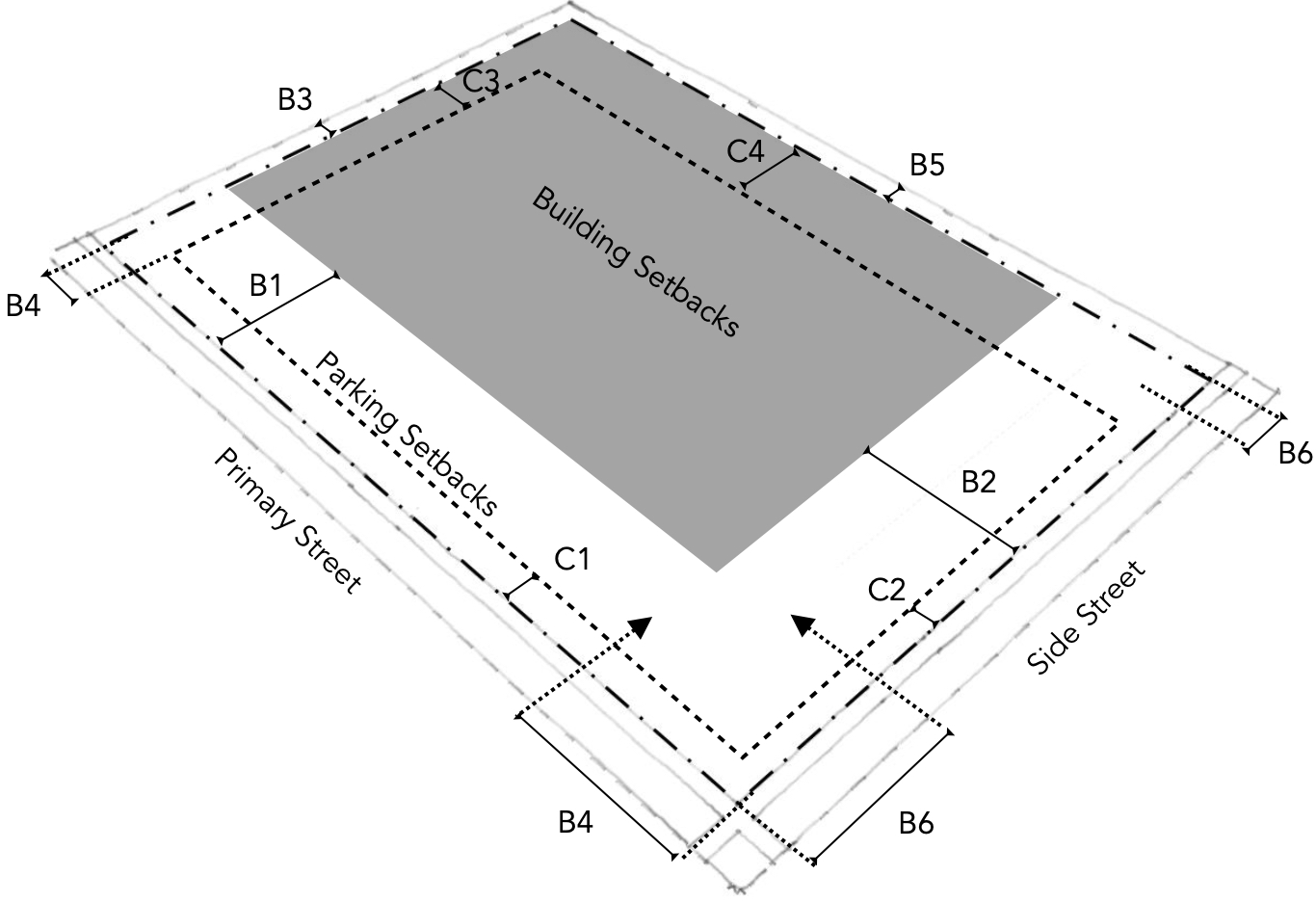
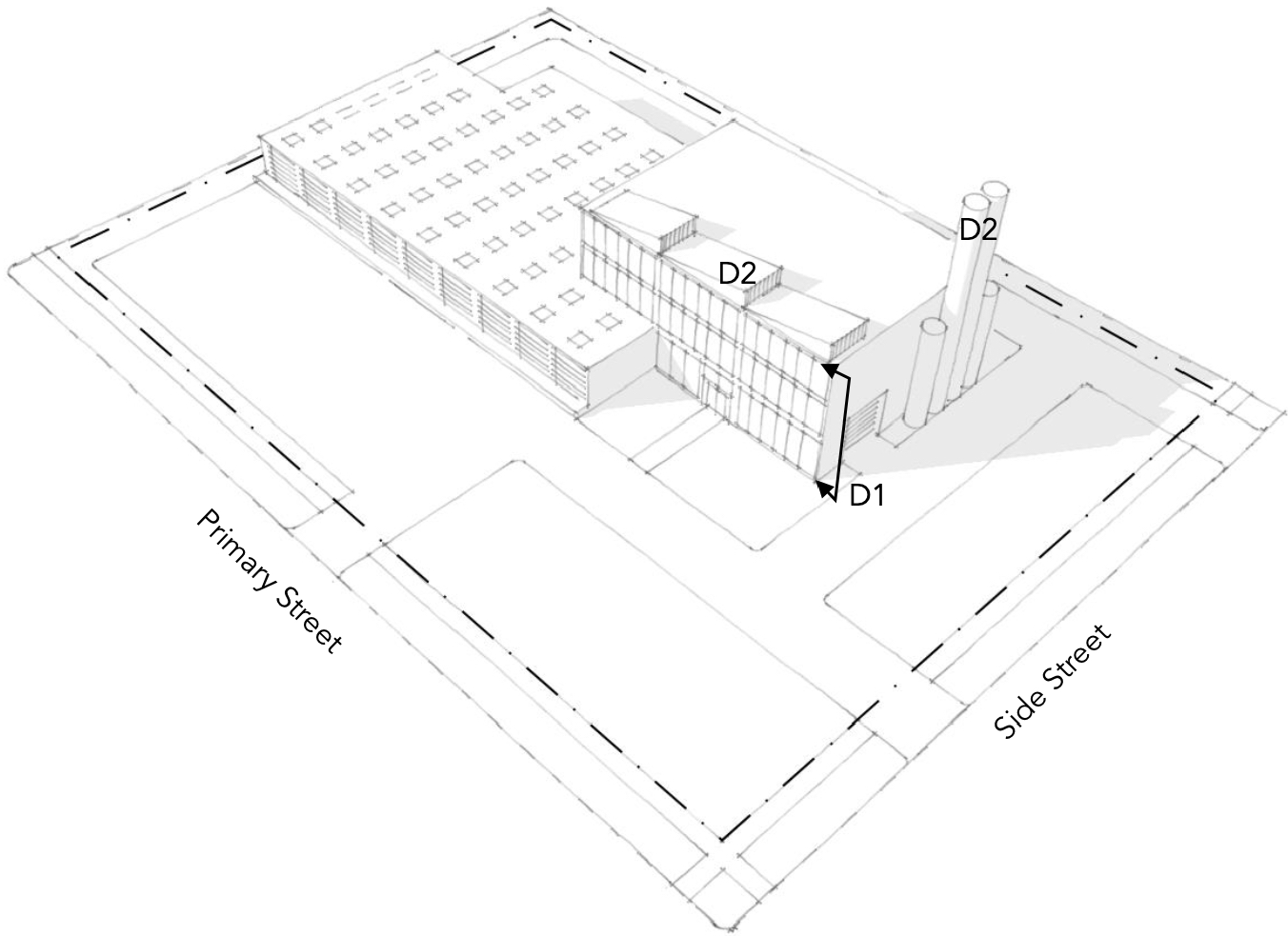
| E. Buffer Yard | 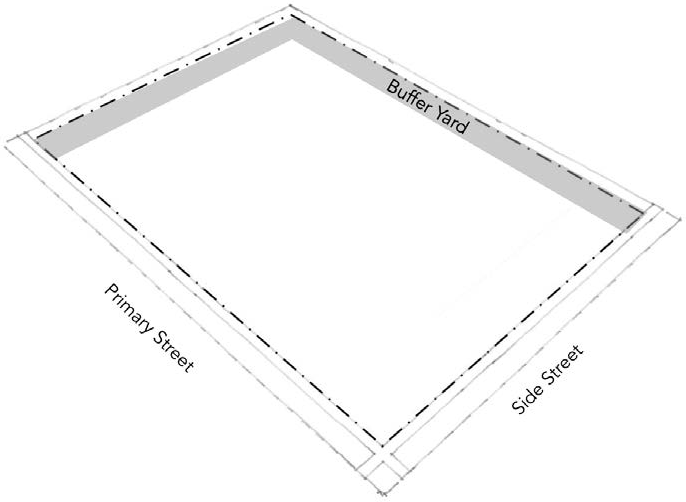 | ||
| Where an Industrial District abuts any other District other than another Industrial District a Type 1, or 2 Buffer Yard shall be provided. A Buffer Yard may be replaced by tree conservation areas per the Gastonia Tree Ordinance. | |||
| Type 1 | Type 2 | ||
| E1 Width (avg. min) | 20' | 35' | |
| E2 Fence Height (min) | not allowed | 6.5' | |
| E3 Wall Height (min) | 6.5' | 6.5' | |
| E4 Shade Trees (min per 100') | 4 | 6 | |
| E5 Understory Trees (min per 100') | 4 | 6 | |
| E6 Shrubs (min per 100') | 40 | 60 | |
| E7 Shrub height (min) | 3' | 3' | |
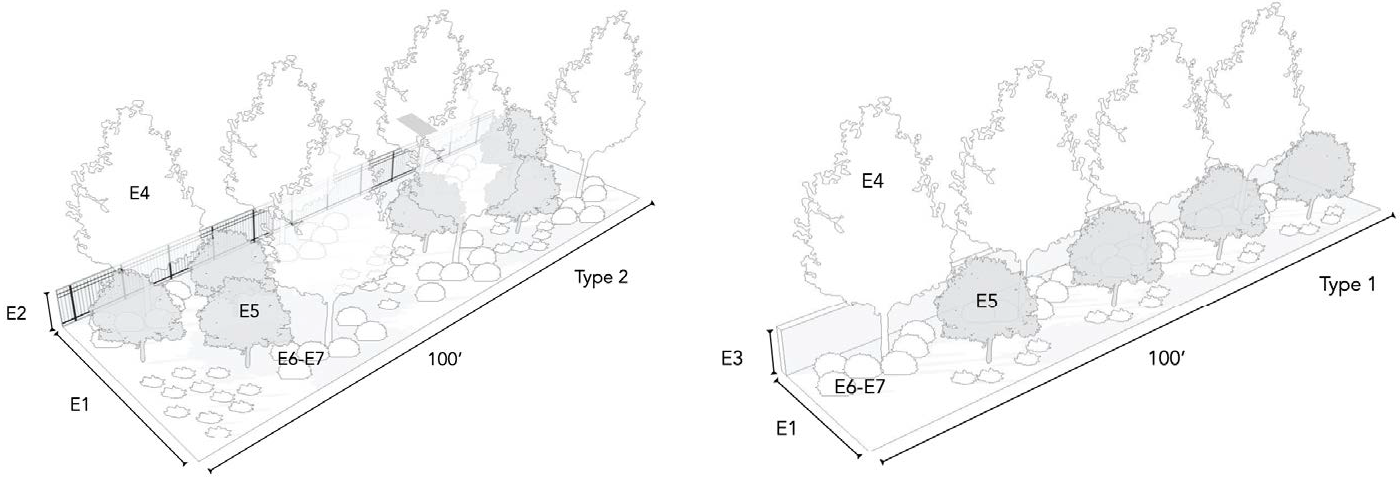
A Type 3, or 4 Street Yard shall be provided where an Industrial District abuts any other district other than another Industrial District. A Street Yard may be replaced by tree conservation areas per the Gastonia Tree Ordinance.
A Type 5, Street Yard shall be provided where an I District abuts any other non residential district. A Street Yard may be replaced by tree conservation areas per the Gastonia Tree Ordinance.
| Type 3 | Type 4 | Type 5 | 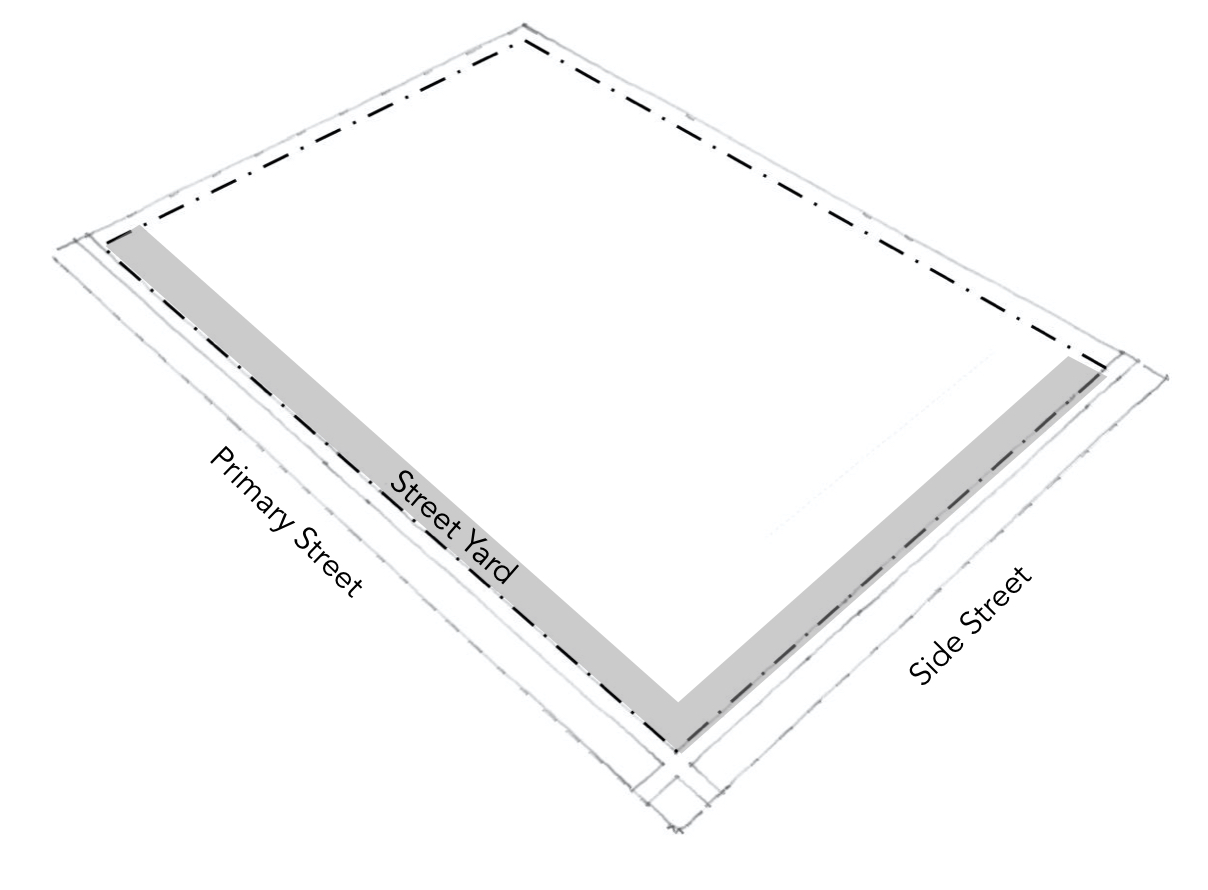 | |
|---|---|---|---|---|
| F1 Width (avg. min) | 10' | 15' | 10' | |
| F2 Fence Height (min) | 6.5' | Not req. | Not req. | |
| F3 Wall Height (min) | 6.5' | Not req. | 3.5' or | |
|
F4 Shade Trees
(min per 100') | not req. | 4 |
shrubs
not req. | |
|
F5 Understory Trees
(min per 100') | not req. | not req. | not req. | |
| F6 Shrubs (min per 100') | 30 | 15 | 30 | |
| F7 Shrub height (min) | 3' | 5' | 3.5' | |
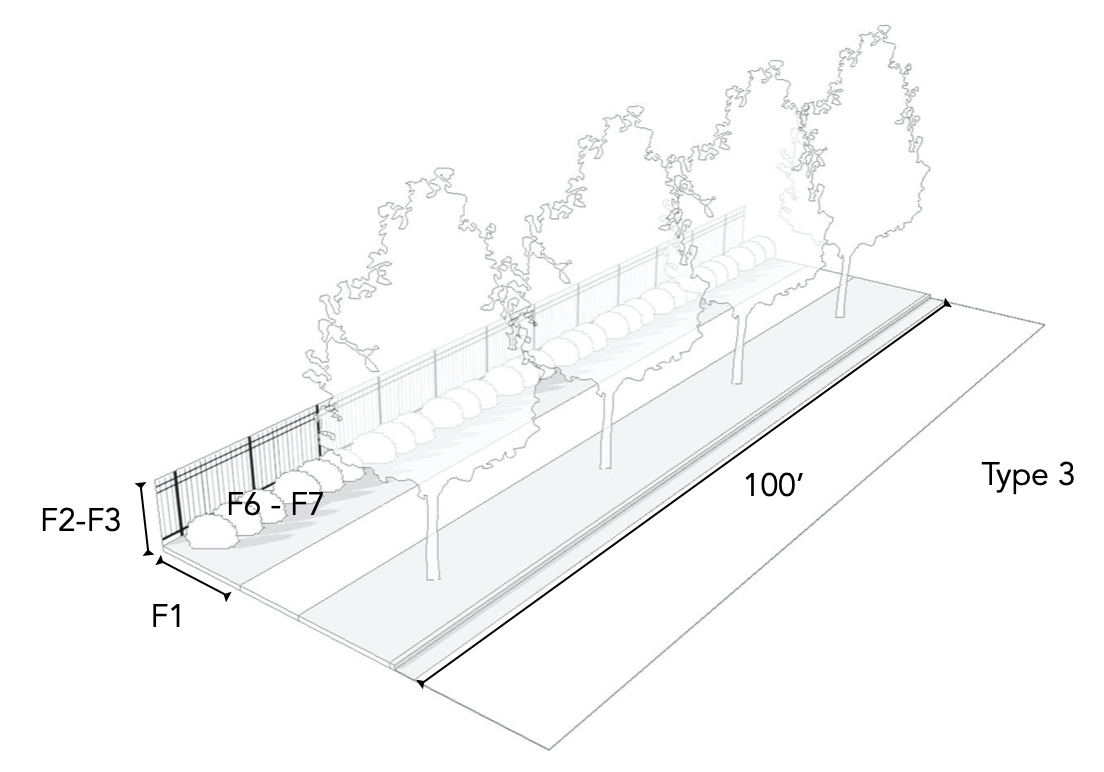 | 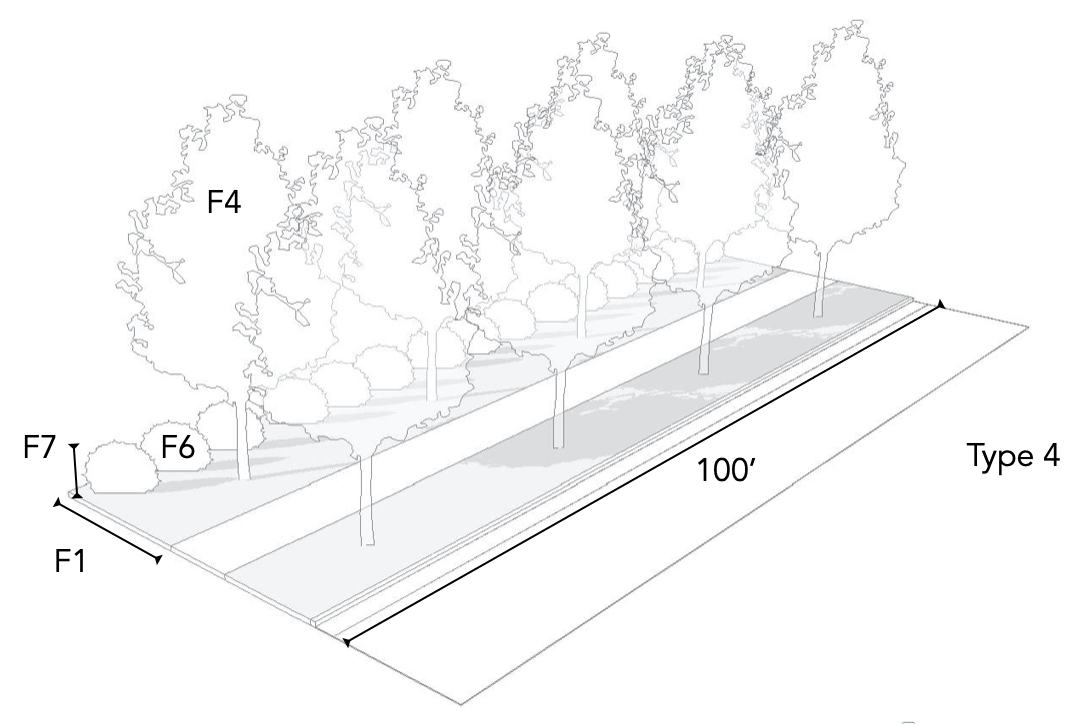 | 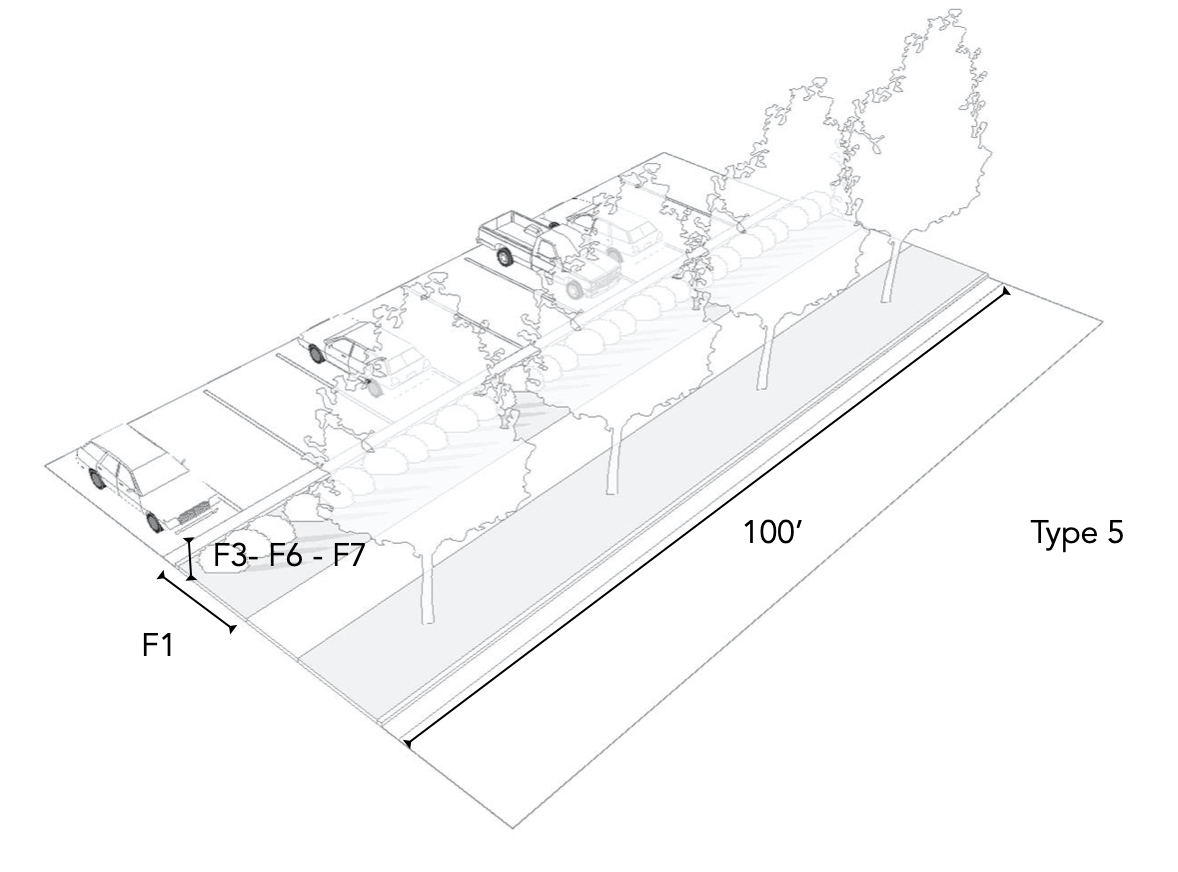 | ||
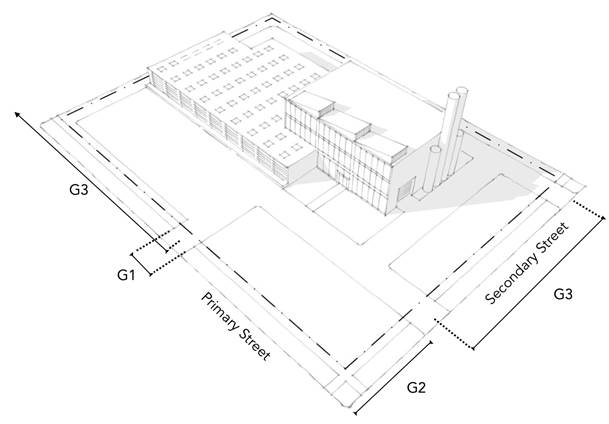
H. Parking Lot Landscape
Parking lots shall be classified as either employee & visitor lots, or service/loading
and storage lots. Service/loading/storage lots that accommodate truck and van circulation
and storage as part of the day to day operations of the primary use. Such lots are
exempt from landscaping requirements and are encouraged to be designed to direct water
runoff into swales rather than curb and gutter, unless topographic conditions or environmental
conditions require curb and gutter. All other lots shall be designated as employee
& visitor parking and shall adhere to the landscape and design regulations of the
Gastonia UDO.
H1 Service/loading/storage lots
H2 Employee and Visitor lots, see landscape ordinance
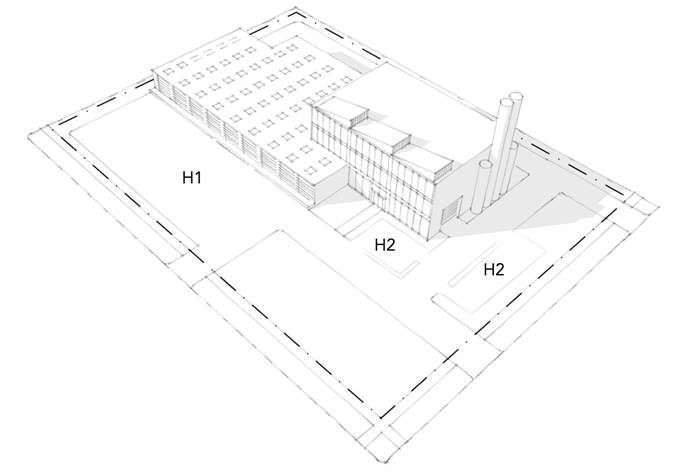
I. Industrial Park Development
Industrial Park Development is defined as any property a minimum of thirty (30) acres that is subdivided as part of a master planned development. Minimum subdivided lot size shall be five (5) acres.
- Building and Structure Setbacks and Parking Setbacks as listed in Sections B and C shall apply to all subdivide lots within an Industrial Park.
- Buffer Yard and Street Yard requirements shall apply only to the perimeter property boundary of the Industrial Park Development.
- Buffer Yard requirements that apply to the perimeter property boundary abutting residential districts may be relaxed as specified by the Gastonia Tree Ordinance.
- Street Yard requirements as described in Section F shall apply to all ROW directly abutting the perimeter property boundary.
- Streets internal to an Industrial Park Development shall be classified as primary and secondary. Primary streets shall be those streets that intersect with streets outside the consolidated property and provide access into the property. Such streets shall be designated Primary until their first intersection with streets providing access to subdivided lots within the Industrial Park Development. The Planning Administrator may require designation of additional segments of Primary Street based on adopted City Plans.
(Ord. No. 20-725, § 3, 9-1-20)
8.4.1 - AUDITORIUM/ASSEMBLY HALL/AMPHITHEATRE/COMMUNITY CENTER/CONFERENCE CENTER/MEETING FACILITY (500 SEATS OR MORE); RECREATION CENTER AND SPORTS CENTER
Access to the site shall be provided by a major or minor thoroughfare only, as depicted on the most currently adopted version of the local thoroughfare plan or access to a major or minor thoroughfare via a collector street that directly connects the property with the thoroughfare, as long as the distance between the property and the thoroughfare is less than one-fourth (¼) mile as measured along the street centerline.
8.4.2 - BOTANICAL GARDEN
All maintenance and accessory structures and off-street parking facilities shall be located no closer than three hundred (300) feet from any property line unless separated from the property line by a Type B buffer yard.
8.4.3 - CEMETERY
A.
Tombstones, crypts, monuments and mausoleums shall be located a minimum of twenty (20) feet from any side or rear lot line and at least thirty (30) feet from a street right-of-way. Greater setbacks shall be observed if otherwise required by the zoning district in which the cemetery is located. Gravesites shall be setback twenty (20) feet from the side or rear lot lines.
B.
Sales of crypts shall be allowed as an accessory use on premises (for cemeteries as a principal use only).
C.
A minimum of three (3) acres shall be required for a cemetery as a principal use.
D.
All requirements contained herein also apply to any pet cemetery.
8.4.4 - BLOOD PLASMA FACILITY; CHARITABLE RELIEF ORGANIZATION
A.
Shall be located at least five hundred (500) linear feet away from any single family residential use; elementary, middle, or high school facility; church or other house of worship facility.
B.
Hours of operations for Blood Plasma Facilities shall be between 6:00 a.m. and 8:00 p.m. only.
C.
Shall be located on a site that is:
(1)
On a (CATS or Gastonia) transitline.
(Ord. No. 19-691, § 3, 8-20-19)
8.4.5 - CHURCH/PLACE OF WORSHIP
Any church/house of worship having a sanctuary capacity of five hundred (500) or more seats shall be located on and have direct access to a major or minor thoroughfare as depicted on the most currently adopted version of the local thoroughfare plan or access to a major or minor thoroughfare via a collector street that directly connects the property with the thoroughfare, as long as the distance between the property and the thoroughfare is less than one-fourth (¼) mile as measured along the street centerline. Refer to Section 8.2.19 for additional requirements on Child Care Centers that are associated with churches/houses of worship.
(Ord. No. 21-737, § 2, 5-18-21)
8.4.6 - CORRECTIONAL FACILITY
A.
The principal structure and any accessory use or structure (excluding property boundary fencing) shall be located at least five hundred (500) feet from any residential structure or property located in a residential zoning district.
B.
That property boundary fencing shall not employ barbed wire, razor wire, electrical fencing, or similar materials where abutting property located in a residential district. Said fence shall be setback twenty (20) feet from the property line.
C.
In addition to the security fencing, the landscaping requirements for a Type B buffer yard shall be provided on the exterior of fencing wherever it is adjacent to a street or property in a residential district.
D.
Any facility larger than five (5) acres shall have direct access to a major or minor thoroughfare as depicted on the most currently adopted version of the local thoroughfare plan or comprehensive transportation plan.
E.
Any expansion of a correctional facility requires a special use permit.
(Ord. No. 21-739, § 1, 6-15-21)
8.4.7 - SWIM AND TENNIS CLUB
A.
All outdoor swimming facilities shall be located at least one hundred (100) feet from any adjoining residentially zoned lot.
B.
Regular hours of operation may be between 8:00 a.m. and 10:00 p.m. only if located in a residential (R) zone.
C.
If located in a residential (R) district, the facility shall be open to members of the club and their guests only.
8.4.8 - ESSENTIAL SERVICES, CLASS 3 AND 4
•
Heliports shall be allowed within one-half (½) mile from any public safety stations with a special use permit.
•
A special use permit shall be required for sanitary landfills, septic tank waste disposal facilities, solid waste/recycling or transfer stations, medical waste transfer facilities, and radio and television transmission towers (not otherwise classified as a "communications tower" nor cited as an essential services, Class 2 or a cable television signal receiving facility).
(Ord. No. 11-594, § 3, 9-6-11; Ord. No. 21-739, § 1, 6-15-21)
Editor's note— Ord. No. 11-594, § 3, adopted September 6, 2011, amended Section 8.4.8 in its entirety to read as herein set out. Formerly, Section 8.4.8 pertained to essential services, class 4 and derived from original codification.
8.4.9 - RESERVED
Editor's note— Ord. No. 11-593, § 3, adopted August 2, 2011, repealed the former Section 8.4.9 in its entirety, which pertained to farmers markets and derived from original codification.
8.4.10 - FRATERNAL AND SERVICE ORGANIZATION MEETING FACILITY
A.
In any non-residential district, if the lot containing the use is located within one hundred (100) feet of a residentially zoned district, a special use permit shall be required.
B.
This use is not permitted in the RLD, RMF, TMU, O-1, OLC, C-1 districts or an historic overlay district if a restaurant, nightclub, alcoholic beverages or amplified music is provided.
C.
An auditorium or assembly hall of five hundred (500) seats or greater is allowed provided the use shall have access from a major or minor thoroughfare and shall be a conditional use.
(Ord. No. 21-739, § 1, 6-15-21)
8.4.11 - HELIPORT/HELISTOP
A.
In the OM district, heliports are only allowed in association with a hospital or other medical service provider.
B.
All heliports will meet the standards and requirements imposed by the Federal Aviation Administration and all other federal, state, or local agencies having jurisdiction.
C.
Non-emergency use (i.e., for use other than for public safety or medical purposes) of private heliports between the hours of 10:00 p.m. and 6:00 a.m. shall be prohibited. Emergencies for public safety or medical purposes shall not be subject to this requirement.
D.
Heliports located on top of buildings shall be exempt from any height limitations (except those promulgated by the FAA).
8.4.12 - MILITARY RESERVE CENTER
All outdoor equipment shall be screened in accordance with Section 11.6.
8.4.13 - RECYCLING DEPOSIT STATION
NOTE: The supplemental regulations below only apply to principal uses.
A.
Any building or structure or any outdoor recycling bins shall be located at least one hundred (100) feet from any preexisting principal residential structure. This shall only apply to recycling deposit stations that serve as principal uses and recycling deposit stations that are in the form of manned trailers that serve as collection points for deposited clothes and other household items.
B.
No outdoor storage of goods to be recycled shall be permitted.
C.
The station shall be kept free of litter, debris, and residue.
D.
All drop-off containers and storage bins shall be durable, waterproof, rustproof, covered, and secure from unauthorized entry, and shall be clearly marked to indicate the type of material to be deposited therein.
8.4.14 - SCHOOL, ELEMENTARY, MIDDLE AND SENIOR HIGH
A.
Middle and senior high schools having an enrollment capacity of five hundred (500) students or greater shall have direct access to a major or minor thoroughfare, as depicted on the most currently adopted version of the Gaston Urban Area thoroughfare plan or access to a major or minor thoroughfare via a collector street that directly connects the school property with the thoroughfare, as long as the distance between the school property and the thoroughfare is less than one-fourth (¼) mile as measured along the street centerline.
B.
All modular classrooms are subject to site plan review.
8.4.15 - SCHOOL, VOCATIONAL
A.
Truck driving schools with outdoor maneuvering area shall be allowed in the I-1 and I-2 districts only. All parking, training and maneuvering areas shall adhere to the surface material requirements found in Chapter 10 Off-Street Parking and Loading.
One shade (canopy) tree for every four thousand (4,000) square feet of truck training, parking and maneuvering areas shall be installed throughout the site. Preservation of existing trees are eligible to count towards this requirement. Existing trees of a caliper greater than eight (8) inches may be used to satisfy the tree coverage requirement listed above based on the location of the tree(s), the caliper, and the species as approved by the Administrator.
B.
In the event the school engages in commerce, that is, trainees practice their developing skills with the public, then, the facility housing these transactions must abide by the regulations on that trade or industry found within this Ordinance. For example, if the school operates a repair garage for the benefit of training students and that activity is in a free standing facility, it must adhere to those regulations imposed upon automotive repair shop as both a conditional and/or "permitted based on standards" uses.
(Ord. No. 22-761, § 4, 4-5-22)
8.4.16 - SOLID WASTE TRANSFER STATION
A.
Any principal or accessory structure must be located at least three hundred (300) feet from any residentially zoned lot or fifty (50) feet from any other lot line.
B.
There shall be no outdoor storage of waste products, unless entirely enclosed in containers and storage bins that are durable, waterproof, rustproof, covered, and secure from unauthorized entry.
8.4.17 - STADIUM; AMPHITHEATER
A.
In residential (R) zoning districts, only stadiums accessory to a school shall be allowed. Stadiums shall be a use by right if accessory to a school, and must be located within one-quarter (¼) of a mile from the school. Otherwise, a stadium shall be subject to the issuance of a special use permit.
B.
For commercial stadiums that have seating for more than one thousand (1,000) persons, access to the site shall be provided by major or minor thoroughfares only, as depicted on the most currently adopted version of the local thoroughfare plan or access to a major or minor thoroughfare via a collector street that directly connects the property with the thoroughfare, as long as the distance between the property and the thoroughfare is less than one-fourth (¼) mile as measured along the street centerline.
C.
All principal structures (including bleachers) shall be located a minimum of one hundred (100) feet from all interior lot lines.
D.
A Type C buffer yard or higher screen will be required between said use and any abutting lot located in a residential district.
E.
Off-street parking requirements need to be met if the stadium is freestanding and not an accessory use to a school.
(Ord. No. 21-739, § 1, 6-15-21)
8.4.18 - RADIO AND TELEVISION STUDIO TOWERS
Communication towers meeting the following criteria may be erected as an accessory use to a radio and television studio:
A.
Communication towers shall not be allowed as an accessory use to radio and television studios within the CBD zoning district.
B.
Towers shall have a maximum height of three hundred (300) feet. Towers over three hundred (300) feet in height shall be deemed a separate principal use (telecommunication tower).
C.
The tower must be located at least two hundred (200) feet from any residentially zoned lot or forty (40) feet from any other lot line.
D.
Towers shall be setback a minimum of two hundred fifty (250) feet from any major or minor thoroughfare as depicted on the most currently adopted version of the local thoroughfare plan or comprehensive transportation plan.
E.
Guy wire ground connections within thirty (30) feet of a residentially zoned lot shall be surrounded by a five-foot high chain-link fence located along the adjoining residential property line. Where said fencing is within clear view of a residential lot, sufficient landscaping shall be installed around the fence to screen the fence from the residential lot within five (5) years.
F.
Where a tower site is adjacent to a residentially zoned district, access to each tower base shall be secured with an eight-foot high wooden privacy fence with a three-strand barbed wire security top angled outward. When a tower site is adjacent to a residential district (except in RSF, RSB or RSC) and multiple towers exist, or are being installed on the site, a nine-gauge, chain-link tower area perimeter fence (without a top rail) shall be installed. Said tower area perimeter fence shall be at least eight (8) feet in height and include a three-strand barbed wire security top angled outward. The Administrator shall determine the location of all fencing required by this Section based on both security and aesthetics from adjacent properties.
8.4.19 - TOWER, TELECOMMUNICATION
See Section 9.15.

