
Gastonia City Zoning Code
CHAPTER 11
SCREENING AND LANDSCAPING
11.1.1 - PURPOSE
The purposes of these screening and landscaping regulations are to:
A.
Reduce soil erosion and stormwater runoff by increasing infiltration in permeable land areas;
B.
Mitigate air, dust, noise, heat and chemical pollution;
C.
Reduce the "heat island" effect of impervious surfaces such as parking lots, by cooling and shading the paved surface areas and breaking up large expanses of pavement;
D.
Establish a landscape theme including street trees and streetscape designs;
E.
Preserve native vegetation as an integral part of wildlife habitats;
F.
Promote innovative and cost-conscious approaches to the design, installation and maintenance of landscaping while encouraging water and energy conservation;
G.
Promote planting techniques that ensure long term health of plant materials;
H.
Screen unsightly equipment or materials from the view of persons on public streets or adjoining properties and buffering uncomplimentary uses; and
I.
Maintain and protect property values by requiring an appropriate amount of landscaping that is properly designed and installed.
11.1.2 - GENERAL STANDARDS
A.
Retention of Existing Vegetation.
To the greatest degree feasible and practical, existing trees, shrubs and ground cover shall be retained and incorporated into a landscape plan that meets or exceeds the standards contained herein.
B.
Landscape Plans.
Landscape materials shall be planned and installed in conformity with an approved landscaped plan. Such landscape plan shall accompany any application for site plan approval (refer to Section 5.2). Approval of a site plan shall indicate that the requirements of this Ordinance, as well as other applicable provisions of this Ordinance among others, have been met. If a specific use or development plan requires review and approval by the governing board, Board of Adjustment or another approval body, the landscaping plan shall be submitted as part of such plan or application. The landscaping plan shall be drawn at such scale to enable the Administrator (or other approval body) to clearly determine whether or not the proposed buffers or landscaped areas shown are in compliance with this Ordinance. The landscape plan shall identify the plant species to be installed and show their location in relation to property lines, easements, rights-of-way, buildings, driveways and parking and loading areas. At the time of installation, species certification shall be required and may be in the form of written certification from a nursery or nursery tags located on the planted materials.
C.
Performance Guarantee.
Except as herein provided, neither a certificate of compliance nor a certificate of occupancy may be issued for a particular piece of property unless all applicable requirements of this Ordinance have been met. A temporary Certificate of Compliance, may be issued by the Administrator in instances where the installation of required planted materials prior to use or occupancy of the lot in question would not be practical or would serve no useful purpose. The installation deadline shall extend only to the nearest seasonal period suitable for planting such materials. The planting deadline will be extended only to the nearest seasonal period suitable for planting such materials.
D.
Violations.
Failure to provide or maintain landscaping or buffering in accordance with an approved landscaping plan shall constitute a violation of this Ordinance and shall subject the violating party(ies) to any and all of the remedies as called for in this Ordinance (Chapter 13).
E.
Installation and Maintenance.
The plantings that constitute required buffering and landscaping shall be properly installed and maintained in order to fulfill the purpose of which it is established. Plant species shall be recommended for healthy growth under local climate conditions, not be of a type highly prone to disease, and be of a type expected to grow in a manner that will satisfy the spirit and intent of this Ordinance. Plant materials shall be planted in accordance with the recommended practices of the American Standard for Nursery Stock of the American Nursery and Landscape Association. The owner of the property and any tenant on the property where buffering and landscaping are required shall be jointly and severally responsible for the maintenance of all required landscaped materials. Such maintenance shall include all actions necessary: to keep the buffered and landscaped areas free of litter and debris; to keep plantings healthy; to keep growth from interfering with safe vehicular or pedestrian travel, or use of parking areas, or from creating any nuisances to adjoining properties; and, to keep walls, fences and berms in good repair and neat appearance. Any vegetation that constitutes a required screen or landscaped area shall be replaced in the event that it dies. All buffering and landscaping material shall be protected from damage.
F.
Relief.
1.
The Administrator may modify or waive certain portions of this Ordinance when he determines that unusual topography or elevation of a development site, the location, shape or size of the parcel to be developed would make either (1) strict adherence to the requirements of this Ordinance serve no meaningful purpose; (2) not achieve one or more of the goals of this Ordinance; or (3) would make it physically impossible to install or maintain the required screening or landscaping materials as otherwise called for.
2.
Such modification or waiver may occur only at the request of the developer, who shall submit as part of their landscape plan the existing site features that would screen the proposed use and any additional buffer materials that are to be planted or installed that would serve as the proposed screened or landscaped area. The Administrator shall have no authority to provide said modification or waiver unless the developer demonstrates that existing or proposed buffering material will screen the proposed use as effectively as the required buffer. This section shall not be construed to negate the necessity for establishing buffers for uses that lie adjacent to vacant properties.
3.
Where the Historic District commission, in considering an application for a certificate of appropriateness, finds that portions of this Ordinance come into direct conflict with the purpose and intent of any historic district, the Commission may recommend to the Planning Director, that certain portions of this section be waived or alternate plans accepted.
G.
Easements and Rights-of-Way.
Any planting that is proposed to be placed in a general drainage and utility easement or in a street right-of-way to conform with the provisions of this Ordinance must first be approved by the Subdivision Administrator and/or NCDOT in conjunction with site plan approval. In all such instances, the location of the affected rights-of-way must be shown on the site plan.
H.
Distance from Roads and Sidewalks.
All trees shall be placed in the most feasible manner so as not to interfere with roadways, sidewalks, or streetlights and shall not be planted closer than eight (8) feet to a fire hydrant.
I.
Distance from Utilities.
1.
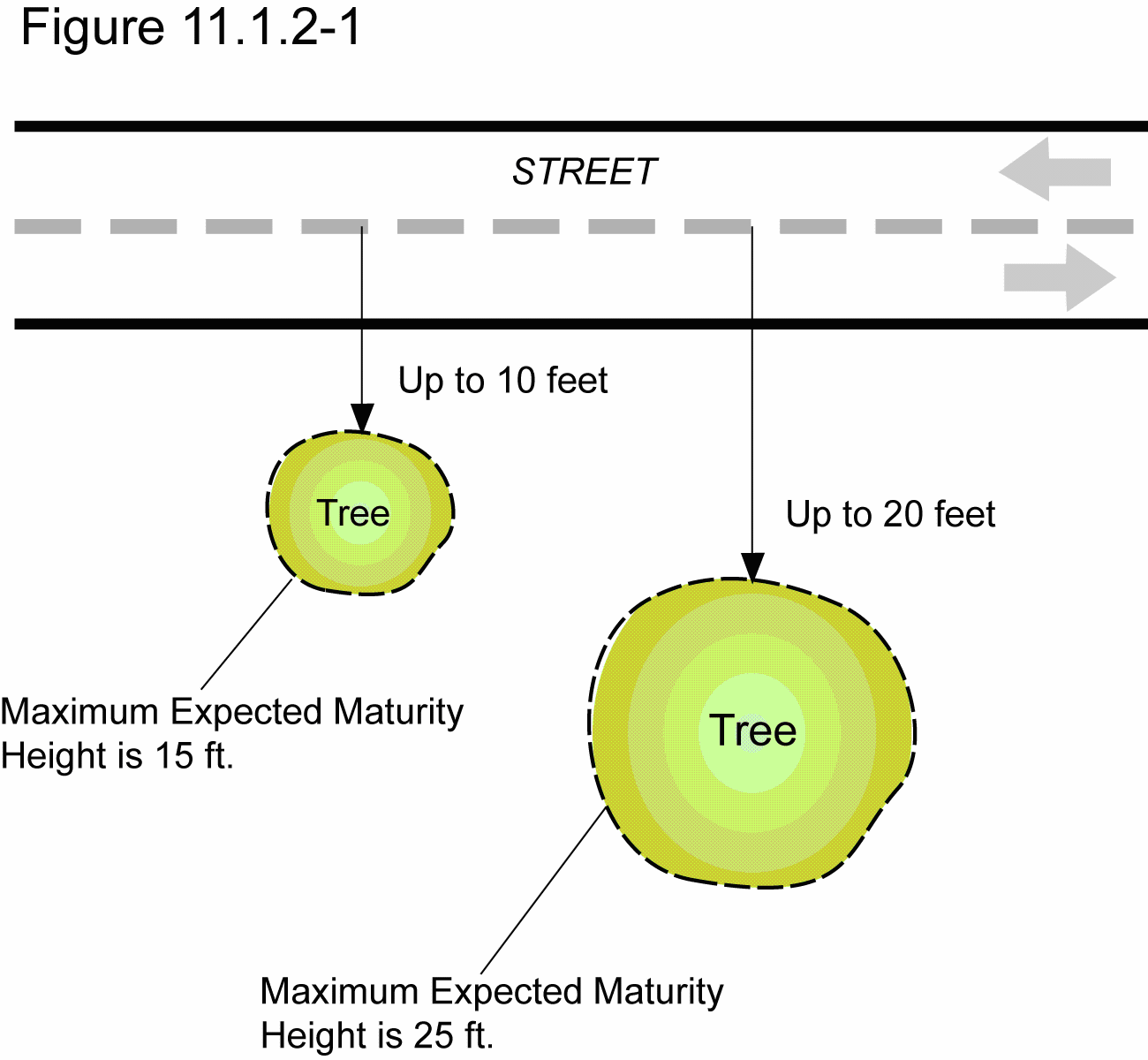
Any tree required by this Ordinance to be placed within twenty (20) feet lateral distance from the centerline of an above ground electric utility line shall be an understory tree. Furthermore, maximum expected maturity heights of these trees shall be as follows:
a.
Zero (0) to ten (10) feet lateral distance of centerline: Fifteen (15) feet maximum expected maturity height; and
b.
Greater than ten (10) and up to twenty (20) feet lateral distance of centerline: Twenty-five (25) feet maximum expected maturity height.
Refer to Figure 11.1.2-1 for an illustration of these requirements.
2.
Outside said 20-foot lateral distance, trees shall be placed to avoid future conflict with above ground electric utilities and violations of the National Electric Safety Code, and to avoid conflict with any below ground utilities and drainage facilities.
J.
List of Acceptable Tree and Shrub Species.
The Administrator can provide an approved list of tree and shrub species that are satisfactory for planting in accordance with the guidelines of this subsection. The Administrator may approve the use of a species different from said recommended list, provided the maximum maturity height is in accordance with the standards of this subsection and is recommended for Gaston County's climate.
K.
Planting Yards in Site Triangles.
Buffers and landscaping shall be subject to site triangle requirements contained in Section 9.7.
L.
Additional Landscaping Standards.
1.
Any tree or planting required by Sections 11.3, 11.4, 11.5, 11.6, shall stand alone and shall not be counted toward meeting the requirements for any other section except as provided for under Section 11.5F.
2.
No structure other than a mailbox, wall, fence, sidewalk, or driveway shall be permitted within a required screen area. No off-street parking may be permitted within any required screen area. Where plant materials are required, the required amount shall be installed on the side of any wall or fence opposite the new development unless a waiver of such requirement is granted.
(Ord. No. 10-585, § 6, 8-17-10; Ord. No. 21-739, § 1, 6-15-21)
11.2.1 - PURPOSE
Screening and landscaping aesthetically enhance and separate certain land uses and zoning districts from each other, as well as to beautify individual sites.
11.2.2 - APPLICABILITY
A.
Planting and landscaping materials shall be required for all principal uses except:
1.
Single-family detached homes (except that street yards shall be required in residential subdivisions located in the USO Overlay District).
2.
Manufactured homes (all classes)
3.
Rooming House
4.
Bed and Breakfast Inn (without restaurant)
5.
Family care homes
6.
Two-family dwelling
7.
Agricultural Uses
8.
Child Care Center, Located in a Residence (CLIR) and Family Child Care Home.
9.
Developments within the CBD (except that the parking lot landscaping requirements of Section 11.5 shall apply)
10.
Developments within a PRD, TND, infill residential, or multi-family development, except as specifically provided for those developments
11.
Essential Services, Class 1
12.
Essential Services, Class 2 (provided that no building or facility exceeds 250 square feet in area)
13.
Parks without any active recreational facilities (except that the street yard requirements of Section 11.4 and the parking lot landscaping requirements of Section 11.5 shall apply)
B.
Screening of outdoor storage areas and solid waste dumpsters shall apply as called for in Sections 11.6.
C.
Landscaping required within a planting yard shall only be counted for that planting yard requirement and shall not be used for calculating the minimum quantity for any other planting yard.
(Ord. No. 21-737, § 7, 5-18-21)
11.2.3 - EXPANSION OF EXISTING USES
The physical expansion of an existing structure or parking lot that results in a ten percent (10%) or more increase of gross floor area shall be required to comply with this Ordinance to the greatest extent practical. In addition, a change of use of an existing use, structure or parking lot shall be required to comply with this Ordinance to the greatest extent practical.
11.3.1 - PURPOSE
Buffer yards are natural areas of specified widths that serve as a visual screen between different zoning districts. Buffer yards shall be of different types, based upon the relationship between the two land uses where the buffer yard is to be located and may include natural plantings, a wall, fence or berm. The width of the buffer yard and the density of plantings shall increase as the difference in intensity between adjacent zoning districts increases. Minimum buffer yard dimensions shall be measured horizontally; minimum buffer yard widths shall be measured from the respective property line. Where buffer yards turn at property corners, the length measurements determining plant quantities shall not be required to overlap.
11.3.2 - BUFFER YARD REQUIREMENTS
Screening and buffering shall be required under the following situations:
1.
When an Industrial District abuts a Residential District, screening must be provided on the Industrial lot in the form of a Type D Buffer.
2.
When a Commercial District abuts a Residential District, screening must be provided on the Commercial lot in the form of a Type C Buffer.
3.
When an Office District abuts a Residential District, screening must be provided on the Office lot in the form of a Type B Buffer. UMU and TMU Districts are exempt.
4.
When a Residential District abuts another lot which contains a multifamily development, screening must be provided on the lot containing said multifamily development in the form of a Type C Buffer. UMU and TMU Districts are exempt.
5.
When residential use adjoins a nonresidential use and both are located in a nonresidential zone, screening must be provided on the lot containing the nonresidential use in the form of a Type A Buffer. UMU and TMU Districts are exempt.
Summary of Required Buffer Types
a.
When a single-family residential zone abuts a local or residential collector street and a nonresidential use is within view of the residential zone, screening shall be located on the property developed for the nonresidential purpose, to the extent that the nonresidential use is generally screened from residential view.
b.
When an industrial use adjoins a residential zone, the industrial use may reduce the buffer level from a Type D to a Type C if no structure is located within 100 feet of the adjoining property line in question and if no external apparatus or loading dock facilities are visible from the residential use or property line. Said buffer levels may also be reduced from a Type D to a minimum planted buffer when the industrial use adjoins a RLD zoning district or adjoins land which has been designated for industrial or commercial use in a land use plan adopted by the City Council, provided no structure on the industrial site lies within 100 feet of the zoning district line and that no dwelling on the adjoining RLD or other residential district is within 200 feet of the subject industrial district boundary. Said minimum planted buffer shall consist of at least three evergreen canopy trees and one deciduous canopy tree per 100 linear feet of the applicable zoning district boundary.
c.
For open-air storage, or an unenclosed structure consisting of a roof, but no walls used for storage of materials, products, wastes or equipment associated with business or industrial uses located in any zoning district within one hundred (100) feet of the street right-of-way, screening must be provided so as to materially screen said storage or storage in the form of a berm, wall or fence or an appropriate amount of natural plantings so as to provide the necessary amount of screening.
d.
Except as provided in Section 11.3.2A5 screening shall not be required between any two lots which contain principal residential uses.
e.
Screening and buffering shall be provided as otherwise called for in this Ordinance.
f.
Institutional uses, i.e. church/house of worship, school, recreation center, park, public safety station etc. shall install a Type B buffer along applicable property lines if adjacent to a residential zone. A Type A buffer shall be required if next to a residential use in a non-residential zone.
g.
A minimum of Type A buffer shall be required for any non-residential use abutting a Residential District unless otherwise indicated in this Ordinance.
(Ord. No. 22-763, § 6, 5-17-22)
11.3.3 - BUFFER YARD COMPOSITION STANDARDS
Buffer yard widths and landscaping shall meet or exceed the following standards:
(1) Amount and type of plant material per 100 linear feet.
(2) All shrubs are to be of a screening variety. At least fifty (50) percent of the required shrubs shall be of an evergreen species.
(3) Buffer width includes the width of the berm.
11.3.5 - OTHER BUFFER YARD STANDARDS
A.
Prohibited Uses.
The construction of any building or the placement of any mechanical equipment within a buffer yard shall not be permitted except for equipment necessary for the provision of utilities. Active recreational uses, such as ballfields, swimming pools and tennis courts, or other active structured recreational uses, or circulation drives or parking lots shall not be allowed within the buffer yard area.
B.
Permitted Uses.
The following other uses may be permitted in a buffer yard area provided that none of the required plant material is eliminated, the intended screening is accomplished, the total width of the buffer yard is maintained, and all other requirements of this Ordinance are met:
1.
Sculpture, outdoor furniture.
2.
Open space areas (provided that none of the uses listed in Subsection A above are located within the buffer yard area).
3.
Walls, fences and driveways connecting to an adjoining property.
C.
Existing Vegetation.
Existing healthy vegetation may be counted toward the required buffer yard. The landscape plan submitted for approval shall indicate the number, type, size and location of such plant materials. Existing vegetation that the Administrator deems "unhealthy" and not likely to materially serve as a screening agent for the foreseeable future, may be disqualified as counting towards the required buffer.
D.
Reserved.
E.
Application Toward Setback Requirements.
Buffer yard areas shall be counted towards meeting applicable building setback areas.
F.
Standards for Walls and Fences.
Fences used for buffering purposes shall be constructed in a durable fashion with weather resistant wood and be of a consistent pattern. All materials used in the construction of a fence shall be designed and intended for such use. Notwithstanding the foregoing, the Administrator may approve a buffer fence constructed of other materials provided the materials and finish used will provide generally the same degree of opacity, durability, and aesthetic compatibility with adjoining residential areas as weather resistant wood. A finished side of all walls or fences shall face the common property line boundary. No wall or fence used as part of a buffer shall be less than six (6) feet or more than eight (8) feet in height above grade, unless specifically approved by the Administrator.
G.
Standards for Berms.
All berms shall be planted with both shrubs and ground covers so as to leave no bare earth. All shrubs shall be a species that can be expected to materially buffer the development site within five (5) years of planting. The slope of a berm shall be of a grade so that it is suitable for maintenance and soil stability while taking into consideration the type of plantings and ground cover that will be utilized but in no case shall a berm be less than three (3) feet in height. The use of Pueraria lobata (kudzu) for berm ground cover is not permitted nor is any other nuisance vining plants that have a tendency to spread to other properties. A natural planting plan with a mix of species is recommended to prevent heavy blight loss.
H.
Location of Buffer Yard.
With the exception of buffering required for open storage (refer to Section 11.7), any buffer yard required by this section shall be located along the side and/or rear property lines of the lot(s) containing the use subject to buffering. If buffering is required along the right-of-way, it shall be located behind such right-of-way. A natural planting plan with a mix of species is recommended to prevent heavy blight loss. Except where existing vegetation is used, at least fifty (50) percent of the required trees should be evergreen species.
SECTION 11.4 - STREET TREES
A.
Purpose
In order to absorb carbon dioxide and provide oxygen necessary for human life; purify air through transpiration; provide cooling through shade; reduce the impact of wind; retard the rate of water runoff; reduce glare and noise; to conserve property values; and to contribute to the natural beauty and aesthetics of the community, street trees, as herein provided, are required. Additional landscape planting strip standards associated with parking decks are found in Chapter 10. The required street trees may be planted within said landscaped area or elsewhere on the lot as herein called for in Subsection D. Greenstrips may also be required as provided for in Section 9.18.2.
B.
Where Required
1.
Street yard and landscaping requirements shall be met along and parallel to any public road for all new developments (except those listed in Section 11.2.2), new developments along road frontage not developed, or substantial redevelopment of an existing site to another use (except for those listed in Section 11.2.2) within the Urban Standards (USO) Overlay and CH Corridor Highway Overlay Districts. In addition, street yard and landscaping requirements shall be met on any internal road two-hundred fifty (250) linear feet or greater in length that is used as an entryway into a parking lot for a commercial development within said districts. Street trees shall also be required on lots located within a planned residential development (PRD), traditional neighborhood development (TND), and planned unit development (PUD) whether such developments are located in a USO or CH overlay district.
2.
Where the distance between the building line and the right-of-way is less than that proscribed, the zoning administrator may waive planting requirements where the measurement is less than six (6) feet or when planting is not in the best interest of public safety or where planting the material would serve no practical purpose. In these cases, the administrator may require a planting alternative, such as planting within the street right-of-way.
C.
Number of Street Trees Required
Canopy and understory trees shall be planted, where required, as follows:
1.
One canopy tree for each forty (40) linear feet of frontage; or
2.
One understory tree for each thirty (30) feet of frontage; or
3.
A combination of canopy and understory trees at the rate of one per thirty-five (35) feet of frontage.
4.
For interior roads only, any combination of canopy trees so long as the type and spacing of trees placed can be expected to form a substantial canopy within twenty (20) years of initial planting.
D.
Location of Trees.
1.
Street trees must be located within forty-five (45) feet of the curb or right-of-way and in front of the building line in order to be counted toward the required total. The Administrator shall have the authority to approve the placement of street trees in a variety of locations, based on (1) the nature of the development (2) the underlying zoning district (3) the presence of other street trees on adjacent or nearby lots (4) the presence of overhead utility lines (5) road maintenance, and (5) other factors that directly affect the maintenance and long-term viability of the trees.
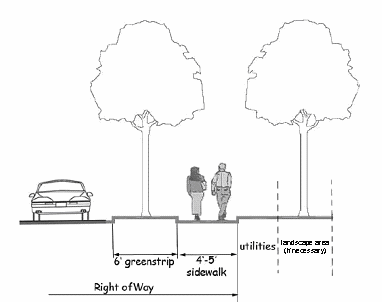
Accordingly, the Administrator shall have the authority to have the street trees in the following locations, each of which is listed in descending order of preference:
a.
In the greenstrip area between the sidewalk and the back of curb, provided per Section 9.18.2;
b.
Within a landscape area on private property, shown in Figure 11.4-1;
c.
Elsewhere in the front yard as practical;
d.
Within the sidewalk in planters or grates, as long as all applicable construction and disability standards can be met.
Where the Administrator deems none of the above locations feasible and practical, he shall have the authority to modify the placement of street trees. Refer to Figure 11.4-1 below for a schematic of these possible locations.
Figure 11.4-1
2.
In no instance shall canopy trees be placed underneath aboveground utility lines.
3.
Distribution shall be generally proportionate along the road frontage; however, this shall not be construed to require equal intervals between trees. The intent is to allow flexibility in design while discouraging long intervals without trees.
E.
Peninsula Lots.
Properties with street frontage (not including Interstate 85 or the limited access portion of US 321) on three (3) or more sides may reduce the number of required street trees by one-half (½) for each street not listed as an thoroughfare on the most recently adopted version of the local thoroughfare plan.
F.
Existing Trees.
Existing trees with a caliper of at least ten (10) inches Diameter at Breast Height (DBH) may be counted as two (2) trees.
G.
Median Landscaping.
Any median which is at any point three (3) feet or greater in width (except medians which are used for sidewalks and as handicapped access ramps) shall contain a general cover of planted ground materials or be planted with shrubs or trees. Areas lying beneath and around the shrub or tree materials shall be covered with mulch, wood bark, wood chips, pine straw, or other decorative ground cover. Notwithstanding, the foregoing trees may be planted in tree planters and in such areas as brick or concrete walks. There shall be no bare soil in the medians.
H.
Internal Road Landscaping.
Any internal road two hundred fifty (250) linear feet or greater in length which is used as an entryway into a parking lot for a commercial development shall be planted (on both sides) with any combination of canopy trees so long as the type and spacing of trees is such that the trees touch each other at the date of maturity.
(Ord. No. 23-787, § 6, 6-20-23)
SECTION 11.5 - RESERVED
Editor's note— Ord. No. 21-737, § 7, adopted May 18, 2021, repealed Section 11.5, pertained to Off Street Parking Landscaping, derived from the original UDO codification. Refer to Section 10.13 Parking Lot Landscaping.
SECTION 11.6 - OPEN-AIR STORAGE AND SOLID WASTE DUMPSTER SCREENING
A.
Within all zones, except for residential uses in Residential zones, screening shall be required for the open storage of any goods, materials, products, wastes or equipment that is visible from any adjacent Residential zone and/or any public street.
Excluded from such requirement are the following displays of items for sale: outdoor in-service vending machines; fresh produce; Christmas trees; live plants; bagged ice in freezers; firewood in sales bins, tanks of propane in exchange racks; other retail goods left outside during business hours only, vehicles, trailers, other equipment capable of being driven or towed on a roadway, manufactured or modular homes; and storage buildings prefabricated to building codes.
B.
In addition to the above, all uses that store heavy equipment outdoors on a regular basis (e.g., bobcats, graders, and other such heavy equipment) shall provide such screening per the standards listed below.
C.
Screening for storage areas one acre or less in size shall consist of a Type C Buffer as described in Chapter 11 Screening and Landscaping.
D.
If the storage area is greater than one acre in size, screening shall consist of a Type D Buffer as described in Chapter 11 Screening and Landscaping.
(Ord. No. 22-761, § 6, 4-5-22)
SECTION 11.7 - OPEN SPACE IN TRADITIONAL NEIGHBORHOOD DEVELOPMENTS, REVISED RESIDENTIAL DEVELOPMENT DISTRICT, PLANNED UNIT DEVELOPMENTS, SINGLE-FAMILY ATTACHED RESIDENTIAL DEVELOPMENTS, AND MULTI-FAMILY RESIDENTIAL DEVELOPMENTS
A.
Amount of Land to be Dedicated (Minimum)
1.
Traditional Neighborhood Development—(See Section 8.1.13)
2.
Revised Residential Development District—(See Section 8.1.11)
3.
Planned Unit Development—(See Section 8.2.26)
4.
Single-Family Attached Residential Development—(See Section 8.1.17)
5.
Multi-Family Residential Development—(See Section 8.1.10)
The payment of fees, in lieu of the dedication of land shall not be allowed for the development types listed above.
B.
The standards and types of open space to be in accordance with Sections above for type of development and in accordance with 8.1.11 Revised Residential Development District - OPEN SPACE.
(Ord. No. 20-725, § 4, 9-1-20)

