
Gastonia City Zoning Code
CHAPTER 12
SIGNS
12.1.1 - PURPOSE
The purpose and intent of this Ordinance is to support and complement the various land uses allowed in Gastonia by the adoption of policies and regulations concerning the placement of signs.
The City Council does hereby find and declare that outdoor placement of signs to be a legitimate use of private property but that the erection of signs should be controlled and regulated for the purposes outlined below. It is also the intent of this Chapter to prevent signs from dominating the visual appearance of the area in which they are located.
The purposes of these sign regulations are:
A.
To promote the health, safety, welfare, convenience and enjoyment of travel on streets and roads.
B.
To protect public investment in street and roads within the City.
C.
To encourage the effective display of signs as a means of communication.
D.
To maintain and enhance the pleasing look of the City.
E.
To preserve the City as an attractive place to do business.
F.
To improve motorist, bicyclist and pedestrian safety.
G.
To minimize the possible adverse affects of signs on nearby public and private property.
H.
To ensure that signs placed in the City are compatible with the high quality image that the City seeks.
12.1.2 - APPLICABILITY
A.
Applicability.
Except as otherwise provided in Section 12-2 of this Ordinance, it shall be unlawful for any person to erect, construct, enlarge, move or replace any sign or cause the same to be done, without first having obtained a zoning permit for such sign from the zoning administrator as required by this Ordinance. A fee, in accordance with a fee schedule adopted by the City Council, shall be charged for each such permit issued. Changing or replacing the copy on a sign (other than a changeable copy sign) shall require the issuance of a zoning permit.
B.
Effect.
The effects of these regulations as herein set forth are:
1.
To establish a system to allow a variety of types of signs in the various zoning districts, subject to the standards and permit requirements herein contained.
2.
To allow certain signs that are small, unobtrusive and incidental to the principal use of the lot upon which they are located, and without having to seek a permit.
3.
To provide for temporary signs of a limited nature.
4.
To prohibit all signs that are not expressly permitted by this Ordinance.
5.
To provide for the enforcement of the provisions of this Ordinance.
12.1.3 - SIGN AREA AND HEIGHT MEASUREMENTS
A.
Sign Area Computations
The Administrator shall employ the following principles when determining the area of sign:
1.
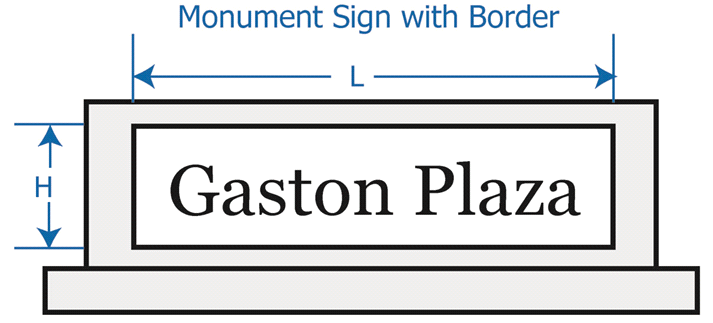
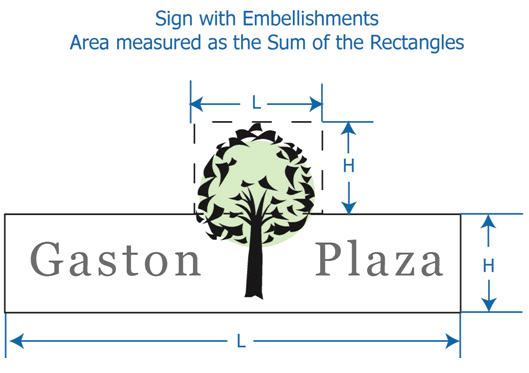
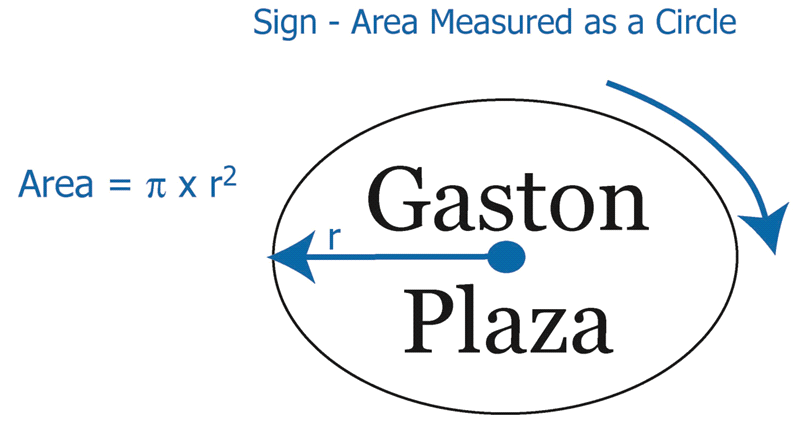
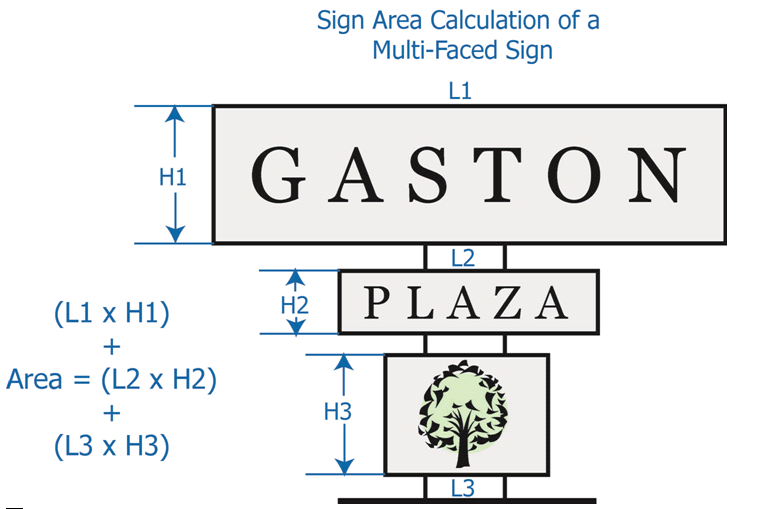
The area of a sign face shall be computed by using up to three (3) of the smallest basic geometric shapes (i.e. square, circle, triangle) that will encompass the extreme limits of the writing, representation, emblem, or other display, together with any material or color forming an integral part of the background of the display or used to differentiate the sign from the backdrop or structure against which it is placed. Such measurement shall not include any supporting framework, bracing or decorative fence or wall when such fence or wall is clearly incidental to the display itself and does not contain any sign copy. For pole signs, poles covered with corporate logos or with more than one corporate color will be considered part of the sign area.
2.
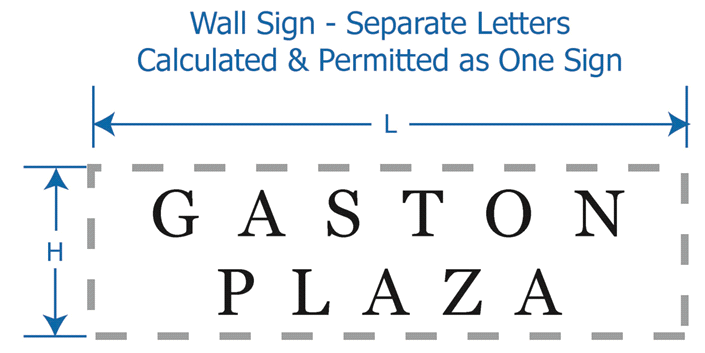
For a single wall (i.e., the entire wall that shares the same architectural elevation as shown on the approved sign permit) all pieces of information or other graphic representations on the wall that are logically related shall be measured as part of one sign. If multiple signs on a single wall share a frame or other material of color forming an integral part of the display or used to differentiate the signs from the background against which they are placed, such area will be measured as part of one sign.
3.
Regardless of whether a single wall has wall sections that project, recess or otherwise vary from the predominate wall plane, the sign area measurement shall include the area of all sign faces that can be viewed from a single vantage point. Signs may be placed back-to-back, side-by-side, or in V-type construction. Side-by-side signs must be structurally tied together and considered as one sign. V-type and back-to-back signs must be considered as two (2) signs if the angle between the faces is forty-five (45) degrees or more. In all other cases, the areas of each face of a multi-faced sign shall be added together to compute the sign area. Sign area of multi-faced signs is calculated based on the principle that all sign elements that can be seen at one time or from one vantage point should be considered when measuring the area of such sign.
Examples Of How Sign Area Is To Be Computed Are Indicated Below:
B.
Sign Height Computation
The height of a sign shall be measured from the highest point of a sign to the street grade level. In the case of a ground or monument sign, the maximum sign height shall be measured from the ground or street grade level from which the sign is to be viewed, whichever is higher.
SECTION 12.2 - SIGNS NOT REQUIRING A PERMIT
The following signs shall be exempt from the regulations contained in this Ordinance and shall not be required to have had a permit issued from the Administrator for their placement. Unless otherwise specified (e.g., signs specifically allowed to be located off-premises or placed in a street right-of-way), such signs shall not fall into any of the "prohibited sign" categories contained in Section 12.3. See Section 5.7 for procedures for obtaining a sign permit. Notwithstanding, any sign shown herein, except as where noted shall be placed outside of a street right-of-way or required sight distance triangle, unless specific authorization for such placement is granted by the City or NCDOT.
A.
Any official or public notice or warning sign required by a valid or applicable federal, state, or local law; by a public utility company; or by a court of competent jurisdiction.
B.
Building marker signs that include the building name, date of construction, or historical data, if such sign is cut or etched into the building masonry, bronze or similar material; architectural features, building decorations, or other works of art attached as long as there are no letters, lights, or moving parts.
C.
Governmental Signs.
D.
On-premise Public Interest Signs. Signs indicating vehicular entrances and exits, parking areas, one-way traffic, "no trespassing," "no loitering," etc. Such signs may be illuminated, shall not exceed four (4) square feet in area and shall be located at the driveway entrance or where other instruction is required.
E.
Memorial signs, plaques or grave markers.
F.
On-premise (ground or wall) identification signs for residential uses that show the name and may also include the street address, with a maximum aggregate area of six (6) square feet.
G.
Incidental signs. Such on-premise signs shall be displayed for the convenience of the general public and includes such signs as signs for public rest rooms; automobile inspection; hours of operation; credit cards accepted, etc. Such signs may be illuminated and contain no other sign copy other than service information, trade names, and logos. Such signs shall be a maximum of six (6) square feet apiece.
H.
Commercial signs may be placed in an athletic field and other enclosed outdoor space where such signs are intended to be visible by persons attending such events at such facilities. A signage plan should be submitted showing the location of the proposed sign display areas, the location of adjacent streets, and the location of the athletic field or other outdoor space. The general concept must be approved by staff, evaluated based on the general appropriateness of the field or facility for the placement of signs, the location of the field or facility, the surrounding districts and land uses, the size and number of signs proposed, the material construction and other design features of the proposed signs. Once the template is approved, individual signs will not require a permit.
I.
Other internal building signs, such that if a sign is inside a building and cannot be seen by a person of ordinary eyesight who is outside the building.
J.
Breezeway or entryway signs, such that if a sign is located inside a breezeway or entranceway, under the roof and within the foundation line of the building but outside the actual entrance door and such sign cannot be seen by a person of ordinary eyesight who is not under the roof of the building or is outside the building.
K.
Signage on mailboxes shall be limited to that allowable under U.S. Postal Service Provisions, and shall also be limited to individual name(s) and the address of the property served by the mailbox. Commercial messages and directional information shall be prohibited.
L.
Sidewalk cafes, restaurants and other outdoor eating and social venues shall be allowed to have tables, chairs, umbrellas and similar objects normally associated with commercial signage.
M.
Entrance flags located upon the premises of multi-family developments with more than one hundred (100) units, as follows:
1.
May consist of any color or design;
2.
Shall not contain any copy or logo;
3.
Shall be located ten (10) feet from all property lines;
4.
Shall be located at driveways connecting the site to a thoroughfare;
5.
Shall be securely affixed to three (3) or more corners;
6.
Shall be no more than sixteen (16) square feet in area (each);
7.
May consist of cloth, fiberglass, vinyl, or any non-rigid material, however, flags shall not consist of any reflective and/or shiny material; and
8.
Specified developments may have up to two (2) flags on both sides of each entrance driveway.
N.
Type 1 Temporary Signs.
1.
Type 1A signs in this category consist of small, temporary yard signs that are typically associated with (but not limited to) the advertisement of real estate, political campaigns and meeting announcements. Such signs are also subject to NCGS 136-32(b).
2.
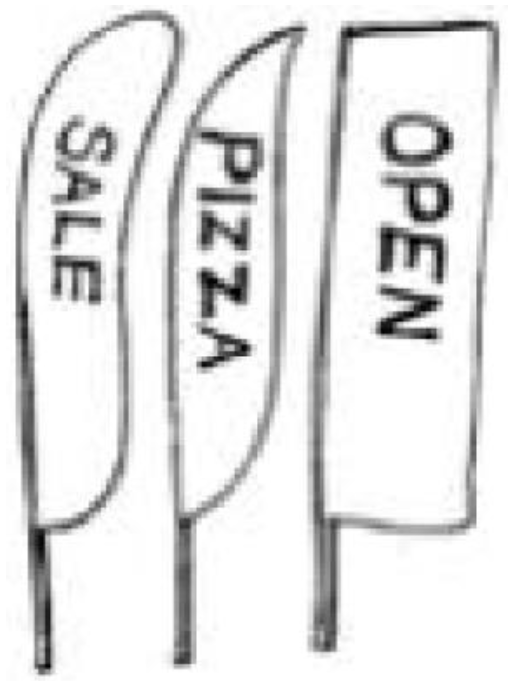
Type 1B signs are defined in Table 2.7-1 as Sign, Feather and usually consist of temporary signs with or without characters, letters, illustrations, or ornamentations applied to cloth, flexible plastic, or fabric of any kind with only such material for backing.
3.
Type 1 temporary signs shall not be affixed to a permanent sign or its supporting structure, including both building mounted and freestanding permanent signs.
4.
Type 1 temporary signs shall not be affixed to poles, posts, stakes or other supporting structures that are permanently installed or anchored into the ground through the use of concrete foundations or similar anchoring techniques.
5.
Type 1 temporary signs shall not be placed in the site distance triangle or in a location that obstructs site distances.
6.
Type 1 temporary signs shall not be placed on the roof of a building, or affixed to a motor vehicle, tree, utility pole or street sign.
7.
Type 1 temporary signs shall not be placed within any public street right-of-way, including within medians except as follows:
a.
During the period beginning on the 30th day before the beginning date of "one-stop" early voting under G.S. 163A-1300 and ending on the 10th day after the primary or election day, persons may place non-commercial Type 1 temporary signs in the public right-of-way. Signs must be placed in compliance with subsection (b) of this section and must be removed by the end of the period described in this subsection. Commercial signs are not permitted in the public right-of-way under this subsection.
b.
Sign Placement. - The permittee must obtain the permission of any property owner of a residence, business, or religious institution fronting the right-of-way where a sign would be erected. Signs must be placed in accordance with the following:
(1)
No sign shall be permitted in the right-of-way of a fully controlled access highway.
(2)
No sign shall be closer than three (3) feet from the edge of the pavement of the road.
(3)
No sign shall obscure motorist visibility at an intersection.
(4)
No sign shall be higher than forty-two (42) inches (four (4) feet) above the edge of the pavement of the road.
(5)
No sign shall be larger than eight hundred sixty-four (864) square inches (six (6) square feet).
(6)
No sign shall obscure or replace another sign.
8.
Any cracked, faded, torn, ripped, broken, or otherwise damaged temporary sign shall be immediately removed until repaired or replaced.

TYPE 1A
TYPE 1B
O.
Murals displayed in non-residential zoning districts as follows:
1.
Shall be permitted on only two facades of a structure;
2.
Shall be maintained in good condition and repaired in case of vandalism or accidental destruction or be painted over to match the building;
3.
Shall be applied using weather-resistant paint;
4.
Shall not be painted on or obscure windows or doors;
5.
Design Review approval required for murals in Central Business District (Section 7.11) and Urban Mixed Use District (Section 7.12);
6.
Nothing in this section shall prevent someone who installs a mural from incorporating their name or other identifying information as part of the mural; and
7.
If any portion of the mural contains a commercial message, a sign permit shall be required for that portion, and the area of the commercial message shall be counted toward the maximum permitted sign area for wall signs.
(Ord. No. 10-585, § 7, 8-17-10; Ord. No. 11-593, § 4, 8-2-11; Ord. No. 11-595, § 1, 9-20-11; Ord. No. 12-608, § 5, 4-17-12; Ord. No. 16-651, § 1, 10-18-16; Ord. No. 17-662, § 1, 8-15-17; Ord. No. 20-727, § 2, 9-15-20; Ord. No. 25-828, § 1, 4-15-25)
SECTION 12.3 - PROHIBITED SIGNS
1.
All signs not expressly addressed under this Ordinance (or elsewhere in this Ordinance) are prohibited. Any permitted or non-permitted sign shall not violate this Section. Such signs include, but are not limited to:
A.
Any sign that obstructs the view of bicyclists or motorists using any street, approach to any street intersection, or which interferes with the effectiveness of or obscures any traffic sign, device, or signal shall be prohibited.
B.
Signs, other than traffic regulatory signs, which contain lights, rotating disks, words and other devices not erected by a public authority that may be erroneously construed as government signs or emergency-warning signs shall be prohibited. An example of this is a sign that contains a picture of a traffic sign plus the word "Stop," "Yield," etc. Any sign located outdoors that interferes with free passage from or physically obstructs any fire escape, downspout, window, door, stairway, ladder, or opening intended as a means of ingress or egress or providing light or air shall be prohibited. (NOTE: Signs painted onto windows shall not be prohibited, nor shall neon and similar signs attached to windows.)
C.
Any sign placed on any curb, sidewalk, post, pole, hydrant, bridge, tree, or other surface located on, over, or across any public street or right-of-way, (with the exception of certain projecting/suspended signs and sandwich board signs per Sections 12.5.6 and 12.5.7 of this Ordinance and/or other signs specifically listed as being allowed for placement within a street right-of-way) unless otherwise authorized by the City Manager or the Subdivision Administrator shall be prohibited. Signs placed in a required sight distance triangle without having first received approval for such placement from the City shall also be prohibited. (NOTE: The Administrator shall have the authority to remove and may discard without notice any such prohibited sign illegally placed within a street right-of-way or sight triangle and, at local discretion, may immediately destroy such sign.)
D.
Any sign located in such a way as to intentionally deny an adjoining property owner visual access to an existing sign shall be prohibited.
E.
Flashing signs, signs with flashing or reflective disks, signs with flashing lights or lights of changing degree of intensity or color or signs with scrolled messages, signs with electronically scrolled messages (except government traffic signs and signs which give time and temperature information) shall be prohibited. Provided, however, sign lights shall change in degree of intensity based on ambient light conditions to conform to the requirements of Section 12.15.
If a time and temperature sign alternates between a time message and a temperature message, it shall continuously show one message a minimum of two and one-half (2.5) seconds in time before switching to the other message. Except as noted in this paragraph, or allowed under of Section 12.15, signs with a message or text made wholly or partially of lights, including but not limited to, light emitting diodes (LED), incandescent lights, or exposed light bulbs, or highly reflective materials, so as to generate a contrast between the sign and adjacent surfaces or the surrounding area shall be prohibited. This provision shall not apply to static neon signs where the neon creates the sign message.
F.
Portable signs, excluding temporary signs otherwise permitted as set forth in Section 12.2 and Section 12.4. A sign originally constructed as a portable sign may not be converted into a permanent sign by chaining or bolting it to the ground, or by other means or alterations.
G.
Vehicular signs.
H.
Rotating signs.
I.
Electric signs which are not installed and/or wired in accordance with the national electric code.
J.
Signs not installed in accordance with the North Carolina building code.
K.
Roof signs (except as approved pursuant to Section 12.14 within the UMU zoning district).
L.
Signs that contain language and/or pictures deemed obscene per G.S. 14-190.1.
M.
Signs that advertise an activity or business no longer conducted on the property upon which the sign is located.
N.
Off-premise advertising signs.
O.
Inflatable objects, including balloons with a diameter of two (2) feet or greater.
P.
Freestanding signs which are not installed into the ground shall be prohibited.
Q.
Any other sign not expressly permitted by this Ordinance shall be prohibited.
2.
A violation of this section is punishable as a misdemeanor.
(Ord. No. 10-585, § 7, 8-17-10; Ord. No. 16-651, § 1, 10-18-16; Ord. No. 23-786, § 1, 6-20-23; Ord. No. 23-796, § 1, 11-21-23)
SECTION 12.4 - PERMITTED SIGNS: LOCATION, SIZE, NUMBER
Signs requiring the issuance of a sign permit by the Administrator shall be permitted in accordance with Table 12.4-1 to 12.4-6 and shall also be subject to any conditions placed on a particular development through the issuance of a Special Use Permit or Conditional Zoning District. Any allowed sign shall also be subject to the design and construction standards for such type of sign as set forth in Section 12.5.
TABLE 12.4-1
TABLE OF SIGNS REQUIRING A SIGN PERMIT
NOTE: An "X" indicates that the sign will be permitted with an approved sign permit, as outlined in Section 5.7.
* Refer to Section 12.5 for additional specifications.
TABLE 12.4-2
DIMENSION AND LOCATION STANDARDS FOR SIGNS REQUIRING A PERMIT - RESIDENTIAL DISTRICTS
The following signs may be placed in such districts subsequent to the issuance of a permit by the zoning administrator. All signs not specifically allowed shall be prohibited.
* Lighting permitted per Section 12.6 for bed and breakfast inns only
** Refer to Section 12.5 for additional specifications.
TABLE 12.4-3
DIMENSION AND LOCATION STANDARDS FOR SIGNS REQUIRING A PERMIT - TMU AND UMU DISTRICTS
The following are regulations for most on-premise wall and freestanding signs. For freestanding multitenant development signs, individual uses advertised upon the sign structure shall be limited to not more square footage of sign area than would be allowed for the use if it were not located within a multitenant development. Signs may be placed subsequent to the issuance of a permit by the administrator. All signs not specifically allowed shall be prohibited.
* Lighting permitted per Section 12.6 for bed and breakfast inns, class A day care centers, and group care facilities only.
** Refer to Section 12.5 for additional specifications.
*** Refer to Section 12.10 for additional information and specifications.
TABLE 12.4-4
DIMENSION AND LOCATION STANDARDS FOR SIGNS REQUIRING A PERMIT - OFFICE DISTRICTS
The following are regulations for most on-premise wall and freestanding signs. For freestanding multitenant development signs, individual uses advertised upon the sign structure shall be limited to not more square footage of sign area than would be allowed for the use if it were not located within a multitenant development. Signs may be placed subsequent to the issuance of a permit by the administrator. All signs not specifically allowed shall be prohibited.
* Lighting permitted per Section 12.6 for bed and breakfast inns, class A day care centers, and group care facilities only.
** Refer to Section 12.5 for additional specifications.
TABLE 12.4-5
DIMENSION AND LOCATION STANDARDS FOR SIGNS REQUIRING A PERMIT - CBD
* Refer to Sections 12.5 and 12.10 for additional specifications.
TABLE 12.4-6
DIMENSION AND LOCATION STANDARDS FOR SIGNS REQUIRING A PERMIT
COMMERCIAL AND INDUSTRIAL DISTRICTS
The following are regulations for most on-premise wall and freestanding signs for uses not located within a multitenant development or an overlay district. For freestanding multitenant development signs, individual uses advertised upon the structure shall be limited to no more square footage of sign area than would be allowed for the use if it were not located within a multitenant development. Signs for residential uses shall be the same as in office (O) districts. The following signs may be placed subsequent to the issuance of a permit by the zoning administrator. All signs not specifically allowed shall be prohibited.
* Refer to Section 12.5 for additional specifications.
TABLE 12.4-7
DIMENSION AND LOCATION STANDARDS FOR SIGNS REQUIRING A PERMIT
TEMPORARY SIGNS TYPE 2 AND TYPE 3 - ALL DISTRICTS

(Ord. No. 12-608, § 5, 4-17-12; Ord. No. 12-613, § 1, 6-19-12; Ord. No. 13-622, § 1, 7-16-13; Ord. No. 16-651, § 1, 10-18-16; Ord. No. 18-675, § 1, 9-18-18; Text Amend. 9508, § 3, 6-16-20; Ord. No. 21-739, § 1, 6-15-21; Ord. No. 24-813, § 3, 9-17-24)
SECTION 12.5 - DESIGN AND CONSTRUCTION STANDARDS
Any sign shown herein (except canopy/awning signs per Section 12.5.1, projecting/suspended signs per Section 12.5.6, and sandwich board signs per Section 12.5.7) shall be placed outside of a street right-of-way or required sight distance triangle, unless specific authorization for such placement is granted herein and/or by the Subdivision Administrator.
(Ord. No. 10-585, § 7, 8-17-10; Ord. No. 16-651, § 1, 10-18-16)
12.5.1 - CANOPY/AWNING SIGNS
Awning signs shall be allowed provided that:
A.
Awning signs may be used in lieu of or in addition to any other wall sign.
B.
The total of all awning signage area, together with all other canopy or wall signage, shall not exceed the maximum allowable wall signage area for such use.
C.
Awning signs may be illuminated only with direct surface lighting and not with any form of backlighting.
D.
All canopy/awning signs shall maintain a clearance of at least eight (8) feet from the ground beneath it and shall be allowed to protrude a maximum of five (5) feet from the building face.
E.
A canopy or awning sign may not extend into a street right-of-way, except with prior approval from the Subdivision Administrator.
F.
All signs placed on a canopy shall be located on the awning skirt, and not the awning face.
(Ord. No. 10-585, § 7, 8-17-10)
12.5.2 - DIRECTORY SIGNS
Directory signs shall be allowed where a particular site includes more than one principal use and shall not be counted towards meeting the maximum allowable sign area for the site or development, provided that:
A.
Directory signs shall be allowed in multi-tenant developments provided that such signs are: (1) located at least fifty (50) feet from any external public street right-of-way, and (2) placed at internal street intersections within the development.
B.
Such signs shall each have a maximum area of twenty-four (24) square feet and be no greater than six (6) feet in height.
C.
Such signs may contain business names or logos along with arrows and similar directional information.
D.
Such signs shall not contain any other commercial messages.
E.
In lieu of a ground-mounted directory sign, such sign may be placed on a building wall. If so placed, such sign shall not exceed ten (10) percent of the allowable wall signage for such use.
F.
Directory signs shall be shown on any applicable site plan, shall be ground signs, and shall not encroach within a public right-of-way without prior approval from the Subdivision Administrator.
(Ord. No. 10-585, § 7, 8-17-10)
12.5.3 - MENU BOARDS
Drive throughs shall be allowed menu boards provided that:
A.
The sign face shall not exceed thirty-two (32) square feet in area.
B.
The color of such sign shall have ties to the main building or other signage for the project.
(Ord. No.16-644, § 1, 2-16-16)
12.5.4 - GROUND/POLE SIGNS
(NOTE: CERTAIN USES MAY EXCEED THE SIGN AREA AND HEIGHT REQUIREMENTS SHOWN HEREIN USING THE "MASTER SIGN PLAN FLEXIBILITY OPTION SHOWN IN SECTION 12.5.10).
Ground/pole signs shall be allowed provided that:
A.
A pole sign may only be installed if allowed in the underlying zoning district (refer to Table 12.4-1). There shall be no commercial copy or other advertising sign copy on the poles of the sign. Otherwise, freestanding signs shall be limited to ground signs.
B.
In no instance shall uses located in outparcels in shopping centers or similar multi-tenant developments be allowed to have a ground mounted or pole sign.
C.
Any ground/pole sign erected shall be located no closer than ten (10) linear feet from any adjacent side lot line, or twenty (20) feet if that side lot line abuts a residentially developed or vacant lot in a Residential zoning district. A ground/pole sign shall be located no closer than thirty (30) feet from a pre-existing ground/pole sign on an adjacent lot.
D.
No pole sign shall be allowed along a local street (any street not designated as a thoroughfare on the most recently adopted thoroughfare plan) if such lot is located directly opposite from a residential (R) zoning district. In such instances, freestanding signs shall be limited to a ground sign.
E.
Any ground/pole sign shall be placed no closer than ten (10) feet from the edge of the adjoining street right-of-way. However, such signs nine (9) square feet in size or smaller, if proposed in a locally designed historic district, may be placed up to three (3) feet from the leading edge of the sign to the right-of-way line if deemed appropriate to achieve the design goals and intent of the historic district designation.
F.
Notwithstanding other provisions contained in this section, if a lot is located within a one thousand (1,000) foot linear radius of the centerline of a grade-separated intersection of a four-lane, divided, limited access highway, the height of a free-standing pole sign shall be a minimum of fifty (50) feet and a maximum of eighty (80) feet and the area of such pole sign may be increased to two hundred (200) feet under the following conditions:
1.
For multitenant developments; If such a larger and/or higher pole sign is erected, a maximum of one other on-premise freestanding multitenant sign may be erected on-site for the use in question. Said sign shall be in compliance with the sign area and height requirements contained in Section 12.4 for multitenant uses.
2.
Said sign may exceed the normal height and area requirements that otherwise would be allowed if the sign is oriented so as to be viewed by motorists traveling on the four-lane, divided, limited access highway.
3.
If such a larger and/or higher pole sign is erected, a maximum of one other on-premise freestanding sign may be erected on-site for the use in question. Said sign may only be a ground sign (as opposed to a pole sign) and shall have a maximum area of thirty-two (32) square feet.
(Ord. No. 12-613, § 1, 6-19-12; Ord. No. 20-725, § 5, 9-1-20)
12.5.5 - WALL SIGNS
The following regulations shall apply to on-premise wall signs:
A.
Permitted wall signage for a use may be placed on walls that may or may not front a public street.
B.
Wall signs may not extend above the wall upon which the sign is mounted.
C.
Wall signs shall not project more than eighteen (18) inches from the wall and shall not cover any window.
D.
A retail store in the C-1, C-2 or C-3 zoning district and exceeding forty thousand (40,000) square feet gross floor area may add a business name identification sign to its front building wall for any in-store adjunct business located within said retail store. Said adjunct business identification signage shall be allowed in addition to wall signage permitted pursuant to this section but no such adjunct business identification sign shall exceed twenty-five (25) square feet in area and no retail store shall display more than a total of seventy-five (75) square feet of adjunct business signage. As used in this section, the term "in-store adjunct business" shall mean a small store or service located inside a larger retail store, but not associated by name or patron transaction with the main retail store. Examples of such businesses include a financial institution, fast food restaurant chain, or "postal store and contract station" located in a separate area within a department store and operating under a different name. Leased specialty departments (e.g., shoes, jewelry) within a retail store, cosmetic counters with or without their own personnel, pharmacies, lunch counter, or eye care departments, either of which operate under the main store's name and/or conduct patron transactions through the main store transaction system are examples of store departments which shall not be deemed an in-store adjunct business. Any such retail store housing inside said store an automatic teller machine (ATM) operated by a financial institution, but not associated with an adjunct business within the store, may display on the front wall an identification sign for said ATM. The ATM sign shall not exceed eight (8) square feet and shall be counted within the maximum seventy-five (75) square feet for adjunct business signs.
E.
Wall signs on designated historic buildings shall be placed within the sign frieze, or distinct place within which a wall sign was intended to be placed. No wall sign shall extend beyond such space. If there is no such sign frieze, the wall sign shall be placed below the typical second floor window area.
F.
Canopy/awning signs and/or projecting signs may be substituted for square footage allowed for a wall sign.
G.
Signs attached to a mansard portion of a roof shall be considered to be a wall sign.
12.5.6 - PROJECTING/SUSPENDED SIGNS
A.
A projecting or suspended sign shall not project more than five (5) feet from the wall.
B.
The bottom of the projecting or suspended sign shall be at least eight (8) feet above the ground immediately below it.
C.
In no case may a projecting or suspended sign extend more than three (3) feet into the street right-of-way, unless otherwise approved by the Subdivision Administrator.
D.
The height of the top edge of the signboard or bracket shall not exceed the height of the wall from which the sign projects.
(Ord. No. 10-585, § 7, 8-17-10; Ord. No. 16-651, § 1, 10-18-16)
12.5.7 - SANDWICH BOARD SIGNS
Sandwich board signs shall be allowed as provided in the Section 12.4 provided the following requirements are met:
A.
The total area of the signboard shall not exceed eight (8) square feet per side. Such signs shall not be used in calculating maximum allowed square footage for the use.
B.
The sign shall have a maximum height of four (4) feet and a maximum width of two (2) feet. Easel and pedestal signs may be six (6) feet in height.
C.
The sign must be constructed of materials that present a finished appearance. Rough-cut plywood and similar unfinished surfaces shall not be used for such signs.
D.
Signs may be placed in a sidewalk or within a street right-of-way (but outside a vehicular travel way) but such signs shall not interfere with pedestrian or vehicular movement and circulation.
E.
Signs shall be removed by the end of the business day.
(Ord. No. 16-651, § 1, 10-18-16)
12.5.8 - TEMPORARY SIGNS
A.
Temporary signs shall comply with the following standards:
1.
Type 2 Freestanding Temporary Sign. Signs in this category are typically referred to as "banners" that are typically associated with (but not limited to) the announcement of community, sporting, grand opening, special sales, and special events.
2.
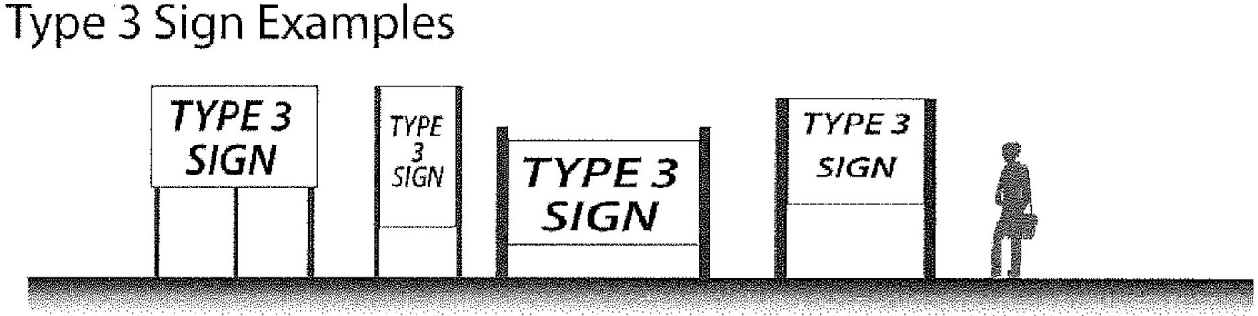
Type 3 Freestanding Temporary Sign. Signs in this category are large temporary signs typically associated with (but not limited to) the advertisement of large tracts of land for sale, construction and development activity or the advertisement of commercial or industrial building for sale or lease.
3.
Temporary signs shall not be affixed to a permanent sign or its supporting structure, including both building mounted and freestanding permanent signs.
4.
Temporary signs shall not be affixed to poles, posts, stakes or other supporting structures that are permanently installed or anchored into the ground through the use of concrete foundations or similar anchoring techniques.
5.
Temporary signs shall not be placed in a manner that obstructs clear sight distance (with the required sight triangle) for motorists at street intersections or driveways.
6.
Temporary signs shall not be placed on the roof of a building, or affixed to a motor vehicle, tree, utility pole or street sign.
7.
Temporary signs shall not be illuminated or be provided with any electric service.
8.
Temporary signs shall not be placed within any public street right-of-way, including within medians, unless expressly permitted by this Ordinance.
9.
Temporary signs attached to building walls (other than permitted temporary window signs) shall not be placed in a manner that obstructs any window, door, fire department sprinkler connection, or street number sign.
10.
Temporary signs shall not be place upon any sidewalk or other pedestrian walkway.
11.
Where temporary signs are limited in the duration of their display and limited in the total number of displays per calendar year, any required period of separation between such displays shall carry through to the following calendar year, and shall be observed prior to initiating the first allowed display during the new calendar year.
(Ord. No. 16-651, § 1, 10-18-16)
12.5.9 - (PERMANENT) ON-PREMISE BANNERS FOR AUTOMOBILE, BOAT, MANUFACTURED HOME ETC. SALES USES
Special sign requirements regarding the provision of permanent on-site banners shall prevail for automobile, truck, boat, motorcycle, manufactured home and recreational vehicle sales and rental facilities. Such banners may be allowed under the following conditions:
A.
The banners may consist of any color, design, copy or logo;
B.
The banners shall be placed in a manner that does not obstruct or impair motorists' vision, particularly at ingress and egress points;
C.
The banners shall be affixed, connected to three (3) or more corners, and shall be no more than sixteen (16) square feet in area;
D.
The banners may consist of cloth, fiberglass, vinyl, or any non-rigid material. Banners shall not consist of any reflective and/or shiny-related material;
E.
The banners may have up to two (2) flags for the first one hundred (100) feet of street frontage plus a maximum of one flag for each additional fifty (50) feet of frontage along a thoroughfare, plus, up to one flag for every fifteen thousand (15,000) square feet of outdoor display area;
F.
The banners shall not have an on-site flag within fifty (50) feet of another flag; and,
G.
All banners and flags shall be located outside all right-of-ways.
12.5.10 - PLANNED DEVELOPMENT SIGN PLAN FLEXIBILITY OPTION
A.
Purpose.
For the purpose of providing flexibility and incentives for coordinated signage design for certain planned multi-tenant developments, recreation uses, and for other uses that, by their nature, draw persons from beyond the greater Gaston County area, provisions are hereby made to allow the Administrator to approve certain flexibility options in the amount and size of signs such uses may ordinarily have.
B.
Applicability.
The planned development flexibility option is available to the following uses:
1.
Planned unit developments and traditional neighborhood developments;
2.
Office parks of at least fifty thousand (50,000), shopping centers, and industrial parks and similar multi-tenant developments of at least one hundred thousand (100,000) or greater square feet of gross leasable area;
3.
Continuing care facilities;
4.
Hospitals, stadiums; amusement parks; amphitheaters; auditoriums, churches with over four hundred (400) seats and multiple buildings, schools with multiple buildings, and similar large-scale civic or recreational facilities.
5.
Indoor movie theaters.
C.
Approval Procedure.
1.
If the use being proposed requires the issuance of a special use permit or is in association with a conditional district rezoning, the Administrator may recommend to the Planning Commission that the sign flexibility option be applied as proposed by the applicant or as otherwise recommended by the Administrator.
2.
The Administrator may otherwise administratively approve the signage flexibility option. In making such approval, the Administrator shall have the authority to attach fair and reasonable conditions to the approval upon making a determination that such conditions enhance the aesthetics of the development, provide needed site visibility to motorists and pedestrians visiting the facility, and promote the public health, safety and welfare, and are otherwise in keeping with the sign package being proposed.
D.
Submittal and Review Process.
1.
A master sign program shall be submitted to the Administrator. This shall include, as a minimum, the following information:
a.
All information required for issuance of a sign permit per Section 5.7 of this Ordinance;
b.
Detailed designs of all proposed exterior signs including their size, height, copy, materials, and color;
c.
Proposed locations and number of signs;
d.
Sign illumination plans; and
e.
Landscaping plans to be used in conjunction with the signs.
2.
The Administrator shall have a maximum of thirty (30) days to review the sign program submitted and by the end of such period shall either: (a) approve the sign package as submitted; (b) approve the sign package with modifications; (c) disapprove the sign package, or (d) make a recommendation to the special use permit or conditional zoning review and approval bodies when the use being proposed requires the issuance of a special use permit or is subject to conditional district rezoning.
E.
Sign Specifications.
1.
All signs must be coordinated in terms of design features.
2.
Refer to Tables in Section 12.4 Permitted Signs: Location, Size, Number for specifications.
3.
The maximum area of any sign or the aggregate amount of sign area, may be increased by up to twenty-five (25) percent above that which normally is allowed in the underlying zoning district.
(Ord. No. 18-673, § 1, 8-23-18; Ord. No. 21-739, § 1, 6-15-21)
12.5.11 - SUBDIVISION, MULTI-FAMILY DEVELOPMENT, AND PLANNED RESIDENTIAL DEVELOPMENT IDENTIFICATION SIGNS
Subdivision, Multi-family Development, and Planned Residential Development Identification Signs shall be allowed under the following conditions:
1.
Such signs may be placed on one or both sides of each principal entrance to the development.
2.
Such signs shall not exceed thirty-two (32) square feet in area apiece.
3.
Such signs shall not exceed eight (8) feet in height, unless integrated into a wall or column in which the sign is encased.
4.
Such signs shall contain no commercial messages.
5.
Such signs may be placed in a street median (i.e., in a street right-of-way), if specific permission for such is first given by the Subdivision Administrator and meets the requirements of Section 12.7.
(Ord. No. 10-585, § 7, 8-17-10)
SECTION 12.6 - SIGN LIGHTING STANDARDS
A.
No sign for which a sign permit is required (other than ground mounted signs) located within one hundred (100) linear feet of a pre-existing residential structure or a Residential zoning district may be illuminated between the hours of 12:00 midnight and 6:00 a.m. A residence shall be deemed to be pre-existing for purposes of this subsection if a building permit had been issued for construction prior to the issuance of a sign permit for that sign. Any residential structure constructed prior to the effective date of this subsection shall also be considered to be "pre-existing."
B.
All externally illuminated signs shall have their lighting directed in such a manner as to illuminate only the face of the sign.
SECTION 12.7 - SIGNS IN THE PUBLIC RIGHT-OF-WAY
A.
No signs shall be allowed in the public right-of-way, except for the following:
1.
Government signs;
2.
Bus stop signs erected by a public transit company;
3.
Informational signs of a public utility regarding its poles, lines, pipes or other facilities;
4.
Signs appurtenant to a use of public property permitted under a franchise or lease with the City;
5.
Canopy/Awning signs per Section 12.5.1;
6.
Projecting/suspended signs per Section 12.5.6;
7.
Ground signs with the name of the residential or non-residential subdivision or multi-family development shall comply with Section 12.5.11 and may be located in the roadway median under the following guidelines:
A.
The sign shall have a maximum height of four (4) feet.
B.
If located within the public street right-of-way, specific approval for such location must be granted by the Subdivision Administrator.
B.
Unless otherwise specifically allowed per this Ordinance, all other signs placed in the street right-of-way shall be prohibited and shall be subject to removal per Section 12.3(C).
(Ord. No. 10-585, § 7, 8-17-10; Ord. No. 16-651, § 1, 10-18-16)
SECTION 12.8 - NONCONFORMING SIGNS
A.
Subject to the restrictions of this Section, nonconforming signs that were otherwise lawful on the effective date of this Ordinance may be continued.
B.
No person may engage in any activity that causes an increase in the extent of nonconformity of a nonconforming sign or causes a previously conforming sign to become nonconforming. This provision shall not apply when the nonconformity is the result of the acquisition of right-of-way by a public entity. The City Manager in such instances may authorize the continuation or replacement of a sign in the right-of-way.
C.
A nonconforming sign may not be moved or sign structure replaced except to bring the sign into complete conformity with this Ordinance. Once a nonconforming sign structure is removed (i.e., the removal of any structural elements below the sign cabinet) from the premises or otherwise taken down or moved, said sign only may be replaced or placed back into use with a sign that is in conformance with the terms of this Ordinance.
D.
Minor repairs and maintenance of nonconforming signs necessary to keep a nonconforming sign in sound condition are permitted, not including the replacement of structural elements below the sign cabinet.
E.
If a nonconforming sign is destroyed by natural causes, it may not thereafter be repaired, reconstructed, or replaced except in conformity with all the provisions of this Ordinance, and the remnants of the former sign structure shall be cleared from the land. For purposes of this section, a nonconforming sign shall be considered "destroyed" if it receives damage to an extent of greater than fifty (50) percent of its current replacement cost.
F.
Notwithstanding other provisions contained in this section, the message and/or sign cabinet of a nonconforming sign may be changed or replaced so long as such change does not increase the degree of any nonconformity.
G.
If a nonconforming on-premises sign remains blank for a continuous period of six (6) months, that sign shall be deemed abandoned and, within thirty (30) days after such abandonment, be altered to comply with this Chapter or be removed by the sign owner, owner of the property where the sign is located, or other person having control over such sign. For purposes of this section, a sign shall be deemed "blank" if:
1.
It advertises a business, service, commodity, accommodations, attraction, or other enterprise or activity that is no longer operating, offered, or being conducted; or
2.
The advertising message it displays becomes illegible in whole or substantial part; or
3.
It does not contain an advertising message. (For such purposes, the terms "sign for rent," "sign for lease," "sign for sale," etc., shall not be deemed to be an advertising message).
H.
Any off premise sign for which there is in effect a valid permit issued by the North Carolina Department of Transportation may be repaired or reconstructed so long as the square footage of its advertising surface area is not increased. Reconstruction includes the replacement of an existing multipole structure with a monopole structure.
I.
All other advertising signs which are nonconforming by virtue of their height, setback, spacing (i.e., distance between two (2) advertising signs, or location in a zoning district other than a residential (R) zoning district), shall not be required to be removed and may continue subject to all other applicable portions of this section.
J.
Reserved.
K.
G.S. 136-131.1 requires that "just compensation" be paid upon removal of certain outdoor advertising signs adjacent to the highway on the national system of interstate and defense highways or a highway on the federal-aid primary highway system for which a valid permit has been issued by all appropriate governmental agencies. Section 12.8(H) shall not require that any sign be removed if compensation must be paid upon removal of such sign due to any state or federal law that mandates such form of "just compensation" upon removal. Should any such state or federal requirement become inoperative or otherwise fail to apply to a given sign, then such sign shall be removed within seven (7) years of such state or federal requirements becoming inoperative or otherwise failing to apply to such sign.
L.
Any sign which is prohibited under Section 12.3 (prohibited signs) which was lawfully existing at the time it became prohibited (April 18, 1995) shall be allowed to continue provided that:
1.
No additions or expansions of the sign occur;
2.
Message display time shall not be less than one second;
3.
The same message shall not be repeated without an intervening message; and
4.
At no time shall light rays be cast directly upon residential dwellings.
M.
Subject to the provisions of this Subsection, the Zoning Administrator may approve the consolidation, relocation and replacement of certain off-premise advertising signs upon the submission by the owner of such signs of a plan for such consolidation, relocation and replacement provided the Zoning Administrator finds that the plan meets either purpose and all applicable requirements of this Subsection. The first purposes of this Subsection shall be to allow the removal and consolidation of older, structurally deteriorating, obsolete or visually deteriorated off-premise advertising signs into fewer more structurally sound and visually appealing structures and fewer sign faces in the City's zoning jurisdiction. The second purpose shall be to allow the relocation of off-premise advertising signs from locations of significant aesthetic interest, such as historical areas and gateways as set forth in Paragraph (2) of this Subsection.
1.
Consolidation/relocation/replacement of Off-premise Advertising Signs. The Zoning Administrator may approve an application for the consolidation, relocation and replacement of off-premise advertising signs with static, electronic changeable face, or changing/tri-vision off-premise advertising signs identified by the owner of said signs (and/or owner of the property on which the signs are located) in the application.
Each consolidation/relocation/replacement plan shall result in the removal of at least two (2) active off-premise advertising signs and two (2) sign structures. Each plan shall result in the erection of either one static, electronic changeable face, or changing/tri-vision off-premise advertising sign structure with no more than two (2) faces, having no more than one face per direction of travel. Stacked (double decker) and side-by-side off-premise advertising signs proposed for removal, shall count as one sign structure regardless of any structural system that may connect or separately support them. Any two (2) signs proposed for removal within twenty (20) feet of each other, whether or not connected to each other shall count as one sign structure. The removal of the entire sign or signs proposed for removal must be completed before the erection of the replacement or relocated sign.
The replacement sign must meet the following standards and specifications:
2.
Relocation of Off-premise Advertising Signs from Certain Areas. The Zoning Administrator may approve an application and plan for the relocation of one or more existing off-premise advertising signs from the CBD (Central Business District), UMU (Urban Mixed Use) any Historic (HD) Overlay District, Gateway Corridor Overlay, or any National Register Historic District to location(s) outside such areas, but within eligible locations. Relocation of such eligible signs shall be on a one sign face for one sign face basis; however, the term "relocation" shall mean the removal of the complete sign structure and all faces from its existing/original location. The term "relocation" shall also include the installation of a new replacement sign structure to replace the removed sign structure and not necessarily the actual structure from the original location. The relocated sign must meet all the requirements listed in Table 12.8 of this Subsection.
3.
The application for consolidation/relocation/replacement of off-premise advertising signs shall be submitted in accordance with Section 5.7 Sign Permit and shall include a survey prepared by a registered surveyor showing the following:
a.
Location of the off-premise advertising sign for which the permit is requested, showing a scaled representation of the structure, for measuring purposes:
b.
The zoning district in which the sign is located;
c.
Type of off-premise advertising sign;
d.
Message duration time, if applicable;
e.
Maximum sign height;
f.
Maximum sign face area;
g.
The tax parcel identification number of the property;
h.
The setbacks of the site;
i.
All buildings located on the site within 20' of the subject sign;
j.
Distance from the subject sign to any residential zoning district within four hundred (400) feet;
k.
Show the location of nearby existing off-premise advertising signs in the vicinity, and provide the following:
The distance from the proposed sign to all existing off-premise advertising signs located within two thousand (2,000) linear feet on the same side of the street,
The distance from the proposed sign to all existing off-premise advertising signs located within one thousand (1,000) linear feet on the opposite side of the street,
Information to show the off-premise advertising sign will be situated so as to not substantially block the view from vehicular traffic from either direction of travel of any on-premise business identification sign within two hundred (200) feet of the off-premise advertising sign (this does not apply to views from an Interstate highway).
(Ord. No. 12-613, § 1, 6-19-12; Ord. No. 13-628, § 17, 11-19-13; Ord. No. 17-651, § 1, 3-21-17)
SECTION 12.9 - SIGN MAINTENANCE
All signs and all components thereof, including supports, braces, anchors, etc. shall be kept in a good state of repair, in compliance with all building and electrical codes and in conformance with the requirements of this Ordinance.
Any sign which is determined by the zoning administrator as being in danger of falling or otherwise endangering the public safety shall be immediately removed by its owner unless it is repaired and made to otherwise comply with the requirements of this Ordinance. Any sign which has been out-of-use for at least one year shall be considered derelict and shall be required to be removed immediately thereafter. Signs that are ripped, illegible, and/or have hanging debris for more than thirty (30) days shall be made blank or replaced with another advertisement immediately. Any sign related debris shall be removed from the area.
SECTION 12.10 - CENTRAL BUSINESS DISTRICT SIGN SPECIFICATIONS
A.
Signs in the CBD present special design challenges. Signs using modern materials and construction methods can be well designed or poorly done, as can signs constructed with traditional materials. For this reason, all signs proposed for the district shall first be reviewed and approved by the Design Review Committee as provided for under Section 7.11.B
Applicants must submit, at a minimum, a detailed scale drawing of the sign, indicating its dimensions, placement on the site or building, lettering sizes and fonts, and all materials that are to be used in its construction. In addition, committee members may require the submission of samples of materials proposed, if deemed necessary for proper review and consideration of the application. Where there is conflict with other sections of this Chapter, central business district signage standards within this section shall prevail. Where the standards of this section are silent, the requirements of Chapter 12 shall prevail.
1.
Due to the flexibility inherent in this review process, there are no materials or techniques that are categorically disallowed in the construction of signs.
2.
FREESTANDING SIGNS: All freestanding identification signs shall be ground signs with a maximum height of seven (7) feet.
The maximum area of the sign face for freestanding signs shall be a maximum of sixty-four (64) square feet for buildings whose primary entrance fronts Franklin Boulevard. For all other properties the maximum shall be forty (40) square feet.
3.
WALL SIGNS: For signage attached to the building wall (attached signs), signage may be attached to any building wall facing a public street or facing a public or private parking lot where customers are allowed to park, and the area of allowed signage on any such wall face shall be calculated separately.
•
Each such facade shall be allowed two (2) square feet of sign area for each linear foot of building wall width along said facade up to a maximum of sixty-four (64) square feet for each facade. Such sign area may be distributed between multiple signs carrying separate messages.
The zoning administrator may grant up to twenty-five (25) additional square feet of signage that would otherwise meet the standards of this section in order to make use of an historic sign frieze, or on a new building, in the creation of a new sign frieze.
a)
In addition to such facades, one (1) identification sign (either single tenant or multitenant), up to thirty-two (32) square feet in size, may be placed on any other building wall which is generally perpendicular to the building front face and is placed where it is visible from the street on which the building fronts.
b)
Additional attached signage is allowed for uses located on upper floors.
For separate uses located on upper floors of buildings having only one (1) tenant at the street level, one (1) separate sign (per premises), each with a maximum area of nine (9) square feet is allowed.
c)
For other multitenant buildings, separate retail or office uses facing along a street at the street pedestrian level shall be treated as if they were separate buildings for the purpose of calculating attached sign area; and, for other uses in the same building (ground floor uses not fronting along a street and upper or basement floor uses), a single common tenant directory sign may be allowed on each facade containing a separate or common entrance leading to such use. Such directory sign shall not exceed twenty-four (24) square feet or nine (9) square feet for each tenant accessed by the entrance, whichever is less.
d)
The use of plastic or vinyl sign faces, sandblasted sign, and/or "sign foam" faces and lettering is strongly discouraged, though not categorically disallowed.
e)
Wall signs shall be mounted within the sign frieze of a building, if one exists.
4.
BULLETIN BOARDS: Property owners shall be allowed to attach to the ground floor facade, a bulletin board not exceeding nine (9) square feet in size, upon which community notices, flyers, brochures, etc., may be attached. Such bulletin board may not contain any permanent advertising material or verbiage. Such bulletin boards may not be framed with or constructed from plastic or unfinished metal. The owner of such bulletin boards shall be responsible for controlling who may attach community notices, flyers, or brochures thereto.
5.
ROOF SIGNS:
a)
Roof signs are permitted only for nonresidential buildings and multi-family dwellings of thirty (30) feet or more in height in the CBD zoning district.
b)
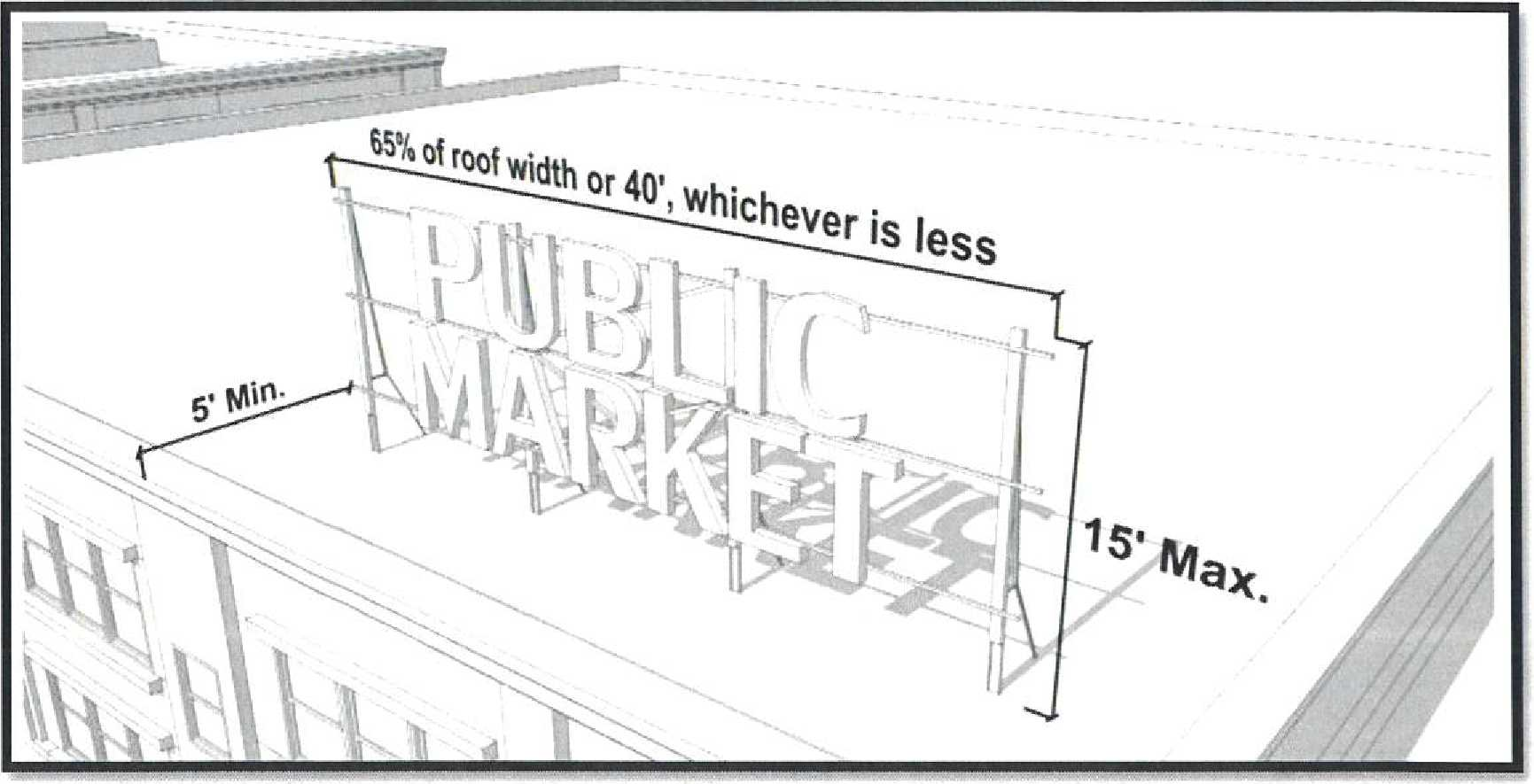
The size of the roof sign is limited to a height of fifteen (15) feet above the roof, including the support structure. The width of a roof sign is limited to sixty-five (65) percent of the roof level width or forty (40) feet, whichever is less.
c)
Roof signs shall be designed with channel letters/icons and the overall area shall be a minimum of forty (40) percent transparent.
d)
A maximum of one (1) roof sign is permitted per building. Roof signs shall only be installed on a flat roof.
e)
If a roof sign is erected on a building, a skyline sign is prohibited.
f)
Roof signs shall be safely and securely attached to the roof structure and cannot interfere with any roof access points.
g)
Roof signs shall only be internally illuminated.
6.
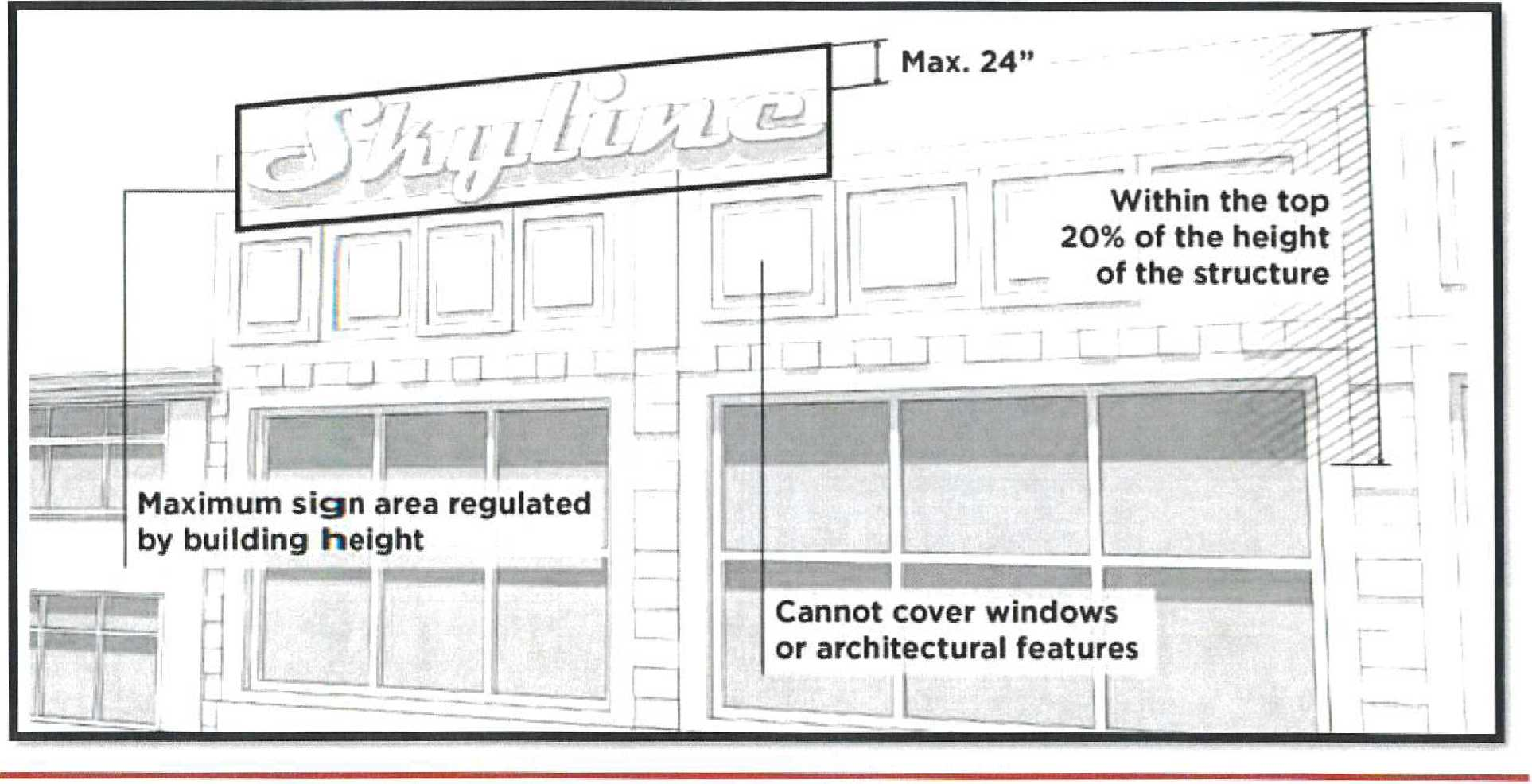
SKYLINE SIGNS:
1.
Skyline signs are permitted only for nonresidential buildings and multi-family dwellings of fifty (50) feet or more in height in the following zoning districts: Central Business District.
2.
The size of the skyline sign is limited as follows:
a.
Building height of fifty (50) feet to seventy-five (75) feet: Three hundred (300) square feet
b.
Building height of seventy-five (75) feet to one hundred (100) feet: Four hundred eighty (480) square feet
c.
Building height of one hundred (100) feet to two hundred (200) feet: Six hundred (600) square feet
d.
Building height of two hundred (200) feet to five hundred (500) feet: Seven hundred twenty (720) square feet
e.
Building height of greater than five hundred (500) feet: Eight hundred fifty (850) square feet
3.
One skyline sign is permitted per facade.
4.
Skyline signs shall be placed within the top twenty (20) percent of the height of the structure and cannot cover any windows or architectural features.
5.
Skyline signs may project up to twenty-four (24) inches above the roofline or parapet but shall be designed as a wall mounted sign and cannot be primarily supported by structures installed on the roof.
6.
If a skyline sign is erected on a building, a roof sign (item 5.f) above) is prohibited.
7.
Skyline signs shall only be internally illuminated.
8.
Sign proposals shall be evaluated and approved upon a finding that:
a.
The overall design and materials used in the construction of the sign are sympathetic to the historic character of the downtown; and/or
b.
The proposal represents an innovative way to achieve a sympathetic, quality design with materials and/or techniques that were not generally available in the past;
c.
The sign meets all other requirements of this section and of Chapter 12, Sign Regulations, except where in conflict with the requirements listed above.
9.
Awnings and hanging signs shall be allowed to protrude a maximum of five (5) feet from the building face over a public sidewalk, provided that the bottom edge of the awning or sign leaves at least eight (8) feet of vertical clearance from the sidewalk; and provided that the awning or sign come no closer than two (2) feet to the street pavement. Entryway canopies shall not be subject to the five-foot limit described herein; but all other rules shall apply.
10.
Stadium signage including all individual uses located as part of the stadium and advertising external and internal to the stadium will be reviewed by the Design Review Committee as part of an overall master sign plan and not be subject to the minimum size, number, and location requirements as listed herein and Chapter 12, Signs.
B.
Other Sign Considerations.
1.
Signs should be framed in stone, brick, wood, or ornamental metal. Vinyl lettering may be appropriate if attached to windows, but should be avoided as a lettering material on constructed sign faces. Constructed sign faces should have painted backgrounds, with contrasting painted letters, and a painted border framing the sign face.
2.
The sandblasting of sign panels to provide three-dimensional relief is not an historically accurate sign making technique, and should be avoided. However, such signs are generally considered preferable to plastic or vinyl sign faces.
3.
Three-dimensional ornamental metal lettering (bronze, wrought iron, copper, etc.) may be appropriate if directly attached to a building wall. Sheet metal, aluminum, and tin should be discouraged as a lettering material, as should flat metal lettering of any kind.
4.
Signs protruding from a wall should be attached with ornamental metal framing and support hardware.
(Ord. No. 11-589, § 1, 6-21-11; Ord. No. 18-672, § 2, 8-23-18; Ord. No. 24-813, § 1, 9-17-24)
SECTION 12.11 - SIGNS PERMITTED IN OVERLAY AND SPECIALTY DISTRICTS
A.
Properties within overlay districts 1—4 as listed below may have an interstate sign consistent with the requirements found in Section 12.5.4, regarding special sign requirements in the vicinity of four-lane divided limited access highway interchanges.
1.
Corridor Highway (CH) Overlay District: Signs shall be in accordance with the sign regulations for the underlying zoning districts.
2.
Gateway Corridor Overlay District:
a.
All freestanding signage shall be ground or monument. Signs shall follow the maximum sign height and area allowed for single and multitenant office developments in an office zone, regardless of the actual use.
b.
Attached signage shall be allowed per the underlying zoning district.
3.
Special Highway (SH) Overlay District:
a.
All freestanding signage shall be ground or monument. Signs shall follow the maximum sign height and area allowed for single and multitenant office developments in an office zone, regardless of the actual use.
b.
Attached signage shall be allowed per the underlying zoning district.
4.
State Park (SP) Zoning District: Irrespective of any other requirements contained in this Chapter, sign requirements for State parks shall be as determined by the State.
5.
Airport Zoning District: All freestanding signage shall be ground or monument. Signs shall follow the maximum sign height and area allowed for multitenant developments in a commercial zone, regardless of actual use. See Table 12.4-6 Dimension and Locational Standards For Signs Requiring A Permit - Commercial and Industrial Districts.
6.
Historic (HD) Overlay Districts: Certificate of appropriateness required.
(Ord. No. 22-762, § 2, 4-19-22)
SECTION 12.12 - OFF-PREMISE SIGNS
A.
Advertising Signs (Off-Premise Signs, "Billboards" or "Outdoor Advertising Signs.") No advertising sign shall be permitted within the city's zoning jurisdiction, except as provided under Section 12.8M of this Ordinance.
B.
Planned Non-Residential Multitenant Development Off-Premise Directional Signs.
1.
Purpose. In order to maintain the flow of traffic on thoroughfares and to promote vehicular safety, the number of points of ingress and egress on thoroughfares is limited. Certain planned non-residential multitenant developments therefore may not be directly accessible and visible by motorists traveling on thoroughfares. The purpose of the regulations is to give notice to the motorist of such developments and to promote the public health, welfare and safety.
2.
Signage Eligibility Criteria.
a.
Access to the development is made exclusively by local streets not designated as thoroughfares on the most recently adopted version of the thoroughfare plan of the Gaston Urban Area.
b.
The development is not visible by the motorist from any thoroughfare.
c.
The multitenant non-residential development is a conforming use in the zoning district in which it is located.
d.
A sign permit for the placement of such a sign shall be required. The signature of the applicant and the owner of whose property upon which the sign will be placed shall be required.
3.
Sign Specifications.
a.
One sign bearing the name of the development (and, if desired, the names of any uses within the development) may be erected.
b.
The sign is placed in the vicinity of the intersection of a nearby thoroughfare and another road which provides access to the development in a manner so as to direct motorists traveling from a thoroughfare to the development.
c.
The sign is constructed of wood, brick, or other decorative and nonreflective materials. The sign may be lighted by external sources only.
d.
The sign is a ground or monument sign.
e.
The sign is placed in an office (O), commercial (C), or industrial (I) zoning district.
f.
The sign has maximum area of forty-eight (48) square feet. For mixed-use multitenant developments with three hundred thousand (300,000) or more square feet of leasable space, the sign has a maximum area of two hundred (200) square feet.
g.
The owner or manager of the development must file a statement with the zoning administrator (upon issuance of the sign permit) that he will apprise all tenants of said signage regulations.
h.
Mixed-use multitenant developments with three hundred thousand (300,000) or more square feet of leasable space may maintain an off-premise sign within a local or collector (not a thoroughfare) street right-of-way within a median. In order to protect public safety through adequate travel lanes and unobstructed sight lines, the location, maximum length, and maximum width of the median shall be determined by the City of Gastonia. A sign permit (for a sign maintained within a public street right-of-way) may be granted only after a public hearing has been conducted by the City Council and the City Council has authorized the issuance of said permit.
C.
The Planning Commission may, upon application, permit any single or multitenant non-residential development not having direct access to a major or minor thoroughfare to have an off-site directional sign. Said directional sign shall be a ground sign, have a maximum size of sixteen (16) square feet, and may be allowed only upon the findings by the Planning Commission that one or more of the following factors create a situation whereby without said sign it will be difficult for the business located on a local or collector street to be identified from a major or minor thoroughfare:
1.
The property location;
2.
The finish elevation of said property; or
3.
Other factors that are unique to the property.
Said signs shall be set back at least ten (10) feet from the street right-of-way and be located outside of required site triangles. In no case shall an off-site directional sign be allowed within a residential zoning district (except RLD). Where said directional signs are permitted, the maximum size of any freestanding, onsite sign, shall be reduced by the amount of each off-site monument sign permitted. Said reductions shall apply to existing or proposed onsite identification signs. Included in the application submission, the owner/developer must indicate in writing that he is in agreement with said sign proposal including the reduction of the maximum allowance for the identification sign. The application shall also include permission from the property owner where the off-site directional sign is located.
D.
Off-Premises Residential Directional Monument Sign.
1.
Purpose and Applicability. Certain residential developments may not be directly accessible and visible by motorists traveling on thoroughfares. The purpose of this section is to provide for directional signage from a nearby thoroughfare during marketing of such developments in a manner that promotes the public safety, health and welfare while ensuring compatibility with surrounding land uses. In order for the Zoning Administrator to evaluate a proposed off-premises residential directional monument sign under the standards established herein the applicant shall provide drawings to scale of the plans and specifications of the sign to be erected. Such plans shall include, but not be limited to, details of the location, design, dimensions and material of the proposed sign, as well as proposed landscaping, if any is associated with the sign structure and location. Subject to all standards and requirements established herein, eligible signs may be placed in any commercial, office or industrial zoning district. Signs proposed either within a residential district or on a property immediately adjacent to a residential district shall require the issuance of a special use permit according to the procedures provided for such permits in Article IX of this Chapter.
2.
Only developments that meet the following qualification, placement and design requirements are eligible for an off-premises residential directional monument sign.
3.
Qualification Requirements.
a.
Residential developments of greater than two hundred fifty (250) dwelling units that do not have direct access to an existing thoroughfare (as designated on the most recently adopted version of the Official Gaston Urban Area Thoroughfare Plan) may be eligible for a maximum of one sign subject to all standards established herein. In no instance shall an eligible development have more than one off-premises residential directional monument sign.
b.
A statement signed by the owner of the parcel of property upon which the sign shall be located, consenting to and authorizing the location of the sign on the premises and the right of authorized City Officials or a designee to enter the property to remove a sign which is in violation of these regulations.
c.
A letter from either the City of Gastonia or the North Carolina Department of Transportation, whichever agency has jurisdiction over the road on which the sign is to be located, verifying that the sign will not be in violation of any local or State regulations at its proposed location.
d.
A statement of acknowledgement by the applicant that the applicant shall be responsible for the cost of removal of a sign for any reasons stated herein. (Signs permitted herein shall be removed by the applicant upon the issuance of eighty (80) percent of the certificates of occupancy for the development.)
e.
No development that has direct access to any existing thoroughfare (as designated on the most recently adopted version of the Official Gaston Urban Area Thoroughfare Plan) shall be eligible for any sign under this section.
4.
Placement Requirements.
a.
No portion of any sign shall be situated in such a way as to violate any public ordinances or regulation regarding sight distance or obstruction of vision at street intersections, nor shall any sign be located closer than ten (10) feet from the public right-of-way of any public street; however the City of Gastonia or N.C. Dept. of Transportation may require that the sign be located further than ten (10) feet from the public right-of-way based upon sight distance and safety needs.
b.
An off-premises residential directional monument sign must be located on a thoroughfare (as designated on the most recently adopted version of the Official Gaston Urban Area Thoroughfare Plan) and is only permissible on a lot at the corner of the intersection leading to the development being advertised. Only two (2) such signs are allowable at any given intersection each for separate developments and each located on opposite sides of the thoroughfare.
c.
The entrance to the development shall be no further than one mile along the street leading from the intersection where the off-premises residential directional monument sign is to be placed.
d.
No sign shall be placed in any manner that would obstruct any legally existing sign.
e.
No off-premises residential directional monument sign shall be located closer than five hundred (500) linear feet to any other similar directional sign on the same side of the thoroughfare.
5.
Design Requirements.
a.
All signs permitted under this section shall be monument (ground) style and shall be placed within a supporting structure finished with brick, stone, cultured stone, stucco, synthetic stucco or EIFS.
b.
The sign face may only contain the name and/or logo of the development and a directional element (such as an arrow). No additional copy is permissible on said sign.
c.
In evaluating the Special Use Permit, the Planning Commission and/or City Council shall take into consideration the character of the surrounding residential area in which the sign is to be placed.
d.
Lighting shall be by external sources only (light cast upon by an external source). In situations requiring a Special Use Permit, lighting shall be at the discretion of the body (Planning Commission or City Council) approving the Special Use Permit. Such lighting, if approved, shall be from external sources only and shall be evaluated with regard to external lighting characteristics in order to ensure that such lighting does not negatively impact adjacent properties. Decorative elements that are not part of the sign face, structure or height (including decorative lighting) may also be considered in the same discretionary manner as part of this Special Use Permit process.
e.
Dimensional Requirements.
i.
Maximum Sign Face Area: Twenty (20) square feet
ii.
Maximum Sign Supporting Structure Area: Sixty (60) square feet
iii.
Maximum Total Height of Sign (including supporting structure): Six (6) feet
(Ord. No. 09-576, § 1, 11-17-09; Ord. No. 21-739, § 1, 6-15-21)
SECTION 12.13 - HISTORIC SIGNS
A.
The zoning administrator shall have the authority to designate certain signs as historic signs based on the criteria stated below. An existing historic sign may be allowed to remain and a previously existing historic sign may be reconstructed, without counting towards the total sign square footage allowed for a property, when the following conditions are met.
1.
The sign was erected at prior to 12/21/74; and
2.
The sign will comply with the appropriate provisions of the North Carolina State Building and Electrical Codes; and
3.
The sign is an on-premise sign; and
4.
The sign is part of a building or property renovation endorsed by the State Historic Preservation Office, the sign exhibits unique or rare characteristics that enhance the building, streetscape, or the community at large, or the sign is an historic, mural type wall sign painted on the side of a building; and
5.
The historic nature of the sign is documented to the satisfaction of the Zoning Administrator.
B.
An historic sign shall be maintained in its original condition, shape and size, except for minor changes required for structural enhancements or changes required to comply with minimum electrical or building codes, or to remove portions from a public right-of-way. Where original materials are unavailable, substitute materials, which are as near as possible to the original, may be used.
C.
Once designated as an historic sign, the sign shall be deemed to be in compliance with the zoning regulations of this Chapter, however, designation as an historic sign does not prevent the zoning administrator from enforcing other, applicable provisions of the Zoning Ordinance. If the sign is moved on the premises, it shall be subject to the location standards of this Chapter.
D.
Any appeal of the Zoning Administrator's decision to designate a sign as historic shall be heard by the Board of Adjustment, where the burden of proof is on the applicant to show how the criteria are met.
SECTION 12.14 - SIGN FLEXIBILITY OPTIONS
A.
This Section contains provisions for sign bonus options, allowing greater sign area, or sign type, when specifications are met. The provisions of this Section apply to all zoning districts unless noted.
1.
The aggregate area of all wall signs per premises may be increased based on the distance the principle building is set back from the required front setback line. Said increase shall be in accordance with the following table:
B.
Where a freestanding sign is not used and/or permitted, a projecting sign may be substituted for part or all of the allowable wall signage per premises. A projecting sign shall not project more than four (4) feet from a building. In no instance shall a projecting sign extend into a street right-of-way, except in the CBD (where such extensions may be permitted subject to approval of the Subdivision Administrator).
C.
Where a freestanding sign is not used and/or permitted in the Urban Mixed Use District (UMU), a roof sign may be substituted pursuant to this section.
D.
Design review alternative.
1.
Purpose. The purpose of this Subsection is to provide functional flexibility, encourage variety, and create an incentive to relate wall signs, or unique sign type, to basic principles of good building design. This Subsection promotes the integration of signage and building facades and rewards design innovation and creativity. The goal is to create a better product, than would typically be provided through strict adherence to the signage requirements, by offering a voluntary procedure for building design review. This option encourages wall signage that is context sensitive to the building on which it is placed.
In order to provide such signage flexibility and incentives for well-designed buildings, provisions are hereby made to allow a review committee to approve an increase in wall sign square footage, or roof sign in the UMU zoning district, where external building features create an attractive wall face, reducing the negative impacts of larger signs. Such determination shall be made through a voluntary building design review submittal. Said flexibility shall be available for structures within commercial and industrial zoning districts, or as specifically identified within this section. Applicants are required to have a consultation with Planning Department staff before submitting a proposal for increased wall sign size.
2.
Process. All submittals shall be reviewed and approved by the city's Design Review Committee (DRC). The committee shall meet not more than ten (10) working days after submittal or re-submittal of a sign proposal. Actions of this committee may be as follows: approval of the sign as submitted, or rejection of the proposal with recommendations for design changes that would elicit favorable consideration upon re-submittal. Such actions shall also govern resubmittals. Appeals of any decision made by the committee shall be made to the Board of Adjustment at the first meeting following a 30-day period after the committee decision. The appeal shall be heard and processed pursuant to Section 5.13.
3.
Submittal. Applicants must submit, at a minimum, a detailed scale drawing of all building facade(s) including proposed building materials, colors to be used, and applicable dimensions (roof overhand and/or roof slope, wall height, etc.). Submittal shall also include sign dimensions, proposed placement on the building, copy, color, sign illumination plans, and all materials that are to be used in sign construction. In addition, committee members may require the submission of samples of materials proposed, if deemed necessary for proper review and consideration of the application.
4.
Review Criteria. When reviewing applicable building facades in association with wall sign size, or sign type, the following concepts are encouraged by the committee to create context sensitive signage:
a.
Building entrances should be articulated (recessed or protruding) from the main facade line sufficient to provide emphasis and variation to the building wall. Applicable building facades should have adequate openings (window and/or doors) to break up long expanses of building wall.
b.
Building facades should not include dominating architectural elements that are identified or associated with the particular franchise or chain and repetitive from community to community. Prototype franchise buildings are discouraged, whereas, creative design is encouraged.
c.
The primary external building materials should include one or more of the following: brick, brick veneer, ornamental split-faced concrete block or similar ornamental concrete masonry unit (CMU), stucco (synthetic or natural), stone or simulated stone/marble. Other materials such as vinyl, aluminum, and ornamental metals may be used as trim only.
d.
The use of subdued or earth tone colors and shades, such as beige, tan, rust, brown, and green, are encouraged in building facade materials. Bright colors typically used in franchise architecture are discouraged.
e.
All signs within a particular project shall be presented within a master sign program and should be coordinated in terms of design features and materials.
f.
Roof signs shall comply with the following:
i.
Roof signs are only permitted for nonresidential buildings or multi-family dwelling structure of 30-feet or more in height in the UMU zoning district.
ii.
Maximum sign height is 15-feet above roof, including the support structure. The width of a roof sign is limited to 65% of the roof level width or 40 feet, whichever is less.
iii.
Roof sign shall be designed with channel letters/icons and overall area shall be a minimum of 40% transparent.
iv.
A maximum of one roof sign is permitted per building on a flat roof only.
v.
A minimum of a five-foot setback is required from all building edges.
vi.
The roof structure and roof sign shall be engineered to ensure safe and secure installation.
vii.
Roof signs may only be internally illuminated.
5.
Approval Procedure. The committee, or Board of Adjustment upon appeal, may approve an increase in sign square footage, or sign type, for a particular structure only upon making the following findings in the affirmative:
a.
The building architecture and materials coordinated with the proposed wall or roof sign to create a context sensitive design solution consistent with the general purpose and intent of this subsection;
b.
The proposal will provide needed sign visibility to motorists and pedestrians visiting the facility;
c.
The proposal will enhance the aesthetics of the development and surrounding area and will not substantially injure the value of adjoining properties (as measured against the nonuse of the design review alternative);
d.
The proposal will not be detrimental to the public's health, safety, or welfare;
e.
Increases in sign area or sign type allowed by the design review alternative may be combined with those allowed in paragraph A but may not be combined with those allowed by the planned development flexibility option.
D.
Special Use Permit for Commercial Markers. In addition to any other signs allowed by this Chapter, the Planning Commission may approve a freestanding marker that incorporates a corporate logo in office and commercial districts (except CBD) after making certain findings. Only one marker shall be allowed per unified development. The Planning Commission shall conduct a design review to evaluate the aesthetics of the proposed marker, compatibility with the site, location on the property, and how much signage is actually gained for the business. The Planning Commission shall approve a commercial marker only after making the following findings in the affirmative:
1.
The marker is primarily made of natural materials, such as stone, brick, or wrought iron, and uses subdued colors to make the marker non-obtrusive. If the marker is a sculpture or other piece of art, metals may be used provided the glare from such marker does not endanger motorists or shine into adjoining residential areas.
2.
The corporate logo or sign copy for business identification does not exceed ten (10) percent of the marker face (area calculated same as for signage). This restriction shall not apply to sculpture or other pieces of art.
3.
The size of the marker and the business identification copy do not result in a significant increase in business signage that would give the business an unfair advantage over other nearby businesses, within or outside the multitenant development.
4.
The marker is set back ten (10) feet from the public right-of-way, outside required sight triangles, does not impair any ingress or egress, and does not fit under any of the categories of prohibited signs (i.e., Section 12-3).
5.
The lot containing the marker is not directly across a public street (excluding thoroughfares) from a residentially zoned lot.
The decision of the Planning Commission is appealable only to the superior court by writ of certiorari.
(Ord. No. 10-585, § 7, 8-17-10; Ord. No. 21-739, § 1, 6-15-21; Ord. No. 23-786, § 2, 6-20-23; Ord. No. 25-827, § 2, 3-4-25)
SECTION 12.15 - ELECTRONIC CHANGEABLE MESSAGE SIGNS
A.
Electronic Changeable Message Signs (ECMS) shall be permitted on freestanding (ground sign, monument sign or pole sign) on-premise business identification signs subject to the following limitations and requirements:
1.
The ECMS shall be part of the freestanding business identification sign or be allowed in lieu thereof, but in no case shall the square footage devoted to the ECMS exceed seventy-five (75) percent of the total allowed sign face area for any such free-standing business identification sign.
2.
ECMS on freestanding signs shall be allowed in certain zoning districts subject to certain location and land use restrictions as follows (the term "thoroughfare" shall mean a street or highway designated as such on the most recently adopted thoroughfare plan of the Gaston Urban Area):
a.
In all Commercial (C) districts except CBD, but not allowed along non-thoroughfare frontages opposite a Residential (R) Zone.
b.
In all Industrial (I) districts, but not allowed along non-thoroughfare frontages opposite a Residential (R) district.
c.
In all Office (O) districts along any thoroughfare frontage.
d.
In Residential (R) districts for schools, museums and churches/houses of worship.
3.
ECMS shall not be permitted on sites where existing freestanding signs are nonconforming unless such freestanding signs are made conforming to this Ordinance.
B.
In the Central Business (CBD) an ECMS is permitted for theaters, and other public event facilities (spectator sports facilities, civic and conference facilities), whether publicly or privately owned; and, said ECMS may be attached to the building or may be free-standing if at a location otherwise permitting a free-standing sign. Such ECMS shall be subject to the design review requirements of the CBD design review found in this Ordinance. Limits to the size, quantity, placement and other considerations of said ECMS, consistent with Section 7.11 shall be part of design review.
C.
In any Commercial (C), Industrial (I) or Office (O) district an ECMS, not exceeding six (6) square feet may be permitted behind a street-fronting window of any business where an ECMS is not used on a freestanding sign. In any Commercial (C) or Industrial (I) district an ECMS may be used on the motor fuel pump canopy for up to fifty (50) percent of the allowable signage for such structure, provided no ECMS is used on any freestanding sign and all other signage on the site conforms to this Ordinance.
D.
In no case shall any ECMS be permitted in any Historic District (HD) overlay zone.
E.
Each ECMS message shall be continuously displayed for a minimum of eight (8) seconds before changing to another message. No ECMS message (copy and/or image) shall be allowed to flash, animate, scroll, or otherwise move, or transition from one message to another in a moving manner except LED signs with electronically scrolled messages shall be allowed subject to the following restriction. Transition between scrolled messages shall be a period of no greater than two (2) seconds.
F.
Each ECMS or other sign employing the use of light emitting diodes (LED) for display shall be equipped with a control system that automatically adjusts light emission level to ambient light conditions so as to not cause glare or excessive brightness. In no case shall the light level of any such sign exceed five hundred (500) nits (candelas per 10.76 square feet) between the time of sunset and sunrise, nor five thousand (5,000) nits at other times (daytime).
G.
Any ECMS located within a Residential (R) district shall be operated or lit only between the hours of 7:00 a.m. and 10:00 p.m. and shall be equipped with an automatic timer control that assures compliance with this restriction.
(Ord. No. 11-589, § 1, 6-21-11; Ord. No. 12-616, § 1, 8-21-12; Ord. No. 13-622, § 1, 7-16-13; Ord. No. 18-675, § 2, 9-18-18)

