
Gastonia City Zoning Code
CHAPTER 3
APPLICABILITY OF ORDINANCE
SECTION 3.1 - RELATIONSHIP WITH OTHER ADOPTED PLANS
It is the intention of the City Council that this Ordinance implements the planning policies adopted by the governing board as reflected in existing and future adopted comprehensive plans and other relevant planning documents adopted by the governing board. While the governing board reaffirms its commitment that this Ordinance and any subsequent amendments to it be in conformity with such adopted plans, the governing board hereby expresses its intent that neither this Ordinance nor any amendment to it may be challenged on the basis of any alleged nonconformity with any adopted planning document in accordance with G.S. 160D-605(a).
(Ord. No. 21-739, § 1, 6-15-21)
3.2.1 - APPROVALS GRANTED BEFORE UDO EFFECTIVE DATE
A.
Building permits, variances, conditional/special use permits, preliminary or final subdivision plat approval, site plan approval, and other similar development approvals that were valid on August 18, 2009 shall remain valid until their expiration date. Development may be completed in accordance with such approvals, even if such building, development or structure does not fully comply with the provisions of this Ordinance. If building construction is not commenced and diligently pursued in the time allowed under the original approval or any extension granted, then the building development or structure shall meet the standards of this Ordinance at the time of re-application, except as outlined below.
For any development where subdivision construction documents were approved prior to the effective date of this Ordinance and the development is not completed, said development shall have two (2) years from the effective date of this Ordinance to show continuous progress toward installation of public improvements, such as the installation of water, sewer, stormwater, or street improvements. After the two-year time period, if ongoing construction activity ceases for more than a six-month time period, said subdivision construction documents shall be considered void and any new development application shall meet the standards of this Ordinance at the time of re-application.
Conditional Use Permits and Special Exceptions issued prior to June 19, 2020, the effective date of chapter 160D of the General Statutes of North Carolina, shall thereafter be deemed special use permits and any amendment or change thereto shall be in accordance with the procedures in Section 5.11 of this Ordinance.
B.
For any piece of property which immediately prior to the adoption of the Ordinance, had been zoned with a CD, parallel conditional district, the zoning designation for such property will remain unaltered until such time such zoning designation is amended pursuant to the procedure contained in Section 5.16. All development and land use standards associated with such CD parallel conditional districts under the former Zoning Ordinance shall apply to the piece of property in question even though such standards may be different from those contained in this Ordinance.
C.
Commensurate with the adoption of this Ordinance, certain CUD, parallel conditional use districts, were amended to CD, conditional districts, in a corresponding zone in this Ordinance. Other CUD districts were changed to a corresponding general use districts where the conditions associated with the CUD parallel conditional use district did not meet or exceed the minimum requirements for the corresponding general use district or served no meaningful purpose due to the existing development on the property.
(Ord. No. 21-739, § 1, 6-15-21)
3.2.2 - APPLICATIONS IN PROGRESS PRIOR TO UDO EFFECTIVE DATE
Building permits, variances, conditional/special use permits, preliminary or final subdivision plat approval, site plan approval, and other similar development approvals that were valid on November 20, 2009 shall remain valid until their expiration date. Development may be completed in accordance with such approvals, even if such building, development or structure does not fully comply with the provisions of this Ordinance. If building construction is not commenced and diligently pursued in the time allowed under the original approval or any extension granted, then the building development or structure shall meet the standards of this Ordinance at the time of re-application. In the event of amendments to this Ordinance which alter the standards and/or specifications and/or requirements of this Ordinance to an application pending a decision by the approval authority herein the applicant may be eligible for certain rights provided by G.S. 160D-108 and 160D-108.1 regarding vesting of rights and permit choice.
(Ord. No. 21-739, § 1, 6-15-21)
3.2.3 - VESTED RIGHTS
Vested rights and permit choice are inherent rights established by G.S. 160D and applied herein accordingly. Each approval procedure stipulated in this Article establishes criteria in accordance with G.S. 160D-108 and G.S. 160D-108.1 for ensuring due process in the vesting of rights to develop, use and enjoy real property in accordance with applicable standards & specifications. Notwithstanding the above, the provisions of this UDO shall not apply to:
A.
Property upon which a valid statutorily approved vested right (per G.S. 160D-108) on November 20, 2009 is in place as described in Section 5.10; or
B.
A judicially established common law vested right where (1) the owner has made substantial expenditures; (2) the expenditures were made in good faith; (3) the expenditures were made in reliance upon a valid governmental approval; and (4) the owner would be harmed without a vested right.
(Ord. No. 21-739, § 1, 6-15-21)
3.2.4 - VIOLATIONS CONTINUE
This Ordinance consolidates one or more previous stand-alone ordinances. Violations of those previous ordinances will continue to be a violation of this Ordinance and be subject to the violations and penalties provisions contained in Chapter 15 herein. The adoption of this Ordinance shall not affect any pending or future action to abate violations of previous Ordinances.
3.2.5 - NONCONFORMITIES
A.
Any nonconforming situation determined to exist under this Ordinance that lawfully existed under the previous zoning or subdivision Ordinance or any other Ordinance identified in Section 1.6 will also be considered to be a nonconformity under this Ordinance, so long as the situation that resulted in the nonconforming status under the previous Ordinance continues to exist.
B.
When a lot is used for a purpose that was a lawful use immediately prior to the effective date of this Ordinance, and this Ordinance no longer classifies such use as either a permitted or conditional use in the zoning district in which it is located, such use shall be considered a "nonconforming use" and shall be subject to the provisions of Section 3.3 of this Ordinance. Where any building, structure, or lot that legally existed on the effective date of this Ordinance and which does not meet all the standards set forth in this Ordinance, such building, structure or lot shall be considered "nonconforming" and shall be subject to the provisions of Section 3.3 of this Ordinance.
SECTION 3.3 - NONCONFORMING SITUATIONS
The purpose of this section is to regulate the continued existence of uses and structures established prior to the effective date of these regulations or any amendment subsequent thereto that does not conform to these regulations. Given the fact that the implementation of this UDO and previous zoning Ordinances has in the past and will in the future result in the creation of a number of nonconformities, some of which are viable uses which do not produce substantial negative impacts, this Ordinance allows the Administrator and the Board of Adjustment to issue permits for the expansion and or replacement of nonconforming uses and structures in certain situations.
3.3.1 - NONCONFORMING PRINCIPAL USES (EXCLUDING SINGLE- AND TWO-FAMILY RESIDENTIAL USES, MANUFACTURED HOMES, AND MANUFACTURED HOME PARKS)
A.
Nonconforming uses of land or structures, and nonconforming structures that contain nonconforming uses may continue only in accordance with the provisions of this Section.
B.
Normal structural repair and maintenance may be performed to allow the continuation of the nonconforming use.
C.
A nonconforming use may not be physically expanded through additions to the structure in which the nonconforming use is located (either principal or accessory structures).
D.
Reserved
E.
Once a nonconforming use has been changed to a conforming use, it shall not thereafter be used for any nonconforming use.
F.
If a nonconforming use becomes an abandoned use as defined in Chapter 2 of this ordinance it shall not be allowed to reestablish, except in conformance with this ordinance, and any new use on the property shall be conforming pursuant to Table 7.1-1, "Table of Uses."
G.
If a principal or accessory structure housing the nonconforming use is destroyed (i.e., receiving damage to an extent of more than fifty (50) percent of the structure's assessed tax value at the time of destruction), the structure may not be allowed to be rebuilt and to house the former nonconforming use.
(Ord. No. 21-739, § 1, 6-15-21)
3.3.2 - NONCONFORMING PRINCIPAL USE—MANUFACTURED HOMES (NOT LOCATED WITHIN A MANUFACTURED HOME PARK)—SEE 8.1.8 FOR MANUFACTURED HOME PARKS
A.
A nonconforming manufactured home not located within a manufactured home park may be replaced by another manufactured home under the following conditions:
1.
The manufactured home was the only principal residential structure on the lot. If more than one principal residential structure is located on the lot, any manufactured home removed may not be replaced;
2.
The manufactured home to be replaced was occupied for at least ninety (90) of the one hundred eighty (180) days immediately preceding the date of replacement);
3.
The replacement manufactured is placed on the property within ninety (90) days following removal of the existing manufactured home;
4.
The replacement manufactured home must meet each of the yard requirements of the R-20 district or the district in which the lot is located, whichever is greater; and
5.
If the nonconforming manufactured home is a class A manufactured home, the replacement manufactured home shall be a class A; if the nonconforming manufactured home is a class B manufactured home, it may only be replaced by a class A or B; if the nonconforming manufactured home is a class C or D manufactured home, it may be replaced by a class A, B, or C manufactured home only.
B.
Normal structural repair and maintenance on the manufactured home may be performed. A nonconforming manufactured home cannot be expanded, except: (i) to bring the structure into compliance with the local government's minimum housing code; or (ii) for the placement of external appurtenances such as decks, porches, stairs, etc. Accessory structures may be placed on the lot in association with the manufactured home, so long as the yard requirements and all other applicable criteria for the placement of accessory structures contained in Section 9.9 are met.
C.
Once a nonconforming manufactured home has been removed from the property (except as provided by Sections 3.3.2(A) or (D)), it may not be replaced.
D.
If the nonconforming manufactured home is destroyed (i.e., receiving damage to an extent of more than fifty (50) percent of the structure's assessed tax value at the time of destruction), the manufactured home may not be replaced.
3.3.4 - NONCONFORMING PRINCIPAL USE—SINGLE OR TWO-FAMILY DWELLINGS (OTHER THAN MANUFACTURED HOMES)
A.
Nonconforming single- and two-family residential principal and accessory structures (other than manufactured homes) may be continued in accordance with the provisions of this Section.
B.
Normal structural repair and maintenance may be performed to allow the continuation of the nonconforming use.
C.
A nonconforming single- or two-family dwelling may be physically expanded (through additions or expansions of the principal or accessory structures) so long as the addition or expansion does not increase the number of dwelling units and so long as the front, side and rear yard requirements of the underlying zoning district, or the RS-8 district, whichever is more restrictive, are met. If any of these yard requirements cannot be met, the expansion may only occur through the issuance of a Special Use Permit by the Planning Commission in accordance with all applicable provisions of Section 5.11.
Notwithstanding, such Special Use Permit may only be issued by the Planning Commission for an expansion of an existing nonconforming structure if that expansion does not extend any closer to a property line than the existing structure and the expansion into a required yard setback does not more than double the area of encroachment already existing within that required yard setback. (Refer to Figure 3.3.4-1 below for an example of how this is to be interpreted.) Any occupation of additional lands beyond the boundaries of the lot on which the nonconforming use is located shall be prohibited.
Figure 3.3.4-1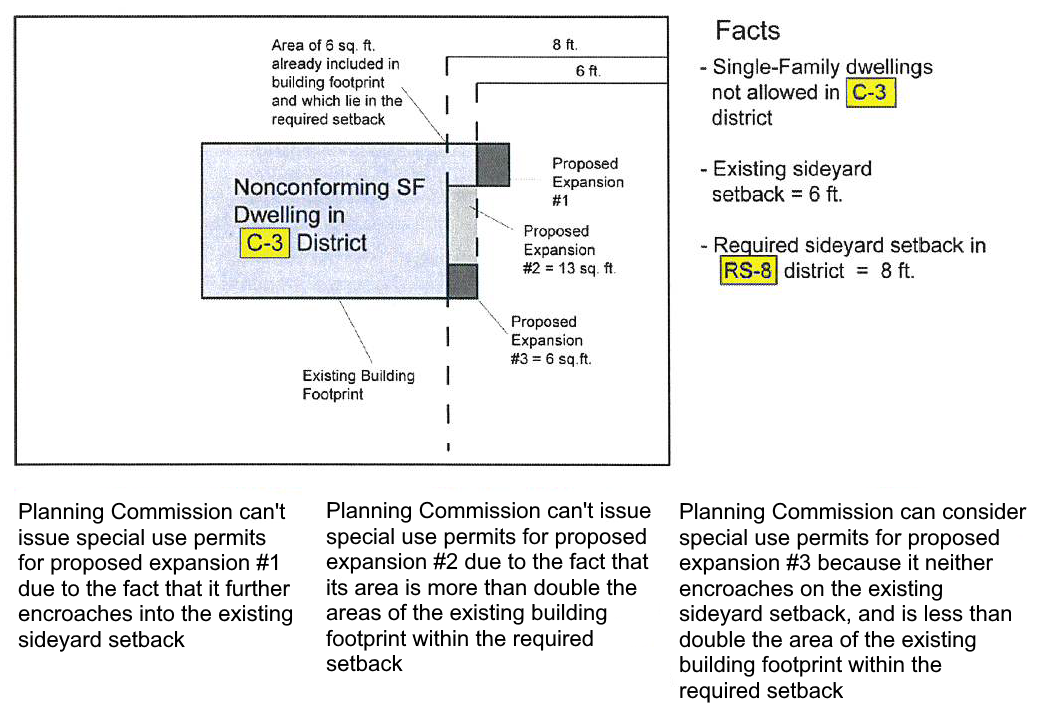
D.
Once a nonconforming single- or two-family dwelling has been changed to a conforming use, it shall not thereafter be used for any nonconforming use.
E.
If a nonconforming single or two-family dwelling use becomes an abandoned use as defined in Chapter 2 of this Ordinance it shall not be allowed to reestablish, except in conformance with this Ordinance, and any new use on the property shall be conforming pursuant to Table 7.1-1, "Table of Uses."
F.
If said principal or accessory structure is destroyed, the residential structure may be allowed to be rebuilt in accordance with a permit issued by the Administrator per Section 3.3.5(C). Application for such permit must be made within one year of the date of destruction.
(Ord. No. 25-827, § 2, 3-4-25)
3.3.5 - OTHER NONCONFORMING PRINCIPAL STRUCTURES
A.
Normal repair and maintenance may be performed to allow the continuation of nonconforming structures.
B.
An existing nonconforming structure may not be enlarged or altered in a way that increases its nonconformity.
C.
If such nonconforming structure is damaged, it may be rebuilt only after the issuance of a permit from the Administrator. Application for such permit shall be made within one year of destruction. In the issuance of said permit the Administrator shall follow these standards:
1.
If the foundation for the replacement structure is moved or removed, the structure shall be rebuilt in as conforming a manner as possible. If the original foundation is used, the structure may be rebuilt at that same location on the lot.
2.
A nonconforming structure shall not be rebuilt in a manner that increases its nonconformity.
3.
A structure rebuilt in accordance with this subsection shall not have a gross floor area larger than the structure it replaced unless all setback and related requirements (e.g., landscaping, parking, etc.) are met for the zoning district in which it is located.
4.
If the rebuilt structure is still nonconforming, the developer will be asked to meet, to the greatest degree feasible, each of the following requirements for that use:
a.
Buffer yard requirements, per Section 11.3.
b.
Off-street parking requirements, per Chapter 10.
c.
Landscaping and street yard tree requirements, per Section 11.4.
5.
Greatest priority will be given by the Administrator to satisfying said buffering requirements, followed in decreasing levels of priority by said off-street parking requirements and said landscaping and street tree requirements. The Administrator shall have the authority to waive and/or modify any of said requirements, on a case-by-case basis, in order to best accommodate that development with respect to the lot upon which it is located and surrounding land uses and development patterns.
6.
If the application to rebuild is submitted more than one year after the date of destruction, the structure may be built only in accordance with all requirements of this Ordinance.
D.
Should a nonconforming structure be moved for any distance on the lot upon which it is located, whenever possible, it shall be moved so as to make the structure conforming. Otherwise the structure, if moved, shall be placed on the lot in a manner as conforming as possible.
(Ord. No. 21-739, § 1, 6-15-21)
3.3.7 - NONCONFORMING LOTS
A nonconforming vacant lot may be developed for any of the uses permitted by this Ordinance in the zoning district in which it is located, provided that the use meets all applicable yard, bulk, and dimensional requirements for that zoning district.
Notwithstanding, in any zoning district where, prior to the effective date of this Ordinance (1) a lot was recorded in a subdivision whose plat was filed with the Gaston County Office of the Register of Deeds; (2) such lot was not in violation of the City Zoning Ordinance or Subdivision Ordinance in effect at the time of adoption of this Ordinance; and, (3) such lot does not comply with this Ordinance's minimum lot area and/or width requirements for the zoning district in which such lot is located, then such lot may be used for any use permitted in that zoning district. In addition, the Administrator may use the front, side, and rear yard setbacks for principal structures as they appear on the recorded final plat in order to conform any additional or expanded principal structures on the lot in question.
3.3.8 - NONCONFORMING SCREENING AND LANDSCAPING
In accordance with Sections 11.3 and 11.4 of this Ordinance, certain uses are required to provide screening and/or landscaping on-site. Except as herein provided, an expansion of an existing use which is deficient in screening and/or landscaping or a change in principal use cannot occur without the required screening and/or landscaping having first been provided on site. The requirements for providing such screening and/or landscaping may be waived or modified by the Administrator under any of the following situations:
A.
Screening requirements shall be waived when the new principal use is a permitted use (i.e., use by right) in the same zoning district as the former principal use. Notwithstanding, if the new principal use is established within one year of the property in question being rezoned to a more restrictive general district or conditional district, said screening requirements shall not be waived.
B.
Screening requirements may be waived on a one-time basis for any principal use (or for a shopping center, office park, or other multi-tenant development), where building expansion of up to ten (10) percent (or up to five (5) percent if adjacent to a residential zoning district) occurs.
3.3.9 - NONCONFORMING OFF-STREET PARKING AND/OR LOADING
A.
On any lot which contains a use which does not comply with the off-street parking and/or loading regulations contained in Section 10.5 of this Ordinance, a certificate of occupancy shall not be issued for any expansion (except as provided in Section 3.3.9(B)) or any change of use, either of which would result in a need to increase the number of off-street parking and/or loading spaces required (except as herein provided), until the off-street parking and paving requirements have been met.
B.
A certificate of occupancy may be issued when there has been a change in a principal use and the number of off-street parking spaces required for the new use (per Chapter 10 of this Ordinance) is within ten (10) percent or ten (10) spaces, whichever is less, of the number of off-street parking spaces actually provided.
C.
Reserved
D.
Any use that is nonconforming with respect to off-street parking and which is destroyed (i.e., receives damage to an extent greater than fifty (50) percent of its assessed tax value at the time of destruction) may be rebuilt so long as the number of off-street parking spaces is not reduced and the zoning permit application for reconstruction is submitted to the Administrator within one year of the date of destruction.
(Ord. No. 21-737, § 2, 5-18-21; Ord. No. 21-739, § 1, 6-15-21)

