
Gastonia City Zoning Code
CHAPTER 9
GENERAL PROVISIONS
SECTION 9.1 - CUSTOMARY HOME OCCUPATIONS
The following regulations shall apply to all "customary home occupations" irrespective of the underlying general zoning district.
A.
Customary home occupations may be established in any principal dwelling unit. Customary home occupations shall be incidental to a residential unit and shall not be considered a substitute to traditional retail establishments that rely on a substantial amount of walk-in traffic. Customary home occupation requirements shown herein shall apply in addition to all other applicable requirements of this Ordinance for the district in which such principal dwelling unit is located.
B.
The home occupation shall be clearly incidental and subordinate to the residential use of the dwelling and shall not change the exterior residential character of the dwelling.
C.
No outside storage of materials or equipment shall be allowed in connection with the customary home occupation except as noted in this paragraph. Said requirement shall not be applicable to swimming instructions given in an outdoor swimming pool. For lawn and garden services, storage of equipment must be obscured from view from the public street and adjoining properties via a blind fence or by storing equipment in an accessory structure (no home occupation activity shall occur in such accessory structure).
D.
Use of the dwelling for the home occupation shall be limited to either twenty-five (25) percent of the gross floor area of the principal structure or seven hundred fifty (750) square feet, whichever is smaller.
E.
The operator of the customary home occupation must reside on the same lot as where the customary home occupation takes place. Only residents of the dwelling may engage in the customary home occupation with the following exception: one nonresident, engaging in work ancillary to the customary home occupation (e.g., a receptionist), may report to work at the dwelling. Otherwise, no other nonresidents shall be allowed to report to work at the dwelling to engage in the same or nearly the same customary home occupation.
F.
No products, goods, materials, or equipment associated with the customary home occupation shall be visible from any adjoining street or properties. All such products, goods, materials or equipment shall be stored within the residential dwelling unit or in an accessory structure per sub-section D above. On-premise sales of products are limited to those made or reconditioned on the premises and those that are necessary to the service being provided.
G.
No external alterations inconsistent with the residential use of the dwelling shall be permitted.
H.
Only vehicles used primarily as passenger vehicles (i.e., passenger automobiles, passenger vans and passenger pickup trucks) shall be permitted in connection with the conduct of the customary home occupation. No more than two (2) vehicles shall be used in conjunction with the customary home occupation. Parking in association with the customary home occupation shall only take place in the driveway or garage.
I.
Chemical, mechanical, or electrical equipment or any other activity associated with the customary home occupation that creates odors, light emission, noises, or interference in radio or television reception detectable outside the dwelling (with the exception of swimming pool lessons) shall be prohibited.
J.
Hours of operation shall be anywhere from 7:00 a.m. to 9:00 p.m. only.
K.
Instruction in music, dancing, and similar subjects shall be limited to a maximum of two (2) students at a time (including the number of persons waiting on the property to receive such instruction).
L.
Signs for customary home occupations shall be as followed:
1.
The sign shall be a ground sign or placed flush against the wall of the principal dwelling unit;
2.
The sign shall have a maximum area of four (4) square feet;
3.
No more than one sign per customary home occupation shall be allowed;
4.
The sign shall not be illuminated.
5.
If freestanding, the sign shall be a suspended sign.
M.
In no instance may an automobile repair shop, automobile body shop, fortuneteller, animal grooming establishment, tanning and nail salon, pest control service, small engine repair and services, retail sales operations, wholesale sales operation with on-site delivery and storage of goods, or a retail florist be conducted as a customary home occupation.
N.
Home occupations shall be limited to or be similar to the following uses: artist's fine arts studio; handmade artisan crafts such as pottery, jewelry, and quilting; barber/beauty shop, building specialty trades and contractor's office, cleaning and maintenance service office, computer and data processing service office, consultant's office, detective's office, doctor's and lawyers office limited to two (2) patients or clients at one time; dressmaking, sewing, tailoring and drapery maker; engineer, architect, drafter or surveyor office; floral service with no on-premise sales; food catering and preparation service for off-site consumption; furniture upholstery and interior antique restoration and repair; home electronics repair; instruction in the fine arts; insurance agent, interior decorator; Internet and mail order business with no on-site delivery, storage, or shipping of goods; locksmith; lawn and garden services; martial arts instructor; massage therapist; message and errand service; real estate agent; stock or security brokers; swimming pool service; tax preparation service; telephone answering service; offices for building contractors and building specialty trades; and writer or journalist.
O.
The Administrator shall have the authority to allow a customary home occupation that is not listed above, provided the Administrator determines that the use will be harmonious with all existing and potential nearby residential uses and meets all of the performance criteria associated with customary home occupations listed herein.
SECTION 9.2 - SATELLITE DISHES
Satellite dishes having a diameter of greater than 39.37 inches which are located in a residential (R) zoning district shall be located in the rear yard only and shall maintain a five-foot setback from all side and rear lot lines. The zoning administrator may allow the dish to be located on a roof; within the side or front yard; or within five (5) feet of a lot line in the rear yard, if he first determines that:
1.
The satellite dish cannot feasibly be located and be operated efficiently if located where normally allowed;
2.
The proposed site would have the least impact on adjacent properties; and
3.
Where no other ground location will enable reception to be received, the zoning administrator may allow for the placement of the satellite on the roof.
If the zoning administrator allows the placement of a satellite dish in a front or side yard, landscaping will be required along the antenna's nonreception window axes. Such treatments along the nonreception window axes shall consist of evergreen plantings designed to create an opaque screen within five (5) years.
(Ord. No. 25-827, § 2, 3-4-25)
SECTION 9.3 - BOUNDARY STRUCTURES
A.
Boundary structures are permitted in any zoning district provided that no portion of the structure, including footings, extends into or over any easement, right-of-way, or property line. The maximum height of a boundary structure shall be twelve (12) feet including all columns, light fixtures or other ornamentations, but excluding berms. A "boundary structure" shall not be considered a "fence or wall" and shall not be subject to the requirements of Section 9.4.
B.
All boundary structures shall require the submittal of a site plan in accordance with Section 5.2.
C.
Boundary structures shall be subject to sight distance triangle provisions contained in Section 9.7.
SECTION 9.4 - FENCES OR WALLS PERMITTED
Except as otherwise noted, fences or walls (NOTE: A boundary structure (as herein defined) shall not be considered a wall and shall be governed per Section 9.3 above) are permitted in the various districts subject to the following regulations:
9.4.1 - RESIDENTIAL DISTRICTS
A.
No fence or wall located in any front yard setback shall be built to a height greater than four (4) feet above grade except as provided in subsection C. Notwithstanding this provision, when the zoning administrator finds that there exists an unusual or extraordinary circumstance where an overwhelming public interest is served by allowing additional height to protect a residential use from the potential negative impacts of non-residential uses, he may permit a height of up to ten (10) feet above grade for such fences.
B.
No fence or wall located in the side or rear yard shall be greater in height than eight (8) feet above grade height in the rear yard except as provided subsection C. Notwithstanding this provision, when the zoning administrator finds that there exists an unusual or extraordinary circumstance where an overwhelming public interest is served by allowing additional height to protect a residential use from the potential negative impacts of non-residential uses, he may permit a height of up to twelve (12) feet above grade for such fences.
C.
Any fence or wall serving as a retaining wall shall be solid cement, masonry or wood and be constructed to the standards of the City of Gastonia.
D.
Any fence or wall constructed within a sight distance triangle must conform to the regulations contained in Section 9.7.
E.
No fence or wall shall be constructed within a general drainage or utility easement which will block or materially impede the flow of stormwater runoff.
F.
Electric fences, except for livestock protection fences, shall be prohibited. Invisible pet fences are not considered "electric."
G.
A finished side of all walls or fences shall face the common property line boundary.
(Ord. No. 12-608, § 4, 4-17-12; Ord. No. 12-617, § 3, 8-21-12)
9.4.2 - ALL OTHER DISTRICTS
A.
Within all required setbacks the maximum height of a fence or wall shall be 12 feet except as provided in Subsection C.
B.
No electrical fences except livestock protection fences shall be permitted. Other allowances for electrified fences in certain non-residential districts are set forth in subsection H of this section.
C.
Any fence or wall constructed within a sight distance triangle must conform to the regulations contained in Section 9.7.
D.
No fence or wall shall be constructed within a general drainage or utility easement which will block or materially impede the flow of stormwater runoff.
E.
Any fence or wall serving as a retaining wall shall be solid cement, masonry or wood and constructed to the standards of the City of Gastonia.
F.
Any fence or wall constructed within the CBD zoning district must conform to the regulations contained in Section 7.11.H.7.
G.
Any fence or wall constructed within the UMU zoning district must conform to the regulations contained in Section 7.12.H.7.
H.
Low-Voltage Electrified Fencing.
Low-voltage electrified fencing with a maximum of twelve (12) volts DC, primary voltage, is allowed in any Industrial district or in the C-3 (General Commercial) district, provided that:
1.
An electrified fence may not exceed ten (10) feet in height or two (2) feet above the adjacent non-electrified fence;
2.
An electrified fence must be inside of or enclosed by a non-electrified fence or wall with a minimum height of five (5) feet;
3.
The entire electrified fence must be installed per manufacturer's installation instructions;
4.
The electrified fence must be identified by a warning sign displayed at the rate of at least one sign per thirty (30) linear feet of fencing; and
5.
A Knox Box shall be required and installed per the standards and direction of the Fire Department.
(Ord. No. 14-632, § 11, 8-19-14; Ord. No. 22-757, § 1, 1-18-22)
9.4.3 - CORRECTIONAL FACILITY; PUBLIC UTILITY STRUCTURES
There shall be no maximum height for any fence located within the required setback of any correctional facility or for any public utility structure.
SECTION 9.5 - LOT TO ABUT A DEDICATED STREET; MINIMUM LOT WIDTHS
A.
No lot may be created after the effective date of this Ordinance that does not have at least forty (40) feet in all zoning districts, except CBD, of publicly maintained street (or privately maintained street approved through the subdivision regulations contained in Chapter 13) frontage except as follows:
1.
Lots within a planned shopping center or office park or other planned multi-tenant development of a nonresidential nature; or
2.
Lots within a condominium, townhome, patio home, duplex or an infill residential development are addressed below:
A.
Lots within a condominium complex are exempt from frontage requirements.
B.
Townhome/patio home/duplex/infill residential development lots may have reduced frontage as prescribed in Chapter 8 and as approved by the Administrator.
3.
Conditionally rezoned districts may be eligible for this exception if the approved rezoning site plan shows a platted public street access or a public access easement to the lot or parcel, as reviewed and authorized by the Administrator.
B.
A single-family dwelling (or manufactured home, where allowed) may be constructed or placed on a lot that was platted and recorded on or before the effective date of this Ordinance which does not abut a dedicated street right-of-way provided the lot is given access to a dedicated street by an easement at least twenty (20) feet in width for the use of the dwelling established on such lot and further provided that such easement is maintained in a condition passable for automobiles and service and emergency vehicles. This easement may not be extended to provide access to any other lots nor to any other residence not having frontage on a dedicated street.
(Ord. No. 21-735, § 6, 3-16-21; Ord. No. 25-827, § 1, 3-4-25)
SECTION 9.6 - ONE PRINCIPAL BUILDING OR USE PER LOT
A.
No more than one principal building devoted to a residential use shall be located on a lot, except as (i) part of a multifamily development, or (ii) planned residential development, or (iii) as private residential quarters per Section 9.10, or (iv) as a temporary manufactured home as provided in Section 5.8.4(H), and (v) where otherwise specifically allowed in this Ordinance.
B.
More than one principal building devoted to a nonresidential use may be located on a lot provided that an access way at least twenty (20) feet wide is maintained from a public street to each building for use by service or emergency vehicles. Each building on the lot shall otherwise be separated from any other building by a distance of at least ten (10) feet.
C.
A lot may not contain a principal nonresidential use and one or more residential dwelling units except in accordance with the regulations governing mixed-use dwellings and planned developments except as may otherwise be permitted by this Ordinance. This provision shall not apply to buildings associated with agricultural uses, where such use is permitted.
D.
Only one principal nonresidential use per lot shall be allowed except as part of a planned shopping center, office building, or similar planned multitenant development as permitted by this Ordinance. Such regulation shall be applicable only to developments occurring on or after the effective date of this Ordinance.
SECTION 9.7 - SIGHT DISTANCE TRIANGLES
1.
On corner lots in any zoning district (except the CBD, UMU and the Revised Residential Development District * ) there shall be no obstruction to vision, except for natural grade, between a height of two (2) feet and a height of ten (10) feet measured above the average elevation of the existing surfaces of the intersecting streets as follows:
* Note: See Section 8.1.11 for standards related to the Revised Residential Development District.
A.
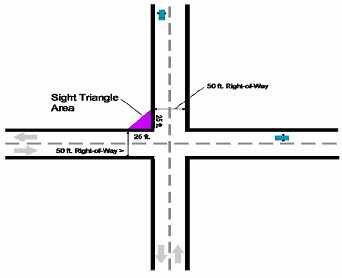
On property lines abutting streets with fifty (50) feet or less in right-of-way width or local streets serving local traffic (i.e. streets other than major or minor thoroughfares), the points on the property lines shall be at least twenty-five (25) feet from the lot corner.
Figure 9.7-1
B.
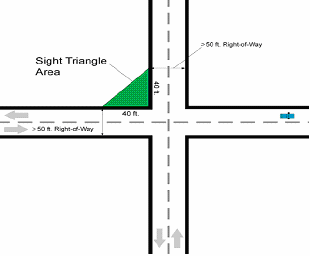
On property lines abutting streets with more than fifty (50) feet in right-of-way width, the points on the property lines shall be at least forty (40) feet from the lot corner. Refer to Figure 9.7-1.
Figure 9.7-2
C.
Where the intersection involves two (2) roads, one with a right-of-way with greater than fifty (50) feet and the other with a right-of-way of less than fifty (50) feet, the more stringent sight triangle shall apply.
Figure 9.7-3
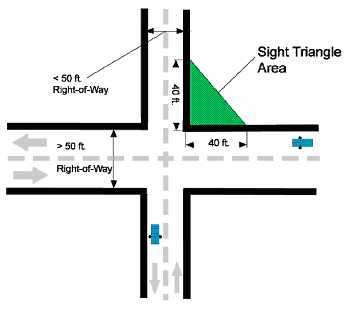
Note: The above illustrations show the typical application of sight triangles for a standard right of way. The City Traffic Engineer shall make a determination for non-typical right of ways and equivalent sight distance may be required.
D.
On roads that are maintained by NCDOT, NCDOT requirements shall prevail. This sight triangle must be shown at all connections to a state-maintained roadway, regardless of street or driveway classification or dimension, and is located on each side of the approaching street or driveway.
2.
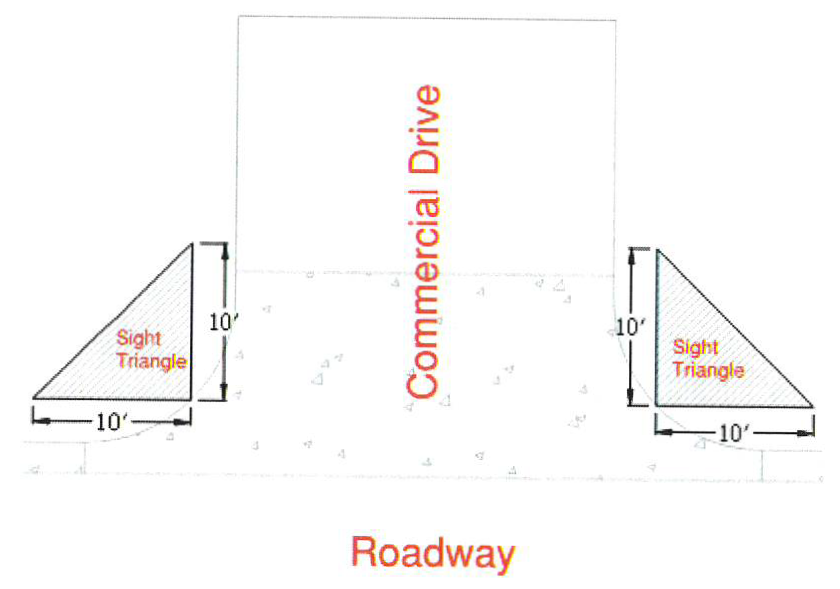
Commercial Driveways - Smaller sight triangles will be required to allow drivers to see pedestrians on sidewalks, shall be 10' x 10' and are required at all commercial driveways. The triangle shall be measured from the midpoint of the curb along the face of the curb. See NCDOT requirements for driveways intersecting with NCDOT maintained roadways.
(Ord. No. 14-632, § 12, 8-19-14; Ord. No. 21-748, § 3, 10-19-21)
SECTION 9.8 - HEIGHT AND YARD EXCEPTIONS
A.
Building height requirements are indicated in Table 7.1-2. Exceptions to these requirements are found in Section 7.6.
B.
Front yard requirements are indicated in Table 7.1-2. Exceptions to these requirements are as follows:
On through lots, the required front and rear yard setbacks shall each equal or exceed the greater required front or rear yard setback that would normally be applied in that zoning district. For example, if a through lot were located in a zoning district which normally required a 30-foot front setback and a 35-foot rear setback, both front and rear setbacks would each have to be a minimum of thirty-five (35) feet. Accessory structures may generally only be placed on through lots in the rear yard. The front yard shall be determined based on the architectural front of the proposed structure and other structures on the same block and side of the street. On through lots within commercial zoning districts, the required front and rear yard setbacks may be reduced by ten (10) feet. For example, if a through lot were located in a commercial zoning district which normally required a 30-foot front setback and a 20-foot rear setback, both front and rear setbacks on a through lot may be reduced to a minimum of twenty (20) feet. Where setback relief is granted opposing a residential lot, street trees shall be installed along said property boundary according to Section 11.4. Notwithstanding the above, the setback provisions within the TH thoroughfare overlay districts shall remain unchanged.
SECTION 9.9 - ACCESSORY STRUCTURES AND USES
A.
Within any zoning district, accessory structures shall be located as follows:
1.
No portion of any accessory structure (except mailboxes, light poles, water wells, newspaper boxes, walls, fences, birdhouses, flag poles, pump houses, and bus shelters) shall be located within any front yard on lots less than one acre in area. Mailboxes, light poles, water wells, newspaper boxes, walls, fences, birdhouses, flag poles, pump houses, and doghouses may be located in any front, side or rear yard. Bus shelters may be located in any required front yard setback. On lots of one acre in area or greater, accessory structures may be located in the front yard, a minimum of one hundred fifty (150) feet from the edge of the street right-of-way line.
2.
Accessory structures are allowed in any side yard or required side yard setback provided that no accessory structure shall be allowed within five (5) feet of any principal structure and five (5) feet of any rear or side yard line.
3.
Accessory structures are allowed in a rear yard or required rear yard setback provided that no accessory structure shall be allowed within five (5) feet of any principal structure and five (5) feet of any rear or side yard line. Except in the CBD, UMU, and local historic districts, if located on a corner lot, an additional ten-foot setback shall be required as measured from any exterior lot line (facing the street). In cases where a nonresidential use abuts a lot in a residential district, a minimum side or rear setback of twenty (20) feet from the adjoining residential district lot line shall be required.
4.
On any lot less than one acre in area containing a principal single-family or two-family dwelling, the cumulative area of all accessory structures (excluding outdoor swimming pools and structures with less than three (3) sides) shall not exceed one-half (½) the heated ground floor area of the principal structure or eight hundred (800) square feet, whichever is greater.
On any lot having an area of between one to three (3) acres, the cumulative area of all accessory structures (except outdoor swimming pools and structures with less than three (3) sides) shall not exceed one-half (½) the heated ground floor area of the principal structure or one thousand two hundred (1,200) square feet, whichever is greater.
On any lot containing an area of over three (3) acres, the cumulative area of all accessory structures (except outdoor swimming pools, structures with less than three (3) sides, barns, stables and private residential quarters) shall not exceed four (4) percent of the total lot acreage.
5.
On any lot one acre or less in area containing a principal residential use, the number of accessory structures (other than a carport or garage) shall be limited to two (2). On any lot greater than one acre in area containing a principal residential use, the number of accessory structures (other than a carport or garage) shall be limited to three (3).
6.
Exceptions to the setback requirements sited above may be made per Section 5.15.1(B) of this Ordinance. Notwithstanding, all swimming pools, pumps, filters and pool water disinfection equipment installations shall not be located in any front or required side yard. Such distances shall be measured from the property line to the water's edge.
7.
In no case may an accessory structure be placed in a general drainage or utility easement without prior approval by the Administrator.
8.
With the exception of accessory structures in association with an agricultural use, the height of an accessory structure shall not exceed the height of the principal structure.
9.
All outdoor in-ground swimming pools shall be enclosed completely by a fence. Fences shall meet the requirements found in appendix G, barrier requirements, of the North Carolina Residential Code.
B.
On any lot containing a principal residential use, no accessory structure shall be permitted that involves or requires any external construction features which are not primarily residential in nature or character except for an accessory structure used in conjunction with a mixed-use dwelling, temporary produce stand, agricultural use, or similar nonresidential use that otherwise would be allowed on the property. Accessory structures on lots containing a principal residential use shall not be made of highly reflective metal materials. Some examples of structures that cannot be used as an accessory structure to a residential use include: school buses, manufactured homes, tractor-trailers (with or without wheels), buses, recreation vehicles, cargo containers, etc.
Any structure which exceeds five hundred (500) square feet in gross floor area shall be finished externally with materials that are similar in nature to the external materials found upon the principal structure. (However, nothing in the preceding sentence shall be construed so as to require a masonry accessory structure for a masonry principal residence.)
C.
No accessory structure shall be constructed or placed on a lot prior to the issuance of a zoning permit or certificate of occupancy for the principal use or structure on the same lot.
D.
Minor modifications to the size of accessory structures are provided for in Section 5.15.1.B.
E.
Certain accessory uses have performance criteria that must be met in order for that use to be conducted. Any accessory use that is listed as a "conditional use" in Table 7.1-1 shall require the issuance of a special use permit per Section 5.11. If such use is listed in Table 7.1-1 as not being permitted in a certain zoning district, that use (either as a principal or accessory use) shall not be allowed in that zoning district.
(Ord. No. 14-632, § 13, 8-19-14; Ord. No. 21-739, § 1, 6-15-21; Ord. No. 24-812, § 1, 8-20-24)
SECTION 9.10 - PRIVATE RESIDENTIAL QUARTERS
Private residential quarters shall be permitted as an accessory use to any single-family detached dwelling unit (excluding manufactured homes) in accordance with the following requirements:
A.
The same person shall own the accessory and principal dwelling units. The owner of the principal dwelling unit shall live on-site.
B.
A disabled person, family member, or an occasional guest shall occupy the accessory dwelling unit.
C.
The private residential quarter shall not serve as a rental unit (except in a Traditional Neighborhood Development).
D.
The accessory dwelling unit may be attached to or be separate from the principal dwelling unit. Except in a TND, the accessory dwelling unit may be located in a separate accessory structure if the area of the lot is at least one hundred fifty (150) percent that of the required minimum lot size for the zoning district in question.
E.
If the accessory dwelling is in a detached structure, it shall be served by the same driveway accessing the principal structure. Manufactured homes, recreational vehicles or other mobile or temporary structures may not be used for the accessory dwelling unit.
F.
The ground floor area of the accessory unit shall be no greater than fifty (50) percent of the ground floor area of the principal dwelling unit, or eight hundred (800) square feet, whichever is less.
G.
If the accessory dwelling unit is located in an accessory structure, said structure shall be located in the rear or side yard. No such structure shall be located closer than fifteen (15) feet from any side or rear lot line (except in a TND). The accessory structure housing the dwelling unit shall not exceed the height of the principal dwelling.
H.
No more than one private residential quarters per lot shall be allowed.
I.
Any lot containing a private residential quarters shall have at least two (2) off-street parking spaces.
(Ord. No. 20-733, § 2, 1-19-21)
SECTION 9.11 - REDUCTION OF LOT AND YARD AREAS
A.
No yard or lot existing at the time of adoption of this Ordinance or any amendment subsequent thereto shall be reduced in size or area below the minimum requirements set forth herein, except as the result of street widening or other taking for public use or conveyance; or as provided herein.
B.
In any Residential zoning district, the required front yard for a single- or two-family dwelling may be reduced if the front yards on nearby developed lots are found to be less than that which is otherwise required in the underlying zoning district. Said front yard may be reduced under the following guidelines:
The front yard setbacks for other single- and two-family dwellings shall be determined on all other lots located on the same block, facing the same street, within the same zoning district, and which lie within two hundred (200) linear feet from the lot in question. The average of these existing front setbacks shall be computed (measurements from at least two (2) qualifying lots shall be required to make this computation). The required front yard setback may be reduced anywhere between said average and the front yard setback required for the zone.
C.
Lots created after the effective date of this Ordinance shall meet all minimum requirements established by this Ordinance. Wherever any portion of this Ordinance may conflict, the more restrictive requirement shall prevail.
D.
If (i) a lot is created subsequent to the effective date of this Ordinance and (ii) said lot is the result of the combination of two (2) or more previously recorded lots, and (iii) one or more of said lots was nonconforming, the resulting lot may also be nonconforming provided it is in greater compliance with the lot area and/or width requirements for that zoning district than the previous lots.
E.
Single-family lots located on the bulb of a cul-de-sac and lots within one hundred fifty (150) feet of the beginning of the bulb of the cul-de-sac may reduce the front yard setback to a minimum of twenty-five (25) feet, provided the rear yard depth is increased by the same amount that the front yard is reduced, and, provided the front setback will not vary more than ten (10) feet from those of the adjoining properties.
SECTION 9.12 - USE OF MANUFACTURED HOMES
A.
Manufactured homes may be used only as a place of residence (i.e., as a dwelling unit). Use of a manufactured home for other uses including, but not limited to, sales offices, school buildings, beauty shops, banks, retail stores, accessory structures, etc. shall be prohibited.
B.
A manufactured home, once constructed, shall always be classified as such a use regardless of any external or internal renovations, improvements, additions, or changes made. Notwithstanding, the class of a manufactured home (i.e., class A, B, C, or D) may be changed according to the corresponding modifications being made.
SECTION 9.13 - OUTDOOR LIGHTING AND REFLECTIVITY
Outdoor lighting shall be located so as to not endanger motorists traveling on any street. The reflectivity of any structure constructed after the effective date of this Ordinance shall in no way hamper or cause endangerment to motorists traveling on any street.
External lighting for any nonresidential use shall be directed in a manner so as to not shine on nor be directed towards lots in a residential (R) zoning district.
The following are prohibited:
1.
The operation of searchlights for advertising purposes.
2.
Illuminated, highly reflective spotlights that hamper the vision of motorists or bicyclists.
3.
Flashing or blinking lights located in the right-of-way.
SECTION 9.14 - SPECIAL GRADING TREATMENT ABUTTING RESIDENTIAL DISTRICTS
A.
Special grading treatment is required where a nonresidential use abuts a residential use or zone and differences in elevations of two (2) feet or greater are proposed within twenty (20) feet of common property lines for the purpose of development. The following methods of grading treatment are permitted to address this situation:
1.
Grade the elevation differences to a maximum two to one (2:1) slope and the installation of grass, plantings, landscaping, etc., as necessary to prevent erosion.
B.
Review and inspection of retaining walls and graded slopes are required as follows:
1.
Retaining walls five (5) feet in height or greater herein required shall be designed and the plans signed and sealed by a professional engineer or a registered architect licensed to practice in North Carolina.
2.
Retaining walls and slopes herein required shall be installed in accordance with all approved plans and whose installation must be approved by the design engineer.
C.
All retaining walls and graded slopes required by this section shall be shown on a site plan for review as required by Section 5.2. Plan and section details of proposed grading treatment shall be submitted as part of the site plan review application.
SECTION 9.15 - COMMUNICATION TOWERS AND COMMUNICATION TOWER, COMBINED
A.
Intent. It is the intent of the city: to allow communication towers for mobile telephone services and other radio and television information services which provide for the needs of its citizens while minimizing adverse visual and operational effects of such towers through careful design, placement, and screening; to avoid potential damage to adjacent properties from tower failure and falling ice; and to maximize the use of any existing towers and to reduce the number of new towers which are needed.
B.
Location.
1.
Location of freestanding communication towers in residential (R) zones (except RLD), the C-1, CBD, O-1, OLC, O-M, and TMU districts shall be as follows:
a.
The tower shall be a use by right if mounted to an existing structure.
b.
Communication towers in the aforementioned zoning districts (except CBD) may not be free-standing structures unless designed as stealth towers and approved through the special use permit process in subsection (f) of this section. Free-standing towers, including stealth, shall be prohibited in the CBD, as well as, the Historic District and the Center City Design District.
c.
A stealth tower, in residential (R) zones (except R-A), the C-1, C-1A, O-1, O-2, O-M, and O-P districts, shall not be permitted if it is independent or not customarily complementary to existing use(s) on the lot in which the proposed tower is to be constructed. For example, a bell tower would not be considered appropriate on a single-family residential lot and, for example, a cell tower disguised as a tree would not be appropriate in the center of an open field.
2.
Location of freestanding communication towers in the RLD, C-2, C-3, UMU, I-1, I-2, I-3, and I-U districts shall be governed as follows:
a.
A monopole tower may be built, subject to the tower meeting all other performance criteria contained herein and elsewhere in this Ordinance.
b.
A lattice tower may be built subject to certain height and distance separations based on how far the base of the tower is set back from the nearest thoroughfare (as designated on the most recently adopted version of the thoroughfare plan of the Gaston Urban Area) along with other performance criteria as herein listed. The following chart shows distance and height requirements for the placement of lattice towers:
An example of this is as follows:
A communication tower (of lattice construction) is proposed to be located in the I-1 district. The tower, meeting all other conditions of this Ordinance, is to be located three hundred fifty (350) linear feet (as measured using the straightest short line distance) from the nearest thoroughfare right-of-way. The tower may therefore be no greater than one hundred twenty (120) feet in height.
If said tower were of monopole construction, the tower could be placed elsewhere on the lot, subject to it meeting all other applicable regulations of this Ordinance.
3.
Two-way local communication radio towers incidental to a business use (i.e., used by said business for their operational communications only) may be up to two hundred (200) feet in height in any zone other than a residential zone. Any such tower shall meet the applicable setback requirements for the zoning district in which it is located. Any such tower shall be set back from any lot in a residential zoning district by a distance equal to the height of the tower, or two hundred (200) feet, whichever is less. Said towers shall be of monopole construction only.
C.
Maximum height. Maximum tower height of lattice towers is discussed in Section 9-15B2. There are no maximum height restrictions for monopole towers, except for two-way local communication radio towers (as discussed in Section 9-15B3.
If the communication tower is placed on top of an existing structure it may extend above the height of that structure by no greater than twenty (20) feet in all residential zones (except R-A) and fifty (50) feet in all other zoning districts.
D.
Minimum setbacks. Minimum setbacks, as herein indicated, shall be measured from the base of the tower. If a tower is to be placed on a leased portion of a lot which is owned by someone other than the tower owner, setbacks shall be measured from the boundaries of said lot.
1.
No additional setbacks shall be required if the tower is to be placed on an existing structure.
2.
In all office, commercial, and industrial districts and the RLD district, a minimum setback of forty (40) feet from any adjoining lot line shall be required, unless the lot line separates the lot from a residential district (except RLD) or a lot containing a residential use. In such instances, a minimum setback of two hundred (200) feet from such residential district or a lot containing a residential use shall be required unless the tower is affixed to an existing structure or a waiver is granted by the Planning Commission or City Council.
3.
Maximum setbacks of monopole, two-way local communication radio towers are discussed in Section 9-15B3.
4.
Minimum lot size for any communication tower which is a principal use shall be ten thousand (10,000) square feet.
E.
Buffering/materials. Buffering shall be required for all communication towers which are freestanding structures. Such landscaping shall not be required when the tower is physically placed within another structure or when incorporated within another structure (e.g., church steeple).
A type D buffer shall be required when a freestanding communication tower is placed in a residential, except RLD, office, C-1, CBD, and TMU zoning district. A type C buffer shall be required for freestanding communication towers in all other zoning districts.
Irrespective of all minimum screening requirements, towers shall be screened with trees so as to minimize the sight impact from surrounding residences. All towers shall not be obtrusive in the neighborhoods in which they are located and shall be constructed of materials so as to have an external finish which renders them compatible with surrounding neighborhoods.
The planning director, or Planning Commission or City Council (through the issuance of a special use permit) may waive any or all of these screening requirements upon a finding that the existing topography or existing screening materials on site screen the property as effectively as the screening which ordinarily would be required; or that the installation of new screening materials would be impractical or would serve no useful purpose (such waiver may also include situations when the type of nonresidential adjoining use would not warrant screening); provided, however, that the spirit and intent of this section is preserved. This shall not be construed to relieve the requirement of establishing screening for towers to be located adjacent to vacant properties or along any public street.
F.
Special Use Permit procedures. The Planning Commission and City Council shall generally follow the procedures found in Section 5.11 in deciding whether to issue a special use permit for a communication tower, with the following exceptions:
1.
Prior to issuing a special use permit, the Planning Commission or City Council shall make, in addition the findings found in Section 5.11, the following findings:
a.
The tower will not interfere with the FAA Part 77 surfaces surrounding the Gastonia Municipal Airport or affect the radio and navigational signals of the operating ground and airborne equipment in the vicinity of the airport.
b.
If the proposed tower is to be located in a residential zone, except RLD, the applicant has provided substantial evidence that the tower cannot feasibly be located upon an existing wireless support structure or structures within the applicant's search ring (as those terms are defined in G.S. 160D-931) or, if the proposed tower is to be located in a residential zone, except RLD, it will be housed within or upon a special structure which will be compatible architecturally with the surrounding residential area. (Note: These findings shall only be applicable in a residential zone, except RLD).
The term "architecturally compatible," as herein used, shall mean "adequately disguised by the structure on which the antenna is located so as to disguise or camouflage the tower in such manner so that the structure housing the tower takes on the appearance of a structure other than a communication tower." In addition, "the design and materials used on the structure and its exterior materials blend harmoniously with the buildings and use of the host sight."
In no case shall the height of said communication tower exceed one hundred fifty (150) feet.
2.
The Planning Commission or City Council, in issuing a special use permit, may waive all or portions of the screening and/or landscape requirements when a tower is located in or on a new special structure which is architecturally compatible with the surrounding area.
G.
Discontinuance of tower. If at any time after the effective date of this Ordinance a communication tower becomes unused for cellular transmission purposes, the tower shall be removed within one year of the date of discontinuance.
H.
Communication tower, combined. The City Council finds it to be in the public interest to encourage the co-location on the same tower of multiple wireless telephone service providers or co-location of public safety communication with wireless telephone service providers. The City Council further finds that the wireless telephone industry is growing and the number of service providers is so increasing that co-location between providers must be achieved if the community is to avoid a proliferation of tall communication towers. The City Council also finds that the policies of the Federal Communication Commission necessitate the city to establish multiple transmission tower locations for the purpose of public safety communications, causing significant public costs as well as aesthetic degradation of the community. Furthermore, the City Council finds that the location of wireless telephone and public safety communication tower facilities on public property, where they are so designed for co-location of at least three (3) users on the same tower, produces an outcome more preferable to the public than single users on single sites due to: (i) a greater degree of co-location being achieved; (ii) a greater control of siting with respect to surrounding land uses and a mitigation of aesthetic harm being achieved; (iii) increased opportunities for tower-sharing for public safety communication being achieved; and (iv) public benefits from the rent being paid to the city by the tower user.
Accordingly, the following performance criteria are placed on combined communication towers:
1.
Irrespective of property ownership, a communication tower may not be located in an historic overlay district.
2.
The tower shall be of a monopole design or be housed within or upon a "special structure" designed to appear like something other than a communications tower and be aesthetically suitable for the site; provided, however, that the City Council, in approving the ground lease and public safety communications use agreement, may approve a lattice-type tower if it determines that a lattice type design is necessary to accommodate the transmission and/or reception needs of the city public safety communications. If a "special structure" is used, the City Council shall determine that the suitability of such special structure in approving the ground lease. In so doing, it shall consider the natural and built characteristics and public use (existing and proposed) of the particular site and surrounding land uses, as well as the need for height and co-location capability. Examples of such special structures include bell towers, athletic field lighting, structures for flying flags, and towers disguised as trees. Design information, certified by a registered professional engineer, must be submitted to the planning department showing how all of the potential multiple users will be accommodated on the pole.
3.
If there is an existing (including built or permitted and not yet constructed) tower within the applicant's search ring, the applicant for the proposed tower shall prove to the Planning Commission that the applicant's antennae facilities cannot feasibly be accommodated on said existing tower.
4.
From a residentially zoned parcel which may or may not adjoin the subject property and which is not owned by the city, used for governmental purposes, or public utility purposes, the required setback shall be two hundred (200) feet from the base of the tower. Setbacks from all other property lines not owned by the city shall be forty (40) feet. Any of the above setbacks may be waived up to fifty (50) percent by the City Council provided that the greatest degree of separation from residentially zoned properties is maintained.
5.
In lieu of the screening and landscaping standards contained in Chapter 11, the following standards for combined communication towers shall apply:
a.
Within, or where adjoining, a residential district or between the tower and a thoroughfare (as designated on the most recently adopted version of the thoroughfare plan): A 20-foot wide planted buffer consisting of tall growing evergreen trees, such as Leyland Cypress, Tree Holly, Magnolia Grandiflora, or Deodar Cedar, which are at least eight (8) feet in height at time of planting, and with spacing approved by the planning director so as to best provide for opacity after five (5) years of growth.
b.
For all other situations: A ten-foot wide planted buffer shall be required according to the standards contained in Section 9-15H5(a).
c.
Plants shall be installed and maintained by the tower owner in accordance with Section 11.2.2E.
d.
Modifications to the buffer requirements may be made by the planning director in situations where there are existing plants and terrain features that can help provide a buffer. In such cases, a plan enhancing such existing features for performance which equals or betters what normally would be expected from a newly planted buffer after five (5) years of growth may be approved by the planning director.
e.
The City Council may partially or totally waive any buffer requirement in situations where a "special structure" is used or where such waiver is necessary to accommodate city public safety communications, provided the base of the tower is screened from view from any adjoining street by either a brick, stone, or decorative masonry wall at least eight (8) feet in height, a principal building on the site, or any combination thereof.
f.
The tower shall have at least one wireless telephone service provider or a city public safety communications tower committed for active use within ninety (90) days of completion of construction. Evidence of writing of commitment for such use shall be submitted with the site plan.
g.
A site plan shall be submitted and approved, in accordance with Section 5.2 prior to issuance of a zoning permit.
h.
If a tower remains unused for wireless telephone paging services or public safety communications for a continuous period of one year, the tower shall then be removed by the tower owner.
I.
Eligible facilities request. The City shall approve an eligible facilities request, which shall be defined as a request for a modification of an existing communication tower or base station that involves collocation of new transmission equipment or replacement of transmission equipment but does not include a substantial modification, provided that the application for such eligible facilities request is complete. A substantial modification for purposes of this section shall be defined as set forth in G.S. 160D-931.
(Ord. No. 13-628, § 16, 11-19-13; Ord. No. 21-739, § 1, 6-15-21)
SECTION 9.15.1 - SMALL WIRELESS FACILITIES
A.
Intent. The purpose of this section is to:
1.
Minimize the impacts of small wireless facilities on surrounding areas by establishing standards for location, structural integrity and compatibility;
2.
Encourage the location and collocation of small wireless facilities equipment on existing structures thereby minimizing new visual, aesthetic, and public safety impacts, and to reduce the need for additional antenna-supporting structures;
3.
Accommodate the growing demand for wireless services and the resulting need for small wireless facilities;
4.
Regulate in accordance with all applicable federal and state laws;
5.
Establish review procedures to ensure that applications for small wireless facilities are reviewed and acted upon within a reasonable period of time or any specific period of time required by law;
6.
Protect the aesthetics of the City while meeting the needs of its citizens and businesses to enjoy the benefits of wireless communications services; and
7.
Encourage the use of existing buildings and structures as locations for small wireless facilities infrastructure as a method to minimize the aesthetic impact of related infrastructure.
It is not the purpose or intent of this section to prohibit or have the effect of prohibiting wireless communications services; unreasonably discriminate among providers of functionally equivalent wireless communication services; regulate the placement, construction or modification of wireless communications facilities on the basis of the environmental effects of radio frequency emissions where it is demonstrated that the small wireless facility does or will comply with applicable FCC regulations; or prohibit or effectively prohibit collocations or modification that the City must approve under state or federal law. The provisions of this section are in addition to, and do not replace, any obligations an applicant may have under any franchises, licenses, encroachment agreements, pole attachment agreements or other permits issued by the City.
B.
Definitions. The following definitions apply in this section:
1.
All terms used in this Section that are defined in N.C.G.S. 160D-931 shall carry the same meaning as set forth therein.
2.
Accessory Equipment means any equipment installed and owned by a third party used to deliver a service (other than a communications service) to a telecommunications facility, such as an electric meter.
3.
Shroud means a box or other container that contains, and is designed to camouflage or conceal the presence of, a telecommunications facility, antenna, or accessory equipment.
C.
Permit required. It shall be unlawful to construct, install, place, or substantially modify a communications facility, micro wireless facility, or small wireless facility, within a City right-of-way or outside of a City right-of-way without a permit. In order to receive a permit, the owner or operator of any such facility shall submit an application to the City in form and content specified by the City including, but not limited to, a structural engineering report prepared by an engineer licensed by the State of North Carolina certifying that the support structure is structurally and mechanically capable of supporting the proposed additional antenna and other equipment, extensions, and appurtenances associated with the installation; and, a site plan showing all the equipment to be installed and the proposed location of all equipment. In order to receive a valid permit, any such facility, and any work associated with the installation of such facility, must comply with all requirements and standards contained in this Section, and all applicable federal, state and local codes, rules and regulations. In the event any such facility is to be installed on a City utility pole, the owner of such facility shall enter into the City's standard Pole Attachment Agreement.
D.
Preferred locations. To protect the aesthetics of the City, to minimize new visual, aesthetic, and public safety impacts, and to reduce the need for additional antenna-supporting structures, communications facilities, micro wireless facilities or small wireless facilities shall be located in the most preferential and desirable location as shown below in descending order with the most desirable location listed first:
1.
Collocation on an existing facility, structure or pole in a non-residential zone outside of the City right-of-way.
2.
Collocation on an existing facility, structure or pole in a non-residential zone in the City right-of-way.
3.
Location on a new facility, structure or pole in a residential zone outside of the City right-of-way.
4.
Location on a new facility, structure or pole in a residential zone in the City right-of-way.
Any such facilities or structures shall be placed using the least intrusive means and shall not be placed in a less desirable location unless the owner or operator can demonstrate evidence that a more desirable location cannot feasibly serve the intended area. Provided, however, that the Planning Director may authorize a less desirable location to avoid unwanted aesthetic impacts. For purposes of this section, least intrusive means is defined as the method of designing potential wireless support structures or other wireless facilities to minimize visual and aesthetic impacts, including stealth elements and that are comparable and compatible with the location, visual environment and surrounding uses and structures.
E.
Design standards.
1.
All communications facilities, wireless facilities, micro wireless facilities and small wireless facilities shall be stealth facilities. Antenna and accessory equipment must be shrouded or otherwise concealed. All ground equipment used or associated with and such facility shall be screened, to the extent possible, with landscaping, fencing or other acceptable alternatives approved by the Planning Director.
2.
Each new wireless or communications facility shall not extend more than ten (10) feet above the utility pole, city utility pole, or wireless support structure on which it is collocated. No portion of the facility or any accessory structures may be mounted on the support structure (other than cabling) lower than eight (8) feet above ground level.
3.
Any new or replacement pole or wireless support structure shall not exceed fifty (50) feet in height and shall be of the same or comparable material and design as the surrounding area's light poles or if there are no light poles in the area, with other utility poles in the surrounding environment. Provided, however, that any new or replacement pole or wireless support structure installed in an area zoned single-family residential where the existing utilities are installed underground shall not exceed forty (40) feet in height.
4.
All wireless support structures, poles used to support wireless facilities and wireless facilities of all types, must meet the design and engineering standards set out in the City's pole attachment agreement, along with all applicable building, fire, electrical, plumbing or mechanical codes.
5.
Other than warning language or signage expressly permitted by the City, no signage or advertising is permitted on any wireless support structure or wireless facility. Provided, however, that the owner or operator of any type of wireless facility shall maintain on site at the facility current contact information for the owner and all parties responsible for maintenance of the facility.
6.
Wireless support structures, poles used for the purpose of supporting wireless facilities and wireless facilities of all types are prohibited in all street medians.
7.
No portion of a wireless facility of any type, a pole used to support a wireless facility or a wireless support structure may be placed in a City right of way in a manner that obstructs pedestrians or vehicular or bicycle access, obstructs sight lines or visibility for traffic, traffic signage, or signals, or interferes with access by persons with disabilities. An applicant may be required to place equipment in vaults to avoid obstructions or interference.
8.
Wireless support structures, poles used to support wireless facilities and wireless facilities of all types located in designated historic districts shall be required to obtain a certificate of appropriateness as required by City ordinance.
9.
Wireless support structures, poles supporting wireless facilities, and wireless facilities of all types, shall be located so as to provide a minimum distance from the combined facility (measured from the base of the support structure or pole) to any residential dwelling, or the available building envelope on vacant property zoned residential, equal to one hundred (100) percent of the combined height of the facility when located on an existing pole or support structure, and one hundred fifty (150) percent of the combined height of the facility when located on a new pole or support structure.
10.
Wireless support structures, poles supporting wireless facilities and wireless facilities of all types, shall not encroach into or through any established public or private airport take-off or landing approach path as established by the Federal Aviation Administration.
F.
Installation, Maintenance and Removal. The installation of any wireless facility for which a permit is issued pursuant to this Section must commence within six (6) months from the permit issuance date and any such wireless facility must be activated for use to provide service no later than one year from the permit issuance date or the permit shall be revoked. All wireless facilities and related or accessory equipment, screening and landscaping shall be maintained in good working condition over the life of their use. This shall include keeping the structures maintained to the visual standards established at the time of permit approval. The wireless facility and related or accessory equipment shall remain free from trash, debris, litter, graffiti, and other forms of vandalism. Any damage shall be repaired as soon as practicable, and in no instance more than thirty (30) calendar days from the date of notification by the City. In public rights of way, damaged or deteriorated components must be corrected within five (5) business days of notification. Any wireless facility and related or accessory equipment that is abandoned shall be removed by the owner within 180 days of abandonment. For purposes of this section, a wireless facility shall be deemed abandoned at the earlier of the date that the owner or operator indicates that it is abandoning such facility, or the date that is 180 days after the date that such wireless facility ceases to transmit a signal. Should the owner fail to timely remove the abandoned wireless facility and related or accessory equipment, the City may cause such wireless facility to be removed at the owner's expense, including any legal fees incurred as a result of such removal by the City.
In the event a wireless support structure, pole supporting a wireless facility or wireless facility of any type located within a City right of way threatens the public safety or welfare of the community or is in violation of this section and the violation is not corrected within the time period specified in any notice of violation, the City's Planning Director may require the removal of such structure or facility and the restoration of the right of way to its preexisting condition. Should the owner fail to remove such structure or facility the City may cause the removal thereof at the owner's expense, including any legal fees incurred as a result of such removal by the City.
After written notice to the owner, the City may require the relocation, at the owner's expense, of any wireless facility, the associated support structure or utility pole and accessory equipment, located within a City right of way, as necessary for maintenance or reconfiguration of the right of way or for other public projects, or take any other action or combination of actions necessary to protect the health and welfare of the City.
Any damage caused to a City right of way by the installation, operation or maintenance of any wireless support structure, pole, wireless facility and accessory equipment shall be repaired by the owner or operator of such structure, pole or facility so as to return the right of way to its functional equivalence before the damage occurred. Any such repairs shall be made within thirty (30) days after notice from the City. In the event the owner or operator of the facility fails to make repairs, the City shall undertake those repairs and charge the costs thereof to said owner or operator.
G.
Other permits. The Owner or Operator of any wireless facility must obtain all other required permits, authorizations, approvals, agreements, and declarations that may be required for installation, modification, and/or operation of the proposed facility under federal, state, or local law, rules, or regulations, including but not limited to encroachment agreements, right of way work permits and FCC approvals. An approval issued under this section is not in lieu of any other permit required, nor is it a franchise, license, or other authorization to occupy the public right of way, or a license, lease, or agreement authorizing occupancy of any other public or private property. It does not create a vested right in occupying any particular location, and an applicant may be required to move and remove facilities at its expense consistent with other provisions of this section or applicable law. An approval issued in error, based on incomplete or false information submitted by an applicant or that conflicts with the provisions of the City Uniform Development Ordinance or the City Code is not valid. No person may maintain a wireless facility in place unless required state or federal authorizations remain in force.
Nothing in this section is intended to authorize a person to place, maintain, modify, operate, or replace a privately owned utility pole or wireless support structure or to collocate wireless facilities of any type on a privately owned utility pole, a privately owned wireless support structure, a city owned pole located on private property or other private property without the consent of the property owner. A written consent or easement from the private property owner must be submitted with any application submitted to the City pursuant to this section.
H.
Exemptions. The following activities and facilities are exempt from the application and permit requirements of this section:
1.
Routine maintenance of existing wireless support structures, poles supporting wireless facilities, and wireless facilities.
2.
The replacement of existing small wireless or micro wireless facilities with facilities that are the same size or smaller, so long as the replacement does not result in a substantial modification.
3.
Any temporary wireless facility, upon the declaration of a state of emergency by federal, state, or local government, and a written determination of public necessity by the City; except that such facility must comply with all federal and state requirements and must be removed at the conclusion of the emergency.
4.
Public safety facilities or installations required for public safety on public or private property, including transmitters, repeaters, and remote cameras so long as the facilities are designed to match the supporting structure.
5.
A wireless facility located in an interior structure or upon the site of any stadium or athletic facility not owned by the City, provided that the wireless facility complies with applicable codes.
I.
Violations. The City may revoke a permit issued pursuant to this section for, (1) any false statements or material made or submitted in support of an application for such permit, (2) any violation of this Section or any other applicable federal, state or local law or regulation. Upon revocation of a permit the facility shall be removed by the owner or operator within sixty (60) days of revocation, unless removed by the City earlier in accordance with this section. This remedy is not exclusive and the City may resort to any and all available remedies at law.
(Ord. No. 18-678A, § 3, 9-18-18; Ord. No. 21-739, § 1, 6-15-21)
SECTION 9.16 - OUTDOOR STORAGE AND DISPLAY OF GOODS, MATERIALS, WASTES AND EQUIPMENT
A.
There shall be no overnight outdoor storage or display of goods, materials, wastes or equipment in association with nonresidential uses in any residential zoning districts, any Office zoning districts or the C-1 or C-2 zoning district. This prohibition shall not include outdoor storage or display in connection with an Essential Service, construction activity for which there exists a valid building permit or contract from the appropriate public entity; outdoor in-service vending machines; fresh produce; Christmas trees and other live plants; bagged ice in sales freezers; firewood in sales bins; propane tanks in exchange racks; or shopping carts intended for customer use. Newspaper racks shall be allowed in all zoning districts.
B.
The outdoor display, during normal business hours only, of other goods for sale is permitted in any commercial or industrial zoning district with the following limitations:
1.
Outdoor display area shall not be located more than twenty (20) linear feet from an external wall of the principal building.
2.
Outdoor display area shall not be located in any landscaping, screening or parking area.
SECTION 9.17 - AUTOMOBILE REPAIR IN RESIDENTIAL ZONING DISTRICTS OR ON LOTS USED PRIMARILY FOR RESIDENTIAL PURPOSES
A.
Automobile repair conducted outdoors (i.e., outside of a garage) on residentially zoned lots is limited to those vehicles registered to the occupant of the dwelling and shall be limited to "routine maintenance." "Routine maintenance" includes work such as: oil changes, tune-ups, transmission fluid changes, brake repair, coolant service, changing a battery, and tire rotation; minor body, trim, and mechanical repairs shall also be considered routine maintenance. Typically, routine maintenance and minor repair is work that can be completed by the resident within a 24-hour time period. Under no circumstances shall outdoor automobile repair extend over a continuous period of forty-eight (48) hours. In addition, no auto parts or work equipment such as jacks, ramps, or hoists shall be left outdoors for a period more than forty-eight (48) hours. Automobile repair or maintenance for fee is strictly prohibited.
B.
Major engine/transmission repair and major bodywork may only be done within an enclosed garage and is limited to vehicles registered to the occupant of the dwelling.
9.18.1 - SIDEWALKS
A.
Sidewalks shall be a minimum of five (5) feet in width along all streets, in CBD, TMU, UMU, and I-U Zones, the following shall apply for sidewalks:
1.
Sidewalks shall be a minimum of seven (7) feet in width.
2.
Utilities may be buried under a required sidewalk.
3.
Trees planted along sidewalks shall be in green strips. If the ground floor uses abutting the sidewalk are residential, and planted in tree wells with tree grates if ground floors of buildings adjacent to sidewalk are non-residential in use.
4.
In instances where tree wells and grates are required, minimum width of unobstructed portion of sidewalk, defined as the distance between the inner side of a tree grate and the front building facade, shall be five (5) feet.
5.
Sidewalks shall not be built along rear lanes and alleys.
Where indicated on the Gastonia Greenway Plan, the Comprehensive Parks and Recreation Master Plan, and/or the Comprehensive Transportation Plan (CTP), a multi-use path shall be constructed in place of a required sidewalk. See Section 9.18.3.
B.
Residential Subdivisions (except as otherwise required in TNDs, PRDs PUDs, and Infill Residential developments):
1.
Sidewalks shall be constructed on both sides of existing major or minor thoroughfare streets and extensions thereof.
2.
Except along culs-de-sac, sidewalks shall be placed on both sides of all local subdivision streets. As used herein, the term "local subdivision street" shall mean any subdivision street other than a thoroughfare. Where a subdivision abuts an existing street (other than a thoroughfare), a sidewalk shall be provided where the subdivision abuts said street.
3.
Sidewalks shall not be required along cul-de-sac streets that are less than two hundred fifty (250) feet in length. For cul-de-sac streets that are greater than two hundred fifty (250) feet in length, sidewalks along the "bulb" of the cul-de-sac may be waived by the plat approval body (without necessitating the issuance of a plat variation) upon determination that such waiver would increase the aesthetics of the subdivision and that there are practical difficulties and unnecessary hardships in placing the sidewalks along the bulb.
4.
All sidewalks in subdivisions shall be installed within two (2) years of final plat approval unless a fee in lieu is paid per Section 13.17 of this Ordinance.
C.
Traditional Neighborhood Developments—Sidewalks shall be required on all streets within a TND. Given that TNDs have unique design elements and building relationships, the Administrator shall have the authority to otherwise modify the sidewalk requirements in order to achieve a better layout and design and to support pedestrian activity and access throughout the TND. Additional development standards for TNDs are found in Section 8.1.13.
D.
Planned Residential Developments—Sidewalks shall be required in all PRDs. Sidewalk requirements within a PRD shall be as any other subdivision, unless more restrictive provisions are found in Section 8.1.11.
E.
Planned Unit Developments—Sidewalks within the various residential and non-residential components of the PUD shall be provided in accordance with the standards contained herein for residential subdivisions, multi-tenant developments and other developments.
F.
Unified Developments. Within all unified developments, a pedestrian circulation system shall be required. Such system shall provide for the movement of pedestrians within the development and provide for connections to adjacent developments. The pedestrian system should include facilities to encourage bicycle use and transit use.
1.
Non-residential Unified developments. Within non-residential unified developments, including but not limited to, office parks and commercial centers, a five-foot wide sidewalk shall be constructed on one side of major stem streets and circumferential and radial connectors as needed to safely move pedestrians throughout the site and to connect pedestrians to adjoining public streets. The provisions for internal sidewalks shall apply to both public and private streets and are in addition to the requirements for sidewalks along adjacent public streets.
2.
Residential Unified Developments. Within residential unified developments, including but not limited to, apartment, townhome, and other attached housing projects, a five-foot wide sidewalk shall be constructed on at least one side of internal streets, irrespective of whether the street is public or private. Sidewalks shall be located internally where needed to provide access from residential dwelling units to parking areas, amenity areas, and adjoining destination land uses.
3.
Unified developments within any zoning district which primarily serve industrial-type uses (e.g. warehousing, distribution centers, contractors' operations centers, welding shops, or machine shops), which generate little or no pedestrian traffic, may be exempt from the internal sidewalk requirements of this section.
G.
All Other Developments.
1.
Sidewalk construction required by this section shall be installed adjacent to uses and developments, under the following circumstances:
a.
When the property is subject to site plan approval per the Technical Review Committee; and
b.
Where curbing exists or is being installed on the applicable side of said adjacent street; and
c.
Where adequate right-of-way is available to construct a sidewalk in accordance with all applicable standards and specifications.
2.
Except as exempted in Subsection 3 below, sidewalks shall be placed in the following locations:
a.
Along the abutting side of major or minor thoroughfare streets.
b.
Along one side of new and existing collector and local streets. When determining if a sidewalk is required on a particular side of the street, the Administrator shall review such criteria as the pattern of existing sidewalks, the location of existing right-of-way, and expected pedestrian patterns. Sidewalks may be required on both sides of a collector or local street if one or more of the following conditions exists:
• The current or projected average daily traffic volume is greater than eight thousand (8,000) vehicles per day.
• The posted speed limit is greater than thirty-five (35) miles per hour.
• The street is a strategic pedestrian route to an existing or planned pedestrian destination, such as a school, park, recreational or cultural facility, greenway trail (or similar amenity), retail commercial site, restaurant, or a multi-family development of ten (10) or more units, located within a one-quarter (¼) mile, as measured along the street centerline.
• Other pedestrian safety, access, or circulation needs are identified.
c.
Sidewalks required by this section shall be constructed along the street for the full extent of each side of a parcel upon which such street abuts and shall be constructed in accordance with all applicable city standards and specifications.
3.
The following locations shall be exempt from the placement of sidewalks:
a.
Sidewalks shall not be required along new and existing local and collector streets where, upon determination of the Administrator, the following conditions are found to exist:
• The character and size of the proposed development will not result in substantial additional pedestrian facility needs; and
• The proposed development is not within one-quarter (¼) mile of a transit stop (as measured along the street centerline); and
• The proposed development is not within one-quarter (¼) mile of an existing or planned pedestrian destination, such as a school, park, recreational or cultural facility, greenway trail (or similar amenity), retail commercial site, restaurant, or a multi-family development of ten (10) or more units (as measured along the street centerline).
b.
Sidewalks shall not be required for developments no greater than two (2) acres that include the division of a tract under single ownership into no more than three (3) lots or tenant spaces.
c.
Further, the Administrator may reduce or waive sidewalk construction required herein provided that specific circumstances unique to the subject property would make meeting the requirements impractical or impossible and that granting such reduction or waiver would not impair the public safety.
(Ord. No. 21-748, § 4, 10-19-21; Ord. No. 22-763, § 5, 5-17-22)
9.18.2 - GREENSTRIPS
A.
A minimum six-foot wide greenstrip shall be required between the edge of the curb and the sidewalk. Said greenstrip shall be grassed or otherwise landscaped with plant material. A greenstrip shall not be required if the abutting street does not contain either a curb or sidewalk. In no case shall a greenstrip be required to be placed along and parallel to a publicly maintained alley.
B.
Greenstrips shall be provided along streets with curbs and sidewalks in any planned unit development (PUD) or traditional neighborhood development (TND).
C.
The Administrator, or plat approval body, shall have the authority to waive or modify the greenstrip requirements herein stated on a case-by-case basis where he determines that the placement of a greenstrip would serve no public purpose and/or the greenstrip would not be in keeping with adjacent developed areas along the same street by meeting at least one of the following findings:
1.
The site is on a street where other adjacent or nearby developed lots that do not contain greenstrips;
2.
The street is within an infill residential development or TND and the lack of a greenstrip would achieve a better layout and design and would support pedestrian activity and access;
3.
There are unique topographic and physical characteristics associated with the site that would severely restrict placement and/or long-term maintenance of the greenstrip; or
4.
The presence of public utilities (either above- or below-ground) would affect the long-term maintenance and upkeep of the greenstrip.
9.18.3 - MULTI-USE PATHS: GREENWAYS AND STREET-SIDE PATHS
A.
Purpose and Definitions. The purpose of the requirements for multi-use paths is to promote the community's vision for a comprehensive system of greenways and paths that support a high quality of life by providing recreational, health, environmental, economic, and connectivity benefits. For the purpose of this section, certain terms are defined as follows:
1.
Multi-use paths: Paved paths that are intended to be shared by several types of users, such as pedestrians, bicyclists, wheelchair users, and others.
2.
Greenways: Multi-use paths that are located in alignments that are independent from roadway alignments.
3.
Street-side paths: Multi-use paths that are located along-side or in the right-of-way of streets and roads.
B.
Locations. Multi-use paths shall be located in accord with the Gastonia Greenway Plan, the Gastonia Bicycle Plan, the Comprehensive Parks and Recreation Master Plan, and/or the GCLMPO Comprehensive Transportation Plan (CTP).
C.
Applicability.
1.
Development requiring site plan review, if located along a corridor identified in the above referenced plans as having a future public multi-use path, shall install the multi-use path (or boardwalk if soil conditions dictate), in accord with specified design standards, in a dedicated public right-of-way or easement, as part of the development process, if such development is any of the following:
i.
Major subdivision;
ii.
Unified development;
2.
Additionally, development activity that is required to provide a sidewalk under Section 9.18.1, and that is on a site recommended to have a street-side path in the adopted plans referenced above, shall provide the path in place of the required sidewalk.
3.
All other development activity requiring site plan review, if located along a corridor identified in the above referenced plans as having a future public multi-use path, shall provide the public right-of-way or easement for the path.
4.
Development that abuts an existing multi-use path in the public system, or developments that construct portions of the public system, must provide public access through at least one paved access path (or boardwalk if soil conditions dictate), in accord with specified design standards. Development that is required to provide only a right-or-way or easement for a segment of the public path system must also provide a public easement for at least one access path.
D.
Acceptance. The City of Gastonia maintains sole discretion on property acceptance.
E.
Open Space Credit. The acreage associated with an easement for a greenway, but not for a street-side path, may be counted toward the acreage required for Common Open Space.
F.
Payment-in-lieu.
1.
The City may permit or require payment in lieu of construction of the multi-use path in situations where the installation would be impractical, serve no useful purpose, and/or would be untimely with respect to a future improvement in the area. The right-of-way or easement is nevertheless required in cases where payment in lieu of construction is accepted.
2.
In cases where the City permits or requires payment-in-lieu, an engineered estimate of the costs of constructing the multi-use path(s) shall be provided to the City.
3.
Funds collected in lieu of construction of a required multi-use path must be expended on construction of the multi-use path network. Construction of sidewalks that are not part of the adopted greenway/multi-use path network shall not be an eligible use of funds accepted in lieu of construction of the adopted multi-use path system.
G.
Design Standards.
1.
Construction of multi-use paths shall adhere to standards for "shared use paths" in the most current version of the American Association of State Highway and Transportation Officials' Guide for the Development of Bicycle Facilities and to applicable requirements of the Americans with Disabilities Act.
2.
Access paths, linking to the main system of multi-use paths, shall be a minimum of seven (7) feet wide, paved with asphalt or concrete, and shall adhere to applicable requirements of the Americans with Disabilities Act.
3.
Where a multi-use path is constructed in an independent alignment, the width of the public easement or the right-of-way within which the path is located shall be a minimum of twenty (20) feet, or a total of ten (10) feet wider than the minimum required width of the path, whichever is greater, in order to allow for the maintenance of shoulders and clear zones. Where construction of the path is not required at the time the public easement or right-of-way is provided, the easement or right-of-way shall be a minimum of thirty (30) feet wide.
4.
The width of the public easement for access paths shall be a minimum of fifteen (15) feet wide.
5.
Where a multi-use path is to be constructed adjacent to a road, the width of easements or dedications will be determined by the City Engineer, as related to the width of the road and right-of-way.
6.
Along public greenways, park benches and trash receptacles shall be provided at a frequency of at least one (1) per one-quarter (¼) mile and pet waste stations at a frequency of at least one (1) per one-half (½) mile, as conditions allow. These shall be installed by the City with funds provided by the developer, based on specifications prescribed by the Parks & Recreation Director.
(Ord. No. 21-748, § 4, 10-19-21; Ord. No. 23-799, § 1, 11-21-23)
SECTION 9.19 - HOURS OF OPERATION
Hours of operations for all office/commercial services/retail uses located in a residential zoning district shall be from 8:00 a.m. to 8:00 p.m. with the exception of automobile service stations which may have hours of operation outside of these limitations. If a use seeks to operate outside of these hours of operations, a special use permit shall first need to be granted by the Planning Commission in accordance with Section 5.11.
(Ord. No. 25-827, § 2, 3-4-25)
SECTION 9.20 - USES WITH OUTDOOR SPEAKERS
All uses with outdoor speakers shall locate the speaker and associated menu board, drive through window, and stacking lane, if applicable, fifty (50) or more feet from the edge of a lot located in a Residential zoning district. Staging spaces may be required per Chapter 10.
(Ord. No. 23-787, § 5, 6-20-23)
SECTION 9.21 - ODOR
A.
Every use of land shall be operated in such a way that regularly recurring odors are not disturbing and do not cause injury, detriment or nuisance to any person of ordinary sensitivities.
B.
Every nonresidential use in a Office, Commercial or Industrial District which adjoins a Residential District must be operated in such a way that any odor which may be detected by the human senses at the district boundary line is similar in character to odors which could be expected to be generated in those Residential Districts.
SECTION 9.22 - NOISE
Every use of land shall be operated in such a way that regularly recurring noises are not disturbing or unreasonably loud and do not cause injury, detriment, or nuisance to any person of ordinary sensitivities. Every nonresidential use in an Office, Commercial, or Industrial District which adjoins a Residential District must be operated in such a way that any noise which may be detected by the human senses without instruments at the district boundary line is no louder than the noise which could be expected from uses permitted in those Residential Districts.
SECTION 9.23 - ACCESS MANAGEMENT
Maximum Number of Curb Cuts
A.
Lots with one hundred fifty (150) feet of road frontage or less are allowed one curb cut per street front. Lots with greater than one hundred fifty (150) feet of road frontage are allowed two (2) curb cuts per street front.
B.
The Administrator, or appropriate approval body in the case of a special use permit or conditional zoning request, may approve additional curb cuts along a particular road in accordance with Section 9.24 (E) provided the lot in question also has at least three hundred (300) feet of road frontage.
Minimum Distance Between Curb Cuts
A.
The minimum separation between curb cuts on the same lot shall be forty (40) feet. The distance between curb cuts shall be measured from a point on each driveway outside of the driveway radius. Refer to Figure 9.24-1 below. For driveway widths requirements refer to Section 10.13.
Figure 9.23-1
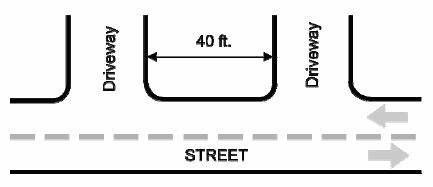
B.
The minimum distance between a new curb cut and a street intersection for lots created after the effective date of this UDO shall be as shown in Table 9.24-1:
C.
The minimum driveway radius shall be ten (10) feet. Refer to Figure 9.24-2 [9.23-2]. This requirement shall not apply to single- and two-family residential uses, including manufactured homes on individual lots.
Figure 9.23-2
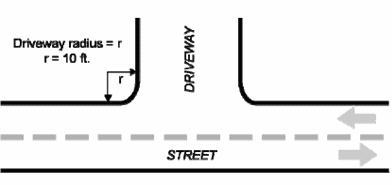
D.
Modification of Requirements.
The Administrator, or appropriate approval body in the case of a special use permit or conditional zoning request, may modify any requirement of this Section upon making a determination that such modification will serve to promote the safety of pedestrians, bicyclists, and/or motorists accessing the lot(s) in question and nearby lots. Factors to be used in making this determination shall include (but not be limited to): (1) the nature of the proposed development; (2) the location of the proposed curb cut on the lot; (3) road classification; (4) adjacent land uses; and (5) crash data on the road that the lot accesses.
(Ord. No. 21-739, § 1, 6-15-21)
SECTION 9.24 - CONSTRUCTION BEGUN PRIOR TO ADOPTION OF ORDINANCE
Nothing in this Ordinance shall be deemed to require any change in the plans, construction or designed use of any building or structure upon which a building permit was secured prior to the adoption of this Ordinance, so long as said building permit remains valid, or so long as a vested right was issued.
SECTION 9.25 - VIBRATION
No use in a nonresidential district may operate in such a fashion that recurring ground vibrations are felt or detected at the property line by human senses without the use of instruments.
SECTION 9.26 - STORMWATER DETENTION
All development shall provide for stormwater detention in accordance with the provisions of Chapter 14, Article VI, Division 4, Management of Post Development stormwater runoff.

