
Gastonia City Zoning Code
CHAPTER 10
OFF-STREET PARKING AND LOADING1
Editor's note— Ord. No. 23-787, § 1, adopted June 20, 2023, repealed and reenacted Chapter 10 to read as set out herein. Former Chapter 10 pertained to similar subject matter and derived from Ord. No. 10-585, § 5, adopted Aug. 17, 2010; Ord. No. 11-586, § 6, adopted Jan. 18, 2011; Ord. No. 12-610, § 4, adopted May 15, 2012; Ord. No. 14-632, § 14, adopted Aug. 19, 2014; Ord. No. 20-733, § 2, adopted Jan. 19, 2021; Ord. No. 21-737, § 6, adopted May 18, 2021; Ord. No. 21-742, § 5, adopted Aug. 10, 2021; Ord. No. 22-761, § 5, adopted April 5, 2022; Ord. No. 22-762, § 1, adopted April 19, 2022; and Ord. No. 21-739, § 1, adopted June 15, 2021.
SECTION 10.1 - PURPOSE
When managed properly parking is an asset for both the driving and non-driving public. Managed parking encourages a balanced supply adequate to meet the day-to-day demands of drivers for access to work, home, shopping and entertainment; and moderates the impacts of its physical presence on the prices paid for goods and services, and the costs of environmental mitigation, which are incurred by all.
When mismanaged parking is a liability for both the driving and non-driving public, delivering excess spaces almost exclusively in the form of low tax revenue generating, and expensive to build, surface lots. The true cost of excess parking raises the price of housing for all residents, specifically burdening those with lower incomes; increases the cost of business development, specifically for small businesses; and increases the cost of utilities and the infrastructure needed mitigate flooding, stormwater runoff quality, and heat island impacts for all. Because the costs of mismanaged parking are inflicted at the community level, while the benefits accrue only to drivers, parking standards must be calibrated to manage an equitable balance between driver accessibility and public cost.
Therefore, the provisions of this Chapter mandate maximum off-street parking requirements for all uses in all Zoning Districts to reduce oversupply with the expressed intent of promoting affordable housing and small business development, reducing parking lot surface areas to lower mitigation costs for, and replenishment of, environmental systems, and making alternative modes of transit economically viable. The provisions of this Chapter establish robust standards for locating and calculating off and on-street parking, encourage ride sharing, and provide bicycle parking to meet these stated goals.
(Ord. No. 23-787, § 1, 6-20-23)
SECTION 10.2 - APPLICABILITY
No permit for the construction, reconstruction, extension, or alteration of any building, structure, or use of land; and no building or land, or any part of any building or land, may receive a Certificate of Occupancy until parking for automobiles and bicycles have been provided in accordance with the requirements of this Chapter except as exempted in Section 10.5. Existing parking lots that do not meet the design requirements of this Chapter shall refer to Chapter 3, Section 3.3.9, Non-conforming Parking Lots.
(Ord. No. 23-787, § 1, 6-20-23)
SECTION 10.3 - RENOVATIONS & ADDITIONS
A.
Buildings fully renovated or repaired without expansion of their gross floor area; or expanded less than 30% of the existing gross floor are exempt from the landscape requirements of this chapter as long as the final parking adheres to the maximum requirement for the use(s), as listed in Table 10.12.
B.
Parking lots that undergo reconstruction of 50% or more of their area, shall adhere to the parking maximums and landscape requirements of this Chapter. Resealing, repaving, restriping and/or resurfacing of an existing parking lot are not considered reconstruction.
(Ord. No. 23-787, § 1, 6-20-23)
SECTION 10.4 - CHANGE IN USE
A change in use must comply with the parking requirements of the new use.
(Ord. No. 23-787, § 1, 6-20-23)
SECTION 10.5 - TYPES OF SPACES EXEMPT
The following types of spaces are exempt from the required parking maximums:
A.
Spaces required for compliance with the Americans with Disabilities Act (ADA) standards.
B.
Pick up and drop off spaces for ride-hailing vehicles, quick commerce delivery vehicles, and carry-out/online purchased goods.
C.
On-site visitor parking for multi-family dwellings up to 10 spaces, or 3% of total number of dwelling units (in spaces), whichever is greater. Such spaces shall be marked as visitor parking.
(Ord. No. 23-787, § 1, 6-20-23)
SECTION 10.6 - VEHICULAR PARKING LOCATIONS
Required off-street vehicle parking shall be located as described below.
A.
Off-Street Parking
1.
No new surface parking may be located in front of a building façade along a primary frontage in a RMF, CBD, TMU, UMU, C-1, and I-U District. Within a PD District no mixed-use buildings shall locate their parking in front of the building façade along a primary frontage.
2.
The primary pedestrian entrance and front facade for all uses on a property, located in a CBD, TMU and UMU District, and all mixed-use developments within a PD District, shall be located facing the primary frontage. Parking shall be located to the side or rear of buildings and shall provide clear and visible access to secondary building entrances for pedestrians from the lot.
3.
In the CBD, UMU, TMU, C-1 and I-U districts access to off-street surface and structured parking, including driveways accessing internal structured parking, shall be from the secondary frontage when available, into the side or rear of a lot, or structure.
B.
Off-Street Remote Parking
All required parking spaces can be located off-site, except for required handicapped spaces, if the remote parking area is located within one thousand five hundred (1,500) feet from the primary entrance of the use served.
1.
Specifically designated parking spaces for employees may be located off-site up to two thousand six hundred forty (2,640) feet from the primary entrance of the use served.
2.
All remote parking spaces used to meet an on-site parking requirement must be located within the boundaries of the Zone in which the use is located.
a.
Properties may use parking located outside the boundaries of the Zone in which the use is located if such Zone permits the use.
3.
The off-site parking area is measured in walking distance from the nearest point of the remote parking area to the primary entrance of the use served.
(Ord. No. 23-787, § 1, 6-20-23)
SECTION 10.7 - BICYCLE PARKING LOCATIONS
A.
General Requirements
1.
Bicycle parking spaces must be located on paved or pervious, surface with a slope no greater than three (3) percent. Surfaces cannot be gravel, landscape stone, or wood chips.
2.
Bicycle parking spaces must be a minimum of two (2) feet by six (6) feet. There must be an access aisle a minimum of five (5) feet in width.
3.
Each required bicycle parking space must be accessible without moving another bicycle and its placement must not result in a bicycle obstructing a required walkway.
4.
Up to twenty-five (25) percent of bicycle parking may be structured parking such as vertical parking, or wall mounted parking, provided there is a five (5) feet access aisle for wall mount parking.
5.
All racks must accommodate cable and "U" locks and must permit the locking of the bicycle frame and one wheel to the rack and must support a bicycle in a stable position.
B.
Short-Term Bicycle Parking
For utility oriented, short duration storage. Required short-term bicycle parking spaces must be located in a convenient and visible area at least as close as the closest non-accessible vehicle parking and within one hundred (100) feet.
C.
Long-Term Bicycle Parking
For commuter oriented, long duration storage typically four (4) hours, or more. See Chapter 2 Definitions, Section 2.7-1.
1.
Required long-term bicycle parking spaces shall be fully covered and offer protection from the elements. Long-term bicycle parking may consist of indoor parking, racks in garage structures, and/or bicycle lockers or other means which provide coverage of the bicycle and must be accessible to intended users.
2.
Long-term bicycle parking shall be located either internal to a building or behind the building line along a frontage. Such parking may be restricted for the sole use of employees, tenants, residents, or others at the direction of the property owner or management.
3.
Required long-term bicycle parking for residential uses cannot be located within dwelling units or within deck, patio areas, or private storage areas accessory to dwelling units.
4.
With permission from the Planning Director, long-term bicycle parking spaces for non- residential uses may be located off-site within three hundred (300) feet of the site.
5.
The off-street parking area is measured in walking distance from the nearest point of the remote parking area to the closest primary entrance of the use served.
(Ord. No. 23-787, § 1, 6-20-23)
SECTION 10.8 - ELECTRIC VEHICLE CHARGING STATIONS
A.
Electric Vehicle (EV) Charging Station Categories
1.
EV-Capable: Installation of electrical panel capacity with a dedicated branch circuit, and continuous raceway from the panel to the future parking space.
2.
EV-Ready: Installation of electrical panel capacity and raceway with conduit to terminate in a junction box of 240-volt outlet accessible to parking space.
3.
EVSE-Installed: Installation of a Level 2 electric vehicle charging station, charging through a 240-volt AC plug, with a dedicated 40-amp circuit.
B.
Electric Vehicle (EV) charging station Requirements
1.
Electric vehicle (EV) charging stations are required per Table 10.8.B(1) for the following uses: Multi-family stacked dwellings, residential components of mixed use developments, hotels, and parking lots and parking structures as a principle use. Percentage figures resulting in fractions shall be rounded up.
2.
Payment in lieu of providing EV spaces of any Category as required by this Section may be approved by Administrator.
3.
Affordable housing projects may request relief from these requirements. Determination of the request shall be the responsibility of the Administrator.
(Ord. No. 23-787, § 1, 6-20-23)
SECTION 10.9 - DRIVE-THROUGH VEHICLE QUEUING
Vehicle Queuing shall comply with the following.
A.
Adequate space must be made available on-site for the stacking, storage and queuing of vehicles
1.
Vehicles using drive-thru facilities may not encroach on or interfere with the public use of streets and sidewalks by pedestrians and vehicles.
2.
A restaurant with drive-thru windows must provide at least eight (8) queuing spaces for vehicles when one drive-thru lane exists and six (6) spaces at each drive-thru when more than one lane exists.
3.
A bank with drive-thru facilities must provide at least three (3) queuing spaces per drive-thru lane.
(Ord. No. 23-787, § 1, 6-20-23)
SECTION 10.10 - PARKING OF BOATS, COMMERCIAL AND RECREATIONAL VEHICLES, MANUFACTURED HOMES
A.
Parking Area Restricted
No boats, recreational vehicles, non-operational trucks or automobiles, or covered trucks or automobiles (whether operational or not) may be stored in any front yard, including a driveway. All such storage shall be in the side and rear yard.
B.
Recreational Vehicles
No more than one recreational vehicle (i.e., RV motor home, travel trailer) and no more than one boat or trailer combination may be parked on a lot containing a principal single-family dwelling. Such recreational vehicle must be owned and titled in the name of the owner of the lot on which it is parked.
No boats or recreational vehicles shall be stored in the front yard, including the driveway. All such storage shall be located in the side or rear yard only and shall be located no closer than five (5) feet from any property line common with a lot under different ownership. Otherwise, such vehicles shall be parked in an enclosed garage.
Recreational vehicles, and corresponding trailers, shall be parked on an improved surface (concrete, asphalt, gravel, pavers, etc.).
Recreational vehicles which do not belong to the property owner but to their visiting guests, boarders, tenants or sub-lessees may be temporarily parked in the side or rear yard in the same manner as set forth above for a period not to exceed fourteen (14) days in any consecutive twelve (12) month period. In no case shall the vehicle be parked in a manner which impairs motorists' vision.
The use of a recreation vehicle as an accessory structure or for living, sleeping or housekeeping and its connection to utility services (other than for periodic maintenance and/or repair purposes) shall be prohibited unless the vehicle is located in a camping and recreational vehicle park designed to accommodate recreation vehicles.
C.
Commercial Vehicles
Commercial vehicles limited to vans and trucks having a gross vehicle weight rating (GVWR) of up eighteen thousand (18,000) pounds may be parked on an overnight basis on any lot of less than one (1) acre. This requirement does not prohibit vehicles from loading and unloading household goods in any Residential area for a period of up to twenty-four (24) hours. No residentially developed lot may be used as the base of operation for any freight hauling truck.
D.
Manufactured Homes
The temporary parking or storage of manufactured homes is prohibited in all zoning districts, except when located in manufactured home sale lots.
(Ord. No. 23-787, § 1, 6-20-23)
SECTION 10.11 - SHARED, VALET, AND TANDEM PARKING STANDARDS
A.
Shared parking for projects with multiple uses that are located in the same building and/or near one another on the same property/properties under single ownership, or unified master development plan; and which have different peak parking demands, or operating hours; shall not exceed the max parking requirement established for the primary use in Table 10.12(A). Primary use shall be defined as the use comprising the greatest percentage of area within the total building(s) square footage.
B.
Valet parking may be permitted as a means of satisfying the parking requirements where all the following standards have been met:
1.
An attendant is provided to park vehicles during all business hours of the use utilizing the valet parking
2.
An equivalent number of valet spaces area available to replace the number required on-site spaces
3.
Valet spaces do not require individual striping and may take into account the mass parking of vehicles.
4.
Where valet parking services are located on a public street, and/or where the public ROW is utilized by the service, a valet parking permit shall be obtained from the Public Works Department.
5.
Valet parking and associated structures shall not disrupt the flow of pedestrian and vehicular traffic.
C.
Tandem Parking
1.
Tandem parking is allowed for single-unit, two-unit and multi-unit living.
2.
Two (2) parking spaces in tandem must have a combined minimum dimension of eight and one-half (8.5) feet in width by thirty-six (36) feet in length.
3.
Both parking spaces in tandem must be assigned to the same dwelling unit.
4.
Tandem parking may not be used to provide guest parking.
(Ord. No. 23-787, § 1, 6-20-23)
SECTION 10.12 - USE DEFINITIONS AND MAXIMUM VEHICLE AND REQUIRED BICYCLE PARKING STANDARDS TABLES
Table A lists the maximum vehicle and Table B lists the minimum bicycle parking spaces required by use. The Uses listed in Table A and Table B are defined as follows:
A.
Residential owner and renter occupied dwelling units governed by long term, or short term lease agreements, consisting of detached, attached, manufactured, or multi-family building(s). Residential includes accessory dwelling units subordinate to the primary residence on a lot, which may be leased, or rented daily by the primary owner.
B.
Lodging overnight accommodation commercially operated and charged daily to a customer.
C.
Office space owned or rented by a business (defined as an individual or corporation) to house employees of the business conducting the day-to-day operations of the business that are not related to the on-premise sale to customers of any goods or services the business may offer.
D.
Retail space owned or rented by a business, (defined as in individual or corporation) used to cater to customers, in both indoor and outdoor space, who purchase, contract, or avail themselves to the goods and services offered by the business, on and off premise.
E.
Workplace space owned or rented, by a business (defined as an individual or corporation) for the manufacturing of goods not classified under uses listed for I-1, I-2 or I-3 Districts, and/or for research into the production of goods and services sold off premise. Workplace may include space set aside for limited on premise sales and ordering by customers, and/or office use for business management and operations. To be considered Workplace at least fifty-one (51) percent of the square footage of a building and its property shall be set aside for the manufacturing of goods, or for the research into the production of goods and services.
F.
Industrial space owned or rented by a business, (identified as an individual or corporation) used for the manufacturing and/or warehousing of goods or components of goods, to be distributed and/or sold off premise. Industrial may include space set aside for office use, for business management and operations. To be considered Industrial at least fifty-one (51) percent of the square footage of a building and its property shall be set aside for the manufacturing and warehousing of goods, or components of goods to be distributed and/or sold off premise. For the purposes of this Ordinance, Municipal Utilities are categorized as Industrial.
G.
Education space used by public or private entities, both religious or state affiliated, for teaching persons enrolled to participate in course study. Space set aside for employees responsible for management and teaching is permissible, but shall not exceed forty-nine (49) percent of the total square footage of a building, or campus of buildings.
H.
Civic space used for gathering of private groups, religious affiliated groups, or the general public to participate in events that require admission, or are free, such as churches, meeting halls, and convention centers. Civic space may be entirely enclosed or combine both enclosed and outdoor space. At least fifty-one (51) percent of the indoor and outdoor space must consist of gathering space to be considered Civic.
I.
Other space that marries aspects of one use with another either in the delivery of services, the production of goods, or the generation of visitor numbers that require parking independent of developed building square footage that may be associated with the use. Fast-food restaurants, assisted living housing/retirement housing, medical offices, hospitals, parks, airports, and transit stations are examples.
1.
Uses requiring more than three (3) spaces per one thousand (1,000) square feet, shall be permitted to increase parking up to five (5) spaces per one thousand (1,000) square feet.
Such exemptions may only be granted to uses located in OLC, O-1, O-M, C-2, C-3, I-1, I-2, and I-3 Districts, and requires best management practices to be used to substantially improve water quality discharge from the site, as determined by the Storm Water Administrator. The Administrator shall have authority to approve parking space increases.
2.
Uses seeking to provide parking in excess of five (5) spaces per one thousand (1,000) square feet require a special use permit or conditional zoning district. Best management practices shall be used to substantially improve water quality discharge from the site, as determined by the Storm Water Administrator.
3.
Uses seeking to provide parking more than one and one-half (1.5) spaces per one thousand (1,000) square feet located in a CBD, TMU, UMU, C-1, and I-U District, may increase up to three (3) spaces per one thousand (1,000) square feet if one or more of the following conditions are met. Such spaces shall be clearly marked as available with the hours permitted posted.
a.
Ten percent (10%) of the total number of spaces are provided for public use twenty-four (24) hours a day and seven (7) days a week.
b.
Twenty percent (20%) of the total number of spaces are provided for public use as shared spaces available from 8:00 a.m. to 5:00 p.m., Monday through Friday.
c.
Twenty percent (20%) of the total number of spaces are provided for public use as shared spaces from 6:00 p.m. to 8:00 p.m. seven days a week.
4.
Townhomes shall provide a maximum of two (2) spaces per unit. On street parking may be used to meet this requirement.
5.
Multi-family residential located in any District for which it is an approved use may provide up to a maximum of 2.0 spaces per dwelling. Single-family Residential in RLD and RS-20 zoning district may provide parking based on driveway and enclosed garage capacity. In no instance shall a car parked on a driveway encroach over a sidewalk.
(Ord. No. 23-787, § 1, 6-20-23)
SECTION 10.13 - STALL SIZE AND DRIVE AISLE DIMENSIONS AND SURFACE MATERIALS
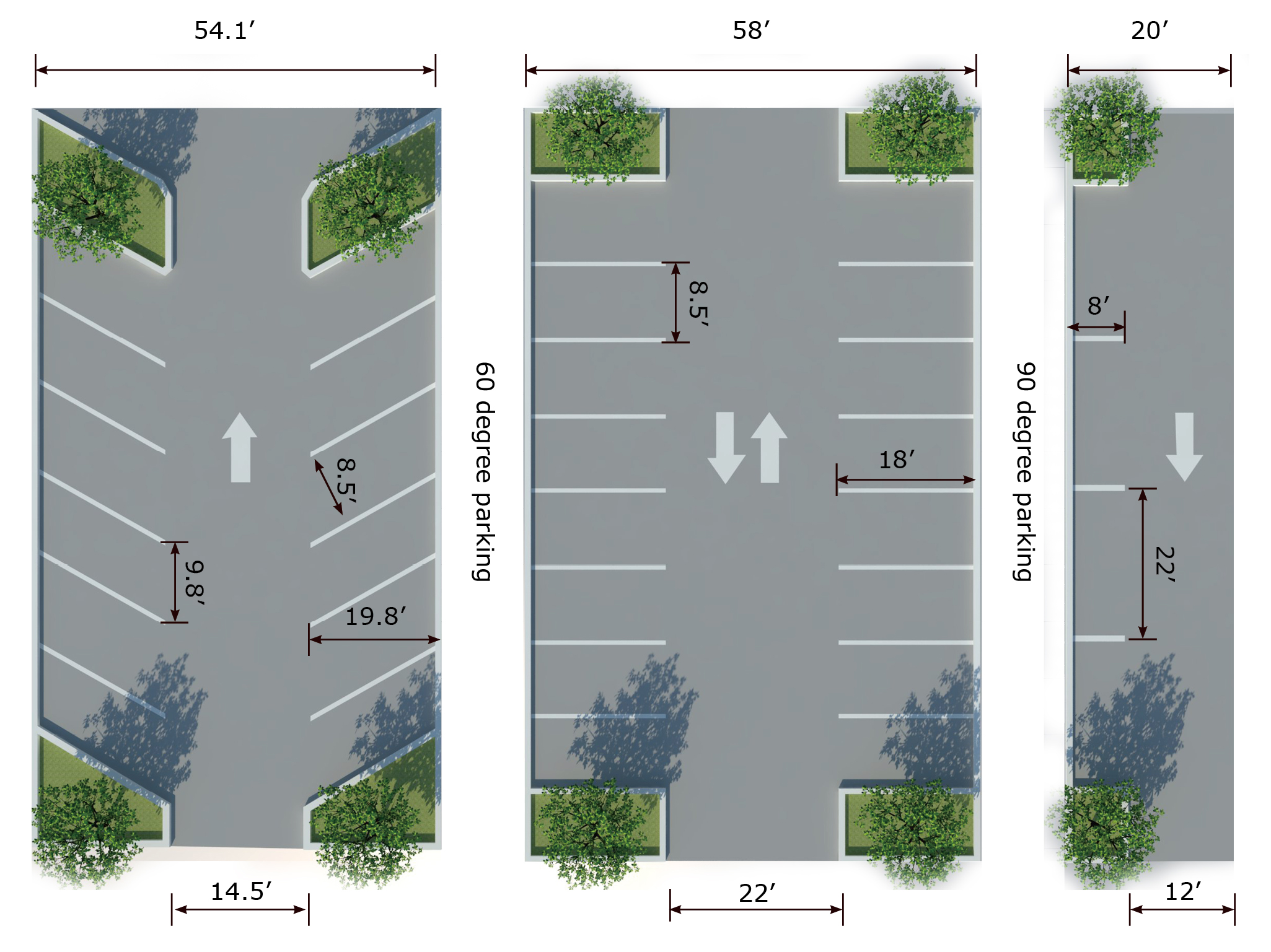
Off-street parking shall refer to areas set aside for the parking needs of customers, employees, and residents of the primary use. Such parking shall be designed so that parked vehicles do not encroach upon or extend into public rights-of-way, sidewalks or strike against or damage any wall, vegetation, utility, or other structure. All parking spaces and drive aisles must meet the following dimensions, except that the portion of off-street parking for primary uses that generate, or require the storage, rental and/or servicing of larger vehicles, such as vans, pickup trucks, and trucks; may use dimensions for parking spaces and drive aisles appropriate for such vehicles. Parking spaces and drive aisles using dimensions other than those specified, except as exempted above, may be used if approved by the Planning Director.
1.
For surface parking lots and structured parking garages having 20 or more spaces, up to thirty (30) percent of the total parking spaces provided may be compact spaces. Compact spaces may be seven and one half (7.5) feet in width by sixteen feet in length. All compact parking spaces must be clearly and visibly striped and labeled for compact car use only.
2.
Parking Lot Surface Material Requirements:
a.
Impervious Materials - Where on-site facilities are provided for parking or any other vehicular use areas, they must be surfaced with asphalt or bituminous concrete.
b.
Existing Unpaved Lots - See Chapter 3 Section 3.9. Non-Conforming off street Parking and/or Loading.
3.
Curbs and Drainage
a.
All surface parking areas must be graded and drained to collect, retain, and infiltrate surface water accumulation on-site to the greatest extent practicable.
b.
Curbs or parking blocks are required at the edges or perimeter and interior landscaped areas. Curbing must have openings to allow drainage to enter and percolate through the landscape area.
4.
Cross Access, Joint Driveways, and Curb Radii/Site Triangles
Applications for project site review must comply with the following standards as well as Section 7.6.5 Urban Standards Overlay Standards and Section 9.23 Access Management.
a.
They shall incorporate site design features such as coordinated landscape, bulb-outs, or hardscape elements to make such connections visibly apparent.
b.
All pre-existing driveways shall be closed and eliminated. The Administrator may modify this requirement if such driveways are necessary to business operations.
c.
Cross access for vehicles is required between abutting lots along US- 74, NC-7, NC 279, and US-321.
d.
A stub for future vehicular cross access must be provided to all abutting vacant land.
5.
When vehicular cross-access is deemed impractical by the Administrator on the basis of topography, the presence of natural features, or vehicular safety factors, the requirement for cross access may be waived.
6.
Property owners who establish cross access easements must:
a.
Record an easement allowing cross access to and from properties served by the cross-access easement
b.
Record a joint maintenance agreement defining the maintenance responsibilities of each property owner.
(Ord. No. 23-787, § 1, 6-20-23)
SECTION 10.14 - PARKING LOT LANDSCAPING
A.
General Provisions
This Section applies to all on-site surface parking lots with more than ten (10) spaces created after the effective date of this ordinance, except as provided below. For purposes of this Section, multiple platted lots contained on a single site plan and any separate parking areas connected with drive aisles are considered a single parking area.
1.
An existing parking lot may be repaired without providing additional landscaping.
2.
When an existing parking lot is increased in size by less than fifty (50) percent, landscaping is required for the additional parking area only.
3.
When an existing parking lot is increased in size by more than fifty (50) percent, landscaping is required for both the existing parking lot and the new parking area.
4.
Parking areas used for storage, rental and/or servicing of larger vehicles, such as vans, pickup trucks, and trucks are exempt from landscape requirements, except for those listed under 10.14.B Perimeter Screening.
B.
Perimeter Screening
All surface parking lots with frontage on any portion of a street right-of-way, not including an alley, must be screened with the following:
1.
A minimum of ten (10) feet wide (five (5) feet max in CBD, TMU, UMU, C-1, I-U and RMF District), landscaped area with a continuous row of shrubs must be provided between the street and parking lot.
2.
Shrubs must be a minimum of eighteen (18) inches in height when planted and must reach a minimum size of thirty-six (36) inches in height within three (3) years of planting. Shrubs used in any screening or landscaping must be evergreen, at least two (2) to two and one-half (2½) feet tall with a minimum spread of two (2) feet when planted and no further apart than five (5) feet. The average expected height shall be no more than four (4) feet for screening along public streets.
3.
A wall between three (3) feet and four (4) feet in height in a minimum five (5) feet planting strip may be substituted for the continuous row of shrubs. Up to fifty (50) percent of the total length of such wall may be designed as a seating wall. If so, the minimum wall height may be adjusted up to one foot lower or higher. No plantings shall be permitted in front of a seating wall.
4.
Breaks for pedestrian and vehicle access are allowed.
C.
Interior Islands
1.
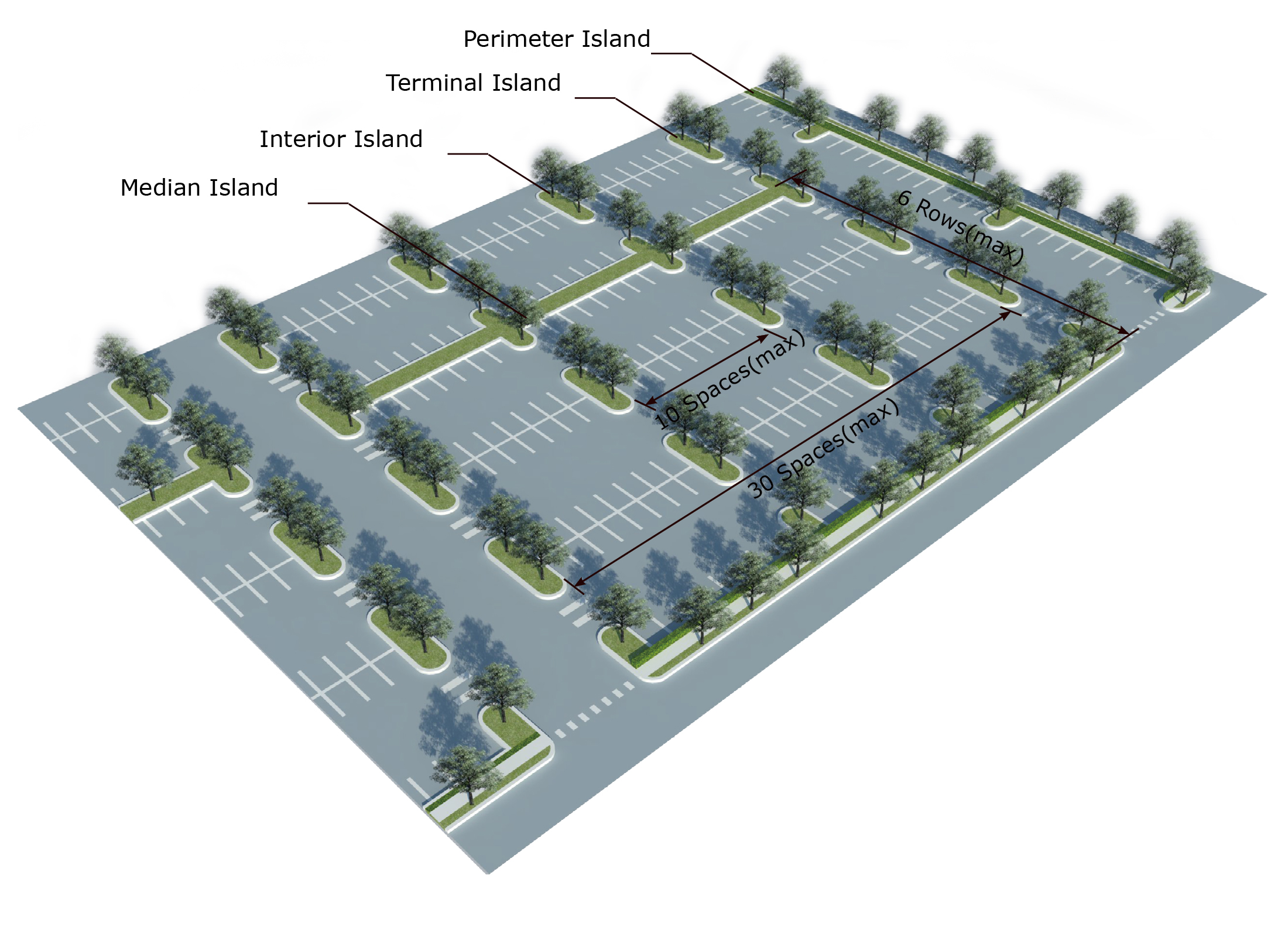
A landscaped interior island must be provided every ten (10) parking spaces. Interior islands must be distributed evenly throughout the parking area. Interior islands may be consolidated or intervals may be expanded in order to preserve existing trees.
2.
An interior island abutting a double row of parking spaces must be a minimum of eight and one-half (8.5) feet in width and three hundred (300) square feet in area.
3.
An interior island abutting a single row of parking spaces must be a minimum of eight and one-half (8.5) feet in width and two hundred (200) square feet in area.
4.
Interior islands shall be designed to capture and infiltrate the flows of lower intensity rain events to the maximum extent practicable. The number of interior islands meeting this requirement shall be dependent on their location within, and the grading of, the parking lot. Parking lots shall not be designed to direct, or concentrate flows to interior islands, or from island to island. Rock, or ground cover plantings shall be used within an island to prevent erosion and contribute to pollutant removal.
D.
Median Islands
1.
A landscape median island must be provided between every six (6) single parking rows.
2.
A landscape median island must be a minimum of five (5) feet wide.
3.
A median island may also serve as the location for a sidewalk. In such case, the sidewalk must be a minimum of six (6) feet wide, and the remaining planting area must be no less than five (5) feet wide.
4.
Median islands may be consolidated or intervals may be expanded in order to preserve existing trees.
5.
Median islands shall be designed to capture and infiltrate the flows of lower intensity rain events to the maximum extent practicable. Median islands meeting this requirement shall be dependent on their location within, and the grading of, the parking lot. Parking lots shall not be designed to direct, or concentrate flows to a median island, or from median island to median island. Rock, or ground cover plantings shall be used within a median island to prevent erosion and contribute to pollutant removal.
E.
Tree Coverage
1.
Each interior island must include at least one shade (canopy) tree per two hundred seventy- five (275) square feet.
2.
In no case can there be less than one shade (canopy) tree for every two thousand (2,000) square feet of parking area including driving aisles.
3.
Existing trees of a caliper greater than eight (8) inches may be used to reduce the tree coverage requirement of 10.15(E)1. The amount of reduction shall be determined by the Planning Director and be based on the location of the tree(s), the caliper, and the specie.
F.
Maintenance and Installation
All required parking lot landscaping must meet the maintenance and installation requirements of the Gastonia Tree Ordinance.
G.
Curbs and Drainage
1.
All surface parking areas must be graded and drained to collect, retain, and infiltrate surface water accumulation on-site to the greatest extent practicable.
2.
Curbs or parking blocks are required at the edges or perimeter and interior landscaped areas. Curbing must have openings to allow drainage to enter and percolate through the landscape area.
H.
Cross Access, Joint Driveways, and Curb Radii/Site Triangles
Applications for project site review must comply with the following standards as well as Section 7.6.5 Urban Standards Overlay Standards and Section 9.23 Access Management.
I.
They shall incorporate site design features such as coordinated landscape, bulb-outs, or hardscape elements to make such connections visibly apparent.
J.
All pre-existing driveways shall be closed and eliminated. The Administrator may modify this requirement if such driveways are necessary to business operations.
K.
Cross access for vehicles is required between abutting lots along US-74, NC-7, NC 279, and US-321.
L.
A stub for future vehicular cross access must be provided to all abutting vacant land.
S.
When vehicular cross-access is deemed impractical by the Planning Director on the basis of topography, the presence of natural features, or vehicular safety factors, the requirement for cross access may be waived.
T.
Property owners who establish cross access easements must:
a.
Record an easement allowing cross access to and from properties served by the crossaccess easement
b.
Record a joint maintenance agreement defining the maintenance responsibilities of each property owner.
(Ord. No. 23-787, § 1, 6-20-23)
SECTION 10.15 - OFF STREET LOADING AREAS
If determined necessary by the Planning Director, non-residential and multi-family uses shall provide adequate space on-site for the unloading and loading of goods, materials, items, or stock for delivery and shipping. In the case of mixed-use developments, required off street loading spaces are calculated on the basis of each individual use.
A.
Location & Screening
If a loading area is provided it must meet the following standards:
1.
The loading area must be located on the same lot occupied by the use served and must be accessible from a public street or alley.
2.
The loading area must be located to the side or rear of buildings. Loading areas may not be placed between the street and the associated building.
3.
With the exception of areas specifically designated by the City, loading and unloading activities are not permitted in the public right-of-way.
4.
Loading and unloading activities may not encroach on or interfere with the use of sidewalks, drive aisles, queuing areas and parking areas by pedestrians or vehicles.
5.
Loading spaces shall be screened with a solid wall, or fence, a minimum of six (6) feet and a maximum of ten (10) feet in height.
B.
Loading Space Calculations Non-residential
Non-residential uses are required to provide loading spaces in accordance with the following gross floor area categories.
Multi-family developments are required to provide loading spaces in accordance with the following net density categories.
(Ord. No. 23-787, § 1, 6-20-23)
SECTION 10.16 - LIGHTING FOR PARKING LOT & VEHICLE LOADING AREAS
No permit for the construction, reconstruction, extension, or alteration of any parking lot may be given until lighting has been provided in accordance with the requirements of this Chapter and Section 9.13 Lighting & Reflectivity. The installation of site lighting, replacement of site lighting, and changes to existing light fixture wattage, type of fixture, mounting, or fixture location must be made in compliance with this Code. Routine maintenance, including changing the lamp, ballast, starter, photo control, fixture housing, lens and other required components, is allowed for all existing fixtures. This section does not apply to lighting installed in the public right-of-way.
A.
Additions
When a parking lot is renovated, any new or replaced outdoor light or lighting fixture must conform to the requirements of this Code.
B.
Light Level Measuring
1.
Light levels are expected, calculated and measured in footcandles. All footcandles values are maintained footcandles.
2.
Measurements are to be made at ground level, with the light-registering portion of the meter held parallel to the ground pointing up.
C.
Prohibited Sources
The following light fixtures and sources cannot be used:
1.
Cobra-head-type fixtures having dished or drop lenses or refractors.
2.
Temporary searchlights and other high-intensity narrow-beam fixtures
3.
Light sources that lack color correction or do not allow for uniform site lighting.
D.
Design and Installation Requirements
1.
The maximum light level of any light fixture cannot exceed 0.5 footcandles measured at the property line of any residential district or single-family residence and 2.0 footcandles measured at the right-of-way line of a street.
2.
Lighting must not be oriented onto adjacent properties, streets, or sidewalks.
3.
Service connections for all freestanding lighting fixtures must be installed underground.
E.
Parking and Pedestrian Areas
1.
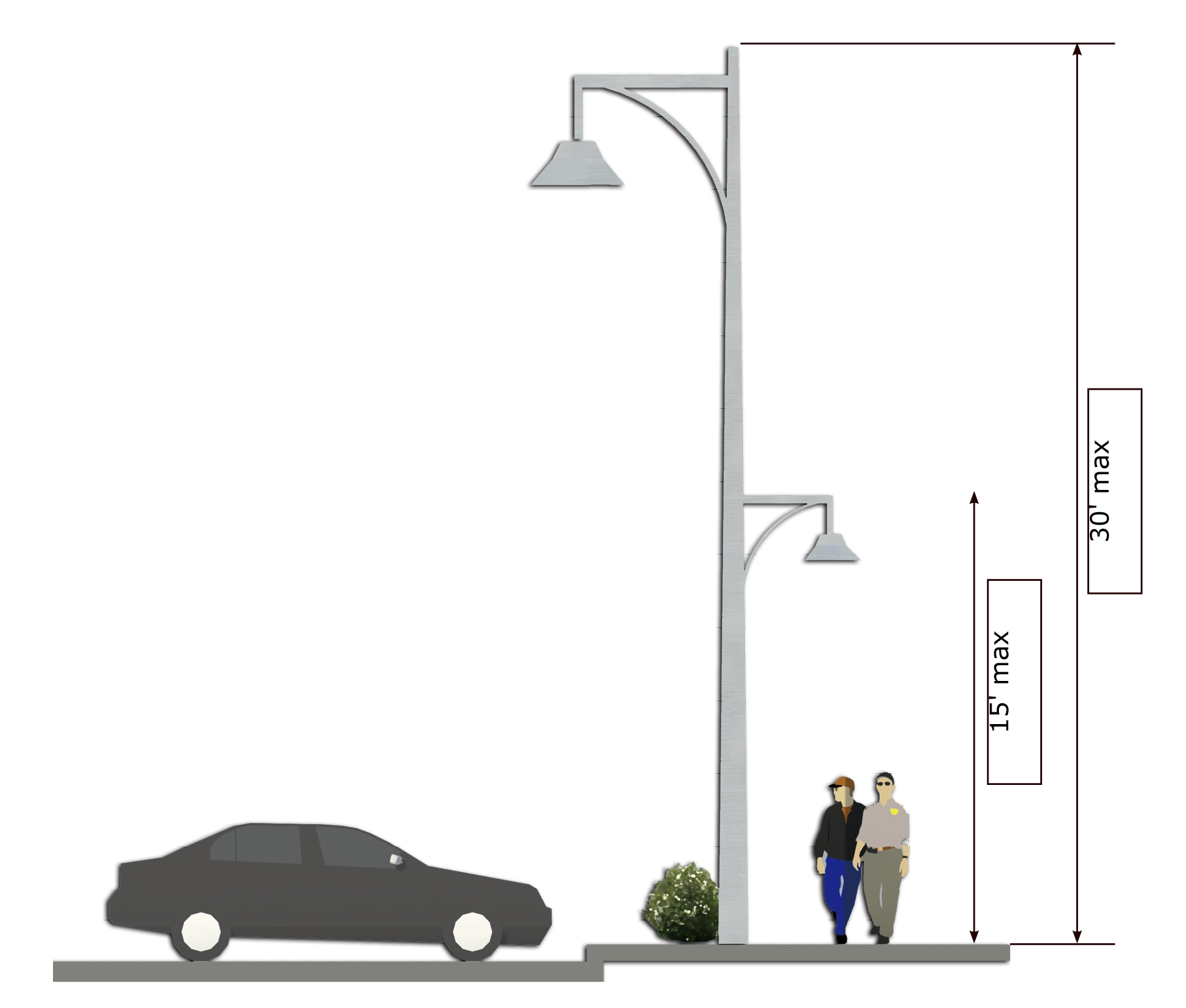
Light fixtures within parking areas may be no higher than thirty (30) feet
2.
Light fixtures within pedestrian areas may be no higher than fifteen (15) feet
3.
Light fixtures located within fifty (50) feet of the property line of a residential district or single-family residence may be no higher than fifteen (15) feet.
4.
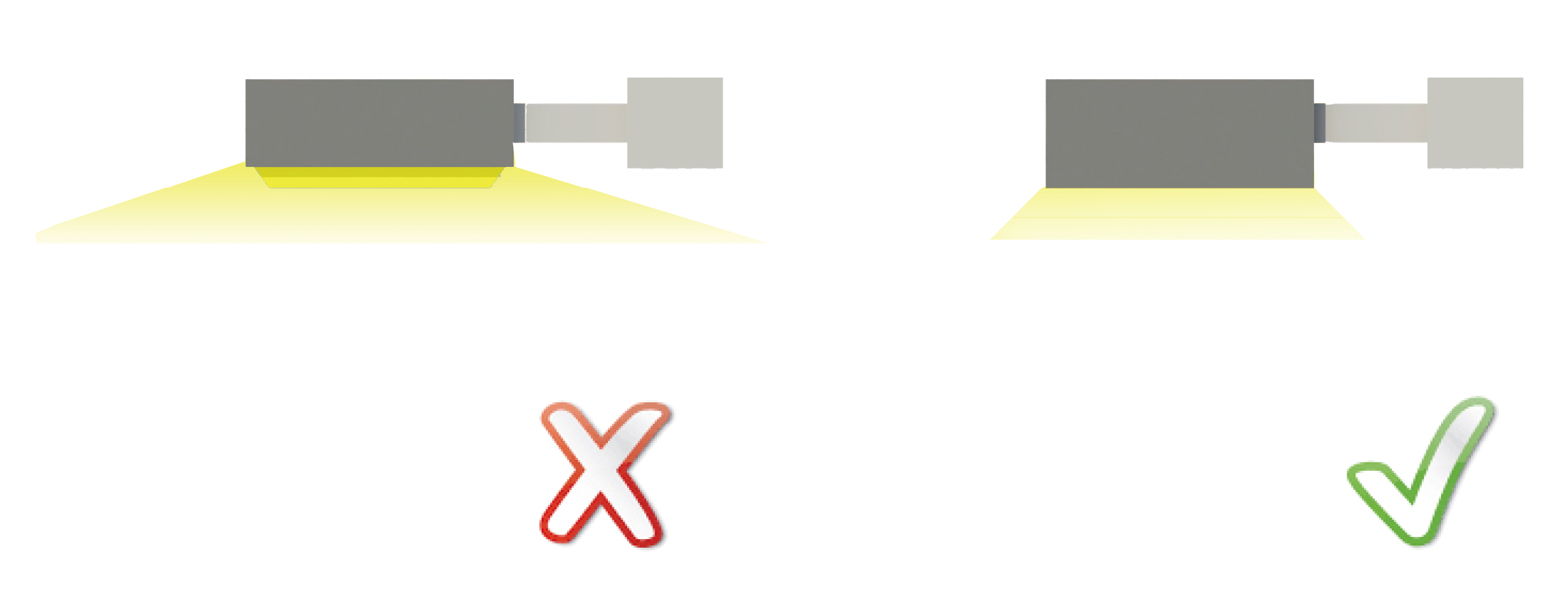
All light fixtures must be full cutoff, except as listed in Section 10.17(E)5 below.
5.
Non-cutoff (unshielded) fixtures can be used when the maximum initial lumens generated by each fixture is less than nine thousand five hundred (9,500) initial lamp lumens. These fixtures must feature globes or vertical glass planes and must be coated with an internal white frosting to diffuse light.

F.
Flood Lights and Lamps
1.
Flood light fixtures must either be aimed down at least 45 degrees from vertical, or the front of the fixture shielded so that no portion of the light bulb extends below the bottom edge of the shield.

2.
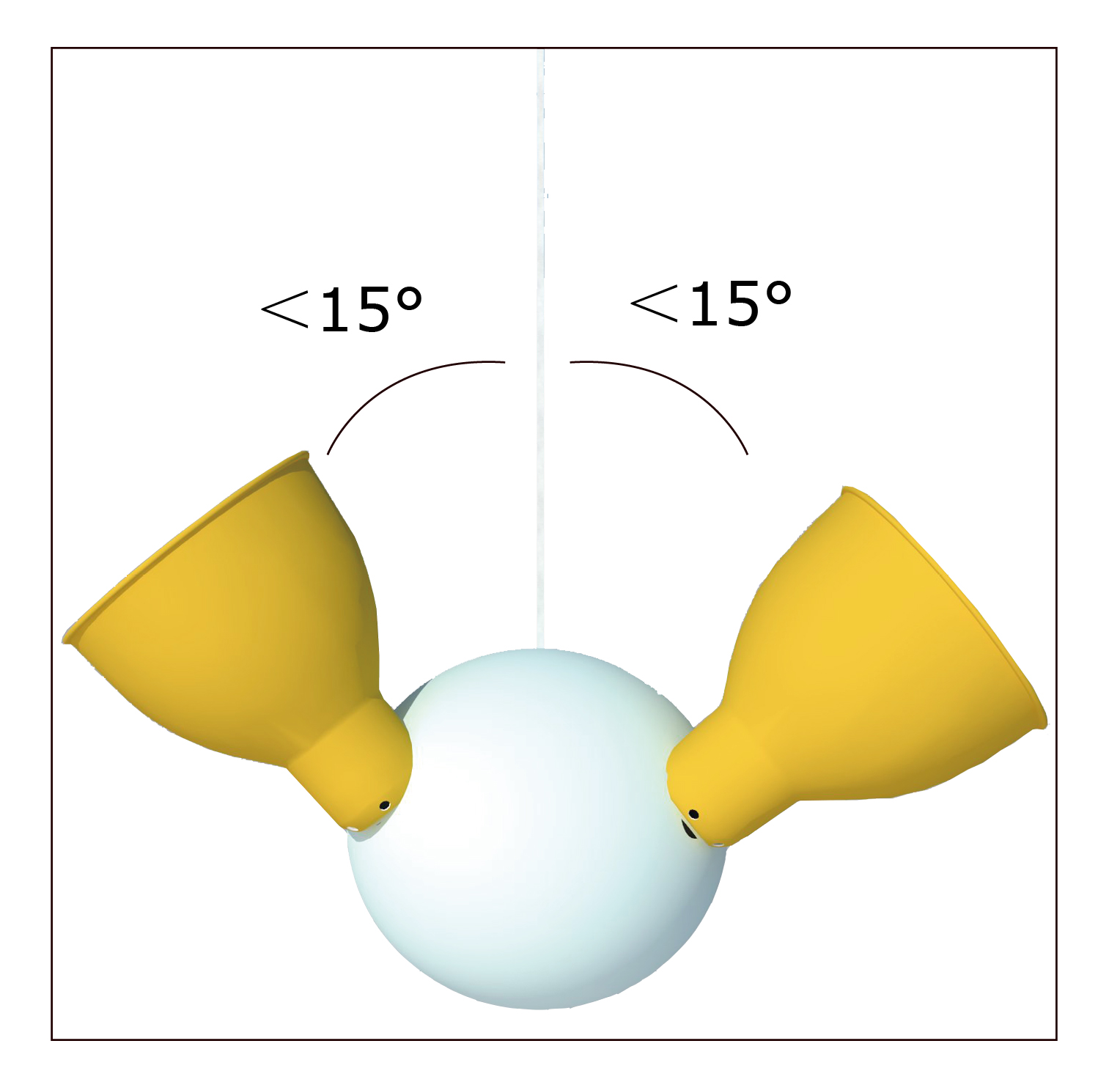
Any flood light fixture located within fifty (50) feet of a street right-of-way must be mounted and aimed perpendicular to the right-of-way with a side-to-side horizontal aiming tolerance not to exceed fifteen (15) degrees.
3.
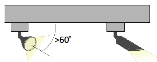
All flood lamps emitting one thousand (1,000) or more lumens must be aimed at least sixty (60) degrees down from horizontal, or shielded so that the main beam is not visible from adjacent properties or the street right-of-way.
G.
Vehicular Canopies
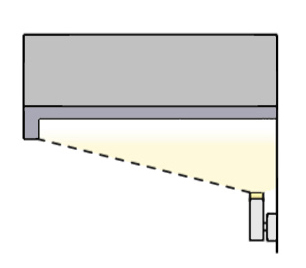
Lighting under vehicular canopies must be less than twenty-four (24) maintained foot candles and be designed to prevent glare off-site. Acceptable lighting designs include the following:
1.
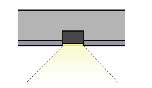
Recessed fixture incorporating a lens cover that is either recessed or flush with the bottom surface of the canopy.
2.
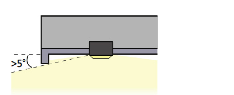
Light fixture incorporating shields or is shielded by the edge of the canopy itself so that light is restrained to five (5) degrees or more below the horizontal plane.
3.
Surface mounted fixture incorporating a flat glass that provides a cutoff design or shielded light distribution.
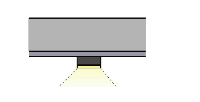
4.
Indirect lighting where light is beamed upward and then reflected down from the underside of the canopy provided the fixture is shielded so that direct illumination is focused exclusively on the underside of the canopy.
(Ord. No. 23-787, § 1, 6-20-23)
SECTION 10.17 - STRUCTURE PARKING DESIGN STANDARDS
Standalone parking structures may be the principal use of a property, or a standalone structure providing parking for another principal use(s) on the property. Integrated parking structures are those built as part of a principal use, whether designed as podiums for the principal use(s) or wrapped by the principal use(s). Standalone and integrated structured parking shall adhere to the following design standards when they contain activated ground floor space, and/or are fully wrapped by the primary use(s).
A.
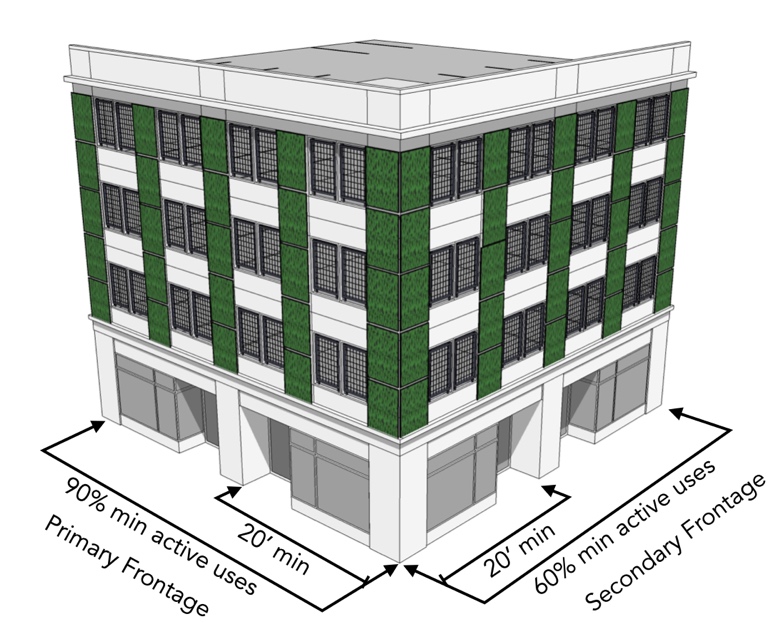
When adjacent to a public frontage (ie: pedestrian and/or greenway corridor, open space, public ROW), parking structures shall include residential and/or non-residential active uses along the ground floor building length. Frontages designated as primary shall provide for residential and/or non-residential active uses along ninety (90) percent of the ground floor length. Frontages designated as secondary shall provide for residential and/or non-residential active uses along fifty (50) percent of the ground floor length. All other frontages are exempt. Areas for required vehicular and pedestrian egress and mechanical an electrical equipment rooms are excluded.
B.
All ground floors shall be a minimum height of fourteen (14) feet floor to floor. Non-residential uses shall be a minimum of twenty (20) feet in width and twenty (20) feet in depth, with utility stubs and the ability to accommodate equipment for restaurant uses.
C.
The ground floors of parking structures abutting a designated primary or secondary frontage that do not have active uses, ingress/egress points, and/or mechanical equipment rooms shall provide architectural elements such as awnings, overhangs, decorative screens, grills, louvers, artwork, and green walls.
D.
Parking Structure facades not wrapped by a primary use(s) that face primary and secondary frontages shall be designed so that vehicles parked on all levels of the structure and associated lighting are screened by a wall or panel, measuring a minimum of forty-eight (48) inches in height. Screening shall include both vertical and horizontal treatment that resembles the patterns and architecture of the occupied portions of the building, including use of similar materials and a similar rhythm of window openings on frontages. The remaining openings shall be screened using decorative elements such as grill-works, lovers, green walls, or similar. For parking structures with rooftop open air parking, a parapet wall of sufficient height to ensure vehicles are not visible from adjoining streets is required. Any such parapet wall shall be a minimum of four (4) feet in height. Parking floors that are inclined may not face a primary frontage unless fully wrapped by a primary use(s) or screened fully with a façade matching that of the primary use(s).
E.
A Vehicular clear sight zone shall be included at vehicular exit areas as follows:
1.
The façade of vehicular exit areas shall be set back a minimum of ten (10) feet for the portion of the façade that includes the vehicle exit area and an additional ten (10) feet on each side of the exit opening.
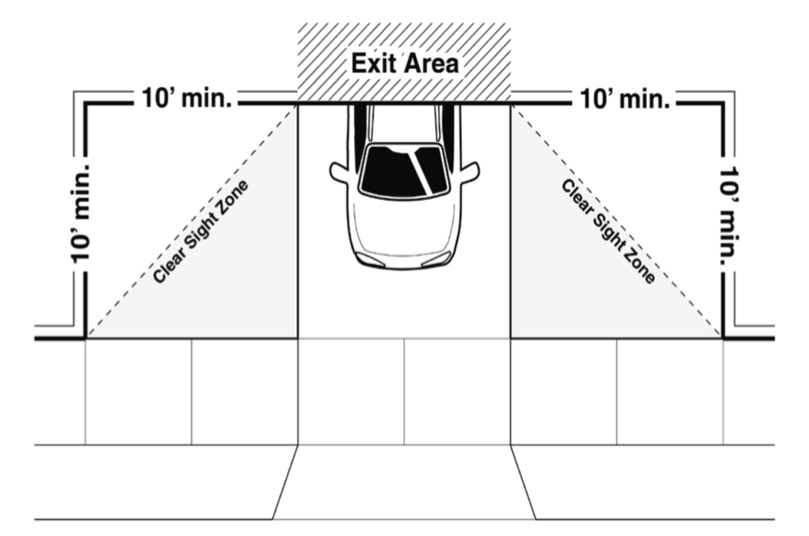
2.
A vehicular clear sight zone is defined by drawing a line from the edge of the vehicular exit area to the main building façade line.
3.
In a vehicular clear sight zone, landscape or a decorative wall shall be used to separate the exit aisle and the pedestrian walkway. Landscape and/or a decorative wall cannot exceed thirty (30) inches in overall combined height in order to maintain driver sightlines.
4.
The upper story façade(s) of a parking structure may overhang the vehicular clear sight zone.
F.
Structure parking shall be designed in accordance with Table 1 when located a primary or secondary frontage. When multiple options are indicated with a "P" any of the indicated options are permitted. An "X" indicates that an option is not permitted.
| Table 1 Parking Structure Frontages |
Primary
Frontage | Secondary Frontage | Other | Frontage Example |
|---|---|---|---|---|
|
A) All Floors Wrapped & Active Ground Floor
Floors above ground floor shall be occupiable, conditioned space with a minimum depth of 20 feet. Parking Structure setback shall be a maximum of 3 feet. | P | P | P | 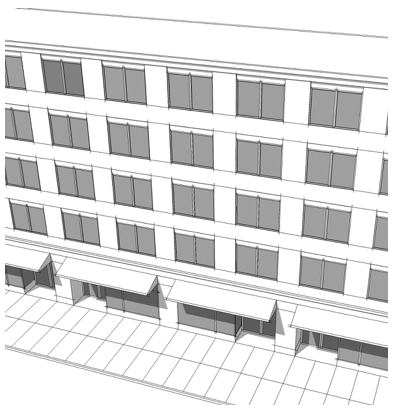 |
|
B) Ground Floor Active Only
See Section 10.17 (D) for upper floor design standards. Parking façade step-back a min of 10 feet may occur after the second level (ground floor plus first floor) | X | P | P | 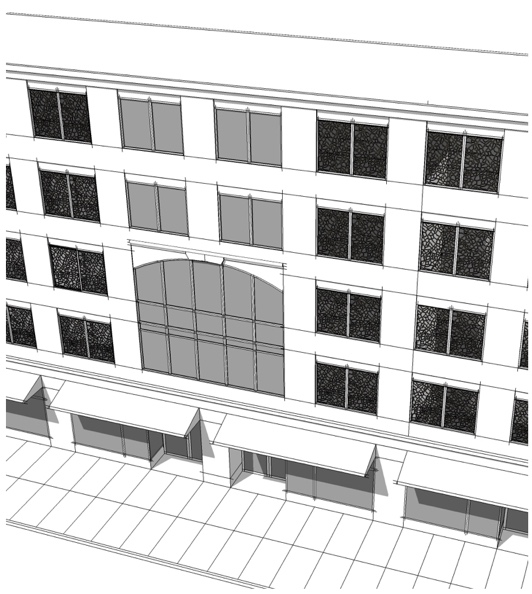 |
| C) Landscaped Setback at 30 feet min. Landscaping shall run the full length of the setback zone, with the exception of areas of vehicular or pedestrian access. The landscaping area shall meet the requirements of Section 10.17 (G) | X | X | P | 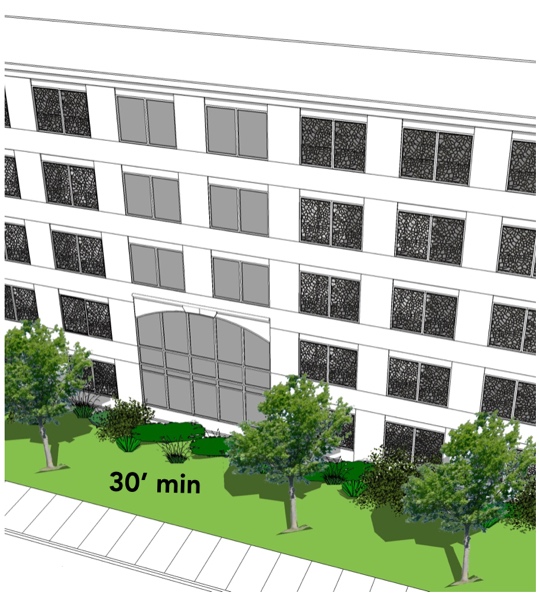 |
G.
Parking Structure Landscaping
Per Table 1(C) parking structures setback from the right of way shall provide foundation landscaping. Such landscaping shall run the length of the façade with the exception of areas of ingress/egress and any building functional operations.
1.
The planted area within the required minimum setback per Table 1(C) shall be a minimum of fifteen (15) feet.
2.
One shrub shall be planted for every three (3) feet of foundation yard length. Shrubs may be spaced linearly, on center, or grouped to complement an overall design concept.
3.
A minimum of one shade tree shall be provided for every thirty (30) feet of linear foundation yard. Two ornamental trees may be substituted for one shade tree and shall be spaced one ornamental tree every fifteen (15) feet. Trees may be spaced linearly, on center, or grouped to complement an overall design concept.
4.
The remaining area of the required foundation landscape outside of shrubs and trees shall be planted in live ground cover, perennials, or ornamental grasses.
(Ord. No. 23-787, § 1, 6-20-23)

