
Hartford City Zoning Code
8.0
SIGNS
8.1.1 - PURPOSE
Regulation of the location, size, placement, and certain features of signs is necessary to:
A.
Enable the public to locate goods, services, and facilities in the city without difficulty and confusion;
B.
Improve the general attractiveness of the community;
C.
Take advantage of the beauty of the community's natural environment;
D.
Protect property values; and
E.
Facilitate and aid in the identification and location of businesses in the city in the event of police, fire, or other emergencies and to avoid confusion and delay in response to such emergencies.
8.1.2 - INTENT
This chapter regulates both permanent signage (see 8.3 through 8.11) and temporary signage (see 8.13), and specifies which signs are exempt from regulation or prohibited. The intent of this chapter is to:
A.
Balance the rights of individuals to convey their messages through signs with the right of the public to be protected against the unrestricted proliferation of signs;
B.
Protect public health, safety, and welfare;
C.
Reduce traffic and pedestrian hazards;
D.
Preserve neighborhood aesthetics, complement historic resources, and protect property values by minimizing the possible adverse effects and visual blight caused by signs;
E.
Promote economic development; and
F.
Ensure the fair and consistent enforcement of sign regulations.
8.1.3 - APPLICABILITY
These standards shall apply to all signs within the city under the following situations:
A.
Newly Constructed or Reconstructed Signage. All new signs and structural improvements to existing signs. Structural improvements include alterations to the sign structure, area, height, or other dimension, but does not include painting, repainting, cleaning, changing permitted items of information, or other normal maintenance and repair, or changes solely to type of illumination (such as changing from fluorescent to LED lighting).
B.
Change in Use for Single Business Signage. For signage serving one business, whenever the existing use is changed to a new use resulting in a change in signage, including rewording.
C.
Multiple-Business Signage. For signage serving multiple businesses, whenever 50 percent or more of the existing uses are changed to new uses resulting in a change in signage, including rewording.
D.
Buildings in the Transit Oriented Development Overlay. In sections 8.3 through 8.11, references to the DT downtown districts shall be construed to apply to signage associated with new construction or major rehabilitation of a building in the Transit Oriented Development Overlay, or, for minor rehabilitations or sign-specific applications, upon the applicant's election.
E.
DT Districts. Notwithstanding anything to the contrary in this chapter, deviations from this chapter's requirements for sign quantity, sign size, sign area, height, location on the building or site, or placement on the building or site may be allowed for signage in the DT districts pursuant to special permit review.
(Amend. of 5-4-2020(1))
8.1.4 - SIGN PERMIT PROCESS
When compliance with this section is required per 8.1.3, an applicant must submit an application for a zoning permit except where expressly exempt from such application by 8.0 Signs. Refer to 8.14 Exempt Signs. Signage may be approved as part of a site plan review or a special permit review without requiring an additional fee.
8.1.5 - NONCONFORMING SIGNS
Refer to 1.5.5 Nonconforming Signs.
8.1.6 - ABANDONED SIGNS
A.
A sign which is not a temporary sign shall be deemed to be abandoned when one of the following occurs:
(1)
The business, service, product, or activity being advertised has ceased to exist for a period of 6 months or more;
(2)
The sign has not been utilized for a period of 6 months or more; or
(3)
The sign is a nonconforming sign and the owner has been notified by the zoning administrator of the need to conform to these regulations.
B.
Abandoned signs shall be completely removed and the site of such sign shall be restored within one month of the date the zoning administrator gives notice of such designation to the owner of the sign.
8.1.7 - SIGN LOCATION
Unless otherwise specified, signs shall only be located within the boundaries of the lot and not in the right-of-way or on public property.
A.
Certain sign types may extend beyond a property line into the right-of-way or public property with permission from the city and in accordance with the regulations outlined in this section.
B.
No sign shall be attached to a utility pole, tree, standpipe, gutter, drain, or fence, except as otherwise expressly permitted in these regulations or otherwise required by law.
C.
Signs shall be erected so as to permit free ingress to or egress from any door, window, the roof, or any other exit-way required by the building code or by fire department regulations.
D.
No sign shall be erected or maintained in such a manner as to obstruct free and clear vision of, interfere with, or be confused with any authorized traffic sign, signal, or device.
E.
Signs shall not unnecessarily obstruct significant architectural building features, such as sculptural elements, windows, doors, cornices, or other expression lines.
F.
No sign shall extend horizontally beyond the two vertical lines, located on the face of the building, which delineate the boundaries of the space for which the sign is advertising.
G.
Multiple signs on a façade shall be organized and designed in a coherent, consistent manner in accordance with 8.2.1 C. and located either in a space on the façade designated for signs or in a location that otherwise refers to architectural features or alignment of existing signs.
H.
Signage permitted in the OS district shall be allowed for Outdoor Markets. Signed typically allowed as attached to buildings may be attached to fences serving as a building façade.
(Amend. of 1-10-2023)
8.1.8 - ILLUMINATION
All signs shall be illuminated according to the following provisions unless otherwise stated.
A.
Signs shall be illuminated only by steady, stationary light sources directed solely at the sign or internal to it, with illumination concentrated on the printed area of the sign.
B.
The following internally illuminated signs are allowed:
(1)
Stencil or channel cut illumination, which lights alphanumeric characters or a logo and does not light the remaining face of the sign.
(2)
Halo illumination, which produces a halo of light surrounding alphanumeric characters or a logo without illuminating the surface to which it is mounted.
(3)
Individual alphanumeric characters or logos may be internally illuminated as permitted per each sign type.
(4)
For transportation shelters permitted per 4.20.7 H., advertising may be fully internally illuminated ("box lit") within the frame.
C.
When an external artificial light source is used to illuminate a sign, the lamp (or bulb) shall be located, shielded, and directed so as to not be visible from any public street or private residence.
(1)
No receptacle or device housing a permitted light source which is attached to the sign itself shall extend more than 18 inches from the face of the sign.
(2)
If ground lighting is used to illuminate a sign, the receptacle or device should not extend more than 12 inches above ground and must be fully screened and housed.
D.
The illumination of any sign, resulting from any internal or external artificial light source, shall not exceed 250 nits at the sign face during the day and 125 nits at the sign face after sunset, with no light trespass onto adjacent property.
(1)
Signs located within DT, MS, and CX districts are exempt from this standard.
E.
Sign illumination shall otherwise conform with the lighting design standards contained in 6.15 Site Lighting, where such standards do not conflict with this section 8.1.8 Illumination.
8.1.9 - CONSTRUCTION, DESIGN, & MAINTENANCE STANDARDS
A.
All signs shall meet the construction, design standards, and maintenance requirements of the state basic building code.
B.
All signs, together with their supporting structure, shall be kept in good repair and in safe condition. The owner of the premises on which a sign is erected or located shall be directly responsible for keeping such sign and premises in a safe and neat condition.
C.
Supports and braces shall be designed as an integral part of the overall sign design and hidden from public view to the extent technically feasible.
D.
A sign design must complement the style and significant architectural building features of a historic building or of any building completed 50 years before. For historic buildings in particular, sign design must follow the Secretary of the Interior's Standards for Rehabilitation and, among other things, shall not permanently damage significant architectural building features, such as sculptural elements, windows, doors, cornices, or other expression lines. Notwithstanding the provisions on materials in the sign-specific portions of this chapter, staff or commission, as applicable, shall take into account compatibility of proposed sign materials with historic fabric and may require more compatible materials or design.
8.2.1 - PERMITTED SIGN TYPES BY DISTRICT
Figure 8.2-A Permitted Sign Types by District establishes the sign types permitted and permitted with conditions by district. Refer to 2.0 Districts for more information about each district.
A.
Exempt/Temporary Signs. Figure 8.2-A Permitted Sign Types by District does not apply to exempt (see 8.14 Exempt Signs) or temporary signs (see 8.13 Temporary Signs) unless otherwise specified. Stadium signage is not subject to sign type limitations but shall only be allowed when approved by the commission in accordance with special permit review.
B.
Prohibited Signs. In addition to the signs listed in 8.15 Prohibited Signs, when a sign type is not listed as permitted or permitted with conditions in the district on Figure 8.2-A Permitted Sign Types by District, the sign is prohibited in the district.
C.
Mixing Multiple Sign Types. Mixing multiple types of signs of any combination on a single building is prohibited, unless:
(1)
A mix of wall and canopy-mounted signs or wall and awning signs is permitted if similar materials, colors, design, and scale of alphanumeric characters is utilized.
(2)
A projecting sign(s) can be mixed with wall, projecting marquee, awning, and/or canopy mounted sign.
(3)
This limitation shall not apply to additional roof, window, monument, or ped-scale pole-mounted signs which would, when combined with the sign types in subsections 8.2.1 C.(1) and (2) above, otherwise meet the size and quantity limitations of section 8.2.2 Maximum Permitted Quantity of Signage by District. However, roof signs may not be combined with upper-story wall signs.
8.2.2 - MAXIMUM PERMITTED QUANTITY AND SIZE OF SIGNAGE BY DISTRICT
Figure 8.2-B Maximum Quantity and Size of Signage by District establishes the overall maximum amount of signage of all types permitted on a lot within each district. Refer to 2.0 Districts for more information about each district. The quantity and size of signage shall be calculated per 8.2.3 Computation.
A.
Exempt/Temporary Signs. Figure 8.2-B Maximum Quantity and Size of Signage by District does not apply to exempt (see 8.14 Exempt Signs) or temporary signs (see 8.13 Temporary Signs) unless otherwise specified. Stadium signage is not subject to sign quantity limitations but shall only be allowed when approved by the commission in accordance with special permit review.
B.
Window Signs. Window Signs shall not count towards a lot's maximum permitted amount of signage. Refer to 8.9 Window Sign.
C.
Through Lots. In addition to the maximum amount of signage permitted per lot, through lots may incorporate an additional 30 square feet of signage permitted for the lot located in either the rear yard or along the rear facade.
D.
Corner Lots. In addition to the maximum amount of signage permitted per lot, corner lots may incorporate an additional 1.5 square feet per 1 linear foot of corner side lot length with a maximum of 100 square feet, with the exception of Residential & Lodging Uses.
E.
Signs on Tall Buildings. Roof signs on buildings over 12 stories and wall signs located on the twelfth story or higher of a building shall not be subject to Figure 8.2-B Maximum Quantity and Size of Signage by District.
F.
First-Floor Tenant Signs. First-floor tenant wall signs allowed per Figure 8.3-A. shall not be subject to Figure 8.2-B Maximum Quantity and Size of Signage by District.
8.2.3 - COMPUTATION
The following standards generally apply to computing the area and height of signs by type and by building lot. Refer to the Sign Types 8.3 through 8.11 for more information.
A.
Sign Area.
(1)
Exempt and temporary signs are not included in the maximum signage area calculations, unless otherwise specified.
(2)
For the purposes of determining area, lot width or frontage is measured along the front property line.
(a)
If the lot is a corner lot, the width shall be measured along the front yard.
(b)
Building frontage is the width of the front facade of a building.
(c)
In regard to first-floor occupancy calculations, public entrances/exits do not include emergency egress exits.
(d)
In regards to first-floor occupancy calculations, "linear front/side/rear foot" refers to the linear portion of the exterior wall of a unit of occupancy (such as retail tenant space) which faces the public street or side/rear parking lot, as applicable, by which the unit of occupancy is accessed.
B.
Sign Height.
(1)
The height of a sign shall be measured as the vertical distance from the grade at the adjacent public sidewalk of the sign to the top of the highest component of the sign.
(2)
The ground clearance of a sign under these regulations shall be measured as the vertical distance from the grade at the base of the sign to the top of the lowest component of the sign.
(3)
For the purposes of this article, grade shall be computed as the average finished ground level of the land around the base of the sign, exclusive of any filling, berming, mounding, or excavating solely for the purpose of locating the sign.
8.2.4 - GRAPHIC ELEMENT
A graphic element is a logo, drawing, image, pattern, or similar feature contributing to the distinct visual identity of the sign, which may or may not include or contain alphanumeric characters.
Figure 8.2-A Permitted Sign Types by District
***Expand table to lock table headings in place while scrolling***
Figure 8.2-B Maximum Quantity and Size of Signage by District
***Expand table to lock table headings in place while scrolling***
(Amend. of 1-10-2023)
8.3.1 - DESCRIPTION
Wall Signs, also known as flat or band signs, are mounted directly to the building face to which the sign is parallel. Refer to Figure 8.3-B Example of Wall Sign.
8.3.2 - GENERAL REQUIREMENTS
Wall Signs shall be developed according to the standards in Figure 8.3-A Wall Sign Requirements.
A.
Building Openings. Wall Signs shall not cover windows or other building openings. The zoning administrator or commission, as applicable, may allow or require a Wall Sign to cover non-operable windows above 8' above grade if doing so would contribute to architectural harmony, while still ensuring proper functioning of the sign.
B.
Architectural Features. Wall Signs shall not cover significant architectural building features, such as sculptural letters and graphic elements, windows, doors, cornices, or other expression lines.
C.
Mural Signs. Mural Signs, a type of Wall Sign painted onto the building face displaying the business name or activity, are prohibited on front facades. Mural Signs shall be identified separately from murals, which do not contain advertisement.
D.
Dynamic Display. Refer to 8.12 Dynamic Display.
E.
No wall sign affixed to a building, including sign support structure, may project beyond the ends of the building façade or higher than the roofline of the structure to which it is attached.
(Amend. of 12-13-2022)
8.3.3 - COMPUTATION
The area of a Wall Sign is calculated using the following information.
A.
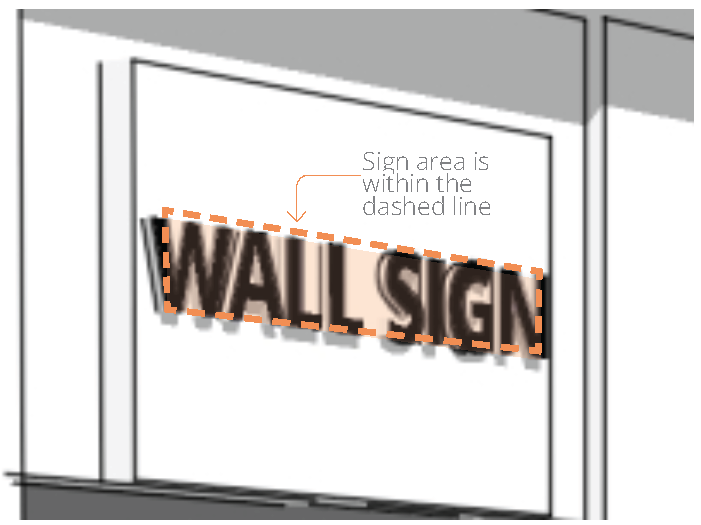
Wall Signs. Area is calculated by drawing the smallest possible square or rectangle around the largest alphanumeric characters and/or graphic elements, as is illustrated in Figure 8.3-C Area Calculation for Wall Sign.
(1)
All areas that utilize individual alphanumeric characters or logos (including only those using wood, wood substitute, metal, or masonry), or a sign that utilizes methods of internal illumination described in section 8.1.8 B.(1) or 8.1.8 B.(2), may use a total area of 110 percent of the permitted maximum sign area and height otherwise allowed.
B.
Mural Sign. Area is calculated by measuring the area of the smallest square or rectangle that can be drawn around all of the sign elements, including any painted background.
Figure 8.3-A Wall Sign Requirements
***Expand table to lock table headings in place while scrolling***
Figure 8.3-B Example of Wall Sign
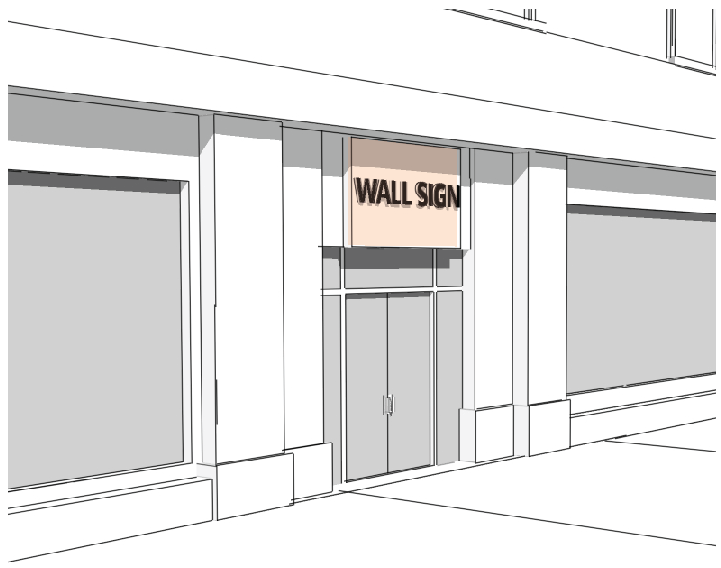
Figure 8.3-C Area Calculation for Wall Sign
8.4.1 - DESCRIPTION
A Projecting Sign is attached to and projects from a building face or hangs from a support structure attached to the building face. Sign faces are typically perpendicular to the building face, but may be at an angle greater than 45 degrees from the facade. The sign may be vertically or horizontally oriented. Refer to Figure 8.4-B Example of Projecting Sign.
8.4.2 - GENERAL REQUIREMENTS
Projecting Signs shall be developed according to the standards in Figure 8.4-A Projecting Sign Requirements.
A.
Dynamic Display. Refer to 8.12 Dynamic Display.
8.4.3 - COMPUTATION
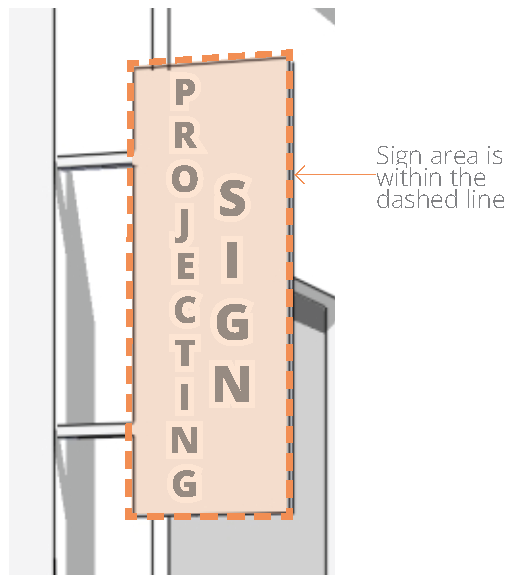
The area of a Projecting Sign is equal to the area of one of the sign's faces. Refer to Figure 8.4-C Area Calculation for Projecting Sign.
Figure 8.4-A Projecting Sign Requirements
***Expand table to lock table headings in place while scrolling***
Figure 8.4-B Example of Projecting Sign
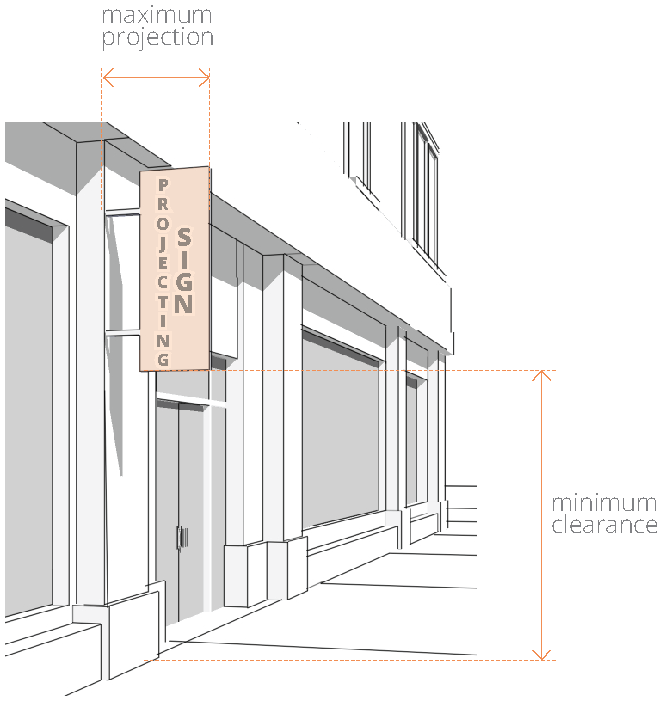
Figure 8.4-C Area Calculation for Projecting Sign
8.5.1 - DESCRIPTION
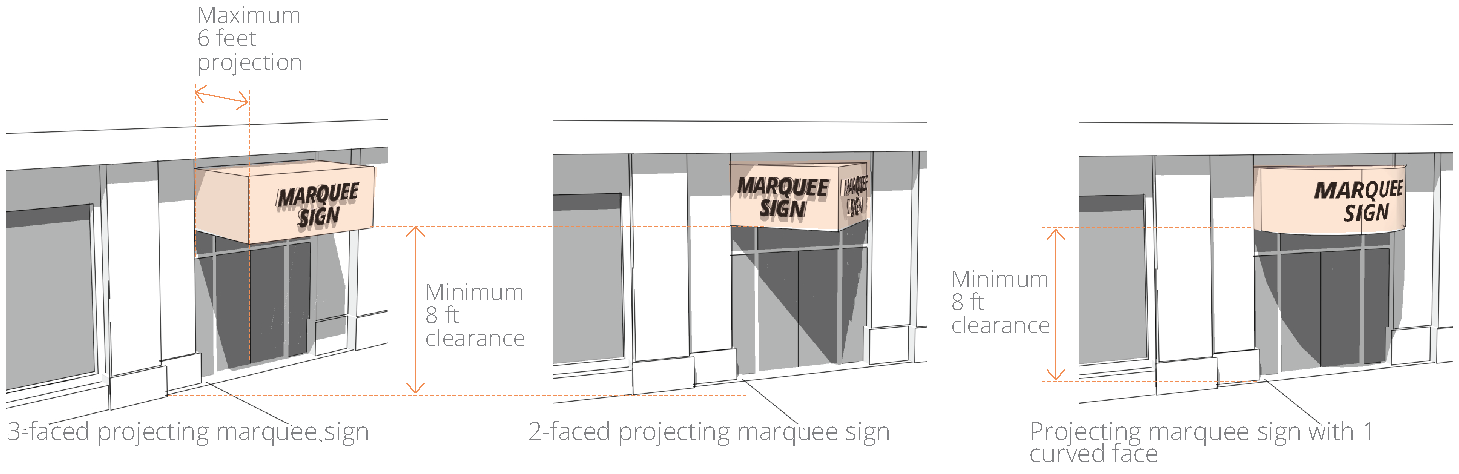
A Projecting Marquee Sign is a projecting sign designed to have manually changeable copy or, where permitted, dynamic display, and 2 to 3 sign faces. Refer to Figure 8.5-B Examples of Projecting Marquee Signs.
8.5.2 - GENERAL REQUIREMENTS
Projecting Marquee Signs shall be developed according to the standards in this section and Figure 8.5-A Projecting Marquee Sign Requirements.
A.
Manually Changeable Copy Boards. Manually Changeable Copy Boards are permitted on Projecting Marquee Signs, provided the following conditions are met:
(1)
The area of the boards cannot be greater than 30 percent of the area of the sign face on which it is located or 32 square feet, whichever is less.
(2)
One sign of any type containing a Manually Changeable Copy Board is permitted per lot.
B.
Dynamic Display. Refer to 8.12 Dynamic Display.
8.5.3 - COMPUTATION
The sign area is calculated by combining the area of all exposed sign faces and the cabinet or structure surrounding them.
Figure 8.5-A Projecting Marquee
Sign Requirements
***Expand table to lock table headings in place while scrolling***
Figure 8.5-B Examples of Projecting Marquee Signs
8.6.1 - DESCRIPTION
A sign that is mounted, painted, or otherwise applied on or attached to an awning. Refer to Figure 8.6-B Example of Awning Sign.
8.6.2 - GENERAL REQUIREMENTS
Awning Signs shall be developed according to the standards in Figure 8.6-A Awning Sign Requirements. See also 4.2.2 Windows, Awnings, & Shutters.
A.
Configurations. The following configurations for awning signs are permitted:
(1)
Awnings attached solely to a building façade, without posts or poles as secondary supports.
(2)
Under-awning signs attached to the underside of the awning or under an arcade entrance type.
8.6.3 - COMPUTATION
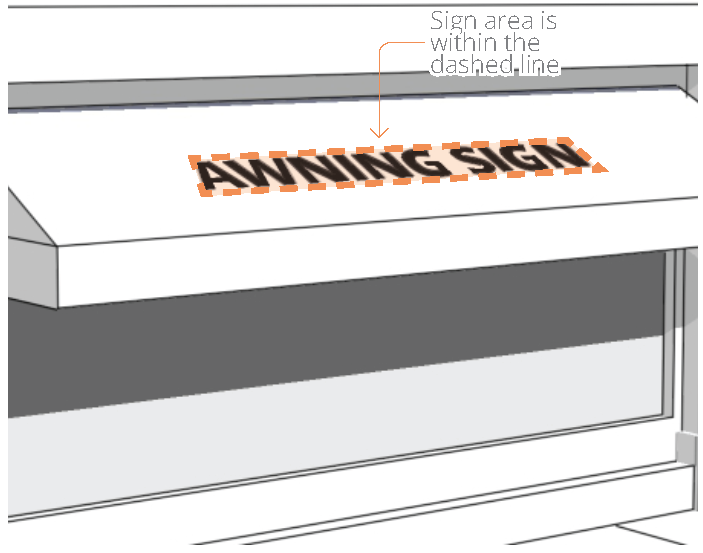
The area of an Awning Sign is calculated by drawing the smallest possible square or rectangle around the largest alphanumeric characters and/or graphic elements of the sign portion of the awning, as is illustrated in Figure 8.6-C Area Calculation for Awning Sign.
Figure 8.6-A Awning Sign Requirements
***Expand table to lock table headings in place while scrolling***
Figure 8.6-B Example of Awning Sign
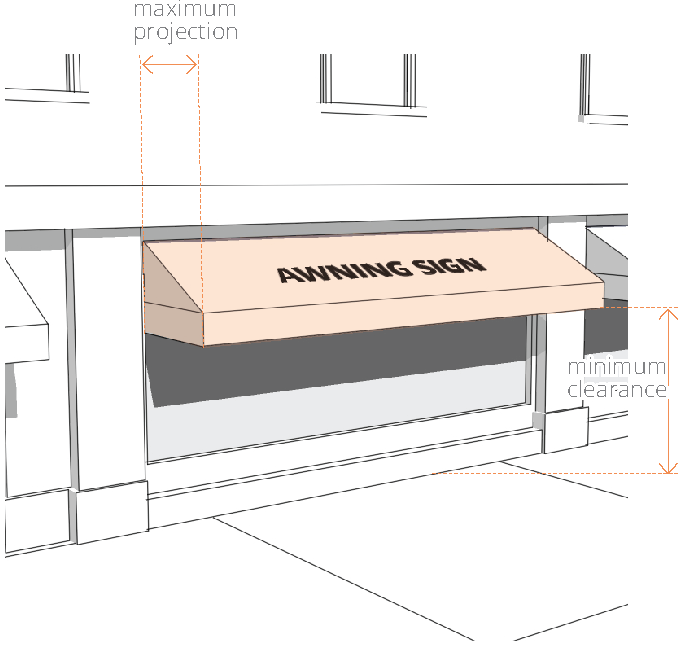
Figure 8.6-C Area Calculation for Awning Sign
8.7.1 - DESCRIPTION
A sign with individual alphanumeric characters and/or graphic elements that is mounted on top of a permanent canopy. Refer to Figure 8.7-B Example of Canopy-Mounted Sign.
8.7.2 - GENERAL REQUIREMENTS
Canopy-Mounted Signs shall be developed according to the standards in Figure 8.7-A Requirements for Canopy-Mounted Signs.
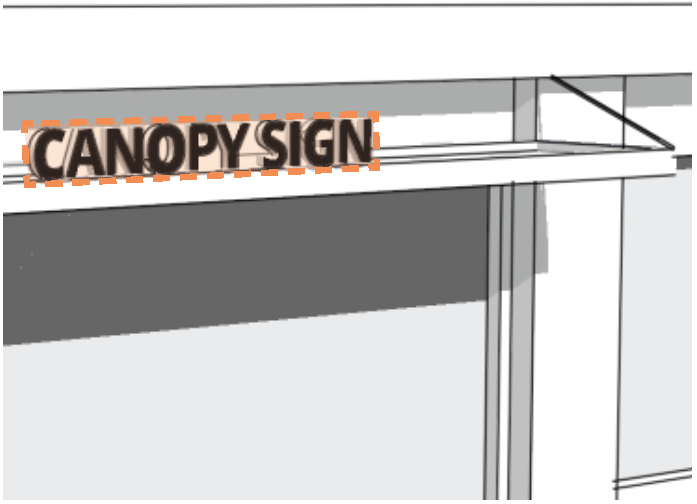
8.7.3 - COMPUTATION
The area of a Canopy-Mounted Sign is calculated by drawing the smallest possible square or rectangle around the largest alphanumeric characters and/or graphic elements of the sign portion of the Canopy-Mounted Sign, as is illustrated in Figure 8.7-C Area Calculation for Canopy-Mounted Sign.
Figure 8.7-A Requirements for
Canopy-Mounted Signs
***Expand table to lock table headings in place while scrolling***
Figure 8.7-B Example of Canopy-Mounted Sign
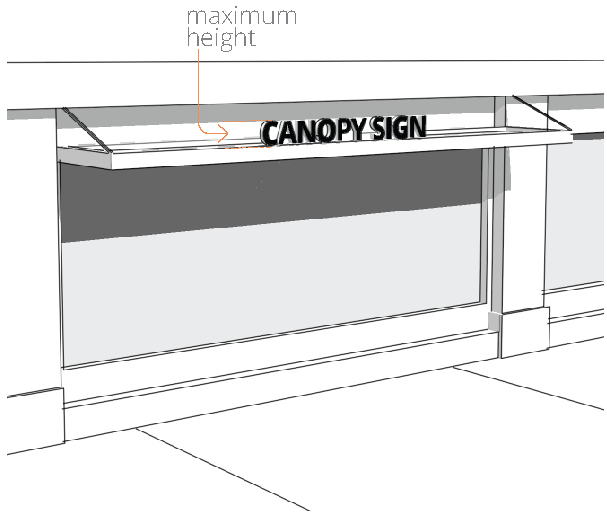
Figure 8.7-C Area Calculation for Canopy-Mounted Sign
8.8.1 - DESCRIPTION
A Roof Sign consists of individual alphanumeric characters or graphic elements. It is erected on the roof of a building and projects above the highest point of the roof line or parapet of the building. It is typically situated parallel to the adjacent street and does not project beyond the front facade of the building. Refer to Figure 8.8-B Example of Roof Sign. Signage attached to a wall face of rooftop mechanical penthouses, screening, or similar, mounted above the eave of the roof type is considered a Roof Sign.
8.8.2 - GENERAL REQUIREMENTS
Roof Signs shall be developed according to the standards in Figure 8.8-A Roof Sign Requirements.
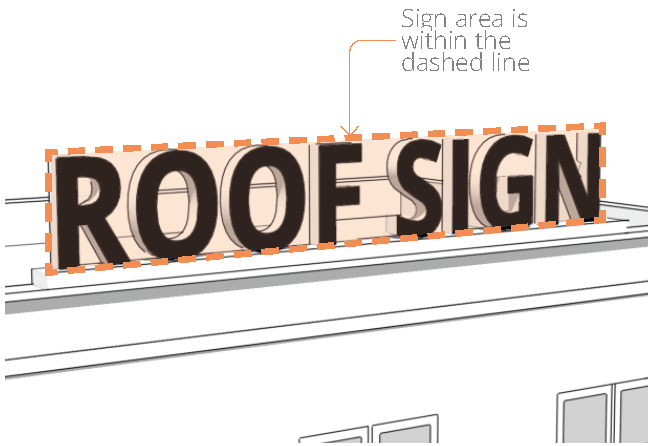
8.8.3 - COMPUTATION
The area of a Roof Sign is calculated by drawing the smallest possible square or rectangle around the largest alphanumeric characters and/or graphic elements as is illustrated in Figure 8.8-C Area Calculation for Roof Sign.
Figure 8.8-A Roof Sign Requirements
***Expand table to lock table headings in place while scrolling***
Figure 8.8-B Example of Roof Sign
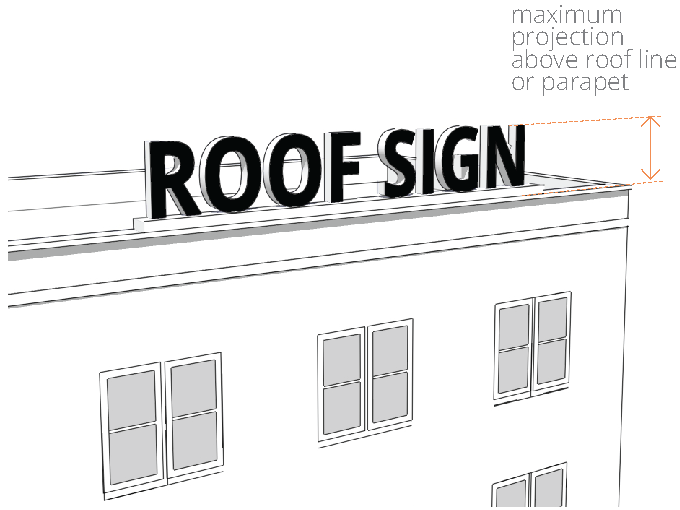
Figure 8.8-C Area Calculation for Roof Sign
8.9.1 - DESCRIPTION
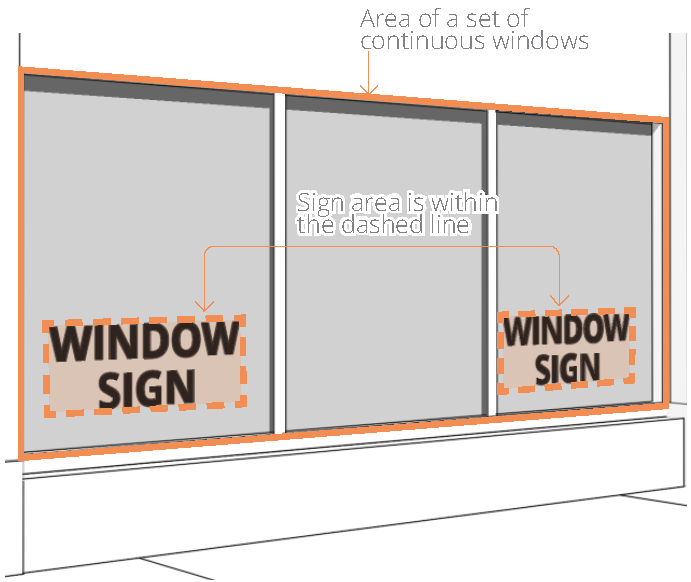
A Window Sign is posted, painted, placed, or affixed in or on a window exposed for public view or is a sign hung inside the building facing the window for public view. Figure 8.9-B Example of Window Sign.
8.9.2 - GENERAL REQUIREMENTS
Window Signs shall be developed according to the standards in Figure 8.9-A Window Sign Requirements. See also 4.2.2 Windows, Awnings, & Shutters.
8.9.3 - COMPUTATION
A series of windows that are separated by frames or supporting material of less than 6 inches in width shall be considered a single window for the purposes of computation.
A.
Measurement. To measure sign area percentage, divide the total sign area, by the total window area, as illustrated in Figure 8.9-C Area Calculation for Window Sign.
(1)
Sign area is calculated by drawing the smallest possible square or rectangle around the largest alphanumeric characters and/or graphic elements.
B.
Maximum Allowance. Window Signs are not counted toward a site's maximum signage allowance per Figure 8.2-B Maximum Quantity and Size of Signage by District
C.
Exempt Signs. Address and hours of operation are considered exempt signs and are not counted in the Window Sign area calculation. Refer to 8.14 Exempt Signs.
D.
Temporary Window Signs. Temporary Window Signs must be included in the total percentage of signage per window calculation per Figure 8.9-A Window Sign Requirements. Refer also to 8.13.2 E. under Temporary Sign Types.
Figure 8.9-A Window Sign Requirements
***Expand table to lock table headings in place while scrolling***
Figure 8.9-B Example of Window Sign
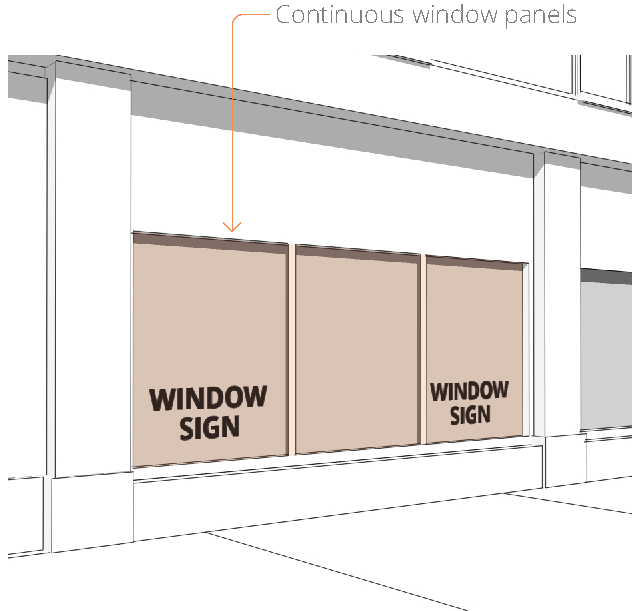
Figure 8.9-C Area Calculation for Window Sign
8.10.1 - DESCRIPTION
A Monument Sign is freestanding; it is located in a front or corner side yard of a lot. Refer to Figure 8.10-B Example of Monument Sign.
8.10.2 - GENERAL REQUIREMENTS
Monument Signs shall be developed according to the standards in Figure 8.10-A Monument Sign Requirements.
A.
Multiple Tenants. Multiple tenant buildings on a lot with a width of greater than 300 feet, measured across the front property line, may have signage with the following parameters:
(1)
Up to 2 Monument Signs on one frontage.
(2)
Signs shall be at least 150 feet apart.
B.
Pole-Mounted Signs. Monument Signs may not be pole-mounted.
C.
Manually Changeable Copy. The area of any Manually Changeable Copy Board cannot equal greater than 50 percent of the area of the sign face on which it is located or 20 square feet, whichever is less.
D.
Dynamic Display. Refer to 8.12 Dynamic Display.
(Amend. of 9-24-2024(1))
8.10.3 - COMPUTATION
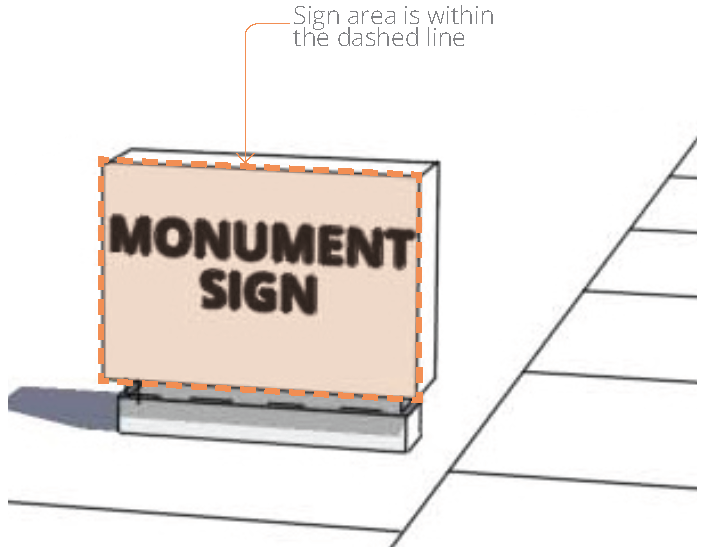
Sign area is calculated per sign face. This measurement includes the sign, any cabinet in which it is enclosed and any changing sign portions, but excludes the base of the sign. Refer to Figure 8.10-C Area Calculation for Monument Sign.
A.
Measuring Height. Height shall include the sign face, base, cabinet, and ornamental cap.
Figure 8.10-A Monument Sign Requirements
***Expand table to lock table headings in place while scrolling***
Figure 8.10-B Example of Monument Sign
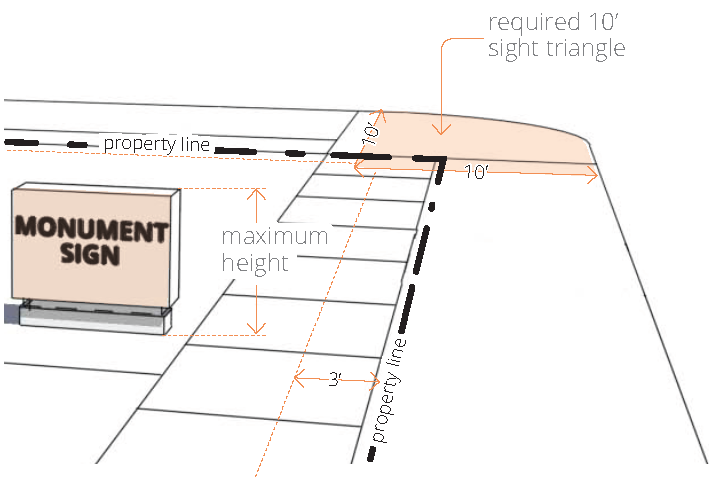
Figure 8.10-C Area Calculation for Monument Sign
(Amend. of 9-24-2024(1))
8.11.1 - DESCRIPTION
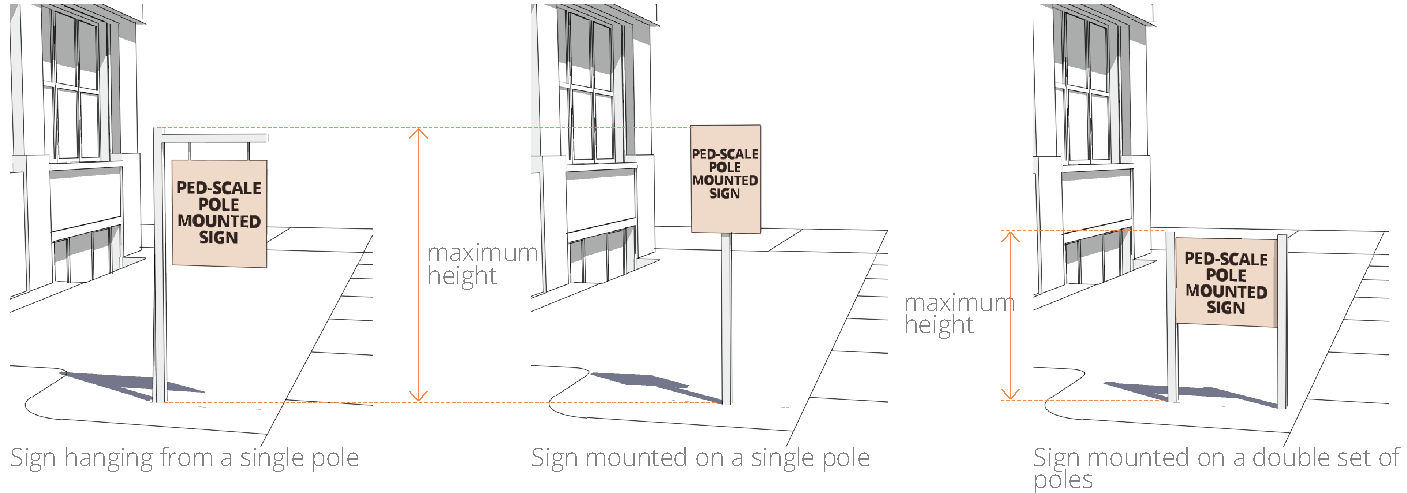
A Ped-Scale Pole-Mounted Sign is freestanding and may be mounted on 1 or 2 poles. Three configurations are permitted. Refer to Figure 8.11-C Examples of Ped-Scale Pole-Mounted Signs.
A.
A sign mounted onto a double set of poles.
B.
A sign mounted on a single pole.
C.
A sign hanging from a single pole.
8.11.2 - GENERAL REQUIREMENTS
Ped-Scale Pole-Mounted Signs shall be developed according to the standards in Figure 8.11-A Ped-Scale Pole-Mounted Sign Requirements.
8.11.3 - COMPUTATION
The area of a Pole-Mounted Sign is equal to the area of one sign face. Refer to Figure 8.11-B Area Calculation for Ped-Scale Pole-Mounted Sign.
Figure 8.11-A Ped-Scale Pole-Mounted Sign
Requirements
***Expand table to lock table headings in place while scrolling***
Figure 8.11-B Area Calculation for Ped-Scale
Pole-Mounted Sign
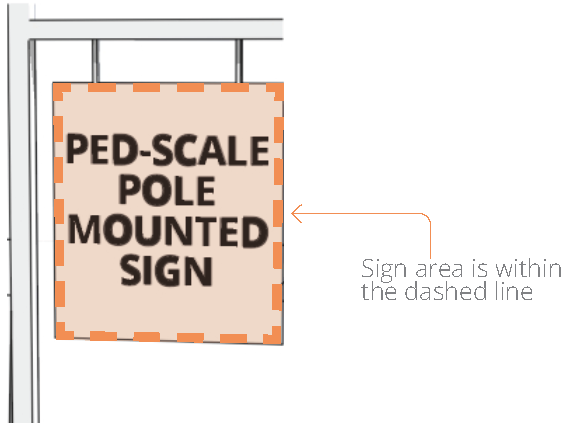
Figure 8.11-C Examples of Ped-Scale Pole-Mounted Signs
8.12.1 - DEFINITION
Any element of a sign or sign structure capable of displaying words, symbols, figures, images or messages that can be electronically or mechanically changed by remote or automatic means. This also includes any display that incorporates rotating panels, LED lights manipulated through digital input, "digital ink" or any other method or technology that allows a sign to present a series of images, messages or displays. This does not include signs with Manually-Changeable Copy Boards or Digital Copy at fueling stations. Digital Copy shall be defined as static, non-flashing electronic letters and numbers intended specifically for conveying pricing.
(Amend. of 12-13-2022)
8.12.2 - APPLICABILITY
Any sign with a dynamic display that is visible from the public right-of-way shall be subject to these regulations.
8.12.3 - GENERAL REQUIREMENTS
A.
Permitted Districts. Dynamic displays are permitted only within the DT districts, the Transit Oriented Development Overlay, the Connecticut River Overlay, and lots containing School: Pre-K, Primary, Elementary, Intermediate, or School: High School, or on existing or new billboards expressly authorized in 8.12.3 D.
B.
Special Permit. An approved Special Permit (refer to 1.3.4) is required for installation of any sign with a dynamic display.
C.
Documentation Required. Proposals for dynamic displays must be reviewed and approved for compliance with all applicable building, safety and electrical codes. Applications must include appropriate documentation from a licensed design professional of the sign structure's ability to accommodate the dynamic display technology.
D.
Allowable Sign Types.
(1)
A dynamic display may be incorporated into any permitted Wall Sign, Projecting Sign, or Projecting Marquee Sign in a Downtown (DT) district (refer to sections 8.3, 8.4, and 8.5, respectively).
(2)
In addition, in accordance with the city's goal of promoting complete streets, an existing large-scale billboard with off-site advertising on property adjacent to or along and visible from Interstate 91, or Interstate 84 west of Park Street, may be converted to a dynamic display, and up to 3 new large-scale billboards with a dynamic display may be erected on city property adjacent to Interstate 91, only if the property owner, or in the case of city-owned property the billboard operator or lessee, applies for a special permit and in the judgment of the commission satisfies the special permit criteria of 1.3.4 and the following criteria, prior to the issuance of any such permit:
(a)
Does not locate such billboard within 500 feet of the city line; and
(b)
Either (i) removes another static billboard along I-91 and pays (per face converted to dynamic display) $175,000 into the complete streets fund, or (ii) pays (per face converted to dynamic display) $300,000 into the complete streets fund; and
(c)
Otherwise mitigates aesthetic issues and visual impact in the immediate vicinity as may be prescribed by the decision-making body during the special permit process; and
(d)
Provides the city with a minimum of 10 hours of advertising time each month of operation, which hours shall occur during the hours of 8 a.m. and 6 p.m., and facilitates all logistics related to the timely posting of such advertising with relevant city officials, such obligation reoccurring on an ongoing, monthly basis throughout the operation of the dynamic display, and such obligation being necessary to ensure continued validity of any permit issued therefor; and
(e)
Demonstrates that the proposed location, design, and operation of such billboard will not have a negative impact on public safety, especially in terms of the billboard's effect on traffic congestion, driver distraction, emergency services, and pollution, which negative impact is not other wise mitigated by the payments tendered pursuant to 8.12.3 D.(2)(b).
E.
Display. The following applies to all dynamic displays.
(1)
The images and messages displayed on a dynamic display must have a minimum dwell time of at least 8 seconds and may not contain any movement, animation, audio, video, pyrotechnics, or other special effects.
(2)
The transition or change from one message to another must occur in one second or less and involve no animation or special effects.
(3)
The images and messages displayed must be complete in and of themselves within the required dwell time.
(4)
Dynamic displays must be equipped with a default mechanism that freezes the display in one position or presents a static or blank display if a malfunction occurs.
(5)
Dynamic displays may not have a brightness of such intensity or brilliance that they impair the vision or endanger the safety and welfare of any pedestrian, cyclist, or person operating a motor vehicle.
(6)
Dynamic displays must be equipped with a light detector/photocell that automatically adjusts the display's brightness according to natural ambient light conditions.
(7)
The maximum brightness level of a dynamic display may not exceed 5,000 nits (candelas per square meter) during daylight hours or 250 nits between 30 minutes after sunset and 30 minutes before sunrise, as those times are determined by the National Weather Service (Actual Time). Brightness must be measured from the brightest element of the sign's face. Before the issuance of a sign permit, the applicant must provide written certification from the sign manufacturer that the light intensity has been factory pre-set so that it will not exceed 5,000 nits (candelas per square meter).
(a)
This maximum brightness may be reduced as a condition of the Special Permit.
(b)
For the purpose of verifying compliance with maximum brightness level requirements, the zoning administrator will measure brightness levels with the dynamic display sign set to run full white copy with a luminance meter positioned at a location perpendicular to the sign face center. When taking the luminance reading, the sign face must be the only subject visible in the viewfinder.
(c)
If the measurement is more than the maximum allowed, the brightness level is in violation of these regulations and must be adjusted downward. Failure to make such adjustments may result in other available enforcement actions to be taken by the city.
(8)
Light trespass from any dynamic display may not cause the light level along any Neighborhood (N) district, as measured at a height of 60 inches above grade in a plane at any angle of inclination, to exceed 0.1 footcandles above ambient light levels at the property line of any property in an N district
F.
Modified Regulations.
(1)
Regulations governing dynamic displays are subject to ongoing monitoring and future modification in the exercise of the city's police powers.
(2)
No vested right is ever created in an existing dynamic display. If regulations governing operational aspects of dynamic displays (e.g., dwell time, transitions, illumination/brightness, etc.) are modified by the city, then sign owners and operators are required to bring dynamic display advertising signs into compliance with all applicable dynamic display regulations.
(3)
A special permit issued pursuant to 8.12.3 D.(2) shall be valid for a maximum period of 5 years, and shall be issued for the maximum period unless further expressly limited in duration by the commission. Renewal applications for special permits issued pursuant to 8.12.3 D.(2) must comply with all aspects of 8.12.3 D.(2) except subsection (b), and must comply with any other relevant regulations as modified from time to time.
G.
Severability. In addition to the severability provisions of 1.1.11., if a court of competent jurisdiction finds any of the provisions of this section 8.12 to be invalid or ineffective in whole or in part, the right of property owners to apply for and receive a permit for dynamic displays shall be null and void, and this section considered to be ineffective in its entirety, subject only to nonconforming sign rights delineated in 1.5.5.
(Amend. of 12-9-2025)
8.13.1 - GENERAL REQUIREMENTS
These signs are temporarily permitted for promoting special community or non-profit activities, special events, or grand openings for businesses. Temporary signs shall adhere to the following general requirements, unless otherwise specified.
A.
Permitted Display Time.
(1)
Temporary signs shall be permitted only for a period of one month prior to and including the duration of the activity which such sign describes, except where specific permissions are stated in 8.13.2 Temporary Sign Types.
(2)
Temporary signs shall be removed within one week after the completion of the activity which the sign describes.
(3)
Once removed, a temporary sign shall not be reinstalled on same lot until after the expiration of an interim period of 90 days, provided, however, that nothing shall prohibit a property owner from erecting a new temporary sign for a real estate sign defined in 8.13.2 in place of an old temporary sign merely because the property owner changed real estate agents.
B.
Location. The following regulations apply to locating temporary signs.
(1)
Temporary signs shall be allowed in all districts.
(2)
Temporary signs must be located on private property and shall not be posted, attached or placed on any tree, utility pole, street sign post, light post, or any official traffic control sign or signal post on the public right-of-way.
(3)
Temporary signs located within the public right-of-way may be removed by the city.
(4)
In all N districts, temporary signs shall be set back a minimum of 10 feet from any property line.
C.
Quantity. One temporary sign is permitted per lot frontage on a public right-of-way per permitted display period.
D.
Size. All temporary signage on a lot shall not exceed an area greater than 32 square feet at one time and is not counted in the determination of the total permitted area of signage on a lot.
(1)
In all N districts, all temporary signs shall be no greater than 12 square feet in area.
E.
Maintenance & Materials. All temporary signs must be properly maintained and of a material able to withstand the elements.
F.
Permit Required. The display of all temporary signs erected in conformance with this section does not require a permit unless a permit is specifically required by another provision in this section, 8.13 Temporary Signs.
G.
Specific Temporary Sign Requirements. The general requirements contained in 8.13.1 shall be superseded by the requirements for specific temporary signs set forth in 8.13.2, where the requirements in 8.13.2 directly contradict the requirements of 8.13.1.
8.13.2 - TEMPORARY SIGN TYPES
The following are permitted types of temporary signs. Requirements defined in 8.13.1 General Requirements, above, shall be met, unless otherwise specified below.
A.
Real Estate Signs. Real estate signs are for the sale, lease, or rental use of a lot, building, or dwelling unit. For real estate signs advertising rooms or rooming units, refer to the requirements of 8.13.2 E. Window Signs. For real estate signs in the form of a banner, refer to the requirements of 8.13.2 G. Banners.
(1)
Permitted Display Time. Real estate signs are permitted for the period during which the property is actively marketed for sale, rental, or lease, and shall be removed within 7 days of a signed agreement, in accordance with 8.13.1 A.
(2)
Open House Signs. Open house signs are permitted up to 4 hours before the event and shall be removed immediately after its end.
(3)
Quantity. One sign pertaining to the sale, lease, rental use of a lot or building, or availability of a rental unit in a building is permitted per lot frontage.
(4)
Size. Real estate signs shall not exceed 6 square feet in area, except for the following pertaining to non-residential uses:
(a)
Lots with 100 to 300 feet of frontage. Real estate signs for properties with lot frontages between 100 and 300 feet shall not exceed 12 square feet, in total, per lot frontage.
(b)
Lots with over 300 feet of frontage. Real estate signs for properties with lot frontages over 300 feet shall not exceed 24 square feet, in total, per lot frontage.
(5)
Height. The maximum height of such signs is 7 feet.
(6)
Permit. A permit is required only for signs larger than 6 square feet in area.
B.
Construction Signs. Construction signs identify the name of the project developers, contractors, engineers, and architects on a site being developed. Construction signs do not include public safety signs, exempt from these regulations in accordance with 8.14.2 D. Public Service Signs.
(1)
Permitted Display Time. Signs shall be removed no later than 7 days after the completion of construction or issuance of a certificate of occupancy, whichever is sooner.
(2)
Size. For every one project developer, contractor, engineer, or architect, 4 additional square feet of area is permitted up to a total sign area of 32 square feet in non-residential and mixed-use districts, and 12 square feet in residential districts without a permit.
(3)
Quantity. One sign is permitted per street frontage for each construction project.
(4)
Height. The maximum height of such signs is 10 feet.
(5)
Permit. A permit for a construction sign is not required unless the proposed sign exceeds the size and height requirements of this subsection 8.13.2 B. The zoning administrator has discretion to approve a construction sign that exceeds the size and height otherwise allowed by this section based on the specific characteristics of the project and site.
C.
Political Signs. Political signs are permitted in all districts incidental to a city, state, or federal election or referendum, or signs which are political in nature.
(1)
Material. Such signs shall be constructed of durable material, and shall be prohibited being attached to from trees, traffic signs or utility poles.
(2)
Permitted Display Time. Such signs shall be erected not more than 60 days prior to such election or referendum, and in any event, no premises shall have a sign erected for more than 120 days in any calendar year. Political signs relating to any election or referendum shall be removed within 7 days after said election or referendum.
(3)
Size. In all residential districts, such signs shall not exceed 16 square feet in area per sign face.
D.
Special Event Signs. A special event sign is permitted for promoting special community activities, special promotional sales, grand openings, special events, or activities as described in this section.
(1)
Permitted Display Time. Signs shall be displayed for no more than 30 days and removed no later than 7 days after completion of the special event.
(2)
Location.
(a)
Special events signs may be located in the right-of-way in the DT, MS, and CX districts where the pedestrian walkway is at least 5 feet in width, and shall not be placed within 10 feet of an intersection or crosswalk. Such sign location is subject to approval by the zoning administrator in coordination with Public Works.
(b)
In all N districts, such signs shall be set back a minimum of 10 feet from any property line.
(3)
Streamers and Pennants. Outside streamers, pennants, and other fluttering, non-verbal decorations intended to draw attention, shall only be allowed as temporary signs in conjunction with a special event, and shall be specified in the required permit.
(4)
Size. The size of special event signs shall not exceed 16 square feet in area, in total for the lot, without a permit.
(5)
Permit. A permit is required for all special event signs larger than 16 square feet in area, in total for the lot. The zoning administrator has discretion to approve a special event sign that exceeds the size and height otherwise allowed by this section based on the specific characteristics of the project and site.
E.
Window Signs. Temporary window signs are those signs that do not exceed 1 square foot in size, are located wholly in the window of the structure housing the use being referenced by the sign, and are composed of paper or other temporary materials not specified in Figure 8.9-A Window Sign Requirements, pertaining to permanent window signs. Such signage may, for example, include advertisement of rooms or rooming units available for rent or "now hiring" signs.
(1)
Multiple Signs. Multiple temporary window signs are considered one sign for the purposes of computing the quantity of temporary signs on a lot.
(2)
Permit. No permit shall be required.
F.
Sandwich Board Signs. A sandwich board is a set of 2 signs set up in a triangular shape and hinged along the top or a T-frame or I-frame sign.
(1)
Permitted Display Time. Sandwich boards are not restricted to the 30 day display time restriction.
(a)
Signs shall only be displayed during business hours and must be removed by close of business each day.
(b)
Signs shall not be displayed when winds exceed 20 miles per hour.
(2)
Location. Sandwich board signs may be located in the right-of-way in the DT, MS, CX, and MX districts where the pedestrian walkway is at least 5 feet in width and shall not be placed within 10 feet of an intersection or crosswalk. Such sign location is subject to approval by the zoning administrator in coordination with Public Works.
(a)
Sandwich board signs shall be located within 15 feet of the entrance to the business and no more than one foot from the building line.
(b)
Signs shall not be attached to the sidewalk or to city-owned property, including but not limited to electric light poles and traffic signs.
(3)
Size. Signs shall not be greater than 3 feet in height and no more than 6 square feet in area per sign face.
(4)
Quantity. No more than one sandwich board sign is permitted per building lot.
(5)
Materials. Signs shall be constructed of wood, metal, or other durable materials to withstand the elements. Signs shall not be reflective.
(6)
Liability. The owner of any sandwich board sign has an absolute duty to prevent such sign from causing any property damage or personal injuries.
G.
Banners. A sign made of fabric or other similar non-rigid material with no enclosing framework or electrical components that is supported or anchored on 2 or more edges or at all 4 corners.
(1)
Permit. A permit shall be required for all banners, other than:
(a)
Banners used as construction signs;
(b)
Political signs that are allowed as of right without a permit in accordance with section 8.13 Temporary Signs; and
(c)
Individual banners installed in a permanent structural installation associated with a civic and institutional use, although a permanent structural installation requires a permit.
(2)
Requirements per Use or District.
(a)
Multi-Unit Dwelling Uses. Temporary banners are allowed on lots with Multi-Unit Dwelling buildings, provided that no more than one temporary banner is allowed for each 50 dwelling units in the building, up to a maximum of 3 banners. Temporary banners may not exceed 32 square feet in area and no more than one may be attached to each building wall. The mounted height of the temporary banner may not exceed 24 feet. Temporary banners on multi-unit buildings may be in place for no more than 180 days in any calendar year.
(b)
Non-residential Uses. One temporary banner is allowed on lots with allowed non-residential uses. Such banners may not exceed 32 square feet in area and may remain in place for no more than 180 days per calendar year , with the exception of certain Civic and Institutional uses regulated by 8.13.2 G.(2)(d).
(c)
Downtown, Main Street, and Commercial Industrial Mix Districts. Temporary banners in all DT, MS, and CX districts are subject to the standards applicable to permanent signs and are counted in the total square footage of signage allowed on the site.
(d)
Certain Civic and Institutional Uses. Each building containing a Government/Higher Education/Hospital use, Library/Museum use, or non-profit theater use (a type of Assembly use) may have one or two permanent structural installations, or up to three permanent structural installations when the building occupies a corner, which are designed to allow for one temporary banner each, which must be mounted parallel with the building face. Each banner shall not exceed 100 square feet in area and each shall be replaced at least three times per calendar year. Such banners shall be excluded from the total square footage of signage allowed on site, including in the DT, MS, and CX districts, notwithstanding the foregoing.
(3)
Location. Banners must be mounted to the face of a building and may not cover any window or other building opening.
8.14.1 - GENERAL REQUIREMENTS
Exempt signs meeting the standards of this section are subject to the following:
A.
Exempt signs are permitted in all districts.
B.
Exempt signs do not require a sign permit for installation, unless otherwise specified.
C.
Exempt signs are not required to meet any sign type standards, unless otherwise specified.
D.
Exempt signs are not counted in the determination of the total permitted area of signage on a lot per the requirements of 8.2.2 Maximum Permitted Quantity of Signage by District.
8.14.2 - EXEMPT SIGNS
The following are considered exempt signs.
A.
Identification Signs.
(1)
Identification signs indicating names of residents and dwelling or dwelling unit numbers shall have a maximum area of one square foot, and shall be limited to one sign per dwelling unit
(2)
Identification signs indicating the name and purpose of a structure and the name of its management shall have a maximum area of 3 square feet, and shall be limited to one sign per structure.
B.
Hours of Operation. Hours of operation, not exceeding 2 square feet in area.
C.
Official Signs. Any official sign, public notice sign, or warning sign required by a valid and applicable federal, state, or local law, regulation, or ordinance or by order of a court of competent jurisdiction; or signs consisting of fabric or plastic banners which the department of public works has approved for mounting on publicly owned or operated streetlights or within public rights of way.
D.
Public Service Signs. Signs used for safety purposes relative to the repair or maintenance of streets, sidewalks, or utilities in a public right-of-way.
E.
Traffic Control Signs. Traffic and other official signs of any public or governmental agency, such as traffic control signs, railroad crossing signs, trespass signs, signs indicating danger, or signs used as aids to service or safety.
F.
Flags. A sign made of fabric or other similar non-rigid material supported or anchored along only one edge or supported or anchored at only 2 corners.
(1)
One or 2 flags may be displayed per lot without a sign permit, provided that any Flag Pole used to mount such flag or flags complies with 4.20.4 E., regulating flag poles as an accessory outdoor structure.
(2)
All flags shall be counted towards the maximum signage per lot.
G.
Signs Inside Buildings and Stadiums. Any sign which is located completely within an enclosed building or within a stadium, when such sign is not readable from 10 feet or more outside the building or stadium.
H.
Informational Signs. Any sign not exceeding 8 square feet and not legible beyond the property line of upon which it is situated or from any right-of-way and signs oriented inward upon a lot and intended solely for the information of employees, students, faculty, or visitors.
I.
Directional Signs. Signs directing vehicular ingress and egress to off-street parking facilities. These signs shall meet the following requirements:
(1)
No more than 2 signs are permitted for each lot per right-of-way frontage.
(2)
One sign per parking lot per right-of-way frontage identifying the facilities and the conditions of use.
(3)
Each sign face shall not exceed 2 square feet in area.
(4)
Signs shall not exceed 3 feet in height.
(5)
Signs shall be set back a minimum of 2 feet from property lines and are not permitted to overhang any property line.
(6)
Logos or other advertising are not permitted.
(7)
A sign permit is required.
J.
Historical Markers. Memorial signs, tablets, or cornerstones including the name of building or date of erection, when cut into any masonry surface or when constructed of bronze or other incombustible materials.
(1)
Historical markers shall not exceed 4 square feet in area.
(2)
Historical markers may be placed only by a bona fide historical organization or by a governmental agency.
K.
Temporary Decorations or Displays. Temporary decorations or displays celebrating the occasion of traditionally accepted patriotic, ethnic, or religious holidays, as well as national, state, and city holidays as differentiated from temporary signs regulated by 8.13.
L.
Signs for a Home Occupations. These signs shall meet the following requirements:
(1)
One sign per dwelling unit is permitted.
(2)
Sign shall be mounted flat against the building.
(3)
Sign shall be no larger than one square foot in area.
(4)
Sign shall not be directly or indirectly illuminated other than by those lights incidental to the residential use of the premises.
M.
Ghost Signs. Any sign or mural that was painted prior to January 1, 1980, on an exterior wall of a building or structure, which has become faded due to natural weathering and is visible from a public right of way.
(1)
Ghost signs may be maintained or repainted, but no new information or images may be added if addition would create nonconformance with these regulations.
(Amend. of 1-24-2023)
8.15.1 - GENERAL REQUIREMENTS
Prohibited signs shall not be constructed in any district.
8.15.2 - PROHIBITED SIGNS
The following signs are prohibited.
A.
Animated or Moving Signs. Signs not erected by bona fide public traffic officials which move or give the appearance of movement, including but not limited to signs which flutter, undulate, swing, rotate, oscillate, or otherwise move by natural or artificial means. Moving signs shall not include flags, signs displaying time and temperature, and electronic message board signs as permitted in this section.
B.
Similarity to Traffic Control Signs. Signs that include words such as "Stop", "Danger", "Warning", "Caution", or "Go Slow," unless such language is part of the name of the business, or any other words, phrases, symbols, or characters that imitate any authorized traffic sign by shape, color, or character or employs any red, yellow, green, or other colored lamps or lights in such a manner as to interfere with, mislead, or confuse traffic.
C.
Vehicles as Signs. Any sign attached to or placed on a vehicle or trailer parked on public or private property that is prominently visible from public streets, except during the following conditions:
(1)
The primary purpose of such a vehicle or trailer is not the display of signs.
(2)
The vehicle or trailer is in operating condition, currently registered and licensed to operate on public streets, and actively used or available for use in the daily function of the business to which such signs relate.
D.
Portable or Wheeled Signs. Any sign permanently mounted on wheels.
E.
Inflatable or Balloon Signs. Temporary or permanent signs that are inflatable or balloon-like are not permitted.
F.
Off-Site Advertising. Signs utilized to market, promote, or draw attention to an activity, business, person, entity, or thing not located or offered on the site on which the sign is located, are prohibited, except off-site advertising signage for transportation - bike share structures permitted per 4.20.7 G., transportation - bus shelters permitted per 4.20.7 H., billboards permitted per 8.12.3.D, and signage for stadiums authorized pursuant to a special permit approval.
G.
Obscene Signs. Signs that contain words, pictures, or statements that are obscene, as defined by the general statutes, section 53a-193.
H.
Signs with Sound. Signs that emit or utilize in any manner any sound capable of being detected from any public right-of-way by a person with normal hearing.
I.
Rope Lighting. Rope lighting, or other similar linear lighting with small lights (usually incandescent bulbs or light emitting diodes (LEDs)) covered in heavy-duty plastic tubing, and installed to outline signs, merchandise, windows, buildings, or building elements, where such lighting is intended to be visible from the exterior of the building, is prohibited.
J.
Other Signs. Signs not addressed in this section shall not be permitted.
K.
Streamers and Pennants. Streamers and pennants are not allowed unless they have been approved as part of a permit for a special event sign.
8.16.1 - PURPOSE
The purpose of this Section is to provide flexibility and incentives for coordinated, well designed signage plans that serve large developments with multiple buildings or parcels. The Commission recognizes that in certain circumstances, flexibility in signage type, size, and quantity is necessary to ensure that projects are cohesive, and balance the need for signage with the intent to ensure developments are integrated with the surrounding neighborhood.
(Amend. of 7-9-2024(1))
8.16.2 - INTENT
Notwithstanding anything to the contrary stated herein, the intent of this Section is to establish a standalone process for the comprehensive review and approval of a unified sign plan for developments meeting the criteria below. Accordingly, the Commission may approve a Unified Sign Plan which may otherwise exceed or deviate from the requirements of the preceding portions of this section. Following approval, such plan shall serve as the basis for all signage review in lieu of other requirements stated herein.
(Amend. of 7-9-2024(1))
8.16.3 - CRITERIA
An application seeking approval of a Unified Sign Plan may be submitted only when one (1) of the following criteria are met:
A.
The subject parcel(s) is located within a Campus Overlay zone.
B.
The subject parcel(s) is part of an approved unified development as defined herein containing at least three (3) separate buildings or 100,000 square feet.
C.
The primary use is conducted within a civic & institutional building type and located on a parcel containing at least five (5) acres.
(Amend. of 7-9-2024(1))
8.16.4 - APPLICATION REQUIREMENTS
Approval of a Unified Sign Plan shall require a Special Use Permit, issued by the Commission. In addition to the application requirements of Section 1.3.4, such application shall include the following:
A.
A site plan or other property plan indicating the parcel(s) subject to the sign plan, adjacent streets, sidewalks, pedestrian pathways, and the location of all existing and proposed signage.
B.
Scale drawings showing the dimensions, design, and illumination of all signs, including any proposed landscaping. When possible, renderings of proposed signage should also be included.
C.
A computation of the total linear frontage, amount of signage allowed and requested for each building, noting any requested deviations and a statement for why such deviations are necessary.
D.
The locations of other structures, design elements, art or other way finding features which contribute to the overall campus environment and are to be located on the property.
(Amend. of 7-9-2024(1))

