ADMINISTRATION
Alley. A public way which affords either a primary or secondary means of vehicular access but only a secondary means of pedestrian access to an abutting property.
Amenities, Tenant. One or more common areas located within the principal building or on the same parcel which have been provided for the exclusive use of building residents for professional, recreational or social purposes.
Applicant. The owner of a subject property or the authorized representative of the owner on which a land development application is being made.
Automobile. A motor vehicle, including cars, light duty trucks, and motorcycles, originally manufactured for the transport of eight (8) or fewer private, noncommercial passengers from one location to another, excluding large-sized motor vehicles such as motor homes, mobile homes, and recreational vehicles intended for living, not merely transport.
Bathroom. A room containing a water closet and lavatory and bathtub or shower, or both bathtub and shower.
Basement. A story partly underground and having at least half of its height aboveground.
Bike Plan. The City of Hartford Bicycle Master Plan adopted in 2019, as amended from time to time.
Block. The aggregate length of lots, passages, lanes, and alleys bounded on all sides by streets.
Block Face. The aggregate length of all the building facades on one side of a block.
Block Length. A block measurement that is the horizontal distance along the front property lines of the lots comprising the block.
Bona Fide Guest. A non-paying guest who is invited to live in a dwelling unit, on a temporary basis, by the person or persons with legal possession of the property, with whom such guest has a personal relationship that pre-existed the guest's occupancy of the property.
Building. Any structure having a roof, supported by columns or by walls and intended for the shelter, housing, or enclosure of any person, animal, or tangible property.
Build-to Zone. An area in which the front or corner side facade of a building shall be placed; it may or may not be located directly adjacent to a lot line, but is typically in reference to the building line. The zone dictates the minimum and maximum distance a structure may be placed from the lot or building line.
Building Line. A line established by the commission defining the dominant, above-ground limit of front facades along a block face and from which measurement of the build-to zone of a lot is taken. The building line location is available at the department of development services.
Building Type. A structure defined by the combination of configuration, form, and function. Refer to 4.0 Building Types for more information and the list of permitted building types.
City. The City of Hartford.
Code (or Municipal Code). The municipal code of the city of Hartford, as it may be amended from time to time.
Cool Roof. A roof designed to reflect more sunlight and absorb less heat than a standard roof, which is composed of a highly reflective type of paint, a sheet covering, or highly reflective tiles or shingles.
Commission. The city planning and zoning commission established and operating pursuant to the general statutes and Chapter VII of the city charter.
Council. The city council.
Courtyard. An outdoor area enclosed by a building on at least 2 sides and open to the sky.
Critical Root Zone. The area of soil and roots within the radius beneath the tree's canopy, within the dripline, or within a circular area of soil and roots with a radius out from the trunk a distance of 1.5 feet for every inch of the tree's width, measured at diameter breast height above the mean grade of the tree's trunk.
District, or Zoning District. A designation given to each Lot within the city that dictates the standards for development on that lot. Refer to 2.0 Districts for more information and a list of permitted zoning districts.
Driveway. A private way that affords motor vehicle access from a public or private street into abutting property.
Dwelling. Any building or portion thereof, which is designed or used exclusively for residential purposes and containing one or more dwelling or rooming units.
Dwelling Unit. A room or group of rooms connected together that include a bathroom and facilities for living, sleeping, cooking, and eating that are arranged, designed, or intended to be used as living quarters for one household, whether owner occupied, rented, or leased.
Easement. A legal interest in land, granted by the owner to another person or entity, which allows for the use of all or a portion of the owner's land for such purposes as access or placement of utilities.
Eave. The edge of a pitched roof; it typically overhangs beyond the side of a building.
Entrance Type. The permitted treatment types of the ground floor facade of a building type. Refer to 4.19.1 Entrance Types for more information and a list of permitted entrance types.
Erected. Includes built, constructed, reconstructed, moved upon, or any physical operations on the premises required for the building. Excavations, fill, drainage, paving and the like shall be considered a part of erection.
Essential Services. The erection, construction, alteration, or maintenance by public utilities or municipal departments of underground, surface or overhead gas, communication, electrical, steam, fuel or water transmission or distribution systems, collection, supply or disposal systems, including towers, poles, wires, mains, drains, sewers, pipes, conduits, cables, fire alarm and police call boxes, traffic signals, hydrants and similar accessories in connection therewith but not including structures which are necessary for the furnishing of adequate service by such utilities or municipal departments for the general public health, safety, convenience and welfare.
Expression Line. An architectural feature which is a decorative, three-dimensional, linear element, horizontal or vertical, protruding or indented at least 2 inches from the exterior facade of a building, and with a minimum width or height of one and one half inches, typically utilized to delineate floors or stories of a building.
Facade. The exterior face of a building, including but not limited to the wall, windows, windowsills, doorways, and design elements such as expression lines. The front facade is any building face adjacent to the front property line.
February 28, 1968. The date which established zoning within Hartford Municipal Code Chapter 35.
Floodplain. The area of land adjoining a river, stream, water course, lake, or other similar water body within the 100 year frequency flood area defined by Federal Emergency Management Agency or its successor, or as shown on floodplain maps on file with the city clerk or the office of the Greater Hartford Flood Commission, whichever is more inclusive.
Floor Area, Gross. The sum of all gross horizontal areas of a building under the roof, measured from the exterior faces of the exterior walls (and from the center lines of party walls), including basement space where 1/2 of the basement height is above the finished lot grade average along the exterior walls of the building; elevators and stairwells on each floor; attic space with headroom of more than 7 feet; and enclosed porches, interior balconies and mezzanines, and penthouses; and excluding floor space using to mechanical equipment used in the operation and maintenance of a building and floor space devoted to parking space(s) or parking facilities.
Floor Area, Net. The total of all floor areas of a building, excluding stairwells and elevator shafts, equipment rooms, interior vehicular parking or loading, and all floors below the first or ground floor, except when used or intended to be used for human habitation or service to the public.
Floor Area, Usable. Any floor area within outside walls of a residential building, which has a minimum height clearance of 7 feet floor to ceiling, exclusive of areas in unfinished cellars, unfinished basements, unfinished attics, garages, open porches and accessory buildings.
Functional Green Roof. A green roof for which the depth of soil and planted material is at least 2 inches, which is accessible and usable for human activity.
General Statutes. The most recent revision of the general statutes of the State of Connecticut, as from time to time amended.
Grade. The average level of the finished surface of the ground story adjacent to the exterior walls of a building.
Green Roof. The area atop a roof surface on a building, open to the sky and air, which is surfaced with soil and living plant materials for the purpose of retaining rainwater and absorbing heat from sunlight, and which may be accessible by means of a roof entrance if required to maintain plant material.
Historic and Monument Sites. Those locations set aside primarily to commemorate a historical event, activity, architectural style, archaeological period, or person.
Household.
(1)
One adult, together with up to 2 domestic employees; 2 or more adults, each related to the other by blood, marriage, adoption, custodianship, or guardianship, together with up to 2 domestic employees; up to 2 adults; or 3 adults, of which at least one is unrelated to the others by blood, marriage, adoption, custodianship, or guardianship, living together as a household unit; and, for each of the preceding categories of adults, any children related to any adult in the household by blood, marriage, adoption, custodianship, or guardianship.
(2)
A roomer or boarder or bona fide guest shall not be considered a member of a household, nor shall any resident of a group living arrangement as defined in 3.3.1 C.
(3)
The household or members of the household shall not be temporary or itinerant.
Household Unit. A collection of individuals occupying the entire dwelling unit, sharing a household budget and expenses, preparing food and eating together regularly, sharing in the work to maintain the premises, and legally sharing in the ownership or possession of the premises.
Impervious Surface. Any hard surface, man-made area that does not absorb water, including roofs (other than green roofs), sidewalks, parking, driveways, and other paved surfaces.
Loading Space. An off-street space on the same lot with a building or group of buildings, for temporary parking for a commercial motor vehicle while loading and unloading merchandise or materials.
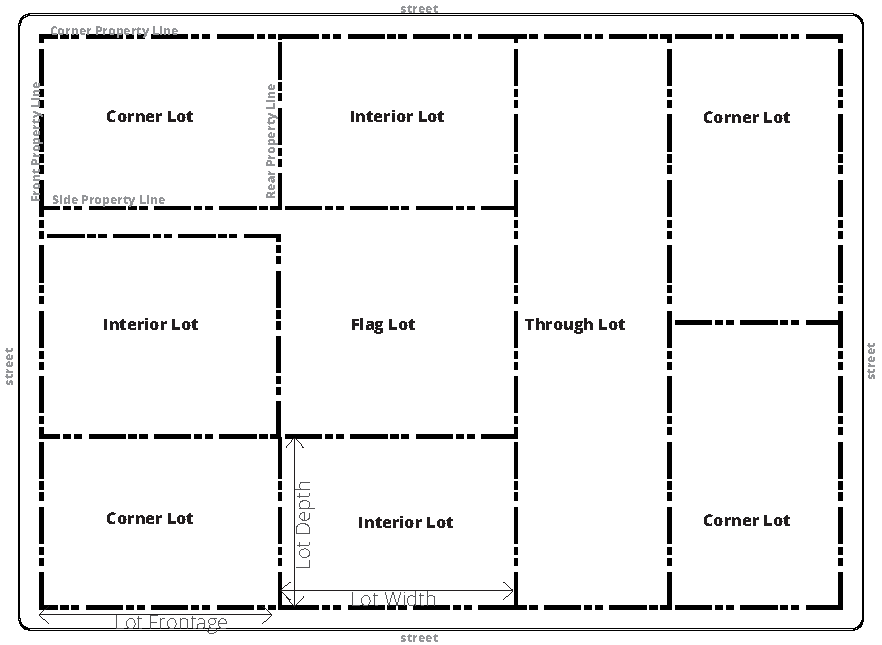
Lot. Also referred to as parcel. A plot of land intended to be separately owned, developed, or otherwise used as a unit, and which is recognized as a distinct unit of property in the zoning map, as amended from time to time. Refer to Figure 1.6-A Lots.
Lot Area. The computed area contained within the property lines; it is typically denoted in square feet or acres.
Lot, Corner. A parcel of land abutting at least 2 street rights-of-way, excluding an alley, at their intersection. Refer to Figure 1.6-A Lots.
Lot Frontage. The horizontal distance between the side property lines, measured at the front property lines. Refer to Figure 1.6-A Lots.
Lot, Through. An interior lot having frontage on two approximately parallel street rights-of-way, excluding an alley. Refer to Figure 1.6-A Lots.
Figure 1.6-A Lots
Micro-Unit. Also referred to as an Efficiency Unit. Refer to 3.1.1 A.(5).
Occupied Space. Interior building space regularly occupied by the building users. It does not include storage areas, utility space, or parking.
Open Space, Usable. That space on the same lot and contiguous to the principal building or buildings which is either landscaped with shrubs, planted with grass, or developed and maintained for recreation purposes, and excludes that portion of the lot which is covered with impervious surface.
Owner. The legal or beneficial title-holder of land or holder of a written option or contract to purchase the land.
Primary Street. A street designated on the zoning map that receives priority over other streets in terms of setting front lot lines and locating building entrances.
Property Line. Also referred to as lot line. A boundary line of a parcel of land or lot. Refer to Figure 1.6-A Lots.
Property Line, Corner. A boundary of a lot that is approximately perpendicular to the front property line and is directly adjacent to a public right-of-way, other than an alley or railroad. Refer to Figure 1.6-A Lots.
Property Line, Front. The boundary abutting a right-of-way, other than an alley, from which the required setback or build-to zone is measured, with the following exceptions:
(1)
Corner and through lots that abut a primary street (refer to 2.2 Zoning Map) shall have the Front property line on that primary street.
(2)
Corner and through lots that abut 2 primary streets or do not abut a primary street shall utilize the orientation of the 2 directly adjacent lots, or shall have the front property line determined by the zoning administrator.
Property Line, Rear. The boundary of a lot that is approximately parallel to the front property line; this line separates lots from one another or separates a lot from an alley. Refer to Figure 1.6-A Lots.
Property Line, Side. The boundary of a lot that is approximately perpendicular to the front and rear property lines; it is not adjacent to the public right-of-way. Refer to Figure 1.6-A Lots.
Right-of-Way. Land dedicated or utilized for a street, trail, pedestrianway, utility, railroad, or other similar purpose.
Roof Type. The detail at the top of a building that finishes a facade, including a pitch roof with various permitted slopes and a parapet. Refer to 4.18.2 Height for more information and a list of the permitted roof types.
Rooming Unit. A room designed for living and sleeping with a separate means of egress which may or may not have a bathroom, and does not have a kitchen.
Scale. The relative size of a building, street, sign, or other element of the built environment.
Semi-Pervious Surface. Also referred to as semi-pervious material. A material that allows for at least 40 percent absorption of water into the ground or plant material, such as pervious pavers, permeable asphalt, permeable concrete, or gravel. Also includes green roofs.
Setback. The horizontal distance from a property line inward, beyond which a structure may be placed. Above-ground structures or other impervious surfaces are not permitted within a setback, unless specifically permitted in these regulations.
Sign. An object, device, or structure used to advertise, identify, display, direct, or attract attention to an object, person, institution, organization, business, product, service, event, or location by such means as words, letters, figures, images, designs, symbols, or colors.
Single Family Residence. A detached or semidetached building in which a single household is located on a single zoning lot, and shall not be construed to mean an individual dwelling unit which may be an accessory unit to another use, or may be located on the same lot as any other use, including but not limited to a mixed-use structure containing both one dwelling unit and commercial uses.
Single Ownership. Possession wherein the owner does not own adjoining property.
Soil Erosion and Sediment Control Plan. A scheme that minimizes soil erosion and sedimentation and includes, but is not limited to, a map and narrative.
Solar Reflectance Index (SRI). A measure of a constructed surface's ability to reflect solar heat, as shown by a small temperature rise. The measure utilizes a scale from 0 to 100 and is defined so that a standard black surface is 0 and a standard white surface is 100. To calculate for a given material, obtain the reflectance value and emittance value for the material; calculate the SRI according to ASTM E 1980-01 or the latest version.
Specified Anatomical Areas.
(1)
Less than completely and opaquely covered: human genitals, pubic region; buttock; or female breast below a point immediately above the top of the areola; and
(2)
human male genitals in a discernibly turgid state, even if completely and opaquely covered.
Specified Sexual Activities. Human genitals in a state of sexual stimulation or arousal; acts of human masturbation, sexual intercourse or sodomy; or fondling or other erotic touching of human genitals, pubic regions, buttocks or female breasts.
Story. A habitable level within a building measured from finished floor to finished floor.
Story, Ground. Also referred to as ground floor. The first floor of a building that is level to or elevated above the finished grade on the front and corner facades, excluding basements or cellars.
Story, Half. A story either in the base of the building, partially below grade and partially above grade, or a story fully within the roof structure with transparency facing the street.
Story, Upper. Also referred to as upper floor. The floors located above the ground story of a building.
Street Face. The facade of a building that faces a public right-of-way.
Street Frontage. The portion of a building or Lot directly adjacent to a vehicular right-of-way. Refer to definition of lot frontage.
Street Type. The permitted and regulated types of streets in these regulations. Refer to 9.0 Street Types for more information and a list of the permitted street types.
Structure, Accessory. The general term for a subordinate structure detached from, but located on the same lot as the principal structure; it may or may not be inhabitable. Refer to 1.6 Definitions for more information and a list of the permitted accessory structures.
Structure, Principal. Also referred to as the principal building. A building that contains the dominant use of the lot. It is typically located toward the front of the lot in the front build-to zone or behind the front yard setback.
Subdivision. The division of a tract or parcel of land into 3 or more parts or lots made subsequent to the adoption of subdivision regulations by the commission, for the purpose, whether immediate or future, of sale or building development expressly excluding development for municipal, conservation or agricultural purposes, and includes resubdivision.
Transparency. The measurement of the percentage of a facade that has highly transparent, low reflectance glass with a minimum 50 percent transmittance factor and a reflectance factor of not greater than 0.25.
Tree protection zone. Area within the dripline of a tree or a circle centered on the center of the tree trunk with a radius of 18 times the diameter of the tree trunk at 4.5 feet above ground level, whichever is larger. It extends to a depth 3.5 feet. The City Forester may approve other definitions or delineations on a case-by-case basis. ANSI 300 Part 5 identifies activities that are prohibited within the tree protection zone.
Use. Also referred to as land use. A purpose or activity that may occur within a building or a lot.
Use, Accessory. A use customary, incidental, and subordinate to the principal use or structure and located on the same lot with such principal use or structure.
Use, Principal. The dominant purpose for which a lot or building is utilized.
Veranda Line. A line established by the commission between the building line and the street beyond which no part of a veranda, porch, or stoop can be built. The veranda line location is available at the department of development services.
Visible Basement. A half story partially below grade and partially exposed above with required transparency on the street facade.
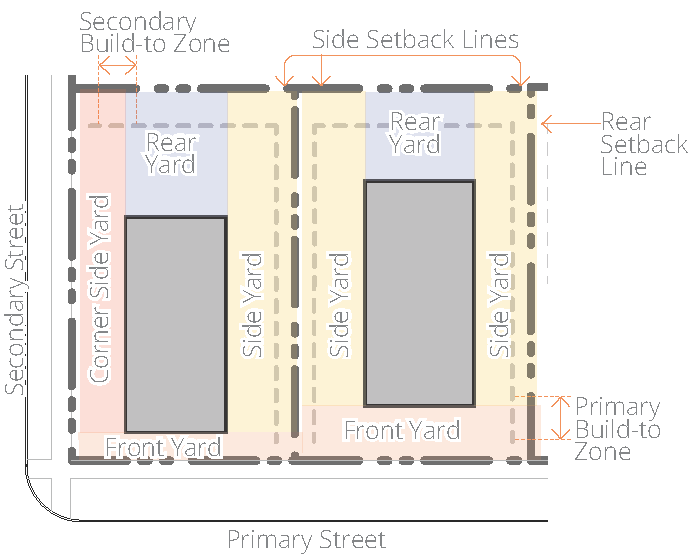
Yard. The space on a lot which is unoccupied and unobstructed from the ground to the sky by the principal structure. Refer to Figure 1.6-B Yards. Lots without a structure do not have yard designations.
Yard, Corner Side. A yard extending from the corner side building facade along a corner side property line between the front yard and rear property line. Refer to Figure 1.6-B Yards.
Yard, Front. A yard extending from the front facade of the principal structure along the full length of the front property line, between the side property lines or side and corner side property lines. Refer to Figure 1.6-B Yards.
Yard, Rear. A yard extending from the rear building façade along the rear property line between the side yards or, on a corner lot, the corner side and side yards. Refer to Figure 1.6-B - Yards. For purposes of parking and detached garage locations, the rear yard shall be defined as the area behind the principal structure not to include the corner side yard.
Yard, Side. A yard extending from the side building facade along a side property line between the front yard and rear property line. Refer to Figure 1.6-B Yards.
Figure 1.6-B Yards
Zoning Administrator. The director of development services, or his or her designee, who will administer these regulations in accordance with their provisions and the general statutes.
Zoning Enforcement Officer. The official designated to enforce these regulations in accordance with their provisions and the general statutes.
(Amend. of 2-22-2022(1); Amend. of 12-13-2022; Amend. of 3-7-2025(1))
These regulations are adopted pursuant to the city charter and in accordance with the general statutes, in order for the commission to achieve the purposes outlined in 1.1.4 and elsewhere in these regulations.
These regulations become effective on January 19, 2016, except as otherwise expressly stated. For amendments to these regulations, see 1.3.5.
These regulations apply to all public and private use and development of properties within the corporate limits of the city, except as provided by state or federal law or as otherwise expressly stated in these regulations.
These regulations are adopted for the purposes of:
A.
Protecting and promoting the public health, safety and general welfare;
B.
Implementing the policies and goals of the plan of conservation and development and other relevant, officially adopted plans of the city; and
C.
Achieving all of the other purposes and intent statements contained in these regulations.
A.
These regulations are the minimum requirements deemed necessary to carry out their stated purpose.
B.
In addition to the requirements of these regulations, all uses, buildings and structures must comply with all other applicable ordinances, laws and regulations and with decisions made by other governmental or quasi-governmental bodies with jurisdiction, including but not limited to decisions made by the Greater Hartford Flood Control Commission, the Historic Properties Commission, and the Historic Preservation Commission.
C.
All references in these regulations to other governmental regulations are for informational purposes only and do not constitute a complete list of such regulations. These references do not imply any responsibility for the city to enforce regulations imposed by other government authorities.
A.
Land may not be used for any purpose other than ones that are allowed by the provisions of these regulations.
B.
A building or structure may not be erected, located, moved, reconstructed, extended or structurally altered except as allowed by these regulations.
C.
Buildings, structures and land may be used and occupied only in compliance with the provisions of these regulations.
D.
All lots created or modified must comply with all applicable provisions of these regulations.
A.
Stricter Regulations - External. When any provision of these regulations imposes more stringent requirements, regulations, restrictions or limitations than are imposed or required by the provisions of any ordinance, statute, regulations or law, the provisions of these regulations shall apply and govern.
B.
Stricter Regulations - Internal. When any provision of these regulations conflicts with any other provision of these regulations, the stricter of the provisions shall apply and govern. Notwithstanding the preceding sentence, where there is a conflict between minimum front lot line coverage requirements and maximum building width requirements per 4.0 Building Types, the minimum front lot line coverage requirement will prevail.
C.
General Statutes. When there is a clear conflict between these regulations and the provisions of the general statutes, then the provisions of the general statutes shall govern. When provisions in these regulations relate to the general statutes, and the general statutes have been amended without corresponding amendment to these regulations, then the practical intent of the commission in passing its provision shall be carried out, to the fullest extent allowed by law.
D.
Text and Illustration. In case of any difference of meaning or implication between the text of these regulations and any heading, drawing, table, figure or illustration, the text governs.
E.
Private Law. These regulations are not intended to abrogate or annul any easement, covenant or other private agreement.
A.
Establishment. The location and boundaries of the zoning districts defined in these regulations must be established by regulation and shown on the city's official zoning map, which must be available for inspection in the office of the zoning administrator or the city clerk.
B.
Interpretation.
(1)
Where the street or lot layout actually on the ground, or as recorded, differs from the street or lot lines as shown on the zoning map, the commission, after notice to the owners of the property and after public hearing, shall interpret the map in such a way as to carry out the intent and purposes of these regulations for the particular section or district in question.
(2)
In case of any question as to the location of any boundary line between zoning districts, a request for interpretation of the zoning map may be made to the commission. Notwithstanding the previous sentence, the following shall prevail in the case of a parcel or subdivided lot which is split-zoned with two or more zoning designations. When a parcel line is revised or a lot is combined which contains two or more zoning designations, the application shall constitute a rezoning and shall be reviewed by the Commission per Section 1.3.5.
(Amend. of 12-13-2022)
Whenever a provision appears requiring the head of a department or another officer or employee to perform an act or duty, that provision will be construed as authorizing the department head or officer to delegate that responsibility to others over whom they have authority. Delegation of authority is not allowed when the provisions of these regulations expressly prohibit such delegation.
A.
Nothing in these regulations shall be deemed to require any change in the plans, construction or designated use of any building or structure upon which actual construction was lawfully begun prior to the adoption of these regulations and upon which building or structure actual construction has been diligently carried on.
B.
The adoption of these regulations does not affect any pending or future prosecution of, or action to abate, violations of the previous regulations that occurred before the effective date specified in 1.1.2 Effective Date.
A.
If a court of competent jurisdiction finds any provisions of these regulations to be invalid or ineffective in whole or in part, the effect of such decision shall be limited to those provisions which are expressly stated in the decision to be invalid or ineffective, and all other provisions of these regulations shall continue to be separately and fully effective.
B.
If a court of competent jurisdiction finds the application of any provision or provisions of these regulations to any lot, building or structure to be invalid or ineffective in whole or in part, the effect of such decision shall be limited to the person, property or situation immediately involved in the controversy, and the application of any such provision to other persons, property or situations shall not be affected.
C.
While any provisions of these regulations or application of any provisions of these regulations to any lot, building or structure is before a court of competent jurisdiction, all other provisions of these regulations and all other applications of the provisions of these regulations to other lots, buildings or structures shall continue to be separately and fully effective.
A.
Composition.
(1)
The planning and zoning commission shall consist of 7 members and 3 alternate members.
(2)
Alternate members, when seated as regular voting members, have all the powers and duties set forth in the general statutes relating to planning and zoning commissions and their members.
(3)
The regular members and alternate members of the planning and zoning commission must be electors of the city and have skills and knowledge in planning, architecture, landscape architecture, real estate, or law. They may not be members of the zoning board of appeals.
(4)
Regular members and alternate members of the commission shall be appointed and any vacancies shall be filled by the mayor in the manner provided in the charter for appointment and filling of vacancies of members of city commissions.
B.
Officers. The commission, by vote of its regular members only, must elect from its membership a chair, vice chair, and secretary in accordance with its Bylaws
C.
Meetings. Meetings of the commission shall be held, with rules of procedures followed, in accordance with the commission's Bylaws. All meetings of the commission shall be open to the public and shall be held in accordance with the general statutes, including state freedom of information act. Records of the commission may be examined in the offices of the division of planning at any reasonable time. Executive meetings of the commission may be held, but any record of executive meetings must be open to public inspection.
D.
Records. The commission must keep minutes of its proceedings, recording each action of the commission and the vote of each member upon each action or, if absent or failing to vote, indicating such fact. It shall also keep records of its examinations and other official actions, all of which shall be filed in the office of the division of planning and be open to public examination at reasonable hours.
E.
Vote Required. As provided in the general statutes, a simple majority shall be necessary for the commission to act, except in the case of Protest Petitions identified in 1.3.5 H.
F.
Powers. The commission has the powers and duties that are expressly identified in these regulations and the general statutes, including but not limited to establishing or changing the zoning regulations and the zoning map; hearing and acting on applications for zoning permits, site plan reviews, and special permits; recommending every 10 years a plan of conservation and development; preparing a program of public improvements for a 5-year period; establishing building lines and streets in accordance with section 8-29 of the general statutes; enacting and administering subdivision regulations; and conducting reviews in accordance with section 8-24 of the general statutes.
G.
Inland Wetlands Commission. In accordance with municipal code section 28-6, the commission serves as the inland wetlands and watercourses agency required to be created pursuant to section 22a-42 of the general statutes, exercising all powers accorded to inland wetlands and watercourses agencies by law.
H.
Design Review Board. The commission assumes all powers and responsibilities previously assigned to the design review board, where such powers survived the dissolution of the design review board.
A.
Composition.
(1)
The zoning board of appeals shall consist of 5 regular members and 3 alternate members.
(2)
Alternate members, when seated as regular voting members, have all the powers and duties set forth in the general statutes relating to zoning boards of appeals and their members.
(3)
The regular members and alternate members of the zoning board of appeals must be electors of the city and may not be members of the commission.
(4)
Regular members and alternate members of the zoning board of appeals shall be appointed and any vacancies shall be filled by the mayor in the manner provided in the charter for appointment and filling of vacancies of members of city commissions.
B.
Officers. The zoning board of appeals, by vote of its regular members only, must elect from its membership a chair, vice chair, and secretary in accordance with its Bylaws
C.
Meetings. Meetings of the zoning board of appeals shall be held, with rules of procedures followed, in accordance with its Bylaws. All meetings of the zoning board of appeals shall be open to the public and shall be held in accordance with the general statutes, including the state freedom of information act. Records of the zoning board of appeals may be examined in the offices of the division of planning at any reasonable time. Executive meetings of the commission may be held, but any record of executive meetings must be open to public inspection.
D.
Records. The zoning board of appeals must keep minutes of its proceedings, recording each action of the zoning board of appeals and the vote of each member upon each action or, if absent or failing to vote, indicating such fact. It shall also keep records of its examinations and other official actions, all of which shall be filed in the office of the division of planning and be open to public examination at reasonable hours.
E.
Vote Required. As provided in the general statutes, the concurring vote of 4 members of the zoning board of appeals shall be necessary to reverse any order, requirement or decision of the zoning enforcement officer or to decide in favor of the applicant in any matter upon which it is required to pass under the regulations or to vary the application of the zoning regulations.
F.
Assistance From Other Officials. The zoning board of appeals may call upon any city department for assistance in the performance of its duties and it is the duty of such department to render such assistance to the zoning board of appeals, as may be reasonably required.
G.
Powers. The zoning board of appeals has the powers and duties that are expressly identified in these regulations and the general statutes, including hearing and acting on applications for variances and appeals of administrative decisions.
A.
Applicability. The common procedural provisions of this section apply to all of the procedures in this chapter unless otherwise expressly stated.
B.
Application Procedures.
(1)
Applicability. This section 1.3.1 B. shall apply to applications for special permits, site plan reviews, zoning permits, and variances.
(2)
Authority to File. Applications must be filed with the zoning administrator by the owner of the subject property. Applications may also be filed by the property owner's authorized agent.
(3)
Pre-Application Meetings.
(a)
Purpose. Pre-application meetings provide an early opportunity for staff and applicants to discuss the procedures, standards and regulations required for development approval under these zoning regulations
(b)
Requirement. Applicants are required to schedule pre-application meetings with staff regarding applications for the following types of projects: Multi-Unit Residential, Hotel/Apartment Hotel, Civic and Institutional Use, Intensive Park Use, River Use, Beer/Wine/Liquor Sales, Convenience Store, Drinking Place, Entertainment Assembly, Vehicle Fueling and Limited Service, Vehicle Service/Car Wash, Office Use involving new construction of more than 5,000 square feet, Adult Use, Infrastructure Use, Industrial Use, new construction in the DT districts, and any other project the zoning administrator determines is a major development project. Pre-application meetings are encouraged in all cases. An applicant's failure to schedule and attend a pre-application meeting (or meetings, if more than one meeting is required by the zoning administrator) shall render the application incomplete.
(4)
Application Submittal Requirements. Applicants must complete the online application form and attach all required corresponding documentation. If the Applicant is unable to access or use the online application, a paper copy shall be made available to them. If a paper application is submitted, supporting documents must be submitted in the following format: 3 edge-bound paper copies of all plans and paperwork, folded 8.5 inches by 11 inches or smaller if fewer than 12 sheets, or rolled if 12 sheets or more, and collated into 3 separate packets. Applications must also be labeled with the property address. Applications must include materials and information to assist the staff and the decision-making bodies in their consideration of the application, with specific application requirements further outlined in 1.3.2 through 1.3.8.
(5)
Completeness of an Application.
(a)
An application will be considered complete and ready for processing only if it is submitted in the required number and form, includes all required information, does not contain significant inaccuracies or omissions, does not contain multiple minor inaccuracies or omissions, and is accompanied by the required fee amount.
(b)
If an application is determined to be incomplete, the zoning administrator may provide notice to the applicant along with an explanation of key deficiencies in the application. Notice of an incomplete application may be provided by personal service, electronic mail, or first-class mail. Failure to provide such a notice shall not be construed as a finding that any submittal is complete, given the plain and clear language of these regulations regarding applicable requirements.
(c)
No further processing of an incomplete application will occur. The application will only be returned to the processing cycle if and when all deficiencies are corrected and the application requirements are fully met, whether or not each and every such requirement was expressly included in the list of deficiencies given to the applicant by staff pursuant to 1.3.1 B.(5)(b). If an application is not complete within 60 days of the initial submission of the application to staff, the application will be deemed to have been withdrawn. No decision-making body has the authority to review an incomplete application.
(d)
Only upon the completion of an application in accordance with this section shall any legal period within which an application may be "deemed approved" commence. An incomplete application shall not suffice to establish the applicable effective date of these regulations, and shall not forestall the enactment or imposition of any regulations made effective prior to the date that a complete application is submitted.
(e)
Prior to the consideration of any application for any permit or approval by the decision-making body, an applicant may amend an application without prejudice.
(6)
Separate Applications. A separate application must be filed for each project, for each permit sought, for each lot unless such lot is to be improved as part of a unified development as specified in 1.3.1.B(8).
(7)
Rejection of an Application Prior to Full Review. An application may be rejected prior to a full review if the decision-making body does not have legal authority to approve the application or if the application is not completed within 60 days of the application's initial submission to staff.
(8)
Unified Developments:
A.
Separate parcels may be developed under a single application and site plan with bulk requirements applied to the entire development area when such parcels are contiguous, under common development, and are fully incorporated as part of a valid, integrated development as determined by the zoning administrator.
B.
In instances where a unified development contains more than one principle use or multiple building types, the commission may review the application by special permit to determine that that the design guidelines are generally met.
C.
Applications for unified developments shall include all necessary easements which shall be filed on the land records and noted on the plans.
D.
Parcels included within a unified development shall include a restriction which specifies such parcels are not to be treated separately without the issuance of a new approval and demonstration that, upon separation, each parcel will fully comply with all standards as set forth in the Regulations as of the time such separation is proposed.
E.
All parcels contained within a unified development shall at the time of application and continuously thereafter be subject to land interest agreements such as an easement, leasehold, or other assignment of rights which create permanent or long-term (defined as greater than 20 years) common property interest in the development. The managing party shall file the appropriate documentation declaring this restriction on the land records.
C.
Application Processing Cycles. The zoning administrator, after consulting with review and decision-making bodies, is authorized to promulgate reasonable cycles and timelines for processing applications, including deadlines for receipt of complete applications.
D.
Notices.
(1)
Newspaper Notice. For public hearings and for other instances in which this chapter requires that newspaper notice be provided, the notice must be published in a newspaper of general circulation within the city. Notice of the hearing shall be published at least twice, at intervals of not less than 2 days, the first not more than 15 days or less than 10 days and the last not less than 2 days before the date set for the hearing.
(2)
Posted Notice. For public hearings and for other instances in which this chapter requires that posted notice be provided, the applicant must post notice for at least 7 consecutive days before the public hearing. Such notice shall consist of at least one official public hearing notice sign in a conspicuous place visible from each public street abutting the subject project. The city is authorized to collect a deposit to ensure the return of official public hearing notice signs. Before any required public hearing, the applicant must file a certificate of posting or equivalent which affirms that notice signs have been posted in accordance with the provisions of these zoning regulations.
(3)
Mailed Notice. For public hearings and for other instances in which this chapter requires that mailed notice be provided:
(a)
Notices must be sent by United States Postal Service, postmarked at least 10 days before the scheduled public hearing. State law may require that such notice be sent by certified mail, return receipt requested.
(b)
Addresses must be based on the best obtainable property ownership information. When required notices have been properly addressed and deposited in the U.S. mail, alleged failure of a party to receive the mailed notice does not constitute grounds to invalidate any action taken.
(c)
Before a public hearing, the applicant or other party expressly assigned responsibility for delivery of mailed notice must file a certificate of mailing or equivalent affirming that notice has been provided in accordance with the provisions of these zoning regulations.
(4)
Content of Notice. All required notices must:
(a)
Indicate the date, time and place of the public hearing that is the subject of the notice;
(b)
Describe any property involved in a specific, property-owner-initiated application by map, street address, or legal description;
(c)
Describe the action sought in the application or proposal;
(d)
Identify who will conduct the hearing; and
(e)
Indicate where additional information on the matter can be obtained.
(5)
Meeting Agendas and Materials.
(a)
The agenda for any meeting of the commission must be released at least 24 hours before the meeting at which listed matters are to be considered, unless a longer time period is required by law. A copy of any application which will be the subject of a public hearing and related documents must be filed in the office of the city clerk and made available for public inspection at least 24 hours prior to the hearing, unless a longer time period is required by law.
(b)
The agenda for any meeting of the zoning board of appeals must be released at least 10 days before the meeting at which listed matters are to be considered. A copy of any application which will be the subject of a public hearing and related documents must be filed in the office of the city clerk and made available for public inspection at least 10 days prior to the hearing.
(6)
Notice to Adjoining Municipalities.
(a)
The commission must provide mailed notice, certified mail, return receipt requested, to the clerk of any adjoining municipality of the pendency of any application concerning any project on any site that meets one or more of the following criteria, within 7 days of receipt of an application:
(i)
Any portion of the property affected by a decision of the commission is within 500 feet of the boundary of the adjoining municipality;
(ii)
A significant portion of the traffic to the completed project on the site will use streets within the adjoining municipality to enter or exit the site;
(iii)
A significant portion of the sewer or water drainage from the project on the site will flow through and significantly impact the drainage or sewerage system within the adjoining municipality; or
(iv)
Stormwater runoff from the improved site will impact streets or other municipal or private property within the adjoining municipality.
(b)
Such adjoining municipality may, through a representative, appear and be heard at any hearing on any such application.
(7)
Notice to the Capitol Region Council of Governments. For proposed zoning amendments that affect the use of a zone any portion of which is within 500 feet of the boundary of another municipality, the Capitol Region Council of Governments and the other municipality shall be notified by certified mail, return receipt requested, or electronic mail 30 days before the public hearing to be held in relation thereon. If any report from such council is not submitted at or before the hearing, it shall be presumed that such council does not disapprove of the proposal. The report of such council is purely advisory. Regional notice by certificate or electronic mail shall be provided in accordance with general statutes section 8.3b.
(8)
Constructive Notice.
(a)
Minor defects in required notices will not be deemed to impair the notice or invalidate proceedings pursuant to the notice. Minor defects in notice are limited to errors in a legal description or typographical or grammatical errors that do not impede communication of the notice to affected parties. If questions arise at the hearing regarding the adequacy of notice, the hearing body must make a formal finding about whether there was substantial compliance with the notice requirements of these zoning regulations.
(b)
When the records of the city document the publication, mailing, and posting of notices as required by this chapter, required notice of the public hearing will be presumed to have been given.
E.
Public Hearings.
(1)
Prior to Public Hearing. The public shall be allowed to inspect relevant public hearing materials in accordance with 1.3.1 D.(5).
(2)
At the Public Hearing.
(a)
Any person or persons may appear and be heard and may be represented by agent or by attorney.
(b)
Interested persons may submit information and comments, verbally or in writing.
(c)
The hearing body is authorized to establish reasonable rules and regulations governing the conduct of hearings and the presentation of information and comments.
(3)
Continuance of a Public Hearing.
(a)
Once commenced, a public hearing may be continued by the hearing body.
(b)
No re-notification is required if the continuance is set for a specified date and time, and that date and time is announced at the time of the continuance.
(c)
If a public hearing is continued or postponed for an indefinite period of time from the date of the originally scheduled public hearing, new public hearing notice must be given before the rescheduled public hearing.
(d)
If the applicant requests and is granted a continuance or postponement requiring renotification, the applicant must pay any costs of re-notification.
(4)
Timing of Hearings and Decisions.
(a)
For all petitions, applications, requests, or appeals requiring a hearing, such hearing must commence within 65 days after receipt of such petition, application, request, or appeal, and shall be completed within 35 days after such hearing commences.
(b)
All decisions on such matters shall be rendered not later than 65 days after completion of such hearing, unless a shorter period of time is required by state law.
(c)
The petitioner or applicant may consent to one or more extensions of any period specified in this subsection, provided the total extension of all such periods shall not be for longer than 65 days, or may withdraw such petition, application, request or appeal.
F.
Decision-Making.
(1)
Action. Review and decision-making bodies may take any action that is consistent with:
(a)
These zoning regulations;
(b)
Any rules or bylaws which apply to the review or decision-making body; and
(c)
The notice that was given.
(2)
Reasons. The decision-making body must state in the record the reasons for its action.
(3)
Burden of Proof or Persuasion. In all cases, the burden is on the applicant to show that an application or proposal complies with all applicable review or approval criteria.
(4)
Continuance or Deferral. Decision-making bodies are authorized to continue a public hearing or defer action in order to receive additional information or further deliberate.
(5)
Time Limit. Unless otherwise expressly stated, if a review or decision-making body does not render a decision or take action within any time period required under these zoning regulations, and the applicant has not agreed to an extension of that time limit, the application is deemed denied.
(6)
Conditions of Approval.
(a)
Review bodies are authorized to recommend conditions and decision-making bodies are authorized to approve the subject application with conditions.
(b)
Any conditions recommended or approved must relate to a situation likely to be created or aggravated by the proposed use or development and must be roughly proportional to the impacts of the use or development.
(c)
The decision-making body may restrict hours of operation, including but not limited to hours of operation of Drinking Places and Smoking Places.
(d)
To ensure the orderly development of land or to increase conformity with these regulations, decision-making bodies may require the merger of lots owned in common (or to be developed in common) prior to or as a condition of approval. In such a circumstance, front line lot coverage requirements shall not apply to any existing building but would apply to a new building, new addition, or building reconstruction or replacement.
G.
Post-Approval Matters.
(1)
Applicants who have received a permit or other approval for a project requiring a pre-application meeting pursuant to 1.3.1 B.(3) must, before commencing any substantial work on the site, meet with the director of the division of licenses and inspections to establish construction and inspection schedules. For the purposes of the preceding sentence, the determination of what constitutes "substantial work" shall be made by the director of the division of licenses and inspections.
(2)
Amendments to Approved Permits and other Development Approvals. After approval has been granted, all amendments or changes to an issued permit or other approval under these regulations must be processed and considered as a new application and the issuance of an additional zoning permit. However, the zoning administrator is authorized to approve minor changes in the placement and size of improvements and the type of exterior materials for an approved project if:
(a)
The changes are required because of conditions that were unknown at the time the approval was issued and have only a de minimis impact;
(b)
The zoning administrator determines that the changes satisfy and are consistent with the intent of these regulations and the findings made by the decision-making body in connection with the approval and have only a de minimis impact; and
(c)
The changes involve, as applicable: a change in placement of a building or structure which is less than 2 feet away from the approved placement, the use of materials or components accounting for no more than 2.5 percent of the facade, a modification in landscaping that produces no additional negative environmental effects, or the use of a replacement material whose performance and appearance is substantially similar to an approved material.
(3)
Lapse of Approval.
(a)
All work in connection with any permit or approval issued pursuant to these regulations must be completed within 3 years from the date of the original permit or approval, provided that work made in connection with a site plan approval must be completed within 5 years from the date of the original approval, except that projects involving 400 or more dwelling units and commercial, industrial, or retail projects greater than 400,000 square feet may be completed within up to 10 years from the date of the approval.
(b)
Failure to complete all work within the applicable period shall result in automatic lapse and expiration of the permit or approval, except that with good cause shown, the commission may grant one or more extensions of the time to complete all or part of the work in connection with the site plan provided the total extension or extensions shall not exceed 10 years from the date such permit or approval has been issued.
(c)
"Work" for purposes of this subsection means all physical improvements required by the permit or approval.
(d)
Notice regarding certificates and approvals which have expired and on which no action has been taken may be sent to the applicant within 15 days of the date on which the period for approval has lapsed.
(4)
Transferability. The status of permits and approvals is not affected by mere changes of tenancy (of the same use), ownership, or management.
(5)
Appeals of any decision by a decision-making body pursuant to these regulations may be pursued in accordance with state statute. Appeals of administrative decisions may be filed in accordance with 1.3.8.
H.
Fees and Charges.
(1)
The commission is authorized to establish a fee schedule for all applications for approvals and permits being sought from the commission, the zoning board of appeals, the inland wetlands commission, and the historic preservation and properties commissions, or for any administrative review required. The fee schedule may also include any matter deemed necessary in order for the planning division or any review or decision-making body to carry out its responsibilities under these zoning regulations.
(2)
Among other things, the fee schedule may include applicable charges for zoning permits, special permits, zoning map amendments, zoning text amendments, zoning board of appeals applications (including variances), zoning board of appeals applications following notices of violation, certificates of zoning compliance, site plan reviews (both residential and commercial), subdivision applications, mapping, liquor permits, wetland permits (with and without public hearings), historic properties reviews and certificates of appropriateness, fence permits, public notice costs, security deposits for posted notice signs, and late penalties.
(3)
The fee schedule and any amendment to the fee schedule must be adopted by the council before becoming effective.
(4)
A copy of the fee schedule must be available for public inspection in the office of the commission and the division of licenses and inspections.
(5)
Applicable fees must be paid in advance to the commission by all parties other than a department of the city or the commission, in which case no fee is required.
(6)
Fees due to the city forester for permits to alter, damage, remove, or perform other covered activities to covered trees shall be administered in accordance with the city tree ordinance separately from the zoning fees. Such fees may appear on the commission fee schedule as a courtesy to applicants.
I.
Bonds.
(1)
The decision-making body is expressly authorized to require applicants for zoning permits, site plan permits, and special permits to post a bond with the decision-making body in a form and on such terms as are acceptable to the corporation counsel, and in such amount as the decision-making body deems necessary to ensure the faithful performance and completion of the work in accordance with the provisions of the approved permit. The amount of such financial guarantee shall be calculated so as not to exceed the anticipated actual costs for the completion of such site improvements or the implementation of such erosion and sediment controls plus a contingency amount not to exceed ten per cent of such costs.
(2)
If the applicant fails to comply with any requirements of a permit, the decision-making body may declare the permit to be null and void, declare the project to be in default and call the bond.
(3)
The decision-making body may take whatever steps are needed to bring the site into compliance with the permit, and may pay for such work from the bond proceeds.
(4)
The bond will be released by the decision-making body upon certification by the applicant's architect or engineer, through submission of accurate, detailed "as-built" plans, that all work is in accordance with the approved permit.
(5)
Notwithstanding any other provision of this paragraph, the bond terms may provide for partial, proportionate release of the bond as work is completed. For any site plan that is approved for development in phases, the financial guarantee provisions of this section shall apply as if each phase was approved as a separate site plan.
(6)
Release of such bonds shall follow procedures set forth in state statutes.
J.
Third Party Assistance.
(1)
The decision-making body may call upon any city department or third party consultant for assistance in the performance of its duties. It is the duty of such department to render such assistance, as may be reasonably required.
(2)
Applicants shall be required to pay the city in advance for projected or proposed third party consultant expenses associated with review of their applications, prior to any approval being effective.
(Amend. of 12-13-2022; Amend. of 12-12-2023(1))
A.
Applicability.
(1)
The zoning permit procedures of this section apply to all zoning permits, other than site plan reviews and special permit approvals.
(2)
Zoning permits are required as follows:
(a)
Before the issuance of a building permit, by notation on the building permit form; or
(b)
If no building permit is required, at the time of a change of use.
(3)
If no building permit is required, a separate zoning permit will be issued.
(4)
Prior to issuance, the zoning administrator must find that the application and plans conform to all provisions of these regulations.
B.
Application Submittal Requirements. The following documents are required for all applications requiring zoning permit review. All maps and plans shall include the date of preparation, north arrow, and scale:
(a)
A list of the names and addresses of all owners of record of the property that is the subject of the application; and
(b)
Any maps, plats, surveys, dimensioned site plans, engineering documents, environmental reports, traffic studies, and other materials and information, and any of the documents listed in 1.3.3 B. Site Plan Review Application Submittal Requirements and 1.3.4 B. Special Permit Application Submittal Requirements, which the zoning administrator may deem appropriate given the subject matter of the application.
C.
Decision-Making.
(1)
The commission delegates to the zoning administrator decision-making authority for zoning permit review except where expressly stated elsewhere in these regulations. The zoning administrator has discretion to refer a zoning permit review to the full commission, which would then become the decision-making body.
(2)
Following the receipt of a completed application, the zoning administrator must act to approve the proposed zoning permit, approve the proposed zoning permit with conditions, or deny the proposed zoning permit, and state the reasons for its actions on the record.
(3)
Zoning permits may be modified, conditioned or denied only if the proposal fails to satisfy these regulations, the inland wetlands regulations, or the subdivision regulations, or in accordance with 1.3.1 F.(6) or 1.3.1 I.
D.
Decision-Making Criteria. In reviewing any application for a zoning permit, the authorized decision-maker must consider and base its decision on all aspects of the proposal and primarily whether the proposal in the application complies with all applicable sections of these regulations pertaining to the district in which the proposal is located. If there are any ambiguities in interpretation, the decision-maker shall make a decision in accordance with whether the proposal:
(1)
Is in harmony with the plan of conservation and development;
(2)
Comports with the purposes of the district in which the proposal is located;
(3)
Will not be detrimental to existing development in the district because of its location, bulk, scale, or design;
(4)
Does not create safety hazards in the proposed vehicular and pedestrian circulation pattern;
(5)
Will not seriously degrade traffic levels of service without providing mitigation measures;
(6)
Is compatible with adjacent properties;
(7)
Provides for the suitable arrangement of buildings, open space, and provision of light and air;
(8)
Properly provides for adequate provision of essential services;
(9)
Places excessive demands on city services and infrastructure; and
(10)
Violates the code.
A.
Applicability. The site plan review procedures of this section govern all instances that require site plan or special permit approval under these zoning regulations and for:
(1)
Any expansion of lot coverage by an amount greater than 5 percent of existing lot coverage
(2)
An alteration to more than 10 percent of a facade
(3)
New construction, including an addition to a primary structure and new accessory structures
(4)
A change in an existing use from a less intense to more intense use
(5)
Any activity requiring an increase of 5 or more parking spaces
(6)
Any project in the OS district valued at $50,000 or more, and
(7)
Applications triggering site plan review by the inland wetlands agency pursuant to the general statutes.
(8)
Any three-dimensional artwork larger than 100 cubic feet, valued at $50,000 or more, likely to effect a nuisance (particularly a light and noise nuisance), or potentially harmful to the natural environment, which is proposed to be located outdoors on public property.
(9)
Any activity triggering a soil erosion and sediment control plan in accordance with 6.16.3 A., where such activity is not already included in another pending site plan or special permit application.
B.
Application Submittal Requirements. The following documents are required for all applications requiring site plan review provided, however, that the zoning administrator may excuse the applicant from submitting a particular document upon a written finding that the document is not applicable. All maps and plans shall include the date of preparation, north arrow, and scale.
(1)
List of Owners. A list of the names and addresses of all owners of record of the property that is the subject of the application.
(2)
Site Location Map. Location of site within a half mile context of streets, fixed transit stations, and notable sites.
(3)
Survey Plat. Legal description of site, dimensions of property lines, easements, and rights-of-way.
(4)
Boundaries. Development boundaries and proposed phasing (as applicable).
(5)
Existing Conditions Plan. Existing on-site and adjacent off-site structures, streets, utilities, easements, and pavement noted either on an aerial photograph or site survey.
(6)
Existing Natural Conditions Plan. Existing topography, vegetation, wetlands (or documentation of lack thereof), drainageways, floodplain/way, or other unique features either on an aerial photograph or site survey. Plans shall include mapping location of existing trees, tree type, caliper, and tree protection zone. Tree protection zone must be shown on all exterior improvement plan sheets.
(7)
Site Plan. A site plan delineating all proposed structures and surfaces, including buildings, parking, pavement, accessory structures per 4.20, lighting, landscape (including tree protection zone), and retaining walls.
(8)
Building Plan(s). Floor plans for all buildings illustrating compliance with the requirements of 4.0 Building Types.
(9)
Use Requirements. A table of uses is required on the Building Plan delineating locations and gross square footages of categories of uses, and illustrating compliance with the Use Table for the applicable building type, per 3.0 Uses.
(10)
Building Elevations. Building elevations of all facades, rendered to illustrate compliance with 4.0 Building Types, including but not limited to such items as color, materials, depth of details on facades, glass locations, and specifications of glass.
(11)
Landscape Plan, Tree Survey, Tree Protection Plans. Plans illustrating compliance with the requirements of 6.0 Sitework & Landscape. All ground plane vegetation shall be illustrated. For sites with less than 10 percent landscape area, the Landscape Plan may be combined with the Site Plan.
(12)
Parking Plan. Parking layout plan with table of spaces keyed to plan, illustrating compliance with 7.0 Parking.
(13)
Sign Plan. Sign plan and elevation illustrating compliance with the requirements of 8.0 Signs.
(14)
Soil Erosion and Sediment Control Plan. A plan for controlling erosion and sediment as may be required by state statutes or by 6.16.
(15)
Stormwater Management Plan. A plan, if required pursuant to 6.14.2 C., which shall include the following:
(a)
A calculation of the overall square footage amount of impervious and semi-pervious surfaces, respectively, and the corresponding amount, peak runoff rate, and 24-hour volume for the 2, 10, 25, and 100-year storms for both pre-development conditions and post-development conditions;
(b)
A description of the proposed on-site stormwater management facilities which shall be constructed to manage the gallons of water generated by impervious and semi-pervious surfaces on the lot, and the mechanism through which the facilities will be operated and maintained after construction is complete;
(c)
Information on each of the proposed on-site stormwater management facilities, including:
(i)
the type of facility;
(ii)
the location of the facility;
(iii)
the gallons of water managed by the facility; and
(iv)
the surface waters into which the facility will discharge, if any;
(d)
An explanation of any off-site compliance mechanism selected by the applicant, including the same information required to be submitted for on-site stormwater management facilities and including letter(s) of consent from relevant off-site property owner(s);
(e)
Soil characteristics;
(f)
Location of closest surface water bodies and wetlands to the site;
(g)
Ground and surface water quality classifications of water bodies on and adjacent to site;
(h)
Location and description of all stormwater control BMPs for both construction activities and post-construction long-term stormwater control;
(i)
Calculation of stormwater runoff rates, suspended solids removal rates, and soil infiltration rates before and after completion of the activity proposed in the application;
(j)
A hydrologic study of pre-development site conditions, conducted at a level of detail commensurate with the probable impact of the proposed activity, extending downstream to the point where the proposed activity causes less than a five percent change in the peak flow rates.
(16)
Additional Information. Any additional maps, plats, surveys, dimensioned site plans, engineering documents, environmental reports, traffic studies, and other materials and information the zoning administrator may deem appropriate given the subject matter of the application, including, for example:
(a)
A transportation management plan (required for all Civic and Institutional Uses) describing:
(i)
The number of on-site parking spaces allowed by the provisions of 7.2.2 Required Automobile & Bicycle Parking;
(ii)
The number and types of parking spaces to be provided on-site including employee parking, transient parking for on-site uses, transient parking for off-site uses, parking for high occupancy motor vehicles, parking for compact automobiles, parking with electric vehicle charging stations required by 7.2.2 D. Required Electric Vehicle Charging Stations, and handicapped parking;
(iii)
The number, location and type of any parking spaces to be provided off-site and the method of transporting persons between the off-site facility and the project site;
(iv)
Alternative modes of transportation such as mass transit, carpools, and vanpools;
(v)
Expected usage of non-vehicular modes of transportation;
(vi)
Location of all vehicular and pedestrian entrances and exits; and
(vii)
The impact of the proposed development on the city's vehicular and circulation system, including the numerical impact on a.m. and p.m. peak hour volumes and peak hour link and intersection capacities for all streets and intersections within 3 blocks of the project site.
(b)
A noise mitigation plan detailing the measures taken by an establishment to maintain noise at a level that is not audible at a distance of 100 feet or greater from any opening of that establishment and to otherwise comply with section 23 of the code (required for Drinking Places and Entertainment Assembly);
(c)
An odor control plan (required for laundromats and fast food Eating Places);
(d)
A security plan detailing security measures that will be undertaken by the applicant to control patron and/or visitor behavior inside and outside of the facility so as to not negatively impact the public safety, health, welfare and quality of life of those living in and frequenting the immediate area around the facility and so as to ensure compliance with all applicable provisions of the code, including the city noise ordinance (required for Drinking Places);
(e)
A parking management plan demonstrating that there is adequate parking for users of the property;
(f)
A photometric lighting plan (required for stadiums/arenas and other large outdoor facilities, and surface parking lots for over 200 vehicles); and
(g)
Roofing materials explanation, for buildings covered by 4.2.1 C.
C.
Decision-Making.
(1)
The commission delegates to the zoning administrator decision-making authority for site plan review except where expressly stated elsewhere in these regulations. The zoning administrator has discretion to refer a site plan review to the full commission, which would then become the decision-making body.
(2)
Following the receipt of a completed application, the zoning administrator must act to approve the proposed site plan, approve the proposed site plan with conditions, or deny the proposed site plan, and state the reasons for its actions on the record.
(3)
Site plans may be modified, conditioned or denied only if they fail to satisfy these regulations, the inland wetlands regulations, the subdivision regulations, or the code, in accordance with 1.3.1 F.(6) or 1.3.1 I.
(4)
To expressly address the presumption contained in section 8-7d of the general statutes, approval of a site plan shall be deemed denied if a decision to approve, deny, or modify it is not expressly rendered by the zoning administrator within 64 days after receipt of such site plan.
(5)
To provide flexibility that will promote rehabilitation of existing buildings and new construction, the decision-making body may approve an application that deviates from the minimum or maximum requirements for building siting, height, street facades, accessory structures dimensions, tree installation (in consultation with the city forester), landscape installation, buffers, fencing, lighting, parking, signage, and street design by up to 15 percent, or deviations in required building materials, if the decision-making body finds that:
(a)
The adjustment from the minimum or maximum requirements is consistent with all relevant purpose and intent statements of these zoning regulations and with the general purpose and intent of the plan of conservation and development; and
(b)
The adjustment will not have a substantial or undue adverse effect upon adjacent property, the character of the area, or the public health, safety, and general welfare.
(6)
The commission's review of proposals for any artwork may be conducted simultaneously with the advisory review of the city commission on cultural affairs, or the council if no commission on cultural affairs exists or is available to act, pursuant to section 2-178 of the municipal code.
D.
Concurrent Special Permit and Site Plan Review. If a special permit is required, the commission shall combine and serve as the decision-making authority for the site plan review process and the special permit process, unless the applicant expressly elects to undergo separate review processes.
E.
Effective Date and Notice of Decision.
(1)
Notice of the commission's decision must be provided by certified mail to the person who applied for the site plan approval within 15 days of the commission's final decision on the site plan.
(2)
The commission must also publish notice of action on site plans in a newspaper of general circulation in the city. If such notice is not published within 15 days of the date of the commission's final decision, the applicant may provide for the publication of required notice within 10 days thereafter.
(Amend. of 2-22-2022(1))
A.
Applicability. The special permit procedures of this section govern all instances that require special permit approval under these zoning regulations.
B.
Application Submittal Requirements. The following documents are required for all applications requiring special permit review. All maps and plans shall include the date of preparation, north arrow, and scale.
(1)
A list of the names and addresses of all owners of record of the property that is the subject of the application;
(2)
Documents listed in the 1.3.3 B. Site Plan Review Application Submittal Requirements; and
(3)
Any additional maps, plats, surveys, dimensioned site plans, engineering documents, environmental reports, traffic studies, and other materials and information the zoning administrator may deem appropriate given the subject matter of the application.
C.
Notice of Hearing. The following provision supplements the notice requirements set forth in 1.3.1 D. Notices:
(1)
Mailed Notice. The applicant must provide mailed notice to all owners of property included within the area that is the subject of the proposed special permit, and to all owners of property within 150 feet of the subject property.
D.
Decision-Making.
(1)
Following the close of the public hearing, the commission must act to approve the proposed special permit, approve the proposed special permit with conditions, or deny the proposed special permit, and state the reasons for its actions on the record.
(2)
In reviewing applications for special permit approval, the commission must consider, and base its approval or disapproval on all aspects of the proposal, and in particular whether the proposed special permit:
(a)
Is in harmony with the plan of conservation and development;
(b)
Complies with all applicable sections of these regulations pertaining to the district in which the proposal is located;
(c)
Comports with the purposes of the district in which the proposal is located;
(d)
Will not be detrimental to existing development in the district because of its location, bulk, scale, or design;
(e)
Does not create safety hazards in the proposed vehicular and pedestrian circulation pattern;
(f)
Will not seriously degrade traffic levels of service without providing adequate mitigation measures;
(g)
Is compatible with adjacent properties;
(h)
Provides for the suitable arrangement of buildings, open space, and provision of light and air;
(i)
Properly provides for adequate provision of essential services;
(j)
Will not be detrimental to the control of stormwater at its source and the minimization of runoff;
(k)
Does not place excessive demands on city services and infrastructure;
(l)
Provides landscaping, including vegetation and trees, that are appropriate to the district and enhance the public realm;
(m)
Provides pedestrian amenities; and
(n)
Conforms fully with the code.
E.
Effective Date and Notice of Decision.
(1)
Notice of the commission's decision must be provided by certified mail to the person who applied for the special permit within 15 days of the commission's final decision on the special permit.
(2)
Approved special permits become effective at such time as is fixed by the commission, provided that notice of the approved special permit is published in a newspaper of general circulation within the city before such effective date. If such notice is not published within 15 days of the date of the commission's final decision, the applicant may provide for the publication of required notice within 10 days thereafter.
(3)
A special permit is only effective after a certified copy of the approved permit is filed in the office of the city clerk and recorded in the city land records in accordance the general statutes.
F.
Amendments. Amendments to approved special permits must be processed as a new special permit application, including all requirements for fees, notices and public hearings, provided that the zoning administrator is authorized to approve the following:
(1)
Any structures or uses authorized to be approved by the zoning administrator at the time of special permit approval; and
(2)
The addition or relocation of customary accessory uses and structures.
G.
Deviations: To provide flexibility that will promote rehabilitation of existing buildings and new construction, the commission may approve by special permit a deviation from the minimum or maximum requirements for building siting, height, street facades, accessory structures dimensions, tree installation (in consultation with the city forester), landscape installation, buffers, fencing, lighting, parking, signage, and street design by up to 15 percent, or deviations in required building materials, if the commission finds that:
a.
The adjustment from the minimum or maximum requirements is consistent with all relevant purpose and intent statements of these zoning regulations and with the general purpose and intent of the plan of conservation and development; and
b.
The adjustment will not have a substantial or undue adverse effect upon adjacent property, or the public health, safety, and general welfare.
(Amend. of 12-5-2023(1))
A.
Applicability. The procedures of this section apply to:
(1)
Amendments to the text of these zoning regulations, except that they do not apply to reformatting of and non-substantive edits to the existing text, such as changing the typeface, font size or other physical attributes, margins, indentations, headers/footers, or similar edits which may be made by the commission or by its staff, from time to time, to facilitate printing, readability, consistency, or related goals; and
(2)
Amendments to the zoning map (rezonings) which change the boundaries of the zoning districts.
B.
Authority to File. Zoning text or map amendments may be initiated by the commission or by a person or persons submitting a petition.
C.
Application Submittal Requirements.
(1)
An application for a proposed text amendment must contain the text of the portion of the regulations proposed to be amended (if applicable) and the text of the proposed amendment.
(2)
An application for a proposed map amendment must include the existing and proposed zoning designation of the subject property and be accompanied by a map or maps of the subject property or properties and all contiguous streets. The existing zoning district boundaries and the proposed zoning district boundaries must be accurately indicated on such map or maps, which must be at a scale corresponding with that of the city's official zoning map.
D.
Zoning Administrator Report and Recommendation. The zoning administrator must prepare a report and recommendation on the proposed zoning amendment. The report must be transmitted to the commission before the public hearing on the proposed amendment.
E.
Public Hearing. The commission must hold a public hearing on all complete proposed zoning amendments.
F.
Notice of Hearing for Zoning Map Amendments. The following provisions supplement the notice requirements set forth in 1.3.1 D. Notices:
(1)
Mailed Notice. The applicant must provide mailed notice to all owners of property included within the property or area which is the subject of the proposed zoning map amendment, and to all owners of property within 150 feet of the subject property.
(2)
Posted Notice. Applicable for property or properties which are the subject of the zoning map amendment application filed by a party other than the commission.
(3)
Available Copy. A copy of the proposed amendment must be placed in the city clerk's office 10 days before a public hearing.
(4)
Exceptions. Mailed notice and posted notice are not required for zoning map amendments affecting more than 500 acres or 100 lots, or to zoning map amendments initiated by the commission or the zoning administrator.
G.
Decision-Making.
(1)
Following the close of the public hearing, the commission must act to approve, approve with modifications, or deny the proposed zoning map amendment.
(2)
In making its decision on a proposed amendment, the commission must consider the plan of conservation and development and state on the record its findings on the consistency of the proposed amendment with such plan.
(3)
Zoning map amendments may be approved by a simple majority vote, except in the case of a valid Protest Petition (see 1.3.5 H.).
(4)
In acting on zoning map amendments, the commission is authorized to approve a zoning classification that is the same or less intensive than the zoning classification that was described in required public notices.
H.
Protest Petitions.
(1)
If a valid protest petition is filed against any proposed zoning amendment, passage of the zoning amendment requires a favorable vote of two-thirds of the members of the commission.
(2)
A protest petition will be deemed valid if it is signed and acknowledged by the owners of 20 percent or more of the total area of the lots included in proposed zoning amendment area or the total area of lots within 500 feet of the subject property.
(3)
Petitions in protest of any proposed zoning amendment must be completed and filed in the following manner:
(a)
Petitions in protest must be submitted on a printed form to be provided by the commission to any interested party upon request. The form must include space for signatures;
(b)
No invalid signature shall invalidate remaining authentic signatures contained in the same petition;
(c)
Petitions must include space for addresses of property owned by those signing;
(d)
Petitions must include a form for attestation by the circulator of the petition and acknowledgment as provided by law; and
(e)
Petitions and forms must be duly attested and acknowledged and must be filed with the commission at or before the hearing on the subject zoning map amendment.
(4)
Any petition that fails in any respect to be completed in the manner described in 1.3.5 H.(3) will be held to be invalid.
I.
Effective Date and Notice of Decision. Zoning amendments become effective at such time as is fixed by the commission, provided that a copy of the approved zoning amendment is filed in the office of the city clerk and notice of the decision is published in a newspaper of general circulation within the city before such effective date. If such notice is not published within 15 days of the date of the commission's final decision, an applicant or petitioner may provide for the publication of required notice within 10 days thereafter.
J.
Formatting. The procedures described in this section shall not apply to formatting of the existing text of these regulations, which includes changing the typeface, font size or other physical attributes, margins, indentations, headers/footers, correction of minor typographical errors in punctuation or numbering or spelling, or similar edits that may be made by the commission or by the staff of development services, from time to time, to facilitate printing, readability, consistency, or related goals.
A.
Intent. The zoning board of appeals may grant a variance to grant relief to a property owner from strict compliance with the provisions of these zoning regulations. The intent of a variance is not to simply remove an inconvenience or financial burden that may result from compliance with applicable zoning requirements. Vari ances are intended to help alleviate an exceptional difficulty or unusual hardship that would result from literal enforcement of the subject zoning requirements. Variances are intended to provide relief when the requirements of these zoning regulations render property very difficult or impossible to put to reasonable use because of some unique or special characteristics of the property itself.
B.
Zoning Administrator and Department of Public Works Report and Recommendation.
(1)
The zoning administrator must submit an advisory opinion on the variance request at least 4 days before the required public hearing, and the advisory opinion must be submitted into the record at such public hearing.
(2)
The director of the department of public works must submit an advisory opinion to the zoning board of appeals, and upon request, a verbal opinion at the public hearing, regarding any traffic and on-street parking implications of the requested variance. This opinion must be made part of the record at the public hearing.
(3)
If the zoning administrator or director of the department of public works fails to submit required advisory opinions to the zoning board of appeals before the public hearing, the zoning board is authorized to act on the variance request without such opinions.
C.
Notice of Hearing. Notice of the zoning board of appeals' required public hearing on a variance request must be provided as follows (refer to 1.3.1 D. Notices for additional information on required public hearing notices):
(1)
Newspaper Notice.
(2)
Mailed Notice. The applicant must provide mailed notice to all owners of property included within the area that is the subject of the variance request and to all owners of property within 300 feet of the subject property.
(3)
Posted Notice.
D.
Public Hearing. The commission must hold a public hearing on all complete variance applications.
E.
Decision-Making.
(1)
After the close of the public hearing, the zoning board of appeals must act to approve the requested variance, approve the variance with modifications and/or conditions, or deny the variance.
(2)
The zoning board of appeals must make specific findings of fact and specifically state the nature of the findings found and specific evidence proving the same. The statement of the facts upon which such action is based must appear in the minutes of the zoning board of appeals. Actions taken by the zoning board of appeals without making the findings required by this section shall be invalid.
(3)
In approving a variance, the zoning board of appeals is authorized to impose such conditions and restrictions as the board determines to be necessary to ensure compliance with the standards of 1.3.6 F., to reduce or minimize the effect of the variance upon other properties in the area, and to better carry out the general purpose and intent of these zoning regulations.
(4)
If the zoning board of appeals grants a variance conditioned on satisfying conditions, such conditions must be explicitly set forth in writing.
(5)
The zoning board of appeals may not issue a variance for any of the following new or expanded principal uses (or for any such use as an accessory use) or conditions:
(a)
Automobile fueling and limited service in any DT, MS-1, MS-2, MX, NX, or N district;
(b)
Automobile service/car wash in any DT, MS-1, MS-2, MX, NX, or N district;
(c)
Substance Use Rehabilitation Clinics in any DT, MS, MX-2, NX, or N district.
(d)
Roominghouse/boardinghouse in any DT, MS, MX, NX, or N district;
(e)
Temporary shelter facility in any MX, NX, or N district;
(f)
Outdoor sales lot in any NX or N district;
(g)
Pawn shop/check cashing establishment in any MS, MX, NX, or N district;
(h)
Small cell nodes in any MS, MX, NX, or N district;
(i)
Any of the uses prohibited in 3.2.5;
(j)
Parking in front of buildings;
(k)
Quantity of trees per 6.4; or
(l)
Stormwater requirements per 6.14.
F.
Finding of Facts. No variance may be approved unless the zoning board of appeals finds that all of the following facts, favorable to the property owner, have been established:
(1)
That there are special circumstances or conditions fully described in the zoning board of appeals' written findings, applying to the land or buildings for which the variance is sought, which circumstances or conditions are peculiar to such land or building, and do not apply generally to land or buildings in the district, and have not resulted from any action by the property owner, whether in violation of these zoning regulations or not;
(2)
That, for reasons stated in the zoning board of appeals' written findings, the circumstances or conditions applying to the land or buildings are such that the strict application of the provisions of these zoning regulations would deprive the applicant of the reasonable use of such land or building and the granting of the variance is necessary for the reasonable use of the land or building and that the variance, as granted by the zoning board of appeals, is the minimum variance that will accomplish this purpose; and
(3)
That the granting of the variance will be in harmony with the purposes and intent of these zoning regulations, and will not be injurious to the neighborhood or otherwise detrimental to the public welfare.
(4)
Approval of a variance requires an affirmative vote of at least 4 members of the zoning board of appeals.
(5)
Variances may not be used to:
(a)
Waive, modify, or amend any definition or use classification;
(b)
Waive, modify, or otherwise vary any of the review and approval procedures of this chapter; or
(c)
Waive, vary, modify, or otherwise override a condition of approval or requirement imposed by an authorized decision-making body or the state or federal government.
G.
Transferability. Approved variances run with the land and are not affected by changes of tenancy, ownership, or management.
H.
Successive Applications. If a zoning variance is denied by the zoning board of appeals, the zoning board of appeals is not required to hear the same or substantially the same variance request within 6 months of the decision by the zoning board of appeals or by a court.
I.
Revocation. Any zoning permit granted in the absence of full compliance with imposed conditions shall be invalid and must be revoked by the zoning enforcement officer.
J.
Effective Date and Notice of Decision.
(1)
Notice of the commission's decision must be provided by certified mail to the person who applied for the variance within 15 days of the commission's final decision on the variance.
(2)
Approved variances become effective at such time as is fixed by the commission, provided that notice of the approved variance is published in a newspaper of general circulation within the city before such effective date. If such notice is not published within 15 days of the date of the commission's final decision, the applicant may provide for the publication of required notice within 10 days thereafter.
(3)
A variance is only effective after a certified copy of the approved variance is filed in the office of the city clerk and recorded in the city land records in accordance with the general statutes.
(Amend. of 9-13-2022)
A.
Certificate of Zoning Compliance.
(1)
No land may be occupied or used, and no building hereafter erected or altered may be occupied or used in whole or in part for any purpose whatsoever until a certificate of zoning compliance has been issued by the zoning enforcement officer stating that the premises or building complies with all the provisions of these regulations, except that where the alteration does not require the vacating of the premises or where parts of the premises are finished and ready for occupancy before the completion of the alteration, or in the case of a new structure, before its completion, a conditional certificate of zoning compliance may be issued.
(2)
A certificate of zoning compliance must be issued within 10 days after the inspection by the zoning enforcement officer of a completed building project, if the zoning enforcement officer determines the work to be in conformity with the provisions of these regulations.
(3)
A Certificate of Zoning Compliance may also be issued to confirm an existing use.
B.
Certificate of Occupancy.
(1)
A certificate of occupancy may not be granted until the director of the division of licenses and inspections finds that the construction, erection, rehabilitation, use, alteration, or other proposal requiring an approval or permit pursuant to these regulations complies with commission or staff approval and any conditions related thereto.
(2)
A variance holder who fails to comply with any conditions imposed by the zoning board of appeals is ineligible for a certificate of occupancy.
C.
Certificate of Nonconformance. A certificate of nonconformance may be issued as described in 1.5.3 I.
D.
Zoning Verification Letter.
1.
Zoning Verification Letters are issued for informational purposes to support a real estate transaction. These letters verify the zoning district of a property and any special overlay districts. They may also provide a list of allowable uses; they may indicate whether there are open zoning violations and whether or not a specific proposed use can be permitted.
2.
If requested, with research, Zoning Verification Letters can further verify conformance or nonconformance of existing structures or uses on site, existence of variances or valid special permits, neighborhood context, additional development history.
3.
A Zoning Verification Letter does not authorize the property owner to proceed with a specific development or formally establish a new use.
(Amend. of 12-13-2022)
A.
Authority. The zoning board of appeals is authorized to hear and decide all appeals of administrative decisions made by the commission or by staff (including the zoning enforcement officer) when it is alleged there has been an error in any order, requirement, decision or determination made by the administrative official in the administration, interpretation, or enforcement of these zoning regulations.
B.
Right to Appeal. Appeals of administrative decisions may be filed by any person aggrieved by the administrative official's decision or action. The zoning board of appeals is authorized to make determinations about whether individuals filing appeals are "aggrieved" by the decision or action.
C.
Application Filing.
(1)
Complete applications for appeals of administrative decisions must be filed with the commission or the administrative official from whom the appeal has been taken and with the zoning board of appeals.
(2)
Appeals of administrative decisions must be filed within 15 days of the earlier of the following events:
(a)
Receipt of the order, requirement, or decision from which such person may appeal;
(b)
The publication of a notice of decision in accordance with general statutes section 8-3 (relating to certification of building permits); or
(c)
Actual or constructive notice of such order, requirement, or decision.
D.
Record of Decision. Upon receipt of a complete application for appeal, the administrative official whose decision is being appealed must transmit to the zoning board of appeals all papers constituting the record related to the decision being appealed
E.
Effect of Filing.
(1)
An appeal shall not stay any order, requirement, or decision that prohibits further construction or expansion of a use in violation of such zoning regulations, except to the extent that the zoning board of appeals expressly grants a stay.
(2)
An appeal from any other order, requirement, or decision stays all proceedings in furtherance of the action appealed, unless the commission or the administrative official from whom the appeal has been taken certifies to the zoning board of appeals (after the notice of appeal has been filed), that, by reason of facts stated in the certificate, a stay would cause imminent peril to life or property. In such case, proceedings will not be stayed except by a restraining order, which may be granted by a court of record on application, on notice to the commission or the administrative official from whom the appeal has been taken, and on due cause shown.
F.
Notice of Hearing. Notice of the zoning board of appeals required public hearing on an appeal must be provided as follows (refer to 1.3.1 D. Notices for additional information on required public hearing notices).
(1)
Newspaper Notice.
(2)
Mailed Notice. When an appeal affects a specific property, the applicant must provide mailed notice to all owners of property that is the subject of the appeal, and to all owners of property within 300 feet of the subject property.
(3)
Posted Notice.
G.
Public Hearing. The zoning board of appeals must hold a public hearing on the appeal (refer to 1.3.1 E. Public Hearings for additional information on required public hearing notices):
H.
Decision-Making.
(1)
The decision being appealed may be reversed or wholly or partly modified only if the administrative official erred.
(2)
In exercising the appeal power, the zoning board of appeals has all the powers of the administrative official from whom the appeal is taken. The zoning board of appeals may affirm or may, upon the concurring vote of at least 4 members, reverse, wholly or in part, or modify the decision being appealed.
A.
Powers. The planning and zoning commission may adopt at any regularly scheduled meeting a moratorium on a specific use.
B.
Notice & Public Hearing. A public hearing must be held and proper notice provided pursuant to 1.3.1 D. Notices and 1.3.1 E. Public Hearings of these regulations prior to the enactment of any moratorium by the commission.
C.
Requirements. In order to enact a moratorium, the commission must:
(1)
State the purpose for enacting the moratorium based on a need to protect the public safety, health or welfare.
(2)
Specify a time period, not to exceed 2 years from the date of enactment, for the moratorium to be in effect.
(3)
State how the moratorium conforms with the current comprehensive plan.
(4)
Set forth the conditions, if any, which would allow the moratorium to be extinguished prior to the end of the time period set forth in 1.3.9 C.(2).
D.
Extension. A moratorium may be extended on or prior to the end of the time period set forth in 1.3.9 C.(2) by the commission so long as such extension follows the same procedures for original enactment.
A.
Powers. The commission shall advise the council and city agencies about municipal improvements in accordance with section 8-24 of the general statutes.
B.
Applicability.
(1)
This section applies to improvements proposed either by the council or city agencies, or by qualifying private party actions sanctioned or permitted or otherwise approved by the council or city agencies.
(2)
This section applies to the design and/or installation of any and all pieces of furniture (including but not limited to benches, chairs, and tables), trash receptacles, drinking water fountains, lighting fixtures, fencing, buildings, structures, historic and monument sites, playground equipment, athletic equipment, decorative fountains, man-made ponds and water features, sculpture, and artwork within any park or parkette in the OS district, provided, however, that if the commission adopts an approved schedule for the preceding items for the relevant park or parkette, no additional commission review is required.
C.
Review Criteria.
(1)
In reviewing proposals for municipal improvements, the commission shall focus primarily on whether the municipal improvement will be completed in a manner consistent with the comprehensive plan of development.
(2)
The commission shall not base its decision solely on financial matters (including but not limited to the cost to the city of the municipal improvement).
D.
Process.
(1)
The commission's review of proposals for any artwork to be placed in the OS district may be conducted simultaneously with the advisory review of the city commission on cultural affairs, or the council if no commission on cultural affairs exists or is available to act, pursuant to section 2-178 of the municipal code.
(2)
Failure of the commission to issue a report within 35 days of the official submission of the proposal for municipal improvements shall be deemed an approval of such proposal.
(3)
The issuance of a negative report may only be superseded by the council with a two-thirds vote.
A.
Powers. A "first cut" is the ability to create a lot without the need for a formal application and approval by the Planning & Zoning Commission, pursuant to the municipality's subdivision regulations.
B.
Applicability.
(1)
The Connecticut General Statutes generally define a "subdivision" as the division of a tract or parcel of land into three (3) or more parts or lots made subsequent to the adoption of subdivision regulations.
(2)
The City of Hartford's subdivision regulations were originally adopted in the Municipal Code in 1977 ( §§ 30-125—30-130). Any parcel of land that has not been divided since this date and which can be divided in a manner that results in a lot that otherwise complies with zoning requirements may be eligible for a "first cut".
C.
Review Criteria.
(1)
Before a "first cut" can be created/ recorded, any proposed split or lot line revision must be reviewed by the zoning administrator in order to ensure compliance with these regulations.
(2)
To determine that a lot is a lawful building lot, it must be demonstrated that the lot has been duly recorded by deed on the land records.
(3)
Unapproved lots must be addressed prior to additional changes being made. All taxes must be up to date prior to a "first cut" being made.
D.
Process.
(1)
All requests for the determination of eligibility for a free split without a subdivision (or resubdivision) approval must be submitted to the Planning Department for review with the following information:
a.
A completed application form for a zoning permit.
b.
Title Search - A title search should be conducted by a qualified professional. (Title Company, Attorney etc.) to ascertain that a property is eligible for first cut.
c.
Affidavit - An affidavit from the person conducting the search shall be provided to the Zoning Administrator for review. The affidavit shall certify that the person conducting the title search has searched the land records (including maps on file) of the Town Clerk and the property has not been divided since the original date of adoption of the Hartford Subdivision Regulations.
d.
Paper prints showing the existing and proposed conditions drawn to class A-2 Survey standards.
e.
A mylar plan with a revised Legal Description of the property shall be prepared for submission after staff indicate that a preliminary review is complete.
(2)
Review by the Tax Assessor's Office. The commission shall make a good faith effort to notify and consult with the Tax Assessor in exercising these powers.
(Amend. of 12-13-2022)
A.
Powers. This commission shall prepare and file surveys, maps or plans of proposed highways, streets, sidewalks or the relocation, grade, widening or improvement of existing highways, streets or sidewalks, or of any building or veranda lines.
B.
Applicability.
(1)
This section applies to the powers of the commission: to prepare its own proposals for highways, streets, and sidewalks; to decide the precise location, dimensions, and direction of highways, streets, and sidewalks; to determine accompanying drainage, landscape improvements, stormwater management, and the like; to approve accompanying street furniture, and poles and other lighting fixtures pursuant to section 31-116 of the municipal code; and to make other technical decisions related to the proper and safe functioning of the highways, streets, and sidewalks at issue.
(2)
Such powers shall extend to both public and private streets.
(3)
The commission's powers shall not infringe upon the council's powers, which include but are not limited to the powers: to approve or disapprove public financing of construction related to these projects; to establish and maintain a department of public works or similar entity; to enter into contracts with third parties related to construction of these projects; to request and process federal, state, and private monies related to construction of these projects; to condemn land; to accept easements on behalf of the city; to approve or disapprove the acquisition or disposition of any interest in land; or to perform any other duties assigned to the council by the general statutes, the charter, the municipal code, or any other source of law.
C.
Review Criteria.
(1)
In exercising its powers related to proposed highways, streets, sidewalks or the relocation, grade, widening or improvement of existing highways, streets or sidewalks, the commission shall consider, and shall base its determination on, whether the proposal: is in harmony with the plan of conservation and development; comports with the purposes of the district in which the proposal is located; will not be detrimental to existing development in the district; does not create safety hazards in the proposed vehicular and pedestrian circulation pattern; will not degrade traffic levels of service without providing adequate mitigation measures; properly provides for adequate provision of essential services; minimizes use of wetlands, steep slopes, floodplains, and hilltops; preserves unique natural or historical features; minimizes negative environmental impacts, including pollution of air and water, unnecessary erosion and sedimentation, and threats to ecosystems and wildlife habitat; and does not increase, and satisfactorily addresses, flood hazards or water run-off.
(2)
In exercising its powers related to the location or relocation of any building or veranda lines, the commission shall consider, and shall base its determination on, whether the location or relocation: is in harmony with the plan of conservation and development; comports with the purposes of the district in which the building or veranda line is located; will not be detrimental to existing development in the district; does not create safety hazards in the proposed vehicular and pedestrian circulation pattern; provides for the suitable arrangement of buildings, open space, and provision of light and air; and preserves unique natural or historical features.
(3)
The commission shall not base its decision solely on financial matters (including but not limited to the cost to the city of the municipal improvement).
D.
Process.
(1)
Notice of Hearing. Upon the filing of any survey, map or plan pursuant to this section, the commission shall provide the following notice about the place and time of public hearing:
(a)
Newspaper Notice and
(b)
Mailed Notice to each record owner and to each mortgagee of record of land included in such survey, map or plan.
(2)
Review by Department of Public Works. The commission shall make a good faith effort to notify and consult with the department of public works in exercising these powers.
(3)
Approved Maps and Plans. Approved maps or plans for proposed improvements must be submitted to the city clerk. Such map or plan shall have inscribed thereon the following: "Recommended by planning and zoning commission" and shall bear the date of such recommendation and be signed by the chairman or secretary of the commission.
E.
Assessments.
(1)
The commission, after a public hearing, may approve and adopt such map or plan, and may make assessments of benefits accruing to and damages sustained by any person owning land included in such survey, map or plan, and shall give notice of such benefits and damages to mortgagees of record of such land.
(2)
Any assessments of benefits so made shall, from the time of the completion of such work, constitute a lien against the property affected, which lien shall take precedence of all other encumbrances except taxes and other municipal liens or encumbrances of earlier date.
(3)
Such liens may be continued by filing with the city clerk for record in the land records of such municipality, within 90 days after such assessment has been made and notice thereof given to the person or persons affected thereby, a certificate of such lien signed by the secretary of the commission, which lien may be enforced in the same manner as is provided for the enforcement of tax liens.
(4)
Upon the adoption of any such survey, map or plan which takes an easement for public use over any parcel of land, a notice of the taking of each such easement and a description of the easement shall be recorded in the land records of the city, in the names of the owners of record, before such easement becomes effective.
F.
Amendments. The commission may change any survey, map or plan so made and filed by it, at such time and in such manner as it deems necessary, and shall thereupon file a survey, map or plan of such change, inscribed as provided in 1.3.11 D.(3) with the city clerk. Notice by mail of such change shall be given by the commission to each record owner and to all persons having a recorded mortgage interest in land affected thereby and by advertisement as in the first instance and the subsequent proceedings shall be as provided in the case of an original filing.
(Amend. of 12-13-2022)
Editor's note— Amend. of Dec. 13, 2022, renumbered the former § 1.3.11 as § 1.3.12. The historical notation has been retained with the amended provisions for reference purposes.
The zoning enforcement officer is responsible for enforcing these zoning regulations and may deputize any employee of the city of Hartford or duly qualified citizen to issue citations. All departments, officials, agencies, and employees vested with the authority to review, recommend or issue development approvals, permits, or licenses must act in accordance with the provisions of these regulations.
Unless otherwise expressly allowed by these regulations or, any violation of a provision of these zoning regulations—including any of the following—are subject to the remedies and penalties provided for in these zoning regulations.
A.
To use land, buildings, or other structures in any way that is not consistent with the requirements of these zoning regulations;
B.
To erect a building or other structure in any way not consistent with the requirements of these zoning regulations;
C.
To install or use a sign in any way not consistent with the requirements of these zoning regulations;
D.
To engage in the use of a building, structure, or land, the use or installation of a sign, or any other activity requiring one or more permits or approvals under these zoning regulations, without obtaining such required permits or approvals;
E.
To engage in the use of a building, structure, or land, the use or installation of a sign, or any other activity for which a permit or approval has been granted under these zoning regulations or under previous zoning regulations of the city, that is in any way inconsistent with such permit or approval or any conditions imposed on the permit or approval;
F.
To violate the terms of any permit or approval granted under these zoning regulations, or under previous zoning regulations of the city, or any condition imposed on the permit or approval;
G.
To obscure, obstruct, or destroy any notice required to be posted under these zoning regulations;
H.
To violate any lawful order issued by any authorized public official; or
I.
To continue any violation after receipt of notice of a violation.
Each day that a violation continues constitutes a separate violation of these zoning regulations.
The remedies and enforcement powers established in these zoning regulations are cumulative, and the city may exercise them in any combination or order. Penalties may be imposed for each and every individual violation of the zoning regulations; for example, a property owner who has too many parking spaces or cars parked on the property may be issued a separate penalty for each additional parking space or car parked over the allowed number.
The owner or tenant of any building, structure, premises, or part thereof, and any architect, builder, contractor, or agent, or other person (including a user of public property in the OS district) who commits, participates in, assists in, or maintains such violations may each be found guilty of a separate offense and be subject to penalties, remedies, and enforcement actions.
The city has all remedies and enforcement powers allowed by law, including, without limitation, all of the following:
A.
Withhold Permit.
(1)
The zoning administrator is authorized to deny or withhold all permits, certificates, or other forms of authorization on any land or structure or improvements upon which there is an uncorrected violation of a provision of these zoning regulations, or of a condition or qualification of a permit, certificate, approval, or other authorization previously granted by the city. This enforcement provision may be used regardless of whether the current owner or applicant is responsible for the violation in question.
(2)
The zoning administrator may deny or withhold all permits, certificates or other forms of authorization on any land where an uncorrected violation exists. The zoning administrator may also withhold all permits, certificates, or other forms of authorization on any other land owned by the owner of land on which an uncorrected violation exists. This enforcement provision may be used regardless of whether the property for which the permit or other approval is sought is the property in violation.
(3)
Instead of withholding or denying a permit or other authorization, the zoning administrator may grant such authorization subject to the condition that the violation be corrected.
B.
Revoke Permits.
(1)
A permit, certificate, or other form of authorization required under these zoning regulations may be revoked by the zoning administrator when the zoning administrator determines:
(a)
That there are unapproved, significant departures from approved plans or permits;
(b)
That the development permit was procured by false representation or was issued by mistake; or
(c)
That any of the provisions of these zoning regulations, or any approval previously granted by the city, are being violated.
(2)
Written notice of revocation must be served upon the owner, the owner's agent or contractor, or upon any person employed on the building or structure for which such permit was issued. If no persons can reasonably be served with notice, the notice must be posted in a prominent location.
C.
Stop Work. With or without revoking permits, the zoning administrator may stop work on any building or structure on any land on which there is an uncorrected violation of a provision of these zoning regulations, or of a permit or other form of authorization, issued under this or previous zoning regulations.
D.
Injunctive Relief. The city may seek an injunction or other equitable relief in court to stop any violation of these zoning regulations or of a permit, certificate or other form of authorization granted under this or previous zoning regulations.
E.
Forfeiture and Confiscation of Signs on Public Property. Any sign installed or placed on public property, except in compliance with the regulations of these zoning regulations will be considered forfeited to the public and subject to confiscation. In addition to other remedies and penalties of this chapter, the city has the right to recover from the sign owner, or person who placed the sign, the full costs of sign removal and disposal.
F.
Abatement. The city may seek a court order in the nature of mandamus, abatement, injunction or other action or proceeding to abate or remove a violation or to otherwise restore the premises in question to the condition in which they existed prior to the violation.
G.
Municipal Citations. The city may issue a municipal citation and a penalty of $150.00 per day, per violation. Additional penalties, including fines per day, per violation, and replacement costs for certain trees, may be imposed by the city forester in accordance with the city tree ordinance. Any person issued a municipal citation for violating the provisions of these regulations may, within 10 days of receipt of the citation, appeal in writing to a citation hearing officer in accordance with municipal code section 1-5 (relating to hearing procedures for citations).
H.
Fines and Criminal Penalties.
(1)
Any person violating any provisions of these zoning regulations or failing to comply with any of its requirements may be fined not less than $10.00 nor more than $100.00 for each day that such violation continues. If, however, the offense is willful, the person convicted of the offense may be fined not less than $100.00 nor more than $250.00 for each day that such violation continues, or imprisoned not more than 10 days for each day such violation continues or both.
(2)
The superior court shall have jurisdiction over all such offenses, subject to appeal as in other cases. Any person who, having been served with an order to discontinue any such violation, fails to comply with such order within 10 days after such service or continues to violate any provision of these regulations specified in such order shall be subject to a civil penalty of $2,500.00 for each violation, payable to the treasurer of the city.
(3)
In any criminal prosecution under this section, the defendant may plead in abatement that such criminal prosecution is based on a regulation that is the subject of a civil action wherein one of the issues is the interpretation of such regulation, and that the issues in the civil action are such that the prosecution would fail if the civil action results in an interpretation different from that claimed by the state in the criminal prosecution. The court before which such prosecution is pending may order such prosecution abated if it finds that the allegations of the plea are true.
I.
Other Penalties, Remedies and Powers. The city may seek such other penalties and remedies as are provided by law.
J.
Continuation of Previous Enforcement Actions. Nothing in these zoning regulations prohibits the continuation of previous enforcement actions, undertaken by the city pursuant to previous valid zoning regulations and laws.
A.
General. The zoning enforcement officer may cause any building, structure, place, or premises to be inspected and examined, and may order in writing the remedying of any condition found to exist therein or thereon in violation of any provisions of these regulations. Any deviation from any permit or approval issued pursuant to these regulations, or any violation of these regulations shall be sufficient cause for the zoning enforcement officer to issue a notice of violation or a cease and desist order, for revocation by the commission, or by the staff, if staff has been delegated authority to issue said permit or approval, of the permit or approval, and for an order for any structures or improvements constructed which do not meet the terms of the permit or approval to be demolished or removed.
B.
Non-Emergency Matters. In the case of violations of these zoning regulations that do not constitute an emergency or require immediate attention, the zoning enforcement office must give notice of the nature of the violation to the property owner by personal service, U.S. first class mail, or by posting notice on the premises or other provable methods of service. Notices of violation must state the nature of the violation and the time period for compliance, and the nature of subsequent penalties and enforcement actions, should the situation not be corrected.
C.
Emergency Matters. In the case of violations of these zoning regulations that constitute an emergency situation as a result of public health or safety concerns, if not remedied immediately, the city may use the enforcement powers available under these zoning regulations without prior notice, but the zoning enforcement office must attempt to give notice to the property owner simultaneously with beginning enforcement action.
(Amend. of 12-13-2022)
Except as otherwise expressly stated in these regulations or in the general statutes, a determination made by the zoning enforcement officer or other administrative officials that a zoning violation has occurred may be appealed by the affected party in accordance with 1.3.8 Appeals of Administrative Decisions.
A.
Intent. The adoption and amendment of the zoning code text and map, beginning with the adoption of the city's first zoning code February 26, 1968, establishing the zoning within Hartford Municipal Code Chapter 35, has resulted in some lots, uses, and structures becoming nonconforming — that is, they were established in compliance with regulations in effect at the time of their establishment, but were prohibited under subsequently adopted regulations.
(1)
Recognize the interests of property owners in continuing to use their property for uses that were lawfully established;
(2)
Promote maintenance, reuse, and rehabilitation of existing buildings; and
(3)
Place reasonable limits on nonconformities that have the potential to adversely affect surrounding properties.
B.
Determination of Nonconforming Status.
(1)
The burden of proving that a nonconformity exists (as opposed to a zoning violation) rests entirely with the subject owner.
(2)
The zoning administrator is authorized to determine whether reliable evidence of nonconforming status has been provided by the subject owner.
(3)
Building permits, zoning clearance reports, lawfully recorded plats, lawfully recorded instruments of conveyance, aerial photography owned by a governmental agency, and other official government records that indicate lawful establishment of the use, lot, or structure constitute conclusive evidence of nonconforming status. If such forms of conclusive evidence are not available, the zoning administrator is authorized to consider whether other forms of evidence provided by the property owner are reliable and adequate to document nonconforming status. Common examples of evidence that may be determined to be reliable and adequate include:
(a)
Professional registrations or business licenses;
(b)
Utility billing records;
(c)
Rent records;
(d)
Advertisements in dated publications;
(e)
Listings in telephone or business directories; and
(f)
Notarized affidavits affirming the date of lawful establishment of the use or structure.
(g)
The zoning administrator's determination of nonconforming status may be appealed in accordance with 1.3.8 Appeals of Administrative Decisions.
C.
Repairs and Maintenance.
(1)
Repairs and normal maintenance necessary to keep a nonconformity in sound condition are permitted unless the work increases the extent of the nonconformity or is otherwise expressly prohibited by these zoning regulations.
(2)
If a nonconforming structure or a structure occupied by a nonconforming use becomes physically unsafe or unlawful due to lack of repairs and maintenance, and a final order of vacation or demolition is entered by any duly authorized official by reason of physical condition, it may not thereafter be used, restored, or repaired, or rebuilt except in conformity with the provisions or spirit of the district in which it is located unless a certificate of nonconformance is obtained.
(3)
Nothing in these regulations are intended to prevent nonconformities from being structurally strengthened or restored to a safe condition in accordance with an order from a duly authorized public official.
D.
Change of Tenancy or Ownership. Nonconforming status runs with the land and is not affected by changes of tenancy, ownership or management.
(Amend. of 12-13-2022)
A.
Description. A nonconforming lot is a lot that was lawfully established but that no longer complies with applicable lot area, shape, frontage or locational requirements because of the adoption or amendment of applicable zoning regulations.
B.
Use Allowed. Any nonconforming lot of record in single ownership that does not meet the requirements of these regulations for required lot area and lot width, may be utilized for any use permitted in the zoning district in which the lot is located, provided all the requirements for such zoning district, except the required lot area and lot width, are met on such lot.
C.
Landscaping. Nonconforming lots may maintain the level of existing landscaping, but any action that reduces the canopy cover and/or landscaping below what is required by these regulations shall require in-kind replacement of the canopy and/or landscaping lost.
A.
Description. A nonconforming use is a use that was lawfully established in accordance with all zoning regulations in effect at the time of its establishment and has been lawfully operated in accordance with existing laws since the establishment, but that is no longer allowed by the use regulations of the zoning district in which the use is now located. A nonconforming use may demonstrate its nonconformance through the use itself, or through a characteristic related to the operation of such use, such as hours of operation, number of employees, or services offered, where the term characteristic does not include a nonconforming structure. Lawfully established uses that do not comply with separation distance (spacing) requirements are also deemed to be nonconforming uses.
B.
Accessory Uses. A nonconforming principal use does not allow the right to establish a new accessory use where the proposed accessory use either would constitute the expansion of the nonconforming use or would establish a new nonconforming use.
C.
Change of Use. A nonconforming use may be changed to a conforming use, provided, however, that whenever a nonconforming use has been changed to a conforming use, it shall not thereafter be changed to a nonconforming use.
D.
Extension of Nonconforming Use or Characteristic. No nonconforming use or characteristic shall be extended throughout a building or structure, and no structural alterations or changes shall be made therein, except those required by law or ordinance or regulation or such as may be required for safety. Nor shall any nonconforming use or characteristic be expanded to other portions of the lot other than the portions the nonconforming use or characteristic occupied at the time it became nonconforming.
E.
Moving of Nonconforming Use or Characteristic. No nonconforming use or characteristic may be moved to any other part of a parcel of land upon which the use is conducted or upon which the characteristic is manifest, except those required by law or ordinance or such as may be required for safety.
F.
Alterations.
(1)
No building or structure containing a nonconforming use or nonconforming characteristic shall be enlarged or structurally altered except to make it a conforming building or structure or to comply with requirements of health and safety laws or ordinances or regulations.
(2)
If the ability of the commission to apply the preceding sentence to a property owner's voluntary demolition or destruction of a building or structure housing a nonconforming use or characteristic is ever deemed to be invalid, then the preceding sentence shall only apply to those buildings or structures containing a nonconforming use or characteristic where the property owner has demonstrated an intent to voluntarily discontinue such use and an intent to not reestablish such use, which shall be evidenced by any of the following activities: the property owner demolishes or deconstructs the building prior to a building permit being issued for reconstruction; a building permit obtained prior to demolition or deconstruction expires due to lack of action; or a duly permitted reconstruction is not completed within 12 months of demolition or deconstruction.
G.
Restoration.
(1)
Any building or structure containing a nonconforming use or characteristic, which has been destroyed or damaged by fire, explosion, act of God or by public enemy to the extent of 60 percent or more of its existing replacement value at the time such damage occurred, shall thereafter be made to conform with the provisions of these regulations, when, within 2 months of such destruction or damage, the property owner has not sent a certified letter, return receipt requested, to the zoning administrator stating an intent to reestablish such a use and has not submitted a certificate of nonconformance and has not applied for a building permit for reconstruction, because the commission hereby finds and determines that such failure to take these 3 actions within this reasonable time period is evidence of a voluntary discontinuance and an intent not to reestablish such use.
(2)
If the ability of the commission to make such a finding and determination is ever deemed to be invalid, then the nonconforming use shall be allowed to continue, but the building or structure in which it is housed must be made to conform to these regulations.
(3)
Buildings or structures containing a nonconforming use or characteristic which has been destroyed or damaged to the extent of less than 60 percent of its existing replacement value at the time such damage occurred may be rebuilt, provided, however, that the zoning administrator has discretion to ensure that the manner in which the building or structure is rebuilt conforms as much as possible to the surrounding district, even if such building or structure cannot, as a practical matter, achieve the fullest expression of a building type allowed in the district per Figures 4.1-A and 4.1-B.
(4)
The valuation of the existing replacement cost shall be subject to the approval of the zoning enforcement officer whose decision shall be subject to review by the ZBA. The property owner will be required to submit appropriate documentation from an insurance company, a certified appraiser, or another reasonable source, which may be taken into consideration by the zoning enforcement officer.
H.
Cessation or Abandonment of Nonconforming Use or Characteristic.
(1)
Where a property owner has not filed for a certificate of nonconformance any time before 6 months after the date of cessation of a nonconforming use, any nonconforming use or characteristic that has in fact not existed for a period of 6 months from the time of cessation shall thereafter conform to the provisions of these regulations or from the effective date of the applicable prohibiting regulation, whichever is later; provided that no valid nonconforming use in existence on February 26, 1968, shall be terminated solely as a result of nonuse without regard to the intent of the property owner to maintain that use. This commission finds and determines that the fact that a nonconforming use or characteristic has not in fact existed for a period of 6 months from the time of cessation, where the property owner fails to file for a certificate of nonconformance, as contemplated in the preceding sentence, demonstrates sufficient evidence of voluntary discontinuance and intent not to reestablish such use for the purposes of general statutes 8-2.
(2)
Any nonconforming use or characteristic shall conform to the provisions of these regulations if such use or characteristic is intentionally and voluntarily discontinued and such discontinuance is accompanied by intent to abandon. The voluntary nature of a discontinuance and accompanying intent to abandon shall be found in one or more of the following actions or inactions: an abandonment of premises after removal of equipment and machinery and leaving property vacant; using property for a conforming use; voluntary demolition of a nonconforming building or structure; failure to apply for licenses necessary for the continuation of a nonconforming use or permits necessary for the continuation of a nonconforming use (except to the extent that such failure to apply results from an untimely delay in or undue withholding of the grant of any required State or federal approvals), or to appeal from the denial of a permit; failure to file for a certificate of nonconformance; failure to operate the use in accordance with existing laws at any point since the establishment of the nonconforming use; and similar situations.
(3)
Mere nonuse caused by either infirmity of the property owner or depression in economic activity or inability (after reasonable effort) to find a tenant who would continue a nonconforming use, shall not demonstrate intent to abandon on its own.
(4)
A nonconforming use or nonconforming characteristic may be ordered to be terminated by the zoning enforcement officer when it directly imperils the public health or safety, in the determination of the zoning enforcement officer. This commission deems such imperilment to be inconsistent with any allowed use, including allowed nonconforming uses, in the zoning regulations, and also finds that a property owner's allowing such imperilment to occur constitutes a voluntary discontinuance of such use pursuant to general statutes section 8-2 because of the aforementioned inconsistency with allowed uses, and also finds that a property owner's allowing such imperilment to occur demonstrates a clear intent to abandon any allowed use for the purposes of general statutes section 8-2 because of the aforementioned inconsistency. In making a determination as to whether a nonconforming use or characteristic shall be terminated for such imperilment, the zoning enforcement officer shall take as prima facie evidence of such imperilment any violation of the anti-blight and property maintenance program, outlined in chapter 9, article V of the code, as amended from time to time, and citations issued by police for disturbances or other activities associated with the use or structure. The property owner shall be subject to daily penalties for zoning violations, and the city shall retain other remedies and enforcement powers, all as further articulated in 1.4.6.
I.
Certificates.
(1)
The owner of any property containing a nonconforming Roominghouse/Boardinghouse, Temporary Shelter Facility, Beer/Wine/Liquor Sales, Outdoor Sales Lot, Automobile/Truck/Limousine Rental, Pawn Shop/Check Cashing Establishment, Smoking Place, Tattoo/Piercing Parlor, Vehicle Fueling & Limited Service, Vehicle Service/Car Wash, Adult Establishment, or Industrial use in a Neighborhood (N) or Neighborhood Mix (NX) district (such uses being, collectively and individually, for the purpose of this subsection, "certifiable nonconforming uses") , or an owner of property subject to 1.5.3 G. or 1.5.4 G, or an owner of property on which a nonconforming use is ceased for a period of 6 months pursuant to 1.5.3 H.(1), shall petition the zoning administrator for a certificate of nonconformance, which shall be required for continuation of such use, prior to applying for any new zoning permit for the subject property.
(2)
The property owner must present clear and convincing evidence to the zoning administrator that the certifiable nonconforming use existed on his or her property as of February 28, 1968. If the certifiable nonconforming use was conforming as of February 28, 1968, but became nonconforming by virtue of an amendment to these regulations since 1968, the property owner must present clear and convincing evidence (such as the evidence required in 1.5.1 B.) to the zoning administrator that the nonconformance existed on his or her property as of the date of the amendment to these regulations which rendered his or her property nonconforming.
(3)
If the evidence presented by the property owner is either not clear or not convincing, the zoning administrator shall refer the property owner to the commission, who shall determine whether the property owner has met his or her burden of proving the existence of nonconformance.
(4)
If the property owner meets his or her burden of proof, either to the zoning administrator or the commission, as applicable, that the certifiable nonconforming use existed at the pertinent date, then such use of property shall for the purposes of these regulations be considered to be a nonconforming use until the date such use becomes conforming, after which no nonconforming use may be operated on the property.
(5)
Failure of a property owner to obtain a certificate of nonconformance prior to applying for a zoning permit shall be taken as prima facie evidence of a lack of intent to continue the certifiable nonconforming use.
(6)
If obtained, a certificate of nonconformance shall be filed by the property owner in the land records within 30 days of receipt to be effective and to provide proper notice of the nonconformance.
A.
Description. A nonconforming structure is a building or structure, or any feature thereof, other than a sign, that was lawfully established but that no longer complies with applicable regulations governing building bulk, lot coverage, height, setbacks, or density because of the adoption or amendment of zoning regulations after the structure was established, provided that a feature may include, without limitation, fenestration, fences, walls, pools, patios, tennis courts, decks, and similar structures.
B.
General Design Requirements. For any restoration, expansion, or renovation involving the exterior facade of a nonconforming structure, the new construction shall meet the requirements of these zoning regulations.
C.
Facade Renovations. For any level of renovation, if the street-facing facade of a nonconforming building is or will be visible from the public right of way, the Street Facade Requirements of the applicable building type (per 4.0 Building Types) shall be met if any one of the following is included.
(1)
Installation of 2 or more additional doors or a change in location of 2 or more doors.
(2)
Expansion or change in location of 30 percent of windows on any street facade.
(3)
Replacement of 30 percent or more of facade materials on any street facing facade with a different facade material.
D.
Roof Renovation. For any level of renovation of a nonconforming building, if the renovation of the shape or style of more than 60 percent of the roof occurs and visible from the public right of way, the permitted roof type requirements of the applicable building type (per 4.0 Building Types) shall be met.
E.
Extension or Alteration of Nonconforming Structure.
(1)
No nonconforming structure shall be enlarged or structurally altered except to make it a conforming structure or to comply with requirements of health and safety laws or ordinances or regulations. If the ability of the commission to apply the preceding sentence to a property owner's voluntary demolition or destruction of a nonconforming structure is ever deemed to be invalid, then the preceding sentence shall only apply to those nonconforming structures where the property owner has demonstrated an intent to voluntarily discontinue such use and an intent to not reestablish such use, which shall be evidenced by any of the following activities: the property owner demolishes or deconstructs the building prior to a building permit being issued for reconstruction; a building permit obtained prior to demolition or deconstruction expires due to lack of action; or a duly permitted reconstruction is not completed within 12 months of demolition or deconstruction.
(2)
No nonconforming structure shall be expanded to other portions of the lot other than the portions the nonconforming structure occupied at the time it became nonconforming.
(3)
Notwithstanding anything to the contrary in this subsection 1.5.4 E., the installation of a solar energy facility designed in accordance with 4.20.6. shall not be deemed an enlargement or structural alteration that increases the nonconformity of a nonconforming structure.
F.
Moving of Nonconforming Structure. No non-conforming structure may be moved to any other part of a parcel of land upon which the structure is manifest, except those required by law or ordinance or such as may be required for safety.
G.
Restoration.
(1)
Any nonconforming structure, which has been destroyed or damaged by fire, explosion, act of God or by public enemy to the extent of 60 percent or more of its existing replacement value at the time such damage occurred, shall thereafter be made to conform with the provisions of these regulations, when, within 2 months of such destruction or damage, the property owner has not sent a certified letter, return receipt requested, to the zoning administrator stating an intent to reestablish such a use and has not submitted a certificate of nonconformance and has not applied for a building permit for reconstruction, because the commission hereby finds and determines that such failure to take these 3 actions within this reasonable time period is evidence of a voluntary discontinuance and an intent not to reestablish such structure.
(2)
A nonconforming structure that has been destroyed or damaged to the extent of less than 60 percent of its existing replacement value at the time such damage occurred may be rebuilt, provided, however, that the zoning administrator has discretion to ensure that the manner in which the structure is rebuilt conforms as much as possible to the surrounding district, even if such structure cannot, as a practical matter, achieve the fullest expression of a building type allowed in the district per Figures 4.1-A and 4.1-B.
(3)
The valuation of the existing replacement cost shall be subject to the approval of the zoning enforcement officer, whose decision shall be subject to review by the ZBA.
(4)
The property owner will be required to submit appropriate documentation from an insurance company, a certified appraiser, or another reasonable source, which may be taken into consideration by the zoning enforcement officer.
A.
Description. A nonconforming sign is a sign that was lawfully established but that no longer complies with applicable zoning regulations because of the adoption or amendment of regulations after the sign was established.
B.
Alterations or Changes.
(1)
A nonconforming sign may not be altered or changed in any way unless it is made to conform to these regulations.
(2)
A change shall not include the changes of Manually Changeable or Digital Copy on a sign and shall not include normal maintenance activities.
(3)
Notwithstanding the foregoing, a duly permitted nonconforming sign associated with a lawfully established conforming or nonconforming use may be replaced when the use remains lawfully conforming or nonconforming, but where there has been a change in the name of the entity or service being advertised or where the sign condition has deteriorated to the point that replacement is warranted. In such a situation, the zoning administrator or commission, as applicable, may allow replacement of such sign upon a finding that the proposed replacement sign:
(a)
Does not exceed the total square footage of the sign being replaced;
(b)
Is of an appearance that is substantially similar to or better than the sign being replaced;
(c)
Is of a type and location that is suitable to the surrounding environment, regardless of any previous type and location; and
(d)
Otherwise meets, to the extent feasible, the requirements of the sign type contained in 8.0 Signs of these regulations.
C.
Relocation. A nonconforming sign may not be relocated, unless such relocation results in eliminating or reduction of the nonconformity.
D.
Re-establishment of Damaged or Destroyed Signs. A nonconforming sign, including its structure, that has been destroyed or damaged to the extent of 50 percent or more of its replacement cost at the time such damage occurred, may not be re-established unless it is made to conform to the provisions of these regulations. The valuation of the existing replacement cost shall be subject to the approval of the zoning enforcement officer whose decision shall be subject to review by the ZBA.
E.
New Signs on Lots with Nonconforming Signs. No new sign of any type may be located, installed, mounted, painted or erected on a lot while a nonconforming sign, located thereon, remains.
(Amend. of 12-13-2022; Amend. of 9-6-2023(2), Exh. A)
Complete Streets Fund may be used to improve city streets in safety, function, aesthetics, and more, and relevant interventions may include, but not be limited to, striping, signage, tactical urbanism, pilot projects, crosswalks, accessible curb ramps, new curbing, roadway repair or paving, new sidewalks, streetscape improvements, maintenance of streets and public rights of way and design services associated with the direct implementation of any of the aforementioned items. In terms of safety improvements, allowable uses include projects that provide bicycle, pedestrian, and/or transit safety education and projects that encourage individuals to walk, ride, and/or bicycle more. As other modes of sustainable transportation become more prevalent, alternative transportation options such as scooters may also be considered. Grants may be made from the fund to entities who can fulfill any of the fund uses. In the event improvements are done on private property, an easement shall be filed on the land records to preserve the area utilized for complete streets improvements for a minimum of 10 years, or as agreed upon by the director of Public Works or their designee.
(Amend. of 1-10-2023)
Deposits to the Complete Streets Fund have been and will likely continue to be made in discrete lump sums. As such, it is challenging to predict when and how much will be deposited into the fund each year. Thus, each year, the Bicycle and Pedestrian Coordinator in the Department of Development Services will develop and/or update the budget for the Complete Streets Fund. This proposal will then be shared with the Department of Public Works for review and comment. Once reviewed at the inter departmental level, the proposed budget will be made available for public comment and shared with the Planning & Zoning Commission for recommendation; after which it will be made available circulated for approval by Office of Management, Budget and Grants (OMBG), Finance, and Chief Operating Officer. To account for the intermittent nature of the fund, the Department of Development Services may request interim amendments to the budget as needed, but must follow the same approval process as stated above.
(Amend. of 1-10-2023)

Green Infrastructure Funds may be used for activities related to education, encouragement, and implementation of the use of low impact development and green infrastructure, including costs for staff time and monitoring and reporting of stormwater management systems to ensure compliance with MS4 (Municipal Separate Storm Sewer System) requirements. It may also include, but not be limited to, improvements that address flooding or areas of poor drainage, installation and design of low impact development measures, other various green infrastructure measures and maintenance. The location of these improvements may be on public or private lands. In the event improvements are done on private property an easement shall be filed on the land records to preserve the area utilized as green infrastructure for a minimum of 10 years, or as agreed upon by the director of Public Works or their designee.
(Amend. of 1-10-2023)
Deposits to the Green Infrastructure Fund have been infrequent and will likely continue to be made in sporadic discrete lump sums. As such, it is challenging to predict when and how much will be deposited into the fund each year. Thus, it will be at the discretion of the Department of Development Services to develop and/or update the budget for the Green Infrastructure Fund as needed on an annual basis. This proposal will then be shared with the Department of Public Works and the Office of Sustainability for review and comment. Once reviewed at the interdepartmental level, the proposed budget will be made available for public comment and shared with the Planning & Zoning Commission for recommendation; after which it will be made available circulated for approval by Office of Management, Budget and Grants (OMBG), Finance, and Chief Operating Officer. To account for the intermittent nature of the fund, the Department of Development Services may request interim amendments to the budget as needed, but must follow the same approval process as stated above.
(Amend. of 1-10-2023)

ADMINISTRATION
Alley. A public way which affords either a primary or secondary means of vehicular access but only a secondary means of pedestrian access to an abutting property.
Amenities, Tenant. One or more common areas located within the principal building or on the same parcel which have been provided for the exclusive use of building residents for professional, recreational or social purposes.
Applicant. The owner of a subject property or the authorized representative of the owner on which a land development application is being made.
Automobile. A motor vehicle, including cars, light duty trucks, and motorcycles, originally manufactured for the transport of eight (8) or fewer private, noncommercial passengers from one location to another, excluding large-sized motor vehicles such as motor homes, mobile homes, and recreational vehicles intended for living, not merely transport.
Bathroom. A room containing a water closet and lavatory and bathtub or shower, or both bathtub and shower.
Basement. A story partly underground and having at least half of its height aboveground.
Bike Plan. The City of Hartford Bicycle Master Plan adopted in 2019, as amended from time to time.
Block. The aggregate length of lots, passages, lanes, and alleys bounded on all sides by streets.
Block Face. The aggregate length of all the building facades on one side of a block.
Block Length. A block measurement that is the horizontal distance along the front property lines of the lots comprising the block.
Bona Fide Guest. A non-paying guest who is invited to live in a dwelling unit, on a temporary basis, by the person or persons with legal possession of the property, with whom such guest has a personal relationship that pre-existed the guest's occupancy of the property.
Building. Any structure having a roof, supported by columns or by walls and intended for the shelter, housing, or enclosure of any person, animal, or tangible property.
Build-to Zone. An area in which the front or corner side facade of a building shall be placed; it may or may not be located directly adjacent to a lot line, but is typically in reference to the building line. The zone dictates the minimum and maximum distance a structure may be placed from the lot or building line.
Building Line. A line established by the commission defining the dominant, above-ground limit of front facades along a block face and from which measurement of the build-to zone of a lot is taken. The building line location is available at the department of development services.
Building Type. A structure defined by the combination of configuration, form, and function. Refer to 4.0 Building Types for more information and the list of permitted building types.
City. The City of Hartford.
Code (or Municipal Code). The municipal code of the city of Hartford, as it may be amended from time to time.
Cool Roof. A roof designed to reflect more sunlight and absorb less heat than a standard roof, which is composed of a highly reflective type of paint, a sheet covering, or highly reflective tiles or shingles.
Commission. The city planning and zoning commission established and operating pursuant to the general statutes and Chapter VII of the city charter.
Council. The city council.
Courtyard. An outdoor area enclosed by a building on at least 2 sides and open to the sky.
Critical Root Zone. The area of soil and roots within the radius beneath the tree's canopy, within the dripline, or within a circular area of soil and roots with a radius out from the trunk a distance of 1.5 feet for every inch of the tree's width, measured at diameter breast height above the mean grade of the tree's trunk.
District, or Zoning District. A designation given to each Lot within the city that dictates the standards for development on that lot. Refer to 2.0 Districts for more information and a list of permitted zoning districts.
Driveway. A private way that affords motor vehicle access from a public or private street into abutting property.
Dwelling. Any building or portion thereof, which is designed or used exclusively for residential purposes and containing one or more dwelling or rooming units.
Dwelling Unit. A room or group of rooms connected together that include a bathroom and facilities for living, sleeping, cooking, and eating that are arranged, designed, or intended to be used as living quarters for one household, whether owner occupied, rented, or leased.
Easement. A legal interest in land, granted by the owner to another person or entity, which allows for the use of all or a portion of the owner's land for such purposes as access or placement of utilities.
Eave. The edge of a pitched roof; it typically overhangs beyond the side of a building.
Entrance Type. The permitted treatment types of the ground floor facade of a building type. Refer to 4.19.1 Entrance Types for more information and a list of permitted entrance types.
Erected. Includes built, constructed, reconstructed, moved upon, or any physical operations on the premises required for the building. Excavations, fill, drainage, paving and the like shall be considered a part of erection.
Essential Services. The erection, construction, alteration, or maintenance by public utilities or municipal departments of underground, surface or overhead gas, communication, electrical, steam, fuel or water transmission or distribution systems, collection, supply or disposal systems, including towers, poles, wires, mains, drains, sewers, pipes, conduits, cables, fire alarm and police call boxes, traffic signals, hydrants and similar accessories in connection therewith but not including structures which are necessary for the furnishing of adequate service by such utilities or municipal departments for the general public health, safety, convenience and welfare.
Expression Line. An architectural feature which is a decorative, three-dimensional, linear element, horizontal or vertical, protruding or indented at least 2 inches from the exterior facade of a building, and with a minimum width or height of one and one half inches, typically utilized to delineate floors or stories of a building.
Facade. The exterior face of a building, including but not limited to the wall, windows, windowsills, doorways, and design elements such as expression lines. The front facade is any building face adjacent to the front property line.
February 28, 1968. The date which established zoning within Hartford Municipal Code Chapter 35.
Floodplain. The area of land adjoining a river, stream, water course, lake, or other similar water body within the 100 year frequency flood area defined by Federal Emergency Management Agency or its successor, or as shown on floodplain maps on file with the city clerk or the office of the Greater Hartford Flood Commission, whichever is more inclusive.
Floor Area, Gross. The sum of all gross horizontal areas of a building under the roof, measured from the exterior faces of the exterior walls (and from the center lines of party walls), including basement space where 1/2 of the basement height is above the finished lot grade average along the exterior walls of the building; elevators and stairwells on each floor; attic space with headroom of more than 7 feet; and enclosed porches, interior balconies and mezzanines, and penthouses; and excluding floor space using to mechanical equipment used in the operation and maintenance of a building and floor space devoted to parking space(s) or parking facilities.
Floor Area, Net. The total of all floor areas of a building, excluding stairwells and elevator shafts, equipment rooms, interior vehicular parking or loading, and all floors below the first or ground floor, except when used or intended to be used for human habitation or service to the public.
Floor Area, Usable. Any floor area within outside walls of a residential building, which has a minimum height clearance of 7 feet floor to ceiling, exclusive of areas in unfinished cellars, unfinished basements, unfinished attics, garages, open porches and accessory buildings.
Functional Green Roof. A green roof for which the depth of soil and planted material is at least 2 inches, which is accessible and usable for human activity.
General Statutes. The most recent revision of the general statutes of the State of Connecticut, as from time to time amended.
Grade. The average level of the finished surface of the ground story adjacent to the exterior walls of a building.
Green Roof. The area atop a roof surface on a building, open to the sky and air, which is surfaced with soil and living plant materials for the purpose of retaining rainwater and absorbing heat from sunlight, and which may be accessible by means of a roof entrance if required to maintain plant material.
Historic and Monument Sites. Those locations set aside primarily to commemorate a historical event, activity, architectural style, archaeological period, or person.
Household.
(1)
One adult, together with up to 2 domestic employees; 2 or more adults, each related to the other by blood, marriage, adoption, custodianship, or guardianship, together with up to 2 domestic employees; up to 2 adults; or 3 adults, of which at least one is unrelated to the others by blood, marriage, adoption, custodianship, or guardianship, living together as a household unit; and, for each of the preceding categories of adults, any children related to any adult in the household by blood, marriage, adoption, custodianship, or guardianship.
(2)
A roomer or boarder or bona fide guest shall not be considered a member of a household, nor shall any resident of a group living arrangement as defined in 3.3.1 C.
(3)
The household or members of the household shall not be temporary or itinerant.
Household Unit. A collection of individuals occupying the entire dwelling unit, sharing a household budget and expenses, preparing food and eating together regularly, sharing in the work to maintain the premises, and legally sharing in the ownership or possession of the premises.
Impervious Surface. Any hard surface, man-made area that does not absorb water, including roofs (other than green roofs), sidewalks, parking, driveways, and other paved surfaces.
Loading Space. An off-street space on the same lot with a building or group of buildings, for temporary parking for a commercial motor vehicle while loading and unloading merchandise or materials.
Lot. Also referred to as parcel. A plot of land intended to be separately owned, developed, or otherwise used as a unit, and which is recognized as a distinct unit of property in the zoning map, as amended from time to time. Refer to Figure 1.6-A Lots.
Lot Area. The computed area contained within the property lines; it is typically denoted in square feet or acres.
Lot, Corner. A parcel of land abutting at least 2 street rights-of-way, excluding an alley, at their intersection. Refer to Figure 1.6-A Lots.
Lot Frontage. The horizontal distance between the side property lines, measured at the front property lines. Refer to Figure 1.6-A Lots.
Lot, Through. An interior lot having frontage on two approximately parallel street rights-of-way, excluding an alley. Refer to Figure 1.6-A Lots.
Figure 1.6-A Lots
Micro-Unit. Also referred to as an Efficiency Unit. Refer to 3.1.1 A.(5).
Occupied Space. Interior building space regularly occupied by the building users. It does not include storage areas, utility space, or parking.
Open Space, Usable. That space on the same lot and contiguous to the principal building or buildings which is either landscaped with shrubs, planted with grass, or developed and maintained for recreation purposes, and excludes that portion of the lot which is covered with impervious surface.
Owner. The legal or beneficial title-holder of land or holder of a written option or contract to purchase the land.
Primary Street. A street designated on the zoning map that receives priority over other streets in terms of setting front lot lines and locating building entrances.
Property Line. Also referred to as lot line. A boundary line of a parcel of land or lot. Refer to Figure 1.6-A Lots.
Property Line, Corner. A boundary of a lot that is approximately perpendicular to the front property line and is directly adjacent to a public right-of-way, other than an alley or railroad. Refer to Figure 1.6-A Lots.
Property Line, Front. The boundary abutting a right-of-way, other than an alley, from which the required setback or build-to zone is measured, with the following exceptions:
(1)
Corner and through lots that abut a primary street (refer to 2.2 Zoning Map) shall have the Front property line on that primary street.
(2)
Corner and through lots that abut 2 primary streets or do not abut a primary street shall utilize the orientation of the 2 directly adjacent lots, or shall have the front property line determined by the zoning administrator.
Property Line, Rear. The boundary of a lot that is approximately parallel to the front property line; this line separates lots from one another or separates a lot from an alley. Refer to Figure 1.6-A Lots.
Property Line, Side. The boundary of a lot that is approximately perpendicular to the front and rear property lines; it is not adjacent to the public right-of-way. Refer to Figure 1.6-A Lots.
Right-of-Way. Land dedicated or utilized for a street, trail, pedestrianway, utility, railroad, or other similar purpose.
Roof Type. The detail at the top of a building that finishes a facade, including a pitch roof with various permitted slopes and a parapet. Refer to 4.18.2 Height for more information and a list of the permitted roof types.
Rooming Unit. A room designed for living and sleeping with a separate means of egress which may or may not have a bathroom, and does not have a kitchen.
Scale. The relative size of a building, street, sign, or other element of the built environment.
Semi-Pervious Surface. Also referred to as semi-pervious material. A material that allows for at least 40 percent absorption of water into the ground or plant material, such as pervious pavers, permeable asphalt, permeable concrete, or gravel. Also includes green roofs.
Setback. The horizontal distance from a property line inward, beyond which a structure may be placed. Above-ground structures or other impervious surfaces are not permitted within a setback, unless specifically permitted in these regulations.
Sign. An object, device, or structure used to advertise, identify, display, direct, or attract attention to an object, person, institution, organization, business, product, service, event, or location by such means as words, letters, figures, images, designs, symbols, or colors.
Single Family Residence. A detached or semidetached building in which a single household is located on a single zoning lot, and shall not be construed to mean an individual dwelling unit which may be an accessory unit to another use, or may be located on the same lot as any other use, including but not limited to a mixed-use structure containing both one dwelling unit and commercial uses.
Single Ownership. Possession wherein the owner does not own adjoining property.
Soil Erosion and Sediment Control Plan. A scheme that minimizes soil erosion and sedimentation and includes, but is not limited to, a map and narrative.
Solar Reflectance Index (SRI). A measure of a constructed surface's ability to reflect solar heat, as shown by a small temperature rise. The measure utilizes a scale from 0 to 100 and is defined so that a standard black surface is 0 and a standard white surface is 100. To calculate for a given material, obtain the reflectance value and emittance value for the material; calculate the SRI according to ASTM E 1980-01 or the latest version.
Specified Anatomical Areas.
(1)
Less than completely and opaquely covered: human genitals, pubic region; buttock; or female breast below a point immediately above the top of the areola; and
(2)
human male genitals in a discernibly turgid state, even if completely and opaquely covered.
Specified Sexual Activities. Human genitals in a state of sexual stimulation or arousal; acts of human masturbation, sexual intercourse or sodomy; or fondling or other erotic touching of human genitals, pubic regions, buttocks or female breasts.
Story. A habitable level within a building measured from finished floor to finished floor.
Story, Ground. Also referred to as ground floor. The first floor of a building that is level to or elevated above the finished grade on the front and corner facades, excluding basements or cellars.
Story, Half. A story either in the base of the building, partially below grade and partially above grade, or a story fully within the roof structure with transparency facing the street.
Story, Upper. Also referred to as upper floor. The floors located above the ground story of a building.
Street Face. The facade of a building that faces a public right-of-way.
Street Frontage. The portion of a building or Lot directly adjacent to a vehicular right-of-way. Refer to definition of lot frontage.
Street Type. The permitted and regulated types of streets in these regulations. Refer to 9.0 Street Types for more information and a list of the permitted street types.
Structure, Accessory. The general term for a subordinate structure detached from, but located on the same lot as the principal structure; it may or may not be inhabitable. Refer to 1.6 Definitions for more information and a list of the permitted accessory structures.
Structure, Principal. Also referred to as the principal building. A building that contains the dominant use of the lot. It is typically located toward the front of the lot in the front build-to zone or behind the front yard setback.
Subdivision. The division of a tract or parcel of land into 3 or more parts or lots made subsequent to the adoption of subdivision regulations by the commission, for the purpose, whether immediate or future, of sale or building development expressly excluding development for municipal, conservation or agricultural purposes, and includes resubdivision.
Transparency. The measurement of the percentage of a facade that has highly transparent, low reflectance glass with a minimum 50 percent transmittance factor and a reflectance factor of not greater than 0.25.
Tree protection zone. Area within the dripline of a tree or a circle centered on the center of the tree trunk with a radius of 18 times the diameter of the tree trunk at 4.5 feet above ground level, whichever is larger. It extends to a depth 3.5 feet. The City Forester may approve other definitions or delineations on a case-by-case basis. ANSI 300 Part 5 identifies activities that are prohibited within the tree protection zone.
Use. Also referred to as land use. A purpose or activity that may occur within a building or a lot.
Use, Accessory. A use customary, incidental, and subordinate to the principal use or structure and located on the same lot with such principal use or structure.
Use, Principal. The dominant purpose for which a lot or building is utilized.
Veranda Line. A line established by the commission between the building line and the street beyond which no part of a veranda, porch, or stoop can be built. The veranda line location is available at the department of development services.
Visible Basement. A half story partially below grade and partially exposed above with required transparency on the street facade.
Yard. The space on a lot which is unoccupied and unobstructed from the ground to the sky by the principal structure. Refer to Figure 1.6-B Yards. Lots without a structure do not have yard designations.
Yard, Corner Side. A yard extending from the corner side building facade along a corner side property line between the front yard and rear property line. Refer to Figure 1.6-B Yards.
Yard, Front. A yard extending from the front facade of the principal structure along the full length of the front property line, between the side property lines or side and corner side property lines. Refer to Figure 1.6-B Yards.
Yard, Rear. A yard extending from the rear building façade along the rear property line between the side yards or, on a corner lot, the corner side and side yards. Refer to Figure 1.6-B - Yards. For purposes of parking and detached garage locations, the rear yard shall be defined as the area behind the principal structure not to include the corner side yard.
Yard, Side. A yard extending from the side building facade along a side property line between the front yard and rear property line. Refer to Figure 1.6-B Yards.
Figure 1.6-B Yards
Zoning Administrator. The director of development services, or his or her designee, who will administer these regulations in accordance with their provisions and the general statutes.
Zoning Enforcement Officer. The official designated to enforce these regulations in accordance with their provisions and the general statutes.
(Amend. of 2-22-2022(1); Amend. of 12-13-2022; Amend. of 3-7-2025(1))
These regulations are adopted pursuant to the city charter and in accordance with the general statutes, in order for the commission to achieve the purposes outlined in 1.1.4 and elsewhere in these regulations.
These regulations become effective on January 19, 2016, except as otherwise expressly stated. For amendments to these regulations, see 1.3.5.
These regulations apply to all public and private use and development of properties within the corporate limits of the city, except as provided by state or federal law or as otherwise expressly stated in these regulations.
These regulations are adopted for the purposes of:
A.
Protecting and promoting the public health, safety and general welfare;
B.
Implementing the policies and goals of the plan of conservation and development and other relevant, officially adopted plans of the city; and
C.
Achieving all of the other purposes and intent statements contained in these regulations.
A.
These regulations are the minimum requirements deemed necessary to carry out their stated purpose.
B.
In addition to the requirements of these regulations, all uses, buildings and structures must comply with all other applicable ordinances, laws and regulations and with decisions made by other governmental or quasi-governmental bodies with jurisdiction, including but not limited to decisions made by the Greater Hartford Flood Control Commission, the Historic Properties Commission, and the Historic Preservation Commission.
C.
All references in these regulations to other governmental regulations are for informational purposes only and do not constitute a complete list of such regulations. These references do not imply any responsibility for the city to enforce regulations imposed by other government authorities.
A.
Land may not be used for any purpose other than ones that are allowed by the provisions of these regulations.
B.
A building or structure may not be erected, located, moved, reconstructed, extended or structurally altered except as allowed by these regulations.
C.
Buildings, structures and land may be used and occupied only in compliance with the provisions of these regulations.
D.
All lots created or modified must comply with all applicable provisions of these regulations.
A.
Stricter Regulations - External. When any provision of these regulations imposes more stringent requirements, regulations, restrictions or limitations than are imposed or required by the provisions of any ordinance, statute, regulations or law, the provisions of these regulations shall apply and govern.
B.
Stricter Regulations - Internal. When any provision of these regulations conflicts with any other provision of these regulations, the stricter of the provisions shall apply and govern. Notwithstanding the preceding sentence, where there is a conflict between minimum front lot line coverage requirements and maximum building width requirements per 4.0 Building Types, the minimum front lot line coverage requirement will prevail.
C.
General Statutes. When there is a clear conflict between these regulations and the provisions of the general statutes, then the provisions of the general statutes shall govern. When provisions in these regulations relate to the general statutes, and the general statutes have been amended without corresponding amendment to these regulations, then the practical intent of the commission in passing its provision shall be carried out, to the fullest extent allowed by law.
D.
Text and Illustration. In case of any difference of meaning or implication between the text of these regulations and any heading, drawing, table, figure or illustration, the text governs.
E.
Private Law. These regulations are not intended to abrogate or annul any easement, covenant or other private agreement.
A.
Establishment. The location and boundaries of the zoning districts defined in these regulations must be established by regulation and shown on the city's official zoning map, which must be available for inspection in the office of the zoning administrator or the city clerk.
B.
Interpretation.
(1)
Where the street or lot layout actually on the ground, or as recorded, differs from the street or lot lines as shown on the zoning map, the commission, after notice to the owners of the property and after public hearing, shall interpret the map in such a way as to carry out the intent and purposes of these regulations for the particular section or district in question.
(2)
In case of any question as to the location of any boundary line between zoning districts, a request for interpretation of the zoning map may be made to the commission. Notwithstanding the previous sentence, the following shall prevail in the case of a parcel or subdivided lot which is split-zoned with two or more zoning designations. When a parcel line is revised or a lot is combined which contains two or more zoning designations, the application shall constitute a rezoning and shall be reviewed by the Commission per Section 1.3.5.
(Amend. of 12-13-2022)
Whenever a provision appears requiring the head of a department or another officer or employee to perform an act or duty, that provision will be construed as authorizing the department head or officer to delegate that responsibility to others over whom they have authority. Delegation of authority is not allowed when the provisions of these regulations expressly prohibit such delegation.
A.
Nothing in these regulations shall be deemed to require any change in the plans, construction or designated use of any building or structure upon which actual construction was lawfully begun prior to the adoption of these regulations and upon which building or structure actual construction has been diligently carried on.
B.
The adoption of these regulations does not affect any pending or future prosecution of, or action to abate, violations of the previous regulations that occurred before the effective date specified in 1.1.2 Effective Date.
A.
If a court of competent jurisdiction finds any provisions of these regulations to be invalid or ineffective in whole or in part, the effect of such decision shall be limited to those provisions which are expressly stated in the decision to be invalid or ineffective, and all other provisions of these regulations shall continue to be separately and fully effective.
B.
If a court of competent jurisdiction finds the application of any provision or provisions of these regulations to any lot, building or structure to be invalid or ineffective in whole or in part, the effect of such decision shall be limited to the person, property or situation immediately involved in the controversy, and the application of any such provision to other persons, property or situations shall not be affected.
C.
While any provisions of these regulations or application of any provisions of these regulations to any lot, building or structure is before a court of competent jurisdiction, all other provisions of these regulations and all other applications of the provisions of these regulations to other lots, buildings or structures shall continue to be separately and fully effective.
A.
Composition.
(1)
The planning and zoning commission shall consist of 7 members and 3 alternate members.
(2)
Alternate members, when seated as regular voting members, have all the powers and duties set forth in the general statutes relating to planning and zoning commissions and their members.
(3)
The regular members and alternate members of the planning and zoning commission must be electors of the city and have skills and knowledge in planning, architecture, landscape architecture, real estate, or law. They may not be members of the zoning board of appeals.
(4)
Regular members and alternate members of the commission shall be appointed and any vacancies shall be filled by the mayor in the manner provided in the charter for appointment and filling of vacancies of members of city commissions.
B.
Officers. The commission, by vote of its regular members only, must elect from its membership a chair, vice chair, and secretary in accordance with its Bylaws
C.
Meetings. Meetings of the commission shall be held, with rules of procedures followed, in accordance with the commission's Bylaws. All meetings of the commission shall be open to the public and shall be held in accordance with the general statutes, including state freedom of information act. Records of the commission may be examined in the offices of the division of planning at any reasonable time. Executive meetings of the commission may be held, but any record of executive meetings must be open to public inspection.
D.
Records. The commission must keep minutes of its proceedings, recording each action of the commission and the vote of each member upon each action or, if absent or failing to vote, indicating such fact. It shall also keep records of its examinations and other official actions, all of which shall be filed in the office of the division of planning and be open to public examination at reasonable hours.
E.
Vote Required. As provided in the general statutes, a simple majority shall be necessary for the commission to act, except in the case of Protest Petitions identified in 1.3.5 H.
F.
Powers. The commission has the powers and duties that are expressly identified in these regulations and the general statutes, including but not limited to establishing or changing the zoning regulations and the zoning map; hearing and acting on applications for zoning permits, site plan reviews, and special permits; recommending every 10 years a plan of conservation and development; preparing a program of public improvements for a 5-year period; establishing building lines and streets in accordance with section 8-29 of the general statutes; enacting and administering subdivision regulations; and conducting reviews in accordance with section 8-24 of the general statutes.
G.
Inland Wetlands Commission. In accordance with municipal code section 28-6, the commission serves as the inland wetlands and watercourses agency required to be created pursuant to section 22a-42 of the general statutes, exercising all powers accorded to inland wetlands and watercourses agencies by law.
H.
Design Review Board. The commission assumes all powers and responsibilities previously assigned to the design review board, where such powers survived the dissolution of the design review board.
A.
Composition.
(1)
The zoning board of appeals shall consist of 5 regular members and 3 alternate members.
(2)
Alternate members, when seated as regular voting members, have all the powers and duties set forth in the general statutes relating to zoning boards of appeals and their members.
(3)
The regular members and alternate members of the zoning board of appeals must be electors of the city and may not be members of the commission.
(4)
Regular members and alternate members of the zoning board of appeals shall be appointed and any vacancies shall be filled by the mayor in the manner provided in the charter for appointment and filling of vacancies of members of city commissions.
B.
Officers. The zoning board of appeals, by vote of its regular members only, must elect from its membership a chair, vice chair, and secretary in accordance with its Bylaws
C.
Meetings. Meetings of the zoning board of appeals shall be held, with rules of procedures followed, in accordance with its Bylaws. All meetings of the zoning board of appeals shall be open to the public and shall be held in accordance with the general statutes, including the state freedom of information act. Records of the zoning board of appeals may be examined in the offices of the division of planning at any reasonable time. Executive meetings of the commission may be held, but any record of executive meetings must be open to public inspection.
D.
Records. The zoning board of appeals must keep minutes of its proceedings, recording each action of the zoning board of appeals and the vote of each member upon each action or, if absent or failing to vote, indicating such fact. It shall also keep records of its examinations and other official actions, all of which shall be filed in the office of the division of planning and be open to public examination at reasonable hours.
E.
Vote Required. As provided in the general statutes, the concurring vote of 4 members of the zoning board of appeals shall be necessary to reverse any order, requirement or decision of the zoning enforcement officer or to decide in favor of the applicant in any matter upon which it is required to pass under the regulations or to vary the application of the zoning regulations.
F.
Assistance From Other Officials. The zoning board of appeals may call upon any city department for assistance in the performance of its duties and it is the duty of such department to render such assistance to the zoning board of appeals, as may be reasonably required.
G.
Powers. The zoning board of appeals has the powers and duties that are expressly identified in these regulations and the general statutes, including hearing and acting on applications for variances and appeals of administrative decisions.
A.
Applicability. The common procedural provisions of this section apply to all of the procedures in this chapter unless otherwise expressly stated.
B.
Application Procedures.
(1)
Applicability. This section 1.3.1 B. shall apply to applications for special permits, site plan reviews, zoning permits, and variances.
(2)
Authority to File. Applications must be filed with the zoning administrator by the owner of the subject property. Applications may also be filed by the property owner's authorized agent.
(3)
Pre-Application Meetings.
(a)
Purpose. Pre-application meetings provide an early opportunity for staff and applicants to discuss the procedures, standards and regulations required for development approval under these zoning regulations
(b)
Requirement. Applicants are required to schedule pre-application meetings with staff regarding applications for the following types of projects: Multi-Unit Residential, Hotel/Apartment Hotel, Civic and Institutional Use, Intensive Park Use, River Use, Beer/Wine/Liquor Sales, Convenience Store, Drinking Place, Entertainment Assembly, Vehicle Fueling and Limited Service, Vehicle Service/Car Wash, Office Use involving new construction of more than 5,000 square feet, Adult Use, Infrastructure Use, Industrial Use, new construction in the DT districts, and any other project the zoning administrator determines is a major development project. Pre-application meetings are encouraged in all cases. An applicant's failure to schedule and attend a pre-application meeting (or meetings, if more than one meeting is required by the zoning administrator) shall render the application incomplete.
(4)
Application Submittal Requirements. Applicants must complete the online application form and attach all required corresponding documentation. If the Applicant is unable to access or use the online application, a paper copy shall be made available to them. If a paper application is submitted, supporting documents must be submitted in the following format: 3 edge-bound paper copies of all plans and paperwork, folded 8.5 inches by 11 inches or smaller if fewer than 12 sheets, or rolled if 12 sheets or more, and collated into 3 separate packets. Applications must also be labeled with the property address. Applications must include materials and information to assist the staff and the decision-making bodies in their consideration of the application, with specific application requirements further outlined in 1.3.2 through 1.3.8.
(5)
Completeness of an Application.
(a)
An application will be considered complete and ready for processing only if it is submitted in the required number and form, includes all required information, does not contain significant inaccuracies or omissions, does not contain multiple minor inaccuracies or omissions, and is accompanied by the required fee amount.
(b)
If an application is determined to be incomplete, the zoning administrator may provide notice to the applicant along with an explanation of key deficiencies in the application. Notice of an incomplete application may be provided by personal service, electronic mail, or first-class mail. Failure to provide such a notice shall not be construed as a finding that any submittal is complete, given the plain and clear language of these regulations regarding applicable requirements.
(c)
No further processing of an incomplete application will occur. The application will only be returned to the processing cycle if and when all deficiencies are corrected and the application requirements are fully met, whether or not each and every such requirement was expressly included in the list of deficiencies given to the applicant by staff pursuant to 1.3.1 B.(5)(b). If an application is not complete within 60 days of the initial submission of the application to staff, the application will be deemed to have been withdrawn. No decision-making body has the authority to review an incomplete application.
(d)
Only upon the completion of an application in accordance with this section shall any legal period within which an application may be "deemed approved" commence. An incomplete application shall not suffice to establish the applicable effective date of these regulations, and shall not forestall the enactment or imposition of any regulations made effective prior to the date that a complete application is submitted.
(e)
Prior to the consideration of any application for any permit or approval by the decision-making body, an applicant may amend an application without prejudice.
(6)
Separate Applications. A separate application must be filed for each project, for each permit sought, for each lot unless such lot is to be improved as part of a unified development as specified in 1.3.1.B(8).
(7)
Rejection of an Application Prior to Full Review. An application may be rejected prior to a full review if the decision-making body does not have legal authority to approve the application or if the application is not completed within 60 days of the application's initial submission to staff.
(8)
Unified Developments:
A.
Separate parcels may be developed under a single application and site plan with bulk requirements applied to the entire development area when such parcels are contiguous, under common development, and are fully incorporated as part of a valid, integrated development as determined by the zoning administrator.
B.
In instances where a unified development contains more than one principle use or multiple building types, the commission may review the application by special permit to determine that that the design guidelines are generally met.
C.
Applications for unified developments shall include all necessary easements which shall be filed on the land records and noted on the plans.
D.
Parcels included within a unified development shall include a restriction which specifies such parcels are not to be treated separately without the issuance of a new approval and demonstration that, upon separation, each parcel will fully comply with all standards as set forth in the Regulations as of the time such separation is proposed.
E.
All parcels contained within a unified development shall at the time of application and continuously thereafter be subject to land interest agreements such as an easement, leasehold, or other assignment of rights which create permanent or long-term (defined as greater than 20 years) common property interest in the development. The managing party shall file the appropriate documentation declaring this restriction on the land records.
C.
Application Processing Cycles. The zoning administrator, after consulting with review and decision-making bodies, is authorized to promulgate reasonable cycles and timelines for processing applications, including deadlines for receipt of complete applications.
D.
Notices.
(1)
Newspaper Notice. For public hearings and for other instances in which this chapter requires that newspaper notice be provided, the notice must be published in a newspaper of general circulation within the city. Notice of the hearing shall be published at least twice, at intervals of not less than 2 days, the first not more than 15 days or less than 10 days and the last not less than 2 days before the date set for the hearing.
(2)
Posted Notice. For public hearings and for other instances in which this chapter requires that posted notice be provided, the applicant must post notice for at least 7 consecutive days before the public hearing. Such notice shall consist of at least one official public hearing notice sign in a conspicuous place visible from each public street abutting the subject project. The city is authorized to collect a deposit to ensure the return of official public hearing notice signs. Before any required public hearing, the applicant must file a certificate of posting or equivalent which affirms that notice signs have been posted in accordance with the provisions of these zoning regulations.
(3)
Mailed Notice. For public hearings and for other instances in which this chapter requires that mailed notice be provided:
(a)
Notices must be sent by United States Postal Service, postmarked at least 10 days before the scheduled public hearing. State law may require that such notice be sent by certified mail, return receipt requested.
(b)
Addresses must be based on the best obtainable property ownership information. When required notices have been properly addressed and deposited in the U.S. mail, alleged failure of a party to receive the mailed notice does not constitute grounds to invalidate any action taken.
(c)
Before a public hearing, the applicant or other party expressly assigned responsibility for delivery of mailed notice must file a certificate of mailing or equivalent affirming that notice has been provided in accordance with the provisions of these zoning regulations.
(4)
Content of Notice. All required notices must:
(a)
Indicate the date, time and place of the public hearing that is the subject of the notice;
(b)
Describe any property involved in a specific, property-owner-initiated application by map, street address, or legal description;
(c)
Describe the action sought in the application or proposal;
(d)
Identify who will conduct the hearing; and
(e)
Indicate where additional information on the matter can be obtained.
(5)
Meeting Agendas and Materials.
(a)
The agenda for any meeting of the commission must be released at least 24 hours before the meeting at which listed matters are to be considered, unless a longer time period is required by law. A copy of any application which will be the subject of a public hearing and related documents must be filed in the office of the city clerk and made available for public inspection at least 24 hours prior to the hearing, unless a longer time period is required by law.
(b)
The agenda for any meeting of the zoning board of appeals must be released at least 10 days before the meeting at which listed matters are to be considered. A copy of any application which will be the subject of a public hearing and related documents must be filed in the office of the city clerk and made available for public inspection at least 10 days prior to the hearing.
(6)
Notice to Adjoining Municipalities.
(a)
The commission must provide mailed notice, certified mail, return receipt requested, to the clerk of any adjoining municipality of the pendency of any application concerning any project on any site that meets one or more of the following criteria, within 7 days of receipt of an application:
(i)
Any portion of the property affected by a decision of the commission is within 500 feet of the boundary of the adjoining municipality;
(ii)
A significant portion of the traffic to the completed project on the site will use streets within the adjoining municipality to enter or exit the site;
(iii)
A significant portion of the sewer or water drainage from the project on the site will flow through and significantly impact the drainage or sewerage system within the adjoining municipality; or
(iv)
Stormwater runoff from the improved site will impact streets or other municipal or private property within the adjoining municipality.
(b)
Such adjoining municipality may, through a representative, appear and be heard at any hearing on any such application.
(7)
Notice to the Capitol Region Council of Governments. For proposed zoning amendments that affect the use of a zone any portion of which is within 500 feet of the boundary of another municipality, the Capitol Region Council of Governments and the other municipality shall be notified by certified mail, return receipt requested, or electronic mail 30 days before the public hearing to be held in relation thereon. If any report from such council is not submitted at or before the hearing, it shall be presumed that such council does not disapprove of the proposal. The report of such council is purely advisory. Regional notice by certificate or electronic mail shall be provided in accordance with general statutes section 8.3b.
(8)
Constructive Notice.
(a)
Minor defects in required notices will not be deemed to impair the notice or invalidate proceedings pursuant to the notice. Minor defects in notice are limited to errors in a legal description or typographical or grammatical errors that do not impede communication of the notice to affected parties. If questions arise at the hearing regarding the adequacy of notice, the hearing body must make a formal finding about whether there was substantial compliance with the notice requirements of these zoning regulations.
(b)
When the records of the city document the publication, mailing, and posting of notices as required by this chapter, required notice of the public hearing will be presumed to have been given.
E.
Public Hearings.
(1)
Prior to Public Hearing. The public shall be allowed to inspect relevant public hearing materials in accordance with 1.3.1 D.(5).
(2)
At the Public Hearing.
(a)
Any person or persons may appear and be heard and may be represented by agent or by attorney.
(b)
Interested persons may submit information and comments, verbally or in writing.
(c)
The hearing body is authorized to establish reasonable rules and regulations governing the conduct of hearings and the presentation of information and comments.
(3)
Continuance of a Public Hearing.
(a)
Once commenced, a public hearing may be continued by the hearing body.
(b)
No re-notification is required if the continuance is set for a specified date and time, and that date and time is announced at the time of the continuance.
(c)
If a public hearing is continued or postponed for an indefinite period of time from the date of the originally scheduled public hearing, new public hearing notice must be given before the rescheduled public hearing.
(d)
If the applicant requests and is granted a continuance or postponement requiring renotification, the applicant must pay any costs of re-notification.
(4)
Timing of Hearings and Decisions.
(a)
For all petitions, applications, requests, or appeals requiring a hearing, such hearing must commence within 65 days after receipt of such petition, application, request, or appeal, and shall be completed within 35 days after such hearing commences.
(b)
All decisions on such matters shall be rendered not later than 65 days after completion of such hearing, unless a shorter period of time is required by state law.
(c)
The petitioner or applicant may consent to one or more extensions of any period specified in this subsection, provided the total extension of all such periods shall not be for longer than 65 days, or may withdraw such petition, application, request or appeal.
F.
Decision-Making.
(1)
Action. Review and decision-making bodies may take any action that is consistent with:
(a)
These zoning regulations;
(b)
Any rules or bylaws which apply to the review or decision-making body; and
(c)
The notice that was given.
(2)
Reasons. The decision-making body must state in the record the reasons for its action.
(3)
Burden of Proof or Persuasion. In all cases, the burden is on the applicant to show that an application or proposal complies with all applicable review or approval criteria.
(4)
Continuance or Deferral. Decision-making bodies are authorized to continue a public hearing or defer action in order to receive additional information or further deliberate.
(5)
Time Limit. Unless otherwise expressly stated, if a review or decision-making body does not render a decision or take action within any time period required under these zoning regulations, and the applicant has not agreed to an extension of that time limit, the application is deemed denied.
(6)
Conditions of Approval.
(a)
Review bodies are authorized to recommend conditions and decision-making bodies are authorized to approve the subject application with conditions.
(b)
Any conditions recommended or approved must relate to a situation likely to be created or aggravated by the proposed use or development and must be roughly proportional to the impacts of the use or development.
(c)
The decision-making body may restrict hours of operation, including but not limited to hours of operation of Drinking Places and Smoking Places.
(d)
To ensure the orderly development of land or to increase conformity with these regulations, decision-making bodies may require the merger of lots owned in common (or to be developed in common) prior to or as a condition of approval. In such a circumstance, front line lot coverage requirements shall not apply to any existing building but would apply to a new building, new addition, or building reconstruction or replacement.
G.
Post-Approval Matters.
(1)
Applicants who have received a permit or other approval for a project requiring a pre-application meeting pursuant to 1.3.1 B.(3) must, before commencing any substantial work on the site, meet with the director of the division of licenses and inspections to establish construction and inspection schedules. For the purposes of the preceding sentence, the determination of what constitutes "substantial work" shall be made by the director of the division of licenses and inspections.
(2)
Amendments to Approved Permits and other Development Approvals. After approval has been granted, all amendments or changes to an issued permit or other approval under these regulations must be processed and considered as a new application and the issuance of an additional zoning permit. However, the zoning administrator is authorized to approve minor changes in the placement and size of improvements and the type of exterior materials for an approved project if:
(a)
The changes are required because of conditions that were unknown at the time the approval was issued and have only a de minimis impact;
(b)
The zoning administrator determines that the changes satisfy and are consistent with the intent of these regulations and the findings made by the decision-making body in connection with the approval and have only a de minimis impact; and
(c)
The changes involve, as applicable: a change in placement of a building or structure which is less than 2 feet away from the approved placement, the use of materials or components accounting for no more than 2.5 percent of the facade, a modification in landscaping that produces no additional negative environmental effects, or the use of a replacement material whose performance and appearance is substantially similar to an approved material.
(3)
Lapse of Approval.
(a)
All work in connection with any permit or approval issued pursuant to these regulations must be completed within 3 years from the date of the original permit or approval, provided that work made in connection with a site plan approval must be completed within 5 years from the date of the original approval, except that projects involving 400 or more dwelling units and commercial, industrial, or retail projects greater than 400,000 square feet may be completed within up to 10 years from the date of the approval.
(b)
Failure to complete all work within the applicable period shall result in automatic lapse and expiration of the permit or approval, except that with good cause shown, the commission may grant one or more extensions of the time to complete all or part of the work in connection with the site plan provided the total extension or extensions shall not exceed 10 years from the date such permit or approval has been issued.
(c)
"Work" for purposes of this subsection means all physical improvements required by the permit or approval.
(d)
Notice regarding certificates and approvals which have expired and on which no action has been taken may be sent to the applicant within 15 days of the date on which the period for approval has lapsed.
(4)
Transferability. The status of permits and approvals is not affected by mere changes of tenancy (of the same use), ownership, or management.
(5)
Appeals of any decision by a decision-making body pursuant to these regulations may be pursued in accordance with state statute. Appeals of administrative decisions may be filed in accordance with 1.3.8.
H.
Fees and Charges.
(1)
The commission is authorized to establish a fee schedule for all applications for approvals and permits being sought from the commission, the zoning board of appeals, the inland wetlands commission, and the historic preservation and properties commissions, or for any administrative review required. The fee schedule may also include any matter deemed necessary in order for the planning division or any review or decision-making body to carry out its responsibilities under these zoning regulations.
(2)
Among other things, the fee schedule may include applicable charges for zoning permits, special permits, zoning map amendments, zoning text amendments, zoning board of appeals applications (including variances), zoning board of appeals applications following notices of violation, certificates of zoning compliance, site plan reviews (both residential and commercial), subdivision applications, mapping, liquor permits, wetland permits (with and without public hearings), historic properties reviews and certificates of appropriateness, fence permits, public notice costs, security deposits for posted notice signs, and late penalties.
(3)
The fee schedule and any amendment to the fee schedule must be adopted by the council before becoming effective.
(4)
A copy of the fee schedule must be available for public inspection in the office of the commission and the division of licenses and inspections.
(5)
Applicable fees must be paid in advance to the commission by all parties other than a department of the city or the commission, in which case no fee is required.
(6)
Fees due to the city forester for permits to alter, damage, remove, or perform other covered activities to covered trees shall be administered in accordance with the city tree ordinance separately from the zoning fees. Such fees may appear on the commission fee schedule as a courtesy to applicants.
I.
Bonds.
(1)
The decision-making body is expressly authorized to require applicants for zoning permits, site plan permits, and special permits to post a bond with the decision-making body in a form and on such terms as are acceptable to the corporation counsel, and in such amount as the decision-making body deems necessary to ensure the faithful performance and completion of the work in accordance with the provisions of the approved permit. The amount of such financial guarantee shall be calculated so as not to exceed the anticipated actual costs for the completion of such site improvements or the implementation of such erosion and sediment controls plus a contingency amount not to exceed ten per cent of such costs.
(2)
If the applicant fails to comply with any requirements of a permit, the decision-making body may declare the permit to be null and void, declare the project to be in default and call the bond.
(3)
The decision-making body may take whatever steps are needed to bring the site into compliance with the permit, and may pay for such work from the bond proceeds.
(4)
The bond will be released by the decision-making body upon certification by the applicant's architect or engineer, through submission of accurate, detailed "as-built" plans, that all work is in accordance with the approved permit.
(5)
Notwithstanding any other provision of this paragraph, the bond terms may provide for partial, proportionate release of the bond as work is completed. For any site plan that is approved for development in phases, the financial guarantee provisions of this section shall apply as if each phase was approved as a separate site plan.
(6)
Release of such bonds shall follow procedures set forth in state statutes.
J.
Third Party Assistance.
(1)
The decision-making body may call upon any city department or third party consultant for assistance in the performance of its duties. It is the duty of such department to render such assistance, as may be reasonably required.
(2)
Applicants shall be required to pay the city in advance for projected or proposed third party consultant expenses associated with review of their applications, prior to any approval being effective.
(Amend. of 12-13-2022; Amend. of 12-12-2023(1))
A.
Applicability.
(1)
The zoning permit procedures of this section apply to all zoning permits, other than site plan reviews and special permit approvals.
(2)
Zoning permits are required as follows:
(a)
Before the issuance of a building permit, by notation on the building permit form; or
(b)
If no building permit is required, at the time of a change of use.
(3)
If no building permit is required, a separate zoning permit will be issued.
(4)
Prior to issuance, the zoning administrator must find that the application and plans conform to all provisions of these regulations.
B.
Application Submittal Requirements. The following documents are required for all applications requiring zoning permit review. All maps and plans shall include the date of preparation, north arrow, and scale:
(a)
A list of the names and addresses of all owners of record of the property that is the subject of the application; and
(b)
Any maps, plats, surveys, dimensioned site plans, engineering documents, environmental reports, traffic studies, and other materials and information, and any of the documents listed in 1.3.3 B. Site Plan Review Application Submittal Requirements and 1.3.4 B. Special Permit Application Submittal Requirements, which the zoning administrator may deem appropriate given the subject matter of the application.
C.
Decision-Making.
(1)
The commission delegates to the zoning administrator decision-making authority for zoning permit review except where expressly stated elsewhere in these regulations. The zoning administrator has discretion to refer a zoning permit review to the full commission, which would then become the decision-making body.
(2)
Following the receipt of a completed application, the zoning administrator must act to approve the proposed zoning permit, approve the proposed zoning permit with conditions, or deny the proposed zoning permit, and state the reasons for its actions on the record.
(3)
Zoning permits may be modified, conditioned or denied only if the proposal fails to satisfy these regulations, the inland wetlands regulations, or the subdivision regulations, or in accordance with 1.3.1 F.(6) or 1.3.1 I.
D.
Decision-Making Criteria. In reviewing any application for a zoning permit, the authorized decision-maker must consider and base its decision on all aspects of the proposal and primarily whether the proposal in the application complies with all applicable sections of these regulations pertaining to the district in which the proposal is located. If there are any ambiguities in interpretation, the decision-maker shall make a decision in accordance with whether the proposal:
(1)
Is in harmony with the plan of conservation and development;
(2)
Comports with the purposes of the district in which the proposal is located;
(3)
Will not be detrimental to existing development in the district because of its location, bulk, scale, or design;
(4)
Does not create safety hazards in the proposed vehicular and pedestrian circulation pattern;
(5)
Will not seriously degrade traffic levels of service without providing mitigation measures;
(6)
Is compatible with adjacent properties;
(7)
Provides for the suitable arrangement of buildings, open space, and provision of light and air;
(8)
Properly provides for adequate provision of essential services;
(9)
Places excessive demands on city services and infrastructure; and
(10)
Violates the code.
A.
Applicability. The site plan review procedures of this section govern all instances that require site plan or special permit approval under these zoning regulations and for:
(1)
Any expansion of lot coverage by an amount greater than 5 percent of existing lot coverage
(2)
An alteration to more than 10 percent of a facade
(3)
New construction, including an addition to a primary structure and new accessory structures
(4)
A change in an existing use from a less intense to more intense use
(5)
Any activity requiring an increase of 5 or more parking spaces
(6)
Any project in the OS district valued at $50,000 or more, and
(7)
Applications triggering site plan review by the inland wetlands agency pursuant to the general statutes.
(8)
Any three-dimensional artwork larger than 100 cubic feet, valued at $50,000 or more, likely to effect a nuisance (particularly a light and noise nuisance), or potentially harmful to the natural environment, which is proposed to be located outdoors on public property.
(9)
Any activity triggering a soil erosion and sediment control plan in accordance with 6.16.3 A., where such activity is not already included in another pending site plan or special permit application.
B.
Application Submittal Requirements. The following documents are required for all applications requiring site plan review provided, however, that the zoning administrator may excuse the applicant from submitting a particular document upon a written finding that the document is not applicable. All maps and plans shall include the date of preparation, north arrow, and scale.
(1)
List of Owners. A list of the names and addresses of all owners of record of the property that is the subject of the application.
(2)
Site Location Map. Location of site within a half mile context of streets, fixed transit stations, and notable sites.
(3)
Survey Plat. Legal description of site, dimensions of property lines, easements, and rights-of-way.
(4)
Boundaries. Development boundaries and proposed phasing (as applicable).
(5)
Existing Conditions Plan. Existing on-site and adjacent off-site structures, streets, utilities, easements, and pavement noted either on an aerial photograph or site survey.
(6)
Existing Natural Conditions Plan. Existing topography, vegetation, wetlands (or documentation of lack thereof), drainageways, floodplain/way, or other unique features either on an aerial photograph or site survey. Plans shall include mapping location of existing trees, tree type, caliper, and tree protection zone. Tree protection zone must be shown on all exterior improvement plan sheets.
(7)
Site Plan. A site plan delineating all proposed structures and surfaces, including buildings, parking, pavement, accessory structures per 4.20, lighting, landscape (including tree protection zone), and retaining walls.
(8)
Building Plan(s). Floor plans for all buildings illustrating compliance with the requirements of 4.0 Building Types.
(9)
Use Requirements. A table of uses is required on the Building Plan delineating locations and gross square footages of categories of uses, and illustrating compliance with the Use Table for the applicable building type, per 3.0 Uses.
(10)
Building Elevations. Building elevations of all facades, rendered to illustrate compliance with 4.0 Building Types, including but not limited to such items as color, materials, depth of details on facades, glass locations, and specifications of glass.
(11)
Landscape Plan, Tree Survey, Tree Protection Plans. Plans illustrating compliance with the requirements of 6.0 Sitework & Landscape. All ground plane vegetation shall be illustrated. For sites with less than 10 percent landscape area, the Landscape Plan may be combined with the Site Plan.
(12)
Parking Plan. Parking layout plan with table of spaces keyed to plan, illustrating compliance with 7.0 Parking.
(13)
Sign Plan. Sign plan and elevation illustrating compliance with the requirements of 8.0 Signs.
(14)
Soil Erosion and Sediment Control Plan. A plan for controlling erosion and sediment as may be required by state statutes or by 6.16.
(15)
Stormwater Management Plan. A plan, if required pursuant to 6.14.2 C., which shall include the following:
(a)
A calculation of the overall square footage amount of impervious and semi-pervious surfaces, respectively, and the corresponding amount, peak runoff rate, and 24-hour volume for the 2, 10, 25, and 100-year storms for both pre-development conditions and post-development conditions;
(b)
A description of the proposed on-site stormwater management facilities which shall be constructed to manage the gallons of water generated by impervious and semi-pervious surfaces on the lot, and the mechanism through which the facilities will be operated and maintained after construction is complete;
(c)
Information on each of the proposed on-site stormwater management facilities, including:
(i)
the type of facility;
(ii)
the location of the facility;
(iii)
the gallons of water managed by the facility; and
(iv)
the surface waters into which the facility will discharge, if any;
(d)
An explanation of any off-site compliance mechanism selected by the applicant, including the same information required to be submitted for on-site stormwater management facilities and including letter(s) of consent from relevant off-site property owner(s);
(e)
Soil characteristics;
(f)
Location of closest surface water bodies and wetlands to the site;
(g)
Ground and surface water quality classifications of water bodies on and adjacent to site;
(h)
Location and description of all stormwater control BMPs for both construction activities and post-construction long-term stormwater control;
(i)
Calculation of stormwater runoff rates, suspended solids removal rates, and soil infiltration rates before and after completion of the activity proposed in the application;
(j)
A hydrologic study of pre-development site conditions, conducted at a level of detail commensurate with the probable impact of the proposed activity, extending downstream to the point where the proposed activity causes less than a five percent change in the peak flow rates.
(16)
Additional Information. Any additional maps, plats, surveys, dimensioned site plans, engineering documents, environmental reports, traffic studies, and other materials and information the zoning administrator may deem appropriate given the subject matter of the application, including, for example:
(a)
A transportation management plan (required for all Civic and Institutional Uses) describing:
(i)
The number of on-site parking spaces allowed by the provisions of 7.2.2 Required Automobile & Bicycle Parking;
(ii)
The number and types of parking spaces to be provided on-site including employee parking, transient parking for on-site uses, transient parking for off-site uses, parking for high occupancy motor vehicles, parking for compact automobiles, parking with electric vehicle charging stations required by 7.2.2 D. Required Electric Vehicle Charging Stations, and handicapped parking;
(iii)
The number, location and type of any parking spaces to be provided off-site and the method of transporting persons between the off-site facility and the project site;
(iv)
Alternative modes of transportation such as mass transit, carpools, and vanpools;
(v)
Expected usage of non-vehicular modes of transportation;
(vi)
Location of all vehicular and pedestrian entrances and exits; and
(vii)
The impact of the proposed development on the city's vehicular and circulation system, including the numerical impact on a.m. and p.m. peak hour volumes and peak hour link and intersection capacities for all streets and intersections within 3 blocks of the project site.
(b)
A noise mitigation plan detailing the measures taken by an establishment to maintain noise at a level that is not audible at a distance of 100 feet or greater from any opening of that establishment and to otherwise comply with section 23 of the code (required for Drinking Places and Entertainment Assembly);
(c)
An odor control plan (required for laundromats and fast food Eating Places);
(d)
A security plan detailing security measures that will be undertaken by the applicant to control patron and/or visitor behavior inside and outside of the facility so as to not negatively impact the public safety, health, welfare and quality of life of those living in and frequenting the immediate area around the facility and so as to ensure compliance with all applicable provisions of the code, including the city noise ordinance (required for Drinking Places);
(e)
A parking management plan demonstrating that there is adequate parking for users of the property;
(f)
A photometric lighting plan (required for stadiums/arenas and other large outdoor facilities, and surface parking lots for over 200 vehicles); and
(g)
Roofing materials explanation, for buildings covered by 4.2.1 C.
C.
Decision-Making.
(1)
The commission delegates to the zoning administrator decision-making authority for site plan review except where expressly stated elsewhere in these regulations. The zoning administrator has discretion to refer a site plan review to the full commission, which would then become the decision-making body.
(2)
Following the receipt of a completed application, the zoning administrator must act to approve the proposed site plan, approve the proposed site plan with conditions, or deny the proposed site plan, and state the reasons for its actions on the record.
(3)
Site plans may be modified, conditioned or denied only if they fail to satisfy these regulations, the inland wetlands regulations, the subdivision regulations, or the code, in accordance with 1.3.1 F.(6) or 1.3.1 I.
(4)
To expressly address the presumption contained in section 8-7d of the general statutes, approval of a site plan shall be deemed denied if a decision to approve, deny, or modify it is not expressly rendered by the zoning administrator within 64 days after receipt of such site plan.
(5)
To provide flexibility that will promote rehabilitation of existing buildings and new construction, the decision-making body may approve an application that deviates from the minimum or maximum requirements for building siting, height, street facades, accessory structures dimensions, tree installation (in consultation with the city forester), landscape installation, buffers, fencing, lighting, parking, signage, and street design by up to 15 percent, or deviations in required building materials, if the decision-making body finds that:
(a)
The adjustment from the minimum or maximum requirements is consistent with all relevant purpose and intent statements of these zoning regulations and with the general purpose and intent of the plan of conservation and development; and
(b)
The adjustment will not have a substantial or undue adverse effect upon adjacent property, the character of the area, or the public health, safety, and general welfare.
(6)
The commission's review of proposals for any artwork may be conducted simultaneously with the advisory review of the city commission on cultural affairs, or the council if no commission on cultural affairs exists or is available to act, pursuant to section 2-178 of the municipal code.
D.
Concurrent Special Permit and Site Plan Review. If a special permit is required, the commission shall combine and serve as the decision-making authority for the site plan review process and the special permit process, unless the applicant expressly elects to undergo separate review processes.
E.
Effective Date and Notice of Decision.
(1)
Notice of the commission's decision must be provided by certified mail to the person who applied for the site plan approval within 15 days of the commission's final decision on the site plan.
(2)
The commission must also publish notice of action on site plans in a newspaper of general circulation in the city. If such notice is not published within 15 days of the date of the commission's final decision, the applicant may provide for the publication of required notice within 10 days thereafter.
(Amend. of 2-22-2022(1))
A.
Applicability. The special permit procedures of this section govern all instances that require special permit approval under these zoning regulations.
B.
Application Submittal Requirements. The following documents are required for all applications requiring special permit review. All maps and plans shall include the date of preparation, north arrow, and scale.
(1)
A list of the names and addresses of all owners of record of the property that is the subject of the application;
(2)
Documents listed in the 1.3.3 B. Site Plan Review Application Submittal Requirements; and
(3)
Any additional maps, plats, surveys, dimensioned site plans, engineering documents, environmental reports, traffic studies, and other materials and information the zoning administrator may deem appropriate given the subject matter of the application.
C.
Notice of Hearing. The following provision supplements the notice requirements set forth in 1.3.1 D. Notices:
(1)
Mailed Notice. The applicant must provide mailed notice to all owners of property included within the area that is the subject of the proposed special permit, and to all owners of property within 150 feet of the subject property.
D.
Decision-Making.
(1)
Following the close of the public hearing, the commission must act to approve the proposed special permit, approve the proposed special permit with conditions, or deny the proposed special permit, and state the reasons for its actions on the record.
(2)
In reviewing applications for special permit approval, the commission must consider, and base its approval or disapproval on all aspects of the proposal, and in particular whether the proposed special permit:
(a)
Is in harmony with the plan of conservation and development;
(b)
Complies with all applicable sections of these regulations pertaining to the district in which the proposal is located;
(c)
Comports with the purposes of the district in which the proposal is located;
(d)
Will not be detrimental to existing development in the district because of its location, bulk, scale, or design;
(e)
Does not create safety hazards in the proposed vehicular and pedestrian circulation pattern;
(f)
Will not seriously degrade traffic levels of service without providing adequate mitigation measures;
(g)
Is compatible with adjacent properties;
(h)
Provides for the suitable arrangement of buildings, open space, and provision of light and air;
(i)
Properly provides for adequate provision of essential services;
(j)
Will not be detrimental to the control of stormwater at its source and the minimization of runoff;
(k)
Does not place excessive demands on city services and infrastructure;
(l)
Provides landscaping, including vegetation and trees, that are appropriate to the district and enhance the public realm;
(m)
Provides pedestrian amenities; and
(n)
Conforms fully with the code.
E.
Effective Date and Notice of Decision.
(1)
Notice of the commission's decision must be provided by certified mail to the person who applied for the special permit within 15 days of the commission's final decision on the special permit.
(2)
Approved special permits become effective at such time as is fixed by the commission, provided that notice of the approved special permit is published in a newspaper of general circulation within the city before such effective date. If such notice is not published within 15 days of the date of the commission's final decision, the applicant may provide for the publication of required notice within 10 days thereafter.
(3)
A special permit is only effective after a certified copy of the approved permit is filed in the office of the city clerk and recorded in the city land records in accordance the general statutes.
F.
Amendments. Amendments to approved special permits must be processed as a new special permit application, including all requirements for fees, notices and public hearings, provided that the zoning administrator is authorized to approve the following:
(1)
Any structures or uses authorized to be approved by the zoning administrator at the time of special permit approval; and
(2)
The addition or relocation of customary accessory uses and structures.
G.
Deviations: To provide flexibility that will promote rehabilitation of existing buildings and new construction, the commission may approve by special permit a deviation from the minimum or maximum requirements for building siting, height, street facades, accessory structures dimensions, tree installation (in consultation with the city forester), landscape installation, buffers, fencing, lighting, parking, signage, and street design by up to 15 percent, or deviations in required building materials, if the commission finds that:
a.
The adjustment from the minimum or maximum requirements is consistent with all relevant purpose and intent statements of these zoning regulations and with the general purpose and intent of the plan of conservation and development; and
b.
The adjustment will not have a substantial or undue adverse effect upon adjacent property, or the public health, safety, and general welfare.
(Amend. of 12-5-2023(1))
A.
Applicability. The procedures of this section apply to:
(1)
Amendments to the text of these zoning regulations, except that they do not apply to reformatting of and non-substantive edits to the existing text, such as changing the typeface, font size or other physical attributes, margins, indentations, headers/footers, or similar edits which may be made by the commission or by its staff, from time to time, to facilitate printing, readability, consistency, or related goals; and
(2)
Amendments to the zoning map (rezonings) which change the boundaries of the zoning districts.
B.
Authority to File. Zoning text or map amendments may be initiated by the commission or by a person or persons submitting a petition.
C.
Application Submittal Requirements.
(1)
An application for a proposed text amendment must contain the text of the portion of the regulations proposed to be amended (if applicable) and the text of the proposed amendment.
(2)
An application for a proposed map amendment must include the existing and proposed zoning designation of the subject property and be accompanied by a map or maps of the subject property or properties and all contiguous streets. The existing zoning district boundaries and the proposed zoning district boundaries must be accurately indicated on such map or maps, which must be at a scale corresponding with that of the city's official zoning map.
D.
Zoning Administrator Report and Recommendation. The zoning administrator must prepare a report and recommendation on the proposed zoning amendment. The report must be transmitted to the commission before the public hearing on the proposed amendment.
E.
Public Hearing. The commission must hold a public hearing on all complete proposed zoning amendments.
F.
Notice of Hearing for Zoning Map Amendments. The following provisions supplement the notice requirements set forth in 1.3.1 D. Notices:
(1)
Mailed Notice. The applicant must provide mailed notice to all owners of property included within the property or area which is the subject of the proposed zoning map amendment, and to all owners of property within 150 feet of the subject property.
(2)
Posted Notice. Applicable for property or properties which are the subject of the zoning map amendment application filed by a party other than the commission.
(3)
Available Copy. A copy of the proposed amendment must be placed in the city clerk's office 10 days before a public hearing.
(4)
Exceptions. Mailed notice and posted notice are not required for zoning map amendments affecting more than 500 acres or 100 lots, or to zoning map amendments initiated by the commission or the zoning administrator.
G.
Decision-Making.
(1)
Following the close of the public hearing, the commission must act to approve, approve with modifications, or deny the proposed zoning map amendment.
(2)
In making its decision on a proposed amendment, the commission must consider the plan of conservation and development and state on the record its findings on the consistency of the proposed amendment with such plan.
(3)
Zoning map amendments may be approved by a simple majority vote, except in the case of a valid Protest Petition (see 1.3.5 H.).
(4)
In acting on zoning map amendments, the commission is authorized to approve a zoning classification that is the same or less intensive than the zoning classification that was described in required public notices.
H.
Protest Petitions.
(1)
If a valid protest petition is filed against any proposed zoning amendment, passage of the zoning amendment requires a favorable vote of two-thirds of the members of the commission.
(2)
A protest petition will be deemed valid if it is signed and acknowledged by the owners of 20 percent or more of the total area of the lots included in proposed zoning amendment area or the total area of lots within 500 feet of the subject property.
(3)
Petitions in protest of any proposed zoning amendment must be completed and filed in the following manner:
(a)
Petitions in protest must be submitted on a printed form to be provided by the commission to any interested party upon request. The form must include space for signatures;
(b)
No invalid signature shall invalidate remaining authentic signatures contained in the same petition;
(c)
Petitions must include space for addresses of property owned by those signing;
(d)
Petitions must include a form for attestation by the circulator of the petition and acknowledgment as provided by law; and
(e)
Petitions and forms must be duly attested and acknowledged and must be filed with the commission at or before the hearing on the subject zoning map amendment.
(4)
Any petition that fails in any respect to be completed in the manner described in 1.3.5 H.(3) will be held to be invalid.
I.
Effective Date and Notice of Decision. Zoning amendments become effective at such time as is fixed by the commission, provided that a copy of the approved zoning amendment is filed in the office of the city clerk and notice of the decision is published in a newspaper of general circulation within the city before such effective date. If such notice is not published within 15 days of the date of the commission's final decision, an applicant or petitioner may provide for the publication of required notice within 10 days thereafter.
J.
Formatting. The procedures described in this section shall not apply to formatting of the existing text of these regulations, which includes changing the typeface, font size or other physical attributes, margins, indentations, headers/footers, correction of minor typographical errors in punctuation or numbering or spelling, or similar edits that may be made by the commission or by the staff of development services, from time to time, to facilitate printing, readability, consistency, or related goals.
A.
Intent. The zoning board of appeals may grant a variance to grant relief to a property owner from strict compliance with the provisions of these zoning regulations. The intent of a variance is not to simply remove an inconvenience or financial burden that may result from compliance with applicable zoning requirements. Vari ances are intended to help alleviate an exceptional difficulty or unusual hardship that would result from literal enforcement of the subject zoning requirements. Variances are intended to provide relief when the requirements of these zoning regulations render property very difficult or impossible to put to reasonable use because of some unique or special characteristics of the property itself.
B.
Zoning Administrator and Department of Public Works Report and Recommendation.
(1)
The zoning administrator must submit an advisory opinion on the variance request at least 4 days before the required public hearing, and the advisory opinion must be submitted into the record at such public hearing.
(2)
The director of the department of public works must submit an advisory opinion to the zoning board of appeals, and upon request, a verbal opinion at the public hearing, regarding any traffic and on-street parking implications of the requested variance. This opinion must be made part of the record at the public hearing.
(3)
If the zoning administrator or director of the department of public works fails to submit required advisory opinions to the zoning board of appeals before the public hearing, the zoning board is authorized to act on the variance request without such opinions.
C.
Notice of Hearing. Notice of the zoning board of appeals' required public hearing on a variance request must be provided as follows (refer to 1.3.1 D. Notices for additional information on required public hearing notices):
(1)
Newspaper Notice.
(2)
Mailed Notice. The applicant must provide mailed notice to all owners of property included within the area that is the subject of the variance request and to all owners of property within 300 feet of the subject property.
(3)
Posted Notice.
D.
Public Hearing. The commission must hold a public hearing on all complete variance applications.
E.
Decision-Making.
(1)
After the close of the public hearing, the zoning board of appeals must act to approve the requested variance, approve the variance with modifications and/or conditions, or deny the variance.
(2)
The zoning board of appeals must make specific findings of fact and specifically state the nature of the findings found and specific evidence proving the same. The statement of the facts upon which such action is based must appear in the minutes of the zoning board of appeals. Actions taken by the zoning board of appeals without making the findings required by this section shall be invalid.
(3)
In approving a variance, the zoning board of appeals is authorized to impose such conditions and restrictions as the board determines to be necessary to ensure compliance with the standards of 1.3.6 F., to reduce or minimize the effect of the variance upon other properties in the area, and to better carry out the general purpose and intent of these zoning regulations.
(4)
If the zoning board of appeals grants a variance conditioned on satisfying conditions, such conditions must be explicitly set forth in writing.
(5)
The zoning board of appeals may not issue a variance for any of the following new or expanded principal uses (or for any such use as an accessory use) or conditions:
(a)
Automobile fueling and limited service in any DT, MS-1, MS-2, MX, NX, or N district;
(b)
Automobile service/car wash in any DT, MS-1, MS-2, MX, NX, or N district;
(c)
Substance Use Rehabilitation Clinics in any DT, MS, MX-2, NX, or N district.
(d)
Roominghouse/boardinghouse in any DT, MS, MX, NX, or N district;
(e)
Temporary shelter facility in any MX, NX, or N district;
(f)
Outdoor sales lot in any NX or N district;
(g)
Pawn shop/check cashing establishment in any MS, MX, NX, or N district;
(h)
Small cell nodes in any MS, MX, NX, or N district;
(i)
Any of the uses prohibited in 3.2.5;
(j)
Parking in front of buildings;
(k)
Quantity of trees per 6.4; or
(l)
Stormwater requirements per 6.14.
F.
Finding of Facts. No variance may be approved unless the zoning board of appeals finds that all of the following facts, favorable to the property owner, have been established:
(1)
That there are special circumstances or conditions fully described in the zoning board of appeals' written findings, applying to the land or buildings for which the variance is sought, which circumstances or conditions are peculiar to such land or building, and do not apply generally to land or buildings in the district, and have not resulted from any action by the property owner, whether in violation of these zoning regulations or not;
(2)
That, for reasons stated in the zoning board of appeals' written findings, the circumstances or conditions applying to the land or buildings are such that the strict application of the provisions of these zoning regulations would deprive the applicant of the reasonable use of such land or building and the granting of the variance is necessary for the reasonable use of the land or building and that the variance, as granted by the zoning board of appeals, is the minimum variance that will accomplish this purpose; and
(3)
That the granting of the variance will be in harmony with the purposes and intent of these zoning regulations, and will not be injurious to the neighborhood or otherwise detrimental to the public welfare.
(4)
Approval of a variance requires an affirmative vote of at least 4 members of the zoning board of appeals.
(5)
Variances may not be used to:
(a)
Waive, modify, or amend any definition or use classification;
(b)
Waive, modify, or otherwise vary any of the review and approval procedures of this chapter; or
(c)
Waive, vary, modify, or otherwise override a condition of approval or requirement imposed by an authorized decision-making body or the state or federal government.
G.
Transferability. Approved variances run with the land and are not affected by changes of tenancy, ownership, or management.
H.
Successive Applications. If a zoning variance is denied by the zoning board of appeals, the zoning board of appeals is not required to hear the same or substantially the same variance request within 6 months of the decision by the zoning board of appeals or by a court.
I.
Revocation. Any zoning permit granted in the absence of full compliance with imposed conditions shall be invalid and must be revoked by the zoning enforcement officer.
J.
Effective Date and Notice of Decision.
(1)
Notice of the commission's decision must be provided by certified mail to the person who applied for the variance within 15 days of the commission's final decision on the variance.
(2)
Approved variances become effective at such time as is fixed by the commission, provided that notice of the approved variance is published in a newspaper of general circulation within the city before such effective date. If such notice is not published within 15 days of the date of the commission's final decision, the applicant may provide for the publication of required notice within 10 days thereafter.
(3)
A variance is only effective after a certified copy of the approved variance is filed in the office of the city clerk and recorded in the city land records in accordance with the general statutes.
(Amend. of 9-13-2022)
A.
Certificate of Zoning Compliance.
(1)
No land may be occupied or used, and no building hereafter erected or altered may be occupied or used in whole or in part for any purpose whatsoever until a certificate of zoning compliance has been issued by the zoning enforcement officer stating that the premises or building complies with all the provisions of these regulations, except that where the alteration does not require the vacating of the premises or where parts of the premises are finished and ready for occupancy before the completion of the alteration, or in the case of a new structure, before its completion, a conditional certificate of zoning compliance may be issued.
(2)
A certificate of zoning compliance must be issued within 10 days after the inspection by the zoning enforcement officer of a completed building project, if the zoning enforcement officer determines the work to be in conformity with the provisions of these regulations.
(3)
A Certificate of Zoning Compliance may also be issued to confirm an existing use.
B.
Certificate of Occupancy.
(1)
A certificate of occupancy may not be granted until the director of the division of licenses and inspections finds that the construction, erection, rehabilitation, use, alteration, or other proposal requiring an approval or permit pursuant to these regulations complies with commission or staff approval and any conditions related thereto.
(2)
A variance holder who fails to comply with any conditions imposed by the zoning board of appeals is ineligible for a certificate of occupancy.
C.
Certificate of Nonconformance. A certificate of nonconformance may be issued as described in 1.5.3 I.
D.
Zoning Verification Letter.
1.
Zoning Verification Letters are issued for informational purposes to support a real estate transaction. These letters verify the zoning district of a property and any special overlay districts. They may also provide a list of allowable uses; they may indicate whether there are open zoning violations and whether or not a specific proposed use can be permitted.
2.
If requested, with research, Zoning Verification Letters can further verify conformance or nonconformance of existing structures or uses on site, existence of variances or valid special permits, neighborhood context, additional development history.
3.
A Zoning Verification Letter does not authorize the property owner to proceed with a specific development or formally establish a new use.
(Amend. of 12-13-2022)
A.
Authority. The zoning board of appeals is authorized to hear and decide all appeals of administrative decisions made by the commission or by staff (including the zoning enforcement officer) when it is alleged there has been an error in any order, requirement, decision or determination made by the administrative official in the administration, interpretation, or enforcement of these zoning regulations.
B.
Right to Appeal. Appeals of administrative decisions may be filed by any person aggrieved by the administrative official's decision or action. The zoning board of appeals is authorized to make determinations about whether individuals filing appeals are "aggrieved" by the decision or action.
C.
Application Filing.
(1)
Complete applications for appeals of administrative decisions must be filed with the commission or the administrative official from whom the appeal has been taken and with the zoning board of appeals.
(2)
Appeals of administrative decisions must be filed within 15 days of the earlier of the following events:
(a)
Receipt of the order, requirement, or decision from which such person may appeal;
(b)
The publication of a notice of decision in accordance with general statutes section 8-3 (relating to certification of building permits); or
(c)
Actual or constructive notice of such order, requirement, or decision.
D.
Record of Decision. Upon receipt of a complete application for appeal, the administrative official whose decision is being appealed must transmit to the zoning board of appeals all papers constituting the record related to the decision being appealed
E.
Effect of Filing.
(1)
An appeal shall not stay any order, requirement, or decision that prohibits further construction or expansion of a use in violation of such zoning regulations, except to the extent that the zoning board of appeals expressly grants a stay.
(2)
An appeal from any other order, requirement, or decision stays all proceedings in furtherance of the action appealed, unless the commission or the administrative official from whom the appeal has been taken certifies to the zoning board of appeals (after the notice of appeal has been filed), that, by reason of facts stated in the certificate, a stay would cause imminent peril to life or property. In such case, proceedings will not be stayed except by a restraining order, which may be granted by a court of record on application, on notice to the commission or the administrative official from whom the appeal has been taken, and on due cause shown.
F.
Notice of Hearing. Notice of the zoning board of appeals required public hearing on an appeal must be provided as follows (refer to 1.3.1 D. Notices for additional information on required public hearing notices).
(1)
Newspaper Notice.
(2)
Mailed Notice. When an appeal affects a specific property, the applicant must provide mailed notice to all owners of property that is the subject of the appeal, and to all owners of property within 300 feet of the subject property.
(3)
Posted Notice.
G.
Public Hearing. The zoning board of appeals must hold a public hearing on the appeal (refer to 1.3.1 E. Public Hearings for additional information on required public hearing notices):
H.
Decision-Making.
(1)
The decision being appealed may be reversed or wholly or partly modified only if the administrative official erred.
(2)
In exercising the appeal power, the zoning board of appeals has all the powers of the administrative official from whom the appeal is taken. The zoning board of appeals may affirm or may, upon the concurring vote of at least 4 members, reverse, wholly or in part, or modify the decision being appealed.
A.
Powers. The planning and zoning commission may adopt at any regularly scheduled meeting a moratorium on a specific use.
B.
Notice & Public Hearing. A public hearing must be held and proper notice provided pursuant to 1.3.1 D. Notices and 1.3.1 E. Public Hearings of these regulations prior to the enactment of any moratorium by the commission.
C.
Requirements. In order to enact a moratorium, the commission must:
(1)
State the purpose for enacting the moratorium based on a need to protect the public safety, health or welfare.
(2)
Specify a time period, not to exceed 2 years from the date of enactment, for the moratorium to be in effect.
(3)
State how the moratorium conforms with the current comprehensive plan.
(4)
Set forth the conditions, if any, which would allow the moratorium to be extinguished prior to the end of the time period set forth in 1.3.9 C.(2).
D.
Extension. A moratorium may be extended on or prior to the end of the time period set forth in 1.3.9 C.(2) by the commission so long as such extension follows the same procedures for original enactment.
A.
Powers. The commission shall advise the council and city agencies about municipal improvements in accordance with section 8-24 of the general statutes.
B.
Applicability.
(1)
This section applies to improvements proposed either by the council or city agencies, or by qualifying private party actions sanctioned or permitted or otherwise approved by the council or city agencies.
(2)
This section applies to the design and/or installation of any and all pieces of furniture (including but not limited to benches, chairs, and tables), trash receptacles, drinking water fountains, lighting fixtures, fencing, buildings, structures, historic and monument sites, playground equipment, athletic equipment, decorative fountains, man-made ponds and water features, sculpture, and artwork within any park or parkette in the OS district, provided, however, that if the commission adopts an approved schedule for the preceding items for the relevant park or parkette, no additional commission review is required.
C.
Review Criteria.
(1)
In reviewing proposals for municipal improvements, the commission shall focus primarily on whether the municipal improvement will be completed in a manner consistent with the comprehensive plan of development.
(2)
The commission shall not base its decision solely on financial matters (including but not limited to the cost to the city of the municipal improvement).
D.
Process.
(1)
The commission's review of proposals for any artwork to be placed in the OS district may be conducted simultaneously with the advisory review of the city commission on cultural affairs, or the council if no commission on cultural affairs exists or is available to act, pursuant to section 2-178 of the municipal code.
(2)
Failure of the commission to issue a report within 35 days of the official submission of the proposal for municipal improvements shall be deemed an approval of such proposal.
(3)
The issuance of a negative report may only be superseded by the council with a two-thirds vote.
A.
Powers. A "first cut" is the ability to create a lot without the need for a formal application and approval by the Planning & Zoning Commission, pursuant to the municipality's subdivision regulations.
B.
Applicability.
(1)
The Connecticut General Statutes generally define a "subdivision" as the division of a tract or parcel of land into three (3) or more parts or lots made subsequent to the adoption of subdivision regulations.
(2)
The City of Hartford's subdivision regulations were originally adopted in the Municipal Code in 1977 ( §§ 30-125—30-130). Any parcel of land that has not been divided since this date and which can be divided in a manner that results in a lot that otherwise complies with zoning requirements may be eligible for a "first cut".
C.
Review Criteria.
(1)
Before a "first cut" can be created/ recorded, any proposed split or lot line revision must be reviewed by the zoning administrator in order to ensure compliance with these regulations.
(2)
To determine that a lot is a lawful building lot, it must be demonstrated that the lot has been duly recorded by deed on the land records.
(3)
Unapproved lots must be addressed prior to additional changes being made. All taxes must be up to date prior to a "first cut" being made.
D.
Process.
(1)
All requests for the determination of eligibility for a free split without a subdivision (or resubdivision) approval must be submitted to the Planning Department for review with the following information:
a.
A completed application form for a zoning permit.
b.
Title Search - A title search should be conducted by a qualified professional. (Title Company, Attorney etc.) to ascertain that a property is eligible for first cut.
c.
Affidavit - An affidavit from the person conducting the search shall be provided to the Zoning Administrator for review. The affidavit shall certify that the person conducting the title search has searched the land records (including maps on file) of the Town Clerk and the property has not been divided since the original date of adoption of the Hartford Subdivision Regulations.
d.
Paper prints showing the existing and proposed conditions drawn to class A-2 Survey standards.
e.
A mylar plan with a revised Legal Description of the property shall be prepared for submission after staff indicate that a preliminary review is complete.
(2)
Review by the Tax Assessor's Office. The commission shall make a good faith effort to notify and consult with the Tax Assessor in exercising these powers.
(Amend. of 12-13-2022)
A.
Powers. This commission shall prepare and file surveys, maps or plans of proposed highways, streets, sidewalks or the relocation, grade, widening or improvement of existing highways, streets or sidewalks, or of any building or veranda lines.
B.
Applicability.
(1)
This section applies to the powers of the commission: to prepare its own proposals for highways, streets, and sidewalks; to decide the precise location, dimensions, and direction of highways, streets, and sidewalks; to determine accompanying drainage, landscape improvements, stormwater management, and the like; to approve accompanying street furniture, and poles and other lighting fixtures pursuant to section 31-116 of the municipal code; and to make other technical decisions related to the proper and safe functioning of the highways, streets, and sidewalks at issue.
(2)
Such powers shall extend to both public and private streets.
(3)
The commission's powers shall not infringe upon the council's powers, which include but are not limited to the powers: to approve or disapprove public financing of construction related to these projects; to establish and maintain a department of public works or similar entity; to enter into contracts with third parties related to construction of these projects; to request and process federal, state, and private monies related to construction of these projects; to condemn land; to accept easements on behalf of the city; to approve or disapprove the acquisition or disposition of any interest in land; or to perform any other duties assigned to the council by the general statutes, the charter, the municipal code, or any other source of law.
C.
Review Criteria.
(1)
In exercising its powers related to proposed highways, streets, sidewalks or the relocation, grade, widening or improvement of existing highways, streets or sidewalks, the commission shall consider, and shall base its determination on, whether the proposal: is in harmony with the plan of conservation and development; comports with the purposes of the district in which the proposal is located; will not be detrimental to existing development in the district; does not create safety hazards in the proposed vehicular and pedestrian circulation pattern; will not degrade traffic levels of service without providing adequate mitigation measures; properly provides for adequate provision of essential services; minimizes use of wetlands, steep slopes, floodplains, and hilltops; preserves unique natural or historical features; minimizes negative environmental impacts, including pollution of air and water, unnecessary erosion and sedimentation, and threats to ecosystems and wildlife habitat; and does not increase, and satisfactorily addresses, flood hazards or water run-off.
(2)
In exercising its powers related to the location or relocation of any building or veranda lines, the commission shall consider, and shall base its determination on, whether the location or relocation: is in harmony with the plan of conservation and development; comports with the purposes of the district in which the building or veranda line is located; will not be detrimental to existing development in the district; does not create safety hazards in the proposed vehicular and pedestrian circulation pattern; provides for the suitable arrangement of buildings, open space, and provision of light and air; and preserves unique natural or historical features.
(3)
The commission shall not base its decision solely on financial matters (including but not limited to the cost to the city of the municipal improvement).
D.
Process.
(1)
Notice of Hearing. Upon the filing of any survey, map or plan pursuant to this section, the commission shall provide the following notice about the place and time of public hearing:
(a)
Newspaper Notice and
(b)
Mailed Notice to each record owner and to each mortgagee of record of land included in such survey, map or plan.
(2)
Review by Department of Public Works. The commission shall make a good faith effort to notify and consult with the department of public works in exercising these powers.
(3)
Approved Maps and Plans. Approved maps or plans for proposed improvements must be submitted to the city clerk. Such map or plan shall have inscribed thereon the following: "Recommended by planning and zoning commission" and shall bear the date of such recommendation and be signed by the chairman or secretary of the commission.
E.
Assessments.
(1)
The commission, after a public hearing, may approve and adopt such map or plan, and may make assessments of benefits accruing to and damages sustained by any person owning land included in such survey, map or plan, and shall give notice of such benefits and damages to mortgagees of record of such land.
(2)
Any assessments of benefits so made shall, from the time of the completion of such work, constitute a lien against the property affected, which lien shall take precedence of all other encumbrances except taxes and other municipal liens or encumbrances of earlier date.
(3)
Such liens may be continued by filing with the city clerk for record in the land records of such municipality, within 90 days after such assessment has been made and notice thereof given to the person or persons affected thereby, a certificate of such lien signed by the secretary of the commission, which lien may be enforced in the same manner as is provided for the enforcement of tax liens.
(4)
Upon the adoption of any such survey, map or plan which takes an easement for public use over any parcel of land, a notice of the taking of each such easement and a description of the easement shall be recorded in the land records of the city, in the names of the owners of record, before such easement becomes effective.
F.
Amendments. The commission may change any survey, map or plan so made and filed by it, at such time and in such manner as it deems necessary, and shall thereupon file a survey, map or plan of such change, inscribed as provided in 1.3.11 D.(3) with the city clerk. Notice by mail of such change shall be given by the commission to each record owner and to all persons having a recorded mortgage interest in land affected thereby and by advertisement as in the first instance and the subsequent proceedings shall be as provided in the case of an original filing.
(Amend. of 12-13-2022)
Editor's note— Amend. of Dec. 13, 2022, renumbered the former § 1.3.11 as § 1.3.12. The historical notation has been retained with the amended provisions for reference purposes.
The zoning enforcement officer is responsible for enforcing these zoning regulations and may deputize any employee of the city of Hartford or duly qualified citizen to issue citations. All departments, officials, agencies, and employees vested with the authority to review, recommend or issue development approvals, permits, or licenses must act in accordance with the provisions of these regulations.
Unless otherwise expressly allowed by these regulations or, any violation of a provision of these zoning regulations—including any of the following—are subject to the remedies and penalties provided for in these zoning regulations.
A.
To use land, buildings, or other structures in any way that is not consistent with the requirements of these zoning regulations;
B.
To erect a building or other structure in any way not consistent with the requirements of these zoning regulations;
C.
To install or use a sign in any way not consistent with the requirements of these zoning regulations;
D.
To engage in the use of a building, structure, or land, the use or installation of a sign, or any other activity requiring one or more permits or approvals under these zoning regulations, without obtaining such required permits or approvals;
E.
To engage in the use of a building, structure, or land, the use or installation of a sign, or any other activity for which a permit or approval has been granted under these zoning regulations or under previous zoning regulations of the city, that is in any way inconsistent with such permit or approval or any conditions imposed on the permit or approval;
F.
To violate the terms of any permit or approval granted under these zoning regulations, or under previous zoning regulations of the city, or any condition imposed on the permit or approval;
G.
To obscure, obstruct, or destroy any notice required to be posted under these zoning regulations;
H.
To violate any lawful order issued by any authorized public official; or
I.
To continue any violation after receipt of notice of a violation.
Each day that a violation continues constitutes a separate violation of these zoning regulations.
The remedies and enforcement powers established in these zoning regulations are cumulative, and the city may exercise them in any combination or order. Penalties may be imposed for each and every individual violation of the zoning regulations; for example, a property owner who has too many parking spaces or cars parked on the property may be issued a separate penalty for each additional parking space or car parked over the allowed number.
The owner or tenant of any building, structure, premises, or part thereof, and any architect, builder, contractor, or agent, or other person (including a user of public property in the OS district) who commits, participates in, assists in, or maintains such violations may each be found guilty of a separate offense and be subject to penalties, remedies, and enforcement actions.
The city has all remedies and enforcement powers allowed by law, including, without limitation, all of the following:
A.
Withhold Permit.
(1)
The zoning administrator is authorized to deny or withhold all permits, certificates, or other forms of authorization on any land or structure or improvements upon which there is an uncorrected violation of a provision of these zoning regulations, or of a condition or qualification of a permit, certificate, approval, or other authorization previously granted by the city. This enforcement provision may be used regardless of whether the current owner or applicant is responsible for the violation in question.
(2)
The zoning administrator may deny or withhold all permits, certificates or other forms of authorization on any land where an uncorrected violation exists. The zoning administrator may also withhold all permits, certificates, or other forms of authorization on any other land owned by the owner of land on which an uncorrected violation exists. This enforcement provision may be used regardless of whether the property for which the permit or other approval is sought is the property in violation.
(3)
Instead of withholding or denying a permit or other authorization, the zoning administrator may grant such authorization subject to the condition that the violation be corrected.
B.
Revoke Permits.
(1)
A permit, certificate, or other form of authorization required under these zoning regulations may be revoked by the zoning administrator when the zoning administrator determines:
(a)
That there are unapproved, significant departures from approved plans or permits;
(b)
That the development permit was procured by false representation or was issued by mistake; or
(c)
That any of the provisions of these zoning regulations, or any approval previously granted by the city, are being violated.
(2)
Written notice of revocation must be served upon the owner, the owner's agent or contractor, or upon any person employed on the building or structure for which such permit was issued. If no persons can reasonably be served with notice, the notice must be posted in a prominent location.
C.
Stop Work. With or without revoking permits, the zoning administrator may stop work on any building or structure on any land on which there is an uncorrected violation of a provision of these zoning regulations, or of a permit or other form of authorization, issued under this or previous zoning regulations.
D.
Injunctive Relief. The city may seek an injunction or other equitable relief in court to stop any violation of these zoning regulations or of a permit, certificate or other form of authorization granted under this or previous zoning regulations.
E.
Forfeiture and Confiscation of Signs on Public Property. Any sign installed or placed on public property, except in compliance with the regulations of these zoning regulations will be considered forfeited to the public and subject to confiscation. In addition to other remedies and penalties of this chapter, the city has the right to recover from the sign owner, or person who placed the sign, the full costs of sign removal and disposal.
F.
Abatement. The city may seek a court order in the nature of mandamus, abatement, injunction or other action or proceeding to abate or remove a violation or to otherwise restore the premises in question to the condition in which they existed prior to the violation.
G.
Municipal Citations. The city may issue a municipal citation and a penalty of $150.00 per day, per violation. Additional penalties, including fines per day, per violation, and replacement costs for certain trees, may be imposed by the city forester in accordance with the city tree ordinance. Any person issued a municipal citation for violating the provisions of these regulations may, within 10 days of receipt of the citation, appeal in writing to a citation hearing officer in accordance with municipal code section 1-5 (relating to hearing procedures for citations).
H.
Fines and Criminal Penalties.
(1)
Any person violating any provisions of these zoning regulations or failing to comply with any of its requirements may be fined not less than $10.00 nor more than $100.00 for each day that such violation continues. If, however, the offense is willful, the person convicted of the offense may be fined not less than $100.00 nor more than $250.00 for each day that such violation continues, or imprisoned not more than 10 days for each day such violation continues or both.
(2)
The superior court shall have jurisdiction over all such offenses, subject to appeal as in other cases. Any person who, having been served with an order to discontinue any such violation, fails to comply with such order within 10 days after such service or continues to violate any provision of these regulations specified in such order shall be subject to a civil penalty of $2,500.00 for each violation, payable to the treasurer of the city.
(3)
In any criminal prosecution under this section, the defendant may plead in abatement that such criminal prosecution is based on a regulation that is the subject of a civil action wherein one of the issues is the interpretation of such regulation, and that the issues in the civil action are such that the prosecution would fail if the civil action results in an interpretation different from that claimed by the state in the criminal prosecution. The court before which such prosecution is pending may order such prosecution abated if it finds that the allegations of the plea are true.
I.
Other Penalties, Remedies and Powers. The city may seek such other penalties and remedies as are provided by law.
J.
Continuation of Previous Enforcement Actions. Nothing in these zoning regulations prohibits the continuation of previous enforcement actions, undertaken by the city pursuant to previous valid zoning regulations and laws.
A.
General. The zoning enforcement officer may cause any building, structure, place, or premises to be inspected and examined, and may order in writing the remedying of any condition found to exist therein or thereon in violation of any provisions of these regulations. Any deviation from any permit or approval issued pursuant to these regulations, or any violation of these regulations shall be sufficient cause for the zoning enforcement officer to issue a notice of violation or a cease and desist order, for revocation by the commission, or by the staff, if staff has been delegated authority to issue said permit or approval, of the permit or approval, and for an order for any structures or improvements constructed which do not meet the terms of the permit or approval to be demolished or removed.
B.
Non-Emergency Matters. In the case of violations of these zoning regulations that do not constitute an emergency or require immediate attention, the zoning enforcement office must give notice of the nature of the violation to the property owner by personal service, U.S. first class mail, or by posting notice on the premises or other provable methods of service. Notices of violation must state the nature of the violation and the time period for compliance, and the nature of subsequent penalties and enforcement actions, should the situation not be corrected.
C.
Emergency Matters. In the case of violations of these zoning regulations that constitute an emergency situation as a result of public health or safety concerns, if not remedied immediately, the city may use the enforcement powers available under these zoning regulations without prior notice, but the zoning enforcement office must attempt to give notice to the property owner simultaneously with beginning enforcement action.
(Amend. of 12-13-2022)
Except as otherwise expressly stated in these regulations or in the general statutes, a determination made by the zoning enforcement officer or other administrative officials that a zoning violation has occurred may be appealed by the affected party in accordance with 1.3.8 Appeals of Administrative Decisions.
A.
Intent. The adoption and amendment of the zoning code text and map, beginning with the adoption of the city's first zoning code February 26, 1968, establishing the zoning within Hartford Municipal Code Chapter 35, has resulted in some lots, uses, and structures becoming nonconforming — that is, they were established in compliance with regulations in effect at the time of their establishment, but were prohibited under subsequently adopted regulations.
(1)
Recognize the interests of property owners in continuing to use their property for uses that were lawfully established;
(2)
Promote maintenance, reuse, and rehabilitation of existing buildings; and
(3)
Place reasonable limits on nonconformities that have the potential to adversely affect surrounding properties.
B.
Determination of Nonconforming Status.
(1)
The burden of proving that a nonconformity exists (as opposed to a zoning violation) rests entirely with the subject owner.
(2)
The zoning administrator is authorized to determine whether reliable evidence of nonconforming status has been provided by the subject owner.
(3)
Building permits, zoning clearance reports, lawfully recorded plats, lawfully recorded instruments of conveyance, aerial photography owned by a governmental agency, and other official government records that indicate lawful establishment of the use, lot, or structure constitute conclusive evidence of nonconforming status. If such forms of conclusive evidence are not available, the zoning administrator is authorized to consider whether other forms of evidence provided by the property owner are reliable and adequate to document nonconforming status. Common examples of evidence that may be determined to be reliable and adequate include:
(a)
Professional registrations or business licenses;
(b)
Utility billing records;
(c)
Rent records;
(d)
Advertisements in dated publications;
(e)
Listings in telephone or business directories; and
(f)
Notarized affidavits affirming the date of lawful establishment of the use or structure.
(g)
The zoning administrator's determination of nonconforming status may be appealed in accordance with 1.3.8 Appeals of Administrative Decisions.
C.
Repairs and Maintenance.
(1)
Repairs and normal maintenance necessary to keep a nonconformity in sound condition are permitted unless the work increases the extent of the nonconformity or is otherwise expressly prohibited by these zoning regulations.
(2)
If a nonconforming structure or a structure occupied by a nonconforming use becomes physically unsafe or unlawful due to lack of repairs and maintenance, and a final order of vacation or demolition is entered by any duly authorized official by reason of physical condition, it may not thereafter be used, restored, or repaired, or rebuilt except in conformity with the provisions or spirit of the district in which it is located unless a certificate of nonconformance is obtained.
(3)
Nothing in these regulations are intended to prevent nonconformities from being structurally strengthened or restored to a safe condition in accordance with an order from a duly authorized public official.
D.
Change of Tenancy or Ownership. Nonconforming status runs with the land and is not affected by changes of tenancy, ownership or management.
(Amend. of 12-13-2022)
A.
Description. A nonconforming lot is a lot that was lawfully established but that no longer complies with applicable lot area, shape, frontage or locational requirements because of the adoption or amendment of applicable zoning regulations.
B.
Use Allowed. Any nonconforming lot of record in single ownership that does not meet the requirements of these regulations for required lot area and lot width, may be utilized for any use permitted in the zoning district in which the lot is located, provided all the requirements for such zoning district, except the required lot area and lot width, are met on such lot.
C.
Landscaping. Nonconforming lots may maintain the level of existing landscaping, but any action that reduces the canopy cover and/or landscaping below what is required by these regulations shall require in-kind replacement of the canopy and/or landscaping lost.
A.
Description. A nonconforming use is a use that was lawfully established in accordance with all zoning regulations in effect at the time of its establishment and has been lawfully operated in accordance with existing laws since the establishment, but that is no longer allowed by the use regulations of the zoning district in which the use is now located. A nonconforming use may demonstrate its nonconformance through the use itself, or through a characteristic related to the operation of such use, such as hours of operation, number of employees, or services offered, where the term characteristic does not include a nonconforming structure. Lawfully established uses that do not comply with separation distance (spacing) requirements are also deemed to be nonconforming uses.
B.
Accessory Uses. A nonconforming principal use does not allow the right to establish a new accessory use where the proposed accessory use either would constitute the expansion of the nonconforming use or would establish a new nonconforming use.
C.
Change of Use. A nonconforming use may be changed to a conforming use, provided, however, that whenever a nonconforming use has been changed to a conforming use, it shall not thereafter be changed to a nonconforming use.
D.
Extension of Nonconforming Use or Characteristic. No nonconforming use or characteristic shall be extended throughout a building or structure, and no structural alterations or changes shall be made therein, except those required by law or ordinance or regulation or such as may be required for safety. Nor shall any nonconforming use or characteristic be expanded to other portions of the lot other than the portions the nonconforming use or characteristic occupied at the time it became nonconforming.
E.
Moving of Nonconforming Use or Characteristic. No nonconforming use or characteristic may be moved to any other part of a parcel of land upon which the use is conducted or upon which the characteristic is manifest, except those required by law or ordinance or such as may be required for safety.
F.
Alterations.
(1)
No building or structure containing a nonconforming use or nonconforming characteristic shall be enlarged or structurally altered except to make it a conforming building or structure or to comply with requirements of health and safety laws or ordinances or regulations.
(2)
If the ability of the commission to apply the preceding sentence to a property owner's voluntary demolition or destruction of a building or structure housing a nonconforming use or characteristic is ever deemed to be invalid, then the preceding sentence shall only apply to those buildings or structures containing a nonconforming use or characteristic where the property owner has demonstrated an intent to voluntarily discontinue such use and an intent to not reestablish such use, which shall be evidenced by any of the following activities: the property owner demolishes or deconstructs the building prior to a building permit being issued for reconstruction; a building permit obtained prior to demolition or deconstruction expires due to lack of action; or a duly permitted reconstruction is not completed within 12 months of demolition or deconstruction.
G.
Restoration.
(1)
Any building or structure containing a nonconforming use or characteristic, which has been destroyed or damaged by fire, explosion, act of God or by public enemy to the extent of 60 percent or more of its existing replacement value at the time such damage occurred, shall thereafter be made to conform with the provisions of these regulations, when, within 2 months of such destruction or damage, the property owner has not sent a certified letter, return receipt requested, to the zoning administrator stating an intent to reestablish such a use and has not submitted a certificate of nonconformance and has not applied for a building permit for reconstruction, because the commission hereby finds and determines that such failure to take these 3 actions within this reasonable time period is evidence of a voluntary discontinuance and an intent not to reestablish such use.
(2)
If the ability of the commission to make such a finding and determination is ever deemed to be invalid, then the nonconforming use shall be allowed to continue, but the building or structure in which it is housed must be made to conform to these regulations.
(3)
Buildings or structures containing a nonconforming use or characteristic which has been destroyed or damaged to the extent of less than 60 percent of its existing replacement value at the time such damage occurred may be rebuilt, provided, however, that the zoning administrator has discretion to ensure that the manner in which the building or structure is rebuilt conforms as much as possible to the surrounding district, even if such building or structure cannot, as a practical matter, achieve the fullest expression of a building type allowed in the district per Figures 4.1-A and 4.1-B.
(4)
The valuation of the existing replacement cost shall be subject to the approval of the zoning enforcement officer whose decision shall be subject to review by the ZBA. The property owner will be required to submit appropriate documentation from an insurance company, a certified appraiser, or another reasonable source, which may be taken into consideration by the zoning enforcement officer.
H.
Cessation or Abandonment of Nonconforming Use or Characteristic.
(1)
Where a property owner has not filed for a certificate of nonconformance any time before 6 months after the date of cessation of a nonconforming use, any nonconforming use or characteristic that has in fact not existed for a period of 6 months from the time of cessation shall thereafter conform to the provisions of these regulations or from the effective date of the applicable prohibiting regulation, whichever is later; provided that no valid nonconforming use in existence on February 26, 1968, shall be terminated solely as a result of nonuse without regard to the intent of the property owner to maintain that use. This commission finds and determines that the fact that a nonconforming use or characteristic has not in fact existed for a period of 6 months from the time of cessation, where the property owner fails to file for a certificate of nonconformance, as contemplated in the preceding sentence, demonstrates sufficient evidence of voluntary discontinuance and intent not to reestablish such use for the purposes of general statutes 8-2.
(2)
Any nonconforming use or characteristic shall conform to the provisions of these regulations if such use or characteristic is intentionally and voluntarily discontinued and such discontinuance is accompanied by intent to abandon. The voluntary nature of a discontinuance and accompanying intent to abandon shall be found in one or more of the following actions or inactions: an abandonment of premises after removal of equipment and machinery and leaving property vacant; using property for a conforming use; voluntary demolition of a nonconforming building or structure; failure to apply for licenses necessary for the continuation of a nonconforming use or permits necessary for the continuation of a nonconforming use (except to the extent that such failure to apply results from an untimely delay in or undue withholding of the grant of any required State or federal approvals), or to appeal from the denial of a permit; failure to file for a certificate of nonconformance; failure to operate the use in accordance with existing laws at any point since the establishment of the nonconforming use; and similar situations.
(3)
Mere nonuse caused by either infirmity of the property owner or depression in economic activity or inability (after reasonable effort) to find a tenant who would continue a nonconforming use, shall not demonstrate intent to abandon on its own.
(4)
A nonconforming use or nonconforming characteristic may be ordered to be terminated by the zoning enforcement officer when it directly imperils the public health or safety, in the determination of the zoning enforcement officer. This commission deems such imperilment to be inconsistent with any allowed use, including allowed nonconforming uses, in the zoning regulations, and also finds that a property owner's allowing such imperilment to occur constitutes a voluntary discontinuance of such use pursuant to general statutes section 8-2 because of the aforementioned inconsistency with allowed uses, and also finds that a property owner's allowing such imperilment to occur demonstrates a clear intent to abandon any allowed use for the purposes of general statutes section 8-2 because of the aforementioned inconsistency. In making a determination as to whether a nonconforming use or characteristic shall be terminated for such imperilment, the zoning enforcement officer shall take as prima facie evidence of such imperilment any violation of the anti-blight and property maintenance program, outlined in chapter 9, article V of the code, as amended from time to time, and citations issued by police for disturbances or other activities associated with the use or structure. The property owner shall be subject to daily penalties for zoning violations, and the city shall retain other remedies and enforcement powers, all as further articulated in 1.4.6.
I.
Certificates.
(1)
The owner of any property containing a nonconforming Roominghouse/Boardinghouse, Temporary Shelter Facility, Beer/Wine/Liquor Sales, Outdoor Sales Lot, Automobile/Truck/Limousine Rental, Pawn Shop/Check Cashing Establishment, Smoking Place, Tattoo/Piercing Parlor, Vehicle Fueling & Limited Service, Vehicle Service/Car Wash, Adult Establishment, or Industrial use in a Neighborhood (N) or Neighborhood Mix (NX) district (such uses being, collectively and individually, for the purpose of this subsection, "certifiable nonconforming uses") , or an owner of property subject to 1.5.3 G. or 1.5.4 G, or an owner of property on which a nonconforming use is ceased for a period of 6 months pursuant to 1.5.3 H.(1), shall petition the zoning administrator for a certificate of nonconformance, which shall be required for continuation of such use, prior to applying for any new zoning permit for the subject property.
(2)
The property owner must present clear and convincing evidence to the zoning administrator that the certifiable nonconforming use existed on his or her property as of February 28, 1968. If the certifiable nonconforming use was conforming as of February 28, 1968, but became nonconforming by virtue of an amendment to these regulations since 1968, the property owner must present clear and convincing evidence (such as the evidence required in 1.5.1 B.) to the zoning administrator that the nonconformance existed on his or her property as of the date of the amendment to these regulations which rendered his or her property nonconforming.
(3)
If the evidence presented by the property owner is either not clear or not convincing, the zoning administrator shall refer the property owner to the commission, who shall determine whether the property owner has met his or her burden of proving the existence of nonconformance.
(4)
If the property owner meets his or her burden of proof, either to the zoning administrator or the commission, as applicable, that the certifiable nonconforming use existed at the pertinent date, then such use of property shall for the purposes of these regulations be considered to be a nonconforming use until the date such use becomes conforming, after which no nonconforming use may be operated on the property.
(5)
Failure of a property owner to obtain a certificate of nonconformance prior to applying for a zoning permit shall be taken as prima facie evidence of a lack of intent to continue the certifiable nonconforming use.
(6)
If obtained, a certificate of nonconformance shall be filed by the property owner in the land records within 30 days of receipt to be effective and to provide proper notice of the nonconformance.
A.
Description. A nonconforming structure is a building or structure, or any feature thereof, other than a sign, that was lawfully established but that no longer complies with applicable regulations governing building bulk, lot coverage, height, setbacks, or density because of the adoption or amendment of zoning regulations after the structure was established, provided that a feature may include, without limitation, fenestration, fences, walls, pools, patios, tennis courts, decks, and similar structures.
B.
General Design Requirements. For any restoration, expansion, or renovation involving the exterior facade of a nonconforming structure, the new construction shall meet the requirements of these zoning regulations.
C.
Facade Renovations. For any level of renovation, if the street-facing facade of a nonconforming building is or will be visible from the public right of way, the Street Facade Requirements of the applicable building type (per 4.0 Building Types) shall be met if any one of the following is included.
(1)
Installation of 2 or more additional doors or a change in location of 2 or more doors.
(2)
Expansion or change in location of 30 percent of windows on any street facade.
(3)
Replacement of 30 percent or more of facade materials on any street facing facade with a different facade material.
D.
Roof Renovation. For any level of renovation of a nonconforming building, if the renovation of the shape or style of more than 60 percent of the roof occurs and visible from the public right of way, the permitted roof type requirements of the applicable building type (per 4.0 Building Types) shall be met.
E.
Extension or Alteration of Nonconforming Structure.
(1)
No nonconforming structure shall be enlarged or structurally altered except to make it a conforming structure or to comply with requirements of health and safety laws or ordinances or regulations. If the ability of the commission to apply the preceding sentence to a property owner's voluntary demolition or destruction of a nonconforming structure is ever deemed to be invalid, then the preceding sentence shall only apply to those nonconforming structures where the property owner has demonstrated an intent to voluntarily discontinue such use and an intent to not reestablish such use, which shall be evidenced by any of the following activities: the property owner demolishes or deconstructs the building prior to a building permit being issued for reconstruction; a building permit obtained prior to demolition or deconstruction expires due to lack of action; or a duly permitted reconstruction is not completed within 12 months of demolition or deconstruction.
(2)
No nonconforming structure shall be expanded to other portions of the lot other than the portions the nonconforming structure occupied at the time it became nonconforming.
(3)
Notwithstanding anything to the contrary in this subsection 1.5.4 E., the installation of a solar energy facility designed in accordance with 4.20.6. shall not be deemed an enlargement or structural alteration that increases the nonconformity of a nonconforming structure.
F.
Moving of Nonconforming Structure. No non-conforming structure may be moved to any other part of a parcel of land upon which the structure is manifest, except those required by law or ordinance or such as may be required for safety.
G.
Restoration.
(1)
Any nonconforming structure, which has been destroyed or damaged by fire, explosion, act of God or by public enemy to the extent of 60 percent or more of its existing replacement value at the time such damage occurred, shall thereafter be made to conform with the provisions of these regulations, when, within 2 months of such destruction or damage, the property owner has not sent a certified letter, return receipt requested, to the zoning administrator stating an intent to reestablish such a use and has not submitted a certificate of nonconformance and has not applied for a building permit for reconstruction, because the commission hereby finds and determines that such failure to take these 3 actions within this reasonable time period is evidence of a voluntary discontinuance and an intent not to reestablish such structure.
(2)
A nonconforming structure that has been destroyed or damaged to the extent of less than 60 percent of its existing replacement value at the time such damage occurred may be rebuilt, provided, however, that the zoning administrator has discretion to ensure that the manner in which the structure is rebuilt conforms as much as possible to the surrounding district, even if such structure cannot, as a practical matter, achieve the fullest expression of a building type allowed in the district per Figures 4.1-A and 4.1-B.
(3)
The valuation of the existing replacement cost shall be subject to the approval of the zoning enforcement officer, whose decision shall be subject to review by the ZBA.
(4)
The property owner will be required to submit appropriate documentation from an insurance company, a certified appraiser, or another reasonable source, which may be taken into consideration by the zoning enforcement officer.
A.
Description. A nonconforming sign is a sign that was lawfully established but that no longer complies with applicable zoning regulations because of the adoption or amendment of regulations after the sign was established.
B.
Alterations or Changes.
(1)
A nonconforming sign may not be altered or changed in any way unless it is made to conform to these regulations.
(2)
A change shall not include the changes of Manually Changeable or Digital Copy on a sign and shall not include normal maintenance activities.
(3)
Notwithstanding the foregoing, a duly permitted nonconforming sign associated with a lawfully established conforming or nonconforming use may be replaced when the use remains lawfully conforming or nonconforming, but where there has been a change in the name of the entity or service being advertised or where the sign condition has deteriorated to the point that replacement is warranted. In such a situation, the zoning administrator or commission, as applicable, may allow replacement of such sign upon a finding that the proposed replacement sign:
(a)
Does not exceed the total square footage of the sign being replaced;
(b)
Is of an appearance that is substantially similar to or better than the sign being replaced;
(c)
Is of a type and location that is suitable to the surrounding environment, regardless of any previous type and location; and
(d)
Otherwise meets, to the extent feasible, the requirements of the sign type contained in 8.0 Signs of these regulations.
C.
Relocation. A nonconforming sign may not be relocated, unless such relocation results in eliminating or reduction of the nonconformity.
D.
Re-establishment of Damaged or Destroyed Signs. A nonconforming sign, including its structure, that has been destroyed or damaged to the extent of 50 percent or more of its replacement cost at the time such damage occurred, may not be re-established unless it is made to conform to the provisions of these regulations. The valuation of the existing replacement cost shall be subject to the approval of the zoning enforcement officer whose decision shall be subject to review by the ZBA.
E.
New Signs on Lots with Nonconforming Signs. No new sign of any type may be located, installed, mounted, painted or erected on a lot while a nonconforming sign, located thereon, remains.
(Amend. of 12-13-2022; Amend. of 9-6-2023(2), Exh. A)
Complete Streets Fund may be used to improve city streets in safety, function, aesthetics, and more, and relevant interventions may include, but not be limited to, striping, signage, tactical urbanism, pilot projects, crosswalks, accessible curb ramps, new curbing, roadway repair or paving, new sidewalks, streetscape improvements, maintenance of streets and public rights of way and design services associated with the direct implementation of any of the aforementioned items. In terms of safety improvements, allowable uses include projects that provide bicycle, pedestrian, and/or transit safety education and projects that encourage individuals to walk, ride, and/or bicycle more. As other modes of sustainable transportation become more prevalent, alternative transportation options such as scooters may also be considered. Grants may be made from the fund to entities who can fulfill any of the fund uses. In the event improvements are done on private property, an easement shall be filed on the land records to preserve the area utilized for complete streets improvements for a minimum of 10 years, or as agreed upon by the director of Public Works or their designee.
(Amend. of 1-10-2023)
Deposits to the Complete Streets Fund have been and will likely continue to be made in discrete lump sums. As such, it is challenging to predict when and how much will be deposited into the fund each year. Thus, each year, the Bicycle and Pedestrian Coordinator in the Department of Development Services will develop and/or update the budget for the Complete Streets Fund. This proposal will then be shared with the Department of Public Works for review and comment. Once reviewed at the inter departmental level, the proposed budget will be made available for public comment and shared with the Planning & Zoning Commission for recommendation; after which it will be made available circulated for approval by Office of Management, Budget and Grants (OMBG), Finance, and Chief Operating Officer. To account for the intermittent nature of the fund, the Department of Development Services may request interim amendments to the budget as needed, but must follow the same approval process as stated above.
(Amend. of 1-10-2023)
Green Infrastructure Funds may be used for activities related to education, encouragement, and implementation of the use of low impact development and green infrastructure, including costs for staff time and monitoring and reporting of stormwater management systems to ensure compliance with MS4 (Municipal Separate Storm Sewer System) requirements. It may also include, but not be limited to, improvements that address flooding or areas of poor drainage, installation and design of low impact development measures, other various green infrastructure measures and maintenance. The location of these improvements may be on public or private lands. In the event improvements are done on private property an easement shall be filed on the land records to preserve the area utilized as green infrastructure for a minimum of 10 years, or as agreed upon by the director of Public Works or their designee.
(Amend. of 1-10-2023)
Deposits to the Green Infrastructure Fund have been infrequent and will likely continue to be made in sporadic discrete lump sums. As such, it is challenging to predict when and how much will be deposited into the fund each year. Thus, it will be at the discretion of the Department of Development Services to develop and/or update the budget for the Green Infrastructure Fund as needed on an annual basis. This proposal will then be shared with the Department of Public Works and the Office of Sustainability for review and comment. Once reviewed at the interdepartmental level, the proposed budget will be made available for public comment and shared with the Planning & Zoning Commission for recommendation; after which it will be made available circulated for approval by Office of Management, Budget and Grants (OMBG), Finance, and Chief Operating Officer. To account for the intermittent nature of the fund, the Department of Development Services may request interim amendments to the budget as needed, but must follow the same approval process as stated above.
(Amend. of 1-10-2023)