
Hartford City Zoning Code
7.0
PARKING
7.1.1 - INTENT
The following provisions are established to accomplish these goals:
A.
Ensure an appropriate level of vehicle parking, loading, and storage to support a variety of land uses.
B.
Provide appropriate site design standards to mitigate the impacts of parking lots on adjacent land uses and zoning districts.
C.
Provide specifications for vehicular site access.
D.
Reduce the amount of impervious surface, including parking lot paving, in the city through tandem parking, multiple use reduction strategies, and bicycle parking, which will reduce the urban heat island effect and provide other environmental benefits.
E.
Protect against unnecessary reductions in landscaped green space, negative impacts on historic resources, and impairment of the urban design objectives of the city.
F.
Encourage bicycle use as a mode of transportation by ensuring quick, convenient, and safe access to secure bicycle parking.
7.1.2 - APPLICABILITY
This section shall apply to off-street parking for all new development and changes in use or intensity of use for existing development, in all districts.
A.
Compliance. Compliance with the standards outlined shall be attained in the following circumstances:
(1)
Development of all new parking facilities, loading facilities, and driveways.
(2)
Improvements to existing parking facilities, loading facilities, and driveways, including reconfiguration, enlargement, removal or pulverization of an existing parking lot (excluding milling and paving), or the addition of curbs, walkways, fencing, or landscape installation.
(3)
Change in use requiring a change in the amount of parking.
B.
Damage or Destruction. When a use that has been damaged or destroyed by fire, collapse, explosion, or other cause is reestablished, any associated off-street parking spaces or loading facilities must be reestablished based on the requirements of this section.
C.
Site Plan Approval Required. Parking quantities and parking design and layout shall be approved through the Site Plan Review process. Refer to 1.3.3 Site Plan Review for more information.
7.1.3 - AUTHORIZED VEHICLES
A.
Permitted Vehicles. Except as otherwise provided in this article, off-street parking spaces required may be occupied by automobiles owned by the occupants, employees or patrons of the property or by visitors, or by delivery vehicles incidental to the principal use, but not by motor vehicles being repaired, stored or displayed for sale or hire or for any other purpose which is classified by these regulations as a principal use, and not by inoperable motor vehicles.
B.
Parking of Other Motor Vehicles. Motor vehicles that are not automobiles may not be parked in any district, except in the following circumstances:
(1)
Brief, infrequent outdoor parking of such motor vehicles, when such motor vehicles are providing a direct service, such as a delivery, to an occupant of a building
(2)
Authorized loading and unloading pursuant to the terms of section 957.
(3)
Authorized construction-related motor vehicles.
(4)
Garaging (interior storage) of lightweight motor vehicles that are not automobiles but that are used primarily on the premises on which they are stored.
C.
Parking of Vehicular and Marine Equipment. No non-motorized vehicular equipment (including a travel trailer, tent trailer, horse trailer, pickup camper or coach, cycle trailer, or utility trailer) or marine equipment (including a boat or boat trailer) shall be parked in any district unless the following requirements are met:
(1)
Such vehicular and marine equipment shall be parked inside a structure, or in a rear or side yard in an area that is either not visible from adjacent public rights of way or is buffered from view with a 6.12 Screening of Necessary Appurtenances buffer.
(2)
Such vehicular and marine equipment shall be adequately blocked or tied down or otherwise secured so that such vehicle does not roll off the lot, does not move about during high winds, and is not susceptible to theft.
(3)
Any vehicular and marine equipment parked outside must be in a condition for safe and effective performance of the functions for which it is intended.
(4)
No travel trailer, tent trailer, pickup camper or coach may be used for the conduct of business or for living purposes on the lot on which it is parked except temporarily in the case of an emergency caused by a natural disaster.
(5)
Exceptions. Any vehicular or marine equipment may be parked in a permitted outdoor sales lot or warehouse/distribution facility where such equipment is sold or permitted. Horse trailers may be parked where a stable (an intensive park use) has been permitted. Boats and boat trailers may be parked in a marina.
7.1.4 - CONTINUING CHARACTER OF OBLIGATIONS
A.
The requirement for off-street parking space and off-street loading space shall be the continuing obligation of the owner of the real estate on which any such structure or use is located as long as the structure or use is in existence and its use requiring parking or loading facilities continues.
B.
It shall be unlawful for an owner of any structure or use affected by this article to discontinue, change or dispense with, or to cause the discontinuance or change of the required parking or loading space apart from an alternative parking or loading space which meets with the requirements of and is in compliance with the section.
C.
It shall be unlawful for any business entity to use such structure without acquiring such land or other suitable land for parking or loading space which meets with the requirements of and is in compliance with these regulations.
D.
Where a final transportation management plan is approved by the commission, the applicant shall covenant to ensure continued compliance with the final transportation management plan. The covenant shall be recorded on the land records and shall endure for a term of 20 years unless the commission specifically finds that another period of time would be in accordance with the purposes set forth in this section.
7.2.1 - GENERAL REQUIREMENTS FOR PARKING
A.
Required Accessible Parking. Parking facilities accessible for persons with disabilities shall be in compliance with or better than the standards detailed in the state and federal building or accessibility requirements, including quantity, size, location, and accessibility.
B.
Requirements for Unlisted Uses. Upon receiving a site plan approval, occupancy certificate, or other permit application for a use not specifically addressed in this section, the zoning administrator is authorized to apply off-street parking standards specified for the Use deemed most similar to the proposed Use. In instances where an equivalent may not be clearly determined, the zoning administrator may require the applicant to submit a parking study or transportation management plan or other evidence that will help determine the appropriate requirements.
C.
Private Off-Premises Parking. Where private off-site parking facilities are approved, such facilities shall be possessed by the same possessor as the lot occupied by the building or use to which the parking facilities are accessory. Stand-alone off-premise parking shall be regulated as a principal use pursuant to Figure 3.2-A Table of Principal Uses.
(1)
Such possession may be either by deed or by lease, guaranteeing availability of the parking commensurate with the use served by the parking.
(2)
The agreement providing for the use of off-site parking, executed by the parties involved, shall be in a form approved by the city attorney and filed with the zoning administrator.
(3)
The deed or lease shall require the owner to maintain the required number of parking facilities for the duration of the use served.
(4)
Location of Parking. Any off-premise parking must be within the following number of feet, measured from the closest parking space along a dedicated pedestrian path:
(a)
500 feet from a Multi-Unit Dwelling use.
(b)
1,000 feet from a residential use other than household living.
(c)
1,000 feet from a non-residential use.
(d)
Exception. The parking may be located beyond these linear feet minimums where a regular means of mass transportation is provided specifically for conveyance from such parking facility to the use.
(5)
No off-premises parking shall be allowed for one-, 2-, and 3-unit dwelling structures.
D.
Tandem Parking. Tandem parking is permitted with approval of the zoning administrator through the site plan review process. Tandem parking is most appropriate where there are small numbers of users or where cars are parked by a professional parking manager.
Figure 7.2-A Maximum Parking Requirements
***Expand table to lock table headings in place while scrolling***
(Amend. of 11-23-2021(2); Amend. of 9-13-2022; Amend. of 12-13-2022; Amend. of 1-10-2023)
7.2.2 - REQUIRED AUTOMOBILE & BICYCLE PARKING
A.
Organized by Use. The parking requirements are organized by use, in a similar fashion to Figure 3.2-A Table of Principal Uses in 3.0 Uses.
(1)
Parking rates are provided for general use categories; these numbers are applicable for all of the uses within these categories.
(2)
If a specific use requires a different parking rate than its use category, it is also listed in Figure 7.2-A Required Off-Street Automobile Parking and Figure 7.2-B Bicycle Parking.
B.
Maximum Parking Requirements. The "Maximum Parking Requirements" column in Figure 7.2-A indicates the maximum number of off-street parking spaces allowed, which may be subject to credits and other reductions as are detailed in this section.
C.
Required Bicycle Parking.
(1)
Applicability. Bicycle parking requirements apply to the following projects:
(a)
Construction of a new building.
(b)
Establishment of a new use, on any lot, other than an open-air use such as a farmers' market or bazaar.
(c)
Projects that increase the number of residential dwelling units in any building or on any lot by 15 percent or more.
(d)
Projects that increase the floor area of non-residential uses in any building or on any lot by 15 percent or more.
(2)
Required Quantity of Spaces. Minimum long-term and short-term bicycle parking spaces for specified land uses are set forth in Figure 7.2-B Bicycle Parking.
(3)
Required Quantity of Showers and Changing Facilities. For new office uses, retail uses, hospital and hospital-related uses, colleges, and universities, one shower and changing facility shall be provided for every full-time occupant, up to 0.5 percent of full-time occupants. For example, a site with 100 employees must provide one shower and changing facility (using the rounding rules set forth in 7.2.2 E.(2)); a site with 1,000 employees must provide 5 shower and changing facilities.
Figure 7.2-B Minimum Required Bicycle Parking Spaces
***Expand table to lock table headings in place while scrolling***
D.
Required Electric Vehicle Charging Stations. New development shall provide for electric vehicle charging stations designed in accordance with 4.20.7 B. in the following prescribed manner:
(1)
For Residential and Lodging Uses, Government/Higher Education/Hospital Uses, Police/Fire, Schools, Employment Uses, Parking as a Principal Use, Commercial and Industrial Uses with 350 or more designated parking spaces for cars or light duty trucks, electric vehicle charging infrastructure capable of supporting Level 2 or Level 3 charging stations shall be provided in at least 10 percent of the total number of parking spaces, and at least 3 percent of the total number of parking spaces shall have Level 2 charging stations.
(2)
For Assembly, Library/Museum, Stadiums/Arenas, Transit Station, Retail Uses, and Service Uses with 35 or more parking spaces, at least 3 percent of the total number of parking spaces shall be wired to support a Level 2 charging station, if one is not installed initially, or shall have Level 2 charging stations.
(3)
For Automobile Fueling & Limited Service Stations, at least one Level 2 charging station shall be installed.
(4)
For any freestanding one- and 2-Unit Dwelling with adjacent parking (such as in a driveway or garage), one Level 1 station (which may consist of an outdoor electrical receptacle) shall be provided.
(5)
Level 3 charging stations are not required, but may be installed to satisfy the electric vehicle charging station requirements described herein.
(6)
The number of parking spaces upon which these electric vehicle charging station requirements are based shall not include any parking spaces designated for tractor-trailers or storage of trailers or other equipment that is not self-propelled.
(7)
Any electric vehicle charging stations required by this section shall be functional, except for reasonable periods during maintenance, repairs, installation, or grid connectivity problems. Charging stations shall be repaired or replaced if damaged or otherwise rendered non-functional.
E.
Computation. Off-street automobile or bicycle parking spaces, electric vehicle charging stations, or showers or changing facilities shall be calculated using the following information.
(1)
Area Measurements. The following units of measurements shall be utilized to calculate parking requirements.
(a)
Gross Square Footage. Unless otherwise expressly stated, parking standards for non-residential uses shall be computed on the basis of gross floor area in square feet.
(b)
Occupancy- or Capacity-Based Measurements. Parking spaces or shower and changing facilities required per available seat or per employee, student, or occupant shall be based on the greatest number of persons on the largest shift, the maximum number of students enrolled, or the maximum fire-rated capacity, whichever measurement is applicable.
(c)
Employees. The calculation of the number of employees of a use for purposes of calculating requirements under this article shall be based on the estimated maximum daily or maximum 8 hour shift requirements in a 24 hour period.
(d)
Bench Seating. For uses in which users occupy benches, pews, or other similar seating facilities, each 24 inches of such seating shall be counted as one seat.
(2)
Fractions. When computation of the number of required off-street parking spaces or shower and changing facilities results in a fractional number, any result of 0.5 or more shall be rounded up to the next consecutive whole number. Any fractional result of less than 0.5 may be rounded down to the previous consecutive whole number.
(3)
Multiple Uses on a Lot. When there are multiple uses on a lot, required spaces or shower and changing facilities shall be calculated as an amount equal to the total requirements for all uses on the lot, unless the uses qualify for shared, cooperative, or other credits to reduce parking. (Refer to 7.2.3 Multiple Use Reduction.)
(Amend. of 12-13-2022; Amend. of 1-10-2023; Amend. of 8-13-2024(1))
7.2.3 - MULTIPLE USE REDUCTION
The commission must consider evidence presented regarding: the possibility of multiple use reductions; the provision of bicycle parking; the proximity to transit stations or bus stops; the provision of on-site or nearby car share services; and transportation management plans promoting carpools, vanpools, subsidized transit passes, walking, biking, or regional ride sharing.
(Amend. of 12-13-2022)
7.3.1 - OFF-STREET PARKING LOTS
The design or redesign of all off-street parking facilities shall be subject to the site plan approval procedure.
A.
Automobile Parking Space Dimensions. The appropriate dimensions for parking spaces are outlined in Figure 7.3-A Parking Space Dimensions.
(1)
The width of a parking space shall be measured from the center of a stripe.
(2)
Each space shall have a vertical clearance of at least 7 feet.
B.
Wheel Stops. Install wheel stops or bumper guards when parking is adjacent to a pedestrian pathway to limit vehicle overhang that reduces the sidewalk width. Such stops or guards shall be properly anchored or secured.
C.
Location of Parking. Refer to 4.0 Building Types and for information on the location of on-site parking facilities and 7.2.1 C.(4) for location of off-site parking facilities.
D.
Access. All off-street parking and loading facilities shall open directly onto an aisle, alley, or driveway designed to provide safe access to such facilities. Exceptions include:
(1)
Tandem Parking. No more than 2 spaces may be included in a tandem parking spot, and the rear space must meet the access requirement.
(2)
Parking Lifts. The lift exit shall meet the access requirement.
E.
Slopes. All parking and driveway or sidewalk access shall meet the requirements of the Connecticut Accessibility Code.
F.
Landscape Screening and Buffer Zones. All parking areas shall meet the requirements of 6.0 Sitework & Landscape.
G.
Landscape Areas. Areas not used specifically for sidewalks, parking spaces, driving aisles, loading, or refuse shall be built and maintained as a raised landscaped area and shall not be paved.
H.
Pavement Construction. All parking and driveways shall be constructed using asphalt, concrete, pavers, or other semi-pervious surfaces approved by the zoning administrator. One of the following shall be met:
(1)
Paving materials with a solar reflectance index (SRI) of at least 29.
(2)
Pervious pavement material, such as permeable asphalt, permeable concrete, or permeable pavers.
(3)
Recycled content of 15 percent or more.
I.
Sidewalk Crossings. Sidewalk pavement elevation, width, design, scoring, and material shall extend continuously over any driveway pavement with the intent of prioritizing the sidewalk path over the driveway and distinguishing the sidewalk path from the driveway.
J.
Illumination. All off-street parking lots or parking structures and their related pedestrian areas and pathways shall provide a level of illumination at any point in the parking lot or parking structure not less than one foot-candle measured at the pavement. All lighting shall be shielded or otherwise optically controlled to provide glare-less illumination and limit trespass on adjacent properties.
(1)
Inter-Lot Drives. In all districts except NX and N, when 2 or more parking lots are located adjacently in the rear and each lot contains the same building type, the parking lots shall be connected with a drive perpendicularly crossing the minimum setback.
7.3.2 - PEDESTRIAN ACCESS
All parking lots with 2 or more double-loaded aisles shall provide internal pedestrian pathway(s) within the parking area and outside of the parking drive aisle. Refer to Figure 7.3-B Parking Lot Pedestrian Walkway.
A.
Dimension. The pathway shall be a minimum of 6 feet in width.
B.
Quantity. One pathway is required for every 2 double-loaded aisles.
C.
Location. The pathway shall be centrally located within the parking area to serve a maximum number of parking stalls.
(1)
Pathways shall provide direct connections to the principal structure(s) entrances from the spaces furthest from the entrance.
(2)
At least one pathway shall provide a direct connection between adjacent street rights-of-way and/or trails and the principal structure's entrance.
D.
Pathway Delineation. Pedestrian pathways should be clearly marked with striping or through the use of alternative materials, such as pavers.
7.3.3 - BICYCLE PARKING DESIGN
Bicycle parking (refer to Figure 7.2-B Bicycle Parking for quantity required) shall be designed and located as follows.
A.
Dimensions.
(1)
An aisle a minimum of 5 feet wide shall be provided adjacent to any bicycle parking facilities to allow for maneuvering.
(2)
Racks shall be installed a minimum of 2 feet from any wall or other obstruction, except for wall-mounted bicycle racks, which may be mounted directly on a wall.
B.
Location. Bicycle parking may be located within 50 feet of the entrance of the use on the same lot as the use served by such parking.
(1)
Short-term bicycle parking may be indoors or outdoors. Long-term bicycle spaces must be located in a limited-access enclosure protecting bicycles from precipitation and theft, such as: enclosed indoor bicycle rooms, bicycle sheds, bicycle lockers, and weather-protected bicycle parking spaces that are monitored by an attendant or security system, such as bike boxes.
(2)
Spaces located within individual dwelling units may not be counted toward bicycle parking requirements.
(3)
Bicycle parking facilities shall be separated from vehicular parking areas to protect parked bicycles from damage. The separation may be accomplished through grade separation, distance or physical barrier, such as curbs, wheel stops, poles or other similar features.
C.
Racks and Structures. Racks and structures shall be provided for each unprotected parking space, and shall be designed to accommodate both chain and U-shaped locking devices supporting the bicycle frame at 2 points. Racks may be floor-mounted or wall-mounted, and they must be securely affixed or bolted to the floor or wall.
D.
Surface. The parking surface shall be designed and maintained to be mud and dust free. The use of rock or gravel areas for bicycle parking is permitted provided that edging materials, so that the bicycle parking area is clearly demarcated and the rock material is contained.
E.
Signage. If required bicycle parking for public use is not visible from the street, signs must be posted indicating their location.
F.
Maintenance and Lighting. Areas used for required bicycle parking must be well-lit with acceptable drainage to be reasonably free of mud and standing water. Accessory off-street parking for bicycles shall include provision for secure storage of bicycles. Such facilities shall provide lockable enclosed lockers or racks or equivalent structures in or upon which a bicycle may be locked by the user.
Figure 7.3-A Parking Space Dimensions
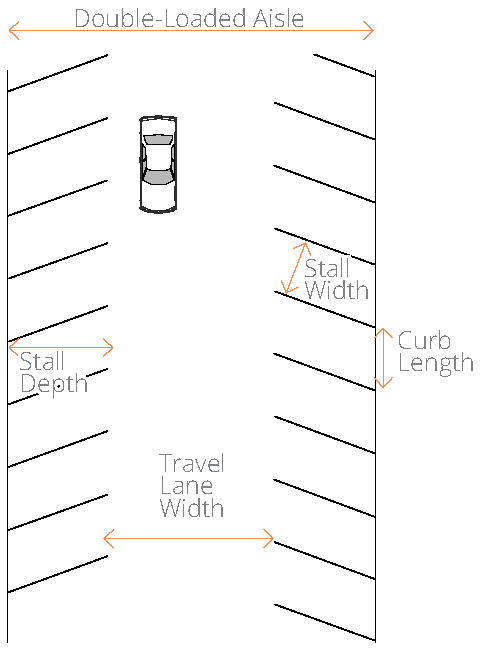
***Expand table to lock table headings in place while scrolling***
Figure 7.3-B Parking Lot Pedestrian Walkway
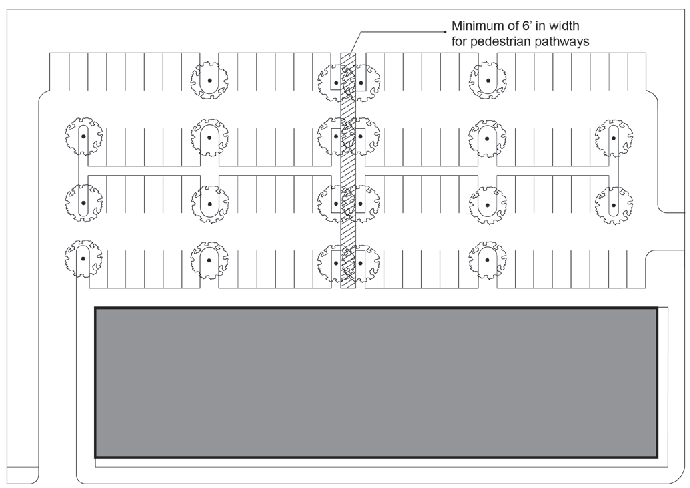
(Amend. of 12-13-2022)
7.4.1 - GENERAL REQUIREMENTS
All loading facilities shall adhere to the following requirements, unless otherwise approved during Site Plan Review (refer to 1.3.3).
A.
Use of Off-Street Loading Areas. Space allocated to any off-street loading use shall not be used to satisfy the space requirements for any off-street parking facilities or portions thereof.
B.
Location. Unless otherwise specified, all required loading facilities shall be located on the same lot as the use to be served. No loading space shall block or project into a street, alley, access drive, or parking area.
C.
Building Frontage. Loading facilities shall be located per 4.0 Building Type requirements.
D.
Access. Loading facilities shall have clear access onto an alley or be connected to an alley or street via a driveway.
(1)
Direct access to a public way, other than an alley, is prohibited.
(2)
Each required off-street loading space shall be designed with appropriate means of vehicular access to a street or alley in a manner which will least interfere with traffic movement.
7.4.2 - LOADING REQUIREMENTS
All uses except in the residential and lodging, open space, and civic and institutional categories shall provide off-street loading spaces in compliance with Figure 7.4-A Required Loading Facilities.
7.4.3 - COMPUTATION
Loading facilities shall be calculated using the following information.
A.
Gross Square Footage. Unless otherwise expressly stated, loading standards for non-residential buildings shall be computed on the basis of gross floor area in square feet.
B.
Fractions. When computation of the number of required off-street loading spaces results in a fractional number, any result of 0.5 or more shall be rounded up to the next consecutive whole number. Any fractional result of less than 0.5 may be rounded down to the previous consecutive whole number.
C.
Shared or Central Loading Facilities. Shared or central loading facilities are permitted if the following conditions are met.
(1)
Each lot served shall have direct access to the central loading area without crossing streets or alleys.
(2)
Total off-street loading spaces provided shall meet the minimum requirements herein specified, based on the sum of the several types of uses served unless reviewed and approved by the zoning administrator through site plan review.
(3)
No lot served shall be more than 500 feet from the central loading area.
7.4.4 - DIMENSIONS
A standard off-street loading space shall be a minimum of 10 feet in width by 26 feet in length and an oversized loading space shall be a minimum of 12 feet in width and 40 feet in length, exclusive of aisle and maneuvering space and shall have a minimum vertical clearance of 15 feet.
7.4.5 - PAVEMENT CONSTRUCTION
Pavement construction standards of 7.3.1 H. shall apply to all loading spaces.
Figure 7.4-A Required Loading Facilities
***Expand table to lock table headings in place while scrolling***
7.5.1 - GENERAL REQUIREMENTS
These standards shall supplement the provisions for access provided in 4.0 Building Types. Each driveway providing site access from a street, alley, or other vehicular right-of-way shall be designed, constructed, and permanently maintained as follows.
7.5.2 - QUANTITY & LOCATION OF DRIVEWAYS
The number of driveways permitted for each building type and the location of the driveways is established in 4.0 Building Types. Refer to 4.1.2 I. Vehicular Access for general design requirements associated with building types.
7.5.3 - DIMENSIONS & DESIGN
A.
Curb Cuts and Driveway Width at Property Line. All curb cuts shall have a maximum width in the public right of way as required by the department of public works. Maximum driveway width at the property line shall be 22', unless a turning lane is required by Public Works. The following specific requirements apply based upon use:
(1)
Driveways in any NX and N district shall be no wider than 10 feet at the property line and within any front or corner side yard, except that buildings with more than 12 units, and buildings with primarily nonresidential uses, are permitted up to an 18 foot driveway where a greater width is necessary to the function of the use.
B.
Distance Between Curb Cut and Intersections. For corner properties, the minimum distance permitted between any curb cut and the property line forming the adjoining street extended to the curbline shall be 40 feet, unless otherwise approved by the department of public works.
C.
Distance Between Two Driveways. The minimum distance between 2 driveways shall be 10 feet.
D.
Distance from Side Lot Line.
(1)
A minimum distance of 2 feet from side property lines shall be maintained at the back of sidewalk for all driveways in residential districts.
(2)
A minimum distance of 5 feet from side property lines shall be maintained at the back of sidewalk for all driveways in all districts other than residential districts.
E.
Public Works Review Required. Any curb cut for any use other than dwellings with 3 units or fewer, which connects to, or crosses, any public street or public right of way must be reviewed and approved in writing by the director of the department of public works.
F.
Maximum Width at Garages. When a garage door is located on the front facade of the structure, the driveway shall be no more than 2 feet wider than the garage door at any location.
G.
Shared Access. When possible, adjacent developments should share points of access to minimize impervious surface.
H.
Circular Drop-Off Drives. Circular drop-off drives may be permitted by building type in 4.0 and per 4.1.2 I.(4) Circular Drop-Off Drives. Maximum width of the driveway shall be 15 feet.
I.
Curb Cut Specifications. Applicants shall comply with curb cut specifications issued by the department of public works.
J.
Intersection with Sidewalks. A driveway intersecting with a sidewalk shall be designed to favor the sidewalk, including ensuring that the sidewalk is level over the driveway and that the sidewalk is not lowered to match the driveway height.
(Amend. of 12-13-2022)

