
Hartford City Zoning Code
3.0
USES
3.1.1 - GENERAL PROVISIONS
The following general provisions apply to the uses outlined in this section.
A.
A lot may contain more than one principal use, unless otherwise specified.
B.
Each of the principal uses may function as either a principal use or accessory use on a lot, unless otherwise specified.
C.
Uses are either permitted by right in a district, permitted by right with conditions, or require a Special Permit (refer to 1.3.4) in order to be developed.
D.
Each use shall be located within a permitted building type (refer to 4.0 Building Types), unless otherwise specified.
E.
Each use shall be located indoors (within a building), unless otherwise expressly stated.
3.1.2 - APPLICABILITY
No building, structure, or land shall be used in any way other than the uses permitted in the district in which the building, structure, or land is located, with the exception of the following.
A.
Continuation of Existing Uses. The continuation of any use existing and permitted at the time of adoption of these regulations is permitted, subject to 1.5.3 Nonconforming Uses.
3.2.1 - TABLE OF PRINCIPAL USES
Figure 3.2 -A Table of Principal Uses identifies the principal uses allowed in each zoning district. Principal uses are defined in 3.3 Principal Use Definitions & Use-Specific Conditions, and each defined use is given one of the following designations.
A.
Permitted ("●"). These uses are permitted by right in the districts in which they are listed.
B.
Permitted in Upper Stories Only ("◓"). These uses are permitted by right in the districts in which they are listed, provided that the uses are located in the upper stories of a structure. These uses may also be located in the ground story provided that they are located beyond a depth of at least 30 feet from the front facade. For clarification, the language in the preceding sentence prevails even if certain charts in 4.0 Building Types limit uses for Primary Street Ground Story.
C.
Permitted Subject to Conditions ("◐"). These uses are permitted by right in the districts in which they are listed, provided that they comply with the listed use-specific conditions (refer to 3.3 Principal Use Definitions & Use-Specific Conditions). These conditions are intended to mitigate potential negative land use impacts, thereby making such uses appropriate in district where they might otherwise not have been appropriate.
D.
Requires a Special Permit ("◯"). These uses are allowed only if reviewed and approved in accordance with the procedures of 1.3.4 Special Permits. In addition, they must comply with all applicable use-specific conditions associated with the use and comply with any requirements of the Special Permit.
E.
Prohibited Use. Uses without a symbol are prohibited in the district because they are considered incompatible with the intent of the district.
3.2.2 - ORGANIZATION
Uses are grouped into general categories, which are further broken into subcategories and specific use types. For example, the Retail Uses category includes a subcategory of uses for Neighborhood Retail and specific uses such as Beer/Wine/Liquor Sales.
3.2.3 - UNLISTED USES
A.
Unlisted Similar Uses.
(1)
If a use is not listed but is substantially similar in nature and impact to a use permitted within a zoning district, the commission is authorized to interpret the use as permitted. Such unlisted use is subject to any use-specific conditions applicable to the similar permitted use.
(2)
If the unlisted use is substantially similar in nature and impact to a use requiring a Special Permit, the commission is authorized to interpret the use as also requiring a Special Permit.
(3)
If the unlisted use is substantially similar in nature and impact to a use that is prohibited, the commission is authorized to interpret the use as prohibited.
B.
Unlisted Dissimilar Use. If a use is not listed and cannot be interpreted as similar in nature and impact to a use within a zoning district that is either permitted or requires a Special Permit, the use is prohibited.
3.2.4 - BUILDING TYPES
The uses permitted within the district may be further limited within the building types permitted in the district. Refer to 4.0 Building Types.
3.2.5 - PROHIBITED USES
The following uses are prohibited in any district.
A.
Cemetery. Land dedicated for the internment of human or animal remains, or cremated remains, except existing cemeteries may make reasonable improvements, such as cosmetic repairs, structural alterations, and internments.
B.
Hunting. The use of land to discharge a firearm, bow, or crossbow for the purpose of killing animals for sport, consumption, or pleasure.
C.
Natural Gas, Oil, or Other Surface Hydrocarbon Extraction Activities. All geologic or geophysical activities related to the exploration for or extraction of natural gas, oil, or other subsurface hydrocarbons, including, but not limited to, core and rotary drilling and hydraulic fracturing (i.e., the drilling into the ground and subsequent pumping of water, sand, chemicals, or a combination thereof, to break apart underground rock formations, including shale and non-shale formations, for the purpose of stimulating natural gas, oil, or other subsurface hydrocarbon production); and natural gas waste, oil waste, or other subsurface hydrocarbon waste associated with such activities, including but not limited to: the application (i.e., physical placing or spreading), storage, disposal, sale, acquisition, transfer (excluding transport through the city in enclosed containers), handling, treatment and/or processing of waste from natural gas, oil, or other subsurface hydrocarbon extraction. In the preceding sentence, "natural gas waste or oil waste" shall mean: (1) any liquid or solid waste or its constituents that is generated as a result of natural gas or oil extraction activities, which may consist of water, brine, chemicals, naturally occurring radioactive materials, heavy metals, or other contaminants; (2) leachate from solid wastes associated with natural gas or oil extraction activities; (3) any waste that is generated as a result of or in association with the underground storage of natural gas; (4) any waste that is generated as a result of or in association with liquefied petroleum gas well storage operations; and (e) any products or byproducts resulting from the treatment, processing, or modification of any of the above wastes.
D.
Outdoor Wood Furnace. An accessory structure or appliance designed to be located outside living space ordinarily used for human habitation and designed to transfer or provide heat, via liquid or other means, through the burning of wood or solid waste, for: heating spaces other than where such structure or appliance is located; heating any other structure or appliance on the premises; or for heating domestic, swimming pool, hot tub or jacuzzi water. Does not include a fire pit, wood-fired barbecue or chiminea.
E.
Sanitary Landfills. A sanitary landfill is a waste disposal facility where layers of garbage are covered, usually with layers of earth and a cap made of a synthetic membrane.
F.
Scrapyards. The use of land for the storage or collection or accumulation of used lumber and other used materials, or for the dumping or disposal of scrap iron, junk, garbage, rubbish or other refuse or of ashes, slag or other industrial wastes or byproducts.
G.
Temporary Health Care Structures, including those identified in general statutes Public Act No 17-155.
Figure 3.2-A Table of Principal Uses
***Expand table to lock table headings in place while scrolling***
(Amend. of 11-23-2021(2); Amend. of 4-12-2022; Amend. of 9-13-2022; Amend. of 12-13-2022; Amend. of 1-10-2023; Amend. of 9-6-2023(1); Amend. of 4-23-2024(1))
3.3.1 - RESIDENTIAL & LODGING USES
A category of uses for residential and overnight accommodations.
A.
Household Living. Household living means the use of one or more dwelling units located within the principal structure of a lot by a household, in which the units may or may not share a common wall with the adjacent unit or have individual entrances from the outside. Nothing in this section shall be deemed to limit the ability of lawful occupants of a dwelling unit to have bona fide guests.
(1)
One-Unit Dwelling. One principal dwelling unit located on a lot that does not contain any other principal dwelling units.
(2)
2-Unit Dwelling. Two principal dwelling units, both of which are located on the same lot, with no other principal dwelling units located on such lot.
(3)
3-Unit Dwelling. Three principal dwelling units, all 3 of which are located on the same lot, with no other principal dwelling units located on such lot.
(4)
Multi-Unit Dwelling. Four or more principal dwelling units, all of which are located on the same lot.
B.
Bed & Breakfast. A facility providing temporary lodging to the general public consisting of no more than 6 sleeping rooms with daily room cleaning services, without in-room kitchen facilities, in either an owner-occupied principal structure or in a principal structure on the same lot of an owner-occupied accessory structure.
When noted as subject to conditions ("◐") or requires a special permit ("◯") in Figure 3.2 -A Table of Principal Uses, the following regulations apply:
(1)
The bed & breakfast shall not alter the residential nature of the neighborhood and/or the character of the dwelling as a residence.
(2)
The bed & breakfast shall be located in a structure, of 50 years of age or greater, which was historically used for residential purposes.
(3)
Access to guestrooms shall be via a main entrance, lobby or foyer within the building. No guestroom shall have a separate exterior access, except as may be required by fire or building codes.
(4)
Occupancy by any one guest shall not exceed 21 cumulative nights within any 3 month period. To facilitate enforcement of this requirement, the owner of the bed & breakfast shall maintain a guest book that records the names of guests and the lengths of stay, and shall make such guest book available to a city staff member within 10 days of receipt of written request for same.
(5)
No employees who are not otherwise eligible to be a member of the same household with the owner of the bed & breakfast may live on-site. No more than 3 non-resident employees of the bed shall be working on-site during any one shift.
(6)
Breakfast must be served daily to guests of the bed & breakfast, and breakfast must be included in the rate paid by guests. No other meals may be served by the facility. Only guests, not the general public, may partake in breakfast.
(7)
Accessory dwelling units (as defined in 3.5.1 A.), long-term room rentals (as defined in 3.5.1 D.), and short-term room rentals (as defined in 3.5.1 E.), are not permitted on the same lot as a bed & breakfast.
C.
Group Living. A facility where a group of persons other than a household resides together with a common purpose or goal, excluding medical or rehabilitation purposes or goals. Typically includes a communal kitchen and dining facilities. Includes such uses as fraternity houses, sorority houses, convents, monasteries, foster homes for more than 6 children, orphanages or children's homes. Does not include a roominghouse or boardinghouse or group living for health reasons (such as a rehabilitation home).
When noted as subject to use-specific conditions ("◐") or requires a special permit ("◯") in Figure 3.2 -A Table of Principal Uses, the following regulations apply:
(1)
There shall be a minimum lot area of one acre for all uses, except orphanages and children's homes are required to have a minimum of 5 acres.
(2)
A minimum of 400 square feet of usable open space shall be provided per resident. For fraternity and sorority houses, the open space of the university or college campus on which they are located may be counted toward the usable open space requirement.
(3)
Fraternity and sorority houses shall be permitted only on the campus of a college or university.
D.
Group Living for Health Reasons. Any state-licensed community residence that houses 6 or fewer persons with an intellectual disability (as the term is defined by the state legislature) and necessary staff persons, any state-licensed child care residential facility that houses 6 or fewer children with mental or physical disabilities and necessary staff persons, and any state-licensed community residence that houses 6 or fewer persons receiving mental health or addiction services and necessary staff persons. Does not include all other group living for health reasons not expressly identified in the preceding sentence.
When noted as subject to conditions ("◐") or requires a special permit ("◯") in Figure 3.2 -A Table of Principal Uses, the following regulations apply:
(1)
Pursuant to general statutes section 8-3e(1), group living for health reasons shall be treated the same manner as a single family residence, where such uses are allowed. In addition to other restrictions contained in these regulations, group living for health reasons must abide by the conditions on single family residences in 3.3.1 A.(1).
(2)
Pursuant to general statutes section 8-3g, group living for health reasons is allowed anywhere 2-unit dwellings, 3-unit dwellings, or multi-unit dwellings are allowed. However, group living for health reasons shall only be allowed to locate in a single family residence (as defined in 1.6 Definitions) within these districts. However, group living for health reasons shall not alter the residential character of any residential neighborhood in which it may be located or the character of the dwelling as a residence. Group living for health reasons for adults shall not be located within 1,500 feet of a temporary shelter facility, rehabilitation home, group living facility, or roominghouse/boardinghouse.
(3)
Pursuant to general statutes section 8-3f, no group living for health reasons facility established pursuant to this section may be located within 1,000 feet of any other such facility without the approval of the commission by special permit.
E.
Hotel/Apartment Hotel. A facility offering temporary lodging to the general public consisting of 6 or more sleeping rooms with a bathroom for each room and providing daily room cleaning services and other guest services. In-room kitchen facilities may or may not be provided. Includes apartment or residential hotels. Secondary service uses may also be provided, such as restaurants and meeting rooms.
When noted as subject to conditions ("◐") or requires a special permit ("◯") in Figure 3.2 -A Table of Principal Uses, the following regulations apply:
(1)
A private lobby shall be included.
(2)
Rooms shall be accessed from the interior of the building, including from interior courtyards, lobbies, or halls.
F.
Residential Care. A facility that offers lodging in conjunction with daily professional care focusing on physical health and well-being and assistance to members of the public or a specific subset of persons. Includes such uses as convalescent, nursing, or rest home; assisted living facilities; and extended care residence. Does not include a roominghouse or boardinghouse or other group living for health reasons (such as a rehabilitation home).
(1)
Residential Care, Large. A residential care use in an institutional or multi-unit-style living arrangement with more than 6 residents or more than 2 professional staff living or working on site on a 24-hour basis.
(2)
Residential Care, Small. A residential care use where residents reside together with no more than 6 residents and 2 staff living on-site.
(3)
When noted as subject to conditions ("◐") or requires a special permit ("◯") in Figure 3.2 -A Table of Principal Uses, the following regulations apply:
(a)
A large residential care facility shall be allowed as an accessory use of a senior housing development, but only in a Campus Overlay and subject to a special permit pursuant to 5.1.2.
G.
Roominghouses and Boardinghouses. A roominghouse is a residential structure whose principal use is to provide lodging, but not meals, for compensation by prearrangement for definite periods, to between 3 and 6 roomers, wherein no dining facilities are maintained for the roomer and in which bathrooms may or may not be shared. A boarding house is a residential structure where lodging and meals are provided for compensation to between 3 and 6 persons by pre-arrangement for definite periods.
When noted as subject to conditions ("◐") or requires a special permit ("◯") in Figure 3.2 -A Table of Principal Uses, the following regulations apply:
(1)
Roominghouses and boardinghouses are distinguished from hotels/apartment hotels and bed & breakfast facilities by the following: the length of stay is typically longer (typically a minimum of two weeks) for roominghouses and boardinghouses; roomers and boarders often have personal household appliances (such as toaster ovens and mini-refrigerators); and there is no daily room cleaning or other guest services provided for rooming or boardinghouses. In addition, in contrast to hotels/apartment hotels, the architectural character of a roominghouse or boardinghouse structure is primarily residential in nature.
H.
Temporary Shelter Facility. A public or non-profit facility providing temporary housing, and social, health, and related services for families and/or individuals 18 years of age or older, who are without resources and access to shelter.
When noted as subject to conditions ("◐") or requires a special permit ("◯") in Figure 3.2 -A Table of Principal Uses, the following regulations apply:
(1)
The use shall only be operated by or in conjunction with a governmental, welfare or charitable service.
(2)
The maximum number of residents of the lodging shall be based upon a ratio of one person for every 50 square feet of interior space devoted to sleeping area, not to exceed 100 residents total.
(3)
The facility shall have staffing on-site during all hours of operation.
(4)
At least one toilet and shower must be provided for every 15 shelter beds.
(5)
New temporary shelter facilities shall not be located within 2,000 feet of another temporary shelter facility, group living facility, group living facility for health reasons, rehabilitation home, roominghouse/boardinghouse, medical clinic, hospital, school, or park.
(6)
The temporary shelter facility must be open to the individuals it serves for 24 hours per day, including the provision of an indoor waiting area for use by individuals when a portion of the facility is not opened for operation. Lodging must be provided on a reservation or referral basis so that clients will not be required or allowed to queue for services outdoors.
(7)
All functions associated with the temporary shelter facility, except for children's play areas, outdoor recreation areas, and parking must take place within the building housing the shelter.
(8)
There shall be annual licensing by the division of licenses and inspections to ensure the health and safety of residents and neighbors, and compliance with the zoning regulations. Operators of emergency shelters shall comply with the following:
(a)
Annually submit to the Zoning Enforcement Officer copies of their up-dated program description.
(b)
Annually submit updated listing of board members, proprietors, and responsible government officials.
(c)
Annually submit updated neighborhood relations plan.
(d)
When there are no changes since the previously filed documents, a statement to this effect is sufficient.
(e)
Operators shall also have available for review, if requested, the complaint log for the previous year.
(f)
An annual review will occur at the anniversary of the date upon which approval was originally granted.
(Amend. of 12-13-2022)
3.3.2 - CIVIC & INSTITUTIONAL USES
A category of uses related to fulfilling the needs of day-to-day community life including assembly, public services, educational facilities, and hospitals.
A.
Assembly. A facility that has organized services, meetings, or programs to benefit, educate, or promote discourse amongst the residents of the community in a public or private setting, with incidental entertainment. Includes such uses as houses of worship, community centers, and recreation centers.
(1)
Neighborhood Assembly. An assembly use that occupies a building with less than 10,000 square feet of gross floor area.
(2)
General Assembly. An assembly use that occupies a building with 10,000 square feet or more gross floor area.
(3)
When noted as subject to conditions ("◐") or requires a special permit ("◯") in Figure 3.2 -A Table of Principal Uses, the following regulations apply:
(a)
Minimum Lot Frontage. A minimum lot frontage of 100 feet is required for all Neighborhood Assembly Uses. A minimum lot frontage of 150 feet is required for all General Assembly Uses.
(b)
Street Type. When located in an N or NX district, General Assembly uses shall front a Boulevard or Avenue street type. Refer to 9.0 Street Types.
(c)
Minimum Lot Area. The following minimum lot areas for all assembly uses, exclusive of any other uses on the same lot, are required: 5 acres in the N-1 district, 4 acres in all other NX and N districts, and 0.5 acres in every other district, except in the DT districts, where there is no minimum acreage-required.
(d)
N-1 District. In the N-1 district, only existing houses of worship are permitted, and any addition to or expansion of such houses of worship or their accessory parking facilities shall not be permitted.
B.
Government/Higher Education/Hospital Facilities. Large-scale community-serving facilities associated with healthcare, universities, colleges, or government functions. Includes such uses as universities, theological schools, city hall, government offices, and hospitals.
(1)
Government Facility. A single-purpose public facility used for civic functions, which includes a place for public assembly in a portion of the facility, for the executive, legislative, or judicial branches of the State or a political subdivision thereof. Includes City Hall, council chambers, and courts. Does not include office buildings occupied by a government entity which do not contain assembly areas, or office buildings occupied by a government entity which are also utilized by private or non-governmental occupants.
(2)
Higher Education Facility. A non-profit institution for post-secondary education, public or private, for higher education that grants associate or bachelor degrees and may also have research facilities and/or professional schools that grant master and doctoral degrees. Does not include facilities located in a higher education housing overlay zone. Does include vocational and trade schools which are not high schools.
(3)
Hospital. A licensed institution providing medical care and health services to the community, primarily ill or injured in-patients. These services may be located in one building or clustered in several buildings, one of which must provide emergency services, and may include additional hospital-affiliated accessory uses such as laboratories, in- and out-patient facilities, training facilities, medical offices, staff sleeping quarters (but not full-time residences), food service, heliports, pharmacies, laundry facilities, florists, vendors of medical equipment, opticians, and gift shops.
(4)
When noted as subject to conditions ("◐") or requires a special permit ("◯") in Figure 3.2 -A Table of Principal Uses, the following regulations apply:
(a)
When these uses require more than one building on one lot, a Campus Overlay shall be required, and 5.1 shall apply
(b)
Higher education and hospital facilities shall be located on lots with a minimum lot area of 10 acres.
(c)
Any food service facility, florist, or gift shop shall have a separate entrance open to the public during hours of operation within 25 feet of a public street or right of way, and visible from such public street or right of way. Food service facilities or gift shops exclusively serving a dormitory, faculty department, or campus society are exempt from this requirement.
(d)
Any power plant or laundry facility related to government, higher education, and hospital facilities shall be located a minimum of 100 feet from any adjacent residential property.
C.
Library/Museum. A structure open to the general public housing educational, cultural, artistic, or historic information, resources, and exhibits. Includes such uses as libraries, museums, aquariums, planetariums, and exhibitions. May also include theater space, gift shops, classrooms, food service uses that may or may not serve alcohol per section 3.3.4 C.(6), and other accessory uses customary to libraries or museums.
D.
Police and Fire. A facility providing public safety and emergency services; training facilities, locker rooms, and limited overnight accommodations may also be included.
When noted as subject to conditions ("◐") or requires a special permit ("◯") in Figure 3.2 -A Table of Principal Uses, the following regulations apply:
(1)
Police and Fire facilities shall be housed only in permitted building types (refer to 4.0 Building Types), but will have the following additional allowances:
(a)
Garage doors are permitted on the front facade.
(b)
Police and Fire facilities are exempt from maximum driveway width regulations.
E.
School Pre-Kindergarten, Primary, Elementary, Intermediate. Public or private education facilities with classrooms and offices, which may also include associated indoor facilities such as ball courts, gymnasium, theater, and food service.
When noted as subject to conditions ("◐") or requires a special permit ("◯") in Figure 3.2 -A Table of Principal Uses, the following regulations apply:
(1)
Minimum Lot Area. There shall be a minimum lot area of 5 acres for, primary, and elementary schools, and 10 acres for intermediate schools, except in the DT districts, where there is no minimum acreage required.
(2)
Pre-kindergarten and facilities that only offer kindergarten and pre-kindergarten shall comply with the lot size, lot size per child, and outdoor space requirements of the Child Day Care Center per Section 3.3.5.G.
(3)
For any new school or any school involving a substantial renovation of food preparation facilities, a scratch kitchen sufficient to meet the needs of the expected student population must be provided.
F.
School High School. Public or private educational facilities for high school. Facilities may be on a larger-scale campus and include significant traffic and parking. May include gymnasium, theater, cafeteria, offices, classrooms, athletic facilities, and athletic fields. Use does not include stadium; refer to 3.3.2 G. Stadium/Arena.
When noted as subject to conditions ("◐") or requires a special permit ("◯") in Figure 3.2 -A Table of Principal Uses, the following regulations apply:
(1)
Minimum Lot Area. There shall be a minimum lot area of 10 acres for high schools, except in the DT districts, where there is no minimum acreage required.
(2)
For any new school or any school involving a substantial renovation of food preparation facilities, a scratch kitchen sufficient to meet the needs of the expected student population must be provided.
G.
Stadium/Arena. A building or structure seating more than 1,000 spectators in tiered seating at sporting events, concerts, meetings, and gatherings of large groups. A stadium/arena may be open air or covered by either a fixed or retractable roof.
When noted as subject to conditions ("◐") or requires a special permit ("◯") in Figure 3.2 -A Table of Principal Uses, the following regulations apply:
(1)
Building Type. This use is not required to meet a building type, but the commission shall consider the building type requirements of the district it is located within.
(2)
Major Entrances. A stadium/arena shall have multiple public entrances, including one major entrance on the facade designated by the property owner as the front setback. Such entrances shall be well-marked to cue access and use through means of enhancement that may include but are not limited to architectural, landscape, or graphic treatments. Where possible, major entrances should take advantage of prominent intersection locations.
(3)
Transparency. In the DT districts and MX-2 districts, a minimum transparency of 70 percent is required on the ground-floor facade.
(a)
Transparency shall be measured between the height of 2 feet and 12 feet on the front facade.
(b)
For stadiums/arenas, transparency includes open views into the stadium/arena in addition to the definition of transparency (refer to 1.6 Definitions).
(c)
Where transparency into the structure cannot be achieved due to the interior layout required by the use, alternate methods of achieving transparency or architectural design providing appropriate levels of visual relief and interest that is contextually appropriate to the surrounding area may be proposed.
(d)
On side streets there is no required level of transparency, but approval is contingent upon providing appropriate levels of visual relief and interest that is contextually appropriate to the surrounding area.
(e)
Blank walls on any street frontage are prohibited.
(f)
The commission may impose additional requirements for transparency in any district in which a stadium/arena is allowed.
(4)
Street-Level Experience. The design of a stadium/arena must avoid visual monotony and relate well with pedestrians through scale, material, and form. Ground floor spaces shall have not less than 12 feet of floor-to-ceiling height, and the exterior architecture shall distinguish the ground floor from upper levels. The commission may require that the facility contain retail or consumer uses, which shall remain open during normal business hours year-round, including on days when the stadium/arena is not in active use for public assembly.
(5)
Materials. The use of durable, high-quality building materials are required on any façade that faces the public realm.
(a)
Materials should provide variety and reinforce massing and changes in the horizontal and vertical planes of the façade.
(b)
Materials should be especially durable on ground-floor facades.
(c)
Modern building materials and methods as well as historically appropriate materials are encouraged and include but are not limited to steel, glass, stone or similar material, brick, or brick veneer.
(d)
Materials and architectural features shall help define the pedestrian environment by providing for a variety of scale and texture at the pedestrian level.
(e)
Materials specifically prohibited include: the use of exterior insulation and finishing system (EIFS) as a building cladding material on the ground floor level or lower than 14 feet, whichever is greater; chain link fences visible from the public realm; and dark tinted, overly reflective or opaque glass.
(6)
Lighting. Lighting shall conform to 6.15 Site Lighting of these regulations and be so designed to prohibit any direct illumination of any adjacent property and so as to not impinge upon any adjoining residential premises, or light trespass, to the greatest extent possible. Direct illumination occurs when light is cast directly onto an object, measured perpendicularly from its origin. In addition, the amount of light trespass shall be limited to a maximum of 25 foot candles at a distance of 25 feet beyond the property lines, provided, however, that the commission may reduce this maximum amount relative to adjacent uses and other circumstances. Glow, as a result of the combination of all light reflected from what is being illuminated and escaped into the night sky, should be minimized.
(7)
School Stadium. A stadium/arena may be an accessory use to a school only if a stadium/arena is allowed in the district per Figure 3.2 -A Table of Principal Uses.
H.
Transit Station. A building or permanent platform with an area for passenger boarding and alighting which is roofed for at least 30 feet, and which may include a waiting room, ticket office, ticket machines, restrooms, or concessions. A transit station must serve a passenger railway company, a bus rapid transit service company, or a water transportation company, with or without other forms of transit or transportation at the same facility.
(Amend. of 7-26-2022; Amend. of 12-13-2022)
3.3.3 - OPEN SPACE USES
A category of uses generally applicable to the use of the land and may not require buildings or other facilities used for active or passive, public or private, outdoor recreation, education, or entertainment.
A.
Community Gardens. A space used to grow plants for personal use, education, recreation, community distribution, or beautification by members of the neighboring community. Community gardens may be divided into separate plots for cultivation by one or more individuals or may be farmed collectively by members of the group and may include common areas maintained or used by community group members.
When noted as subject to conditions ("◐") or requires a special permit ("◯") in Figure 3.2 -A Table of Principal Uses, the following regulations apply:
(1)
Requirements for Food Production.
(a)
The site shall have reliable and legal access to an onsite source of water. Use of water storage systems is allowed.
(b)
The site shall be operated in a manner that prevents the drainage of water or chemicals onto any neighboring property.
(c)
Site operators shall ensure that soils are suitable and shall obtain any permits for operation required by law. Prior to development, soils shall be tested to ensure the viability and safety of the location. This requirement is waived when soils have been remediated and/or demonstrated to meet the Residential Direct Exposure Criteria as specified by the Connecticut Department of Energy and Environmental Protection. At a minimum, soil shall be tested for the following heavy metals: boron, arsenic, mercury, selenium, lead, cadmium, chromium, nickel, zinc and copper. Analytical test shall be conducted with methods and procedures suitable for soil media. Suitable soil shall be defined as soil which meets the regulations set forth by the Connecticut Department of Energy and Environmental Protection. Soil tests results shall be submitted with application.
(d)
Tools, supplies, and machinery shall be stored in an enclosed structure or removed from the property daily. All chemicals and fuels shall be stored off the ground in an enclosed, locked structure when the site is unattended.
(e)
The site must be maintained using organic agricultural practices, including the use of organic chemicals only. Use of pesticides must meet the regulations detailed in the Connecticut Pesticide Control Act, general statutes section 22a-46.
(f)
A composting and waste management plan, a plan for the use of organic agricultural chemicals, and a soil remediation plan (if necessary) must be approved by the city department of health and human services prior to the issuance of any zoning permit.
(g)
At the end of the growing season (and no later than December 15 of each year), all plant material must be cut to no more than 6 inches in height, unless there is an agricultural reason for keeping the plant materials uncut.
(h)
One identification sign containing the name and phone number of the contact person for the site is required. The sign shall be designed in accordance with 8.0 Signs. The sign shall be visible from the most active adjacent street.
(2)
Operating Rules. Applicants must establish operating rules addressing the governance structure of the garden, hours of operation, maintenance, assignment of garden plots when applicable, and security requirements.
(3)
Garden Coordinator. Applicants must identify a garden coordinator to manage the garden and act as the point of contact with the city. The coordinator shall be an employee or volunteer of a public entity, non-profit organization, or other community-based organization. Applicants must file the name and telephone number of the garden coordinator and a copy of the operating rules with the city department of health and human services.
(4)
Farm Stand. A community garden may have one temporary farm stand selling and/or distributing agriculture and horticultural products produced on site and off-site products produced by no more than one off-site producer for no more than 50 days during a calendar year, except in the N district where such products may be sold and/or distributed for no more than 4 days during a calendar year. Such stand shall be attended during all hours of sales and/or distribution and shall be permitted in accordance with 4.19 Accessory Structures.
(5)
Shade Pavilions. A maximum of 2 shade pavilions are permitted per 4.20.4 Accessory Outdoor Structures.
(6)
Community gardens are authorized as an accessory use in the same districts in which they are authorized as principal uses, and accessory community gardens shall be subject to the same conditions set forth in this section.
B.
Honey Beekeeping. The keeping of one or more colonies of the common domestic honey bee, Apis Mellifera. Colonies include a hive and its equipment and appurtenances, including bees, comb, honey, pollen, and brood.
When noted as subject to conditions ("◐") or requires a special permit ("◯") in Figure 3.2 -A Table of Principal Uses, the following regulations apply:
(1)
Maximum Number of Colonies.
(a)
Any lot containing a residential use shall be limited to 4 colonies. One additional colony is permitted for every 1,000 square feet of lot area over 10,000 square feet, and an absolute maximum of 10 colonies.
(b)
Any lot containing a community garden or urban farm, and any lot in the CX-2, ID-2, and ID-1 zoning districts, shall be limited to 10 colonies per lot.
(c)
The following exception shall be made for colonies located on rooftops: There shall be no limitation on the number of colonies located on rooftops in the CX-2, ID-1, and ID-2 zoning districts.
(2)
Colony Size. No colony shall exceed 20 cubic feet in volume.
(3)
Location. The colony shall be located in a rear or side yard in all N districts or on any lot with a residential use. No colony shall be located closer than 10 feet from any property line, or closer than 10 feet from a public sidewalk or 25 feet from a principal building on an abutting lot.
(4)
Flyaway Barrier. A flyway barrier of at least 6 feet in height must shield any part of a property line within 25 feet of a colony, unless the base of the colony is located more than 6 feet above the ground.
(a)
A required flyway barrier shall consist of a wall, fence, dense vegetation, or a combination thereof.
(b)
The barrier shall be positioned to transect both legs of a triangle extending from an apex at the colony to each end point of the part of the property to be shielded.
(5)
Farm Stand. No sales of honey shall occur on the lot containing the honey bee colony, except in the case of a honey bee colony located on an urban farm where there is a farm stand, in which case the operator of the honey bee colony shall be permitted to sell honey at the farm stand. Such stand shall be permitted in accordance with 4.19.5 Accessory Agricultural Structures.
(6)
State Permit Required. The property owner shall obtain any necessary permits prior to the installation of any colony and shall annually, on or before the first day of October, make application to the State Entomologist for the registration of bees, as required by general statutes section 22-89.
(7)
Honey beekeeping is authorized as an accessory use in the same districts in which it is authorized as principal uses, and accessory honey beekeeping shall be subject to the same conditions set forth in this section.
C.
Intensive Park Uses. A category of impactful uses which includes buildings (including additions of 1,000 square feet or more to existing buildings), golf courses, riding stables, zoos, campsites, group camps, and, in Keney Park only, a large-scale organic matter composting facility that primarily utilizes natural methods of composting.
(1)
When noted as subject to conditions ("◐") or requires a special permit ("◯") in Figure 3.2 -A Table of Principal Uses, the only type of intensive park use allowed in the ID-1 district is a stable.
(2)
Applications involving projects within the boundaries of Colt Park which have more than a de minimis impact may be referred to the Superintendent of the Coltsville National Historical Park, managed by the National Park Service. The Superintendent may submit a written opinion on the project for the record, within any formal time limits established for the consideration of the matter.
D.
Park. A use of land for active or passive, public or private, outdoor space, including such uses as public parks, plazas, greens, parkettes, playfields, playgrounds, recreation centers, and tot lots for general recreation, athletics, and leisure. May include historic structures/monuments, botanical gardens, ornamental gardens, or arboretums. Accessory uses may include picnic areas, fishing, ziplines, and swimming pools. See also: 3.3.3 C. Intensive Park.
When noted as subject to conditions ("◐") or requires a special permit ("◯") in Figure 3.2 -A Table of Principal Uses, the following regulations apply:
(1)
General. The following is applicable to all parks:
(a)
Parks shall be open only between the hours of sunrise to dusk.
(b)
Refer to 6.0 Sitework & Landscape for lighting, outdoor furnishings, fencing, stormwater, and landscape requirements.
(2)
Site Design Components, Landscape Furnishings, & Art.
(a)
The commission shall review and approve, through a public hearing and the site plan review process of 1.3.3., the design of any and all pieces of furniture (including but not limited to benches, chairs, and tables), trash receptacles, drinking water fountains, lighting fixtures, fencing, buildings, structures, historic and monument sites, playground equipment, athletic equipment, decorative fountains, man-made ponds and water features, sculpture, signage programs, and artwork within any park, prior to such items being installed.
(b)
Notwithstanding the preceding subsection, the commission may adopt a schedule of approved site furniture, drinking water fountains, lighting fixtures, and fencing for each park or group of parks, and any item on the approved schedule may be installed for the relevant park without requiring additional commission review.
(3)
Events. Park uses may be utilized to host temporary festivals, events, and farmers markets per 3.6 Allowed Temporary Uses and 3.7 Temporary Use Definitions and Use-specific Conditions. Refer to chapter 7 of the code for special events requirements.
(4)
Park Buildings. A limited number of park buildings may be located in a park per the following:
(a)
Buildings visible from the street shall utilize the requirements of 4.10 Civic Building Type.
(b)
Kiosks may be used for small-scale food and beverage service uses within parks, provided that the structure is no more than 200 square feet in area.
(c)
Uses within park buildings may include community spaces, gyms and other fitness facilities, classrooms, and park offices. Other uses may be approved through a Special Use permit.
(d)
Buildings shall occupy no more than 10 percent of a park site.
(5)
Parking. Parking lots are not permitted in parks other than in the following parks: Colt, Elizabeth, Goodwin, Keney, Pope, and Riverside Parks, and Charter Oak Landing. Refer to 7.0 Parking.
(6)
Colt Park. Applications involving projects within the boundaries of Colt Park which have more than a de minimis impact may be referred to the Superintendent of the Coltsville National Historical Park, managed by the National Park Service. The Superintendent may submit a written opinion on the project for the record, within any formal time limits established for the consideration of the matter.
E.
River Uses. A boathouse, boat launch, or marina.
(1)
Floating Structure. Floating structure is a water vessel or amphibious inhabitable structure used or designed to be used as a dwelling unit, office, restaurant, or club for more than merely weekend periods or more than 30 days in any calendar year, whether such vessel is self-propelled or not.
(2)
Marina. Marina is a dock or base providing public moorings or marine services primarily for power boats, sailboats, floating structures, or other watercraft, and which is also capable of removing any and all crafts moored within the marina out of the water for repair, storage or as a result of emergent conditions.
(3)
When noted as subject to conditions ("◐") or requires a special permit ("◯") in Figure 3.2 -A Table of Principal Uses, the following regulations apply:
(a)
River Uses shall only be allowed along the Connecticut River.
(b)
Floating structures are not subject to the density, lot dimension, height, and other requirements of 4.0 Building Types or the parking requirements of 7.0 Parking.
(c)
Every floating structure shall be inspected and approved by the Director of Public Works or the building inspector for buoyancy, windage, stability, structure, means of egress, sufficiency of lifesaving equipment, and for compliance with these regulations. Approval may be conditioned on the use of construction methods and building materials which reduce negative environmental impacts, including in the areas of stormwater runoff, energy usage, and water and air quality.
(d)
Every floating structure shall have: a secure water connection above the waterline with an approved backflow prevention device; a permanent and adequate electrical connection; a secure connection to a public sewer system with adequate vents, tanks and ejector devices or, where direct connections cannot be accomplished, holding tanks accepting all waste discharge and other devices acceptable to the city department of public works and the Metropolitan District Commission.
(e)
A marina shall maintain adequate lines, cleats and other necessary mooring equipment; shall provide firm and substantial walkways to all water vessels; and shall provide adequate trash receptacles and waste management. It shall receive all necessary permits from other city commissions and state agencies prior to operation.
(f)
A floating structure marina shall furnish to the city the following information on an annual basis:
(i)
The number of floating structures located or proposed to be located within the subject marina;
(ii)
A brief physical description of all such floating structures;
(iii)
The names of the legal owners and their addresses of all such floating structures; and the location within the marinas of all such floating structures.
(g)
A floating structure marina shall provide a permanent holding tank pump-out facility or equivalent services which are operable and available for use at all times and which are capable of servicing all floating structures berthed, docked, or moored at the marina or anchorage area.
F.
Urban Farms. A ground or roof-level agricultural operation of any size, excluding agricultural growing (such as aquaculture) occurring in a permanent indoor facility other than a farm structure, which is used for urban agriculture for commercial purposes, whether for profit or non-profit, with a single entity serving as the primary operator.
When noted as subject to conditions ("◐") or requires a special permit ("◯") in Figure 3.2 -A Table of Principal Uses, the following regulations apply:
(1)
Requirements for Food Production. All Requirements for Food Production, as defined in 3.3.3 A.(1) under "Community Gardens" shall apply to all urban farms.
(2)
Lighting. Lighting should be limited to that required for operational and safety purposes of any activity defined as urban agriculture, and shall not create a nuisance through excessive brightness to abutting residential uses.
(3)
Operating Hours. The urban farm shall only operate between the hours of 7 a.m. and 9 p.m. in any residential (N or NX) district or on any lot abutting a residential district or residential building. In all other locations, the urban farm shall only operate between the hours of 5 a.m. and 9 p.m.
(4)
Odors. No odors or fumes from a urban farm shall be allowed to escape into the open air in such amounts as to be detrimental to the health of any individuals or the public or create a nuisance.
(5)
Farm Stand. An urban farm may have one farm stand selling and/or distributing agriculture and horticultural products produced on site, provided such stand shall be attended during all hours of sales and/or distribution, and shall be permitted in accordance with 4.20.5 Accessory Urban Agricultural Structures.
(6)
Equipment. Applicants shall submit a description of the type of equipment intended for use in each season and the frequency and duration of anticipated use.
(a)
In any N or NX district where an urban farm is located, the operator of the garden shall utilize no more than one motorized tractor, of a compact utility size or smaller, over the course of any calendar year, shall utilize said tractor for no more than 15 days per calendar year, and shall utilize no other large-scale motorized vehicles. The preceding sentence shall not apply to walk-behind tractors or other small motorized devices (such as snow blowers or tillers) primarily moved by human power.
(7)
Location in N Districts. In any N district, an urban farm may only be located on college or university campuses or similar institutional settings, in new subdivisions, or on an historic industrial site.
G.
Outdoor Market. An outdoor use, which is not a Temporary Use or an Accessory Use, intended to activate vacant or underutilized lots or lots utilized principally for parking. Outdoor Markets are uses on lots that do not require a principal structure, such as food truck parks, outdoor restaurants or open-air markets, and small business incubators, and may include incidental entertainment. The Outdoor Market space is occupied by common seating areas, shade structures and other accessory structures that house vendors. Outdoor Markets may also contain accessory structures such as storage containers, garbage enclosures, or bathrooms. When noted as subject to conditions ("◐") or requires a special permit ("◯") in Figure 3.2-A Table of Principal Uses, the following regulations apply:
(1)
Structures: A primary structure is not required, and accessory structures are permitted without a primary structure on-site. An Outdoor Market may also be permitted in conjunction with a vacant or underutilized principal structure.
(2)
Site Conditions:
(a)
All structures shall be located behind the building line and connected by a paved or compacted gravel surface that satisfies ADA requirements. The area between the building line and the street shall be landscaped.
(b)
In the absence of a principal structure, for the purposes of applying fence regulations (Section 6.13), front yard shall be defined as the area between the building line and any primary street; the corner side yard shall be defined as the area between the building line and any secondary street.
(c)
The area of the Outdoor Market must be clearly defined and separated from any public or private right-of-way, parking area, or surrounding property with a fence that complies with Section 6.13, or other façade as approved by the Commission.
(d)
Outdoor Markets are required to provide one clearly delineated street-facing pedestrian entrance per frontage or one entrance per 70' of lot frontage, whichever is greater.
(e)
Any new parking installed in conjunction with an Outdoor Market shall be limited to the rear yard.
(3)
Operations.
(a)
A designated manager must be present during all business hours of the Outdoor Market. The designated manager is responsible for the orderly setup of the vendors, the cleanliness of the site, and the site's compliance with all rules and regulations during business hours.
(b)
Each vendor, such as an individual food truck, shall maintain its own licenses from Health and Human Services along with other required state or local licenses, as applicable.
(c)
Food must be served at all times that beer/wine/liquor is being served. Vendors solely serving alcohol shall not be street facing.
(d)
Lighting, odor control, and queueing for food trucks shall be managed in such a way that no nuisance, including light, smell, noise, and litter nuisances, are created.
(e)
Restrooms shall be required on-site, and the City Health and Human Services Department (HHS) shall provide a review and approval of the facilities plan.
(f)
All Outdoor Markets shall provide litter receptacles with adequate capacity for on-site patrons. On-site mobile vendors shall be held to the same requirements in Chapter 27-41 of the Hartford Municipal Code.
(g)
Dumpsters shall comply with the requirements of Section 6.12.
(h)
Mobile Vendors shall comply with the signage; awnings; and umbrellas requirements in Chapter 27-136 of the Municipal Code. Vendor signage shall not contribute to the overall allowed signage on-site.
(4)
Required Application Documents:
(a)
Applicants shall provide a site plan, sign plan, noise mitigation plan, lighting plan, and building plans. The zoning administrator may require additional information pertaining to the application that they deem necessary to aid in their review, including other plans or documents listed in Sections 1.3.3 Site Plan Review or 1.3.4 Special Permits as applicable.
(b)
The Department of Health and Human Services shall provide comment on the submitted site plan.
Figure 3.3-A Typical Retail Uses
(Amend. of 11-23-2021(2); Amend. of 12-13-2022; Amend. of 1-10-2023)
3.3.4 - RETAIL USES
A category of uses involving the sale of goods and provision of services to the general public for personal or household consumption. Visibility and accessibility are important to these uses, as most businesses typically rely heavily on walk-in customers or clients and rarely utilize scheduled appointments.
A.
Neighborhood Retail. A retail use with a gross floor area of less than 8,000 square feet and outdoor sales limited to no more than 10 percent of the indoor gross floor area of the retail use. Neighborhood retail includes such uses as those listed in Figure 3.3-A Typical Retail Uses.
(1)
Specialty Food Store. A retail establishment that devotes 50 percent or more of its shelf space or square footage to a particular type of food.
(2)
Neighborhood Grocery Store. A retail establishment that devotes at least 60 percent of retail space, exclusive of office, bathrooms, kitchen or storage, which shall be used for the sale of a general line of food products intended for home preparation, consumption and utilization and at least 1,000 square feet or 30 percent of such retail space, whichever is greater, for the sale of perishable goods that shall include dairy, fresh produce, and frozen foods and may include fresh meats, poultry and fish, of which at least 250 square feet of such retail space shall be designated for the sale of fresh produce. Neighborhood Grocery Stores shall meet the façade requirements of a storefront building.
(3)
When noted as subject to conditions ("◐") or requires a special permit ("◯") in Figure 3.2 -A Table of Principal Uses, the retail use is limited to a maximum of 25 percent of the ground floor area and shall be located at the entrance or on a corner of the building.
B.
General Retail. A retail use with a gross floor area of 8,000 square feet or greater and outdoor sales limited to no more than 25 percent of the indoor gross area of the retail use. General retail includes such uses as those listed in Figure 3.3-A Typical Retail Uses.
(1)
Grocery Store. Any store commonly known as a supermarket, food store, or grocery store, with at least 60 percent of gross square footage dedicated to the retail sale of fresh and/or frozen meat, seafood, poultry, fruits, and vegetables; and dairy and bakery products.
(2)
Public Market. An indoor or covered, open-air permanent structure dedicated to the sale of local and regional food, flowers, baked goods, and small crafts, excluding secondhand goods.
C.
Beer/Wine/Liquor Sales. A use involving the sale of alcoholic liquor not to be consumed on the premises, with such sales to be made only in sealed bottles or other containers. Includes sale of beer and wine.
When noted as subject to conditions ("◐") or requires a special permit ("◯") in Figure 3.2 -A Table of Principal Uses, the following regulations apply:
(1)
Proximity to Other Beer/Wine/Liquor Sales. No beer/wine/liquor sales use shall be located within a 1,500 foot radius in any direction of any establishment where beer/wine/liquor sales are located, except that these dispersion requirements shall not apply to prohibit new beer/wine/liquor sales uses: in the DT districts; on a university campus where a university permit or a non-profit theater permit is duly obtained; for beverage and/or food production-related craftsman industrial places in the ID and CX districts, as identified in 3.3.7 B.; or in a full-service grocery store as defined in 3.3.4 B.(1).
(2)
Proximity to Certain Uses. No beer/wine/liquor sales use shall be located within a 500-foot radius of any part of an establishment used or reserved to be used for the purposes of a school, library, park, hospital, funeral home, and assembly, except that these dispersion requirements shall not apply to prohibit new beer/wine/liquor sales uses: in the DT districts; on a university campus where a university permit or a non-profit theater permit is duly obtained; for beverage and/or food production-related craftsman industrial places in the ID and CX districts, as identified in 3.3.7 B.; in a full-service grocery store as defined in 3.3.4 B.(1); or in a neighborhood grocery store as defined in Section 3.3.A.(2).
(3)
Grocery Store/Convenience Store Beer Permit. A grocery store or convenience store selling beer under a grocery beer permit shall have no more than 5 percent of its net floor area dedicated to the sale of beer.
(4)
University Permit. The sale of beer and wine under a university permit issued pursuant to the provisions of the general statutes shall be permitted as an accessory use on a university or college campus. Such use shall be located a minimum of 100 feet from any residential property adjacent to such campus.
(5)
Non-profit Theater Permit. The sale of alcoholic beverages under a non-profit theater permit issued under the provisions of general statutes section 30-35a (relating to non-profit theater alcohol permits) shall be permitted in connection with a theater located on a university campus and operated by either the university, or a non-profit organization under a lease agreement with the university.
(6)
Non-profit Public Museum Permit. The sale of alcoholic beverages under a non-profit museum permit issued under the provisions of general statues section 30-37a shall be permitted in connection with a museum as defined by the above section on land and in buildings that are subject to the care, custody and control of the museum board of trustees, or similar, to be consumed on the premises by museum patrons.
Figure 3.3-B Typical Commercial
Equipment & Supply Uses
D.
Commercial Equipment & Supply. A use involving the large scale sale of goods to residents or businesses within the region. The goods or merchandise sold may be of the same type or a variety of types and typically occupy a space greater than 20,000 square feet. This use may include bulk sales and typically involves frequent commercial vehicle and consumer traffic. This use is primarily located indoors, but may also include accessory outdoor storage of goods. This includes such uses as those listed in Figure 3.3-B Typical Commercial Equipment & Supply Uses.
When noted as subject to conditions ("◐") or requires a special permit ("◯") in Figure 3.2 -A Table of Principal Uses, the following regulations apply:
(1)
Commercial vehicles shall be limited to no more than 2 deliveries per day, no more than 2 trucks.
(2)
Loading docks shall be fully screened from any residential uses. Refer to 6.12 Screening of Necessary Appurtenances.
E.
Convenience Store. Any retail store with a wide mix of goods typically used on a daily basis, including household goods, personal health items, cosmetics, candy, and tobacco products, and food.
When noted as subject to conditions ("◐") or requires a special permit ("◯") in Figure 3.2 -A Table of Principal Uses, the following regulations apply:
(1)
At least 5 percent of the net floor area of the retail space dedicated to each of the following products:
(a)
Both fresh fruits and vegetables, with no more than one variety of fruit or vegetable comprising 50 percent of the respective category.
(b)
Both whole grains (including whole grain bread, corn tortillas, brown rice, or oatmeal, but not including popcorn or white flour tortillas) and whole grain cereal.
(c)
Dairy products (including both milk and cheese, but not ice cream) and eggs.
(d)
Canned or dried goods, without added fats, oils, meats, or seasoning including canned beans (but not baked beans), canned legumes, dried peas, dried beans, and dried legumes, and excluding soup mixes.
(2)
No convenience store over the size of 3,500 square feet of floor area shall be permitted.
(3)
No convenience store shall be located within 1,500 feet of another convenience store or grocery store, except such dispersion requirement shall not apply in the DT district.
(4)
Any combination of tobacco and beer sales shall not equal more than 15 percent of the floor area.
F.
Discount Variety Store. A use involving the sale of a wide variety of daily consumer retail goods typically at a discount price, especially multiple items for one dollar, and commonly known as dollar stores or five and dime stores.
When noted as subject to conditions ("◐") or requires a special permit ("◯") in Figure 3.2 -A Table of Principal Uses, the following regulations apply:
(1)
Discount variety stores shall not be located less than 1,500 feet from another discount variety store.
G.
Outdoor Sales Lot. A use involving the sale of goods or merchandise to businesses and/or the general public, where the majority of the goods are stored or displayed outdoors. Outdoor sales lots include such uses as: the sale and rental of automobiles, trucks, trailers, boats, and recreational vehicles; and the outdoor sale of building materials, landscape materials, and garden supplies.
(1)
For the purposes of off-street parking requirements per 7.2 Parking Requirements, the net floor area devoted to retail space of an outdoor sales lot is the net floor area of the building containing the sales counter, service area, and other related functions.
(2)
When noted as subject to conditions ("◐") or requires a special permit ("◯") in Figure 3.2 -A Table of Principal Uses, the following regulations apply:
(a)
Outdoor sales lots are not permitted on corner parcels, except in the ID-1 district.
(b)
Outdoor sales lots are allowed only on lots fronting Boulevards or Avenues.
(c)
Outdoor sales lots must include permanent construction of a building utilizing one of the permitted building types in the district.
Figure 3.3-C Typical Service Uses
(Amend. of 11-23-2021(2); Amend. of 12-13-2022; Amend. of 1-10-2023)
3.3.5 - SERVICE USES
A category of uses that provide patrons services and limited retail products related to those services.
A.
Neighborhood Service. A service use with a gross floor area of less than 8,000 square feet. Neighborhood service includes such uses as those listed in Figure 3.3-C Typical Service Uses.
(1)
Medical Clinic. Medical clinic means a licensed institution providing same-day, walk-in, or urgent medical care and health services to the community, primarily ill or injured out-patients, which is not a hospital per Section 3.3.2.B and which is not a medical office per Section 3.3.7.A.(1), and which is not a Substance Use Rehabilitation Clinic per Section 3.3.5.Q. Provision of an indoor waiting area for use by individuals when a portion of the facility is not opened for operation is required, so that clients will not be required or allowed to queue for services outdoors. The term licensed institution as used in this section shall mean a single legal entity formed for the diagnosis and treatment of out-patients in which at least 2 medical professionals, licensed by the State and having related specialties, practice cooperatively. The term medical professionals shall only mean medical doctors, dentists, clinical psychologists, osteopaths, podiatrists, chiropractors, acupuncturists, nurses or nurse practitioners, or physiotherapists so licensed by the State. A medical clinic shall not provide rental services, storage of hazardous materials in large quantities, or dormitory facilities.
(2)
Bottle Redemption Center. A small-scale, indoor facility where consumers drop off beverage containers, such as bottles and cans, to receive a refund of deposits paid on the containers. Bottle redemption centers are intended to serve individual patrons, and may not receive beverage containers from retailers. Bottle redemption centers shall be designed to be welcoming, user-friendly spaces oriented towards serving patrons.
(a)
Types of activities. Bottle redemption centers shall only engage in the collection of beverage containers; limited sorting and storage activities may also be permitted subject to the conditions below. Bottle redemption centers shall not engage in any other processing of materials on-site (e.g., cleaning, packaging, or any other industrial processing of materials). As such, a bottle redemption center is expressly distinct from a recycling center as described in the Heavy Industry use per Section 3.3.9.A. Activities occurring in a bottle redemption center shall be primarily performed by one or several Reverse Vending Machines (RVM). An RVM is a mechanical device that provides an automated method for collecting and sorting containers.
1.
Limited storage activity: Beverage containers shall only be stored on-site for a limited duration of not more than one week at a time. Storage shall be located indoors and concealed from view from the patrons.
2.
Limited sorting activity: On-site sorting of beverage containers shall be limited to what RVMs can perform.
(b)
Façade transparency. Street-facing façades of a commercial unit or building occupied by a bottle redemption center shall have a minimum ground-floor façade transparency of 20%, or the percentage required by the relevant building type, whichever is greater.
(c)
Bottle redemption centers shall be registered with the State Department of Energy and Environmental Protection (DEEP) as required by Connecticut General Statutes.
(d)
The following documents shall be submitted to the zoning administrator for review:
1.
Site plan, floor plans, and elevations showing location of patron-oriented space, storage area, quantity and location of RVMs, and façade transparency.
2.
Loading/unloading plan consistent with Section 7.4.
3.
Noise mitigation plan per Section 1.3.3.B.(16)(b).
(3)
When noted as subject to conditions ("◐") or requires a special permit ("◯") in Figure 3.2-A Table of Principal Uses, the following regulations apply:
a.
Neighborhood service uses may operate only at times during which the use is a not a nuisance to adjacent uses, except for the following uses, which may be open 24 hours: Fitness Club, Athletic Club, Dance Studio, Yoga Studio, & Gym; Mailing & Delivery Services; Medical Clinic; Photocopying & Printing; and Veterinary Services/Animal Hospital (no outdoor kennels).
b.
Upon request by the city, proof shall be presented that all workers performing services in such establishments are duly licensed by the state of Connecticut.
c.
In the MX-2 and NX districts, the service use is limited to a maximum of 25 percent of the ground floor area and shall be located at the entrance or on a corner of the building.
d.
Reserved.
e.
The only neighborhood service uses permitted in the ID-1 district by special permit are: fitness club, athletic club, dance studio, yoga studio, gym, funeral home, photography studio with supplies, and veterinary services/animal hospital.
B.
General Service. A service use with a gross floor area of 8,000 square feet or greater as well as larger scale indoor and outdoor entertainment uses. General Service includes such uses as those listed in Figure 3.3-C Typical Service Uses.
C.
Adult Day Care Center. Adult day care means a non-residential facility in which custodial care is provided for adults, related or unrelated, who are in need of supervision and/or assistance with routine daily functions but who are not in need of regular medical attention (including drug or alcohol rehabilitation services).
When noted as subject to conditions ("◐") or requires a special permit ("◯") in Figure 3.2 -A Table of Principal Uses, the following regulations apply:
(1)
The adults are receiving said care on a regular and recurring basis during a part of the 12 hour period between 7:00 a.m. and 7:00 p.m., for not less than 3 and not more than 12 hours.
(2)
Such a facility shall comply with all state and local statutes, codes and/or ordinances regarding licensing, zoning, building, fire, health and housing.
(3)
Adult day care centers shall not include rooming house/boardinghouses, group living for health reasons, or rehabilitation homes.
(4)
The maximum number of individuals receiving care at any one time shall be the lesser of any cap established by any state licensing body, or Fire Marshal.
D.
Automobile Fueling & Limited Repair Service. A business involving the sale and distribution of fuel, electric vehicle battery exchange stations, and/or limited repair service for vehicles to residents of the community and region. A convenience store may also be included as a secondary use, as well as the sale of propane and kerosene.
When noted as subject to conditions ("◐") or requires a special permit ("◯") in Figure 3.2 -A Table of Principal Uses, the following regulations apply:
(1)
Limited Service. A maximum of 2 bays for vehicle servicing is permitted, located on the side or rear of the building.
(2)
Proximity Restriction. No vehicle fueling & limited repair service use shall be located within a 1,200 foot radius of another vehicle fueling & limited repair service use.
(3)
Permitted Types of Repair Service. Repairs include minor engine repairs and repairs and replacement of cooling, electrical, fuel and exhaust systems, brake adjustments, relining and repairs, wheel alignment and balancing, and repair and replacement of shock absorbers. Engine rebuilding, bodywork, and painting are not included in this definition.
(4)
Outdoor Storage. Disabled or inoperable vehicles and those awaiting pick-up may be stored outdoors if all of the following occur:
(a)
No more than 4 vehicles are stored for no more than 2 days each.
(b)
The storage area is located in the rear yard screened from view of the front lot line.
(c)
The storage area is screened per 6.0 Sitework & Landscape, regardless of the adjacent land uses.
(d)
The vehicles must be stored in a legitimate parking space, and not in the public right of way or in a part of the lot not specifically designated as a parking space.
(5)
Outdoor Activities. All repairs or washing activities must occur inside a structure.
(6)
Bathroom Facilities. At least one bathroom must be provided and open during regular business hours for customers.
E.
Automobile Service/Car Wash. A business involving the servicing of vehicles and/or the sale and distribution of fuel to residents of the community and region. A convenience store may also be included as a secondary use, as well as the sale of propane and kerosene. Vehicle service includes such uses as automotive filling stations, vehicle repair, car wash facilities, and tire sales and mounting. Engine rebuilding, bodywork, and painting are included in this definition.
When noted as subject to conditions ("◐") or requires a special permit ("◯") in Figure 3.2 -A Table of Principal Uses, the following regulations apply:
(1)
Use Limitation. Repair and wash facilities for vehicles which are not automobiles are not permitted.
(2)
Service Bays. Vehicular service bays, including garages and car wash bays, shall not be located on the front facade, unless otherwise expressly permitted by the building type.
(3)
Outdoor Storage. Disabled or inoperable vehicles and those awaiting pick-up may be stored outdoors under all of the following conditions:
(a)
The vehicles are not stored for more than 2 days.
(b)
The storage area is located in the rear yard screened from view of the front lot line.
(c)
The storage area is screened per 7.0 Sitework & Landscape, regardless of the adjacent land uses.
(d)
The vehicles must be stored in a legitimate parking space, and not in the public right of way or in a part of the lot not specifically designated as a parking space.
(4)
Outdoor Activities.
(a)
All repairs or washing activities must occur inside a structure.
(b)
Vacuuming activities may occur in open air, but must be located in the side or rear yards, screened from the front lot line.
(c)
Temporary outdoor display of seasonal items, such as windshield wiper fluid or salt, is permitted during business hours under the canopy and adjacent to the principal structure.
F.
Automobile/Truck/Limousine Rental Service. A commercial facility that offers automobiles, trucks, and/or limousines for rent or lease for specific periods of time, including a stand-alone facility for automobile leasing services associated with an off-site automobile dealership.
When noted as subject to conditions ("◐") or requires a special permit ("◯") in Figure 3.2 -A Table of Principal Uses, the following regulations apply:
(1)
Facility is limited to automobile rental service only.
(2)
Any such facilities in a DT district must house all associated automobiles, including model automobiles, in a structured parking garage adjacent to the rental counter or leasing office, and not indoors and not on a surface parking lot.
G.
Child Day Care Center. Child day care center, means a public or private facility, as defined in general statutes section 19a-77 (relating to child day care services), which offers or provides a program of supplementary care to more than 12 related or unrelated children outside of their own homes on a regularly recurring basis for a part of the 24 hours in one or more days in the week. May include accessory tot lots.
When noted as subject to conditions ("◐") or requires a special permit ("◯") in Figure 3.2 -A Table of Principal Uses, the following regulations apply:
(1)
State Requirements. All provisions of general statutes section 19a-77 (relating to child day care services) shall apply.
(2)
Minimum Lot Size. There shall be a minimum lot area of 6,000 square feet.
(3)
Area Per Child. There shall be a minimum lot area for each child of 250 square feet.
(4)
Open Space. There shall be provided a minimum of 100 square feet of open play space on the lot for each child, or the applicant shall obtain approval from the zoning administrator of a play schedule, which shall identify the number of children that will use the play area at particular times and the proximity of the facility to a public park.
(5)
Additional Setbacks. In addition to the zoning district setback requirements, every building shall be set back a minimum distance of 25 feet from any adjacent residential property which is located in a Neighborhood (N or NX) District.
H.
Community Service. A public or not-for-profit service or activity undertaken to advance the welfare of citizens in need that provides food and goods distribution to private citizens.
I.
Drinking Places. Establishments selling alcoholic beverages, including beer, wine, and liquor for on-site consumption.
When noted as subject to conditions ("◐") or requires a special permit ("◯") in Figure 3.2 -A Table of Principal Uses, the following regulations apply:
(1)
Proximity to Residential. The establishment shall not be located within 1,200 feet of any residentially used parcel or a district permitting residential uses, unless cooked food is served (including taverns, pubs, or Eating Places).
(2)
Proximity to Certain Uses. Except in DT and MS districts, no drinking place use shall be located within a 200 foot radius of any part of a lot used or reserved to be used as a temporary shelter facility, group living facility, group living facility for health reasons, rehabilitation home, roominghouse/boardinghouse, funeral home, house of worship, medical clinic, medical office, hospital, school, or park.
(3)
Outdoor Cafe. The sale of alcoholic beverages and food shall be permitted to be extended beyond the building line for outdoor cafes permitted in accordance with the requirements in 3.5.2 D. Outdoor Cafe.
(4)
Approval of Drinking Places with Eating Places. The zoning administrator is authorized to administratively approve an application by an Eating Place for the sale of alcoholic beverages subject to all of the following conditions:
(a)
The sale of alcoholic beverages shall be subordinate and incidental to the use of the premises as an Eating Place.
(b)
The Eating Place to which the sale of liquor is subordinate and incidental shall contain an active commercial floor area of no less than 1,000 square feet, exclusive of kitchen, office and storage areas.
(c)
In a mixed-use residential/commercial building, any residential use shall be on a different floor than any Eating Place.
(d)
Eating and Drinking Places that do not meet the preceding conditions are permitted with approval of a special permit per 1.3.4 Special Permits.
(e)
Incidental entertainment is allowed per 3.5.2 Accessory Commercial Uses.
(5)
Approval of Drinking & Entertainment Assembly Places. Establishments that combine the sale of alcoholic beverages with Entertainment Assembly uses (refer to 3.3.5 K.) require a separate special permit (per 1.3.4 Special Permits). This includes facilities for banquets, parties, events, dancing, and other entertainment. This use is subject to the following conditions:
(a)
These establishments are limited to the locations where Entertainment Assembly uses are permitted per 3.3.5 K. and Figure 3.2 -A Table of Principal Uses.
(b)
Food is required to be served.
(c)
Applicants must submit:
(i)
Menu
(ii)
Security plan
(iii)
Parking management plan, except in the DT-1 zoning district
(iv)
Floor plan(s)
(v)
Noise mitigation plan
(vi)
The commission may also require any additional information pertaining to the application that it deems necessary to aid in its decision.
(6)
Hours of Operation. Drinking Places shall serve alcohol only during the hours authorized by Connecticut general statutes section 30-91, provided, however, that the commission may further restrict such hours as a condition of a special permit.
J.
Eating Places. An establishment selling prepared foods and/or non-alcoholic drinks for on-premise consumption. Includes such uses as restaurants, cafes, coffee shops, diners, delis, fast-food establishments, lunch counters, and cafeterias.
(1)
Drive-in or drive-through services may or may not be permitted per 3.5.2 Accessory Commercial Uses and Figure 3.4 -A Table of Accessory Uses.
(2)
For Eating Places with Drinking Places, refer to 3.3.5 I.(4)
(3)
Outdoor dining may or may not be permitted per 3.5.2 Accessory Commercial Uses.
(4)
Incidental Entertainment may or may not be permitted per 3.5.2 Accessory Commercial Uses and Figure 3.2 -A Table of Principal Uses.
(5)
Hours of Alcohol Consumption. Eating Places with "bring your own beverage" policies that allow patrons to consume alcoholic beverages not sold or served by the Eating Place, shall not allow consumption of alcohol by patrons between the hours of 12 a.m. and 9 a.m. daily.
K.
Entertainment Assembly. A facility, other than an assembly (per 3.3.2 A), a stadium/arena (per 3.3.2 G.) or adult entertainment (per 3.3.6 Adult Establishments), for holding events, indoors or outdoors, to which members of the public are invited with or without charge. Events may include theatrical performances; live music performances; dances, balls; shows or exhibitions; or live wrestling, boxing/sparring matches, or other sporting events. Includes such uses as auditoriums, event rental halls, civic centers, convention centers, and performing arts facilities.
(1)
Beer, wine, and liquor beverages may or may not be permitted per 3.3.5 I. Drinking Places and Figure 3.2 -A Table of Principal Uses.
L.
Pawn Shop/Check Cashing Establishment. An establishment primarily engaged in the businesses of lending money on the security of pledged goods left in pawn; purchasing tangible personal property to be left in pawn on the condition that it may be redeemed or repurchased by the seller; or providing cash to patrons for, payroll, personal, and bank checks.
(1)
When noted as subject to conditions ("◐") or requires a special permit ("◯") in Figure 3.2 -A Table of Principal Uses, the use shall be located in a Storefront Building Type only (refer to 4.5 Storefront Building).
M.
Private Club. A non-profit association, documented by state or federal records, of persons who are bona fide members paying annual dues, where the use of premises is restricted to members and their guests and as determined by the zoning administrator.
When noted as subject to conditions ("◐") or requires a special permit ("◯") in Figure 3.2 -A Table of Principal Uses, the following regulations apply:
(1)
A private club may be operated with or without incidental entertainment per 3.5.2 B. Incidental Entertainment.
(2)
New clubhouses that abut a residential (N, NX, or MX) zoning district shall not be located within 1,500 feet of another private club;
(3)
There shall be no loitering outside of the premises after 10:00 p.m.
(4)
An annual license must be obtained from the division of licenses and inspections to ensure the absence of illegal activity on the premises, adequate maintenance of the interior and exterior of the premises, the absence of public disturbance or nuisance, and compliance with the zoning regulations.
N.
Smoking Places and Smoke Shops. Smoking Places shall be defined as establishments for which the sale of tobacco products for on-site consumption yields at least 75 percent of gross revenues, including such uses as hookah lounges. Smoke Shops shall be defined as establishments for which the display, sale, distribution, delivery, offering, furnishing, or marketing of conventional cigars, cigarettes or tobacco, e-cigarettes or any other tobacco products or tobacco accessories yields at least 75 percent of gross revenues.
When noted as subject to conditions ("◐") or requires a special permit ("◯") in Figure 3.2-A Table of Principal Uses, the following regulations apply:
(1)
Applicants shall present information to the zoning administrator regarding proper ventilation (as applicable).
(2)
Outdoor Use Prohibited. In all districts, this use is prohibited in outdoor spaces.
(3)
Alcohol. Smoking Places shall not serve alcohol, have "bring your own beverage" policies, or allow patrons to consume alcoholic beverages unless the following criteria have been satisfied:
a.
The establishment complies with the standards of a Tobacco Bar as defined by Connecticut General Statutes §30-22a(k) (as amended).
b.
The sale of alcohol shall remain accessory and subordinate to the primary use.
c.
Unless included in the initial request for a Special Permit for a Smoking Place, a Special Permit for the sale of alcohol is obtained in accordance with Section 3.3.5.I. Such Special Permit may provide for the demonstration of compliance with this Section by the permit holder or operator on a recurring basis and that such permit shall be willfully terminated if compliance with this Section is not maintained.
(4)
Smoking Places and Smoke Shops shall not be located within 500 feet, property line to property line, from a parcel used or reserved to be used for the purpose of a school or civic assembly except that these dispersion requirements shall not apply to prohibit new Smoking Places and Smoke Shops in the DT districts.
(5)
Smoke shops and tobacco stores shall not be located within 1500 feet, property line to property line, from another Smoking Place or Smoke Shop except that these dispersion requirements shall not apply to prohibit new Smoking Places and Smoke Shops in the DT districts.
(6)
Smoke shops and tobacco stores shall post clear signage stating that minors may not enter the premises unless accompanied by a parent or legal guardian.
O.
Tattoo/Piercing Parlor. Establishments primarily in the business of applying lettering, art, and other images with permanent and semi-permanent inks, paints, pigments, or piercings to the body of patrons.
When noted as subject to conditions ("◐") or requires a special permit ("◯") in Figure 3.2 -A Table of Principal Uses, the following regulations apply:
(1)
Upon request by the city, proof shall be presented that all workers performing services in such establishments are duly licensed by the state of Connecticut or are operating as an apprentice to an individual with a license from the state of Connecticut. Apprentices shall be registered with the State of Connecticut in accordance with Section 20-2660(g) of the Connecticut General Statutes.
(2)
Non-porous flooring shall be installed in all work areas. A floor plan shall be provided showing the areas of the premises that non-porous flooring shall be installed. Non-porous flooring examples include epoxy finish and porcelain or ceramic tile.
(3)
Applicant shall provide a hazardous waste disposal plan.
P.
Neighborhood Shops. A storefront facility that is allowed by special permit in existing nonconforming building types in residential zones, subject to the following conditions:
(1)
Neighborhood Shops are limited to any of the following uses:
a.
Neighborhood Retail per Section 3.3.4.A.
b.
Neighborhood Service per Section 3.3.5.A.
c.
Eating Place per Section 3.3.5.J.
d.
Craftsman Industrial per Section 3.3.7.B.
(2)
The Neighborhood Shops use is only permitted within an existing Storefront Building type.
Q.
Substance Use Rehabilitation Clinic. A Substance Use Rehabilitation Clinic is a licensed facility, with 8,000 square feet of gross floor area or less, that administers methadone, and that may include one or more of the following: alternative Medication Assisted Treatment, mental health treatment services with or without medication management, substance use counseling services, and wellness and community services. The term "licensed facility" shall mean a legal entity formed for the treatment of out-patients in which at least two medical professionals, licensed by the State, practice cooperatively. A Substance Use Rehabilitation Clinic shall be registered as accredited opioid treatment program with the Substance Abuse and Mental Health Service Administration. Such a clinic shall not provide inpatient or residential care. Note that this use is distinct from Medical Clinics per Section 3.3.5.A.(1) and Medical Offices per Section 3.3.7.A.(1).
When noted as subject to conditions ("◐") or requires a special permit ("◯") in Figure 3.2 -A Table of Principal Uses, the following regulations apply:
(1)
Minimum Lot Area. There shall be a minimum lot area of 0.5 acres for Substance Use Rehabilitation Clinic.
(2)
Building Type. Substance Use Rehabilitation Clinic may only locate in single-occupant, General Building Types. This shall mean that a Substance Use Rehabilitation Clinic may fully occupy 100% of a General Building Type's ground floor and upper floors, as long as the maximum gross square footage (8,000 gsf) is not exceeded.
(3)
Queueing. Indoor queuing is required.
(4)
Security Plan. Applicants are required to submit a security plan for review by the zoning administrator. Refer to Section 1.3.3.B.(16)(d). Additional documentation may be requested of the applicant per Section 1.3.4.B.
(5)
Proximity to Substance Use Rehabilitation Clinics. No Substance Use Rehabilitation Clinic shall be located within a 1,500-foot radius in any direction of any parcel where a Substance Use Rehabilitation Clinic is located.
(6)
Proximity to Certain Uses. No new Substance Use Rehabilitation Clinic shall be located within a 500-foot radius of any part of an existing school, park, or municipal library.
(Amend. of 11-23-2021(1); Amend. of 11-23-2021(2); Amend. of 4-12-2022; Amend. of 6-14-2022; Amend. of 9-13-2022; Amend. of 12-13-2022; Amend. of 1-10-2023; Amend. of 4-23-2024(2), Exh. A; Amend. of 1-14-2025(1); Amend. of 6-24-2025(2))
Editor's note— An amendment adopted Sept. 13, 2022, enacted provisions designated as 3.3.5 P., inasmuch as the subsection P. already exists, said provisions have been redesignated as 3.3.5 Q., at the discretion of the editor.
3.3.6 - ADULT ESTABLISHMENTS
Adult establishment means adult bookstore, adult cabaret, adult mini-motion-picture-theater or adult motion picture theater, or any combination thereof.
A.
Adult Bookstore. An establishment having as a substantial or significant portion of its stock (more than 25%) in trade motion pictures, video recordings, books, magazines and other periodicals which are distinguished or characterized by their emphasis on matter depicting, describing or relating to specified anatomical areas or specified sexual activities for observation by patrons thereof or an establishment with a segment or section devoted to the sale, rental or display of such material.
B.
Adult Cabaret. A nightclub, bar, restaurant or similar establishment that regularly features live performances that are characterized by the exposure of specified anatomical areas or by specified sexual activities, or films, motion pictures, video cassettes, slides or other photographic reproductions in which a substantial portion of the total presentation time is devoted to the showing of material that is characterized by any emphasis upon the depiction or description of specified activities or anatomical areas.
C.
Adult Mini-Motion-Picture-Theater. An enclosed building with a capacity for less than 50 persons used for presenting material distinguished or characterized by an emphasis on matters depicting, describing or relating to specified anatomical areas or specified sexual activities for observation by patrons therein.
D.
Adult Motion Picture Theater. An enclosed building with a capacity of 50 or more persons used for presenting material distinguished or characterized by an emphasis on matters depicting, describing or relating to specified anatomical areas or specified sexual activities for observation by patrons therein.
E.
Conditions. When noted as subject to conditions ("◐") or requires a special permit ("◯") in Figure 3.2 -A Table of Principal Uses, the following regulations apply:
(1)
Proximity to Certain Uses. No building or premises shall be used, and no building shall be erected or altered, which is arranged, intended or designed to be used for an adult establishment if any part of such building or premises is situated on any part of a lot within a 1,000 foot radius in any direction of any lot used for, or upon which is located any building used for any household living use; religious institution, medical clinic, medical office, hospital, school, facility attended by persons under the age of 18 (including but not limited to school programs, children's museums, camps, and athletic leagues), park, or other adult establishment.
Figure 3.3-D Typical Office Uses
Figure 3.3-E Typical Craftsman Industrial Uses
(Amend. of 11-23-2021(2); Amend. of 12-13-2022)
3.3.7 - EMPLOYMENT USES
A category of uses for businesses involving activities that may not be associated with walk-in customers.
A.
Office Uses. A category of uses for businesses that involve the transaction of affairs and/or the training of a profession, service, industry, or government. Patrons of these businesses usually have set appointments or meeting times; the businesses do not typically rely on walk-in customers. Office uses include those listed in Figure 3.3-D Typical Office Uses.
(1)
Medical Office. Medical office means a facility in which medical professional(s) licensed by the State have their offices and provide medical care and health services primarily on a pre-scheduled basis (not primarily on a same-day or urgent care basis), which is not a hospital per Section 3.3.2.B and which is not a medical clinic per Section 3.3.5.A.(1), and which is not a Substance Use Rehabilitation Clinic per Section 3.3.5.Q. The term medical professionals shall only mean medical doctors, dentists, clinical psychologists, osteopaths, podiatrists, chiropractors, acupuncturists, nurses or nurse practitioners, or physiotherapists so licensed by the State. A medical office may also contain in-house ancillary services such as in-house diagnostic testing facilities, medical counseling services, in-house research, and similar services. A medical office shall not provide rental services, storage of hazardous materials in large quantities, or dormitory facilities.
(2)
Ground floor office uses shall be permitted in the MS-1 and DT-1 zones subject to special permit approval by the Planning and Zoning Commission.
B.
Craftsman Industrial. A use that includes a showroom or small retail outlet and production space, and involves small scale production, assembly, and/or repair with little to no noxious by-products. Craftsman industrial includes such uses as those found in Figure 3.3-E Typical Craftsman Industrial Uses. This use may also include associated facilities such as offices and small scale warehousing, but distribution is limited as determined by zoning administrator.
(1)
When noted as subject to conditions ("◐") or requires a special permit ("◯") in Figure 3.2 -A Table of Principal Uses, the following regulations apply:
(a)
Maximum Size. The maximum overall gross floor area is limited to 20,000 square feet.
(b)
Required Showroom. A minimum 10 percent of gross floor area, or 1,000 square feet, whichever is smaller, shall be dedicated to a showroom located at the front of the space. In MS districts, the showroom is required to be open to the public and include some retail sales.
(c)
Outdoor Activities & Storage. Outdoor activities and storage of goods are not permitted in any MS or DT district.
(d)
Eating and Drinking Place. A beverage and/or food production use may have an Eating or Drinking Place, respectively, primarily serving the products of that particular facility, as an accessory use. The gross floor area of the accessory use shall not exceed 45 percent. The Eating or Drinking Place use is subject to conditions in 3.3.5 I. Drinking Places and 3.3.5 J. Eating Places except a separate special permit is not required for a Drinking Place without Entertainment Assembly, and except that the dispersion requirements of 3.3.5 I.(1) and (2) shall not apply to Drinking Places that are accessory to Craftsman Industrial beverage and/or food production uses in the ID district, CX district, Connecticut River Overlay, or Transit Oriented Development Overlay.
(e)
Additional Application Information. The zoning administrator may request additional information to ensure proper evaluation of such application. Such information may include ventilation plans, materials characteristics, drainage plans, waste disposal plans, and chemical disposition plans.
(f)
Craftsman Industrial Dwelling Unit. A craftsman industrial use may include a dwelling unit for the craftsman who conducts his or her craft in the same or adjacent space, provided that the usable floor area of such dwelling unit shall not exceed 30 percent of the gross floor area of the same or adjacent space (including the required showroom) in which work occurs. As is the case for all uses in this code, the dwelling unit must meet all applicable building code requirements.
(Amend. of 11-23-2021(2); Amend. of 9-13-2022; Amend. of 4-23-2024(1))
3.3.8 - INFRASTRUCTURE USES
A category of uses for the provision of public and private infrastructure to support other uses. Infrastructure uses typically do not include a principal building meeting the building type requirements. Accessory structures may be included.
A.
Parking as a Principal Use. A lot that does not contain a permitted building of more than 1,000 square feet or a building that is more than 25 percent of the gross square feet of any parking use on the same site, is not used for open space, and is almost exclusively used for the parking of vehicles. [Ch. 6 Development Standards and Section 7.2.1.C]
When noted as subject to conditions ("◐") or requires a special permit ("◯") in Figure 3.2 -A Table of Principal Uses, the following regulations apply:
(1)
Reserved.
(2)
Adjacent Parking Facilities. Two principal parking facilities shall not be located directly adjacent to one another, with the exception of a new structured parking facility replacing an existing parking lot.
(3)
Parking is allowed as a principal use if it:
(a)
Is a parking structure per 3.5.2 G.(2); and
(b)
Meets the building siting and height requirements of allowable building types in that district; and
(c)
Is screened from the street(s) by at least three contiguous stories (including the ground story) of enclosed, habitable space (which is not used for parking), across at least 90 percent of the full street-side length of the parking structure; and
(d)
The enclosed, habitable space is a minimum of thirty (30) feet in depth as measured from the face of the building fronting the street(s).
(e)
Is designed in such a way that it can be converted to habitable use in the future, including, for example, reinforcement for additional loads, the minimization of ramping, fenestration of a size and dimension suitable for later window installation, flat slabs on the perimeter of the structure, and upper-story infrastructure that can be retrofitted to support a roof, walls, and related material.
B.
Transportation & Utilities. A lot that is primarily utilized for the city's infrastructure needs. Transportation and utilities includes such uses as street rights-of-way, rail rights-of-way, electric or gas services, sewage treatment, water treatment and storage, pumping stations, transmission and receiving stations, and energy conversion systems.
When noted as subject to conditions ("◐") or requires a special permit ("◯") in Figure 3.2 -A Table of Principal Uses, the following regulations apply:
(1)
The total lot coverage of all buildings and structures shall be not more than 30 percent of the area of the lot.
(2)
All buildings and structures shall be set back from every adjacent property a minimum distance of 25 feet and, in addition, not closer than 50 feet from any adjacent residential property, except that any tower shall be set back a minimum distance of that equal to the height of the tower from any adjacent residential property.
(3)
Transformers shall be located within buildings.
(4)
Any electric or other utility lines between the infrastructure and the street shall be underground.
(5)
The infrastructure shall be suitably screened from any adjacent residential property by a solid fence or planting screen which shall provide year-round screening. Refer to 6.12 Screening of Necessary Appurtenances
(6)
The zoning administrator shall provide the chief of police or his or her designee with the opportunity to provide input on applications for transportation and utilities, and shall provide such input to the commission, which shall take such input into account in making a decision about any transportation and utilities application.
(7)
Transportation and utilities are not required to satisfy a building type.
C.
Transmission Towers. A structure, which is not a building and which is intended to support equipment used to transmit or receive communications signals, all or part of which may be subject to Connecticut Siting Council review. Examples of such structures include monopoles and lattice construction steel structures.
When noted as subject to conditions ("◐") or requires a special permit ("◯") in Figure 3.2 -A Table of Principal Uses, the following regulations apply:
(1)
Minimum Lot Area. There shall a minimum lot area of 6,000 square feet.
(2)
Fencing and Landscaping. A permanent fence with a maximum height of 8 feet shall be required to secure the base of the facility. Landscaping on the perimeter of such fencing, which complies with 6.0 Sitework & Landscape, shall be required to shield the base of any communications facility.
(3)
Design. All communications facilities shall be designed and constructed to all applicable standards of the American National Standards Institute, ANSI/EIA-222-E manual, as amended, where applicable.
(4)
Tower Setback.
(a)
If a new transmission tower is constructed, the tower shall not exceed the height of 160 feet, shall be a monopole, and shall be located a minimum of 160 feet or the height of the tower from the property line of the nearest residential property, measured from the base of tower to the property line.
(b)
This tower setback provision may be altered based upon engineering documentation prepared by a professional engineer demonstrating to the planning and zoning commission's satisfaction that the proposed design shall prevent collapse of the tower off of the site.
(c)
Criteria. In all instances where a special permit is required for a transmission tower, the commission shall evaluate the special permit application using the criteria in 1.3.4 Special Permits and the following criteria:
(i)
Any topographic or other barriers to transmission;
(ii)
Screening potential of existing or proposed vegetation, structures and topographic features;
(iii)
Compatibility with adjacent land uses, provided that the commission shall not look favorably on sites proximate to N-#-1 zoning districts;
(iv)
Least number of sites to serve desired area;
(v)
Proposals to mitigate possible visual impact, including the preservation of view corridors and vistas;
(vi)
Potential for preservation of preexisting character of site;
(vii)
Minimal impact on residential areas surrounding commercial, business or industrial zoned sites; and
(viii)
Accessibility of roads, electric power, land based telephone lines or microwave link capability, other utilities required for the proper functioning of the communication facility.
(d)
Grounds for Denial; Site Selection Criteria. The commission may deny an application to construct a new transmission tower if it is determined that the applicant has not made a good faith effort to mount the transmission equipment on an existing structure. In addition, the commission shall give consideration to the site selection criteria for transmission towers as follows:
(i)
On existing buildings, transmission towers, and smokestacks.
(ii)
In locations where the existing topography, vegetation, buildings or other structures provide the greatest amount of screening.
(iii)
In locations that mitigate the visual and operational effects that contribute to blighting or deterioration of the surrounding neighborhood.
(iv)
In locations that do not mitigate such visual and operational effects.
(5)
Building Type. Transmission towers are not required to satisfy a building type.
Figure 3.3-F Typical Industrial Use Categories
(Amend. of 12-13-2022; Amend. of 12-5-2023(1))
3.3.9 - INDUSTRIAL USES
A category of uses for businesses involving assembly, production, storing, transferring and disposal of goods or products, and which may also include associated facilities such as offices, maintenance facilities, and fuel pumps and both indoor and outdoor activities and storage of goods. All outdoor storage associated with industrial uses shall adhere to the provisions in 3.5.2 E. Outdoor Storage.
A.
Heavy Industry. An industrial use with the potential for significant external effects, including noise, odor, and/or other noxious by-products and may involve frequent commercial vehicle access and outdoor storage of materials or products. Heavy Industry includes such uses as:
(1)
Waste. Waste means a heavy industrial use involving the sorting, storage and disposal of goods and by-products. Facilities may have large-scale outdoor storage; buildings for administrative offices, storage, processing waste or service of machinery and frequent commercial vehicle access. Waste related industries include composting facilities, garbage grinding and extraction, recycling facilities (with or without collection and sorting), refuse disposal, and refuse incineration, but shall not include sanitary landfills. Note that bottle redemption centers may be considered a separate neighborhood service use per Section 3.3.5.A.(2).
(2)
Crematory Services. Crematory services means a structure containing a furnace used or intended to be used for the cremation of human remains. The location of a crematory within the city shall be in accordance with the provisions of general statutes section 19a-320 (relating to erection and maintenance of crematories).
B.
Light Industry. A use involving the production of goods from raw materials or the assembly of finished products that can result in limited negative external effects, noise, and other non-noxious by-products. Light Industry Uses include all Craftsman Industrial Uses identified in Figure 3.3-E and those Light Industry uses identified in Figure 3.3-F: Typical Industrial Use Categories.
(1)
When noted as subject to conditions ("◐") or requires a special permit ("◯") in Figure 3.2 -A Table of Principal Uses, the following regulations apply:
(2)
Additional Application Information. The zoning administrator may request additional information to ensure proper evaluation of such application. Such information may include ventilation plans, materials characteristics, drainage plans, waste disposal plans, and chemical disposition plans.
C.
Outdoor Storage Yard. A lot used primarily for the outdoor storage of construction equipment parts, materials and supplies, and parking of wheeled construction equipment. This use does not include associated on-site offices.
When noted as subject to conditions ("◐") or requires a special permit ("◯") in Figure 3.2 -A Table of Principal Uses, the following regulations apply:
(1)
An owner's office shall be located within a quarter mile of the outdoor storage yard location.
(2)
Frontage, side, and rear buffers are required per 6.0 Sitework & Landscape.
D.
Transportation Facilities. A facility that functions either as: a depot for train, bus, or limousine service, which may include maintenance facilities and vehicle storage; or an airport. This is a distinct use from 3.3.2 H. Transit Station, which is primarily dedicated to passenger boarding and alighting. It is also distinguished from 3.3.8 B. Transportation & Utilities, which primarily relates to rights-of-way. Transportation facilities includes such uses as bus or rail terminals, rail yards, and bus or limousine fleet storage.
When noted as subject to conditions ("◐") or requires a special permit ("◯") in Figure 3.2 -A Table of Principal Uses, the following regulations apply:
(1)
All airports, airfields, runways, hangars, beacons and other facilities involved with aircraft operations, where permitted, shall be developed in accordance with the rules and regulations of the Federal Aviation Administration and the state department of transportation, which agencies shall approve the preliminary plans submitted to the city. Land beneath all aircraft approach lanes, as established by appropriate aeronautical authorities or airport zoning, which is not part of any airport, shall be so developed as not to endanger safe flight conditions to and from an established airport. This provision is supplemental to any adopted airport zoning plan, ordinance, or regulation.
E.
Warehouse/Distribution. A use involving large-scale indoor or outdoor storage of goods, packaging of goods, and distribution typically between production and the market. May include a small ancillary retail facility. Warehouse, Packing and Distribution uses also include substantial commercial vehicle access, storage, and intermodal exchanges. Warehousing, Packing and Distribution includes such uses as those identified in Figure 3.3-E Typical Industrial Use Categories.
When noted as subject to conditions ("◐") or requires a special permit ("◯") in Figure 3.2 -A Table of Principal Uses, the following regulations apply:
(1)
Transportation Study. A transportation study is required to determine truck access and paths and address any potential disruptions of surrounding businesses.
F.
Adaptive Reuse: To support the occupancy of vacant or underutilized buildings in the CX-1 zone the Commission may allow a portion of an existing "General" or "Workshop Warehouse" building type to be converted to Personal Storage following the issuance of a Special Permit and demonstration that the below listed criteria in addition to those outlined in Section 1.3.4 D.(2) are found to have been met:
a.
Evaluation Criteria: In evaluating a request for adaptive reuse under this section, the Commission may consider any environmental constraints on the property which make the operation of other permitted uses not possible in addition to the minimum standards below:
i.
Not less than 15% of the gross floor area shall remain available for other permitted uses
ii.
Personal storage areas shall be interior to the building and interior parking garage only and not accessible from the front façade.
iii.
Bay doors shall not be located on the front façade or visible from the street.
iv.
There shall be no outdoor storage yard.
v.
There are no residential &and lodging or civic &and institutional uses located on the property.
(Amend. of 6-14-2022; Amend. of 6-24-2025(1))
3.3.10 - CANNABIS USES
A category of uses involving the cultivation, propagation, processing, extraction, creation, packaging, labeling and retail of cannabis, cannabis products and medical marijuana. Such cannabis and medical marijuana establishments are subject to the requirements of state law and regulations as established by the State of Connecticut Department of Consumer Protection.
When a use requires a special permit as noted in Figure 3.2 -A Table of Principal Uses, the zoning administrator may request, in addition to the special permit requirements of Section 1.3.4, additional information to ensure proper evaluation of such application. Such information may include without limitation, documentation from the State Department of Consumer Protection, signage plans, ventilation plans, material characteristics, drainage plans, waste disposal plans, chemical disposition plans, and odor control plans.
All advertising, displays, signage, and visibility requirements must comply with state law and the regulations as established by the State Department of Consumer Protection.
A.
Cultivator. A person that is licensed to engage in the cultivation, growing and propagation of the cannabis plant at an establishment with not less than fifteen thousand (15,000) square feet of grow space as defined in state law.
B.
Micro-cultivator. A person that is licensed to engage in the cultivation, growing and propagation of the cannabis plant at an establishment containing not less than two thousand (2,000) square feet and not more than ten thousand (10,000) square feet of grow space as defined in state law.
C.
Cannabis Retailers. A Retailer, defined as a person, excluding a medical marijuana dispensary facility and hybrid retailer, that is licensed to purchase cannabis from producers, cultivators, micro-cultivators, product manufacturers and food and beverage manufacturers and to sell cannabis to consumers and research programs, or a Hybrid Retailer, defined as a person that is licensed to purchase cannabis and sell cannabis and medical marijuana products.
(1)
Proximity to Other Cannabis Retailers. No cannabis retailer shall be located within a 1,500-foot radius in any direction of any parcel where cannabis retail sales are located, except that these dispersion requirements shall not apply to prohibit new cannabis retail in the DT districts.
(2)
Proximity to Certain Uses. No cannabis retailer shall be located within a 500-foot radius of parcel used or reserved to be used for the purpose of a school or civic assembly, except that these dispersion requirements shall not apply to prohibit new cannabis retail in the DT districts.
(3)
Hours of Operation. Cannabis retailers are permitted to be open to the public for sales between the hours of 8:00am and 10:00pm on Monday through Saturday, and between the hours of 10:00am and 10:00pm on Sunday.
(4)
Drive-Through Facilities shall be permitted in accordance with 3.4.2 Accessory Uses and 3.5.2.A.
D.
Product Manufacturer. A person that is licensed to obtain cannabis extract and manufacture products exclusive to such license type.
E.
Food and Beverage Manufacturer. A person that is licensed to own and operate a place of business that acquires cannabis and creates food and beverages.
F.
Product Packager. A person that is licensed to package and label cannabis.
G.
Medical Marijuana Production Facility. A secure, indoor facility where the production of marijuana occurs and is operated by a person to whom the Connecticut Department of Consumer Protection has issued a production facility permit.
H.
Medical Marijuana Dispensary. A place of business where cannabis may be dispensed, sold or distributed in accordance with chapter 420f of the Connecticut general statutes and any regulations adopted thereunder, to qualifying patients and caregivers, and to which the State of Connecticut has issued a dispensary facility license under chapter 420f of the general statutes.
(Amend. of 11-23-2021(2); Amend. of 1-10-2023)
3.4.1 - ACCESSORY USES: GENERAL PROVISIONS
A.
Accessory Uses Allowed. Accessory uses are allowed only in connection with lawfully established principal uses. Accessory uses for nonconforming principal uses and structures are treated under 1.5.3.
B.
Allowed Uses. Allowed accessory uses are limited to those expressly regulated in this chapter as well as those that, in the determination of the zoning administrator, satisfy all of the following criteria:
(1)
They are subordinate and clearly incidental to the principal use(s) of the property; and
(2)
Either:
(a)
They are customarily found in conjunction with the subject principal use(s) or principal structure; or
(b)
They serve a necessary function for the comfort, safety or convenience of occupants of the principal use(s).
C.
Accessory Structures. Refer to 4.20 Accessory Structures.
D.
Time of Construction and Establishment. Accessory uses may be established only after the principal use of the property is in place.
E.
Location. Accessory uses must be located on the same lot as the principal use to which they are accessory, unless otherwise expressly stated.
Figure 3.4-A Table of Accessory Uses
***Expand table to lock table headings in place while scrolling***
(Amend. of 12-12-2023(3))
3.4.2 - TABLE OF ACCESSORY USES
Figure 3.4 -A Table of Accessory Uses presents a listing of expressly allowed accessory uses. Each of the listed accessory uses is given one of the following designations.
A.
Permitted ("●"). These accessory uses are permitted by right in the districts in which they are listed.
B.
Permitted Subject to Conditions ("◐"). These accessory uses are permitted by right in the districts in which they are listed, provided that they comply with the use-specific conditions of 3.5. Accessory Use Definitions & Use-Specific Conditions.
C.
Requires a Special Permit ("◯"). These accessory uses are allowed only if reviewed and approved in accordance with the Special Permit procedures of 1.3.4. In addition, they must comply with all applicable conditions associated with the use and comply with the requirements of the Special Permit.
3.5.1 - ACCESSORY RESIDENTIAL USES
A.
Accessory Dwelling Unit. A dwelling unit that is associated with and is incidental to another dwelling unit on the same lot which serves as the lot's principal use.
When noted as subject to conditions ("◐") or requires a special permit ("◯") in Figure 3.4 -A Table of Accessory Uses, the following regulations apply:
(1)
A property owner must file a zoning permit for an accessory dwelling unit prior to its recognition as an accessory dwelling unit. The property proposed for an accessory dwelling unit must contain one, but no more than one, residential structure occupied as a one-unit dwelling.
(2)
No property shall contain more than one accessory dwelling unit.
(3)
The accessory dwelling unit shall be located either: in a detached accessory structure or outbuilding; or in a principal structure.
(4)
The usable floor area of the accessory dwelling unit shall not exceed 50 percent of the usable floor area of the principal dwelling unit or 1,000 square feet, whichever is less. Exterior patios, decks, porches, and staircases providing interior access from the principal unit to the accessory dwelling unit will not be counted toward the usable floor area of the accessory dwelling unit.
(5)
Parking for the accessory dwelling unit must be provided on-site in accordance with the requirements of these regulations as they apply to 2-Unit Dwellings. No additional curb cuts shall be allowed beyond those permitted by the building type and zoning district.
(6)
The orientation of the proposed accessory dwelling unit shall, to the maximum extent practical, maintain the privacy of residents in adjacent dwellings as determined by the physical characteristics surrounding the accessory dwelling unit including landscaped screening, fencing, and window and door placement. The exterior entrance of an accessory dwelling unit located in a principal structure shall not be visible from the front right of way. A separate numeric address for the accessory apartment is prohibited.
(7)
No new, separate utility connection may be installed for the accessory dwelling unit in a principal structure, unless more than one utility connection already serves the lot, to the location of the proposed accessory dwelling unit, at the time of the application for the accessory dwelling unit.
(8)
Reserved.
(9)
At any one time, the number of dwellers in an accessory dwelling unit shall be limited to: (a) 1 adult and minor children related to said adult by blood, marriage, adoption, custodianship, or guardianship, (b) 2 adults (in total) and minor children related to at least one of the adults by blood, marriage, adoption, custodianship, or guardianship.
B.
Home Child Care. Shall include "group child care home" and "family child care home" as defined by CT General Statutes §19A-77 and shall be permitted as of right provided the following conditions are met.
When noted as subject to conditions ("◐") or requires a special permit ("◯") in Figure 3.4-A Table of Accessory Uses, the following regulations apply:
(1)
Limited Attendees. Shall be limited to the number of attendees as defined by CGS §19A-77 (as amended) for the specific license issued by the CT Office of Early Childhood.
(2)
Accessory Use. Home child care may only be an accessory use to the principal use of household living.
(3)
State Licensing Requirements. All applicable State of Connecticut licensing requirements shall be met.
C.
Home occupation. A use that is clearly subordinate to the principal use as a residence, is customarily conducted within the dwelling unit, basement of a 2-unit dwelling or 3-unit dwelling, or within a detached or semidetached garage, barn, or similar structure that is accessory to the dwelling unit, by one or more members of the occupying household, and does not alter the exterior of the building or its appearance.
(1)
Included Uses. Home occupation includes the following and other uses deemed similar by the zoning administrator: Accountant, artist, attorney, author, computer operator or programmer, cottage food business, designer (computer, graphic, architect, interior, etc.) home crafts, seamstress or tailor, sales person or representative (no on-site retail or wholesale transactions), tutoring, and instruction of craft and fine art.
(2)
Excluded Uses. Home Occupation excludes such uses, as otherwise defined in these regulations, as Civic & Institutional Uses; Retail Uses; Service Uses other than photography studio, tailor or seamstress, therapeutic massage establishment (licensed proprietor), travel agency, ticketing & tour operator; Industrial Uses; and Warehouse/Distribution Uses.
(3)
When noted as subject to conditions ("◐") or requires a special permit ("◯") in Figure 3.4 -A Table of Accessory Uses, the following regulations apply:
(a)
Advertisement. Offering, displaying or advertising any commodity or service for sale on the premises is prohibited, except that an identification sign is permitted in accordance with the regulations of 8.14.2.L Signs for Home Occupations.
(b)
Outside Storage. No materials or products shall be stored outside of a building.
(c)
Area. The customary home occupation shall not occupy more than 25 percent of the usable floor area of a dwelling unit in which the home occupation is operated.
(d)
Employees. Employment is limited to any member of the immediate household residing in the dwelling unit plus one person not residing in the dwelling unit.
(e)
Hours of Operation. Permitted hours of operation are 7 AM to 8 PM.
(f)
Limited Attendees. Up to 4 attendees may be served or instructed at a time, except as provided for in Home Child Care.
(g)
Residence. The operator of the Home Occupation shall reside in the dwelling unit in which the home occupation operates.
(h)
Physical Appearance. The appearance of the structure shall conform to the character of the area.
(i)
Vehicles. No more than one motor vehicle shall be used in connection with a Home Occupation.
(i)
The vehicle shall be of a type ordinarily used for conventional private passenger transportation, such as a passenger automobile, van, or pickup truck not exceeding a payload capacity of one ton.
(ii)
The vehicle shall not be designed to carry more than 12 persons.
(iii)
Parking of the vehicle must be accommodated on site.
(j)
The N-1-1 District. Home Occupations may not operate in the N-1-1 district.
D.
Room Rental - Long-Term. The temporary rental of a room to a roomer or boarder for a minimum of 3 months during a 1-year period by a private property owner residing within an on-site, principal residence.
When noted as subject to conditions ("◐") or requires a special permit ("◯") in Figure 3.4 -A Table of Accessory Uses, the following regulations apply:
(1)
At any one time, the number of persons occupying a room or rooms in a long-term room rental on a lot shall be limited to: (a) 1 adult roomer or boarder and minor children related to him or her by blood, marriage, adoption, custodianship, or guardianship, or (b) 2 adult roomers or boarders (in total) and minor children related to at least one of the adults by blood, marriage, adoption, custodianship, or guardianship.
(2)
Such accessory use shall be permitted only in detached or semi-detached one-unit dwelling structures.
(3)
Such accessory use shall not be permitted in the N-1-1 district.
(4)
Room rentals of a duration of less than 3 months shall be prohibited unless they satisfy the terms of 3.5.1 E.).
(5)
Short-term room rentals (as defined in 3.5.1 E.) are not permitted on the same lot as a long-term room rental. Long-term room rentals are not allowed in a dwelling unit occupied by a household that includes 3 adults, of which at least one is unrelated to the others by blood, marriage, adoption, custodianship, or guardianship.
E.
Room Rental - Short Term. The temporary rental of part or all of a dwelling unit to any temporary renters for no more than 21 cumulative days during any 6 month period, with no dwelling unit being used for such temporary rental more than 3 times during any 6 month period. If the dwelling unit is owner-occupied and does not qualify as a roominghouse, the temporary rental of part of that dwelling unit to any temporary renters shall not be restricted in terms of frequency or duration.
When noted as subject to conditions ("◐") or requires a special permit ("◯") in Figure 3.4 -A Table of Accessory Uses,, the following regulations apply:
(1)
Operators of a short-term room rental offering a portion or all of their property for short-term room rentals must file a zoning permit prior to offering their properties for short-term room rentals. As short-term room rentals are conducted on a temporary and periodic basis, no nonconforming use rights will be recognized for short-term room rentals existing at the time of the passage of these regulations. The zoning permit application must include either (a) in the case of lots in the N-#-1 districts, the name of the property owner residing on the premises, or, (b) in the case of lots outside of the N-#-1 districts, the name and contact information of the property manager who must live or work within 10 miles of the site and the express written consent of the property owner for such temporary rental.
(2)
At any one time, the number of persons occupying a room or rooms in a single dwelling unit authorized for short-term room rentals shall be limited to 4 adults (in total) and minor children related to at least one of the adults by blood, marriage, adoption, custodianship, or guardianship, subject to a minimum square footage of usable floor area of 70 square feet for one person and 50 square feet for each additional person, including children one year of age or older.
(3)
If a short-term room rental occurs in a N-#-1 district, or if it occurs in any other district on a lot containing only a one-unit dwelling (and no additional dwelling units or other nonresidential uses), then the property owner must reside on the premises during the duration of the short-term room rental.
(4)
Notwithstanding Figure 3.4 -A Table of Accessory Uses, an operator of a short-term room rental may submit a special permit application for permission to conduct short-term room rentals in excess of the number of days and frequency required by this section.
(5)
Any zoning permit or special permit issued pursuant to this section shall expire within 3 years of approval and may be revoked if the zoning administrator receives information showing that such temporary rentals have imposed a nuisance on neighbors. A special permit issued pursuant to this section may be conditioned on a limitation on the number of days during which temporary rentals may occur.
(6)
The requirements in this section shall not apply to sublets or assignments of a possessory interest in the entire portion of a dwelling unit pursuant to a written lease agreement of one month or more in duration.
(7)
Long-term room rentals (as defined in 3.5.1 D.) are not permitted on the same lot as a short-term room rental.
F.
Sleeping Quarters for a Caretaker. Sleeping quarters for a caretaker of an industrial facility, which shall not include a full kitchen or constitute a dwelling unit.
Figure 3.5-A Drive-Through Facility
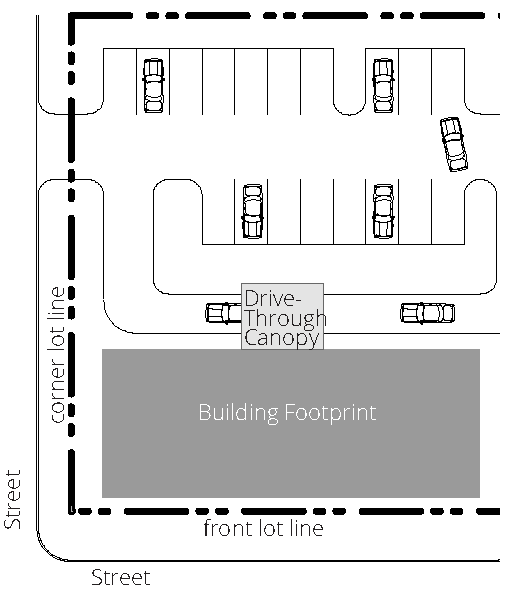
(Amend. of 12-13-2022; Amend. of 12-12-2023(2))
3.5.2 - ACCESSORY COMMERCIAL USES
A.
Drive-Through Facility. A type of drive-in establishment related to a Coffee Shop, Eating Place, Financial Depository Institution/Bank, Cannabis Retail, and Laundromat & Dry Cleaning subject to 3.3.5 or to a Drug or Cosmetic Store allowed pursuant to 3.3.4, where part of its retail or service character is dependent on providing a driveway approach or parking spaces for motor vehicles to either serve patrons food or beverage while in the motor vehicle or else intended to permit consumption in the motor vehicle of food or beverage obtained by a patron from such business establishment.
When noted as subject to conditions ("◐") or requires a special permit ("◯") in Figure 3.4 -A Table of Accessory Uses, the following regulations apply:
(1)
Layout. Refer to Figure 3.5-A Drive-Through Facility for one illustration of the following requirements.
(a)
Structure/Canopy. Drive-through structures or canopies shall be located on the rear facade of the building or in the rear of the lot behind the building, where permitted by use. The structure shall not be visible from the front lot line or any primary street.
(b)
Stacking Lanes. Stacking lanes shall be located perpendicular to the front lot line or behind the building.
(c)
Materials. The canopy and structure shall be constructed of the same materials utilized on the building.
(d)
Drive Locations. There shall be a minimum distance of 40 feet between any 2 curb cuts and a minimum distance of 25 feet between any curb cut and the corner of any corner lot which is at the intersection of 2 streets.
(2)
Recommendations. A recommendation in support of the drive-through is required from the director of the department of public works and the chief of police, subject to the conditions of this section. The department of public works shall specifically approve each entrance and exit to any facility.
(3)
Lot Requirements. There shall be a minimum lot area of 15,000 square feet and a minimum lot width of 120 feet;
(4)
Front Yard Landscape. The area between the building line and the front lot line not utilized for driveways shall be landscaped with year-round plantings so as to prohibit parking over the building line.
(5)
Proximity to Residential. The drive-through facility shall not be located directly abutting any lot in a residential district or any lot containing a dwelling.
(6)
Proximity to Schools. The drive-through facility shall not be located within 1,000 feet of a school.
(7)
Proximity to Other Drive-Through Facilities. The drive-through facility shall not be located within 300 feet of another drive-through facility.
(8)
Pedestrian Convenience & Safety. The drive-through facility shall not be located near other uses where the location of such facility would be detrimental to pedestrian convenience or safety.
(9)
Additional Requirements. In addition to these conditions, the commission may require an applicant to modify a site plan to provide for sufficient pedestrian amenities, reduce the negative visual impact, and/or provide better circulation and parking so as to reduce the potential for accidents and the impact the proposed use may have on neighboring development when the director of the department of public works or the chief of police suggests such modifications are desirable. Such modifications to a site plan may include, but are not limited to, additional landscaping and screening, redesign of parking areas, relocation of entrances/exits and curb cuts and the limitation of the size and number of signs.
B.
Incidental Entertainment. Live entertainment provided in establishments whose primary use is not entertainment assembly. The addition of incidental entertainment as defined in this section requires a zoning permit unless specified elsewhere in the regulations. When noted as subject to conditions ("◐") or requires a special permit ("◯") in Figure 3.4-A Table of Accessory Uses the following regulations apply:
1.
Format of Entertainment.
a.
The following entertainment formats are permitted between 10am and 11pm. The hours permitted for these formats may be reduced by the zoning administrator based on the location and context of the subject property and its relationship to surrounding sensitive uses (e.g. residential, education, assembly uses):
i.
Live performances may include live bands, disc jockeys, karaoke, plays/shows and comedians.
ii.
Minor assembly uses accessory to the principal use such as weddings, private gatherings and birthday parties are permitted but are subject to this section's operating hours.
2.
Volume. Incidental entertainment shall be permissible provided that the maximum volume of incidental entertainment, irrespective of the format, shall be limited so as not to extend beyond the boundaries of the premises at any time.
3.
Noise Mitigation Plan. A noise mitigation plan described in 1.3.3.B.(16)(b) is required.
C.
Kitchen. The rental of commercial kitchen facilities to third parties shall be a permitted accessory use, where the commercial kitchen is already permitted as either a principal or accessory use and is also in use by the property owner or his or her designee.
D.
Outdoor Cafe. Tables and chairs for patrons of any use where food and beverages are served located outdoors. When noted as subject to conditions ("◐") or requires a special permit ("◯") in Figure 3.2 -A Table of Principal Uses, the following regulations apply:
(1)
General Location. The following requirements apply to all outdoor cafes, unless otherwise noted:
(a)
Outdoor Cafes may be located anywhere on the lot, or on the adjacent right-of-way, provided that, if it is located in the right of way, a minimum of 5 feet of sidewalk shall remain available and obstacle-free for passing pedestrians.
(b)
Outdoor cafes are not subject to building line requirements or front yard or corner side setbacks.
(c)
Outdoor cafes associated with eating places shall be subject to administrative approval by the zoning administrator. Outdoor cafes associated with drinking places shall be subject to special permit review by the commission.
(d)
Notwithstanding anything to the contrary in these regulations, the outdoor café shall be located directly adjacent to the principal use, on an adjacent zoning lot pursuant to 3.5.2.(1)(e), or in all or part of a parking lot previously associated with the use, which may be separated from the principal use by a pedestrian path, pavement, or landscaped area.
(e)
Notwithstanding anything to the contrary in these regulations, outdoor café space may be shared among adjacent users, provided that written permission of the property owner agreeing to such shared use shall be provided to the planning department as part of the application.
(2)
Maximum Size. The total area occupied by the outdoor café shall be determined after the zoning administrator or the commission, as applicable, takes into consideration the nature, width, and use of any public right of way proposed to be occupied, harmony with and likely noise and nuisance impacts on the surrounding neighborhood, the suitability of the proposed location for outdoor seating, and other health and safety factors.
(3)
Enclosure. The outdoor cafe shall be enclosed by a fence with a minimum height 30 inches and a maximum of 42 inches. All construction in the right-of-way shall be fully removable during the off-season or when the outdoor cafe is not in use. No chain link fencing, plastic fencing, or other material not durable enough to endure the season shall be utilized. Steel or colored PVC, wood, or planters may be used. For outdoor seating areas of eight chairs or fewer, the preceding enclosure requirements may be waived by the zoning administrator or commission, as applicable, upon a determination that an enclosure may cause undue interference with the public right-of-way or is unnecessary because of site conditions.
(4)
Cover. The outdoor cafe may have a covering or overhead enclosure and shall be open-air.
(5)
COVID. Any Outdoor Cafe that has not been the subject of a zoning enforcement action or nuisance activity report, which is operating with a permit issued pursuant the 2020 Gubernatorial Executive Order 7MM, shall be permitted to operate until December 1, 2021, provided that such extension shall not be interpreted to create any nonconforming right, and further provided that the operation of the Outdoor Café between the date of the suspension of the State's declared state of emergency and December 1, 2021, shall be deemed to be a complete and total waiver of any claim of nonconforming rights under any local, state, or federal legal authority.
E.
Outdoor Display. The outdoor display of merchandise or other items offered for sale or advertisement. When noted as subject to conditions ("◐") or requires a special permit ("◯") in Figure 3.2 -A Table of Principal Uses, the following regulations apply:
(1)
Outdoor displays must extend at least 5 feet from the building façade, but in no instance shall merchandise or other items for sale or advertisement be located beyond an established street line. In the case of street lines and building lines being coincident, there shall be no outdoor display unless permission has been granted by the department of public works and all necessary permits have been obtained;
(2)
Merchandise or other items displayed as the accessory use shall be restricted to those items or merchandise which are sold at the principal use;
(3)
If associated with a principal use on a corner lot, only a single frontage shall be utilized for accessory outdoor display purposes;
(4)
Merchandise or other items, and all temporary structures used for outdoor display, shall be removed and stored indoors from dusk to dawn;
(5)
Notwithstanding any provision of this section, the public way, street, sidewalk, curb, and all means of ingress and egress to the structure containing the principal use shall be maintained free of obstructions, merchandise or other items. A minimum of 4 feet of sidewalk shall remain available and obstacle-free for passing pedestrians.
(6)
Any Outdoor Display that has not been the subject of a zoning enforcement action or nuisance activity report, which is operating with a permit issued pursuant the 2020 Gubernatorial Executive Order 7MM, shall be permitted to operate until December 1, 2021, provided that such extension shall not be interpreted to create any nonconforming right, and further provided that the operation of the Outdoor Display between the date of the suspension of the State's declared state of emergency and December 1, 2021, shall be deemed to be a complete and total waiver of any claim of nonconforming rights under any local, state, or federal legal authority.
F.
Outdoor Storage. Permanent outdoor storage of goods not typically housed or sold indoors, such as large scale materials and building and landscape supplies. When noted as subject to conditions ("◐") or requires a special permit ("◯") in Figure 3.2 -A Table of Principal Uses, the following regulations apply:
(1)
Outdoor storage areas shall be located in the rear or side yard of the lot.
(2)
Loose materials shall not be stacked higher than 6 feet.
(3)
Loose materials shall at a minimum be stored in a 3-sided shelter and shall be covered.
(4)
Materials shall be set back a minimum of 5 feet from any lot line.
(5)
All outdoor storage areas shall be screened from view of adjacent parcels and street rights-of-way using the heavy side or rear buffer, refer to 6.9.2 Side & Rear Buffer Requirements.
G.
Parking. Parking as an accessory use in conjunction with an adjacent principal building on the lot; a principal building on the lot and nearby buildings; or multiple buildings on one or more lots within a Campus Overlay. Does not include parking for one-unit, 2-unit, and 3-unit dwellings.
(1)
Parking Lot. A parking lot is a paved surface used solely for the parking of vehicles. A parking lot may be uncovered or covered by a solar parking lot canopy per 4.20.6 C. Parking lot locations are regulated by building type. Refer to 4.0 Building Types.
(2)
Parking Structure. A structure with 2 or more stories containing decked parking, which may or may not be enclosed. Parking structures within buildings are regulated per building type. Refer to 4.0 Building Types. Separate accessory parking structures are regulated in 4.20.3 D. Accessory Parking Structure, with the yard location set by the building type. While the parking use may be permitted in a particular district on Figure 3.4 -A Table of Accessory Uses, whether the structure is permitted is defined in Figure 4.20-A Accessory Structure Table.
(3)
When noted as subject to conditions ("◐") or requires a special permit ("◯") in Figure 3.2 -A Table of Principal Uses, the following regulations apply:
(a)
Parking Lots in Public Parks. New parking lots may be permitted in public parks named in 3.3.3 D.(5) through a special permit application, which shall be referred to the department of public works and the city advisory commission on parks and recreation for a report of their recommendations at least 30 days prior to the date assigned for a public hearing. Such recommendations, if any, shall be publicly read and incorporated into the records of any public hearings held thereon.
(b)
Parking Lots in Private Parks. New parking lots may be permitted in private parks in accordance with special permit or site plan review, as applicable.
(4)
Drive-in Theater. For the duration of the State's declared state of emergency, an outdoor drive-in theater shall be allowed as a temporary accessory or principal use, pursuant to site plan review by the zoning administrator, provided that any outdoor drive-in theater that has not been the subject of a zoning enforcement action or nuisance activity report, which is operating with a permit issued pursuant to this section, shall be permitted to operate until December 1, 2021, provided that such extension shall not be interpreted to create any nonconforming right, and further provided that the operation of the outdoor drive-in theater between the date of the suspension of the State's declared state of emergency and December 1, 2021, shall be deemed to be a complete and total waiver of any claim of nonconforming rights under any local, state, or federal legal authority.
(Amend. of 3-23-2020(1); Amend. of 12-13-2022; Amend. of 1-10-2023)
3.6.1 - TEMPORARY USES: GENERAL PROVISIONS
A.
Voting Place. The provisions of these regulations shall be so construed as not to interfere with the temporary use of any premises as a voting place in connection with a municipal, state or federal election, or primary.
3.6.2 - TABLE OF TEMPORARY USES
Figure 3.6-A Table of Allowed Temporary Uses presents a listing of expressly allowed temporary uses. Each of the listed temporary uses is given the following designation:
Permitted Subject to Conditions ("◐"). These temporary uses are permitted by right in the districts in which they are listed, provided that they comply with the use-specific conditions of 3.7 Temporary Use Definitions & Use-specific conditions.
Figure 3.6-A Table of Temporary Uses
***Expand table to lock table headings in place while scrolling***
3.7.1 - TEMPORARY OUTDOOR EVENT
A temporary event such as a carnival, circus, street celebration, race, bazaar, market or other similar outdoor event. Such events may be on a street, open space, or other public space in which public access is wholly or partially restricted. The event may include the sale of goods.
A.
Speeches & Political Events. This temporary use is not intended to include public speeches, political rallies, political marches, protests, demonstrations or similar events.
B.
Use-Specific Conditions. When noted as subject to conditions ("◐") in Figure 3.6-A Table of Temporary Uses, the following regulations apply:
(1)
Proof of permission for use of the subject property must be obtained from the owner, or other person with authority to grant same, and be submitted to the zoning administrator;
(2)
The temporary outdoor event is of a temporary nature;
(3)
The temporary outdoor event does not operate nightly beyond the hour of 11:00 p.m.;
(4)
The temporary outdoor event shall be operated in accordance with all applicable statutes, ordinances and regulations of the state and the city, and shall have obtained and submitted to the zoning administrator any permits, certificates, permissions, licenses, and authorizations required;
(5)
Proper insurance, protecting the city and being evidenced by an insurance certificate, approved by the city's risk manager, shall be submitted to the zoning administrator;
(6)
The director of licenses and inspections may issue permits for specific festivals and events, pursuant to the municipal code, provided that such permits shall only be issued if consistent with these regulations, and consistent with any commission decisions regarding the appropriate uses of land.
(7)
Temporary Outdoor Events in the OS District. For temporary outdoor events in the OS district, the following additional provisions shall apply:
(a)
A deposit or bond benefitting the city, in an amount and form determined by the director of the department of public works, shall be tendered by the applicant to the department of development services, and shall be forfeited by the applicant to the department of development services in the event of any damage to any property or person in and around the site of the festival or event during the operation thereof, provided that whether the deposit or bond is forfeited, and the amount of deposit or bond that is forfeited, shall be in the sole discretion of the director of the department of public works.
(b)
The commission hereby delegates its authority to determine whether specific festivals and events in the OS district are appropriate uses of land to the park superintendent in the department of public works. In making decisions regarding such uses of land in the OS district, the park superintendent shall consider:
(i)
the impact of the proposed activities on existing furniture, lighting fixtures, historic and monument sites, sculptures, artwork, pathways, trees, shrubs, grasses, other landscaping, watersheds, watercourses, inland wetlands, and the environment generally;
(ii)
runoff;
(iii)
sewage and solid waste management plans of the applicant; suitability of the proposed site for the proposed activities;
(iv)
the financial capability and experience of the applicant in managing an event of the proposed nature and scale;
(v)
the need for street closures or other impacts on any public rights of way;
(vi)
public safety;
(vii)
parking;
(viii)
fencing materials and the impact thereof;
(ix)
and the adequate provision of lighting, drinking water, essential services, and connections to public utilities.
(c)
The park superintendent shall base his or her approval of such uses, and any conditions thereon, on careful consideration of each of the preceding matters and in no event shall approve a use that:
(i)
is likely to cause irreparable harm to physical property, real or personal, natural or artificial, in the OS district;
(ii)
is so poorly planned or managed that significant threats to public safety may occur;
(iii)
will result in environmental hazards; or
(iv)
is being proposed or run by an individual, business entity, non-profit organization, or other group that has in the past violated any aspect of the code, including the noise ordinance, and appears likely to do so again during its involvement in this activity.
(d)
If the park superintendent intends to find a specific festival or event to be an appropriate use of land for property contained within the OS district, he or she must report such an intent to the staff and the chair of the commission prior to any formal approval being given to the applicant for such uses.
(e)
Such an intent to approve is reviewable by the commission and may be rejected if the commission determines that the decision to approve was made in error, if the decision to approve was arbitrary or capricious, or if the park superintendent failed to fully consider the concerns in the preceding subsection or the conditions set forth in these regulations.
(f)
The park superintendent shall be required to submit quarterly reports to the commission regarding the number, attendance, and impact of any activities approved pursuant to this section on the property contained within the OS district.
3.7.2 - FARMERS MARKET
A public market administered by a market manager and held multiple times per year to connect and mutually benefit farmers, communities, and shoppers. When noted as subject to conditions ("◐") in Figure 3.6-A Table of Temporary Uses, the following regulations apply:
A.
Permission. Proof of permission for use of the subject property must be obtained from the owner, or other person with authority to grant same, and be submitted to the zoning administrator.
B.
Time Limit. The farmers' market is of a temporary nature, namely, in operation only one day or 2 days per week.
C.
Minimum Lot Size. A minimum lot area of 100 square feet per stand shall be provided.
D.
Operating Hours. The farmers' market operates between the maximum hours of 8 a.m. and 8 p.m.
E.
Insurance. Proper insurance, protecting the city and being evidenced by an insurance certificate, approved by the city's risk manager, shall be submitted to the zoning administrator.
F.
OS District. For farmers' markets taking place in the OS district, a deposit or bond benefitting the city, in an amount and form determined by the director of the department of public works, shall be tendered by the applicant to the department of development services, and shall be forfeited by the applicant to the department of development services in the event of any damage to any property or person in and around the site of the farmers' market during the operation thereof, provided that whether the deposit or bond is forfeited, and the amount of deposit or bond that is forfeited, shall be in the sole discretion of the director of the department of public works.
G.
Local Vendors. The farmers' markets shall allow as vendors predominantly local farmers, farmers' cooperatives and producers selling any of the following: whole produce; value-added agricultural products such as jams, jellies, and pickles; prepared food; all agricultural and horticultural products including but not limited to whole produce, plants, flowers, meats, dairy products, and other food-related products.
H.
Parking Plan. A parking plan for attendees of the farmers' market shall be provided and approved by the zoning administrator.
3.7.3 - FOOD TRUCK OPERATION.
The operation of one or more food trucks, namely wheeled vehicles from which hot or cold food or beverages are served, on property subject to these zoning regulations. When noted as subject to conditions ("◐") in Figure 3.6-A Table of Temporary Uses, the following regulations apply:
A.
The operation of food trucks is prohibited after 9 p.m., except where express permission, such as permits for operation in the OS district during temporary festivals and events or permits for operation in conjunction with Drinking Places and Craftsman Industrial uses serving alcoholic beverages and Outdoor Markets, have been obtained from the city and state.
B.
A food truck may be operated in the MX district only on property designated as a Campus Overlay or as part of an Outdoor Market.
C.
The operation of food trucks is prohibited after 9 p.m., except where express permission, such as permits for operation in the OS district during temporary festivals and events or permits for operation in conjunction with Drinking Places and Craftsman Industrial uses serving alcoholic beverages, have been obtained from the city and state.
D.
A food truck may be operated in the MX district only on property designated as a Campus Overlay.
E.
A food truck may be operated in the OS district only after the food truck operator obtains any permits, certificates, permissions, licenses, and authorizations required from the state or city.
F.
Lighting, odor control, and queueing for food trucks shall be managed in such a way that no nuisance, including light, smell, noise, and litter nuisances, are created.
(Amend. of 1-10-2023)
3.8.1 - SMOKING PLACES, SMOKE SHOPS, AND RETAIL SALE OF NICOTINE AND TOBACCO PRODUCTS
A.
Purpose: The Commission has determined that there has been a significant recent increase in the number of smoke shops, smoking establishments, and other retail uses that sell tobacco and nicotine products within the city. The proliferation of these uses has raised concerns regarding public health, safety, and welfare, including the encouragement of consumption of products that are addictive and harmful.
Based on this, the Commission has determined that the existing regulatory framework governing these uses warrants a comprehensive review to assess the adequacy and effectiveness with which their impacts are addressed. Accordingly, the establishment of a temporary moratorium is necessary to provide the Commission with sufficient time to evaluate current standards, consider potential amendments, and determine whether updates to the existing framework are appropriate.
During the moratorium period, the Commission may also consult and coordinate with other municipal departments and agencies, including the Hartford Police Department and the Department of Health and Human Services, to ensure that any proposed regulatory changes are informed, balanced, and consistent with broader public health and safety objectives.
B.
Applicability: Moratorium on approvals of new or expansions of existing uses as follows:
1.
Smoke Shops as defined by § 3.3.5 N. of these regulations.
2.
Smoking Places as defined by § 3.3.5 N. of these regulations
3.
Any Convenience Store as defined by § 3.3.4 E. which sells tobacco products.
4.
Any other primary or accessory use which includes the sale or consumption of nicotine, tobacco and/or smoking products or paraphernalia. These products may include but are not limited to tobacco, cigarettes, cigars, smokeless tobacco (chewing tobacco, dip, or nicotine pouches), rolling papers, smoking pipes, bongs, hookahs, e-cigarettes, and vaping devices.
C.
Duration: The moratorium shall be effective for a period of 180 days (6 months) from the effective date set by the Commission and shall automatically expire. Prior to such expiration, the Commission may grant one or more extensions of this timeframe without an additional public hearing provided the total duration does not exceed 2 years as provided for by § 1.3.9.
(Amend. of 4-28-2026(1))

