
Heber City City Zoning Code
18.28 Commercial
Zones
18.28.010 Purpose And Objectives
A. The C-2 commercial zone has been established to facilitate the development of attractive entrances to the City. To reduce the conflict between commercial and residential uses along principal highways and streets adjacent to the central commercial districts and to facilitate the orderly expansion of commercial uses out from the central commercial districts. Incorporating some of the historical architectural styles evident on Main Street is suggested for development in the C-2 zone.
B. The C-3 central commercial zone has been established as a district in which the primary use of the land is for business, a mixture of uses, and community activities. The area covered by this zone is the historical core area encompassing Main Street and adjacent blocks, which acts as the dominant shopping, community gathering place, and financial center for the City and surrounding territory. For this reason, the zone has been located in the central part of the City, where the street pattern makes the variety of uses readily accessible to all parts of the City and surrounding region and where business, shopping, and engaging activities can be carried on with maximum convenience. The C-3 zone is characterized by wide, clean, well-lighted streets and ample pedestrian ways for the convenience and safety of the public. It is the historic core of the City with an historic architectural style and variety that is distinct from the rest of the City.
C. The C-4 general commercial zone has been established as a district in which the primary use of the land is for business, recreation, and hospitality purposes.
18.28.020 Application Requirements
18.28.030 Permitted And Conditional Uses
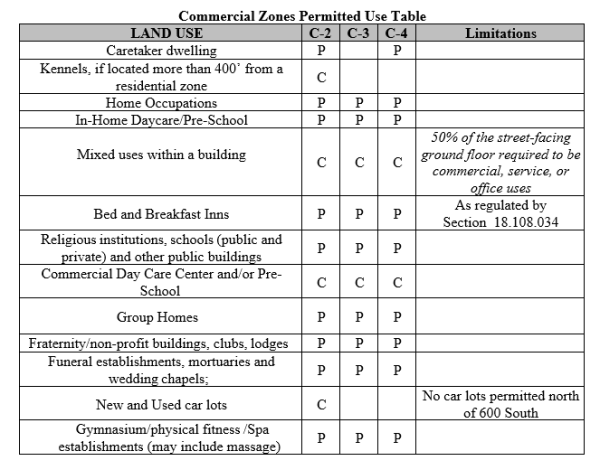
The following chart describes the uses that are appropriate in each commercial zone: A. Symbol definitions: P = PERMITTED USE (P) A site plan application is required with staff processing. Site plan applications are approved when and if they meet the ordinance standards. C = PLANNING COMMISSION CONDITIONAL USE REVIEW (C). A site plan application with Planning Commission review is required. Blank means prohibited.
B. If a use is not specifically designated below, then it is prohibited.
C. All uses listed in the use table that require a building permit shall also require a site plan application.
Commercial Zones Permitted Use Table
| LAND USES | C-2 | C-3 | c-4 | Limitations |
| Arts and arts-related used, including the crafting of products for sale | P | |||
| Caretaker dwelling | P | P | P | |
| Kennels, if located more than 400' from a residential zone | C | |||
| Home Occupations | P | P | P | |
| In-Home Daycare/Pre-School | P | P | P | |
| Mixed uses within a building | C | C | C | The Main Street-facing ground floor is required to be non-residential |
| Bed and Breakfast Inns | P | P | P | As regulated by Section 18.108.034 |
| Religious institutions, schools (public and private) and other public buildings | P | P | P | |
| Commercial Day Care Center and/or Pre-School | C | C | C | |
| Group Homes | P | P | P | |
| Fraternity/non-profit building, clubs, lodges | P | P | P | |
| Funeral establishments, mortuaries, and wedding chapels | P | P | P | |
| New and used car lots | C | No car lots permitted north of 600 South | ||
| Gymnasium/physical fitness/spa establishment (may include massage) | P | P | P | |
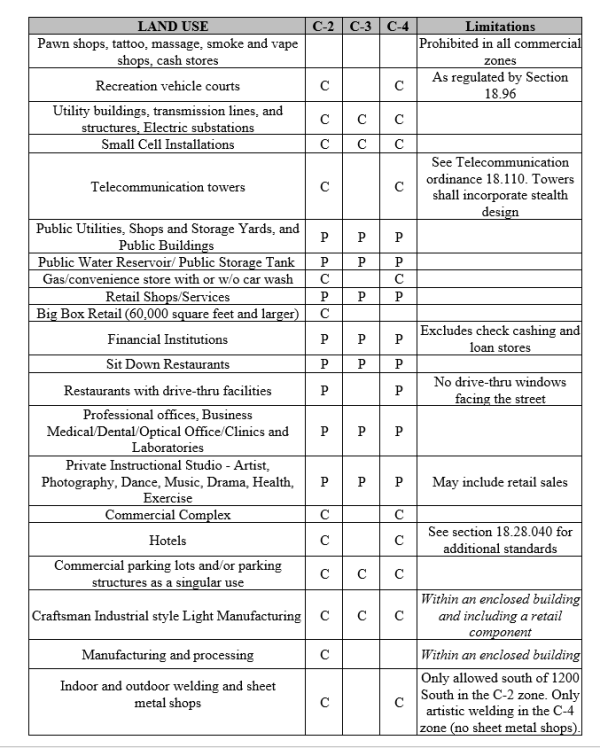
| Pawn shops, massage, smoke and vape shops, cash stores | Prohibited in all commercial zones | |||
| Body Art Facilities | P | P | P | |
| Recreational vehicle courts | C | C | As regulated by section 18.96 | |
| Utility buildings, transmission lines, and structures, electric substations | C | C | C | |
| Small Cell Installations | C | C | C | |
| Telecommunication towers | C | C | See Telecommunication Ordinance 18.110. Towers shall incorporate a stealth design | |
| Public Utilities, Shops and Storage, Yards, and Public Buildings | P | P | P | |
| Public Water Reservoir/Public Storage Tank | P | P | P | |
| Gas/convenience store with or w/o car wash | C | C | ||
| Car Wash | C | |||
| Retail Shops/Services | P | P | P | |
| Big Box Retail (60,000 square feet or larger) | C | |||
| Financial Institutions | P | P | P | Excludes check cashing and loan stores |
| Sit Down Restaurants | P | P | P | |
| Restaurants with drive-thru facilities | P | P | No drive-thru windows facing the street | |
| Professional offices, Business Medical/Dental/Optical Office/Clinics and Laboratories | P | P | P | |
| Private Instructional Studio - Artist, Photography, Dance, Music, Drama, Health, Exercise | P | P | P | May include retail sales |
| Commercial Complex | C | C | ||
| Hotels | C | C | C | See section 18.28.040 for additional standards |
| Commercial parking lots and/or parking structures as a singular use | C | C | C | Not allowed with 100' of Main Street in the C-3 zone |
| Craftsman Industrial style Light Manufacturing | C | C | C | Within an enclosed building and including a retail component |
| Manufacturing and processing | C | Within an enclosed building | ||
| Indoor and outdoor welding and sheet metal shops | C | C | Only allowed south of 1200 South in the C-2 zone. Only artistic welding in the C-4 zone (no sheet metal shops). | |
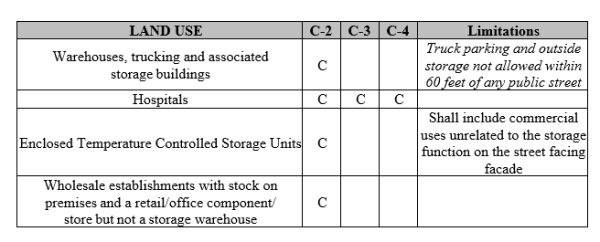
| Warehouses, trucking, and associated storage buildings | C | Truck parking and outside storage are not allowed within 60 feet of any public street. | ||
| Hospitals | C | C | ||
| Enclosed Temperature Controlled Storage Units | C | Shall include commercial uses unrelated to the storage function on the street-facing facade | ||
| Wholesale establishments with stock on-premises and a retail/office component/store, but not a storage warehouse | C | |||
| Attached Residential Developments (3 units and up) | P | Shall not occupy ground floor facing Main Street except for residential entrances and amenities |
Adopted by Ord. 199 §02.0912.02 on 11/6/1973
Amended by Ord. 202 §2 on 3/19/1974
Amended by Ord. 220 on 1/1/1978
Amended by Ord. 89-10 on 12/7/1989
Amended by Ord. 90-12 on 12/20/1990
Amended by Ord. 92-12 on 8/20/1992
Amended by Ord. 98-05 on 5/7/1998
Amended by Ord. 99-23 on 11/18/1999
Amended by Ord. 2012-03 on 4/5/2012
Amended by Ord. 2018-20 on 5/17/2018
Amended by Ord. 2020-20 Amending C-2 Commercial Zone Uses on 4/21/2020
Amended by Ord. 2021-25 on 7/20/2021
Amended by Ord. 2021-09 on 8/3/2021
Amended by Ord. 2022-26 on 10/4/2022
Adopted by Ord. 2023-14 on 3/7/2023
Adopted by Ord. 2024-02 on 3/19/2024
Adopted by Ord. 2025-05 on 6/3/2025
18.28.040 Development Standards
A. In the C-2 and C-4 Commercial Zones, there shall be no area, width, and location requirements except that all buildings and structures in the C-2 and C-4 zones shall conform to the requirements of the adopted Heber City C-2 and C-4 Design Standards and Guidelines. In the C-3 zone, a 0 (zero) foot front setback is required.
B. Dry Utilities (power, communication, gas). In the C-3 Zone where an intentional street wall is required, dry utility placement shall occur in the public Right of Way or through negotiated locations such as an alley or a public utility easements (PUE) on private property. A determination of the best locations for utilities shall occur during the application process with an application requirement for a conceptual utility plan as part of that process. No above ground utilities, especially utility boxes shall be placed in the clear view of an intersection or driveway. Any above ground utilities shall be located in an easement (PUE) behind the front face of the building, and preferably to the rear of the building.
C. Entrances and Windows C-3 Zone. Entrances to the first floor of buildings shall front a public street, plaza or courtyard. Main entrances shall be covered or recessed using angular side walls to create a larger opening into the first-floor use. On double or triple-frontage lots, main doors are required where the greatest amount of pedestrian traffic is anticipated. When facing Main Street or within 100’ of Main Street on a perpendicular street, all windows shall constitute at least 50% of first-floor street-facing facades, and 25 percent of all upper-story street facing facades. First-floor windows shall include transom and bulkhead features to assure historical complementary design. Windows shall be at least 50 percent transparent. Street facing windows that are not on the same façade as the main building entrance, may cover the first-floor windows with non-advertising window films using a mountain (including flora and fauna), mill, orchard, pioneers, agricultural, or mountain-related sports theme. Living screens may replace up to 50% of the window requirement for the lowest anticipated pedestrian traffic frontage. Mirrored windows are not allowed. For residential units, balconies shall be required for at least 50% of the units. In no case shall any balconies have a separation from an opposing balcony of less than 10 feet. Windows above the first floor in the C-3 zone shall conform to the standards described in the sketch in Section F, including sills, windowpanes, and a sash.
D. Building Materials. One or more of the following exterior materials of a durable or resilient nature, such as brick, stone, composite materials, metal accents, or other materials of similar quality, hardiness, and low maintenance characteristics, are required in the C-3 zones. New development in the C-3 zone shall incorporate common, locally found materials such as granite, stone, sandstone, or brick as part of the first floor façade of each building for at least 75% of the first floor, excluding the windows. All stories above the first floor shall incorporate at least 50% of the above specified materials. Stucco and EIFS are prohibited for use as materials on any façade visible from a right-of-way, except if located on an upper floor of a building or on the side or rear façade. Where used they shall be sculpted to resemble brick, and/or sandstone blocks. Other materials may be considered by the Planning Director for soffits or as accents or unique architectural features. Twenty-five-year guarantee architectural shingles or other long-lasting materials are required for sloped roofs.
E. Building Length and Facades. For the C-3 zone, no new street-facing building elevation may exceed 50 feet in length without at least a 3-foot variation in the depth of the façade along the public right of way and a 2-foot variation on other facades. Residential unit balconies shall not be interpreted to meet this requirement. No single building shall exceed 200 feet in length. Where buildings are proposed of that length, a separation between that building and the next building of a minimum of ten feet is required, creating a passageway to interior spaces. Such passageways shall be downward-lighted, provide a safe pedestrian space and include vegetation in boxes every 30 feet of length. At minimum, building facades shall provide pedestrian plazas every 200 feet of building length to break up long building façades along public rights-of-way. Streetside outdoor dining areas may substitute for such plazas. Top floors shall have architectural differentiation from the other floors of the building, and rooflines shall vary at least every 100 feet, at a minimum. For first-floor uses in mixed use buildings, the appearance of small shops/storefronts with variation in the first-floor façade at least every 30 feet is required. If buildings fronting on Main Street include a permanent awning, it shall extend at least 7 feet from the storefront/façade to provide shade and refuge from inclement weather. Awnings shall be cantilevered from the front façade of the building. Such awnings shall be provided in colors that reflect colors incorporated as part of the exterior of the building.
F. Building Design Features. From the sketch below (Figure 1: Anatomy of a Main Street Building), to obtain a permitted use or conditional use permit, choose and incorporate within the building design:
1. C-3 Zone. At least 4 of the historic features, over and above any required features. 2. Storefront, Bulkhead, and Transom Windows are required as per section B above.
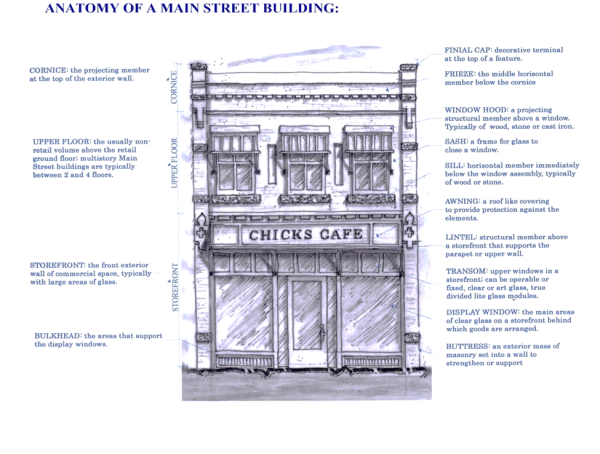
Figure 1 Sketch courtesy of Lane Lythgoe
G. C-3 Zone Adaptive Reuse. There are several existing buildings within the C-3 zone that could be reworked into a new use. The following general requirements are required:
1. If the character of the existing building is deemed historic or historically significant, either by Federal programs or by the Historic Master Plan or by individual application to the City, due to its age (50 plus years minimum) or displays a unique architectural style or unique features, as determined by the Planning Director, then reconstruction shall attempt to retain as much of that character as possible. False facades shall be removed to reveal the original finish materials, which shall be rehabilitated, as per industry best practices for historic buildings. 2. The ground floor facing a public ROW shall encompass retail or restaurant uses to a minimum depth of 20’ 3. The maximum height in the zone may be exceeded by up to 12’ to accommodate architectural features or an additional story. No transitional height requirement is imposed. 4. A change of use to any use allowed in the zone, permitted or conditional, is allowed. Although a change of use may occur, no additional parking is required. 5. Exterior additions shall be reflective of the historical character/style of the original building. 6. All adaptive reuse proposals shall be processed as permitted uses.
H. C-3 Zone Site Furnishings. Each development shall incorporate site furnishings into the site including benches facing Main Street. One additional site furnishing shall be included from this list: a patio/seating area, pedestrian plaza with benches, play areas, kiosk area, water feature, clock tower, sculpture, bike racks, and public art.
I. Private Outdoor Lighting and Outdoor Dining. In the C-3 Zone, lighting for streets and parking lots on the interior of the development is required. All lighting shall be dark sky compliant as required by Chapter 18.78 of Heber City Municipal Code. The applicant shall submit a plan which indicates the type and location of lights in relation to the development and designed for pedestrian/vehicular safety. Pedestrian lighting may include bollards and all lighting shall follow established themes. Outdoor seating and dining may be partially or fully covered to extend the outdoor dining experience through the spring and fall months. Outdoor patio heaters and misters are permitted. Restaurant tables and chairs may be movable or permanent and should be reflected on the site plan. If alcohol is served, the restaurant will need to provide signage and decorative fencing per the health department code. Fencing materials shall be limited to metal picket fencing. Any accommodation for dogs shall be subject to the Wasatch County Health Department regulations. Access Between Uses. In the C-3 zone, vehicular and pedestrian access is required between uses and does not force vehicles/pedestrians out to the adjacent streets.
J. Open Space and Plazas. For residential development in the C-3 zone, that includes residential mixed uses, the open space requirement is 20% of the gross area of the site.
1. This open space requirement shall be fulfilled through rooftops, terraces for general resident use, plazas and pocket parks. The required common open space shall be privately maintained for general use by the residents of the building and/or the public and be usable land areas that are not occupied by buildings, dwellings, structures, parking areas, streets, public park strips, curb-gutter-sidewalk, driveways, or alleys and shall be accessible by all residents of the development. For the purposes of this Chapter, gross site area is defined as the total area of the development excluding anything in the public right of way. For development or redevelopment involving sites that are one acre in size or greater, at least 40 percent of required open space must be in the form of a plaza that is located at the front, corner or side of the building along a street, and open and accessible to the public at all times. The following requirements must be met:
a. At least 50% of the plaza’s perimeter that does not front on vehicular right-of-way shall be lined by building frontages. b. Fully enclosed permanent structures are not permitted. c. Playgrounds are not permitted. d. Minimum pervious surface = 30% e. Must include seating, shade structures, and one tree (2-inch caliper minimum) per 800 sf of plaza area f. Special features such as fountains and for sale public art installations are encouraged. Active features, that give visitors something to do, shall be incorporated into the plaza.
2. On-site open space/park substitution. In-lieu Substitutions in the C-3 zone. The open space/park requirement may be modified through potential substitutions for any development within the C-3 zone. Such in-lieu substitutions are intended to enhance existing parks with features or improve park land. The three parks on Main Street and the regional facilities near 600 West are the signature open spaces in the Central Heber area and are a benefit to all development in the area. In-lieu substitutions are encouraged for the benefit of the Main Street parks and 600 West parks by application to the City Council or City Manager, under the following circumstances:
3. Cash in-lieu. The City may determine that in certain situations, accepting cash as an in-lieu substitution, where it can be shown that acceptance of those funds, is more effective by creating park improvements as opposed to smaller on-site private parks. Cash in-lieu payments shall not be accepted without a qualified appraisal process, managed by the City. The City shall be obligated, in a timely manner, to use the in-lieu funds within the C-3 zone for land purchases, open space, pedestrian system enhancements, the daylighting of streams, and/or traditional park related improvements.
4. Any land which has been already dedicated, set aside, platted, or otherwise approved as park or open space, may not be substituted or used for any purpose other than those allowed by this chapter.
5. In-lieu substitutions shall be reviewed by the City Council and/or City Manager, through an application, however, final approval of the in-lieu substitution rests with the City Council. Such approvals shall occur as part of an MDA, or prior to issuance of Final Site Plan approval or a building permit.
K. Where buildings are located on a corner in the C-3 zone that addresses Main Street, a corner plaza creating a 10’ by 10’ triangle outside but adjacent to the ROW is required. Such plazas shall include street furniture that allows for seating, as a minimum.
L. In the C-3 zone, height shall be a maximum of three stories without a stepback (see Figure 2), and shall not exceed 46 feet.
M. In the C-3 zone, buildings over two stories shall include stepbacks (see Figure 2) between the second and third stories when adjacent to publicly owned properties.
N. In the areas on the west side of 100 West and the east side of 100 East, no building shall be taller than three stories.
O. In the C-2, C-3 and C-4 zones, height may be increased to 4 stories, not to exceed 55 feet if all of the following standards are met:
1. The application includes at least 10% percent affordable housing, available to persons at 60% of the current County Average Median Income (AMI) or below that threshold. 2. If it is a mixed-use building. 3. If the building design includes a stepback of a least ten feet between the second and third stories (see Figure 2).
P. In the C-2 zone, buildings may be increased to 5 stories with a stepback (see Figure 2) included and affordable housing is included.
Q. Any use on a parcel larger than 1 acre in a C-3 or C-4 zone or any use with a building footprint larger than 30,000 square feet, shall become a conditional use.
R. Any use on a parcel larger than 5 acres and any use with a building footprint larger than 60,000 square feet in the C-2 zone shall become a conditional use.
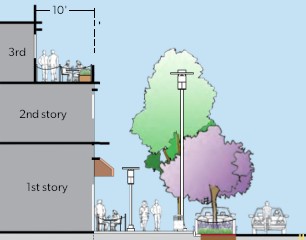
Figure 2: Building Stepback
18.28.050 Additional Regulations
The following provisions apply within the Commercial Zones
A. For buildings within the C-2 and C-4 zone, a strip of land at least fifteen feet in width adjacent to all public streets shall be landscaped as set forth in Chapter 18.76 of this title except for permitted driveways, except as required by the Heber City C-2 and C-4 Zone Design Standards and Guidelines.
B. No dust, odors, smoke, vibration or intermittent light, glare or noise shall be emitted which is discernible beyond the premises except for normal traffic movement.
C. Storage of all merchandise, material and products shall be carried on within a building or within an area enclosed with a sight-obscuring fence or wall except for licensed vehicles in running order.
D. All off-street parking shall be hard-surfaced as regulated by Chapter 18.72, except within the C-3 zone where some parking requirements have been reduced.
E. All buildings located adjacent to major streets shall have at least one entrance way facing onto said street.
F. Sale material may be displayed on business premises during normal working hours.
G. See 18.76.050 for building setbacks adjacent to residential use.
18.28.060 Gross Floor Area Of Buildings Limitations For Retail Business
A. C-2 Zone. No floor area limitation.
B. C-3 Zone. Retail establishments shall not exceed 60,000 square feet of gross first floor area, considered the building footprint, within the C-3 Zone. As per section 18.28.040 (4), all buildings in the C-3 zone that exceed a 30,000 square foot footprint, be a conditional use
C. C-4 Zone. No floor area limitation.
18.28.070 Gasoline Pump Island Locations And Lighting
Gasoline pump islands shall be set back from any right-of-way line to accommodate the landscape setback and proper circulation/stacking for the pumps. Each pump shall provide stacking for a minimum of two standard sized vehicles defined as 20’ for each. A circulation aisle beyond the stacking area is required that allows for a circular traffic movement. Pump islands shall be so located that automobiles stopped for service will not extend over the property line. In no case shall pumps be set closer than twelve feet from any street lines, nor closer than ten feet from any side or rear property line. Lots from which gasoline is dispensed to customers at retail shall be not less than seventy-five by one hundred feet in size. Canopies over pump islands may extend to the closest edge of any required landscaping. Any above ground fuel tanks such as propane tanks shall be located with a minimum setback from the ROW as per the IBC or 30’ whichever is greater. See the Lighting Chapter 18.78, for lighting standards.

