
Heber City City Zoning Code
18.72 Off-Street
Parking And Loading
18.72.010 Purpose Of Provisions
The following regulations are established to:
A. Increase safety and lessen congestion in the public streets; B. To provide adequately for parking needs associated with the development of land and increased automobile usage, to set standards for off-street parking according to the amount of traffic generated by each use, and to reduce the on-street storage of vehicles.
18.72.020 Parking Space Requirements -- Computation
For the purpose of computing off-street parking spaces which are required by this title, the following rules shall apply:
A. "Floor area" means gross floor area, unless otherwise specified for a particular use; net floor area means the area of a building excluding the width of exterior walls, stairwells, elevators, hallways, closets, restrooms and storage areas. B. In stadiums, sports arenas, churches and other places of assembly in which benches or pews are used in place of seats, each eighteen inches of length of such benches or pews shall be counted as one seat.
18.72.030 Parking Space Requirements -- Designated
A. The following required off-street parking spaces for the particular use are minimum requirements:
1. Auditoriums, sports arenas and places of assembly shall have one parking space per two people; 2. Banks, professional offices, retail stores, personal service shops, medical clinics and other business buildings not specifically mentioned elsewhere in this section shall have four parking stalls per 1,000 square feet of net floor area; 3. Boardinghouses shall have one parking space for each one hundred square feet of floor space devoted to bedrooms or one space for each two persons domiciled in the premises, whichever is greater; 4. Bowling Alleys shall have four (4) parking stalls per lane. 5. Churches shall have one parking space per three seating spaces in the main assembly room; 6. Commercial recreational uses shall have one parking space per two patrons, based on the design capacity of the facility; 7. Convalescent, nursing and other institutions shall have one visitor parking space per three patient beds, plus one parking space for each employee at work in the home during daylight hours; 8. Day Care facilities shall have one (1) parking space for each employee plus one (1) loading/unloading space for every 20 people, or portion thereof enrolled. Loading space requirement may be eliminated if there is a circular drive-way. 9. Drive-ins (retail) shall have at least twelve off-street parking spaces or sufficient off-street parking spaces to accommodate all patrons or customers, whichever is greater. No patron or customer may be served in automobiles which are parked on public streets; 10. Government buildings shall provide at least three (3) parking stalls per 1,000 square feet of floor area; 11. Grocery stores shall have at least 1 parking stall per 300 square feet of net floor area; 12. Hospitals shall have one visitor parking space per two patient beds, plus one parking space for each employee at work in the hospital during daylight hours; 13. Hotels and motels shall have one parking space per room or suite, plus one parking space for each employee at work on the premises during daylight hours; 14. Industrial, manufacturing and wholesale establishments shall have one parking space per two employees based. on the largest shift; 15. Mortuaries or funeral parlors shall have thirty parking spaces or one space for each twenty-five square feet of floor space in all assembly rooms, whichever is greater; 16. Parks shall have parking as follows:
a. As each park is designed, an evaluation of parking demand based on size, functions and features of the park, available on street parking within two blocks, and opportunities for shared parking with adjacent uses and such uses within two blocks, is to be completed by the park designers and coordinated with City staff. When considering complex parks with many functions, it is anticipated that on-site parking will not meet the entire demand of the combined functions for peak time periods. In parks with more than three functions, an overall reduction of 30% of the additive parking demands for each function is recommended. As the park is designed, any parking recommendations shall supersede the recommendations in number D. below. b. Local parks smaller than 2 acres shall be considered “walkable” parks and are not required to have parking, however, on-street parking for 8 vehicles shall be available within two blocks. c. Park parking shall be reviewed by the Parks Department using their experience with existing parks and may recommend different parking standards. d. Parking demand shall be evaluated by function using the general recommended standards:
1) Pavilion – 1/5 of seating capacity 2) Play Structure – based on an estimate of use/capacity, 1 space for every 5 users 3) Picnic Area - one space for every two tables 4) Baseball/Softball Field – 10 per diamond 5) Passive Lawn area – 3 per acre 6) Multi-sport field (soccer lacrosse, rugby, etc.) – 12 per field 7) Tennis/pickle ball courts - 2 per court 8) Outdoor Basketball/sport court – 2 per court 9) Recreation/Community Center – based on seating, interior functions, and square footage 10) Trail Head – five spaces 11) Amphitheater – based on 1/4 of seating capacity 12) Dog park – 4 per acre
17. Private clubs and lodge halls shall have one parking space per two persons based on the design capacity of the facility; 18. Residential structures, not including boardinghouses and rooming houses shall have parking spaces per dwelling units as follows:
a. One-family dwellings, including townhomes, detached single family dwellings and semi-detached single family dwellings and mobile homes, two spaces per dwelling unit; b. Multiple-family dwellings, two spaces per dwelling unit, which spaces shall be located on the side yards or rear yard or said lot. As a means of encouraging the occupants of multiple dwellings to use the required off-street parking space in preference to on-street parking space, entrances to buildings containing multiple dwellings shall be provided in locations that are as direct and convenient to the required off-street parking spaces as are the fronting streets;
19. Restaurants, taverns and lounges shall have one parking space per two hundred square feet of net floor area; 20. Theaters shall have one parking space per four seats; 21. Uses Not Mentioned. The required off-street parking for any building, structure or use of land of a type not listed in this section shall be determined by the board of adjustment. The board of adjustment shall be guided by comparison with the requirements for similar uses which are listed; 22. Designated Mixed Use Village Center Parking Requirements.
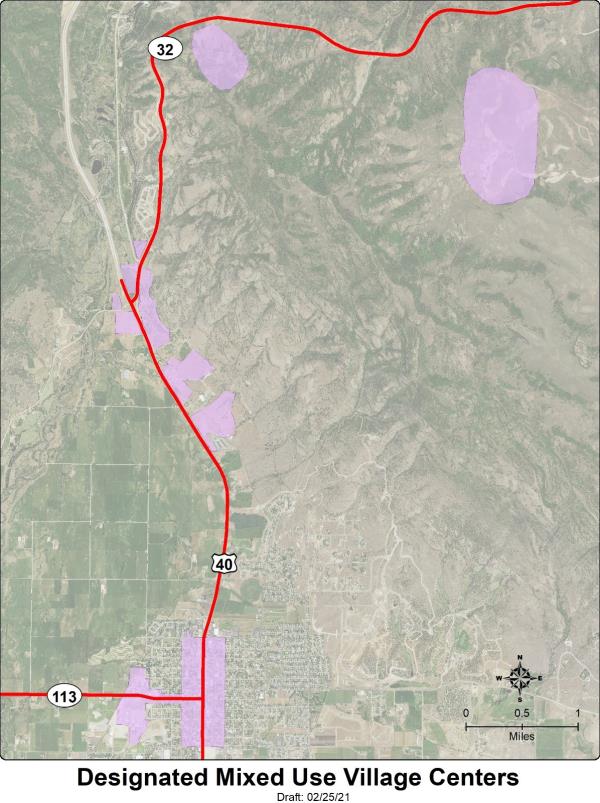
a. Designated Mixed Use Village Centers are shown on the map below.
Mixed Use Village Centers
b. Designated Mixed Use Village Center Parking requirements for retail, office, restaurant and government uses is 3 parking stalls per 1,000 square feet.
c. Designated Mixed Use Village Center Parking requirements for multi-family residential units (condominiums and apartments) is as follows:
| Unit Type | Parking Space Requirements | Notes |
| Studio Units | 1.0 space per unit | 25% of Parking stalls may be compact spaces |
| One Bedroom Units | 1.25 spaces per unit | " " |
| Two Bedroom Units | 1.5 spaces per unit | " " |
| Three Bedroom Units | 2.0 spaces per unit | " " |
| Four Bedroom Units | 2.0 spaces per unit | " " |
| Guest/visitor Parking | 0.25 spaces per unit | " " |
d. When there is insufficient area to provide the required number of off-street parking stalls for a property within a Mixed Use Village Center, the property owner may pay a fee-in-lieu to the Parking Authority in an amount equivalent to the value of the required parking stalls when approved by the City Council.
23. One-half (1/2) of available angled on-street parking along a parcel's frontage may be counted towards the requirements for meeting the off-street parking requirements for uses within a designated Mixed Use Village Center. 24. Street improvements shall include angled parking for those streets identified as having angled parking on the City’s Master Plan or Zoning Ordinance;
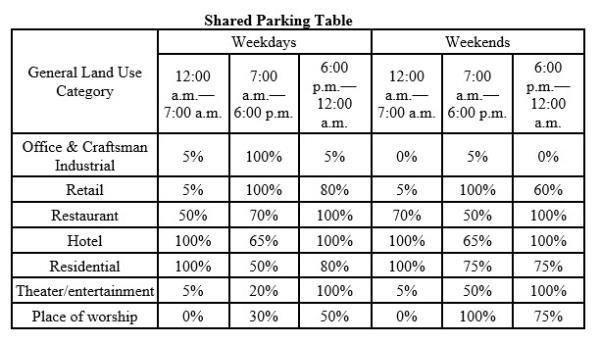
B. Shared Parking. In determining the total requirements for shared parking facilities, the Planning Director or designee shall use the Shared Parking Table below, according to the following guidelines:
1. For each applicable general land use category, calculate the number of spaces required for a use as if it were the only use (refer to the schedule of minimum off-street parking requirements above). 2. Use the figures for each individual land use to calculate the number of spaces required for that use for each time period specified in the table (six time periods per use). 3. For each time period, add the number of spaces required for all applicable land uses to obtain a grand total for each of the six time periods. 4. Select the time period with the highest total parking requirement and use that as the total number of parking spaces required for the site on a shared parking basis. 5. If a new use is proposed for a building or portion of a building, the shared parking analysis shall be re-evaluated and additional parking provided, if shown as necessary.
C. For uses not listed in Table 18.72 (1), the Planning Director shall determine the required parking for the six time periods.
 D. Parking Lot Landscaping: For every third parking aisle, one (1) raised six (6) foot wide landscaped parking island with trees, bounded with slotted high back curb with defined openings to allow for runoff shall be provided, thereby creating separated parking areas to aid in safe and orderly use of the lot and confine vehicular movement to marked drives. Raised or curved circulation islands of at least eight (8) foot width and planted with trees shall be constructed at the ends of the rows of parking spaces at locations where circulation drives intersect, and for every 20 parking spaces. Parking lots shall be bounded with a high back curb that includes openings for stormwater runoff. Paved areas and parking lots shall be separated from buildings with a minimum four foot (4’) wide landscape area bounded with a slotted high back curb or a five foot (5’) raised sidewalk.
E. Street and Parking Lot Lighting: Parking lot lighting shall be mounted on black poles, and be dark sky compliant. Parking lots with less than 3 aisles may alternatively light the parking lot with lighting attached to the building. In no case shall the poles exceed 16 feet in height. Lighting shall be directed to avoid intrusion on adjacent residential properties and away from adjacent thoroughfares and shall be downward directed and fully shielded.
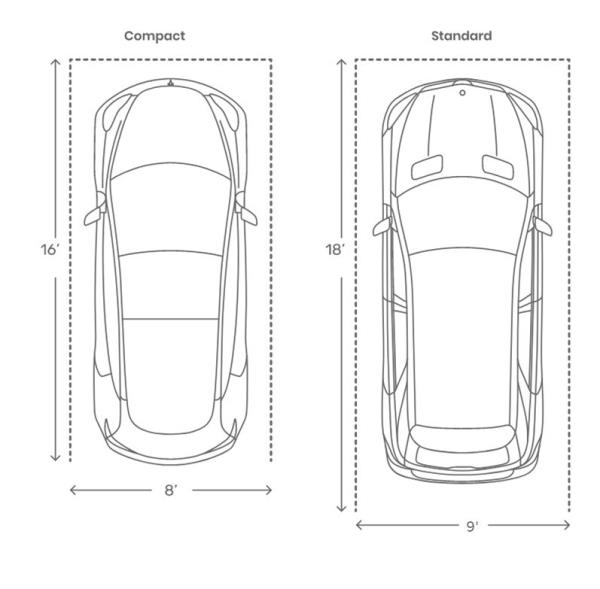
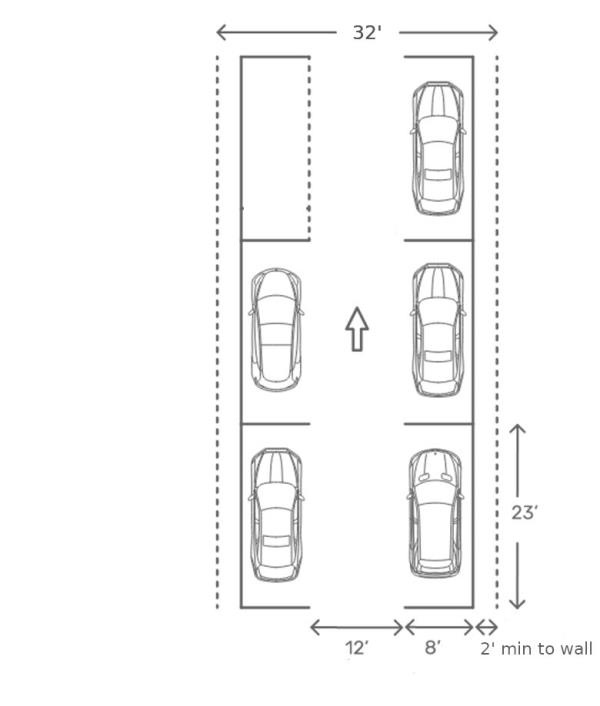
F. Parking Stall Size. Each off-street parking space shall be at least 9 feet by 18 feet for diagonal or ninety-degree spaces, or 8 feet by 23 feet for parallel spaces, exclusive of access drives or aisles. Compact parking stalls shall be a minimum of 8 feet by 16 feet for diagonal or ninety-degree spaces, or 8 feet by 21 feet for parallel spaces, exclusive of access drives or aisles. Parking stalls adjacent to a column or wall must have an additional 2 feet of width to accommodate ingress/egress from the vehicle. Access to parking spaces shall be from private roadways and not from public streets. The Planning Director or designee may consider modifications to stall width and length requirements for up to 15% of the stall dimensions.
D. Parking Lot Landscaping: For every third parking aisle, one (1) raised six (6) foot wide landscaped parking island with trees, bounded with slotted high back curb with defined openings to allow for runoff shall be provided, thereby creating separated parking areas to aid in safe and orderly use of the lot and confine vehicular movement to marked drives. Raised or curved circulation islands of at least eight (8) foot width and planted with trees shall be constructed at the ends of the rows of parking spaces at locations where circulation drives intersect, and for every 20 parking spaces. Parking lots shall be bounded with a high back curb that includes openings for stormwater runoff. Paved areas and parking lots shall be separated from buildings with a minimum four foot (4’) wide landscape area bounded with a slotted high back curb or a five foot (5’) raised sidewalk.
E. Street and Parking Lot Lighting: Parking lot lighting shall be mounted on black poles, and be dark sky compliant. Parking lots with less than 3 aisles may alternatively light the parking lot with lighting attached to the building. In no case shall the poles exceed 16 feet in height. Lighting shall be directed to avoid intrusion on adjacent residential properties and away from adjacent thoroughfares and shall be downward directed and fully shielded.
F. Parking Stall Size. Each off-street parking space shall be at least 9 feet by 18 feet for diagonal or ninety-degree spaces, or 8 feet by 23 feet for parallel spaces, exclusive of access drives or aisles. Compact parking stalls shall be a minimum of 8 feet by 16 feet for diagonal or ninety-degree spaces, or 8 feet by 21 feet for parallel spaces, exclusive of access drives or aisles. Parking stalls adjacent to a column or wall must have an additional 2 feet of width to accommodate ingress/egress from the vehicle. Access to parking spaces shall be from private roadways and not from public streets. The Planning Director or designee may consider modifications to stall width and length requirements for up to 15% of the stall dimensions.
1. Standard and Compact Parking Stalls
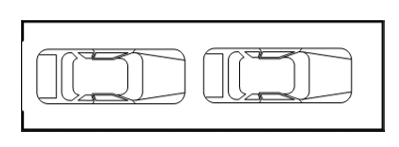
G. Parking Lot Locations and buffering from the street. Parking lots shall be separated from the right-of-way property line with a minimum width 6’ landscaped area, unless the zoning ordinance requires a larger separation elsewhere. Such landscaping shall include trees and shrubs to minimize the visual impact of the vehicles. Such areas shall accommodate stormwater, but without a depression greater than 1 foot. H. Snow Storage. Sufficient area shall be provided adjacent to uncovered parking lots for snow storage as recommended by the design engineer. I. Tandem Parking. Tandem parking stall placement is not permitted for required parking stalls. Example of Tandem Parking shown in diagram below.
J. Garage Door Setback. Garage doors facing a public right of way shall be setback at least 22 feet from a public right of way property line, unless a larger setback is required elsewhere in the zoning ordinance.
18.72.040 Parking Space Requirements -- Location And Control
A. The off-street parking facilities required by this chapter shall be located on the same lot or parcel of land as the use they are intended to serve, except within designated Mixed Use Village Centers when approved by the Planning Commission, or where a Parking Authority has a policy providing off-street parking for an area. Any required parking stalls provided off-site shall be located within ¼ mile of the property they are intended to serve. B. Individual stalls shall not be directly accessed from the street, unless approved by the Planning Commission when it can be shown that such allowance:
1. Results in a decrease in the overall hard surface area; 2. Makes more efficient use of the right of way and private land; 3. Protects a landscaped area; 4. Provides at least the number of parking stalls required by this parking ordinance; 5. Results in a safe traffic movement as determined by the City Engineer; and 6. Is not located along an Arterial or Collector Street as designated on the City’s Master Transportation Plan.
18.72.050 Parking Space Requirements -- Combined Parking Area
The required off-street parking and loading facilities may be provided collectively for two or more buildings or uses, provided that the total number of parking spaces shall generally be the sum of the requirements for each of the individual uses, unless modified by the shared parking table above.
18.72.060 Parking Space Requirements -- Mixed Uses
In the event that two or more uses occupy the same zoning lot or parcel, if land, the total requirements for off-street parking and off-street loading space shall be the sum of the requirements of the various uses computed separately, but shall use the shared parking table above for a final calculation.
18.72.070 Access To Parking Facilities
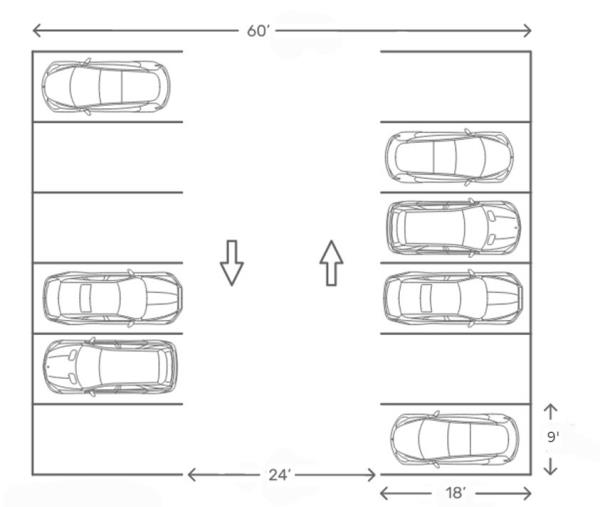
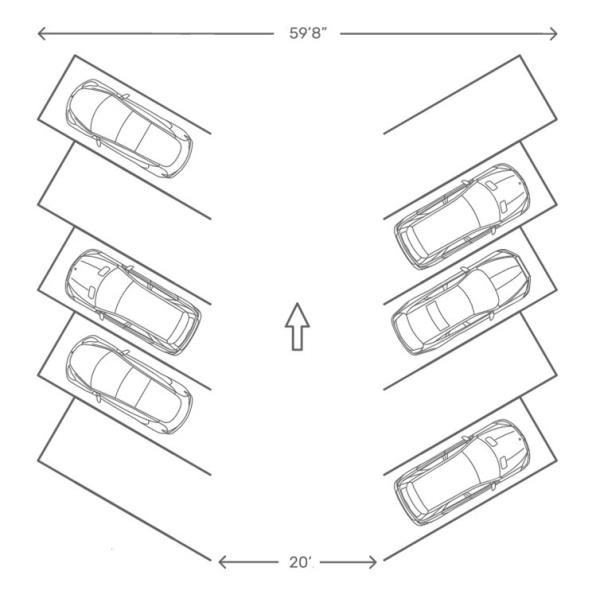
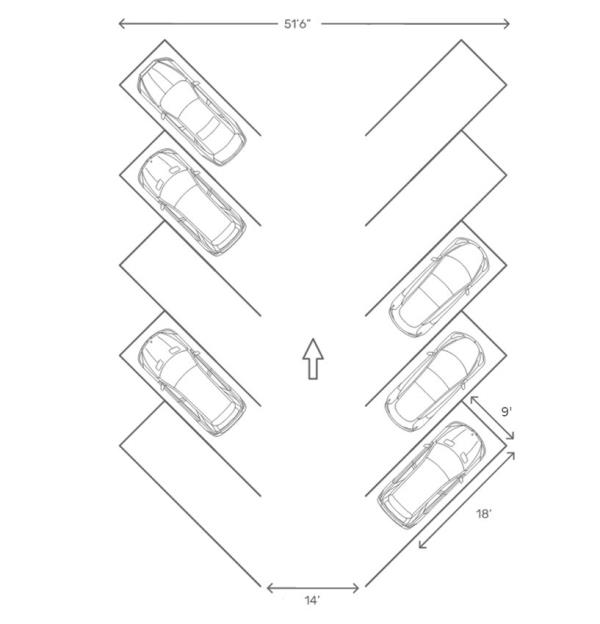
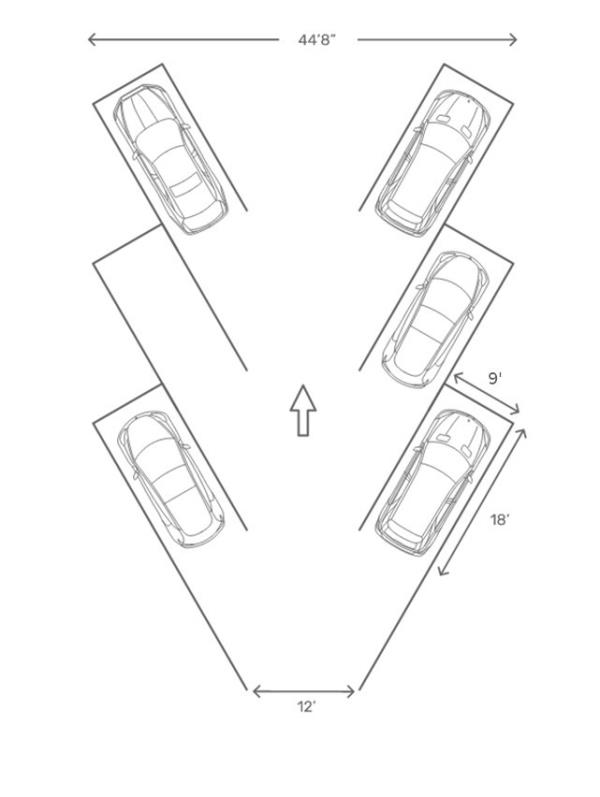
Access driveways shall be provided for ingress to and egress from all parking and loading facilities. Each parking and loading space shall be easily accessible to the intended use. Driveways shall be dimensioned at minimum as shown below.
A. 90 degree double loaded driveway.
 B. 60 degree parking spaces
 C. 45 degree parking spaces
 D. 30 degree parking spaces
 E. Parallel parking spaces
18.72.080 Circulation Within Parking Areas And Between Parking Areas
A. Circulation within a parking area shall comply with the following requirements:
1. Parking area with more than one aisle must be so arranged that a car need not enter the street to reach another aisle within the same parking area. 2. Directional signs shall be required to differentiate between entrance and exit access points to the street.
B. Circulation between separate parking lots on adjacent parcels, shall comply with the following:
1. Vehicular access between separate parking lots is required to provide the ability for patrons to park only once for multiple tasks. 2. Pedestrian accommodation between separate parking lots is required. 3. Adjoining property owners with shared parking lots shall have parking agreements addressing rules and maintenance of the parking lot area, lighting and striping.
18.72.090 Location Restricted
Parking and loading facilities may be located any place on the premises except for areas that are required to be landscaped. Off- street parking space which is required in connection with a use shall be construed to be part of that use and shall not be located within a zone unless expressly permitted therein.
18.72.100 Parking Requirements In The C-3 Zone
There shall be no parking requirement for existing building floor area in the C-3 Zone, even if a change of use occurs that increases parking demand within the existing floor area. Expansions to existing floor area and new buildings shall meet the standards for off street parking (chapter 18.72).
18.72.110 Continuing Obligation To Provide Spaces
The required off-street parking and loading facilities shall be a continuing obligation of the property owner so long as the use requiring vehicle loading facilities continues. It is unlawful for an owner of any building or use to discontinue or dispense with the required vehicle parking and loading facilities without providing other vehicle parking or loading area which meet the requirements of this chapter.
18.72.120 Plot Plan Approval Required
At the time a building permit is requested for any building or structure, or at the time the use of land is changed which requires additional off-street parking space, a plot plan shall be submitted showing the location and layout of such required space along with access aisles, roadways, lighting, conceptual stormwater retention, snow storage areas, curbs and curb cuts. The zoning administrator shall disapprove such plans if the required spaces are not usable for standard-sized automobiles or do not comply with the requirements for off-street parking as set forth in this chapter.
18.72.130 Reserved
18.72.140 Loading Space Requirements
For every building having a gross floor area of five thousand square feet or more to which goods, material, merchandise or supplies are received or distributed by vehicle, there shall be provided at least one off-street loading space. One additional loading space shall also be provided for each additional twenty thousand square feet of gross floor area of such building or for each vehicle which must be loaded or unloaded at the same time, whichever requirement is greater. Each required off-street loading space shall be not less than ten feet in width, twenty-five feet in length, and fourteen feet in height.

