
Heber City City Zoning Code
18.68 Supplementary
Zoning Regulation
18.68.010 Intent Of Provisions
The intent of this section is to accumulate in one chapter, regulations which apply to two or more zones, rather than to repeat them several times.
18.68.015 Frontage For Dwellings
Except as otherwise provided for in this title, at least one side of lot used as a dwelling site shall abut upon a street which has been designated or dedicated to the public for street purposes and the length of such abutting side measured at the setback line shall be at least as great as the width required for dwelling sites in the zone in which such building site is located.
18.68.020 Yard Space For One Building Only
No required yard or other open space around an existing building or which is hereafter provided around any building, which is needed to comply with the provisions of this title, shall be considered as providing a yard or open space for any other building; nor shall any yard or other required open space on the lot whereon a building is to be erected or established.
18.68.030 One Dwelling And One Internal Or One External Accessory Dwelling Unit Per Residentially Zoned Lot
Only one Single Family dwelling, and one internal accessory dwelling unit or one external accessory dwelling unit shall be located and maintained on a “R” zoning lot as defined in this title, except for dwellings within a planned unit development, mobile home park or and large multiple-family dwelling projects.
18.68.040 Sale Or Lease Of Required Space Prohibited
No space needed to meet the width, yard, area, coverage, parking or other requirements of this title for a lot or building may be sold from such lot or building unless other space so complying is provided.
18.68.050 Obstruction Of Required Yard Space Prohibited
Every part of a required yard shall be open to the sky and unobstructed except for permitted accessory buildings and except for ordinary and customary projection of sills, bay or box windows, belt courses, cornices and other ornamental features and unenclosed steps and unwalled stoops, porches, and carports, which may project up to three feet into a required yard.
18.68.060 Accessory Buildings
Accessory buildings such as detached garages, sheds, barns and external accessory dwelling units in residential zones are subject to the following: A. No accessory buildings shall be located in the front yard. B. No accessory buildings shall be located between the street and the main building.
C. Accessory Building Setbacks:
1. Rear: 5 feet from property line 2. Side: 5 feet from property line 3. Street Corner Side: 10 feet from property line
D. Accessory Buildings over 200 total square feet shall require a building permit and;
1. Shall meet all setbacks for accessory buildings. 2. Shall not exceed a maximum of 27’ in height. 3. Shall be placed in the rear yard.
a. A garage may be placed within the side yard if all requirements of this ordinance are met.
E. Accessory Buildings less than 200 total square feet:
1. May encroach within the required accessory building setbacks if:
a. The building is no larger than 120 total square feet. b. The building is no taller than 8 feet. c. The building is movable, except as permitted in 18.68.060(I). d. The building complies with 18.68.060(J).
2. No such building shall be taller than 12 feet.
3. No permit is required, unless required by the building code.
F. Accessory Buildings less than 50 total square feet and no taller than 6 feet are exempt from all requirements other than 18.68.060(A).
G. Square footage is calculated to the outside of the structure’s exterior walls.
H. Accessory buildings in any residential zone shall cover not more than twenty-five percent of the rear yard.
I. Separation from other Structures. Accessory buildings shall be a minimum of 12 feet from any dwelling or other main building and not less than 8 feet from any other
J. Accessory Building over Easements. Accessory buildings may be constructed (attached to a foundation as required by the building code) over utility easements provided that all applicable public utility companies have in writing released the easement for such a purpose. These releases must accompany the building permit application.
K. Provisions for Roof Drainage. No roof eave shall extend over any property line and any roof that drains toward the adjoining property shall be set back at least 5 feet from the property line.
18.68.070 Accessory Building -- Habitation Prohibited
18.68.075 Shipping Containers
A. Shipping Container shall mean “A large metal box used for the transportation of goods”.
B. The keeping of shipping containers is prohibited in all residential zones.
1. Exceptions. A shipping container may be located on a residential property when:
a. The container is being used to store personal property in conjunction with a move to or from said property, not to exceed 2 weeks; or b. The container is being used for the storage of construction equipment with an active building permit.
2. Shipping containers may be kept in Commercial and Mixed-Use zones upon the approval of a Conditional Use Permit consistent with Section 18.108.120, or a Temporary Use Permit consistent with 18.68.606.
3. Shipping Containers may be kept in Manufacturing and Industrial zones when the following standards are met.
a. Containers shall not be placed in a required setback or landscaping area. b. Containers shall not be placed between a building and the street.
4. In no case shall any containers by stacked.
5. In no case shall any containers be placed in the public right of way.
18.68.080 Motels And Hotels -- Determination Of Lot Area
Lot area per dwelling unit shall apply to motels an hotels for those units that include kitchen facilities.
18.68.090 Residential Zones - Commercial Vehicle Parking Restricted
The storage and/or continuous parking of trucks having a rated capacity of one and one-half tons or greater and construction equipment such as bulldozers, graders, compressors, etc., shall not be permitted in any residential zone, provided that construction equipment may be stored on a lot during construction of a building thereon, but not to exceed one year.
18.68.100 Residential Zones -- Property Maintenance Standards
No yard or other open space surrounding an existing building in any residential zone, or which is hereafter provided around any building in any residential zone, shall be used for the storage of junk, debris or obsolete vehicles; and no land shall be used for such purposes, except as specifically permitted in this title. Title 8.08 of the Heber City Municipal Code Weed and Refuse Abatement also applies to this Section.
18.68.110 Building Height Measurement And Allowable Projections Above The Maximum Height Limit
A. Measurement:
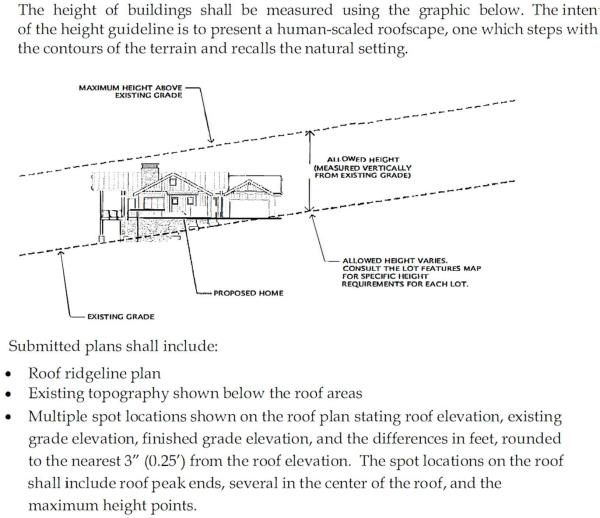 B. Allowable Projections: Penthouse or roof structures for the housing of elevators, stairways, tanks, ventilating fans or similar equipment required to operate and maintain the building, and fire or parapet walls, skylights, towers, steeples, flagpoles, chimneys, smokestacks, water tanks, theater lofts, or similar structures, may be erected above the height limits prescribed in this title, but no space above the height limit shall be allowed for the purpose of providing additional floor space. All HVAC equipment and stacks/piping shall be located at least 10’ from the edge of flat roofed buildings and located on the opposite side of the street facing façade for a pitched roof building. Pitched roof buildings that extend perpendicular from the adjacent street shall not locate HVAC equipment on the roof.
18.68.120 Heights Of Fences And Walls
A. Fences and Walls in Residential Zones. No fence or wall shall be constructed to a height greater than four (4) feet in any front yard. Any fence or wall along a side yard or rear yard shall be not be constructed to a height greater than six (6) feet. However, a fence along a side or a rear property line of a residential lot, which side or rear property line borders a non-residential zone, may be constructed to the height allowed in the non-residential zone. The "thirty foot" setback may be reduced to the front wall line for legally non-conforming homes which are closer than thirty feet to the street right-of-way line.
1. New subdivisions must have Covenants, Conditions, and Restrictions for the subdivision approved by the City through the subdivision process and recorded with the subdivision plat, addressing standardized fence height, materials, and color for fences constructed within the subdivision.
B. Fences and Walls in Non-Residential Zones. No fence or wall shall be constructed to a height of greater than eight (8) feet in any non-residential zone. The permitted fencing materials for non-residential zones are as follows:
| Zone | Barbed or Razor Wire | Chain Link | Vinyl | Wood | Decorative Metal | Welded Wire | Cast Concrete | CMU Block | Field Fencing |
| C-3 | N | N | N | P | P | C | P | C | N |
| C-2 | N | N | N | P | P | C | P | C | N |
| C-4 | N | N | N | P | P | C | P | C | N |
| MURC | N | N | C | P | P | C | P | C | N |
| NVOZ | N | N | C | P | P | C | P | C | N |
| MBP | P | P | P | P | P | C | P | C | C |
| I-1 | P | P | P | P | P | C | P | C | C |
| I-2 | P | P | P | P | P | C | P | C | C |
| CMP | N | N | P | P | P | C | P | C | C |
(P) Permitted (N) Not Permitted (C) Conditional Conditions: Welded Wire is only permitted when used with another permitted material in the applicable zone. Field Fence is only permitted for properties with an agricultural use or in keeping of grazing animals. CMU Block must be split face, honed, or covered with a decorative veneer. Vinyl, where conditional, is only permitted for residential uses. * Where these provisions conflict with individual zones, the stricter shall apply.
C. The provisions of 18.68.150 shall apply to all fences on all corner lots.
D. Outdoor swimming pools shall be completely enclosed by a six (6) foot tall fence.
E. Sports Courts, in all zones, may have fencing or netting not to exceed ten (10) feet in height. Such fencing and netting shall be black in color, transparent, and not extend beyond the area or extent of the Sports Court.
F. All private fences, regardless of fence height or property zoning classification, shall be constructed upon private property and not within the street right-of-way.
G. No fence shall be constructed near any driveway which would interfere with the visibility triangle required in Section 18.68.155.
H. Fences and walls may be extended to eight (8) feet in height with the top two (2) feet constructed of barb-wire in the following institutional use areas: around culinary wells and springs, pump houses, airport, sewer facilities and electrical transmission and telecommunication facilities. When institutional fences are adjacent to residential zones, residential fences immediately adjacent to an institutional fence may be extended to eight (8) feet in height. However, no part of an institutional fence may hang over a residential lot
I. Any fence constructed on top of or along a retaining wall, which is legitimately retaining, shall have their regulated height measured from the highest point of the top of the retaining wall. However, any fence constructed within a driveway visibility triangle or street visibility triangle as regulated by Section 18.68.155 and 18.68.150 shall not exceed the height limits for those respective code sections, with such height measured along street grade for street visibility triangles and driveway grade for driveway visibility triangles.
J. All fences constructed prior to May 19, 2011, which conform to Sections 18.68.155 and 18.68.150, shall be considered legal.
Amended by Ord. 2001-17 on 9/20/2001
Amended by Ord. 2004-28 on 12/2/2004
Amended by Ord. 2006-10 on 5/18/2006
Amended by Ord. 2008-11 on 6/5/2008
Amended by Ord. 2009-13 on 8/20/2009
Amended by Ord. 2011-06 on 5/19/2011
Amended by Ord. 2022-09 on 5/17/2022
Amended by Ord. 2023-37 on 11/7/2023
Amended by Ord. 2025-23 on 9/2/2025
18.68.122 Deer Suppression Netting
Deer suppression netting may be installed in any zone to protect gardens and landscaping, provided it:
A. Is constructed with an open mesh material that allows a clear view through the mesh for any material placed at a height over 6 feet, and is not composed of the following prohibited materials:
1. Contractor Sand/Snow fence (Usually orange); 2. Chain Link; 3. Poultry netting;
B. Does not result in a total structure height over 8 feet; and
C. Is not located within any front yard, and on corner lots is not located closer to the street than the dwelling.
Amended by Ord. 2023-37 on 11/7/2023
18.68.125 Chickens In Residential Zones
Chickens may be kept within the Residential “R” Zones, on any detached single family dwelling lot, subject to the following:
A. Hens (females) of any chicken species may be kept. However, roosters (males) are prohibited.
B. Chickens shall be kept for personal family use only. Commercial uses (the selling of chicken products) of chickens are prohibited.
C. Chickens shall be kept controlled on the property at all times.
D. Coops shall not be located within the front yard, and shall be located at least twenty-five (25) feet from any neighboring dwellings, and shall be located at least twenty (20) feet from the edge of any open waterway that drains into a natural stream. Surface drainage from coops shall not be permitted to drain into a waterway that drains into a natural stream.
E. Up to three (3) chickens may be kept on a detached single-family home lot which contains at least 5,000 square feet. One (1) additional chicken may be kept for each 1,000 square feet of lot area above the 5,000 square foot minimum, for a maximum of eight (8) chickens permitted on each lot.
F. The premises upon which chickens are kept shall be maintained in a clean, sanitary, and reasonably odor-free condition.
G. Definitions.
1. "Coop" means a cage, pen, enclosure, or building for the sheltering of chickens.
H. The provisions of this Section (Section 18.68.125) do not impair, enhance, or otherwise regulate the uses of other zones which expressly permit the keeping of chickens.
18.68.130 Barn Location Restrictions
No barn, barn for keeping of animals or corral shall be constructed closer than one hundred feet from any existing dwelling or public street, nor shall any corral or pen be constructed or maintained closer than twenty feet to any open waterway that drains into a natural stream. Surface drainage from corrals or coops shall not be permitted to drain into a waterway that drains into a natural stream.
18.68.135 Grazing Animals In Non-Agricultural Zones
A. Intent. The intent of this Section is to:
1. Promote well landscaped properties in the City; 2. Provide an alternative means for owners of larger properties in the city to maintain and control vegetation on their property through the pasturing of grazing animals; and 3. Promote a green pastoral and rural town lifestyle.
B. The raising, care and keeping of animals for personal family use and consumption is permitted in all zones. Animals are limited to only those specified:
1. Large animals: horses, cows, llamas, alpacas, or ostriches, but not including pigs; 2. Medium animals: sheep and goats, but not including pigs.
C. Animals shall not be kept within the front yard of any dwelling or main building and shall be kept at least 20 feet from the rear of the dwelling or main building, and at least 10 feet from the side of the dwelling or main building. Barns and corrals shall be located as per Section 18.68.130. Animals shall not be permitted to wallow within or access a stream or canal.
D. At least 34,000 square feet of green landscaped pasture area shall be maintained for each large animal, and at least 9,000 square feet of green landscaped pasture area shall be maintained for each medium animal.
E. The premises upon which animals are kept shall be maintained in a clean, sanitary, and reasonably odor-free condition, and animals shall be kept controlled on the property at all times.
F. The property upon which the animals are kept is required to be maintained in a green pastoral condition. In the event a pasture becomes overgrazed, the number of animals on a property shall be reduced. Overgrazing occurs when animals are permitted to graze vegetative cover excessively to the detriment of the vegetation, often characterized by soil erosion, dusty or muddy conditions, soil compaction, increased water runoff, noxious weed invasion, trampled vegetation, or a lack of grazing (i.e. hay or alfalfa) vegetation. A green pastoral condition exists when the land is not overgrazed, often characterized by the existence of healthy, non-trampled, green and growing vegetation (or dormant vegetation in non-growing months), healthy non-compacted soils, along with minimal dust, mud and weeds.
G. The provisions of this Section do not impair, enhance, or otherwise regulate non-conforming animal uses, or the uses of zones which expressly permit the keeping of animals.
H. Animals which create noise that disturbs neighbors shall be considered a public nuisance pursuant to Chapter 8.04 of this code.
18.68.140 Surface Water Drainage
Surface water from roof tops, impervious surfaces, lots or irrigation ditches shall not be allowed to drain onto adjacent except after written agreement between the parties involved. Low impact development techniques are required by the Heber City Standards and Specifications.
18.68.150 Intersection -- Visibility Triangle
In all zones which require a front yard, no obstruction, living or inanimate, which will obscure the view of automobile drivers shall be placed on any corner lot within a triangular area formed by the street property lines and a line connecting them at a point forty-five feet from the intersection of the street lines.
18.68.155 Driveway Visibility Triangle
In all zones which require a front yard, no fence, wall, hedge, landscaping, or other material or structure that will obstruct vision between a height of three (3) feet and eight (8) feet shall be erected, placed or maintained within a triangular area formed by the intersection of a driveway line and a street property line and a line connecting them at a point 15 feet from their point of intersection.
18.68.160 Yards -- Planning For Future Development
Whenever a front or side yard is required for a building, which building abuts on a proposed street which has not been constructed but which is shown in the General Plan as a future street, or represents a needed or likely connection to adjacent or future development, or has been designated by the planning commission as a future street, the depth of such front or side yard shall be measured from the planned street lines.
18.68.170 Front Yard Setback Flexibility
In residential zones, the setback from the street for any dwelling situated between two existing dwellings (a) on the same side of the street, (b) located within 150 feet of each other, and (c) located less than thirty feet from the front property line may be reduced to 20 feet or the same as the average for said two existing dwellings, whichever is the greater setback distance, as demonstrated by the permittee to the Community Development Director or designee.
18.68.172 Rural Highway Setbacks
Along any state and federal highway between 850 North to Coyote Lane, all buildings and structures shall be setback from the edge of the highway right of way at least 150' for residential buildings and 50' for non-residential buildings.
18.68.175 Open Space
- When a proposed subdivision which adjoins a collector or arterial street as identified on the Heber City Master Street Plan, or adjoins a water feature such as a canal, stream, flood channel or other critical feature as determined by the City Council, the minimum required area and street frontage widths of the lots within the subdivision may be reduced by up to 25 percent of the usual requirement to accommodate dedicated open space along said features.
- The City Council may permit, through a special exception, a rear yard setback reduction of up to 5 feet and/or front yard setback reduction of up to 5 feet to accommodate these open space features, and/or a side yard setback reduction of up to 4-feet on each side yard, if in the opinion of the City Council such reduction is necessary to accommodate, protect or enhance the open space feature. Such reduction must be approved by the City Council through the subdivision process, and the reduction shall be noted upon the subdivision plat, stating which lots are affected and the approved setback distances. It is the responsibility of the developer to prove that the setback reduction is necessary to accommodate the open space.
- No density bonuses shall be granted as a result of this Section (i.e. if 10 lots are permitted before the lot size reduction, 10 lots are permitted after the lot size reduction).
- This Section shall not apply to cottage home lots.
18.68.180 Concessions In Public Parks And Playgrounds
18.68.190 Domestic Sewage Disposal Facilities -- Approval Required
Where domestic sewage disposal facilities are used which are not connected to a public sewer, approval of such facilities shall be obtained from the health department before a building permit shall be issued therefore.
18.68.200 Gasoline Pump Island Location
Gasoline pump islands shall be set back not less than fifteen feet from any street line to which the pump island is vertical and twelve feet from any street line to which the pump island is parallel and not less than twelve feet from any residential zone boundary line. If the pump island is set in an angle on the property, it shall be so located that automobiles stopped for service will not extend over the property line. In no case shall pumps set closer than twelve feet from any street lines, nor closer than ten feet from any side or rear property line. Lots from which gasoline is dispensed to customers at retail shall be not less than seventy-five by one hundred feet in size. Canopies over pump islands may extend to within five feet to the property lines.
18.68.210 Motor Vehicle Access
Access to all lots and parcels of land having frontage on a public street shall be controlled as follows:
- Number of Driveways. Access shall be by not more more than two driveways from any one street, except as may be permitted by the City Engineer, when it can be shown that additional driveway approaches will promote traffic safety;
- Driveway setbacks
- Driveway approaches shall be no closer than five feet to the side property line, measured from the curb opening, and no closer than ten feet to another driveway approach. When permitted along collector or greater streets, driveway approaches shall be setback at least 50 feet from another driveway approach.
- Driveway Approach Width
- Non-Residential Uses. Driveway approaches for non-residential uses shall be not more than forty feet in width.
- Residential Uses. Driveway approaches shall not be more than thirty feet in width for residential uses.
- Drive ways on centerline Corner Lots
- Non-Residential Uses On corner lots, no non-residential driveway approach shall be closer than fifty feet to the point of intersection of the front property line with the side property line which abuts upon a street.
- Residential Uses. No residential driveway approach shall be closer than thirty feet on local streets, or forty, on collector or greater street designation, when approved, to the point of intersection of the front property line with the side property line which abuts upon a street;
- Driveways on Collector and Greater Streets
- On Lots which contain frontage upon two different streets, driveway access shall be established from the street with the lesser street classification, as shown on the Master Plan. No driveway approach shall be established on collector or greater designation streets, or streets with a larger classification, except for non-residential and multifamily residential developments with common driveway approaches, which under certain situations the City deems appropriate and which include traffic mitigation measures acceptable to the City.
- Such measures may include, but are not limited to, shared driveways and setbacks from other driveway approaches.
- On Lots which contain frontage upon two different streets, driveway access shall be established from the street with the lesser street classification, as shown on the Master Plan. No driveway approach shall be established on collector or greater designation streets, or streets with a larger classification, except for non-residential and multifamily residential developments with common driveway approaches, which under certain situations the City deems appropriate and which include traffic mitigation measures acceptable to the City.
- Definitions
- The "apron" is that portion of the driveway approach extending from the gutter flow line to the sidewalk section and lying between the end slopes of the driveway approach.
- The "curb return": is the curved portion of a street curb at street intersections, or the curved portion of a curb in the end slopes of a driveway approach.
- A "driveway" is an area on private property where automobiles and other vehicles are operated or allowed to stand.
- "Driveway approach" is an area, construction, or improvement between the roadway of a public street and private property intended to provide access for vehicles from the roadway of a public street to a definite area of the private property, such as a parking area, a driveway, or a door at least seven feet wide intended and used for the ingress and egress of vehicles. The component parts of the driveway approach are termed the apron, the end slopes or curb return, and sidewalk section.
- The "end slopes" are those portions of the driveway approach which provide a transition from the normal curb and sidewalk elevations to the grade of the apron, either by means of sloping surface or by means of a curb return, together with the area between the projected tangents of the curb return.
- The "sidewalk section" is that portion of the driveway approach lying between the back edge of the sidewalk and the apron, plus the end slopes measured at the front edge of the sidewalk.
18.68.220 Pollution Prevention
Any use which emits or discharges gases, fumes, dust, glare, noise or other pollutants into the atmosphere in amounts which exceed the standards as prescribed by State Law, the Utah State Air Conservation Board or the Board of Health and any use which emits or discharges liquids or solid material onto the soil or water in amounts which results in pollutants entering groundwater in amounts exceeding the standards prescribed in State or Federal Law or policies or by the Utah State Water Pollution Control Board of the Board of Health, shall be prohibited.
18.68.230 Private Schools In Residential Zones
Private schools in residential zones shall be reviewed by the Community Development Director and approved if the application meets the following standards.
A. Building and Health Codes. The site shall comply with applicable health, building and fire codes.
B. Licenses. The private school shall obtain applicable state and local business licenses.
C. Site size. The site shall contain at least 1 acre.
D. Street Access. The site shall front upon and directly access a Collector or Major Collector Street.
E. Parking. See Parking Chapter 18.72.
F. Building setbacks. Building setbacks shall meet the requirements of the underlying zone.
G. Height. Building height shall not exceed 30’ above grade.
H. Loading and unloading. 1 off-street loading/unloading space for every 20 people, or portion thereof enrolled. Loading space requirement may be eliminated if there is a circular drive-way.
I. Lot Coverage. No more than 30 percent of the lot shall be covered by buildings.
J. Common Areas. The site shall provide landscaped outdoor common area for use by students, covering a minimum of 20% of the site.
K. Screening and Fencing. Evergreen trees and shrubbery shall be planted along property lines shared with adjoining residential subdivisions.
18.68.501 Residential Facilities For Elderly Persons
- A residential facility for elderly persons may not operate as a business.
- A residential facility for elderly persons shall:
- be owned by one of the residents or by an immediate family member of one of the residents or be a facility for which the title has been placed in trust for a resident;
- be consistent with existing zoning of the desired location; and
- be occupied on a 24-hour-per-day basis by eight or fewer elderly persons in a family-type arrangement.
- A residential facility for elderly persons may not be considered a business because a fee is charged for food or for actual and necessary costs of operation and maintenance of the facility.
18.68.502 Elderly Residential Facilities As A Permitted Use
- A residential facility for elderly persons is a permitted use in any area where residential dwellings are allowed, except an area zoned to permit exclusively single-family dwellings.
- A permit to establish a residential facility for elderly persons shall be granted only if:
- the facility meets all applicable building safety, zoning, and health ordinances applicable to similar dwellings;
- there is adequate off-street parking space provided;
- the facility is capable of use as a residential facility for elderly persons without structural or landscaping alterations that would change the structure's residential character;
- no residential facility for elderly persons is established within three-quarters mile of another residential facility for elderly persons or residential facility for handicapped persons, as defined by Section 10-9-103 of the Utah Code;
- no person being treated for alcoholism or drug abuse is placed in a residential facility for elderly persons; and
- placement in a residential facility for elderly persons is on a strictly voluntary basis and not a part of, or in lieu of, confinement, rehabilitation, or treatment in a correctional facility.
18.68.503 Approval Of Elderly Residential Facilities
- Upon application for a permit to establish a residential facility for elderly persons in any area where residential dwellings are allowed, except an area zoned to permit exclusively single-family dwellings, Heber City may decide only whether or not the residential facility for elderly persons conforms to ordinances under 18.68.502(B); and
- if the residential facility for elderly persons complies with the ordinance under 18.68.502(B), Heber City shall grant the requested permit to that facility.
- The use granted and permitted by this section is nontransferable and terminates if the structure is devoted to a use other than a residential facility for elderly persons or if the structure fails to comply with the ordinances under 18.68.502(B).
18.68.504 Elderly Residential Facilities In Areas Zoned Exclusively For Single-Family Dwellings
For the purposes of this section:
- No person who is being treated for alcoholism or drug abuse may be placed in a residential facility for elderly persons; and
- placement in a residential facility for elderly persons shall be on a strictly voluntary basis and may not be a part of, or in lieu of, confinement, rehabilitation, or treatment in a correctional institution.
- Subject to the granting of a conditional use permit, a residential facility for elderly persons shall be allowed in any zoning district that is zoned to permit exclusively single-family dwelling use, if that facility:
- conforms to all applicable health, safety, zoning, and building codes;
- is capable of use as a residential facility for elderly persons without structural or landscaping alterations that would change the structure's residential character;
- conforms to Heber City's criteria adopted by ordinance, governing the location of residential facilities for elderly persons in areas zoned to permit exclusively single-family dwellings; and
- is not established within three-quarters mile of another existing residential facility for elderly persons or residential facility for handicapped persons, as defined by Section 10-9-103 of the Utah Code.
- The use granted and permitted by this section is nontransferable and terminates if the structure is devoted to a use other than as a residential facility for elderly persons or if the structure fails to comply with applicable health, safety, and building codes.
- Discrimination against elderly persons and against residential facilities for elderly persons is prohibited.
- Decisions regarding the application for a permit by a residential facility for elderly persons shall be based on legitimate land use criteria and not based on the age of the facility's residents.
- The requirements of this section that a residential facility for elderly persons obtain a conditional use permit or other permit do not apply if the facility meets the requirements of existing zoning ordinances that allow a specified number of unrelated persons to live together.
18.68.505 Review And Approval
The granting of permits and decisions relating to the administration of the provisions of Chapter 18.68 rests with the Heber City Planning Commission, with appeals going to the Appeal Authority.
18.68.506 Definitions
As used in the chapter:
- "Conditional Use" means a land use that, because of its unique characteristics or potential impact on the municipality, surrounding neighbors, or adjacent land uses, may not be compatible only if certain conditions are required that mitigate or eliminate the detrimental impacts.
- "Elderly person" means a person who is 60 years old or older, who desires or needs to live with other elderly persons in a group setting, but who is capable of living independently.
- "Residential facility for elderly persons" means a single-family or multi-family dwelling unit that meets the requirements of the 500 series of Chapter 18.68 of this ordinance.
- "Residential facility for elderly persons" does not include a health care facility as defined by Section 26-21-2 of the Utah Code.
18.68.601 Group Care Facilities
A. Intent. It is the intent of this ordinance to accommodate individuals with a bona fide disability as defined by the ADA, HUD, and the Utah Fair Housing Act. This ordinance shall not be used to circumvent other requirements of the Heber City Zoning Ordinance.
B. Group Care Facilities as Permitted Use. Each facility is a permitted use within any Zone where residential dwellings are permitted. The granting of a permit to operate a facility rests with the Community Development Director or designee, with appeals going to the Appeal Authority. The following standards shall be used in the Community Development Director’s review of applications:
1. All facilities shall have adequate off-street parking space provided per Chapter 18.68. 2. All facilities shall be capable of use as a group care facility without exterior structural or landscaping alterations that would change the structure’s residential character. 3. The use granted and permitted by this section is nontransferable and terminates if the structure is devoted to a use other than as a group care facility or if the structure fails to comply with the requirements. 4. The minimum site development standards for group care facility for elderly persons shall be the same as those required for a single-family dwelling in the zone in which the facility is to be located. 5. All setback areas not occupied by buildings or parking shall be landscaped and properly maintained. 6. No Group Care facility shall be established, operated or maintained within the City without a valid license or operating contract issued by the Utah state division of licensing or department of corrections or other appropriate state agency, and without obtaining a Heber City business license. For types of uses that do not require a state license, the applicant shall provide evidence from the state of Utah indicating that the state does not require a license for the facility.
18.68.606 Temporary Use And Structures
A. Uses and structures may be permitted for a period of time outlined in this section, with no use or structure exceeding six (6) months.
B. Permit. A temporary use permit is required for all temporary uses and structures.
1. Permit applications shall be submitted to the Planning Department and include the following:
a. Proposed use and time frame of use or structure. b. Site plan outlining the size and location of the use or structure and any required parking and site improvements.
2. Temporary use permits are reviewed and approved the Planning Department.
3. Certain uses may require a building permit in addition to the temporary use permit.
C. Uses and structures not listed in this section are not permitted as temporary uses or structures.
D. The following uses and structures are permitted on a temporary basis upon compliance with the standards associated with the use or structure as reviewed and permitted by the Community Development Director.
1. Construction Office
a. Construction Offices may be permitted as a temporary use in any zone. b. Structures shall not be placed in any right of way that has been dedicated and accepted by the City, or open for public use. c. A temporary use permit may be extended when associated with a commercial building permit. d. Separate permits may be obtained for developments with multiple phases. e. All temporary offices shall be removed within fourteen (14) days of the issuance of a Certificate of Occupancy or acceptance of the public infrastructure of the associated phase of a subdivision or development.
2. Onsite Real Estate Sales Office
a. Onsite Sales Offices may be permitted as a temporary use in residential zones as reviewed and permitted by the Community Development Director. Sales Offices located within a model home do not require a temporary use permit. b. Sales Offices shall be placed on private property. c. An off street parking area adjacent to the sales office shall be provided. Said parking area shall be constructed of compacted gravel or road base and provide for a minimum of 3 parking spaces. d. All sales offices shall be accessible to persons with disabilities. e. Sales Offices shall be removed upon the establishment of a sales office within a model home, clubhouse, or other permanent structure.
18.68.608 Mobile Food Vendors
A. Definitions: Mobile Food Vendors are comprised of the following:
1. Ice Cream Truck: A fully encased food service establishment on a motor vehicle from which a vendor, from within the frame of the vehicle, serves ice cream; that attracts patrons by traveling through a residential area and signaling the truck's presence in the area, including by playing music; and that may stop to serve ice cream at the signal of a patron. 2. Food Truck: A fully encased food service establishment on a motor vehicle or on a trailer that a motor vehicle pulls to transport; and from which a food truck vendor, standing within the frame of the vehicle, prepares, cooks, sells, or serves food or beverages for immediate human consumption. 3. Food Cart: "Food cart" means a cart that is not motorized; and that a vendor, standing outside the frame of the cart, uses to prepare, sell, or serve food or beverages for immediate human consumption.
B. General Requirements
1. All Mobile Food Vendors shall have a Business License and comply with the requirements of Section 5.04.160 of the Heber Municipal Code. 2. All requirements of the Health Department shall be met. 3. A building permit shall be required for any electrical connections.
C. Ice Cream Truck
1. Retail sales are permitted in all zones and:
a. Shall not sell any goods to individuals standing in the street. b. Shall not be allowed to sell goods from a motorized vehicle while in the right of way on the following streets:
1) Main Street 2) Hwy 40 3) Hwy 189 4) Center Street 5) 100 South (Midway Lane) 6) 1200 South
c. Are prohibited from pulling any type of trailer with a motorized vehicle during business operation. d. Shall not stop or be located within an area that would block an intersection or driveway clear site triangle or obstruct the view of traffic.
D. Food Trucks
1. Retail sales are restricted to Commercial, Industrial, and Manufacturing Zones and shall:
a. Only be permitted at an existing brick and mortar business location, with the property owner’s written permission. b. Provide, maintain, and remove trash receptacles for the duration of sales and/or event. c. Provide sanitation services for employees and patrons. An agreement with the hosting business may satisfy this requirement. d. Exceptions: Retail sales are permitted on public and private school property with written permission of the school district or property owner, regardless of the zone. e. Retail sales are permitted at parks or on public property as part of a Civic, Recreation, or Special Event with written permission of the property owner, regardless of the zone.
2. Dining areas are only permitted when approved by the property owner and shall be set up and taken down with each occurrence. 3. Food Trucks shall not be parked at a sales location overnight without written permission from the property owner. Food Trucks shall not be parked overnight on public property or within a public right of way.
E. Food Cart
1. Food Carts are prohibited outside of Civic, Recreation, or Special Events and;
a. Must have written permission from the property owner and event coordinator. b. Shall obtain an Event Vendor Business License. c. Shall not be located in the public right of way. d. Shall not be located in an intersection or driveway clear site triangle.
2. Dining areas are only permitted when approved by the property owner and shall be set up and taken down with each occurrence. 3. Food Carts are not permitted to be located at a sales location overnight, unless approved with the associated event.
F. Signs
1. All images, text, and wraps that do not project from a motorized or non-motorized vehicle that solely advertise for the Mobile Food Vendor business are permitted. 2. Ice Cream Trucks are only permitted signage that does not project from the vehicle and solely advertises for the associated business. 3. Food Trucks are permitted two A-Frame signs. 4. Food Carts are permitted one A-Frame sign. 5. A-Frame signs shall not exceed four feet in height and twelve square feet of sign copy area and include weights to prevent movement due to windy conditions. 6. Signs are not permitted in the public right of way. 7. Signs that exceed three feet in height shall not be placed in either an intersection or driveway clear sight triangle. 8. Off-premise signs are prohibited.
G. Process
1. Ice Cream Truck: The following shall be submitted for review with the business license application.
a. Picture of the vehicle.
2. Food Trucks: The following shall be submitted for review with the business license application.
a. A Permitted Use application including a site plan for each location. b. Any proposed signage. c. Letter of consent by hosting property owner. d. Proof of sanitation facilities or agreement with hosting business/property owner.
3. Food Carts: The following shall be submitted for review with the business license application.
a. Site Plan for each location b. Any proposed signage c. Letter of consent from property owner and event coordinator
18.68.609 Home Occupations
A. Purpose. The purpose of this section is to permit the establishment of home occupations in all zoning districts in a manner that is compatible with the district in which they are located, with minimal negative impacts to surrounding residential areas. Home occupations are intended to promote local and sustainable economic growth and development. B. The Community Development Director or designee may grant a permit for a home occupation subject to the following conditions:
1. The home occupation shall be carried on offsite or entirely within a building onsite; 2. The business licensee must reside at the site that contains the business. Short-term rental occupants (those found in nightly rentals, hotels, motels, bed & breakfast, Air BnB, etc.), do not qualify for a license for a home occupation; 3. Signs used in conjunction with a home occupation shall not be illuminated and shall not exceed one sign that is no more than 2 square feet in area; 4. The home occupation shall not involve the use of any yard space or carport space for storage or other business related activities, unless specifically stored within a trailer or a building; 5. No commercial vehicles shall be used onsite in connection with the home occupation except passenger motor vehicles. This subsection does not prevent deliveries to the home by parcel or letter carrier mail service vehicles typically employed for residential deliveries. No deliveries by semi-tractor/trailer trucks are permitted in connection with a home occupation. Deliveries shall not be made to or from the site between the hours of 10:00 pm and 7:00 A.M.; 6. Each site is permitted to park on the premises one commercial vehicle that has a rated capacity not to exceed one ton and one trailer not exceeding a length of 27 feet, excluding the tongue, provided:
a. Materials and equipment shall not be stored outside of the vehicle/ trailer; b. The vehicle/trailer shall not be parked upon the street right of way or between the street and home; and c. The vehicle/trailer must be well maintained.
7. The home occupation shall be clearly incidental to the primary use of the dwelling for dwelling purposes and shall not change the character of the building from that of a dwelling or alter the residential character of the surrounding neighborhood; 8. The home occupation activity shall be conducted entirely within the home or an enclosed accessory building or garage. The total permissible square footage to be used for the home occupation shall not exceed twenty-five percent of the total ground floor square footage of the house, or one room, whichever is greater. Where an accessory building or garage is used, no more than twenty-five percent of the total ground floor square footage of the house or six hundred square feet in area, whichever is less, shall be devoted to the home occupation; 9. The home occupation shall be registered with the proper licensing agencies or City and State departments; 10. The physical appearance, traffic and other activities incidental to the home occupation shall not be contrary to the objectives and characteristics of the zone in which the home occupation is located; 11. The home occupation shall not generate vehicular traffic or parking around the dwelling unit or other external evidence of the home occupation not normally associated with a residential use; 12. In connection with the operation of the home occupation, it shall not be permitted:
a. to have exterior displays or a display of goods visible from the outside, b. to produce offensive noise (not to exceed fifty-five (55) decibels), vibration, fumes, smoke, gas, light, dust or other particulate matter, odor, heat, humidity, glare, magnetic or electrical interference or other objectionable impacts extending beyond the property line of the lot where the occupation is located, c. to involve more than three people (total of employees and clients) being at the home at any one time due to the home occupation, except those members of the family living in the home. An unlimited number of employees may be employed offsite; or d. to occupy on-street parking beyond the extent of the property’s street frontage;
13. Home occupations involving visitations from pedestrian or vehicular traffic shall only be conducted between the hours of eight o'clock (8:00) A.M. and seven o-clock (7:00) P.M. 14. The following businesses, regardless of their conformance with the standards for Home Occupations, are prohibited:
a. Auto repairs; b. Welding shops or machine shops; c. Large appliance/electronics or equipment repair or service (washers, dryers, refrigerators and other appliances or equipment that are too large to be carried in 1 individual's arms); d. Industrial assembly; e. Truck hauling; f. Kennels; and g. Stables.
18.68.610 Bed And Breakfast Homes And Boarding Houses, Lodging Houses, And Rooming Houses
A. Subject to the provisions contained herein, Bed And Breakfast Homes and Boarding Houses, Lodging Houses, And Rooming Houses shall be approved by the Planning Department as permitted uses as per the standards set for in this Section 18.108.034. B. When a Boarding Housing, Lodging Housing or Rooming Housing is permitted within a particular zone, the following standards shall apply:
1. Such facilities shall not shall not exceed eight guest rooms. 2. Each facility shall be modified to meet all building, zoning, fire, health and other applicable regulations. 3. Each facility must be and remain the primary residence of the owner. If employees may be hired in conjunction with the facility; however, the employees shall not be allowed to reside at the residence. A letter attesting that the owner(s) will occupy the said facility, except for bona fide temporary absences, shall be submitted to the Planning Department. 4. Parking shall be off the street, hard surfaced, and provided at a rate of one space per tenant plus two spaces for the residing owner(s). Off-street parking spaces may be provided in tandem. Off-street parking shall not exceed 40% (forty percent) of any required setback area adjacent to a public street. 5. Construction and alterations of facilities shall not alter the residential character of the dwelling. 6. All facilities must collect and pay any applicable Transient Room Tax, Sales tax, and City Business License fees. 7. No more than one person may occupy any guest room within an approved facility. 8. High-quality landscaping of the entire property is required. Solid fencing may be required to screen parking areas and utility areas. 9. All provided exterior lighting shall meet the requirements of Chapter 18.78 Lighting. 10. A site plan showing parking, buildings, landscaping and screening, building elevations and lighting shall be submitted to the Planning Department to illustrate compliance with this section.
C. When a Bed and Breakfast Inn is permitted within a particular zone, the following standards shall apply:
1. All facilities shall operate with a current city business license and collect Transient Room Taxes and Sales Taxes. 2. The number of guest rooms will be determined by the applicant’s ability to provide acceptable parking and mitigate neighborhood impacts; however, no facility shall exceed ten (10) guestrooms. 3. Guest rooms are only available for overnight rental, with maximum continuous stay of fourteen nights. 4. No more than two persons may occupy any guest bedroom. 5. Food may only be served to residents, employees, lodgers, and guests of overnight lodgers. 6. Any retail use shall be incidental to the lodging use (i.e. gift shop) and shall not occupy more than twenty-five percent of the total floor area of the main floor and in no event more than three hundred square feet of floor area; 7. No cooking facilities are permitted in the guest bedrooms. A kitchenette with a small sink, small fridge, and microwave (no stove, oven, dishwasher) is permitted. However, a suite may have a separate kitchen that is not located within a bedroom. 8. An owner or manager shall live on the property, or there shall be 24-hour on-site management during guest rental nights. 9. Employees may be hired for cooking, cleaning, maintenance, and management of the Inn. 10. Alcoholic beverages shall not be sold or provided in a Bed and Breakfast. Guests may provide their own beverages, if desired. 11. Parking is required at the rate of at least one space per rented bedroom, plus two spaces for owner/manager. Off-street parking spaces may be provided in tandem. Parking is permitted to be off-site or along the property’s available street frontage. All on-street parking shall be built to adopted city road standards for either diagonal or parallel on-street parking. Off-street parking shall not exceed 40% (forty percent) of any required setback area adjacent to a public street. 12. High-quality landscaping of the entire property is required. A landscaping plan shall be submitted to the city planning department for review, comment, and approval. Solid fencing may be required to screen parking areas and utility areas. 13. All provided exterior lighting shall meet the requirements of Chapter 18.78 Lighting. 14. One identification sign may be placed on an ornamental wall or free standing monument sign, with said sign not exceeding 24 square feet in area. If illuminated, only hooded downward facing spot lighting is allowed. Free-standing signs shall not exceed five (5) feet in height above natural grade. 15. Construction and alterations of facilities shall not alter the residential character of the dwelling. 16. A site plan showing parking, buildings, landscaping and screening, building elevations and lighting shall be submitted to the Planning Department to illustrate compliance with this section. 17. Bed & Breakfast Inns that are located within the R-1 Residential Zone shall front upon a Collector or Arterial Street as identified on the Heber City Transportation Plan, and shall be restricted to such Streets.
18.68.611 Accessory Dwelling Units (ADUs)
The Community Development Director may grant a permit for an Accessory Dwelling Unit subject to the following conditions:
A. No more than one ADU may be permitted accompanying each Single Family Detached.
B. Either the ADU or the principal residence shall be occupied by the owner of the property except for temporary bona fide absences.
C. ADUs are permitted only in owner-occupied single-family dwellings or owner-occupied Single Family Detached.
D. There shall be no external evidence of occupancy by more than one family. The ADU shall be clearly incidental to the primary use of the dwelling for dwelling purposes and shall not change the character of the building from that of a dwelling.
E. Each unit shall have the same address as the main structure. Homes with an ADU may designate mail to its renters by Apartment Number, to wit, Apartment #1 or Apartment #2.
F. A Single Family Detached with an ADU shall provide at least two (2) off-street parking spaces for the principal dwelling, and at least one (1) off-street parking space for the ADU.
1. The required ADU off-street parking spaces are required to be hard surfaced with concrete or asphalt. 2. Garage or car port spaces do count as approved spaces. 3. Required ADU parking stalls may be located within a front, rear or side yard setback area, provided such placement does not displace required landscaping.
G. A Single Family Detached with an ADU shall have one but no more than two (2) meters for each water, and gas service. Each meter shall be in the property owner's name. There shall only be one (1) electric meter per building.
H. All construction and remodeling to accommodate the ADU shall be in accordance with both the International Residential and Building Codes, as amended, in effect at the time of construction or remodeling.
I. Landscaping:
1. The lot on which the ADU is located shall have a landscaped yard in accordance with Chapter 18.76.020. 2. The lot on which the ADU is located shall have street trees in accordance with Chapter 12.20.
J. ADU size requirements are:
1. Minimum size: no minimum size. 2. Maximum size: no maximum size for ADUs located within a main building; ADUs located within an accessory building shall not exceed 1,500 square feet and shall comply with Section 18.68.060.
K. ADUs must include the following:
1. A kitchen separate from the main dwelling. 2. Sanitation facilities (full bathroom) separate from the main dwelling.
L. A person desiring an ADU shall:
1. Obtain a Building Permit from the City and include the following in addition to standard submittal requirements for a permit:
a. Site plan drawn accurately to scale that shows property lines and dimensions, the location of existing buildings or additions, dimensions from buildings or additions to property line, and the location of parking stalls, and utility meters. b. Include detailed floor plans drawn to scale with labels on rooms indicating uses or proposed uses.
2. For ADUs that are rented, obtain a City business license. ADUs licensed within the City may be inspected annually as part of the business license renewal for compliance with building, fire, and health codes by any appropriate department of the City or other governmental agency to ensure compliance with building, fire and health and safety codes. No ADU shall be approved without all such required inspections and approval of the City Building Department. ADUs that were constructed legally previous to the adoption of this Code shall meet the building and safety codes required at the time of construction. No ADU business license shall be granted without providing evidence of a Certificate of Occupancy. 3. Record Notice of Compliance Agreement at time of building permit application and/or business licensure.
M. Prior Uses: No ADU existing prior to the enactment of this Section shall be "grandfathered", or considered legal solely because they were previously used as such.
N. Other Apartments Prohibited: There shall be no other type of accessory apartment allowed except as provided in this Section. Any portion of a home or dwelling unit that has been sectioned off so that any occupant in the dwelling does not have access to any portion of the home, and contains separate living quarters and/or a kitchen, regardless of the relationship of the occupants, shall be prohibited unless it meets all of the requirements and standards of this Section, and an application has been made pursuant to the requirements and conditions of this Section.
O. Decisions of the Community Development Director for an ADU are appealable to the Appeal Authority.
P. The ownership of an ADU shall not be separated from a principal dwelling.
18.68.612 Child Daycare Facilities
Child daycare shall be permitted pursuant to the following provisions:
A. Nonregistered Home Daycare.
1. Nonregistered home daycare, limited to no more than six (6) children, excluding the provider's own children, is permitted in the home of the care provider as set forth in the Zoning District Chapters of this title and within legal conforming single-family, duplex, and multi-family dwellings within commercial and nonresidential districts. A business revenue license or home occupation permit approval shall not be required.
B. Registered Home Daycare or Registered Home Preschool.
1. A registered home daycare or registered home preschool may be allowed as a conditional use Chapter 18.108. Registered home day cares shall be considered administrative conditional uses and be eligible for administrative approval under that section. The principal place of residence is only to be used to provide educational or daycare opportunities for children under age seven (7) in small groups. The group size at any given time shall not exceed eight (8), including the provider's own children under age seven (7). The applicant shall also obtain appropriate licensing where applicable from the State pursuant to the Utah Code.
C. Permit Application: An application for a residential home daycare or preschool must be submitted to the Planning Director. As a part of the application, the applicant must submit the following documentation:
1. The number of children and employees; both total for the day and the expected maximum number to be on the premises at any given time; 2. The hours and days of operation; and 3. Proof of appropriate licensing from the State, where applicable, or basis upon which exemption therefrom is claimed.
D. Additional Standard of Review: All residential home daycare or preschools shall be subject to the following specific standards:
1. The applicant resides at the home in which the business will be conducted; 2. At no time shall the applicant provide home daycare or home preschool services for a group of children exceeding the maximum specified for such facility; 3. The outdoor play area for the home daycare or home preschool shall be located in the rear or side yards of the home for the protection and safety of the children and for the protection of the neighborhood; 4. The use of the home for the services of providing childcare shall be clearly incidental and secondary to the use of the dwelling for residential purposes and shall not change the character of the home or the neighborhood; 5. The care and supervision of the children shall be conducted in a manner which is not a public nuisance to the neighborhood; 6. There shall be no advertising of such occupation, business or service, no window or other signs or displays; 7. No employees other than persons lawfully living in the dwelling; 8. Dwellings that front upon a culdesac are prohibited from operating such facilities; 9. Parking standards per Chapter 18.72 of this title; 10. No play or yard equipment located in the front yard; and 11. It is unlawful for any person to engage in a "registered home daycare or registered home preschool" as defined without first obtaining a license pursuant to the provisions of the Heber City code. Prior to issuance of said license, the criteria set forth in this title must be satisfied and all applicable fees shall be paid. All home occupation business licenses shall be valid for one year, and may be renewed annually, provided there have been no reported violations of the issued permit.
E. Commercial Child Daycare Center and/or Preschool Facility:
1. Conditional Use Standards: A Child Daycare Center and/or Preschool Facility providing care and maintenance to nine (9) or more children at any one time of any age separated from their parents or guardians is allowed as a conditional use pursuant to the provisions of Chapter 18.108 of this title.
Amended by Ord. 2023-37 on 11/7/2023
18.68.613 Recreational Vehicle Courts
A. Intent of Provisions. The intent of this chapter is to promulgate minimum regulations which are designed to facilitate the development of safe and sanitary accommodations for short-term occupants.
B. Permit And Plans Required. Any person wishing to construct a recreational vehicle court shall prepare a plan therefor and submit the same to the Community Development Director. Before a permit can be issued for any construction connected with a recreational vehicle court, the plans must be approved as set forth in this chapter. No construction connected with said vehicle court shall be commenced until a valid permit has been obtained therefore.
C. Content Of Plan. The plan shall show the following information:
1. The topography represented by contours shown at no greater intervals than two feet when required by the Community Development Director; 2. The proposed street and recreational vehicle court layout; 3. Proposed reservations for parks, playgrounds and open spaces, if any; 4. Size and character of service and recreation buildings and other structures associated with land and facilities to be used by the recreational vehicle court occupants; 5. Proposed landscape planting plan, including type and location of plant material; 6. Location of existing and proposed utility lines and easements, water and sewer lines, fire hydrants and other improvements.
Amended by Ord. 2023-37 on 11/7/2023
18.68.614 Reasonable Accommodation Provisions
A. Applicability. Reasonable accommodation in the land use and zoning context means providing individuals with disabilities or developers of housing for people with disabilities, flexibility in the application of land use and zoning and building regulations of Heber City or even waiving certain requirements, when it is necessary to eliminate barriers to housing opportunities. An individual with a disability is someone who has a physical or mental impairment that limits one or more major life activities; anyone who is regarded as having such impairment; or anyone with a record of such impairment. A request for reasonable accommodation may be made by any individual with a disability, his or her representative, or a developer or provider of housing for individuals with disabilities, when the application of a land use, zoning or building regulations of Heber City acts as a barrier to fair housing opportunities.
B. Requesting Reasonable Accommodation. In order to make housing available to an individual with a disability, any eligible person as defined in Section A may request a reasonable accommodation in land use, zoning and building regulations, policies, practices and procedures. Requests for reasonable accommodation shall be in writing and provide the following information:
1. Name and address of the individual(s) requesting reasonable accommodation. 2. Name and address of the property owner(s). 3. Address of the property for which accommodation is requested. 4. Description of the requested accommodation and the regulation(s), policy or procedure for which accommodation is sought; and 5. Reason that the requested accommodation may be necessary for the individual(s) with the disability to use and enjoy the dwelling.
C. Request for accommodation. A request for reasonable accommodation in regulations of Heber City may be filed at any time that the accommodation may be necessary to ensure equal access to housing. A reasonable accommodation does not affect an individual’s obligations to comply with other applicable regulations not at issue in the requested accommodation. If an individual needs assistance in making the request for reasonable accommodation, the City will provide assistance to ensure that the process is accessible.
D. Reviewing Authority. Requests for reasonable accommodation shall be reviewed by the Community Development Director using the criteria set forth in Section E. The Community Development Director shall issue a written decision on a request for reasonable accommodation within thirty (30) days of the date of the application and may either grant, grant with modifications, or deny a request for reasonable accommodation in accordance with the required findings set forth in Section
E. If necessary to reach a determination on the request for reasonable accommodation, the Community Development Director may request further information from the applicant consistent with fair housing laws, specifying in detail the information that is required. If a request for additional information is made, the thirty (30) day period to issue a decision is stayed until the applicant responds to the request.
F. Required Findings. The written decision to grant, grant with modifications, or deny a request for reasonable accommodation shall be consistent with Federal and State fair housing laws and based on the following factors:
1. Whether the housing, which is the subject of the request for reasonable accommodation, will be used by an individual with disabilities protected under fair housing laws; 2. Whether the requested accommodation is necessary to make housing available to an individual with disabilities protected under the fair housing laws; 3. Whether the requested accommodation would impose an undue financial or administrative burden on the jurisdiction and; 4. Whether the requested accommodation would require a fundamental alteration in the nature of Heber City’s land use and zoning or building ordinances.
G. Written Decision on the Request for Reasonable Accommodation. The written decision on the request for reasonable accommodation shall explain in detail the basis of the decision, including the Community Development Director’s findings on the criteria set forth in Section E. All written decisions shall give notice of the applicant’s right to appeal and to request reasonable accommodation in the appeals process. The notice of decision shall be sent to the applicant by certified mail. The written decision of the Community Development Director shall be final unless an applicant appeals to the Appeal Authority. While a request for reasonable accommodation is pending, all laws and regulations otherwise applicable to the property that is the subject of the request shall remain in full force and effect.
Amended by Ord. 2023-37 on 11/7/2023

