
Hemet City Zoning Code
ARTICLE X
- SPECIAL HOUSING CLASSIFICATIONS
DIVISION 1. - BOARDING HOUSES AND GROUP HOMES[6]
Editor's note— Section 3, Exhibit A, of Ord. No. 1852, adopted June 12, 2012, added divs. 1 and 2, §§ 90-271—90-310. Inasmuch as some of those section numbers already exist, to avoid duplication, said provisions have been redesignated to read as herein set out, and the original ordinance section designations have been included as part of the history note following each section.
DIVISION 2. - REASONABLE ACCOMMODATION[7]
Editor's note— Section 3, Exhibit A, of Ord. No. 1852, adopted June 12, 2012, added divs. 1 and 2, §§ 90-271—90-310. Inasmuch as some of those section numbers already exist, to avoid duplication, said provisions have been redesignated to read as herein set out, and the original ordinance section designations have been included as part of the history note following each section.
DIVISION 3. - RESERVED[8]
Editor's note— Ord. No. 1935, § 2, adopted August 8, 2017, repealed division 3, §§ 90-291—90-299, which pertained to sex offender registry restrictions and derived from Ord. No. 1846, § 1(Exh. A(90-311—90-319)), adopted February 28, 2012.
Sec. 90-261. - Purpose.
This article X, as part of the city's overall zoning regulations and in the exercise of its police powers to protect the public health safety and welfare, seeks to preserve the quality and character of the community's single-family and multifamily neighborhoods by limiting, and where appropriate prohibiting, the operation of housing that is commercial or institutional in nature, such as boarding houses and other group homes, to zones within the city that are best suited to accommodate impacts and needs of those housing types. In adopting this article X, the city is mindful that the fair housing laws provide individuals with a disability the right to an equal opportunity to use and enjoy housing, and that the city may need to provide reasonable accommodation in the city's zoning ordinances and policies where necessary to afford disabled persons such equal opportunity. The city recognizes that group homes providing care and services to six or fewer disabled persons that are required to be and are licensed by the State of California must be allowed to operate in single-family zones as a matter of right and therefore, such uses are excepted from this article X as provided herein. The city recognizes that the fair housing laws do not prohibit the city from regulating the location of large group homes (those providing residency to seven or more disabled individuals whether required to be licensed or not) and small group homes (those providing residency to six or fewer disabled individuals that are not required to be licensed by the state) but that the city must make a reasonable accommodation upon request to the residents of such group homes where such request does not cause an undue financial or administrative burden on the city or result in a fundamental alteration in the nature of the city's zoning regulations. This article X establishes regulations to avoid clustering and overconcentration of such uses subject to the city's reasonable accommodation provisions. Finally, this article X serves to protect all residents from the negative impacts of multiple parolees housed in individual dwellings.
(Ord. No. 1852, § 3(Exh. A, § 90-271), 6-12-12; Ord. No. 1855, § 2(Exh. A, § 1(§ 90-271)), 9-11-12)
Sec. 90-262. - Definitions.
For the purposes of this article X, the following definitions shall apply:
Boarding house is defined as provided in section 90-4 of this Code.
Disabled or individual with a disability means an individual with a qualifying disability under federal and state fair housing laws. Generally, any person with any mental or physical impairment, disorder or condition, which substantially limits one or more major life activities, including physical, mental and social activities and working. Disabled or individual with a disability does not include impairments, disorders or conditions resulting from the current, illegal use of or addiction to a controlled substance, sexual behavior disorders, compulsive gambling, kleptomania, or pyromania.
Fair housing laws means the federal Fair Housing Act (42 U.S.C. § 3601 et seq.), the California Community Care Facilities Act (Health and Safety Code § 1500 et seq.), the California Fair Housing and Employment Act (Government Code § 12900 et seq.), and Civil Code § 54, together with published judicial decisions interpreting those laws.
Group home means any boarding house that provides temporary, interim, or permanent housing to individuals where every person residing in the dwelling is an individual with a disability, and the individuals are not living as a single housekeeping unit.
(1)
Large group home means a group home in which seven or more individuals reside, whether the group home is required to be and is licensed by the State of California, or is not required to be licensed by the State of California. Large group homes do not include small licensed residential care facilities.
(2)
Small group home means a group home in which six or fewer individuals reside and which is not required to be licensed by the State of California. Small group homes do not include small licensed residential care facilities.
(3)
Supportive housing is defined by California Government Code § 65582 and means housing with no limit on length of stay, that is occupied by the target population, and that is linked to an onsite or offsite service that assists the supportive housing resident in retaining the housing, improving his or her health status, and maximizing his or her ability to live and, when possible work in the community.
Low barrier navigation center means a housing first, low-barrier, service-enriched shelter focused on moving people into permanent housing that provides temporary living facilities while case managers connect individuals experiencing homelessness to income, public benefits, health services, shelter, and housing, as defined in Government Code § 65660.
Multiple-family residential zones means those zones intended for multiple-family residential units as described in section 90-381 and similar sections in chapter 90.
Operator means any entity(ies) or person(s) who owns, manages, or operates a group home or boarding house.
Parolee-probationer means (i) any individual who has been convicted of a federal crime, sentenced to a United States prison, and received conditional or revocable release into the community under the supervision of a federal parole officer: (ii) any individual who has served a term of imprisonment in a state prison and who is serving a period of supervised community custody, as defined in Penal Code § 3000, and is under the jurisdiction of the California Department of Corrections, Parole and Community Services Division; (iii) an adult or juvenile sentenced to a term in the California Youth Authority and who has received conditional and revocable release into the community under the supervision of a Youth Authority Parole Officer; (iv) any individual who has been convicted of a felony, sentenced to any correctional facility, including county correctional facilities, and is under the jurisdiction of any federal, state, or county parole or probation officer: or (v) any person released to postrelease community supervision under the "Postrelease Community Supervision Act of 2011" (Penal Code § 3450 et seq.). For purposes of this paragraph "felony" means a felony as defined in any California or United States statute.
Parolee-probationer home means any boarding house, whether owned or operated by an individual or a for-profit or nonprofit entity, which houses two or more parolee-probationers unrelated by blood, marriage, or legal adoption, in exchange for monetary or nonmonetary consideration given and/or paid by the parolee-probationer and/or any public or private entity or person on behalf of the parolee-probationer.
Single-family residential zones means those zones intended for single-family residential units as described in section 90-311 and similar sections in chapter 90.
Single housekeeping unit means an interactive group of persons jointly residing in a single dwelling unit exercising joint responsibility for and use of the dwelling's common areas, jointly sharing household expenses, jointly sharing household activities and responsibilities such as meals, chores, and household maintenance. A boarding house shall not be considered a single housekeeping unit. If a dwelling is leased or rented under a single written or oral lease or rental agreement, the makeup of the group of persons occupying the unit must be determined by the residents of the dwelling, not the landlord or property manager, to be a single housekeeping unit.
Small licensed residential care facility means a group home in which six or fewer individuals with a disability or children reside that provides onsite care, treatment or other services to its residents and that is required to be and is licensed by the State of California. Small licensed residential care facilities are exempt from the provisions of this division and shall be treated for purposes of applying the requirements of chapter 90 as a residential use of property occupied by a single housekeeping unit. Small licensed residential care facilities include without limitation the following, provided the number of residents does not exceed six: Intermediate care facilities for the developmentally disabled (Health and Safety Code § 1267.8(c)); congregate living health facilities (Health and Safety Code §§ 1267.8(c), 1267.16(a)); residential community care facilities, including foster family homes, small family homes, social rehabilitation facilities, community treatment facilities, alcohol and drug treatment facilities, and transitional shelter care facilities (Health and Safety Code §§ 1502, 1566.3); residential care facilities for persons with chronic life-threatening illnesses (Health and Safety Code § 1568.0831); residential care facilities for the elderly (Health and Safety Code § 1569.85); pediatric day health and respite care facilities (Health and Safety Code § 1761.4).
Transitional housing is defined by California Government Code § 65582 and means buildings configured as rental housing developments, but operated under program requirements that require the termination of assistance and recirculating of the assisted unit to another eligible program recipient at a predetermined future point in time that shall be no less than six months from the beginning of the assistance. Transitional housing is a type of supportive housing used to facilitate the movement of people experiencing homelessness into permanent housing. A person experiencing homelessness may live in a transitional apartment for a predetermined period of time, however not less than six months while receiving supportive services that enable independent living.
(Ord. No. 1852, § 3(Exh. A, § 90-272), 6-12-12; Ord. No. 1855, § 2(Exh. A, § 2(§ 90-272)), 9-11-12; Ord. No. 1901, § 1(Exh. 1), § 3(Exh. 3), 4-14-15; Ord. No. 1696(2020-008), § 6, 5-12-20; Ord. No. 1972, § 2, 2-9-21; Ord. No. 2034, § 4, 6-11-24)
Sec. 90-263. - Applicability.
The provisions of this division shall apply to all boarding houses, parolee-probationer homes and group homes (except small licensed residential care facilities), and to all persons who own, manage, or operate them.
(Ord. No. 1852, § 3(Exh. A, § 90-273), 6-12-12; Ord. No. 1855, § 2(Exh. A, § 3(§ 90-273)), 9-11-12)
Sec. 90-264. - Permitted locations.
(a)
Boarding houses are prohibited in all single-family residential zones. Subject to a conditional use permit, boarding houses are permitted in R-2 and R-3 multiple-family residential zones and O-P commercial zone.
(b)
Large group homes are prohibited in all single-family residential zones. Subject to an administrative use permit, large group homes of ten or fewer residents are permitted in the multiple-family residential zones. Subject to a conditional use permit, large group homes of ten or fewer residents are permitted in the O-P commercial zone. Subject to a conditional use permit, large group homes of 11 or more residents are permitted in the multiple-family residential zones and in the O-P commercial zone.
(c)
Small group homes are permitted in single-family residential zones and R-2 and R-3 multiple-family residential zones, subject to the issuance of a small group home permit as provided in this division. Small group homes are permitted in the O-P commercial zone, subject to the issuance of a conditional use permit.
(d)
Small licensed residential care facilities are permitted in all single-family residential zones, R-2 and R-3 multiple-family residential zones. Small licensed residential care facilities are prohibited in the O-P commercial zone.
(e)
Parolee-probationer homes are prohibited in or adjacent to all single-family residential zones and in all multiple-family residential zones. Subject to a conditional use permit, parolee-probationer homes are permitted in the O-P commercial zone.
(Ord. No. 1852, § 3(Exh. A, § 90-274), 6-12-12; Ord. No. 1855, § 2(Exh. A, § 4(§ 90-274)), 9-11-12; Ord. No. 1929, § 3(Exh. A-3), 6-13-17)
Sec. 90-265. - Reasonable accommodation.
Any individual with a disability, or their representative, or a developer or provider of housing for individuals with a disability may seek a reasonable accommodation from the provisions of chapter 90 under division 2 of this article.
(Ord. No. 1852, § 3(Exh. A, § 90-275), 6-12-12)
Sec. 90-266. - Application for a small group home permit.
(a)
Any person or entity seeking to establish a small group home in a single-family residential or multiple-family residential (R-2 or R-3) zone shall first apply to the director for a small group home permit. The application for a small group home permit shall include the following information:
(1)
Client profile (the subgroup of the population the facility is intended to serve such as single men, families, elderly, minor children, developmentally disabled, etc.);
(2)
The maximum number of occupants and the facility's hours of operation;
(3)
The term of client stay;
(4)
The support services to be provided on-site and projected staffing levels;
(5)
The ownership, permit and license history of the applicant, owner, and operator, if applicable, in previously owning or operating such a dwelling, including the name and addresses of similar homes in the State of California owned or operated within the past five years;
(6)
A certification under penalty of perjury that none of the identified homes have been found by state or local authorities to be operating in violation of state or local law; and
(7)
An operations and management plan, as provided in the Uniform Building Code, and house rules (as defined in section 90-270) of this Code.
(8)
Information demonstrating that the premises are in compliance with, or will prior to occupancy be brought into compliance with, the standards set forth in section 90-270 of this division.
(9)
The applicant must secure the inspection and report of the fire marshal and building official showing that the premises to be used are suitable under applicable uniform building and related codes to safely house the number of persons identified for residency in the dwelling. The building official shall determine the applicable use and occupancy classification for the premises for the purposes of the application of the uniform building and related codes.
(10)
The names of all persons and entities with an ownership or leasehold interest in the use or home, or who will be an operator of the use or home, shall be disclosed in writing to the city, and such persons and entities shall not have a demonstrated pattern or practice of operating similar uses or homes in or out of the city in violation of state or local law.
(11)
The use or home shall provide certification, if available, from a governmental agency or qualified nonprofit organization and such certification is a generally accepted practice or standard among the owners, operators, profession, or industry related to the use or home.
(b)
The director shall grant the permit within 30 days after determining that the application for a small group home permit is complete. The director shall not deny an application for a small group home permit unless the director determines that the application is incomplete or, after reasonable investigation, the director determines that the applicant has provided information that is materially false, misleading or inaccurate or has made material misstatements on the application.
(Ord. No. 1852, § 3(Exh. A, § 90-276), 6-12-12)
Sec. 90-267. - Application for an administrative use permit.
An application for an administrative use permit shall be filed and processed with the city as provided in section 90-43 et seq., of this chapter. The following additional requirements shall apply to an administrative use permit under this division:
(a)
In addition to the application requirements in section 90-43 et seq., the application shall also include the application requirements noted in section 90-266(a)(1) through (11).
(b)
The director shall grant or deny the permit within 90 days after determining the application for an administrative use permit is complete.
(Ord. No. 1852, § 3(Exh. A, § 90-277), 6-12-12)
Sec. 90-268. - Application for a conditional use permit.
An application for a conditional use permit shall be filed and processed with the city as provided in section 90-42 et seq., of this chapter. The following additional requirements shall apply to a conditional use permit under this division:
(a)
In addition to the application requirements in section 90-42 et seq., the application shall also include the application requirements noted in section 90-266(a)(1) through (11).
(b)
In the case of boarding houses and parolee-probationer homes, the director shall ascertain whether or not all persons who will have an ownership or leasehold interest in, or will be an operator of, a boarding house or parolee-probationer home have been convicted of a felony or any crime involving moral turpitude. The city shall cause fingerprints to be taken of the applicant, owner, and operator of such dwelling or facility.
(Ord. No. 1852, § 3(Exh. A, § 90-278), 6-12-12; Ord. No. 1855, § 2(Exh. A, § 5(§ 90-278)), 9-11-12)
Sec. 90-269. - Findings for conditional use permits and administrative use permits.
In addition to the findings applicable to conditional use permits under section 90-42 et seq., and to administrative use permits under section 90-43 et seq., the decision making body shall make the following supplemental findings before approving or conditionally approving a conditional use permit or administrative use permit granted under this division:
(a)
The boarding house, group home or parolee-probationer home includes sufficient on-site parking and traffic and transportation impacts have been mitigated to a level of insignificance.
(b)
The boarding house, group home or parolee-probationer home conforms to all applicable development standards.
(c)
The property upon and structure(s) within which a boarding house, group home or parolee-probationer home will be located is physically suited to accommodate the use.
(d)
The boarding house, group home or parolee-probationer home will be compatible with the character of the surrounding neighborhood, and the addition or continued maintenance of the use will not contribute to changing the residential character of the neighborhood, such as creating an overconcentration of boarding houses, group homes or parolee-probationer homes in the vicinity of the proposed use. In making this finding or sustaining this finding, the decision making body shall consider as appropriate the following factors:
(1)
The proximity of the boarding house, group home or parolee-probationer home to schools, parks, other similar and related uses, including small licensed residential care facilities, places where alcoholic beverages are sold or distributed to the public and any other uses which could be affected by, or affect the operation of, the use or the health, safety and welfare of the residents.
(2)
The existence of substandard physical characteristics of the area in which the boarding house, group home or parolee-probationer home is to be located such as lot widths, setbacks, narrow streets, limited available parking, nonconforming housing types, physical or economic conditions of blight, and other substandard characteristics which are pervasive in certain areas of the city.
(3)
Whether, in light of the factors applied in subsections (d)(1) and (d)(2) of this section, it would be appropriate to apply the American Planning Association standard of permitting one boarding house, group home or parolee-probationer home per block. For purposes of this paragraph, "block" means an area of land that is bounded on all sides by streets or by streets and a cul-de-sac or by any other form of termination of the street (i.e., dead-end not a cul-de-sac). In applying this factor, the decision making body shall take into consideration circumstances where, because of unusually long block or short block, application of the separation standard in section 90-270(i) would result in less than one use per block or more than two uses per block.
(e)
For boarding houses, group homes or parolee-probationer homes in or adjacent to residential zones:
(1)
The operation of buses, vans, and other similar passenger carrying vehicles, to transport residents to and from off-site activities does not generate vehicular traffic substantially greater than that normally generated by residential activities in the surrounding areas.
(2)
Arrangement for the delivery of goods are made within the hours that are compatible with and will not adversely affect the peace and quiet of neighboring properties.
(3)
Arrangement for commercial trash collection in excess of usual residential collection are made within hours that are compatible with and will not adversely affect the peace and quiet of neighboring properties.
(f)
That none of the homes identified by the applicant in its application have been found by state or local authorities to be operating in substantial or persistent violation of state or local law.
(g)
That none of the persons who will have an ownership or leasehold interest in, or will be operators of, a boarding house or parolee-probationer home, have been convicted of a felony or any crime involving moral turpitude.
(Ord. No. 1852, § 3(Exh. A, § 90-279), 6-12-12; Ord. No. 1855, § 2(Exh. A, § 6(§ 90-279)), 9-11-12)
Sec. 90-270. - Standards.
The following standards shall apply to boarding houses, group homes, and parolee-probationer homes requiring an administrative or conditional use permit or a small group home permit. Violation of any of these standards shall constitute grounds for revoking the permit:
(a)
The property shall be used, maintained, occupied, and/or operated in conformity with a operation and management plan approved by the director and filed with the city. The plan shall ensure compliance with applicable state and local laws, ordinances, and regulations.
(b)
The property shall be used, maintained, occupied and/or operated in such a manner as to not permit public nuisances under article II of chapter 30 of this Code, public offenses under articles I, III and IV of chapter 46 of this Code, illegal parking under article IV of chapter 78 of this Code, and violations of state and federal laws regarding disturbance of the peace, illegal drug activity, public drunkenness, public consumption of alcohol, harassment of passers-by, gambling, solicitation, public urination, theft, assault, battery, vandalism, littering, loitering, solicitation, and lewd conduct.
(c)
The use shall not have any substantial adverse impacts on adjoining properties or land uses and shall be compatible with the character of the surrounding neighborhood.
(d)
The property shall comply with all setback, landscaping and other development standards of the underlying zone.
(e)
Both indoor and outdoor common areas shall be provided on site.
(f)
No care, treatment or other services shall be provided on the property that would require licensure by the State of California. Large group homes holding a current and valid license from the State of California are exempt from this standard.
(g)
There shall be no more than two residents per bedroom (except that three minor children may share a single bedroom), unless the decision-making body approved a higher occupancy limit in issuing the permit. The decision-making body shall not approve a higher occupancy limit unless it finds, based on substantial evidence in the record, that such limit is appropriate given the characteristics of the dwelling, the availability of parking, and the measures taken to adequately protect the public health, safety, peace, comfort, and welfare (including, but not limited to, the reasonable sanitary needs of residents).
(h)
The use or home shall maintain certification, if available, from a governmental agency or qualified nonprofit organization and such certification is a generally accepted practice or standard among the owners, operators, profession, or industry related to the use or home.
(i)
Group homes shall not be located within 300 feet, measured from the property lines, of any other group home, small licensed residential care facility, or parolee-probationer home. All other types of boarding houses, including, but not limited to, parolee-probationer homes, shall not be located within 1,000 feet, measured from the property lines, of any other boarding house, group home, small licensed residential care facility, or parolee-probationer home. Parolee-probationer homes shall not be located within 1,000 feet, measured from the property lines, of any child day care center, public or private elementary or secondary school, park, public library, public swimming pool, a commercial establishment with an on-site children's playground, or any place where classes or group activities for children are regularly held.
(j)
All group homes shall (1) maintain and enforce house rules that, at a minimum, shall provide for the protection of occupant safety and require occupants to register weekly schedules with the onsite house manager; and (2) provide for an onsite house manager who shall be responsible for, at a minimum, enforcement of the house rules and supervision of occupant schedules.
(Ord. No. 1852, § 3(Exh. A, § 90-280), 6-12-12; Ord. No. 1855, § 2(Exh. A, § 7(§ 90-280)), 9-11-12)
Sec. 90-271. - Nonconforming uses.
(a)
Group homes.
(1)
Any small group home, other than a parolee-probationer home, operating in a single-family residential zone as of the date of the adoption of Hemet Ordinance 1798 (May 27, 2008) may remain in operation provided that a valid use permit, or such other valid permit as was required at the time, was obtained and such facility was in compliance with the applicable standards set forth in chapter 14, buildings and building regulations, and chapter 90, zoning, of this Code, at the time the permit was obtained.
(2)
Any small group home or large group home, other than a parolee-probationer home, operating in the R-2 or R-3 multiple-family residential zones or in the O-P commercial zone as of the date of the adoption of Ordinance 1798 (May 27, 2008) may remain in operation provided that a valid use permit, or such other valid permit as was required at the time, was obtained and such facility was in compliance with the applicable standards set forth in chapter 14, buildings and building regulations, and chapter 90, zoning, of this Code, at the time the permit was obtained.
(b)
Boarding houses. Any boarding house, other than a parolee-probationer home, operating in the R-2 or R-3 multiple-family residential zones or the O-P commercial zone as of the date of adoption of Ordinance 1798 (May 27, 2008) may remain in operation provided that a valid use permit, or such other valid permit as was required at the time, was obtained and such facility was in compliance with the applicable standards set forth in chapter 14, buildings and building regulations, and chapter 90, zoning, of this Code, at the time the permit was obtained.
(Ord. No. 1852, § 3(Exh. A, § 90-281), 6-12-12; Ord. No. 1855, § 2(Exh. A, § 8(§ 90-281)), 9-11-12; Ord. No. 1929, § 3(Exh. A-3), 6-13-17)
Sec. 90-272. - Compliance.
The director may suspend or revoke a permit upon a determination that the boarding house, group home, or parolee-probationer home that is the subject of the permit violated any provisions of this division or any condition of the permit. Prior to such suspension or revocation, the granting authority shall set and conduct a hearing wherein the permit holder shall have the opportunity to be heard and present evidence in his/her defense. After such hearing the granting authority shall notify the permit holder in writing as to the outcome of the hearing. In the event that the permit is suspended or revoked, the permit holder may appeal to the city council but must do so within ten days of the date of the notification. The city council shall hear the appeal within ten days after the date of receipt of the notice of appeal.
(Ord. No. 1852, § 3(Exh. A, § 90-282), 6-12-12; Ord. No. 1855, § 2(Exh. A, § 9(§ 90-282)), 9-11-12)
Sec. 90-273. - Authority to inspect.
Any city official or authorized representative charged with enforcement responsibilities under this Municipal Code, state law or other government authority may enter and inspect the premises or perform any duty imposed by the municipal code or by state law, provided the owner, managers, operators, or lawful occupant(s) has consented to the inspection. The refusal by an owner, manager, operator, or occupant to permit such entry and inspection may be considered in any proceeding to suspend or revoke the permit.
(Ord. No. 1852, § 3(Exh. A, § 90-283), 6-12-12)
Sec. 90-281. - Purpose.
In accordance with the fair housing laws, it is the purpose of this division to provide reasonable accommodations in the city's zoning and land use regulations (chapter 90 of this Code), of the city's policies, and practices implementing those regulations when needed to provide an individual with a disability an equal opportunity to use and enjoy a dwelling.
(Ord. No. 1852, § 3(Exh. A, § 90-291), 6-12-12)
Sec. 90-282. - Definitions.
The definitions provided in division 1 of this article (section 90-272) shall also apply within this division. For the purposes of this division, the following definitions shall also apply:
Major reasonable accommodation means a request to allow a use in a zone where it is otherwise not permitted or a request for a modification or exception to the substantive land use, zoning and development standards and regulations.
Minor reasonable accommodation means a modification or exception to the procedural requirements contained in this chapter, including, but not limited to, fee adjustments or deferrals, modification of application filing requirements, and modification of appeal filing requirements.
(Ord. No. 1852, § 3(Exh. A, § 90-292), 6-12-12)
Sec. 90-283. - Review authority.
The planning commission is designated to approve, conditionally approve, or deny all applications for a major reasonable accommodation, except that the director is hereby vested with authority to review and approve major reasonable accommodation applications that solely request a modification of development standards for uses requiring a small group home permit or an administrative use permit. The director, or his or her designee, is designated to approve, conditionally approve, or deny all applications for a minor reasonable accommodation, provided that the director may decide to allow the planning commission to determine whether to approve, conditionally approve, or deny an application for a minor reasonable accommodation if the director finds that the minor reasonable accommodation involves significant controversy or extraordinary circumstances.
(Ord. No. 1852, § 3(Exh. A, § 90-293), 6-12-12)
Sec. 90-284. - Application for reasonable accommodation.
(a)
Applicant. A request for reasonable accommodation may be made by any individual with a disability, their representative, or a developer or provider of housing for individuals with a disability. A reasonable accommodation may be approved only for the benefit of one or more individuals with a disability.
(b)
Application. An application for a reasonable accommodation shall be made on a form provided by the community development department. No fee shall be required for an application for reasonable accommodation, but if the project requires another discretionary permit, then the prescribed fee shall be paid for all other discretionary permits.
(c)
Other discretionary permits. If the project for which the request for reasonable accommodation is made requires another discretionary permit or approval, then the applicant may file the request for reasonable accommodation together with the application for the other discretionary permit or approval, and may elect to have the reasonable accommodation request processed and decided simultaneously with the application for the other discretionary permit. In such cases, the procedures applicable to the other discretionary permit shall govern the processing of the reasonable accommodation request. A minor reasonable accommodation request seeking a modification or exception to procedural requirements shall not be processed simultaneously with any other discretionary permit.
(d)
Required submittals. In addition to materials required under other applicable provisions of this Code, an application for reasonable accommodation shall include the following:
(1)
Documentation that the applicant is:
a.
An individual with a disability;
b.
Applying on behalf of one or more individuals with a disability; or
c.
A developer or provider of housing for one or more individuals with a disability;
(2)
The specific exception or modification to the zoning code provision, policy, or practices requested by the applicant;
(3)
Documentation that the specific exception or modification requested by the applicant is necessary to provide one or more individuals with a disability an equal opportunity to use and enjoy the residence;
(4)
Any other information that the Director reasonably concludes is necessary to determine whether the findings required by section 90-295(c) can be made, so long as any request for information regarding the disabled person benefited complies with fair housing law protections and the privacy rights of the individuals affected.
(e)
Additional information. If necessary to reach a decision on a request for a reasonable accommodation, the decision-making body may request further information from the applicant. The deadline for the decision-making body to render a decision on the application for a reasonable accommodation shall be extended by the number of days it takes the applicant to fully respond to the request for additional information.
(Ord. No. 1852, § 3(Exh. A, § 90-294), 6-12-12)
Sec. 90-285. - Decision.
(a)
Minor reasonable accommodations. The director shall mail his or her written determination to approve, conditionally approve, or deny a request for a minor reasonable accommodation to the applicant within 30 days of the receipt of a complete application for a minor reasonable accommodation. The mailed notice of decision shall inform the applicant that the decision of the director may be appealed to the planning commission within 14 days of the mailing of the notice.
(b)
Major reasonable accommodations.
(1)
A major reasonable accommodation request that is filed concurrently with another application for a discretionary permit shall be heard with, and subject to, the notice, review, approval, and appeal procedures prescribed for the other discretionary permit filed concurrently with the reasonable accommodation request.
(2)
If a major reasonable accommodation request is not filed concurrently with an application for another discretionary permit, then the notice, review, approval, and appeal procedures for an administrative use permit shall be followed if the proposed use is a small group home or large group home with up to ten residents. If the proposed use is a large group home with 11 or more residents then the notice, review, approval and appeal procedures for a conditional use permit shall be followed. The findings in section 90-269 and section 90-285(c) shall be made for a reasonable accommodation to be granted.
(3)
Notwithstanding the foregoing, the standard of review on appeal of a decision on a major reasonable accommodation shall not be de novo and the appellate body shall determine whether the findings made by the decision-making body are supported by substantial evidence presented during the hearing. The appellate body may sustain, reverse or modify the decision or remand the matter for further consideration, which remand shall include specific issues to be considered or a direction for a de novo hearing.
(c)
Findings. The written decision to approve, conditionally approve, or deny a request for a reasonable accommodation shall be based on the following findings, all of which are required for approval:
(1)
The requested accommodation is requested by or on the behalf of one or more individuals with a disability protected under the fair housing laws.
(2)
The requested accommodation is necessary to provide one or more individuals with a disability an equal opportunity to use and enjoy a dwelling.
(3)
The requested accommodation will not impose an undue financial or administrative burden on the city as undue financial or administrative burden is defined in fair housing laws.
(4)
The requested accommodation will not result in a fundamental alteration in the nature of the city's zoning program, as fundamental alteration is defined in fair housing laws.
(5)
The requested accommodation will not, under the specific facts of the case, result in a direct threat to the health or safety of other individuals or substantial physical damage to the property of others.
(d)
[Approving alternate accommodations.] In making findings the [sic] in subdivision (b), the decision maker may approve alternative reasonable accommodations which provide an equivalent level of benefit to the applicant.
(e)
[Determination of provision of accommodations.] The city may consider, but is not limited to, the following factors in determining whether the requested accommodation is necessary to provide one or more individuals with a disability an equal opportunity to use and enjoy a dwelling:
(1)
Whether the requested accommodation will affirmatively enhance the quality of life of one or more individuals with a disability;
(2)
Whether the individual or individuals with a disability will be denied an equal opportunity to enjoy the housing type of their choice absent the accommodation;
(3)
In the case of a group home, whether the requested accommodation is necessary to make facilities of a similar nature or operation economically viable in light of the particularities of the relevant market and market participants;
(4)
In the case of a group home, whether the existing supply of facilities of a similar nature and operation in the community is sufficient to provide individuals with a disability an equal opportunity to live in a residential setting.
(f)
[Determination of alteration to accommodation.] The city may consider, but is not limited to, the following factors in determining whether the requested accommodation would require a fundamental alteration in the nature of the city's zoning program:
(1)
Whether the requested accommodation would fundamentally alter the character of the neighborhood;
(2)
Whether the accommodation would result in a substantial increase in traffic or insufficient parking;
(3)
Whether granting the requested accommodation would substantially undermine any express purpose of either the city's general plan or an applicable specific plan;
(4)
In the case of a group home, whether the requested accommodation would create an institutionalized environment due to the number of and distance between facilities that are similar in nature or operation.
(g)
Rules while decision is pending. While a request for reasonable accommodation is pending, all laws and regulations otherwise applicable to the property that is the subject of the request shall remain in full force and effect.
(h)
Effective date. No reasonable accommodation shall become effective until the decision to grant such accommodation shall have become final by reason of the expiration of time to make an appeal. In the event an appeal is filed, the reasonable accommodation shall not become effective unless and until a decision is made on such appeal and becomes final.
(Ord. No. 1852, § 3(Exh. A, § 90-295), 6-12-12)
Sec. 90-286. - Expiration, time extension, violation, discontinuance and revocation.
(a)
Expiration. Any reasonable accommodation approved in accordance with the terms of this division shall expire within 24 months from the effective date of approval or at an alternative time specified as a condition of approval unless:
(1)
A building permit has been issued and construction has commenced;
(2)
A certificate of occupancy has been issued;
(3)
The use is established; or
(4)
A time extension has been granted.
(b)
Time extension. The director may approve a time extension for a reasonable accommodation for good cause for a period or periods not to exceed one year. An application for a time extension shall be made in writing to the director no less than 30 days or more than 90 days prior to the expiration date.
(1)
Notice. Notice of the director's decision on a time extension shall be provided as specified in this chapter. All written decisions shall give notice of the right to appeal and to request reasonable accommodation in the appeals process.
(2)
Appeal of determination. A time extension for a reasonable accommodation shall be final unless appealed within 14 calendar days of the date of mailing of the determination. An appeal shall be made in writing and shall be noticed and heard pursuant to the procedures established in this chapter.
(e)
Violation of terms. Any reasonable accommodation approved in accordance with the terms of this Code may be revoked if any of the conditions or terms of such reasonable accommodation are violated, or if any law or ordinance is violated in connection therewith.
(f)
Discontinuance. A reasonable accommodation shall lapse if the exercise of rights granted by it is discontinued for 180 consecutive days. If the persons initially occupying a residence vacate, the reasonable accommodation shall remain in effect only if the director determines that: (1) the modification is physically integrated into the residential structure and cannot easily be removed or altered to comply with the Code, and (2) the accommodation is necessary to give another individual with a disability an equal opportunity to enjoy the dwelling. The director may request the applicant or his or her successor in interest to the property to provide documentation that subsequent occupants are individuals with a disability. Failure to provide such documentation within ten days of the date of a request by the city shall constitute grounds for discontinuance by the city of a previously approved reasonable accommodation.
(g)
Revocation. Procedures for revocation shall be as prescribed by section 90-43 et seq., of this chapter.
(Ord. No. 1852, § 3(Exh. A, § 90-296), 6-12-12)
Sec. 90-287. - Amendments.
A request for changes in conditions of approval of a reasonable accommodation, or a change to plans that would affect a condition of approval shall be treated as a new application. The director may waive the requirement for a new application if the changes are minor, do not involve substantial alterations or addition to the plan or the conditions of approval, and are consistent with the intent of the original approval.
(Ord. No. 1852, § 3(Exh. A, § 90-297), 6-12-12)
Sec. 90-301. - Purpose.
To establish supplemental development standards for emergency shelters that:
(a)
Ensure that adequate sites to accommodate emergency shelters are available.
(b)
Provide regulations for the development, maintenance, and operation of emergency shelters.
(c)
Meet the requirements of Government Code § 65583(a)(4).
(d)
Contribute to the provision of a variety of housing types in compliance with state law and the general plan housing element.
(Ord. No. 1867, § 1(Exh. A1), 8-13-13)
Sec. 90-302. - Emergency shelter defined.
Emergency shelter shall have the meaning ascribed to it in Government Code § 65582(d) and Health and Safety Code § 50801(e), as such sections may be amended from time to time, and which presently define the term "emergency shelter" to mean housing with minimal supportive services for homeless persons that is limited to occupancy of six months or less by a homeless person. No individual or household may be denied emergency shelter because of an inability to pay.
(Ord. No. 1867, § 1(Exh. A1), 8-13-13)
Sec. 90-303. - Applicability.
To accommodate the city's emergency shelter needs:
(a)
Emergency shelters shall be permitted in the commercial-manufacturing (CM) zone subject to issuance of a conditional use permit pursuant to section 90-42 and the development and management standards in section 90-304.
(b)
As of the effective date of this ordinance, an emergency shelter overlay zone has been established for property located at 200 E. Menlo Avenue, known as Valley Restart, which accommodates the city's need for emergency shelter pursuant to Government Code § 65583(a)(4)(C) and 65583(a)(7). An emergency shelter is permitted by right at this location, subject to the development and management standards outlined in article XXVI, division 4, emergency shelter overlay zone.
(c)
Emergency shelters shall be subject only to the development and management standards of the underlying zone and the provisions of this article. In the event of an inconsistency, the standards of this article shall prevail.
(d)
Emergency shelters established within the boundaries of the Hemet-Ryan Airport land use compatibility zones may be subject to review by the Riverside County Airport Land Use Commission in accordance with the adopted airport land use plan.
(Ord. No. 1867, § 1(Exh. A1), 8-13-13; Ord. No. 2034, § 5, 6-11-24)
Sec. 90-303.5. - Shelter crisis.
(a)
Applicability. Notwithstanding any other requirements of this division, the following provisions shall only be effective for the duration of a shelter crisis, as declared by the city council pursuant to Government Code § 8698.2. Upon the expiration of the city's shelter crisis declaration, or the repeal or expiration of the ordinance codified in this section, the emergency shelter must immediately cease its expanded emergency sleeping cabin operations and immediately return the site to its previous condition. Approvals issued pursuant to this section are not property, have no value, and do not create vested rights or confer nonconforming status.
(b)
Emergency sleeping cabins.
(1)
For purposes of this section 90-303.5, "emergency sleeping cabin" shall mean a relocatable hard-sided structure, constructed in accordance with chapter 14, article XIV of this Code, which may be occupied only for emergency shelter.
(2)
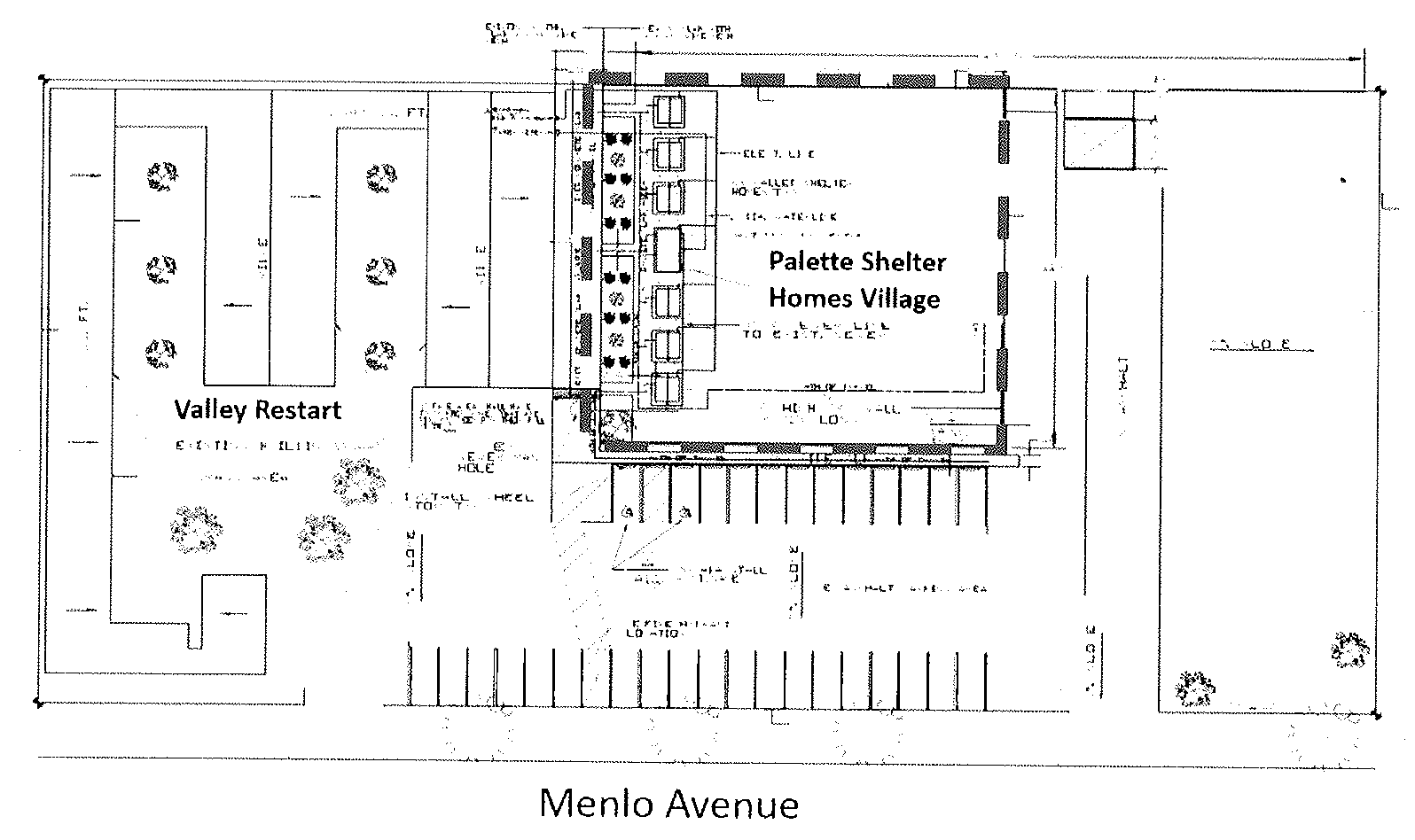
For the duration of the shelter crisis, emergency sleeping cabins shall be allowed on the site(s) identified in subsection 90-303(b) in the approved Palette Shelter Village area depicted below as necessary to accommodate the city's need for emergency shelter pursuant to Government Code § 65583, provided the emergency sleeping cabins comply with all applicable building, health, and safety standards set forth herein.
(c)
Site plan.
(1)
To establish emergency sleeping cabins, an emergency shelter provider shall submit to the city a site plan for the emergency sleeping cabins that complies with the standards set forth in chapter 14, article XIV of this Code.
(2)
To protect occupants in the event of an emergency, the site plan must also satisfy the following requirements:
a.
A fire flow of 1,500 gpm at 20 psi residual pressure shall be available from hydrants within 600 feet of the furthest point of any building;
b.
Approved fire apparatus access shall be within 150 feet of any point of the building;
c.
Fire sprinklers designed to 2022 NFPA 130 may be required;
d.
The site shall conform to all pertinent requirements of the Americans with Disabilities Act (https://www.ada.gov/pcatoolkit/chap7shelterchk.htm);
e.
At least one accessible route shall be provided within the site from accessible parking spaces and accessible parking loading zones, public streets and sidewalks, and public transportation stops, to the accessible building or facility entrance they serve. If more than one route is provided, all routes must be accessible;
f.
The site shall provide adequate space for emergency response vehicles; and
g.
As part of the site plan, a building egress plan shall be provided to the building department for review and approval.
(3)
A site plan must be approved prior to the establishment of emergency sleeping cabins on a site. The city manager, or his or her designee, shall have the ability to impose any and all site conditions necessary to ensure the adequate protection of life, health, and property.
(d)
Management. Emergency sleeping cabin operators shall comply with the development and management standards set forth in subsections 90-304(a), (c)—(f), and (h)—(n), including the submission of an onsite management plan. A management plan must be approved by the city prior to the establishment of emergency sleeping cabins on a site. The city manager, or his or her designee, shall have the ability to impose any and all management conditions necessary to ensure the adequate protection of life, health, and property.
(e)
Inspection. The city shall have a right to inspect the site to ensure compliance with the requirements set forth herein.
(f)
Violations. Violations of this chapter include:
(1)
Operating emergency sleeping cabins without an approved site plan, or failing to operate emergency sleeping cabins in accordance with an approved site plan, pursuant to subsection (c) above;
(2)
Operating emergency sleeping cabins without an approved management plan, or failing to operate emergency sleeping cabins in accordance with an approved management plan, pursuant to subsection (d) above;
(3)
Failing to maintain facilities in good repair;
(4)
Denying or otherwise interfering with the city's inspection of the site pursuant to subsection (e) above;
(5)
Failing to abide by the management standards set forth in subsection (d) above;
(6)
Failing to comply with any other provision of this Code, including those provisions in chapter 30; and
(7)
Failing to comply with state and local health, environmental, and safety standards.
(g)
Enforcement. In addition to other remedies allowed by law, any person who violates this chapter or operates an unauthorized emergency sleeping cabin facility may be subject to civil action, including (but not limited to) a petition for the appointment of a receiver under Health and Safety Code § 17980 et seq., administrative penalties, criminal citation, and all other actions set forth in [chapter 1] of this Code. Violations of this chapter are hereby declared a public nuisance. All remedies prescribed under this section shall be cumulative and the election of one or more remedies shall not bar the city from the pursuit of any other remedy for the purpose of enforcing provisions hereof.
(Ord. No. 2022-2000, § 2, 6-28-22; Ord. No. 2034, § 5, 6-11-24)
Sec. 90-304. - Development and management standards.
In accordance with the authority granted in Government Code § 65583(a)(4)(C), all emergency shelters shall comply with the following development and management standards except as provided in article XXVII, division 4, overlay zone:
(a)
On-site management. The emergency shelter provider shall prepare and file a management plan with the community development department that includes clear operational rules and standards, including, but not limited to, staff training, security, screening of clients, mechanisms to address loitering, management of outdoor areas, and opportunities for training, counseling, and treatment programs for residents.
(b)
Maximum number of beds. The Emergency shelter shall limit the number of beds available nightly to 35, unless a greater number of beds is allowed as a condition of approval to the use's conditional use permit.
(c)
Parking. The emergency shelter shall accommodate sufficient parking for staff given that it does not require more parking for emergency shelters than other residential or commercial uses within the same zone.
(d)
Client intake area. The client intake area shall be not less than 500 square feet in total floor area.
(e)
Outdoor activity. For purposes of noise abatement and neighborhood compatibility, outdoor activities on site are limited to the hours of 9:00 a.m. to 9:00 p.m.
(f)
Length of stay. An emergency shelter client may not stay at the facility for more than 180 consecutive days.
(g)
Location.
(i.)
The shelter shall be located at least 1,000 feet, as measured from property line to property line, from another emergency shelter.
(ii.)
The emergency shelter must be located within one-half mile of a bus stop or transit station.
(h)
Lighting. Adequate external lighting shall be provided for security purposes. The lighting shall be stationary, directed away from adjacent properties and public rights-of-way, and of an intensity that is compatible with the neighborhood.
(i)
Security. Parking and outdoor facilities shall be designed to provide security for residents, visitors, and employees. On-site supervisorial personnel shall be provided at a minimum ratio of one staff person for every 15 beds during operational hours.
(j)
Refuse collection. Refuse collection areas shall conform to the requirements for multiple-family housing in section 90-457.
(k)
Signage. Signage identifying the name and address of the facility is required pursuant to sign standards for institutional uses in section 90-1255.
(l)
Business license. A city business license is required to operate an emergency shelter pursuant to chapter 18 of the Hemet Municipal Code.
(m)
Bathroom and laundry facilities. The emergency shelter shall provide sufficient bathroom and laundry facilities pursuant to chapter 14 of the Hemet Municipal Code.
(n)
Accessibility. The shelter must meet Americans with Disabilities Act (ADA) accessibility and adaptability requirements.
(Ord. No. 1867, § 1(Exh. A1), 8-13-13; Ord. No. 2034, § 5, 6-11-24)
Sec. 90-305. - Findings for denial.
The city shall not disapprove an emergency shelter, or condition approval in a manner that renders the project infeasible for development for an emergency shelter, including through the use of design review standards, unless the city makes one or more of the following findings in writing, based upon substantial evidence in the record, as required by Government Code § 65589.5(d):
(a)
The city has adopted a housing element pursuant to this article 10.6 of title 7, division 1, chapter 3 of the Government Code and:
(1)
The housing element has been revised in accordance with Government Code § 65588;
(2)
The housing element is in substantial compliance with Article 10.6 of Title 7, Division 1, Chapter 3 of the Government Code; and
(3)
The city has met or exceeded the need for emergency shelter, as identified pursuant to Government Code § 65583(a)(7).
Any disapproval or conditional approval shall not be based on any of the reasons prohibited by Government Code § 65008. Any disapproval or conditional approval pursuant to this section shall be in accordance with applicable law, rule, or standards.
(b)
The emergency shelter as proposed would have a specific, adverse impact upon the public health or safety, and there is no feasible method to satisfactorily mitigate or avoid the specific adverse impact without rendering the development of the emergency shelter financially infeasible. As used in this subsection, the term "specific, adverse impact" means a significant, quantifiable, direct, and unavoidable impact, based on objective, identified written public health or safety standards, policies, or conditions as they existed on the date the application was deemed complete. Inconsistency with the zoning ordinance or general plan land use designation shall not constitute a specific, adverse impact upon the public health or safety.
(c)
The denial of the project or imposition of conditions is required in order to comply with specific state or federal law, and there is no feasible method to comply without rendering the development of the emergency shelter financially infeasible.
(d)
The emergency shelter is proposed on land zoned for agriculture or resource preservation that is surrounded on at least two sides by land being used for agricultural or resource preservation purposes, or which does not have adequate water or wastewater facilities to serve the project.
(e)
The emergency shelter is inconsistent with both the city's zoning ordinance and general plan land use designation as specified in any element of the general plan as it existed on the date the application was deemed complete, and the city has adopted a revised housing element in accordance with Government Code § 65588 that is in substantial compliance with article 10.6 of title 7, division 1, chapter 3 of the Government Code.
(Ord. No. 1867, § 1(Exh. A1), 8-13-13)

