
Hemet City Zoning Code
ARTICLE XXIV
TTPD TRAVEL TRAILER PLANNED DEVELOPMENT ZONE
Sec. 90-811.- Purpose.
The purpose of the travel trailer planned development zone is to provide for the development and maintenance of travel trailer subdivisions with common open space.
(Ord. No. 914; Code 1984, § 22900)
Sec. 90-812. - Permitted uses.
(a)
If a conditional use permit has first been obtained as provided in article II, section 90-42 of this chapter, property in the TTPD zone may be used for a travel trailer planned development subject to approval by the planning commission as provided in section 90-832.
(b)
In the travel trailer planned development zone the following uses are permitted, as specifically provided and allowed in this article:
(1)
Recreational vehicles, including but not limited to:
a.
Travel trailers.
b.
Motor homes.
c.
Fifth wheel trailers.
d.
Cab-over campers.
e.
Vans.
f.
Tent trailers.
(2)
Manager's residence, which may be a mobile home.
(3)
Recreational buildings and appurtenances.
(4)
Storage buildings, subject to the provisions of section 90-819.
(5)
One household pet per dwelling.
(6)
Greenhouses.
(Ord. No. 1211; Code 1984, § 22901; Ord. No. 1903, § 2(Exh. 1), 8-11-15)
Sec. 90-812.5. - Definitions.
The following words, terms and phrases, when used in this article, shall have the meanings ascribed to them in this section, except where context clearly indicates a different meaning. All other terms shall be as defined in section 90-4 of this chapter.
Accessory structures: Physical improvements, not part of the dwelling unit's original factory construction, which are installed at the building site.
Temporary awning: A temporary, collapsible fixture designed to provide shade, which is supported only by the recreational vehicle and is comprised of materials similar to cloth, canvas, or aluminum.
Permanent awning: A permanent accessory structure, designed to provide shade, which is either freestanding or partially supported by the dwelling unit.
Eyebrow: A permanent awning with a maximum 24-inch projection.
Carport: A permanent, roofed accessory structure entirely open on two or more sides and used or intended to be used primarily for the shelter or storage of the resident's vehicle(s). A louver-type privacy screen shall be considered "open" for the purposes of this section.
Kick panel: The bottom portion of a patio enclosure wall, constructed of solid material, and uniform in height.
Outdoor patio: An area outside of the main dwelling which is not designed as a habitable space, contains no heating or cooling equipment and is open on at least two sides, for the enjoyment of open air uses by the resident family and their guests.
Patio cover: A permanent accessory structure which is designed to cover a defined outdoor area, such as a raised deck, and which may be either free-standing or partially supported by the dwelling unit.
Patio enclosure: An accessory wall system designed to enclose an outdoor patio, as further defined in Exhibit C.
Privacy screen: An accessory structure consisting of a partial wall or partition on the exterior side of a carport intended to visually screen the subject property from public or private view.
Raised deck: An accessory structure consisting of an outdoor patio area elevated above the existing grade and which is freestanding (unsupported by the recreational vehicle).
Ramada: A free-standing accessory structure consisting of a roof or shade structure, installed or erected above a recreational vehicle or any portion thereof.
Recreational vehicles: The term "recreational vehicle" shall be as defined in the California State Health and Safety Code, Division 13, Part 2, Chapter 1, Paragraph 18010.
Return wall: A short segment of one portion of the outdoor patio wall which is comprised of solid material and which is intended to stabilize an adjoining perpendicular wall.
Screen wall: A wall/partition designed to enclose or partially enclose an outdoor patio.
Storage cabinet: An enclosure which is part of the solid outdoor patio wall and which is designed and used solely for the storage of personal possessions of the occupant of the dwelling unit.
Storage shed: A free-standing-accessory structure between 80 and 100 square feet in size.
Utilities to storage shed: The installation of water, sewer, electrical, gas or telephone services to the storage shed.
(Ord. No. 1544, § 1, 5-28-96)
Sec. 90-813. - Site area; yards.
(a)
Site area. Minimum site area for a travel trailer planned development is five acres.
(b)
Yards.
(1)
Front yard. Front yard requirements are as follows:
a.
Major or secondary highway: 15 feet minimum.
b.
Collector or local street: Ten feet minimum.
(2)
Landscaped buffer. A landscaped bufferyard of not less than ten feet in depth shall be provided along any R-1 or R-2 district boundary line. Such buffer shall include trees and shrubs. No parking, storage or mechanical equipment shall be permitted in the bufferyard.
(Code 1984, § 22902)
Sec. 90-814. - Lot layout.
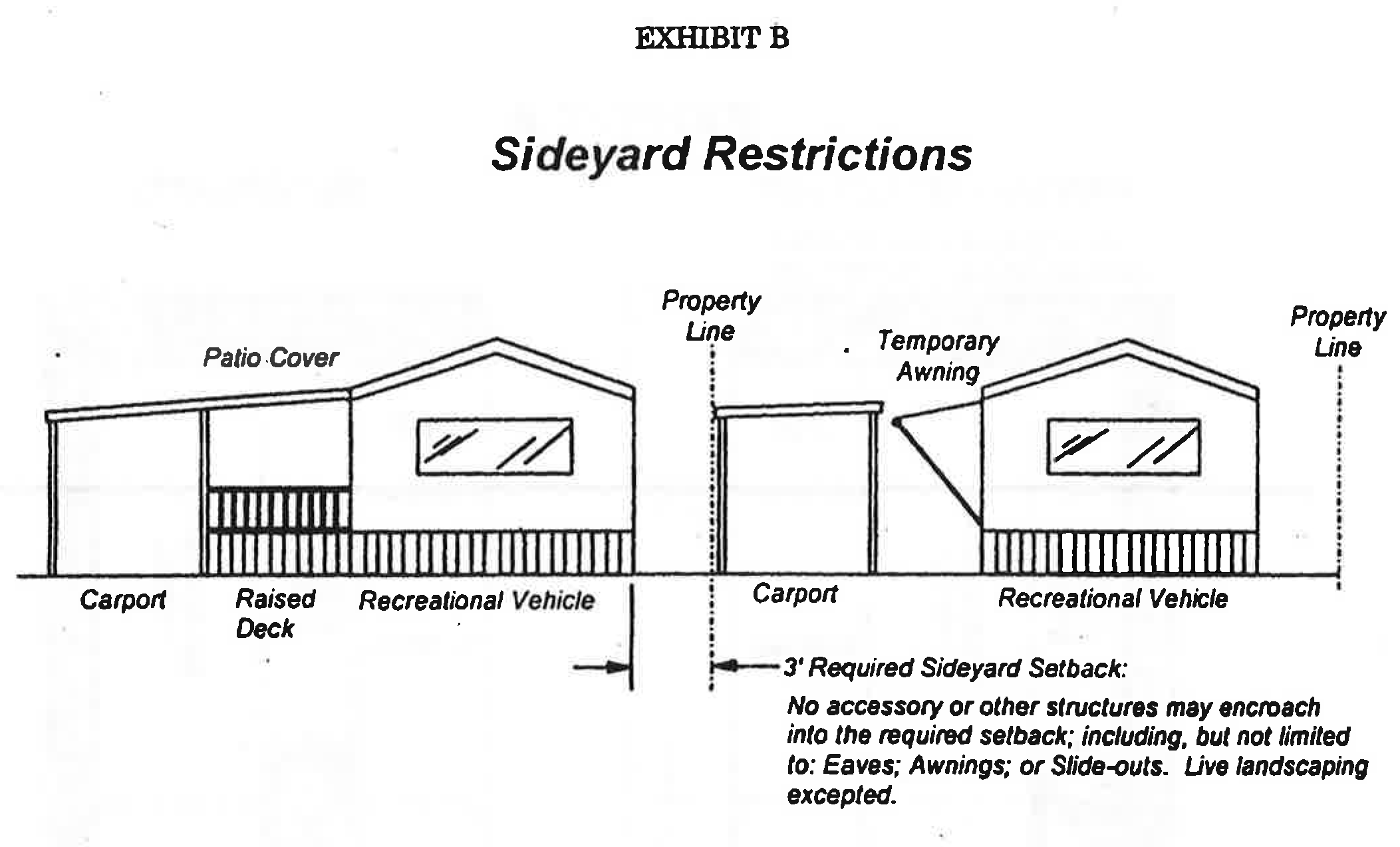
Each dwelling lot and structures and vehicles thereon in a travel trailer planned development shall be in compliance with exhibit A and exhibit B of this section.
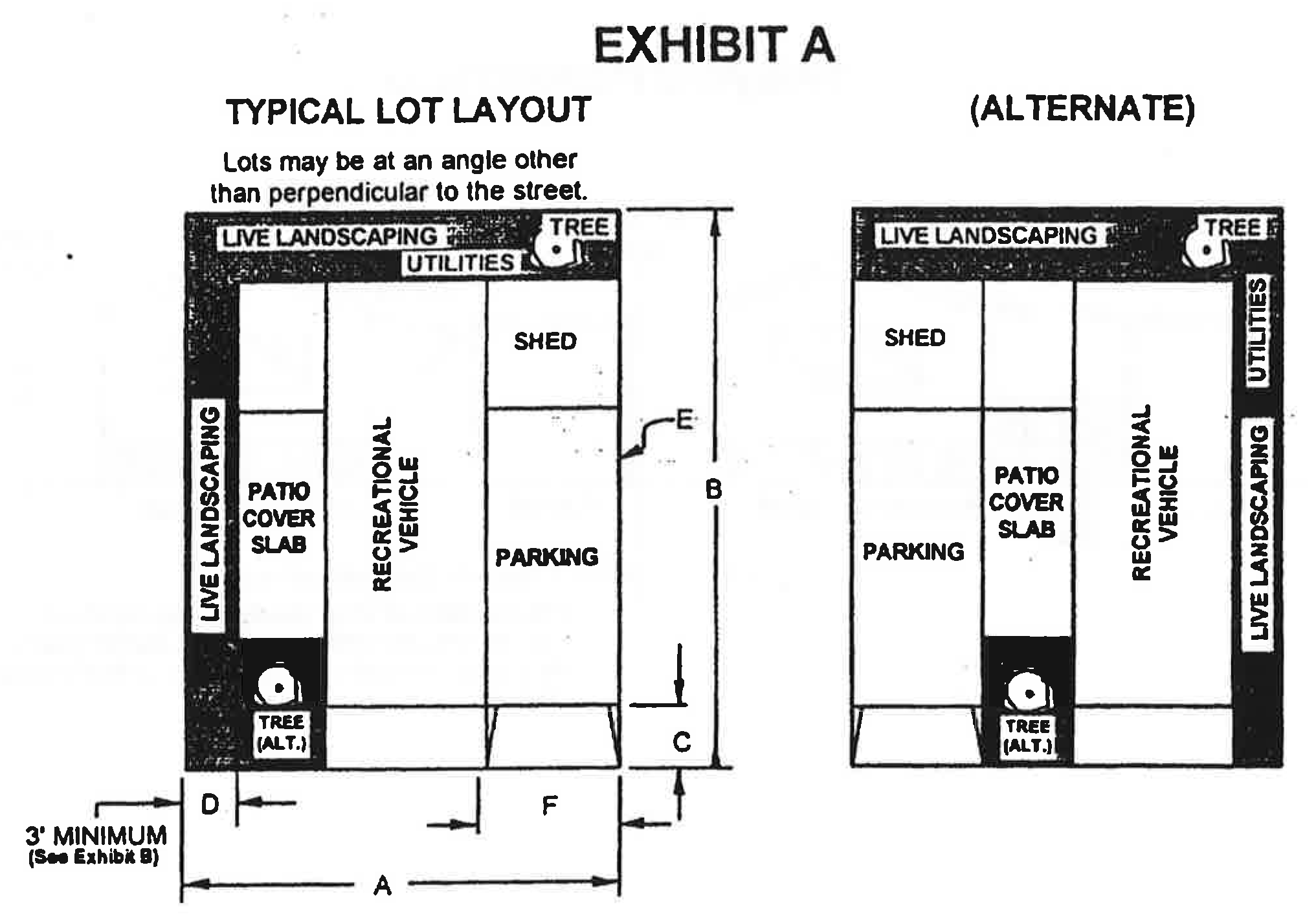
Legend (numbers shown are minimums):
*A freestanding carport may be erected on a lot line, provided that such a carport is constructed of aluminum or aluminum alloy and provided that there is a minimum of three feet clearance from a travel trailer or any other structure on adjacent lots.
**See exhibit B.
EXHIBIT B
(Ord. No. 1211; Code 1984, § 22903; Ord. No. 1544, §§ 2, 3, 5-28-96)
Sec. 90-815. - Building height.
(a)
Maximum building height in a travel trailer planned development is 15 feet, except as otherwise provided.
(b)
Maximum height of recreation buildings is 35 feet.
(c)
A central antenna system may exceed the 35-foot maximum, subject to planning commission approval.
(Code 1984, § 22904)
Sec. 90-816. - Dwelling lot coverage.
There is no maximum dwelling lot coverage in a travel trailer planned development.
(Ord. No. 1211; Code 1984, § 22905)
Sec. 90-817. - Access drives.
(a)
All private drives serving as access to dwelling lots in a travel trailer planned development shall be a minimum of 25 feet wide, exclusive of adjoining parking areas. No dwelling lots shall have frontage on an arterial highway or secondary highway.
_____
(b)
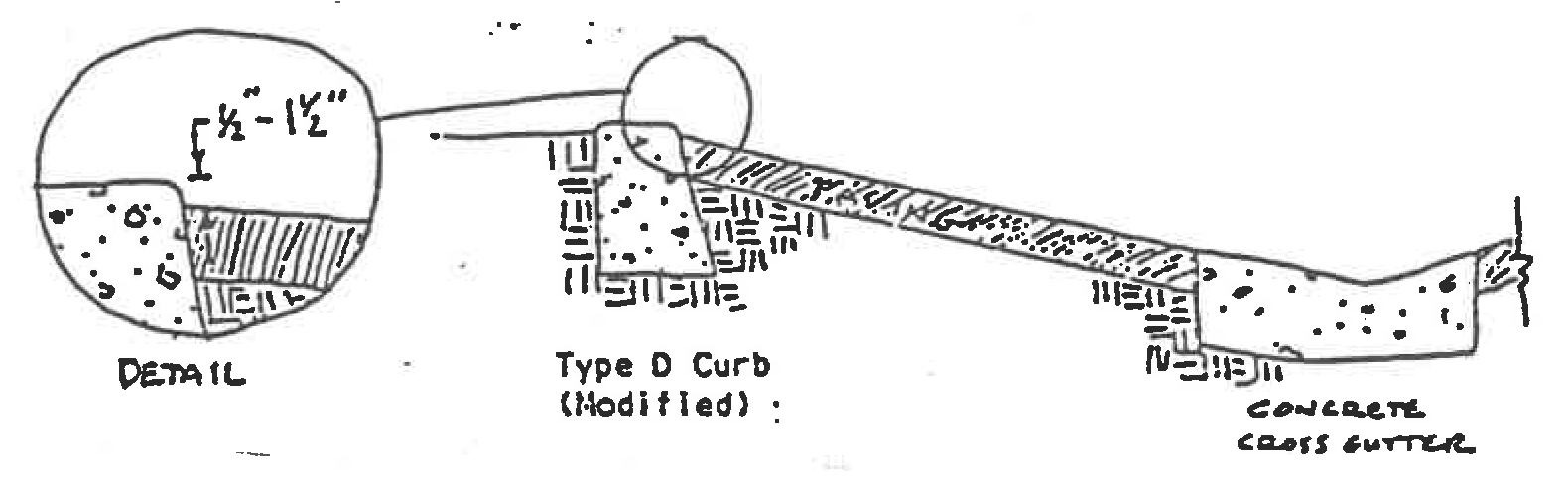
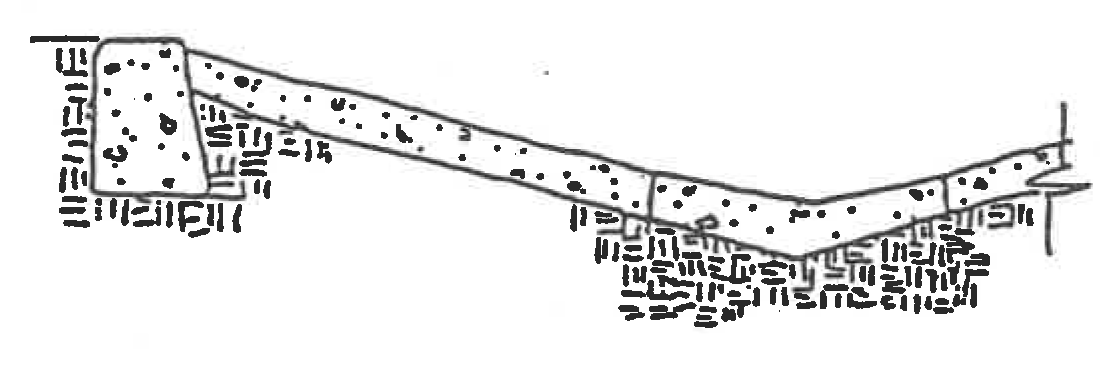
Private drives shall be constructed to the specifications of the director of public works in any of the following configurations:
Rolled curb:

Modified type D curb, inverted street section, Portland cement concrete cross gutter, asphaltic concrete street surface:
Modified type D curb, inverted street section, cross gutter all Portland cement concrete:
(Ord. No. 1075; Code 1984, § 22906)
Sec. 90-818. - Accessory structures.
(a)
Development within the TTPD zone shall be exempt from the provisions of section 90-14, pertaining to accessory buildings, and Title 25 of the California Administrative Code, except as specifically noted herein.
(b)
All accessory structures and awnings shall comply with the following:
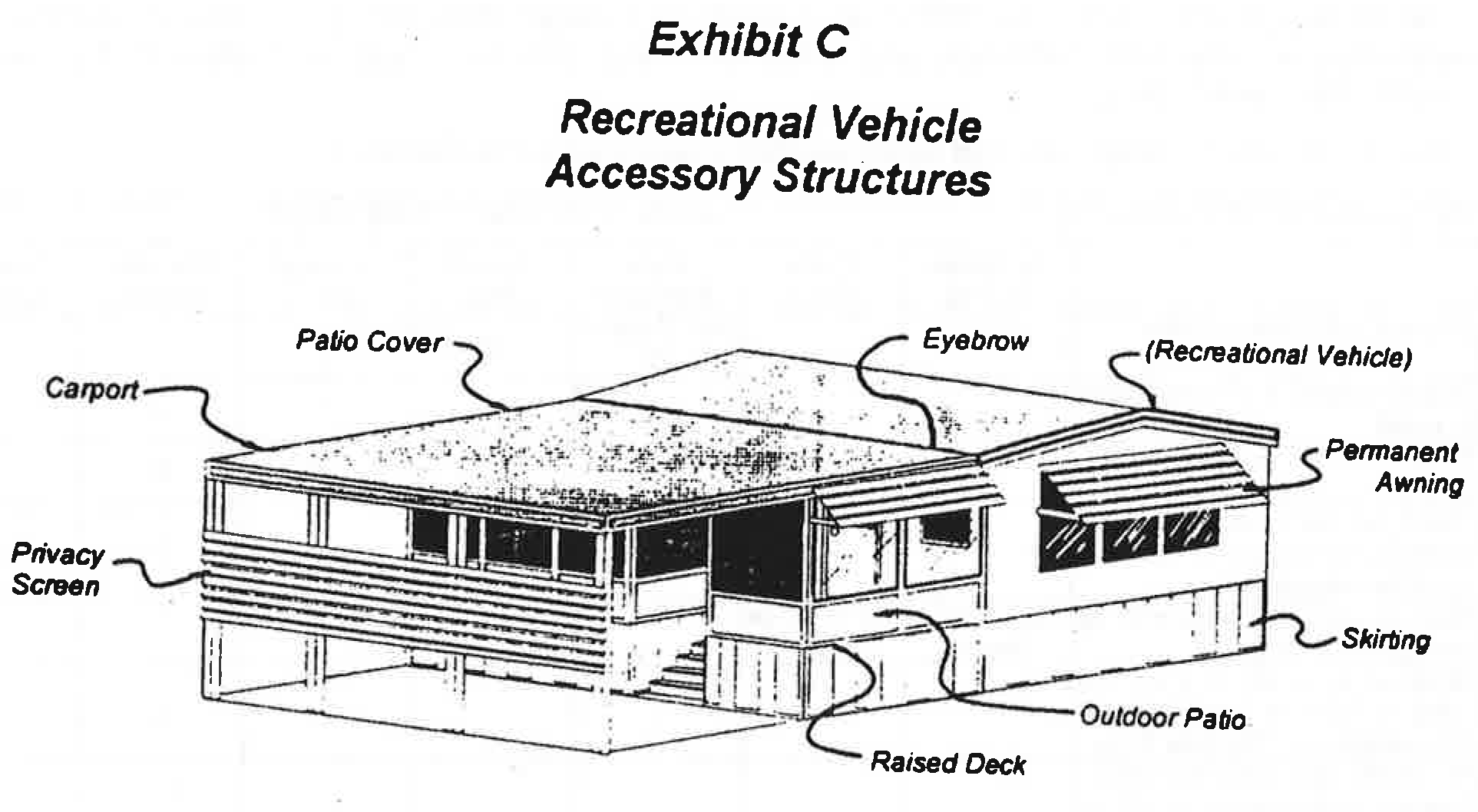
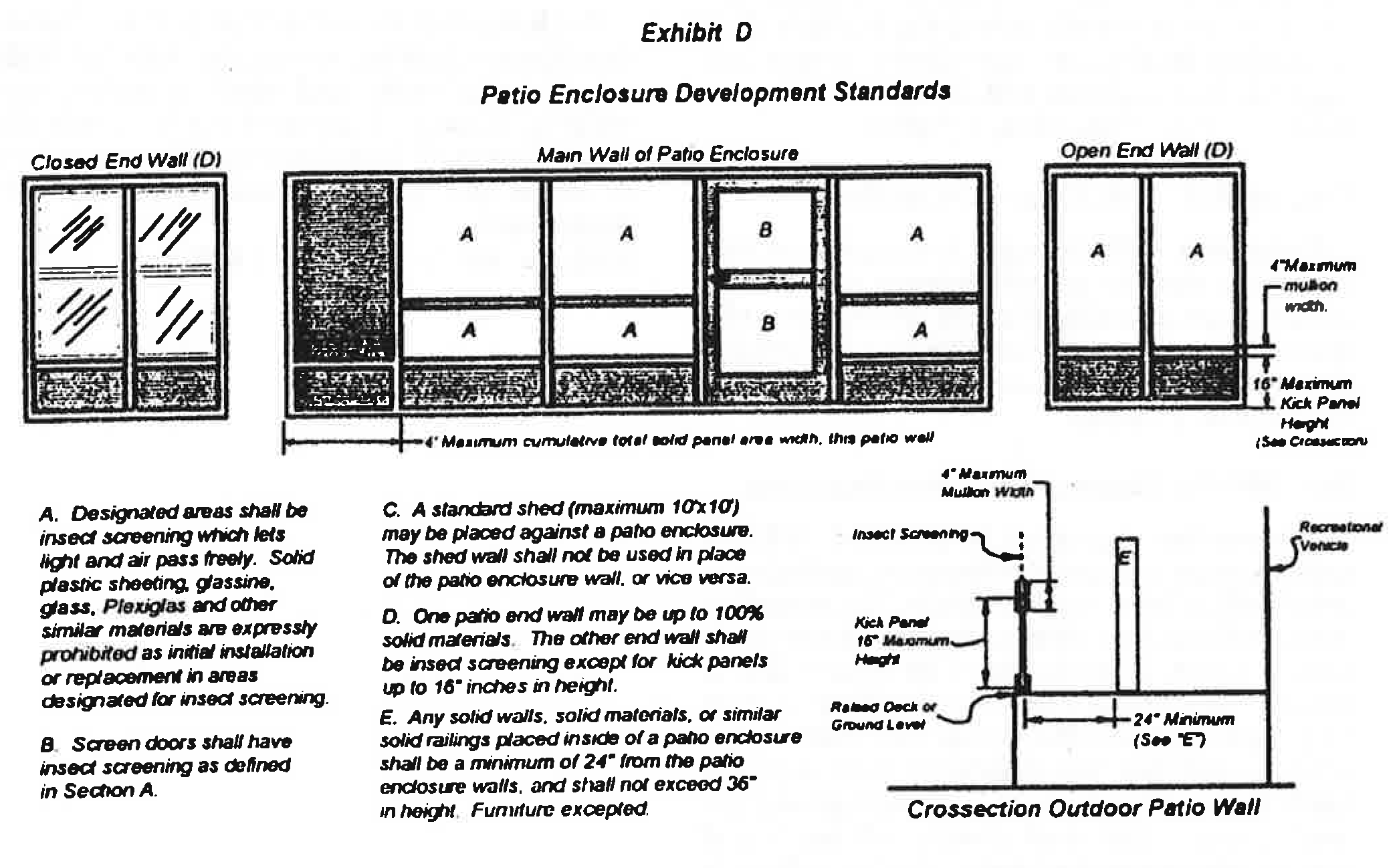
(Ord. No. 1211; Code 1984, § 22907; Ord. No. 1544, §§ 4—8, 5-28-96)
_____
Sec. 90-819. - Storage buildings.
The developer of a travel trailer planned development shall provide and install a minimum 80-square-foot, maximum 100-square-foot, storage building on each dwelling lot. The placement, construction and materials of the building shall be subject to planning commission review and approval in accordance with section 90-831.
(Ord. No. 1211; Code 1984, § 22908)
Sec. 90-820. - Pedestrian circulation.
Pedestrian walk-throughs a minimum of four feet wide shall be placed through dwelling lot rows in a travel trailer planned development at a spacing determined by the planning commission in accordance with section 90-831.
(Code 1984, § 22909)
Sec. 90-821. - Community recreation area.
A recreation area shall be provided within a travel trailer planned development, exclusive of any dwelling lot or required yards. The recreation area shall contain a clubhouse and outdoor recreational areas. A minimum of 90 square feet of community recreation area per dwelling lot shall be provided. The clubhouse shall be a minimum of 1,200 square feet. The clubhouse shall contain a kitchen, restroom, laundry, and storage and assembly areas. The final design and location of community recreational areas shall be subject to planning commission review and approval in accordance with section 90-831.
(Ord. No. 1058; Code 1984, § 22910)
Sec. 90-822. - Landscaping.
(a)
Park site. Required yards and community outdoor recreational areas in a travel trailer planned development shall be landscaped by the developer, in accord with a conceptual landscaping plan showing plant materials, location and sizes and submitted to the planning commission for review and approval. Final landscaping and irrigation plans in substantial conformance with the approved conceptual plan shall be submitted to the community development department for review and approval prior to the issuance of building permits. The landscaping shall be installed prior to occupancy of any dwelling lot.
(b)
Dwelling lot sites. See exhibit A of section 90-814 for minimum requirements.
(Ord. No. 1211; Code 1984, § 22911)
Sec. 90-823. - Refuse areas.
Trash disposal areas in a travel trailer planned development shall be conveniently located throughout the subdivision and shall be within easy walking distance of any dwelling lot. Trash disposal areas shall be designed and located subject to review and approval of the city public works department.
(Ord. No. 1058; Code 1984, § 22912)
Sec. 90-824. - off-street parking and loading.
(a)
off-street parking and loading shall be provided for each use in a travel trailer planned development as prescribed in article XL of this chapter.
(b)
Such space may be covered by a carport, except that at least two sides of the carport shall remain open and unobstructed.
(Ord. No. 1211; Code 1984, § 22913)
Sec. 90-825. - Walls.
Decorative masonry walls six feet in height shall be erected on all perimeter property lines of a travel trailer subdivision site. Fencing on individual lots within the project shall be determined at the time the conditional use permit is reviewed by the planning commission. Adequate openings shall be provided in the walls for pedestrian, vehicular and emergency access.
(Ord. No. 1211; Code 1984, § 22914)
Sec. 90-826. - Signs.
For requirements for signs in a travel trailer planned development, see article XXXVI of this chapter.
(Code 1984, § 22915)
Sec. 90-827. - Dogs and other animals.
An area in a travel trailer planned development shall be provided and used for a dog run. Dogs and other household pets shall not be permitted to run at large in a in a travel trailer planned development. Bird aviaries, rabbits, poultry or other barnyard animals shall not be permitted in any travel trailer planned development.
(Code 1984, § 22916)
Sec. 90-828. - Antennas.
Individual outdoor TV or radio antennas in excess of 18 inches above the recreational vehicle roof are prohibited in a travel trailer planned development. A central antenna system shall be provided by the developer, and shall be connected to each dwelling lot by underground wiring.
(Code 1984, § 22917)
Sec. 90-829. - Electrical service.
All new travel trailer subdivisions, not conversions, shall be wired for minimum 100-ampere underground electrical service to each unit, with 50-ampere pedestals initially installed.
(Code 1984, § 22918)
Sec. 90-830. - Declaration of covenants, conditions and restrictions.
A declaration of covenants, conditions and restrictions (CC&Rs) shall be prepared by the developer of a travel trailer planned development and submitted to the community development director and city attorney. The covenants, conditions and restrictions shall be signed and acknowledged by all parties having any record title interest in the property to be developed. The covenants, conditions and restrictions shall be reviewed and approved by the city and recorded prior to the issuance of building permits for the project. The covenants, conditions and restrictions shall be subject to the following conditions:
(1)
The covenants, conditions and restrictions shall be prepared at the developer's sole cost and expense.
(2)
The covenants, conditions and restrictions shall provide for the effective establishment, operation, management, use, repair and maintenance of all common areas and facilities.
(3)
The covenants, conditions and restrictions shall provide that the property shall be developed, operated and maintained so as not to create a public nuisance.
(Code 1984, § 22919)
Sec. 90-831. - Application for development approval.
(a)
Application for approval of a travel trailer planned development shall be made by the property owner or his authorized agent on a conditional use permit application form.
(b)
Except in those cases involving maintenance work or minor alterations, the applicant shall submit 25 prints of the development plan to the community development department. The plan shall be drawn in sufficient detail to clearly illustrate the design and details for which approval is sought. The plan shall show the following:
(1)
Existing conditions, contours, trees, natural features, structures, uses, improvements, public streets, easements and other rights-of-way.
(2)
A site plan showing:
a.
Proposed structures, including storage shed locations.
b.
Conceptual landscaping.
c.
Drainage.
d.
Resident and visitor parking.
e.
Community recreational and open space.
f.
Circulation.
g.
Lighting.
h.
Walls.
i.
Electrical and water service.
j.
Fire prevention facilities.
k.
Trash storage.
l.
Signage.
m.
Sufficient other information to demonstrate the proposed development.
(3)
A tentative tract map.
(4)
Such other information as may be required by the community development department to permit reasonable consideration of the application.
(5)
Conversion of existing travel trailer parks shall provide:
a.
An existing site plan in accordance with section (b)(2) of this section;
b.
A revised site plan clearly showing additional parking and landscaping and other modifications to comply with the intent and purpose of this article;
c.
Tentative tract maps; and
d.
Such other information as may be required by the community development department to permit reasonable consideration of the application.
(Code 1984, § 22920)
Sec. 90-832. - Required findings for development approval.
Before granting a conditional use permit for a travel trailer planned development, the planning commission shall make the following findings, in addition to those specified in section 90-1537(c):
(1)
That the travel trailer planned development is so designed and located as to afford adequate access for the transportation of and placement of recreational vehicles.
(2)
That the travel trailer planned development will be located and developed in a manner that permits adequate circulation to and within the proposed development for conventional emergency vehicles and equipment.
(3)
That the community recreational areas are easily accessible to all dwelling lots.
(4)
That the following elements are shown and so arranged that traffic congestion is avoided and pedestrian and vehicular safety are protected, and that there will be no adverse effect on adjoining property and uses:
a.
Building, structures and improvements.
b.
Vehicular ingress and egress and internal circulation.
c.
Setbacks.
d.
Height of buildings.
e.
Service areas.
f.
Walls.
g.
Landscaping.
h.
Drainage.
i.
Pedestrian circulation.
j.
Such other elements as are found to be relevant to the fulfillment of the purpose of the TTPD zone.
(5)
The planning commission shall deny approval of a final or tentative map if it makes any of the following findings:
a.
That the proposed map is not consistent with applicable general and specific plans.
b.
That the design or improvement of the proposed subdivision is not consistent with applicable general and specific plans.
c.
That the site is not physically suitable for the type of development.
d.
That the site is not physically suitable for the proposed density of development.
e.
That the design of the subdivision or the proposed improvements is likely to cause substantial environmental damage or substantially and avoidably injure fish or wildlife or their habitat.
f.
That the design of the subdivision or the type of improvements is likely to cause serious public health problems.
g.
That the design of the subdivision or the type of improvements will conflict with easements, acquired by the public at large, for access through or use of property within the proposed subdivision. In this connection, the city council may approve a map if it finds that alternate easements, for access or for use, will be provided, and that these will be substantially equivalent to ones previously acquired by the public. This subsection shall apply only to easements of record or to easements established by judgment of a court of competent jurisdiction, and no authority is granted by this subsection to a legislative body to determine that the public at large has acquired easements for access through or use of property within the proposed subdivision.
(Code 1984, § 22921)
Sec. 90-833. - Conversion of existing travel trailer parks—Generally.
(a)
Intent. It is the intent of this section to permit the conversion of existing travel trailer parks to travel trailer planned developments, if constructed prior to the effective date of the ordinance codified in this article (September 24, 1982). Such travel trailer parks shall be upgraded to be compatible with the intent and purpose of the development standards for travel trailer planned developments, and shall follow all requirements of this section dealing with conversions.
(b)
Development standards. In addition to the development standards in sections 90-813 through 90-829, the following shall apply:
(1)
Additional landscaping shall be required to provide soft edge materials in permanent locations to minimize the harsh appearance of existing streetscapes and site boundaries.
(2)
All main buildings, structures, driveways, landscape areas and irrigation systems, and additional elements as required by the community development department, shall be refurbished and restored as necessary to achieve a high-quality appearance, function and safety.
(Code 1984, § 22922)
Sec. 90-834. - Same—Authority to grant exceptions.
Exceptions may be granted with respect to dimensional requirements for lots, setbacks and other development standards of the TTPD zone for conversion of existing travel trailer parks where the planning commission finds as follows, in addition to the required findings of section 90-832 and article II, section 90-42 of this chapter, pertaining to conditional use permits:
(1)
The proposed modifications are reasonable and will not be detrimental to the health, safety and general welfare of the community.
(2)
The overall design and physical condition of this conversion will result in a project which is aesthetically attractive and safe.
(Code 1984, § 22923; Ord. No. 1903, § 2(Exh. 1), 8-11-15)
Sec. 90-835. - Same—Tenant's rights.
(a)
A written notice of intent to convert an existing travel trailer park to a travel trailer planned development shall be delivered to each tenant's dwelling unit, as well as to any prospective tenants, at least 60 days prior to the filing of a tentative map. Evidence of delivery shall be submitted with the application for conversion. The form of the notice shall be as approved by the community development department, and the notice shall contain not less than the following:
(1)
The name and address of the current owner;
(2)
The name and address of the proposed subdivider;
(3)
The approximate date on which the tentative map is to be filed;
(4)
The approximate date on which the final map or parcel map is to be filed;
(5)
The approximate date on which the unit is to be vacated by nonpurchasing tenants;
(6)
The tenant's right to purchase;
(7)
The tenant's right of notification to vacate;
(8)
The tenant's right of termination of lease;
(9)
The tenant's right of completion of the term of any existing lease;
(10)
A statement of limitation on rent increases;
(11)
Provision for special cases; and
(12)
Other information as may be deemed necessary by the department of community development.
(b)
Each tenant shall receive ten days' written notification that an application for a public report will be or has been submitted to the department of real estate, and that such report will be available on request.
(c)
Each tenant of the proposed conversion project shall be given written notification within ten days of approval of a final map.
(d)
Each tenant of the proposed conversion shall be given 180 days' written notice of intention to convert prior to termination of tenancy due to the conversion or proposed conversion.
(e)
Each tenant of the proposed conversion project shall be given notice of an exclusive right to contract for the purpose of his respective lot upon the same terms and conditions that such lot will be initially offered to the general public or terms more favorable to the tenant. The right shall run for a period of not less than 90 days from the date of issuance of the subdivision public report, unless the tenant gives prior written notice of his intention not to exercise the right.
(f)
Unless the tenant of the proposed conversion project was given notice of the intention to convert by the owner at the time the tenant executed his rental agreement, the owner shall permit the tenant to remain pursuant to the term of any existing lease, or for six months from the date of the issuance of the conversion permit, whichever is longer, at the existing space rental rate prior to the notice of intent to convert.
(g)
The written notices to tenants required by this section shall be deemed satisfied if such notices comply with the legal requirements for service by mail.
(h)
The provisions of this section shall not alter or abridge the rights or obligations of the parties in performance of their covenants, including but not limited to the provision of services, the payment of rent or the obligations imposed by Civil Code §§ 1941, 1941.1 and 1941.2.
(Code 1984, § 22923)
Sec. 90-836. - Same—Issuance of permits.
(a)
The building administrator shall issue a travel trailer planned development conversion permit when he determines that:
(1)
The applicant has complied with all applicable city and state regulations in effect at the time the conversion was approved; and
(2)
The applicant has complied with the conditions of approval.
(b)
Once issued, the conversion permit can be revoked only due to failure of the applicant or his successors in interest to comply with the conditions of approval.
(c)
A conversion permit shall expire if the tentative subdivision map application expires.
(Code 1984, § 22924)
Sec. 90-837. - Appeals.
Appeals under this article shall be in accordance with section 90-44.
(Code 1984, § 22925)

