
Hemet City Zoning Code
ARTICLE XIII
MULTIPLE-FAMILY ZONES11
Editor's note— Ord. No. 1868, § 1(Exh. A), adopted Aug. 13, 2013, amended art. XIII in its entirety to read as herein set out. Former art. XIII, §§ 90-381—90-385, pertained to similar subject matter, and derived from Ord. No. 1552, § 2, adopted January 28, 1997; Ord. No. 1581, § 2, adopted Feb. 24, 1998; Ord. No. 1622, § 1, adopted May 23, 2000; Ord. No. 1657, § 1, adopted Feb. 12, 2002; Ord. No. 1675, adopted Oct. 8, 2002; Ord. No. 1684, §§ 1—5, adopted May 27, 2003; Ord. No. 1782, § 1(Exh. A), § 2(Exh. B), adopted July 10, 2007; Ord. No. 1783, § 1, adopted July 10, 2007; Ord. No. 1798, § 2(c)(Exh. C), adopted May 27, 2008; Ord. No. 1852, § 4(Exh. C), adopted June 12, 2012; Ord. No. 1855, § 3(Exh. B, § 2), adopted Sept. 11, 2012.
Sec. 90-381.- Purposes.
(a)
The multiple-family zones provide areas for low-medium to very high density residential uses with a variety of housing types where adequate public facilities and services exist with the capacity to serve development. Commonly maintained on-site recreational facilities and open space are typically required to serve the more concentrated residential population.
(b)
The multiple-family zones implement the low-medium density to very high density residential designations of the general plan. The designations provide for multiple-family housing with allowable densities that range from five to 45 dwelling units per acre.
(Ord. No. 1868, § 1(Exh. A), 8-13-13)
Sec. 90-382. - Zones established.
(a)
R-2 (low density multiple family) zone. Provides for the development of low to medium density multiple-family residential uses with density not to exceed eight dwelling units per acre. Typical housing units may include detached or attached single-family homes, duplexes, or other low-medium density housing types. The R-2 zone is consistent with the low-medium density residential (LMDR) designation of the general plan.
(b)
R-3 (medium-high density multiple family) zone. Provides for the development of medium to high density multiple-family residential uses with density not to exceed 30 dwelling units per acre. Typical housing units may include townhouses, condominiums, cluster developments, apartments, or residential care facilities. R-3 development is typically located near commercial nodes, school sites, parks, and other activity centers. The R-3 zone is consistent with the medium density residential (MDR) and high density residential (HDR) designations of the general plan.
(c)
R-4 (high density multiple family) zone. Provides for the development of high to very high density multiple-family residential uses with density not to exceed 45 dwelling units per acre. Typical housing units may include townhouses, condominiums, apartments, or residential care facilities that integrate functionally and aesthetically with nearby transit-corridors, commercial centers, parks, bike trails, and other transportation and recreational systems. The R-4 zone is consistent with the very high density residential (VHDR) designation of the general plan.
(Ord. No. 1868, § 1(Exh. A), 8-13-13; Ord. No. 1949, § 8(Exh. A, 8), 9-25-18)
Sec. 90-383. - Permitted uses.
In the R-2, R-3 and R-4 zones, permitted and conditionally permitted uses shall be as listed within the Land Use Matrix.
(Ord. No. 1868, § 1(Exh. A), 8-13-13; Ord. No. 1892, § 1(Exh. A2), 12-9-14; Ord. No. 1901, § 2(Exh. 2), 4-14-15; Ord. No. 1919, § 1(Exh. 5), 9-27-16; Ord. No. 1940, § 2(Exh. B), 12-12-17; Ord. No. 1964(2020-003), § 2, 2-25-20; Ord. No. 1965(2020-004), § 4, 2-25-20; Ord. No. 1969(2020-008), § 3, 5-12-20; Ord. No. 1972, § 2, 2-9-21)
Sec. 90-385. - General requirements.
(a)
New development projects in the multiple-family residential zones are subject to pre-application review as provided in section 90-49 and site development review as provided in section 90-48. Development of the site and structures shall be consistent with all applicable design guidelines.
(b)
All multiple-family development projects shall comply with the adopted city's design guidelines for multiple-family residential uses.
(c)
Prior to the construction of any building or structure a building permit shall be required in accordance with the latest city-adopted California Building Code, and shall meet all Hemet Municipal Code and applicable state and federal code requirements.
(d)
Developments projects established within the boundaries of the Hemet-Ryan Airport land compatibility zones shall be in accordance with the adopted airport land use plan.
(e)
Whenever a commercial or rental unit business is conducted, a city business license is required pursuant to chapter 18 of the Hemet Municipal Code. The owners or agent of all existing and proposed rental units shall be required to register with the city as a non-owner occupied residential rental unit.
(f)
The following are minimum requirements, unless otherwise noted, and shall apply to all land, buildings, and structures in their respective zones. All area dimensions are in square feet, unless otherwise noted. All linear dimensions are in feet, unless otherwise noted.
(Ord. No. 1868, § 1(Exh. A), 8-13-13; Ord. No. 1900, § 5(Exh. 2), 4-14-15; Ord. No. 1930, § 2(Exh. A-2), 6-13-17; Ord. No. 1949, § 8(Exh. A, 8), 9-25-18)
Sec. 90-386. - Site development requirements.
(a)
Measurement of yards.
(1)
A required yard or other open space around an existing or proposed building shall not be used to meet a required yard or other open space for any other building on an adjoining lot or building site.
(2)
Garage doors shall not, when open or being opened, project beyond any lot line.
(b)
Building projections into yards.
(1)
Cornices, eaves, belt courses, sills, canopies, chimneys, bay windows or other similar architectural features may extend or project into a required yard of the zone up to two feet, six inches. In no case shall the projection be closer than three feet from another structure or property line.
(2)
Open, unenclosed porches, platforms or landing places not covered by a roof or canopy, which do not extend above the level of the first floor of the building, may extend or project into any required front, side or rear yard, or into a court six feet. A 42-inch high openwork railing may be installed or constructed on any such porch, platform or landing space.
(3)
Open, unenclosed stairways or balconies, not covered by a roof or canopy, may extend or project into a required rear yard three feet, and such balconies or stairways may extend into a required front yard not more than the required exit dimension. In no case shall the projection be closer than three feet from another structure or property line.
(4)
Fire escapes may extend or project into any required yard four feet; provided, however, that at least a three-foot clearance to the property line is maintained.
(5)
The director may allow additions to an existing, legally constructed structure, sited in accordance with the laws and setbacks in effect at the time of the construction, within the currently required front, side, and/or rear setback. The building addition or the sum of all additions shall not exceed 50 percent of the floor area of the original structure. For additions in the front yard, the building shall occupy no more than 25 percent of the lineal frontage of the existing building. The director shall deny any addition when it has been determined to be harmful to the health and safety of the resident or the area. In no case shall any addition be closer than 15 feet to the ultimate street right-of-way. The addition shall not exceed the coverage requirements of the zone.
(c)
Height exceptions. Structures permitted above a specified height limit may be erected as follows: Structures or walls for the housing of elevators, stairways, tanks, ventilating fans or similar structures, skylights, towers, steeples, flagpoles, chimneys, smokestacks, wireless masts, radio and television masts, water tanks, silos or similar structures, provided that no roof structure, as listed in this subsection, or any space above the height limit specifically prescribed for particular zones, shall be allowed or used for the purpose of providing usable floor space in excess of that reasonably required to maintain such structures and shall not be used for signage. The maximum area that can utilize the height exception is limited to ten percent of the roof area.
(d)
Accessory buildings.
(1)
Accessory structures shall meet the required setbacks and lot coverage requirements of the zone in which they are located, except that accessory structures less than 120 square feet in area and less than eight feet in height which are not permanently affixed to the ground may be located as close as three feet to interior side or rear property lines. In no instance shall any accessory structure be placed closer to the front property line than the principal structure(s).
(2)
Accessory structures shall be architecturally compatible with the principal structure(s).
(3)
An accessory structure shall:
a.
Be consistent with the regulations of the zone in which it is located and any conditions of project approval;
b.
Not be detrimental to the public health, safety and welfare particularly that of adjacent properties; and
c.
Not detract from the residential character of the project and the surrounding neighborhood.
(4)
All accessory structures shall be screened to the maximum intent possible with landscaping, fencing, or combination thereof, so as to minimize visual impacts from adjacent rights-of-way and from adjoining properties.
(e)
Placement of buildings in the R-2, R-3 and R-4 zones. Placement of buildings shall be as prescribed in section 90-385, except that there shall be a minimum distance between buildings as follows:
(f)
Open space and recreational facilities in the R-2, R-3 and R-4 zones. The following minimum open space and recreational facility requirements shall apply:
(1)
Required area. Each new apartment project of three or more units shall provide the following usable open space, which shall be exclusive of the front yard setback:
a.
Common open space.
1.
A minimum of 250 square feet of common open space shall be provided for each dwelling unit. Common open space shall have no dimension less than 25 feet. A minimum of 1,000 square feet of common open space shall be required for any project. Common open space shall be planned and located so that the maximum number of units derives benefit by being adjacent to common open space areas.
2.
The design and orientation of open space shall be oriented to take advantage of available sunlight and should be sheltered from the noise and traffic of adjacent streets.
b.
Private open space.
1.
Generally. An average of 125 square feet of private open space shall be provided per unit, with a minimum dimension of seven feet. The following minimum private open space shall be provided for each unit type:
i.
One-bedroom or studio: 100 square feet.
ii.
Two- or more-bedroom: 150 square feet.
2.
Ground floor space. The patio area shall be completely enclosed on all sides by a minimum 42-inch up to a six-foot high decorative fence or masonry wall.
3.
Above ground floor space. Private balconies or lanais shall have at least one exterior side open above railing height.
(2)
Minimum open space improvements. The common open space shall be improved as indicated in this subsection:
Footnotes:
a. At least one-third of the common open space shall be in one or more pool areas, with the pool area having no dimension less than 75 feet.
b. At least one-half of the common open space shall be in one or more pool areas, with the pool area having no dimension less than 100 feet.
c. Recreational buildings are optional, and may be located in the common open space areas. The buildings will be a minimum of 1,000 square feet in size, up to a maximum of 2,500 square feet. Total square footage of all buildings shall not exceed ten percent of the required common open space, or 7,500 square feet, whichever is smaller. If recreational buildings are proposed, the amount of required common open space may be reduced by two square feet for every one square foot of building provided.
(3)
Adjustments. The director may adjustment the type of facilities required when alternate facilities provide specific benefit to the type of occupancy anticipated.
(g)
Parking in the R-3 and R-4 zones, except for parking lots. The following minimum requirements for parking shall apply:
(1)
No off-street parking area shall be located facing or adjacent to a required front yard, except for the placement of residential garages and driveways.
(2)
Parking is discouraged adjacent to a side street frontage; however, if parking is placed adjacent to a side street frontage, trees, shrubs, and berms shall be installed in sufficient quantity and size to visually screen vehicles and carport or garage structures.
(h)
Service and refuse areas. All service areas, refuse collection areas and trash bins shall conform with the setback requirements and shall be completely screened by a solid fence or wall, or shall be enclosed within a building in accordance with the adopted standards of the city.
(i)
Walls, fencing, screening and landscaping. This subsection provides for the regulation of location and height of walls, fencing, screening and landscaping so as to allow the enjoyment of the use of property and for the safety of persons using sidewalks and streets related to the property.
(1)
Lower density multiple family residential projects with seven or fewer units shall meet the following standards.
a.
Solid walls, fences, screening or hedge plantings in any required front yard setback shall be a maximum of 42 inches in height when measured from the adjacent sidewalk or street in order to maintain safe visibility for pedestrians and egress and ingress of vehicular traffic. A combination of solid and open fences not exceeding 72 inches in height is permitted provided the solid part of such fence, screening, or hedge does not exceed 42 inches. Pilasters to a maximum height of 72 inches are permitted if spaced a minimum of ten feet on center with a maximum width of 18 inches.
b.
Open fencing shall be a minimum of 75 percent open with the space between the solid material being three times the width of the solid material. The solid materials are limited to wrought iron, tubular steel, vinyl, or similar material.
c.
Prohibited materials are chain link, chain link with slats, plexiglass, electric, hog wire, woven, barbed wire, and similar materials. Wood is prohibited in excess of 42 inches in height regardless of design.
d.
Replacement fencing of any nonconforming material is subject to the provisions of division 2 of article II of this chapter regarding nonconforming uses.
e.
A wall, fence or hedge up to six feet in height may be located parallel to the edge of the sidewalk on the street side yard adjacent to the lot up to the front yard setback, whether the sidewalk area is monolithic or has a planted parkway.
f.
On corner lots the corner cutback area shall be free and clear of visual obstructions in excess of 42 inches in height. The corner cutback shall be defined by a line on a horizontal plane connecting two points along the front and street side property lines and forming a triangle. These points shall be measured 30 feet back from the intersection of the prolongation of the front and street side property lines.
g.
On lots where the driveway is adjacent to the rear yard of a neighboring lot the corner cutback area shall be free and clear of visual obstructions in excess of 42 inches in height. The cutback lines shall be determined by measuring from the projection of the coterminous front and rear property line ten feet along the inside edge of the sidewalk and ten feet back from the street connecting the two points forming a 45-degree triangle.
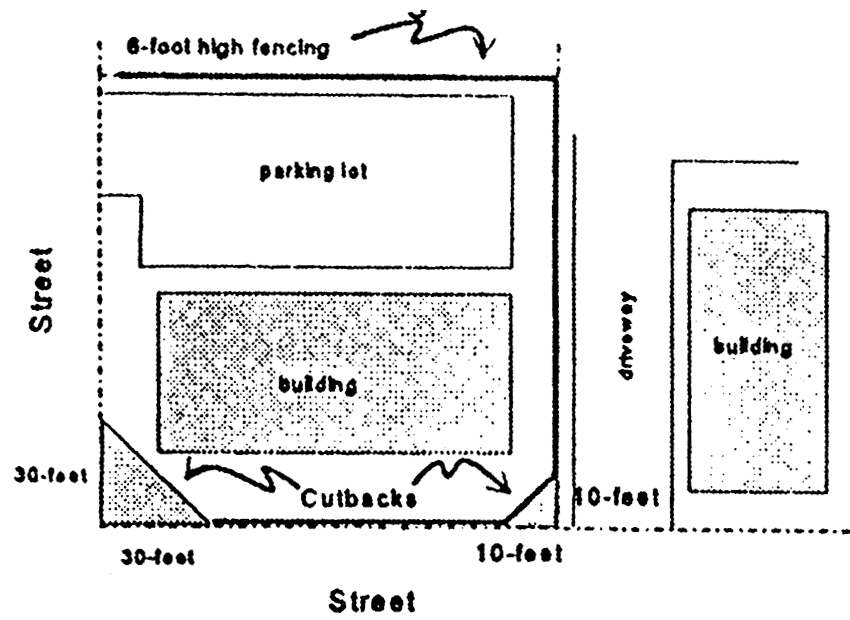
Corner Cutback Lines
h.
When a retaining wall is necessary, the combined retaining wall and hedge, walls or fence shall not be permitted to exceed six feet in height along the street side yard or reverse corner lot and nine feet in height along interior or rear property lines.
(2)
Higher density multiple family residential projects with 8 or more units shall meet the following standards.
a.
Fencing shall be wrought iron, tubular steel, vinyl, or similar materials or a combination of solid and open fencing no higher than 72 inches in height. The solid component shall not exceed 42 inches in height in order to maintain safe visibility for pedestrians, vehicular traffic, and to not hinder surveillance activities of the police. Greater heights may be allowed for security reasons subject to the requirements of section 90-386(i)(6).
b.
The color of the fencing shall be either black, white or beige. Any other color requires approval by the director.
c.
Pilasters shall be up to 18 inches square, and the distance between pilasters shall be at least eight feet edge to edge for the main run of the fence.
d.
Gates shall provide emergency access with the installation of a Knox box system or other similar method approved by the fire department.
e.
Access shall be provided for essential city services, including, but not limited to, refuse pickup.
f.
A means of access to visitor parking spaces, such as call boxes, shall be provided to the public.
g.
Intersection and driveway visibility is maintained by limiting opaque fencing, including pilasters, to 42 inches in height within cutback areas.
h.
Adequate area for vehicle stacking at the entrances and exits of the development shall be provided and approved by the city traffic engineer.
i.
Concertina, razor, barbed wire, electrified or chain link materials are expressly prohibited.
j.
A minimum of five feet of live landscaping shall be planted between the curb and fence line (i.e., within the parkway), to soften the appearance of the fence.
k.
Fencing constructed in accordance with this section shall obtain appropriate building permits and inspections. Plans shall be submitted to the building department for review and approval by all affected departments prior to the issuance of permits. The project shall meet applicable requirements of the I.C.B.O. Uniform Building Code, uniform fire code, and related codes.
(3)
Wall and landscape buffer for yards adjoining certain uses. When a site adjoins a single-family zone, or a site general planned for low density single-family use, a solid masonry wall six feet in height shall be located adjoining the property line, except adjoining a required front yard; and an area at least five feet in depth adjoining the property line shall be landscaped with live plant material, including trees. Where a carport or garage is placed within three feet of a property line adjoining a single-family zone or a site general planned for low density single-family use, no landscaped buffer is required.
(4)
Block walls. Block walls or opaque fencing or landscaping materials used for screening purposes shall not be placed within any required front yard or street side yards. Block walls or opaque fencing may be used in other locations.
(5)
Swimming pool fencing. Swimming pools shall be entirely enclosed by buildings, fences or walls. Prior to filling the pool the required fencing must be in place and approved by the city building department.
(6)
Security fencing. Nothing in this section shall be deemed to set aside or reduce the requirements established for security fencing by either local, state or federal law, or by safety requirements of the board of education. A fence or wall shall be constructed along the perimeter of all areas considered by the director to be dangerous to the public health and safety. The height of fence or wall in excess of six feet in height shall be as determined by the director in relation to the danger or hazard involved. Such fence or wall may be required when a use requires a permit, or at the discretion of the director, according to the danger or hazard involved.
(7)
Landscaping. Where landscaping is required by this chapter, it shall consist predominantly of plant materials, except for necessary walks and drives. Planted areas, where prescribed, shall be landscaped exclusively with live plant materials. Required landscaping shall be installed in accord with landscaping standards approved by the planning commission and shall be of types and sizes prescribed in the standards. All screening and landscaping shall be permanently maintained in an orderly condition. Plant materials shall be watered, weeded, pruned and replaced as necessary to screen or ornament the site.
(j)
Buffer with adjacent uses. All multifamily projects shall provide adequate buffering to adjoining or adjacent uses. This can be accomplished through implementation of the following:
(1)
Grade levels shall be maintained at an equal or lower level than adjacent uses unless there are unique topographical features.
(2)
When adjoining a single-family residential use a minimum landscape setback of 20 feet in addition to the five feet per story required under section 90-385.
(3)
When the adjacent land use is other than single-family residential, the minimum landscape setback shall be ten feet in addition to the five-foot per story required under section 90-385.
(k)
Lighting. All on-site lighting shall be shielded to prevent off-site glare.
(1)
All outdoor lighting shall be designed to illuminate uses, while minimizing light trespass into neighboring areas.
(2)
The candlepower of outdoor lighting shall be the minimum required for safety purposes.
(3)
Light for safety purposes shall be provided at entryways, along walkways, between buildings, and within parking areas.
(4)
All lights shall be directed, oriented, and shielded downward to prevent light from shining onto adjacent properties, onto public rights-of-way, and into driveway areas in a manner that would obstruct drivers' vision.
(5)
Light sources shall not be located in required buffer areas, except those required to illuminate pedestrian walkways.
(l)
Laundry facilities. Common laundry facilities shall be provided for multifamily projects, unless provided in individual units, at a minimum ratio of one washing machine/dryer for every ten units. Laundry facilities shall be located on each floor unless elevators are provided.
(Ord. No. 1868, § 1(Exh. A), 8-13-13; Ord. No. 1919, § 1(Exh. 5), 9-27-16; Ord. No. 1966(2020-005), § 2, 2-25-20; Ord. No. 1972, § 2, 2-9-21)
Sec. 90-387. - Senior residential projects.
The following development standards shall be applied to apartment, condominium or similar residential units for senior residential projects permitted within the R-2, R-3 and R-4 zones. In the event that specific development standards are not set forth in this section, the standards contained in section 90-385 and 90-386 shall apply.
(1)
Density. Density shall be within the density limitations of the applicable zone. Density bonuses shall be allowed as permitted by Government Code § 65915 et seq., and chapter 90, article VI of the Hemet Municipal Code.
(2)
Floor area. The interior floor area of the individual senior housing units may be reduced below the minimum floor area per unit types required in section 90-385, provided that additional square footage is allocated to common area activity centers or facilities. In no case shall a one-bedroom unit be less than 460 square feet or a two-bedroom unit be less than 690 square feet.
(3)
Accessibility. Dwelling units shall be constructed with Americans with Disabilities Act-compliant features in accordance with state and federal accessibility requirements.
(4)
Parking. Parking requirements shall be subject to chapter 90, article XL of the Hemet Municipal Code.
(5)
Occupancy. The occupancy of all dwelling units within an approved senior-only housing development shall be secured by appropriate conditions, covenants, and restrictions (CC&Rs) recorded against the property and provided to the city prior to the issuance of building permits.
(6)
Open space reduction. Senior-only housing developments may request a reduction in private and common open space required per unit pursuant to this article, provided that compensating alternative indoor, recreational or outdoor open space amenities is approved by the community development director or the planning commission as a component of the site development review.
(7)
Wall and landscape buffer for yards adjoining certain uses. Where a site adjoins a single-family zone or a site general planned for low-density single-family use, a solid masonry wall six feet in height shall be located adjoining the property line, except adjoining a required front yard; and an area at least five feet in depth adjoining the property line shall be landscaped with live plan materials, including trees. Where a carport or garage is placed within three feet of a property line adjoining a single-family zone or a site general planned for low density single-family use, no landscape buffer is required.
(8)
Recreational facilities. An indoor recreation building or space shall be provided for each senior development project based on the following:
a.
For developments of 20 units up to 100 units, a minimum of 1,200 square feet, or 25 square per unit, whichever is greater;
b.
For developments with 100 or more units, a minimum of 1,600 square feet, or ten square feet per unit, whichever is greater, to a maximum requirement of 4,000 square feet;
c.
The recreation building shall provide the following uses: kitchen, library, dining and game playing area, restrooms and conversation and lounging areas. An outdoor patio and recreation area shall be provided in addition to these uses.
(9)
Elevators. Any project two stories in height or greater shall be furnished with an elevator large enough to accommodate a gurney, which shall be accessible to all units higher than the first floor.
(Ord. No. 1868, § 1(Exh. A), 8-13-13)
Sec. 90-420. - Objective design and development standards.
This section creates objective design and development standards for multiple family and mixed use development projects which are set out in article XIV below. Article XIV functions as an overlay zone additive to the standards of the R-3 zone set forth in section 90-382 above.
(Ord. No. 1987, § 1, 12-14-21)
Cross reference— Section 90-48, site development review standards; Article XIV, Multifamily Residential and Mixed-Used Objective Development and Design Standards, Sections 90-421—90-432.

