
Hemet City Zoning Code
ARTICLE XI
SINGLE-FAMILY RESIDENTIAL ZONES9
Editor's note— Ord. No. 1552, § 2, adopted Jan. 28, 1997, reorganized the residential zones by deleting §§ 90-311—90-321 and adding new §§ 90-311—90-315. Formerly, such sections pertained to similar provisions and derived from Ord. No. 1216, §§ 21400—22410 of the 1984 Code; Ord. No. 1240; Ord. No. 1520, § 1, 5-23-95; Ord. No. 1335; Ord. No. 1246; Ord. No. 1286; Ord. No. 1335.
Sec. 90-311.- Purposes.
The purpose of the single-family residential zones is to:
(1)
Comply with the overall purposes stated in section 90-1 relating to the purpose of the zoning ordinance.
(2)
Provide properly located family living areas based on a wide range of population densities in conformity with the general plan;
(3)
Protect residential properties from noise, odors, smoke, dirt, vibration, glare, fire, explosion, noxious fumes, unsightliness and other hazards or objectionable influences;
(4)
Protect residential properties from congestion and nuisances caused by commercial and industrial traffic;
(5)
Ensure adequate privacy, light, air and usable open space for each dwelling unit;
(6)
Provide a variety of housing opportunities with a move-up market and quality of life amenities that serve existing residents and attract new residents;
(7)
Encourage land use and community design practices that balance growth and infrastructure, encourage smart growth principles, achieve a citywide jobs and housing balance, and otherwise implement the goals and polices of the general plan; and
(8)
Implement the RR (rural residential), LDR (low density residential), LMDR (low and moderate density residential), and MDR (medium density residential) land use designations of the general plan.
(Ord. No. 1552, § 2, 1-28-97; Ord. No. 1653, § 1, 10-9-01; Ord. No. 1919, § 1(Exh. 1), 9-27-16)
Sec. 90-312. - Permitted uses.
In the R-R, R-1-5, R-1-6, R-1-7.2, R-1-10, R-1-20, R-1-40 zones, permitted and conditionally permitted uses shall be as listed within the "land use matrix." Whenever a business is conducted, even if it is a home occupation, a city business license is required pursuant to chapter 18. All other uses not specifically listed in the matrix shall be interpreted as not permitted unless a similar use determination is made by the community development director pursuant to section 90-3. Uses located within the Hemet-Ryan Airport Influence Area are subject to the requirements of the Riverside County Airport Land Use Plan.
(Ord. No. 1566, § 2(B), 8-26-97; Ord. No. 1581, § 2, 2-24-98; Ord. No. 1591, § 1(2), 9-29-98; Ord. No. 1653, § 1, 10-9-01; Ord. No. 1684, § § 1—5, 5-27-03; Ord. No. 1798, § 2(b)(Exh. B), 5-27-08; Ord. No. 1852, § 4(Exh. B), 6-12-12; Ord. No. 1855, § 3(Exh. B, § 1), 9-11-12; Ord. No. 1901, § 2(Exh. 2), 4-14-15; Ord. No. 1919, § 1(Exh. 1), 9-27-16; Ord. No. 1926, § 1(Exh. A), 4-25-17; Ord. No. 1946, § 1, 7-24-18; Ord. No. 1949, § 6(Exh. A, 6), 9-25-18; Ord. No. 1965(2020-004), § 3, 2-25-20; Ord. No. 1969(2020-008), § 2, 5-12-20; Ord. No. 1972, § 2, 2-9-21)
Sec. 90-313. - Zones established.
The single family residential zones are established in accordance with the standards of this article and as shown on the official zoning map pursuant to section 90-6.
(1)
R-R rural residential zone: To provide for the development of large residential lots or parcels that may combine the attributes of rural and urban living, to allow for commercial crop production in appropriate areas, and to preclude premature or untimely land development at urban densities in areas inappropriate or ill-suited for such development.
(2)
R-1 single-family zone: To provide for the development of single-family homes at a variety of lot sizes:
a.
R-1-5: minimum lot size 5,000 square feet.
b.
R-1-6: minimum lot size 6,000 square feet.
c.
R-1-7.2: minimum lot size 7,200 square feet.
d.
R-1-10: minimum lot size 10,000 square feet.
e.
R-1-20: minimum lot size 20,000 square feet.
f.
R-1-40: minimum lot size 40,000 square feet.
(Ord. No. 1919, § 1(Exh. 1), 9-27-16; Ord. No. 1926, § 1(Exh. A), 4-25-17; Ord. No. 1946, § 2, 7-24-18)
Sec. 90-314. - General requirements.
(a)
New development projects in the single family residential zones are subject to pre-application review as provided in section 90-49 and site development review as provided in section 90-48 of this chapter. Development of the site and structures shall be consistent with all applicable design guidelines.
(b)
Prior to the construction of any building or structure a building permit shall be required in accordance with the latest city-adopted uniform building code. The following are minimum requirements, unless otherwise noted, and shall apply to all land, buildings, and structures in their respective zones. All area dimensions are in square feet, unless otherwise noted. All linear dimensions are in feet, unless otherwise noted.
(c)
Development projects established within the boundaries of the Hemet-Ryan Airport Influence Area shall be in accordance with state airport land use law.
(d)
Subdivisions located in the R-1-5 and the R-1-6 zones with a lot size average of less than 7,200 square feet are subject to the compensating open space/park guidelines for small lot projects referenced in the city's single-family residential design guidelines.
(e)
The following are minimum requirements, unless otherwise noted, and shall apply to all land, buildings, and structures in their respective zones. All area dimensions are in square feet, unless otherwise noted. All linear dimensions are in feet, unless otherwise noted.
(f)
Allowed projections into setback areas. Maximum allowed projections shall be as follows, except that in all instances a minimum 36-inch wide passageway shall be maintained adjacent to the primary structure. The passageway shall be free of any obstructions including fences, mechanical equipment, and storage containers.
(Ord. No. 1552, § 2; Ord. No. 1581, § 2; Ord. No. 1653, § 1; Ord. No. 1748, § 3; Ord. No. 1900, § 5(Exh. 2), 4-14-15; Ord. No. 1919, § 1(Exh. 1), 9-27-16; Ord. No. 1926, § 1(Exh. A), 4-25-17; Ord. No. 1946, §§ 3, 4, 7-24-18; Ord. No. 1982, § 1, 9-28-21)
Sec. 90-315. - Site development requirements.
(a)
In addition to the requirements of this article, the approving authority shall consider the following:
(1)
The integration of natural features into the site plan, where appropriate, including rock formations, streambeds, unique vegetation, and hillsides.
(2)
The use of grading and landscape design to enhance visual interest, reduce conflicts between land uses, accommodate drainage and treatment, and improve stormwater management.
(3)
The incorporation of sustainable land use and community design practices into site design including walkable neighborhoods, sense of place, preservation of open space, and crime free environmental design.
(b)
No manufactured home shall be installed on a lot zoned for single-family dwellings if more than ten years has elapsed between the date of manufacture of the manufactured home and the date of the application for the permit to install the manufactured home in the subject zone. This exclusion shall not apply to legally permitted manufactured homes converting from a pier foundation system to a permanent foundation system.
(c)
Single-family residential design guidelines that are established by resolution of the city council provide examples of design solutions to code requirements and are applicable to all new single-family residential projects to complement the mandatory standards contained in this article. Where there is a conflict or lack of clarity, the provisions of this article shall apply.
(d)
Single-story dwelling supplemental requirements in projects of five or more lots.
(1)
A minimum of 25 percent of the units in a tract/project shall be one-story dwellings.
(2)
Only units having a minimum 15 percent one-story element shall be plotted on corner lots.
(e)
Architectural supplemental requirements in projects of two or more lots.
(1)
The design of infill projects shall be compatible with adjoining neighborhoods in terms of massing, building heights, setbacks, and architectural style.
(2)
Architectural trim features such as window moldings, recessed windows, shutters, or similar features shall be provided on all front, side, and rear façades, which are visible from public view.
(3)
At least 25 percent of any front and side façade shall be of a different building material to provide contrast. This requirement is waived for architectural styles that dictate uniformity of building materials.
(4)
Alternative garage orientations and variations in front yard setbacks shall be incorporated into project design.
(f)
Site design supplemental requirements in all single-family residential projects.
(1)
Front yard design is subject to the city's landscape design standards.
(2)
Private rear yard open space. A minimum flat, useable rear yard area is required in square footage equal to five percent of lot area.
(3)
Trash collection area. A concrete pad with a minimum size of three feet by ten feet shall be provided in the rear side yard adjacent to a minimum 42-inch wide walkway to the front driveway or sidewalk to accommodate the trash bins and shall be screened from public view. For alley collection, other options may be provided.
(g)
Second story design criteria. To mitigate privacy impacts and the visual mass and bulk of new multi-story homes and additions built adjacent to existing single-story homes.
(1)
Applicability.
a.
These requirements shall apply to new multi-story homes, multi-story decks, multi-story additions, modifications to the existing multi-story decks and/or new windows on existing multi-story homes that increase privacy impacts on neighboring residents.
b.
These requirements shall not apply to:
1.
Skylights;
2.
Windows with sills more than five feet above the finished second floor;
3.
Obscured, non-openable windows;
4.
Windows with permanent exterior louvers to a height of five feet above the second floor;
5.
Non-operable windows with obscure glass to a height of five feet above the second floor; and
6.
When waivers have been obtained by all affected property owners.
(2)
Options. The applicant shall select from the following options a design that achieves the intent of this section.
(3)
Second story.
a.
Where adjacent to an existing single-story home, the second story of all structures shall be located with a 35-degree plane beginning at the adjacent property line.
b.
Where adjacent to an existing single-story home, a minimum of 100 percent of the second story adjacent façade shall be stepped back from the ground floor adjacent façade a minimum of 15 feet. This option exempts additional planting plan.
c.
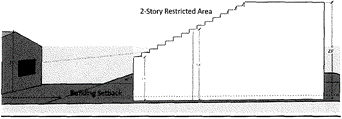
A no build envelope shall be established for every one foot in building height, the structure shall step back at least two feet where adjacent to an existing single-story home. The measurement shall begin at the rear or adjacent property line.
d.
Windows and balconies shall be offset to avoid direct sight lines into and from neighboring properties.
e.
Where adjacent to an existing single-story home, the minimum distance between any bedroom in the existing single-story home and the upper level of the new structure shall be a minimum of 50 feet, unless window orientation and design completely restricts visibility. Subject to review and approval by the planning division.
f.
For the purposes of this section, the term "adjacent to a single-story home" shall mean property that shares a boundary with, including at a point, any property that contains an existing single-story structure zoned and used for residential purposes.
(4)
Planting plan and windows.
a.
Windows. Proposals for a new multi-story homes, multi -story decks, multi -story additions, modifications to the existing multi -story decks, and/or new windows on existing multi -story homes shall be accompanied by a planting plan which identifies the location, species and canopy diameter of existing and proposed trees or shrubs to meet the requirements in subsection b. below.
b.
Privacy planting.
1.
New trees and/or shrubs are required on the applicant's property in an area bounded by a 30-degree angle on each side and rear window jamb.
2.
The applicant shall provide the planning division with a list of proposed privacy planting trees and shrubs. The list includes allowed plant species, minimum size of trees and shrubs, caliper of tree five feet above soil. expected canopy or spread size, and planting distance between trees. The minimum tree size shall be 24-inch box at the time of planting or as approved by the planning division to ensure privacy screening is achieved.
3.
In any residential zone, the minimum height of privacy trees at the time of planting shall be 12 feet. The trees and/or shrubs shall be planted prior to issuance of a final occupancy permit.
4.
Waivers.
a)
New trees and/or shrubs are not required to replace existing front or privacy trees or shrubs if an internationally certified arborist or licensed landscape architect verifies that the existing trees/shrubs have the characteristics of privacy planting species, subject to approval by the director of community development.
b)
Affected property owner(s) may choose to allow privacy planting on their own property. In such cases, the applicant must plant the privacy screening prior to issuance of a building permit.
c)
The privacy mitigation measures may be modified in any way with a signed waiver statement from the affected property owner. Modifications can include changes to the number of shrubs or trees, their species or location.
5.
The property owner shall record a covenant with the Riverside County Recorder's Office that requires the retention of all privacy planting, or use of existing vegetation as privacy planting, and required front yard trees, prior to receiving a final building inspection from the building division.
6.
Maintenance. The required plants shall be maintained. Landscape planting maintenance includes irrigation, fertilization and pruning as necessary to yield a growth rate expected for a particular species.
7.
Replacement. Where required planting is removed or dies it must be replaced within 30 days with privacy tree(s) of similar size as the tree(s) being replaced, unless it is determined to be infeasible by the director of community development.
c.
Windows. The following is required for all side and rear yard-facing multi-story windows in residential zones:
1.
Cover windows with exterior louvers to a height of five feet above the second floor; or
2.
Obscure glass to a height of five feet above the second floor; or
3.
Have a windowsill height of five feet minimum above the finished second floor.
(Ord. No. 1581, § 2; Ord. No. 1653, § 1; Ord. No. 1675; Ord. No. 1684, § §§ 1—5; Ord. No. 1748, § 3; Ord. No. 1919, § 1(Exh. 1), 9-27-16; Ord. No. 1992, § 1, 3-8-22)
Sec. 90-316. - Walls, fencing, and screening.
This section provides for the regulation of location and height of walls, fencing, screening and landscaping so as to allow the enjoyment of the use of the property and the safety of persons using sidewalks and streets related to the property.
(1)
Fencing in the front yard setback is subject to the following provisions:
a.
Solid walls, fences, screening or hedge plantings in any required front yard setback shall be a maximum of 42 inches in height when measured from the adjacent sidewalk or street in order to maintain safe visibility for pedestrians and the egress and ingress of vehicular traffic. A combination of solid and open fences not exceeding 72 inches in height is permitted provided the solid part of such fence, screening, or hedge does not exceed 42 inches. Pilasters to a maximum height of 72 inches are permitted if spaced a minimum of ten feet on center with a maximum width of 18 inches.
b.
Open fencing shall be a minimum of 75 percent open with the space between the solid material being three times the width of the solid material. The solid materials are limited to wrought iron, tubular steel, vinyl, or similar material.
c.
Prohibited materials are chain link, chain link with slats, plexiglass, electric, hog wire, woven, barbed wire, and similar materials. Wood is prohibited in excess of 42 inches in height regardless of design.
d.
Replacement fencing of any nonconforming material is subject to the provisions of division 2 of article II of this chapter regarding nonconforming uses.
(2)
On a corner lot a wall, fence or hedge up to six feet in height may be located parallel to the edge of the sidewalk on the street side yard adjacent to the lot up to the front yard setback, whether the sidewalk area is monolithic or has a planted parkway.
(3)
On corner lots, the corner cutback area shall be free and clear of visual obstructions in excess of 42 inches in height. The corner cutback shall be defined by a line on a horizontal plane connecting two points along the front and street side property lines and forming a triangle. These points shall be measured 30 feet back from the intersection of the prolongation of the front and street side property lines.
(4)
On lots where the driveway is adjacent to the rear yard of a neighboring lot the corner cutback area shall be free and clear of visual obstructions of 42 inches in height. The cutback lines shall be determined by measuring from the projection of the coterminous front and rear property line ten feet along the inside edge of the sidewalk and ten feet back from the street connecting the two points forming a 45-degree triangle.
(5)
Fencing, screening, hedges along interior and rear property lines may not exceed 72 inches in height.
(6)
When a retaining wall is necessary, the combined retaining wall and hedge, walls or fence shall not be permitted to exceed six feet in height along the street side yard or reverse corner lot and nine feet in height along interior or rear property lines.
(7)
Wall and fencing supplemental requirements in projects of five or more lots.
a.
Perimeter fencing. All perimeter fencing adjacent to the public right-of-way shall be decorative block, textured concrete or stucco with pilasters and caps and/or other material consistent with any adopted policy, guideline or standard in effect at time of approval. Wrought iron view fences are also permitted with pilasters and caps. Chain link fencing is prohibited.
b.
Interior lot fencing. Interior lot line fencing shall be comprised of masonry block, vinyl, wood, or other materials that comply with any adopted policy, guideline, or standard in effect at the time of approval.
c.
Gates. Gates and front yard returns visible to the public right-of-way shall be comprised of painted or stained wood, vinyl, wrought iron or tubular steel, or other materials that comply with any adopted policy, guideline, or standard in effect at the time of approval. Chain link gates are prohibited.
d.
A six-foot-high masonry wall shall be constructed along the perimeter of any lots that are placed adjacent to an existing church, school, commercial use, or public facility.
(8)
Swimming pool fencing. Swimming pools shall be entirely enclosed by buildings, fences or walls. Prior to filling the pool, the required fencing or walls must be in place and approved by the city building department.
(Ord. No. 1919, § 1(Exh. 1), 9-27-16; Ord. No. 1966(2020-005), § 1, 2-25-20; Ord. No. 1972, § 2, 2-9-21)
Editor's note— Ord. No. 1919, § 1(Exh. 1), adopted September 27, 2016, repealed the former § 90-316, and enacted a new § 90-316 as set out herein. The former § 90-316 pertained to hillside development, and those provisions are now set forth in article XII of this chapter. The former § 90-316 derived from Ord. No. 1653, § 1, adopted on October 9, 2001; and Ord. No. 1903, § 2(Exh. 1), adopted August 11, 2015.
Sec. 90-317. - Landscaping.
(a)
All new development must comply with the provisions of article XLVIII of this chapter.
(b)
Landscape guidelines that are established by resolution of the city council provide examples of landscaping solutions to code requirements and are applicable to all new single-family residential projects to complement the mandatory standards contained in this article and article XLVIII. Where there is a conflict or lack of clarity, the provisions of this chapter shall apply.
(c)
Landscaping on existing single-family residential properties is subject to the following minimum standards:
(1)
All areas in the front or side yard setback visible from the public right-of-way and not covered by structures, driveways, or hardscape shall be landscaped.
(2)
Parkways, located between the curb and the sidewalk, are the responsibility of the property owner and shall be landscaped and maintained.
(3)
Appropriate landscape includes drought tolerant plants, groundcover, bushes, and trees or a combination of living and non-living groundcover such as decorative rock, bark, artificial turf, or decomposed granite.
(Ord. No. 1919, § 1(Exh. 1), 9-27-16)
Sec. 90-318. - Measurement of yards.
(a)
A required yard or other open space around an existing or proposed building shall not be used to meet a required yard or other open space for any other building on an adjoining lot or building site.
(b)
Garage doors shall not, when open or being opened, project beyond any lot line.
(c)
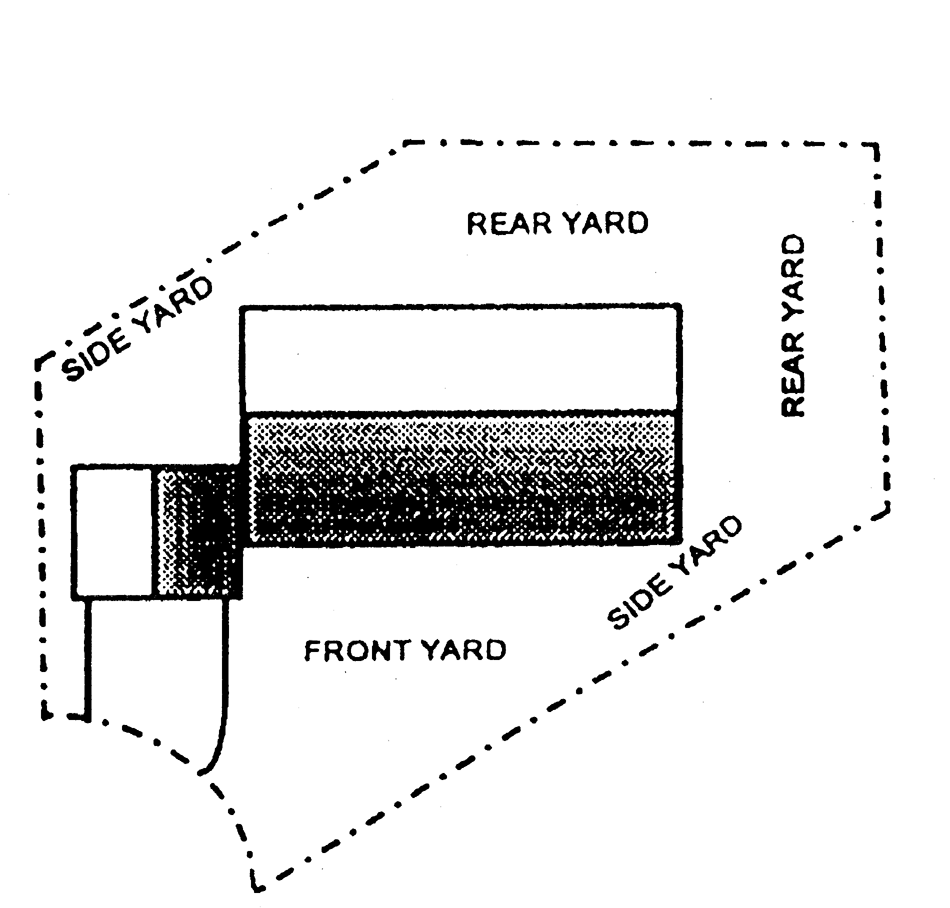
On most lots the required yards shall be as defined in section 90-4. On lots of unusual shape the director shall determine the front, rear and side yard areas based upon the location of the entrance to the house, the address of the house, the floor plan of the house, the slope of the lot, and other similar considerations. The yards shall be indicated on a site plan and maintained on file along with the building permit, see figure 1 below.
Figure 1
(d)
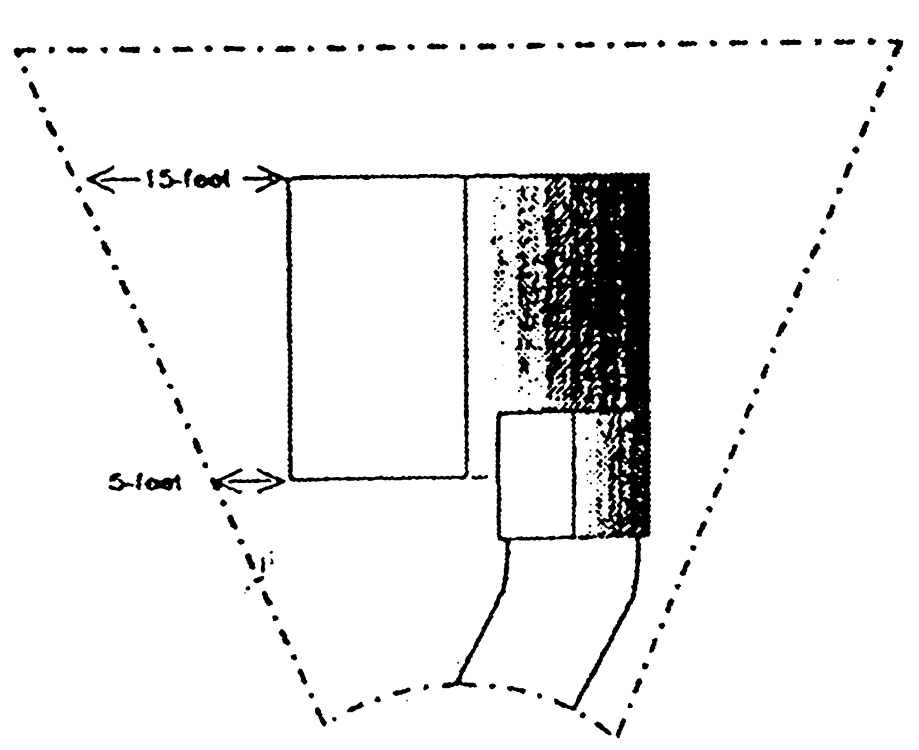
On lots at the terminus of a cul-de-sac street and lots on the knuckle of a street the required setbacks of this section shall be an average of the closest and furthest setback from the proposed building. For example if the closest side yard setback is five feet the furthest side yard setback on that same side is 15 feet, the average setback would be ten feet. In no case shall the required yard be less than five feet, see figure 2 below.
Figure 2
(Ord. No. 1919, § 1(Exh. 1), 9-27-16)
Sec. 90-319. - Height measurement and height limit exceptions.
(a)
Maximum height shall be measured as the vertical distance from the finished grade to an imaginary plan located parallel to the finished grade at a height allowed by the zone.
(b)
Structures permitted above a specified height limit may be erected follows: structures or walls for the housing of elevators, stairways, tanks, ventilating fans or similar structures, skylights, towers, steeples, flagpoles, chimneys, smokestacks, wireless masts, radio and television masts, water tanks, silos or similar structures, provided that no roof structure, as listed in this subsection, or any space above the height limit specifically prescribed for particular zones, shall be allowed or used for the purpose of providing usable floor space in excess of that reasonably required to maintain such structures and shall not be used for signage.
(Ord. No. 1919, § 1(Exh. 1), 9-27-16)
Sec. 90-320. - Accessory structures (non-dwelling).
(a)
An accessory structure is as defined in section 90-4. An accessory structure greater than 120 square feet is required to obtain a building permit.
(b)
Accessory structures shall meet the required setbacks and lot coverage maximum of the zone in which they are located with the following exception: Accessory structures less than 120 square feet in area and less than eight feet in height which are not permanently affixed to the ground may be located as close as three feet to interior side or rear property lines. In no instance shall any accessory structure be placed closer to the front property line than the principal structure.
(c)
The total area of all accessory structures shall not exceed 50 percent of the floor area of the principal structure. On lots of one acre or larger, accessory structures may be constructed in excess of 50 percent of the principal structure upon review and approval of an administrative adjustment application by the community development director and subject to the following criteria:
(1)
The accessory structure is otherwise consistent with the regulations of the zone in which it is located;
(2)
The accessory structure is not detrimental to the public health, safety and welfare particularly that of adjacent properties; and
(3)
The accessory structure does not detract from the residential character of the surrounding neighborhood.
(d)
Accessory structures shall not exceed the following height limits:
(1)
Garage, carport, portable covers: 20 feet.
(2)
Gazebo, greenhouse, playhouse, outdoor play equipment, stationary barbeque, storage shed, stationary compost bin, and other accessory structures: 15 feet.
(3)
Structures located within five feet of a side yard or rear yard property line: eight feet.
(e)
Accessory structures shall be architecturally compatible with the principal structure and adhere to the following criteria:
(1)
For accessory structures over 120 square feet, compatibility shall include the structures' primary color and construction materials;
(2)
A garage installed in conjunction with a manufactured home shall be frame-constructed (e.g., wood, engineered wood, or structural steel) on a permanent concrete foundation;
(3)
For portable carports and/or RV covers, compatibility shall be limited to the structures' primary color.
(f)
All accessory structures shall be screened to the maximum intent possible with landscaping, fencing, or combination thereof, so as to minimize visual impacts from adjacent rights-of-way and from adjoining properties.
(Ord. No. 1919, § 1(Exh. 1), 9-27-16; Ord. No. 1957, § 3, 6-11-19)
Sec. 90-321. - Accessory dwelling units.
(a)
General provisions.
(1)
An application for an accessory dwelling unit ("ADU") or junior accessory dwelling unit ("JADU") shall be submitted to the building department for building plan check approval and shall be permitted ministerially without discretionary review or public hearing if it meets the definitions. The purpose of this chapter is to allow and regulate accessory dwelling units ("ADUs") and junior accessory dwelling units ("JADUs") in compliance with state law governing accessory dwelling units, including Government Code tit. 7, ch. 13, div. 1, as may be amended from time to time. To the extent state law is more permissive than this chapter, state law shall control.
(2)
An application for an ADU or JADU shall be submitted to the building department for building plan check approval and shall be permitted ministerially without discretionary review or public hearing if it meets the definitions and criteria listed in this section and all other applicable zoning, building, and health and safety codes.
a.
If the city has not acted upon a completed application for an ADU or JADU within 60 days from submission of a complete application, and the applicant has not requested a delay, the application shall be deemed approved, unless the permit application is to create a new single family or multifamily dwelling on the lot, in which case the city shall not act on the permit application for the ADU or JADU until the city acts on the permit application for the new dwelling unit. The city shall determine whether an ADU or JADU application is complete within 15 business days of submission. If the application is incomplete, the city shall provide the applicant with a written list of items needed to make the application complete and shall review resubmittals only for the items identified in the incompleteness determination, consistent with state law.
b.
If the city denies an application for an ADU or JADU, the city shall provide in writing a full set of comments within 60 days to the applicant from the date of receipt of a completed application, with a list of items that are defective or deficient, and a description of how the application can be remedied, in accordance with applicable state law.
c.
An ADU or JADU may not be used for short-term rentals. If rented shall be for a term longer than 30 days.
d.
Occupancy of an ADU or JADU shall not be allowed until the city approves occupancy of the primary dwelling unit.
(3)
For the purposes of meeting the city's applicable regional housing needs allocation as contained in the adopted housing element, ADUs may be reported as progress towards meeting these goals.
(4)
Authority to designate areas. The city may designate areas within the jurisdiction where ADUs may be permitted based on the adequacy of water and sewer services and the impact of accessory dwelling units on traffic flow and public safety. However, where the city has not designated such areas, ADUs shall be permitted in all areas zoned for residential or mixed use pursuant to this section and applicable state law, as may be amended from time to time.
(5)
An ADU shall only be allowed on a residentially zoned lot under this article that contains an existing or proposed single-family or existing multiple-family residence.
(6)
For purposes of calculating allowable density, an ADU is not counted as an additional unit.
(b)
Definitions.
Accessory dwelling unit (ADU) means an attached or detached residential dwelling unit which provides complete independent living facilities for one or more persons and is located on a lot with a proposed or existing primary residence. It shall include permanent provisions for living, sleeping, eating, cooking, and sanitation on the same parcel as the single-family or multifamily dwelling. An ADU also includes the following:
(1)
An efficiency unit, as defined in Health and Safety Code § 17958.1.
(2)
A manufactured home, as defined in Health and Safety Code § 18007.
Accessory structure means a structure that is accessory and incidental to a dwelling located on the same lot.
Junior accessory dwelling (JADU) unit means an accessory dwelling unit that is no more than 500 square feet in size and is contained entirely within a single-family residence. It includes its own separate sanitation facilities, kitchen, or shares sanitation facilities with the existing or proposed single-family structure.
Efficiency unit has the same meaning as defined in Health and Safety Code § 17958.1.
Impact fee has the same meaning as the term "fee," as defined in subdivision (b) of Government Code § 66000, except that it also includes fees specified in Government Code § 66477. "Impact Fee" does not include any connection fee or capacity charge by a local agency, special district, or water corporation.
Livable space or interior livable space has the same meaning as defined in applicable state law and means the interior habitable area of a dwelling unit intended for human habitation, including living, sleeping, eating, cooking, or sanitation. This measurement is based on net square footage and does not include exterior walls, garages, or uninhabitable spaces.
Living area means the interior habitable area of a dwelling unit, including basements and attics, but does not include a garage or any accessory structure.
Local agency means a city, county, or city and county, whether general law or chartered.
Multifamily dwelling means two or more attached primary dwelling units.
Nonconforming zoning condition means a physical improvement on a property that does not conform with current zoning standards.
Objective standards means standards that involve no personal or subjective judgment by a public official and are uniformly verifiable by reference to an external and uniform benchmark or criterion available and knowable by both the development applicant or proponent and the public official prior to submittal.
Permitting agency means any entity that is involved in the review of a permit for an accessory dwelling unit or junior accessory dwelling unit and for which there is no substitute, including, but not limited to, applicable planning departments, building departments, utilities, and special districts.
Primary dwelling unit means the single-family dwelling or each multifamily dwelling unit, but does not include an ADU or JADU. An attached garage is considered part of the primary dwelling unit.
Proposed dwelling means a dwelling that is the subject of a permit application and that meets the requirements for permitting.
Public transit means a location, including, but not limited to, a bus stop or train station, where the public may access buses, trains, subways, and other forms of transportation that charge set fares, run on fixed routes, and are available to the public.
Passageway means a pathway that is unobstructed clear to the sky and extends from a street to one entrance of the accessory dwelling unit.
Tandem parking means that two or more automobiles are parked on a driveway or in any other location on a lot, lined up behind one another, provided that the vehicles do not extend over the public sidewalk or right-of-way.
(c)
General criteria. An ADU shall meet the following criteria.
(1)
The ADU may be rented separate from the primary residence and may be sold or conveyed separately from the primary residence only if the requirements in applicable state law for separate conveyance are met.
(2)
The ADU may be either attached to, or located within, the proposed or existing primary dwelling, including attached garages, storage areas, or similar uses, or detached from the primary dwelling.
(3)
The number of ADUs that may be established on a lot shall be as follows, consistent with state law:
a.
On lots with a proposed or existing single-family dwelling:
1.
Up to two detached ADUs are permitted;
2.
Up to one attached ADU is permitted; and
3.
Up to one JADU is permitted.
4.
The detached and attached ADUs and JADUs may be established concurrently or separately, provided the total number of primary dwellings and ADUs/JADUs does not exceed four on any lot zoned for single-family residential uses.
b.
On lots with existing multifamily dwellings:
1.
No more than two detached ADUs on a lot with proposed multifamily dwelling, or up to four detached ADUs on a lot with an existing multifamily dwelling if each detached ADU satisfies all of the following:
(i)
The side- and rear-yard setbacks are at least four feet. If the existing multifamily dwelling has a rear or side yard setback of less than four feet, the city will not require any modification to the multifamily dwelling as a condition of approving the ADU.
(ii)
The peak height above grade does not exceed the height limit provided in section 90-321(c)(15)(A).
(iii)
Provided the number of detached ADUs does not exceed the number of primary dwelling units on the lot.
2.
Up to 25 percent of the number of existing multifamily units may be attached ADUs, with a minimum of one ADU allowed; and
3.
Up to 25 percent of the existing multifamily dwelling units may be created within portions of existing multifamily dwelling structures that are not used as livable space, with a minimum of one ADU allowed.
c.
On parcels created through an SB 9 lot split: No more than two units (including ADUs and JADUs) on a parcel created through a Senate Bill 9 (Chapter 162, Statutes of 2021) lot split shall be allowed, and in no case shall the total number of primary dwellings and ADUs/JADUs exceed four on the two parcels collectively.
(4)
A lot having an ADU shall not be subdivided in a manner that would allow for the principal dwelling unit and the ADU to be located on separate lots that do not meet the development standards required by the underlying zone, unless otherwise permitted by state law.
(5)
The maximum interior livable space of an attached ADU is 850 square feet for a studio or one-bedroom unit and 1,000 square feet for a unit with two or more bedrooms, consistent with state law. An attached ADU that expands the existing primary dwelling by more than 150 square feet shall not exceed 50 percent of the existing primary dwelling's floor area.
(6)
The maximum interior livable space of a detached ADU is 850 square feet for a studio or one-bedroom unit and 1,000 square feet for a unit with two or more bedrooms, except that a detached ADU meeting the simplified approval standards may not exceed 800 square feet of interior livable space, consistent with state law.
(7)
Unless otherwise provided in this subsection, an ADU shall comply with the required standards and setbacks of the zone in which it is located.
a.
No setback shall be required for an ADU that is constructed in the same location and to the same dimensions as an existing structure that is converted to an ADU.
b.
A setback of no more than four feet from the side and rear lot lines shall be required for an ADU that is not converted from an existing structure or a new structure constructed in the same location and to the same dimensions as an existing structure.
c.
The minimum side, street-side, and rear yard setback shall be four feet, except when converting or replacing an existing accessory structure that is less than four feet from those lot lines.
(8)
Parking requirements.
a.
When a garage, carport, uncovered parking space, or covered parking structure is demolished in conjunction with the construction of an ADU or is converted to an ADU, no replacement off-street parking spaces are required.
b.
Generally, no parking is required for ADUs or JADUs. However, one parking space per ADU or per bedroom, whichever is less, may be required for detached ADUs only, except as provided in subsection c. The required parking space may be provided as tandem parking on a driveway or in setback areas.
c.
Notwithstanding any other provision in this section, no parking standards shall be imposed for an ADU in the following instances:
1.
The ADU is located within one-half mile walking distance of public transit.
2.
The ADU is located within an architecturally and historically significant and designated historic district.
3.
The ADU is part of the proposed or existing primary residence or an existing accessory structure.
4.
When on-street parking permits are required but not offered to the occupant of the ADU.
5.
When there is a car share vehicle located within one block of the ADU.
6.
When the ADU permit application is submitted concurrently with a permit application to create a new single-family or new multifamily dwelling on the same lot.
(9)
No passageway shall be required in conjunction with the construction of the ADU.
(10)
An accessory dwelling unit shall be architecturally compatible with the principal dwelling unit. Compatibility shall be based on the architectural style, construction materials, and primary color of the principal dwelling unit.
(11)
An ADU shall not be considered a new residential use for the purpose of calculating connection fees or capacity charges for utilities, including water and sewer services, unless the ADU is constructed with a new single-family dwelling, consistent with applicable state law, as may be amended from time to time. The city may require a new or separate utility connection directly between the ADU and the utility service.
(12)
Impact fees.
a.
No impact fee is required for an ADU or JADU that is less than 750 square feet of interior livable space. Additionally, ADUs and JADUs that are 500 square feet or less of interior livable space are exempt from school fees, consistent with applicable state law, as may be amended from time to time.
b.
Any impact fee required for an ADU that is 750 square feet or more in size shall be charged proportionately in relation to the square footage of the primary dwelling unit (e.g. the floor area of the ADU divided by the floor area of the primary dwelling, times the typical fee charged for a new dwelling), consistent with applicable state law.
(13)
Prior to issuance of a certificate of occupancy for a JADU, a deed restriction shall be recorded that runs with the land and specifies that the JADU may not be sold separately from the primary single-family dwelling, that the JADU is restricted to the maximum square footage, and includes other requirements of state law for JADUs, as may be amended from time to time. For ADUs, a deed restriction is required only if the ADU is to be sold separately, in which case it must comply with applicable state law regarding separate conveyance.
(14)
The city will not deny an application for an ADU or JADU due to a nonconforming zoning condition, building code violation, or unpermitted structure that does not threaten public health and safety and is unaffected by the construction of the ADU or JADU, consistent with applicable state law. For ADUs constructed before January 1, 2020, the city may not deny a permit to legalize the ADU based on violations of building standards or noncompliance with ADU law, except where correcting the violation is necessary to protect health and safety as defined in applicable state law, as may be amended from time to time.
(15)
Height standards.
a.
For one-story detached ADUs, the maximum height shall be 16 feet.
b.
Transit-oriented height. Where the detached ADUs is located within one-half mile walking distance of a major transit stop or a high-quality transit corridor, as defined in Public Resources Code § 21155, or is adjacent to or abuts a multi-story multifamily dwelling, then the maximum height limit for a one-story detached ADUs is 18 feet.
c.
The maximum height for a two-story detached ADU over a garage shall be 25 feet, provided that:
1.
The structure maintains a minimum setback of ten feet from the side and rear property lines(s) of any abutting single-family use property. The side and rear setbacks may be reduced to the setbacks prescribed for detached accessory structures or garages in the underlying zone, or if the setback of an existing garage is legal nonconforming; and
2.
The structure complies with the privacy and design compliance requirements of section 90-315(g).
d.
Notwithstanding subsections a and b above, an attached ADU may be constructed to the maximum height allowed for a primary dwelling in the underlying base zone, provided that the ADU complies with all objective front, side, and rear yard setbacks applicable to the primary dwelling in the base zone as well as the privacy and design compliance requirements of section 90-315(g).
e.
An additional two feet in height shall be allowed to accommodate a roof pitch on an ADU that is aligned with the roof pitch of the primary dwelling unit.
f.
When an existing accessory structure is converted to a detached ADU, the maximum height may equal the height of the existing accessory structure.
g.
An attached ADU may not exceed 25 feet in height and two stories, or the maximum height allowed in the base zone for the primary dwelling, whichever is lower.
(16)
Development standards. ADUs shall comply with all applicable base zone district objective development standards (e.g. lot coverage, floor area ratio, open space, front setbacks, minimum lot size) unless the application of those standards would physically preclude the construction of at least an 800-square-foot ADU with four-foot side and rear setbacks. The city may require that the property be used for rentals of terms 30 days or longer.
(17)
Utilities and safety. All ADUs shall be connected to public utilities or their equivalent, including water, electric and sewer, unless the ADU was constructed with a new single-family dwelling. The city may require separate address identification for an ADU to facilitate emergency responses. Fire sprinklers shall only be required in an ADU or JADU if sprinklers are required in the primary residence, consistent with applicable state law.
(d)
Special criteria for junior accessory dwelling units. JADUs shall be subject to the following requirements, in addition to or, where conflicting, in lieu of the general requirements in subsection (c) of this section. To the extent that any of the requirements of the subsection (d) conflict with the requirements of subsection (c), the provisions of this subsection (d) shall control.
(1)
If necessary, an expansion of no more than 150 square feet to the physical dimensions of the existing structure may be added to accommodate ingress and egress to the JADU.
(2)
The JADU must include a cooking facility with appliances and a food preparation counter and storage cabinets that are of reasonable size in relation to the size of the junior accessory unit.
(3)
The JADU may include separate bathroom facilities or may share sanitation facilities with the existing structure.
(4)
No more than one JADU is permitted on a single lot.
(5)
The owner of the single-family residential home in which the JADU is located must reside in either the remaining portion of the home or in the newly created JADU unit, unless the JADU includes separate sanitation facilities, in which case owner-occupancy is not required. Owner-occupancy is also not required if the owner is another governmental agency, land trust, or housing organization, consistent with applicable state law, as may be amended from time to time.
(6)
A JADU shall not be metered separately from the principal dwelling unit for gas, electricity, and water/sewer services, and shall not be considered a separate residential use for purposes of connection fees or capacity charges, or for the purposes of fire or life protection ordinances or regulations.
(7)
Size. A JADU shall be no more than 500 square feet of interior livable space and contained entirely within a single-family residence. The minimum interior livable space of a JADU unit shall be 150 square feet, consistent with applicable state law.
(e)
Conflicting standards and compliance with state law. To the extent that any provision of this section conflicts with or is less permissive than state law governing ADUs and JADUs, state law shall prevail. This ordinance is intended to comply with all applicable state laws governing accessory dwelling units and junior accessory dwelling units, as may be amended from time to time, and shall be interpreted consistent with such laws. Where this section is silent, state law standards apply.
(Ord. No. 1919, § 1(Exh. 1), 9-27-16; Ord. No. 1940, § 1(Exh. A), 12-12-17; Ord. No. 1964(2020-003), § 1, 2-25-20; Ord. No. 1972, § 2, 2-9-21; Ord. No. 2072, § 2, 3-10-26)
Sec. 90-322. - Appeals.
Appeal of a decision of the planning commission or the community development director or designee may be made pursuant to section 90-48(6).
(Ord. No. 1919, § 1(Exh. 1), 9-27-16)

