
Hemet City Zoning Code
ARTICLE XIV
MULTIFAMILY RESIDENTIAL AND MIXED-USE OBJECTIVE DEVELOPMENT AND DESIGN STANDARDS
Sec. 90-421.- Purpose.
This article establishes design standards for multifamily residential projects and mixed-use development projects that include a multifamily residential component. These design standards work in tandem with the development standards of the applicable zone to advance the city's goal to promote site planning and building design that is functional, rich in variety, well proportioned, constructed of durable materials of high quality, and visually appealing; that promotes long-lasting community investment; and that encourages the development of workforce housing. The goal is also to provide the means to streamline development approval for qualifying applications that meet all requirements for the applicable zone and the design standards set forth in this article, as well as approval of projects with a qualifying density bonus.
(Ord. No. 1987, § 1, 12-14-2021)
Sec. 90-422. - Applicability.
These standards apply to all multifamily residential developments and all mixed-use developments in which at least two-thirds of the floor area consists of residential use, including project applications with a qualifying density bonus. These standards shall apply in addition to and [in] concert with the standards of the applicable zone.
(Ord. No. 1987, § 1, 12-14-2021)
Sec. 90-423. - Density bonus and modification of standards.
Pursuant to article VI (density bonuses) of this chapter, and section 90-164 (concessions and incentives for qualifying housing developments containing lower-, very low-, and moderate-income units) in particular, the approval body has the authority to grant incentives or concessions for qualifying housing development applications. For the purpose of article VI, the standards in this section can be considered for the granting of incentives or concessions.
(Ord. No. 1987, § 1, 12-14-2021)
Sec. 90-424. - Terms.
(a)
Building types. The terms describe the accommodation of units within multifamily residential buildings. Other building types for other uses allowed in the zone do not use these terms.
(1)
Townhouse. A building up to two stories in height with private entrances to each individual unit, with entrances generally located on the ground floor. Units generally are attached, with common side walls, although the type may include bungalow courts.
(2)
Stacked. Multistory building(s) with unit entrances on any floor and entry to buildings generally through a common lobby area.
(3)
Low-rise. Two-story building(s) in conformance within the maximum height allowed in the zone.
(4)
Mid-rise. Three- to five-story building(s) in conformance within the maximum height allowed in the zone. Conventional features include a single point of entry to the building with units are accessed inside the building via stairs, corridors/hallways, and elevators.
(5)
Walkup. Any building over one story in height that lacks an elevator to access units.
(b)
Site layout. The terms describe the arrangement of site improvements as it relates to any one of the building types.
(1)
Clustered. A type of open space development that is predominantly open spaces encircling a compact arrangement of structures, improvements, and paved areas.
(2)
Courtyard. A type of building and open space layout where structures create horizontal and vertical enclosure of landscaped common open or outdoor space area (courtyard). Examples include bungalow court, garden court, and cottage court, and courtyard apartments, and similar courtyard housing.
(3)
Garden-style. A type of site layout characterized by landscaped open spaces that surround multiple two-story buildings containing five units or more that are identical in architectural design. The open spaces typically are contiguous area linked by pathways.
(4)
Mixed-use. A development site containing residential and commercial uses. Each type of use may occupy the same structure or occupy separate buildings. Such building types can include stacked dwelling, lined blocked, flex block, and tower on podium. Mid-rise multifamily building type dwellings may also be combined with nonresidential use as part of a mixed-use development.
(c)
Street wall. Any exterior wall of a building abutting a public street.
(Ord. No. 1987, § 1, 12-14-2021)
Sec. 90-425. - Site design.
(a)
Applicability. This section applies to improvements located on the surface of the site including, but not limited to buildings, landscaping, service areas, paths of travel, and open spaces.
[(b)]
Building layout.
(1)
Low-rise building layout.
(i)
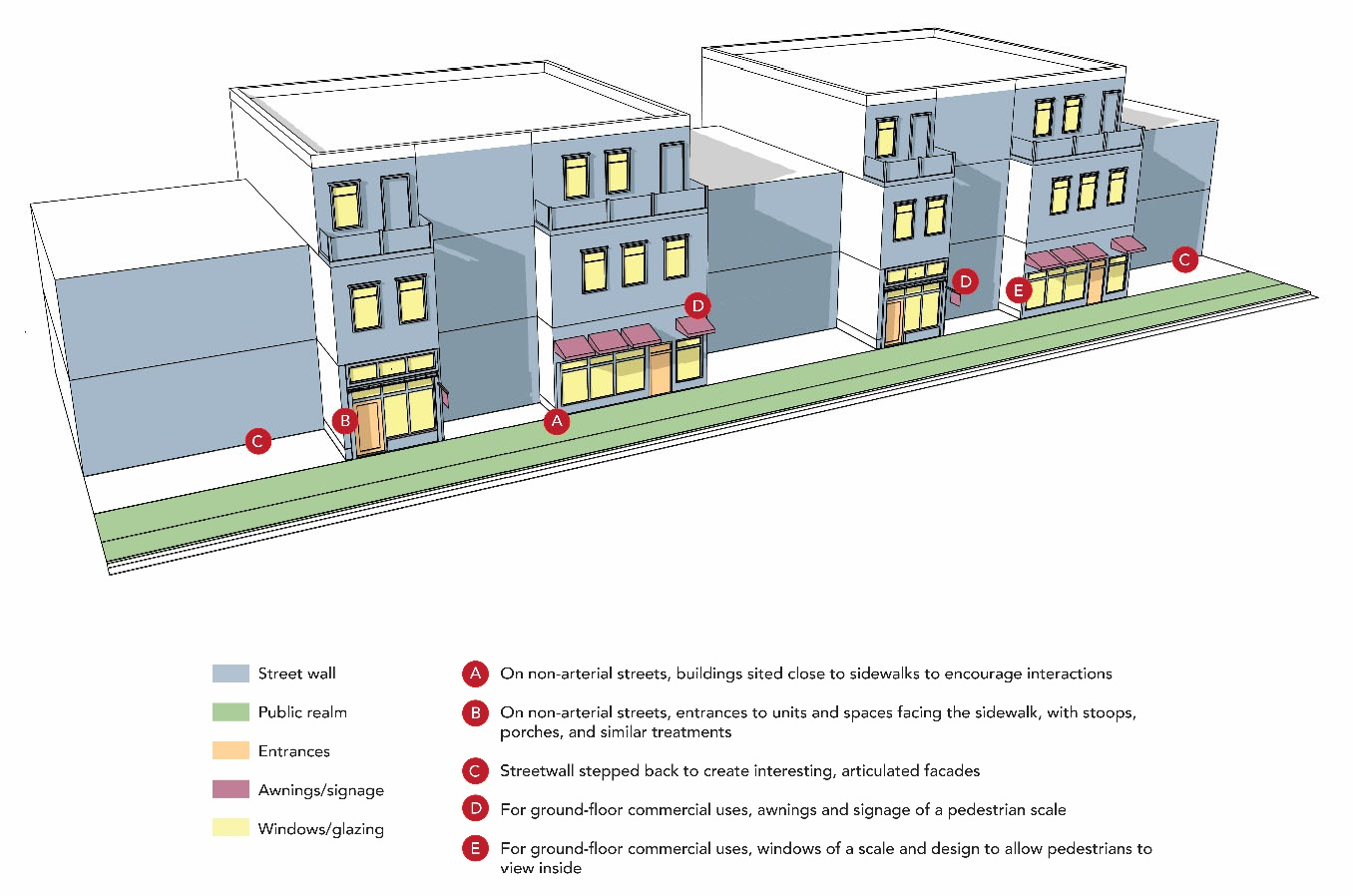
Buildings shall be oriented toward street frontages and along internal driveways or alleyways.
(ii)
Building blocks shall be oriented to face and animate the adjacent public sidewalk or other public space and in particular, any pedestrian connection and open space adjacent to them.
(2)
Mid-rise building layout.
(i)
Buildings, plazas, building entrances, and seating shall be sited and designed to encourage interaction among occupants and passersby.
(ii)
The street wall shall create a safe, attractive, and cohesive streetscape where pedestrians can see building entrances, signs, and businesses (where provided).
(iii)
Street wall façades shall be designed to create articulation and visual interest along a block face and to reinforce the pedestrian scale and character of the street.
[(c)]
Pedestrian access.
(1)
Low-rise building access.
(i)
Each low-rise building shall have separate individual entries to each dwelling unit accessible via an internal courtyard, street frontage, breezeway, common exterior corridor, or private driveway.
(ii)
For the purpose of providing privacy within a unit, each unit shall be designed so that social areas such as the living room, family room, kitchen/dining room—rather than sleeping and service rooms—are generally oriented toward the fronting street or to the courtyard.
(iii)
Residential units that are directly entered from an abutting public sidewalk shall provide entryways, dooryards, porches, stoops, terraces, or similar step-up areas with a minimum depth of two feet.
(iv)
No unit entry shall face a garage door of another unit unless access is through a shared driveway.
(2)
Mid-rise building access.
(i)
Entrance to the residential portions of the building shall be through a street level lobby, courtyard access, or through a combination of street lobby directly accessible from the street.
(ii)
The main entrance to each ground-floor unit shall be directly from the street for those units along a street. In lieu of this standard, access may be provided via an interior corridor or common area if the building design for ground-floor units along a street includes a patio area adjacent to the street.
(iii)
Access to each unit above the second level, not accessed through a podium, shall be through an interior corridor of at least six feet in width with recessed doors and/or other articulation in the hallways.
[(d)]
Walkways and stairs.
(1)
All walkways or any other pedestrian paths shall provide unimpeded access from an abutting public roadway to each building and unit entry, stairways, parking areas, common outdoor space, and other common areas.
(2)
Walkways shall be compliant with accessibility requirements, have a flat surface, and be routed to minimize a meandering path between areas.
(3)
No portion of any walkway shall abut a vehicular driveway unless provided with a raised curb or other buffer feature.
(4)
No portion of any walkway shall provide travel through private outdoor areas.
(5)
Elevated walkways, skyways, and bridges are prohibited between buildings unless architecturally integrated with the buildings.
(6)
Corridors or halls providing access to upper-story units shall be located inside a building.
(7)
Walkways shall be routed to take advantage of shade provided by arbor/trellises or tree canopy.
(8)
Stairs that access upper-story units shall have risers and abut the building wall on at least one side. Stairwells must use the same colors, materials, and finish as the building they serve.
(9)
Stair railings visible outdoors shall be distinguished using either caps, moldings, or other architectural elaborations consistent with the building style.
[(e)]
Driveways.
(1)
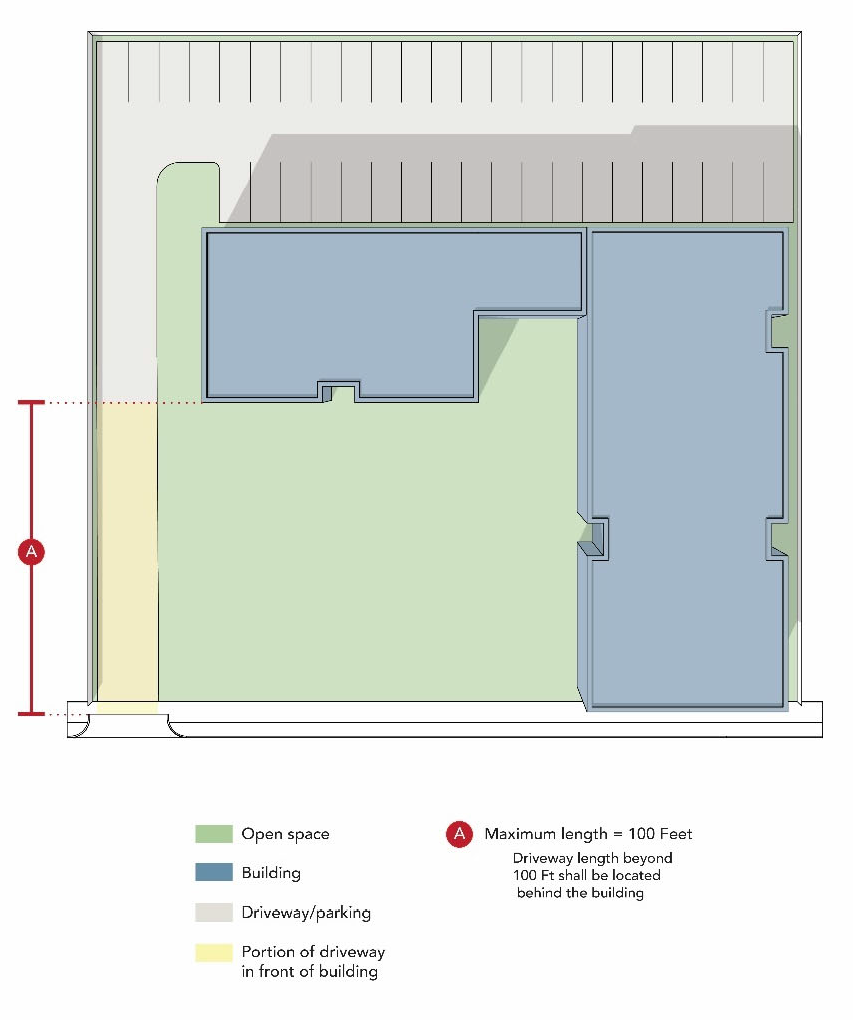
For driveways providing vehicular access to the site that are longer than 100 feet, that portion of the driveway beyond the initial 100 feet, measured from the driveway apron, shall be located behind buildings.
(2)
Entries to garages or carports shall not face an arterial street.
(3)
The number of curb cuts and driveway entrances shall be minimized to reduce conflicts with pedestrians. The entrance to parking facilities shall be located on a side street unless no other configuration is physically possible, as determined by the review authority. If a driveway entrance is located on the primary street frontage, the length of the curb cut shall be minimized to a standard acceptable to the city engineer and limited to one curb cut per primary street frontage.
(4)
Garage and carport entrances, when located on side yards, shall be oriented perpendicular to the orientation of the primary street frontage to reduce their visibility.
(5)
Where a secured entry driveway is provided, the driveway design shall include space outside of the drive aisle sufficient to allow for vehicle queueing and to accommodate a vehicle to turn around without impeding vehicle flow. Also, a pullout area shall be provided for delivery vehicles, which may be combined with the turnaround area.
(6)
Where gates are provided across a driveway or other entrance, that gate shall be consist of a rolling gate or gates that open into the site (away from the public right-of-way). All such gates shall have automatic controls.
[(f)]
Design for security.
(1)
All wall faces fronting interior courts, parking areas, open space, pathways, and other similar features shall feature one window, door, or balcony per building story to provide visibility between residences and these areas.
(2)
Courts, paths, vehicular access drives, and other extended open space areas that are hidden from offsite views shall incorporate a viewpoint (window, balcony, patio, etc.) at least every 30 feet.
(3)
Recessed entryways shall include features such as lighting and cut-outs that allow for visibility from the street, driveways, and other common public areas.
(4)
The lighting standards in section 90-429 (lighting) shall apply.
(Ord. No. 1987, § 1, 12-14-2021)
Sec. 90-426. - Open space design.
(a)
Applicability. This section applies to open spaces required by subsection 90-386(f) of this Code and shall be in addition to the requirements of subsection 90-386(f).
(b)
General standards.
(1)
Open spaces shall be designed as an integrated element of the project (and the street or adjacent building, if applicable).
(2)
Open spaces shall be designed to have sunlight during at least part of the day, and in consideration of the comfort and safety of users.
(c)
Private open space.
(1)
Privacy and safety objectives shall be balanced with air and solar access, as well as wind protection.
(2)
Balconies that face a public street shall be enclosed with nontransparent building materials.
(3)
Privacy and solar access for open spaces that face the public street and/or sidewalk shall include partially transparent screening or landscaping.
(d)
Common open space.
(1)
No portion of a common open space shall limit access to any one or group of residents. Where fencing or other protective barriers are provided, such spaces shall not have locked access, except for any required secure fencing and gates for swimming pools and spas.
(2)
Common amenity spaces shall be centrally located or have a connecting element to a larger or major open space feature, pathways, or trail system.
(3)
Common amenity spaces shall be purposely designed as functional focal points and not be created from leftover spaces.
(4)
Common outdoor areas such as children's play, sheltered seating, mailboxes/kiosks, and similar features shall be designed with clear visual from adjacent units for safety.
(5)
Roof terraces, where provided, shall be designed for sunlight access. Green roofs can fulfill common open space requirements, provided that usable open space features are incorporated into the green roof design.
(Ord. No. 1987, § 1, 12-14-2021)
Sec. 90-427. - Perimeter design.
(a)
Applicability. The perimeter of a development site provides the opportunity to create an attractive appearance along city streets. Design of the site's perimeter shall incorporate walls and fences, landscaping, materials and finishes, and signage that identify the development and match the architectural style of the buildings. Fencing and wall materials shall comply with the requirements of the zone in which they are located.
(b)
Project entries. Vehicular access to the site shall provide the following:
(1)
For projects along State Street, project entries shall incorporate design and landscaping elements that complement the planned streetscape on this designated landscaped corridor.
(2)
Project entry elements, as identified in this section, shall be provided along arterial, major, and secondary streets.
(3)
Project entry walls shall use the following materials or combination of these materials: brick, slumpstone, tile, textured concrete, stucco on masonry, and steel framing. The tops of walls must provide capping using contrasting/complementary materials and elaboration from the wall they top. Columns or pilasters shall be provided every 100 feet.
(4)
The following shall be included in the design of the main entrance to developments:
(i)
Trellis, arbor, recessed entry, or similar permanent architectural feature.
(ii)
Landscape plan of groundcover, shrubs, and trees.
(iii)
Project identification monument sign or wall sign with backlit illumination and channel lettering.
(iv)
Textured or brushed concrete or decorative paving material at driveway entrances.
(5)
Where fencing is proposed along public frontages, such fencing shall be open view unless otherwise required to be solid for noise attenuation or screening purposes. Open view fencing shall also be required where located adjacent to open space areas.
[(c)]
Walls and fences. The following regulations shall be in addition to the requirements of subsection 90-386(i) of this Code.
(1)
The design of walls and fences shall be consistent with the approved design for project entries.
(2)
Fences and walls shall not exceed the height required to fully screen from view, attenuate noise, and secure the property and as may be regulated by standards for the underlying zone.
(3)
Exterior perimeter walls located along public streets shall provide the following changes to the wall plane: an offset a minimum of five feet deep for every 50 feet to 75 feet of wall.
(4)
The maximum height of any portion of the project entry wall shall not exceed six feet. Walls and fences located in any other areas and physically integrated into berm landscape shall have a maximum height of ten feet measured at grade.
(5)
A combination of landscaped berms and fences or walls may be used for screening purposes.
[(d)]
Gated communities. In addition to article VIII, gated communities, of chapter 67 of this Code, gated communities shall not be required as a condition for approval on any permits or maps for developments subject to the provisions of these standards.
(Ord. No. 1987, § 1, 12-14-2021)
Sec. 90-428. - Building design and architectural treatments.
(a)
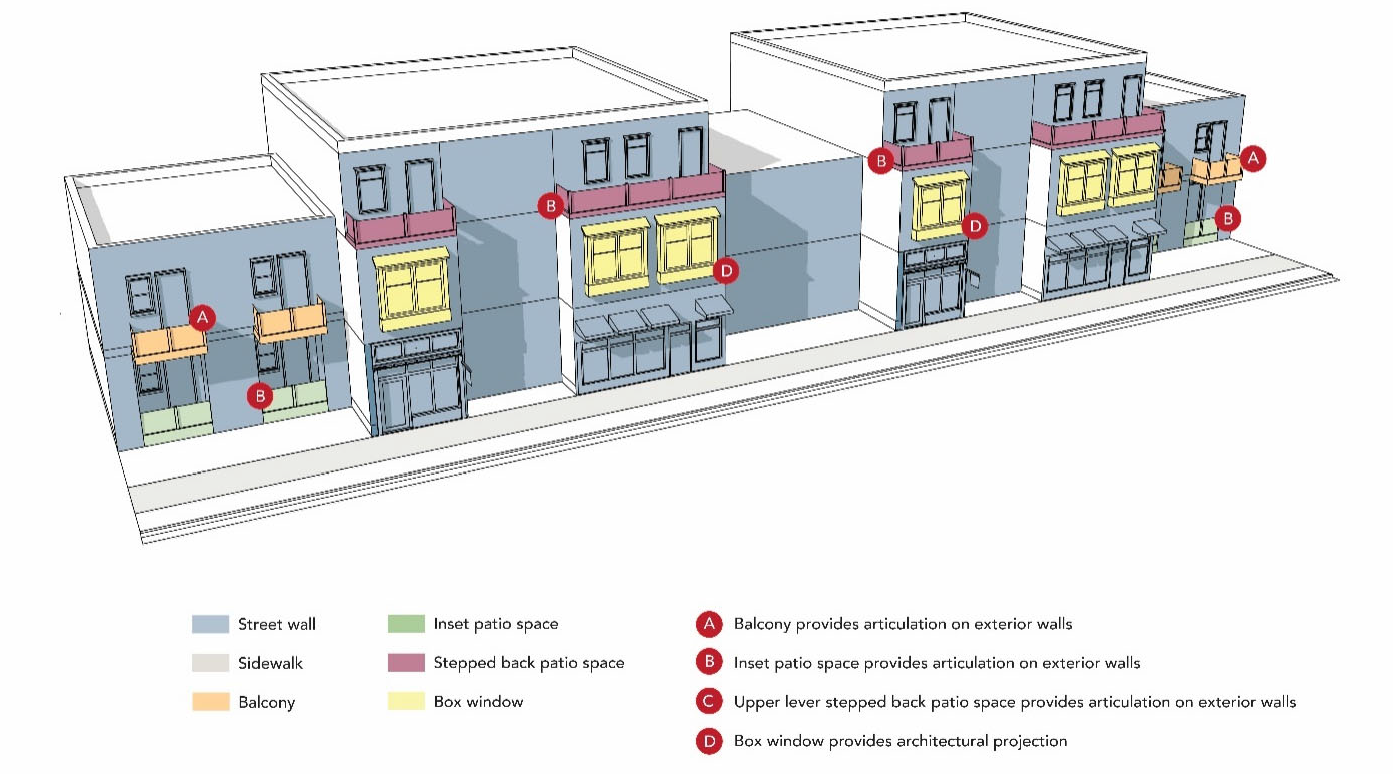
Articulation. Articulation is an architectural method used to address the perceived visual impact of building mass and scale by increasing the number of dimensions on the surface of a building wall. Design techniques that avoid unarticulated building walls include, but are not limited to, some or all the following methods: identifying multiple floor plans for each building, using compounded floor plans with more than four corners, architectural projections, recessed windows and doors from the surrounding building plane, and outdoor spaces projecting from or inset into the building wall.
Buildings containing three or more units shall provide articulation of the building as follows:
(1)
All facades of a two-story or higher building shall have articulated exterior walls. A portion of a building wall not containing floor areas may cantilever to provide articulation.
(2)
Articulation requirements can be satisfied through private outdoor space inset into the building wall and enclosed on three sides. Other areas of the building enclosed on three sides by the adjacent building walls, roof, and floor are considered to form a continuous building wall plane.
(3)
All buildings shall provide architectural projections such as roof overhangs, box windows, covered stairwells and elevators, pilasters, towers, bay windows, or balconies. Porches, patios, verandas, private open spaces, or unit entries are required on the exposed façades of units located at building corners.
(4)
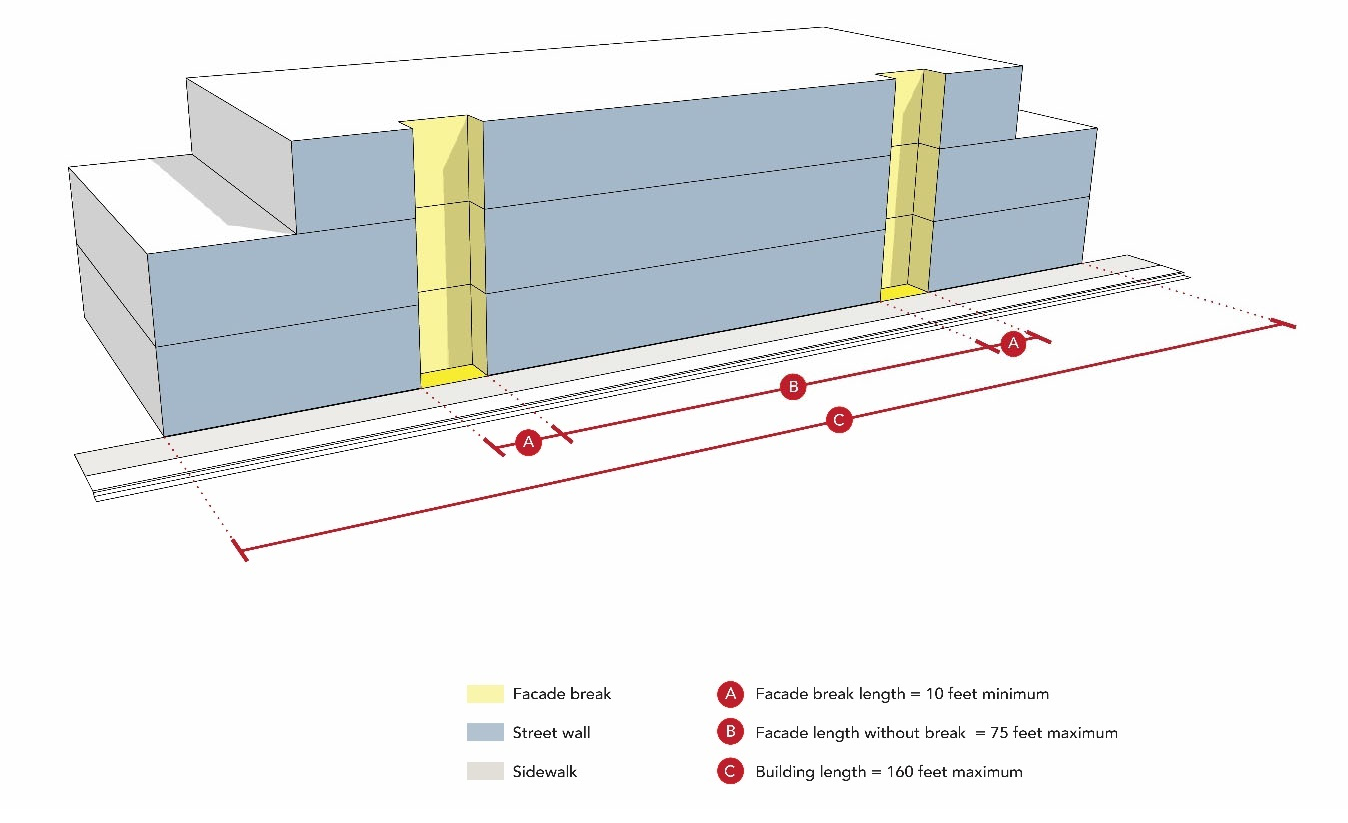
Building(s) with two or more stories shall have a maximum length [of] 160 feet. The length includes any length of wall or roof that attaches one or more buildings and walkways.
(5)
No building shall extend more than 75 linear feet without a break in the façade of at least ten feet in width provided by the architectural elements and treatments described above.
(b)
Ground-floor areas—Mixed-use developments.
(1)
Ground-floor uses shall be directly accessible from adjacent sidewalks or parking areas. For mixed-use buildings, access to the residential and commercial portions of the building shall be provided in separate areas.
(2)
Ground-floor floor-to-ceiling height shall be a minimum of 12 feet.
(3)
Access to the ground-floor spaces shall be at sidewalk grade.
(4)
All portions of windows and wherever glazing is applied on the exterior building shall be transparent to allow for passersby to view the interior of commercial spaces. At least 60 percent of the surface area of the ground-floor portion of a mixed-use building shall incorporate transparent windows and glazing. Mirrored glass shall be prohibited.
(c)
Roof treatments.
(1)
Multistory buildings shall have pitched roofs. Flat roofs are permissible only if wall planes are articulated at intervals greater than the minimum 75 feet required in subsection 90-428(a)(5) and if a flat roof is consistent with the architectural building style employed.
(2)
Pitched roofs must have a ridgeline at its peak height. No portion of a pitched roof shall contain flat surfaces unless a mansard-style roof is used.
(3)
Parapets or eaves are required on flat roofs to include decorative elements such as cornices, crenellation, eaves, and covered or exposed rafters.
(4)
Roofs and associated design elements shall be constructed to prevent pooling of water on surfaces.
(d)
Doors and windows.
(1)
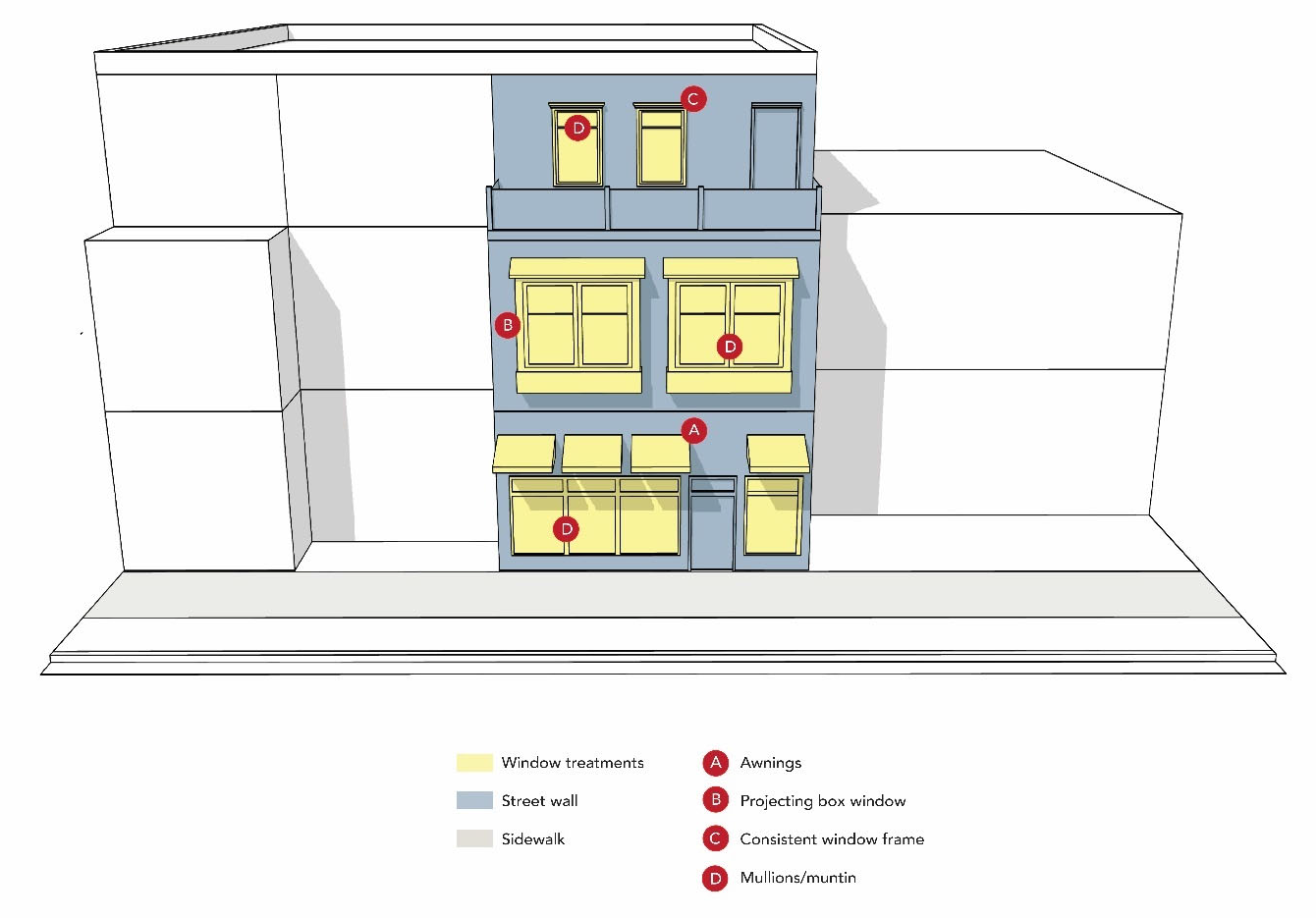
Doors and windows shall be composed of different material than used in the building wall. Windows shall have accent and trim finishes and colors.
(2)
Windows shall not be flush with the exterior wall surface unless window frames, shutters, or other exterior architecturally consistent window treatments, such as projecting sills or awnings, are used.
(3)
Mullions and muntin shall be incorporated on windows facing the street and adjacent properties.
(e)
Materials and finishes.
(1)
Buildings shall use materials rated for residential construction: stucco, brick, stone, masonry, wood, concrete, architectural terra cotta and ceramic, and fiber cement. Exterior siding/cladding may include manufactured, composite, or veneer stone/brick. Trim and accent materials permitted include metal, tiles (ceramic, porcelain, stones). All building materials must be durable. Exterior foam molding and plastic are prohibited.
(2)
High-quality, durable, and low-maintenance architectural materials and finishes shall be used throughout the exterior and public interior spaces of the buildings.
(3)
A minimum of two complementary building materials, excluding glass, shall be used on any façade facing a public right-of-way.
(4)
The same material and finishes must be uniformly applied on the building exterior elevations to create four-sided architecture. Exterior siding/cladding shall not exceed 50 percent of any building surface area. Stone is allowed at the base and first story of a building and as architectural treatment.
(f)
Architectural style and exterior elements.
(1)
Buildings shall carry the same theme on all elevations. A theme includes primary (non-accent) materials and colors.
(2)
No particular architectural style is mandated for any area in the city. All development shall be sensitive to the context and the surroundings without necessarily conforming to the architectural style of surrounding development.
(3)
Buildings shall be designed and constructed with materials and colors that relate to masses and volumes. Changes in material or color shall be designed with a change in the wall plane. Compatible materials shall be used on all four sides of the structure.
(4)
Base materials shall wrap corners of exposed interior property line walls a minimum of five feet.
(5)
Accent materials shall be used at the ground level to add texture, color, and visual interest at the pedestrian level.
(6)
Any downspout located on the exterior of a building shall match the architectural style, colors, and finishes used on the building.
(7)
Affordable units and market rate units in the same development shall be constructed of the same or similar exterior materials and details such that the units are not distinguishable.
(Ord. No. 1987, § 1, 12-14-2021)
Sec. 90-429. - Lighting.
(a)
The following requirements shall be in addition to those set forth in subsection 90-836(k) of this Code.
(b)
Lighting design. A lighting plan shall be submitted that includes photometric information demonstrating compliance with the following:
(1)
No portion of a lighting fixture shall be mounted above the building façade or above the roof of the building.
(2)
Nighttime illumination of walkway paths shall include fully shielded path lights.
(3)
Architectural and landscape lighting shall not use up-lighting (thus to achieve dark-sky objectives).
(4)
Lighting shall not be directed at any unit, illuminate units on other buildings, or create glare visible to any unit.
(5)
Exterior lighting shall be limited to a maximum of 525 lumens for landscape lighting, 1,025 lumens for shielded light fixtures, 2,400 lumens for shielded exterior light fixtures above the first story, and 3,000 lumens for unshielded light fixtures.
(Ord. No. 1987, § 1, 12-14-2021)
Sec. 90-430. - Parking facilities.
(a)
Applicability. This section applies to developments subject to this article and providing more than 25 parking spaces. The standards shall be in addition to those required for the authorized use.
(b)
Standards.
(1)
Surface parking areas shall be located behind buildings or behind a screening wall and shall not be located between a public street and buildings on the site.
(2)
Parking spaces shall be located no farther than 400 feet from the closest building containing residential units.
(3)
Carports, where allowed and provided, shall be constructed of materials, finish, and colors consistent with the adjacent buildings. If carports include solar equipment on top, designs may include cantilevered coverings if the coverings are oriented both to provide protection for the parked cars and collect sunlight. Required support structures must be finished with colors consistent with the adjacent buildings.
(Ord. No. 1987, § 1, 12-14-2021)
Sec. 90-431. - Infrastructure and utilities.
(a)
Applicability. This section applies to air conditioners, heaters, utility meters, cable and similar onsite telecommunications equipment, backflow preventions, irrigation control valves, onsite electrical transformers, pull boxes, ducting for HVAC systems, fire protection equipment, and all roof-mounted equipment. These provisions do not apply to wireless telecommunications facilities.
(b)
Standards.
(1)
Transformers shall be placed underground to maximize safety and minimize visual impacts. When underground locations are impractical due to access limitations or other factors verified by the community development director, the transformers shall be placed within a public right-of-way and covered. Where a location in the public right-of-way is not physically practical or feasible, as determined by the community development director, the transformer may be placed on site but shall not be placed within any required usable open space area.
(2)
Ground-mounted utilities and mechanical equipment that directly serve the development shall not be located within any required usable open space area, with the exception of irrigation control valves.
(3)
Solar panels, if ground mounted, shall not be placed in any required private or common open space areas.
(4)
Screening.
(i)
All rooftop-mounted equipment, where allowed and with the exception of solar power collection devices, shall be screened from view from public rights-of-way by parapet walls or other architectural features incorporated into the building.
(ii)
All ground-mounted equipment, with the exception of fire control equipment, shall be screened from view from adjacent properties and public rights-of-way by an enclosure designed as part of the building or by landscaping.
(c)
Service and refuse areas.
(1)
Common refuse collection and recycling areas shall be located within 300 feet of the residential units and businesses that they serve. To achieve this standard, multiple collection areas may be needed within a development.
(2)
Refuse and recycling receptacles shall be completely screened from public rights-of-way and parking areas through orientation, screening materials (walls/ landscaping), or a combination of both.
(3)
Refuse collection and recycling areas shall be prohibited in any required front yard, street side yard, parking space, landscaped area, or open space areas.
(4)
The location for all refuse, recyclable materials, and green waste collection and disposal areas shall be within an enclosed structure. Refuse, recyclable materials, and green waste collection and disposal areas shall be contained within an enclosure that on three sides consists of a minimum six-foot-high masonry wall. The fourth side for access shall consist of a solid decorative metal gate. A roof shall be provided to prevent precipitation from entering the enclosure. Enclosures shall be designed with similar finishes, materials, and details as the primary buildings within the project.
(5)
Enclosures shall not be visible from adjacent roadways.
(6)
Recyclable materials and green waste storage areas shall be located adjacent to refuse collection areas, or near one another, or combined.
(7)
Driveways or aisles shall provide unobstructed access for collection vehicles and personnel with at least the minimum clearance required by the collection methods and vehicles utilized by the designated collector. Designs or arrangements that require staging of collection on public rights-of-way shall be prohibited.
(d)
Mailboxes. Common mailbox areas shall be designed to be similar or complementary in form, material, and color to the buildings they serve.
(1)
Mailboxes should be located in highly visible, heavy use areas for convenience, to allow for casual social interaction, and to promote safety.
(2)
Installation of cast iron, cast aluminum, brick, or slump stone-encased curbside mailboxes are encouraged.
(3)
Common mailbox enclosures shall be designed to be similar or complementary in form, material, and color to the surrounding residential buildings.
(4)
Each mailbox installation shall conform to current United States Postal Service standards.
(Ord. No. 1987, § 1, 12-14-2021)
Sec. 90-432. - Performance standards.
(a)
Noise. Where residential and non-residential uses are incorporated into a single building or development project, noise-attenuating construction approaches shall be used to achieve interior and exterior noise standards set forth in the California Health and Safety Code and this Code. All other provisions of subsection 90-1048(1) (noise) of this Code shall apply.
(b)
Sustainable design. With regard to the requirements set forth in subsection 90-1048(9) (sustainable design), all development projects shall implement required provisions of the most recent CALGreen Code and specifically requirements for multifamily dwellings and mixed-use projects with at least a two-thirds residential component, as defined by this article, most notably as required for provide electric vehicle (EV) capable parking spaces and bicycle parking facilities.
(Ord. No. 1987, § 1, 12-14-2021)

