
Hemet City Zoning Code
ARTICLE XL
OFF-STREET PARKING28
Editor's note— Ordinance No. 1586, § 3, adopted August 11, 1998, deleted §§ 90-1421—90-1428 and added new §§ 90-1421—90-1427 to read as herein set out. Formerly, such sections pertained to off-street parking and loading. See Code Comparative Table for history.
Sec. 90-1421.- Purpose.
The purposes of this article are to ensure that adequate off-street parking is provided for land uses in proportion to the need for each use, and to ensure that off-street parking facilities are designed in a manner that will ensure efficient traffic flow, protect public safety, and, where appropriate, insulate surrounding land uses from adverse impacts from parking facilities.
(Ord. No. 1586, § 3, 8-11-98)
Sec. 90-1422. - General provisions.
(a)
Off-street parking, consistent with the requirements of this article, shall be provided for any new structure or new use established. Loading spaces are not required by this article. If loading spaces are provided they may not count toward the required parking.
(b)
For any addition or enlargement, or for any change of use, additional parking shall be required only for the area of such addition, enlargement or change of use, but not for the entire structure or use. Additional parking shall not be required where the total number of spaces required for the addition, enlargement or change is less than ten percent of the total required spaces for the use prior to such addition, enlargement or change.
(c)
Required parking for shopping centers, business centers, and industrial parks (three or more uses on the same site) shall be calculated based upon total gross floor area and not based upon individual uses. In shopping center developments where the center is on more than one lot, reciprocal access, drainage, and parking easements shall be required so that the shopping center and parking function as a single unit.
(d)
On property in residential zones, the required front yard and street side yard shall not be utilized for parking, loading, or storage of motor vehicles, except as allowed by this article.
(e)
Parking for recreation vehicles is permitted on the site of an existing single-family home when the requirements of this article are met. The director may issue a fee-free permit, for a period not to exceed 30 days, to park on residential streets immediately adjacent to property owned or controlled by the visitor's host. The director may impose reasonable conditions on such permit for the protection of the public health and safety. Such permit may not authorize the parking of such vehicles on areas restricted by other provisions of this Code.
(f)
Parking for commercial vehicles is permitted on the site of an existing single-family home when the requirements of this article are met.
(g)
Required parking shall be maintained for the duration of the use. Such facilities shall only be used for motor vehicle parking not exceeding one ton in capacity during those hours which the business is open. The parking lot may contain pedestrian ways, landscaping, parking structures, permitted signs and lights. The parking lot shall not be used for sale, display, storage, or repair of vehicles, except as provided in section 90-73, temporary uses. Exceptions for temporary outdoor display, sales, and events may be granted in accordance with section 90-73, temporary uses.
(h)
For the purposes of this article, gross floor area shall include the entire floor area of a structure, excluding those areas used for air conditioning and heating equipment, or enclosed or covered areas used for required off-street parking.
(i)
Handicapped parking shall be provided as specified in the Uniform Building Code adopted by the city.
(j)
Where the application of the parking schedule set out in section 90-1423 results in a fractional number of spaces, a fraction of one-half or greater shall be rounded to the next highest whole number.
(k)
Required parking spaces shall be located on the same site as the use they serve or parking may be located offsite within the maximum distance specified in section 90-1423. When required parking is located offsite, a parking agreement shall be recorded on both properties indicating that the offsite parking shall be maintained as parking for the life of the use.
(l)
Where offsite parking spaces are allowed by section 90-1423, they shall be located no further from the use than the maximum distance indicated, as measured along the shortest practical walking distance between the nearest portion of the parking area and an entrance to the site or structure to be served.
(m)
Visitor parking shall be located in reasonable proximity to the units served and may be aggregated in bays. Visitor parking areas shall meet the requirements of section 90-1423 and 90-1424.
(n)
When a parking lot abuts, adjoins, or is adjacent to a R zone, a solid wall six feet in height shall be constructed and maintained on the property lot line. Where the parking lot is adjacent to the front or side yards of the R zone, a three-foot high barrier consisting of either a landscaped earthen berm, dense shrubbery, a block wall, or combination thereof, shall be installed to screen the vehicle headlights. Corner cutoffs, in accordance with sections 90-316(3), (4) and 90-385(i)(1)(c) and (d) are required in the construction of the wall.
(Ord. No. 1586, § 3, 8-11-98; Ord. No. 1919, § 1(Exh. 5), 9-27-16)
Sec. 90-1423. - Schedule of required off-street parking spaces.
Unless otherwise indicated, the parking requirements include employee parking.
For a use not specifically listed below, the required off-street parking shall be determined by the director. The decision of the director may be appealed in accordance with the requirements of section 90-43.6.
A. RESIDENTIAL
B. COMMERCIAL/OFFICE
C. MANUFACTURING
D. INSTITUTIONAL
(Ord. No. 1586, § 3, 8-11-98; Ord. No 1929, § 3(Exh. A-3), 6-13-17; Ord. No. 1940, § 2(Exh. B), 12-12-17)
Sec. 90-1424. - Parking area development standards.
Prior to the establishment of any use of any property in an existing building, a proposed parking plan shall be submitted to the director to check for compliance with this article. If development of a site is proposed, such plans shall be included with an application for a building permit. In either case, the plans shall clearly indicate the existing and/or proposed development, including location, size, shape, design, curb cuts, lighting, required landscaping (including provisions for irrigation, types of plants and trees to be planted, design of masonry walls to be installed in accordance with the provisions of this chapter, or other requirements), wheel stops, traffic barricades, traffic flow design and other features and appurtenances of the proposed parking lot. No property in the city shall be used for any purpose requiring the establishment of parking under the terms of this chapter, and no building permit shall be issued for any construction requiring parking facilities under the terms of this chapter, until such time as the parking plans are approved by the city.
(a)
Standard parking spaces. off-street parking spaces shall meet the requirements of this section. Handicapped parking spaces shall be provided as required by state and federal law and shall comply with the Uniform Building code as adopted by the city. Compact parking spaces are prohibited.
Parking Space Development Standards
(b)
Aisle dimension. Each parking space for multiple family residential, mobile home parks, trailer parks, commercial and manufacturing uses shall have adequate aisles, turning radii and maneuvering areas for onsite access and parking in accordance with the following table:
(c)
Traffic circulation. Traffic circulation within any outdoor parking facility shall be designed to ensure that no vehicle need enter a public street in order to progress from one aisle to any other aisle within the same lot, or to back out into a public street in order to leave a lot. Directional signs, not exceeding four square feet in area, and/or pavement markings shall be provided in all facilities in which one-way traffic has been established.
(d)
Traffic barriers. To channel traffic into travel lanes and prevent unrestricted movement through and across parking stalls, the city may require that traffic barriers be installed and maintained for the life of the project.
(e)
Drainage. Parking facilities shall be graded so that all surface waters will drain into a public street, alley or storm drain in accordance with the latest adopted City of Hemet Standard Specifications for Public Works Construction.
(f)
Wheel stops. A barrier, to stop the vehicle wheels, shall be provided so that no portion of any parked vehicle shall touch any wall, fence or building, project beyond any lot lines, or encroach on any sidewalk adjacent to the parking facility. A continuous raised concrete curbing is encouraged in lieu of concrete wheel stops. This curbing may be adjacent to a sidewalk and/or landscape area.
(g)
Driveway standards. Driveway locations on arterial highways shall be minimized through the use of reciprocal access agreements, shared access, and reciprocal parking agreements. Where raised medians are planned but not yet installed, the driveways shall be located in such a manner to facilitate future median openings.
(1)
Residential. Residential driveways shall not exceed 30 feet in width and shall meet the following requirements:
a.
For driveways serving one parking space, the minimum width of the driveway shall be ten feet.
b.
For driveways serving two to four parking spaces, the minimum width of the driveway shall be 12 feet.
c.
For driveways serving five to nine parking spaces, the minimum width of the driveway shall be 16 feet.
d.
For driveways serving ten or more parking spaces or driveways that exceed 100 feet in length, the minimum width of the driveway shall be 20 feet.
e.
Where separate driveways are provided for ingress and egress to a parking lot or facility, the minimum width for each driveway shall be 12 feet, and the direction of travel shall be clearly indicated by directional arrows on the pavement and posted directional signs.
f.
Shared driveways. On all lots used for residential purposes, all driveways, aisles and parking areas for each residential lot shall be independent of adjoining lots, except as follows:
1.
To provide access to existing landlocked parcels.
2.
Within condominiums and condominium conversions where common access is part of a condominium development.
3.
Within projects under single ownership.
(2)
Commercial and manufacturing. Commercial and industrial driveways shall meet the following requirements:
a.
Any driveway 150 feet or more in length shall be a minimum of 30 feet in width and shall provide an adequate turnaround for fire apparatus as approved by the fire marshal.
b.
A driveway with two or more points of ingress or egress to a dedicated street shall have a minimum aisle width of 20 feet.
c.
A driveway to be used by a tractor-trailer for pickup, delivery or shipping shall not be less than 30 feet in width.
d.
All other driveways shall be not less than 20 feet in length and not more than 40 feet in width.
(h)
Surfacing. The entire surface of each parking area devoted to vehicular or pedestrian traffic shall be surfaced in accordance with the alley paving standards in the latest adopted City of Hemet Standard Specifications for Public Works Construction. Each parking area shall be maintained in a clean and orderly manner, in good repair, and with spaces clearly marked. Specific surfacing requirements are required as follows:
(1)
Residential.
a.
Single family residential driveways. Portland cement to a minimum thickness of three and one-half inches shall be required.
b.
Multiple family residential, mobile home parks, and trailer parks. Two and one-half-inch asphalt concrete with fog seal coating over four inches of class III base or Portland cement to a minimum thickness of three and one-half inches.
(2)
Commercial. Two and one-half-inch asphalt concrete with a fog seal over four inches of class III base or Portland cement concrete to a minimum thickness of three and one-half inches.
(3)
Manufacturing. A structural section of six inches of Portland cement concrete or equivalent over a suitable base.
(i)
Illumination. All artificial illumination provided in connection with such facilities shall be low pressure sodium lights, installed and shielded to confine direct rays of artificial light within the boundaries of the parking lot. Light standards shall not exceed 25 feet in height and shall be located so as not to interfere with parking lot landscaping. Parking lot lighting may be required to be shut off after certain hours, depending upon the use and proximity to residential developments.
(j)
Signage. All residential driveways serving three or more parking spaces, and all commercial or manufacturing driveways, shall be posted as no parking areas or the curb painted red. Directional signing may also be required to assure safe and convenient traffic flow. Directional signing may be in the form of pavement signing and/or small, four-square foot sign.
(k)
Facilities in excess of required parking to comply with development standards. Where off-street parking facilities are provided but not required by this chapter, such facilities shall comply with the development standards prescribed for required facilities.
(Ord. No. 1586, § 3, 8-11-98)
Sec. 90-1425. - Parking lot landscaping.
(a)
Purpose. The purpose of parking lot landscaping is to provide aesthetic relief, and to reduce heat absorption and reflected glare through the use of live landscaping.
(b)
General requirements.
(1)
Five percent of the parking area shall be landscaped with live plant materials, including but not limited to trees, shrubs and ground cover. The required landscaping may be in the form of islands, strips or tree wells as shown in Figure 1. The required landscaping shall be evenly distributed throughout the parking area to accomplish the stated purpose. Required side, rear or front yard landscaping up to a maximum of five feet in width when adjacent to the parking area may be used to satisfy up to one-half of the required parking lot landscaping. All landscaping shall be kept in a health and thriving condition, free and clear of weeds and debris.
(2)
All landscaped areas, including setback landscaping, shall be separated from paved areas by a six-inch-high Portland cement concrete curb.
(3)
All landscaped areas shall be provided with an automatic controller for the sprinkler system. Installation of the sprinkler system shall meet the requirements of chapter 14, buildings and building regulations.
(4)
All landscaped areas to be included as satisfying any portion of the parking lot landscaping requirements shall have a length and width of not less than three feet of planting area, exclusive of curbs. Automobiles may overhang planting area a maximum of two feet, however, the overhang area shall not be counted to satisfy any portion of the parking lot landscaping requirements. Light standards, trash enclosures, electrical transformers, signs and the like shall not be located within the parking lot landscape areas.
(5)
Covered parking areas associated with multiple-family residences or condominiums and similar development shall be exempt from the requirements of subsections (2)a. of this section, but shall comply with the following.
a.
Garages or carports, any portion of which is within 50 feet of a public or private right-of-way other than an alley shall have a minimum five-foot-wide planter adjacent to the portion of the garage or carport facing the right-of-way.
b.
The planter shall be landscaped with trees, shrubs and ground cover and shall be provided with a functional remote control sprinkler system.
c.
Required front yard or side street landscaping which is adjacent to a garage or carport may be used to satisfy the landscaping requirements in this subsection in accordance with the standards indicated in subsection (b)(1), general requirements, above.
(c)
Required trees. Trees shall be planted in the required parking area at a ratio of one tree per five parking spaces as depicted in Figure 1. The purpose of planting trees in the parking area is to shade the parking area and to provide visual relief to the large paved area. Trees placed in required setback areas shall not be counted as satisfying part of this requirement. Trees planted under this requirement shall be a minimum of 15-gallon size at planting, and shall be a species which shall reach a 30- to 50-foot crown within 15 years. Tree wells utilized under this subsection shall have minimum interior measurements of four feet. The plant materials shall be in accordance with a resolution of the city council, which may be amended from time to time.
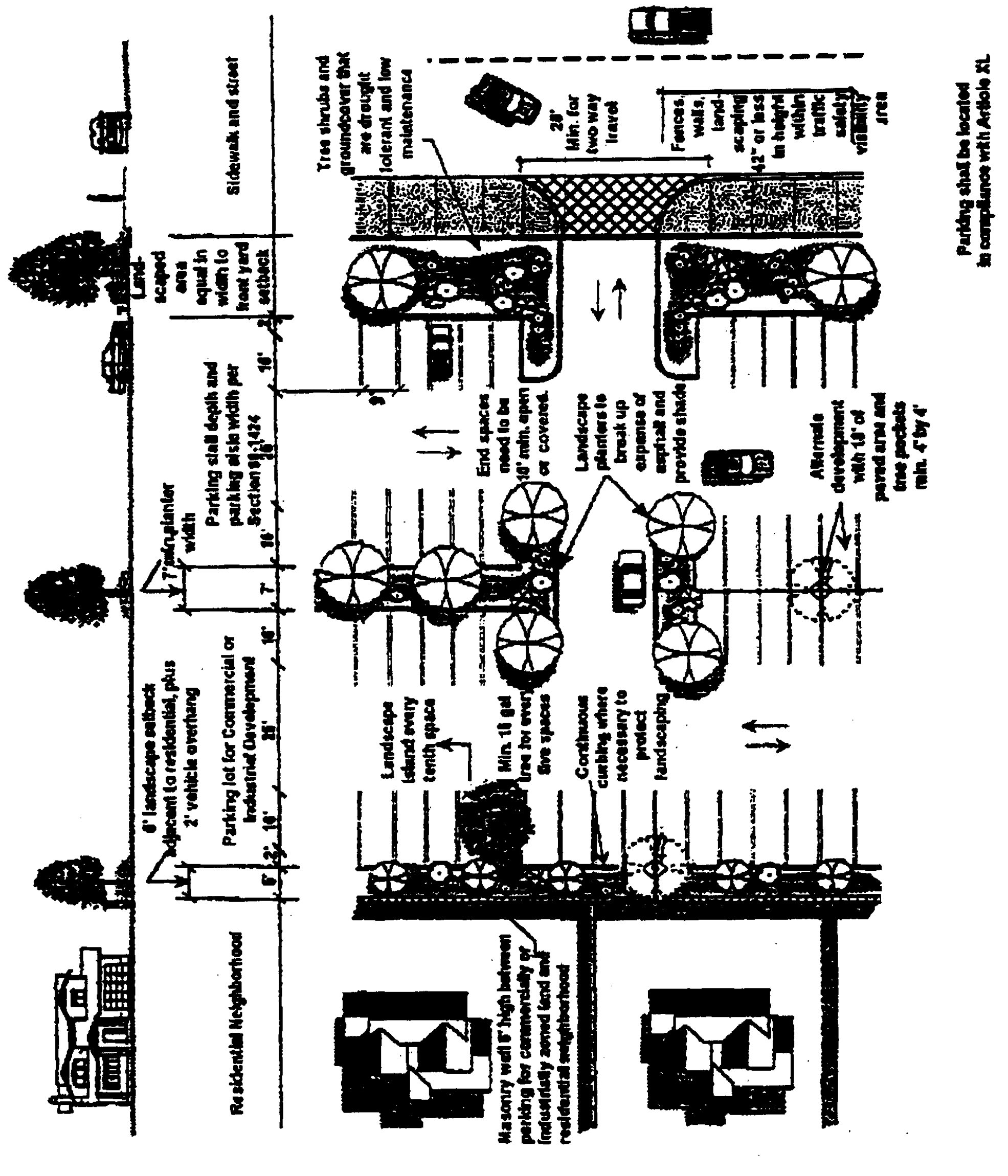
Figure 1. Map
(Ord. No. 1586, § 3, 8-11-98)
Sec. 90-1426. - Joint use of parking facilities.
The director, upon application from a property owner or authorized representative, may authorize up to 50 percent of the parking required by this article for a use considered to be primarily a daytime use to be provided by a use considered to be primarily a nighttime use, and vice versa, subject to the following conditions:
(1)
The principal operating hours of the uses do not conflict.
(2)
The joint use parking area is within 150 feet of the building which it is proposed to serve.
(3)
An agreement authorizing joint use of the parking area by both parties shall be prepared by the developer and submitted to the city attorney for review and approval as to form and content. The agreement may be in the form of a license, lease, easement, covenants, conditions and restrictions or other documents approved by the city attorney.
(Ord. No. 1586, § 3, 8-11-98)
Sec. 90-1427. - Payment of fees in lieu of required parking.
Notwithstanding the provisions of section 90-1423, in any commercial zone, upon application, the city council may, in its sole discretion, permit a portion of the parking required by section 90-1423 to be satisfied by the payment of in-lieu fees for the use of providing parking spaces in a public parking lot. In acting upon such applications, the city council shall be guided by the following standards:
(1)
Applications shall be in writing and state the reason why the applicant should not be required to provide all parking on the site. A plot plan of the on-site parking shall also be submitted.
(2)
A public parking lot owned by the city shall be within the maximum distance of the proposed use as specified in section 90-1423. Such public parking shall have capacity to accommodate the applications.
(3)
In-lieu fees shall not be permitted for more than 75 percent of parking as required by section 90-1423.
(4)
Following 60 days of use, the city council, in its sole discretion, may allow posting of the affected portions of public parking lots in the manner and for the period it may determine.
(5)
Nothing in this section shall prejudice the city council's right to manage city property, including but not limited to the exclusion of all parking from the affected public parking lot, without notice.
(6)
In-lieu fees, as provided for in this section, may be established or amended from time to time by resolution.
(Ord. No. 1586, § 3, 8-11-98)
Sec. 90-1428. - Trash enclosure upgrade program.
Notwithstanding the provisions of section 90-1423, in any commercial or industrial zone, upon application, the community development director may permit a portion of the parking required by section 90-1423 to be utilized for the purpose of modifying the refuse collection areas and trash bins to bring such area and/or bins into conformity with current city refuse design and location standards and to ensure that such areas and bins are completely screened by a solid fence or wall or enclosure and covered within a building in accordance with the adopted standards of the city subject to the following requirements:
(1)
Applications after the effective date of the ordinance codified in this section shall be in writing and state the purpose of the application, provide a description of the proposed modifications, a detailed site plan showing the proposed modifications to the parking area, and plans for the refuse area and/or bins screening fence/walls or building.
(2)
Applications shall describe the parking needs of the property and how those needs will be met with the loss of parking as a result of the modification.
(3)
Reserved.
(4)
The community development director shall have the authority to approve exceptions or consider modified design standards to the requirements of this section for existing and new development projects and projects involving the expansion or retrofit of an existing development. The property owner/applicant must first prove that the requirements for the refuse and recycling collections areas set forth in this Code cannot be met.
Exceptions may be approved for reasons including, but not limited to, the following:
a.
The requirement to provide adequate space for refuse and recyclable materials storage and collection would necessitate the conversion or removal of required parking spaces or required landscaping or would conflict with some other essential site improvement required by the city;
b.
The nature of the proposed development justifies the provision of less recyclable materials storage and collection space than mandated by this section; or
c.
The construction of the entire enclosure would reduce the vehicular access aisle to less than acceptable width. Cost alone is not a valid reason for granting an exception.
Exceptions from any provision of this section may be approved if the exceptions will not be detrimental to the public's health, safety, or welfare nor result in a nuisance and if the project will provide adequate capacity and distribution of collection areas to serve the new or existing development.
(Ord. No. 2031, § 2, 2-27-24)

