
Hot Springs City Zoning Code
ARTICLE X
- ACCESSORY STRUCTURES
16-2-10.1. - General accessory structure regulations.
Accessory structures are subject to the requirements of this article and this section. Certain specific accessory structures are regulated in section 16-2-10.2. All accessory structures are subject to the following regulations, unless otherwise permitted or restricted by specific regulations of this section or Code.
(1)
No accessory structure may be constructed prior to construction of the principal building to which it is accessory. Where there is no principal structure as part of the use, such as a community garden, no accessory structure may be constructed until the use is approved.
(2)
Detached accessory structures must be setback as follows, unless otherwise permitted or restricted by this Code:
a.
A minimum of five feet from any interior side or rear lot line.
b.
No detached accessory structure may be located in a front or corner side yard unless specifically allowed by this Code.
c.
A minimum of ten feet from an existing city water, sewer, or stormwater main.
d.
A minimum of two feet from any existing utility service line.
(3)
Certain accessory structures may be prohibited in specific yards. The use of the term "yard" refers to the area between the principal building line and applicable lot line (see definitions in article II). The distinction is made because certain principal buildings may be built further back than the required district setback lines, thereby creating a yard larger than the minimum setback dimension of the district.
(4)
On a double-frontage lot, one of the front setbacks is considered a rear yard for the purposes of applying these accessory structure regulations.
(5)
The maximum height of any detached accessory structure is 22 feet, unless otherwise permitted or restricted by this Code; however, no accessory structure may exceed the height of the principal building. These height limitations do not apply to any structure accessory to an active agricultural or forestry use, which is not limited in height.
(6)
The footprint of any single detached accessory structure cannot exceed the footprint of the principal building.
(7)
Accessory structures are included in the calculations of maximum building coverage and maximum impervious surface limitations for the lot within the applicable district.
(Ord. No. 6513, § 1(Exh. A), 11-19-24)
16-2-10.2. - Specific accessory structure standards.
(a)
Amateur (ham) radio equipment.
(1)
Towers that solely support amateur (ham) radio equipment are permitted in the rear yard only, and must be located ten feet from any lot line. Towers are limited to the maximum building height of the applicable district plus an additional five feet.
(2)
If a taller tower is technically necessary to engage successfully in amateur radio communications, a conditional use is required and the operator must provide evidence that a taller tower and/or antenna is technically necessary to engage successfully in amateur radio communications. In addition, the applicant must provide evidence that the tower and/or antenna will not prove a hazard.
(3)
Antennas may also be building-mounted and are limited to a maximum height of five feet above the structure, unless a taller antenna is technically necessary to engage successfully in amateur radio communications and conditional use approval is obtained.
(4)
Amateur (ham) radio equipment must conform to all applicable performance criteria set forth in section 16-2-9.6.
(b)
Apiary.
(1)
Hives are subject to all Arkansas state regulations.
(2)
Hives are allowed only in rear yards.
(c)
Carport (detached).
(1)
A carport may not be erected closer than five feet from any lot line
(2)
No carport is permitted in a front yard or within the required corner side setback.
(3)
A carport must be located a minimum of 20 feet from the lot line that provides access to the street.
(d)
Chicken coops.
(1)
Chicken coops are subject to the City of Hot Springs Code of Ordinances.
(2)
Chicken coops are permitted only in the rear yard.
(e)
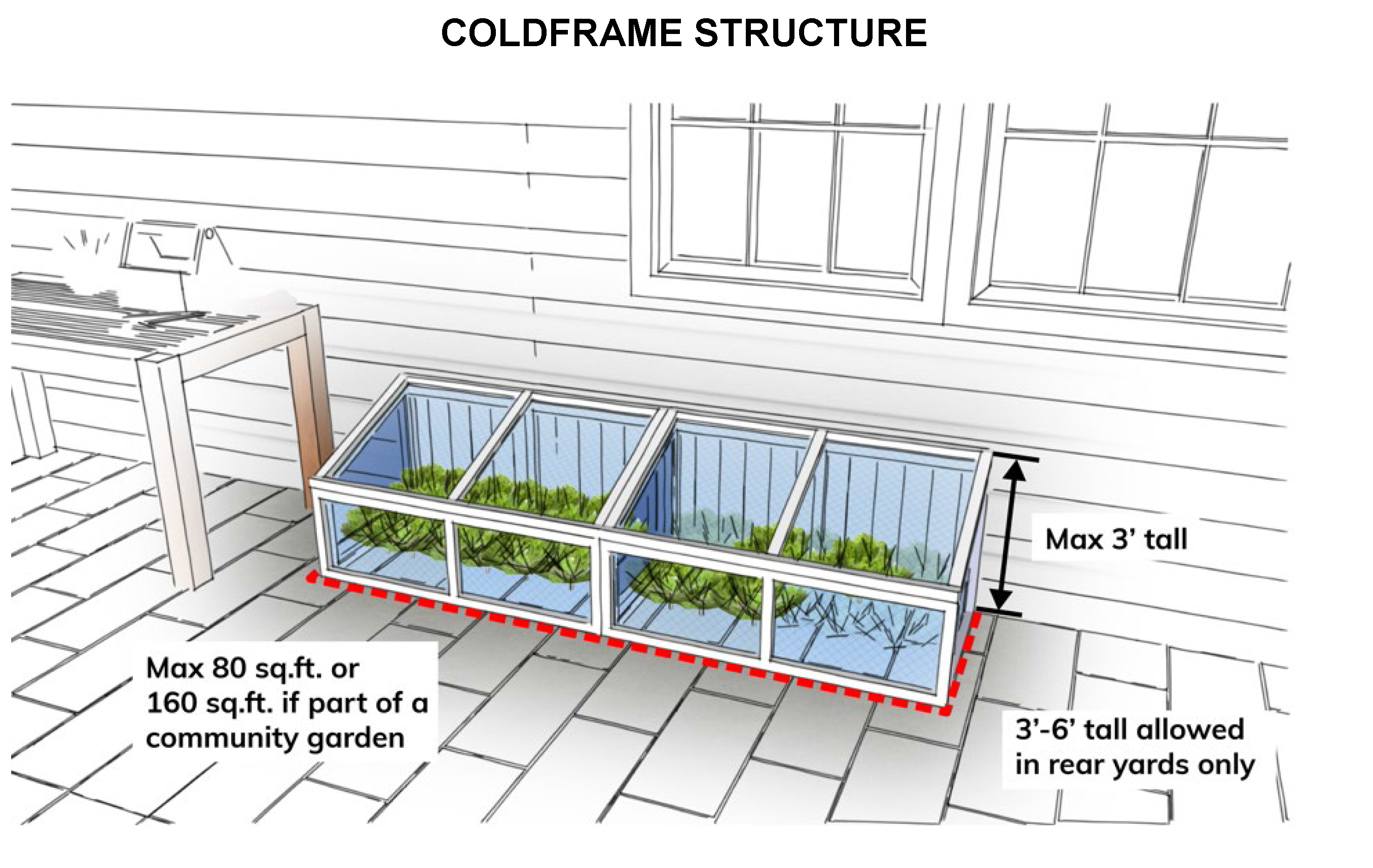
Coldframe structures.
(1)
Coldframe structures up to three feet in height are permitted in all yards.
(2)
Coldframe structures over three feet in height and up to a maximum of six feet are permitted in the rear yard only.
(3)
Coldframe structures in the corner side, interior side and rear yards must be located five feet from any lot line.
(4)
Coldframe structures in the front yard may only encroach two feet into a required setback.
(5)
Each coldframe structure is limited to a maximum square footage of 80 square feet.
(6)
When part of a community garden, each coldframe structure is permitted a maximum square footage of 160 square feet and six feet in height. Coldframe structures in a community garden must meet all required setbacks.
(f)
Donation boxes.
(1)
Donation boxes are permitted for nonresidential uses in nonresidential districts only.
(2)
Only one donation box is permitted per lot. Donation boxes are only permitted on a site where there is a principal building.
(3)
Donation boxes may be located along the side or rear of a building.
(4)
A donation box may be located within a parking lot but no donation box may be located within a required parking space.
(5)
The area surrounding the donation box must be kept free of any junk and debris.
(6)
Donation boxes must be made of metal and maintained in good condition and appearance with no structural damage, holes, or visible rust, and must be free of graffiti.
(7)
Donation boxes must be locked or otherwise secured.
(8)
Donation boxes must contain the following contact information on the front of each donation box: the name, address, email, and phone number of the operator.
(g)
Garage, detached.
(1)
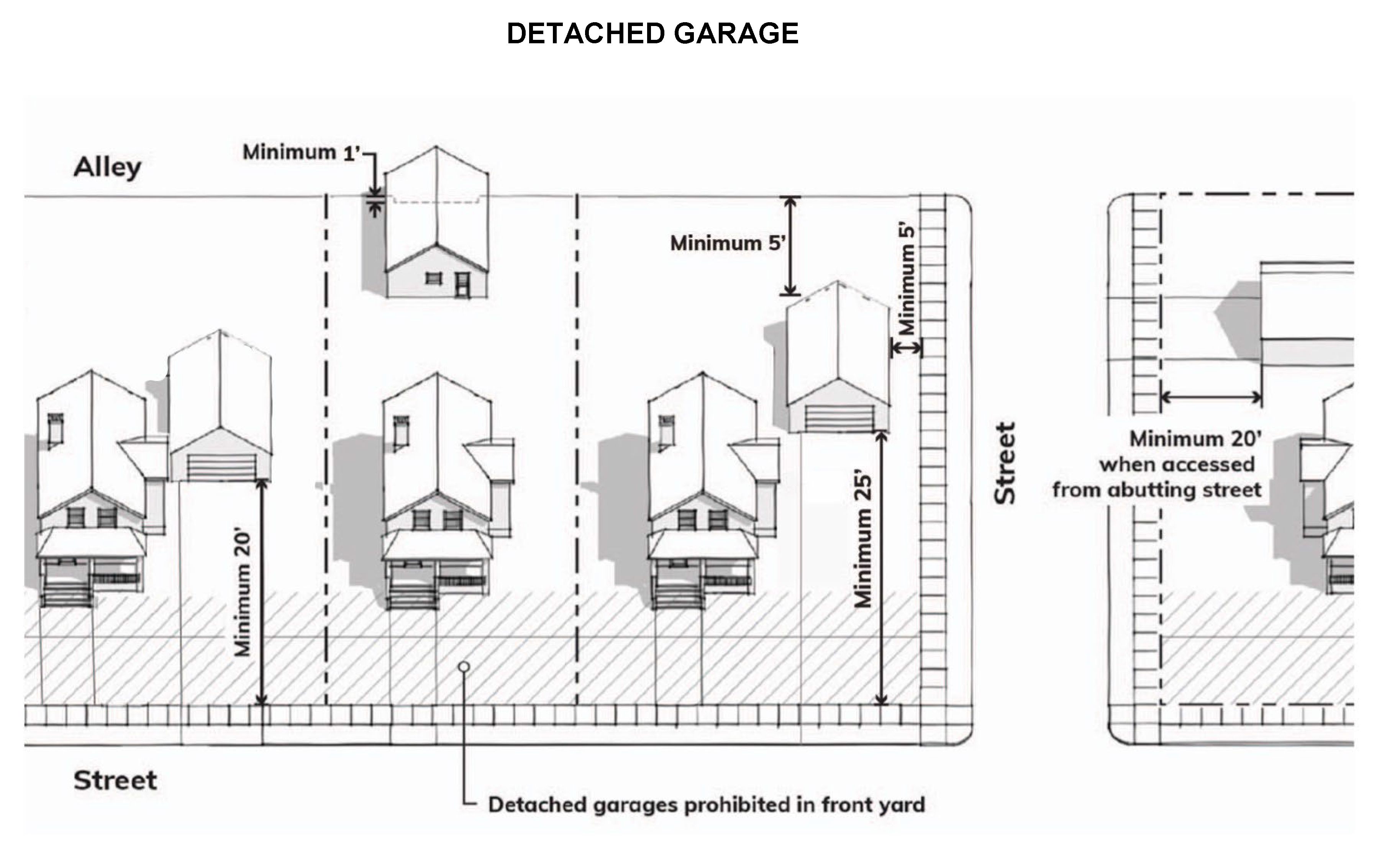
Detached garages are permitted in the rear, corner side, and interior side yards, and must be five feet from any lot line.
(2)
Detached garages are not permitted in the front yard.
(3)
Detached garages in the rear and interior side yards must be set back a minimum of 20 feet from the lot line where access to the garage is taken. This does not apply where garages take access from an alley access.
(4)
Where detached garages are accessed by the alley, they may be located a minimum of one foot from the rear lot line.
(5)
Detached garages in the corner side yard are subject to the following:
a.
Where the garage is located in the corner side yard and takes access from the abutting street, the garage must be set back 20 feet from the corner side lot line.
b.
Where the garage is located in the corner side yard but does not take access from the abutting street, the garage must be set back five feet from the corner side lot line and must be set back a minimum of 25 feet from the lot line where access to the garage is taken.
(6)
The area above vehicle parking spaces in a detached garage may not contain a cooking facility or a full bath. This does not apply if an accessory dwelling unit use has been approved, in which case those standards control.
(h)
Mechanical equipment. Mechanical equipment includes heating, ventilation, and air conditioning (HVAC) equipment, electrical generators, power storage, pool pumps, and similar equipment.
(1)
Ground-mounted equipment.
a.
Ground-mounted mechanical equipment is permitted in the interior side or rear yard only.
b.
For multi-family, nonresidential, and mixed-use developments, ground-mounted mechanical equipment must be screened from public view along the right-of-way by year-round landscaping or a decorative wall or solid fence that is compatible with the architecture and landscaping of a development site. The wall, fence, or plantings must be of a height equal to or greater than the height of the mechanical equipment being screened.
(2)
Roof-mounted equipment.
a.
For structures 40 feet or more in height, all roof equipment must be set back from the edge of the roof a minimum distance of one foot for every two feet in height.
b.
For structures less than 40 feet in height and for any building where roof equipment cannot meet the setback requirement of item a above, there must be either a parapet wall to screen the equipment or the equipment must be housed in solid building material that is architecturally integrated with the structure.
(3)
Wall-mounted equipment.
a.
Wall-mounted mechanical equipment is not permitted along the front or corner side façade of the building.
b.
For multi-family nonresidential, and mixed-use developments, wall-mounted mechanical equipment that protrudes more than 18 inches from the outer building wall must be screened from view by structural features that are compatible with the architecture of the subject building.
c.
Wall-mounted mechanical equipment that protrudes less than 18 inches must be designed to blend with the primary color and architectural design of the subject building.
d.
These requirements do not apply to window air conditioning units, satellite dishes, or required public utility meters.
(i)
Recreational equipment.
(1)
Personal recreation game courts are permitted only in the rear yard. Courts must be located ten feet from any lot line.
(2)
Private playground equipment is permitted only in the interior side or rear yard and must be located five feet from any lot line.
(3)
These standards do not apply to backstops and portable basketball nets, which are allowed in any yard.
(j)
Solar panels.
(1)
Solar panels may be building-mounted or freestanding, subject to the regulations of this section. Solar panels in the historic districts may require approval by the Historic District Commission.
(2)
Solar panels must be placed so that concentrated solar radiation or glare is not directed onto nearby properties or roadways.
(3)
A building-mounted system may be mounted on the roof or wall of a principal building or accessory structure.
a.
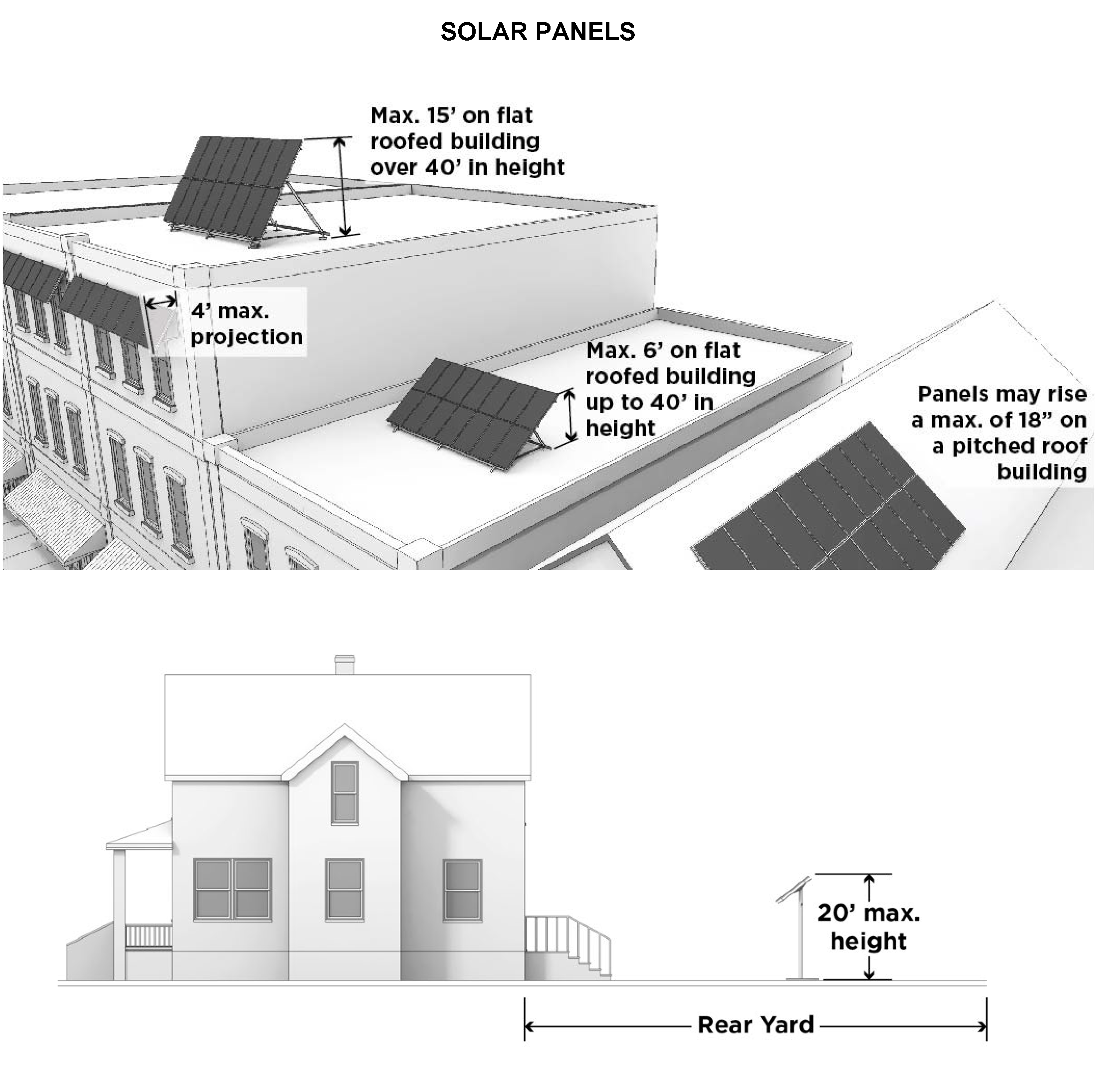
On pitched roof buildings, the maximum height a roof-mounted solar panel may rise is 18 inches.
b.
On flat roofed buildings up to 40 feet in height, the roof-mounted solar panel system is limited to a maximum height of six feet above the surface of the roof. On flat roofed buildings over 40 feet in height, the roof-mounted solar panel system is limited to 15 feet above the height of such structure. Roof-mounted solar energy systems are excluded from the calculation of building height.
c.
Wall-mounted solar panels may project up to four feet from a building façade and must be integrated into the structure as an architectural feature. Wall-mounted panels cannot encroach more than three feet into a required setback.
(4)
A freestanding solar energy system is permitted only in the rear yard and must meet the following standards. A freestanding solar energy system may not be the only use on a lot.
a.
A freestanding solar energy system must be located ten feet from any lot line.
b.
The system is limited to a maximum of 20 feet in height, measured to the highest point of the structure including the solar panel.
c.
Freestanding solar panels are excluded from any building coverage and impervious surface coverage calculations.
(k)
Swimming pools.
(1)
Swimming pools are permitted in the rear yard only.
(2)
Swimming pools must be set back ten feet from any lot line.
(l)
Wind turbines.
(1)
Wind turbines may be designed as either vertical or horizontal axis turbines or as a design that combines elements of the different types of turbines.
(2)
Wind turbines are subject to the following height restrictions:
a.
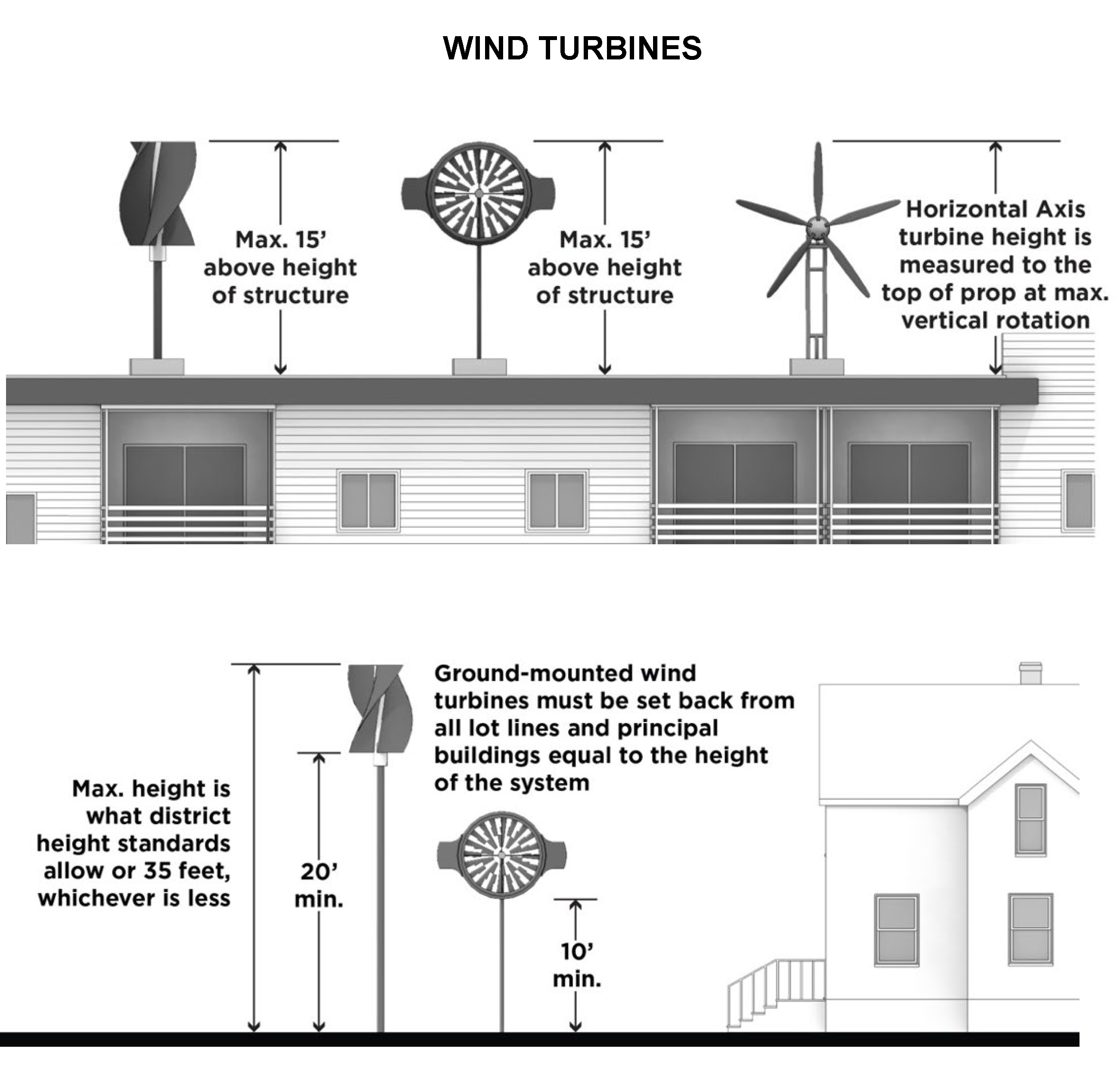
The maximum height of any ground-mounted wind turbine is the maximum height allowed in the district or 35 feet, whichever is less.
b.
The maximum height of any wind turbine mounted upon a structure is 15 feet above the height of such structure.
c.
Maximum height is the total height of the turbine system as measured from the base of the tower to the top. For horizontal axis turbines, the maximum vertical height of the turbine blades is measured as the length of a prop at maximum vertical rotation.
d.
No portion of exposed turbine blades may be within 20 feet of the ground. Unexposed turbine blades may be within ten feet of the ground.
(3)
Ground-mounted wind turbines are permitted only in the rear yard. The tower must be set back from all lot lines equal to the height of the system. No principal buildings may be located within this area.
(4)
All wind turbines must be equipped with manual (electronic or mechanical) and automatic over speed controls to limit the blade rotation speed to within the design limits of the wind energy system.
(5)
Building-mounted wind turbines in the historic districts may require approval by the Historic District Commission.
(Ord. No. 6513, § 1(Exh. A), 11-19-24)

