
Hot Springs City Zoning Code
ARTICLE II
- DEFINITIONS AND RULES OF MEASUREMENT
16-2-2.1. - Rules of interpretation.
The terms in the text of this Code are interpreted in accordance with the following rules of construction:
(1)
The singular number includes the plural, and the plural the singular.
(2)
The present tense includes the past and future tenses, and the future tense includes the present.
(3)
The terms "must," "shall," and "will" are mandatory.
(4)
The terms "may" and "can" are permissive.
(5)
The terms "must not," "will not," "cannot," "may not," and "shall not" are prohibiting.
(6)
Any gender includes all genders.
(7)
Whenever a defined word or term appears in the text of this Code, its meaning must be construed as set forth in the definition. Words not defined must be interpreted in accordance with the definitions considered to be normal dictionary usage.
(8)
This article contains definitions of general terms used throughout the Code with the exception of use definitions, which are defined in article VIII.
(Ord. No. 6513, § 1(Exh. A), 11-19-24)
16-2-2.2. - General abbreviations.
The following abbreviations may be used within this Code:
BTZ is an abbreviation for "build-to zone"
GFA is an abbreviation for "gross floor area"
ft is an abbreviation for "feet"
N/A is an abbreviation for "not applicable"
NR is an abbreviation for "nonresidential"
sf is an abbreviation for "square feet"
SF is an abbreviation for "single-family" (also called single-family detached)
SF-D is an abbreviation for "single-family detached" (also called single-family)
SF-A is an abbreviation for "single-family attached"
2F is an abbreviation for "two-family"
TH is an abbreviation for "townhome"
MF is an abbreviation for "multi-family"
(Ord. No. 6513, § 1(Exh. A), 11-19-24)
16-2-2.3. - General definitions.
Use definitions for all uses within Table 8-1: Use Matrix are defined in section 16-2-8.6 of article VIII.
Abut means to physically touch or border on, or to share a common lot line but not overlap.
Access means a way or means of approach to provide vehicular or pedestrian physical entrance to a property.
Accessibility ramp means a ramp or similar structure that provides wheelchair or similar access to a structure.
Accessory structure means a structure detached from a principal building located on the same lot and customarily incidental and subordinate to the principal building or use.
Accessory use means a use of land or of a building or portion thereof customarily incidental and subordinate to the principal use of the land or building and located on the same lot with the principal use.
Addition means a structure added to the original structure at some time after the completion of the original or an extension or increase in floor area or height of a building or structure.
Adjacent means a lot or parcel of land that shares all or part of a common lot line with another lot or parcel of land.
Aisle means the traveled way by which cars enter and depart parking spaces means also called a travel aisle.
Alley means a service roadway providing a secondary means of access to abutting property and not intended for general traffic circulation.
Alteration means any change or rearrangement in the supporting members of an existing building, such as bearing walls, columns, beams, girders, or interior partitions, as well as any change in doors, windows, or means of ingress or egress; or any enlargement to or diminution of a building or structure, whether horizontally or vertically; or the moving of a building or structure from one location to another.
Amateur (ham) radio equipment means an amateur (ham) radio station licensed by the Federal Communications Commission (FCC), including equipment such as, but not limited to, a tower or building-mounted structure supporting a radiating antenna platform and other equipment.
Ancillary, in regard to principal uses, means a structure or use that provides support and is integral to the operation of a principal use.
Apiary means a structure for the keeping of honeybees.
Appurtenance means the visible, functional, or ornamental objects accessory to, and part of, buildings or structures.
Architectural feature means a part or projection that contributes to the aesthetics of a structure, exclusive of signs, that is not necessary for the structural integrity of the structure or to make the structure habitable.
Articulation, for structures, means a change in the depth of the building plane, roofline, or height.
Awning means a roof-like cover projecting from the wall of a building for the purpose of shielding a doorway or window from the elements.
Balcony means a roofed or unroofed platform that projects from the exterior wall of a structure above the ground floor, which is exposed to the open air, has direct access to the interior of the building, and is not supported by posts or columns extending to the ground.
Banner means a temporary sign printed upon flexible material mounted with or without rigid frames.
Bay window means a window that projects outward from the structure, which does not rest on the building foundation or on the ground.
Berm means an earthen mound designed to provide visual interest on a site, fully or partially screen undesirable views, reduce noise, or fulfill similar purposes.
Bike facility means improvements to accommodate bicyclists, including bike parking facilities, bike lanes, and facilities for bicyclists such as repair stations and shower facilities.
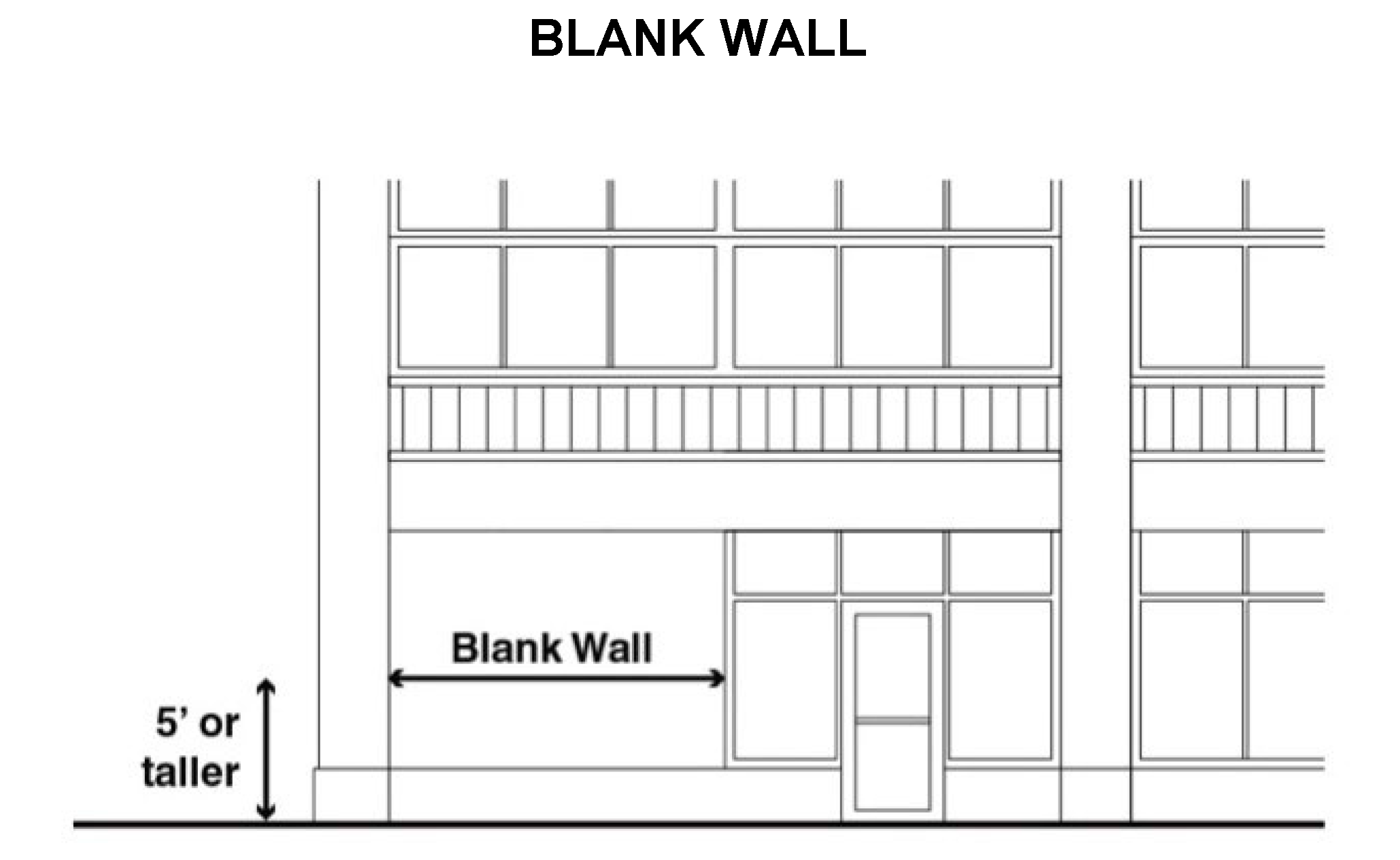
Blank wall means the horizontal linear dimension of contiguous building wall that does not contain fenestration, doors, or decorative elements such as banding, medallions, artwork such as murals and mosaics, change in wall plane of at least three inches, or other architectural or material embellishment means any wall less than five feet in height is not considered to be a blank wall.
Block. Defined in section 16-2-2.4.
Blockface. Defined in section 16-2-2.4.
Blue roof means a roof designed to temporarily store water and slowly discharge rainfall.
Buffer yard means an area of land within a property or site, generally adjacent to and parallel with a property line, to allow adequate screening of view, noise, and/or activity taking place within the property or site from adversely affecting an adjoining property, site, or the public right-of-way.
Build-to zone (BTZ). Defined in section 16-2-2.4.
Build-to percentage. Defined in section 16-2-2.4.
Buildable area means the portion of a lot, excluding required setbacks, where a structure or building improvements may be erected.
Building means any structure having a roof supported by columns or walls and intended for the shelter, housing, or enclosure of any individual, animal, process, equipment, goods, or materials of any kind and intended for use in one place.
Building coverage. Defined in section 16-2-2.4.
Building envelope means the three-dimensional space within which a structure is permitted to be built on a lot and which is defined by regulations governing building setbacks, maximum height, and bulk, by other regulations, and/or by any combination thereof.
Building footprint means the area encompassed by a building's outer wall at ground level.
Building height.Defined in section 16-2-2.4.
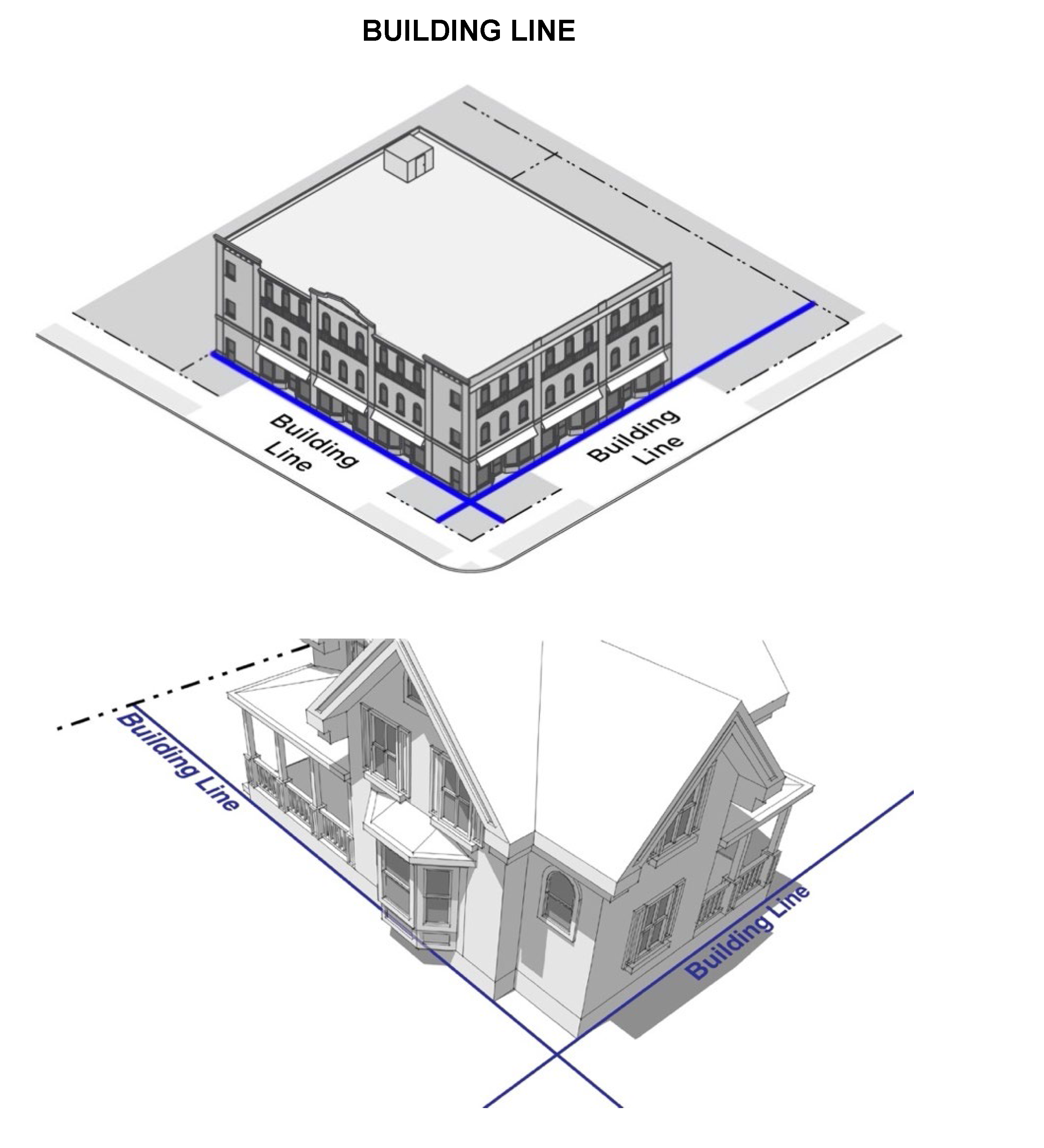
Building line means a line measured at the building wall of a structure between parallel lot lines. For the purposes of establishing a building line, the building wall does not include permitted encroachments of architectural features, such as bay windows, eaves, and steps and stoops means a building line does include a porch.
Canopy means a canopy is a roof-like cover designed for protection from the weather or as a decorative embellishment affixed to a building or freestanding, with supports that extend to the ground.
Carport means a roofed structure providing space for the parking of motor vehicles and enclosed on not more than three sides.
Chicken coop means a structure where hens are kept.
Chimney means a vertical shaft of reinforced concrete, masonry or other approved material enclosing one or more flues, for the purpose of removing products of combustion from solid, liquid, or gaseous fuel.
Coldframe structure means a temporary unheated outdoor structure consisting of a wooden or concrete frame and a top of glass or clear plastic, used for protecting seedlings and plants from the cold.
Co-location means placement of equipment from more than one service or service provider on a single tower or site.
Cool roof means a roofing system designed to reflect more sunlight and absorb less heat than a standard roof. Cool roofs can be of various colors, including white, light gray, and reflective coatings in other colors. Cool roof encompasses both reflective roofing materials and roofing systems designed to enhance reflectivity.
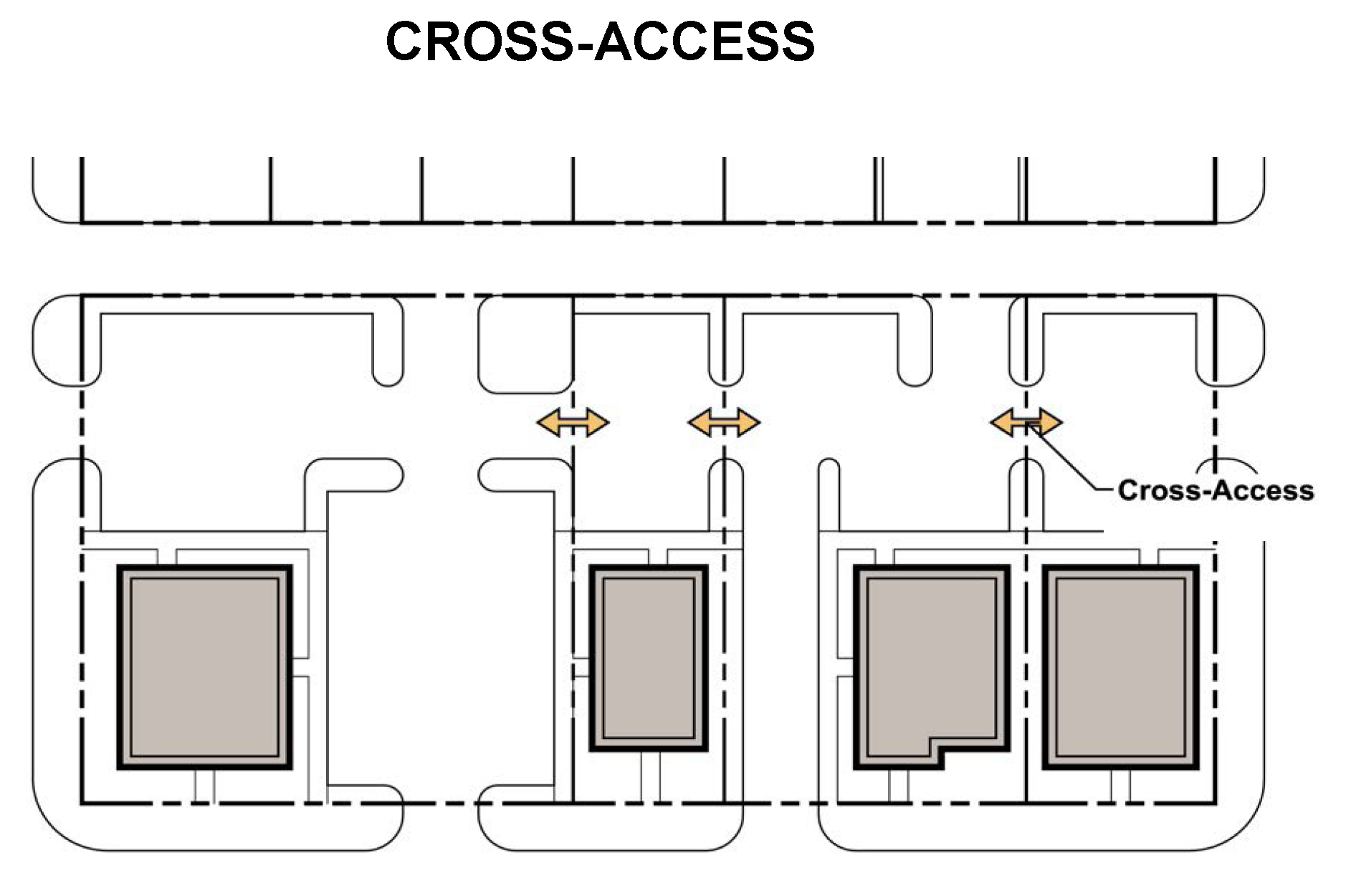
Cross-access means a vehicular and/or pedestrian connection between abutting properties that connects the two sites and allows vehicles and/or pedestrians to travel between sites without the having to exit to the street.
Deck, ground floor means a roofless outdoor space built as an aboveground platform projecting from the first floor of a structure and connected by structural supports at grade and/or by the structure.
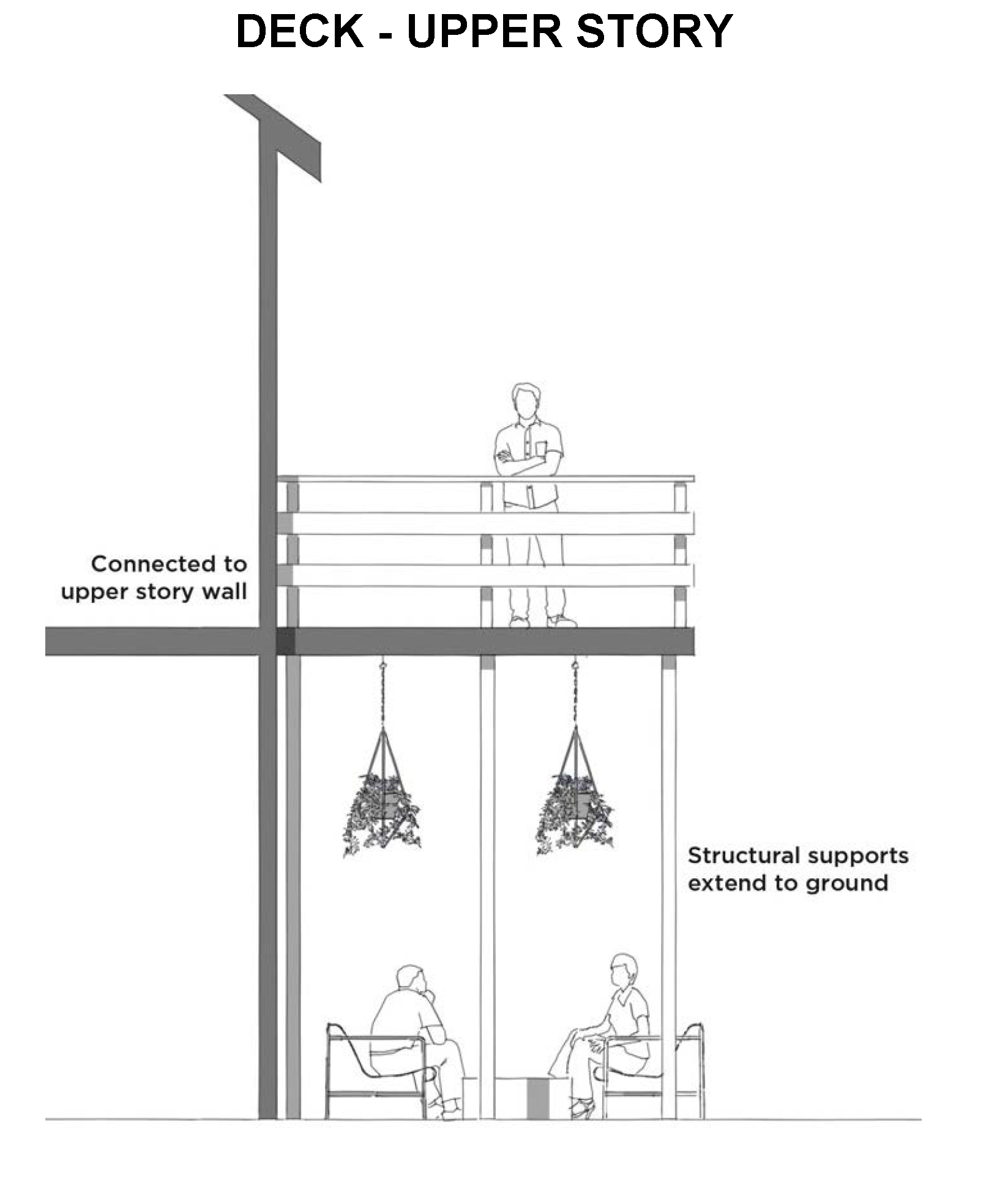
Deck, upper story means a roofless outdoor space built as an aboveground platform projecting from and connecting to an upper story wall of a structure with structural supports that extend to the ground.
Development means any residential, multi-family, commercial, mixed-use, or industrial improvement to lands within the city.
Donation box means an unattended receptacle designed with a door, slot, or similar opening intended to accept and store donated clothes and household items.
Driveway means a private roadway providing access to a street or highway.
Dwelling means a structure, or portion thereof, designed exclusively for human habitation.
Dwelling unit means one or more habitable rooms which are occupied, or which are intended or designed to be occupied as a residence by one household or family, with facilities for living, sleeping, sanitation, and cooking.
Easement means a grant of one or more of the property rights by the property owner to and/or for use by the public, a corporation, or another person or entity.
Eave means the projecting lower edges of a roof overhanging the wall of a structure.
Egress means a place or means of exiting a property.
Encroachment means the extension or placement of any structure, or a component of such, into a required setback or right-of-way.
Enlargement means an increase in the size of an existing structure or use, including the physical size of the property, building, parking, and other improvements.
Endwall means the wall of the end unit of a townhouse development that is not attached to another dwelling unit or party wall.
Erect means to build, construct, attach, hang, place, suspend, or affix.
Existing use means the use of a property at the time that an application for development or redevelopment is made.
External illumination means illumination by an artificial source of light not internal to the sign face.
Exterior lighting means the illumination of an outside area or object by any man-made device that produces light by any means.
Exterior wall means any wall that defines the exterior boundaries of a building or structure.
Exterior stairwell means one or more flights of stairs, and the necessary landings and platforms connecting them, to form a continuous passage from the entryway of a floor or level to another in a structure located on the exterior of a principal building.
Family means one or more persons related by blood, marriage, or civil union, including adopted children. family is also defined as a group of persons not related by blood, marriage, or civil union, not to exceed eight persons, occupying premises and living as a single housekeeping unit, as distinguished from a group occupying a boarding or lodging house, hotel, club, or similar group living arrangement means a family may include those persons employed by said family for assistance in house upkeep, childcare, and similar services.
Façade means an exterior building wall, from grade to the top of the parapet or eaves means a façade incorporates the full width of a building elevation, including any projections or recesses occurring across an elevation means the front building façade is the principal elevation of a building and contains the building's main entrance, the rear façade is the building's rear exterior wall, and the side façades are a building's side exterior walls.
Fence means an artificially constructed barrier of any permitted material or combination of materials erected to enclose, screen, or separate areas.
(1)
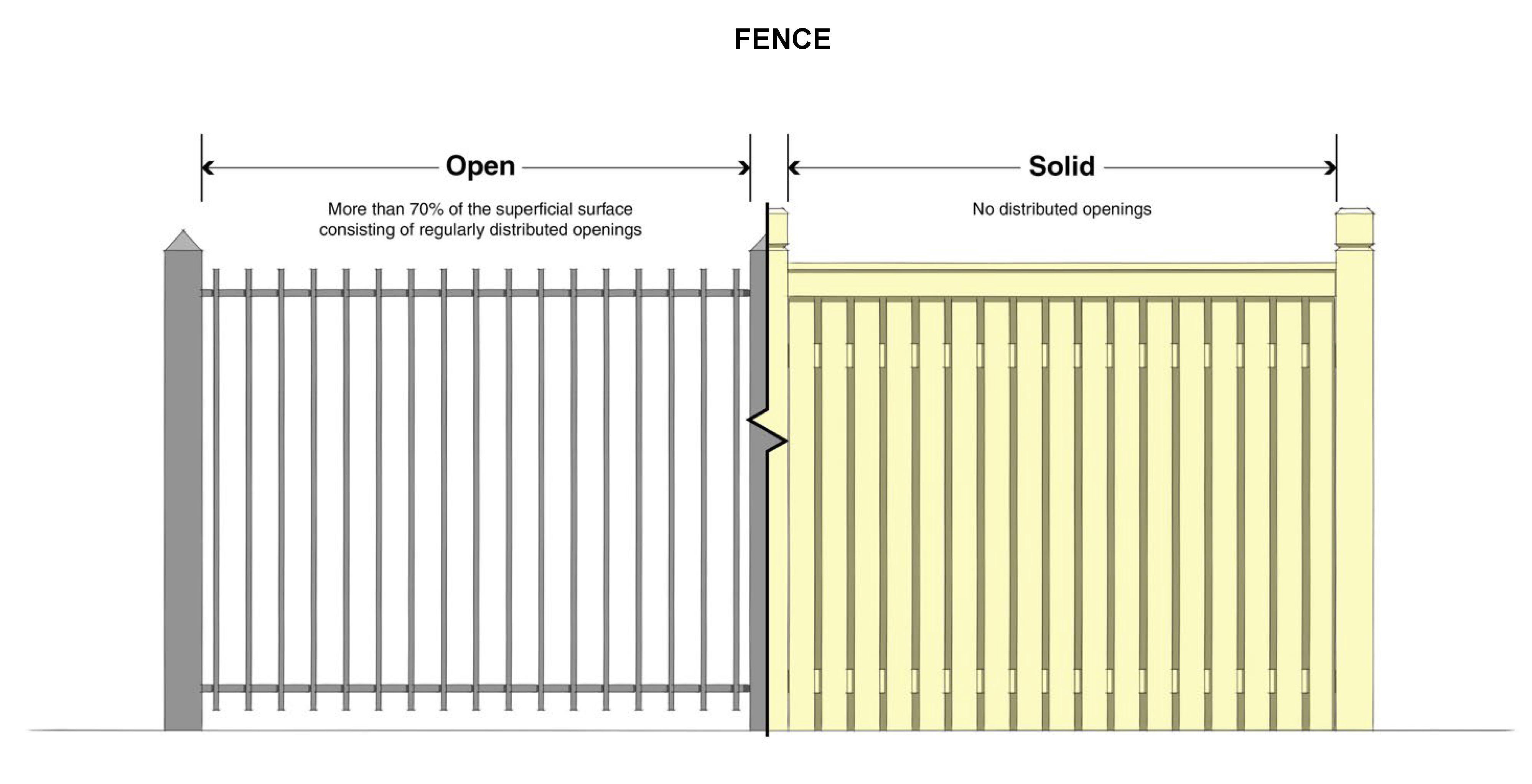
Fence, open means a fence that has, over its entirety, more than 70 percent of the superficial surface consisting of regularly distributed openings.
(2)
Fence, solid means a fence that has, over its entirety, no distributed openings means a shadowbox design fence, where pickets alternate on the rail, is considered a solid fence means a chain link fence with slats is not considered a solid fence.
Fenestration means windows and other openings on a building façade.
Flood plain or flood-prone area means any land area susceptible to being inundated by water from any source.
Floodway means the channel of a river or other watercourse and the adjacent land areas that must be reserved in order to discharge the 100-year flood without cumulatively increasing the water surface elevation more than one foot at any point.
Floodway fringe means all that land in a flood plain not lying within a delineated floodway. Land within a floodway fringe is subject to inundation by relatively low velocity flows and shallow water depths.
Floodlight/searchlight means a luminaire intended to illuminate a large area by flooding it with light, and which can produce light above the luminaire means a floodlight concentrates the light output into a direct beam in a particular direction by using a reflector or a refractor.
Foot-candle means a unit of measure of illuminance equal to one lumen of light spread over an area of one square foot.
Frontage means the boundary line of a lot between a building and the right-of-way or the pavement of a sidewalk.
Garage means an accessory building or portion of a principal building intended for storage of motor vehicles of the occupants of the premises.
Gazebo means a freestanding outdoor accessory structure designed for recreational use and not for habitation.
Glare means the effect produced by light from a luminaire with an intensity sufficient to cause annoyance, discomfort, or loss in visual performance and visibility.
Grading means any stripping, cutting, filling, or stockpiling of earth or land, including the land in its cut or filled condition, to create new grades.
Green roof means a building roof partially or completely covered with vegetation and a growing medium, planted over a waterproofing membrane. It may also include additional layers such as a root barrier and drainage and irrigation systems.
Gross floor area (GFA). Defined in section 16-2-2.4.
Hardscape means nonliving components of a landscape design, such as walls, sculpture, paved walkways, patios, stone and gravel areas, benches, fountains, and similar hard-surface areas and objects.
Hedge means a row of bushes or small trees planted close together, especially when demarcating a boundary or forming a barrier.
Horizontal property regime (HPR) means a system of individual fee ownership of buildings or portions of buildings, combined with common ownership of buildings, portions of buildings, land, and site improvements.
Impervious surface coverage. Defined in section 16-2-2.4.
Infrastructure means facilities and services needed to sustain land use activities.
Ingress means a place or means of gaining access or entry into a property.
Light pole means pole on which a luminaire is mounted.
Light trespass means the shining of light produced by a luminaire (light fixture) beyond the boundaries of the property on which it is located.
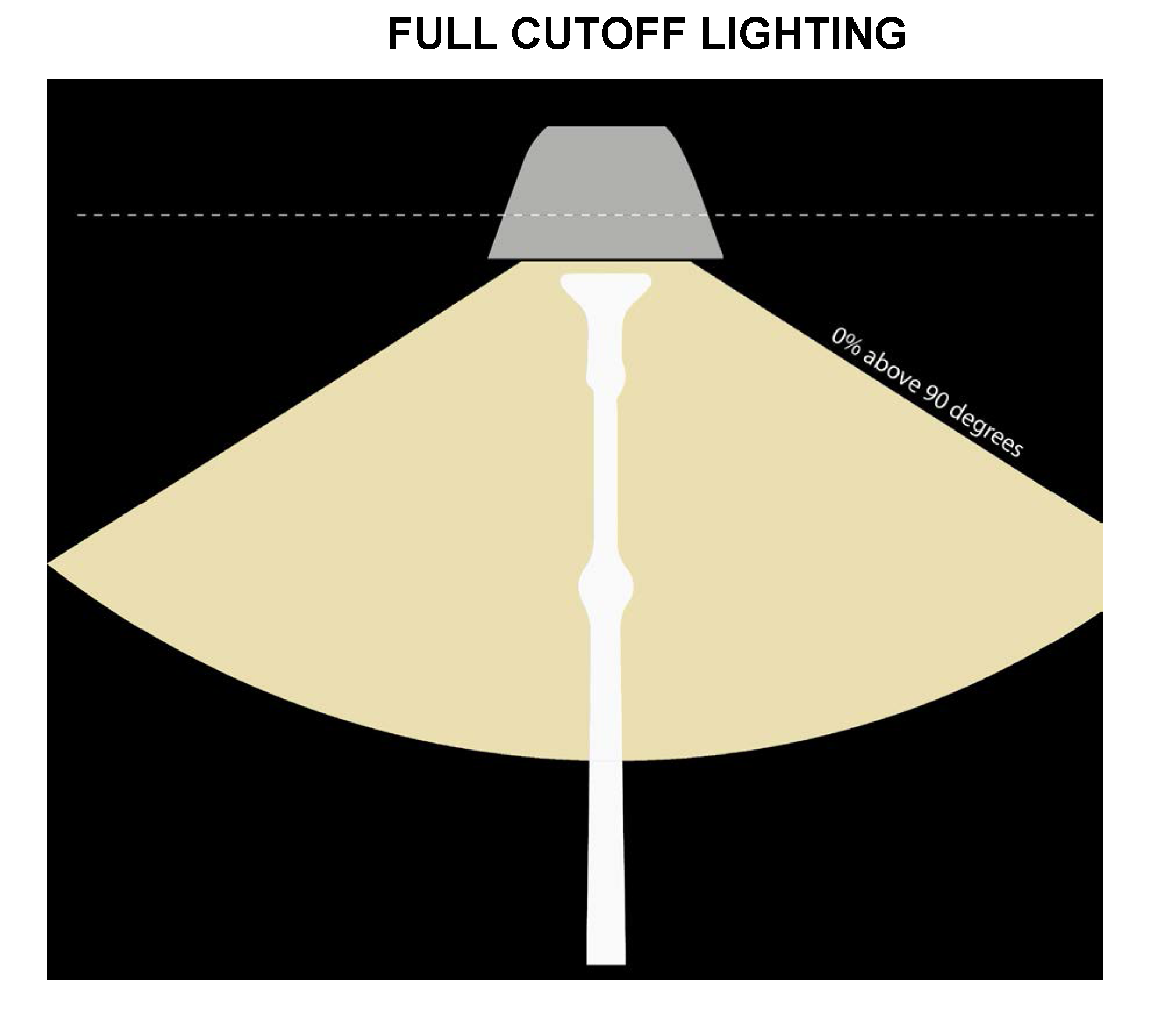
Lighting, full cutoff means a light distribution where the candela value is zero at or above horizontal (90 degrees above nadir).
Lot. See lot of record.
Lot area. Defined in section 16-2-2.4.
Lot, corner. Defined in section 16-2-2.4.
Lot depth. Defined in section 16-2-2.4.
Lot, interior. Defined in section 16-2-2.4.
Lot, pipestem. Defined in section 16-2-2.4.
Lot, Lake Hamilton Waterfront. Defined in section 16-2-2.4.
Lot of record means a lot that existed as of June 1, 2011 that is shown or described on a plat, survey, or deed recorded with the state or county. Lots created after June 1, 2011 are considered a lot of record when lawfully created by approved land division.
Lot line. Defined in section 16-2-2.4.
Lot line, corner. Defined in section 16-2-2.4.
Lot, double-frontage. Defined in section 16-2-2.4.
Lot line, front. Defined in section 16-2-2.4.
Lot line, interior. Defined in section 16-2-2.4.
Lot line, rear. Defined in section 16-2-2.4.
Lot line, street. Defined in section 16-2-2.4.
Lot line, Lake Hamilton Waterfront. Defined in section 16-2-2.4.
Lot width. Defined in section 16-2-2.4.
Lumen means a unit of measure of the quantity of light that falls on an area of one square foot, every point of which is one foot from the source of one candela.
Luminaire means a complete lighting unit consisting of a light source, pole, and all mounting brackets, if appropriate, and all necessary mechanical, electrical, and decorative parts.
Masonry means veneer of exterior walls constructed of bricks, decorative block, split-face concrete, stone, or other materials of similar appearance approved for exterior use by the building code.
Manufactured home overlay means areas of the city defined on the zoning map that permit placement of manufactured homes without a conditional use permit.
Mobile retail food establishment means a vehicle-mounted retail food establishment designed to be readily movable and approved by law to travel highways, roadways, and/or waterways in the State of Arkansas that is a self-contained retail food establishment equipped with permanently mounted fresh water holding tanks and wastewater holding tanks duly licensed and operated in accordance with the rules and regulations promulgated by the Arkansas State Board of Health.
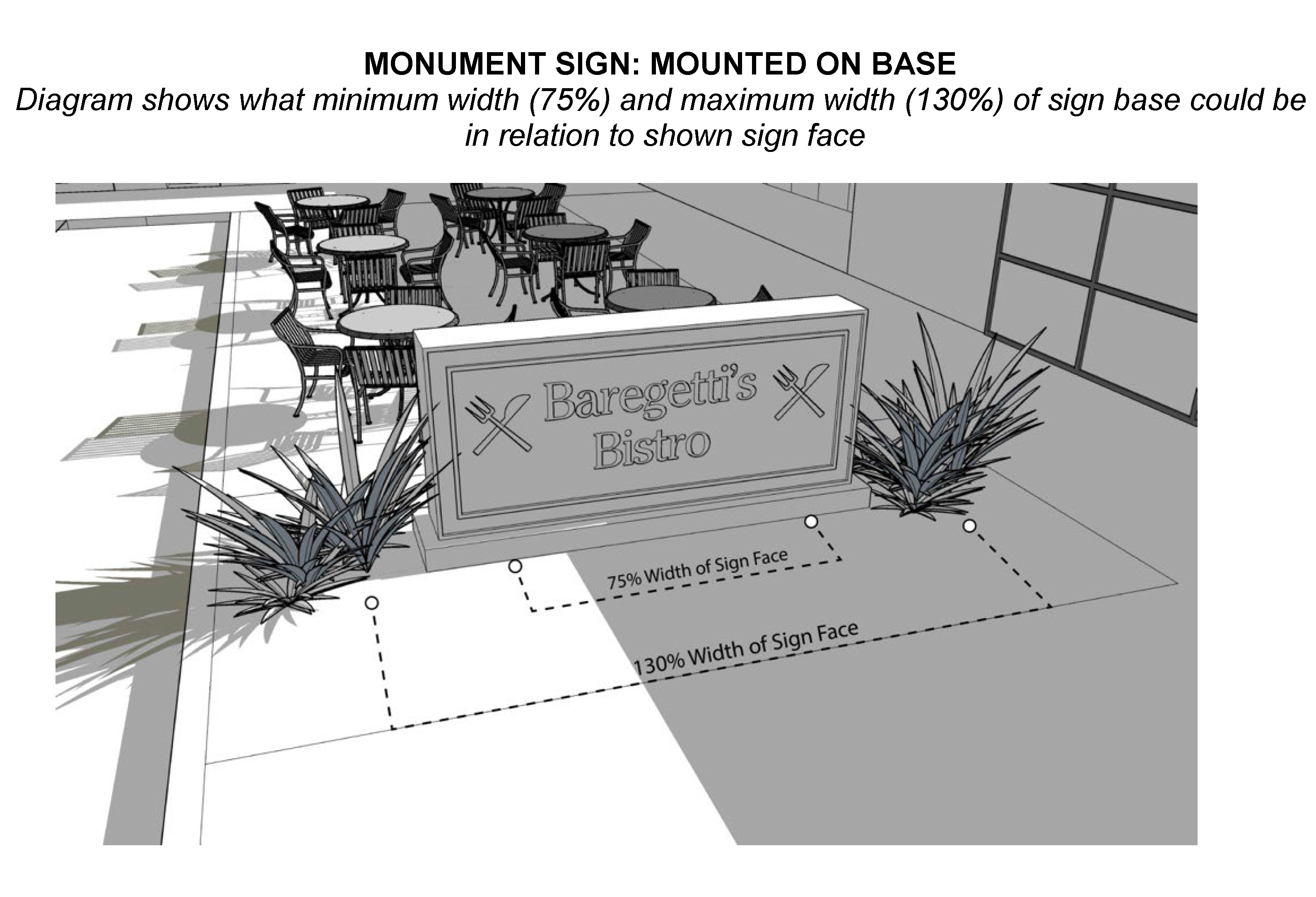
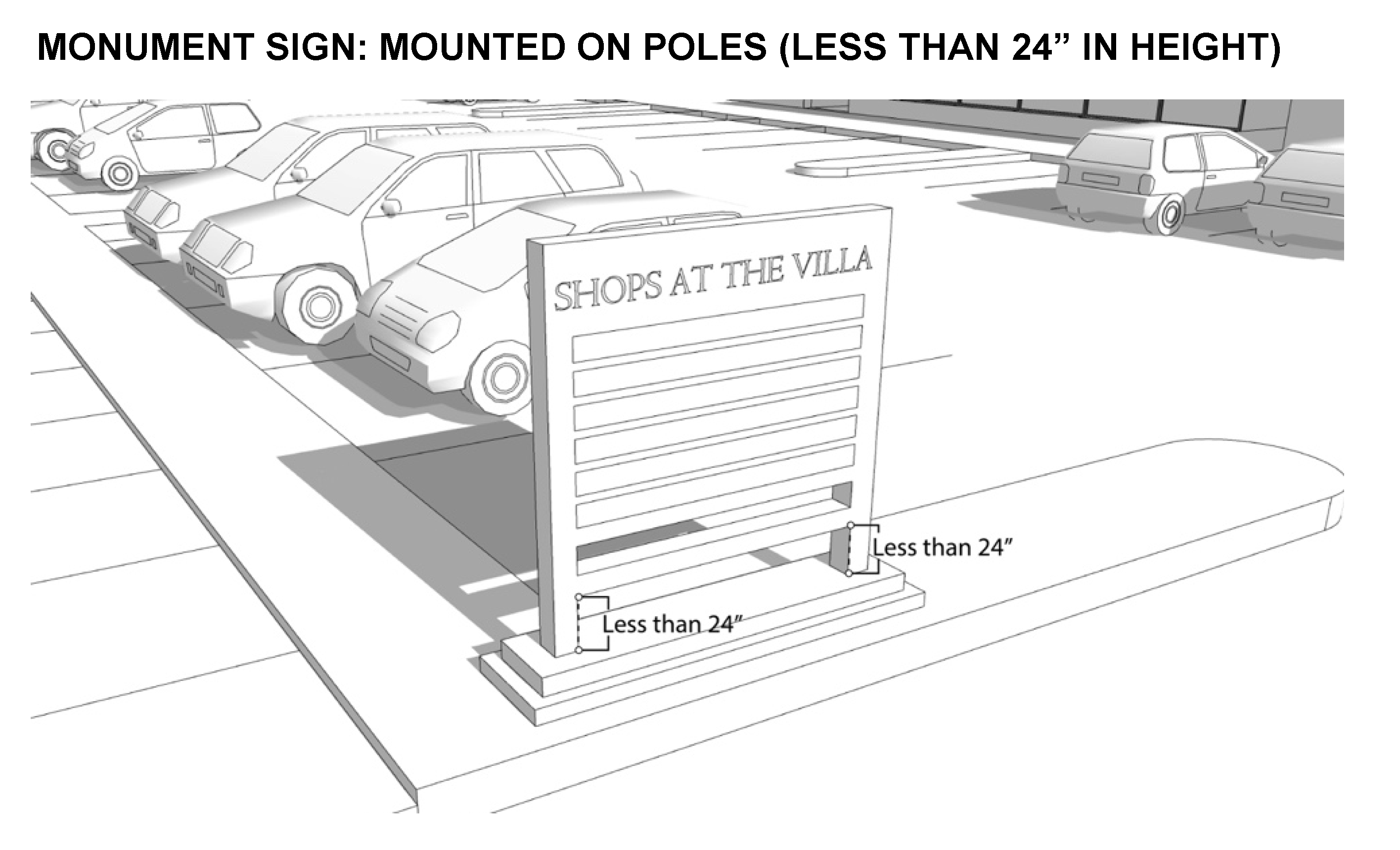
Monument sign means a sign placed upon or supported by the ground independently of any other structure means the sign base of a monument sign must be a minimum of 75 percent to a maximum of 130 percent of the width of the sign face situated upon the base means a sign is considered a monument sign when the sign face is mounted on poles that are 24 inches or less in height.
Noncommercial message means the expression of noncommercial ideas and messages means a noncommercial message does not promote a business, product, service, commercial entertainment, or other commercial activity, product, or service offered on or off the premises.
Off-street parking means the storage space for an automobile on premises other than streets or rights-of-way.
Outlot means an area of land set aside within a retail center for a separate principal building that shares a circulation system and may share common parking with the larger retail center development but is separated from the principal building or buildings, typically located along the property line.
Owner means an individual, firm, association, syndicate, partnership, or corporation having sufficient proprietary interest to seek development of land, such as the owner of the title or a mortgage whose interest is shown of record in the mortgage and conveyance records, a person shown as owner in the records of the tax assessor of the county in which the property is situated, or the agent of any such person and those in possession of a dwelling, dwelling unit, or premises.
Parking facility means a parking lot and/or parking structure. Parking facility does not include parking spaces and parking pads for individual dwelling units for single-family detached and attached, two-family, or townhouse dwellings.
Parking lot means an open, hard-surfaced area, excluding a street or public way, used for the storage of operable vehicles, whether for compensation or at no charge.
Parking structure means a structure used for the parking or storage of operable vehicles, whether for compensation or at no charge.
Party wall means a common wall from the foundation and extending continuously through all stories to or above the roof that separates one building from another, but in joint use by each building.
Patio means a hard surface designed and intended for recreational use by people and not used as a parking space.
Pedestrian facilities means sidewalks, shared use paths, and similar facilities intended for pedestrian mobility.
Pergola means an open structure, which may be either freestanding or attached to a structure, that forms a partially shaded pedestrian walkway, passageway, or sitting area, and is constructed of a semi-open roof and vertical posts that support cross-beams and a sturdy open lattice. It may also be used as an extension of a building entryway.
Personal recreation game court means specifically-designed and constructed playing areas intended for recreational use on private property, such as a residence. Common examples of personal recreation game courts are basketball courts and tennis courts means this does not include backstops and portable basketball nets.
Pervious paving means a range of sustainable materials and techniques for permeable paving that allow the movement of water through the surface. Gravel and loose rock are not considered pervious paving.
Porch means an architectural feature that projects from the exterior wall of a structure, has direct access to the street level of the building, and is covered by a roof or eaves.
(1)
Porch, unenclosed means a porch that is open on all sides, with the exception of the side attached to the principal building.
(2)
Porch, enclosed means a porch enclosed by walls, screens, lattice, or other material means a screened-in porch is an enclosed porch.
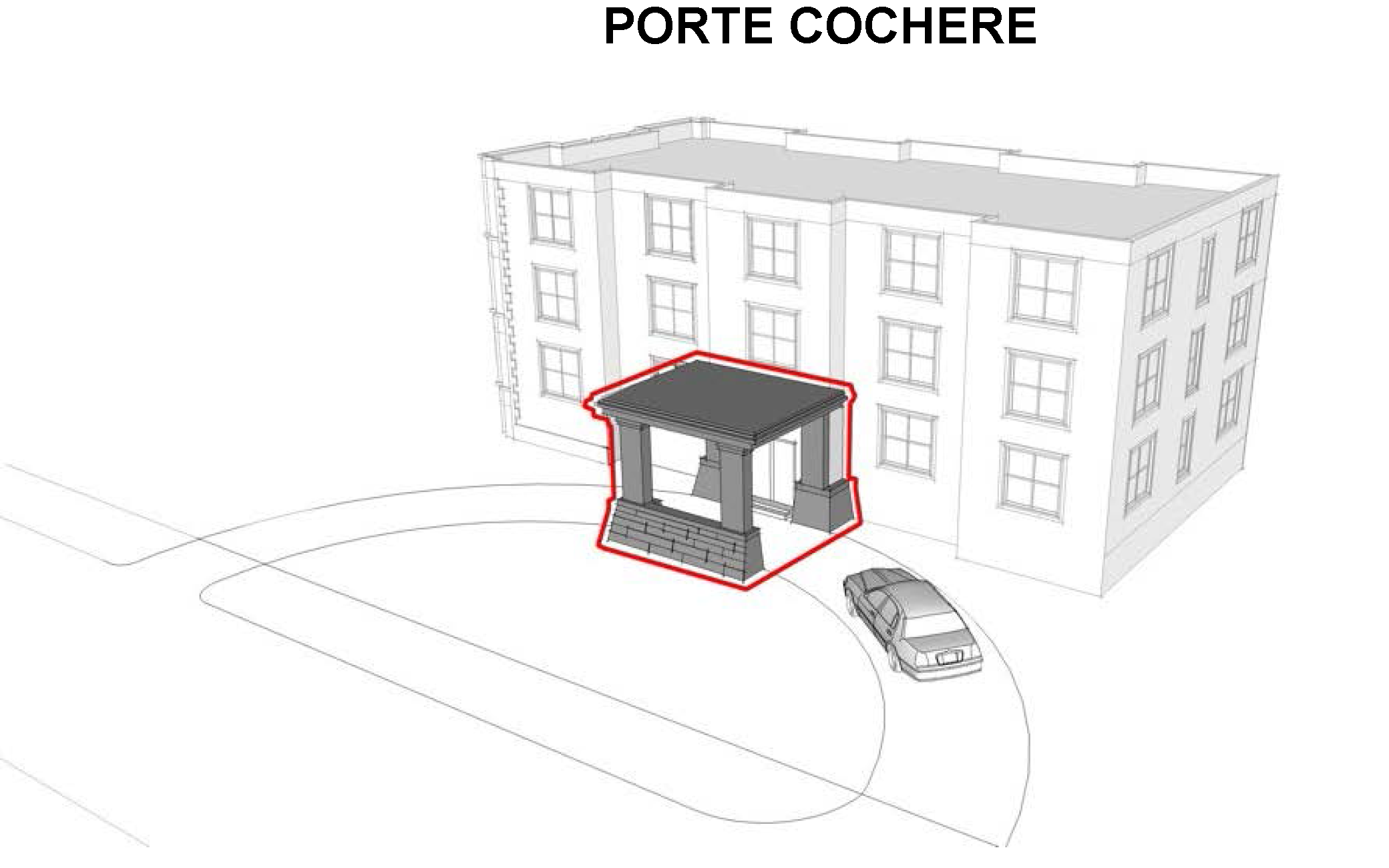
Porte cochere means a permanent structure built over a driveway or entry drive that provides temporary shelter to persons exiting a vehicle, but not serving as the only covered or enclosed vehicle shelter on-site.
Principal building means a non-accessory structure in which a principal use of the lot on which it is located is conducted.
Principal use means the main use of land or structures as distinguished from an accessory use.
Private playground equipment means playground structures and playsets installed on private property, such as a residence. Common examples of private playground equipment include swing sets, slides, and seesaws.
Recreational vehicle means any vehicle or boat designed for temporary living quarters, recreation, or temporary human habitation and not used as a commercial vehicle including, but not limited to, the following: boat/watercraft, camper trailer, motorized trailer, off-road vehicle, racing car or cycle, travel trailer, and truck camper. "Recreational vehicle" does not include a manufactured home as regulated and defined in article VIII.
Refuse container means an exterior waste container designed to be mechanically lifted by and emptied into or carted away by a collection vehicle.
Recycling containers means a container for the collection of recyclables.
Right-of-way means a strip of land dedicated for use as a public way. In addition to the roadway, it typically incorporates the curbs, tree lawn, sidewalks, and shoulders.
Roofline means the top edge of a roof or building parapet, whichever is higher, excluding any cupolas, pylons, chimneys or minor projections.
Seasonal operation means any establishment operating on a seasonal basis not to exceed a 150-day period of time per calendar year, limited to the serving of dispensed drinks, coffee, snow cones, shaved ice, and other similar ice based products duly licensed and operated as a "seasonal operation" in accordance with the rules and regulations promulgated by the Arkansas State Board of Health.
Setback. Defined in section 16-2-2.4.
Setback, corner side. Defined in section 16-2-2.4.
Setback, front. Defined in section 16-2-2.4.
Setback, interior side. Defined in section 16-2-2.4.
Setback, parking. Defined in section 16-2-2.4.
Setback, rear. Defined in section 16-2-2.4.
Setback, street. Defined in section 16-2-2.4
Setback, Lake Hamilton Waterfront. Defined in section 16-2-2.4
Shed means an accessory structure, which may be pre-built or a kit in prefabricated sections, that is not designed to be served by heat or plumbing and does not need to be placed on a permanent foundation means a shed is typically intended to store lawn, garden, or recreational equipment.
Solar panel means a photovoltaic device capable of collecting and converting solar energy into electricity.
Stacking space means a space specifically designed and designated as a waiting area for vehicles patronizing a drive-through facility or service bay.
Standpipe means a rigid vertical or horizontal pipe to which fire hoses can be connected, which may be building, ground, or roof mounted.
Stoop means an exterior floor typically, constructed of stone, concrete, and/or masonry, with a finished floor elevation higher than the adjacent ground level, often with steps leading up to it, and utilized primarily as an access platform to a structure means a stoop may be roofed and designed with railings but cannot be enclosed.
Structure means a combination of materials that form a construction for use, occupancy, or ornamentation, whether installed on, above, or below the surface of land or water.
Temporary use means a use established for a limited duration with the intent to discontinue such use upon the expiration of the time period.
Transparency. Defined in section 16-2-2.4.
Unified control means the combination of two or more tracts of land wherein each owner has agreed that his tract of land will be developed under the same development approvals.
Use means the purpose or activity for which the land or structure is designed, arranged, or intended, or for which it is occupied or maintained.
Vehicle, junk means any rusted, wrecked, damaged, dismantled, or partially dismantled, inoperative, or abandoned motor vehicle in such a condition that it is economically infeasible to restore the vehicle to an operating condition.
White roof means a roofing surface designed to reflect more sunlight and absorb less heat than a standard roof. White roofs are typically made of reflective materials, such as white membrane or white roof coatings means the goal is to reduce the absorption of solar radiation, lower the roof temperature, and decrease the amount of heat transferred into the building.
Yard. Defined in section 16-2-2.4.
Yard, front. Defined in section 16-2-2.4.
Yard, interior side. Defined in section 16-2-2.4.
Yard, corner side. Defined in section 16-2-2.4.
Yard, rear. Defined in section 16-2-2.4.
Yard, Lake Hamilton Waterfront. Defined in section 16-2-2.4.
Zoning lot means a lot or combination of lots within a single block, which is designated by its owner or developer to be used, developed, or built upon as a unit means a zoning lot may coincide with a lot of record or may comprise one or more lots of record.
(Ord. No. 6513, § 1(Exh. A), 11-19-24; Ord. No. 6538, § 3, 5-6-25)
16-2-2.4. - Rules of measurement.
This section provides the rules of measurement for the dimensional standards and locational characteristics within the Code.
(1)
Block and blockface.
a.
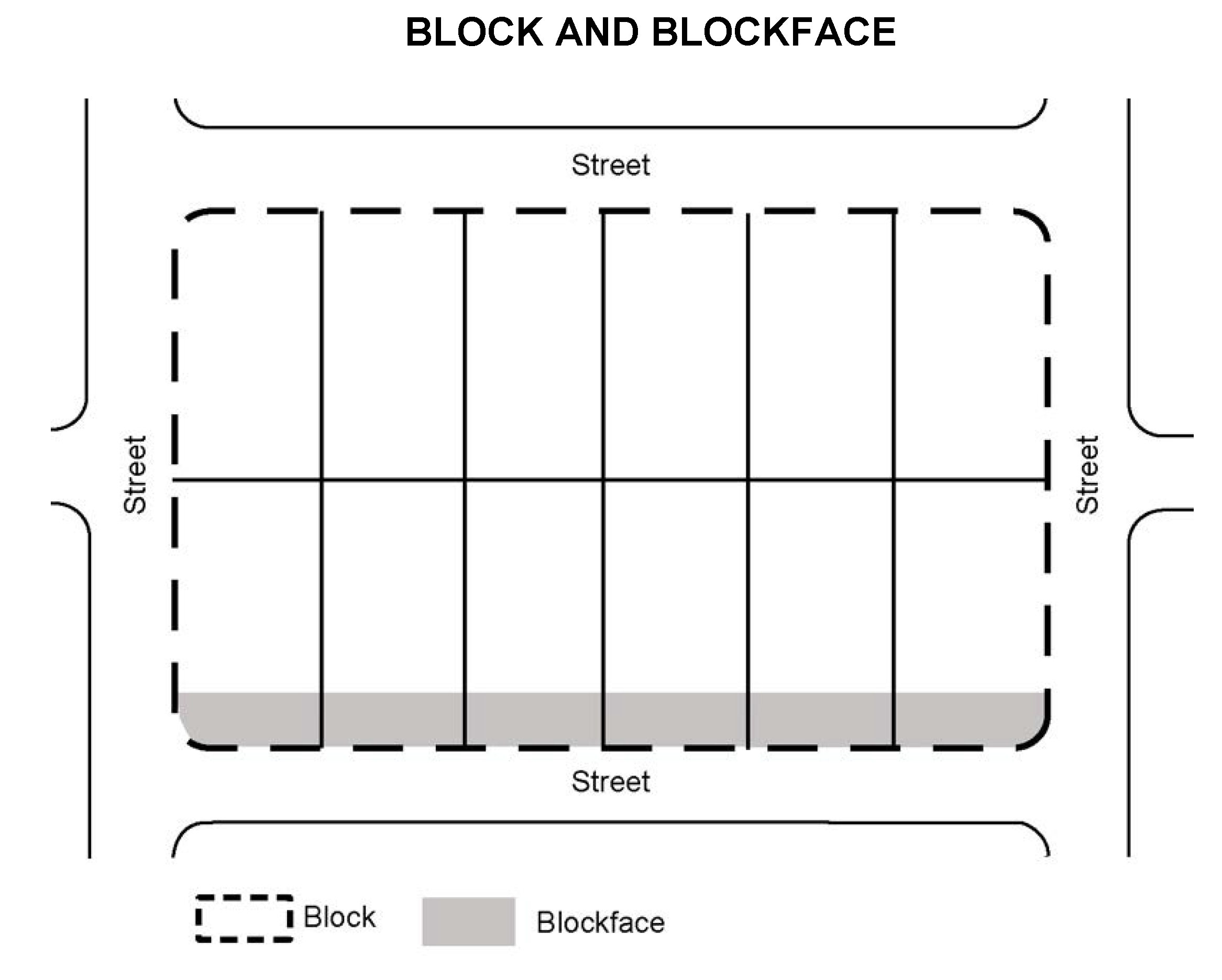
A block is a tract of land bounded by streets, or a combination of streets and railroad rights-of-way or municipal boundary lines.
b.
Blockface is measured as that portion of a block or tract of land facing the same side of a single street and lying between the closest intersecting streets.
(2)
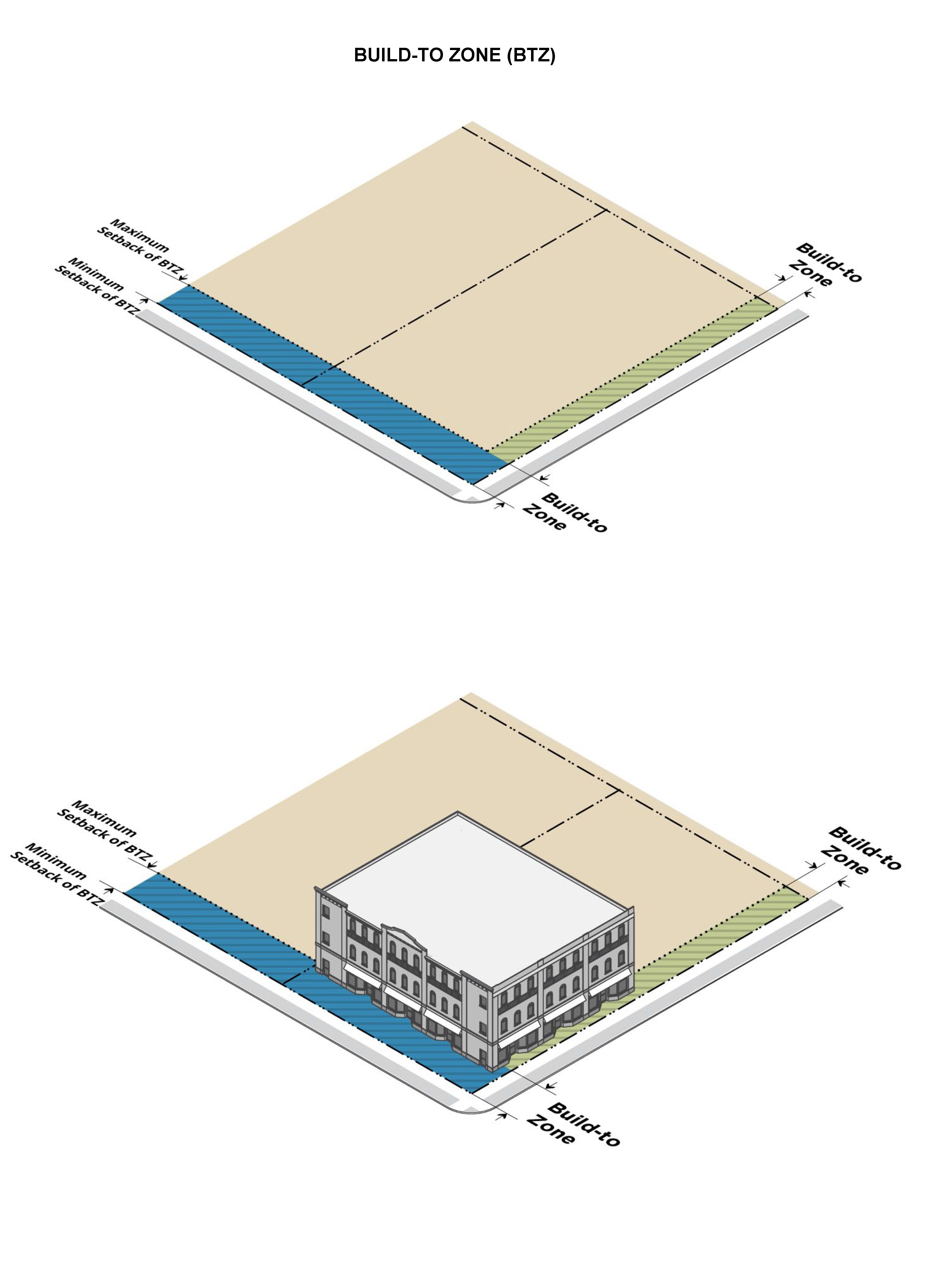
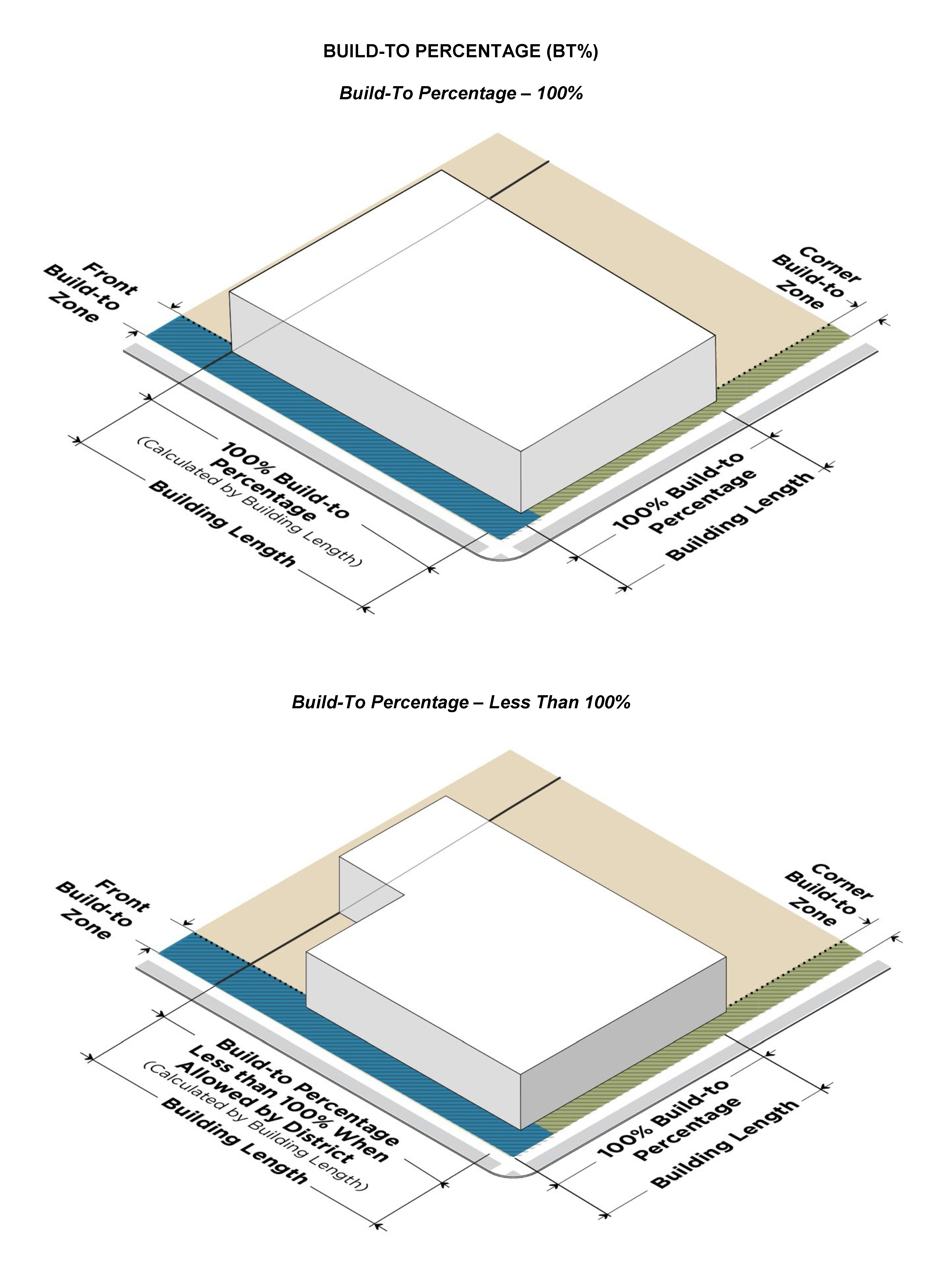
Build-to dimensions. Certain dimensional requirements within the zoning districts require structures to be constructed at a build-to dimension. A build-to requirement is a boundary or alignment, parallel to a lot line, where a structure must be placed. This Code includes the following build-to dimensions:
a.
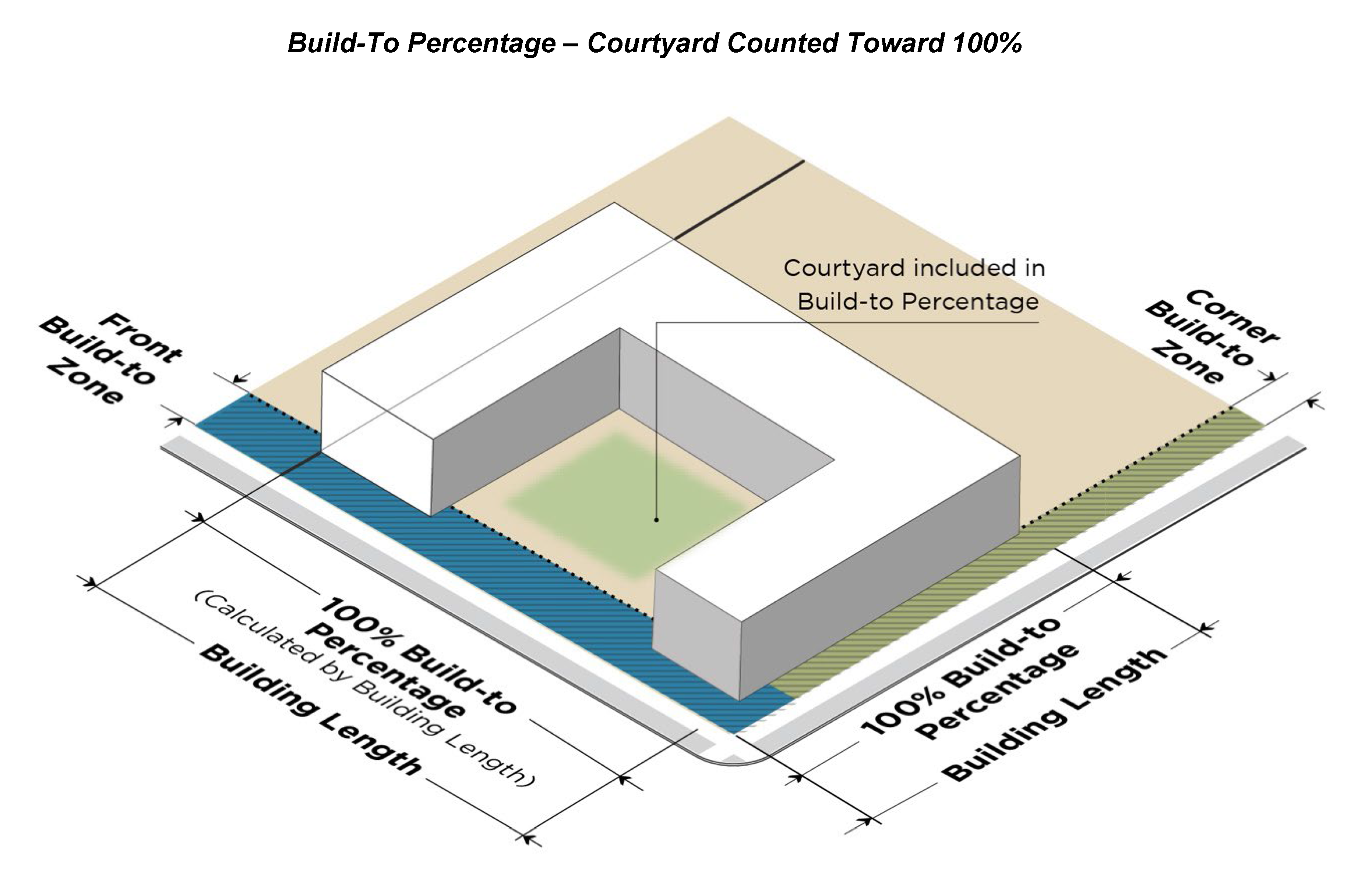
Build-to zone (BTZ). A build-to zone (BTZ) is the area on a lot, measured perpendicular from the applicable lot line, where the building must locate within the minimum and maximum range of setback provided. The building façade must be located within the build-to zone.
b.
Build-to percentage (BT%). A build-to percentage specifies the percentage of the building façade that must be located within the build-to zone. Build-to percentage is calculated by building façade, not lot width.
1.
Façade articulation elements, such as window or wall recesses and projections, are included in the calculation of a required build-to percentage.
2.
Programmed outdoor spaces and outdoor dining areas that are bounded by a building façade parallel to the frontage are included in the calculation of a required build-to percentage.
3.
Open space bounded on three sides by a building, such as courtyards, are included in the calculation of a required build-to percentage.
(3)
Building height.
a.
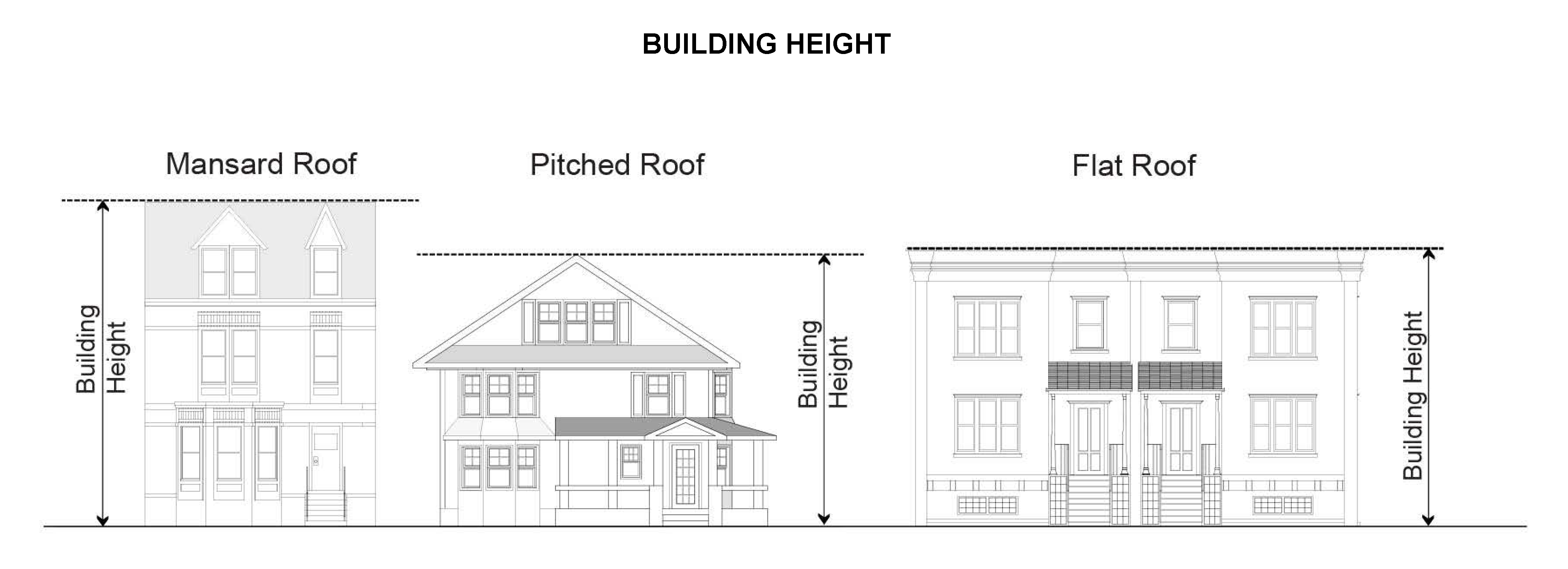
Building height is the vertical distance from the sidewalk grade or finished lot grade adjacent to the building, whichever is higher, to the highest point of the building.
b.
The following structures or parts thereof are exempt from maximum height limitations, unless otherwise limited by any height restriction imposed by any airport authority, or other similar federal, state, or local authority.
1.
Public utility poles, towers, and wires. Public utilities do not include wireless telecommunications, solar panels, and wind turbines unless operated by a government agency.
2.
Water tanks and standpipes.
3.
Building appurtenances such as chimneys, parapet walls, skylights, steeples, flagpoles, smokestacks, cooling towers, elevator bulkheads, fire towers, monuments, water towers, stacks, stage towers, or scenery lofts, tanks, ornamental towers and spires, rooftop accessory structures, recreational facilities, necessary mechanical appurtenances, or penthouses to house mechanical appurtenances.
(4)
Gross floor area (GFA). The gross floor area (GFA) of a structure is the sum of the gross horizontal areas of all floors of the structure as measured from the exterior faces of the exterior walls or from the centerline of walls separating two buildings.
(5)
Lot types. The following describes the types of lot configurations:
a.
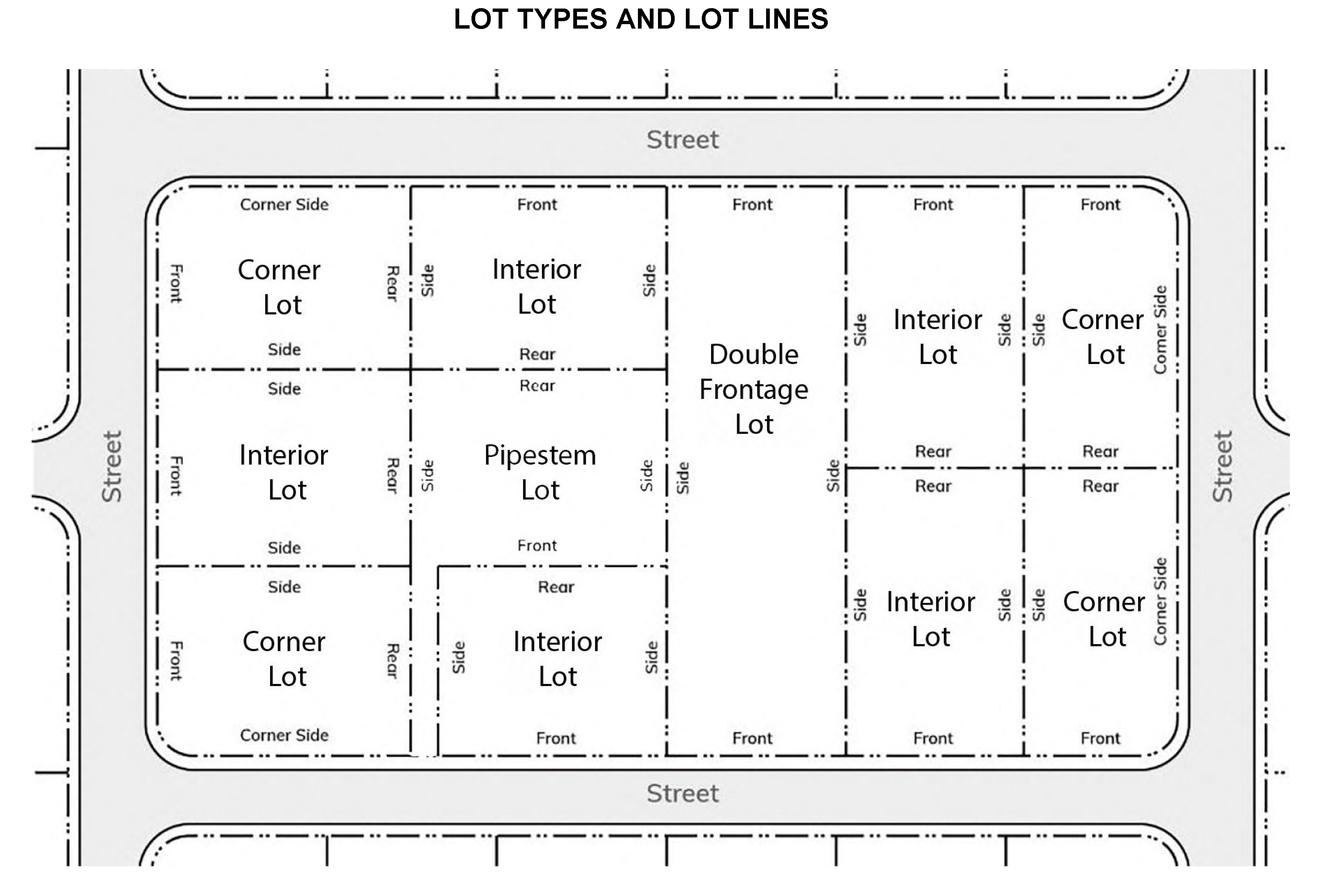
An interior lot is a lot other than a corner or through lot, bounded by two interior side lot lines.
b.
A corner lot is a lot situated at the junction of, and abutting, two or more intersecting streets.
c.
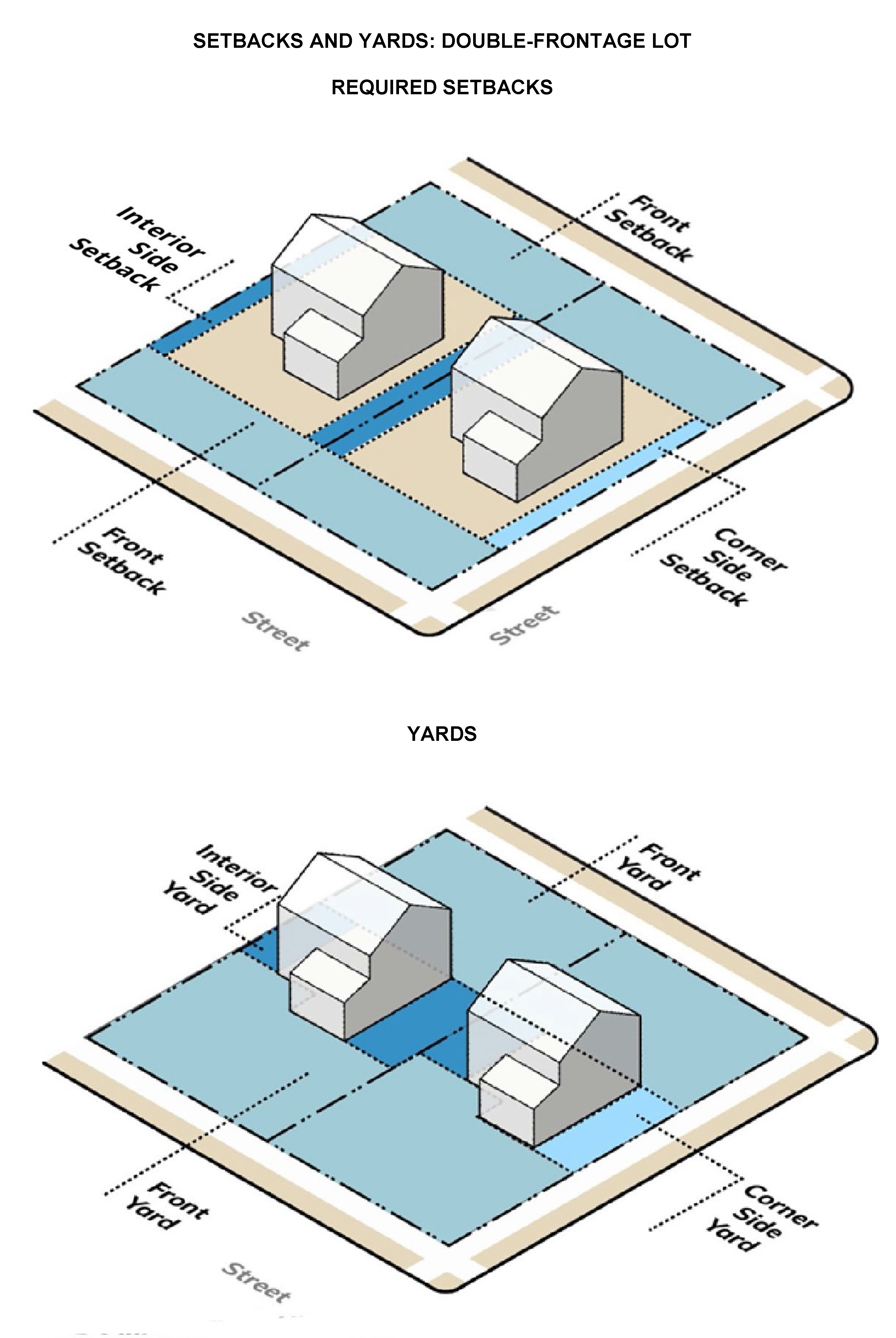
A double-frontage lot is a lot which fronts upon two parallel streets, or which fronts upon two streets which do not intersect at the boundaries of the lot. A double-frontage lot is also called a through lot.
d.
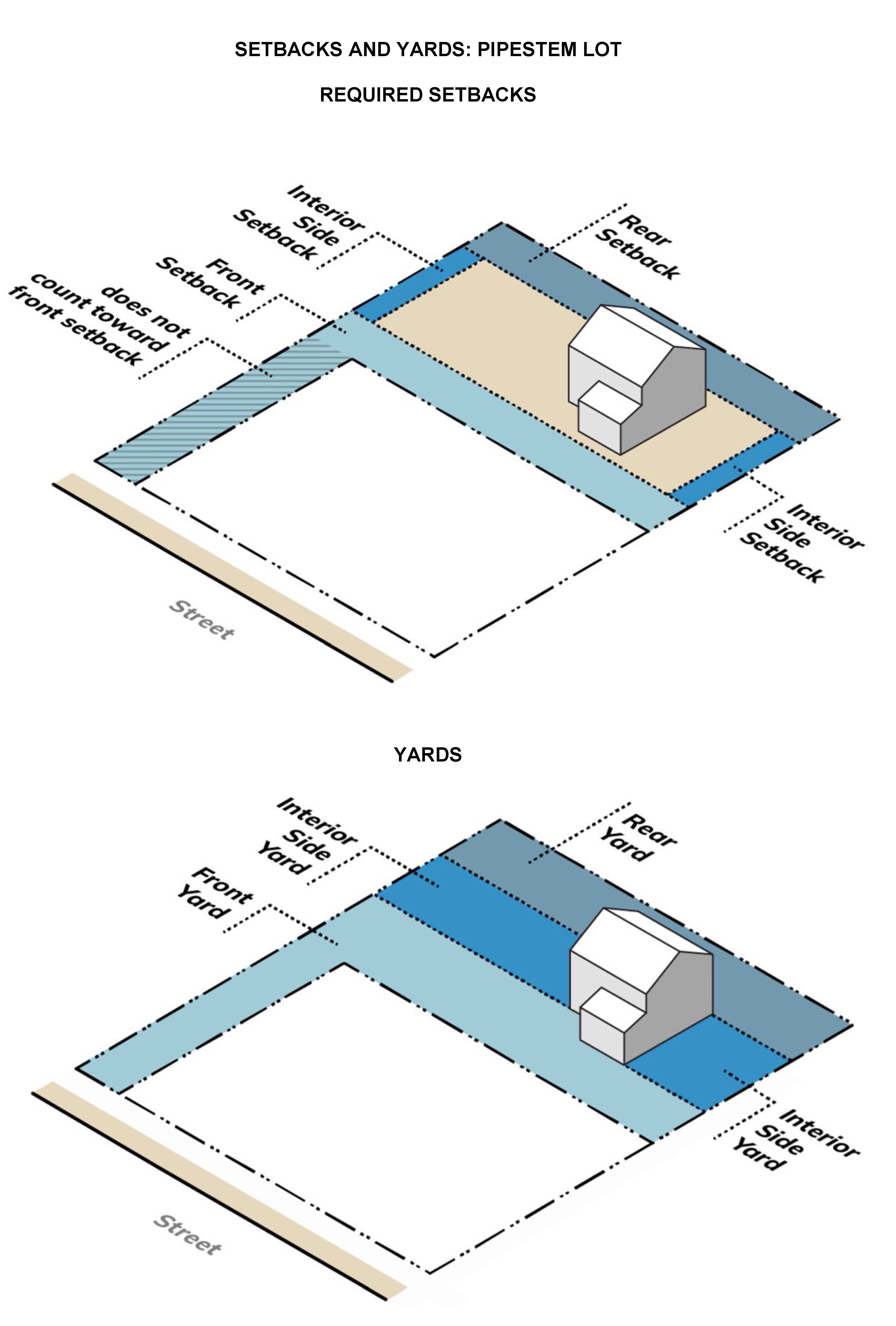
A pipestem lot is platted so that the main building site area is set back from the street on which it fronts and includes an access strip (the "pole") connecting the main building site with the street. A pipestem lot may also be called a flag lot.
e.
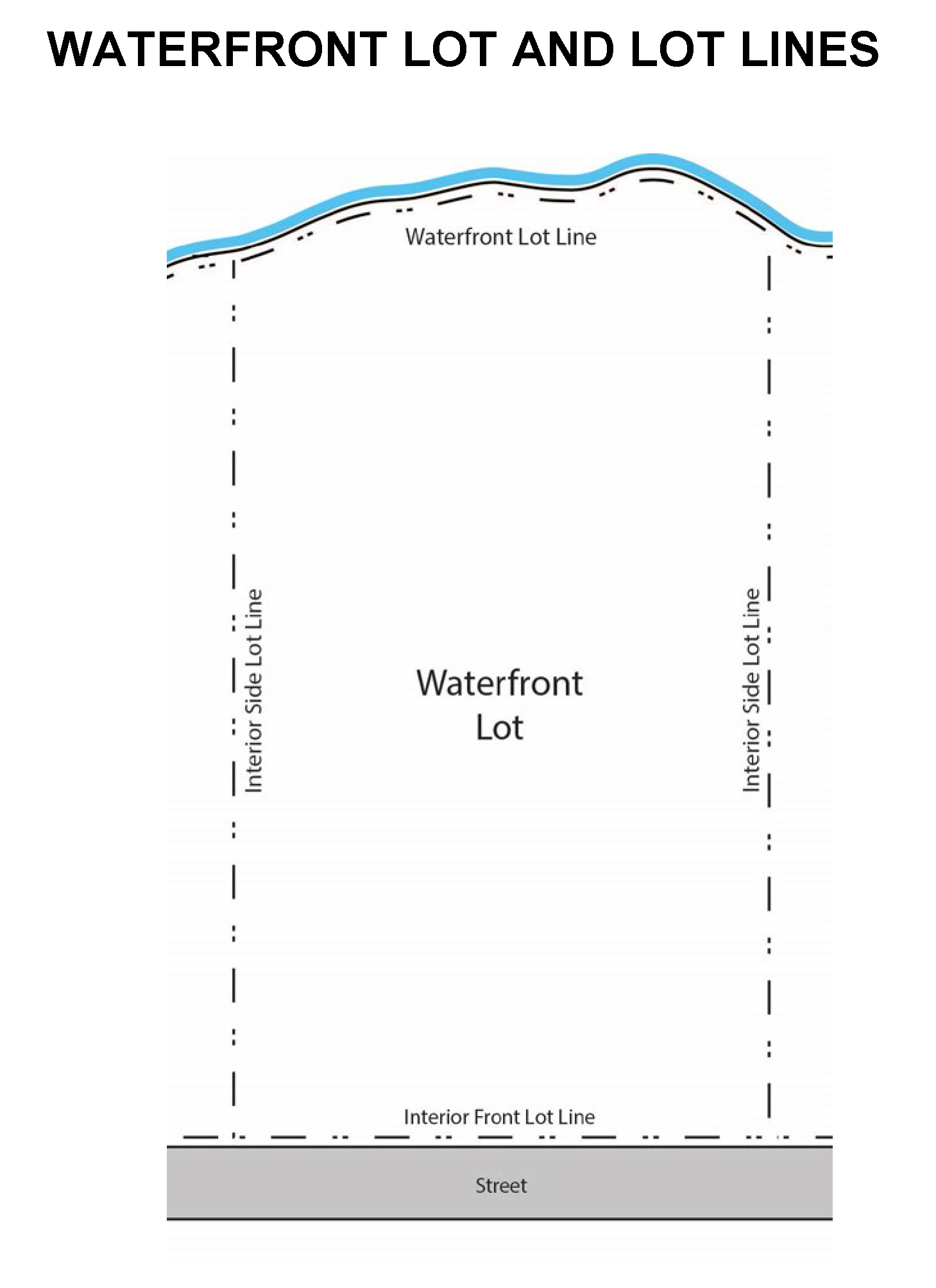
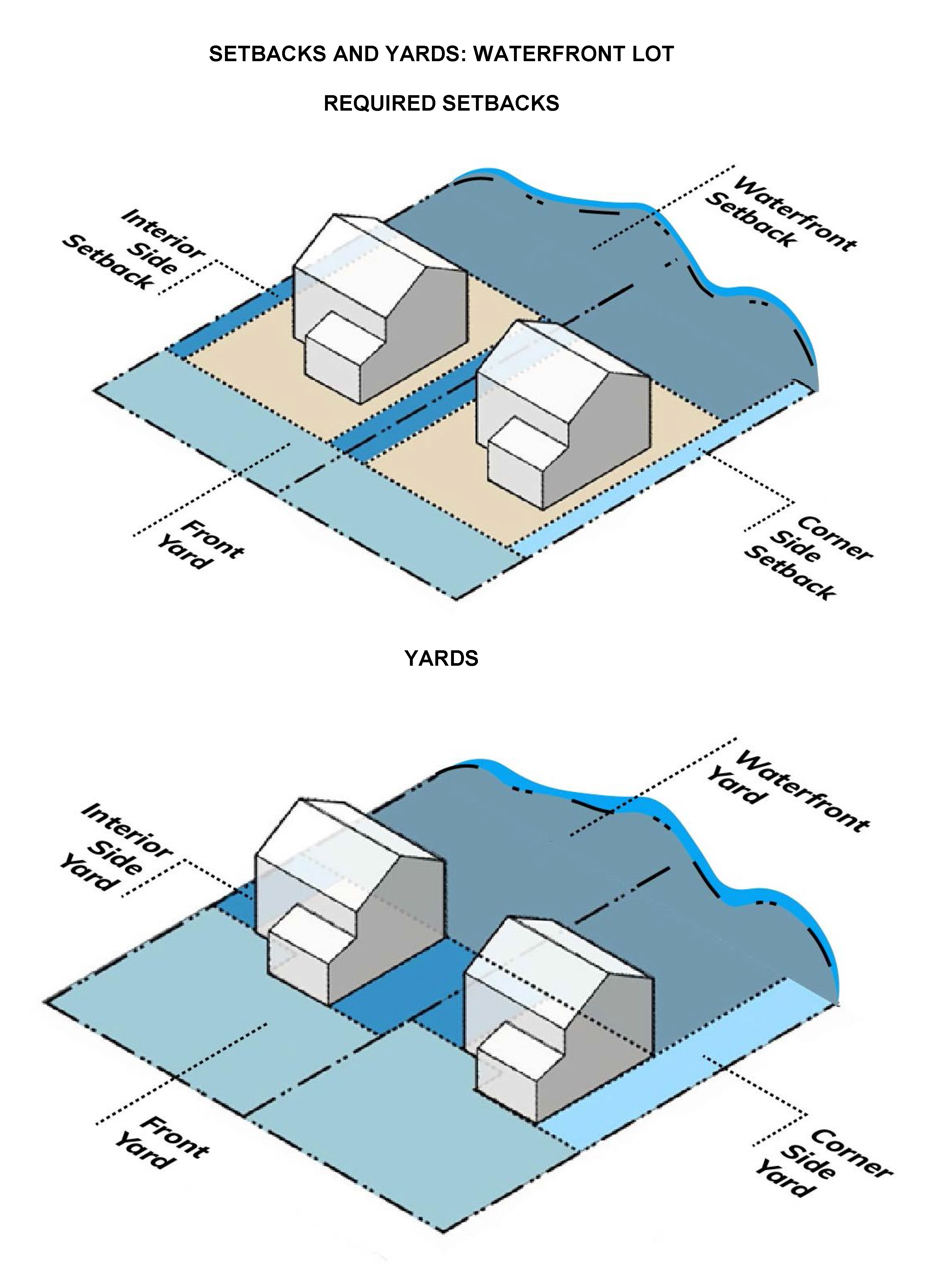
A waterfront lot is a lot where one or more lot lines abut a body of water.
(6)
Lot area. The total area within the boundaries of a lot, excluding any street right-of-way.
(7)
Lot line. A line of record which divides one lot from another lot or from a public or private street or any other public or private space and includes:
a.
A front lot line is the lot line separating a lot from a street right-of-way. The front lot line of a corner lot is the shortest street lot line of a corner lot abutting a street. A front lot line for a through lot is both lot lines that abut a street.
b.
A rear lot line is the lot line opposite and most distant from the front lot line. In the case of triangular or similarly irregularly shaped lots, the rear lot line is a calculated line often feet in length entirely within the lot, parallel to and at a maximum distance from the front lot line.
c.
On a corner lot, the corner side lot line is perpendicular or approximately perpendicular to the front lot line and is the longer street abutting lot line of a corner lot.
d.
On an interior lot, the interior side lot line is perpendicular or approximately perpendicular to the front lot line and abuts an adjacent lot.
e.
A street lot line is any lot line separating a lot from a street right-of-way.
f.
A waterfront lot line is any lot line separating a lot from a body of water.
(8)
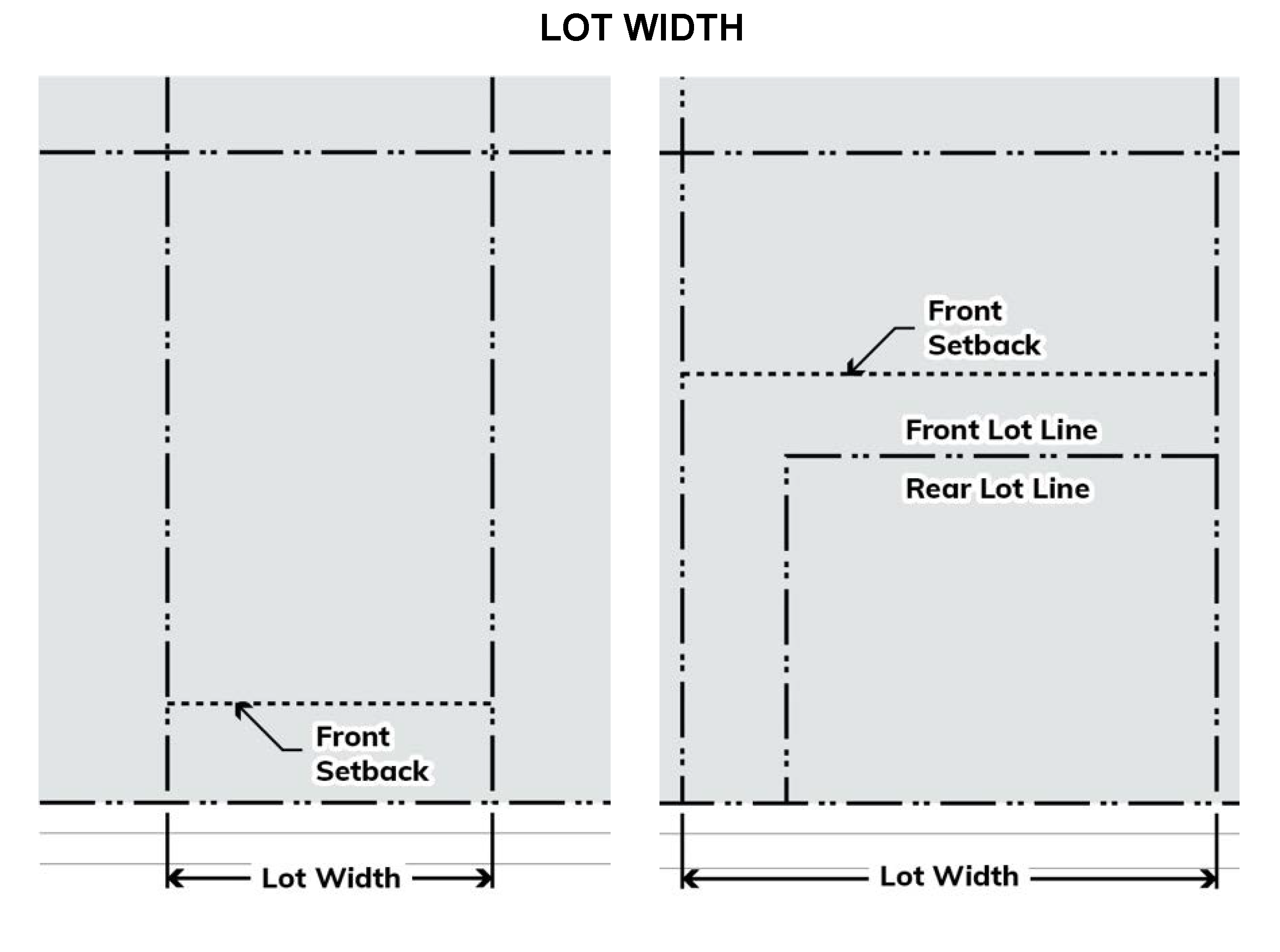
Lot width. Lot width is the horizontal distance between the side lot lines measured at right angles to its depth along a straight line parallel to the required minimum front setback or the maximum dimension of a build-to zone. For pipestem lots, lot width is measured at the required front setback as defined in this section.
(9)
Transparency. The required amount of window area as a percentage of the specified façade area. Doors are included in ground floor transparency when such doors are designed with glass or other transparent materials. Garage entrances are not included in ground floor transparency.
a.
Visible light reflectance (VLR): The amount of visible light that is reflected out by a glazing system. A high VLR percentage blocks more daylight from passing through the window.
b.
Visible light transmission (VLT): The amount of light (daylight) that travels through a glazing system. A high VLT percentage allows more daylight to pass through.
c.
To qualify as transparent for the calculation, glazing must have a minimum of 40 percent VLT and no more than 15 percent VLR.
d.
The following do not meet the ground floor or upper floor transparency requirements and do not count in meeting the standard:
1.
Windows with shadowboxes on the interior;
2.
Glass block;
3.
Printed window film, regardless of whether it allows views into or out of the building.
(10)
Yards and setbacks.
a.
General definitions.
1.
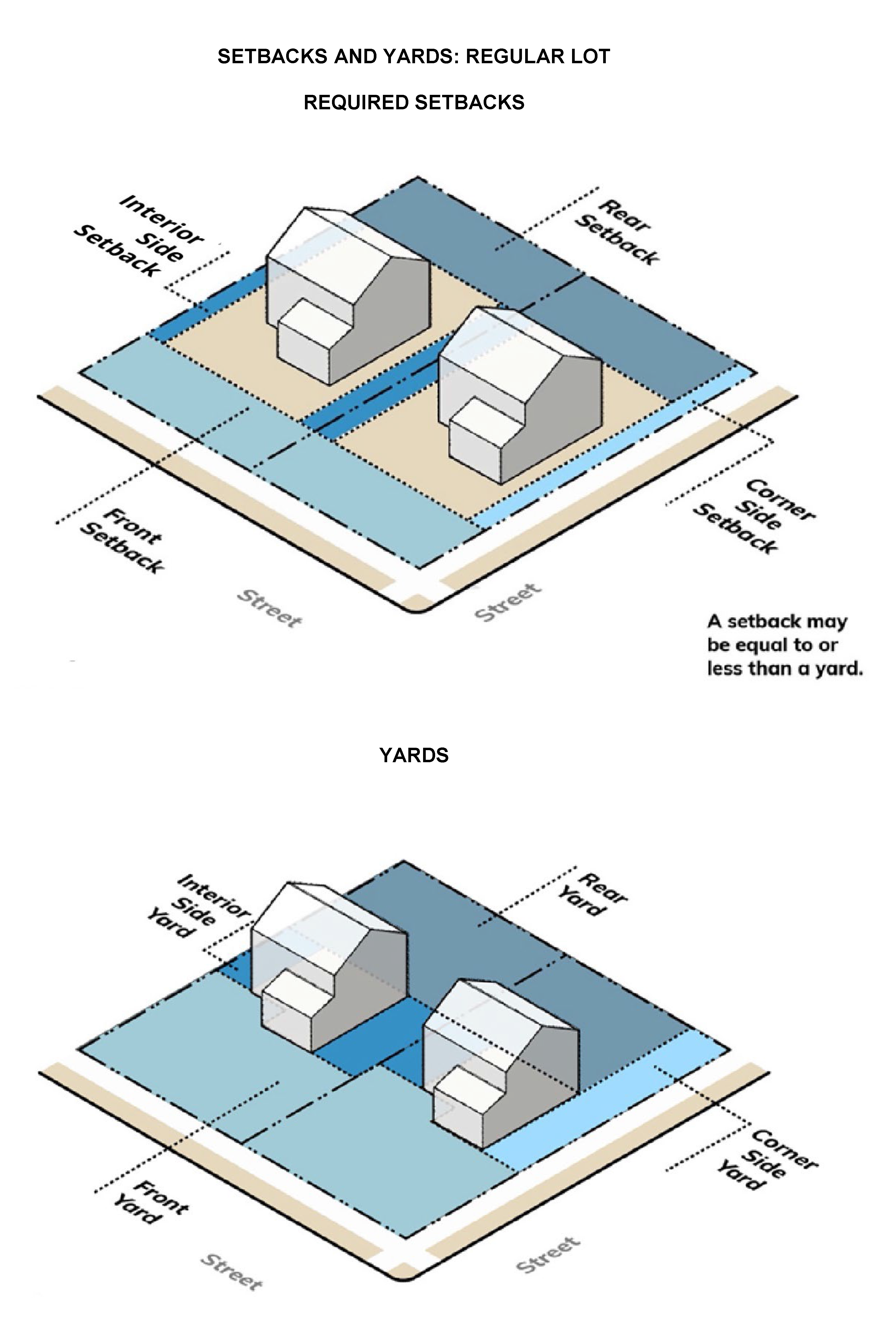
A yard is the area between the building line of a principal building and the lot line.
2.
A required setback is the required minimum distance a principal building must be located from a lot line, which is unoccupied and unobstructed by any projections of a principal building with the exception of permitted encroachments allowed by this Code.
i.
A build-to zone is considered a required setback. In the case of a build-to zone, the setback is the defined area (defined by minimum and maximum build-to lines) where the principal building must be located.
3.
A setback may be equal to or less than a yard.
4.
A setback is located along the applicable lot line for the minimum depth specified by the zoning district in which such lot is located.
b.
Front yard and front setback. The front yard and front setback extend the full width of the lot between side lot lines measured perpendicular to the front lot line.
1.
Front yard: A front yard is the area located between a principal building line and the front lot line.
2.
Front setback: A front setback is the required minimum distance per the zoning district that a principal building must be located from the front lot line.
3.
Front setback averaging: Where front setback averaging is permitted, the average front setback of the adjacent lots on either side of a lot are used to establish the required front setback. Averaging is based on the two adjacent lots on either side or, in the case of a corner lot, the next two adjacent lots. In the case of a lot configuration where only one lot is available for averaging, the required front setback is that of the adjacent lot.
4.
For pipestem lots, the front yard and setback is measured from the rear lot line of the lot that separates the pipestem portion of the lot from the street.
c.
Interior side yard and interior side setback. The interior side yard and interior side setback extend along the interior side lot line between the front and rear yard or setback, measured perpendicular to the interior side lot line.
1.
Interior side yard: An interior side yard is the area located between a principal building line and the interior side lot line.
2.
Interior side setback: An interior side setback is the required minimum distance per the zoning district that a principal building must be located from the interior side lot line.
3.
For townhouse developments, the interior side yard and interior side setback are only applicable to end units of the overall townhouse building.
4.
For single-family attached dwellings, the interior side yard and interior side setback are only applicable to the side of the dwellings that is not part of the vertical party wall.
d.
Corner side yard and corner side setback. The corner side yard and corner side setback extend along the corner side lot line between the front yard or front setback and the rear lot line, measured perpendicular to the corner side lot line.
1.
Corner side yard: A corner side yard is the area located between a principal building line and the corner side lot line.
2.
Corner side setback: A corner side setback is the required minimum distance per the zoning district that a principal building must be located from the corner side lot line.
e.
Rear yard and rear setback. The rear yard and rear setback extend between interior side lot lines, measured perpendicular to the rear lot line. The rear setback is also applied along any waterfront lot line (see item d below).
1.
Rear yard: A rear yard is the area located between a principal building line and the rear lot line.
2.
Rear setback: A rear setback is the required minimum distance per the zoning district that a principal building must be located from the rear lot line.
3.
In the case of a corner lot, the following apply:
i.
A rear yard is the area located between a principal building line and the rear lot line.
ii.
A rear setback extends between the interior side lot line to the required corner side setback, measured perpendicular to the rear lot line.
4.
In the case of a Lake Hamilton waterfront lot, a required waterfront setback is the district's required rear setback if no specific setback dimension is established, as measured from the 400 foot elevation along the waterfront, measured perpendicular to the waterfront lot line. This setback applies to any Lake Hamilton waterfront lot line.
f.
Yards and setback requirements for Lake Hamilton Lots.
1.
Lake Hamilton waterfront yard: A waterfront yard is the area located between a principal building line and the waterfront lot line.
2.
Lake Hamilton waterfront setback: A waterfront setback is considered a rear setback that is measured from the 400 foot elevation along the waterfront. See [subsection] e.4 above.
g.
Yard and setback requirements for double-frontage lots. For double-frontage lots, both the front and the rear required setbacks must meet the required front setback of the zoning district. One of the front setbacks is considered a rear yard for the purposes of applying the accessory structure regulations of this Code; the required dimension of the front setback applies.
(Ord. No. 6513, § 1(Exh. A), 11-19-24)

