
Hot Springs City Zoning Code
ARTICLE IX
- GENERAL DEVELOPMENT STANDARDS
16-2-9.1. - General development standards applicable to zones.
(a)
Applicability of dimensional requirements.
(1)
All structures must meet the dimensional requirements of the district in which the structure is located. No existing structure may be enlarged, altered, reconstructed, or relocated in a manner that conflicts with the requirements of the district in which the structure it is located unless a variance is approved.
(2)
The location of required setbacks on irregularly shaped lots will be determined by the planning and development director. The determination will be based on the spirit and intent of this Code to achieve an appropriate spacing and location of buildings on individual lots.
(b)
Number of structures on a lot.
(1)
Lots used for single-family or two-family dwellings are limited to one principal building per lot. An accessory dwelling unit is not considered a principal building.
(2)
For all other uses, there may be more than one principal building on a lot, but all buildings must comply with all standards of the zoning district.
(c)
Structures prohibited in utility easements.
(1)
Permanent structures, including buildings, retaining walls, and decks, and accessory structures are prohibited within utility easements unless otherwise approved by the authorizing agency.
(2)
If any structures are located within a utility easement and repair or replacement of the utility is needed, the city or utility is not responsible for the repair or replacement of any structures that may be damaged.
(3)
Additionally, no excavation for new structural foundations may be made within ten feet of an existing city water, sewer, or stormwater main.
(d)
Development on individual well and septic tanks.
(1)
The minimum lot area requirement for development of lots on individual wells and septic tanks is 20,000 square feet.
(2)
New structures with plumbing must comply with all requirements of title IX, Municipal Utilities, of the City of Hot Springs Code of Ordinances, and other applicable regulations, for connections to city water and sewer service.
(e)
Sight visibility.
(1)
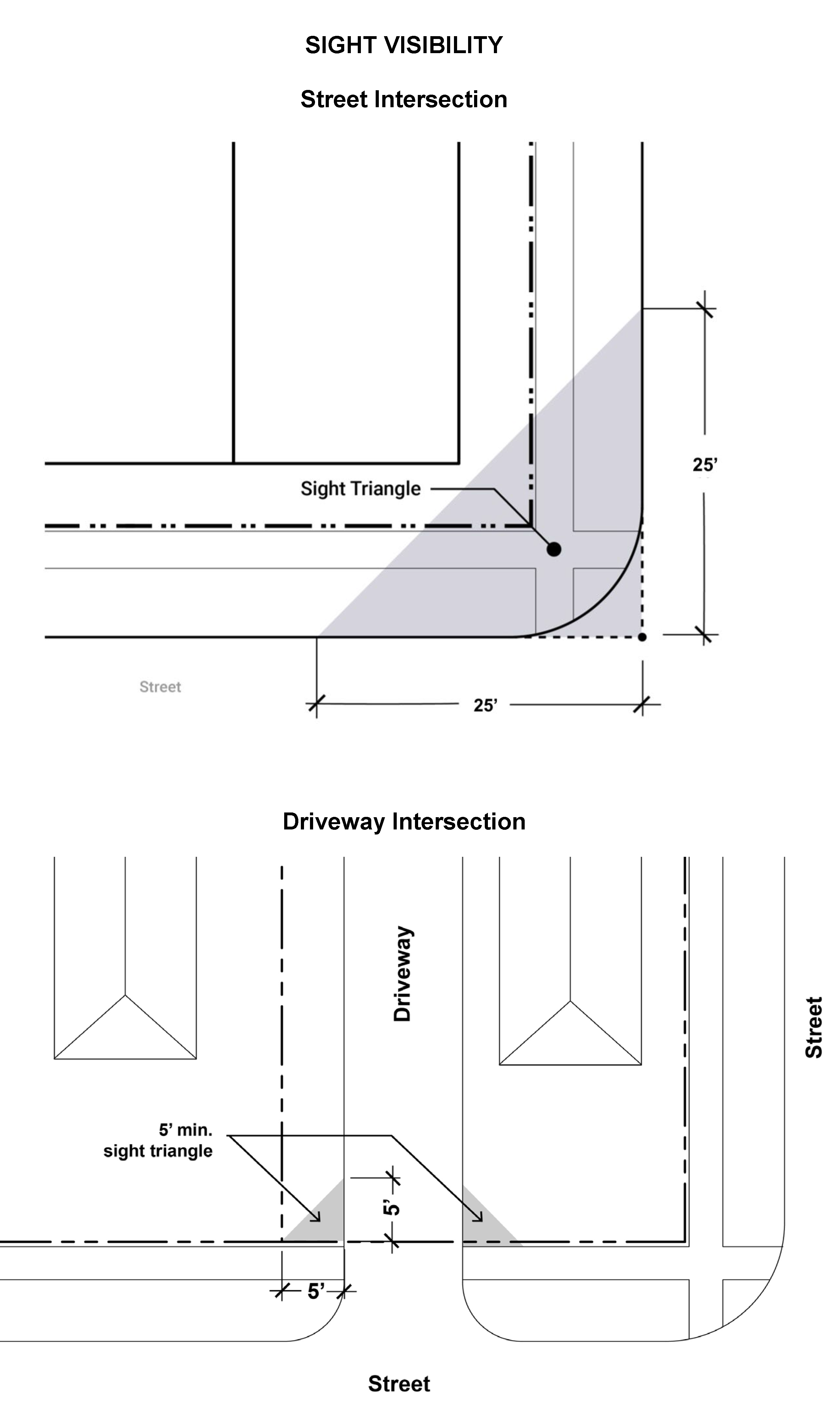
On a corner lot no building, structure, fence, sign, or landscape may be erected, placed, planted, or allowed to grow in such a manner that impedes vision between a height of three and one-half feet and ten feet above the centerline grade of the intersecting street in the area bounded by the front and corner side lot lines of such corner lot and a line joining points along said streets rights-of-way lines 25 feet from the point of intersection.
(2)
No building, structure, fence, sign, or landscape may be erected, placed, planted, or allowed to grow in such a manner that impedes vision between a height of three and one-half feet and ten feet within the sight triangle area on each side of any driveway. Beginning at the intersection of the driveway with the lot line, the sight triangle is formed by measuring five feet along the lot lines perpendicular and parallel to driveway, then connecting the endpoints of the lines across the subject property.
(Ord. No. 6513, § 1(Exh. A), 11-19-24)
16-2-9.2. - Steep slope development.
Steep slopes constitute significant natural topographic features of the city. In addition, when development occurs on steep slopes, there are potential serious consequences, such as increased erosion, fire, or flood hazards, and property damage from extensive soils slippage and subsidence.
(1)
These steep slope regulations apply only to new development on a lot as of the March 1, 2025 effective date of this Code.
(2)
These regulations apply to all lots with slopes over 15 percent for a minimum of 2,000 square feet of contiguous sloped area, verified by the city's geographic information systems (GIS) map contour layer or a field topographic survey. Slopes are defined as follows:
a.
Steep slope: Fifteen percent to 25 percent.
b.
Very steep slope: More than 25 percent up to 35 percent.
c.
Extremely steep slope: More than 35 percent.
(3)
The following percentages of a sloped lot may be disturbed, developed, cleared, graded, regraded, or stripped of vegetation, unless plans are prepared by a registered engineer and approved by the city to ensure that the proposed use will not cause excessive surface water runoff, erosion, sedimentation, and unstable soil conditions that adversely impact neighboring properties or streets and drainage courses or facilities.
a.
Steep slope: No more than 30 percent of the steep slope areas of a lot can be disturbed, developed, cleared, graded, regraded, or stripped of vegetation.
b.
Very steep slope: No more than ten percent of the very steep slope areas of a lot can be disturbed, developed, cleared, graded, regraded, or stripped of vegetation.
c.
Extremely steep slope: No part of the extremely steep slopes areas of a lot can be disturbed, developed, cleared, graded, regraded, or stripped of vegetation.
(4)
Earth moving activities and vegetation removal must be conducted only to the extent necessary to accommodate proposed uses and structures and in a manner that does not cause excessive surface water runoff, erosion, sedimentation, and unstable soil condition.
(Ord. No. 6513, § 1(Exh. A), 11-19-24)
16-2-9.3. - Lake Hamilton Waterfront Filtration and Stabilization Zone.
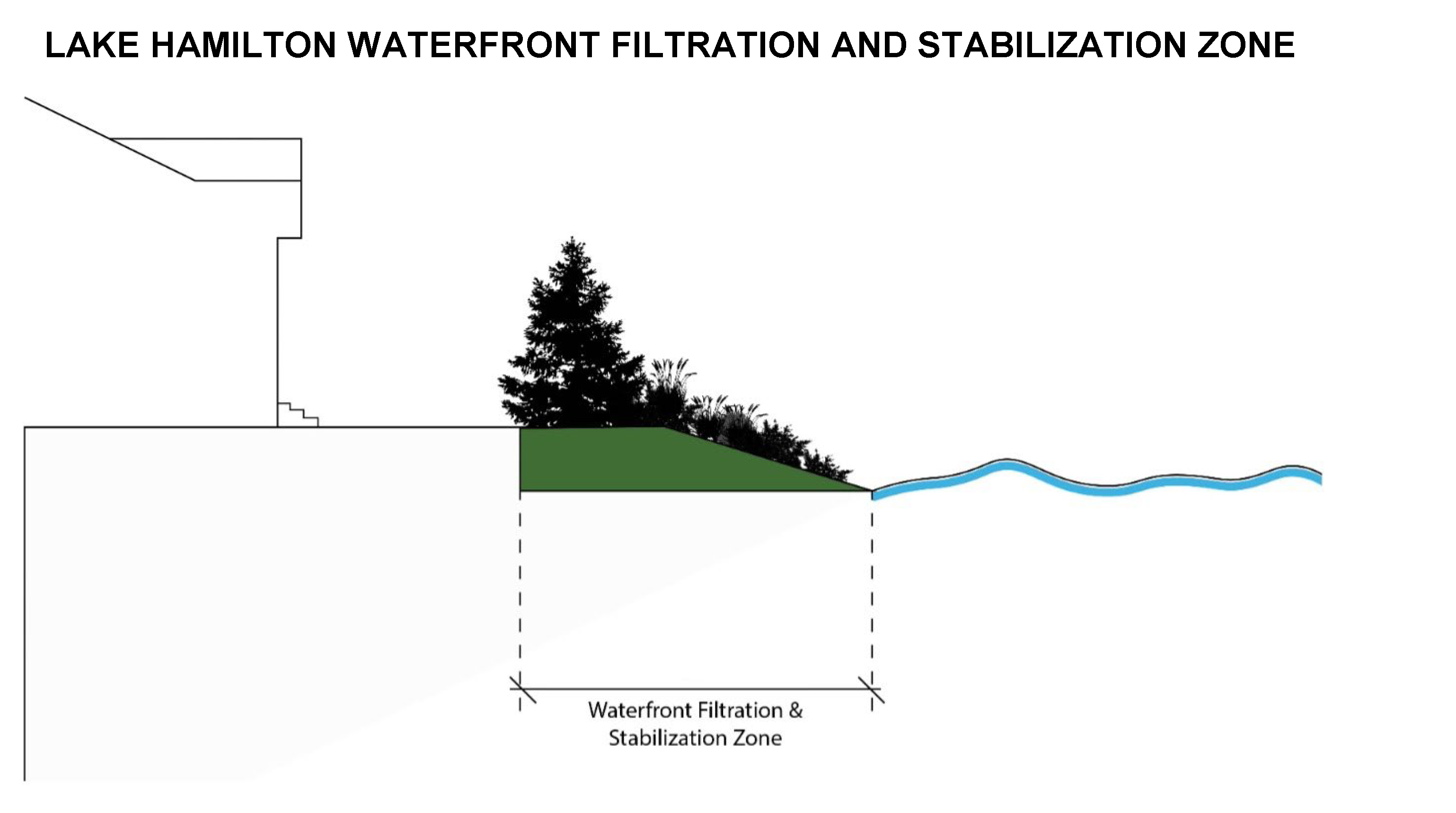
A waterfront filtration and stabilization zone has been established to protect the city's Lake Hamilton waterfront areas. Runoff from adjacent land filters through this zone, removing pollutants and sediment. This sediment and related pollutants are removed by filtration and settle into the network of plants and plant residue. This zone also helps to prevent shoreline erosion. Natural riparian vegetation has dense, deep root systems that firmly anchor shoreline soils.
(1)
These Lake Hamilton waterfront filtration and stabilization zone regulations apply only to new development on a lot as of the March 1, 2025 effective date of this Code.
(2)
A Lake Hamilton waterfront filtration and stabilization zone of 20 feet is required from the 400-foot elevation along the waterfront, measured perpendicular to the Lake Hamilton waterfront lot line.
(3)
Such zone must be planted with plants, shrubs, groundcover, and/or trees that specifically stabilize soil and reduce runoff. Existing vegetation within the zone should be preserved to the maximum extent possible.
(4)
Where Entergy regulations apply, they have precedence.
(Ord. No. 6513, § 1(Exh. A), 11-19-24)
16-2-9.4. - Exterior lighting controls.
(a)
Lighting plan required.
(1)
A lighting plan is required for all nonresidential uses, mixed-use, and multi-family developments. Other developments are exempt from a required lighting plan but are subject to applicable lighting standards of [subsection] (b) below.
(2)
A lighting plan must include the following:
a.
A plan showing all light pole locations, building-mounted lights, bollard lights, and all other lighting.
b.
Specifications for luminaires, including certifications of energy efficient lighting, and lamp types, and poles, including photographs or drawings of proposed light fixtures.
c.
Pole and luminaire details including pole height, height of building-mounted lights, mounting height, and height of the luminaire.
d.
Elevations of the site including all structures and luminaires sufficient to determine the total cutoff angle of all luminaires and their relationship to abutting parcels.
e.
For developments subject to site plan review, photometric plans that show the footcandle measurement at all lot lines may be required if the lot is adjacent to a residential district or public right-of-way.
f.
Other information and data reasonably necessary to evaluate the required lighting plan.
(b)
Lighting standards.
(1)
The maximum allowable footcandle at any lot line is one footcandle.
(2)
All luminaires must be full cutoff luminaire design.
(3)
The maximum total height of a freestanding luminaire is 20 feet in a nonresidential district, and 15 feet in a residential district.
(4)
All outdoor luminaires must be located and adequately shielded so that there is no glare onto adjacent lots or onto the public right-of-way.
(5)
All lighting sources, except for outdoor recreation fields, must have a correlated color temperature (CCT) at or below 2,700°K.
(6)
Security lighting is installed with a motion vacancy sensor that extinguishes the lights within 15 minutes after the area is vacated.
(c)
Exceptions to lighting standards.
(1)
Luminaires used for public roadway illumination or installed by a utility to light public rights-of-way are exempt from the requirements of this Code. However, any lighting installed on a public utility light pole that physically extends onto private property is subject to these standards.
(2)
All temporary emergency lighting required by public safety agencies, other emergency services, or construction is exempt from the requirements of this Code.
(3)
Shielded, directional accent lighting, or uplighting is permitted but must be aimed at a building façade, sign, or accent feature, such as landscape, and directed so that glare is not visible from adjacent properties. However, such lighting must not exceed one footcandle at any lot line.
(4)
Because of their unique requirements for nighttime visibility and limited hours of operation, outdoor recreational fields (public or private) such as, but not limited to, football fields, soccer fields, baseball fields, softball fields, tennis courts, driving ranges, and other similar uses are exempt from the lighting standards of [subsection] (b) above and subject to the following:
a.
Recreational fields are permitted a total luminaire height of 75 feet in any district. Luminaires greater than 75 feet in total height may only be approved by conditional use.
b.
All lighting must be directed onto the field.
c.
Lighting outside the recreational field, such as for parking areas, must comply with the lighting standards of [subsection] (b) above.
d.
The recreational field lighting must be extinguished one hour following the end of the event. Lighting outside the recreational field, such as for parking areas, is not subject to this timeframe in order to facilitate patrons leaving the facility, cleanup, nighttime maintenance, and other closing activities.
(5)
Temporary holiday and seasonal lighting designs are exempt from the requirements of this Code.
(6)
Certain temporary uses may use lighting that does not meet the requirements of this section. When such temporary uses are allowed, approval of the lighting plan is required as part of the temporary use permit.
(d)
Prohibited lighting.
(1)
Flickering or flashing lights.
(2)
Searchlights, laser source lights, or any similar high intensity.
(3)
Any light fixture that can be confused with or construed as a traffic control device.
(Ord. No. 6513, § 1(Exh. A), 11-19-24)
16-2-9.5. - Fences and walls.
(a)
Fences and walls are permitted along a lot line.
(b)
For lots in the residential and commercial districts, fences and walls in the front yard are subject to the following limitations:
(1)
Open fences: No height limit.
(2)
Solid fences and walls: Four-foot height limit.
(c)
For lots in the residential and commercial districts, fences and walls in the corner side yard are subject to the following limitations when located in front of the front building line:
(1)
Open fences: No height limit.
(2)
Solid fences and walls: Four-foot height limit.
(d)
For fences and walls that enclose a larger development, such as a residential subdivision or a retail center, those fences and walls along the perimeter of that development are not subject the requirements for the front yard fences ([subsection] (b) above).
(e)
All fences and walls in any district must comply with sight visibility requirements of section 16-2-9.1(e) above.
(f)
Fences and walls in the front and corner side yard require a fence permit. However, no fees are required for the permit.
(g)
Fences and walls above seven feet in height require a building permit.
(Ord. No. 6513, § 1(Exh. A), 11-19-24)
16-2-9.6. - Refuse and recycling containers.
These provisions do not apply to standard personal refuse and recycling bins, approximately 96 gallons or less in size.
(1)
Refuse and recycling containers are prohibited in the front or corner side yard.
(2)
All refuse and recycling containers must be fully enclosed on three sides by a solid fence, wall, or wall extension of the principal building a minimum of six feet in height. A wall extension must be constructed as an integral part of the building's architectural design.
(3)
The enclosure must be gated and such gate must be solid. This requirement does not apply to refuse containers located adjacent to an alley.
(Ord. No. 6513, § 1(Exh. A), 11-19-24)
16-2-9.7. - Permitted encroachments.
An encroachment is the extension or placement of an architectural feature into a required setback. Permitted encroachments are indicated in Table 9-1: Permitted Encroachments into Required Setbacks.
(1)
Article X contains regulations for accessory structures, which may include additional permissions or restrictions on specific permitted encroachments into required setbacks.
(2)
When an architectural feature regulated by Table 9-1 is allowed within a yard, it is also allowed within the required setback, subject to any additional standards.
(3)
When an architectural feature regulated by Table 9-1 is prohibited from encroachment into a required setback, it may be allowed within the corresponding yard, subject to any additional standards or prohibitions.
(4)
Unless specifically allowed by Table 9-1, no architectural feature may project into a right-of-way or over a lot line.
Ord. No. 6513, § 1(Exh. A), 11-19-24)
16-2-9.8. - Performance standards.
All uses must comply with the performance standards established in this section unless any federal, state, or local law, code, ordinance, or regulation establishes a more restrictive standard, in which case, the more restrictive standard applies.
(1)
Noise. Any activity or the operation of any use must comply with title 4, chapter 5 of the City of Hot Springs Code of Ordinances.
(2)
Glare and heat. Any activity or the operation of any use that produces glare or heat must be conducted so that no glare or heat from the activity or operation is detectable at any point off the lot on which the use is located. Flickering or intense sources of light must be controlled or shielded so as not to cause a nuisance across lot lines.
(3)
Vibration. No earthborne vibration from the operation of any use may be detectable at any point off the lot on which the use is located.
(4)
Dust, air, and water pollution.
a.
Dust and other types of air pollution, borne by the wind from sources, such as storage areas, yards, roads, conveying equipment and the like, within lot boundaries, must be kept to a minimum by appropriate landscape, screening, sheltering, paving, fencing, wetting, collecting, or other acceptable means.
b.
Storage of materials must include all proper precautions to protect any surface water or groundwater sources, whether natural or manmade, from contamination.
(5)
Discharge and disposal of hazardous waste. The discharge of fluid and the disposal of hazardous waste materials must comply with applicable federal, state, and local laws, and regulations governing such materials or waste. Hazardous material waste must be transported, stored, and used in conformance with all applicable federal, state, and local laws.
(6)
Electromagnetic interference. Electromagnetic interference from any operation of any use must not adversely affect the operation of any equipment located off the lot on which such interference originates.
(7)
Odors. Any condition or operation which results in the creation of odors of such intensity and character as to be detrimental to the public health and welfare, or which interferes unreasonably with the comfort of the public, must be removed, stopped, or modified to remove the odor.
(8)
Fire and explosion hazards. Materials that present potential fire and explosion hazards must be transported, stored, and used only in conformance with all applicable federal, state, and local regulations.
(Ord. No. 6513, § 1(Exh. A), 11-19-24)

