
Hot Springs City Zoning Code
ARTICLE VIII
- USES
16-2-8.1. - General use regulations.
(a)
No structure or land may be used or occupied unless allowed as a permitted or conditional use within the district.
(b)
All uses must comply with any applicable federal and state requirements, and any additional federal, state, or city regulations.
(c)
Any use that is not included in the use matrix or is not interpreted as part of a listed use is prohibited in all districts.
(d)
A lot may contain more than one principal use, so long as each principal use is allowed in the district. Only one principal use per lot is allowed in the residential districts.
(e)
Each principal use must be approved separately.
(f)
In certain cases, uses are defined to include ancillary uses that provide necessary support or are functionally integrated into the principal use.
(g)
All uses, whether permitted or conditional, must comply with the use standards of section 16-2-8.3 for principal uses, section 16-2-8.4 for accessory uses, or section 16-2-8.5 for temporary uses, as applicable.
(Ord. No. 6513, § 1(Exh. A), 11-19-24)
16-2-8.2. - Use matrix.
(a)
Table 8-1: Use Matrix identifies the principal, accessory, and temporary uses allowed within each district.
(b)
The permissions in Table 8-1 are indicated as follows:
(1)
P indicates that the use is permitted by-right in the district.
(2)
C indicates that the use is a conditional use in the district.
(3)
If a cell is blank, the use is not allowed in the district.
(c)
All uses in Table 8-1 are defined in section 16-2-8.6 of this article.
(1)
Definitions of general terms are found in section 16-2-2.3 of article II.
(Ord. No. 6513, § 1(Exh. A), 11-19-24; Ord. No. 6545, § 1, 8-19-25)
16-2-8.3. - Principal use standards.
(a)
Agriculture.
(1)
Confined animal feeding operations (CAFO) are not permitted as part of an agricultural use. CAFO are prohibited within the City of Hot Springs.
(b)
Animal care facility and animal shelter.
1.
Animal care facilities and shelters must locate all overnight boarding facilities indoors.
2.
Animal care facilities and shelters must locate any exterior exercise areas to the side or rear of the building. A fence a minimum of six feet in height is required for all exterior exercise areas.
3.
All animal quarters and exterior exercise areas must be kept in a clean, dry, and sanitary condition.
(c)
Banquet hall.
(1)
A general admission fee or any other payment at the door to the general public for entrance is prohibited, with the exception of fundraisers or events for bona fide non-profit organizations, places of worship, or educational facilities.
(d)
Bed and breakfast.
(1)
A bed and breakfast must be operated entirely within a single-family dwelling or pre-existing accessory structure. Within the commercial districts, when a bed and breakfast is allowed, it may only be operated within a single-family dwelling existing as of the March 1, 2025 effective date of this Code.
(2)
A bed and breakfast must be operated by the property owner who also resides on the property or an adjacent property.
(3)
The exterior of a bed and breakfast must maintain its original appearance as a single-family dwelling. No parking is permitted in the front yard.
(4)
Cooking equipment, other than a mini-refrigerator, coffee maker, and/or a microwave, is prohibited in individual guestrooms.
(5)
No retail sales are permitted with the exception of accessory retail of related items such as souvenirs, postcards, snack items, and personal toiletries.
(6)
No bed and breakfast may operate an eating and drinking establishment.
(7)
For bed and breakfasts without reception facilities, meals may only be served to registered guests, who may invite a personal guest. For bed and breakfasts without reception facilities, meals and events are not open to the general public.
(8)
One sign, either freestanding, window, or wall, is permitted. Such sign may not exceed six square feet in sign area. Freestanding signs are limited to five feet in height and must be a minimum of five feet from any lot line.
(9)
Reception facilities are only allowed on the premises when indicated as such in Table 8-1.
(e)
Campground/recreational vehicle (RV) park.
(1)
The minimum area for a campground or RV park is three acres.
(2)
Campgrounds or RV parks shall provide a common recreational area consisting of a minimum of 100 square feet per campsite or recreational vehicle parking site.
(3)
Management headquarters, recreational facilities, coin operated laundry facilities, cabins for staff, and other uses and structures customarily associated with the operation of a campground are permitted.
(4)
All storage of equipment must be within enclosed structures.
(5)
Long-term occupancy is prohibited at any campground. Use of tents or recreational vehicles as a principal residence is prohibited. This excludes any permanent structures erected for an on-site caretaker or manager, which may be a year-round residency.
(6)
Individual campsites or recreational vehicle parking sites shall be set back a minimum of 50 feet from all lot lines.
(f)
Car wash.
(1)
When a car wash facility abuts a residential district or any open space use, a solid fence or wall, a minimum of six feet in height is required along the interior side and rear lot lines
(2)
The lot must be graded to drain away from adjoining properties.
(g)
Care home.
(1)
A care home with eight or fewer residents is considered a single-family dwelling. Such care homes are not subject to the standards of this section but rather are subject to the standards that apply to all single-family dwellings.
(2)
All care homes must be licensed.
(h)
Community garden.
(1)
Community gardens are limited to the cultivation of herbs, fruits, flowers, or vegetables, including the cultivation and tillage of soil and the production, cultivation, growing, and harvesting of any lawful agricultural, floricultural, or horticultural commodity. It may also include community-gathering spaces for active or passive recreation.
(2)
The keeping of livestock, chickens or other poultry, apiaries, and any aquaculture is prohibited.
(3)
Accessory structures such as high tunnels/hoop-houses, cold frames, and similar structures, are permitted to extend the growing season. This includes sheds, gazebos, and pergolas. All accessory structures must be set back compliant.
(i)
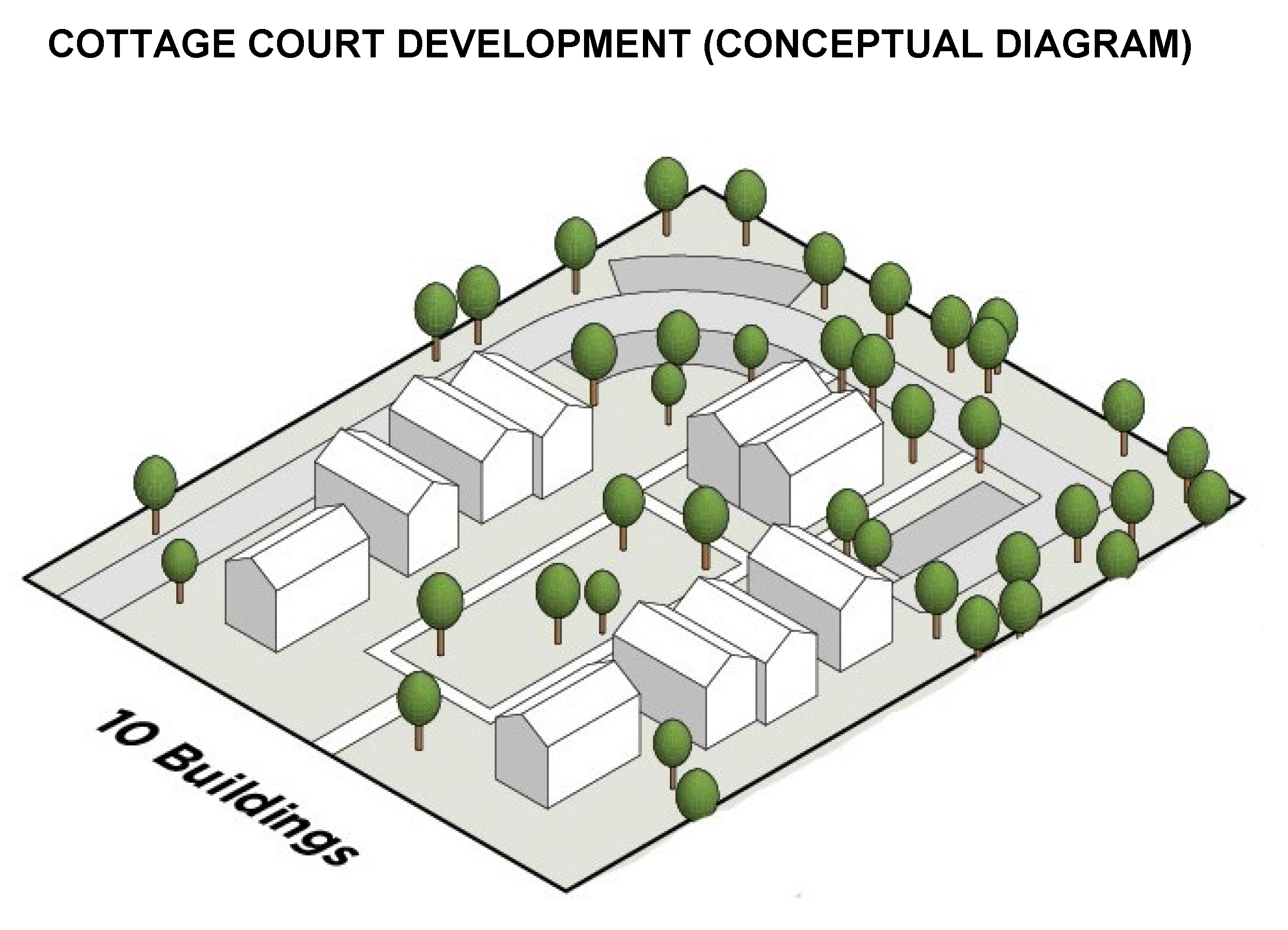
Cottage court development.
(1)
General development standards.
a.
Cottage court development may take one of two forms:
1.
A development may be designed with individual lots.
2.
A development may also be designed as a multi-dwelling development.
b.
A cottage court development requires the establishment of a homeowners association (HOA), property management company, or other designated managing entity approved by the city in place for the maintenance of all common elements.
(2)
Use limitations.
a.
Table 8-2: Cottage Court Permitted Dwelling Types indicates the permitted dwelling types within a cottage court development:
b.
Buildings for common facilities for use by the residents, such as laundry facilities, communal kitchens, and common rooms, are also permitted.
(3)
Development standards.
a.
Cottage court development may be used for any development of four or more buildings and requires a minimum of four structures.
b.
The maximum number of buildings within a cottage court development is ten.
c.
The minimum total lot area required for a cottage court is determined by calculating the cumulative lot area required by the base zoning district for the number of buildings to be constructed, and reducing the result by 50 percent.
d.
Individual lots or building sites within the cottage court development are exempt from the base zoning district standards for lot area, lot width, setbacks, and building coverage. However, dwellings oriented toward the common area must provide a five foot minimum setback from the common area. Such setback does not count toward any required common area.
e.
The cottage court development as a whole must meet the following standards:
1.
Along the lot lines of the development as a whole, a minimum setback of 15 feet is required. No streets or other vehicle access is permitted in this setback. However pedestrian paths across this setback to connect to adjacent lots are allowed.
2.
The development as a whole is limited to a maximum building coverage of 55 percent.
3.
The development as a whole is limited to a maximum impervious surface coverage of 70 percent.
f.
All buildings and lots within the cottage court development must front on a street or a common open space.
g.
Required off-street parking may be provided on individual development sites for each dwelling within the cottage court development, or in a shared parking area serving multiple dwellings on-site. Common parking areas may contain no more than 15 spaces each and must be screened from abutting lots that are not part of the development. Parking may not be located between principal structures and the street, between a common area and a street, or within any required common area.
(4)
Common open space design.
a.
Central common open space is required and must meet the following standards:
1.
The minimum size of the central common open space is 3,000 square feet, or 500 square feet per dwelling unit, whichever is greater.
2.
The central common open space must maintain a minimum width of 50 feet, be contiguous and centrally located, and front on a public or private street.
3.
A maximum of 25 percent of the central common open space may be hardscape.
b.
Once central common open space requirements are met, additional common open space within the development is permitted.
(j)
Data center.
(1)
Data centers are subject to the noise regulations of chapter 4 of title 5 in the City of hot Springs Code of Ordinances.
(k)
Drug treatment clinic.
(1)
All drug treatment clinics must be separated by a distance of at least 1,000 feet from any residential district or use. This does not apply in the INST District.
(l)
Food truck park.
(1)
The following regulations do not apply to seasonal operations defined as any establishment operating on a seasonal basis not to exceed a 150-day period of time per calendar year, limited to the serving of dispensed drinks, coffee, snow cones, shaved ice, and other similar ice based products duly licensed and operated as a "seasonal operation" in accordance with the rules and regulations promulgated by the Arkansas State Board of Health [cross reference H.S.C. § 4-10-2(7)]. They do not apply to mobile retail food establishments allowed as part of a special event permit. They do not apply to private events where mobile retail food establishments are hired for only the duration of the event for catering purposes. They do not apply to franchisees of the city.
(2)
Mobile retail food establishments (commonly referred to from time to time as food trucks) defined as a vehicle mounted retail food establishment designed to be readily movable and approved by law to travel highways, roadways, and/or waterways in the State of Arkansas that is a self-contained retail food establishment equipped with permanently mounted fresh water holding tanks and wastewater holding tanks duly licensed and operated in accordance with the rules and regulations promulgated by the Arkansas State Board of Health are required to locate in a food truck park, where the food truck park is the principal use of a site. Mobile retail food establishments are not permitted as an accessory use on a site.
Provided, however, any mobile retail food establishment holding a duly issued City of Hot Springs business license for an existing location prior to July 1, 2025, may continue at such location subject to the provisions of article XV as a pre-existing nonconforming use so long as it remains otherwise legal.
(3)
A minimum of 15 percent of the lot area must be shared common area. The common area should be designed for customer use, which includes, but is not limited to, elements such as seating areas, and lawn and landscaped areas. Shared common area does not include any food truck parking/service sites and vehicle parking spaces.
(4)
Permanent on-site restroom facilities are required.
(5)
Food truck park must be served by a reliable and safe potable water supply. Proper wastewater disposal systems are required to prevent contamination.
(6)
A commissary for the use of food truck vendors is permitted as part of the food truck park.
(7)
The area must be kept clear of litter and debris at all times. Waste receptacles and/or recycling bins must be provided.
(8)
Food truck parks are permitted one freestanding sign of either pole or monument construction no larger than 32 square feet in area or six feet in height. No temporary signs are permitted with the exception of an A-frame sign located within 15 feet of the food truck.
(m)
Gas station.
(1)
All buildings must be setback from all lot lines a minimum of 40 feet.
(2)
Pump islands and the supports of any sheltering canopy must be setback from all lot lines a minimum of 25 feet.
(3)
Pump islands and main and accessory buildings cannot be constructed closer than 50 feet to any residential district.
(4)
A raised curb, at least six inches in height, must be constructed along all street lines, except at driveway openings.
(5)
All fuel tanks must be underground.
(n)
Halfway house.
1.
Each halfway house shall identify a manager to act as a 24-hour contact.
2.
Halfway houses are limited to eight residents.
3.
The manager contact information must be printed legibly and posted in such a way as to be conspicuous and readable from the exterior of each building to a person at the front entrance of a building. The posting must contain the address of the property, the name of the manager of the property, and the phone number of the manager.
(o)
Industrial—Artisan/craft.
(1)
Artisan/craft industrial uses are limited to a maximum gross square footage of 10,000 square feet in the following districts: C-MU and CBD Districts. There is no limit within other districts where the use is allowed.
(2)
Outside storage or display is prohibited. All business, servicing, processing, and storage uses must be located within the structure. This does not apply to such uses within the I-L District.
(p)
Legacy nonresidential re-use establishment.
(1)
Legacy nonresidential re-use establishments are only allowed within existing structures that are nonresidential in their construction and/or use as of (March 1, 2025).
(2)
The following nonresidential uses are permitted within a legacy nonresidential re-use establishment. After the approval of the initial conditional use approval for the legacy nonresidential re-use establishment and its initial intended use, as allowed by the list below, a new conditional use approval is required for a change of use from the list below. However, a conditional use may be granted allowing for multiple uses from the list below which would not require a conditional use for a use change.
a.
Art gallery.
b.
Arts and fitness studio.
c.
Day care center.
d.
Office.
e.
Personal service establishment.
f.
Eating and drinking establishment - cannot sell alcohol.
g.
Retail goods establishment - cannot sell alcohol.
h.
Specialty food service.
(3)
If any of the above nonresidential uses are allowed within the district, they are not considered a legacy nonresidential re-use establishment. Such uses are subject to this Code's standards for the nonresidential use.
(4)
No additional off-street parking is required. However, any off-street parking currently provided must be maintained.
(5)
Drive-through facilities are prohibited.
(6)
Outside storage or display is prohibited. All business, servicing, processing, and storage uses must be located within the structure.
(7)
Signs are limited to those allowed in the C-TR District.
(q)
Lodge/meeting hall.
(1)
No more than 30 percent of the gross floor area may be used as office space for the lodge/meeting hall.
(2)
Lodges/meeting halls are permitted to serve meals and alcohol on the premises for members and their guests only, or for lessees when leased or used as reception facilities. A lodge/meeting hall may only be leased or used for reception facilities when in a nonresidential district.
(3)
Sleeping facilities are prohibited.
(4)
Lodges/meeting halls leased or used as reception facilities cannot charge a general admission fee or any other payment type at the door to the general public for entrance, with the exception of fundraisers or events for bona fide non-profit organizations, places of worship, educational facilities, or similar uses.
(r)
Long-term care facility.
(1)
Long-term care facilities must comply with all standards for multi-family dwellings in the district in which they are located.
(2)
For mixed-use developments, where the ground floor and any additional upper floors are designed for nonresidential uses with such facilities above, the development must comply with any mixed-use development standards.
(s)
Marina.
(1)
Any outdoor live entertainment areas must be located 500 feet from the lot line of an abutting residential district.
(t)
Micro-production of alcohol.
(1)
All alcohol production must be within completely enclosed structures.
(2)
The establishment shall include a restaurant, bar, and/or tasting room within the same building. The minimum size of the restaurant, bar, and/or tasting room shall be 20 percent of the total square footage of the use or 1,500 square feet, whichever is less.
(3)
Facilities may include retail areas for the purchase of beverages manufactured on-site and related items.
(u)
Outdoor storage yard.
(1)
The storage area must be completely enclosed along all lot lines by a solid fence or wall a minimum of six feet in height, including ingress and egress.
(2)
Fences or walls along the front or corner side lot line must be set back a minimum of ten feet from the lot line. Within that setback, shrubs must be planted and spaced sufficiently to form a continuous linear hedgerow at plant maturity. Plantings must be placed outside the fence facing the right-of-way.
(3)
Storage of any kind is prohibited outside the fence or wall.
(4)
No items stored within 25 feet of the fence may exceed the height of the fence or wall.
(v)
Residential addiction treatment facility.
(1)
Residential addiction treatment facilities must comply with all standards for multi-family dwellings in the district in which they are located.
(2)
For mixed-use developments, where the ground floor and any additional upper floors are designed for nonresidential uses with such facilities above, such development must comply with any mixed-use development standards.
(w)
Salvage yard/junk yard.
(1)
The storage area must be completely enclosed along all lot lines by a solid fence or wall a minimum of six feet in height, including ingress and egress.
(2)
Fences or walls along the front or corner side lot line must be set back a minimum of ten feet from the lot line. Within that setback, shrubs must be planted and spaced sufficiently to form a continuous linear hedgerow at plant maturity. Plantings must be placed outside the fence facing the right-of-way.
(3)
Storage of any kind is prohibited outside the fence or wall.
(4)
No items stored within 25 feet of the fence may exceed the height of the fence or wall.
(x)
Self-storage facility: Fully enclosed and outdoor.
(1)
Storage units cannot be used for residential occupancy or to conduct business.
(2)
No plumbing connections are permitted in self-storage units.
(3)
The following are prohibited uses and activities within self-storage facilities:
a.
Storage of flammable or hazardous chemicals or explosives.
b.
Auctions, commercial, wholesale, or retail sales, or miscellaneous or garage sales.
c.
The servicing, repairing, or fabrication of motor vehicles, boats, trailers, lawn mowers, appliances, or similar equipment.
d.
The operation of power tools, spray-painting equipment, table saws, lathes, compressors, welding equipment, kilns, or other similar equipment.
e.
The establishment of a trash/recycling materials transfer and storage business.
f.
Any use that is noxious or offensive because of odors, dust, noise, fumes, or vibrations.
(4)
For self-storage facilities that include both indoor and outdoor facilities, both types of uses must be allowed in the district.
(5)
The following additional standards apply to enclosed self-storage facilities:
a.
All self-storage activities must be contained within a single building and conducted exclusively indoors. Individual storage units may be accessed from inside the building only. Enclosed self-storage facilities in more than one building are considered outdoor self-storage facilities.
b.
All facilities must meet the standards of the district.
c.
No storage units located on the first floor may be located within the first 20 feet of a façade facing a street. No storage units located on the first floor may be visible from the public right-of-way.
d.
Access to loading areas must be located to the side or rear of the building.
(6)
The following additional standards apply to outdoor self-storage facilities:
a.
Outdoor self-storage facilities should be oriented so that storage unit access doors do not face the public right-of-way.
b.
Only outdoor self-storage facilities are allowed to include an area for storage of recreational vehicles. Storage areas for recreational vehicles must be located in the rear yard.
c.
No storage of recreational vehicles is allowed within ten feet of any rear lot line or interior side lot line that abuts a residential district. No storage of recreational vehicles is allowed within 25 feet of any front or corner side lot line.
d.
Any proposed outdoor storage areas must be shown on a site plan for the facility. Outside storage of any materials will be governed by the specific requirements of the district in which the facility is located. In no case may parking areas or driveways be used for storage.
(y)
Sexually-oriented business.
(1)
Sexually-oriented businesses are subject to the regulations of chapter 8 of title 16 in the City of Hot Springs Code of Ordinances.
(z)
Utility.
(1)
Any minimum building height regulations required by the district do not apply to utility buildings.
(2)
Building design standards for structures on a site apply, unless it can be shown that incorporating certain elements impacts operations and/or creates a public safety issue. The planning and development director will approve the exceptions to design standards.
(3)
Utility equipment must be set back 20 feet from all lot lines.
(aa)
Vehicle repair: Major and minor.
(1)
Repair of vehicles is prohibited outdoors. However, for minor vehicle repair facilities, if another vehicle is currently within the work bay, minor repairs are allowed outdoors unless the vehicle is being disassembled. The disassembly of any vehicle must be conducted completely indoors, whether minor or major repair.
(2)
Storage of all merchandise, auto parts, and supplies must be within an enclosed structure.
(3)
Major vehicle repair facilities require a solid fence or wall a minimum of six feet in height along the interior side and rear lot lines. This does not apply in the industrial districts unless such lot lines abut a residential district.
(4)
Only vehicles under repair may be stored outdoors on the premises.
(5)
The sale of new or used vehicles is prohibited unless separately approved.
(6)
No motor vehicles may be stored and no repair work may be conducted in the right-of-way.
(7)
Vehicles may be stored on-site for the following timeframes:
a.
Minor vehicle repair facility: Seven days.
b.
Major vehicle repair facility: Ninety days.
(bb)
Wind energy system.
(1)
The design of the wind energy system must conform to applicable industry standards as such standards exist as of the date construction is commenced. The facility owner or operator must submit certificates of design compliance obtained by the equipment manufacturers, such as Underwriters Laboratories, Det Norske Veritas, Germanishcer Lloyd Wind Energies, or similar certifying organizations.
(2)
Wind turbines must comply with the following design standards:
a.
Wind turbines must be a non-obtrusive and non-reflective color.
b.
Wind turbines must not display advertising, except for reasonable identification of the turbine manufacturer, or the facility owner and operator.
c.
Wind turbines must not be artificially lit, except to the extent required by the Federal Aviation Administration or other applicable regulatory authorities.
d.
On-site transmission and power lines between wind turbines must, to the maximum extent practicable, be placed underground, reach the property line, and be located and constructed in such a way as to minimize disruption to the property's primary purpose as well as to facilitate the interconnection of other commercial wind power generating facilities.
e.
Non-essential appurtenances are prohibited to be affixed to any wind turbine, including, but not limited to, cellular or radio antennae.
(3)
The applicant must commission and submit at the time of permit application a wildlife assessment (impact study), conducted by a qualified wildlife expert, indicating possible risks to local wildlife, habitat, and migratory birds.
(4)
Wind turbines must not be climbable up to a height of at least 15 feet above ground surface. All access doors to wind turbines and electrical equipment must be locked or fenced, as appropriate, to prevent entry by non-authorized persons.
(5)
Wind turbines must be set back from any existing principal building on the lot and adjacent lots, measured at the nearest external wall or walls, and within the buildable area of any adjacent undeveloped lot, no less than the turbine height. The setback distance is measured from the nearest point on the outside edge of a tower to the nearest point on the foundation of the building.
(6)
Operation and maintenance building(s) and substations must be located in accordance with zoning district yard requirements. All wind farm structures, except for wind turbines, must comply with the regulations of the zoning district.
(7)
All wind turbines must be set back from the nearest public right-of-way a distance of 110 percent of the turbine height, as measured from the right-of-way line to the nearest point on the outside edge of a tower.
(8)
The facility owner or operator must comply with all applicable codes regulating sound generation. A predictive sound study of turbine noise must accompany the application to verify that all code requirements can be met for dBA sound levels. In the event that any sound levels from a wind turbine are found to be in excess of permissible levels per the city code, the facility owner or operator must take necessary measures to bring sound levels down to a level acceptable.
(9)
A shadow flicker study is required and must be submitted with the application. Projects must mitigate shadow flicker on existing structures and shadow flicker must not fall within the buildable area of an adjacent lot, as defined by current setback requirements.
(10)
A maintenance plan and any applicable maintenance agreement designed to ensure long-term, continuous maintenance, such as maintenance of landscape, keeping the area free from debris and litter, and immediate removal of any graffiti.
(11)
The facility owner and operator must, at their sole expense, complete decommissioning of the wind energy system, or individual wind turbines, once the use of the wind energy system or any individual wind turbines are discontinued. The wind energy system or turbine must be deemed to be at the end of its useful life if it is abandoned for a period of time in excess of 180 days. Decommissioning includes removal of wind turbines and related aboveground equipment.
(cc)
Wireless telecommunications. A wireless telecommunication tower, facility, or antenna requires a tower use permit and is subject to conditional use standards and procedures, antenna stealth design (item (7) below) is not subject to review by the planning commission.
(1)
Purpose. The purpose of these standards is to establish general guidelines for the siting of wireless communication facilities (WCF) and granting of tower use permits (TUP).
(2)
Goals. The goals of these standards are to:
a.
Provide a range of locations for WCF in all zones unless otherwise prevented.
b.
Within each zoning district, provide clear performance standards addressing the siting of WCF.
c.
Encourage the location of WCF on existing structures, including utility poles, signs, water towers, buildings, and other WCF where feasible.
d.
Encourage co-location and site sharing of new and existing WCF.
e.
Streamline and expedite permitting procedures to effect compliance with the Federal Telecommunications Act of 1996.
f.
Enhance the ability of providers of telecommunications services to provide such service to the community quickly, effectively, and efficiently.
g.
Protect residential and historic areas from the uncontrolled development of WCF by requiring reasonable siting conditions.
(3)
Application requirements. All applications to erect, construct, or modify any part of a wireless telecommunications system require site plan review (article 2 of chapter 4, Subdivisions) and must include the following items:
a.
A dimensioned site plan showing:
1.
The location, size, screening, and design of all structures and existing improvements on subject and adjacent lots, including fences. It needs to show all required setbacks per this section.
2.
The location and size of all outdoor equipment.
3.
Elevations showing antenna height.
4.
If the site plan is for a new wireless telecommunications facility, a landscape plan showing all screening.
5.
If the site plan is for a new wireless telecommunications tower, indication of the fall district as a shaded circle.
b.
A survey showing property lines.
c.
A maintenance plan and any applicable maintenance agreement designed to ensure long-term, continuous maintenance, such as maintenance of landscape, keeping the area free from debris and litter, and immediate removal of any graffiti.
d.
A disclosure of what is proposed, demonstrating the need for the wireless telecommunications system in the proposed location. This is not required for co-location or stealth design antennas.
e.
The reason or purpose for the placement, construction, or modification in the proposed location with specific reference to the provider's coverage, capacity, and/or quality needs, goals, and objectives. This is not required if the proposal is does not involve the erection of a new tower.
f.
The service area of the proposed wireless telecommunications system.
g.
If the proposal is for a new telecommunications tower, then a map showing collocation opportunities within the city and within areas surrounding the borders of the city must be provided and justification for why co-location is not feasible in order to demonstrate the need for a new tower.
h.
If the proposal is for a new telecommunications tower, certification by a licensed and registered professional engineer regarding the manner in which the proposed structure will fall. The certification may be utilized, along with other criteria such as applicable regulations for the district in question, in determining if additional setback should be required for the structure and other facilities.
(4)
Setbacks.
a.
In residential districts, all wireless telecommunications towers must be set back from any existing principal building on the lot and adjacent lots, measured at the nearest external wall or walls, and within the buildable area of any adjacent undeveloped lot, as defined by current setback requirements, no less than the tower height. The setback distance is measured from the nearest point on the outside edge of a tower to the nearest point on the foundation of the building.
b.
In nonresidential districts, all wireless telecommunications towers must be set back from all lot lines in accordance with the minimum setback requirements in the zoning district or 25 feet, whichever is greater.
c.
All wireless telecommunications facilities must be set back from all lot lines in accordance with the minimum setback requirements in the zoning district.
(5)
Height. The maximum height of a wireless telecommunications tower is 100 feet in residential districts and 150 feet in nonresidential districts. Should this height not allow the tower to function satisfactorily, the applicant must demonstrate the minimum height needed for the tower to function, which will be reviewed and approved as part of the conditional use. The city has the ability to hire an independent consultant to assist in review of the proposed height, whose fee will be charged to the applicant. Where a wireless telecommunications tower exceeds the maximum height permitted in the district, the city may require additional setbacks from all lot lines.
(6)
Lighting and marking. Wireless telecommunications systems must not be lit or marked unless required by the Federal Communications Commission (FCC) or the Federal Aviation Administration (FAA).
(7)
Specific standards for wireless telecommunications antennas. Wireless telecommunications antennas are a conditional use in all districts, unless they are stealth design in which case they are a permitted use. Stealth design for wireless antennas is encouraged and is considered a permitted use in all districts, subject to site plan review. All applications for wireless telecommunications antennas must include all information required by this section. In addition to the standards of this section for wireless telecommunications antennas, stealth design must comply with the following regulations:
a.
To qualify as a stealth design, wireless telecommunications antennas must be enclosed, camouflaged, screened, obscured, or otherwise not readily apparent to a casual observer.
b.
Wireless telecommunication antennas must be mounted at least 30 feet above grade, as measured from grade to the base of the antenna, to qualify as stealth design. Wireless telecommunication antennas mounted lower than 30 feet are considered a conditional use.
c.
Antennas must be located on or in structures already permitted within zoning districts, such as water towers, clock towers, streetlights, penthouses, parapet walls (must be behind the parapet wall), and steeples, and designed to blend in with the structure.
d.
Antennas that co-locate on existing wireless telecommunications towers are also considered stealth design. However, such antennas cannot increase the overall height of the existing wireless telecommunications tower.
e.
No antenna may increase the overall height of any structure on which it is mounted by more than 15 feet.
(8)
Specific standards for wireless telecommunications facilities.
a.
Any buildings, cabinets, or shelters may house only equipment and supplies for operation of the wireless telecommunication tower. Any equipment not used in direct support of such operation must not be stored on the site.
b.
Commercial advertising is prohibited. Only signs that are part of the equipment as manufactured or warning signage is permitted.
(9)
Specific standards for wireless telecommunications towers.
a.
The use of guyed towers is prohibited. Towers must be monopoles, meaning self-supporting with no wires, cables, or beams.
b.
Wireless telecommunications towers must be designed to accommodate other telecommunications providers. The area surrounding a tower must be of a sufficient size to accommodate accompanying wireless telecommunications facilities for other telecommunications providers.
c.
Unless otherwise required by the Federal Communications Commission, the Federal Aviation Administration or the city, towers must have a nonreflective neutral color scheme.
(10)
Small wireless communication facilities.
a.
Definition. Small wireless facilities, including facilities commonly referred to as small cells and distributed antenna systems, are defined by A.C.A. § 23-17-503, a provision of the Small Wireless Facility Deployment Act, hereinafter referred to as the "2019 Act."
b.
Franchise permits.
1.
Consistent with other of the city's public right-of-way franchises, any person or entity proposing the placement or operation of a small wireless facility in Hot Springs's rights-of-way must first apply for and obtain a franchise permit for that purpose.
2.
The city manager will cause the preparation of the required franchise permit application form and designate the office and employees who are charged with administering the permit process.
3.
The permit procedure shall conform to the provisions of A.C.A. § 23-17-510.
4.
The application fee for a franchise permit for the installation, modification, or replacement of a pole together with the co-location of an associated small wireless facility in the right-of-way is $100.00.
5.
All wireless providers obtaining a franchise permit must:
A.
Indemnify and hold harmless the city, its officers, agents and employees, as provided in A.C.A. § 23-17-516(b)(1).
B.
Obtain insurance coverage and submit to the city proof of coverage (or self-insurance if eligible) as required by A.C.A. § 23-17-516(c) in the minimum amount of $5,000,000.00 per occurrence.
C.
Post with the city a bond in the amount of $1,000.00 per wireless facility (up to a total of $10,000.00) for the purposes stated in and pursuant to A.C.A. § 23-17-516(d).
6.
The installation and operation of a small wireless facility for which a franchise permit is issued must conform to the standards of A.C.A. § 23-17-505(b) (non-obstruction of right-of-way); the height, zoning regulations and historic district provisions of A.C.A. § 23-17-506; the damage, repair, replacement, abandonment and removal provisions of A.C.A. § 23-17-507; the aesthetic standards set forth in A.C.A. § 23-17-508 and subsection (g) below; and the provisions regarding colocation of a small wireless facility on city-owned poles as set forth in A.C.A. § 23-17-509.
7.
In addition to the aesthetic standards of A.C.A. § 23-17-508:
A.
No franchise permit will be issued for no-steel poles in right-of-way.
B.
No franchise permit will be issued for a small wireless facility requiring an aboveground pole in any location where Hot Springs Code requires underground utilities.
C.
No franchise permit will be issued for a new pole to be located less than 300 feet of an existing small wireless facility.
D.
A franchise permit for use of a decorative pole in a Central Business Improvement District (CBID) will require approval of the governing body of the CBID; and
E.
A franchise permit for use of a decorative pole in the either the Central Avenue Historic District or the Pleasant Street Historic District requires approval of Hot Springs Historic District Commission.
F.
A franchise permit for use of a decorative pole on Malvern Avenue from Grand Avenue to the city limits; upon any street light accepted for city maintenance; along Park Avenue from Whittington to Edgewood; on Central Avenue from Whittington to Market; on Ouachita from Central to Market; on Market Street from Central to Broadway; on Broadway Street from Market to Malvern; on Bridge Street; on Malvern Avenue from Spring to #324; on Convention Boulevard for its entirety; and on Park Avenue from Whittington to Edgewood requires planning commission approval.
c.
Effect of permit.
1.
Authority granted no property right or other interest created. A franchise permit from the city authorizes the permittee to undertake only permitted activities in accordance with this section and does not create a property right or grant any authority whatsoever to the permittee to impinge upon the rights of others who may already have an interest in the rights-of-way.
2.
Duration. Unless construction has actually begun and is diligently pursued to completion at that point, no franchise permit for construction issued under this article shall be valid for a longer period than 12 months unless both city and permittee agree to a reasonable extension and all required fees are paid for the term regardless of construction.
3.
Removal, relocation, or modification of small wireless facility from public rights-of-way.
A.
General relocation policy.
i.
In the interest of the public health, safety, and welfare and consistent with the city's ordinances and master plans, the city may make or cause to be made improvements, repairs, or replacements of the public facilities located on public rights-of-way. Such construction activity commonly requires adjustment or relocation of installations of public utilities and wireless service providers. The city deems the right of public utilities and wireless service providers to use public rights-of-way to be subordinate to the reasonable exercise of the city's police power. Thus, the cost of relocation a public utility or wireless service provider installation should not be borne by the city.
ii.
The policy of the city is to require a public utility or a wireless services provider to promptly adjust its facilities in, upon, under or above any right-of-way administered by the city to accommodate construction, improvements, alterations, or maintenance of public facilities when directed to do so by officials authorized by the city manager. Public utilities and wireless services providers must make adjustments at their own expense, except as otherwise provided by the city regardless of the source of funds for the project.
iii.
As a matter of policy, the city will seek to minimize current and future installation adjustment costs for utilities and wireless services providers by such measures as regular and systematic consultation in public works planning, advance engineering to the extent feasible, and careful consideration of public utility and wireless services provider needs and installations in both planning and design.
B.
Emergency removal or relocation of facilities. The city retains the right to cut or move any small wireless facility located within its rights-of-way as the city, in its sole discretion, may determine to be necessary, appropriate, or useful in response to any public health or safety emergency. If circumstances permit, the city will notify the wireless provider and wireless infrastructure provider an opportunity to move its own facilities prior to the city cutting or removing a facility and the city shall notify the wireless provider after cutting or removing a small wireless facility.
(11)
Abandonment. Any wireless telecommunications system that is not operated for a period of 180 consecutive days is considered abandoned. The owner must immediately remove the tower or facility, and all aboveground equipment and related debris. The city may ensure and enforce removal by means of its existing regulatory authority.
(12)
Nonconformities.
a.
Ordinary maintenance, including replacement/upgrading, of antenna equipment may be performed on nonconforming antennas or towers. However, if the proposed alteration intensifies a nonconforming characteristic of the antenna or tower, a variance is required.
b.
Co-location of an antenna on an existing nonconforming tower is a permitted use, provided that the addition of the antenna and any additional wireless telecommunications facilities do not increase the overall height of the nonconforming tower.
(13)
Compliance with Airport Zoning District. Any wireless telecommunications system must comply with all requirements of the Airport Zoning District (title 11, chapter 1 of the Hot Springs Code).
(Ord. No. 6513, § 1(Exh. A), 11-19-24; Ord. No. 6538, § 5, 5-6-25; Ord. No. 6545, § 2, 8-19-25)
16-2-8.4. - Accessory use standards.
(a)
Drive-through facility.
(1)
All drive-through facilities must provide a minimum of four stacking spaces per lane or bay, unless additional stacking spaces are specifically required by this Code. Further, additional internal queuing and stacking spaces and other access points to prevent disruption of traffic flow on adjacent streets may be required.
(2)
Stacking spaces provided for drive-through uses must be:
a.
A minimum of nine feet in width, as measured from the outermost point of any service window or bay entrance, to the edge of the driveway, and 18 feet in length. In the case of a recessed service window, the measurement is taken from the building wall.
b.
Stacking spaces must begin behind the vehicle parked at a final point of service exiting the drive through aisle, such as a service window or car wash bay (this does not include a drive-through sign). Spaces must be placed in a single line behind each lane or bay.
(3)
All drive-through lanes must be located and designed to ensure that they do not adversely affect traffic circulation on adjoining streets. Drive-through lanes on corner lots must not route exiting traffic into adjacent residential neighborhoods.
(4)
The minimum width for a drive through lane is ten feet.
(5)
Drive-through facilities require a solid fence or wall a minimum of six feet in height along the interior side and rear lot lines when such lot lines abut a residential district or C-TR District.
(6)
All drive-through facilities, including, but not limited to, drive-through signs, stacking lanes, trash receptacles, ordering box, drive up windows, and other objects associated with the drive-through facility, must be located to the side or rear of the building. Drive-through windows and lanes may not be placed between the street and the associated building.
(b)
Accessory dwelling unit (ADU).
(1)
ADUs are allowed as an accessory use to a single-family dwelling. ADUs must be located on the same lot as the principal dwelling.
(2)
Only one ADU is permitted per lot per single-family dwelling.
(3)
The ADU shall be owned by the same property owner(s) as the principal dwelling unit and cannot be subdivided or otherwise separated in ownership such that the ADU is located on a different lot than the principal dwelling unit.
(4)
The maximum size of an ADU shall not be more than 75 percent of the gross floor area of the single-family dwelling or 1,000 square feet, whichever is less.
(5)
Detached ADUs must be in the rear yard and shall have the same building setbacks as principal structures in the same zone district.
(6)
The maximum height of a detached ADU shall be the same as principal structures in the same zone district.
(7)
An ADU must have a separate entrance. A separate entrance must lead directly to the outside and cannot be through a garage. An exterior staircase used to access an attached ADU cannot be located on the front façade of the structure.
(8)
There is no minimum on-site parking requirement for ADUs. Existing required parking for the principal dwelling unit must be maintained or replaced on-site if parking is lost due to the creation of the ADU.
(9)
Recreational vehicles are prohibited as an ADU.
(c)
Heliport/helipad/helistop.
(1)
Personal use heliport/helipads/helistops require a minimum lot size of five acres.
(2)
Landing locations must be a minimum distance of 1,000 feet from any existing residential structure.
(3)
Permits for establishing and maintaining personal helicopter touchdown or lift-off sites are issued to the owner or lessee of a site by the city.
(4)
All heliports/helipads/helistops must meet all Arkansas Fire Prevention Code requirements in the most recently adopted edition.
(5)
The permit is automatically revoked:
a.
If found in violation of any FAA requirements, and owner revokes the license or refuses to re-license the site after one of its periodic inspections; or
b.
Thirty days after the city has notified the permit holder in writing that the site is no longer in compliance with the requirements set forth herein for the initial granting of the permit, provided the alleged defect has not been cured within the said 30-day period.
(6)
Special event landings-temporary landing facilities are permitted only at city-approved personal helicopter touchdown or lift-off sites.
(d)
Home occupation.
(1)
Home occupations are permitted in a dwelling unit as an accessory use provided that this use is clearly incidental and secondary to the primary use of the dwelling for residential purposes and does not change the character of the dwelling unit or adversely affect the surrounding residential district of which it is a part.
(2)
The home occupation may be conducted within the principal structure or within a detached accessory structure.
(3)
A member or members of the immediate household occupying the dwelling may be in the home at any given time to work in connection with the home occupation.
(4)
No alteration of any structure may be made that changes the residential character of that dwelling. Displays or activities that indicate from the exterior that a structure is being used, in part, for any purpose other than that of a residence or an accessory structure are prohibited.
(5)
No commodities can be sold or services rendered that require receipt or delivery of merchandise, goods, or equipment other than by a passenger motor vehicle or by parcel or letter carrier mail services using vehicles typically employed in residential deliveries.
(6)
The home occupation and all related activity, including storage, equipment, and display, must be conducted completely within the principal building or accessory structure.
(7)
No toxic, explosive, flammable, combustible, corrosive, etiologic, radioactive, or other restricted materials may be used or stored on-site. There must be no perceptible noise, odor, smoke, electrical interference, vibration, or other nuisance emanating from the structure where the home occupation is located in excess of that normally associated with residential use.
(8)
The use or storage of tractor trailers, semi-trucks, or heavy equipment, such as construction equipment used in a commercial business, is prohibited.
(9)
The home occupation cannot create greater vehicular or pedestrian traffic than is average for a residential area. The home occupation and any related activity must not create any traffic hazards or nuisances in public rights-of-way.
(10)
Only one non-illuminated, affixed wall sign no more than one square foot in area is permitted in association with the home occupation.
(11)
Childcare family homes are not a home occupation and are regulated separately by this Code as a principal use.
(12)
Repair and service of any vehicles, boats, equipment, any type of heavy machinery, or any type of engine is prohibited. Small electronic repair, such as computers, is allowed.
(13)
Rental services, where any materials for rent are stored on-site and customers visit the residence to pick-up and return the product, are prohibited.
(14)
Dispatching services, where workers report to the home for dispatching, are prohibited.
(e)
Outdoor sales and display (accessory).
(1)
The regulations of this section apply to outdoor sales and display located entirely on the lot and accessory to the principal use of the site.
(2)
Accessory outdoor sales and display of merchandise must be merchandise that is customarily sold on the premises.
(3)
All outdoor display of merchandise must be located adjacent to the storefront and not in drive aisles, loading districts, or fire lanes.
(4)
No display may be placed within five feet of either side of an active door, or within 20 feet directly in front of an active door.
(5)
A minimum clear width for pedestrian traffic of five feet must be maintained along any pedestrian pathway within the lot.
(f)
Outdoor storage (accessory).
(1)
The regulations of this section apply only to outdoor storage located entirely on the lot and accessory to the principal use of the site. Outdoor storage as a principal use of the site is regulated as a principal use (outdoor storage yard).
(2)
Outdoor storage of material and equipment is associated directly with and accessory to the on-site principal business (input materials, equipment, or outgoing product) use.
(3)
Outdoor storage areas require a solid fence or wall a minimum of six feet in height along the interior side and rear lot lines.
(4)
No outdoor storage is permitted in any public right-of-way or located so that it obstructs pedestrian, vehicular traffic, or view.
(5)
Outdoor storage is prohibited in any required setback. Outdoor storage areas are not permitted between a building and a street.
(g)
Outdoor seating/activity area. This section regulates outdoor seating/activity areas that occur on private property only. Outdoor seating/activity on the right-of-way is regulated elsewhere within the city code.
(1)
Outdoor seating/activity areas must be established in conjunction the principal use on the site.
(2)
No outdoor seating/activity areas may be located within required parking areas including access aisles.
(3)
When a structure is required at a build-to line, the structure may have up to 50 percent or 60 linear feet of the applicable façade, whichever is less, designated as outdoor seating/activity areas, which may be setback up to 30 feet from the required build-to line.
(Ord. No. 6513, § 1(Exh. A), 11-19-24; Ord. No. 6545, § 3, 8-19-25)
16-2-8.5. - Temporary use standards.
These regulations are for temporary uses on private property. Temporary use permissions are granted to property, not individual temporary use permit applicants or temporary use operators. Where temporary uses are limited in timeframes, such as number of times per year, such timeframes apply to the property, not the permit applicant. Temporary uses require a temporary use permit per article XIV unless specifically cited as exempt.
(1)
Real estate project sales office/model unit.
a.
A real estate sales office/model unit(s) is allowed for a residential development. No temporary use permit is required.
b.
No real estate sales office/model unit(s) may be located in a manufactured home or off-site.
c.
The real estate sales office must be removed and/or closed within 30 days after the sale or rental of the last unit of the development. The model unit(s) must be closed within 30 days after the sale or rental of the last unit of the development.
d.
All activities conducted within real estate sales office/model unit(s) must be directly related to the sale of properties within the development. Use as a general office of operation of any firm is prohibited.
e.
These standards do not apply to permanent leasing offices.
(2)
Temporary contractor's office and contractor's yard.
a.
A temporary contractor's office is allowed incidental to an approved permitted construction project. No temporary use permit is required.
b.
The temporary contractor's office must be removed within 30 days of completion of the construction project.
c.
A contractor's yard is permitted on-site and can only be used during the life of the construction project. No sleeping or cooking accommodations are allowed.
(3)
Temporary entertainment and/or sales event.
a.
The timeframe of a temporary entertainment and/or sales event, including number of days per week and overall duration of the event, will be determined and approved as part of the temporary use permit. The temporary use permit may be issued on a yearly basis.
b.
Temporary entertainment and/or sales events in the residential districts are restricted to those events associated with and conducted by an institutional/commercial use within the district, such as a place of worship, commercial business, or educational facility, and must take place entirely on the lot containing the use.
c.
A management plan is required and must be approved as part of the temporary use permit application that demonstrates the following:
1.
An estimate of the daily number of attendees.
2.
General layout of performance or sales areas, visitor facilities, such as any seating areas and restrooms, parking areas, and all ingress and egress points to the site.
3.
An established set of operating rules addressing the governance structure of the event, hours of operation, maintenance, and security requirements.
4.
The on-site presence of a manager during the event.
5.
Provision for waste removal.
6.
The days and hours of operation, including set-up and take-down times.
7.
A description of crowd control and security measures.
8.
Describe all temporary lighting to be installed and demonstrating how light is to be retained on the lot.
d.
Any temporary structures must be removed within five days of conclusion of the event.
e.
No expansion into public right-of-way is allowed.
(Ord. No. 6513, § 1(Exh. A), 11-19-24)
16-2-8.6. - Use definitions.
Accessory dwelling unit (ADU) means an additional dwelling unit associated with and incidental to a principal dwelling on the same lot.
(1)
Attached accessory dwelling unit means a self-contained and independently accessed living unit on the same parcel as a single-family dwelling of greater square footage that includes its own cooking, sleeping, and sanitation facilities which is joined to another dwelling at one or more sides by a wall and contained entirely within the footprint of the principal dwelling unit. Examples include converted living space, attached garages, basements, or attics, additions, or a combination thereof.
(2)
Detached accessory dwelling unit means an additional self-contained and independently accessed living unit on the same parcel as a single-family dwelling of greater square footage that includes its own cooking, sleeping, and sanitation facilities and is a stand-alone, separate structure. This can include an existing garage or other accessory structure detached from the principal dwelling unit that is legally converted (fully or partially) to an accessory dwelling unit.
Agriculture means land used for farming or ranching. Farming or ranching is the employment or operation of real property for the production of agricultural products including, but not limited to, the following:
(1)
The production or cultivation of agricultural, horticultural, or aquacultural commodities such as, but not limited to, field crops, rice, soybeans, cotton, sorghum, corn, wheat, fruit, vegetables, mushrooms, nursery stock, ornamental trees, sod, or flowers.
(2)
Animal or poultry husbandry and the production of poultry and poultry products, livestock, equine or fur-bearing animals and wildlife, including, but not limited to, the raising, breeding, shearing, grazing, or other feeding of these animals.
(3)
Dairy production.
(4)
Viticulture, wine-making, and related activities.
(5)
On-site storing, handling, and processing incidental to the production of the foregoing agricultural or horticultural products and commodities.
(6)
Forestry.
Airport means facilities for the takeoff and landing of aircraft, including, but not limited to, runways, aircraft storage buildings, cargo storage buildings, helicopter pads, air traffic control facilities, informational facilities and devices, terminal buildings, on airport parking products, and airport auxiliary facilities, including fueling, fences, lighting, and antennae systems, on-premises signs, driveways, and access roads. Airport includes aircraft maintenance facilities, aviation instruction facilities, and heliports when part of a larger airport facility. Airport also includes facilities for the aid and comfort of the traveling public.
Alternative correctional facility means a monitored housing facility for adults or minors that is required by the courts or otherwise available as an alternative to incarceration.
Amusement facility - indoor means a facility for spectator and participatory uses conducted within an enclosed building, such as movie theaters, indoor sports arenas, bowling alleys, tumbling centers, skating centers, roller rinks, escape room/physical adventure game facilities, and pool halls. Indoor amusement facilities do not include live performance venues. An indoor amusement facility may include uses such as, but not limited to, concession stands, eating and drinking establishments, and retail sales as ancillary uses.
Amusement facility - outdoor means a facility for spectator and participatory uses conducted outdoors or within partially enclosed structures, such as outdoor sports stadiums, batting cages, and miniature golf courses. An outdoor amusement facility may include uses such as, but not limited to, concession stands, eating and drinking establishments, and retail sales as ancillary uses.
Animal care facility means an establishment which provides care for domestic animals, including veterinary offices for the treatment of animals, where animals may be boarded during their convalescence, pet grooming establishments, animal training centers and clubs, and pet boarding facilities, where animals are boarded during the day and/or for short-term stays.
Animal shelter means a facility used to house or contain stray, homeless, abandoned, and/or unwanted animals.
Art gallery means an establishment that sells, loans and/or displays paintings, sculpture, photographs, video art, or other works of art. Art gallery does not include a cultural facility, such as a library or museum, which may also display paintings, sculpture, photographs, video art, or other works.
Arts and fitness studio means an establishment where an art or activity is taught, studied, or practiced such as dance, martial arts, photography, music, painting, gymnastics, Pilates, or yoga. An arts studio also includes private exercise studios for private sessions with trainers and/or private classes; health clubs are not an arts and fitness studio, but a personal service establishment.
Banquet hall means a facility that provides hosting and rental services of a banquet hall or similar facilities for private events including, but not limited to, wedding receptions, holiday parties, and fundraisers, with food and beverages that are prepared and served on-site or by a caterer to invited guests during intermittent dates and hours of operation. Live entertainment may be provided as an ancillary use as part of an event. A reception facility is not operated as an eating and drinking establishment with regular hours of operation.
Bathhouse means a public or private building containing baths and often other facilities such as a saunas and dressing rooms.
Bed and breakfast means a single-family dwelling where a resident/owner provides lodging within bedrooms for a daily fee and may prepare meals for guests. A bed and breakfast may contain reception facilities when permitted by this Code.
Body modification establishment means an establishment that offers tattooing services, body piercing, and/or non-medical body modification. Body modification establishment does not include an establishment that offers only ear piercing as an ancillary service.
Broadcasting facility means a facility engaged in broadcasting and information relay services for radio and television signals, including studio facilities. A broadcasting facility may or may not include antennae to broadcast the signal.
Campground/RV park means land used for transient occupancy by camping in tents and recreational vehicles (RV), such as camp trailers, travel trailers, motor homes, or similar movable temporary sleeping quarters.
Car wash means an establishment for the washing and cleaning of vehicles or other light duty equipment, whether automatic, by hand, or self-service. The car wash facility may be within an enclosed structure, an open bay structure, or similar configurations.
Care home means a residence licensed, certified, or accredited for specialized residential care home by the appropriate state and/or federal agencies, that functions as a single housekeeping unit for the housing of unrelated persons with functional disabilities who share responsibilities, meals, recreation, social activities, and other aspects of residential living.
Cemetery means land and structures reserved for the interring of human remains or the interring of animal remains. Cemeteries may include structures for performing religious ceremonies related to the entombment of the deceased, mortuaries, including the sales of items related to the internment of remains, and related accessory structures, such as sheds for the storage of maintenance equipment. Cemeteries may also include crematoriums and embalming facilities.
Children's home means an institutional residential facility that provides housing for and care to minors who are wards of the state, whose parents or guardians are deceased or otherwise unable or unwilling to care for them. This includes institutions that are located in one or more buildings on contiguous property with one administrative body.
Commercial kitchen (standalone) means a shared commercial kitchen, properly licensed by the Arkansas Department of Health, in which individuals or businesses prepare value-added food products and meals, usually paying an hourly or daily rate to lease a space shared by others.
Community center means a facility used as a place of meeting, recreation, or social activity, that is open to the public and is not operated for profit, offering a variety of educational and community service activities.
Community garden means fruits, flowers, vegetables, or ornamental plants cultivated by one or more individuals.
Community service center means a service establishment that provides assistance and support for those in need. It does not include in-patient, overnight, or living quarters for recipients of the service or for the staff. Such service does not include treatments normally conducted in a medical office.
Convention center means a facility designed and used for conventions, conferences, seminars, product displays, recreation activities, and entertainment functions, along with other operations such as, but not limited to, temporary outdoor displays, sporting events, parking, and food and beverage preparation and service for on-premises consumption.
Cottage court development means a small lot residential development arranged in a manner that organizes various dwelling types around a common open space, designed as a cohesive whole and maintained in shared stewardship by residents.
Cultural facility means a facility open to the public that provides access to cultural exhibits and activities including, but not limited to, museums, cultural or historical centers, non-commercial galleries, historical societies, and libraries. A cultural facility may include uses such as, but not limited to, retail sales of related items, performance spaces and auditoriums, and eating and drinking establishments as ancillary uses.
Data center means a location engaged in the processing, storage, retrieval, or communication of data, including locations used for digital asset mining, and which utilize data center equipment, as defined under A.C.A. § 26-52-456(a)(1), as computer equipment or software purchased or leased for the processing, storage, retrieval, or communication of data. Data centers are further defined in the noise regulations of chapter 4 of title 5 in the City of Hot Springs Code of Ordinances.
Day care center means a facility where, for a portion of a 24-hour day, care and supervision is provided for minors, the elderly, and/or functionally-impaired adults in a protective setting.
Drive-through facility means that portion of a business where transactions occur directly with customers via a service window, kiosk, or other configuration that allows customers to remain in their vehicle.
Drug treatment clinic means a licensed facility authorized by the state to administer drugs, such as methadone or suboxone, in the treatment, maintenance, or detoxification of persons.
Dwelling - single-family detached means a structure containing one dwelling unit located on one lot. Also called single-family detached dwelling.
Dwelling - single-family attached means a dwelling unit attached to one other dwelling unit, each on their own lot, each of which is separated from the other by a vertical party wall and designed so that each dwelling has a separate exterior entrance to the dwelling unit.
Dwelling - two-family means a structure containing two dwelling units on one lot.
Dwelling - townhouse means three or more attached dwellings where each townhouse building in the larger structure is attached to another townhouse building by a vertical party wall and designed so that each townhouse building in the development has a separate exterior entrance to the dwelling unit.
Dwelling - multi-family means a structure containing three or more dwelling units within a single building where the units are accessed by one or more common entryways. However, ground floor units may be accessed by individual entry ways.
Dwelling - above the ground floor means dwelling units located above ground-floor nonresidential uses or located behind ground-floor nonresidential uses. In the case of dwelling units located behind ground-floor nonresidential uses, the residential uses cannot be located along the street frontage.
Dwelling - live/work means a principal structure that combines a dwelling unit with a commercial use permitted in the zoning district that is used by one or more of the residents. A live/work dwelling may also include the combination of a dwelling unit with arts-related activities, such as painting, photography, sculpture, music, and film, used by one or more of the residents.
Eating and drinking establishment means an establishment where food and/or drinks are prepared and provided to the public for on-premises consumption by seated patrons, carry-out, and/or delivery service. Restaurants and bars are considered eating and drinking establishments.
Educational facility - college/university means a facility for post-secondary higher learning that grants associate or bachelor degrees. The institution may also have research facilities and/or professional schools that grant master and doctoral degrees. Educational facilities - university or college include ancillary uses such as dormitories, cafeterias, eating and drinking establishments, retail sales, indoor or outdoor recreational facilities, and similar uses.
Educational facility - primary or secondary means a public, private, or parochial facility that offers instruction at the elementary, junior high, and/or high school levels. A pre-school may also be included as part of a primary school.
Educational facility - vocational means a facility that offers instruction in industrial, clerical, computer, managerial, automotive, repair (electrical, plumbing, carpentry, etc.), or commercial skills, or a business conducted as a commercial enterprise, such as a school for general educational development or driving school. Educational facility - vocational also applies to privately operated schools that do not offer a complete educational curriculum. This does not include primary or secondary educational facilities.
Family home, adult means a supervised setting in which the caregiver provides adults in their residence or a residence with a homelike environment.
Family home, childcare means a supervised setting in which the caregiver provides childcare in their residence or a residence with a homelike environment.
Financial institution means a bank, savings and loan, credit union, or mortgage office. Financial institution also includes currency exchanges.
Financial institution, alternative (AFS) means a financial service provided outside a traditional banking institution. An alternative financial institution includes pawn shops, payday loans, tax refund anticipation loans, car title loans, and cash for gold establishments.
Food bank means a non-profit or governmental organization that collects and distributes food to hunger relief organizations. Food is not distributed to the public or individuals from a food bank.
Food pantry means a non-profit or governmental organization that provides food directly to those in need. Food pantries receive, buy, store, and distribute food. Food pantries may also prepare meals to be served at no cost to those who receive them. A food pantry may be an ancillary use of a place of worship, social service center, and/or homeless shelter.
Food truck park means the use of land designed to accommodate one or more mobile retail food establishments, as defined by the rules and regulations promulgated by the Arkansas State Board of Health, (commonly referred to from time to time as "food truck") offering food and/or beverages for sale to the public as the principal use of the property, which may include seating areas for customers.
Freight terminal means a processing node for freight, such as a trucking terminal.
Funeral home means an establishment where the dead are prepared for burial display and for rituals before burial or cremation, including chapels for the display of the deceased and the conducting of rituals before burial or cremation, and crematoriums.
Gas station means an establishment where fuel for vehicles is stored and dispensed from fixed equipment into the fuel tanks of motor vehicles. Gas station may include solar and/or electric charging stations. A gas station may also include ancillary retail.
Government office/facility means offices owned, operated, or occupied by a governmental agency to provide a governmental service to the public, such as city offices and post offices. Government offices do not include public safety or public works facilities.
Halfway house means a residential facility for persons who have been institutionalized for criminal conduct and who either require a group setting to facilitate the transition to society or have been ordered to such facilities by the court as a condition of parole or probation.
Heavy retail, rental, and service means retail, rental, and/or service establishments of a heavier and larger-scale commercial character typically requiring permanent outdoor service or storage areas and/or partially enclosed structures. Examples of heavy retail, rental, and service establishments include large-scale home improvement centers that may have outdoor storage, display, and rental components, recreational vehicle dealerships, boat sales, rental, and service, truck rental establishments, and sales, rental, and repair of heavy equipment. Wholesale establishments that sell to the general public, including those establishments where membership is required, are considered heavy retail, rental, and service establishments.
Heliport/helipad/helistop means land or part of a structure used for the landing of helicopters.
Home occupation means an activity carried out for economic gain by a resident, conducted as an accessory use in the resident's dwelling.
Hospital means facilities for primary health services and medical or surgical care to people, primarily in-patient, and including, as an integral part of the institution, related facilities such as laboratories, outpatient facilities, dormitories, or educational facilities, and ancillary uses such as, but not limited to, cafeterias, eating and drinking establishments, retail sales, and similar uses.
Hotel means a commercial facility that provides sleeping accommodations for a fee and customary lodging services. Related ancillary uses include, but are not limited to, meeting facilities, eating and drinking establishments, and recreational facilities for the use of guests.
Industrial - artisan/craft means artisan-related crafts and industrial processes that are more intensive uses, such as small-scale metalworking, glassblowing, furniture making, and small-scale food production that includes preparation, processing, canning, or packaging of food products. Micro-production of alcohol and specialty food production are regulated separately from artisan/craft industrial. An artisan/craft industrial use may also include sales of products created on-site.
Industrial - general means the manufacture, fabrication, processing, reduction, and/or destruction of any article, substance, or commodity, or any other treatment thereof in such a manner as to change the form, character, and/or appearance, and incidental storage, sales, and distribution of such products. General industrial uses may produce noise, vibrations, illumination, or particulate that is perceptible to adjacent land users. These industrial uses typically have outdoor storage areas.
Industrial - light means research and development activities, and the manufacture, fabrication, processing, reduction, and/or destruction of any article, substance, or commodity, or any other treatment thereof in such a manner as to change the form, character, and/or appearance, where such activities are conducted wholly within an enclosed building. A light industrial use may also include a showroom, sales of products related to the items manufactured or stored on-site, and/or ancillary outdoor storage.
Industrial design means an establishment for the research, design, and brand development of products for future production. Industrial design integrates the creative fields of art, science, and/or engineering to determine and define a product's form and features in advance of the physical act of making a product. An industrial design establishment may create prototypes but may not mass manufacture products from the premises.
Kennel means facilities for the breeding and raising of domestic animals for sale.
Landing field means a runway or landing area designed, used, or intended to be used for the landing and taking off of aircraft.
Legacy nonresidential re-use establishment means a commercial use within a residential neighborhood that is nonresidential in its original construction and/or use. The structure containing a neighborhood commercial establishment may also contain dwelling units.
Live entertainment, ancillary means a performance, performed live by one or more persons including, but not limited to, musical acts, including disc jockeys (DJs), theatrical plays, performance art, stand-up comedy, and magic, included as part of the operation of an eating and drinking establishment, amusement facility, or similar use. As an ancillary use, the other principal use operating on the site is open to public during hours when no performance is scheduled. Ancillary live entertainment is approved separately as a principal use. Ancillary live entertainment does not include:
(1)
Any sexually oriented business.
(2)
Live performance venue.
(3)
Periodic performances or entertainment at educational facilities, places of worship, cultural facilities, reception facilities, and performances at weddings and similar events.
(4)
Incidental entertainment, which is defined as background music provided at an eating and drinking establishment.
Live performance venue means a facility for the presentation of live entertainment, including musical acts, including disc jockeys (DJs), theatrical plays, stand-up comedy, and similar performances. Performances are scheduled in advance and tickets are required for admission and available for purchase in advance or may be purchased at the venue on the day of the performance. A live performance venue is only open to the public when a live performance is scheduled. A live performance venue may include classroom space utilized during hours it is not open to the public for a performance. A live performance venue may include concession stands, including sale of alcohol, but only when it is open to the public for a performance. A live performance venue does not include any sexually oriented use.
Lodge/meeting hall means a facility operated by an organization or association for a common purpose, such as, but not limited to, a meeting hall for a fraternal or social organization or a union hall, but not including clubs organized primarily for-profit or to render a service which is customarily carried on as a business.
Long-term care facility means a nursing home, residential care facility, assisted living facility, post-acute head injury retraining and residential care facility, or any other facility which provides long-term medical or personal care. Long-term care facility includes continuum of care facilities.
Marina means a facility with navigable water access for docking or storage of boats or providing services to boats and the occupants thereof. Services may include minor servicing and repair to boats, sale of fuel and supplies, food, beverages, and entertainment as accessory uses. A yacht club is considered a marina.
Medical/dental office/clinic means a facility operated by one or more physicians, dentists, chiropractors, psychiatrists, physiotherapists, or other licensed practitioners of the healing arts for the examination and treatment of persons solely on an outpatient basis. Medical/dental offices also include alternative medicine clinics, such as acupuncture and holistic therapies, and physical therapy offices for physical rehabilitation.
Micro-production of alcohol means a facility for the production and packaging of alcoholic beverages, such as beer, wine, spirits, cider, and mead, for distribution and consumption on-premises. Facilities include a tasting room and may include retail areas for the purchase of beverages manufactured on-site and related items.
Office means an establishment that engages in the processing, manipulation, or application of business information or professional expertise. Such an office may or may not offer services to the public. An office is not materially involved in fabricating, assembling, or warehousing of physical products for the retail or wholesale market, nor engaged in the repair of products or retail services. An office does not include financial institution or industrial design.
Outdoor sales and display (accessory) means part of a lot used for outdoor sales and/or display of goods accessory to the principal use.
Outdoor seating/activity area (accessory) means an outdoor seating/activity area as an accessory use is located outside the permanent enclosed area, and is used for seating, for food and/or beverage consumption, and/or participatory activities such as trivia. This includes, but is not limited to, areas such as patios, decks, rooftops, and open areas.
Outdoor storage (accessory) means the storage of materials, supplies, equipment, vehicles, and similar items outdoors accessory to and used by the principal use of land.
Outdoor storage yard means the storage of material outdoors as a principal use of land for more than 24 hours. Salvage yards and junk yards are not considered outdoor storage yards and are regulated separately by this Code.
Park means a facility that serves the recreational needs of residents and visitors. Park includes, but is not limited to, playgrounds, ballfields, athletic fields, basketball courts, tennis courts, dog parks, skateboard parks, passive recreation areas, trails, golf courses/driving ranges, and gymnasiums. Park may also include non-commercial indoor recreation facilities, and amphitheaters, as well as ancillary uses such as, but not limited to, eating and drinking establishments and retail establishments, and temporary outdoor uses such as festivals and performances.
Parking lot (principal use) means an open, hard-surfaced area, excluding a street or public way, used for the storage of operable vehicles, whether for compensation or at no charge.
Parking structure (principal use) means a structure used for the parking or storage of operable vehicles, whether for compensation or at no charge.
Passenger terminal means a facility for the assembly and dispersal of travelling passengers.
Personal service establishment means an establishment that provides frequent or recurrent needed services of a personal nature. Typical uses include, but are not limited to, beauty shops, barbershops, tanning salons, electronics repair shops, nail salons, laundromats, health clubs, dry cleaners, tailors and the like.
Pharmacy means an establishment licensed by the Arkansas State Board of Pharmacy in which drugs, chemicals, medicines, prescriptions, and poisons are compounded, dispensed, or sold at retail.
Place of worship means a facility where persons regularly assemble for religious purposes and related social events and may include group housing for persons under religious vows or orders. Places of worship may also include ancillary uses such as day care facilities, meeting rooms, auditoriums, and/or classrooms for weekly religious instruction.
Public safety facility means a facility operated by and for the use of public safety agencies, such as the fire department, emergency medical services, and the police department, including the dispatch, storage, and maintenance of police and fire vehicles. Public safety facilities include shelter and training facilities for public safety agencies.
Public works facility means a facility operated by the municipal public works departments to provide municipal services, including dispatch, storage, and maintenance of municipal vehicles.
Racetrack means a facility built for racing of animals (e.g. horse racing) with grandstands or concourses. Racetrack may include ancillary uses such as, but not limited to, casino, lodging, entertainment venue, eating and drinking establishments, and retail establishments.
Real estate project sales office/model unit means a real estate project sales office is a residential unit, commercial space, or standalone structure within a development that is temporarily used as a sales or leasing office. The use includes model units used for display purposes for customers.
Recreation club means an establishment, owned or operated by a corporation, association, or group of private individuals, open to members, their families, and invited guests organized and operated for social and recreation purposes, and which may include recreation facilities, both indoor and outdoor, restaurants and bars, meeting rooms, and/or similar uses.
Research and development means a facility where research and development is conducted in industries that include, but are not limited to, biotechnology, pharmaceuticals, medical instrumentation or supplies, communication, and information technology, electronics and instrumentation, and computer hardware and software. A research and development establishment may create prototypes of products but may not manufacture products for direct sale and distribution from the premises.
Residential addiction treatment facility means a licensed care facility that provides 24-hour medical, non-medical, and/or therapeutic care of persons seeking rehabilitation from a drug and/or alcohol addiction. Such facilities include medical detoxification.
Retail goods establishment means an establishment that provides physical goods, products, or merchandise directly to the consumer, where such goods are typically available for immediate purchase and removal from the premises by the purchaser. Retail goods establishments do not include larger-scale commercial character, a wholesale establishment that sells to the general public with a membership, or those that require permanent outdoor service and/or storage areas, and/or partially enclosed structures.
Retail sales of alcohol means retail sales of alcoholic beverages in factory original containers for consumption off-premises.
Salvage yard/junk yard means a facility used for the abandonment, sale, storage, collection, or baling of scrap metal, other scrap or discarded materials, waste tire processing or collection area, and/or abandoned vehicles or machinery, or parts thereof.
Self-storage facility: fully enclosed means a facility for the storage of personal property where individual renters control and access individual storage spaces located within a single fully enclosed building that is climate controlled. Ancillary retail sales of related items, such as moving supplies, and facility offices may also be included.
Self-storage facility: outdoor means a facility for the storage of personal property where individual renters control and access individual storage spaces and where each storage unit has individual access from the outdoors in one or more buildings. This includes multi-building self-storage enclosed. Ancillary retail sales of related items, such as moving supplies, and facility offices may also be included.
Sexually-oriented business. Sexually-oriented businesses are defined in chapter 8 of title 16 in the City of Hot Springs Code of Ordinances.
Shelter, community means a licensed facility that provides temporary quarters to the community, when needed. The facility may also offer a variety of services.
Shelter, domestic violence means a licensed facility that provides temporary shelter, protection, and support for those escaping domestic violence and intimate partner violence, including victims of human trafficking. A domestic violence shelter also accommodates the minor children of such individuals. The facility may also offer a variety of services to help individuals and their children, including training, counseling, and legal guidance.
Solar energy system means a ground-mounted solar array operated by a public, private, or cooperative company for the generation, transmission, distribution, storage, or processing of solar energy for the purposes of heating and cooling, electricity generation, and/or water heating.
Specialty food service means an establishment where food products are prepared, processed, canned, and/or packaged and all processing is completely enclosed on-site and there are no outside impacts. Such business specializes in the sale of specific food products made on-site, such as a coffee roaster, nut roaster, and cheesemaker, and may offer areas for retail sales and/or eating and drinking areas that serve the products processed on-site. Catering businesses are considered a specialty food service. Specialty food service does not include bakeries, even if products are prepared on-site.
Temporary contractor's office/contractor's yard means a temporary, portable, or modular structure utilized as a watchman's quarters, construction office, or equipment shed during the construction of a new development. This may include a temporary contractor's yard where materials and equipment are stored in conjunction with a construction project.
Temporary entertainment and/or sales event means one or a combination of the following events:
(1)
Temporary entertainment event. A temporary entertainment event, such as the performance of live music, revue, or play within an outdoor space. Temporary entertainment event includes festivals, carnivals/circuses, temporary worship services, and others.
(2)
Temporary sales event. A temporary sales event where goods are sold, such as consignment auctions, arts and crafts fairs, flea markets, temporary vehicle sales, and holiday sales, such as firework stands, Christmas tree lots, and pumpkin sales lots. This temporary use category does not include garage sales, which are regulated by the city code, section 17-4-1 et seq.
Utility means any facility, infrastructure, and/or equipment used for the generation, transmission, storage, or distribution of electric energy, natural or manufactured gas, water, stormwater, cable television, internet, telephone services, or wastewater, between the point of generation and the end user. A utility does not include wireless telecommunications towers, antennas and/or facilities, satellite dish antennas, waste management facilities, recycling collection facilities, or radio, television, or microwave transmission or relay towers. Utility also includes utility operation facilities where all activity occurs indoors.
Vehicle operation facility means a facility for the dispatch, storage, and maintenance of emergency medical care vehicles, taxicabs and similar vehicles for hire, school buses, utility vehicles, and similar vehicles. Vehicle operation facility does not include a public works or public safety facility.
Vehicle repair: major means a business that provides major reconditioning of worn or damaged motor vehicles, motorcycles, all-terrain vehicles (ATV), recreational vehicles and trailers, towing and collision service, including body, frame, or fender straightening or repair, painting of motor vehicles, interior (e.g., upholstery, dashboard, etc.) reconstruction and/or repairs, and restoration services. A major vehicle repair business may also include services considered minor vehicle repair.
Vehicle repair: minor means a business that provides minor repairs to motor vehicles and motorcycles, including repair or replacement of cooling, electrical, fuel and exhaust systems, brake adjustments, tire replacement, wheel servicing, alignment, and balancing, realignment, repair and replacement of shock absorbers, and replacement or adjustment of mufflers and tail pipes, hoses, belts, light bulbs, fuses, windshield wipers/wiper blades, grease retainers, and wheel bearings, and similar minor repairs.
Vehicle sales and/or rental means an establishment that sells, leases, or rents new or used automobiles, vans, motorcycles, and/or all-terrain vehicles (ATV) vehicles, or other similar motorized transportation vehicles. Such use may maintain an inventory of the vehicles for sale or lease outdoors either on-site or at a nearby location and may provide on-site facilities for the repair and service of the vehicles sold, leased, or rented by the dealership. Vehicle dealerships do not include truck, trailer, boat, or heavy equipment sales, which are considered heavy retail, rental, and service.
Warehouse means an enclosed facility for the storage and distribution of manufactured products or raw materials, supplies, and/or equipment.
Wholesale and distribution means a business where goods are sold or consolidated to either retailers, or to industrial, commercial, institutional, or other professional business users, or to other wholesalers and related subordinated services for redistribution to other end users. Wholesale establishments that sell to the general public are considered heavy retail, rental, and service establishments.
Wind energy system means an energy system operated by a public, private, or cooperative company for the generation, transmission, distribution, or processing of wind energy.
Wireless telecommunications means towers, antennas, and facilities used to transmit and receive signals that facilitate wireless telecommunications. The following definitions describe the wireless telecommunications infrastructure described within the general definition for wireless telecommunications:
(1)
Antenna. A specific device, the surface of which is used to transmit and/or receive signals transmitted to or from other antennas. This does not include satellite dish antennae.
(2)
Facility. A structure used to house and protect the equipment necessary for processing telecommunications signals, which may include air conditioning equipment and emergency generators. Facility also includes any necessary equipment that facilitates wireless transmission.
(3)
Tower. A structure designed and constructed to support one or more wireless telecommunications antennae and including all appurtenant devices attached to it.
(4)
Tower use permit. Tower use permit (TUP) is a permit issued by the city specifically for the location, construction, and use of a WCF subject to an approved site plan and any special conditions determined by the planning and development director or planning commission to be appropriate under the provisions of this Code.
(Ord. No. 6513, § 1(Exh. A), 11-19-24; Ord. No. 6538, § 4, 5-6-25; Ord. No. 6545, § 4, 8-19-25)

