
Hot Springs City Zoning Code
ARTICLE XV
- NONCONFORMITIES
16-2-15.1. - General applicability.
(a)
Authority to continue. Any use, structure, sign, or lot that existed as a legal nonconformity as of the March 1, 2025 effective date of this Code, and any use, structure, sign, or lot that has been made nonconforming as of the March 1, 2025 effective date of this Code, and any subsequent amendments, may continue subject to the provisions of this article so long as it remains otherwise legal.
(b)
Burden on property owner. The burden of establishing the legality of a nonconformity under the provisions of this Code is the responsibility of the property owner or operator of the nonconforming use, structure, or lot.
(c)
Safety regulations. All police power regulations enacted to promote public health, safety, and welfare, including, but not limited to, all building, fire, and health codes apply to nonconformities.
(Ord. No. 6513, § 1(Exh. A), 11-19-24)
16-2-15.2. - Nonconforming use.
A nonconforming use is the use of a structure or land that at one time was an allowed use within a district, but because of this Code, or a subsequent amendment to this Code, is no longer allowed. This includes nonconformities created by prior zoning codes or amendments to those codes.
(1)
Expansion. A nonconforming use of a structure or land cannot be expanded, extended, enlarged, or increased in intensity. Such prohibited activity includes additions or enlargements of any structure devoted entirely to a nonconforming use, and any expansion, extension, or relocation of a nonconforming use to any other structure, any portion of the floor area, or any land area currently not occupied by such nonconforming use.
(2)
Change of use. A nonconforming use can only be changed to a use allowed within the district where it is located. When a nonconforming use has been changed, in whole or in part, to an allowed use, the whole or part that conforms cannot be changed back to a use that is not allowed in the district. A change of use occurs when an existing nonconforming use has been terminated and another use has commenced. Any change in use is deemed an abandonment of the previously existing nonconforming use.
(3)
Discontinuation or abandonment. If a nonconforming use is discontinued for a continuous period of 12 months, the nonconforming use terminates automatically. Any subsequent use of such land or structure must comply with all regulations of the district in which the structure or land is located.
(4)
Damage or destruction.
a.
In the event that a structure that is devoted in whole or in part to a nonconforming use is structurally damaged or destroyed through no fault of the property owner or tenant, the nonconforming use may be re-established provided that no new nonconforming uses are created and the degree of the previous nonconformity is not increased, and a building permit is obtained for such rebuilding, restoration, repair, or reconstruction within one year of the date of damage or destruction.
b.
In the event that the building permit is not obtained within one year, then the use cannot be re-established.
c.
If the structure containing the nonconforming use is also a nonconforming structure, the structure may only be rebuilt, restored, repaired, or reconstructed in accordance with section 16-2-15.3.
(5)
Uses allowed through planned development. Where a use is allowed by an approved planned development, such use is not considered a nonconforming use even if not allowed by the base zoning district.
(Ord. No. 6513, § 1(Exh. A), 11-19-24)
16-2-15.3. - Nonconforming structure.
A nonconforming structure is a principal or accessory structure that at one time conformed to applicable zoning regulations, but because of this Code, or a subsequent amendment to this Code, does not conform. This includes nonconformities created by prior zoning codes or amendments to those codes.
(1)
Maintenance. Normal maintenance and repair may be performed on any nonconforming structure. No repairs or reconstruction are permitted that would create any new nonconformity or increase the degree of the previously existing nonconformity.
(2)
Structural alterations. No structural alterations are permitted on any nonconforming structure, except in the following situations:
a.
When the alteration is required by law or is necessary to restore the structure to a safe condition upon the order of any official charged with protecting public safety.
b.
When the alteration will eliminate the nonconformity.
c.
When the alteration will not create a new nonconformity or will not increase the degree of any existing nonconformity.
(3)
Relocation. A nonconforming structure cannot be relocated, in whole or in part, to any other location on the same lot unless such relocation would make the structure conforming. A nonconforming structure may be relocated to another lot only if the structure conforms to all regulations of the district where it is relocated.
(4)
Damage or destruction.
a.
If a nonconforming structure is destroyed or damaged, regardless of the percent of damage, it may be rebuilt to its original condition before such casualty or loss if a building permit is obtained within one year of the date of damage or destruction. No reconstruction is permitted that would create any new nonconformity or increase the degree of the previously existing nonconformity.
b.
In the event that the building permit is not obtained within one year, then the structure cannot be restored unless it conforms to all regulations of the district in which it is located.
c.
As of the March 1, 2025 effective date of this Code, structures that do not comply with the following standards are deemed conforming in regard to these elements, and are subject to the following:
1.
Required build-to zone or build-to line. When a structure does not conform to the required build-to zone or build-to line of the applicable district, the structure is deemed conforming in regard to that standard and may be expanded or altered without having to conform to build-to zone or build-to line of the district until the structure's building footprint is expanded by 50 percent or more. If expansions to the structure are incremental, this is calculated as the sum total of all expansions that occur after the March 1, 2025 effective date of this Code. Once the principal structure is demolished, this deemed conforming status is null and void.
(5)
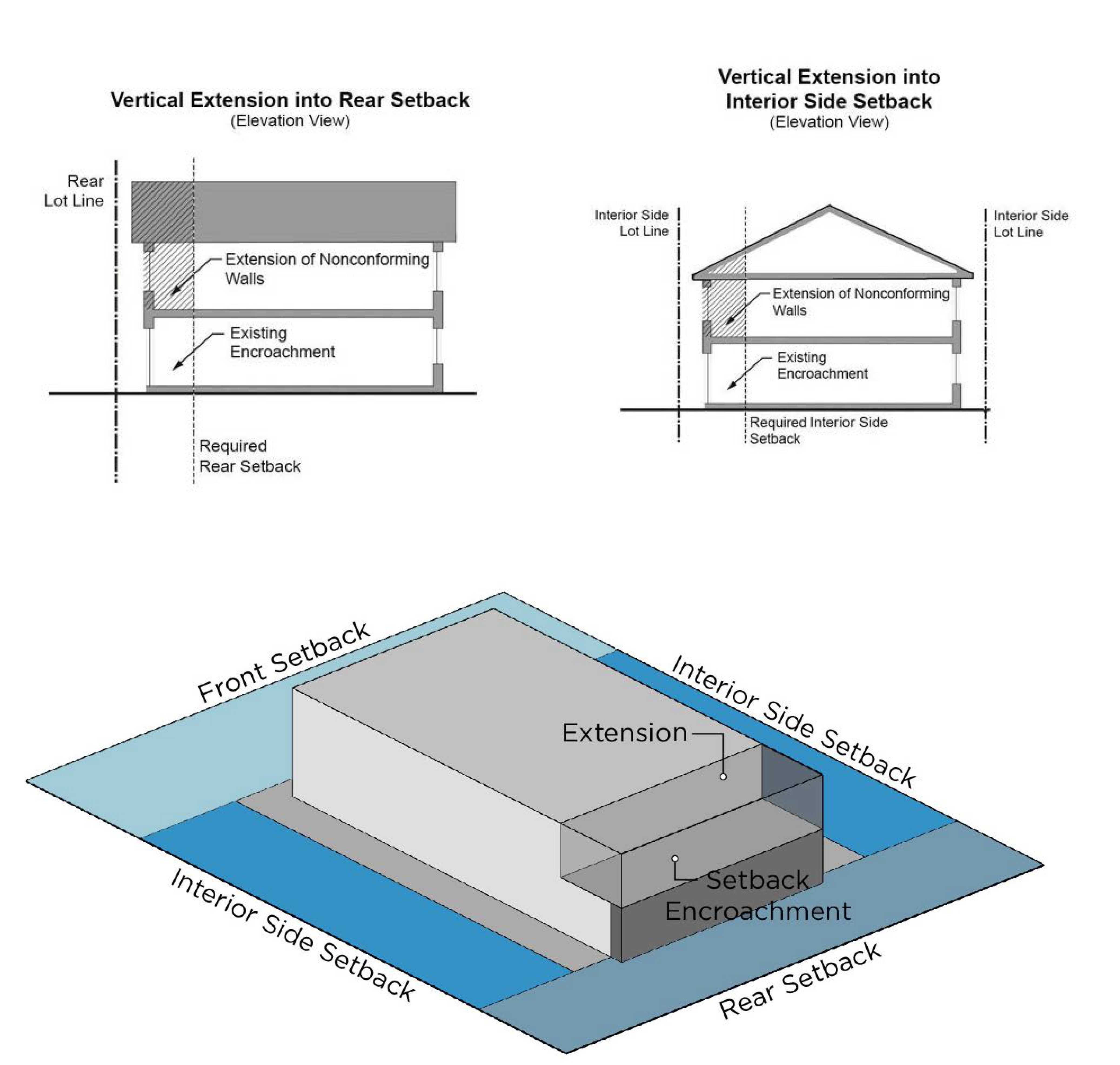
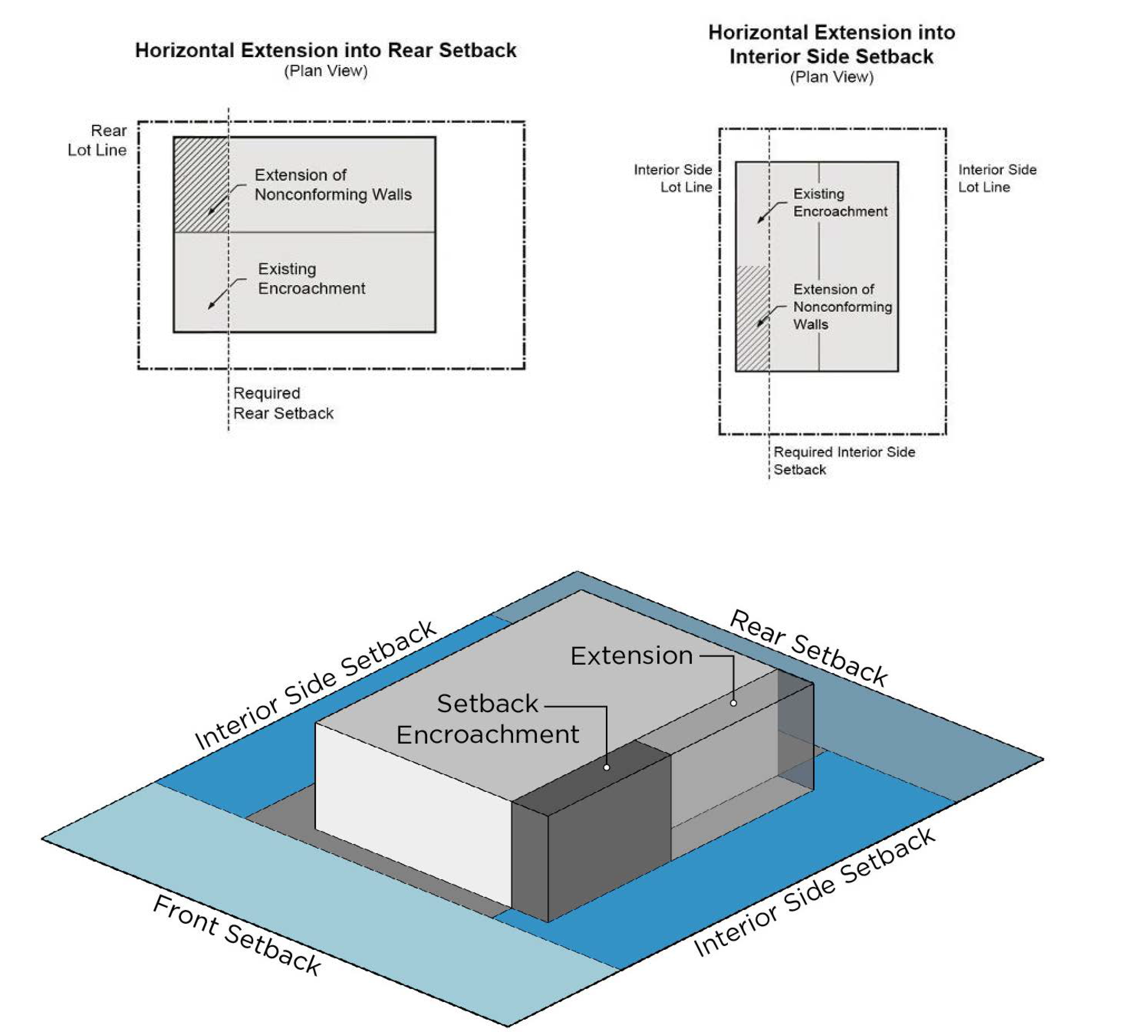
Extension of walls for nonconforming single-family and two-family dwellings. Where a single-family or two-family dwelling is deemed nonconforming because a building wall of the principal structure is located within the required rear or interior side setback, the structure may be enlarged or extended horizontally or vertically along the same plane as the existing perimeter building walls, so long as the resulting structure does not violate any other district regulation.
EXTENSION OF NONCONFORMING WALLS
(Ord. No. 6513, § 1(Exh. A), 11-19-24)
16-2-15.4. - Nonconforming lot.
A nonconforming lot of record is a lot of record that at one time conformed to the lot dimension requirements of the district in which it is located, but because of this Code, or a subsequent amendment to this Code, does not conform. This includes nonconformities created by prior zoning codes or amendments to those codes.
(1)
Use. A nonconforming lot of record may be used for a permitted or conditional use allowed within the district.
(2)
Development. Development of a nonconforming lot of record must meet all applicable dimensional and design regulations of the district in which it is located with the exception of the lot area and/or width requirement that renders it nonconforming. For any nonconforming residential lot under 65 feet in width, interior side setbacks may be reduced to a minimum requirement of five feet in width.
(3)
Lot division. No division of a nonconforming lot is permitted that creates a nonconforming lot and/or renders a lot or lots remaining nonconforming.
(4)
Lot consolidation. A nonconforming lot is permitted to consolidate with an adjacent lot, even if such consolidation still does not conform to the lot dimension requirements of the district in which it is located. Such consolidation is seen as a reduction of the nonconformity.
(5)
Common ownership limitation. If two or more lots with contiguous street frontage are held in common ownership that have historically been used as a single development site, and one or more of the lots does not meet the requirements for lot width or lot area as established by this Code, the land is considered to be a single zoning lot for the purposes of this Code. No portion of the lots may be used, transferred, or conveyed unless each lot meets the lot width and lot area requirements of this Code.
(6)
Building permits. No building permit will be issued for the use of any lot or portion of a lot, transferred or conveyed in violation of this article.
(Ord. No. 6513, § 1(Exh. A), 11-19-24)

